LIVER , GALL BLADDER , PANCREAS AND
SPLEEN
Liver
• The liver is the largest gland in the body and has a wide variety of
functions
• It is exocrine(bile) & endocrine organ(Albumen , prothrombin &
fibrinogen)
• Function of the liver
• Secretion of bile & bile salt
• Metabolism of carbohydrate, fat and protein
• Formation of heparin & anticoagulant substances
• Detoxication
• Storage of glycogen and vitamins
• Activation of vita .D
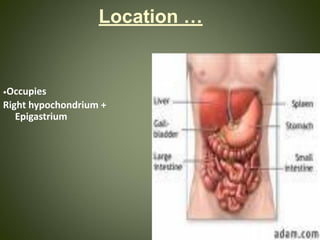
Location …
•Occupies
Right hypochondrium +
Epigastrium
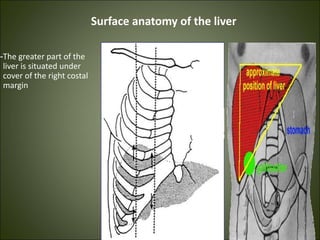
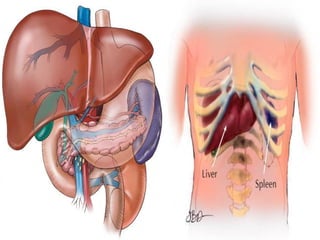
Surface anatomy of the liver
-The greater part of the
liver is situated under
cover of the right costal
margin
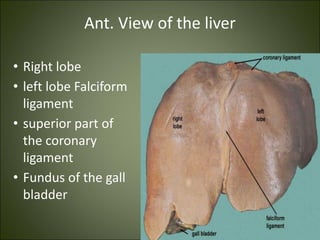
Ant. View of the liver
• Right lobe
• left lobe Falciform
ligament
• superior part of
the coronary
ligament
• Fundus of the gall
bladder
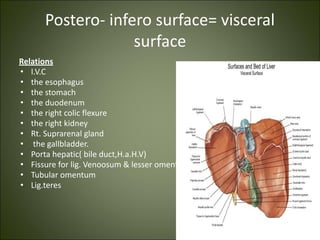
Postero- infero surface= visceral
surface
Relations
• I.V.C
• the esophagus
• the stomach
• the duodenum
• the right colic flexure
• the right kidney
• Rt. Suprarenal gland
• the gallbladder.
• Porta hepatic( bile duct,H.a.H.V)
• Fissure for lig. Venoosum & lesser omentum
• Tubular omentum
• Lig.teres
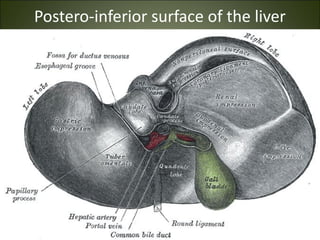
Postero-inferior surface of the liver
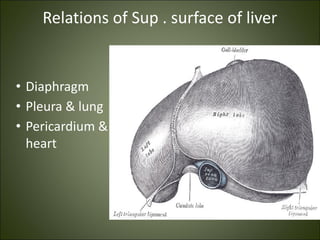
Relations of Sup . surface of liver
• Diaphragm
• Pleura & lung
• Pericardium &
heart
Relations of the liver Anteriorly
• Diaphragm
• Rt & Lt pleura and lung
• Costal cartilage
• Xiphoid process
• Ant. abdominal wall
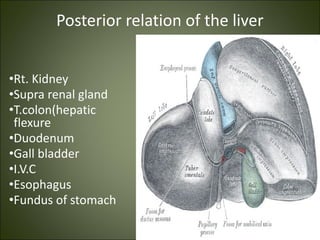
Posterior relation of the liver
•Rt. Kidney
•Supra renal gland
•T.colon(hepatic
flexure
•Duodenum
•Gall bladder
•I.V.C
•Esophagus
•Fundus of stomach
Lobes of the liver
• Rt. Lobe
• Lt .lobe
• Quadrate lobe
• Caudate lobe
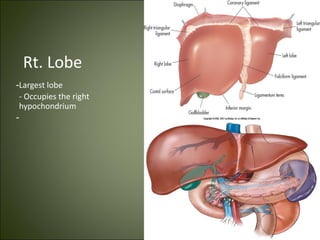
Rt. Lobe
-Largest lobe
- Occupies the right
hypochondrium
-
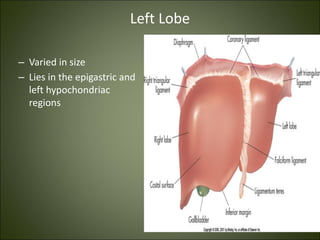
Left Lobe
– Varied in size
– Lies in the epigastric and
left hypochondriac
regions
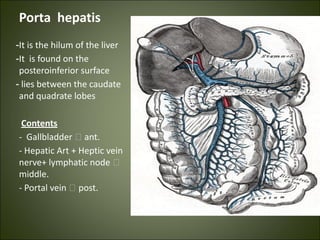
Porta hepatis
-It is the hilum of the liver
-It is found on the
posteroinferior surface
- lies between the caudate
and quadrate lobes
Contents
- Gallbladder 🡪 ant.
- Hepatic Art + Heptic vein
nerve+ lymphatic node 🡪
middle.
- Portal vein 🡪 post.
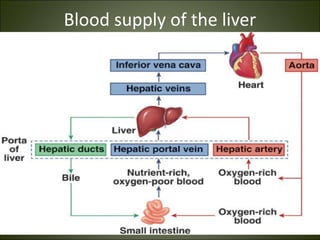
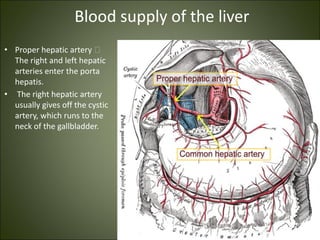
Blood supply of the liver
• Proper hepatic artery 🡪
The right and left hepatic
arteries enter the porta
hepatis.
• The right hepatic artery
usually gives off the cystic
artery, which runs to the
neck of the gallbladder.
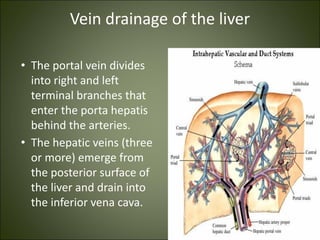
Vein drainage of the liver
• The portal vein divides
into right and left
terminal branches that
enter the porta hepatis
behind the arteries.
• The hepatic veins (three
or more) emerge from
the posterior surface of
the liver and drain into
the inferior vena cava.
Lymphatic drainage of the liver
• Liver produce large amount of lymph~ one third – one half of total body lymph
• Lymph leave the liver and enters several lymph nod in porta hepatis🡪 efferent
vessels pass to celiac nods
• posterior Mediastinal lymph nodes.
• Nerve supply
• Sympathetic 🡪 hepatic plexus>>> celiac plexuses 🡪 thoracic ganglion chain T1-T12
• Parasympathetic 🡪 vagus nerve( anterior part)
• Sympathetic and parasympathetic nerves form the celiac plexus.
• The anterior vagal trunk gives rise to a large hepatic branch, which passes directly
to the liver
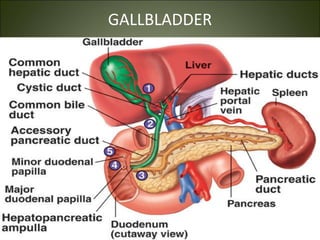
GALLBLADDER
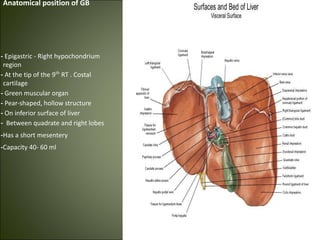
Anatomical position of GB
- Epigastric - Right hypochondrium
region
- At the tip of the 9th
RT . Costal
cartilage
- Green muscular organ
- Pear-shaped, hollow structure
- On inferior surface of liver
- Between quadrate and right lobes
-Has a short mesentery
-Capacity 40- 60 ml
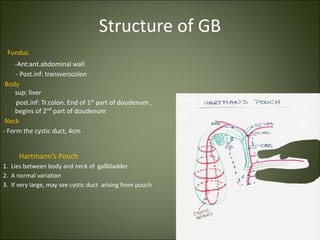
Structure of GB
Fundus
-Ant:ant.abdominal wall
- Post.inf: transverscolon
Body
sup: liver
post.inf: Tr.colon. End of 1st
part of doudenum ,
begins of 2nd
part of doudenum
Neck
- Form the cystic duct, 4cm
Hartmann’s Pouch
1. Lies between body and neck of gallbladder
2. A normal variation
3. If very large, may see cystic duct arising from pouch
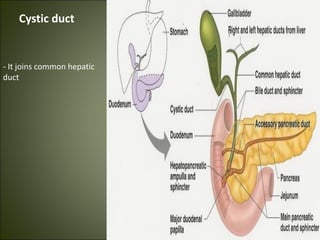
Cystic duct
- It joins common hepatic
duct
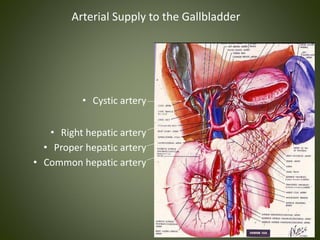
Arterial Supply to the Gallbladder
• Cystic artery
• Right hepatic artery
• Proper hepatic artery
• Common hepatic artery
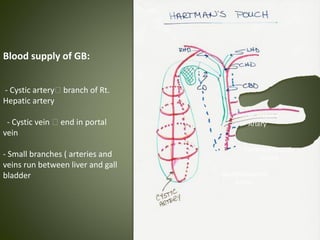
Blood supply of GB:
- Cystic artery🡪 branch of Rt.
Hepatic artery
- Cystic vein 🡪 end in portal
vein
- Small branches ( arteries and
veins run between liver and gall
bladder
Common Hepatic
Artery
Proper Hepatic
Artery
Gastroduodenal
Artery
Lymphatic drainage of GB
1. Terminate @ celiac nodes
2. Cystic node at neck of GB
3. Other lymph vessels also drain
into hepatic nodes
Nerve supply
• Sympathetic and parasympathetic from celiac
plexus
• Parasympathetic ---- vagus nerve
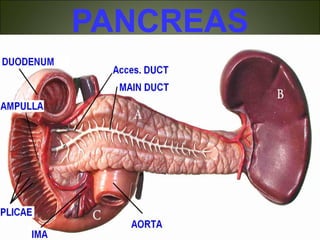
PANCREAS
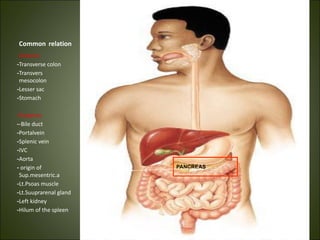
Common relation
Anterior
-Transverse colon
-Transvers
mesocolon
-Lesser sac
-Stomach
-Posterior
--Bile duct
-Portalvein
-Splenic vein
-IVC
-Aorta
- origin of
Sup.mesentric.a
-Lt.Psoas muscle
-Lt.Suuprarenal gland
-Left kidney
-Hilum of the spleen
PANCREAS
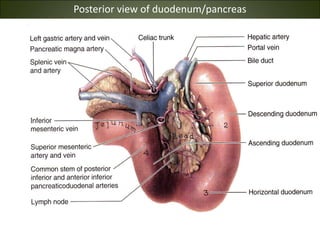
Posterior view of duodenum/pancreas
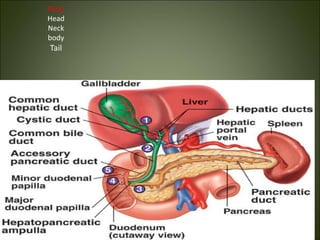
Parts of the pancreas
Parts
Head
Neck
body
Tail
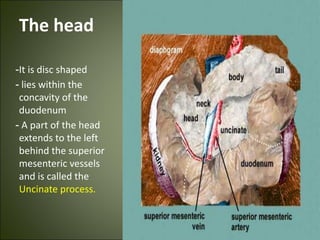
The head
-It is disc shaped
- lies within the
concavity of the
duodenum
- A part of the head
extends to the left
behind the superior
mesenteric vessels
and is called the
Uncinate process.
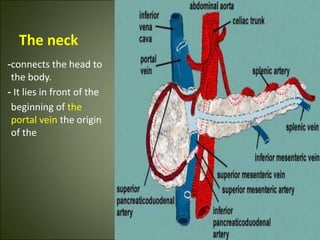
The neck
-connects the head to
the body.
- It lies in front of the
beginning of the
portal vein the origin
of the
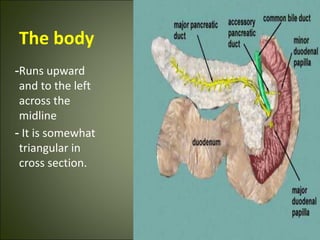
The body
-Runs upward
and to the left
across the
midline
- It is somewhat
triangular in
cross section.
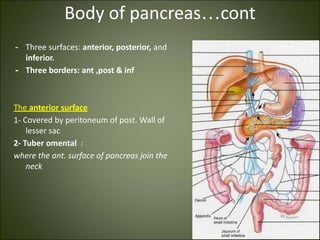
Body of pancreas…cont
- Three surfaces: anterior, posterior, and
inferior.
- Three borders: ant ,post & inf
The anterior surface
1- Covered by peritoneum of post. Wall of
lesser sac
2- Tuber omental :
where the ant. surface of pancreas join the
neck
Body of pancreas…cont
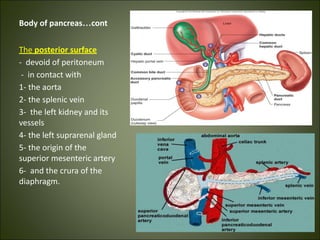
The posterior surface
- devoid of peritoneum
- in contact with
1- the aorta
2- the splenic vein
3- the left kidney and its
vessels
4- the left suprarenal gland
5- the origin of the
superior mesenteric artery
6- and the crura of the
diaphragm.
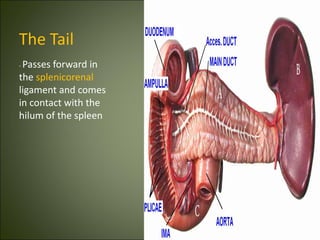
The Tail
- Passes forward in
the splenicorenal
ligament and comes
in contact with the
hilum of the spleen
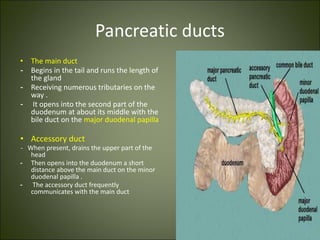
Pancreatic ducts
• The main duct
- Begins in the tail and runs the length of
the gland
- Receiving numerous tributaries on the
way .
- It opens into the second part of the
duodenum at about its middle with the
bile duct on the major duodenal papilla
• Accessory duct
- When present, drains the upper part of the
head
- Then opens into the duodenum a short
distance above the main duct on the minor
duodenal papilla .
- The accessory duct frequently
communicates with the main duct
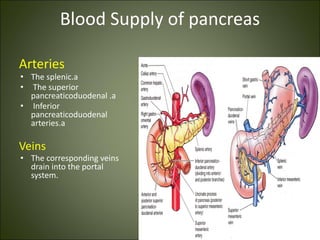
Blood Supply of pancreas
Arteries
• The splenic.a
• The superior
pancreaticoduodenal .a
• Inferior
pancreaticoduodenal
arteries.a
Veins
• The corresponding veins
drain into the portal
system.
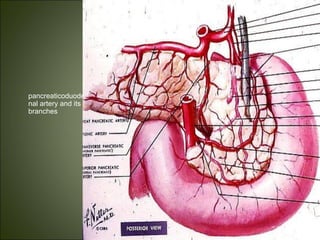
pancreaticoduode
nal artery and its
branches
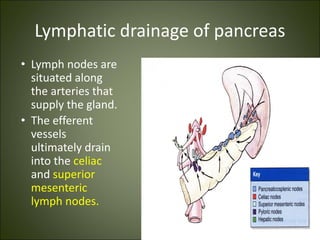
Lymphatic drainage of pancreas
• Lymph nodes are
situated along
the arteries that
supply the gland.
• The efferent
vessels
ultimately drain
into the celiac
and superior
mesenteric
lymph nodes.
Nerve supply
• Sympathetic and parasympathetic chain
• Parasympathetic = vagus nerve
Spleen
Spleen
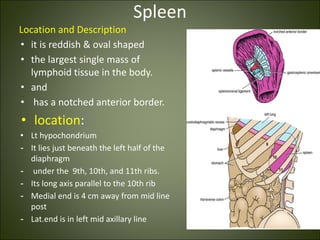
Location and Description
• it is reddish & oval shaped
• the largest single mass of
lymphoid tissue in the body.
• and
• has a notched anterior border.
• location:
• Lt hypochondrium
- It lies just beneath the left half of the
diaphragm
- under the 9th, 10th, and 11th ribs.
- Its long axis parallel to the 10th rib
- Medial end is 4 cm away from mid line
post
- Lat.end is in left mid axillary line
Spleen
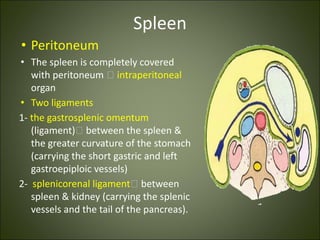
• Peritoneum
• The spleen is completely covered
with peritoneum 🡪 intraperitoneal
organ
• Two ligaments
1- the gastrosplenic omentum
(ligament)🡪 between the spleen &
the greater curvature of the stomach
(carrying the short gastric and left
gastroepiploic vessels)
2- splenicorenal ligament🡪 between
spleen & kidney (carrying the splenic
vessels and the tail of the pancreas).
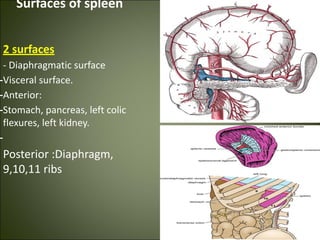
Surfaces of spleen
2 surfaces
- Diaphragmatic surface
-Visceral surface.
-Anterior:
-Stomach, pancreas, left colic
flexures, left kidney.
-
Posterior :Diaphragm,
9,10,11 ribs
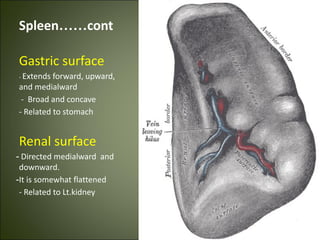
Spleen……cont
Gastric surface
- Extends forward, upward,
and medialward
- Broad and concave
- Related to stomach
Renal surface
- Directed medialward and
downward.
-It is somewhat flattened
- Related to Lt.kidney
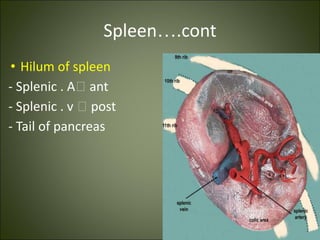
Spleen….cont
• Hilum of spleen
- Splenic . A🡪 ant
- Splenic . v 🡪 post
- Tail of pancreas
Spleen..cont
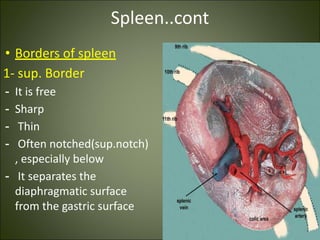
• Borders of spleen
1- sup. Border
- It is free
- Sharp
- Thin
- Often notched(sup.notch)
, especially below
- It separates the
diaphragmatic surface
from the gastric surface
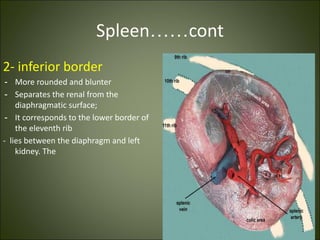
Spleen……cont
2- inferior border
- More rounded and blunter
- Separates the renal from the
diaphragmatic surface;
- It corresponds to the lower border of
the eleventh rib
- lies between the diaphragm and left
kidney. The
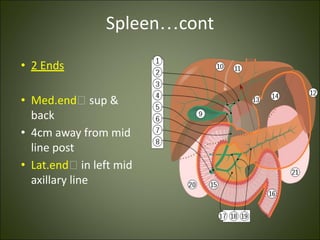
Spleen…cont
• 2 Ends
• Med.end🡪 sup &
back
• 4cm away from mid
line post
• Lat.end🡪 in left mid
axillary line
Blood supply
• The large splenic artery is the largest branch of
the celiac artery.
• It has a tortuous course
• It runs along the upper border of the
pancreas
• The splenic artery then divides into about six
branches, which enter the spleen at the hilum
Blood supply of spleen
•Veins
- The splenic vein leaves the hilum and runs
behind the tail and the body of the pancreas.
- Behind the neck of the pancreas, the splenic
vein joins the superior mesenteric vein to
form the portal vein.
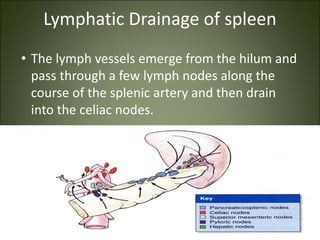
Lymphatic Drainage of spleen
• The lymph vessels emerge from the hilum and
pass through a few lymph nodes along the
course of the splenic artery and then drain
into the celiac nodes.
Nerve Supply of spleen
• The nerves accompany the splenic artery and
are derived from the celiac plexus.
Thank you

liver-pancreasspleen (1).ppt.pdf

  • 1.
    LIVER , GALLBLADDER , PANCREAS AND SPLEEN
  • 2.
    Liver • The liveris the largest gland in the body and has a wide variety of functions • It is exocrine(bile) & endocrine organ(Albumen , prothrombin & fibrinogen) • Function of the liver • Secretion of bile & bile salt • Metabolism of carbohydrate, fat and protein • Formation of heparin & anticoagulant substances • Detoxication • Storage of glycogen and vitamins • Activation of vita .D
  • 3.
  • 4.
    Surface anatomy ofthe liver -The greater part of the liver is situated under cover of the right costal margin
  • 5.
    Ant. View ofthe liver • Right lobe • left lobe Falciform ligament • superior part of the coronary ligament • Fundus of the gall bladder
  • 6.
    Postero- infero surface=visceral surface Relations • I.V.C • the esophagus • the stomach • the duodenum • the right colic flexure • the right kidney • Rt. Suprarenal gland • the gallbladder. • Porta hepatic( bile duct,H.a.H.V) • Fissure for lig. Venoosum & lesser omentum • Tubular omentum • Lig.teres
  • 7.
  • 8.
    Relations of Sup. surface of liver • Diaphragm • Pleura & lung • Pericardium & heart
  • 9.
    Relations of theliver Anteriorly • Diaphragm • Rt & Lt pleura and lung • Costal cartilage • Xiphoid process • Ant. abdominal wall
  • 11.
    Posterior relation ofthe liver •Rt. Kidney •Supra renal gland •T.colon(hepatic flexure •Duodenum •Gall bladder •I.V.C •Esophagus •Fundus of stomach
  • 12.
    Lobes of theliver • Rt. Lobe • Lt .lobe • Quadrate lobe • Caudate lobe
  • 13.
    Rt. Lobe -Largest lobe -Occupies the right hypochondrium -
  • 14.
    Left Lobe – Variedin size – Lies in the epigastric and left hypochondriac regions
  • 15.
    Porta hepatis -It isthe hilum of the liver -It is found on the posteroinferior surface - lies between the caudate and quadrate lobes Contents - Gallbladder 🡪 ant. - Hepatic Art + Heptic vein nerve+ lymphatic node 🡪 middle. - Portal vein 🡪 post.
  • 16.
    Blood supply ofthe liver
  • 17.
    Blood supply ofthe liver • Proper hepatic artery 🡪 The right and left hepatic arteries enter the porta hepatis. • The right hepatic artery usually gives off the cystic artery, which runs to the neck of the gallbladder.
  • 18.
    Vein drainage ofthe liver • The portal vein divides into right and left terminal branches that enter the porta hepatis behind the arteries. • The hepatic veins (three or more) emerge from the posterior surface of the liver and drain into the inferior vena cava.
  • 19.
    Lymphatic drainage ofthe liver • Liver produce large amount of lymph~ one third – one half of total body lymph • Lymph leave the liver and enters several lymph nod in porta hepatis🡪 efferent vessels pass to celiac nods • posterior Mediastinal lymph nodes. • Nerve supply • Sympathetic 🡪 hepatic plexus>>> celiac plexuses 🡪 thoracic ganglion chain T1-T12 • Parasympathetic 🡪 vagus nerve( anterior part) • Sympathetic and parasympathetic nerves form the celiac plexus. • The anterior vagal trunk gives rise to a large hepatic branch, which passes directly to the liver
  • 20.
  • 21.
    Anatomical position ofGB - Epigastric - Right hypochondrium region - At the tip of the 9th RT . Costal cartilage - Green muscular organ - Pear-shaped, hollow structure - On inferior surface of liver - Between quadrate and right lobes -Has a short mesentery -Capacity 40- 60 ml
  • 22.
    Structure of GB Fundus -Ant:ant.abdominalwall - Post.inf: transverscolon Body sup: liver post.inf: Tr.colon. End of 1st part of doudenum , begins of 2nd part of doudenum Neck - Form the cystic duct, 4cm Hartmann’s Pouch 1. Lies between body and neck of gallbladder 2. A normal variation 3. If very large, may see cystic duct arising from pouch
  • 23.
    Cystic duct - Itjoins common hepatic duct
  • 24.
    Arterial Supply tothe Gallbladder • Cystic artery • Right hepatic artery • Proper hepatic artery • Common hepatic artery
  • 25.
    Blood supply ofGB: - Cystic artery🡪 branch of Rt. Hepatic artery - Cystic vein 🡪 end in portal vein - Small branches ( arteries and veins run between liver and gall bladder Common Hepatic Artery Proper Hepatic Artery Gastroduodenal Artery
  • 26.
    Lymphatic drainage ofGB 1. Terminate @ celiac nodes 2. Cystic node at neck of GB 3. Other lymph vessels also drain into hepatic nodes
  • 27.
    Nerve supply • Sympatheticand parasympathetic from celiac plexus • Parasympathetic ---- vagus nerve
  • 28.
  • 29.
    Common relation Anterior -Transverse colon -Transvers mesocolon -Lessersac -Stomach -Posterior --Bile duct -Portalvein -Splenic vein -IVC -Aorta - origin of Sup.mesentric.a -Lt.Psoas muscle -Lt.Suuprarenal gland -Left kidney -Hilum of the spleen PANCREAS
  • 30.
    Posterior view ofduodenum/pancreas
  • 31.
    Parts of thepancreas
  • 32.
  • 33.
    The head -It isdisc shaped - lies within the concavity of the duodenum - A part of the head extends to the left behind the superior mesenteric vessels and is called the Uncinate process.
  • 34.
    The neck -connects thehead to the body. - It lies in front of the beginning of the portal vein the origin of the
  • 35.
    The body -Runs upward andto the left across the midline - It is somewhat triangular in cross section.
  • 36.
    Body of pancreas…cont -Three surfaces: anterior, posterior, and inferior. - Three borders: ant ,post & inf The anterior surface 1- Covered by peritoneum of post. Wall of lesser sac 2- Tuber omental : where the ant. surface of pancreas join the neck
  • 37.
    Body of pancreas…cont Theposterior surface - devoid of peritoneum - in contact with 1- the aorta 2- the splenic vein 3- the left kidney and its vessels 4- the left suprarenal gland 5- the origin of the superior mesenteric artery 6- and the crura of the diaphragm.
  • 38.
    The Tail - Passesforward in the splenicorenal ligament and comes in contact with the hilum of the spleen
  • 39.
    Pancreatic ducts • Themain duct - Begins in the tail and runs the length of the gland - Receiving numerous tributaries on the way . - It opens into the second part of the duodenum at about its middle with the bile duct on the major duodenal papilla • Accessory duct - When present, drains the upper part of the head - Then opens into the duodenum a short distance above the main duct on the minor duodenal papilla . - The accessory duct frequently communicates with the main duct
  • 40.
    Blood Supply ofpancreas Arteries • The splenic.a • The superior pancreaticoduodenal .a • Inferior pancreaticoduodenal arteries.a Veins • The corresponding veins drain into the portal system.
  • 41.
  • 42.
    Lymphatic drainage ofpancreas • Lymph nodes are situated along the arteries that supply the gland. • The efferent vessels ultimately drain into the celiac and superior mesenteric lymph nodes.
  • 43.
    Nerve supply • Sympatheticand parasympathetic chain • Parasympathetic = vagus nerve
  • 44.
  • 45.
    Spleen Location and Description •it is reddish & oval shaped • the largest single mass of lymphoid tissue in the body. • and • has a notched anterior border. • location: • Lt hypochondrium - It lies just beneath the left half of the diaphragm - under the 9th, 10th, and 11th ribs. - Its long axis parallel to the 10th rib - Medial end is 4 cm away from mid line post - Lat.end is in left mid axillary line
  • 46.
    Spleen • Peritoneum • Thespleen is completely covered with peritoneum 🡪 intraperitoneal organ • Two ligaments 1- the gastrosplenic omentum (ligament)🡪 between the spleen & the greater curvature of the stomach (carrying the short gastric and left gastroepiploic vessels) 2- splenicorenal ligament🡪 between spleen & kidney (carrying the splenic vessels and the tail of the pancreas).
  • 47.
    Surfaces of spleen 2surfaces - Diaphragmatic surface -Visceral surface. -Anterior: -Stomach, pancreas, left colic flexures, left kidney. - Posterior :Diaphragm, 9,10,11 ribs
  • 48.
    Spleen……cont Gastric surface - Extendsforward, upward, and medialward - Broad and concave - Related to stomach Renal surface - Directed medialward and downward. -It is somewhat flattened - Related to Lt.kidney
  • 49.
    Spleen….cont • Hilum ofspleen - Splenic . A🡪 ant - Splenic . v 🡪 post - Tail of pancreas
  • 50.
    Spleen..cont • Borders ofspleen 1- sup. Border - It is free - Sharp - Thin - Often notched(sup.notch) , especially below - It separates the diaphragmatic surface from the gastric surface
  • 51.
    Spleen……cont 2- inferior border -More rounded and blunter - Separates the renal from the diaphragmatic surface; - It corresponds to the lower border of the eleventh rib - lies between the diaphragm and left kidney. The
  • 52.
    Spleen…cont • 2 Ends •Med.end🡪 sup & back • 4cm away from mid line post • Lat.end🡪 in left mid axillary line
  • 53.
    Blood supply • Thelarge splenic artery is the largest branch of the celiac artery. • It has a tortuous course • It runs along the upper border of the pancreas • The splenic artery then divides into about six branches, which enter the spleen at the hilum
  • 54.
    Blood supply ofspleen •Veins - The splenic vein leaves the hilum and runs behind the tail and the body of the pancreas. - Behind the neck of the pancreas, the splenic vein joins the superior mesenteric vein to form the portal vein.
  • 55.
    Lymphatic Drainage ofspleen • The lymph vessels emerge from the hilum and pass through a few lymph nodes along the course of the splenic artery and then drain into the celiac nodes.
  • 56.
    Nerve Supply ofspleen • The nerves accompany the splenic artery and are derived from the celiac plexus.
  • 57.