Literature
 from 1950s to 1990s
1950s
 J. D. Salinger - The Catcher in the Rye

 Jack Kerouac - The Dharma Bums

 Ian Fleming - Casino Royale (First James Bond novel)
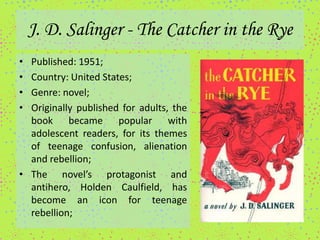
J. D. Salinger - The Catcher in the Rye
• Published: 1951;
• Country: United States;
• Genre: novel;
• Originally published for adults, the
  book became popular with
  adolescent readers, for its themes
  of teenage confusion, alienation
  and rebellion;
• The novel’s protagonist and
  antihero, Holden Caulfield, has
  become an icon for teenage
  rebellion;
• Translated into almost all languages;
• Total sales about 65 million books;
• Novel accurately reflected the teenage speech of the time,
  including:
   –   "Phony": Superficial, hypocritical, and pretentious
   –   "That killed me": I found that hilarious or astonishing
   –   "Flit": Homosexual
   –   "Flitty": Homosexual behavior
   –   Wuddya: (the ya slang) vernacular rendering, idiomatic
   –   "Crumby": Inadequate, insufficient, and/or disappointing.
1960s

 Mario Puzo - The Godfather
 Harper Lee - To Kill a Mockingbird
 Richard Yates - Revolutionary Road
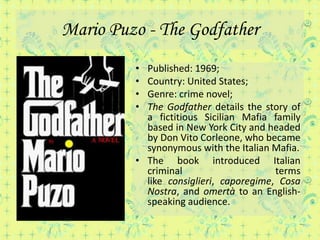
Mario Puzo - The Godfather
         • Published: 1969;
         • Country: United States;
         • Genre: crime novel;
         • The Godfather details the story of
           a fictitious Sicilian Mafia family
           based in New York City and headed
           by Don Vito Corleone, who became
           synonymous with the Italian Mafia.
         • The book introduced Italian
           criminal                     terms
           like consiglieri, caporegime, Cosa
           Nostra, and omertà to an English-
           speaking audience.
• In 1972 the book inspired the film with the same name and
  two more film sequels, in 1974 and 1990. The first and second
  films are widely considered to be two of the greatest films of
  all time.
• Large parts of the novel are based upon reality, notably the
  history of the so-called 'Five Families', the Mafia-organization
  in New York and the surrounding area. The novel also includes
  many allusions to real-life mobsters and their associates,
  and Johnny Fontane is based on Frank Sinatra, Moe
  Greene on Bugsy Siegel, for example.
1970s
 Anne Rice - Interview with the Vampire

 Stephen King - Carrie

 Jeffrey Archer - Kane and Abel
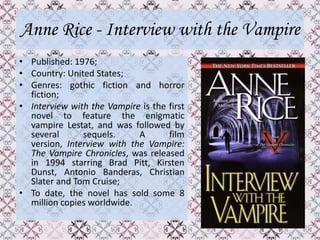
Anne Rice - Interview with the Vampire
• Published: 1976;
• Country: United States;
• Genres: gothic fiction and horror
  fiction;
• Interview with the Vampire is the first
  novel to feature the enigmatic
  vampire Lestat, and was followed by
  several      sequels.     A       film
  version, Interview with the Vampire:
  The Vampire Chronicles, was released
  in 1994 starring Brad Pitt, Kirsten
  Dunst, Antonio Banderas, Christian
  Slater and Tom Cruise;
• To date, the novel has sold some 8
  million copies worldwide.
1980s
 Umberto Eco - The Name of the Rose

 Ernest Hemingway - The Garden of Eden

 Gabriel Garcia Marquez - Love in the Time of Cholera
Gabriel Garcia Marquez - Love in the Time of Cholera

                      • Gabriel Garcia Marquez – Nobel
                        Prize
                      • Published: 1985;
                      • Country: Columbia;
                      • Genre: novel;
                      • Love in the Time of Cholera (El
                        amor en los tiempos del cólera)
                        have four major themes:
                        narrative as seduction, narrative
                        as deconstruction, love as an
                        emotional and physical disease
                        and aging and death.
1990s
 Jose Saramago – Blindness

 Chuck Palahniuk - Fight Club

 J. K. Rowling - Harry Potter and the Philosopher's Stone
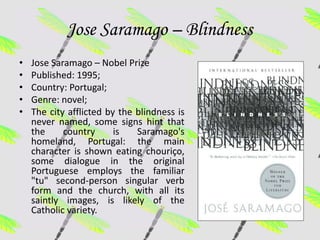
Jose Saramago – Blindness
•   Jose Saramago – Nobel Prize
•   Published: 1995;
•   Country: Portugal;
•   Genre: novel;
•   The city afflicted by the blindness is
    never named, some signs hint that
    the     country      is   Saramago's
    homeland, Portugal: the main
    character is shown eating chouriço,
    some dialogue in the original
    Portuguese employs the familiar
    "tu" second-person singular verb
    form and the church, with all its
    saintly images, is likely of the
    Catholic variety.
English - 12th grade
    Barbara Sousa

Literature

  • 1.
  • 2.
    1950s  J. D.Salinger - The Catcher in the Rye  Jack Kerouac - The Dharma Bums  Ian Fleming - Casino Royale (First James Bond novel)
  • 3.
    J. D. Salinger- The Catcher in the Rye • Published: 1951; • Country: United States; • Genre: novel; • Originally published for adults, the book became popular with adolescent readers, for its themes of teenage confusion, alienation and rebellion; • The novel’s protagonist and antihero, Holden Caulfield, has become an icon for teenage rebellion;
  • 4.
    • Translated intoalmost all languages; • Total sales about 65 million books; • Novel accurately reflected the teenage speech of the time, including: – "Phony": Superficial, hypocritical, and pretentious – "That killed me": I found that hilarious or astonishing – "Flit": Homosexual – "Flitty": Homosexual behavior – Wuddya: (the ya slang) vernacular rendering, idiomatic – "Crumby": Inadequate, insufficient, and/or disappointing.
  • 5.
    1960s  Mario Puzo- The Godfather  Harper Lee - To Kill a Mockingbird  Richard Yates - Revolutionary Road
  • 6.
    Mario Puzo -The Godfather • Published: 1969; • Country: United States; • Genre: crime novel; • The Godfather details the story of a fictitious Sicilian Mafia family based in New York City and headed by Don Vito Corleone, who became synonymous with the Italian Mafia. • The book introduced Italian criminal terms like consiglieri, caporegime, Cosa Nostra, and omertà to an English- speaking audience.
  • 7.
    • In 1972the book inspired the film with the same name and two more film sequels, in 1974 and 1990. The first and second films are widely considered to be two of the greatest films of all time. • Large parts of the novel are based upon reality, notably the history of the so-called 'Five Families', the Mafia-organization in New York and the surrounding area. The novel also includes many allusions to real-life mobsters and their associates, and Johnny Fontane is based on Frank Sinatra, Moe Greene on Bugsy Siegel, for example.
  • 8.
    1970s  Anne Rice- Interview with the Vampire  Stephen King - Carrie  Jeffrey Archer - Kane and Abel
  • 9.
    Anne Rice -Interview with the Vampire • Published: 1976; • Country: United States; • Genres: gothic fiction and horror fiction; • Interview with the Vampire is the first novel to feature the enigmatic vampire Lestat, and was followed by several sequels. A film version, Interview with the Vampire: The Vampire Chronicles, was released in 1994 starring Brad Pitt, Kirsten Dunst, Antonio Banderas, Christian Slater and Tom Cruise; • To date, the novel has sold some 8 million copies worldwide.
  • 10.
    1980s  Umberto Eco- The Name of the Rose  Ernest Hemingway - The Garden of Eden  Gabriel Garcia Marquez - Love in the Time of Cholera
  • 11.
    Gabriel Garcia Marquez- Love in the Time of Cholera • Gabriel Garcia Marquez – Nobel Prize • Published: 1985; • Country: Columbia; • Genre: novel; • Love in the Time of Cholera (El amor en los tiempos del cólera) have four major themes: narrative as seduction, narrative as deconstruction, love as an emotional and physical disease and aging and death.
  • 12.
    1990s  Jose Saramago– Blindness  Chuck Palahniuk - Fight Club  J. K. Rowling - Harry Potter and the Philosopher's Stone
  • 13.
    Jose Saramago –Blindness • Jose Saramago – Nobel Prize • Published: 1995; • Country: Portugal; • Genre: novel; • The city afflicted by the blindness is never named, some signs hint that the country is Saramago's homeland, Portugal: the main character is shown eating chouriço, some dialogue in the original Portuguese employs the familiar "tu" second-person singular verb form and the church, with all its saintly images, is likely of the Catholic variety.
  • 14.
    English - 12thgrade Barbara Sousa