Literary Compositions
1986-1999
Reporters :Johnbill
Garchitorena
Jannel Yza Gunida
Jonalyn Marasigan
The years 1986-1999 cover the careers of three
presidents: Corazon C. Aquino, Fidel V. Ramos and
Joseph Ejercito Estrada.
Spates of literary enthusiasm continue unabated.
Unhampered by compelling handicaps, hard times and
the transient problems of the period.
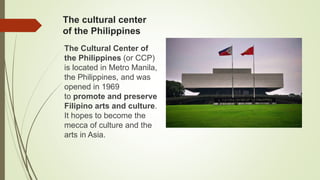
The cultural center
of the Philippines
The Cultural Center of
the Philippines (or CCP)
is located in Metro Manila,
the Philippines, and was
opened in 1969
to promote and preserve
Filipino arts and culture.
It hopes to become the
mecca of culture and the
arts in Asia.
1986 EDSA REVOLUTION
The year 1986 demarcates the beginning
of new scene in the unfolding narrative of
contemporary Philippine Literature.
It saw the fall of the dictatorship that
President Marcos set up on September
21, 1972, when he placed the Philippines
under martial rule, initiating a regime that
did not only suppress the writers’ right to
free expression but also created
conditions that made collaboration and
cooptation convenient choices for artists
struggling for recognition and survival.
Literature under Martial Law
Writing under the Martial Law Regime
was characterized by militancy and
belligerence, even when it showed up in
the legal press. Especially after the
assassination of Ninoy Aquino in 1983,
the temper of poetry and theatre derived
much of its heat and direction from the
political culture of the underground
national democratic movement.
1986 EDSA REVOLUTION
However, when the enemy were
overthrown in 1986, the literary activity
showed a certain disorientation
manifesting itself in a proliferation of
concerns taken up by individual writers
and groups.
Post EDSA: 2 Creative Writing centers
Academic institutions where Creative
Writing is a part of the curricular offerings.
Writers’ organizations that periodically
sponsor symposia on writer and/or set up
workshops for its members and other
interested parties
Through these centers that writers get to
hear about new developments in writing,
and derive enthusiasm for their crafts.
Writers’ Organizations
Various literary organizations conduct live
reading sessions in public places to make
poetry accessible to the masses.
The UMPIL (Unyon ng mga manunulat sa
Pilipinas )
• The largest organization of Filipino
writers in the Philippines. Established in
1974, the organization was first known by
the English version of its name, the Writers'
Union of the Philippines, it has the primary
goal of promoting Philippine literature,
uniting writers in the Philippines, and
providing seminars, workshops, and
symposia in order to achieve goals.
Writers’ Organizations
LIRA (Linangan sa Imahen, Retorika at
Anyo )
• The Filipino language may not be the
sweetest, but it definitely is something
to be proud of. This is one of the
reasons why the Linangan sa Imahen,
Retorika, at Anyo (LIRA) has been
actively running a volunteer program
that aims to foster the growth of our
national literature and culture,
highlighting teaching of Filipino poetry.
Carlos Palanca Memorial
Awards in Literature
The Palanca Awards or Don Carlos
Palanca Memorial Awards for
Literature are a set of literary
awards for Filipino writers. Usually
referred to as the "Pulitzer Prize" of the
Philippines, it is the country's highest
literary honor in terms of prestige.
Winning works are entered in the
competition either as previously published
pieces or in manuscript form. The Palanca
Awards, organized by the Carlos Palanca
Foundation, is one of the Philippines'
longest-running awards programs.
Carlos Palanca Memorial
Awards in Literature
La Tondeña, sponsors of the venerable
Carlos Palanca Memorial Awards in
Literature, has made the name “Palanca”
a synonym for quality literary works in
both English and Filipino.
National Commission for Culture
and the Arts (NCAA)
The National Commission for Culture and
the Arts (NCAA) was created by law in
1992. It has a Committee on Literary Arts
which funds workshops, conferences,
publications and a variety of projects
geared towards the production of a
“national literature”. The committee has
the aim of developing writing that is multi-
lingual, multi-cultural, and truly national.
Overall, the character of the Philippine
literary scene after "EDSA" maybe
pinpointed be referring to the theories that
inform literary production, to the products
issuing from the publishers, to the
dominant concerns demonstrated by the
writers' output, and to the direction
towards which literary studies are tending.
Contemporary Literary Types
Modern and Traditional Poetry
Modern poetry
 The main feature of modern
poetry is
freedom. Modern and Post-
modern poets exercise the
freedom to write in any
structure they choose—
rhymed verse, blank verse,
free verse—and they have
the freedom to experiment
with new hybrid structures.
Traditional Poetry
 A traditional poem is
a poem that adheres to a
definite verse structure or
set of characteristics. By
contrast, the metrical and
rhyme patterns associated
with traditional poems are
typically absent from
contemporary poetry.
Traditional Poetry
“Diyos ang Bahala”
Kung tatayo ako sa gitna ng g’yera,
at sasabihin kong tumigil na sila,
pagpapakamatay’ aking mapapala,
mabuting magdasal sa D’yos na dakila!
‘Pagkat nakalimbag nga sa Kasulatan,
bansa sa mundo ay magsisipaglaban,
kasali pa dito pati kaharian
at magsisitindig, lilong kasamaan.
Magtataka ba kung natutupad ito,
daigdig, sa ngayon ay tila imp'yerno?
tumatatak lamang ang tusong demonyo,
kayang ipaglayo ang buklod ng tao.
Sino ba ang dapat na ating sandigan,
hindi ba Diyos na dakila't mainam?
at kung mananalig sa kapangyarihan,
Diyos ang bahala sa kinabukasan.
Espiritu lamang ang makasusupil,
sa mga alibughang ‘di na mapigil,
sama't kasalanang doo'y nakahimpil,
dagling matutunaw pati mga taksil!
Ang bansang sa asta ay tila nga hari,
maliit na masa ay nilulugami,
tiyak ang parusa ang apoy ang saksi,
hindi na aahon kahit na magsisi.
Ang mga nilalang na ganid sa laman,
at hayok sa lakas ng kapangyarihan,
inagaw ang ginto’t mga kayamanan,
siguradong pugnaw sa init ng kalan!
Kaya kung tayo ma'y umiiyak ngayon,
asahang sa oras nitong paghuhukom,
sa ligtas na pook ang tuloy ng layon
na tungo ng paa - kasama ang Poon!
Modern poetry
Short story
Obviously, the short story is still the
more popular venue of writers up to
this period.
Short romantic fiction in the
vernacular has caught the fancy of
many readers who perhaps find these
less time consuming, as well as less
expensive, giving more time for
remunerative work and earning a
living.
Short story first prize winners in the Carlos Palanca Memorial Awards
in English in 1996 and 1997 were Carlos Ojeda Aureus (Martillo) for
his “The Latecomer” and “The amulet” by David C. Martinez (Michael
Sanchez) respectively .
In the Maikling Kuwento category, we had “Pag-uugat, Pagpapakpak”
by Levy Balgos de la Cruz (Lea Victoria) and Nang GabingMamatay
ang Nana Soling by Alvin B. Yapan(Jose Agustin) in 1996 and 1997.
Short story
DIFFERENCE OF SHORT STORY AND
NOVELS
 Short stories can be 1,000 to 20,000
words. More average is 3,000 to
5,000 words.
 A short story has one main character
and the story is told through that
character’s point of view. Often it is
told in first person or limited first
person.
 A short story has one theme.
 A novel can be anywhere from
60,000 to over 120,000.
 A novel has a cast of characters and
the story can be told from any of
those characters’ viewpoints.
 a novel can explore different
themes and has more breadth and
scope.
PLAYS
Scriptwriting, a popular and developing literature form is probably
due to the growing interest in TV and the visual arts. The following
can be attributed to this trend:
1. TV and stage patronage
2. Theater groups like Dramatis Personae, PETA (Philippine
Educational Theater Association), Dulaang UP, CCP Dramatic
Arts Division Teatro Telesine, Gantimpala Theater Foundation,
Mobile or Touring Children’s theater groups
3. Substantial awards in film-making
4. Expansion to cater to childrens’ needs (TV’s Channel 5’s
Batibot, and TanghalangPambata)
5. The popularity of Taglish which pepper today’s yuppy
lingo and which reach out to the masses
6. The notion of seeking popularity and ratings through
exposure
7. Creative writing workshops
PLAYS
NOVELS
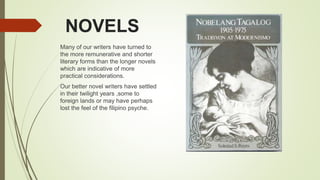
Many of our writers have turned to
the more remunerative and shorter
literary forms than the longer novels
which are indicative of more
practical considerations.
Our better novel writers have settled
in their twilight years ,some to
foreign lands or may have perhaps
lost the feel of the filipino psyche.
Thank you .

Literary compositions

  • 1.
  • 2.
    The years 1986-1999cover the careers of three presidents: Corazon C. Aquino, Fidel V. Ramos and Joseph Ejercito Estrada. Spates of literary enthusiasm continue unabated. Unhampered by compelling handicaps, hard times and the transient problems of the period.
  • 3.
    The cultural center ofthe Philippines The Cultural Center of the Philippines (or CCP) is located in Metro Manila, the Philippines, and was opened in 1969 to promote and preserve Filipino arts and culture. It hopes to become the mecca of culture and the arts in Asia.
  • 4.
    1986 EDSA REVOLUTION Theyear 1986 demarcates the beginning of new scene in the unfolding narrative of contemporary Philippine Literature. It saw the fall of the dictatorship that President Marcos set up on September 21, 1972, when he placed the Philippines under martial rule, initiating a regime that did not only suppress the writers’ right to free expression but also created conditions that made collaboration and cooptation convenient choices for artists struggling for recognition and survival.
  • 5.
    Literature under MartialLaw Writing under the Martial Law Regime was characterized by militancy and belligerence, even when it showed up in the legal press. Especially after the assassination of Ninoy Aquino in 1983, the temper of poetry and theatre derived much of its heat and direction from the political culture of the underground national democratic movement.
  • 6.
    1986 EDSA REVOLUTION However,when the enemy were overthrown in 1986, the literary activity showed a certain disorientation manifesting itself in a proliferation of concerns taken up by individual writers and groups. Post EDSA: 2 Creative Writing centers Academic institutions where Creative Writing is a part of the curricular offerings. Writers’ organizations that periodically sponsor symposia on writer and/or set up workshops for its members and other interested parties Through these centers that writers get to hear about new developments in writing, and derive enthusiasm for their crafts.
  • 7.
    Writers’ Organizations Various literaryorganizations conduct live reading sessions in public places to make poetry accessible to the masses. The UMPIL (Unyon ng mga manunulat sa Pilipinas ) • The largest organization of Filipino writers in the Philippines. Established in 1974, the organization was first known by the English version of its name, the Writers' Union of the Philippines, it has the primary goal of promoting Philippine literature, uniting writers in the Philippines, and providing seminars, workshops, and symposia in order to achieve goals.
  • 8.
    Writers’ Organizations LIRA (Linangansa Imahen, Retorika at Anyo ) • The Filipino language may not be the sweetest, but it definitely is something to be proud of. This is one of the reasons why the Linangan sa Imahen, Retorika, at Anyo (LIRA) has been actively running a volunteer program that aims to foster the growth of our national literature and culture, highlighting teaching of Filipino poetry.
  • 9.
    Carlos Palanca Memorial Awardsin Literature The Palanca Awards or Don Carlos Palanca Memorial Awards for Literature are a set of literary awards for Filipino writers. Usually referred to as the "Pulitzer Prize" of the Philippines, it is the country's highest literary honor in terms of prestige. Winning works are entered in the competition either as previously published pieces or in manuscript form. The Palanca Awards, organized by the Carlos Palanca Foundation, is one of the Philippines' longest-running awards programs.
  • 10.
    Carlos Palanca Memorial Awardsin Literature La Tondeña, sponsors of the venerable Carlos Palanca Memorial Awards in Literature, has made the name “Palanca” a synonym for quality literary works in both English and Filipino.
  • 11.
    National Commission forCulture and the Arts (NCAA) The National Commission for Culture and the Arts (NCAA) was created by law in 1992. It has a Committee on Literary Arts which funds workshops, conferences, publications and a variety of projects geared towards the production of a “national literature”. The committee has the aim of developing writing that is multi- lingual, multi-cultural, and truly national.
  • 12.
    Overall, the characterof the Philippine literary scene after "EDSA" maybe pinpointed be referring to the theories that inform literary production, to the products issuing from the publishers, to the dominant concerns demonstrated by the writers' output, and to the direction towards which literary studies are tending.
  • 13.
  • 14.
    Modern and TraditionalPoetry Modern poetry  The main feature of modern poetry is freedom. Modern and Post- modern poets exercise the freedom to write in any structure they choose— rhymed verse, blank verse, free verse—and they have the freedom to experiment with new hybrid structures. Traditional Poetry  A traditional poem is a poem that adheres to a definite verse structure or set of characteristics. By contrast, the metrical and rhyme patterns associated with traditional poems are typically absent from contemporary poetry.
  • 15.
    Traditional Poetry “Diyos angBahala” Kung tatayo ako sa gitna ng g’yera, at sasabihin kong tumigil na sila, pagpapakamatay’ aking mapapala, mabuting magdasal sa D’yos na dakila! ‘Pagkat nakalimbag nga sa Kasulatan, bansa sa mundo ay magsisipaglaban, kasali pa dito pati kaharian at magsisitindig, lilong kasamaan. Magtataka ba kung natutupad ito, daigdig, sa ngayon ay tila imp'yerno? tumatatak lamang ang tusong demonyo, kayang ipaglayo ang buklod ng tao. Sino ba ang dapat na ating sandigan, hindi ba Diyos na dakila't mainam? at kung mananalig sa kapangyarihan, Diyos ang bahala sa kinabukasan. Espiritu lamang ang makasusupil, sa mga alibughang ‘di na mapigil, sama't kasalanang doo'y nakahimpil, dagling matutunaw pati mga taksil! Ang bansang sa asta ay tila nga hari, maliit na masa ay nilulugami, tiyak ang parusa ang apoy ang saksi, hindi na aahon kahit na magsisi. Ang mga nilalang na ganid sa laman, at hayok sa lakas ng kapangyarihan, inagaw ang ginto’t mga kayamanan, siguradong pugnaw sa init ng kalan! Kaya kung tayo ma'y umiiyak ngayon, asahang sa oras nitong paghuhukom, sa ligtas na pook ang tuloy ng layon na tungo ng paa - kasama ang Poon!
  • 16.
  • 17.
    Short story Obviously, theshort story is still the more popular venue of writers up to this period. Short romantic fiction in the vernacular has caught the fancy of many readers who perhaps find these less time consuming, as well as less expensive, giving more time for remunerative work and earning a living.
  • 18.
    Short story firstprize winners in the Carlos Palanca Memorial Awards in English in 1996 and 1997 were Carlos Ojeda Aureus (Martillo) for his “The Latecomer” and “The amulet” by David C. Martinez (Michael Sanchez) respectively . In the Maikling Kuwento category, we had “Pag-uugat, Pagpapakpak” by Levy Balgos de la Cruz (Lea Victoria) and Nang GabingMamatay ang Nana Soling by Alvin B. Yapan(Jose Agustin) in 1996 and 1997. Short story
  • 19.
    DIFFERENCE OF SHORTSTORY AND NOVELS  Short stories can be 1,000 to 20,000 words. More average is 3,000 to 5,000 words.  A short story has one main character and the story is told through that character’s point of view. Often it is told in first person or limited first person.  A short story has one theme.  A novel can be anywhere from 60,000 to over 120,000.  A novel has a cast of characters and the story can be told from any of those characters’ viewpoints.  a novel can explore different themes and has more breadth and scope.
  • 20.
    PLAYS Scriptwriting, a popularand developing literature form is probably due to the growing interest in TV and the visual arts. The following can be attributed to this trend: 1. TV and stage patronage 2. Theater groups like Dramatis Personae, PETA (Philippine Educational Theater Association), Dulaang UP, CCP Dramatic Arts Division Teatro Telesine, Gantimpala Theater Foundation, Mobile or Touring Children’s theater groups 3. Substantial awards in film-making 4. Expansion to cater to childrens’ needs (TV’s Channel 5’s Batibot, and TanghalangPambata)
  • 21.
    5. The popularityof Taglish which pepper today’s yuppy lingo and which reach out to the masses 6. The notion of seeking popularity and ratings through exposure 7. Creative writing workshops PLAYS
  • 22.
    NOVELS Many of ourwriters have turned to the more remunerative and shorter literary forms than the longer novels which are indicative of more practical considerations. Our better novel writers have settled in their twilight years ,some to foreign lands or may have perhaps lost the feel of the filipino psyche.
  • 23.