OPTIONALWEBINAR
WEEK 2
LIST 5373, SUMMER 16
Dr. Peggy Semingson
Tuesday, 5/31 (6:00-6:45, CST)
Join Link: Link to join the webinar: https://elearn.uta.edu/webapps/bb-
collaborate-bb_bb60/launchSession/guest?uid=38336d4f-5e9d-4017-835a-
765eef7b4712
You can join by computer/laptop or by the mobile app for “Blackboard
Collaborate”.
Plan for theWebinar
■ Reminders about assignments
■ Check-in for how we are doing with the Professional Development
Handout and Lesson Plan Handout
■ Chat/dialogue about key ideas for the course forWeek 1 and 2
■ A few mini-lectures throughout and commentary from Dr.
Semingson
■ A word of encouragement!
■ The webinar will be about 30 minutes (or so) in length!
Reminders of key assignments!
■ Reading Response & Replies every
week
■ Quizzes every week
■ Phonics Quiz-Week 3
■ Word Study Plan-Week 4
■ Professional Development
Handout-Week 5
■ *Be sure you have purchasedTK20!
How’s it going?
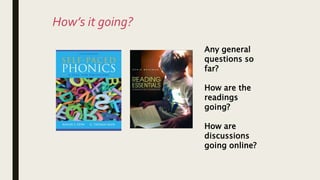
Any general
questions so
far?
How are the
readings
going?
How are
discussions
going online?
What are your ideas so far for the….
■ 1) Professional
Development Handout?
■ 2)Word Study Lesson
Plan?
Image: Bitmoji app
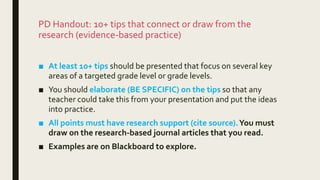
PD Handout: 10+ tips that connect or draw from the
research (evidence-based practice)
■ At least 10+ tips should be presented that focus on several key
areas of a targeted grade level or grade levels.
■ You should elaborate (BE SPECIFIC) on the tips so that any
teacher could take this from your presentation and put the ideas
into practice.
■ All points must have research support (cite source).You must
draw on the research-based journal articles that you read.
■ Examples are on Blackboard to explore.
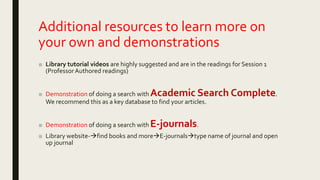
Additional resources to learn more on
your own and demonstrations
■ Library tutorial videos are highly suggested and are in the readings for Session 1
(ProfessorAuthored readings)
■ Demonstration of doing a search with Academic Search Complete.
We recommend this as a key database to find your articles.
■ Demonstration of doing a search with E-journals.
■ Library website-find books and moreE-journalstype name of journal and open
up journal
Reminders about links in syllabus and in PAR 1
Watch the required online tutorials from the UTA library:
Viewing of research database tutorials is required: Watch all of these video tutorials from the
UTA Library prior to the course starting [cut and paste the links, if needed]. They are short
tutorials and will be helpful to you across courses.
■ http://libraries.uta.edu/video/instruction/whatpr/peerreview.htm
■ What is Peer Review?
■ http://libraries.uta.edu/video/instruction/peer-review/database_peer_review.htm
■ Finding Peer-Reviewed Journal Articles
■ http://libraries.uta.edu/video/instruction/peer-review/peer_review.htm
■ Peer Review: How do I Know?
■ http://libraries.uta.edu/video/instruction/asc/asc.htm
■ Academic Search Complete
■ http://libraries.uta.edu/video/instruction/effectsearch/db.htm
■ Effective Searching
■ http://libraries.uta.edu/video/instruction/findingfulltext/ff.htm
■ Finding Full Text Articles
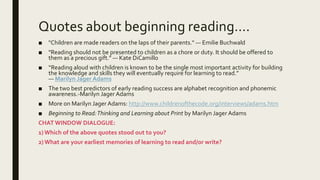
Quotes about beginning reading….
■ "Children are made readers on the laps of their parents." — Emilie Buchwald
■ "Reading should not be presented to children as a chore or duty. It should be offered to
them as a precious gift." — Kate DiCamillo
■ “Reading aloud with children is known to be the single most important activity for building
the knowledge and skills they will eventually require for learning to read.”
― Marilyn Jager Adams
■ The two best predictors of early reading success are alphabet recognition and phonemic
awareness.-Marilyn Jager Adams
■ More on Marilyn Jager Adams: http://www.childrenofthecode.org/interviews/adams.htm
■ Beginning to Read:Thinking and Learning about Print by Marilyn Jager Adams
CHAT WINDOW DIALOGUE:
1)Which of the above quotes stood out to you?
2)What are your earliest memories of learning to read and/or write?
Let’s look at some example handouts
■ Examples of initial plans
■ Example of a final handout (what we are working towards).
■ Consider Smore orTackk
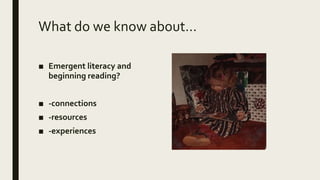
What do we know about…
■ Emergent literacy and
beginning reading?
■ -connections
■ -resources
■ -experiences
Additional Ideas to Discuss
■ Learning to read versus Reading to Learn (Jeanne Chall)
■ Debate of “whole language” versus “phonics” and “balanced
literacy”
■ Matthew Effect (Stanovich, 1986)
■ Discussion of Chall’s stages of reading development:
http://www.scholastic.com/content/collateral_resources/pdf/r/readin
g_bestpractices_assessment_red_c1_L02_tr_alookrsrch.pdf
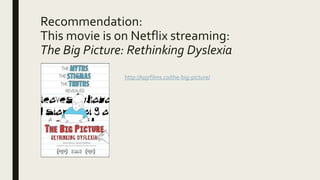
Recommendation:
This movie is on Netflix streaming:
The Big Picture: Rethinking Dyslexia
http://kpjrfilms.co/the-big-picture/
Encouragement
■Keep going!
■Reward yourself
■Finish
assignments
early.
■Resources on
Blackboard!
■Contact Dr. S if
needed!

LIST 5373 Webinar Week Two: Summer 2016

  • 1.
    OPTIONALWEBINAR WEEK 2 LIST 5373,SUMMER 16 Dr. Peggy Semingson Tuesday, 5/31 (6:00-6:45, CST) Join Link: Link to join the webinar: https://elearn.uta.edu/webapps/bb- collaborate-bb_bb60/launchSession/guest?uid=38336d4f-5e9d-4017-835a- 765eef7b4712 You can join by computer/laptop or by the mobile app for “Blackboard Collaborate”.
  • 2.
    Plan for theWebinar ■Reminders about assignments ■ Check-in for how we are doing with the Professional Development Handout and Lesson Plan Handout ■ Chat/dialogue about key ideas for the course forWeek 1 and 2 ■ A few mini-lectures throughout and commentary from Dr. Semingson ■ A word of encouragement! ■ The webinar will be about 30 minutes (or so) in length!
  • 3.
    Reminders of keyassignments! ■ Reading Response & Replies every week ■ Quizzes every week ■ Phonics Quiz-Week 3 ■ Word Study Plan-Week 4 ■ Professional Development Handout-Week 5 ■ *Be sure you have purchasedTK20!
  • 4.
    How’s it going? Anygeneral questions so far? How are the readings going? How are discussions going online?
  • 5.
    What are yourideas so far for the…. ■ 1) Professional Development Handout? ■ 2)Word Study Lesson Plan? Image: Bitmoji app
  • 6.
    PD Handout: 10+tips that connect or draw from the research (evidence-based practice) ■ At least 10+ tips should be presented that focus on several key areas of a targeted grade level or grade levels. ■ You should elaborate (BE SPECIFIC) on the tips so that any teacher could take this from your presentation and put the ideas into practice. ■ All points must have research support (cite source).You must draw on the research-based journal articles that you read. ■ Examples are on Blackboard to explore.
  • 7.
    Additional resources tolearn more on your own and demonstrations ■ Library tutorial videos are highly suggested and are in the readings for Session 1 (ProfessorAuthored readings) ■ Demonstration of doing a search with Academic Search Complete. We recommend this as a key database to find your articles. ■ Demonstration of doing a search with E-journals. ■ Library website-find books and moreE-journalstype name of journal and open up journal
  • 8.
    Reminders about linksin syllabus and in PAR 1 Watch the required online tutorials from the UTA library: Viewing of research database tutorials is required: Watch all of these video tutorials from the UTA Library prior to the course starting [cut and paste the links, if needed]. They are short tutorials and will be helpful to you across courses. ■ http://libraries.uta.edu/video/instruction/whatpr/peerreview.htm ■ What is Peer Review? ■ http://libraries.uta.edu/video/instruction/peer-review/database_peer_review.htm ■ Finding Peer-Reviewed Journal Articles ■ http://libraries.uta.edu/video/instruction/peer-review/peer_review.htm ■ Peer Review: How do I Know? ■ http://libraries.uta.edu/video/instruction/asc/asc.htm ■ Academic Search Complete ■ http://libraries.uta.edu/video/instruction/effectsearch/db.htm ■ Effective Searching ■ http://libraries.uta.edu/video/instruction/findingfulltext/ff.htm ■ Finding Full Text Articles
  • 9.
    Quotes about beginningreading…. ■ "Children are made readers on the laps of their parents." — Emilie Buchwald ■ "Reading should not be presented to children as a chore or duty. It should be offered to them as a precious gift." — Kate DiCamillo ■ “Reading aloud with children is known to be the single most important activity for building the knowledge and skills they will eventually require for learning to read.” ― Marilyn Jager Adams ■ The two best predictors of early reading success are alphabet recognition and phonemic awareness.-Marilyn Jager Adams ■ More on Marilyn Jager Adams: http://www.childrenofthecode.org/interviews/adams.htm ■ Beginning to Read:Thinking and Learning about Print by Marilyn Jager Adams CHAT WINDOW DIALOGUE: 1)Which of the above quotes stood out to you? 2)What are your earliest memories of learning to read and/or write?
  • 10.
    Let’s look atsome example handouts ■ Examples of initial plans ■ Example of a final handout (what we are working towards). ■ Consider Smore orTackk
  • 11.
    What do weknow about… ■ Emergent literacy and beginning reading? ■ -connections ■ -resources ■ -experiences
  • 12.
    Additional Ideas toDiscuss ■ Learning to read versus Reading to Learn (Jeanne Chall) ■ Debate of “whole language” versus “phonics” and “balanced literacy” ■ Matthew Effect (Stanovich, 1986) ■ Discussion of Chall’s stages of reading development: http://www.scholastic.com/content/collateral_resources/pdf/r/readin g_bestpractices_assessment_red_c1_L02_tr_alookrsrch.pdf
  • 13.
    Recommendation: This movie ison Netflix streaming: The Big Picture: Rethinking Dyslexia http://kpjrfilms.co/the-big-picture/
  • 15.