LIQUID PENETRANT
TESTING
LEVE II
Eka Prasetya Siregar
ASNT NDE (RT,UT, MT, PT, VT) Level III
ASNT ID : 190523
Liquid Penetrant Testing
INTRODUCTION
INTRODUCTION
Capillary Action
INTRODUCTION
Capillary Action
Defect at open to Surface
DI BAWAH
PERMUKAAN
DI BAGIAN
DALAM
Tdk dapat dideteksi oleh uji
penetran
Dapat dideteksi oleh uji penetran
INTRODUCTION
Liquid penetrant inspection is a physical chemical
process. Application and reaction of the penetrant
(chemical) is dependent upon the nature of the test
article and the discontinuity it contains (physical).
The ability of penetrant to spread over a solid surface is referred
to as the wetting ability. The wetting ability and contact angle
between solid liquid are inversely proportional. The higher the
wetting ability, the smaller the contact angle. The contact angle
determines the wetting ability.
Penetrating capability of a liquid penetrant is controlled
by:
 Surface tension
 Contact angle
INTRODUCTION
BASIC PRINCIPLES
BASIC PRINCIPLES
STEP - 1
SURFACE
PREPARATION
(PRECLEANING)
SURFACE PREPARATION
SURFACE PREPARATION
Surface preparation, including proper cleaning is essential to liquid
penetrant testing for TWO reasons:
2. If all traces of penetrant materials are not removed after the test,
they may have a harmful effect on the specimen after the test
object is placed in service (chlorine and sulphur may affect some
alloys).
1. If the specimen is not physically and chemically clean and dry, penetrant
testing may be ineffective.
SURFACE PREPARATION
Selection of the cleaning process breaks down to the following basic factors.
 Type of contaminant.
 Composition of the base material.
 Degree of cleanliness required.
 Availability of cleaning equipment.
 Cost and time factors
SURFACE PREPARATION
SURFACE PREPARATION
SURFACE PREPARATION
STEP - 2
APPLY LIQUID
PENETRANT
Basic Liquid Penetrant Classification
System
Classification of Penetrant
Examination Types and Methods
PENETRANT
List below indicates the penetrant systems, ranging from the most sensitive
and expensive to the least one.
1. Post-emulsified – fluorescent.
2. Solvent-removable – fluorescent.
3. Water-washable – fluorescent.
4. Post-emulsified – visible.
5. Solvent-removable – visible.
6. Water-washable – visible.
CONSUMABLE
CONSUMABLE
CONSUMABLE
APPLY LIQUID PENETRANT
DWELL TIME PENETRANT
STEP - 3
REMOVE EXCESS
LIQUID
PENETRANT
REMOVE EXCESS LIQUID PENETRANT
WATER WASHABLE
REMOVE EXCESS LIQUID PENETRANT
POST EMULSIFIABLE - LIPOPHILIC
REMOVE EXCESS LIQUID PENETRANT
POST EMULSIFIABLE - HYDROPHILIC
CONSUMABLE
REMOVE EXCESS LIQUID PENETRANT
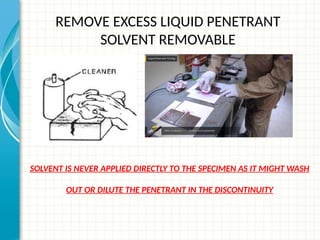
SOLVENT REMOVABLE
SOLVENT IS NEVER APPLIED DIRECTLY TO THE SPECIMEN AS IT MIGHT WASH
OUT OR DILUTE THE PENETRANT IN THE DISCONTINUITY
REMOVE EXCESS LIQUID PENETRANT
CONSUMABLE
STEP - 4
APPL
DEVELOPER
APPLY DEVELOPER
APPLY DEVELOPER
STEP - 5
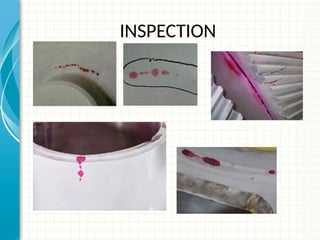
INPECTION
INSPECTION
INSPECTION
INSPECTION
STEP - 6
POST
CLEANING
POST CLEANING
After the specimen has been inspected, it is very important that it be
thoroughly cleaned. A thorough postcleaning is necessary because penetrant
and developer residue tend to attract moisture which may cause corrosion,
or it can interfere with subsequent processing or usage.
Postcleaning usually will involved the same types of cleaning operations as
were used in precleaning.
EQUIPMENT
EQUIPMENT
EQUIPMENT
NDT STEPS
NDT STEPS
POST CLEANING
After the specimen has been inspected, it is very important that it be
thoroughly cleaned. A thorough postcleaning is necessary because penetrant
and developer residue tend to attract moisture which may cause corrosion,
or it can interfere with subsequent processing or usage.
Postcleaning usually will involved the same types of cleaning operations as
were used in precleaning.
Summary
Penetrant testing is succesfully used on most any materials,
including metallic and nonmetallic objects.
Metallic materials include aluminum, magnesium, titanium, cast
iron, stainless steel, powdered metal products, copper, brass,
and bronze, as well as most other common alloys.
Nonmetallic materials include ceramics, plastic, molded rubber,
composites, and glass.
Penetrant testing is limited by its inability to test materials with
discontinuities that are NOT OPEN to the surface or having
extremely porous surface.
Summary
The ability of a given liquid to flow over a surface and enter surface cavities
depends principally on the following:
 Cleanliness of the surface
 Configuration of the cavity
 Cleanliness of the cavity
 Size of surface opening of the cavity
 Surface tension of the liquid
 Ability of the liquid to wet the surface
 Contact angle of the liquid
Choices
material of
Penetrant
Summary
The selection of the best process depends upon:
1. Sensitivity required.
2. Number of articles to be tested.
3. Surface condition of part being inspected.
4. Configuration of test specimen.
5. Availability of water, electricity, compressed air, suitable
testing area
Summary
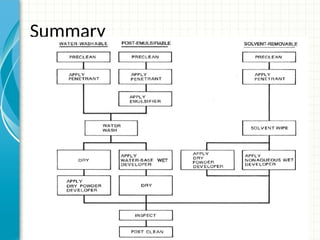
The four methods are broadly classified as:
 Water washable, method A
 Postemulsifiable lipophilic, method B
 Solvent removable, method C
 Postemulsifiable hydrophilic, method D
Summary
QUESTIONS?
Questions - 1
Which of the following is a disadvantage of using the liquid penetrant testing
method?
a) The liquid penetrant test method is adaptable to production
inspection of small parts
b) Liquid penetrant testing can locate fine cracks
c) The liquid penetrant test method is a relatively simple test method
d) The liquid penetrant test method is not effective at all temperatures
Questions - 2
Which of the following is a commonly used classification for
penetrant?
a) Postemulsifiable penetrant
b) Nonferrous penetrant
c) Chemical etch penetrant
d) Nonaqueous penetrant
Questions - 3
Which method of penetrant removal is solvent removable?
a) Method A
b) Method B
c) Method C
d) Method D
Questions - 4
Developer coating of excessive thicknesss:
a) May obscure indications
b) May be beneficial while observing small indications for
flourescent penetrants
c) May be beneficial while observing small indications for
visible penetrants
d) Do not effect the inspection
Questions - 5
a) Developer coating of excessive thicknesss:
a) May obscure indications
b) May be beneficial while observing small indications for
flourescent penetrants
c) May be beneficial while observing small indications for
visible penetrants
d) Do not effect the inspection

Liquid Penetrant Testing ........................

  • 1.
    LIQUID PENETRANT TESTING LEVE II EkaPrasetya Siregar ASNT NDE (RT,UT, MT, PT, VT) Level III ASNT ID : 190523
  • 2.
  • 3.
  • 4.
  • 5.
    INTRODUCTION Capillary Action Defect atopen to Surface DI BAWAH PERMUKAAN DI BAGIAN DALAM Tdk dapat dideteksi oleh uji penetran Dapat dideteksi oleh uji penetran
  • 6.
    INTRODUCTION Liquid penetrant inspectionis a physical chemical process. Application and reaction of the penetrant (chemical) is dependent upon the nature of the test article and the discontinuity it contains (physical). The ability of penetrant to spread over a solid surface is referred to as the wetting ability. The wetting ability and contact angle between solid liquid are inversely proportional. The higher the wetting ability, the smaller the contact angle. The contact angle determines the wetting ability. Penetrating capability of a liquid penetrant is controlled by:  Surface tension  Contact angle
  • 7.
  • 8.
  • 9.
  • 10.
  • 11.
  • 12.
    SURFACE PREPARATION Surface preparation,including proper cleaning is essential to liquid penetrant testing for TWO reasons: 2. If all traces of penetrant materials are not removed after the test, they may have a harmful effect on the specimen after the test object is placed in service (chlorine and sulphur may affect some alloys). 1. If the specimen is not physically and chemically clean and dry, penetrant testing may be ineffective.
  • 13.
    SURFACE PREPARATION Selection ofthe cleaning process breaks down to the following basic factors.  Type of contaminant.  Composition of the base material.  Degree of cleanliness required.  Availability of cleaning equipment.  Cost and time factors
  • 14.
  • 15.
  • 16.
  • 17.
    STEP - 2 APPLYLIQUID PENETRANT
  • 18.
    Basic Liquid PenetrantClassification System
  • 19.
  • 20.
    PENETRANT List below indicatesthe penetrant systems, ranging from the most sensitive and expensive to the least one. 1. Post-emulsified – fluorescent. 2. Solvent-removable – fluorescent. 3. Water-washable – fluorescent. 4. Post-emulsified – visible. 5. Solvent-removable – visible. 6. Water-washable – visible.
  • 21.
  • 22.
  • 23.
  • 24.
  • 25.
  • 26.
  • 27.
    STEP - 3 REMOVEEXCESS LIQUID PENETRANT
  • 28.
  • 29.
  • 30.
    REMOVE EXCESS LIQUIDPENETRANT WATER WASHABLE
  • 31.
    REMOVE EXCESS LIQUIDPENETRANT POST EMULSIFIABLE - LIPOPHILIC
  • 32.
    REMOVE EXCESS LIQUIDPENETRANT POST EMULSIFIABLE - HYDROPHILIC
  • 33.
  • 34.
    REMOVE EXCESS LIQUIDPENETRANT SOLVENT REMOVABLE SOLVENT IS NEVER APPLIED DIRECTLY TO THE SPECIMEN AS IT MIGHT WASH OUT OR DILUTE THE PENETRANT IN THE DISCONTINUITY
  • 35.
  • 36.
  • 37.
  • 38.
  • 39.
  • 40.
  • 41.
  • 42.
  • 43.
  • 44.
  • 45.
    POST CLEANING After thespecimen has been inspected, it is very important that it be thoroughly cleaned. A thorough postcleaning is necessary because penetrant and developer residue tend to attract moisture which may cause corrosion, or it can interfere with subsequent processing or usage. Postcleaning usually will involved the same types of cleaning operations as were used in precleaning.
  • 46.
  • 47.
  • 48.
  • 49.
  • 50.
  • 51.
    POST CLEANING After thespecimen has been inspected, it is very important that it be thoroughly cleaned. A thorough postcleaning is necessary because penetrant and developer residue tend to attract moisture which may cause corrosion, or it can interfere with subsequent processing or usage. Postcleaning usually will involved the same types of cleaning operations as were used in precleaning.
  • 52.
    Summary Penetrant testing issuccesfully used on most any materials, including metallic and nonmetallic objects. Metallic materials include aluminum, magnesium, titanium, cast iron, stainless steel, powdered metal products, copper, brass, and bronze, as well as most other common alloys. Nonmetallic materials include ceramics, plastic, molded rubber, composites, and glass. Penetrant testing is limited by its inability to test materials with discontinuities that are NOT OPEN to the surface or having extremely porous surface.
  • 53.
    Summary The ability ofa given liquid to flow over a surface and enter surface cavities depends principally on the following:  Cleanliness of the surface  Configuration of the cavity  Cleanliness of the cavity  Size of surface opening of the cavity  Surface tension of the liquid  Ability of the liquid to wet the surface  Contact angle of the liquid Choices material of Penetrant
  • 54.
    Summary The selection ofthe best process depends upon: 1. Sensitivity required. 2. Number of articles to be tested. 3. Surface condition of part being inspected. 4. Configuration of test specimen. 5. Availability of water, electricity, compressed air, suitable testing area
  • 55.
    Summary The four methodsare broadly classified as:  Water washable, method A  Postemulsifiable lipophilic, method B  Solvent removable, method C  Postemulsifiable hydrophilic, method D
  • 56.
  • 57.
  • 58.
    Questions - 1 Whichof the following is a disadvantage of using the liquid penetrant testing method? a) The liquid penetrant test method is adaptable to production inspection of small parts b) Liquid penetrant testing can locate fine cracks c) The liquid penetrant test method is a relatively simple test method d) The liquid penetrant test method is not effective at all temperatures
  • 59.
    Questions - 2 Whichof the following is a commonly used classification for penetrant? a) Postemulsifiable penetrant b) Nonferrous penetrant c) Chemical etch penetrant d) Nonaqueous penetrant
  • 60.
    Questions - 3 Whichmethod of penetrant removal is solvent removable? a) Method A b) Method B c) Method C d) Method D
  • 61.
    Questions - 4 Developercoating of excessive thicknesss: a) May obscure indications b) May be beneficial while observing small indications for flourescent penetrants c) May be beneficial while observing small indications for visible penetrants d) Do not effect the inspection
  • 62.
    Questions - 5 a)Developer coating of excessive thicknesss: a) May obscure indications b) May be beneficial while observing small indications for flourescent penetrants c) May be beneficial while observing small indications for visible penetrants d) Do not effect the inspection

Editor's Notes

  • #3 This is another option for an Overview slides using transitions.
  • #8 This is another option for an Overview slides using transitions.