Liposarcoma is atype of cancer . Malignant form
of lipoma and the second most common type of
soft tissue sarcoma.
It grows on the fatty tissue. Liposarcoma is
commonly found in legs and thighs.
Liposarcoma is normally found in adults in the 40
to 60 year age bracket and occur usually in the
extremities or retroperitoneum (space behind
your abdominal organs). Like all other forms of
sarcomas, occurrence of this disease is rare.
DEFINITION
4.
Physical:
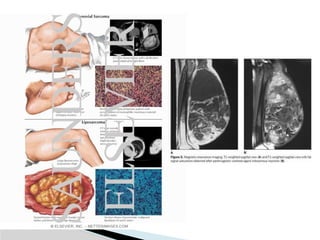
Liposarcoma usually appearsas a well-
circumscribed palpable mass as large as 10 cm in
diameter.
The mass tends to grow slowly over time.
The lesion is commonly not tender on
palpation.
Diffuse abdominal enlargement may be
observed in patients with retroperitoneal disease.
Fascial compartmentalization may cause
liposarcomas to have awkward discoid and fusiform
shapes rather than smooth, round forms. Thus,
liposarcoma can appear with an array of clinical
morphologies and manifestations.
5.
Well-differentiated
TYPES
Myxoid
Dedifferentiated
Pleomorphic
most common type
WDLSis made up of mature
(fully grown) fat cells
most often found in the
deep tissue of legs, and
thighs
second most common type
look like jelly and have a
large amount of water in them
made up of both a fatty tumor
and a non-fatty tumor.
The fatty part of the tumor is a
WDLS.
The non-fatty part of the tumor
is made up of cells found in
bone, muscles, or skin tissue.
rare tumors
have very little or no fat in them
commonly found in your leg muscles
are very hard to treat and often return
spread to areas outside
the lungs
6.
Signs and Symptoms/Manifestation
Decreasedmovement in the limb that has the tumor.
Pain and swelling in the area of your tumor.
Chest pain.
Constipation (hard, dry stools), and diarrhea (loose,
watery stools). May also have pain when having a
bowel movement (BM), or see blood in stools.
Trouble urinating or pain while urinating.
Trouble swallowing and voice changes.
Trouble breathing and coughing.
Weight loss.
Nausea and Vomiting
Treatment
Radiation
Wide local excision.During surgical excision, your
surgeon removes (excises) cancerous tissue, along
with a margin of surrounding healthy tissue.
Limb-sparing surgery. Your surgeon may use one of
several surgical techniques to remove the tumor from
your limb without amputation.
Amputation. Large tumors or those located in
complex regions may require surgery to remove all or
part of the limb.
Surgery
may be given before or after
surgery to reduce the risk of recurrence
Chemotherapy
to shrink the tumor before surgery.
Chemotherapy may also be used to try
to kill small seeds of cancer in other
parts of the body that even advanced
imaging tests can't detect.
9.
When should Icall my caregiver?
Call your caregiver if:
•You are having trouble swallowing.
•You see or feel any new lumps in your body.
•You feel new pain in the area of your tumor.
•You are unable to have a BM.
•You think or know you are pregnant.
When should I seek immediate help?
You have chest pain and trouble breathing.
You have no feeling in or near the area where
your liposarcoma is.
You are unable to move the part of your body
where your tumor is.
You see blood in your stools.
You vomit blood.




![Is it lipoma or liposarcoma[1].docx](https://cdn.slidesharecdn.com/ss_thumbnails/isitlipomaorliposarcoma1-231018122310-a3024c3f-thumbnail.jpg?width=640&height=640&fit=bounds)


![CASE_PRESENTATION_ON_subdural_hematoma(SDH)[1 FINAL PPT]-1.pptx](https://cdn.slidesharecdn.com/ss_thumbnails/casepresentationonsubduralhematomasdh1finalppt-1-260129172522-d405d375-thumbnail.jpg?width=640&height=640&fit=bounds)


