Linux Administration: A Beginner's Guide 8th Edition Wale Soyinka
Linux Administration: A Beginner's Guide 8th Edition Wale Soyinka
Linux Administration: A Beginner's Guide 8th Edition Wale Soyinka
Linux Administration: A Beginner's Guide 8th Edition Wale Soyinka
Linux Administration: A Beginner's Guide 8th Edition Wale Soyinka
1.
Linux Administration: ABeginner's Guide 8th
Edition Wale Soyinka download
https://textbookfull.com/product/linux-administration-a-
beginners-guide-8th-edition-wale-soyinka/
Download more ebook from https://textbookfull.com
2.
We believe theseproducts will be a great fit for you. Click
the link to download now, or visit textbookfull.com
to discover even more!
Linux Administration: A Beginner's Guide 8th Edition
Wale Soyinka
https://textbookfull.com/product/linux-administration-a-
beginners-guide-8th-edition-wale-soyinka/
Linux Administration A Beginner’s Guide 7th Edition
Wale Soyinka
https://textbookfull.com/product/linux-administration-a-
beginners-guide-7th-edition-wale-soyinka/
Astronomy A Beginner s Guide to the Universe 8th
Edition Eric Chaisson
https://textbookfull.com/product/astronomy-a-beginner-s-guide-to-
the-universe-8th-edition-eric-chaisson/
The Law Enforcement and Forensic Examiner s
Introduction to Linux A Comprehensive Beginner s Guide
to Linux as a Digital Forensic Platform Barry J. Grundy
https://textbookfull.com/product/the-law-enforcement-and-
forensic-examiner-s-introduction-to-linux-a-comprehensive-
beginner-s-guide-to-linux-as-a-digital-forensic-platform-barry-j-
3.
ubuntu and Centoslinux server administration Md.
Tanvir Rahman
https://textbookfull.com/product/ubuntu-and-centos-linux-server-
administration-md-tanvir-rahman/
UNIX and Linux System Administration Handbook 5th
Edition Evi Nemeth
https://textbookfull.com/product/unix-and-linux-system-
administration-handbook-5th-edition-evi-nemeth/
Outgrowing God A Beginner s Guide Richard Dawkins
https://textbookfull.com/product/outgrowing-god-a-beginner-s-
guide-richard-dawkins/
Becoming A Programmer A Beginner s Guide 1st Edition
Paul Mabry
https://textbookfull.com/product/becoming-a-programmer-a-
beginner-s-guide-1st-edition-paul-mabry/
Geometric Measure Theory A Beginner s Guide 5th Edition
Frank Morgan
https://textbookfull.com/product/geometric-measure-theory-a-
beginner-s-guide-5th-edition-frank-morgan/
7.
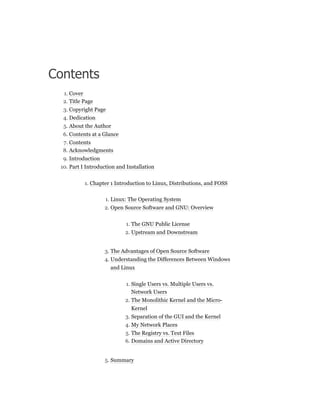
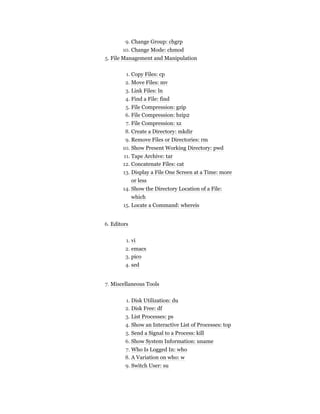
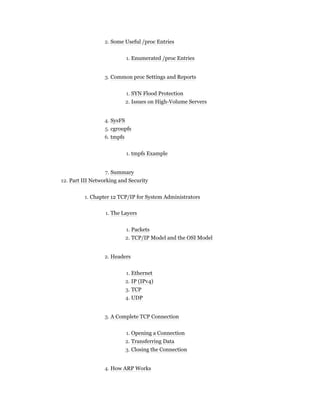
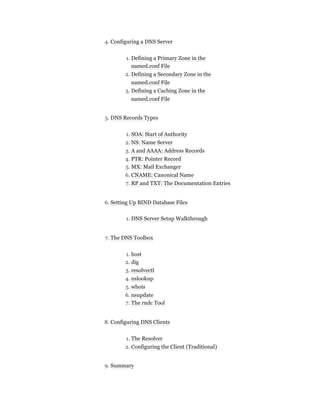
Contents
1. Cover
2. TitlePage
3. Copyright Page
4. Dedication
5. About the Author
6. Contents at a Glance
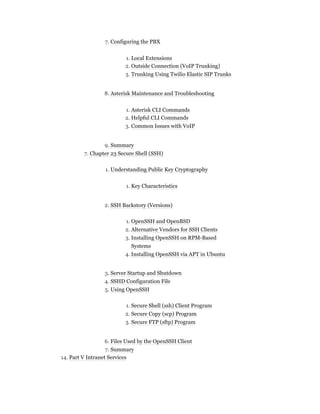
7. Contents
8. Acknowledgments
9. Introduction
10. Part I Introduction and Installation
1. Chapter 1 Introduction to Linux, Distributions, and FOSS
1. Linux: The Operating System
2. Open Source Software and GNU: Overview
1. The GNU Public License
2. Upstream and Downstream
3. The Advantages of Open Source Software
4. Understanding the Differences Between Windows
and Linux
1. Single Users vs. Multiple Users vs.
Network Users
2. The Monolithic Kernel and the Micro-
Kernel
3. Separation of the GUI and the Kernel
4. My Network Places
5. The Registry vs. Text Files
6. Domains and Active Directory
5. Summary
8.
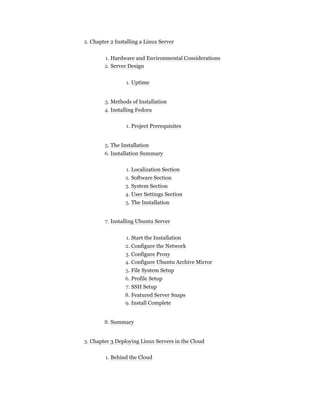
2. Chapter 2Installing a Linux Server
1. Hardware and Environmental Considerations
2. Server Design
1. Uptime
3. Methods of Installation
4. Installing Fedora
1. Project Prerequisites
5. The Installation
6. Installation Summary
1. Localization Section
2. Software Section
3. System Section
4. User Settings Section
5. The Installation
7. Installing Ubuntu Server
1. Start the Installation
2. Configure the Network
3. Configure Proxy
4. Configure Ubuntu Archive Mirror
5. File System Setup
6. Profile Setup
7. SSH Setup
8. Featured Server Snaps
9. Install Complete
8. Summary
3. Chapter 3 Deploying Linux Servers in the Cloud
1. Behind the Cloud
9.
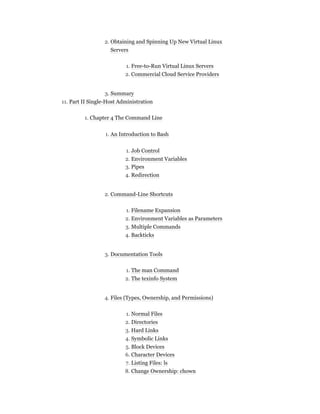
2. Obtaining andSpinning Up New Virtual Linux
Servers
1. Free-to-Run Virtual Linux Servers
2. Commercial Cloud Service Providers
3. Summary
11. Part II Single-Host Administration
1. Chapter 4 The Command Line
1. An Introduction to Bash
1. Job Control
2. Environment Variables
3. Pipes
4. Redirection
2. Command-Line Shortcuts
1. Filename Expansion
2. Environment Variables as Parameters
3. Multiple Commands
4. Backticks
3. Documentation Tools
1. The man Command
2. The texinfo System
4. Files (Types, Ownership, and Permissions)
1. Normal Files
2. Directories
3. Hard Links
4. Symbolic Links
5. Block Devices
6. Character Devices
7. Listing Files: ls
8. Change Ownership: chown
10.
9. Change Group:chgrp
10. Change Mode: chmod
5. File Management and Manipulation
1. Copy Files: cp
2. Move Files: mv
3. Link Files: ln
4. Find a File: find
5. File Compression: gzip
6. File Compression: bzip2
7. File Compression: xz
8. Create a Directory: mkdir
9. Remove Files or Directories: rm
10. Show Present Working Directory: pwd
11. Tape Archive: tar
12. Concatenate Files: cat
13. Display a File One Screen at a Time: more
or less
14. Show the Directory Location of a File:
which
15. Locate a Command: whereis
6. Editors
1. vi
2. emacs
3. pico
4. sed
7. Miscellaneous Tools
1. Disk Utilization: du
2. Disk Free: df
3. List Processes: ps
4. Show an Interactive List of Processes: top
5. Send a Signal to a Process: kill
6. Show System Information: uname
7. Who Is Logged In: who
8. A Variation on who: w
9. Switch User: su
11.
8. Putting ItAll Together (Moving a User and Its
Home Directory)
9. Summary
2. Chapter 5 Managing Software
1. The Red Hat Package Manager
2. Managing Software Using RPM
1. Querying for Information the RPM Way
(Getting to Know One Another)
2. Installing Software with RPM (Moving in
Together)
3. Uninstalling Software with RPM (Ending
the Relationship)
4. Other Things RPM Can Do
3. Yum
4. DNF
5. GUI RPM Package Managers
1. Fedora or Ubuntu
2. openSUSE and SLE
6. The Debian Package Management System
1. APT
7. Software Management in Ubuntu
1. Querying for Information
2. Installing Software in Ubuntu
3. Removing Software in Ubuntu
8. Compile and Install GNU Software
1. Getting and Unpacking the Source
Package
2. Looking for Documentation
3. Configuring the Package
4. Compiling the Package
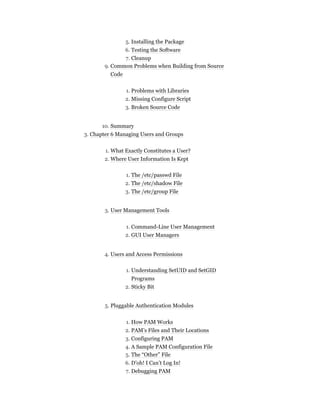
12.
5. Installing thePackage
6. Testing the Software
7. Cleanup
9. Common Problems when Building from Source
Code
1. Problems with Libraries
2. Missing Configure Script
3. Broken Source Code
10. Summary
3. Chapter 6 Managing Users and Groups
1. What Exactly Constitutes a User?
2. Where User Information Is Kept
1. The /etc/passwd File
2. The /etc/shadow File
3. The /etc/group File
3. User Management Tools
1. Command-Line User Management
2. GUI User Managers
4. Users and Access Permissions
1. Understanding SetUID and SetGID
Programs
2. Sticky Bit
5. Pluggable Authentication Modules
1. How PAM Works
2. PAM’s Files and Their Locations
3. Configuring PAM
4. A Sample PAM Configuration File
5. The “Other” File
6. D’oh! I Can’t Log In!
7. Debugging PAM
13.
6. A GrandTour
1. Creating Users with useradd
2. Creating Groups with groupadd
3. Modifying User Attributes with usermod
4. Modifying Group Attributes with
groupmod
5. Deleting Users and Groups with userdel
and groupdel
7. Summary
4. Chapter 7 Booting and Shutting Down
1. Boot Loaders
1. GRUB Legacy
2. GRUB 2
3. Bootstrapping
2. The init Process
3. Systemd Scripts
1. Writing Your Own rc Script
4. Enabling and Disabling Services
1. Enabling a Service
2. Disabling a Service
5. Odds and Ends of Booting and Shutting Down
1. fsck!
2. Booting into Single-User (“Recovery”)
Mode
6. Summary
5. Chapter 8 File Systems
14.
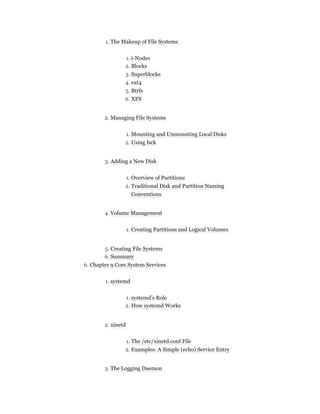
1. The Makeupof File Systems
1. i-Nodes
2. Blocks
3. Superblocks
4. ext4
5. Btrfs
6. XFS
2. Managing File Systems
1. Mounting and Unmounting Local Disks
2. Using fsck
3. Adding a New Disk
1. Overview of Partitions
2. Traditional Disk and Partition Naming
Conventions
4. Volume Management
1. Creating Partitions and Logical Volumes
5. Creating File Systems
6. Summary
6. Chapter 9 Core System Services
1. systemd
1. systemd’s Role
2. How systemd Works
2. xinetd
1. The /etc/xinetd.conf File
2. Examples: A Simple (echo) Service Entry
3. The Logging Daemon
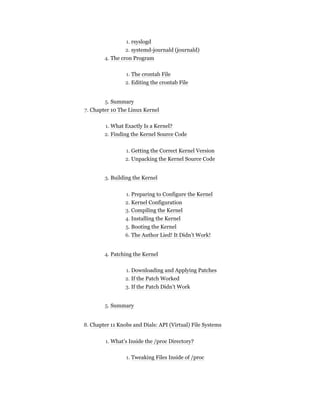
15.
1. rsyslogd
2. systemd-journald(journald)
4. The cron Program
1. The crontab File
2. Editing the crontab File
5. Summary
7. Chapter 10 The Linux Kernel
1. What Exactly Is a Kernel?
2. Finding the Kernel Source Code
1. Getting the Correct Kernel Version
2. Unpacking the Kernel Source Code
3. Building the Kernel
1. Preparing to Configure the Kernel
2. Kernel Configuration
3. Compiling the Kernel
4. Installing the Kernel
5. Booting the Kernel
6. The Author Lied! It Didn’t Work!
4. Patching the Kernel
1. Downloading and Applying Patches
2. If the Patch Worked
3. If the Patch Didn’t Work
5. Summary
8. Chapter 11 Knobs and Dials: API (Virtual) File Systems
1. What’s Inside the /proc Directory?
1. Tweaking Files Inside of /proc
16.
2. Some Useful/proc Entries
1. Enumerated /proc Entries
3. Common proc Settings and Reports
1. SYN Flood Protection
2. Issues on High-Volume Servers
4. SysFS
5. cgroupfs
6. tmpfs
1. tmpfs Example
7. Summary
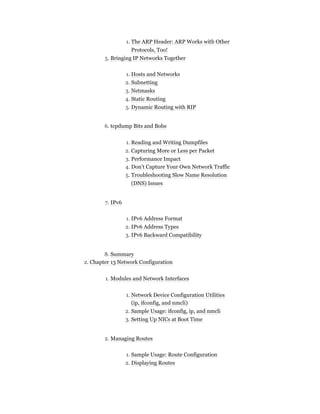
12. Part III Networking and Security
1. Chapter 12 TCP/IP for System Administrators
1. The Layers
1. Packets
2. TCP/IP Model and the OSI Model
2. Headers
1. Ethernet
2. IP (IPv4)
3. TCP
4. UDP
3. A Complete TCP Connection
1. Opening a Connection
2. Transferring Data
3. Closing the Connection
4. How ARP Works
17.
1. The ARPHeader: ARP Works with Other
Protocols, Too!
5. Bringing IP Networks Together
1. Hosts and Networks
2. Subnetting
3. Netmasks
4. Static Routing
5. Dynamic Routing with RIP
6. tcpdump Bits and Bobs
1. Reading and Writing Dumpfiles
2. Capturing More or Less per Packet
3. Performance Impact
4. Don’t Capture Your Own Network Traffic
5. Troubleshooting Slow Name Resolution
(DNS) Issues
7. IPv6
1. IPv6 Address Format
2. IPv6 Address Types
3. IPv6 Backward Compatibility
8. Summary
2. Chapter 13 Network Configuration
1. Modules and Network Interfaces
1. Network Device Configuration Utilities
(ip, ifconfig, and nmcli)
2. Sample Usage: ifconfig, ip, and nmcli
3. Setting Up NICs at Boot Time
2. Managing Routes
1. Sample Usage: Route Configuration
2. Displaying Routes
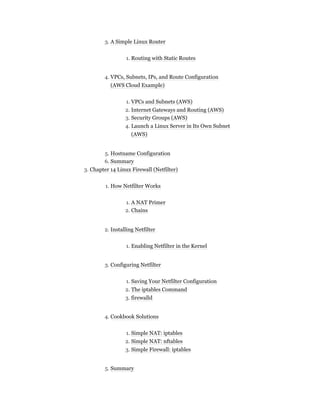
18.
3. A SimpleLinux Router
1. Routing with Static Routes
4. VPCs, Subnets, IPs, and Route Configuration
(AWS Cloud Example)
1. VPCs and Subnets (AWS)
2. Internet Gateways and Routing (AWS)
3. Security Groups (AWS)
4. Launch a Linux Server in Its Own Subnet
(AWS)
5. Hostname Configuration
6. Summary
3. Chapter 14 Linux Firewall (Netfilter)
1. How Netfilter Works
1. A NAT Primer
2. Chains
2. Installing Netfilter
1. Enabling Netfilter in the Kernel
3. Configuring Netfilter
1. Saving Your Netfilter Configuration
2. The iptables Command
3. firewalld
4. Cookbook Solutions
1. Simple NAT: iptables
2. Simple NAT: nftables
3. Simple Firewall: iptables
5. Summary
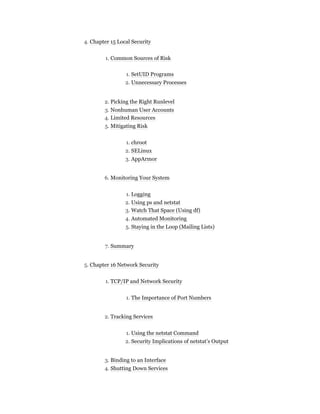
19.
4. Chapter 15Local Security
1. Common Sources of Risk
1. SetUID Programs
2. Unnecessary Processes
2. Picking the Right Runlevel
3. Nonhuman User Accounts
4. Limited Resources
5. Mitigating Risk
1. chroot
2. SELinux
3. AppArmor
6. Monitoring Your System
1. Logging
2. Using ps and netstat
3. Watch That Space (Using df)
4. Automated Monitoring
5. Staying in the Loop (Mailing Lists)
7. Summary
5. Chapter 16 Network Security
1. TCP/IP and Network Security
1. The Importance of Port Numbers
2. Tracking Services
1. Using the netstat Command
2. Security Implications of netstat’s Output
3. Binding to an Interface
4. Shutting Down Services
20.
1. Shutting Downxinetd and inetd Services
2. Shutting Down Non-xinetd Services
5. Monitoring Your System
1. Making the Best Use of syslog
2. Monitoring Bandwidth with MRTG
6. Handling Attacks
1. Trust Nothing (and No One)
2. Change Your Passwords
3. Pull the Plug
7. Network Security Tools
1. nmap
2. Snort
3. Nessus and OpenVAS
4. Wireshark/tcpdump
8. Summary
13. Part IV Internet Services
1. Chapter 17 Domain Name System (DNS)
1. The Hosts File
2. How DNS Works
1. Domain and Host Naming Conventions
2. The Root Domain
3. Subdomain
4. The in-addr.arpa Domain
5. Types of Servers
3. Installing a DNS Server
1. Understanding the BIND Configuration
File
2. The Specifics
21.
4. Configuring aDNS Server
1. Defining a Primary Zone in the
named.conf File
2. Defining a Secondary Zone in the
named.conf File
3. Defining a Caching Zone in the
named.conf File
5. DNS Records Types
1. SOA: Start of Authority
2. NS: Name Server
3. A and AAAA: Address Records
4. PTR: Pointer Record
5. MX: Mail Exchanger
6. CNAME: Canonical Name
7. RP and TXT: The Documentation Entries
6. Setting Up BIND Database Files
1. DNS Server Setup Walkthrough
7. The DNS Toolbox
1. host
2. dig
3. resolvectl
4. nslookup
5. whois
6. nsupdate
7. The rndc Tool
8. Configuring DNS Clients
1. The Resolver
2. Configuring the Client (Traditional)
9. Summary
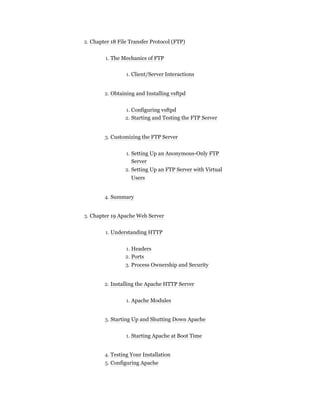
22.
2. Chapter 18File Transfer Protocol (FTP)
1. The Mechanics of FTP
1. Client/Server Interactions
2. Obtaining and Installing vsftpd
1. Configuring vsftpd
2. Starting and Testing the FTP Server
3. Customizing the FTP Server
1. Setting Up an Anonymous-Only FTP
Server
2. Setting Up an FTP Server with Virtual
Users
4. Summary
3. Chapter 19 Apache Web Server
1. Understanding HTTP
1. Headers
2. Ports
3. Process Ownership and Security
2. Installing the Apache HTTP Server
1. Apache Modules
3. Starting Up and Shutting Down Apache
1. Starting Apache at Boot Time
4. Testing Your Installation
5. Configuring Apache
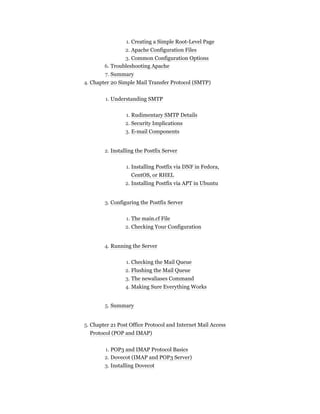
23.
1. Creating aSimple Root-Level Page
2. Apache Configuration Files
3. Common Configuration Options
6. Troubleshooting Apache
7. Summary
4. Chapter 20 Simple Mail Transfer Protocol (SMTP)
1. Understanding SMTP
1. Rudimentary SMTP Details
2. Security Implications
3. E-mail Components
2. Installing the Postfix Server
1. Installing Postfix via DNF in Fedora,
CentOS, or RHEL
2. Installing Postfix via APT in Ubuntu
3. Configuring the Postfix Server
1. The main.cf File
2. Checking Your Configuration
4. Running the Server
1. Checking the Mail Queue
2. Flushing the Mail Queue
3. The newaliases Command
4. Making Sure Everything Works
5. Summary
5. Chapter 21 Post Office Protocol and Internet Mail Access
Protocol (POP and IMAP)
1. POP3 and IMAP Protocol Basics
2. Dovecot (IMAP and POP3 Server)
3. Installing Dovecot
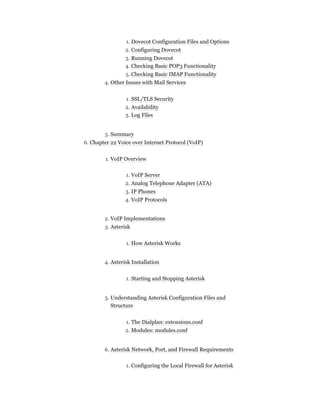
24.
1. Dovecot ConfigurationFiles and Options
2. Configuring Dovecot
3. Running Dovecot
4. Checking Basic POP3 Functionality
5. Checking Basic IMAP Functionality
4. Other Issues with Mail Services
1. SSL/TLS Security
2. Availability
3. Log Files
5. Summary
6. Chapter 22 Voice over Internet Protocol (VoIP)
1. VoIP Overview
1. VoIP Server
2. Analog Telephone Adapter (ATA)
3. IP Phones
4. VoIP Protocols
2. VoIP Implementations
3. Asterisk
1. How Asterisk Works
4. Asterisk Installation
1. Starting and Stopping Asterisk
5. Understanding Asterisk Configuration Files and
Structure
1. The Dialplan: extensions.conf
2. Modules: modules.conf
6. Asterisk Network, Port, and Firewall Requirements
1. Configuring the Local Firewall for Asterisk
25.
7. Configuring thePBX
1. Local Extensions
2. Outside Connection (VoIP Trunking)
3. Trunking Using Twilio Elastic SIP Trunks
8. Asterisk Maintenance and Troubleshooting
1. Asterisk CLI Commands
2. Helpful CLI Commands
3. Common Issues with VoIP
9. Summary
7. Chapter 23 Secure Shell (SSH)
1. Understanding Public Key Cryptography
1. Key Characteristics
2. SSH Backstory (Versions)
1. OpenSSH and OpenBSD
2. Alternative Vendors for SSH Clients
3. Installing OpenSSH on RPM-Based
Systems
4. Installing OpenSSH via APT in Ubuntu
3. Server Startup and Shutdown
4. SSHD Configuration File
5. Using OpenSSH
1. Secure Shell (ssh) Client Program
2. Secure Copy (scp) Program
3. Secure FTP (sftp) Program
6. Files Used by the OpenSSH Client
7. Summary
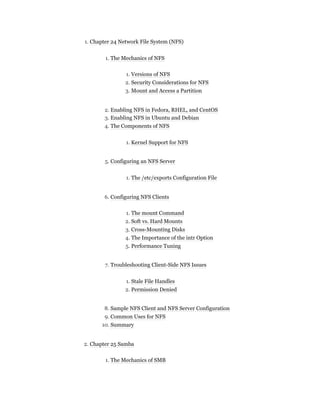
14. Part V Intranet Services
26.
1. Chapter 24Network File System (NFS)
1. The Mechanics of NFS
1. Versions of NFS
2. Security Considerations for NFS
3. Mount and Access a Partition
2. Enabling NFS in Fedora, RHEL, and CentOS
3. Enabling NFS in Ubuntu and Debian
4. The Components of NFS
1. Kernel Support for NFS
5. Configuring an NFS Server
1. The /etc/exports Configuration File
6. Configuring NFS Clients
1. The mount Command
2. Soft vs. Hard Mounts
3. Cross-Mounting Disks
4. The Importance of the intr Option
5. Performance Tuning
7. Troubleshooting Client-Side NFS Issues
1. Stale File Handles
2. Permission Denied
8. Sample NFS Client and NFS Server Configuration
9. Common Uses for NFS
10. Summary
2. Chapter 25 Samba
1. The Mechanics of SMB
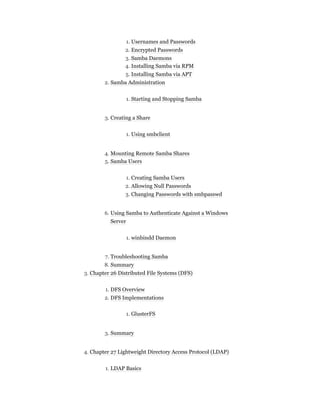
27.
1. Usernames andPasswords
2. Encrypted Passwords
3. Samba Daemons
4. Installing Samba via RPM
5. Installing Samba via APT
2. Samba Administration
1. Starting and Stopping Samba
3. Creating a Share
1. Using smbclient
4. Mounting Remote Samba Shares
5. Samba Users
1. Creating Samba Users
2. Allowing Null Passwords
3. Changing Passwords with smbpasswd
6. Using Samba to Authenticate Against a Windows
Server
1. winbindd Daemon
7. Troubleshooting Samba
8. Summary
3. Chapter 26 Distributed File Systems (DFS)
1. DFS Overview
2. DFS Implementations
1. GlusterFS
3. Summary
4. Chapter 27 Lightweight Directory Access Protocol (LDAP)
1. LDAP Basics
28.
1. LDAP Directory
2.Client/Server Model
3. Uses of LDAP
4. LDAP Terminology
2. OpenLDAP
1. Server-Side Daemons
2. OpenLDAP Utilities
3. Installing OpenLDAP
4. Configuring OpenLDAP
5. Configuring slapd
6. Starting and Stopping slapd
3. Configuring OpenLDAP Clients
1. Creating Directory Entries
4. Searching, Querying, and Modifying the Directory
5. Using OpenLDAP for User Authentication
1. Configuring the Server
2. Configuring the Client
6. Summary
5. Chapter 28 Printing
1. Printing Terminologies
2. The CUPS System
1. Running CUPS
2. Installing CUPS
3. Configuring CUPS
3. Adding Printers
1. Local Printers and Remote Printers
2. Using the Web Interface to Add a Printer
3. Using Command-Line Tools to Add a
Printer
29.
4. Routine CUPSAdministration
1. Setting the Default Printer
2. Enabling, Disabling, and Deleting Printers
3. Accepting and Rejecting Print Jobs
4. Managing Printing Privileges
5. Managing Printers via the Web Interface
5. Using Client-Side Printing Tools
1. lpr
2. lpq
3. lprm
6. Summary
6. Chapter 29 Dynamic Host Configuration Protocol (DHCP)
1. The Mechanics of DHCP
2. The DHCP Server
1. Installing DHCP Software via RPM
2. Installing DHCP Software via APT in
Ubuntu
3. Configuring the DHCP Server
4. A Sample dhcpd.conf File
3. The DHCP Client Daemon
4. Summary
7. Chapter 30 Virtualization
1. Why Virtualize?
1. Virtualization Concepts
2. Virtualization Implementations
1. Hyper-V
2. Kernel-Based Virtual Machine (KVM)
30.
3. QEMU
4. VirtualBox
5.VMware
6. Xen
3. KVM
1. KVM Example
2. Managing KVM Virtual Machines
4. Setting Up KVM in Ubuntu/Debian
5. Containers
1. Containers vs. Virtual Machines
2. Docker
6. Summary
8. Chapter 31 Backups
1. Evaluating Your Backup Needs
1. Amount of Data
2. Backup Hardware and Backup Medium
3. Network Throughput
4. Speed and Ease of Data Recovery
5. Data Deduplication
6. Tape Management
2. Command-Line Backup Tools
1. dump and restore
2. tar
3. rsync
3. Miscellaneous Backup Solutions
4. Summary
15. Part VI Appendixes
1. A Creating a Linux Installer on Flash/USB Devices
1. Overview
31.
1. Native Solutions
2.Distro-Specific Solutions
3. Universal Solutions
2. B Demo Virtual Machine and Container
1. Basic Host System Requirements
2. Installing the Virtualization Applications and
Utilities
3. Download and Prep the Demo VM Image File
4. Import the Demo VM Image and Create a New VM
Instance
1. Managing the Demo Virtual Machine
5. Connecting to the Demo VM
1. Virtual Network Computing (VNC)
2. Virtual Serial TTY Console
3. Connecting via SSH
4. Cockpit Application
5. Just Use It!
6. Demo Containers (Docker, podman, buildah, and
kubectl)
7. Feedback
16. Index
Guide
1. Cover
2. Title Page
3. Linux Administration: A Beginner’s Guide, Eighth Edition
Page List
1. i
32.
2. ii
3. iii
4.iv
5. v
6. vi
7. vii
8. viii
9. ix
10. x
11. xi
12. xii
13. xiii
14. xiv
15. xv
16. xvi
17. xvii
18. xviii
19. xix
20. xx
21. xxi
22. xxii
23. xxiii
24. xxiv
25. xxv
26. xxvi
27. xxvii
28. xxviii
29. xxix
30. xxx
31. 1
32. 2
33. 3
34. 4
35. 5
36. 6
37. 7
38. 8
39. 9
40. 10
41. 11
42. 12
"Good-bye," said Po-ca-hun-tas,giving him her hand again, after the
fashion of the white people.
"Good-bye, my daughter," he answered. "May we soon meet again
when there will be no danger in the meeting."
Po-ca-hun-tas slipped away into the forest as silently as she had
come, and threaded her way safely home to her own "long house."
No one knew she had been out of bed. When the Algonquin braves,
in war paint, reached the bank of the York River they found only the
embers of a camp-fire to show that the white men had waited for
them there.
35.
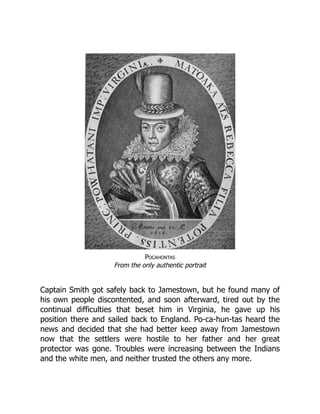
Pocahontas
From the onlyauthentic portrait
Captain Smith got safely back to Jamestown, but he found many of
his own people discontented, and soon afterward, tired out by the
continual difficulties that beset him in Virginia, he gave up his
position there and sailed back to England. Po-ca-hun-tas heard the
news and decided that she had better keep away from Jamestown
now that the settlers were hostile to her father and her great
protector was gone. Troubles were increasing between the Indians
and the white men, and neither trusted the others any more.
36.
When she wassixteen Po-ca-hun-tas was visiting friends in another
village on the James when she was suddenly made prisoner by a
man named Captain Argall, a trader, who decided to hold the Indian
girl as hostage for the friendship of Pow-ha-tan. He took her to
Jamestown, and there Po-ca-hun-tas was given a certain amount of
liberty and met again some of the boys and girls she had played with
before. They all liked her, and although she missed her free life in
the woods she found so much that was new and strange to interest
her that she was not sorry to stay for a time in Jamestown. Here she
soon met a young Englishman named John Rolfe, who was much
attracted by her, and who at length asked her to marry him. She
consented, and a short time after their marriage she sailed with him
to visit his home across seas in England.
The people of London had seen few Indians and were very curious
to learn more about them. They were charmed with Mistress John
Rolfe, or the Princess Po-ca-hon-tas of Pow-ha-tan, as they liked to
call her. Captain John Smith met her again and told his friends how
she had saved his life that night on the York River. The story spread,
and the Princess Po-ca-hon-tas found herself a heroine in England.
But she bore her honors very modestly, and was much happier alone
with her devoted husband than when she was being stared at by
crowds of strange people. She did not live to go back to Virginia or
see her own tribesmen again, but died in England when she was
only twenty-two.
Ma-ta-oka, or Pocahontas as we call her, was a real heroine, one of
the few daughters we know of that brave, romantic race which so
quickly vanished from America after the white settlers came. Many
among the Indians were cruel and bloodthirsty, many were
treacherous and sly, but Pocahontas we know was warm-hearted
and true, faithful to the great Captain she had admired before she
had even seen him and risking her life to save him from her father. It
is fortunate that history has kept her story, for we must always think
more kindly of the Indians when we remember the little daughter of
VIII
Priscilla Alden
The Girlof Plymouth: About 1604—after 1680
Two girls stood on the deck of the Mayflower, hand clasped in hand,
their eyes fixed on a narrow strip of grayish shore beyond the waste
of tossing ocean. About them stood others, men and women and a
few children, all looking in the same direction, wonder and
satisfaction and a certain awe in their faces. They had been at sea
for nearly thirteen weeks, and during most of that time their little
ship had been buffeted by constant storms.
"Mary dear," said one of the girls to the other, "can you really believe
that yonder low line is land?"
"I doubted if it could be when John first pointed it out to me,"
answered the other, "but now I'm sure of it. I can almost see the
breakers on the shore. Do you know, Priscilla, that that's where you
and I are to live and that we may never see England again?" Her
hand tightened on her friend's and her dark eyes turned towards
her.
"Our home!" murmured Priscilla softly. "It looks bleak enough from
here. I hope we find it pleasant country inland."
All over the Mayflower men and women were pointing out the shore
to one another and calling it their home. They had come from
England to find a land where they might worship God in their own
way, and had sailed over the wide and stormy Western sea to found
a new colony in this new and almost unknown land.
39.
Columbus had hadgreat faith when he held his course to the west in
spite of the protests of all his men, but these simple Pilgrims had no
less faith when they started out to make a new home in an
unexplored continent where other settlers had already met with
famine, pestilence, and savage redmen. They were a brave, deeply
religious people, ready to stand the hardships that lay in wait for
them, confident that God was with them and that they were doing
what was right for them to do. This was the spirit that had given
them courage to face many difficulties, for already they had met
with troubles that would have daunted less determined people. They
had had two ships when they had sailed from Southampton on the
fifth of August, 1620, but at the very outset the smaller vessel, the
Speedwell, had sprung a leak, and had to put back to port. A second
time the two ships had started, but again the Speedwell proved
unseaworthy, and they had returned to Plymouth. This time there
were disputes among the officers and some of the men had left, but
the Mayflower had sailed at last on September sixth with one
hundred and two on board. Then they had met with bad weather, so
that instead of reaching the new world in the autumn as they had
planned, it was already November before they sighted the shore of
America. It took brave, persevering spirits to face the odds that
stood in front of them.
Presently a young man came up to the two girls. "We're farther
north than we thought to land," said he. "The Dutch settlements lie
to the south. But they've decided to try this place now we're here,
and by night some may set foot on shore."
"Do you think we can go in the first boat, John?" asked Mary Chilton
eagerly.
John Alden shook his head. "Only a few of the men are to land with
Miles Standish. They're to explore and come back to report. There
may be Indians settled about here."
"I wish I were a man," sighed Mary.
40.
"There'll be plentyfor girls to do once we're ashore," answered
John.
"We've waited a month," put in Priscilla. "I guess we can wait a few
days more to land."
John Alden moved away to examine his matchlock gun for the
hundredth time, and the two girls, who were close friends, tried to
wait as patiently as they could while the Mayflower drew in towards
shore. They went down to the cabin for their simple dinner and then
returned on deck. Now the land stretched before them in a clear
line, a low, barren shore that looked of little promise. The chill
November day made the country seem most inhospitable, and many
on board were already homesick for the green fields and flowering
meadows of England. Mary Chilton and Priscilla Mullins moved about
among the women and children, cheering them with their own
hopefulness.
By nightfall the Mayflower had rounded a point of the coast and
come into a small land-locked harbor, where it seemed as if a
thousand vessels might find safe anchorage. Here the shores
appeared more promising, and many eager eyes strained through
the dusk to see what the site of their future home might be like. It
was too dark to send explorers ashore, so the Mayflower dropped
anchor, and the Pilgrims prepared to go to bed. Before they slept
they gathered in the cabin and with bent heads listened to John
Carver give thanks to God that they had been brought safely across
the sea and in sight of their promised land.
Next day Priscilla and Mary watched Captain Miles Standish and a
score of men lower the shallop and set out towards shore. John
Alden smiled up at the girls as they hung over the rail, and they
waved their kerchiefs to him and to the ruddy-faced Captain
Standish who stood up in the bow to direct the shallop's course.
Then they had to wait as patiently as they could to learn what the
explorers might report.
41.
Standish's party spenttwo days exploring the land about the harbor,
which formed the tip of what we now call Cape Cod. They found that
the land was fertile, as was shown by the fact that the Indians had
cleared much of the ground for planting and had left a magazine of
corn. They caught a distant glimpse of a few Indians, but the latter
fled as soon as they saw Captain Standish's men.
When the explorers returned to the Mayflower and made their report
the leaders of the Pilgrims were in two minds as to whether to settle
on this shore or to seek another site farther to the west. Those who
wanted to settle here spoke of the good harbor for ships, the fact
that the Indians had already tilled the soil, and the chances that they
might find good whale fishing off the coast. They added that they
were tired with the long sea voyage and unfit to go further, and that
with winter almost at hand exploration would be very difficult. But
the others objected that it would be unwise to settle permanently
without having looked a little farther to the west, and the larger
number of the leaders agreed with this view. Therefore on the next
day the shallop was sent out again with eighteen men on board to
explore more of the coast. Eight men stayed on the shallop while the
rest landed and went along the shore. Their journey lasted three
days, and on the third morning the land party had just started to eat
breakfast by their camp-fire when suddenly they heard a series of
wild war-cries, and a shower of arrows struck all about them. At the
same time Indians in ambush on the beach sent their arrows at the
men in the small boat. Captain Standish and his men seized their
muskets and in a moment more the Indians were flying before the
fire that leaped from the muzzles. Not one of the Pilgrims was
wounded, and soon they were on their way along the shore again,
this time more careful to keep a watch for the hidden redmen.
Presently they embarked in the shallop and sailed across the bay,
reaching a place nearly opposite the point of Cape Cod. Here they
found fertile land, a good supply of water, and a protected harbor. It
seemed the ideal spot for which they had been looking, and they
42.
decided to maketheir new home here. The Indian name of this
place, Accomac, had already been changed to Plymouth, which it
happened was also the name of the English seaport from which the
Pilgrims had finally set sail.
The people on board the Mayflower eagerly hailed the returning
explorers. They were growing impatient at being kept on the ship
when the land stretched invitingly before them. Priscilla and Mary,
with the rest, heard Captain Standish tell of the place he had
discovered, and shortly afterward they themselves saw it from the
vessel's deck. Now all was excitement. The different families made
ready to leave the ship which had been their home for nearly seven
weeks and set up their household goods on shore. In the first boat
load went Priscilla and Mary Chilton, and Mary was the first woman
to set foot on Plymouth soil. The two girls looked about them, at the
long beach, the cleared corn land, and the high hill beyond with its
commanding view over the wide bay. Priscilla turned to her father.
"How strange that this should be our home!" said she. "And yet I
feel almost a love for it already."
"I pray you may, my daughter," he answered, "for it is like to be the
only home any of us are henceforth to know."
If it had taken courage to face the perils of the sea it took scarcely
less to face those of the new land. It was already December and
growing more and more cold with each day. Their store of provisions
was almost gone, and there could be no harvest here until spring.
Some of the women and children were sick, and none knew how the
Indians might look upon their coming. But the little band of Pilgrims
set to work with stout hearts, determined to carry out the purpose
on which they had started. They chose John Carver Governor and
Miles Standish Captain of their troops, and set to work to build log
houses for the winter's shelter.
Priscilla was strong and she helped her father in his work during that
long hard winter. There was plenty for all to do, but many had not
43.
the strength toaccomplish what was needed. There was a great
deal of illness and very little good food. The weather made it almost
impossible for the men to hunt or to find wild fruits, and they had
neglected to bring fishing-tackle with them. Their provisions were
eked out with shellfish, but it was hard to gather these in the cold
water. Other colonies in the new world had already been forced to
give up their homes in fear of starvation, but this band held on,
although half their number died, and at one time there were only
seven who were not sick. Fortunately the Indians gave them little
trouble. One day one of them walked into the village and spent the
night there, showing friendliness, although Captain Standish
watched him closely, having little faith in his pretensions. A day or
two later he returned bringing five others, and then there came
another named Tis quantum, who had once been taken as a
prisoner to London, and who understood something of the strange
white people and their ways. With his aid a treaty was made with
Massasoit, the chief of the Indians in that part of the country, and
each side agreed to live in harmony and concord with the other.
Many of the Indians already had a superstitious fear of the men from
across the sea, not only on account of their wonderful "fire-tubes"
but for another reason. Some Indians had a few years before
captured a French trading-ship, and killed all the crew but five,
whom they kept as prisoners. One of these had warned the redmen
that the God of the white people would not let these wrongs go
without some punishment, and very soon afterward pestilence had
broken out on the coast and killed many of the Indians who lived
there. Those who survived recalled the Frenchman's words and
believed that pestilence was a weapon like the "fire-tube" which the
white men kept in their camps to use against their enemies.
Therefore they were very careful how they treated these new
arrivals who had settled at Accomac.
But if the winter was hard and starvation stared them in the face
and sickness was rife in Plymouth the Pilgrims worked on, confident
44.
that they weredoing the will of God. This was the spirit of young as
well as of old, and the thought that must often have cheered Priscilla
as she looked from the door of the rude log-cabin over leagues of
snow to a lowering sky. But there were bright hours even in that first
winter. Sometimes Captain Standish or John Alden or others of the
men would bring logs of red cedar from the near-by forest to the
Mullins cottage and pile them on the hearth. Then they would have
a great fire and all the family would gather round it, and neighbors,
seeing the smoke, would come through the path cut in the deep
snow to the Mullins door and join in the warmth and the stories at
the hearth. Many a day Priscilla and Mary spent at the spinning-
wheel, talking of old play-mates in England while their feet kept the
wheels going and the carded wool piled up about them on the floor.
At other times, when the weather was clearer, they would go down
to the beach and walk its length until they came to a great rock.
There they would sit and talk of what they would do when summer
came and the sea should be calm and the woods full of wild flowers.
Sometimes they would sing, for both girls had good voices, sending
the words of the old hymns of the Pilgrims far out across the
breakers. Slowly the winter passed and Priscilla had her first taste of
spring in New England.
Hope sprang up fresh in the hearts of these Pilgrims as they saw the
snows melt and the days grow longer. They began to build bigger
and stronger houses and to prepare the fields for crops. Whenever
they could be spared from home Priscilla and Mary and the few
other girls in the village went out to the woods. There the trees were
putting forth their buds, and one day they came upon a fragrant
rose-colored flower which they had never seen before and which
they named the Mayflower. Soon the woods were full of them, and
the girls gathered armfuls to take back to their log homes. Beyond
the circle of green woods they found many ponds and on their banks
another white and red flower called the azalea, and in the water
were wide lily pads and still farther beyond bushes of the soft snowy
45.
pink-hued laurel. Inthe evenings they would climb to the hill back of
Plymouth and, seated there, look over the tiny gathering of houses
to the open bay where the light high up in the rigging of the
Mayflower shone like a planet low down in the sky. There they would
talk of England, and of how by this time the hawthorne must be in
bloom and the hedgerows all in blossom and the small stone
churches mantled in ivy and the lark singing as he soared above the
tower. But although they talked much about England, they were
already very fond of their new home, and when they heard that the
Mayflower was to sail back to England they did not say that they
would like to sail on her.
The Mayflower left in the early spring and at nearly the same time
John Carver, the first Governor, died. The settlers chose William
Bradford Governor in his place. Building and farming was now
progressing rapidly and the town began to take definite shape. It
stood on rising ground only a short distance from the beach. Two
streets crossed one another and where they met stood the
Governor's house with an open common in front of it. Four cannon
were placed in the common, one pointing down each of the four
streets. A little above the town they built a big house, which was
used as a church, as a public storehouse for provisions, and also as
a fort. Here were more cannon, and here the settlers gathered with
their matchlocks whenever there was an alarm of Indians. The
settlers' dwelling-houses were simply big log huts, each standing in
its own enclosed piece of ground. Round the whole settlement ran a
heavy palisade, open in front towards the ocean, but guarded on the
other three sides by gates. Beyond the palisade lay the farming land,
divided into many small patches of corn fields. The whole village was
like one big family, all equally concerned in the common lot.
The men of Plymouth were more fortunate in their dealings with the
Indians than those of Virginia had been. At the very start they had
won Massasoit, chief of the Pokanokets, to their side, and now they
had a chance to strengthen that tie. Word came to Governor
46.
Bradford that theIndian chief was very ill and that his native doctors
could do nothing for him. The Governor sent Edward Winslow to the
chief, and he, knowing far more of medicine than the Indians did,
was able to cure Massasoit in a short time. The chief was very
grateful and vowed that if ever the men of Plymouth should need his
aid he would come instantly with all his braves to help them. But
other chiefs were not so friendly, and soon after Canonicus, chief of
the Narragansetts, a tribe that was always warring with the
Pokanokets, took offense at the alliance between his enemies and
the white men. He sent a messenger to Governor Bradford, carrying
a bundle of arrows wrapped in a rattlesnake's skin. An Indian who
happened to be in Plymouth told the Governor that the message
meant hostility on the part of the Narragansetts. The Governor
threw away the bundle of arrows and sent the skin back filled with
powder and balls. This threat from the settlers frightened Canonicus
and he would not take the war-path against them. Realizing that
they were not to be dismayed, he sent other messengers to treat
with them, and arranged to trade with them in corn and furs.
So far Priscilla's life had been much like that of the other girls of
Plymouth, patient, enduring, brave, but with few adventures except
such as fell to the whole colony of Pilgrims. Now her life became
more dramatic. The valiant, vigilant captain of the colony, Miles
Standish, wanted her to be his wife.
Miles Standish was not by nature like the men who had crossed the
sea with him to find a home. He was a soldier first and foremost, a
man who had quarreled with his family in England and gone forth to
seek his fortune with his sword. He had been in many battles, he
had married, and at last, hearing of the Pilgrims' plans to sail for
America he had decided to throw in his lot with theirs. They had
made him their captain and he had proved himself a good one, and
he had become one of the leading men, and one of the most
popular in Plymouth. But the weather was too severe for his fair
English wife Rose, and she had died soon after they landed. A year
47.
later he foundthat he had lost his adventurous soldier's heart to the
pretty Priscilla Mullins.
Captain Standish knew that he was readier with sword and musket
than with the words to win a young girl's love. He was much
perplexed as to what he should do until he thought of his friend
John Alden, who was quick of wit, and ready of tongue and pen, and
who had before now written many a letter for the Captain. So he
went to John Alden and begged him in the name of their friendship
to call upon Mr. Mullins and ask him if he would give his daughter's
hand to the Captain, and if he agreed then to plead his cause with
Priscilla.
John and Priscilla had been brought up together and were close
friends, and when the Captain made his request of John the youth
discovered that he himself was in love with Priscilla. But he felt in
honor bound to do what the Captain asked of him, and so, with a
heavy heart he went to the Mullins house. Priscilla's father listened
while John asked if Miles Standish might have his consent to marry
his daughter, and at the end willingly agreed. Then John went to the
room where the girl sat at her spinning-wheel, and even as he
entered his foot faltered and he turned very pale. With his eyes bent
on the floor and his voice hesitating he told her that he came from
Captain Standish to ask if she would marry him. Priscilla was
astonished; the Captain was older than she and had been so busy
that she had seen little of him. John Alden had been her comrade
and she cared more for him than she had ever dared admit to
herself. He looked so pale and distressed as he stood there before
her that she wondered what might be the cause. Then the reason
flashed upon her. With downcast eyes and a voice that was only a
whisper she spoke to him. "Why don't you speak for yourself, John?"
was what he heard her say.
John wondered if he could have understood aright. Then she looked
up at him and he knew that it was him she loved and that she had
48.
no room forStandish in her heart. So, still trembling, he asked her
to marry him instead of Standish, and she said she would. But even
in his joy John feared that he had proved a traitor to his friend.
Dark days followed for the lovers. John had to give his message to
the Captain, and it was no easy telling. For days he carried with him
the feeling of treachery, and he spent many nights walking on the
shore, distrustful of himself and of the love that had come to him in
such fashion. Priscilla was scarcely happier, for the same thought
was with her, and she knew it was she who had put the words into
John Alden's mouth. Then came news that Captain Standish had
been sent on an expedition against the Indians, and both Priscilla
and John feared that in a moment of rashness over his
disappointment he might expose himself recklessly in battle, and so
the colony lose its best guardian and captain.
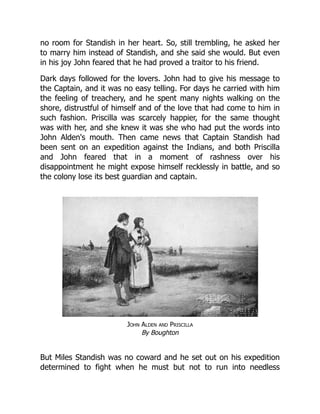
John Alden and Priscilla
By Boughton
But Miles Standish was no coward and he set out on his expedition
determined to fight when he must but not to run into needless
49.
dangers. A threedays' march brought him to the Indian
encampment, but it seemed as peaceful as the town that he had
left. Women were at work in the fields and about the tents, but
there were no braves in sight. After a short détour he discovered
them, their bodies covered with war paint, seated about a fire,
handing a smoking pipe from one to another. One of them caught
the glint of sun on the Captain's armor and spoke to the others, and
then two rose and came towards Standish. They spoke peacefully,
saying that they wanted to be friends with the white men, and
would like to trade skins and corn for knives and muskets and the
mysterious powder the white men used in their "fire-tubes."
Standish offered them blankets but refused to give them arms or
powder. Then their manner changed very quickly, and pointing to the
knives at their belts they began to tell the white men what they
would do to their settlement unless they would come to terms. In
the meantime the wary Captain had noted how the other Indians
had left the fire and were creeping up towards him on all sides,
fixing arrows to their bowstrings as they came, but pretending that
they were only going back to their tents. He waited, like a tiger
ready to spring, while the chief worked himself up into a passion
with his threats. Suddenly the chief drew his knife and raised it high,
giving the war-cry. At the same instant Standish sprang forward, and
before the Indian's knife could fall he had plunged his own into the
redman's breast. The chief fell, and instantly a storm of arrows
swept about Standish and his men and the braves leaped forward,
crying their wild war-whoops. The white men turned back to back,
and, leveling their muskets, sent a deadly fire at the advancing
braves. The latter, always frightened at this mysterious sight and
sound, turned and fled, leaving their chief, Wattawamat, dead in
front of Standish. Then the Captain cut off the head of the Indian
and carried it back with him to Plymouth, where it was stuck on a
pike from the roof of the fort as a warning to other warring redmen.
Such acts were part of the customs of those times, and the elders of
Plymouth approved of the Captain's deed, but one elder, named
50.
John Robinson, whowas the religious leader of them all, cried out as
he passed the fort, "Oh, that he had converted some before he killed
any!"
If Miles Standish had flared up in anger when John Alden first told
him the result of his suit of Priscilla that anger dropped as quickly as
it rose. The Captain had many other matters to think about, what
with the constant fear of attack from restless Indians, and he was
away from Plymouth almost as much as he was there. So the lovers
lost the feeling that they had not been fair to him, and let it be
known through Plymouth that they were to marry.
Meanwhile the Pilgrim village was prospering. Food was plentiful, for
the first harvest had been good, and the hunters had brought in
deer and the fishing-boats returned well-laden from the sea.
Therefore the Governor ordered a day of thanksgiving late in the
autumn, and when that day came the people went to the fortress-
church on the hill and gave thanks to God that He had allowed them
to endure and prosper in their new home. Later in the day they
feasted, and never had Plymouth seen such a plentiful repast. Word
of the feast had been sent to some of the neighboring Indians and
ninety of them came and sat about the board with the white men.
That was the beginning of our Thanksgiving Day.
John Alden was busy building a new house for his bride. He could
build better now than the settlers had been able to do when they
faced that first winter. He chose his ground with care, and built a
substantial home, covering the roof with rushes, and filling the
latticed windows with panes of oiled paper, which let the light come
through but not the wind or rain. He dug a well and planted an
orchard at the rear of the house, and when the place was finished it
was one of the finest in Plymouth. In the spring Priscilla and John
were married, their wedding being one of the earliest in the colony,
and Priscilla being the first of the girls who had sailed on the
Mayflower to change her name.
51.
History does nottell us a great deal about this girl of the Pilgrims,
but we do know how much courage and faith and constancy was
required of the first settlers of New England. We picture Priscilla as
the daughter of such people, devout, simple, and from force of the
rude life about her growing more and more self-reliant from the day
when Mary Chilton and she first set foot on Plymouth Rock. History
does not tell us of Priscilla's wooing, but the romantic story has been
so wonderfully put in poetry by Longfellow that when we hear
Priscilla Alden mentioned we think first of all of "The Courtship of
Miles Standish." It is a story which ought to be true, if it is not.
We know that Captain Standish and John Alden were friends at a
later time, for when the Captain married his second wife he built his
house over on Duxbury Hill, near where John Alden's stood, and his
son married the daughter of John and Priscilla. So the blunt, brave
Captain did not die of a broken heart.
Such is the story of this girl of the Pilgrims and of the brave days
when the foundation stones of our land were being laid.
52.
IX
Catherine the Great
TheGirl of Stettin: 1729-1796
"Come with me," whispered a small boy to a little girl who was
standing, looking rather lonely, in one of the long corridors of a
house in the North German town of Eutin.
"Come along," he added, still in a whisper, and tiptoed down the
hall. The girl followed and saw him stop at a doorway and peep into
the room beyond. Apparently satisfied he entered, and she, her
curiosity roused, went into the room after him.
It was a bare apartment, with walls once white but now gray, small
barred windows, a ceiling supported by rough timbers, and a
wooden floor, uneven and uncarpeted. On a bench at one end stood
a large round tub of water and from pegs in the wall hung caps and
coats. It was the place where the few soldiers who were supposed
to guard the house lounged when off duty, and used as a dressing-
room. It was unoccupied now, and the boy, still on tiptoe, ran across
the bare floor to the tub of water.
Pulling some paper from his pocket the boy tore it into many pieces
and dropped three or four of them into the water. Then taking a
stick that lay on a bench he began to poke the papers. The girl
stood beside him. "See, Figchen," he whispered, "those are boats,
sailing on the great Baltic Sea. This one's heavy laden, see how she
rocks. That's her port over on the other side. Here comes a storm,"
and he stirred the water with his stick and sent the paper boats
tossing to the rim.
53.
"That's not muchof a pond, Peter," said the girl disdainfully. "We've
one in Stettin twice that big with live fish in it, and when we want to
have a storm we throw a stone into it."
But the little boy was too busy with his boats to listen to her. He
threw the rest of the papers into the tub and leaned so far over its
edge that he could see his fat cheeks and blue eyes mirrored in it.
"Look, Figchen, look," he cried excitedly, "there's a whole war-fleet
going over to the other side."
The girl, forgetting her disdain, bent over the rim and began to blow
down at the water.
Before they knew it there were quick steps on the floor behind them
and a man had seized Peter by the collar and jerked him back from
the tub. "Didn't I tell you not to go near that water again?" the man
demanded, his face and voice showing his anger. "What do you think
you are? You're a soldier, and a soldier's first duty is to obey orders.
For this you go to your room and do without dinner to-day."
The little boy stood with his back to the wall, looking much
frightened. "Oh, Herr Brummer——" he began.
"Not a word," ordered the man. "You've heard what I've said."
The girl had looked on in amazement. Now she took a step forward.
"You're a simpleton, Peter Ulric," she said. "Afraid of your tutor. Why
don't you send him away?"
Herr Brummer turned as if he had noticed the girl for the first time.
He bowed, smiling sarcastically. "Ach so; it is the Princess Sophia of
Zerbst who speaks? And you would advise Prince Peter of Holstein to
disobey his tutor?"
The girl's eyes met the man's defiantly. "I would," she answered. "At
home, in Stettin——"
54.
"Well, we're notin Stettin," broke in the man, turning back. "Go to
your room, boy, and stay there till I come for you. And if I find you
playing here again I'll make you kneel on dried peas till you can't
stand up."
The boy, used to being treated in such fashion, went out of the
guard-room, his face surly and white.
"As for you," said Herr Brummer to the girl, "the sooner you go
home the better. You'll find Peter Ulric a dull playmate." With that he
turned on his heel and followed the little Prince of Holstein, and heir
to the thrones of Russia and Sweden, from the room.
Figchen, which was the nickname given to the Princess Sophia of
Zerbst, waited a moment and then went out into the garden at the
rear of the house. She was used to being left to her own devices,
but in her home town she could go out into the city squares and
play with other children, and here in Eutin she had been forbidden to
leave the house and its garden. She wished she were at home again,
and could not understand why her mother was so fond of traveling
about to visit her relations. She thought this particular court of
Holstein the dullest of them all, and little Peter Ulric the stupidest
boy she had ever met. He was stupid, there was no doubt of that,
but no one had ever cared enough about him to try and make him
more intelligent.
Children of rank had a dull time at the courts of the little German
duchies in those days. The Princess Figchen was better off than
Peter Ulric because she was a girl and did not have to be moulded
into a soldier, but she had little enough fun. Her father was very fond
of her, but he was a general in the army of Frederick the Great of
Prussia, and away from home most of the time. Her mother was vain
and capricious. The family were poor and only used the left wing of
their palace at Stettin. Here Figchen had three rooms, and her
bedroom was close to the bell-tower of the church, so that she was
wakened early every morning by a deafening peal of bells. She
55.
played in thestreets with the town children, none of whom called
her "Your Highness," and the children's mothers treated her just like
any other little girl.
Most of her time, however, she spent with her governess and
teachers. French was the fashion then and children were taught the
language, the manners, and the gallantry of Paris. The Princess was
bright but wilful, if she was interested she would learn quickly, if she
was not the teachers might storm and she would only laugh at
them. Her governess told her that her chin was too sharp, and that
by sticking it out she was always knocking against everybody she
came across. Figchen laughed and stuck her chin farther out. But in
her own way she was fond of her French governess and read a good
many French books with her.
Even though Figchen did like the girls of her own town better than
those she met elsewhere, her mother, who was restless and eager
for excitement, found Stettin very dull, and was continually traveling.
She had relatives in all the little German cities, and liked to visit
them at Hamburg, Brunswick, or Berlin, and hear the latest gossip.
So Figchen met most of the Grand Dukes and Duchesses of her
time, and was presented at Berlin to the powerful young Frederick
the Great, who was just beginning his remarkable career. This
visiting also gave her mother a chance to see the young Princes who
might be eligible for her daughter's hand, for it was the first concern
of a young German Princess to find a husband who would some day
wear a crown. But Figchen herself was not interested in these boys
with long titles to their names. Most of them seemed very stupid to
her, much like Peter Ulric of Holstein, taught to be a soldier instead
of being taught to be a gentleman.
Then, suddenly, when this little Princess of Zerbst was twelve years
old, strange events occurred in Europe. To the northwest of her
home lay the mighty country of Russia, still almost savage, but of
enormous size and of unknown strength. Only a short time before
56.
Peter the Greathad been Czar of Russia and had built up a great
Empire that overshadowed the little German duchies that lay along
its borders. One of Peter's daughters had married the Duke of
Holstein, and been the mother of the small Peter Ulric. Another was
the Princess Elizabeth, who had not married. Peter the Czar had a
half-brother Ivan, and Ivan's granddaughter was ruling as regent in
Russia for her little son named Ivan. Then on December 9, 1741, the
Princess Elizabeth, filled with her great father's ambition, suddenly
seized the throne, and threw the regent and the little Czar Ivan into
prison. The child's reign ended, and the unscrupulous woman took
the crown as the Empress Elizabeth. She was strong and could hold
it and that was all that counted in Russia then. The Empress looked
about for an heir and her eyes lighted on Peter Ulric, the son of her
sister. The regent in prison had always called him "the little devil,"
because she was afraid he might some day set aside her own Ivan.
"The little devil" disappeared from his home and reappeared at St.
Petersburg, and all the world learned that Elizabeth had proclaimed
him the Grand Duke Peter, her adopted son and heir to the crown
she wore. Figchen heard the news and wondered how such a stupid
boy could ever be Czar of Russia.
The Empress Elizabeth, like a fairy godmother, waved her wand
again, and this time it rested on Figchen herself. The Empress
ordered the little girl's portrait sent to her, despatched presents to
her and to her father and mother, and finally invited the Princess of
Zerbst to visit her in Moscow and to bring her daughter with her. The
ambitious mother knew what that meant. The Empress meant to
marry Figchen to the Grand Duke Peter. That was a more dazzling
destiny than she had ever dreamed of.
Mother and daughter started out for Moscow. They were poor and
did not need many boxes to carry their wardrobe. Traveling was
hard, and, it being January, the cold was so bitter they had to wear
masks to protect their faces. There were no hotels and they had to
stay at posting-houses, poor shacks where the landlord's family and
57.
his animals oftenslept under the same roof. There was no snow but
the four carriages in which the Princess and her suite traveled were
so heavy they required twenty-four horses to pull them. Sledges
were fastened to the backs of the carriages to be used later, and
these made their progress slower.
But when they crossed the frontier to Russia everything changed.
Troops met them, with flags flying and drums beating. Gallant
officers joined them and paid them compliments. Castles opened to
them and the ladies, shining with diamonds and silks, quite
overwhelmed the simple German Princess and her daughter. When
they reached St. Petersburg ladies of the court were ready to stock
their wardrobes with magnificent toilettes. The travelers were glad of
that, for they knew their own clothes would look shabby enough in
the presence of an Empress who was said to have 15,000 silk
dresses and no less than 5,000 pairs of shoes.
When they left St. Petersburg on their way to Moscow the Princess
and Figchen traveled in a magnificent sleigh, built like a great couch
with curtains of scarlet and gold, and lined inside with sable. The
ladies reclined on what was really a feather bed, with coverings of
satin and fur, and supported on springs so that the sleigh could pass
over the roughest road without disturbing the passengers inside.
Here they lay and looked out through the windows at the snowy
barren country all about them. Figchen was impressed. Used as she
was to the simplicity of the little German duchy, she could not help
wondering at so much extravagance and luxury, or thrilling at the
sight of the great Cossack soldiers and the Imperial grenadiers who
rode as her escort. So she began to realize the might of this great
northern country.
The Empress Elizabeth welcomed them warmly at her palace in
Moscow, and at once Figchen found herself surrounded by fawning
courtiers, ambitious women, and all the pomp and ceremony of a
court. Generals and statesmen struggled to kiss her hand, ladies to
58.
compliment her onher complexion, for they all knew now that the
little German maiden was to marry their Grand Duke Peter. She knew
it now also, but although she remembered how stupid and timid he
had seemed at Eutin, she made no objection, because her eyes were
dazzled with the wonders of this new life.
Peter Ulric had not improved since Figchen had last seen him. Herr
Brummer's iron hand no longer held him in check, and he had run
absolutely wild. His health was ruined, he was dissipated beyond
belief, cowardly, and as ignorant as his poorest soldier. He kissed
Figchen's hand, and said he was glad to see her, and then left her, to
drink himself stupid with vodka. The marriage promised to be about
as tragic as it well could be. But Figchen had more interesting things
to think about than Peter Ulric. She had to study a new religion, so
that she might enter the Russian Church, she had to have prepared
a great trousseau, and she had to try and learn in a short time some
of the things she had refused to learn at Stettin. Then she fell ill,
and was sick for days, while her mother and the Russian doctors
struggled as to the best way to cure her. The doctors advised blood-
letting but the Princess was very much opposed to it. They agreed to
refer the matter to the Empress, and found that she had gone on a
five days' visit to a distant convent where she had shut herself up in
one of her strange spasms of religion. Finally she appeared and
ordered the blood-letting. Poor Figchen suffered, but recovered.
When she regained consciousness she found herself in the arms of
the Empress, and in her hand a gift of a diamond necklace and a
pair of earrings worth 20,000 roubles. Figchen began to realize that
the Empress Elizabeth was a very singular person.
As soon as she was well again she finished making ready to enter
the Russian Church, and in June, 1744, when she was fifteen, she
made her new vows. She was a handsome girl, and her youth,
beauty, and modest manner made a charming picture as she entered
the imperial chapel. She wore what was called an "Adrienne" robe of
red cloth of Tours, laced with cords of silver, and about her
59.
unpowdered hair wasbound a simple white fillet. Her voice did not
tremble and she did not forget a word of the long Russian creed.
Then the new name of Catherine was added to her other names and
it was announced that henceforth that would be her official title. The
next day she was betrothed to Peter Ulric.
Peter's health was so bad that the wedding had to be put off from
one date to another, but finally, in August, 1745, when Peter was
seventeen, and Catherine sixteen, they were married with the
greatest pomp and ceremony. Figchen became a Grand Duchess and
wife to the next Czar of Russia, and her mother went home to
Stettin and left the girl, surrounded by her own court, to fight her
own battles.
No one had ever cared very much for Figchen, her father and
mother had let her grow up as she would, and the only thing that
was asked of her was that she should marry the prince they might
pick out for her. That was her idea of duty, and that she had done.
She had seen very little kindness, or consideration for others, or
happy home life in any of the German courts where she spent her
childhood. She had seen men trained to be soldiers and gamblers
and drunkards, and women who were vain and spiteful and
ambitious. In Russia she found things even worse than they had
been at home. The Empress was a tyrant who had put the rightful
Czar, a little boy, and his mother, in a distant prison, and planned to
keep them there all their lives. Figchen's husband cared nothing for
her, and soon appeared to have forgotten that she existed. If she
had disliked him when he was a boy she despised him now that he
was a young man. All around her were conspirators, and slanderers,
and spies. There seemed only one thing left to her, ambition,
tremendous ambition, such as had made Peter the Great and
Elizabeth mighty conquerors and rulers of Russia. So, cut off from all
other dreams, Catherine began to dream of that, and, as time went
on, she made plans for the future.
60.
Strange to say,although Figchen had always seemed a very quiet,
docile girl, Catherine proved a very strong, determined woman. She
kept her eye on what was happening in Russia, and she laid her
plans. Peter had showed he cared nothing for her, and she cared
nothing for him. More than that she knew that he would make the
worst possible Emperor of Russia, and she thought she knew some
one who would grace the throne much better.
The Empress Elizabeth died at a time when the Grand Duke Peter
was away from the capital. He heard the news and started for St.
Petersburg, but had not gone far when couriers brought him tidings
that Catherine had seized the throne, proclaimed herself Czarina,
and meant to rule alone. So she had. Dressed in the uniform of a
general she had appeared before the troops, and announced that
she was their new commander. Those rough soldiers knew that she
was strong and that Peter was weak, and they put the care of their
country in her hands. So the Empress Catherine II succeeded the
Empress Elizabeth.
61.
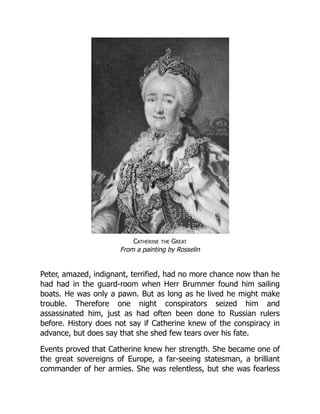
Catherine the Great
Froma painting by Rosselin
Peter, amazed, indignant, terrified, had no more chance now than he
had had in the guard-room when Herr Brummer found him sailing
boats. He was only a pawn. But as long as he lived he might make
trouble. Therefore one night conspirators seized him and
assassinated him, just as had often been done to Russian rulers
before. History does not say if Catherine knew of the conspiracy in
advance, but does say that she shed few tears over his fate.
Events proved that Catherine knew her strength. She became one of
the great sovereigns of Europe, a far-seeing statesman, a brilliant
commander of her armies. She was relentless, but she was fearless
62.
as well, anda century which had given the title of Great to Peter the
First, and to the warrior Frederick of Prussia, paid the same tribute
to her. She had only been taught the value of power in her girlhood,
and that was all she came to care for later. The wonder of it is that
the little Figchen who used to play with the town children in the
streets of Stettin should have become the masterful Catherine the
Great.
63.
X
Fanny Burney
The Girlof London: 1752-1840
A girl sat at a desk in a small third-story room of Dr. Charles
Burney's house in London, writing as rapidly as her quill-pen could
travel over the paper. It was a December afternoon, and the light
was not very bright, so that she had to lean far forward until the end
of her nose almost touched the tip of her pen. Now and then a smile
would cross her lips or she would stop a moment to reread a
sentence or two and nod her head, but for the most part she kept
steadily on, very much in earnest in what she was doing. On one
corner of the desk lay a pile of finished manuscript, showing that she
must have been at this work for many days. As a matter of fact she
had come up to this small spare room every afternoon for a month
and written until it was too dark for her to see.
Presently another girl came tiptoeing up the stairs, paused a
moment at the door, and then stole quietly into the room. Without a
word she crossed over to an old sofa on the other side of the room,
and sat down upon it. The writer went on driving her quill-pen
across the paper. Some five minutes later the quill stuck and sent a
shower of ink-blots in all directions. "There, my pen's stubbed its toe
again," said the writer, sitting up straight. "I'd better let it rest itself
a while."
"Oh, Fanny," exclaimed the girl on the sofa, "do tell me what's
happening to dear Caroline Evelyn now."
The authoress laid down her pen and tilted back in her chair. "The
funniest things have been happening to her lately, Susan. I laughed
64.
until I cried.A young man named Lord Farringfield fell in love with
her. He was very good-looking, with light curly hair, and she thought
she liked him very much. He made her an offer of marriage in her
father's garden, when suddenly a wind came up and blew off his
wig. He looked so funny without any hair that all she could think of
to say was to offer him her handkerchief to cover his head, and that
put him out so that he jumped up from his knees and stalked away.
Later the gardener found the wig on the bough of an apple tree, but
Caroline didn't dare send it to its owner and kept it on a little stand
in her room to remind her of her first offer of marriage. Let me read
it to you."
"Oh, do, Fanny," urged the younger sister.
The writer delved into the pile of papers and pulled out several.
Then, with a preliminary chuckle, she began to read. At first she
went smoothly enough, but after a while she began to laugh, and
finally she had to stop and dry her eyes with a handkerchief. "He did
look so ridiculous," she said. "Can't you see him there, saying, 'Oh,
my adorable Caroline, wilt thou——' when whist! he claps his hands
to his head, but his beautiful curls have gone?"
"Indeed I can," replied Susan, who was hugging herself and rocking
on the sofa with appreciation. "However can you do it, Fanny? It
seems to me each person in the story is funnier than the last."
"They don't start out funny," said the writer, "but after they've talked
a little or walked about they begin to do funny things. Of course the
hero and Caroline herself are quite serious. It's getting to be a big
book. Just look." She opened a drawer of the desk and produced
another pile of papers and laid them on top of those already on the
table. "It's almost a full-sized novel now."
"It's beautiful," said Susan. "I don't know any book that's ever made
me laugh and cry so much."
65.
Welcome to ourwebsite – the ideal destination for book lovers and
knowledge seekers. With a mission to inspire endlessly, we offer a
vast collection of books, ranging from classic literary works to
specialized publications, self-development books, and children's
literature. Each book is a new journey of discovery, expanding
knowledge and enriching the soul of the reade
Our website is not just a platform for buying books, but a bridge
connecting readers to the timeless values of culture and wisdom. With
an elegant, user-friendly interface and an intelligent search system,
we are committed to providing a quick and convenient shopping
experience. Additionally, our special promotions and home delivery
services ensure that you save time and fully enjoy the joy of reading.
Let us accompany you on the journey of exploring knowledge and
personal growth!
textbookfull.com