Linux Kernel Development Developers Library Robert Love
Linux Kernel Development Developers Library Robert Love
Linux Kernel Development Developers Library Robert Love
Linux Kernel Development Developers Library Robert Love
Linux Kernel Development Developers Library Robert Love
1.
Linux Kernel DevelopmentDevelopers Library
Robert Love download
https://ebookbell.com/product/linux-kernel-development-
developers-library-robert-love-49560032
Explore and download more ebooks at ebookbell.com
2.
Here are somerecommended products that we believe you will be
interested in. You can click the link to download.
Mastering Linux Kernel Development A Kernel Developers Reference
Manual 1st Edition Raghu Bharadwaj
https://ebookbell.com/product/mastering-linux-kernel-development-a-
kernel-developers-reference-manual-1st-edition-raghu-
bharadwaj-43576230
Linux Kernel Development 1st Edition Robert Love
https://ebookbell.com/product/linux-kernel-development-1st-edition-
robert-love-2329542
Linux Kernel Development 9780768696790 Love Robert
https://ebookbell.com/product/linux-kernel-
development-9780768696790-love-robert-232198006
Linux Kernel Development 2nd Edition Robert Love
https://ebookbell.com/product/linux-kernel-development-2nd-edition-
robert-love-1020826
3.
Linux Kernel DevelopmentRobert Love Love Robert
https://ebookbell.com/product/linux-kernel-development-robert-love-
love-robert-31745984
Linux Kernel Development 3rd Robert Love
https://ebookbell.com/product/linux-kernel-development-3rd-robert-
love-7117534
Linux Kernel Development Linux Kernel Development P3 3rd Ed Love
https://ebookbell.com/product/linux-kernel-development-linux-kernel-
development-p3-3rd-ed-love-11720192
Linux Kernel Development How To Gain Significant Understanding Maddox
https://ebookbell.com/product/linux-kernel-development-how-to-gain-
significant-understanding-maddox-232209024
Mastering Linux Kernel Development Ch Raghav Maruthi
https://ebookbell.com/product/mastering-linux-kernel-development-ch-
raghav-maruthi-232133924
6.
Developer’s Library
ESSENTIAL REFERENCESFOR PROGRAMMING
PROFESSIONALS
Developer’s Library books are designed to provide practicing programmers
with unique, high-quality references and tutorials on the programming
languages and technologies they use in their daily work.
All books in the Developer’s Library are written by expert technology
practitioners who are especially skilled at organizing and presenting
information in a way that’s useful for other programmers.
Key titles include some of the best, most widely acclaimed books within their
topic areas:
PHP & MySQL Web Development
Luke Welling & Laura Thomson
ISBN 978-0-672-32916-6
MySQL
Paul DuBois
ISBN-13: 978-0-672-32938-8
Linux Kernel Development
Robert Love
ISBN-13: 978-0-672-32946-3
Python Essential Reference
David Beazley
ISBN-13: 978-0-672-32978-6
Programming in Objective-C 2.0
Stephen G. Kochan
ISBN-13: 978-0-321-56615-7
PostgreSQL
Korry Douglas
ISBN-13: 978-0-672-33015-5
7.
Developer’s Library booksare available at most retail and online bookstores,
as well as by subscription from Safari Books Online at safari.informit.com
Developer’s Library
informit.com/devlibrary
8.
Linux Kernel Development
ThirdEdition
Robert Love
Upper Saddle River, NJ • Boston • Indianapolis • San Francisco
New York • Toronto • Montreal • London • Munich • Paris • Madrid
Cape Town • Sydney • Tokyo • Singapore • Mexico City
quantity for bulkpurchases or special sales, which may include electronic
versions and/or custom covers and content particular to your business,
training goals, marketing focus, and branding interests. For more information,
please contact:
U.S. Corporate and Government Sales
(800) 382-3419
corpsales@pearsontechgroup.com
For sales outside the United States please contact:
International Sales
international@pearson.com
Visit us on the Web: informit.com/aw
Acquisitions Editor
Mark Taber
Development Editor
Michael Thurston
Technical Editor
Robert P. J. Day
Managing Editor
Sandra Schroeder
Senior Project Editor
Tonya Simpson
Copy Editor
Apostrophe Editing
Services
Indexer
Brad Herriman
Proofreader
Debbie Williams
Contents at aGlance
1 Introduction to the Linux Kernel
2 Getting Started with the Kernel
3 Process Management
4 Process Scheduling
5 System Calls
6 Kernel Data Structures
7 Interrupts and Interrupt Handlers
8 Bottom Halves and Deferring Work
9 An Introduction to Kernel Synchronization
10 Kernel Synchronization Methods
11 Timers and Time Management
12 Memory Management
13 The Virtual Filesystem
14 The Block I/O Layer
15 The Process Address Space
16 The Page Cache and Page Writeback
17 Devices and Modules
18 Debugging
19 Portability
20 Patches, Hacking, and the Community
Bibliography
Index
14.
Table of Contents
1Introduction to the Linux Kernel
History of Unix
Along Came Linus: Introduction to Linux
Overview of Operating Systems and Kernels
Linux Versus Classic Unix Kernels
Linux Kernel Versions
The Linux Kernel Development Community
Before We Begin
2 Getting Started with the Kernel
Obtaining the Kernel Source
Using Git
Installing the Kernel Source
Using Patches
The Kernel Source Tree
Building the Kernel
Configuring the Kernel
Minimizing Build Noise
Spawning Multiple Build Jobs
Installing the New Kernel
A Beast of a Different Nature
No libc or Standard Headers
GNU C
Inline Functions
Inline Assembly
Branch Annotation
No Memory Protection
No (Easy) Use of Floating Point
15.
Small, Fixed-Size Stack
Synchronizationand Concurrency
Importance of Portability
Conclusion
3 Process Management
The Process
Process Descriptor and the Task Structure
Allocating the Process Descriptor
Storing the Process Descriptor
Process State
Manipulating the Current Process State
Process Context
The Process Family Tree
Process Creation
Copy-on-Write
Forking
vfork()
The Linux Implementation of Threads
Creating Threads
Kernel Threads
Process Termination
Removing the Process Descriptor
The Dilemma of the Parentless Task
Conclusion
4 Process Scheduling
Multitasking
Linux’s Process Scheduler
Policy
I/O-Bound Versus Processor-Bound Processes
Process Priority
16.
Timeslice
The Scheduling Policyin Action
The Linux Scheduling Algorithm
Scheduler Classes
Process Scheduling in Unix Systems
Fair Scheduling
The Linux Scheduling Implementation
Time Accounting
The Scheduler Entity Structure
The Virtual Runtime
Process Selection
Picking the Next Task
Adding Processes to the Tree
Removing Processes from the Tree
The Scheduler Entry Point
Sleeping and Waking Up
Wait Queues
Waking Up
Preemption and Context Switching
User Preemption
Kernel Preemption
Real-Time Scheduling Policies
Scheduler-Related System Calls
Scheduling Policy and Priority-Related System Calls
Processor Affinity System Calls
Yielding Processor Time
Conclusion
5 System Calls
Communicating with the Kernel
APIs, POSIX, and the C Library
17.
Syscalls
System Call Numbers
SystemCall Performance
System Call Handler
Denoting the Correct System Call
Parameter Passing
System Call Implementation
Implementing System Calls
Verifying the Parameters
System Call Context
Final Steps in Binding a System Call
Accessing the System Call from User-Space
Why Not to Implement a System Call
Conclusion
6 Kernel Data Structures
Linked Lists
Singly and Doubly Linked Lists
Circular Linked Lists
Moving Through a Linked List
The Linux Kernel’s Implementation
The Linked List Structure
Defining a Linked List
List Heads
Manipulating Linked Lists
Adding a Node to a Linked List
Deleting a Node from a Linked List
Moving and Splicing Linked List Nodes
Traversing Linked Lists
The Basic Approach
The Usable Approach
18.
Iterating Through aList Backward
Iterating While Removing
Other Linked List Methods
Queues
kfifo
Creating a Queue
Enqueuing Data
Dequeuing Data
Obtaining the Size of a Queue
Resetting and Destroying the Queue
Example Queue Usage
Maps
Initializing an idr
Allocating a New UID
Looking Up a UID
Removing a UID
Destroying an idr
Binary Trees
Binary Search Trees
Self-Balancing Binary Search Trees
Red-Black Trees
rbtrees
What Data Structure to Use, When
Algorithmic Complexity
Algorithms
Big-O Notation
Big Theta Notation
Time Complexity
Conclusion
7 Interrupts and Interrupt Handlers
19.
Interrupts
Interrupt Handlers
Top HalvesVersus Bottom Halves
Registering an Interrupt Handler
Interrupt Handler Flags
An Interrupt Example
Freeing an Interrupt Handler
Writing an Interrupt Handler
Shared Handlers
A Real-Life Interrupt Handler
Interrupt Context
Implementing Interrupt Handlers
/proc/interrupts
Interrupt Control
Disabling and Enabling Interrupts
Disabling a Specific Interrupt Line
Status of the Interrupt System
Conclusion
8 Bottom Halves and Deferring Work
Bottom Halves
Why Bottom Halves?
A World of Bottom Halves
The Original “Bottom Half”
Task Queues
Softirqs and Tasklets
Dispelling the Confusion
Softirqs
Implementing Softirqs
The Softirq Handler
Executing Softirqs
20.
Using Softirqs
Assigning anIndex
Registering Your Handler
Raising Your Softirq
Tasklets
Implementing Tasklets
The Tasklet Structure
Scheduling Tasklets
Using Tasklets
Declaring Your Tasklet
Writing Your Tasklet Handler
Scheduling Your Tasklet
ksoftirqd
The Old BH Mechanism
Work Queues
Implementing Work Queues
Data Structures Representing the Threads
Data Structures Representing the Work
Work Queue Implementation Summary
Using Work Queues
Creating Work
Your Work Queue Handler
Scheduling Work
Flushing Work
Creating New Work Queues
The Old Task Queue Mechanism
Which Bottom Half Should I Use?
Locking Between the Bottom Halves
Disabling Bottom Halves
Conclusion
21.
9 An Introductionto Kernel Synchronization
Critical Regions and Race Conditions
Why Do We Need Protection?
The Single Variable
Locking
Causes of Concurrency
Knowing What to Protect
Deadlocks
Contention and Scalability
Conclusion
10 Kernel Synchronization Methods
Atomic Operations
Atomic Integer Operations
64-Bit Atomic Operations
Atomic Bitwise Operations
Spin Locks
Spin Lock Methods
Other Spin Lock Methods
Spin Locks and Bottom Halves
Reader-Writer Spin Locks
Semaphores
Counting and Binary Semaphores
Creating and Initializing Semaphores
Using Semaphores
Reader-Writer Semaphores
Mutexes
Semaphores Versus Mutexes
Spin Locks Versus Mutexes
Completion Variables
BKL: The Big Kernel Lock
22.
Sequential Locks
Preemption Disabling
Orderingand Barriers
Conclusion
11 Timers and Time Management
Kernel Notion of Time
The Tick Rate: HZ
The Ideal HZ Value
Advantages with a Larger HZ
Disadvantages with a Larger HZ
Jiffies
Internal Representation of Jiffies
Jiffies Wraparound
User-Space and HZ
Hardware Clocks and Timers
Real-Time Clock
System Timer
The Timer Interrupt Handler
The Time of Day
Timers
Using Timers
Timer Race Conditions
Timer Implementation
Delaying Execution
Busy Looping
Small Delays
schedule_timeout()
schedule_timeout() Implementation
Sleeping on a Wait Queue, with a Timeout
Conclusion
23.
12 Memory Management
Pages
Zones
GettingPages
Getting Zeroed Pages
Freeing Pages
kmalloc()
gfp_mask Flags
Action Modifiers
Zone Modifiers
Type Flags
kfree()
vmalloc()
Slab Layer
Design of the Slab Layer
Slab Allocator Interface
Allocating from the Cache
Example of Using the Slab Allocator
Statically Allocating on the Stack
Single-Page Kernel Stacks
Playing Fair on the Stack
High Memory Mappings
Permanent Mappings
Temporary Mappings
Per-CPU Allocations
The New percpu Interface
Per-CPU Data at Compile-Time
Per-CPU Data at Runtime
Reasons for Using Per-CPU Data
Picking an Allocation Method
Conclusion
24.
13 The VirtualFilesystem
Common Filesystem Interface
Filesystem Abstraction Layer
Unix Filesystems
VFS Objects and Their Data Structures
The Superblock Object
Superblock Operations
The Inode Object
Inode Operations
The Dentry Object
Dentry State
The Dentry Cache
Dentry Operations
The File Object
File Operations
Data Structures Associated with Filesystems
Data Structures Associated with a Process
Conclusion
14 The Block I/O Layer
Anatomy of a Block Device
Buffers and Buffer Heads
The bio Structure
I/O vectors
The Old Versus the New
Request Queues
I/O Schedulers
The Job of an I/O Scheduler
The Linus Elevator
The Deadline I/O Scheduler
The Anticipatory I/O Scheduler
25.
The Complete FairQueuing I/O Scheduler
The Noop I/O Scheduler
I/O Scheduler Selection
Conclusion
15 The Process Address Space
Address Spaces
The Memory Descriptor
Allocating a Memory Descriptor
Destroying a Memory Descriptor
The mm_struct and Kernel Threads
Virtual Memory Areas
VMA Flags
VMA Operations
Lists and Trees of Memory Areas
Memory Areas in Real Life
Manipulating Memory Areas
find_vma()
find_vma_prev()
find_vma_intersection()
mmap() and do_mmap() : Creating an Address Interval
munmap() and do_munmap() : Removing an Address Interval
Page Tables
Conclusion
16 The Page Cache and Page Writeback
Approaches to Caching
Write Caching
Cache Eviction
Least Recently Used
The Two-List Strategy
The Linux Page Cache
The address_space Object
26.
address_space Operations
Radix Tree
TheOld Page Hash Table
The Buffer Cache
The Flusher Threads
Laptop Mode
History: bdflush, kupdated, and pdflush
Avoiding Congestion with Multiple Threads
Conclusion
17 Devices and Modules
Device Types
Modules
Hello, World!
Building Modules
Living in the Source Tree
Living Externally
Installing Modules
Generating Module Dependencies
Loading Modules
Managing Configuration Options
Module Parameters
Exported Symbols
The Device Model
Kobjects
Ktypes
Ksets
Interrelation of Kobjects, Ktypes, and Ksets
Managing and Manipulating Kobjects
Reference Counts
Incrementing and Decrementing Reference Counts
27.
Krefs
sysfs
Adding and Removingkobjects from sysfs
Adding Files to sysfs
Default Attributes
Creating New Attributes
Destroying Attributes
sysfs Conventions
The Kernel Events Layer
Conclusion
18 Debugging
Getting Started
Bugs in the Kernel
Debugging by Printing
Robustness
Loglevels
The Log Buffer
syslogd and klogd
Transposing printf() and printk()
Oops
ksymoops
kallsyms
Kernel Debugging Options
Asserting Bugs and Dumping Information
Magic SysRq Key
The Saga of a Kernel Debugger
gdb
kgdb
Poking and Probing the System
Using UID as a Conditional
Using Condition Variables
28.
Using Statistics
Rate andOccurrence Limiting Your Debugging
Binary Searching to Find the Culprit Change
Binary Searching with Git
When All Else Fails: The Community
Conclusion
19 Portability
Portable Operating Systems
History of Portability in Linux
Word Size and Data Types
Opaque Types
Special Types
Explicitly Sized Types
Signedness of Chars
Data Alignment
Avoiding Alignment Issues
Alignment of Nonstandard Types
Structure Padding
Byte Order
Time
Page Size
Processor Ordering
SMP, Kernel Preemption, and High Memory
Conclusion
20 Patches, Hacking, and the Community
The Community
Linux Coding Style
Indention
Switch Statements
Spacing
29.
Braces
Line Length
Naming
Functions
Comments
Typedefs
Use ExistingRoutines
Minimize ifdefs in the Source
Structure Initializers
Fixing Up Code Ex Post Facto
Chain of Command
Submitting Bug Reports
Patches
Generating Patches
Generating Patches with Git
Submitting Patches
Conclusion
Bibliography
Index
30.
Foreword
As the Linuxkernel and the applications that use it become more widely
used, we are seeing an increasing number of system software developers who
wish to become involved in the development and maintenance of Linux.
Some of these engineers are motivated purely by personal interest, some
work for Linux companies, some work for hardware manufacturers, and
some are involved with in-house development projects.
But all face a common problem: The learning curve for the kernel is getting
longer and steeper. The system is becoming increasingly complex, and it is
very large. And as the years pass, the current members of the kernel
development team gain deeper and broader knowledge of the kernel’s
internals, which widens the gap between them and newcomers.
I believe that this declining accessibility of the Linux source base is already a
problem for the quality of the kernel, and it will become more serious over
time. Those who care for Linux clearly have an interest in increasing the
number of developers who can contribute to the kernel.
One approach to this problem is to keep the code clean: sensible interfaces,
consistent layout, “do one thing, do it well,” and so on. This is Linus
Torvalds’ solution.
The approach that I counsel is to liberally apply commentary to the code:
words that the reader can use to understand what the coder intended to
achieve at the time. (The process of identifying divergences between the
intent and the implementation is known as debugging. It is hard to do this if
the intent is not known.)
But even code commentary does not provide the broad-sweep view of what a
major subsystem is intended to do, and of how its developers set about doing
it. This, the starting point of understanding, is what the written word serves
best.
Robert Love’s contribution provides a means by which experienced
developers can gain that essential view of what services the kernel
subsystems are supposed to provide, and of how they set about providing
them. This will be sufficient knowledge for many people: the curious, the
application developers, those who wish to evaluate the kernel’s design, and
31.
others.
But the bookis also a stepping stone to take aspiring kernel developers to the
next stage, which is making alterations to the kernel to achieve some defined
objective. I would encourage aspiring developers to get their hands dirty: The
best way to understand a part of the kernel is to make changes to it. Making a
change forces the developer to a level of understanding which merely reading
the code does not provide. The serious kernel developer will join the
development mailing lists and will interact with other developers. This
interaction is the primary means by which kernel contributors learn and stay
abreast. Robert covers the mechanics and culture of this important part of
kernel life well.
Please enjoy and learn from Robert’s book. And should you decide to take
the next step and become a member of the kernel development community,
consider yourself welcomed in advance. We value and measure people by the
usefulness of their contributions, and when you contribute to Linux, you do
so in the knowledge that your work is of small but immediate benefit to tens
or even hundreds of millions of human beings. This is a most enjoyable
privilege and responsibility.
Andrew Morton
32.
Preface
When I wasfirst approached about converting my experiences with the Linux
kernel into a book, I proceeded with trepidation. What would place my book
at the top of its subject? I was not interested unless I could do something
special, a best-in-class work.
I realized that I could offer a unique approach to the topic. My job is hacking
the kernel. My hobby is hacking the kernel. My love is hacking the kernel.
Over the years, I have accumulated interesting anecdotes and insider tips.
With my experiences, I could write a book on how to hack the kernel and—
just as important—how not to hack the kernel. First and foremost, this is a
book about the design and implementation of the Linux kernel. This book’s
approach differs from would-be competitors, however, in that the information
is given with a slant to learning enough to actually get work done—and
getting it done right. I am a pragmatic engineer and this is a practical book. It
should be fun, easy to read, and useful.
I hope that readers can walk away from this work with a better understanding
of the rules (written and unwritten) of the Linux kernel. I intend that you,
fresh from reading this book and the kernel source code, can jump in and start
writing useful, correct, clean kernel code. Of course, you can read this book
just for fun, too.
That was the first edition. Time has passed, and now we return once more to
the fray. This third edition offers quite a bit over the first and second: intense
polish and revision, updates, and many fresh sections and all new chapters.
This edition incorporates changes in the kernel since the second edition.
More important, however, is the decision made by the Linux kernel
community to not proceed with a 2.7 development kernel in the near to mid-
term. 1 Instead, kernel developers plan to continue developing and stabilizing
the 2.6 series. This decision has many implications, but the item of relevance
to this book is that there is quite a bit of staying power in a contemporary
book on the 2.6 Linux kernel. As the Linux kernel matures, there is a greater
chance of a snapshot of the kernel remaining representative long into the
future. This book functions as the canonical documentation for the kernel,
documenting it with both an understanding of its history and an eye to the
future.
33.
1 This decisionwas made in the summer of 2004 at the annual Linux Kernel
Developers Summit in Ottawa, Canada. Your author was an invited attendee
.
Using This Book
Developing code in the kernel does not require genius, magic, or a bushy
Unix-hacker beard. The kernel, although having some interesting rules of its
own, is not much different from any other large software endeavor. You need
to master many details—as with any big project—but the differences are
quantitative, not qualitative.
It is imperative that you utilize the source. The open availability of the source
code for the Linux system is a rare gift that you must not take for granted. It
is not sufficient only to read the source, however. You need to dig in and
change some code. Find a bug and fix it. Improve the drivers for your
hardware. Add some new functionality, even if it is trivial. Find an itch and
scratch it! Only when you write code will it all come together.
Kernel Version
This book is based on the 2.6 Linux kernel series. It does not cover older
kernels, except for historical relevance. We discuss, for example, how certain
subsystems are implemented in the 2.4 Linux kernel series, as their simpler
implementations are helpful teaching aids. Specifically, this book is up to
date as of Linux kernel version 2.6.34. Although the kernel is a moving target
and no effort can hope to capture such a dynamic beast in a timeless manner,
my intention is that this book is relevant for developers and users of both
older and newer kernels.
Although this book discusses the 2.6.34 kernel, I have made an effort to
ensure the material is factually correct with respect to the 2.6.32 kernel as
well. That latter version is sanctioned as the “enterprise” kernel by the
various Linux distributions, ensuring we will continue to see it in production
systems and under active development for many years. (2.6.9, 2.6.18, and
2.6.27 were similar “long-term” releases.)
Audience
This book targets Linux developers and users who are interested in
understanding the Linux kernel. It is not a line-by-line commentary of the
34.
kernel source. Noris it a guide to developing drivers or a reference on the
kernel API. Instead, the goal of this book is to provide enough information on
the design and implementation of the Linux kernel that a sufficiently
accomplished programmer can begin developing code in the kernel. Kernel
development can be fun and rewarding, and I want to introduce the reader to
that world as readily as possible. This book, however, in discussing both
theory and application, should appeal to readers of both academic and
practical persuasions. I have always been of the mind that one needs to
understand the theory to understand the application, but I try to balance the
two in this work. I hope that whatever your motivations for understanding the
Linux kernel, this book explains the design and implementation sufficiently
for your needs.
Thus, this book covers both the usage of core kernel systems and their design
and implementation. I think this is important and deserves a moment’s
discussion. A good example is Chapter 8 , “Bottom Halves and Deferring
Work,” which covers a component of device drivers called bottom halves. In
that chapter, I discuss both the design and implementation of the kernel’s
bottom-half mechanisms (which a core kernel developer or academic might
find interesting) and how to actually use the exported interfaces to implement
your own bottom half (which a device driver developer or casual hacker can
find pertinent). I believe all groups can find both discussions relevant. The
core kernel developer, who certainly needs to understand the inner workings
of the kernel, should have a good understanding of how the interfaces are
actually used. At the same time, a device driver writer can benefit from a
good understanding of the implementation behind the interface.
This is akin to learning some library’s API versus studying the actual
implementation of the library. At first glance, an application programmer
needs to understand only the API—it is often taught to treat interfaces as a
black box. Likewise, a library developer is concerned only with the library’s
design and implementation. I believe, however, both parties should invest
time in learning the other half. An application programmer who better
understands the underlying operating system can make much greater use of it.
Similarly, the library developer should not grow out of touch with the reality
and practicality of the applications that use the library. Consequently, I
discuss both the design and usage of kernel subsystems, not only in hopes
that this book will be useful to either party, but also in hopes that the whole
35.
book is usefulto both parties.
I assume that the reader knows the C programming language and is familiar
with Linux systems. Some experience with operating system design and
related computer science topics is beneficial, but I try to explain concepts as
much as possible—if not, the Bibliography includes some excellent books on
operating system design.
This book is appropriate for an undergraduate course introducing operating
system design as the applied text if accompanied by an introductory book on
theory. This book should fare well either in an advanced undergraduate
course or in a graduate-level course without ancillary material.
Third Edition Acknowledgments
Like most authors, I did not write this book in a cave, which is a good thing,
because there are bears in caves. Consequently many hearts and minds
contributed to the completion of this manuscript. Although no list could be
complete, it is my sincere pleasure to acknowledge the assistance of many
friends and colleagues who provided encouragement, knowledge, and
constructive criticism.
First, I would like to thank my team at Addison–Wesley and Pearson who
worked long and hard to make this a better book, particularly Mark Taber for
spearheading this third edition from conception to final product; Michael
Thurston, development editor; and Tonya Simpson, project editor.
A special thanks to my technical editor on this edition, Robert P. J. Day. His
insight, experience, and corrections improved this book immeasurably.
Despite his sterling effort, however, any remaining mistakes remain my own.
I have the same gratitude to Adam Belay, Zack Brown, Martin Pool, and
Chris Rivera, whose excellent technical editing efforts on the first and second
editions still shine through.
Many fellow kernel developers answered questions, provided support, or
simply wrote code interesting enough on which to write a book. They include
Andrea Arcangeli, Alan Cox, Greg Kroah-Hartman, Dave Miller, Patrick
Mochel, Andrew Morton, Nick Piggin, and Linus Torvalds.
A big thank you to my colleagues at Google, the most creative and intelligent
group with which I have ever had the pleasure to work. Too many names
would fill these pages if I listed them all, but I will single out Alan Blount,
36.
Jay Crim, ChrisDanis, Chris DiBona, Eric Flatt, Mike Lockwood, San
Mehat, Brian Rogan, Brian Swetland, Jon Trowbridge, and Steve Vinter for
their friendship, knowledge, and support.
Respect and love to Paul Amici, Mikey Babbitt, Keith Barbag, Jacob
Berkman, Nat Friedman, Dustin Hall, Joyce Hawkins, Miguel de Icaza,
Jimmy Krehl, Doris Love, Linda Love, Brette Luck, Randy O’Dowd, Sal
Ribaudo and mother, Chris Rivera, Carolyn Rodon, Joey Shaw, Sarah
Stewart, Jeremy VanDoren and family, Luis Villa, Steve Weisberg and
family, and Helen Whisnant.
Finally, thank you to my parents for so much, particularly my well-
proportioned ears. Happy Hacking!
Robert Love
Boston
37.
About the Author
RobertLove is an open source programmer, speaker, and author who has
been using and contributing to Linux for more than 15 years. Robert is
currently senior software engineer at Google, where he was a member of the
team that developed the Android mobile platform’s kernel. Prior to Google,
he was Chief Architect, Linux Desktop, at Novell. Before Novell, he was a
kernel engineer at MontaVista Software and Ximian.
Robert’s kernel projects include the preemptive kernel, the process scheduler,
the kernel events layer, inotify, VM enhancements, and several device
drivers.
Robert has given numerous talks on and has written multiple articles about
the Linux kernel. He is a contributing editor for Linux Journal . His other
books include Linux System Programming and Linux in a Nutshell .
Robert received a B.A. degree in mathematics and a B.S. degree in computer
science from the University of Florida. He lives in Boston.
38.
1. Introduction tothe Linux Kernel
This chapter introduces the Linux kernel and Linux operating system, placing
them in the historical context of Unix. Today, Unix is a family of operating
systems implementing a similar application programming interface (API) and
built around shared design decisions. But Unix is also a specific operating
system, first built more than 40 years ago. To understand Linux, we must first
discuss the first Unix system.
History of Unix
After four decades of use, computer scientists continue to regard the Unix
operating system as one of the most powerful and elegant systems in
existence. Since the creation of Unix in 1969, the brainchild of Dennis
Ritchie and Ken Thompson has become a creature of legends, a system
whose design has withstood the test of time with few bruises to its name.
Unix grew out of Multics, a failed multiuser operating system project in
which Bell Laboratories was involved. With the Multics project terminated,
members of Bell Laboratories’ Computer Sciences Research Center found
themselves without a capable interactive operating system. In the summer of
1969, Bell Lab programmers sketched out a filesystem design that ultimately
evolved into Unix. Testing its design, Thompson implemented the new
system on an otherwise-idle PDP-7. In 1971, Unix was ported to the PDP-11,
and in 1973, the operating system was rewritten in C—an unprecedented step
at the time, but one that paved the way for future portability. The first Unix
widely used outside Bell Labs was Unix System, Sixth Edition, more
commonly called V6.
Other companies ported Unix to new machines. Accompanying these ports
were enhancements that resulted in several variants of the operating system.
In 1977, Bell Labs released a combination of these variants into a single
system, Unix System III; in 1982, AT&T released System V. 1
1 What about System IV? It was an internal development version.
The simplicity of Unix’s design, coupled with the fact that it was distributed
with source code, led to further development at external organizations. The
most influential of these contributors was the University of California at
39.
Berkeley. Variants ofUnix from Berkeley are known as Berkeley Software
Distributions, or BSD . Berkeley’s first release, 1BSD in 1977, was a
collection of patches and additional software on top of Bell Labs’ Unix.
2BSD in 1978 continued this trend, adding the csh and vi utilities, which
persist on Unix systems to this day. The first standalone Berkeley Unix was
3BSD in 1979. It added virtual memory (VM) to an already impressive list of
features. A series of 4BSD releases, 4.0BSD, 4.1BSD, 4.2BSD, 4.3BSD,
followed 3BSD. These versions of Unix added job control, demand paging,
and TCP/IP. In 1994, the university released the final official Berkeley Unix,
featuring a rewritten VM subsystem, as 4.4BSD. Today, thanks to BSD’s
permissive license, development of BSD continues with the Darwin,
FreeBSD, NetBSD, and OpenBSD systems.
In the 1980s and 1990s, multiple workstation and server companies
introduced their own commercial versions of Unix. These systems were
based on either an AT&T or a Berkeley release and supported high-end
features developed for their particular hardware architecture. Among these
systems were Digital’s Tru64, Hewlett Packard’s HP-UX, IBM’s AIX,
Sequent’s DYNIX/ptx, SGI’s IRIX, and Sun’s Solaris & SunOS.
The original elegant design of the Unix system, along with the years of
innovation and evolutionary improvement that followed, has resulted in a
powerful, robust, and stable operating system. A handful of characteristics of
Unix are at the core of its strength. First, Unix is simple: Whereas some
operating systems implement thousands of system calls and have unclear
design goals, Unix systems implement only hundreds of system calls and
have a straightforward, even basic, design. Second, in Unix, everything is a
file . 2 This simplifies the manipulation of data and devices into a set of core
system calls: open() , read() , write() , lseek() , and close() . Third, the Unix
kernel and related system utilities are written in C—a property that gives
Unix its amazing portability to diverse hardware architectures and
accessibility to a wide range of developers. Fourth, Unix has fast process
creation time and the unique fork() system call. Finally, Unix provides simple
yet robust interprocess communication (IPC) primitives that, when coupled
with the fast process creation time, enable the creation of simple programs
that do one thing and do it well . These single-purpose programs can be
strung together to accomplish tasks of increasing complexity. Unix systems
thus exhibit clean layering, with a strong separation between policy and
40.
mechanism.
2 Well, okay,not everything—but much is represented as a file. Sockets are a
notable exception. Some recent efforts, such as Unix’s successor at Bell Labs,
Plan9, implement nearly all aspects of the system as a file.
Today, Unix is a modern operating system supporting preemptive
multitasking, multithreading, virtual memory, demand paging, shared
libraries with demand loading, and TCP/IP networking. Many Unix variants
scale to hundreds of processors, whereas other Unix systems run on small,
embedded devices. Although Unix is no longer a research project, Unix
systems continue to benefit from advances in operating system design while
remaining a practical and general-purpose operating system.
Unix owes its success to the simplicity and elegance of its design. Its strength
today derives from the inaugural decisions that Dennis Ritchie, Ken
Thompson, and other early developers made: choices that have endowed
Unix with the capability to evolve without compromising itself.
Along Came Linus: Introduction to Linux
Linus Torvalds developed the first version of Linux in 1991 as an operating
system for computers powered by the Intel 80386 microprocessor, which at
the time was a new and advanced processor. Linus, then a student at the
University of Helsinki, was perturbed by the lack of a powerful yet free Unix
system. The reigning personal computer OS of the day, Microsoft’s DOS,
was useful to Torvalds for little other than playing Prince of Persia . Linus
did use Minix, a low-cost Unix created as a teaching aid, but he was
discouraged by the inability to easily make and distribute changes to the
system’s source code (because of Minix’s license) and by design decisions
made by Minix’s author.
In response to his predicament, Linus did what any normal college student
would do: He decided to write his own operating system. Linus began by
writing a simple terminal emulator, which he used to connect to larger Unix
systems at his school. Over the course of the academic year, his terminal
emulator evolved and improved. Before long, Linus had an immature but
full-fledged Unix on his hands. He posted an early release to the Internet in
late 1991.
Use of Linux took off, with early Linux distributions quickly gaining many
41.
users. More importantto its initial success, however, is that Linux quickly
attracted many developers—hackers adding, changing, improving code.
Because of the terms of its license, Linux swiftly evolved into a collaborative
project developed by many.
Fast forward to the present. Today, Linux is a full-fledged operating system
also running on Alpha, ARM, PowerPC, SPARC, x86-64 and many other
architectures. It runs on systems as small as a watch to machines as large as
room-filling super-computer clusters. Linux powers the smallest consumer
electronics and the largest Datacenters. Today, commercial interest in Linux
is strong. Both new Linux-specific corporations, such as Red Hat, and
existing powerhouses, such as IBM, are providing Linux-based solutions for
embedded, mobile, desktop, and server needs.
Linux is a Unix-like system, but it is not Unix. That is, although Linux
borrows many ideas from Unix and implements the Unix API (as defined by
POSIX and the Single Unix Specification), it is not a direct descendant of the
Unix source code like other Unix systems. Where desired, it has deviated
from the path taken by other implementations, but it has not forsaken the
general design goals of Unix or broken standardized application interfaces.
One of Linux’s most interesting features is that it is not a commercial
product; instead, it is a collaborative project developed over the Internet.
Although Linus remains the creator of Linux and the maintainer of the
kernel, progress continues through a loose-knit group of developers. Anyone
can contribute to Linux. The Linux kernel, as with much of the system, is free
or open source software. 3 Specifically, the Linux kernel is licensed under the
GNU General Public License (GPL) version 2.0. Consequently, you are free
to download the source code and make any modifications you want. The only
caveat is that if you distribute your changes, you must continue to provide the
recipients with the same rights you enjoyed, including the availability of the
source code. 4
3 I will leave the free versus open debate to you. See http://www.fsf.org and
http://www.opensource.org .
4 You should read the GNU GPL version 2.0. There is a copy in the file
COPYING in your kernel source tree. You can also find it online at
http://www.fsf.org . Note that the latest version of the GNU GPL is version
3.0; the kernel developers have decided to remain with version 2.0.
42.
Linux is manythings to many people. The basics of a Linux system are the
kernel, C library, toolchain, and basic system utilities, such as a login process
and shell. A Linux system can also include a modern X Window System
implementation including a full-featured desktop environment, such as
GNOME. Thousands of free and commercial applications exist for Linux. In
this book, when I say Linux I typically mean the Linux kernel . Where it is
ambiguous, I try explicitly to point out whether I am referring to Linux as a
full system or just the kernel proper. Strictly speaking, the term Linux refers
only to the kernel.
Overview of Operating Systems and Kernels
Because of the ever-growing feature set and ill design of some modern
commercial operating systems, the notion of what precisely defines an
operating system is not universal. Many users consider whatever they see on
the screen to be the operating system. Technically speaking, and in this book,
the operating system is considered the parts of the system responsible for
basic use and administration. This includes the kernel and device drivers,
boot loader, command shell or other user interface, and basic file and system
utilities. It is the stuff you need —not a web browser or music players. The
term system , in turn, refers to the operating system and all the applications
running on top of it.
Of course, the topic of this book is the kernel . Whereas the user interface is
the outermost portion of the operating system, the kernel is the innermost. It
is the core internals; the software that provides basic services for all other
parts of the system, manages hardware, and distributes system resources. The
kernel is sometimes referred to as the supervisor , core , or internals of the
operating system. Typical components of a kernel are interrupt handlers to
service interrupt requests, a scheduler to share processor time among multiple
processes, a memory management system to manage process address spaces,
and system services such as networking and interprocess communication. On
modern systems with protected memory management units, the kernel
typically resides in an elevated system state compared to normal user
applications. This includes a protected memory space and full access to the
hardware. This system state and memory space is collectively referred to as
kernel-space . Conversely, user applications execute in user-space . They see
a subset of the machine’s available resources and can perform certain system
functions, directly access hardware, access memory outside of that allotted
43.
them by thekernel, or otherwise misbehave. When executing kernel code, the
system is in kernel-space executing in kernel mode. When running a regular
process, the system is in user-space executing in user mode.
Applications running on the system communicate with the kernel via system
calls (see Figure 1.1 ). An application typically calls functions in a library—
for example, the C library —that in turn rely on the system call interface to
instruct the kernel to carry out tasks on the application’s behalf. Some library
calls provide many features not found in the system call, and thus, calling
into the kernel is just one step in an otherwise large function. For example,
consider the familiar printf() function. It provides formatting and buffering of
the data; only one step in its work is invoking write() to write the data to the
console. Conversely, some library calls have a one-to-one relationship with
the kernel. For example, the open() library function does little except call the
open() system call. Still other C library functions, such as strcpy() , should (one
hopes) make no direct use of the kernel at all. When an application executes a
system call, we say that the kernel is executing on behalf of the application .
Furthermore, the application is said to be executing a system call in kernel-
space , and the kernel is running in process context . This relationship—that
applications call into the kernel via the system call interface—is the
fundamental manner in which applications get work done.
Figure 1.1. Relationship between applications, the kernel, and hardware.
44.
The kernel alsomanages the system’s hardware. Nearly all architectures,
including all systems that Linux supports, provide the concept of interrupts .
When hardware wants to communicate with the system, it issues an interrupt
that literally interrupts the processor, which in turn interrupts the kernel. A
number identifies interrupts and the kernel uses this number to execute a
specific interrupt handler to process and respond to the interrupt. For
example, as you type, the keyboard controller issues an interrupt to let the
system know that there is new data in the keyboard buffer. The kernel notes
the interrupt number of the incoming interrupt and executes the correct
interrupt handler. The interrupt handler processes the keyboard data and lets
the keyboard controller know it is ready for more data. To provide
synchronization, the kernel can disable interrupts—either all interrupts or just
one specific interrupt number. In many operating systems, including Linux,
the interrupt handlers do not run in a process context. Instead, they run in a
special interrupt context that is not associated with any process. This special
context exists solely to let an interrupt handler quickly respond to an
45.
interrupt, and thenexit.
These contexts represent the breadth of the kernel’s activities. In fact, in
Linux, we can generalize that each processor is doing exactly one of three
things at any given moment:
• In user-space, executing user code in a process
• In kernel-space, in process context, executing on behalf of a specific
process
• In kernel-space, in interrupt context, not associated with a process,
handling an interrupt
This list is inclusive. Even corner cases fit into one of these three activities:
For example, when idle, it turns out that the kernel is executing an idle
process in process context in the kernel.
Linux Versus Classic Unix Kernels
Owing to their common ancestry and same API, modern Unix kernels share
various design traits. (See the Bibliography for my favorite books on the
design of the classic Unix kernels.) With few exceptions, a Unix kernel is
typically a monolithic static binary. That is, it exists as a single, large,
executable image that runs in a single address space. Unix systems typically
require a system with a paged memory-management unit (MMU); this
hardware enables the system to enforce memory protection and to provide a
unique virtual address space to each process. Linux historically has required
an MMU, but special versions can actually run without one. This is a neat
feature, enabling Linux to run on very small MMU-less embedded systems,
but otherwise more academic than practical—even simple embedded systems
nowadays tend to have advanced features such as memory-management
units. In this book, we focus on MMU-based systems.
Monolithic Kernel Versus Microkernel Designs
We can divide kernels into two main schools of design: the monolithic kernel and the
microkernel. (A third camp, exokernel, is found primarily in research systems.)
Monolithic kernels are the simpler design of the two, and all kernels were designed in this manner
until the 1980s. Monolithic kernels are implemented entirely as a single process running in a
single address space. Consequently, such kernels typically exist on disk as single static binaries.
All kernel services exist and execute in the large kernel address space. Communication within the
kernel is trivial because everything runs in kernel mode in the same address space: The kernel can
invoke functions directly, as a user-space application might. Proponents of this model cite the
46.
simplicity and performanceof the monolithic approach. Most Unix systems are monolithic in
design.
Microkernels, on the other hand, are not implemented as a single large process. Instead, the
functionality of the kernel is broken down into separate processes, usually called servers . Ideally,
only the servers absolutely requiring such capabilities run in a privileged execution mode. The
rest of the servers run in user-space. All the servers, though, are separated into different address
spaces. Therefore, direct function invocation as in monolithic kernels is not possible. Instead,
microkernels communicate via message passing : An interprocess communication (IPC)
mechanism is built into the system, and the various servers communicate with and invoke
“services” from each other by sending messages over the IPC mechanism. The separation of the
various servers prevents a failure in one server from bringing down another. Likewise, the
modularity of the system enables one server to be swapped out for another.
Because the IPC mechanism involves quite a bit more overhead than a trivial function call,
however, and because a context switch from kernel-space to user-space or vice versa is often
involved, message passing includes a latency and throughput hit not seen on monolithic kernels
with simple function invocation. Consequently, all practical microkernel-based systems now
place most or all the servers in kernel-space, to remove the overhead of frequent context switches
and potentially enable direct function invocation. The Windows NT kernel (on which Windows
XP, Vista, and 7 are based) and Mach (on which part of Mac OS X is based) are examples of
microkernels. Neither Windows NT nor Mac OS X run any microkernel servers in user-space in
their latest iteration, defeating the primary purpose of microkernel design altogether.
Linux is a monolithic kernel; that is, the Linux kernel executes in a single address space entirely
in kernel mode. Linux, however, borrows much of the good from microkernels: Linux boasts a
modular design, the capability to preempt itself (called kernel preemption ), support for kernel
threads, and the capability to dynamically load separate binaries (kernel modules) into the kernel
image. Conversely, Linux has none of the performance-sapping features that curse microkernel
design: Everything runs in kernel mode, with direct function invocation—not message passing—
the modus of communication. Nonetheless, Linux is modular, threaded, and the kernel itself is
schedulable. Pragmatism wins again.
As Linus and other kernel developers contribute to the Linux kernel, they
decide how best to advance Linux without neglecting its Unix roots (and,
more important, the Unix API). Consequently, because Linux is not based on
any specific Unix variant, Linus and company can pick and choose the best
solution to any given problem—or at times, invent new solutions! A handful
of notable differences exist between the Linux kernel and classic Unix
systems:
• Linux supports the dynamic loading of kernel modules. Although the
Linux kernel is monolithic, it can dynamically load and unload kernel
code on demand.
• Linux has symmetrical multiprocessor (SMP) support. Although most
commercial variants of Unix now support SMP, most traditional Unix
implementations did not.
47.
• The Linuxkernel is preemptive. Unlike traditional Unix variants, the
Linux kernel can preempt a task even as it executes in the kernel. Of the
other commercial Unix implementations, Solaris and IRIX have
preemptive kernels, but most Unix kernels are not preemptive.
• Linux takes an interesting approach to thread support: It does not
differentiate between threads and normal processes. To the kernel, all
processes are the same—some just happen to share resources.
• Linux provides an object-oriented device model with device classes, hot-
pluggable events, and a user-space device filesystem (sysfs).
• Linux ignores some common Unix features that the kernel developers
consider poorly designed, such as STREAMS, or standards that are
impossible to cleanly implement.
• Linux is free in every sense of the word. The feature set Linux
implements is the result of the freedom of Linux’s open development
model. If a feature is without merit or poorly thought out, Linux
developers are under no obligation to implement it. To the contrary,
Linux has adopted an elitist attitude toward changes: Modifications must
solve a specific real-world problem, derive from a clean design, and have
a solid implementation. Consequently, features of some other modern
Unix variants that are more marketing bullet or one-off requests, such as
pageable kernel memory, have received no consideration.
Despite these differences, however, Linux remains an operating system with
a strong Unix heritage.
Linux Kernel Versions
Linux kernels come in two flavors: stable and development. Stable kernels
are production-level releases suitable for widespread deployment. New stable
kernel versions are released typically only to provide bug fixes or new
drivers. Development kernels, on the other hand, undergo rapid change where
(almost) anything goes. As developers experiment with new solutions, the
kernel code base changes in often drastic ways.
Linux kernels distinguish between stable and development kernels with a
simple naming scheme (see Figure 1.2 ). Three or four numbers, delineated
with a dot, represent Linux kernel versions. The first value is the major
release, the second is the minor release, and the third is the revision. An
48.
optional fourth valueis the stable version. The minor release also determines
whether the kernel is a stable or development kernel; an even number is
stable, whereas an odd number is development. For example, the kernel
version 2.6.30.1 designates a stable kernel. This kernel has a major version of
two, a minor version of six, a revision of 30, and a stable version of one. The
first two values describe the “kernel series”—in this case, the 2.6 kernel
series.
Figure 1.2. Kernel version naming convention.
Development kernels have a series of phases. Initially, the kernel developers
work on new features and chaos ensues. Over time, the kernel matures and
eventually a feature freeze is declared. At that point, Linus will not accept
new features. Work on existing features, however, can continue. After Linus
considers the kernel nearly stabilized, a code freeze is put into effect. When
that occurs, only bug fixes are accepted. Shortly thereafter (hopefully), Linus
releases the first version of a new stable series. For example, the development
series 1.3 stabilized into 2.0 and 2.5 stabilized into 2.6.
Within a given series, Linus releases new kernels regularly, with each version
earning a new revision. For example, the first version of the 2.6 kernel series
was 2.6.0. The next was 2.6.1. These revisions contain bug fixes, new
drivers, and new features, but the difference between two revisions—say,
2.6.3 and 2.6.4—is minor.
This is how development progressed until 2004, when at the invite-only
Kernel Developers Summit, the assembled kernel developers decided to
prolong the 2.6 kernel series and postpone the introduction of a 2.7
development series. The rationale was that the 2.6 kernel was well received,
stable, and sufficiently mature such that new destabilizing features were
unneeded. This course has proven wise, as the ensuing years have shown 2.6
is a mature and capable beast. As of this writing, a 2.7 development series is
49.
not on thetable and seems unlikely. Instead, the development cycle of each
2.6 revision has grown longer, each release incorporating a mini-development
series. Andrew Morton, Linus’s second-in-command, has repurposed his 2.6-
mm tree—once a testing ground for memory management-related changes—
into a general-purpose test bed. Destabilizing changes thus flow into 2.6-mm
and, when mature, into one of the 2.6 mini-development series. Thus, over
the last few years, each 2.6 release—for example, 2.6.29—has taken several
months, boasting significant changes over its predecessor. This “development
series in miniature” has proven rather successful, maintaining high levels of
stability while still introducing new features and appears unlikely to change
in the near future. Indeed, the consensus among kernel developers is that this
new release process will continue indefinitely.
To compensate for the reduced frequency of releases, the kernel developers
have introduced the aforementioned stable release . This release (the 8 in
2.6.32.8) contains crucial bug fixes, often back-ported from the under-
development kernel (in this example, 2.6.33). In this manner, the previous
release continues to receive attention focused on stabilization.
The Linux Kernel Development Community
When you begin developing code for the Linux kernel, you become a part of
the global kernel development community. The main forum for this
community is the Linux Kernel Mailing List (oft-shortened to lkml ).
Subscription information is available at http://vger.kernel.org . Note that this
is a high-traffic list with hundreds of messages a day and that the other
readers—who include all the core kernel developers, including Linus—are
not open to dealing with nonsense. The list is, however, a priceless aid during
development because it is where you can find testers, receive peer review,
and ask questions.
Later chapters provide an overview of the kernel development process and a
more complete description of participating successfully in the kernel
development community. In the meantime, however, lurking on (silently
reading) the Linux Kernel Mailing List is as good a supplement to this book
as you can find.
Before We Begin
This book is about the Linux kernel: its goals, the design that fulfills those
50.
goals, and theimplementation that realizes that design. The approach is
practical, taking a middle road between theory and practice when explaining
how everything works. My objective is to give you an insider’s appreciation
and understanding for the design and implementation of the Linux kernel.
This approach, coupled with some personal anecdotes and tips on kernel
hacking, should ensure that this book gets you off the ground running,
whether you are looking to develop core kernel code, a new device driver, or
simply better understand the Linux operating system.
While reading this book, you should have access to a Linux system and the
kernel source. Ideally, by this point, you are a Linux user and have poked and
prodded at the source, but require some help making it all come together.
Conversely, you might never have used Linux but just want to learn the
design of the kernel out of curiosity. However, if your desire is to write some
code of your own, there is no substitute for the source. The source code is
freely available; use it!
Oh, and above all else, have fun !
51.
2. Getting Startedwith the Kernel
In this chapter, we introduce some of the basics of the Linux kernel: where to
get its source, how to compile it, and how to install the new kernel. We then
go over the differences between the kernel and user-space programs and
common programming constructs used in the kernel. Although the kernel
certainly is unique in many ways, at the end of the day it is little different
from any other large software project.
Obtaining the Kernel Source
The current Linux source code is always available in both a complete tarball
(an archive created with the tar command) and an incremental patch from the
official home of the Linux kernel, http://www.kernel.org .
Unless you have a specific reason to work with an older version of the Linux
source, you always want the latest code. The repository at kernel.org is the
place to get it, along with additional patches from a number of leading kernel
developers.
Using Git
Over the last couple of years, the kernel hackers, led by Linus himself, have
begun using a new version control system to manage the Linux kernel source.
Linus created this system, called Git , with speed in mind. Unlike traditional
systems such as CVS , Git is distributed, and its usage and workflow is
consequently unfamiliar to many developers. I strongly recommend using Git
to download and manage the Linux kernel source.
You can use Git to obtain a copy of the latest “pushed” version of Linus’s
tree:
$ git clone
git://git.kernel.org/pub/scm/linux/kernel/git/torvalds/linux-2.6.git
When checked out, you can update your tree to Linus’s latest:
$ git pull
With these two commands, you can obtain and subsequently keep up to date
with the official kernel tree. To commit and manage your own changes, see
Chapter 20 , “Patches, Hacking, and the Community.” A complete discussion
52.
of Git isoutside the scope of this book; many online resources provide
excellent guides.
Installing the Kernel Source
The kernel tarball is distributed in both GNU zip (gzip) and bzip2 format.
Bzip2 is the default and preferred format because it generally compresses
quite a bit better than gzip. The Linux kernel tarball in bzip2 format is named
linux- x . y . z .tar.bz2 , where x.y.z is the version of that particular release of the
kernel source. After downloading the source, uncompressing and untarring it
is simple. If your tarball is compressed with bzip2, run
$ tar xvjf linux-x.y.z.tar.bz2
If it is compressed with GNU zip, run
$ tar xvzf linux-x.y.z.tar.gz
This uncompresses and untars the source to the directory linux-x.y.z . If you
use git to obtain and manage the kernel source, you do not need to download
the tarball. Just run the git clone command as described and git downloads
and unpacks the latest source.
Where to Install and Hack on the Source
The kernel source is typically installed in /usr/src/linux . You should not use this source tree
for development because the kernel version against which your C library is compiled is often
linked to this tree. Moreover, you should not require root in order to make changes to the kernel—
instead, work out of your home directory and use root only to install new kernels. Even when
installing a new kernel, /usr/src/linux should remain untouched.
Using Patches
Throughout the Linux kernel community, patches are the lingua franca of
communication. You will distribute your code changes in patches and receive
code from others as patches. Incremental patches provide an easy way to
move from one kernel tree to the next. Instead of downloading each large
tarball of the kernel source, you can simply apply an incremental patch to go
from one version to the next. This saves everyone bandwidth and you time.
To apply an incremental patch, from inside your kernel source tree, simply
run
$ patch –p1 < ../patch-x.y.z
Generally, a patch to a given version of the kernel is applied against the
53.
previous version.
Generating andapplying patches is discussed in much more depth in later
chapters.
The Kernel Source Tree
The kernel source tree is divided into a number of directories, most of which
contain many more subdirectories. The directories in the root of the source
tree, along with their descriptions, are listed in Table 2.1 .
Table 2.1. Directories in the Root of the Kernel Source Tree
A number of files in the root of the source tree deserve mention. The file
COPYING is the kernel license (the GNU GPL v2). CREDITS is a listing of
developers with more than a trivial amount of code in the kernel. MAINTAINERS
lists the names of the individuals who maintain subsystems and drivers in the
54.
kernel. Makefile isthe base kernel Makefile.
Building the Kernel
Building the kernel is easy. It is surprisingly easier than compiling and
installing other system-level components, such as glibc. The 2.6 kernel series
introduced a new configuration and build system, which made the job even
easier and is a welcome improvement over earlier releases.
Configuring the Kernel
Because the Linux source code is available, it follows that you can configure
and custom tailor it before compiling. Indeed, it is possible to compile
support into your kernel for only the specific features and drivers you want.
Configuring the kernel is a required step before building it. Because the
kernel offers myriad features and supports a varied basket of hardware, there
is a lot to configure. Kernel configuration is controlled by configuration
options, which are prefixed by CONFIG in the form CONFIG_FEATURE . For example,
symmetrical multiprocessing (SMP) is controlled by the configuration option
CONFIG_SMP . If this option is set, SMP is enabled; if unset, SMP is disabled. The
configure options are used both to decide which files to build and to
manipulate code via preprocessor directives.
Configuration options that control the build process are either Booleans or
tristates . A Boolean option is either yes or no . Kernel features, such as
CONFIG_PREEMPT , are usually Booleans. A tristate option is one of yes , no , or
module . The module setting represents a configuration option that is set but
is to be compiled as a module (that is, a separate dynamically loadable
object). In the case of tristates, a yes option explicitly means to compile the
code into the main kernel image and not as a module. Drivers are usually
represented by tristates.
Configuration options can also be strings or integers. These options do not
control the build process but instead specify values that kernel source can
access as a preprocessor macro. For example, a configuration option can
specify the size of a statically allocated array.
Vendor kernels, such as those provided by Canonical for Ubuntu or Red Hat
for Fedora, are precompiled as part of the distribution. Such kernels typically
enable a good cross section of the needed kernel features and compile nearly
all the drivers as modules. This provides for a great base kernel with support
This ebook isfor the use of anyone anywhere in the United States
and most other parts of the world at no cost and with almost no
restrictions whatsoever. You may copy it, give it away or re-use it
under the terms of the Project Gutenberg License included with this
ebook or online at www.gutenberg.org. If you are not located in the
United States, you will have to check the laws of the country where
you are located before using this eBook.
Title: American Journal of Science, Vol. 1.
Author: Various
Editor: Benjamin Silliman
Release date: July 28, 2016 [eBook #52663]
Most recently updated: October 23, 2024
Language: English
Credits: Produced by Eric Hutton, John Campbell and the Online
Distributed Proofreading Team at http://www.pgdp.net
*** START OF THE PROJECT GUTENBERG EBOOK AMERICAN
JOURNAL OF SCIENCE, VOL. 1. ***
61.
TRANSCRIBER'S NOTE
Vinculums, equivalentto parentheses (), have been retained and are
represented by an overline.
Musical sharp, flat, natural are represented by glyphs copied from the original
book: , , .
This book contains the first four issues of the Journal, each with its own Table of
Contents:
Vol. 1 No. 1 Pages 1 through 104
Vol. 1 No. 2 105 through 208
Vol. 1 No. 3 209 through 316
Vol. 1 No. 4 317 through 442
In issue No. 2, the incorrect numbering of Articles in the text has been left
unchanged. The Table of Contents for this issue is correct. This error is noted in
an Addendum, Footnote [16], by the publisher.
Obvious typographical errors and punctuation errors have been corrected after
careful comparison with other occurrences within the text and consultation of
external sources.
More detail can be found at the end of the book.
62.
T H E
AM E R I C A N
J O U R N A L O F S C I E N C E ,
MORE ESPECIALLY OF
MINERALOGY, GEOLOGY,
AND THE
OTHER BRANCHES OF NATURAL HISTORY;
INCLUDING ALSO
AGRICULTURE
AND THE
ORNAMENTAL AS WELL AS USEFUL
ARTS.
CONDUCTED BY
BENJAMIN SILLIMAN, M. D.
Professor of Chemistry, Mineralogy, &c. in Yale College; Author of Travels in
England, Scotland, and Holland, &c.; and Member of various Literary and
Scientific Societies.
63.
VOL. I.
SECOND EDITION.
New-York:
PUBLISHEDBY J. EASTBURN AND CO. LITERARY ROOMS, BROADWAY, AND
BY HOWE AND SPALDING, NEW-HAVEN.
Sold by Ezekiel Goodall, Hallowell, Maine; Daniel Stone, Brunswick, Maine; Cummings & Hilliard, and Wells &
Lilly, Boston; Simeon Butler, Northampton; Samuel G. Goodrich, Hartford; Clark & Lyman, Middletown;
Russell Hubbard, Norwich; O. &. L. Goodwin, Litchfield; W. E. Norman, Hudson; William Williams, Utica;
E. F. Backus, Albany; S. Potter, Philadelphia; E. J. Coale, Baltimore; W. H. Fitzwhylsonn, Richmond; W. F.
Gray, Fredericksburgh; Caleb Atwater, Circleville; William Poundsford, and James Collord, Cincinnati; John
Guirey, Columbia, S. C.; W. T. Williams, Savannah; Henry Wills, Edenton; John Mill, Charleston; Samuel S.
Spencer, and John Menefee, Natchez; Benjamin Hanna, New-Orleans.
PRINTED BY ABRAHAM PAUL.
1819.
64.
ADVERTISEMENT.
In the followingplan of this Work, we trust it will be
understood, that we do not pledge ourselves that all
the subjects mentioned shall be touched upon in
every Number. This is plainly impossible, unless
every article should be very short and imperfect. All
that the Public are entitled to expect is, that in the
progress of the Journal, the various subjects
mentioned may occupy such an extent as our
communications and resources shall permit.
We have been honoured by such a list of names of
gentlemen who are willing to be considered as
contributors to this Journal, that the publication of it
would afford us no ordinary gratification, did we not
feel that it is more decorous to allow their names to
appear with their communications, without laying
them under a previous pledge to the Public.
65.
PLAN OF THEWORK.
This Journal is intended to embrace the circle of the
Physical Sciences, with their application to the Arts,
and to every useful purpose.
It is designed as a deposit for original American
communications; it will contain also occasional
selections from Foreign Journals, and notices of the
progress of Science in other countries. Within its plan
are embraced
Natural History, in its three great departments of
Mineralogy, Botany, and Zoology.
Chemistry and Natural Philosophy, and their various
branches: and Mathematics, pure and mixed.
It will be a leading object to illustrate American
Natural History, and especially our Mineralogy and
Geology.
The Applications of these sciences are obviously as
numerous as physical arts, and physical wants; for
no one of these arts or wants can be named which is
not connected with them.
66.
While Science willbe cherished for its own sake,
and with a due respect for its own inherent dignity; it
will also be employed as the hand-maid to the Arts.
Its numerous applications to Agriculture, the earliest
and most important of them: to Manufactures, both
mechanical and chemical; and, to Domestic Economy,
will be carefully sought out, and faithfully made.
It is within the design of this Journal to receive
communications likewise on Music, Sculpture,
Engraving, Painting, and generally on the fine and
liberal, as well as useful arts;
On Military and Civil Engineering, and the art of
Navigation;
Notices, Reviews, and Analyses of new scientific
works; accounts of Inventions, and Specifications of
Patents;
Biographical and Obituary Notices of scientific
men; essays on Comparative Anatomy and Physiology,
and generally on such other branches of medicine as
depend on scientific principles;
Meteorological Registers, and Reports of
Agricultural Experiments: and interesting
Miscellaneous Articles, not perhaps exactly included
under either of the above heads.
67.
Communications are respectfullysolicited from
men of science, and from men versed in the practical
arts.
Learned Societies are invited to make this Journal,
occasionally, the vehicle of their communications to
the Public.
The Editor will not hold himself responsible for the
sentiments and opinions advanced by his
correspondents: he will consider it as an allowed
liberty to make slight verbal alterations, where errors
may be presumed to have arisen from inadvertency.
68.
CONTENTS.
Page
Introductory Remarks 1
Art.I. Essay on Musical Temperament, by Professor Alex.
M. Fisher 9
MINERALOGY AND GEOLOGY.
Art. II. Review of Cleaveland's Mineralogy 35
Art. III. New Locality of Fluor Spar, &c. 52
Art. IV. Carbonat of Magnesia, &c. discovered by J.
Pierce, Esq. 54
Art. V. Native Copper, near New-Haven 55
Art. VI. Petrified Wood from Antigua 56
Art. VII. American Porcelain Clays, &c. 57
Art. VIII. Native Sulphur from Java 58
Art. IX. Productions of Wier's Cave, in Virginia 59
Art. X. Mineralogy and Geology of part of Virginia and
Tennessee, by Mr. J. H. Kain 60
Art. XI. Notice of Professor Mitchill's edition of Cuvier's
Geology 68
Art. XII. Notice of Eaton's Index to the Geology of the
Northern States, &c. 69
Art. XIII. Notice of M. Brongniart on Organized Remains 71
BOTANY.
Art. XIV. Observations on a species of Limosella, by
Professor E. Ives 74
69.
Art. XV. Noticeof Professor Bigelow's Memoir on the
Floral Calendar of the United States, &c. 76
Art. XVI. Journal of the Progress of Vegetation, &c. by C.
S. Rafinesque, Esq. 77
ZOOLOGY.
Art. XVII. Description of a new Species of Marten, by C.
S. Rafinesque, Esq. 82
Art. XVIII. Natural History of the Copper-Head Snake, by
the same 84
PHYSICS AND CHEMISTRY.
Art. XIX. On a Method of augmenting the Force of
Gunpowder, by Colonel G. Gibbs 87
Art. XX. On the connexion between Magnetism and Light,
by the same 89
Art. XXI. On a new means of Producing Heat and Light,
by J. L. Sullivan, Esq. 91
Art. XXII. On the Effects of the Earthquakes of 1811,
1812, on the Wells in Columbia, South Carolina,
by Professor Edward D. Smith 93
Art. XXIII. On the Respiration of Oxygen Gas in an
Affection of the Thorax 95
MISCELLANEOUS.
Art. XXIV. On the Priority of Discovery of the Compound
Blowpipe, and its Effects 97
Art. XXV. On the Northwest Passage, the North Pole, and
the Greenland Ice 101
INTRODUCTORY REMARKS.
The agein which we live is not less distinguished by a vigorous and
successful cultivation of physical science, than by its numerous and
important applications to the practical arts, and to the common
purposes of life.
In every enlightened country, men illustrious for talent, worth, and
knowledge, are ardently engaged in enlarging the boundaries of
natural science; and the history of their labours and discoveries is
communicated to the world chiefly through the medium of Scientific
Journals. The utility of such Journals has thus become generally
evident; they are the heralds of science; they proclaim its toils and
its achievements; they demonstrate its intimate connexion as well
with the comfort, as with the intellectual and moral improvement of
our species; and they often procure for it enviable honours and
substantial rewards.
In England the interests of science have been, for a series of
years, greatly promoted by the excellent Journals of Tilloch and
Nicholson; and for the loss of the latter, the scientific world has been
fully compensated by Dr. Thomson's Annals of Philosophy, and by
the Journal of Science and the Arts, both published in London.
In France, the Annales de Chimie et de Physique, the Journal des
Mines, the Journal de Physique, &c. have long enjoyed a high and
deserved reputation. Indeed, there are few countries in Europe
which do not produce some similar publication; not to mention the
transactions of learned societies and numerous medical Journals.
From these sources our country reaps, and will long continue to
reap, an abundant harvest of information: and if the light of science,
as well as of day, springs from the east, we will welcome the rays of
both; nor should national pride induce us to reject so rich an
offering.
73.
But can wedo nothing in return? In a general diffusion of useful
information through the various classes of society, in activity of
intellect, and fertility of resource and invention, characterizing a
highly intelligent population, we have no reason to shrink from a
comparison with any country. But the devoted cultivators of science,
in the United States, are comparatively few; they are, however,
rapidly increasing in number. Among them are persons distinguished
for their capacity and attainments, and notwithstanding the local
feelings nourished by our state sovereignties, and the rival claims of
several of our larger cities, there is evidently a predisposition
towards a concentration of effort, from which we may hope for the
happiest results, with regard to the advancement of both the science
and the reputation of our country.
Is it not, therefore, desirable to furnish some rallying point, some
object sufficiently interesting to be compassed by common efforts,
and thus to become the basis of an enduring, common interest? To
produce these efforts, and to excite this interest, nothing, perhaps,
bids fairer than a Scientific Journal. Hitherto nearly all our exertions,
of this kind, have been made by medical gentlemen, and directed
primarily to medical objects. We are neither ignorant nor forgetful of
the merits of our various Medical Journals, nor of the zeal with which,
as far as consistent with their main object, they have fostered the
physical sciences. We are aware, also, that Journals have been
established, professedly deriving their materials principally from
foreign sources; that our various literary Magazines and Reviews
have given, and continue to give, some notices of physical and
mathematical subjects, and that some of them seem even partial to
these branches of knowledge: that various limited efforts have been
made, and are still making, to publish occasional or periodical
papers, devoted to mathematical or physical subjects, and that even
our newspapers sometimes contain scientific intelligence. We are
aware, also, that some of our academies and societies of natural
history, either in Journals of their own, or through the medium of
existing magazines, communicate to the public the efforts of their
members in various branches of natural science.
74.
But all thesefacts go only to prove the strong tendency which
exists in this country towards the cultivation of physical science, and
the inadequacy of the existing means for its effectual promulgation.
Although our limits do not permit us, however much inclined, to
be more particular in commemorating the labours and in honouring
the performances (often marked by much ability) of our
predecessors and cotemporaries, there is one effort which we are
not willing to pass by without a more particular notice; and we are
persuaded that no apology is necessary for naming the Journal of
the late Dr. Bruce, of New-York, devoted principally to mineralogy
and geology.
No future historian of American science will fail to commemorate
this work as our earliest purely scientific Journal, supported by
original American communications.
Both in this country and in Europe, it was received in a very
flattering manner; it excited, at home, great zeal and effort in
support of the sciences which it fostered, and, abroad, it was hailed
as the harbinger of our future exertions. The editor was honoured
with letters on the subject of his Journal, and with applications for it
from most of the countries in Europe; but its friends had to regret
that, although conducted in a manner perfectly to their satisfaction,
it appeared only at distant intervals, and, after the lapse of several
years, never proceeded beyond the fourth number.
The hopes of its revival have now, unhappily, become completely
extinct, by the lamented death of Dr. Bruce.[1]
This gentleman, with an accomplished education, with extensive
acquirements in science, and great zeal for promoting it in his own
country; advantageously and extensively known in Europe, and
furnished with a correct and discriminating mind, and a chaste,
scientific taste, was so well qualified for the task which he had
undertaken, that no one can attempt to resume those scientific
labours which he has now for ever relinquished, without realizing
that he undertakes an arduous enterprise, and lays himself under a
75.
heavy responsibility. Americanscience has much to lament in the
death of Dr. Bruce.
No one, it is presumed, will doubt that a Journal devoted to
science, and embracing a sphere sufficiently extensive to allure to its
support the principal scientific men of our country, is greatly needed;
if cordially supported, it will be successful, and if successful, it will be
a great public benefit.
Even a failure, in so good a cause, (unless it should arise from
incapacity or unfaithfulness,) cannot be regarded as dishonourable.
It may prove only that the attempt was premature, and that our
country is not yet ripe for such an undertaking; for without the
efficient support of talent, knowledge, and money, it cannot long
proceed. No editor can hope to carry forward such a work without
the active aid of scientific and practical men; but, at the same time,
the public have a right to expect that he will not be sparing of his
own labour, and that his work shall be generally marked by the
impress of his own hand. To this extent the editor cheerfully
acknowledges his obligations to the public; and it will be his
endeavour faithfully to redeem his pledge.
Most of the periodical works of our country have been short-lived.
This, also, may perish in its infancy; and if any degree of confidence
is cherished, that it will attain a maturer age, it is derived from the
obvious and intrinsic importance of the undertaking; from its being
built upon permanent and momentous national interests; from the
evidence of a decided approbation of the design, on the part of men
of the first eminence, obtained in the progress of an extensive
correspondence; from assurances of support, in the way of
contributions, from men of ability in many parts of the union; and
from the existence of such a crisis in the affairs of this country and
of the world, as appears peculiarly auspicious to the success of every
wise and good undertaking.
As regards the subjects of this work, it is in our power to do much
in the department of the natural history of this country. Our Zoology
has been more fully investigated than our mineralogy and botany;
76.
but neither departmentis in danger of being exhausted. The
interesting travels of Lewis and Clark have recently brought to our
knowledge several plants and animals before unknown. Foreign
naturalists frequently explore our territory; and, for the most part,
convey to Europe the fruits of their researches, while but a small
part of our own productions is examined and described by
Americans: certainly, this is little to our credit, and still less to our
advantage. Honourable exceptions to the truth of this remark are
furnished by the exertions of some gentlemen in our principal cities,
and in various other parts of the Union.[2]
Our botany, it is true, has been extensively and successfully
investigated; but this field is still rich, and rewards every new
research with some interesting discovery. Our mineralogy, however,
is a treasure but just opened. That both science and art may expect
much advantage from this source, is sufficiently evinced by the
success which has crowned the active efforts of a few ardent
cultivators of this science: several new species of minerals have been
added to it in this country; great numbers of American localities
discovered, and interesting additions made to our materials, for the
useful and ornamental arts. The science of mineralogy is now
illustrated by courses of lectures, and by several good cabinets in
the different states. Among the cabinets, the splendid collection of
Colonel Gibbs, now in Yale College, (a munificent DEPOSIT for the
benefit of his country,) stands pre-eminent: it would be considered
as a very noble cabinet in any part of Europe: and its introduction
into the United States, and its gratuitous dedication to the promotion
of science, are equally advantageous to the community, and
honourable to its patriotic and enlightened proprietor. Mineralogy is
most intimately connected with our arts, and especially with our
agriculture.
Such are the disguises worn by many most useful mineral
substances, that an unskilful observer is liable to pass a thing by, as
worthless, which, if better informed, he would seize with avidity;
and, still more frequently, a worthless substance, clothed perhaps in
77.
a brilliant andattractive exterior, excites hopes altogether delusive,
and induces expense, without a possibility of remuneration. A
diffusion of correct knowledge on this subject is the only adequate
remedy for either evil.
Our geology, also, presents a most interesting field of inquiry. A
grand outline has recently been drawn by Mr. Maclure, with a
masterly hand, and with a vast extent of personal observation and
labour: but to fill up the detail, both observation and labour still
more extensive are demanded; nor can the object be effected, till
more good geologists are formed, and distributed over our extensive
territory.
To account for the formation and changes of our globe, by
excursions of the imagination, often splendid and imposing, but
usually visionary, and almost always baseless, was, till within half a
century, the business of geological speculations; but this research
has now assumed a more sober character; the science of geology
has been reared upon numerous and accurate observations of facts;
and standing thus upon the basis of induction, it is entitled to a rank
among those sciences which Lord Bacon's Philosophy has
contributed to create. Geological researches are now prosecuted, by
actually exploring the structure and arrangement of districts,
countries, and continents. The obliquity of the strata of most rocks,
causing their edges to project in many places above the surface;
their exposure in other instances, on the sides or tops of hills and
mountains; or, in consequence of the intersection of their strata, by
roads, canals, and river-courses, or by the wearing of the ocean; or
their direct perforation, by the shafts of mines; all these causes, and
others, afford extensive means of reading the interior structure of
the globe.
The outlines of American geology appear to be particularly grand,
simple, and instructive; and a knowledge of the important facts, and
general principles of this science, is of vast practical use, as regards
the interests of agriculture, and the research for useful minerals.
Geological and mineralogical descriptions, and maps of particular
78.
states and districts,are very much needed in the United States; and
to excite a spirit to furnish them will form one leading object of this
journal.
The science of natural philosophy, with its powerful auxiliary,
mathematics, and the science of chemistry, the twin sister of natural
philosophy, are of incalculable importance to this country. A volume
would not suffice to trace their applications, and to enumerate the
instances of their utility.
As one which may be allowed to stand, instar omnium, we may
mention the steam engine; that legitimate child of physical and
chemical science—at once more powerful than the united force of
the strongest and largest animals, and more manageable than the
smallest and gentlest; raising from the bowels of the earth the
massy treasures of its mines, drawing up rivers from their channels,
and pouring them, in streams of life, into the bosom of cities; and,
above all, propelling against the currents, the winds, and the waves
of the ocean, those stupendous vessels, which combine speed with
certainty, and establish upon the bosom of the deep the luxuries and
accommodations of the land.
The successful execution of this magnificent design was first
witnessed upon the waters of the Hudson, but is now imitated in
almost every civilized country; and it remains to be seen whether
they will emulate us by transporting, by the same means, and
against the same obstacles, the most formidable trains of artillery.
The mechanical inventions of this country are numerous; many of
them are ingenious, and some are highly important. In no way can a
knowledge of them be so readily and extensively diffused as in a
scientific journal. To this object, therefore, a part of our labours
(should there be a call for it,) will be devoted, and every necessary
aid will be given by plates and descriptions.
Science and art mutually assist each other; the arts furnish facts
and materials to science, and science illuminates the path of the
arts.
79.
The science ofmathematics, both pure and mixed, can never
cease to be interesting and important to man, as long as the
relations of quantity shall exist, as long as ships shall traverse the
ocean, as long as man shall measure the surface or heights of the
earth on which he lives, or calculate the distances and examine the
relations of the planets and stars; and as long as the iron reign of
war shall demand the discharge of projectiles, or the construction of
complicated defences.
In a word, the whole circle of physical science is directly applicable
to human wants, and constantly holds out a light to the practical
arts; it thus polishes and benefits society, and every where
demonstrates both supreme intelligence, and harmony and
beneficence of design in the Creator.
80.
Art. I. Essayon Musical Temperament.[3]
By Professor Fisher, of Yale College.
It is well known to those who have attended to the subject of
musical ratios, that a fixed scale of eight degrees to the octave,
which shall render all its concords perfect, is impossible. It has been
demonstrated by Dr. Smith, from an investigation of all the positions
which the major, the minor, and the half-tone can assume, that the
most perfect scales possible, of which there are two equally so,
differing only in the position of the major and the minor tone above
the key note, must have one Vth and one 3d too flat, and
consequently the supplementary 4th and VIth too sharp, by a
comma. In vocal music, and in that of perfect instruments, this
defect in the scale is not perceived, because a small change may be
made in the key, whenever the occurrence of either of those
naturally imperfect intervals renders such a change necessary to
perfect harmony. But in instruments with fixed scales, such as the
guitar, the piano-forte, and the organ, if we begin with tuning as
many concords as possible perfect, the resulting chords above-
mentioned will be necessarily false in an offensive degree. Hence it
is an important problem in practical harmonics, to distribute these
imperfections in the scale among the different chords, in such a
manner as to occasion the least possible injury to harmony.
But this is not the only nor the principal difficulty which the tuner
of imperfect instruments has to encounter. In order that these
instruments may form a proper accompaniment for the voice, and be
used in conjunction with perfect instruments, it is necessary that
music should be capable of being executed on them, in all the
different keys in common use; and especially that they should be
capable of those occasional modulations which often occur in the
course of the same piece. Now only five additional sounds to the
81.
octave are usuallyinserted for this purpose, between those of the
natural scale, which, of course, furnish it with only three sharps and
two flats. Hence, when a greater number of flats or sharps is
introduced, the music can be executed only by striking, in the former
case, the sharp of the note next below; and, in the latter, the flat of
the note next above. But as the diatonic semitone is more than half
the major, and much more than half the minor tone, if the additional
sounds in the common artificial scale be made perfect for one of the
above employments, they must be extremely harsh for the other.
Hence arises the necessity of adjusting the position of these five
inserted sounds so that they may make tolerable harmony,
whichever way employed. A change in these will require
corresponding changes in the position of the several degrees of the
natural scale; so that it is highly probable that the best scheme of
temperament will leave no concord, either of the natural or artificial
scale, absolutely perfect.
In adjusting the imperfections of the scale, the three following
considerations have been usually taken into view.
I. One object to be aimed at is, to make the sum of the
temperaments of all the concords the least possible. Since
experience teaches us that the harshness of a given concord
increases with its temperament, it is obvious that of two systems
which agree in other respects, the best is that in which the sum of
the temperaments is least.
II. When other things are equal, the best adjustment of the
imperfections of the scale is that which diminishes the
harmoniousness of all the different concords proportionally. The
succession of a worse to a better harmony, is justly regarded by
several of the best writers on this subject, as one of the principal
causes of offence to the ear, in instruments imperfectly tuned.
III. When different chords of the same kind are of unequally
frequent occurrence, there is an advantage, cæteris paribus, in
giving the greatest temperament to that which occurs most seldom.
This important consideration has indeed been neglected by Dr.
82.
Smith, in thesystems which he recommends, both for his
changeable and the common fixed scale; as it is, also, by the
numerous advocates of the system of equal semitones. But many
authors on temperament, and most instrument-makers, pay a vague
regard to it. Their aim has been, although in a loose and conjectural
manner, to make the prominent chords of the simplest keys the
nearest to perfection, whilst a greater temperament is thrown upon
those which occur only in the more complex keys. Thus Dr. Young, in
the Philos. Trans. for 1800, recommends a scheme which increases
the temperament of the IIIds, on the key note of the successive
keys, as we modulate by fifths from C, nearly in arithmetical
progression. Earl Stanhope assigns as a reason for the small
temperament which is given to several of the IIIds in his system,
that they are on the tonic of the simpler keys. The irregularities in
Mr. Hawkes's scheme may be traced to the same cause. And, with
the instrument-makers, it is a favourite maxim to lay the wolf, as
they term it, where it will be most seldom heard.
But if the above consideration deserves any weight at all, it
deserves to be accurately investigated. Not only ought the relative
frequency of different chords to be ascertained with the greatest
accuracy, of which the nature of the subject is susceptible, but the
degree of weight which this consideration ought to have, when
compared with the two others above-mentioned, should be
determined: for it is plain that neither of them ought to be ever left
out of view.
Accordingly, the principal design of the following propositions will
be to investigate the actual frequency of occurrence of different
chords in practice; and from this and the two other above-mentioned
considerations united, to deduce the best system of temperament
for a scale, containing any given number of sounds to the octave,
and particularly for the common Douzeave, or scale of twelve
degrees.
Proposition I.
83.
All consonances maybe regarded, without any sensible error in
practice, as equally harmonious in their kinds, when equally
tempered; and when unequally tempered, within certain limits, as
having their harmoniousness diminished in the direct ratio of their
temperaments.
As different consonances, when perfect, are not pleasing to the
ear in an equal degree, some approaching nearer to the nature of
discords than others, so a set of tempered consonances, cæteris
paribus, will be best constituted when their harmoniousness is
diminished proportionally. Suppose, for example, that the agreeable
effects of the Vth, IIId, and 3d, when perfect, are as any unequal
numbers, a, b, and c; the best arrangement of a tempered scale,
other things being equal, would be, not that in which the agreeable
effect of the Vth was reduced to an absolute level with that of the
IIId, or 3d, but when they were so tempered that their agreeable
effects on the ear might be expressed by m
n
a, m
n
b, m
n
c.
That different consonances, in this sense, are equally harmonious
in their kinds, when equally tempered, or, at least, sufficiently so for
every practical purpose, may be illustrated in the following manner:
84.
Let the linesAB, ab, represent the times of vibration of two
tempered unisons. Whatever be the ratio of AB to ab, whether
rational or irrational, it is obvious that the successive vibrations will
alternately recede from and approach each other, till they very
nearly coincide; and, that during one of these periods, the longer
vibration, AB, has gained one of the shorter. Let the points, A, B, &c.
represent the middle of the successive times of vibration of the
lower; and a, b, &c. those of the higher of the tempered unisons.
Let the arc AGN..VA be a part of a circle, representing one period of
their pulses, and let the points A, a, be the middle points of the
times of those vibrations which approach the nearest to a
coincidence. It is obvious that the dislocations bB, cC, &c. of the
successive pulses, increase in a ratio which is very nearly that of
their distances from A, or a. Now if the pulses exactly coincided, the
unisons would be perfect; and the same would be equally true, if the
pulses of the one bisected, or divided in any other constant ratio,
those of the other; as clearly appears from observation. It is,
therefore, not the absolute magnitude, as asserted by Dr. Smith, but
the variableness of the successive dislocations, Bb, Cc, &c. which
85.
renders the imperfectunisons discordant; and the magnitude of the
successive increments of these dislocations is the measure of the
degree of discordance heard in the unisons.
If now the time of vibration in each is doubled, AC, ac, &c. will
represent the times of vibration of imperfect unisons an octave
below, and the successive dislocations will be Cc, Ee, &c. only half as
frequent as before. But the unisons AE, ae, will be equally
harmonious with AB, ab; because, although the successive
dislocations are less frequent than before, yet the coincidences C′c′,
E′e′ of the corresponding perfect unisons are less frequent in the
same ratio.
Suppose, in the second place, that the time of vibration is
doubled, in only one of the unisons, ab; and that the times become
AB and ac, or those of imperfect octaves. These will also be equally
harmonious in their kind with the unisons AB, ab. For, although the
dislocations Cc, Ee, &c. are but half as numerous as before, the
coincidences of the corresponding perfect octaves will be but half as
numerous. The dislocations which remain are the same as those of
the imperfect unisons; and if some of the dislocations are struck out,
and the increments of successive ones thus increased, no greater
change is made in the nature of the imperfect than of the perfect
consonance.
If, thirdly, we omit two-thirds of the pulses of the lower unison,
retaining the octave ac of the last case, we shall have AD, ac, the
times of vibration of imperfect Vths, to which, and to all other
concords, the same reasoning may be applied as above. It may be
briefly exhibited thus; since the intermission of the coincidences C′c′,
E′e′ of the perfect unisons, an octave below A′B′, does not render
the Vth A′D′G′ a′c′e′g′ less perfect than the unison A′c′ a′c′, each
being perfect in its kind; so neither does the intermission of the
corresponding dislocations Cc, Ee, of the tempered unisons, in the
imperfect Vth, ADG, aceg, render it less harmonious in its kind than
the tempered unison AB, ab, from which it is derived in exactly the
same manner that the perfect Vth is derived from the perfect unison.
86.
The consonances thusderived, as has been shown by Dr. Smith,
will have the same periods, and consequently the same beats, with
the imperfect unisons. It is obvious, likewise, that they will all be
equally tempered. Let m AB, and n ab, be a general expression for
the times of vibration of any such consonance. The tempering ratio
of an imperfect consonance is always found by dividing the ratio of
the vibrations of the imperfect by that of the corresponding perfect
consonance. But m AB
n ab
÷ m
n
= AB
ab
; which is evidently the
tempering ratio of the imperfect unisons.
Hence, so far as any reasoning, founded on the abstract nature of
coexisting pulses can be relied on, (for, in a case of this kind, rigid
demonstration can scarcely be expected,) we are led to conclude
that the harmoniousness of different consonances is proportionally
diminished when they are equally tempered.
The remaining part of the proposition, viz. that consonances
differently tempered have their harmoniousness diminished, or their
harshness increased, in the direct ratio of their temperaments, will
be evident, when we consider that the temperament of any
consonance is the sole cause of its harshness, and that the effect
ought to be proportioned to its adequate cause. We may add, that
the rapidity of the beats, in a given consonance, increases very
nearly in the ratio of the temperament; and universal experience
shows, that increasing the rapidity of the beats of the same
consonance, increases its harshness. This is on the supposition that
the consonance is not varied so much as to interfere with any other
whose ratio is equally simple.
Cor. We may hence infer, that in every system of temperament
which preserves the octaves perfect, each consonance is equally
harmonious, in its kind, with its complement to the octave, and its
compounds with octaves. For the tempering ratio of the complement
of any concord to the octave, is the same with that of the concord
itself, differing only in its sign, which does not sensibly affect the
harmony or the rate of beating; while the tempering ratio of the
87.
compounds with octavesis not only the same, but with the same
sign.
Scholium 1.
There is no point in harmonics, concerning which theorists have
been more divided in opinion than in regard to the true measure of
equal harmony, in consonances of different kinds. Euler maintains,
that the more simple a consonance is, the less temperament it will
bear; and this seems to have ever been the general opinion of
practical musicians.[4] Dr. Smith, on the contrary, asserts, and has
attempted to demonstrate, that the simpler will bear a much greater
temperament than the more complex consonances. The foregoing
proposition has, at least, the merit of taking the middle ground
between these discordant opinions. If admitted, it will greatly
simplify the whole subject, and will reduce the labour of rendering
all the concords in three octaves as equally harmonious as possible,
which occupies so large a portion of Dr. Smith's volume, to a single
short proposition. Dr. Smith's measure of equal harmony, viz. equal
numbers of short cycles in the intervals between the successive
beats, seems designed, not to render the different consonances
proportionally harmonious, but to reduce the simpler to an absolute
level, in point of agreeableness, with the more complex; which, as
has been shown, is not the object to be aimed at in adjusting their
comparative temperaments. But, in truth, his measure is far more
favourable to the complex consonances than equal harmony, even in
this sense, would require; and, in a great number of instances, leads
to the grossest absurdities. Two consonances, according to him, are
equally harmonious, when their temperaments are inversely as the
products of the least numbers expressing their perfect ratio. If so,
the VIII + 3d, whose ratio is 5/12, when tempered 1/20 of a comma,
and the unison, whose ratio is 1/1, when tempered 3 commas, are
equally harmonious. But all who have the least experience in
tempered consonances will pronounce, at once, that the former
could scarcely be distinguished by the nicest ear from the
88.
corresponding perfect concord,while the latter would be a most
offensive discord. One instance more shall suffice. The
temperaments to render the VIII + Vth, and the VIII + 6th equally
harmonious, are laid down in his tables to be as 80 : 3. We will now
suppose an instrument perfectly tuned in Dr. Smith's manner, and
furnished with all the additional sounds which constitute his
changeable scale. In this system, the IIIds, and consequently the
VIII + 6ths, are tempered 1/9 of a comma; which, so far from being
offensive, will be positively agreeable to the ear. This cannot be
doubted by those who admit that the VIII + 6ths in the common
imperfect scales, when tempered at a medium nearly seven times as
much, make tolerable harmony. Yet, according to the theory which
we are opposing, the VIII + Vth will be equally harmonious when
tempered nearly a minor semitone. Now let any one, even with the
common instruments, whenever an VIII + Vth occurs, strike the
semitone next above or below: for example, instead of playing C, g,
let him play C, g ; instead of A, e, let him play A, e , &c. and
compare the harmony of these with that of the VIII + 6ths, if he
wants any farther evidence that Dr. Smith's measure of equal
harmony is without foundation.
It may be thought, that even the measure of equal harmony laid
down in the proposition, is more favourable to the complex
consonances than the conclusions of experience will warrant. But
when it is asserted by practical musicians, that the octave will bear
less tempering than the Vth, the Vth less than the IIId, &c., they
doubtless intend to estimate the temperament by the rate of
beating, and to imply, that when different consonances to the same
base are made to beat equally fast, the simpler are more offensive
than the more complex consonances. This is entirely consistent with
the proposition; for when equally tempered, the more complex
consonances will beat more rapidly than the more simple; if on the
same base, very nearly in the ratio of their major terms. (Smith's
Har. Prop. XI. Cor. 4.) If, for example, an octave, a Vth, and a IIId on
the same base were made to beat with a rapidity which is as the
89.
numbers 2, 3,and 5, no unprejudiced ear would probably pronounce
the octave less harmonious in its kind than the IIId.
To those, on the other hand, who may incline to a measure of
equal harmony between that laid down in the proposition and that of
Dr. Smith, on account of the rapidity of the beats of the more
complex consonances, it maybe sufficient to reply, that if the beats
of a more complex consonance are more rapid than those of a
simpler one, when both are equally tempered, those of the latter,
cæteris paribus, are more distinct. It is the distinctness of the
undulations, in tempered consonances, which is one of the principal
causes of offence to the ear.
Scholium 2.
It will be proper to explain, in this place, the notation of musical
intervals, which will be adopted in the following pages. It is well
known that musical intervals are as the logarithms of their
corresponding ratios. If, therefore, the octave be represented by
.30103, the log. of 2, the value of the Vth will be expressed by
.17509; that of the major tone by .05115; that of the comma by
.00540, &c. But in order to avoid the prefixed ciphers, in calculations
where so small intervals as the temperaments of different concords
are concerned, we will multiply each of these values by 100,000,
which will give a set of integral values having the same ratio. The
octave will now become 30103, the comma 540, &c.; and, in
general, when temperaments are hereafter expressed by numbers,
they are to be considered as so many 540ths of a comma. Had more
logarithmic places been taken, the intervals would have been
expressed with greater accuracy; but it was supposed that the
additional accuracy would not compensate for the increased labour
of computation which it would occasion. This notation has been
adopted by Dr. Robinson, in the article Temperament, (Encyc. Brit.
Supplement;) and for every practical purpose, is as much superior to
that proposed by Mr. Farey, in parts of the Schisma, lesser fraction
90.
Welcome to ourwebsite – the perfect destination for book lovers and
knowledge seekers. We believe that every book holds a new world,
offering opportunities for learning, discovery, and personal growth.
That’s why we are dedicated to bringing you a diverse collection of
books, ranging from classic literature and specialized publications to
self-development guides and children's books.
More than just a book-buying platform, we strive to be a bridge
connecting you with timeless cultural and intellectual values. With an
elegant, user-friendly interface and a smart search system, you can
quickly find the books that best suit your interests. Additionally,
our special promotions and home delivery services help you save time
and fully enjoy the joy of reading.
Join us on a journey of knowledge exploration, passion nurturing, and
personal growth every day!
ebookbell.com


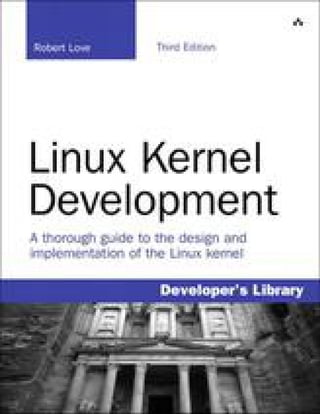





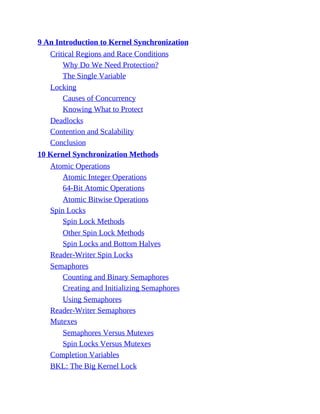
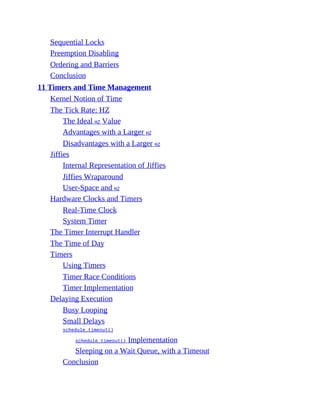
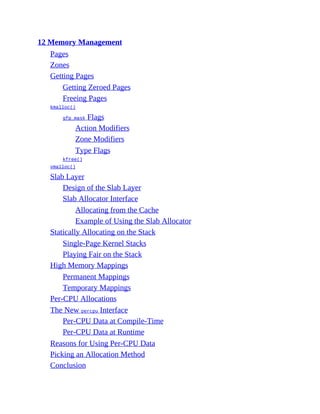
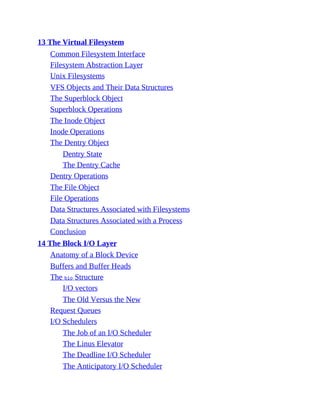


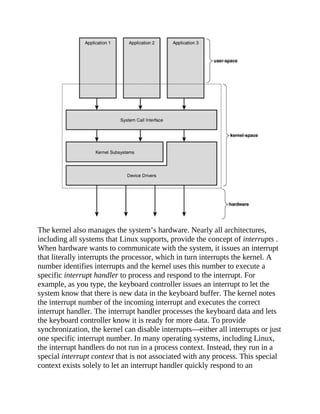
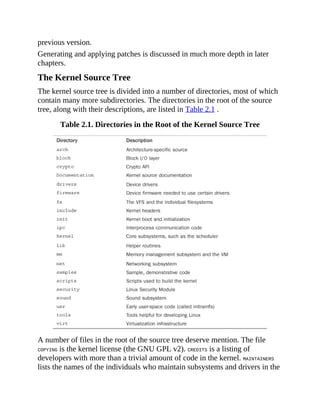



![This ebook is for the use of anyone anywhere in the United States
and most other parts of the world at no cost and with almost no
restrictions whatsoever. You may copy it, give it away or re-use it
under the terms of the Project Gutenberg License included with this
ebook or online at www.gutenberg.org. If you are not located in the
United States, you will have to check the laws of the country where
you are located before using this eBook.
Title: American Journal of Science, Vol. 1.
Author: Various
Editor: Benjamin Silliman
Release date: July 28, 2016 [eBook #52663]
Most recently updated: October 23, 2024
Language: English
Credits: Produced by Eric Hutton, John Campbell and the Online
Distributed Proofreading Team at http://www.pgdp.net
*** START OF THE PROJECT GUTENBERG EBOOK AMERICAN
JOURNAL OF SCIENCE, VOL. 1. ***](https://image.slidesharecdn.com/24780016-250514195628-bbb0ffc6/85/Linux-Kernel-Development-Developers-Library-Robert-Love-60-320.jpg)
![TRANSCRIBER'S NOTE
Vinculums, equivalent to parentheses (), have been retained and are
represented by an overline.
Musical sharp, flat, natural are represented by glyphs copied from the original
book: , , .
This book contains the first four issues of the Journal, each with its own Table of
Contents:
Vol. 1 No. 1 Pages 1 through 104
Vol. 1 No. 2 105 through 208
Vol. 1 No. 3 209 through 316
Vol. 1 No. 4 317 through 442
In issue No. 2, the incorrect numbering of Articles in the text has been left
unchanged. The Table of Contents for this issue is correct. This error is noted in
an Addendum, Footnote [16], by the publisher.
Obvious typographical errors and punctuation errors have been corrected after
careful comparison with other occurrences within the text and consultation of
external sources.
More detail can be found at the end of the book.](https://image.slidesharecdn.com/24780016-250514195628-bbb0ffc6/85/Linux-Kernel-Development-Developers-Library-Robert-Love-61-320.jpg)
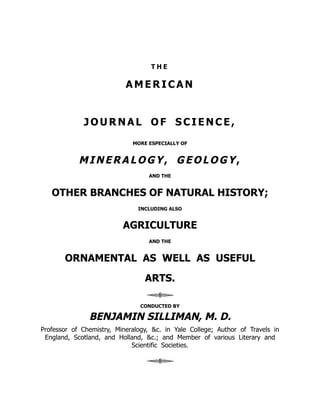
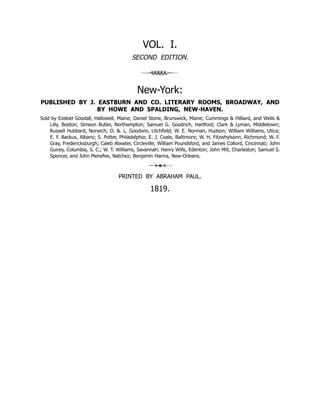



![But all these facts go only to prove the strong tendency which
exists in this country towards the cultivation of physical science, and
the inadequacy of the existing means for its effectual promulgation.
Although our limits do not permit us, however much inclined, to
be more particular in commemorating the labours and in honouring
the performances (often marked by much ability) of our
predecessors and cotemporaries, there is one effort which we are
not willing to pass by without a more particular notice; and we are
persuaded that no apology is necessary for naming the Journal of
the late Dr. Bruce, of New-York, devoted principally to mineralogy
and geology.
No future historian of American science will fail to commemorate
this work as our earliest purely scientific Journal, supported by
original American communications.
Both in this country and in Europe, it was received in a very
flattering manner; it excited, at home, great zeal and effort in
support of the sciences which it fostered, and, abroad, it was hailed
as the harbinger of our future exertions. The editor was honoured
with letters on the subject of his Journal, and with applications for it
from most of the countries in Europe; but its friends had to regret
that, although conducted in a manner perfectly to their satisfaction,
it appeared only at distant intervals, and, after the lapse of several
years, never proceeded beyond the fourth number.
The hopes of its revival have now, unhappily, become completely
extinct, by the lamented death of Dr. Bruce.[1]
This gentleman, with an accomplished education, with extensive
acquirements in science, and great zeal for promoting it in his own
country; advantageously and extensively known in Europe, and
furnished with a correct and discriminating mind, and a chaste,
scientific taste, was so well qualified for the task which he had
undertaken, that no one can attempt to resume those scientific
labours which he has now for ever relinquished, without realizing
that he undertakes an arduous enterprise, and lays himself under a](https://image.slidesharecdn.com/24780016-250514195628-bbb0ffc6/85/Linux-Kernel-Development-Developers-Library-Robert-Love-74-320.jpg)
![but neither department is in danger of being exhausted. The
interesting travels of Lewis and Clark have recently brought to our
knowledge several plants and animals before unknown. Foreign
naturalists frequently explore our territory; and, for the most part,
convey to Europe the fruits of their researches, while but a small
part of our own productions is examined and described by
Americans: certainly, this is little to our credit, and still less to our
advantage. Honourable exceptions to the truth of this remark are
furnished by the exertions of some gentlemen in our principal cities,
and in various other parts of the Union.[2]
Our botany, it is true, has been extensively and successfully
investigated; but this field is still rich, and rewards every new
research with some interesting discovery. Our mineralogy, however,
is a treasure but just opened. That both science and art may expect
much advantage from this source, is sufficiently evinced by the
success which has crowned the active efforts of a few ardent
cultivators of this science: several new species of minerals have been
added to it in this country; great numbers of American localities
discovered, and interesting additions made to our materials, for the
useful and ornamental arts. The science of mineralogy is now
illustrated by courses of lectures, and by several good cabinets in
the different states. Among the cabinets, the splendid collection of
Colonel Gibbs, now in Yale College, (a munificent DEPOSIT for the
benefit of his country,) stands pre-eminent: it would be considered
as a very noble cabinet in any part of Europe: and its introduction
into the United States, and its gratuitous dedication to the promotion
of science, are equally advantageous to the community, and
honourable to its patriotic and enlightened proprietor. Mineralogy is
most intimately connected with our arts, and especially with our
agriculture.
Such are the disguises worn by many most useful mineral
substances, that an unskilful observer is liable to pass a thing by, as
worthless, which, if better informed, he would seize with avidity;
and, still more frequently, a worthless substance, clothed perhaps in](https://image.slidesharecdn.com/24780016-250514195628-bbb0ffc6/85/Linux-Kernel-Development-Developers-Library-Robert-Love-76-320.jpg)
![Art. I. Essay on Musical Temperament.[3]
By Professor Fisher, of Yale College.
It is well known to those who have attended to the subject of
musical ratios, that a fixed scale of eight degrees to the octave,
which shall render all its concords perfect, is impossible. It has been
demonstrated by Dr. Smith, from an investigation of all the positions
which the major, the minor, and the half-tone can assume, that the
most perfect scales possible, of which there are two equally so,
differing only in the position of the major and the minor tone above
the key note, must have one Vth and one 3d too flat, and
consequently the supplementary 4th and VIth too sharp, by a
comma. In vocal music, and in that of perfect instruments, this
defect in the scale is not perceived, because a small change may be
made in the key, whenever the occurrence of either of those
naturally imperfect intervals renders such a change necessary to
perfect harmony. But in instruments with fixed scales, such as the
guitar, the piano-forte, and the organ, if we begin with tuning as
many concords as possible perfect, the resulting chords above-
mentioned will be necessarily false in an offensive degree. Hence it
is an important problem in practical harmonics, to distribute these
imperfections in the scale among the different chords, in such a
manner as to occasion the least possible injury to harmony.
But this is not the only nor the principal difficulty which the tuner
of imperfect instruments has to encounter. In order that these
instruments may form a proper accompaniment for the voice, and be
used in conjunction with perfect instruments, it is necessary that
music should be capable of being executed on them, in all the
different keys in common use; and especially that they should be
capable of those occasional modulations which often occur in the
course of the same piece. Now only five additional sounds to the](https://image.slidesharecdn.com/24780016-250514195628-bbb0ffc6/85/Linux-Kernel-Development-Developers-Library-Robert-Love-80-320.jpg)
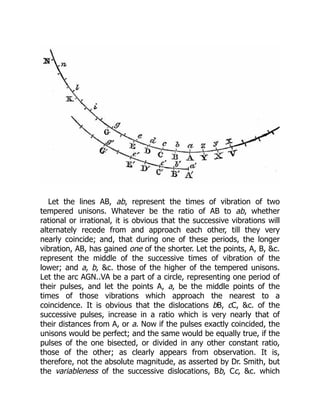
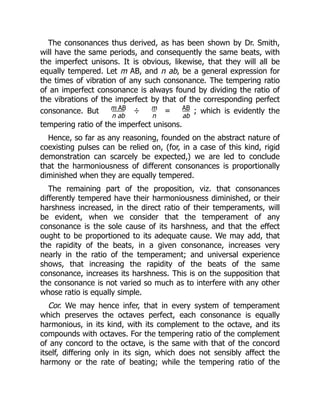
![compounds with octaves is not only the same, but with the same
sign.
Scholium 1.
There is no point in harmonics, concerning which theorists have
been more divided in opinion than in regard to the true measure of
equal harmony, in consonances of different kinds. Euler maintains,
that the more simple a consonance is, the less temperament it will
bear; and this seems to have ever been the general opinion of
practical musicians.[4] Dr. Smith, on the contrary, asserts, and has
attempted to demonstrate, that the simpler will bear a much greater
temperament than the more complex consonances. The foregoing
proposition has, at least, the merit of taking the middle ground
between these discordant opinions. If admitted, it will greatly
simplify the whole subject, and will reduce the labour of rendering
all the concords in three octaves as equally harmonious as possible,
which occupies so large a portion of Dr. Smith's volume, to a single
short proposition. Dr. Smith's measure of equal harmony, viz. equal
numbers of short cycles in the intervals between the successive
beats, seems designed, not to render the different consonances
proportionally harmonious, but to reduce the simpler to an absolute
level, in point of agreeableness, with the more complex; which, as
has been shown, is not the object to be aimed at in adjusting their
comparative temperaments. But, in truth, his measure is far more
favourable to the complex consonances than equal harmony, even in
this sense, would require; and, in a great number of instances, leads
to the grossest absurdities. Two consonances, according to him, are
equally harmonious, when their temperaments are inversely as the
products of the least numbers expressing their perfect ratio. If so,
the VIII + 3d, whose ratio is 5/12, when tempered 1/20 of a comma,
and the unison, whose ratio is 1/1, when tempered 3 commas, are
equally harmonious. But all who have the least experience in
tempered consonances will pronounce, at once, that the former
could scarcely be distinguished by the nicest ear from the](https://image.slidesharecdn.com/24780016-250514195628-bbb0ffc6/85/Linux-Kernel-Development-Developers-Library-Robert-Love-87-320.jpg)