SAMANTHA WONG DOMÍNGUEZ
ALEJANDRA
INGLES
“LINKING WORDS”
10°B INGENIERÍA EN GESTIÓN DE PROYECTOS
29 DE SEPTIEMBRE DEL 2016
Linking Words
Linking words or connecting words help you to build a logical argument in your text by linking one statement to another.
A text without linking words reads like a series of unrelated statements with no flow.
Linking words can be used to:
- Link the flow of ideas in your writing
- Guide your reader towards the next stage of your argument
- Link paragraphs together.
 To get used to these important words, I am providing a list of commonly used Spanish linking words which I have
divided into 6 groups:

 1. Addition)
 2. Opposition)
 3. Cause
 4. Consequence)
 5. Giving examples)
 6. Summarising
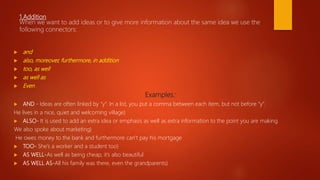
1.Addition
When we want to add ideas or to give more information about the same idea we use the
following connectors:
 and
 also, moreover, furthermore, in addition
 too, as well
 as well as
 Even
Examples:
 AND - Ideas are often linked by “y”. In a list, you put a comma between each item, but not before “y”.
He lives in a nice, quiet and welcoming village)
 ALSO- It is used to add an extra idea or emphasis as well as extra information to the point you are making.
We also spoke about marketing)
He owes money to the bank and furthermore can’t pay his mortgage
 TOO- She’s a worker and a student too)
 AS WELL-As well as being cheap, it’s also beautiful
 AS WELL AS-All his family was there, even the grandparents)
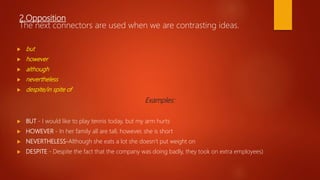
2.Opposition
The next connectors are used when we are contrasting ideas.
 but
 however
 although
 nevertheless
 despite/in spite of
Examples:
 BUT - I would like to play tennis today, but my arm hurts
 HOWEVER - In her family all are tall, however, she is short
 NEVERTHELESS-Although she eats a lot she doesn’t put weight on
 DESPITE - Despite the fact that the company was doing badly, they took on extra employees)
3. (Cause)
 because
 as
 because of
 due to, because of
 since, given that
 since, because
 since, as
 thanks to
 because of Examples:
 BECAUSE is a connector that is usually used in the middle of the sentence in both formal or informal situations.
(I brought an umbrella because it was raining when I left)
 AS is usually used at the beginning of a sentence with a comma between the first and second statement.
As it was raining when I left, I brought an umbrella)
 BECAUSE OF - It is used in the middle or beginning of a sentence.
Because of the contamination you can not swim in the river
4. (Consequence)
These connectors are to express the consequences of the
information previously given and they are all used in a similar way.
 then
 so
 therefore
 in consequence
Examples:
 THEN- If there isn’t any white left, then take the blue one
 SO- Marcos went on vacation, so he closed the store
 THEREFORE They fought often, so they separated
5. (Giving examples)
 for example, for instance
 Namely
EXAMPLES:
 For example - The most common way of giving examples is by using “
 He’s always being thoughtful. For example, he bought her flower as a surprise
 Namely- refers to something by name.
 There are two problems: namely, the expense and the time

Linking words

  • 1.
    SAMANTHA WONG DOMÍNGUEZ ALEJANDRA INGLES “LINKINGWORDS” 10°B INGENIERÍA EN GESTIÓN DE PROYECTOS 29 DE SEPTIEMBRE DEL 2016
  • 2.
    Linking Words Linking wordsor connecting words help you to build a logical argument in your text by linking one statement to another. A text without linking words reads like a series of unrelated statements with no flow. Linking words can be used to: - Link the flow of ideas in your writing - Guide your reader towards the next stage of your argument - Link paragraphs together.  To get used to these important words, I am providing a list of commonly used Spanish linking words which I have divided into 6 groups:   1. Addition)  2. Opposition)  3. Cause  4. Consequence)  5. Giving examples)  6. Summarising
  • 3.
    1.Addition When we wantto add ideas or to give more information about the same idea we use the following connectors:  and  also, moreover, furthermore, in addition  too, as well  as well as  Even Examples:  AND - Ideas are often linked by “y”. In a list, you put a comma between each item, but not before “y”. He lives in a nice, quiet and welcoming village)  ALSO- It is used to add an extra idea or emphasis as well as extra information to the point you are making. We also spoke about marketing) He owes money to the bank and furthermore can’t pay his mortgage  TOO- She’s a worker and a student too)  AS WELL-As well as being cheap, it’s also beautiful  AS WELL AS-All his family was there, even the grandparents)
  • 4.
    2.Opposition The next connectorsare used when we are contrasting ideas.  but  however  although  nevertheless  despite/in spite of Examples:  BUT - I would like to play tennis today, but my arm hurts  HOWEVER - In her family all are tall, however, she is short  NEVERTHELESS-Although she eats a lot she doesn’t put weight on  DESPITE - Despite the fact that the company was doing badly, they took on extra employees)
  • 5.
    3. (Cause)  because as  because of  due to, because of  since, given that  since, because  since, as  thanks to  because of Examples:  BECAUSE is a connector that is usually used in the middle of the sentence in both formal or informal situations. (I brought an umbrella because it was raining when I left)  AS is usually used at the beginning of a sentence with a comma between the first and second statement. As it was raining when I left, I brought an umbrella)  BECAUSE OF - It is used in the middle or beginning of a sentence. Because of the contamination you can not swim in the river
  • 6.
    4. (Consequence) These connectorsare to express the consequences of the information previously given and they are all used in a similar way.  then  so  therefore  in consequence Examples:  THEN- If there isn’t any white left, then take the blue one  SO- Marcos went on vacation, so he closed the store  THEREFORE They fought often, so they separated
  • 7.
    5. (Giving examples) for example, for instance  Namely EXAMPLES:  For example - The most common way of giving examples is by using “  He’s always being thoughtful. For example, he bought her flower as a surprise  Namely- refers to something by name.  There are two problems: namely, the expense and the time