PhillyR Meetup
May 3, 2018
Sponsored by
Linear Regression Introduction
PhillyR R User Group
Leon Kim
(not your ordinary)
Overview
■ PhillyR Logistics
■ Presentation
■ Q&A
PhillyR News
■ Things?
– Some exciting stuff
■ Thing!
– More exciting stuff
■ R-Ladies Philly Meetup
– Git happieR with GitHub
May 16, 6:00 PM - 8:00 PM
Drexel University – LeBow College of Business
– https://www.meetup.com/rladies-philly/events/250279457/
PhillyR News
■ Next PhillyR meetup
– Logistic Regression by Russell Lavery
– May 31st or June 7th
■ Next next PhillyR meetup
– <your favorite topic> by <your name here>
■ Suggestions:
– Survey analysis using survey
– Working with databases
– tidyverse (esp. dplyr 0.7+)
– Machine learning framework using caret and mlr
Overview
■ Gain understanding of and appreciation for lm() function
■ Be able to create a regression model on your own from scratch *
■ Key points
– Mastering linear regression takes more than 1 hour, so this
isn’t end-all and be-all guide
– Stat 101 – level math knowledge. No linear algebra!
– Look at linear regression in a different way
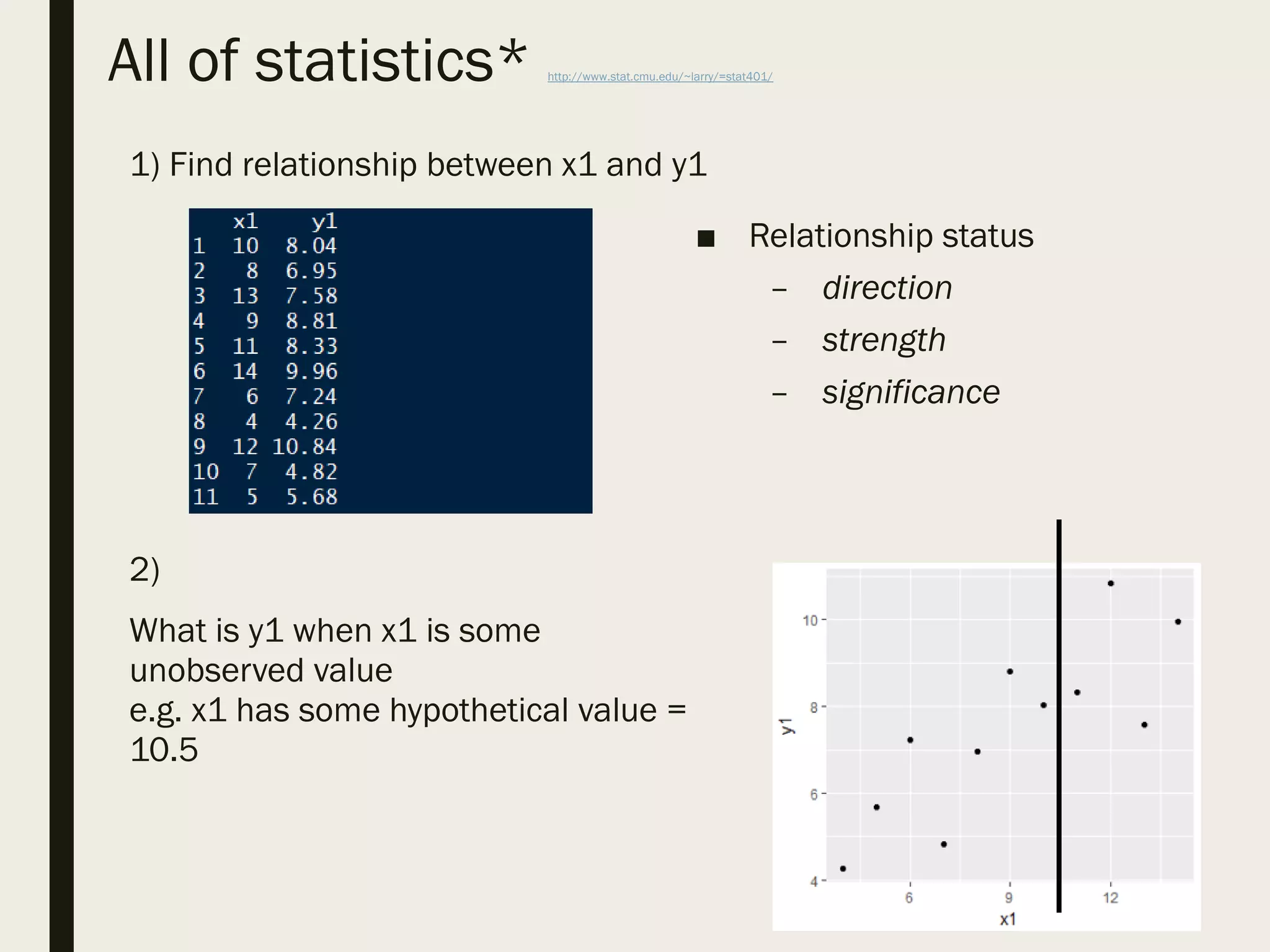
All of statistics* http://www.stat.cmu.edu/~larry/=stat401/
1) Find relationship between x1 and y1
2)
What is y1 when x1 is some
unobserved value
e.g. x1 has some hypothetical value =
10.5
■ Relationship status
– direction
– strength
– significance
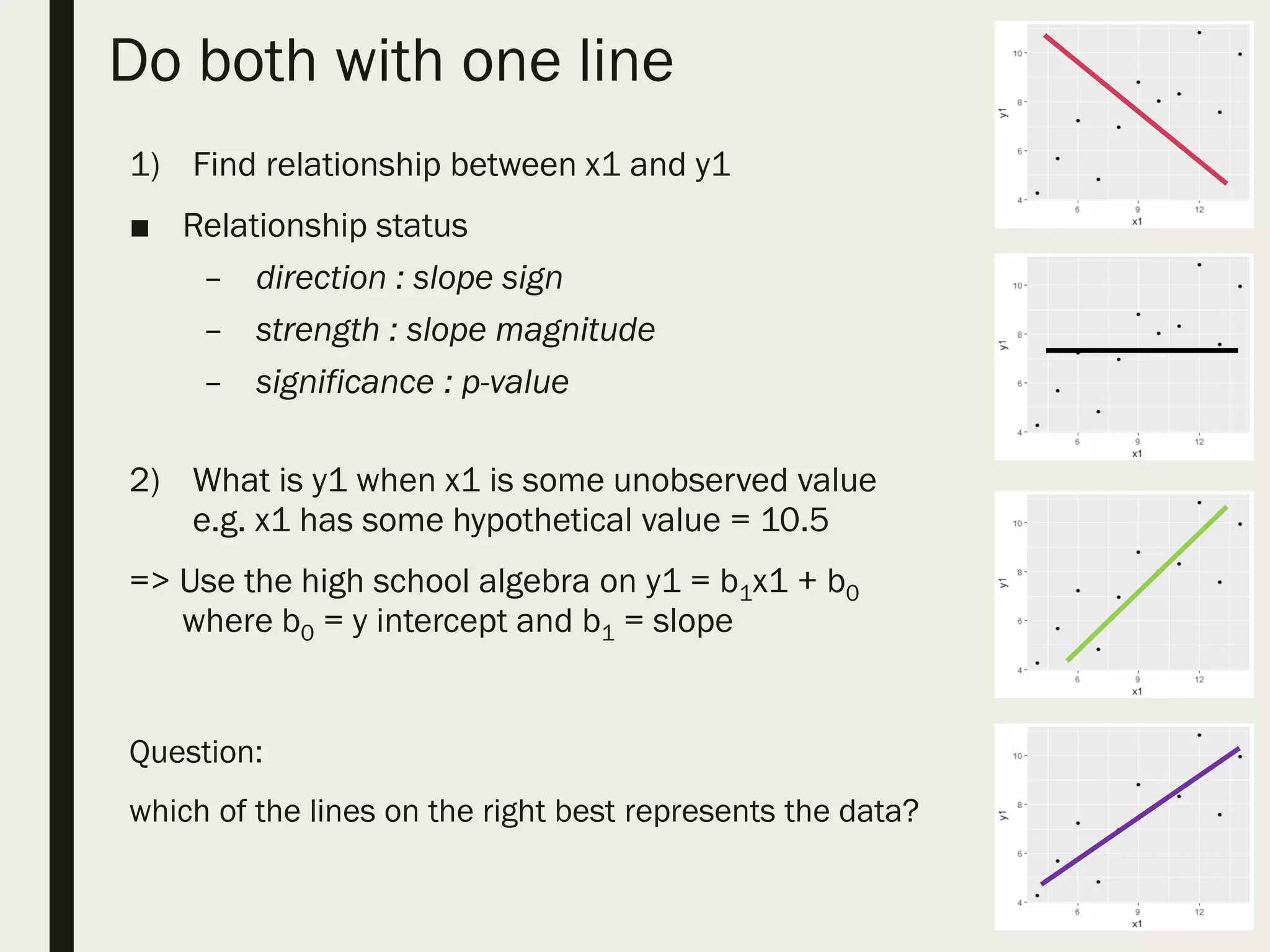
Do both with one line
1) Find relationship between x1 and y1
■ Relationship status
– direction : slope sign
– strength : slope magnitude
– significance : p-value
2) What is y1 when x1 is some unobserved value
e.g. x1 has some hypothetical value = 10.5
=> Use the high school algebra on y1 = b1x1 + b0
where b0 = y intercept and b1 = slope
Question:
which of the lines on the right best represents the data?
What is the line of best fit?
■ Which line represents the data best?
■ This is where concepts like:
- Ordinary Least Squares,
- Maximum Likelihood Estimator,
- Sum of Squared Residuals
… and others are thrown around
■ Choose the line that has the smallest error
– ith real value : yi = b1xi + b0 + ei
– ith predicted value : ŷi = b1xi + b0
■ All of Statistics:
– All models minimize errors in prediction by
optimizing for a loss function.
– In linear regression, this is: Σ [(yi – ŷi)2]
■ b1 = how much y is expected to change if x increased by 1
b0 = what y is expected to be if x = 0
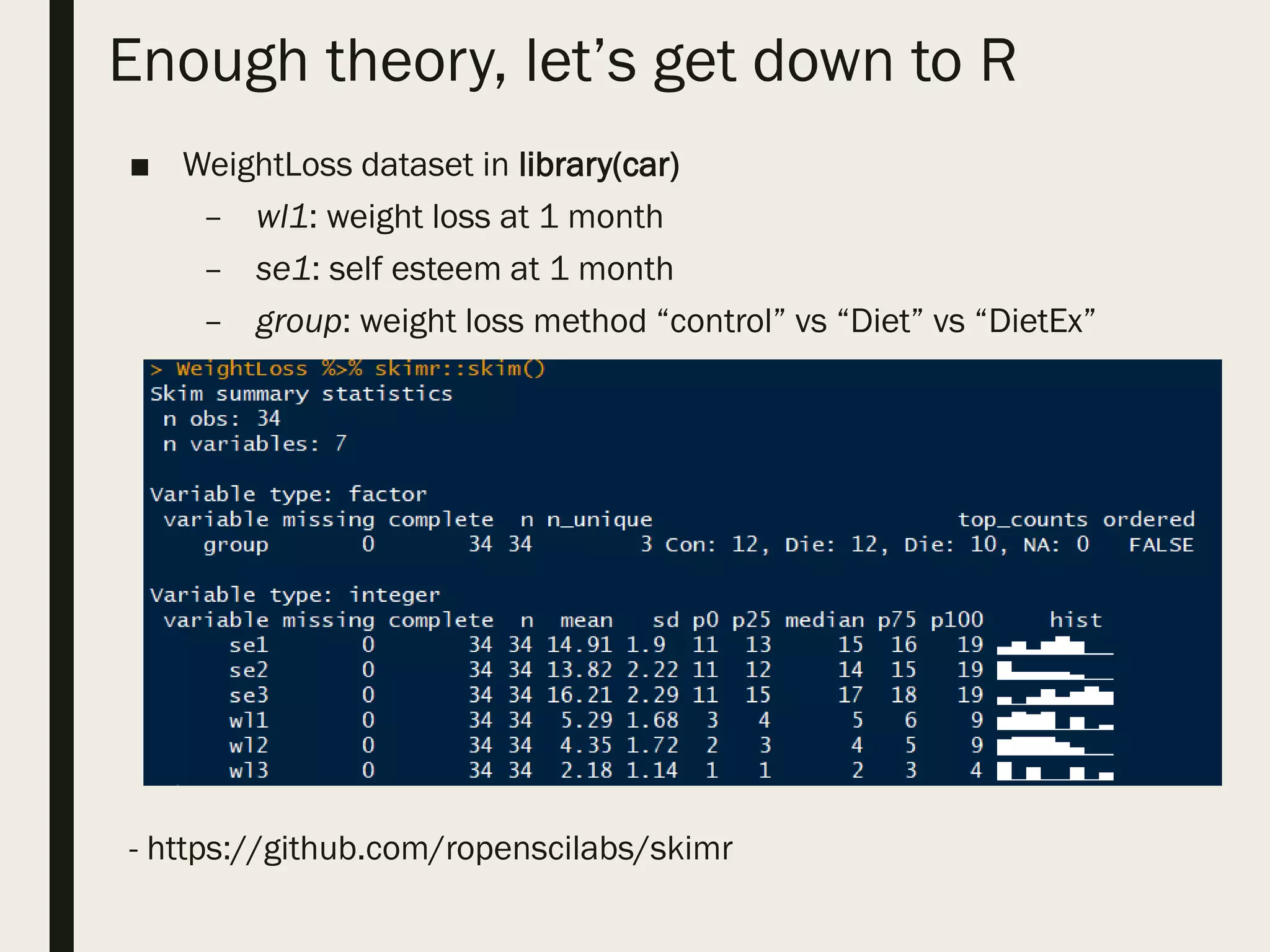
Enough theory, let’s get down to R
■ WeightLoss dataset in library(car)
– wl1: weight loss at 1 month
– se1: self esteem at 1 month
– group: weight loss method “control” vs “Diet” vs “DietEx”
- https://github.com/ropenscilabs/skimr
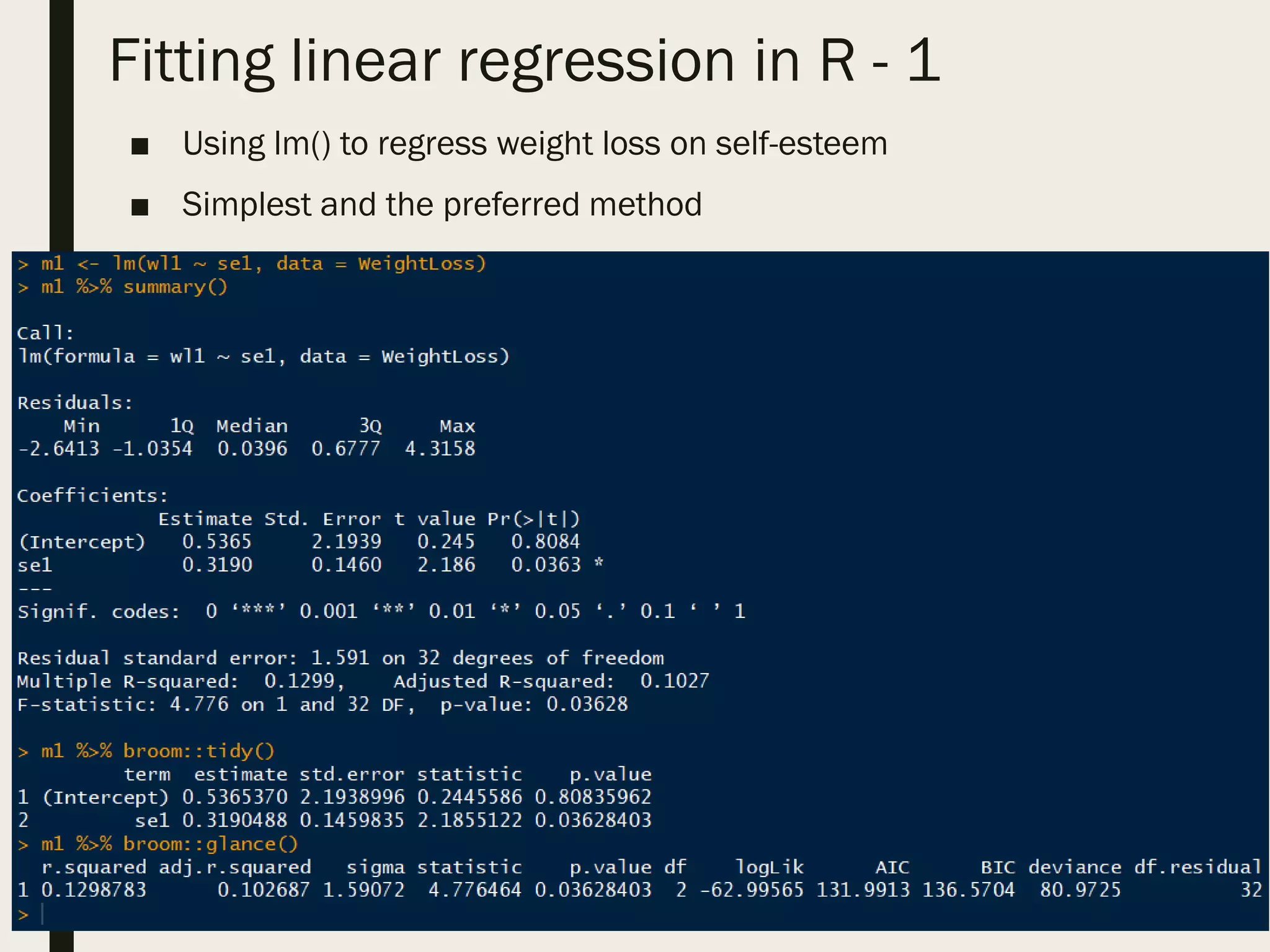
Fitting linear regression in R - 1
■ Using lm() to regress weight loss on self-esteem
■ Simplest and the preferred method
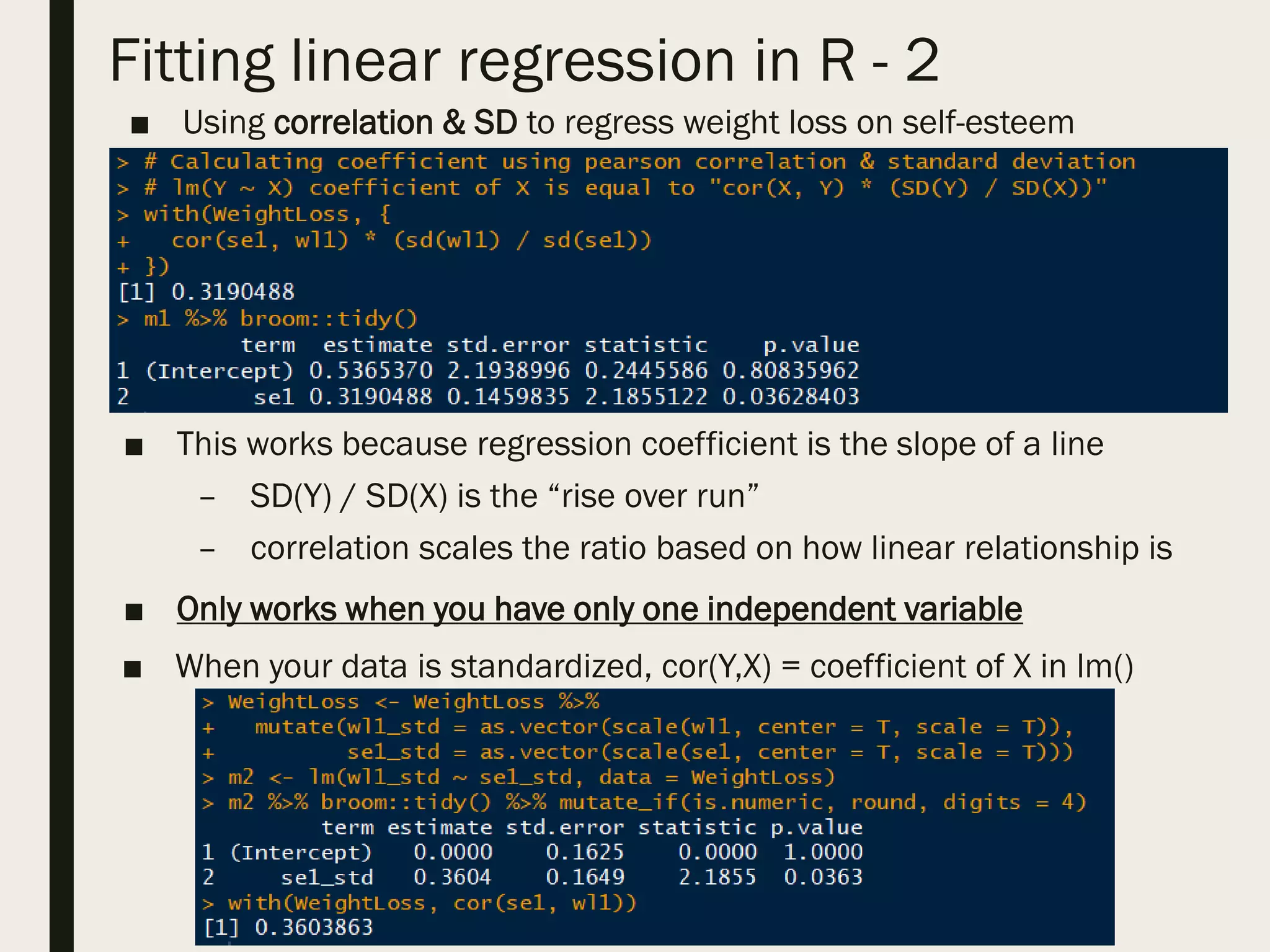
Fitting linear regression in R - 2
■ Using correlation & SD to regress weight loss on self-esteem
■
■ This works because regression coefficient is the slope of a line
– SD(Y) / SD(X) is the “rise over run”
– correlation scales the ratio based on how linear relationship is
■ Only works when you have only one independent variable
■ When your data is standardized, cor(Y,X) = coefficient of X in lm()
Fitting linear regression in R - 3
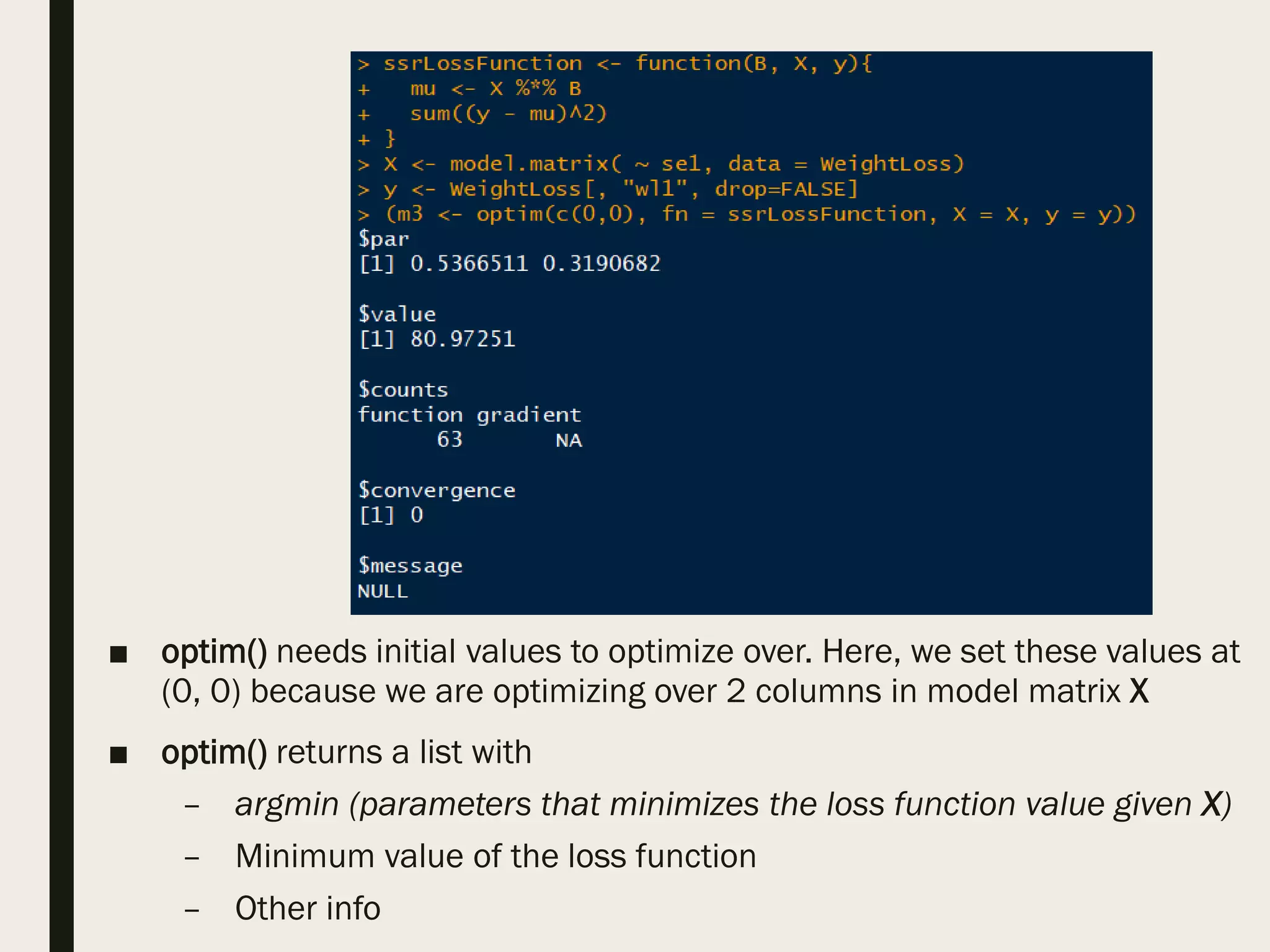
■ Using optim() and model matrix to regress weight loss on self-esteem
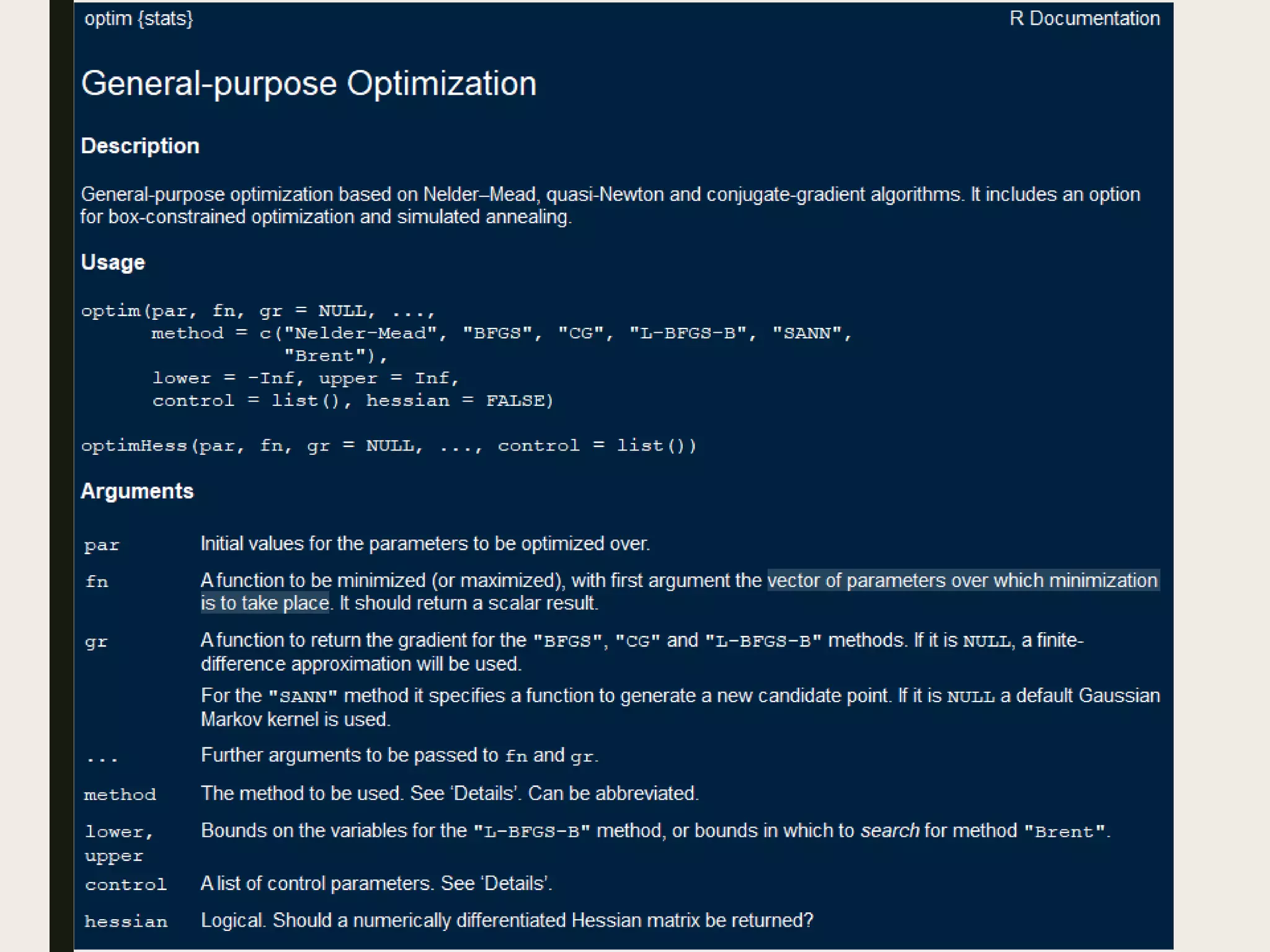
– optim() is a general-purpose optimizer
– Find coefficients that minimizes the loss function Σ [(yi – ŷi)2]
– Requires user to specify design matrix aka model matrix
■ design matrix or model matrix
– This is abstracted away from you when you use formula in lm()
X y
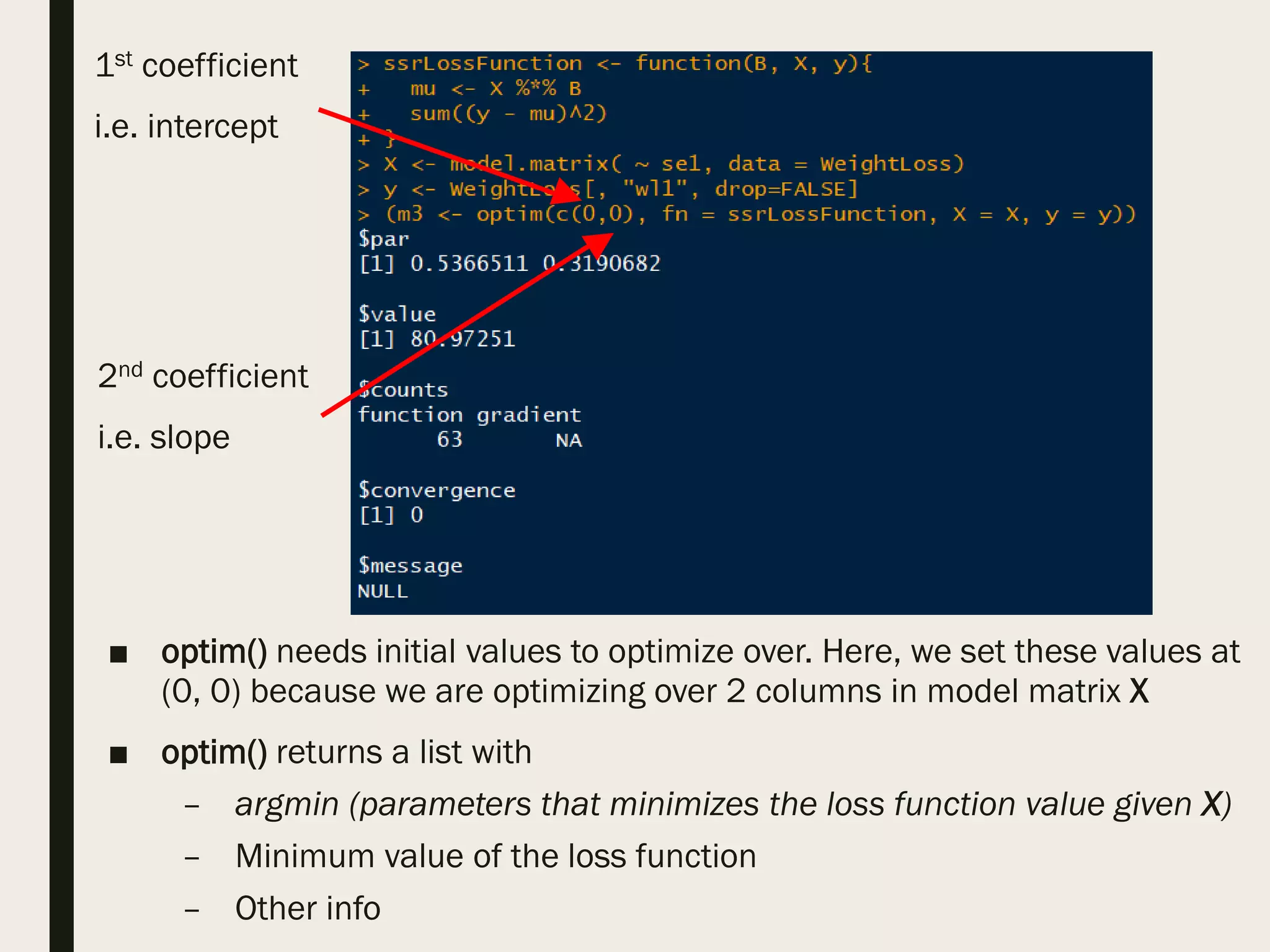
■ optim() needs initial values to optimize over. Here, we set these values at
(0, 0) because we are optimizing over 2 columns in model matrix X
■ optim() returns a list with
– argmin (parameters that minimizes the loss function value given X)
– Minimum value of the loss function
– Other info
1st coefficient
i.e. intercept
2nd coefficient
i.e. slope
■ optim() needs initial values to optimize over. Here, we set these values at
(0, 0) because we are optimizing over 2 columns in model matrix X
■ optim() returns a list with
– argmin (parameters that minimizes the loss function value given X)
– Minimum value of the loss function
– Other info
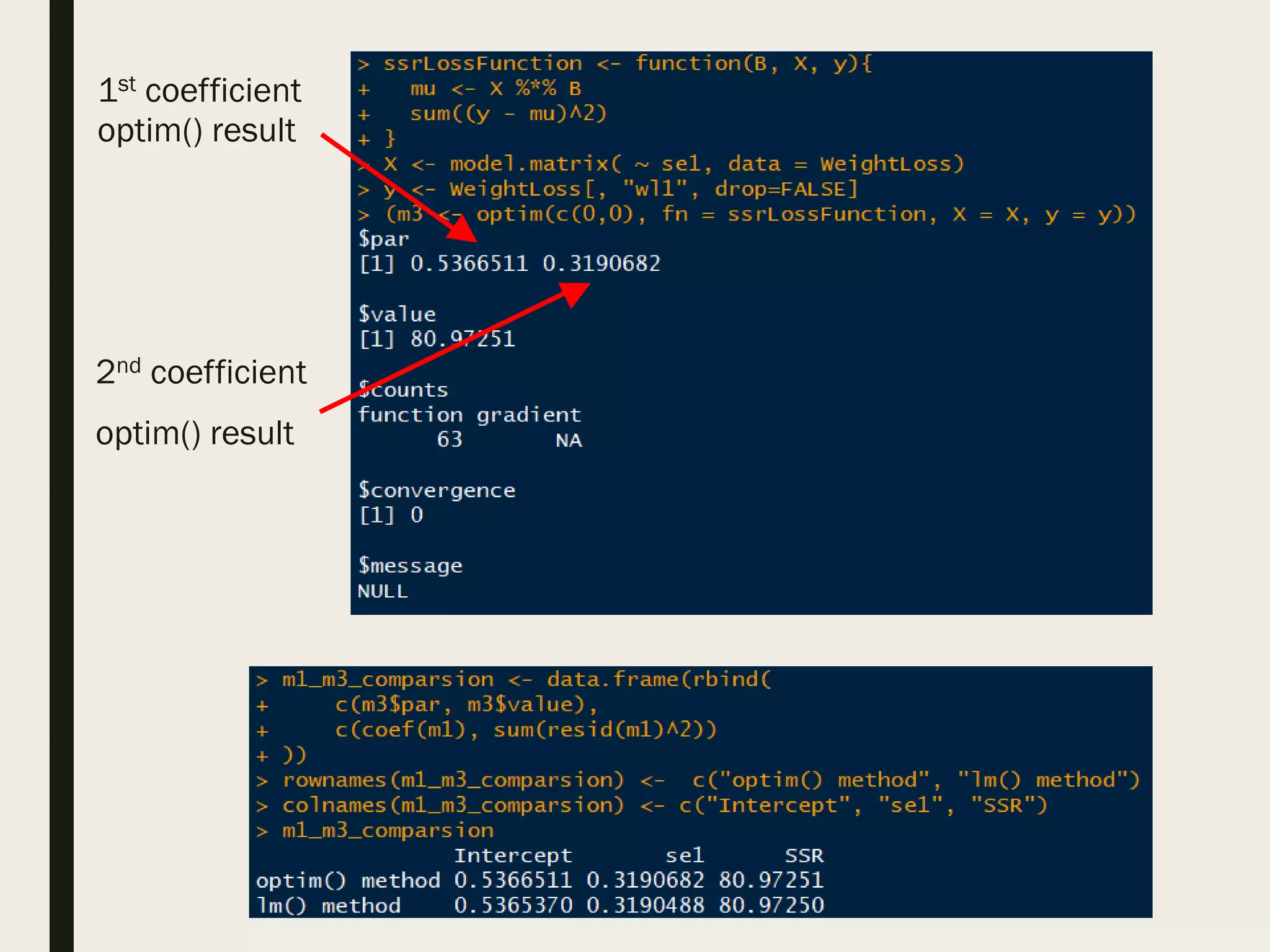
1st coefficient
optim() result
2nd coefficient
optim() result
So far
■ Linear regression at its most primitive form, is just a line equation
that minimizes error based on some loss function
– No probability or statistics concepts are required
■ optim() is a general optimization function in R
(more on this in the future)
■ You should still use lm() to fit and assess linear regression models
– lm() outputs object of class… “lm” that has many useful
metrics and functions associated with it
– but remember your roots! All lm() is using statistical properties
and linear algebra to optimize loss functions
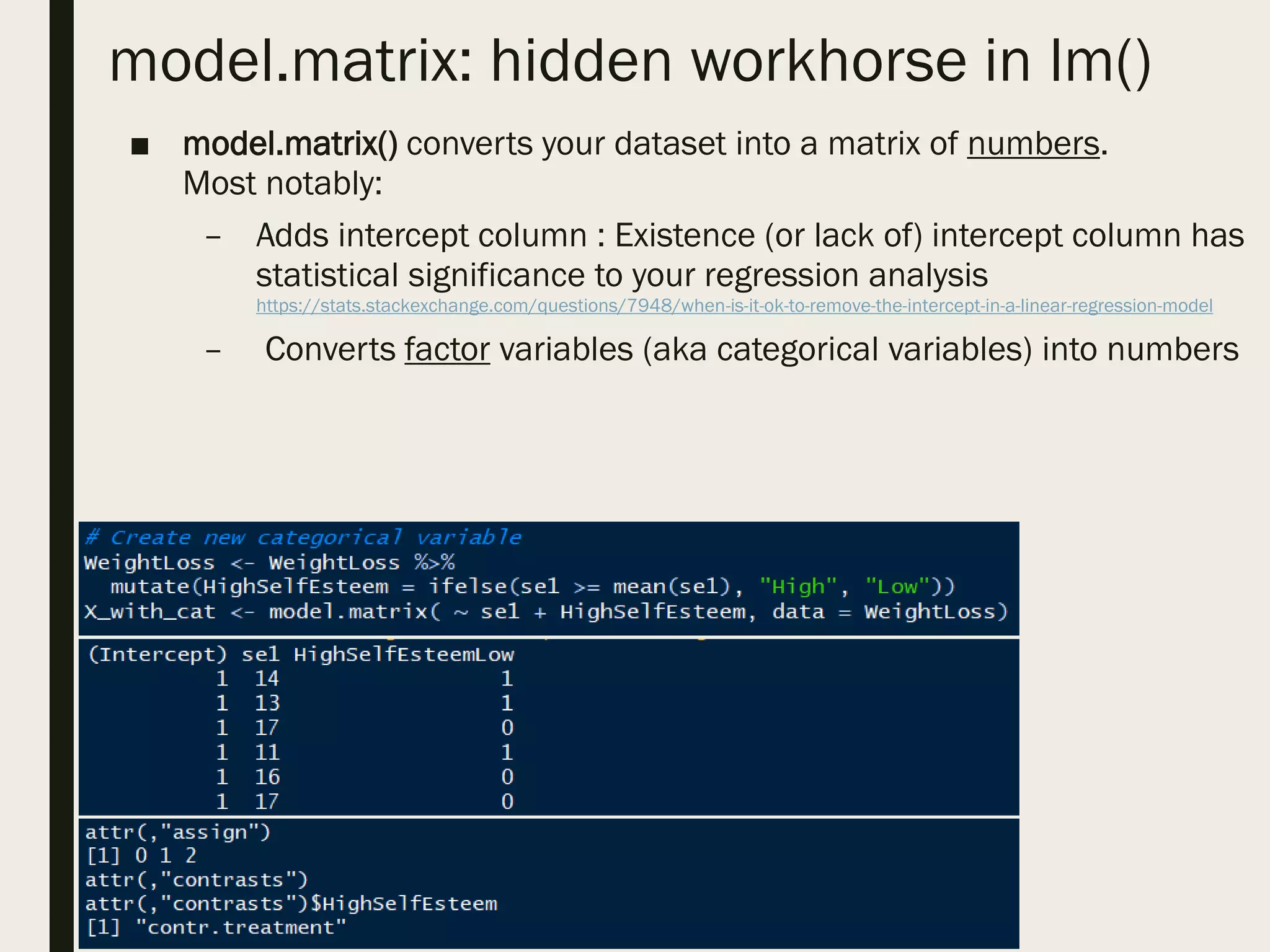
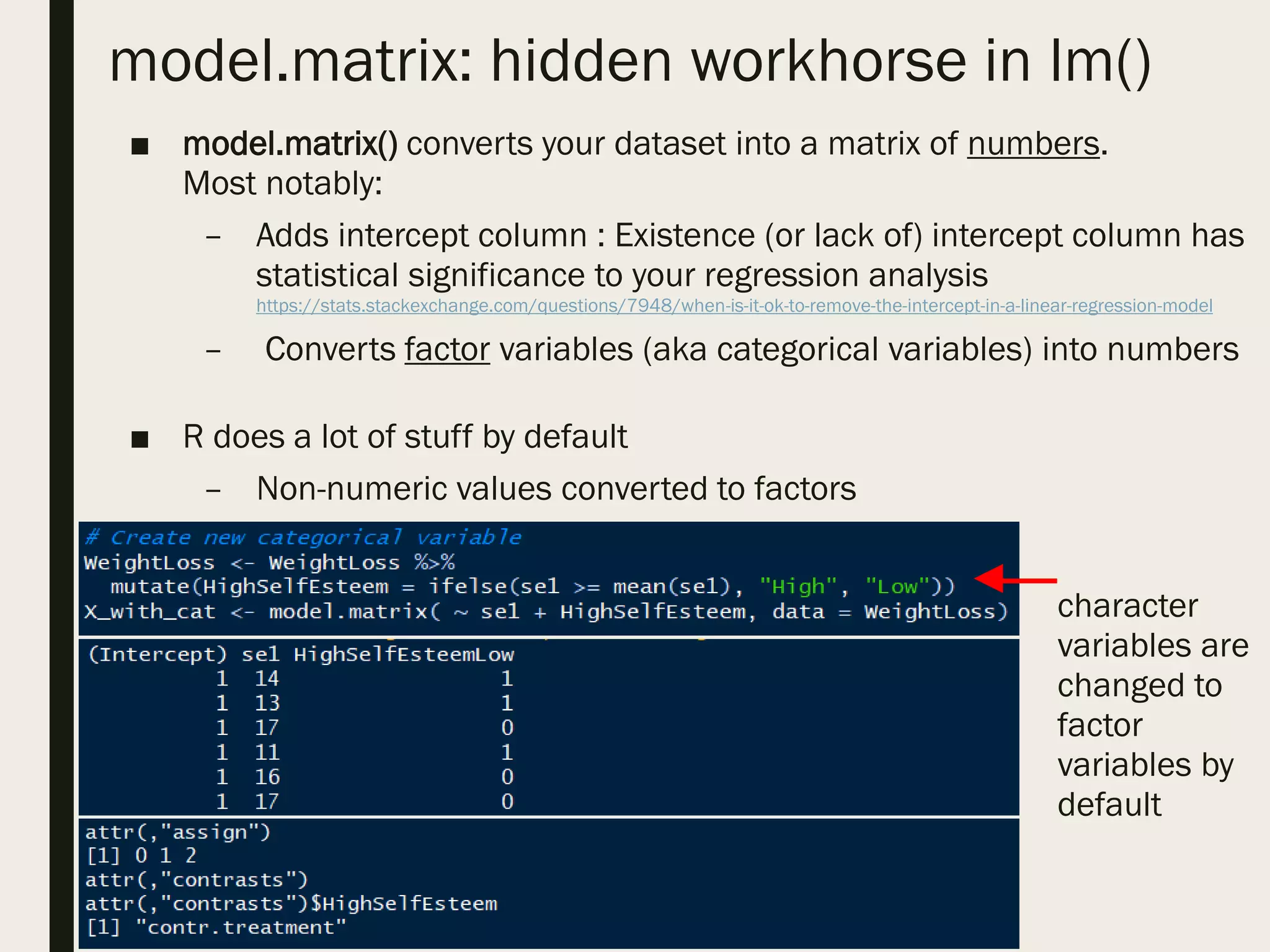
model.matrix: hidden workhorse in lm()
■ model.matrix() converts your dataset into a matrix of numbers.
Most notably:
– Adds intercept column : Existence (or lack of) intercept column has
statistical significance to your regression analysis
https://stats.stackexchange.com/questions/7948/when-is-it-ok-to-remove-the-intercept-in-a-linear-regression-model
– Converts factor variables (aka categorical variables) into numbers
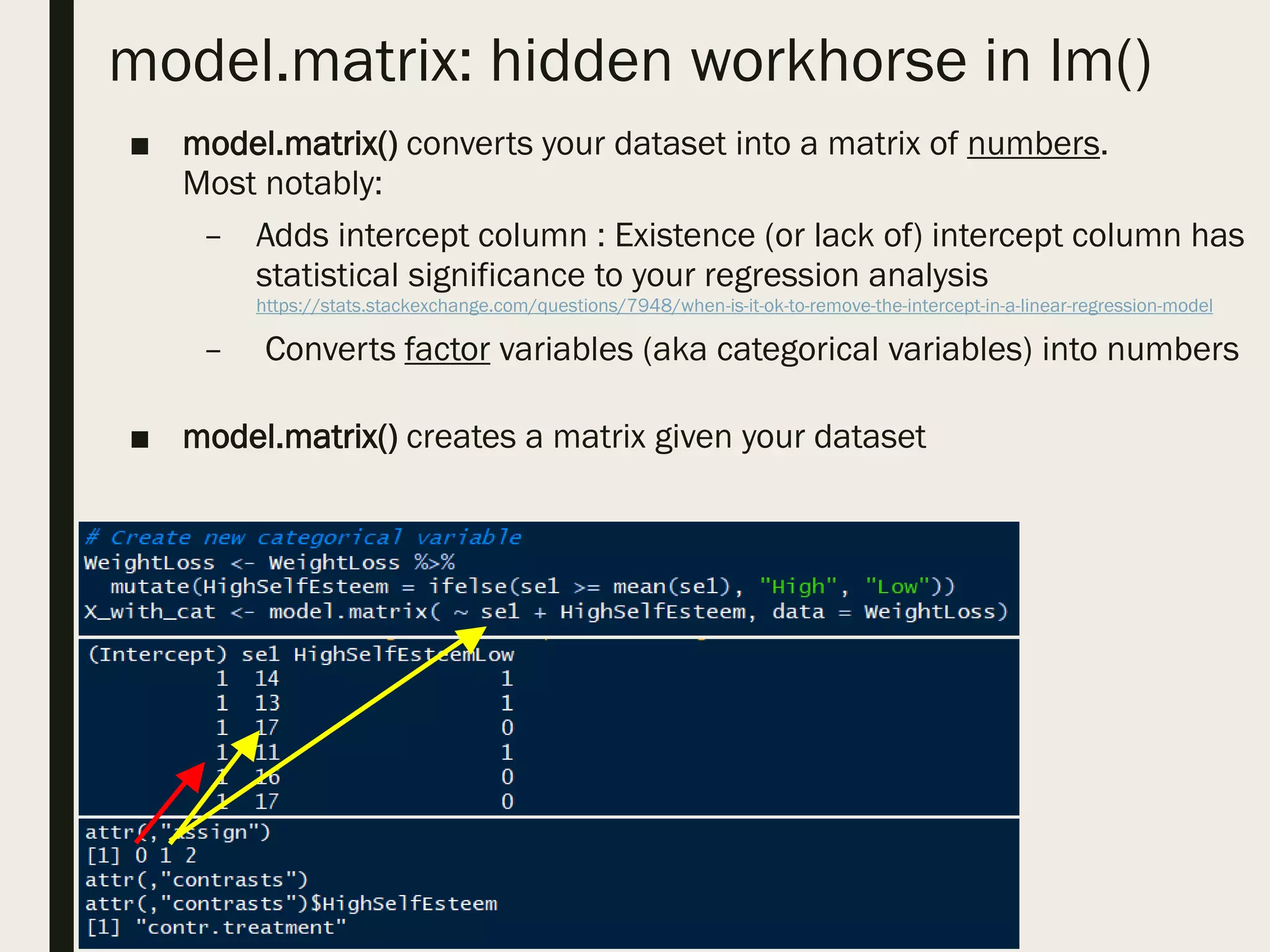
model.matrix: hidden workhorse in lm()
■ model.matrix() converts your dataset into a matrix of numbers.
Most notably:
– Adds intercept column : Existence (or lack of) intercept column has
statistical significance to your regression analysis
https://stats.stackexchange.com/questions/7948/when-is-it-ok-to-remove-the-intercept-in-a-linear-regression-model
– Converts factor variables (aka categorical variables) into numbers
■ model.matrix() creates a matrix given your dataset
model.matrix: hidden workhorse in lm()
■ model.matrix() converts your dataset into a matrix of numbers.
Most notably:
– Adds intercept column : Existence (or lack of) intercept column has
statistical significance to your regression analysis
https://stats.stackexchange.com/questions/7948/when-is-it-ok-to-remove-the-intercept-in-a-linear-regression-model
– Converts factor variables (aka categorical variables) into numbers
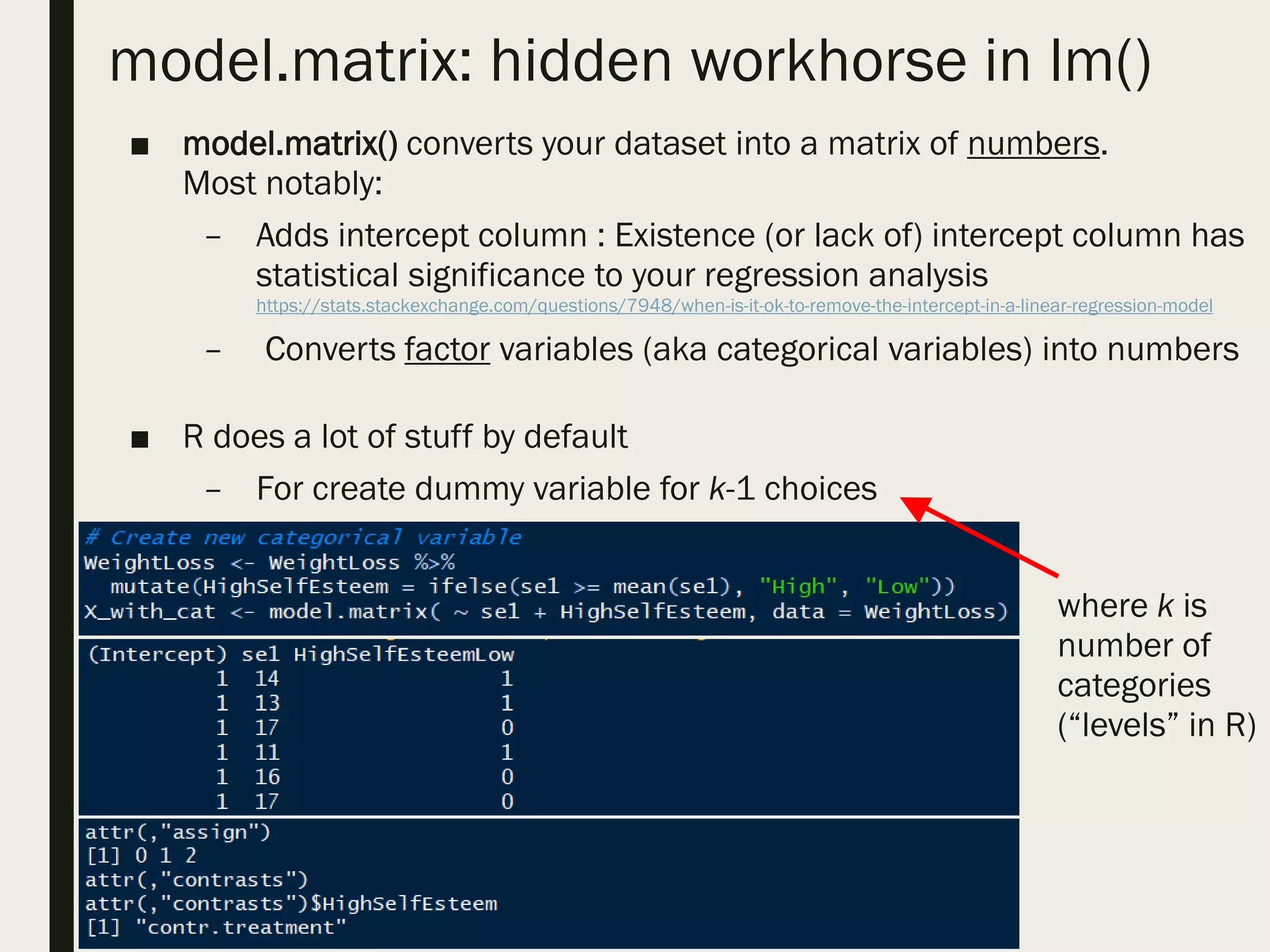
■ R does a lot of stuff by default
– For create dummy variable for k-1 choices
where k is
number of
categories
(“levels” in R)
model.matrix: hidden workhorse in lm()
■ model.matrix() converts your dataset into a matrix of numbers.
Most notably:
– Adds intercept column : Existence (or lack of) intercept column has
statistical significance to your regression analysis
https://stats.stackexchange.com/questions/7948/when-is-it-ok-to-remove-the-intercept-in-a-linear-regression-model
– Converts factor variables (aka categorical variables) into numbers
■ R does a lot of stuff by default
– Non-numeric values converted to factors
character
variables are
changed to
factor
variables by
default
model.matrix: hidden workhorse in lm()
■ model.matrix() converts your dataset into a matrix of numbers.
Most notably:
– Adds intercept column : Existence (or lack of) intercept column has
statistical significance to your regression analysis
https://stats.stackexchange.com/questions/7948/when-is-it-ok-to-remove-the-intercept-in-a-linear-regression-model
– Converts factor variables (aka categorical variables) into numbers
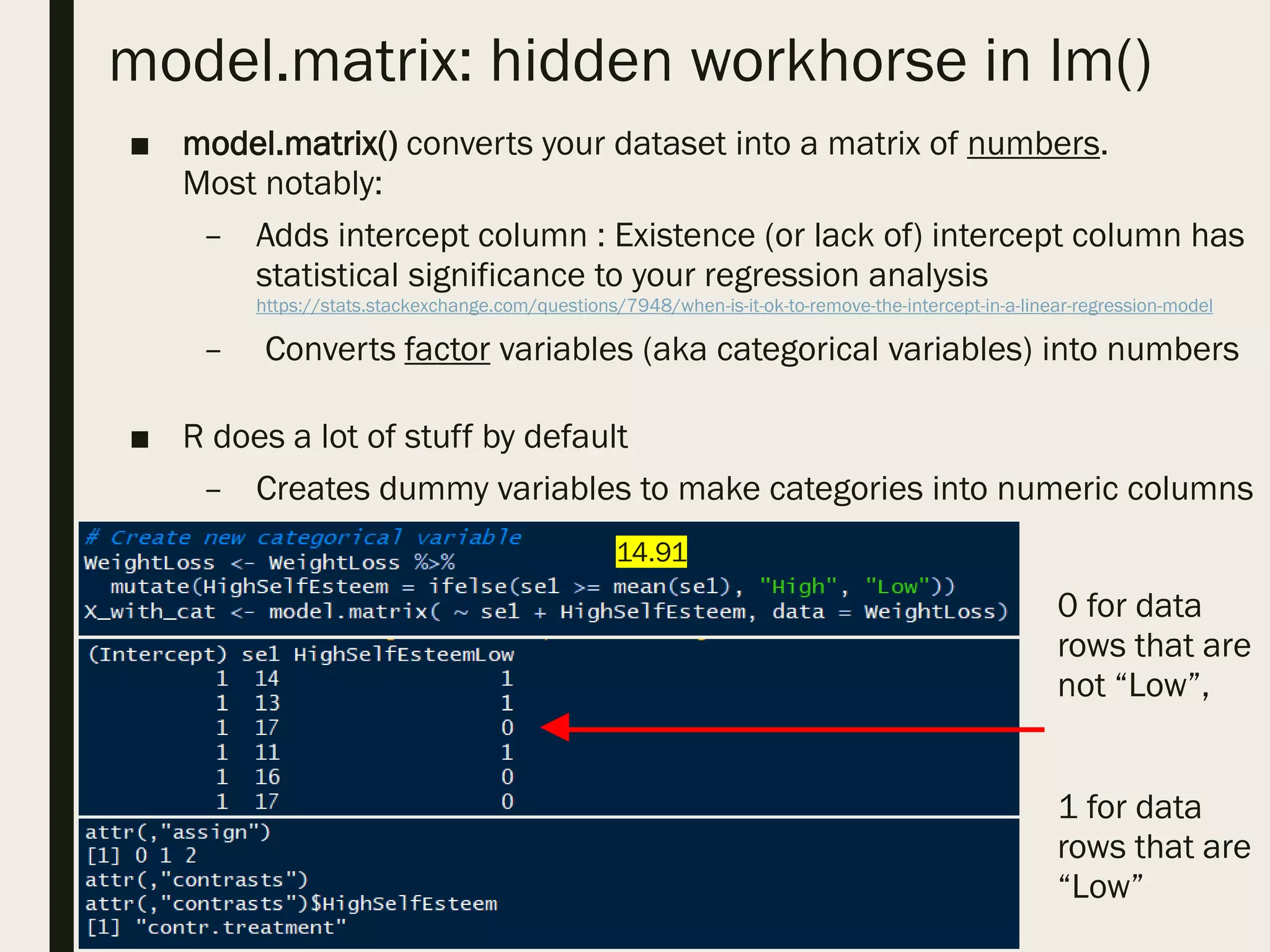
■ R does a lot of stuff by default
– Creates dummy variables to make categories into numeric columns
0 for data
rows that are
not “Low”,
1 for data
rows that are
“Low”
14.91
model.matrix: hidden workhorse in lm()
■ model.matrix() converts your dataset into a matrix of numbers.
Most notably:
– Adds intercept column : Existence (or lack of) intercept column has
statistical significance to your regression analysis
https://stats.stackexchange.com/questions/7948/when-is-it-ok-to-remove-the-intercept-in-a-linear-regression-model
– Converts factor variables (aka categorical variables) into numbers
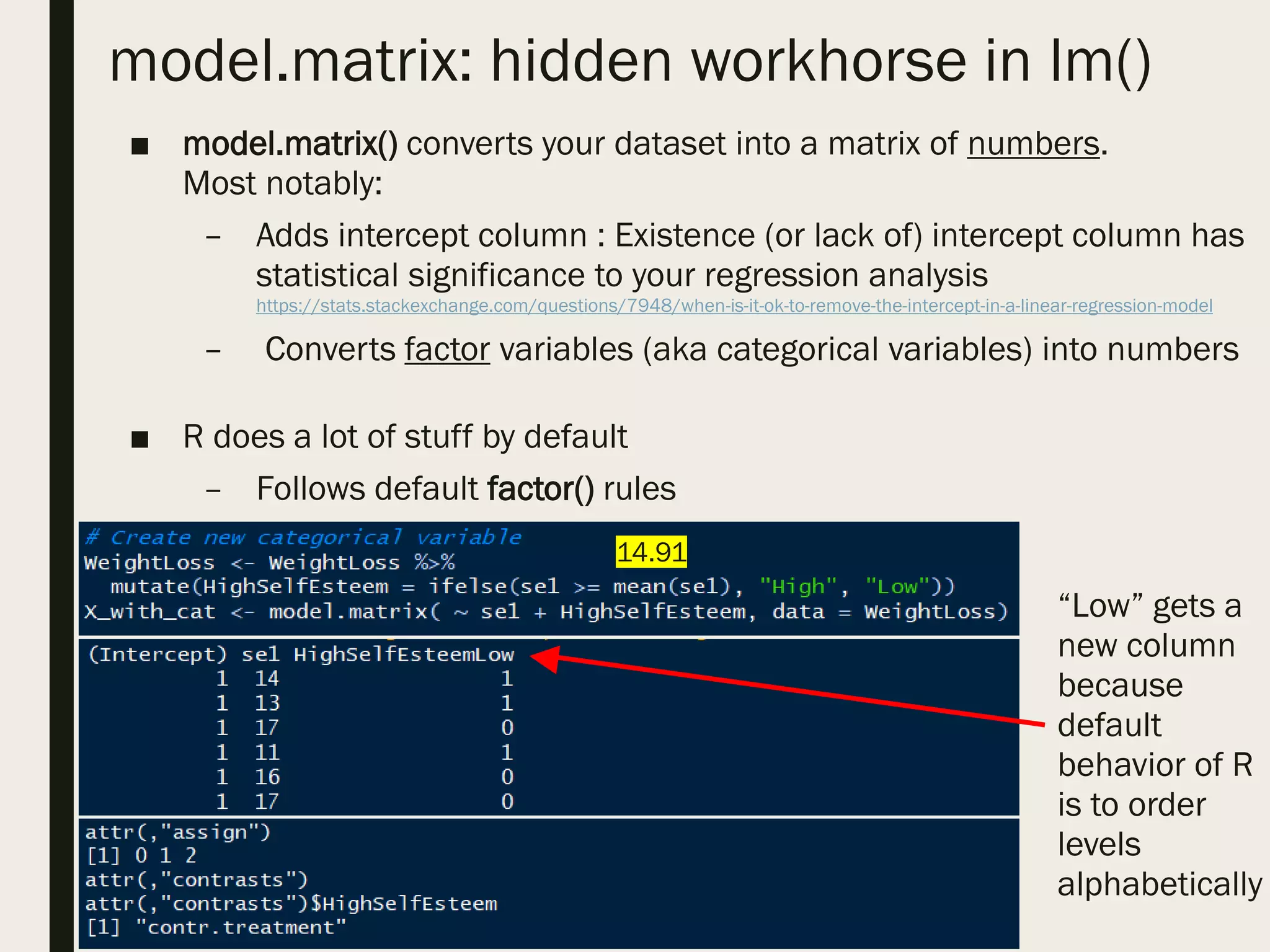
■ R does a lot of stuff by default
– Follows default factor() rules
“Low” gets a
new column
because
default
behavior of R
is to order
levels
alphabetically
14.91
Treating categorical variables
■ There are whole bunch of different encoding techniques to use
– https://stats.idre.ucla.edu/r/library/r-library-contrast-coding-systems-for-
categorical-variables
– http://appliedpredictivemodeling.com/blog/2013/10/23/the-basics-of-
encoding-categorical-data-for-predictive-models
– They have different effects on analysis, predictive power etc.
– R functions:
contr.treatment(),
contr.sum()
contr.poly()
contr.helmert()
contr.SAS()
Treating categorical variables
■ There are whole bunch of different encoding techniques to use
– https://stats.idre.ucla.edu/r/library/r-library-contrast-coding-systems-for-
categorical-variables
– http://appliedpredictivemodeling.com/blog/2013/10/23/the-basics-of-
encoding-categorical-data-for-predictive-models
– They have different effects on analysis, predictive power etc.
– R functions in library(stats):
contr.treatment()
contr.sum()
contr.poly()
contr.helmert()
contr.SAS()
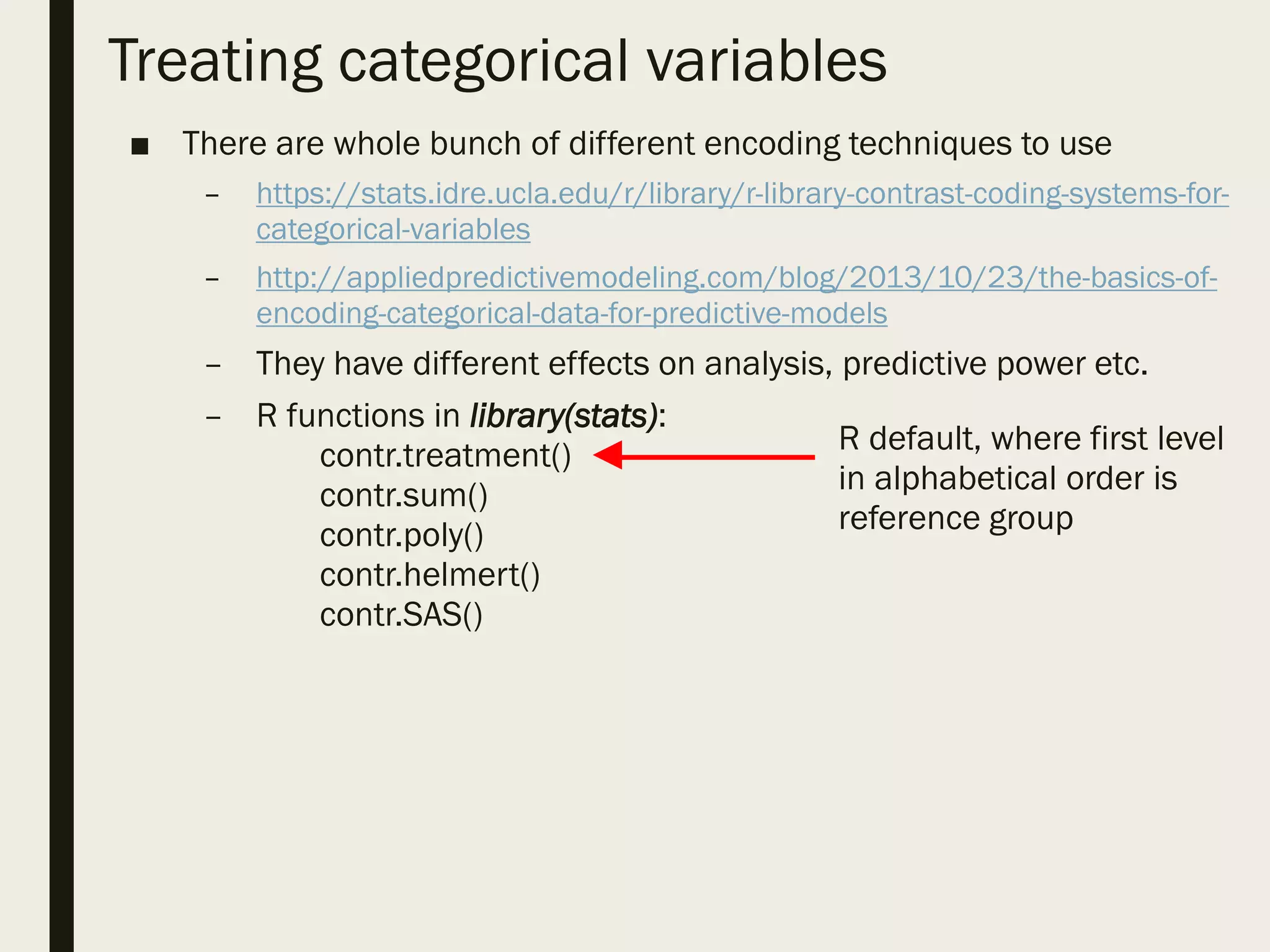
R default, where first level
in alphabetical order is
reference group
Treating categorical variables
■ There are whole bunch of different encoding techniques to use
– https://stats.idre.ucla.edu/r/library/r-library-contrast-coding-systems-for-
categorical-variables
– http://appliedpredictivemodeling.com/blog/2013/10/23/the-basics-of-
encoding-categorical-data-for-predictive-models
– They have different effects on analysis, predictive power etc.
– R functions in library(stats):
contr.treatment()
contr.sum()
contr.poly()
contr.helmert()
contr.SAS()
* This fact is according to the R documentation. As a non SAS programmer, I do not know if
this actually true. However, I have had conversations with other statisticians regarding how
they noticed that R’s output and SAS’s output for the same regression model spec are
different, leading some SAS users to “distrust” R (or vice-versa). This wouldn’t actually be
an issue if these users actually looked at the model outputs carefully and identified that
reference group for the categorical variable is different between R and SAS.
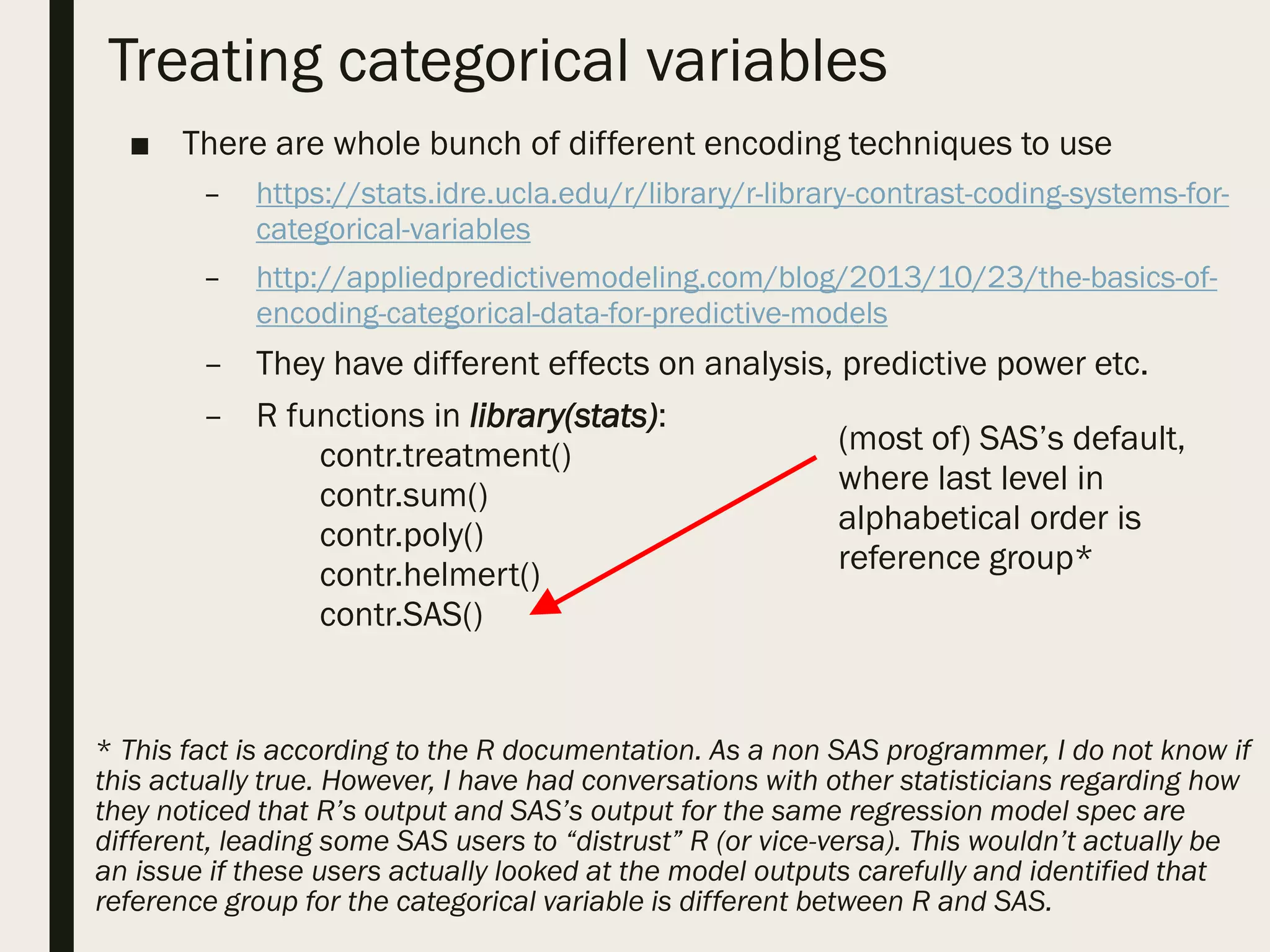
(most of) SAS’s default,
where last level in
alphabetical order is
reference group*
Conclusion
■ Use lm() to fit and assess linear regression models
– lm() outputs object of class… “lm” that has many useful
metrics and functions associated with it
– but remember your roots! lm() just a shortcut for creating
regression models without manually constructing design
matrix and optimizing over loss functions
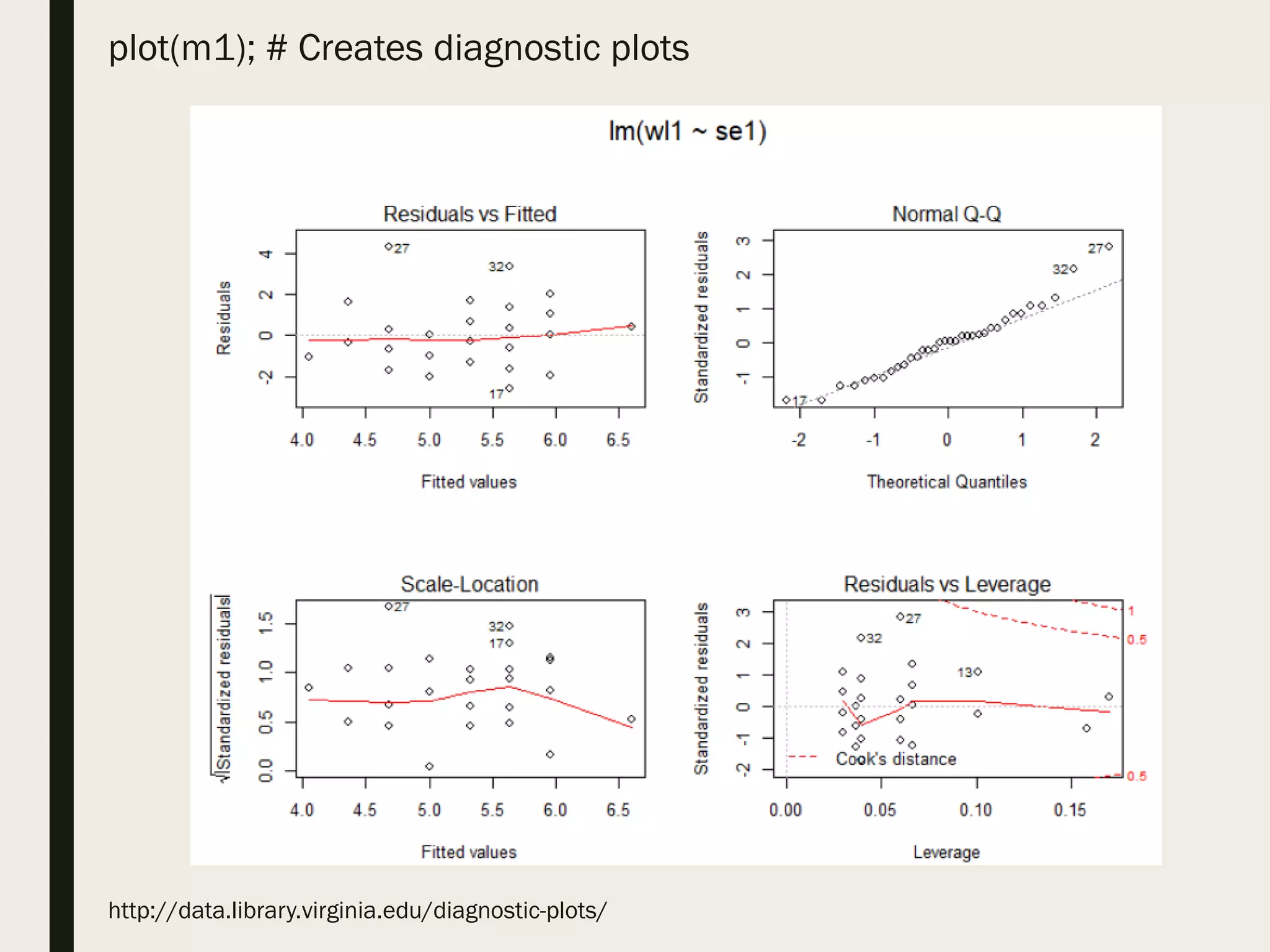
plot(m1); # Creates diagnostic plots
http://data.library.virginia.edu/diagnostic-plots/
Questions and Discussion

Linear regression in R

  • 1.
    PhillyR Meetup May 3,2018 Sponsored by
  • 2.
    Linear Regression Introduction PhillyRR User Group Leon Kim (not your ordinary)
  • 3.
  • 4.
    PhillyR News ■ Things? –Some exciting stuff ■ Thing! – More exciting stuff ■ R-Ladies Philly Meetup – Git happieR with GitHub May 16, 6:00 PM - 8:00 PM Drexel University – LeBow College of Business – https://www.meetup.com/rladies-philly/events/250279457/
  • 5.
    PhillyR News ■ NextPhillyR meetup – Logistic Regression by Russell Lavery – May 31st or June 7th ■ Next next PhillyR meetup – <your favorite topic> by <your name here> ■ Suggestions: – Survey analysis using survey – Working with databases – tidyverse (esp. dplyr 0.7+) – Machine learning framework using caret and mlr
  • 6.
    Overview ■ Gain understandingof and appreciation for lm() function ■ Be able to create a regression model on your own from scratch * ■ Key points – Mastering linear regression takes more than 1 hour, so this isn’t end-all and be-all guide – Stat 101 – level math knowledge. No linear algebra! – Look at linear regression in a different way
  • 7.
    All of statistics*http://www.stat.cmu.edu/~larry/=stat401/ 1) Find relationship between x1 and y1 2) What is y1 when x1 is some unobserved value e.g. x1 has some hypothetical value = 10.5 ■ Relationship status – direction – strength – significance
  • 8.
    Do both withone line 1) Find relationship between x1 and y1 ■ Relationship status – direction : slope sign – strength : slope magnitude – significance : p-value 2) What is y1 when x1 is some unobserved value e.g. x1 has some hypothetical value = 10.5 => Use the high school algebra on y1 = b1x1 + b0 where b0 = y intercept and b1 = slope Question: which of the lines on the right best represents the data?
  • 9.
    What is theline of best fit? ■ Which line represents the data best? ■ This is where concepts like: - Ordinary Least Squares, - Maximum Likelihood Estimator, - Sum of Squared Residuals … and others are thrown around ■ Choose the line that has the smallest error – ith real value : yi = b1xi + b0 + ei – ith predicted value : ŷi = b1xi + b0 ■ All of Statistics: – All models minimize errors in prediction by optimizing for a loss function. – In linear regression, this is: Σ [(yi – ŷi)2] ■ b1 = how much y is expected to change if x increased by 1 b0 = what y is expected to be if x = 0
  • 10.
    Enough theory, let’sget down to R ■ WeightLoss dataset in library(car) – wl1: weight loss at 1 month – se1: self esteem at 1 month – group: weight loss method “control” vs “Diet” vs “DietEx” - https://github.com/ropenscilabs/skimr
  • 11.
    Fitting linear regressionin R - 1 ■ Using lm() to regress weight loss on self-esteem ■ Simplest and the preferred method
  • 12.
    Fitting linear regressionin R - 2 ■ Using correlation & SD to regress weight loss on self-esteem ■ ■ This works because regression coefficient is the slope of a line – SD(Y) / SD(X) is the “rise over run” – correlation scales the ratio based on how linear relationship is ■ Only works when you have only one independent variable ■ When your data is standardized, cor(Y,X) = coefficient of X in lm()
  • 16.
    Fitting linear regressionin R - 3 ■ Using optim() and model matrix to regress weight loss on self-esteem – optim() is a general-purpose optimizer – Find coefficients that minimizes the loss function Σ [(yi – ŷi)2] – Requires user to specify design matrix aka model matrix ■ design matrix or model matrix – This is abstracted away from you when you use formula in lm() X y
  • 17.
    ■ optim() needsinitial values to optimize over. Here, we set these values at (0, 0) because we are optimizing over 2 columns in model matrix X ■ optim() returns a list with – argmin (parameters that minimizes the loss function value given X) – Minimum value of the loss function – Other info
  • 18.
    1st coefficient i.e. intercept 2ndcoefficient i.e. slope ■ optim() needs initial values to optimize over. Here, we set these values at (0, 0) because we are optimizing over 2 columns in model matrix X ■ optim() returns a list with – argmin (parameters that minimizes the loss function value given X) – Minimum value of the loss function – Other info
  • 19.
    1st coefficient optim() result 2ndcoefficient optim() result
  • 20.
    So far ■ Linearregression at its most primitive form, is just a line equation that minimizes error based on some loss function – No probability or statistics concepts are required ■ optim() is a general optimization function in R (more on this in the future) ■ You should still use lm() to fit and assess linear regression models – lm() outputs object of class… “lm” that has many useful metrics and functions associated with it – but remember your roots! All lm() is using statistical properties and linear algebra to optimize loss functions
  • 21.
    model.matrix: hidden workhorsein lm() ■ model.matrix() converts your dataset into a matrix of numbers. Most notably: – Adds intercept column : Existence (or lack of) intercept column has statistical significance to your regression analysis https://stats.stackexchange.com/questions/7948/when-is-it-ok-to-remove-the-intercept-in-a-linear-regression-model – Converts factor variables (aka categorical variables) into numbers
  • 22.
    model.matrix: hidden workhorsein lm() ■ model.matrix() converts your dataset into a matrix of numbers. Most notably: – Adds intercept column : Existence (or lack of) intercept column has statistical significance to your regression analysis https://stats.stackexchange.com/questions/7948/when-is-it-ok-to-remove-the-intercept-in-a-linear-regression-model – Converts factor variables (aka categorical variables) into numbers ■ model.matrix() creates a matrix given your dataset
  • 23.
    model.matrix: hidden workhorsein lm() ■ model.matrix() converts your dataset into a matrix of numbers. Most notably: – Adds intercept column : Existence (or lack of) intercept column has statistical significance to your regression analysis https://stats.stackexchange.com/questions/7948/when-is-it-ok-to-remove-the-intercept-in-a-linear-regression-model – Converts factor variables (aka categorical variables) into numbers ■ R does a lot of stuff by default – For create dummy variable for k-1 choices where k is number of categories (“levels” in R)
  • 24.
    model.matrix: hidden workhorsein lm() ■ model.matrix() converts your dataset into a matrix of numbers. Most notably: – Adds intercept column : Existence (or lack of) intercept column has statistical significance to your regression analysis https://stats.stackexchange.com/questions/7948/when-is-it-ok-to-remove-the-intercept-in-a-linear-regression-model – Converts factor variables (aka categorical variables) into numbers ■ R does a lot of stuff by default – Non-numeric values converted to factors character variables are changed to factor variables by default
  • 25.
    model.matrix: hidden workhorsein lm() ■ model.matrix() converts your dataset into a matrix of numbers. Most notably: – Adds intercept column : Existence (or lack of) intercept column has statistical significance to your regression analysis https://stats.stackexchange.com/questions/7948/when-is-it-ok-to-remove-the-intercept-in-a-linear-regression-model – Converts factor variables (aka categorical variables) into numbers ■ R does a lot of stuff by default – Creates dummy variables to make categories into numeric columns 0 for data rows that are not “Low”, 1 for data rows that are “Low” 14.91
  • 26.
    model.matrix: hidden workhorsein lm() ■ model.matrix() converts your dataset into a matrix of numbers. Most notably: – Adds intercept column : Existence (or lack of) intercept column has statistical significance to your regression analysis https://stats.stackexchange.com/questions/7948/when-is-it-ok-to-remove-the-intercept-in-a-linear-regression-model – Converts factor variables (aka categorical variables) into numbers ■ R does a lot of stuff by default – Follows default factor() rules “Low” gets a new column because default behavior of R is to order levels alphabetically 14.91
  • 27.
    Treating categorical variables ■There are whole bunch of different encoding techniques to use – https://stats.idre.ucla.edu/r/library/r-library-contrast-coding-systems-for- categorical-variables – http://appliedpredictivemodeling.com/blog/2013/10/23/the-basics-of- encoding-categorical-data-for-predictive-models – They have different effects on analysis, predictive power etc. – R functions: contr.treatment(), contr.sum() contr.poly() contr.helmert() contr.SAS()
  • 28.
    Treating categorical variables ■There are whole bunch of different encoding techniques to use – https://stats.idre.ucla.edu/r/library/r-library-contrast-coding-systems-for- categorical-variables – http://appliedpredictivemodeling.com/blog/2013/10/23/the-basics-of- encoding-categorical-data-for-predictive-models – They have different effects on analysis, predictive power etc. – R functions in library(stats): contr.treatment() contr.sum() contr.poly() contr.helmert() contr.SAS() R default, where first level in alphabetical order is reference group
  • 29.
    Treating categorical variables ■There are whole bunch of different encoding techniques to use – https://stats.idre.ucla.edu/r/library/r-library-contrast-coding-systems-for- categorical-variables – http://appliedpredictivemodeling.com/blog/2013/10/23/the-basics-of- encoding-categorical-data-for-predictive-models – They have different effects on analysis, predictive power etc. – R functions in library(stats): contr.treatment() contr.sum() contr.poly() contr.helmert() contr.SAS() * This fact is according to the R documentation. As a non SAS programmer, I do not know if this actually true. However, I have had conversations with other statisticians regarding how they noticed that R’s output and SAS’s output for the same regression model spec are different, leading some SAS users to “distrust” R (or vice-versa). This wouldn’t actually be an issue if these users actually looked at the model outputs carefully and identified that reference group for the categorical variable is different between R and SAS. (most of) SAS’s default, where last level in alphabetical order is reference group*
  • 30.
    Conclusion ■ Use lm()to fit and assess linear regression models – lm() outputs object of class… “lm” that has many useful metrics and functions associated with it – but remember your roots! lm() just a shortcut for creating regression models without manually constructing design matrix and optimizing over loss functions
  • 31.
    plot(m1); # Createsdiagnostic plots http://data.library.virginia.edu/diagnostic-plots/
  • 32.