Linear Programming
Part 1
J. M. Pogodzinski
carol
carol
carol
carol
Agenda
• Mathematical Programming Problems
• Economic Theory and Mathematical Programming Problems
• Linear Programming Problems
• The Objective Function
• The Inequality Constraints
• The Non-Negativity Constraints (which are inequality
constraints)
• Equality Constraints?
• The Feasible Set
• Does a
Solution
Exist to a Linear Programming Problem? (the existence
question)
• Applications (Uses) of Linear Programming
• Solving Linear Programming Problems
• Theorems About Linear Programming
Mathematical Programming Problems
• A Mathematical Programming Problem consists of:
• An objective function
• Constraints defined somehow – equations, inequalities,…
• Little can be said about such a general problem – we need to
make
assumptions about the objective function and/or about the
constraints before we can say anything about the existence of
solutions, algorithms for finding solutions (if they exist),
properties of
solutions
About Objective Functions
• Very common to assume there is only one objective function
• Objective functions are either maximized or minimized – the
generic term is
optimized. The specific problem determines whether
maximization or
minimization is appropriate. There are deeper connections
between
maximization and minimization. Maximization problems can be
restated as
minimization problems. More importantly, specific
maximization problems are
associated with specific minimization problems through duality.
• It is possible to consider multi-objective mathematical
programming problems
(there is a legitimate topic called multi-objective linear
programming)
• What do you get out of multi-objective linear programming (if
there is a
solution)?
• The Pareto Frontier
• We will not consider multi-objective linear programming
because it is
computationally difficult
About Objective Functions
• Example (from microeconomics): Consumers maximize utility
subject
to a budget constraint
• ����,� � �,� ������� �� ��� + ��� = � (and �
≥ 0 and y ≥ 0)
• We assume that � �,� is a quasi-concave continuous function
(Note: famous paper “Quasi-Concave Programming” by Kenneth
J.
Arrow and Alain C. Enthoven, Econometrica, Vol. 29, No. 4
(Oct.,
1961), pp. 779-800)
• A function � �,� is quasi-concave if its upper level sets are
convex
sets
Constraints
• Most common to define constraints by one or more equations
or
inequalities
• Note on finite constraint sets – existence of optimum
• For example, in the consumer choice problem mentioned in the
previous slide, an equation called the budget equation defined
the
constraint set - ��� + ��� = � (and � ≥ 0 and y ≥ 0)
• We might also have defined the constraint set with several
inequalities: ��� + ��� ≤ � and � ≥ 0 and y ≥ 0
• We can write the equation ��� + ��� = � as two
inequalities:
��� + ��� ≤ � and ��� + ��� ≥ �
The Consumer Choice Problem
����,� � �,� ������� �� ��� + ��� = �
(and � ≥ 0 and y ≥ 0)
Draw the constraint set (the feasible set)
Draw some upper level sets of the objective function
Are these sets convex sets?
Convex Sets – Yes or No?
• Examples
Linear Programming Problems
• An LP Problem has:
• A linear objective function
• Linear inequality constraints
• Non-negativity constraints
LP Problem – General Form
• Decision variables: �� (� = 1,…,�)
• (Linear) Objective function: Π = �1�1 + �2�2 + ⋯+ ����
• (Linear) Inequality constraints:
�11�1 + ⋯+ �1��� ≤ �1
�21�1 + ⋯+ �2��� ≤ �2
��1�1 + ⋯+ ����� ≤ ��
• Non-negativity constraints: �1 ≥ 0, �2 ≥ 0,…, �� ≥ 0
Write this in
matrix
notation
Write this in
matrix
notation
x – variables
a, b, c – parameters (constants)
Write this
in matrix
notation
LP Problem – An Example
• A Production Problem
• �� amount of good j to be produced (j=1,…,n)
• ��� amount of resource i required to produce one unit of
good j*
• �� amount of resource i available
• �� profit per unit of good j
*CONVENTION: (i,j) = (row, column)
Graph it!
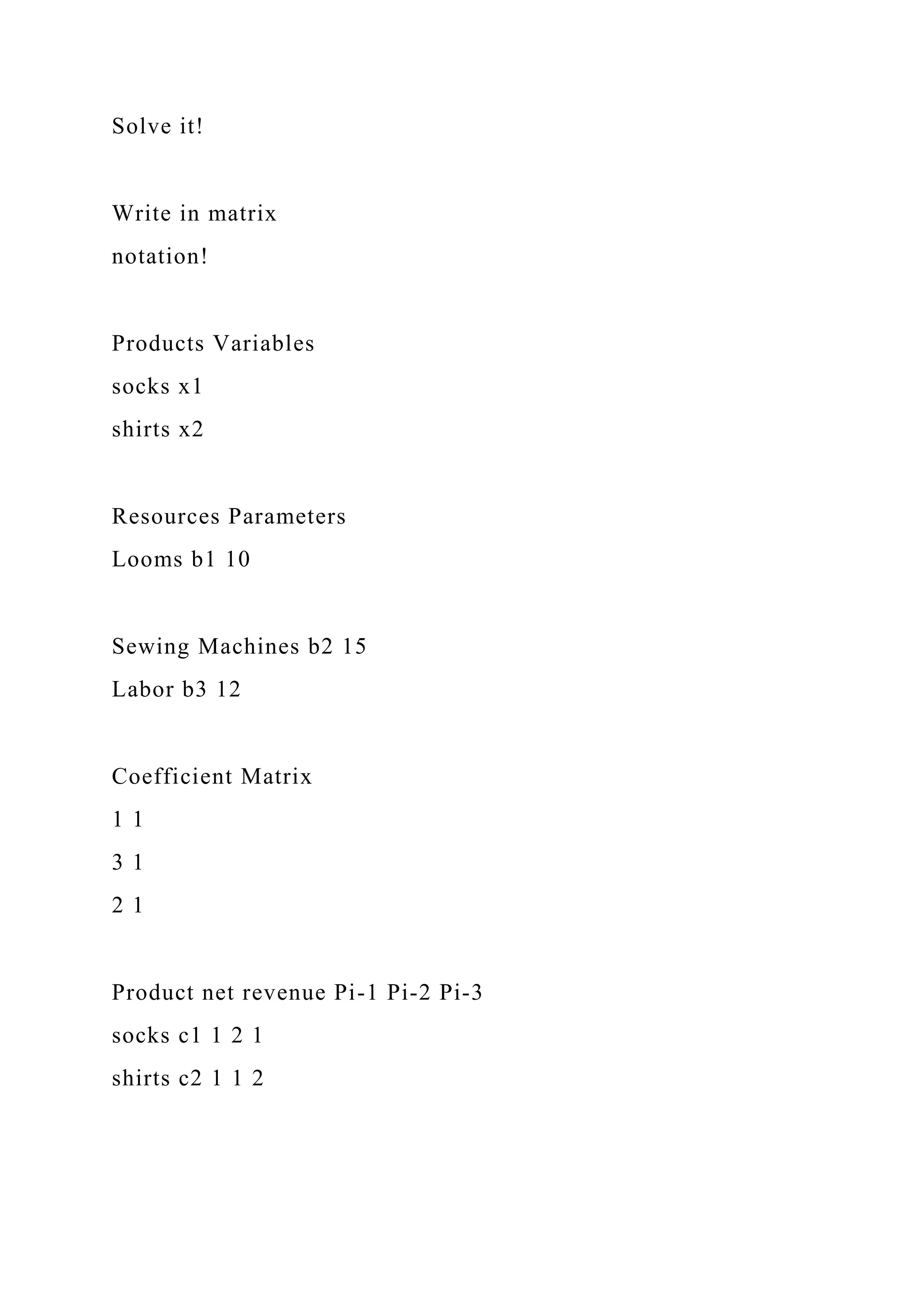
Solve it!
Write in matrix
notation!
Products Variables
socks x1
shirts x2
Resources Parameters
Looms b1 10
Sewing Machines b2 15
Labor b3 12
Coefficient Matrix
1 1
3 1
2 1
Product net revenue Pi-1 Pi-2 Pi-3
socks c1 1 2 1
shirts c2 1 1 2
Linear Programming
Part 2
J. M. Pogodzinski
Agenda
• Some LP Theorems
• Excel skills: sumproduct, matrix multiplication, matrix
inversion
• Using Excel to Solve LP Problems (demo)
• Binding and non-binding constraints
• The Dual LP Problem
• The Dual

Linear ProgrammingPart 1J. M. Pogodzinskicarol.docx

  • 1.
    Linear Programming Part 1 J.M. Pogodzinski carol carol carol carol Agenda • Mathematical Programming Problems • Economic Theory and Mathematical Programming Problems • Linear Programming Problems • The Objective Function • The Inequality Constraints • The Non-Negativity Constraints (which are inequality constraints) • Equality Constraints? • The Feasible Set • Does a
  • 2.
    Solution Exist to aLinear Programming Problem? (the existence question) • Applications (Uses) of Linear Programming • Solving Linear Programming Problems • Theorems About Linear Programming Mathematical Programming Problems • A Mathematical Programming Problem consists of: • An objective function • Constraints defined somehow – equations, inequalities,… • Little can be said about such a general problem – we need to make assumptions about the objective function and/or about the constraints before we can say anything about the existence of solutions, algorithms for finding solutions (if they exist), properties of solutions
  • 3.
    About Objective Functions •Very common to assume there is only one objective function • Objective functions are either maximized or minimized – the generic term is optimized. The specific problem determines whether maximization or minimization is appropriate. There are deeper connections between maximization and minimization. Maximization problems can be restated as minimization problems. More importantly, specific maximization problems are associated with specific minimization problems through duality. • It is possible to consider multi-objective mathematical programming problems (there is a legitimate topic called multi-objective linear programming) • What do you get out of multi-objective linear programming (if
  • 4.
    there is a solution)? •The Pareto Frontier • We will not consider multi-objective linear programming because it is computationally difficult About Objective Functions • Example (from microeconomics): Consumers maximize utility subject to a budget constraint • ����,� � �,� ������� �� ��� + ��� = � (and � ≥ 0 and y ≥ 0) • We assume that � �,� is a quasi-concave continuous function (Note: famous paper “Quasi-Concave Programming” by Kenneth J. Arrow and Alain C. Enthoven, Econometrica, Vol. 29, No. 4 (Oct.,
  • 5.
    1961), pp. 779-800) •A function � �,� is quasi-concave if its upper level sets are convex sets Constraints • Most common to define constraints by one or more equations or inequalities • Note on finite constraint sets – existence of optimum • For example, in the consumer choice problem mentioned in the previous slide, an equation called the budget equation defined the constraint set - ��� + ��� = � (and � ≥ 0 and y ≥ 0) • We might also have defined the constraint set with several inequalities: ��� + ��� ≤ � and � ≥ 0 and y ≥ 0 • We can write the equation ��� + ��� = � as two
  • 6.
    inequalities: ��� + ���≤ � and ��� + ��� ≥ � The Consumer Choice Problem ����,� � �,� ������� �� ��� + ��� = � (and � ≥ 0 and y ≥ 0) Draw the constraint set (the feasible set) Draw some upper level sets of the objective function Are these sets convex sets? Convex Sets – Yes or No? • Examples Linear Programming Problems
  • 7.
    • An LPProblem has: • A linear objective function • Linear inequality constraints • Non-negativity constraints LP Problem – General Form • Decision variables: �� (� = 1,…,�) • (Linear) Objective function: Π = �1�1 + �2�2 + ⋯+ ���� • (Linear) Inequality constraints: �11�1 + ⋯+ �1��� ≤ �1 �21�1 + ⋯+ �2��� ≤ �2 ��1�1 + ⋯+ ����� ≤ �� • Non-negativity constraints: �1 ≥ 0, �2 ≥ 0,…, �� ≥ 0 Write this in matrix notation Write this in matrix
  • 8.
    notation x – variables a,b, c – parameters (constants) Write this in matrix notation LP Problem – An Example • A Production Problem • �� amount of good j to be produced (j=1,…,n) • ��� amount of resource i required to produce one unit of good j* • �� amount of resource i available • �� profit per unit of good j *CONVENTION: (i,j) = (row, column) Graph it!
  • 9.
    Solve it! Write inmatrix notation! Products Variables socks x1 shirts x2 Resources Parameters Looms b1 10 Sewing Machines b2 15 Labor b3 12 Coefficient Matrix 1 1 3 1 2 1 Product net revenue Pi-1 Pi-2 Pi-3 socks c1 1 2 1 shirts c2 1 1 2
  • 10.
    Linear Programming Part 2 J.M. Pogodzinski Agenda • Some LP Theorems • Excel skills: sumproduct, matrix multiplication, matrix inversion • Using Excel to Solve LP Problems (demo) • Binding and non-binding constraints • The Dual LP Problem • The Dual