LINEAR MIXED INTEGER
PROGRAMS
Group Members:
Avadhi Jain – 21bch007
Avani Taiwade – 21bch008
Hiren Babariya – 21bch010
Jay Chaudhary – 21bch012
Brij Dekivadiya – 21bch013
INTRODUCTION
 A mathematical optimization or feasibility program where some or
all of the variables are limited to being integers is known as an
integer programming issue. The phrase is frequently used to refer
to integer linear programming (ILP), which has linear constraints
(apart from integer constraints) and an objective function.
 Programming with integers is NP-complete. Specifically, the
specific situation of 0–1 integer linear programming, when the
constraints are the sole requirements and the unknowns are
binary.
 The problem is referred to as a mixed-integer programming
problem if some of the decision variables are not discrete.
FORMULAS
1. Objective function:
In a mixed integer linear programs the objective function is linear
and describe as
Z = c1x1 + c2x2 + ….. + cnxn
Where,
 Z is the objective function
 c1, c2, c3, …., cn are coefficient for each variable in the objective
function
 x1, x2, x3, …., xn are decision variables, some are restricted to
be integers.
FORMULAS
2. Constraints
 constraints in MILP are also linear and are typically given in the
form of inequalities or equalities.
a11x1 + a12x2 + a13x3 + ….. + a1nxn ≤ b1
a21x1 + a22x2 + a23x3 + ….. + a2nxn ≤ b2
.
.
.
am1x1 + am2x2 + am3x3 + ….. + a1mnxn ≤ bm
FORMULAS
3. Decision Variable Types:
 Continuous :
These can take any real number value within a specified range
 Integer :
These takes integer values, often restricted to binary in many
practical applications.
4. MILP formulation:
Minimize or Maximize Z = Σ cjxj
Subject to Σ aijxj ≤ bi , i = 1,2,….m
xj ϵ Z denotes integer variables
xj ϵ R denotes continous variables
METHODS FOR SOLVING LIP
1. Cutting – Plane method
2. Enumeration Method
3. Branch and bound method
1. CUTTING – PLANE METHOD
 An Algorithm for solving pure and mixed integer programming problems*
 Developed by Ralph E. Gomory
 Steps to solve:
1. Relax the integer requirements.
2. Solve the resulting LP problem using Simplex Method
3. If all the basic variables have integer values, Optimality of the Integer
programming problem is reached. So, go to step 7; otherwise go to step 4.
4. Examine the constraints corresponding to the current optimal solution.
variable with non - integer solution in the current optimal table, find Live
fraction part fFor each basicTherefore b, = [b] + f, where [b] is integer part
and f, is fraction part of b,
1. CUTTING – PLANE METHOD
5. Choose the largest fraction among various f; i.e. Max (f). Treat the constraint
corresponding to the maximum fraction as the source row. Based on the source
row, develop an additional constraint (Gomory's constraint/ fractional cut) as
shown:-Summation[positive fraction for non-basic variables] + S, = -f;
6. Add the fractional cut as the last row in the latest optimal table and proceed
further using dual simplex method, and find the new optimum solution. If the new
optimum solution is integer then go to step 7; otherwise go to step 4.
7. Print the integer solution and optimal value.
 Advantages:
1. By eliminating fractional solutions at each iteration, it refines the search space,
moving it closer to the true solution.
2. It is really helpful with the combine method with branch and bound.
2. ENUMERATION METHOD
 This method is approach to solving mixed integer programs problems by
systematically listing and evaluating all possible combinations of
integers variables.
 Steps:
1. First list all the possible values within the range for the each integers.
This can help to get wide set of solutions.
2. For the each combination of integer values substitute these into MIP,
reducing it to the linear programs.
3. Solve the linear program foe each combination of values and check
feasibility.
4. At the end solution is found for each combination check if it is better
than previous or not.
2. ENUMERATION METHOD
 Advantages:
1. This method is simple and straight to the point it does not require
any complex techniques or heuristics.
2. If all the combinations are evaluated than using this method we can
get optimum solution.
 Disadvantages:
1. This method is extremely computationally expensive as the number
of combinations grows exponentially with the number of integer
variables.
2. This method is inefficient for the large problems.
3. BRANCH AND BOUND METHOD
 Creates and solves a sequence of sub - problems to the original problem
that a increasingly more restrictive until an optimal solution is found.
 BRANCHING:
 Selection of an integer value of a decision variable to examine for a
possible inti solution to a problem.
 If the solution to the LPP contains non - integer values for some or all
decision variables, then the solution space is reduced by introducing
constraints with respect to anyone of those decision variables. If the
value of the decision variable X, is 3.5, then two more problems will be
created by using each of the following constraints. X, <= 3 and X,>=4.
3. BRANCH AND BOUND METHOD
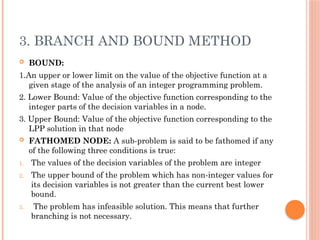
 BOUND:
1.An upper or lower limit on the value of the objective function at a
given stage of the analysis of an integer programming problem.
2. Lower Bound: Value of the objective function corresponding to the
integer parts of the decision variables in a node.
3. Upper Bound: Value of the objective function corresponding to the
LPP solution in that node
 FATHOMED NODE: A sub-problem is said to be fathomed if any
of the following three conditions is true:
1. The values of the decision variables of the problem are integer
2. The upper bound of the problem which has non-integer values for
its decision variables is not greater than the current best lower
bound.
3. The problem has infeasible solution. This means that further
branching is not necessary.
3. BRANCH AND BOUND METHOD
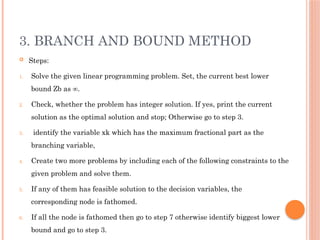
 Steps:
1. Solve the given linear programming problem. Set, the current best lower
bound Zb as ∞.
2. Check, whether the problem has integer solution. If yes, print the current
solution as the optimal solution and stop; Otherwise go to step 3.
3. identify the variable xk which has the maximum fractional part as the
branching variable,
4. Create two more problems by including each of the following constraints to the
given problem and solve them.
5. If any of them has feasible solution to the decision variables, the
corresponding node is fathomed.
6. If all the node is fathomed then go to step 7 otherwise identify biggest lower
bound and go to step 3.
3. BRANCH AND BOUND METHOD
7. Select the solution of the problem with respect to the fathomed
node whose lower bound is equal to the current best bound.
 Advantages:
It handles the large problems very well when it combines with
heuristics and branching problems.
 Disadvantages:
It can be computationally expensive due to the exponential growth of
branch.
Thank You

Linear mixed integer programs for chemical engineering

  • 1.
    LINEAR MIXED INTEGER PROGRAMS GroupMembers: Avadhi Jain – 21bch007 Avani Taiwade – 21bch008 Hiren Babariya – 21bch010 Jay Chaudhary – 21bch012 Brij Dekivadiya – 21bch013
  • 2.
    INTRODUCTION  A mathematicaloptimization or feasibility program where some or all of the variables are limited to being integers is known as an integer programming issue. The phrase is frequently used to refer to integer linear programming (ILP), which has linear constraints (apart from integer constraints) and an objective function.  Programming with integers is NP-complete. Specifically, the specific situation of 0–1 integer linear programming, when the constraints are the sole requirements and the unknowns are binary.  The problem is referred to as a mixed-integer programming problem if some of the decision variables are not discrete.
  • 3.
    FORMULAS 1. Objective function: Ina mixed integer linear programs the objective function is linear and describe as Z = c1x1 + c2x2 + ….. + cnxn Where,  Z is the objective function  c1, c2, c3, …., cn are coefficient for each variable in the objective function  x1, x2, x3, …., xn are decision variables, some are restricted to be integers.
  • 4.
    FORMULAS 2. Constraints  constraintsin MILP are also linear and are typically given in the form of inequalities or equalities. a11x1 + a12x2 + a13x3 + ….. + a1nxn ≤ b1 a21x1 + a22x2 + a23x3 + ….. + a2nxn ≤ b2 . . . am1x1 + am2x2 + am3x3 + ….. + a1mnxn ≤ bm
  • 5.
    FORMULAS 3. Decision VariableTypes:  Continuous : These can take any real number value within a specified range  Integer : These takes integer values, often restricted to binary in many practical applications. 4. MILP formulation: Minimize or Maximize Z = Σ cjxj Subject to Σ aijxj ≤ bi , i = 1,2,….m xj ϵ Z denotes integer variables xj ϵ R denotes continous variables
  • 6.
    METHODS FOR SOLVINGLIP 1. Cutting – Plane method 2. Enumeration Method 3. Branch and bound method
  • 7.
    1. CUTTING –PLANE METHOD  An Algorithm for solving pure and mixed integer programming problems*  Developed by Ralph E. Gomory  Steps to solve: 1. Relax the integer requirements. 2. Solve the resulting LP problem using Simplex Method 3. If all the basic variables have integer values, Optimality of the Integer programming problem is reached. So, go to step 7; otherwise go to step 4. 4. Examine the constraints corresponding to the current optimal solution. variable with non - integer solution in the current optimal table, find Live fraction part fFor each basicTherefore b, = [b] + f, where [b] is integer part and f, is fraction part of b,
  • 8.
    1. CUTTING –PLANE METHOD 5. Choose the largest fraction among various f; i.e. Max (f). Treat the constraint corresponding to the maximum fraction as the source row. Based on the source row, develop an additional constraint (Gomory's constraint/ fractional cut) as shown:-Summation[positive fraction for non-basic variables] + S, = -f; 6. Add the fractional cut as the last row in the latest optimal table and proceed further using dual simplex method, and find the new optimum solution. If the new optimum solution is integer then go to step 7; otherwise go to step 4. 7. Print the integer solution and optimal value.  Advantages: 1. By eliminating fractional solutions at each iteration, it refines the search space, moving it closer to the true solution. 2. It is really helpful with the combine method with branch and bound.
  • 9.
    2. ENUMERATION METHOD This method is approach to solving mixed integer programs problems by systematically listing and evaluating all possible combinations of integers variables.  Steps: 1. First list all the possible values within the range for the each integers. This can help to get wide set of solutions. 2. For the each combination of integer values substitute these into MIP, reducing it to the linear programs. 3. Solve the linear program foe each combination of values and check feasibility. 4. At the end solution is found for each combination check if it is better than previous or not.
  • 10.
    2. ENUMERATION METHOD Advantages: 1. This method is simple and straight to the point it does not require any complex techniques or heuristics. 2. If all the combinations are evaluated than using this method we can get optimum solution.  Disadvantages: 1. This method is extremely computationally expensive as the number of combinations grows exponentially with the number of integer variables. 2. This method is inefficient for the large problems.
  • 11.
    3. BRANCH ANDBOUND METHOD  Creates and solves a sequence of sub - problems to the original problem that a increasingly more restrictive until an optimal solution is found.  BRANCHING:  Selection of an integer value of a decision variable to examine for a possible inti solution to a problem.  If the solution to the LPP contains non - integer values for some or all decision variables, then the solution space is reduced by introducing constraints with respect to anyone of those decision variables. If the value of the decision variable X, is 3.5, then two more problems will be created by using each of the following constraints. X, <= 3 and X,>=4.
  • 12.
    3. BRANCH ANDBOUND METHOD  BOUND: 1.An upper or lower limit on the value of the objective function at a given stage of the analysis of an integer programming problem. 2. Lower Bound: Value of the objective function corresponding to the integer parts of the decision variables in a node. 3. Upper Bound: Value of the objective function corresponding to the LPP solution in that node  FATHOMED NODE: A sub-problem is said to be fathomed if any of the following three conditions is true: 1. The values of the decision variables of the problem are integer 2. The upper bound of the problem which has non-integer values for its decision variables is not greater than the current best lower bound. 3. The problem has infeasible solution. This means that further branching is not necessary.
  • 13.
    3. BRANCH ANDBOUND METHOD  Steps: 1. Solve the given linear programming problem. Set, the current best lower bound Zb as ∞. 2. Check, whether the problem has integer solution. If yes, print the current solution as the optimal solution and stop; Otherwise go to step 3. 3. identify the variable xk which has the maximum fractional part as the branching variable, 4. Create two more problems by including each of the following constraints to the given problem and solve them. 5. If any of them has feasible solution to the decision variables, the corresponding node is fathomed. 6. If all the node is fathomed then go to step 7 otherwise identify biggest lower bound and go to step 3.
  • 14.
    3. BRANCH ANDBOUND METHOD 7. Select the solution of the problem with respect to the fathomed node whose lower bound is equal to the current best bound.  Advantages: It handles the large problems very well when it combines with heuristics and branching problems.  Disadvantages: It can be computationally expensive due to the exponential growth of branch.
  • 15.