Introduction
Linear Logic via Logical Dependencies
Valeria de Paiva
Nuance Communications,
Sunnyvale, CA, USA
Mirant˜ao III, MG, Brazil
August, 2018
Valeria de Paiva Mirantao 2018
Introduction
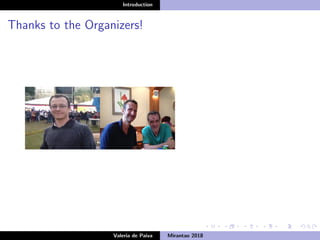
Thanks to the Organizers!
Valeria de Paiva Mirantao 2018
Introduction
Introduction
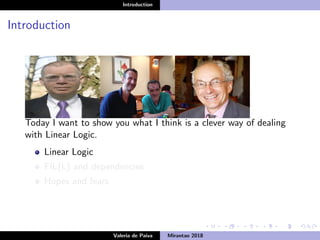
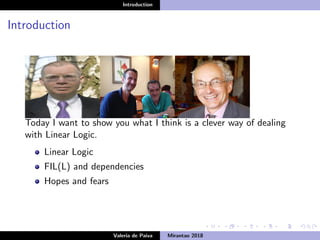
Today I want to show you what I think is a clever way of dealing
with Linear Logic.
Linear Logic
FIL(L) and dependencies
Hopes and fears
Valeria de Paiva Mirantao 2018
Introduction
Introduction
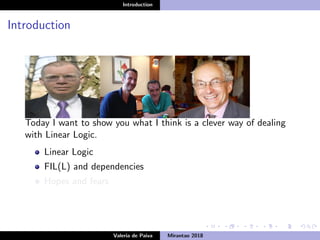
Today I want to show you what I think is a clever way of dealing
with Linear Logic.
Linear Logic
FIL(L) and dependencies
Hopes and fears
Valeria de Paiva Mirantao 2018
Introduction
Introduction
Today I want to show you what I think is a clever way of dealing
with Linear Logic.
Linear Logic
FIL(L) and dependencies
Hopes and fears
Valeria de Paiva Mirantao 2018
Introduction
Linear Logic is full of surprises...
a logical way of coping with resources and resource control
system of dependencies between formulae for a fragment of LL
to prove a cut-elimination theorem for this fragment
Valeria de Paiva Mirantao 2018
Introduction
Linear Logic is full of surprises...
a logical way of coping with resources and resource control
system of dependencies between formulae for a fragment of LL
to prove a cut-elimination theorem for this fragment
Valeria de Paiva Mirantao 2018
Introduction
Linear Logic is full of surprises...
a logical way of coping with resources and resource control
system of dependencies between formulae for a fragment of LL
to prove a cut-elimination theorem for this fragment
Valeria de Paiva Mirantao 2018
Introduction
Applications of Linear Logic include linear functional programming,
linear logic programming, general theories of concurrency,
computational linguistics, AI and planning...
30 years later:
some commercial success: Separation Logic, BI, etc
indisputable academic success (LiCS, decades of EU projects)
definitely out-of-fashion nowadays
Valeria de Paiva Mirantao 2018
Introduction
Linear Logic
A proof theoretic logic described by Jean-Yves Girard in 1986.
Basic idea: assumptions cannot be discarded or duplicated. They
must be used exactly once – just like dollar bills...
Other approaches to accounting for logical resources before.
Great win of Linear Logic: Account for resources when you want
to, otherwise fall back on traditional logic, A → B iff !A −◦ B
Valeria de Paiva Mirantao 2018
Introduction
Linear Implication and (Multiplicative) Conjunction
Traditional implication: A, A → B B
A, A → B A ∧ B Re-use A
Linear implication: A, A −◦ B B
A, A −◦ B A ⊗ B Cannot re-use A
Traditional conjunction: A ∧ B A Discard B
Linear conjunction: A ⊗ B A Cannot discard B
Of course: !A !A⊗!A Re-use
!A ⊗ B B Discard
Valeria de Paiva Mirantao 2018
Introduction
Full Intuitionistic Linear Logic (FILL)
not ILL, nor CLL
independent tensor, par and linear implication, no strict
duality, (A A⊥⊥ but not converse)
syntactic reconstruction of “essence”of Dialectica Categories
long, checkered story of FILL
Valeria de Paiva Mirantao 2018
Introduction
Full Intuitionistic Linear Logic (FILL)
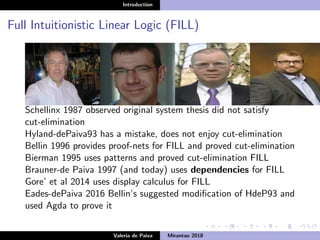
Schellinx 1987 observed original system thesis did not satisfy
cut-elimination
Hyland-dePaiva93 has a mistake, does not enjoy cut-elimination
Bellin 1996 provides proof-nets for FILL and proved cut-elimination
Bierman 1995 uses patterns and proved cut-elimination FILL
Brauner-de Paiva 1997 (and today) uses dependencies for FILL
Gore’ et al 2014 uses display calculus for FILL
Eades-dePaiva 2016 Bellin’s suggested modification of HdeP93 and
used Agda to prove it
Valeria de Paiva Mirantao 2018
Introduction
Full Intuitionistic Linear Logic (FILL)
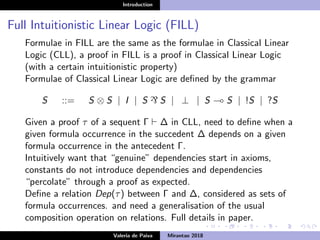
Formulae in FILL are the same as the formulae in Classical Linear
Logic (CLL), a proof in FILL is a proof in Classical Linear Logic
(with a certain intuitionistic property)
Formulae of Classical Linear Logic are defined by the grammar
S ::= S ⊗ S | I | S ` S | ⊥ | S S | !S | ?S
Given a proof τ of a sequent Γ ∆ in CLL, need to define when a
given formula occurrence in the succedent ∆ depends on a given
formula occurrence in the antecedent Γ.
Intuitively want that “genuine” dependencies start in axioms,
constants do not introduce dependencies and dependencies
“percolate” through a proof as expected.
Define a relation Dep(τ) between Γ and ∆, considered as sets of
formula occurrences. and need a generalisation of the usual
composition operation on relations. Full details in paper.
Valeria de Paiva Mirantao 2018
Introduction
Comparing FILL and CLL
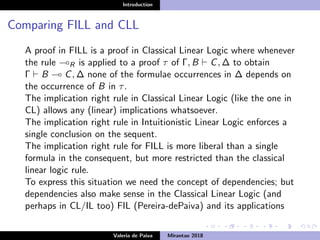
A proof in FILL is a proof in Classical Linear Logic where whenever
the rule R is applied to a proof τ of Γ, B C, ∆ to obtain
Γ B C, ∆ none of the formulae occurrences in ∆ depends on
the occurrence of B in τ.
The implication right rule in Classical Linear Logic (like the one in
CL) allows any (linear) implications whatsoever.
The implication right rule in Intuitionistic Linear Logic enforces a
single conclusion on the sequent.
The implication right rule for FILL is more liberal than a single
formula in the consequent, but more restricted than the classical
linear logic rule.
To express this situation we need the concept of dependencies; but
dependencies also make sense in the Classical Linear Logic (and
perhaps in CL/IL too) FIL (Pereira-dePaiva) and its applications
Valeria de Paiva Mirantao 2018
Introduction
Use of dependencies in FILL
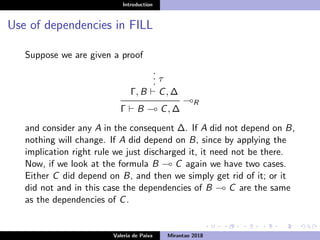
Suppose we are given a proof
·
·
·
τ
Γ, B C, ∆
R
Γ B C, ∆
and consider any A in the consequent ∆. If A did not depend on B,
nothing will change. If A did depend on B, since by applying the
implication right rule we just discharged it, it need not be there.
Now, if we look at the formula B C again we have two cases.
Either C did depend on B, and then we simply get rid of it; or it
did not and in this case the dependencies of B C are the same
as the dependencies of C.
Valeria de Paiva Mirantao 2018
Introduction
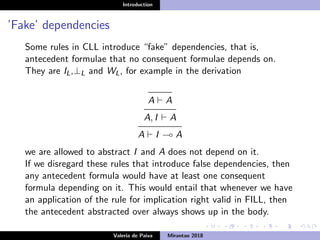
’Fake’ dependencies
Some rules in CLL introduce “fake” dependencies, that is,
antecedent formulae that no consequent formulae depends on.
They are IL,⊥L and WL, for example in the derivation
A A
A, I A
A I A
we are allowed to abstract I and A does not depend on it.
If we disregard these rules that introduce false dependencies, then
any antecedent formula would have at least one consequent
formula depending on it. This would entail that whenever we have
an application of the rule for implication right valid in FILL, then
the antecedent abstracted over always shows up in the body.
Valeria de Paiva Mirantao 2018
Introduction
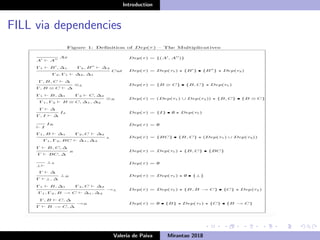
FILL via dependencies
Valeria de Paiva Mirantao 2018
Introduction
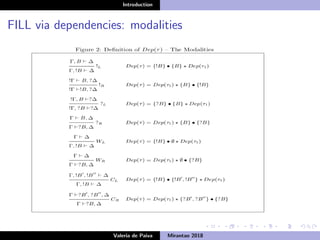
FILL via dependencies: modalities
Valeria de Paiva Mirantao 2018
Introduction
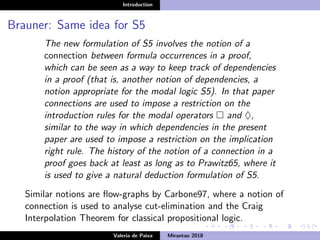
Brauner: Same idea for S5
The new formulation of S5 involves the notion of a
connection between formula occurrences in a proof,
which can be seen as a way to keep track of dependencies
in a proof (that is, another notion of dependencies, a
notion appropriate for the modal logic S5). In that paper
connections are used to impose a restriction on the
introduction rules for the modal operators and ♦,
similar to the way in which dependencies in the present
paper are used to impose a restriction on the implication
right rule. The history of the notion of a connection in a
proof goes back at least as long as to Prawitz65, where it
is used to give a natural deduction formulation of S5.
Similar notions are flow-graphs by Carbone97, where a notion of
connection is used to analyse cut-elimination and the Craig
Interpolation Theorem for classical propositional logic.
Valeria de Paiva Mirantao 2018
Introduction
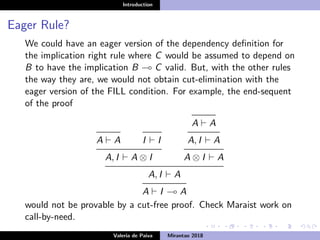
Eager Rule?
We could have an eager version of the dependency definition for
the implication right rule where C would be assumed to depend on
B to have the implication B C valid. But, with the other rules
the way they are, we would not obtain cut-elimination with the
eager version of the FILL condition. For example, the end-sequent
of the proof
A A I I
A, I A ⊗ I
A A
A, I A
A ⊗ I A
A, I A
A I A
would not be provable by a cut-free proof. Check Maraist work on
call-by-need.
Valeria de Paiva Mirantao 2018
Introduction
Conclusions
Introduced/reacquainted you with FILL/FIL, via linear
dependencies
Hinted at their use for other logical systems:
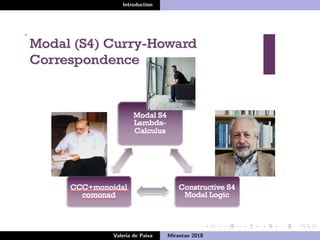
S5/FIL. other modal logics?
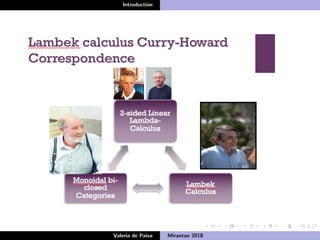
Scedrov reference on subexponentials on Lambek calculus
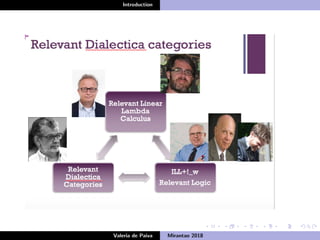
Much more explaining needed... But pictures help.
Valeria de Paiva Mirantao 2018
Introduction
Valeria de Paiva Mirantao 2018
Introduction
Valeria de Paiva Mirantao 2018
Introduction
Valeria de Paiva Mirantao 2018
Introduction
Valeria de Paiva Mirantao 2018
Introduction
Valeria de Paiva Mirantao 2018
Introduction
Some References
(see https://github.com/vcvpaiva/DialecticaCategories)
T.Brauner, V de Paiva A formulation of Linear Logic based on
dependency relations, Computer Science Logic CSL 1997, Springer
Lecture Notes xxx (1997).
de Paiva, A dialectica-like model of linear logic, Category Theory and
Computer Science, Springer, (1989) 341–356.
de Paiva, The Dialectica Categories, In Proc of Categories in Computer
Science and Logic, Boulder, CO, 1987. Contemporary Mathematics, vol
92, American Mathematical Society, 1989 (eds. J. Gray and A. Scedrov)
Max Kanovich, Stepan Kuznetsov, Vivek Nigam, Andre Scedrov, A Logical
Framework with Commutative and Non-commutative Subexponentials,
Automated Reasoning, June 2018, DOI: 10.1007/978-3-319-94205-616
Valeria de Paiva Mirantao 2018

Linear Logic via Logical Dependencies (Mirantao2018)

  • 1.
    Introduction Linear Logic viaLogical Dependencies Valeria de Paiva Nuance Communications, Sunnyvale, CA, USA Mirant˜ao III, MG, Brazil August, 2018 Valeria de Paiva Mirantao 2018
  • 2.
    Introduction Thanks to theOrganizers! Valeria de Paiva Mirantao 2018
  • 3.
    Introduction Introduction Today I wantto show you what I think is a clever way of dealing with Linear Logic. Linear Logic FIL(L) and dependencies Hopes and fears Valeria de Paiva Mirantao 2018
  • 4.
    Introduction Introduction Today I wantto show you what I think is a clever way of dealing with Linear Logic. Linear Logic FIL(L) and dependencies Hopes and fears Valeria de Paiva Mirantao 2018
  • 5.
    Introduction Introduction Today I wantto show you what I think is a clever way of dealing with Linear Logic. Linear Logic FIL(L) and dependencies Hopes and fears Valeria de Paiva Mirantao 2018
  • 6.
    Introduction Linear Logic isfull of surprises... a logical way of coping with resources and resource control system of dependencies between formulae for a fragment of LL to prove a cut-elimination theorem for this fragment Valeria de Paiva Mirantao 2018
  • 7.
    Introduction Linear Logic isfull of surprises... a logical way of coping with resources and resource control system of dependencies between formulae for a fragment of LL to prove a cut-elimination theorem for this fragment Valeria de Paiva Mirantao 2018
  • 8.
    Introduction Linear Logic isfull of surprises... a logical way of coping with resources and resource control system of dependencies between formulae for a fragment of LL to prove a cut-elimination theorem for this fragment Valeria de Paiva Mirantao 2018
  • 9.
    Introduction Applications of LinearLogic include linear functional programming, linear logic programming, general theories of concurrency, computational linguistics, AI and planning... 30 years later: some commercial success: Separation Logic, BI, etc indisputable academic success (LiCS, decades of EU projects) definitely out-of-fashion nowadays Valeria de Paiva Mirantao 2018
  • 10.
    Introduction Linear Logic A prooftheoretic logic described by Jean-Yves Girard in 1986. Basic idea: assumptions cannot be discarded or duplicated. They must be used exactly once – just like dollar bills... Other approaches to accounting for logical resources before. Great win of Linear Logic: Account for resources when you want to, otherwise fall back on traditional logic, A → B iff !A −◦ B Valeria de Paiva Mirantao 2018
  • 11.
    Introduction Linear Implication and(Multiplicative) Conjunction Traditional implication: A, A → B B A, A → B A ∧ B Re-use A Linear implication: A, A −◦ B B A, A −◦ B A ⊗ B Cannot re-use A Traditional conjunction: A ∧ B A Discard B Linear conjunction: A ⊗ B A Cannot discard B Of course: !A !A⊗!A Re-use !A ⊗ B B Discard Valeria de Paiva Mirantao 2018
  • 12.
    Introduction Full Intuitionistic LinearLogic (FILL) not ILL, nor CLL independent tensor, par and linear implication, no strict duality, (A A⊥⊥ but not converse) syntactic reconstruction of “essence”of Dialectica Categories long, checkered story of FILL Valeria de Paiva Mirantao 2018
  • 13.
    Introduction Full Intuitionistic LinearLogic (FILL) Schellinx 1987 observed original system thesis did not satisfy cut-elimination Hyland-dePaiva93 has a mistake, does not enjoy cut-elimination Bellin 1996 provides proof-nets for FILL and proved cut-elimination Bierman 1995 uses patterns and proved cut-elimination FILL Brauner-de Paiva 1997 (and today) uses dependencies for FILL Gore’ et al 2014 uses display calculus for FILL Eades-dePaiva 2016 Bellin’s suggested modification of HdeP93 and used Agda to prove it Valeria de Paiva Mirantao 2018
  • 14.
    Introduction Full Intuitionistic LinearLogic (FILL) Formulae in FILL are the same as the formulae in Classical Linear Logic (CLL), a proof in FILL is a proof in Classical Linear Logic (with a certain intuitionistic property) Formulae of Classical Linear Logic are defined by the grammar S ::= S ⊗ S | I | S ` S | ⊥ | S S | !S | ?S Given a proof τ of a sequent Γ ∆ in CLL, need to define when a given formula occurrence in the succedent ∆ depends on a given formula occurrence in the antecedent Γ. Intuitively want that “genuine” dependencies start in axioms, constants do not introduce dependencies and dependencies “percolate” through a proof as expected. Define a relation Dep(τ) between Γ and ∆, considered as sets of formula occurrences. and need a generalisation of the usual composition operation on relations. Full details in paper. Valeria de Paiva Mirantao 2018
  • 15.
    Introduction Comparing FILL andCLL A proof in FILL is a proof in Classical Linear Logic where whenever the rule R is applied to a proof τ of Γ, B C, ∆ to obtain Γ B C, ∆ none of the formulae occurrences in ∆ depends on the occurrence of B in τ. The implication right rule in Classical Linear Logic (like the one in CL) allows any (linear) implications whatsoever. The implication right rule in Intuitionistic Linear Logic enforces a single conclusion on the sequent. The implication right rule for FILL is more liberal than a single formula in the consequent, but more restricted than the classical linear logic rule. To express this situation we need the concept of dependencies; but dependencies also make sense in the Classical Linear Logic (and perhaps in CL/IL too) FIL (Pereira-dePaiva) and its applications Valeria de Paiva Mirantao 2018
  • 16.
    Introduction Use of dependenciesin FILL Suppose we are given a proof · · · τ Γ, B C, ∆ R Γ B C, ∆ and consider any A in the consequent ∆. If A did not depend on B, nothing will change. If A did depend on B, since by applying the implication right rule we just discharged it, it need not be there. Now, if we look at the formula B C again we have two cases. Either C did depend on B, and then we simply get rid of it; or it did not and in this case the dependencies of B C are the same as the dependencies of C. Valeria de Paiva Mirantao 2018
  • 17.
    Introduction ’Fake’ dependencies Some rulesin CLL introduce “fake” dependencies, that is, antecedent formulae that no consequent formulae depends on. They are IL,⊥L and WL, for example in the derivation A A A, I A A I A we are allowed to abstract I and A does not depend on it. If we disregard these rules that introduce false dependencies, then any antecedent formula would have at least one consequent formula depending on it. This would entail that whenever we have an application of the rule for implication right valid in FILL, then the antecedent abstracted over always shows up in the body. Valeria de Paiva Mirantao 2018
  • 18.
  • 19.
    Introduction FILL via dependencies:modalities Valeria de Paiva Mirantao 2018
  • 20.
    Introduction Brauner: Same ideafor S5 The new formulation of S5 involves the notion of a connection between formula occurrences in a proof, which can be seen as a way to keep track of dependencies in a proof (that is, another notion of dependencies, a notion appropriate for the modal logic S5). In that paper connections are used to impose a restriction on the introduction rules for the modal operators and ♦, similar to the way in which dependencies in the present paper are used to impose a restriction on the implication right rule. The history of the notion of a connection in a proof goes back at least as long as to Prawitz65, where it is used to give a natural deduction formulation of S5. Similar notions are flow-graphs by Carbone97, where a notion of connection is used to analyse cut-elimination and the Craig Interpolation Theorem for classical propositional logic. Valeria de Paiva Mirantao 2018
  • 21.
    Introduction Eager Rule? We couldhave an eager version of the dependency definition for the implication right rule where C would be assumed to depend on B to have the implication B C valid. But, with the other rules the way they are, we would not obtain cut-elimination with the eager version of the FILL condition. For example, the end-sequent of the proof A A I I A, I A ⊗ I A A A, I A A ⊗ I A A, I A A I A would not be provable by a cut-free proof. Check Maraist work on call-by-need. Valeria de Paiva Mirantao 2018
  • 22.
    Introduction Conclusions Introduced/reacquainted you withFILL/FIL, via linear dependencies Hinted at their use for other logical systems: S5/FIL. other modal logics? Scedrov reference on subexponentials on Lambek calculus Much more explaining needed... But pictures help. Valeria de Paiva Mirantao 2018
  • 23.
  • 24.
  • 25.
  • 26.
  • 27.
  • 28.
    Introduction Some References (see https://github.com/vcvpaiva/DialecticaCategories) T.Brauner,V de Paiva A formulation of Linear Logic based on dependency relations, Computer Science Logic CSL 1997, Springer Lecture Notes xxx (1997). de Paiva, A dialectica-like model of linear logic, Category Theory and Computer Science, Springer, (1989) 341–356. de Paiva, The Dialectica Categories, In Proc of Categories in Computer Science and Logic, Boulder, CO, 1987. Contemporary Mathematics, vol 92, American Mathematical Society, 1989 (eds. J. Gray and A. Scedrov) Max Kanovich, Stepan Kuznetsov, Vivek Nigam, Andre Scedrov, A Logical Framework with Commutative and Non-commutative Subexponentials, Automated Reasoning, June 2018, DOI: 10.1007/978-3-319-94205-616 Valeria de Paiva Mirantao 2018