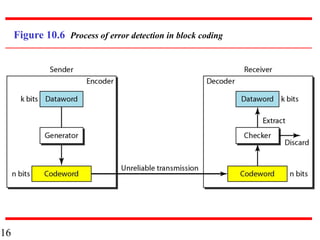
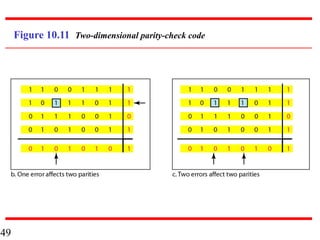
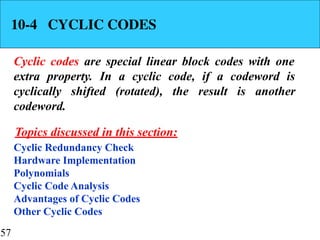
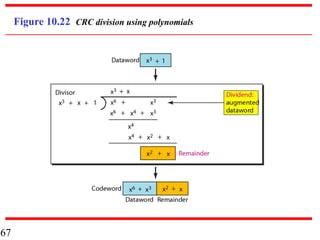
This document discusses error detection and correction techniques for digital data transmission. It introduces different types of errors that can occur during transmission, including single-bit and burst errors. Error detection and correction require adding redundant bits to the data. Block coding divides data into blocks and adds redundant bits to each block to create codewords. Simple parity-check codes can detect single-bit errors by adding one redundant bit. Hamming codes have higher error detection and correction capabilities and can detect up to two errors and correct single errors. The document provides examples to illustrate linear block codes, minimum Hamming distance, and how Hamming codes work.