Lindsay Kendrick
Sierra Nevada College
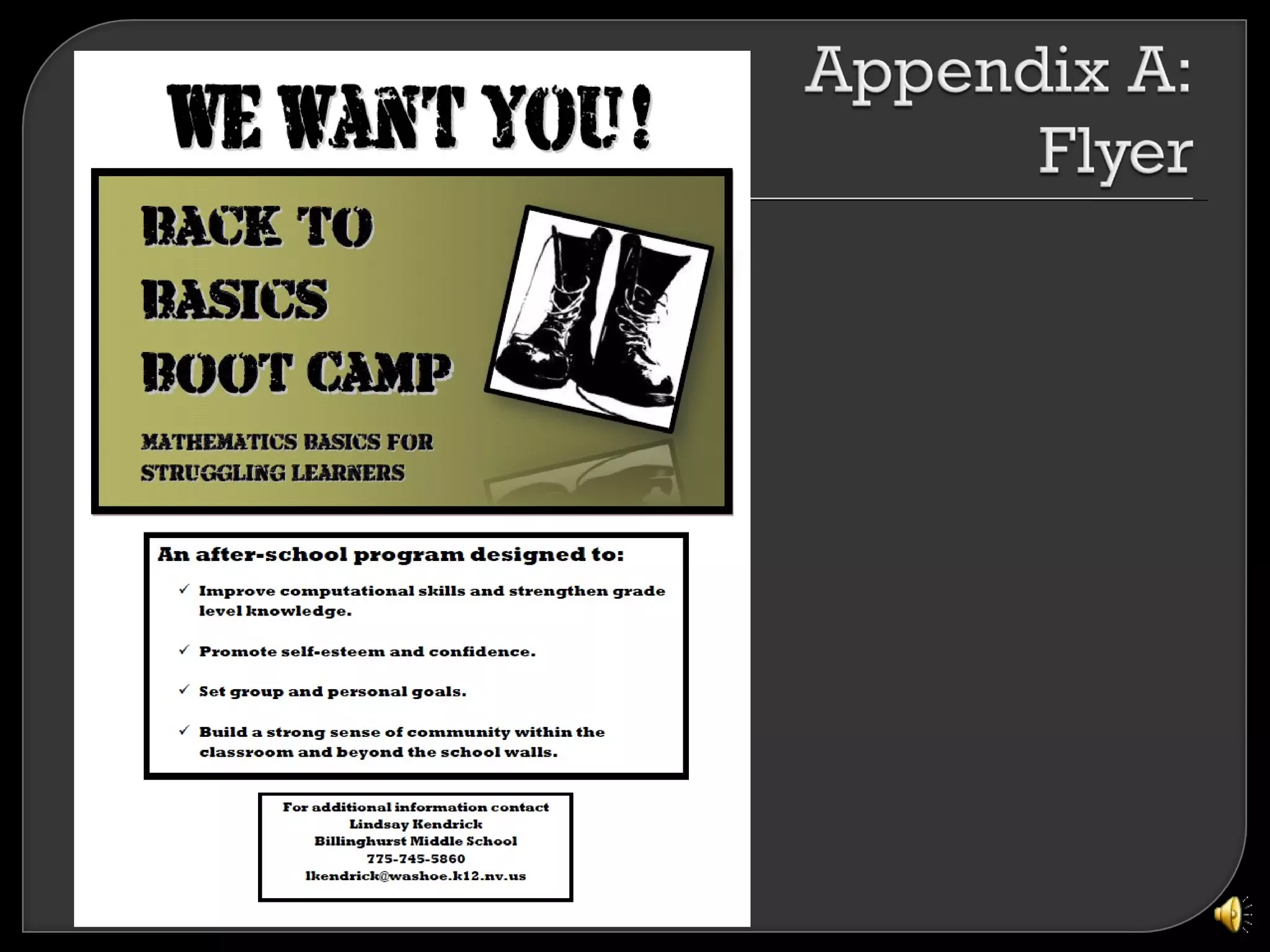
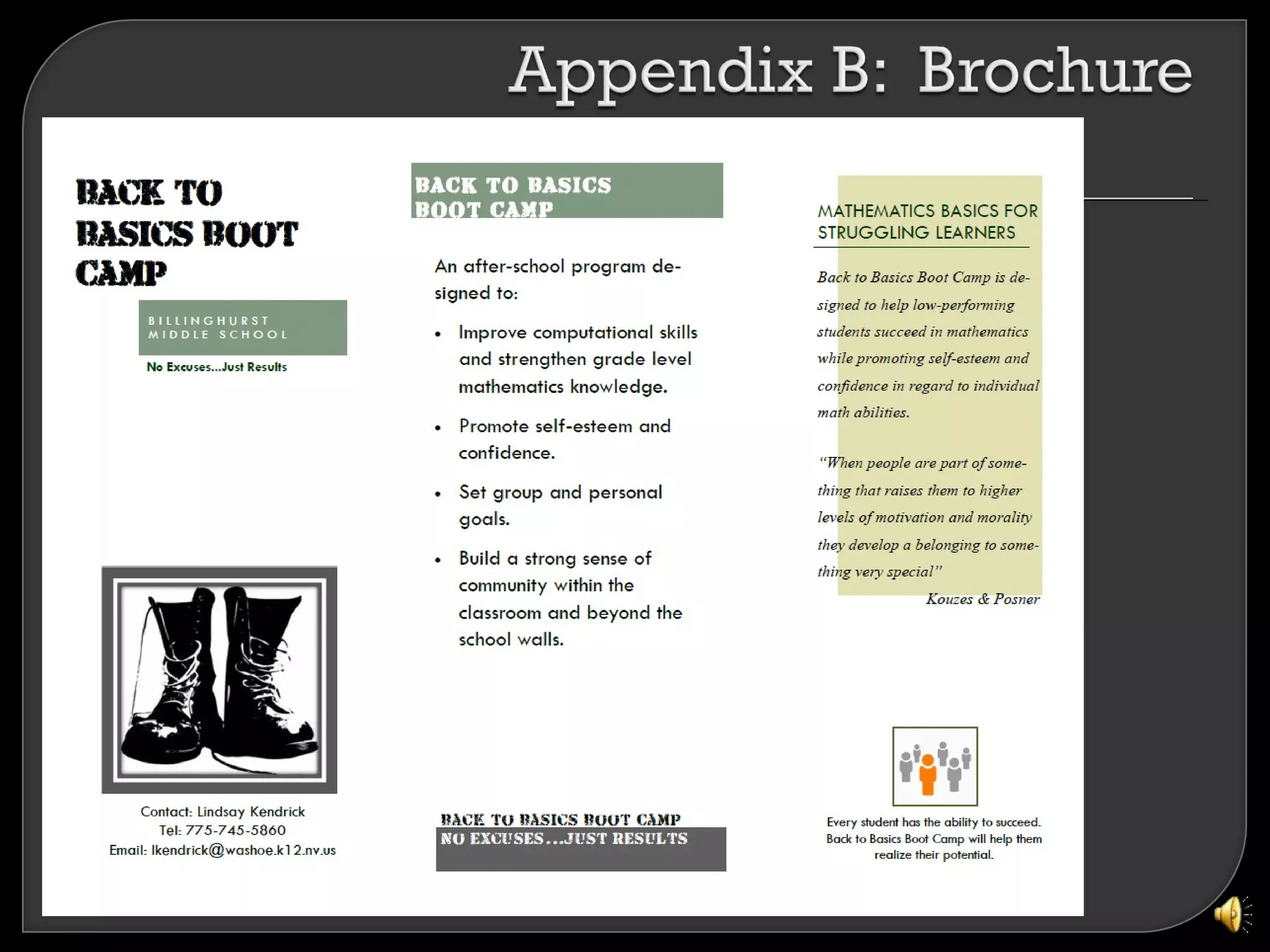
Back to Basics Boot Camp is designed to:


 Prepare students to succeed in future academics.


 Build confidence in individual mathematics ability.

 Facilitate team building and camaraderie among
               students and teachers.

Encourage community connection through work with
             community partner.
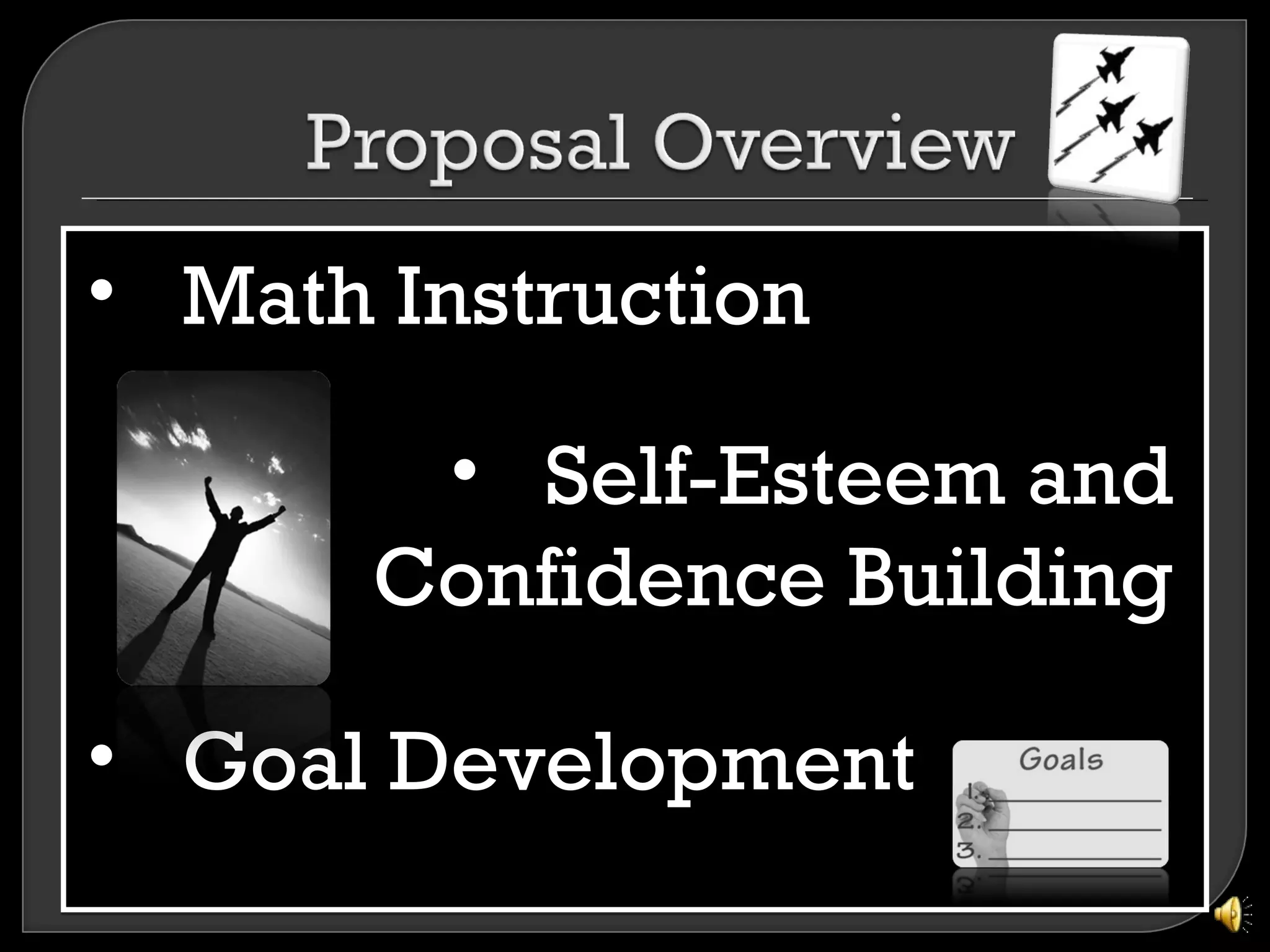
• Math Instruction

        • Self-Esteem and
       Confidence Building

• Goal Development
 12,
    13, and 14 year
 olds at Billinghurst
 Middle School not
 meeting standards in
 mathematics on the
 Nevada Criterion
 Referenced Test
 (CRT).
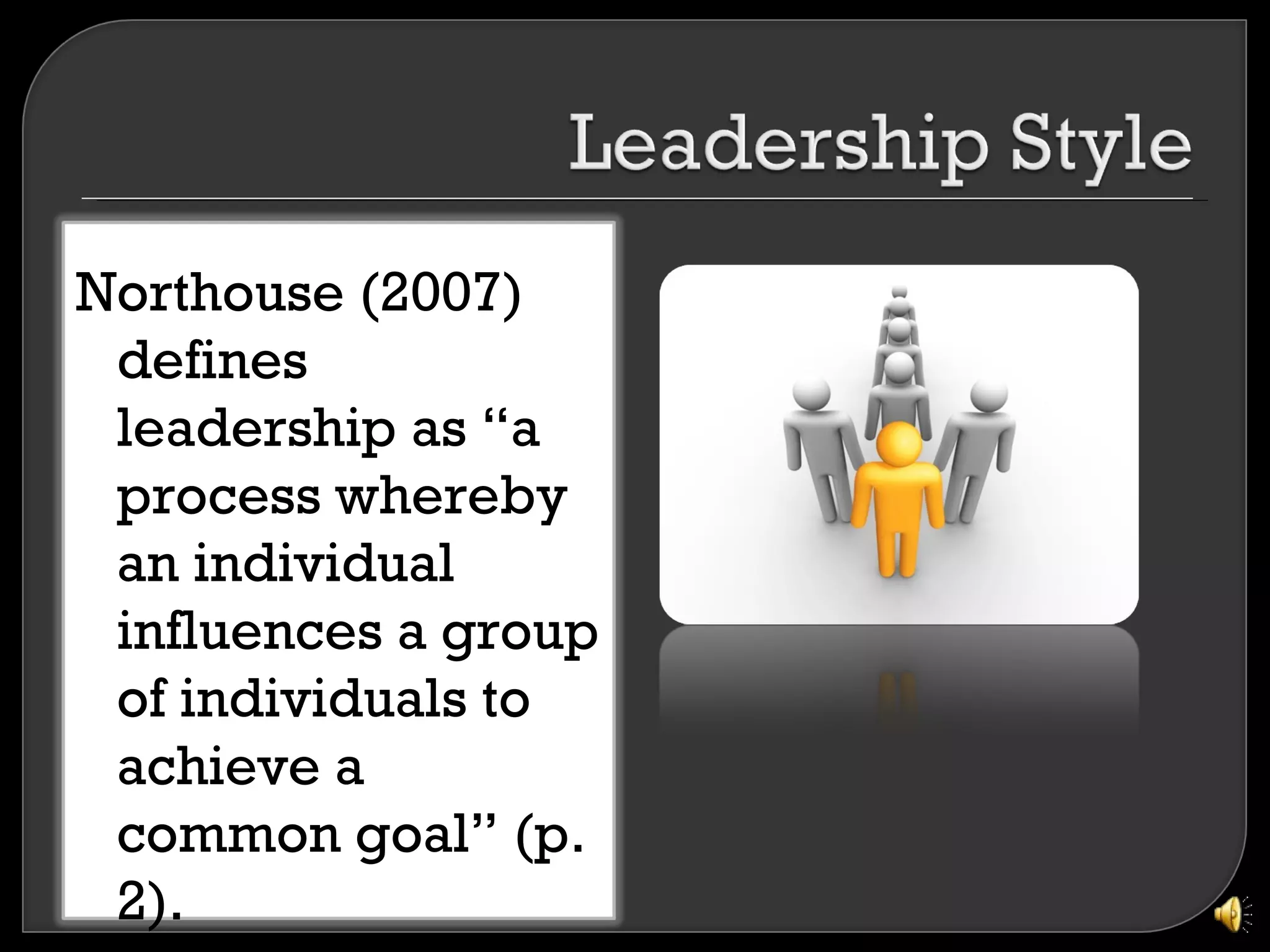
Northouse (2007)
 defines
 leadership as “a
 process whereby
 an individual
 influences a group
 of individuals to
 achieve a
 common goal” (p.
 2).
Collins (2001) writes that
 leading, “from good to
 great means having the
 humility to grasp the fact
 that you do not yet
 understand enough to have
 the answers and then to ask
 the questions that will lead
 to the best possible
 insights” (p. 75).
Scholastic (2005) writes that “the ability to recall basic
math facts is necessary for students to attain higher
order math skills” (p. 3)


Loveless (2003) states that “proficiency with fractions is
critical in preparation for Algebra” (p. 2)


Roulier (1999) notes that goals “help students develop
standards against which they can gauge their
individual performance” (p. 2)
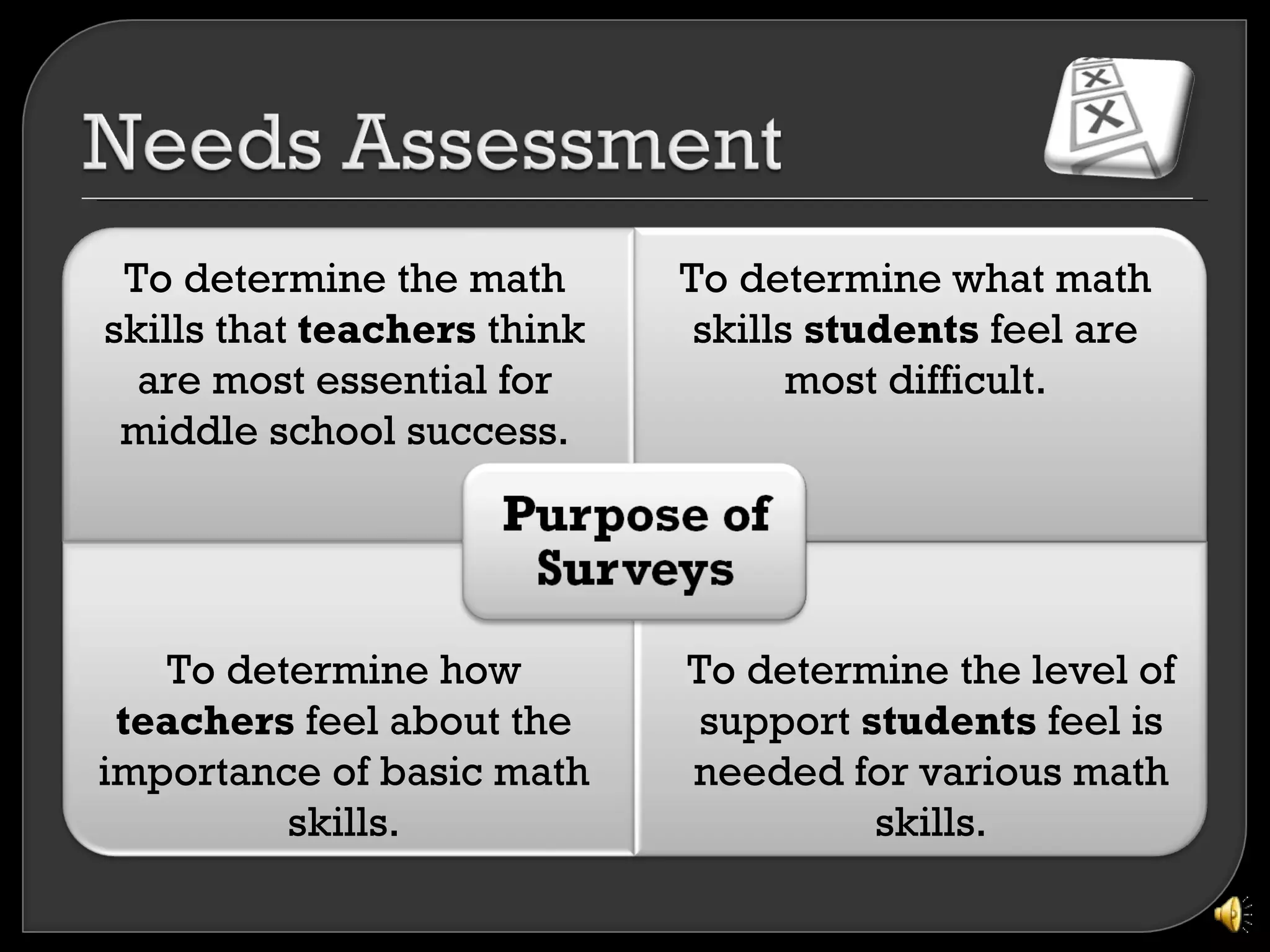
To determine the math       To determine what math
skills that teachers think    skills students feel are
  are most essential for            most difficult.
 middle school success.


   To determine how          To determine the level of
 teachers feel about the     support students feel is
importance of basic math     needed for various math
         skills.                      skills.
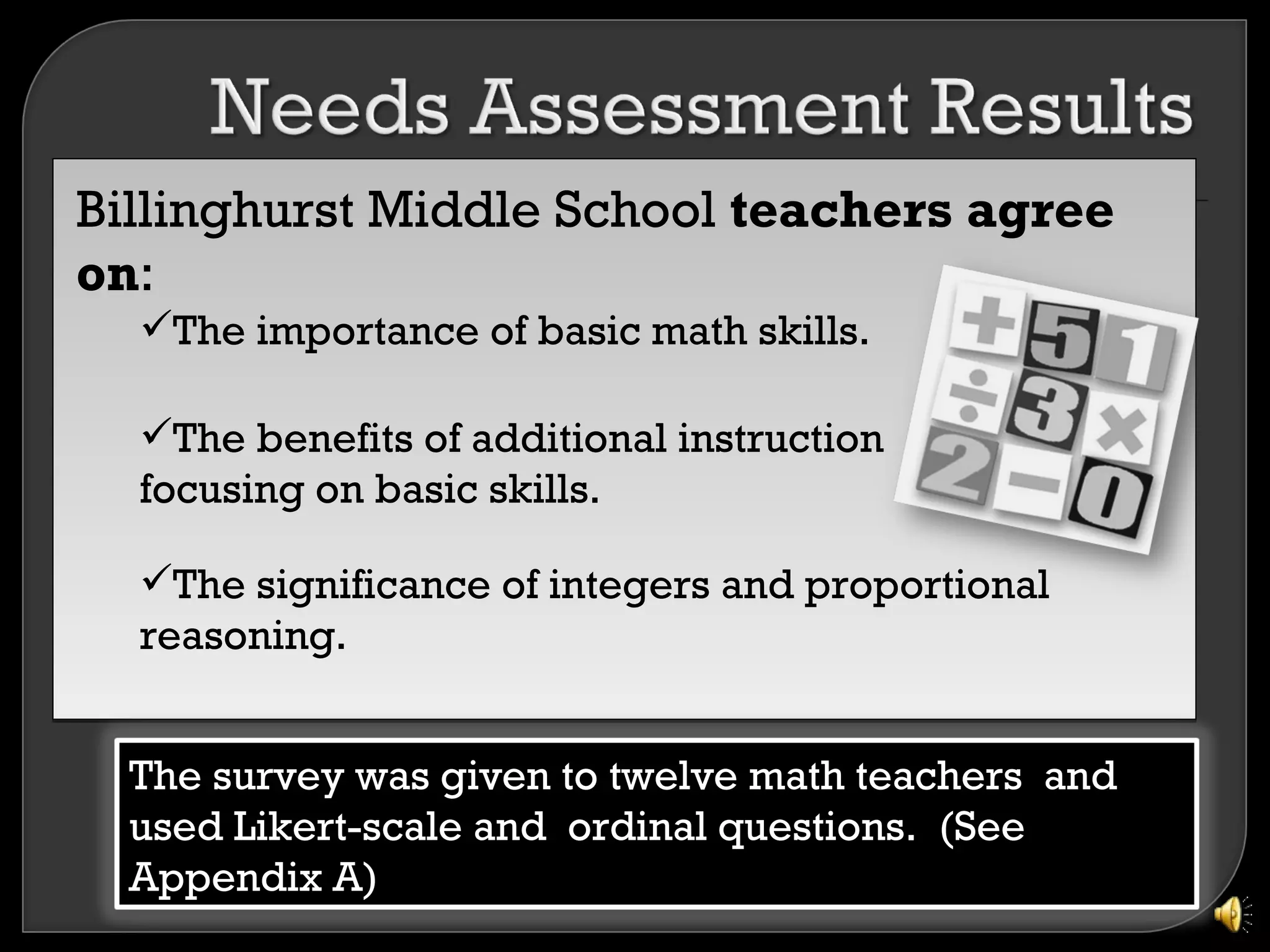
Billinghurst Middle School teachers agree
on:
  The importance of basic math skills.

  The benefits of additional instruction
  focusing on basic skills.

  The significance of integers and proportional
  reasoning.


  The survey was given to twelve math teachers and
  used Likert-scale and ordinal questions. (See
  Appendix A)
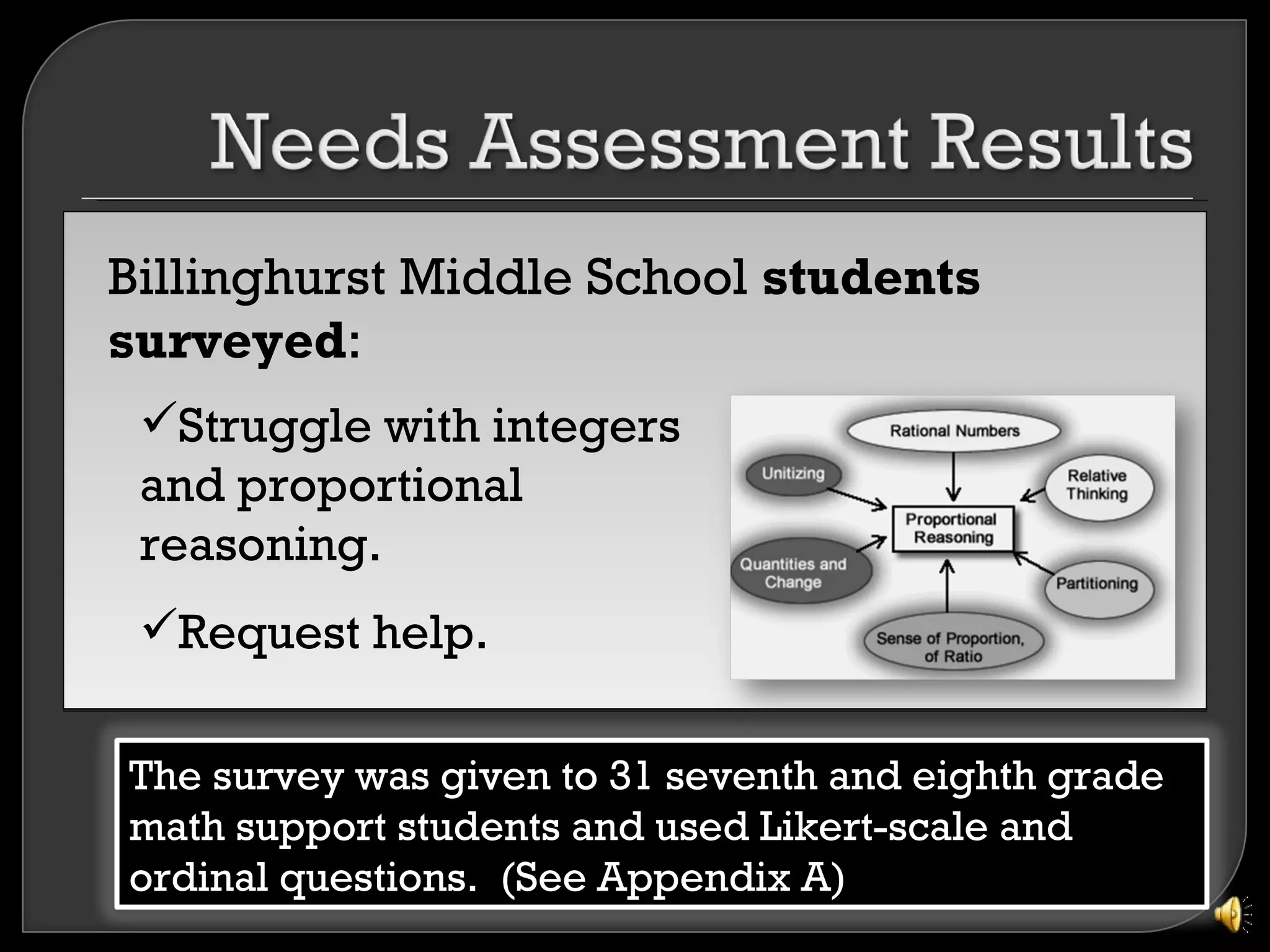
Billinghurst Middle School students
surveyed:
 Struggle with integers
 and proportional
 reasoning.
 Request help.

The survey was given to 31 seventh and eighth grade
math support students and used Likert-scale and
ordinal questions. (See Appendix A)
This program is a unique after-school
program as it:
  • develops data-driven curriculum.
  • implements flexible grouping.

  • administers regular formative
   assessments to guide future lessons.
  • assists students in setting group and
    personal goals to gauge success.
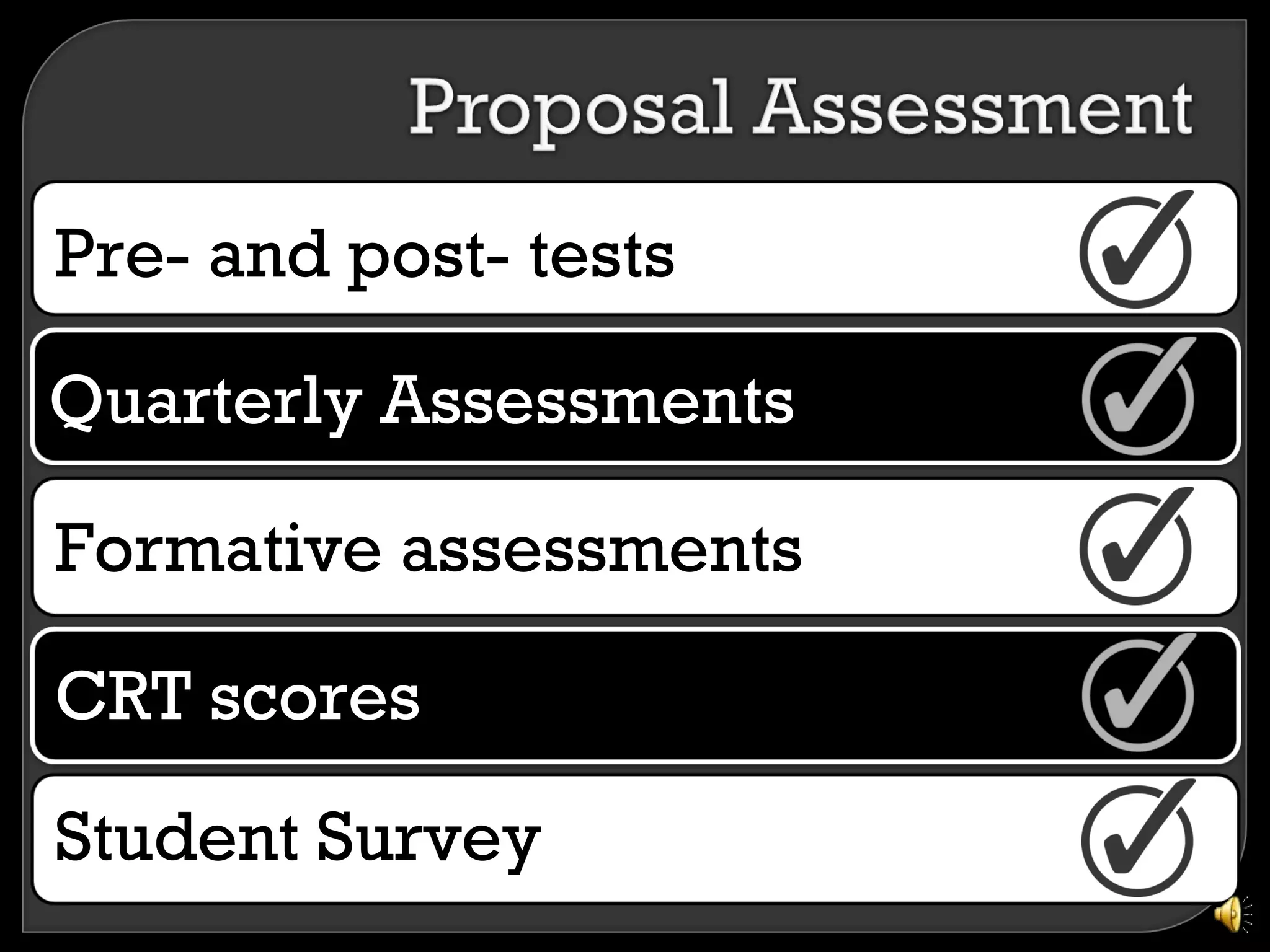
Pre- and post- tests

Quarterly Assessments

Formative assessments

CRT scores
Student Survey
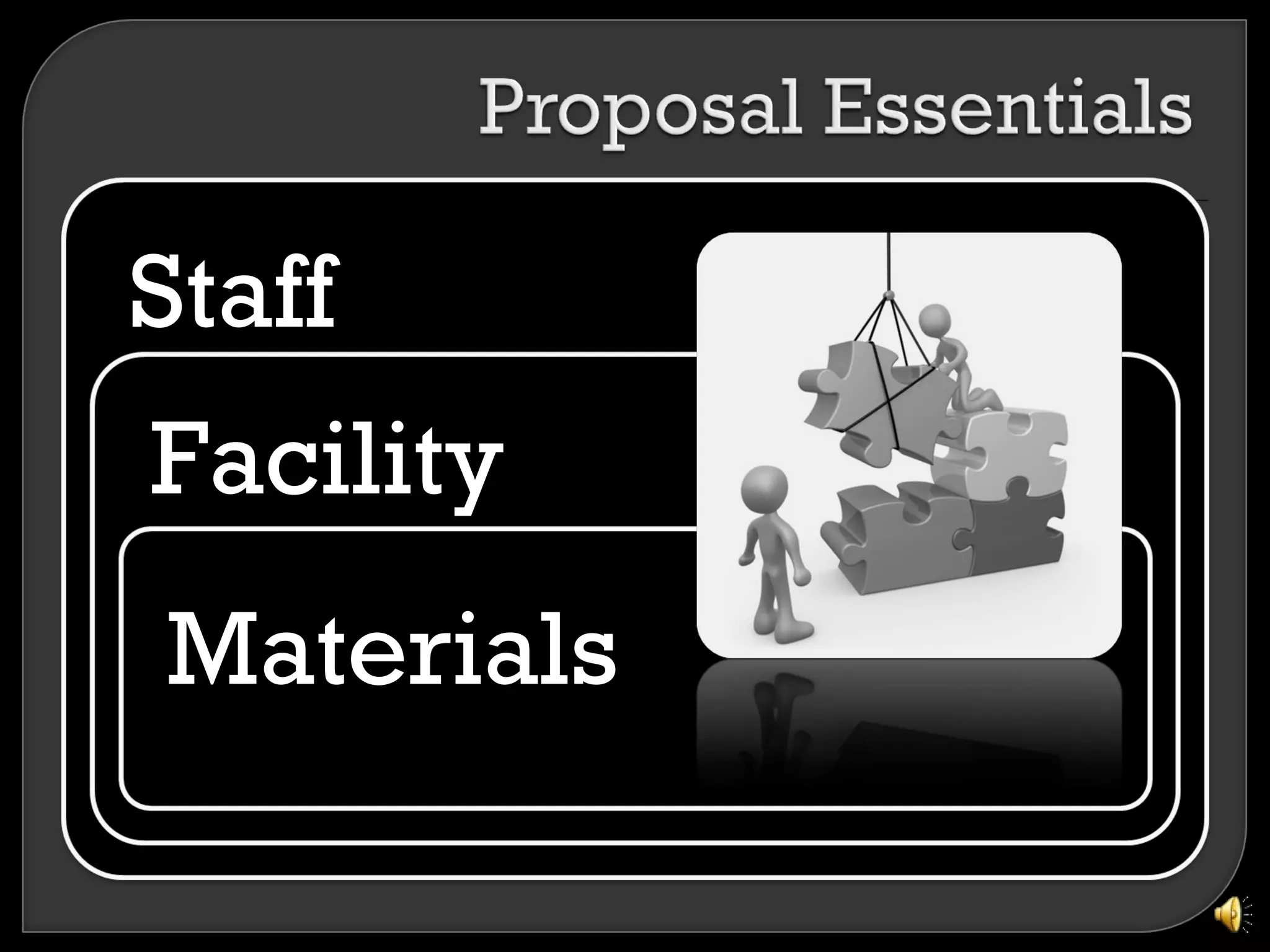
Staff
Facility
Materials
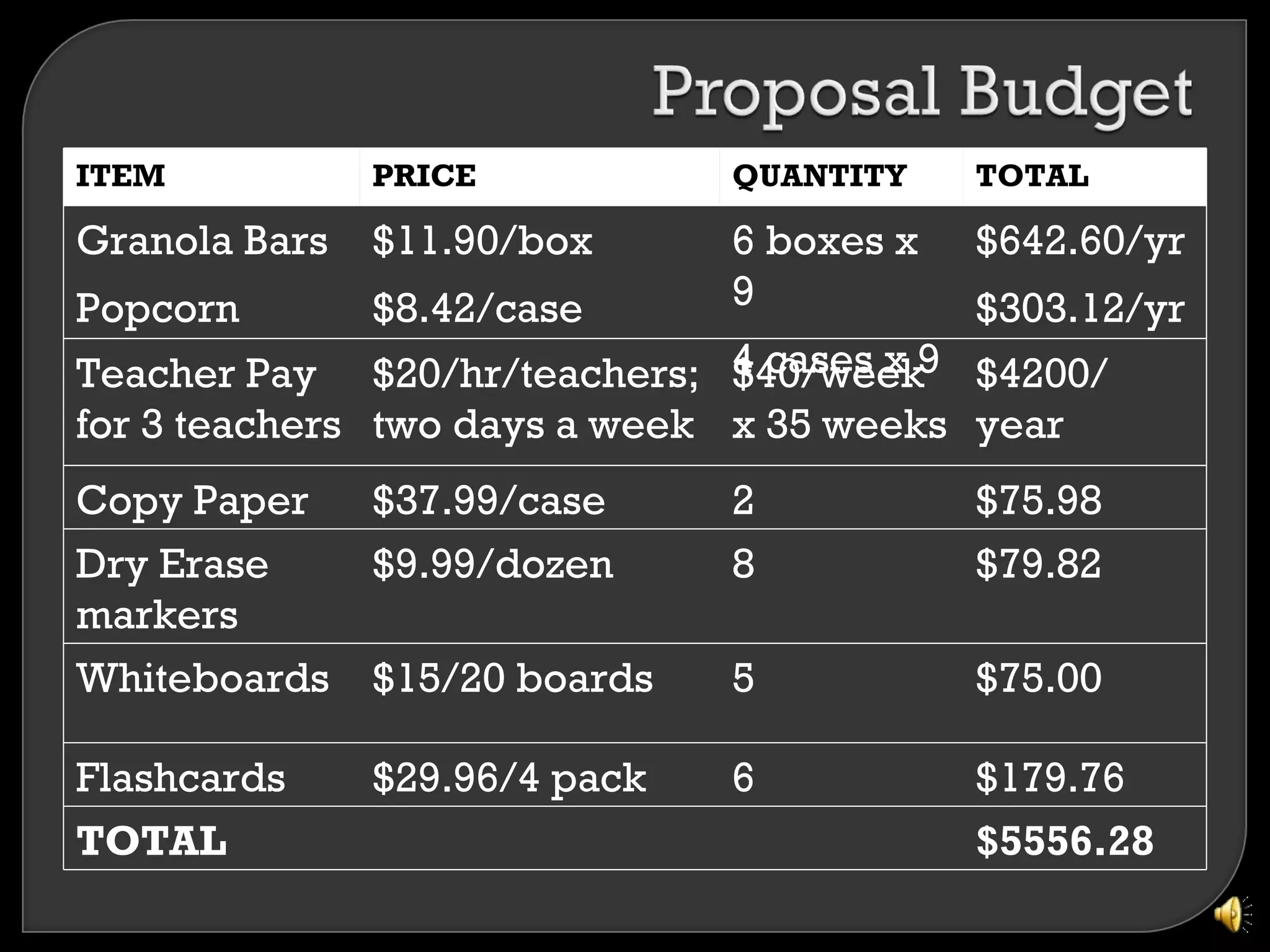
ITEM           PRICE           QUANTITY    TOTAL

Granola Bars   $11.90/box      6 boxes x   $642.60/yr
Popcorn        $8.42/case      9           $303.12/yr
Teacher Pay $20/hr/teachers; 4 cases x 9 $4200/
                               $40/week
for 3 teachers two days a week x 35 weeks year
Copy Paper     $37.99/case     2           $75.98
Dry Erase      $9.99/dozen     8           $79.82
markers
Whiteboards    $15/20 boards   5           $75.00

Flashcards     $29.96/4 pack   6           $179.76
TOTAL                                      $5556.28
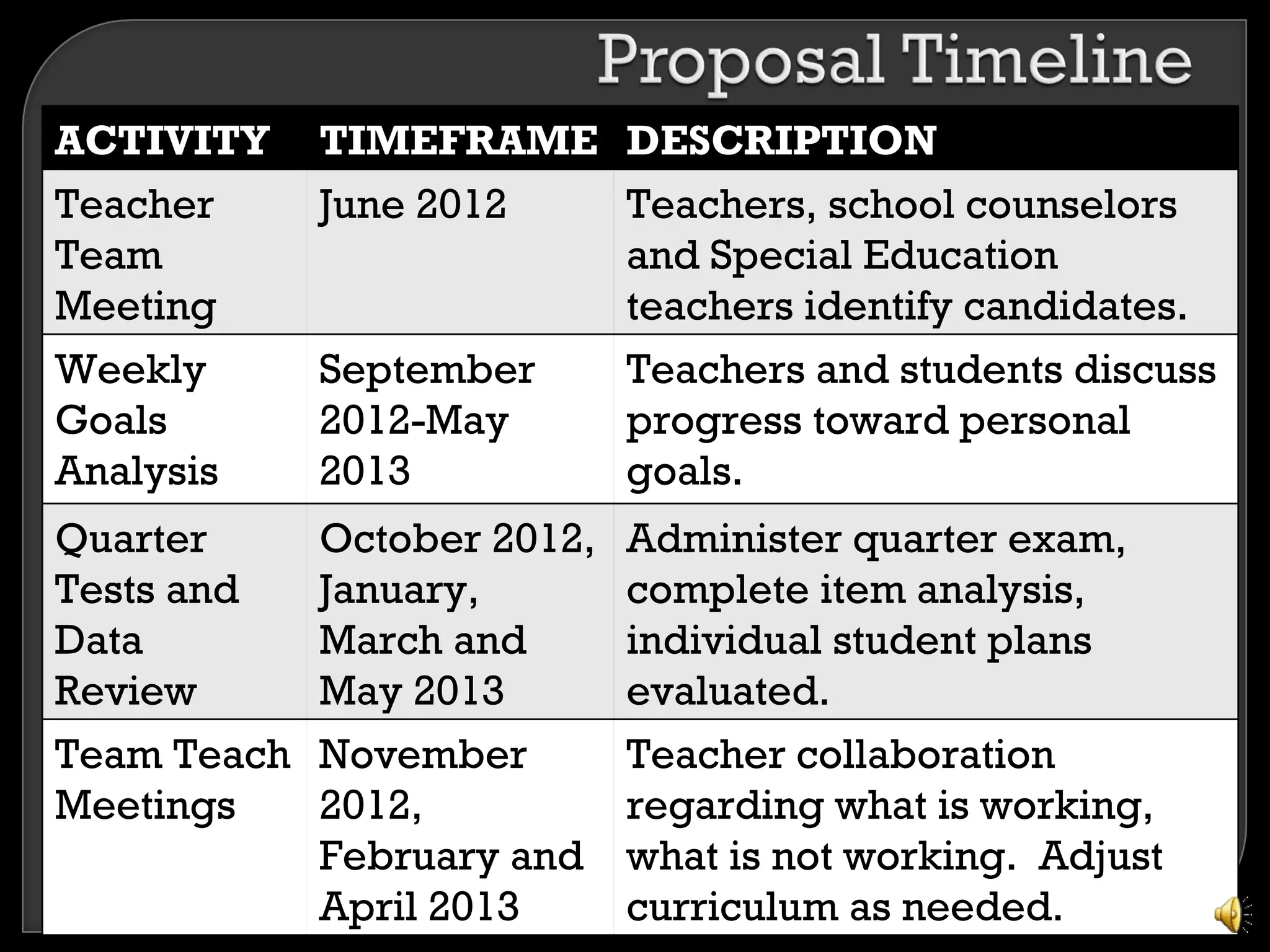
ACTIVITY     TIMEFRAME DESCRIPTION
Teacher      June 2012 Teachers, school counselors
Team                   and Special Education
Meeting                teachers identify candidates.
Weekly       September Teachers and students discuss
Goals        2012-May  progress toward personal
Analysis     2013      goals.
Quarter      October 2012,   Administer quarter exam,
Tests and    January,        complete item analysis,
Data         March and       individual student plans
Review       May 2013        evaluated.
Team Teach   November        Teacher collaboration
Meetings     2012,           regarding what is working,
             February and    what is not working. Adjust
             April 2013      curriculum as needed.
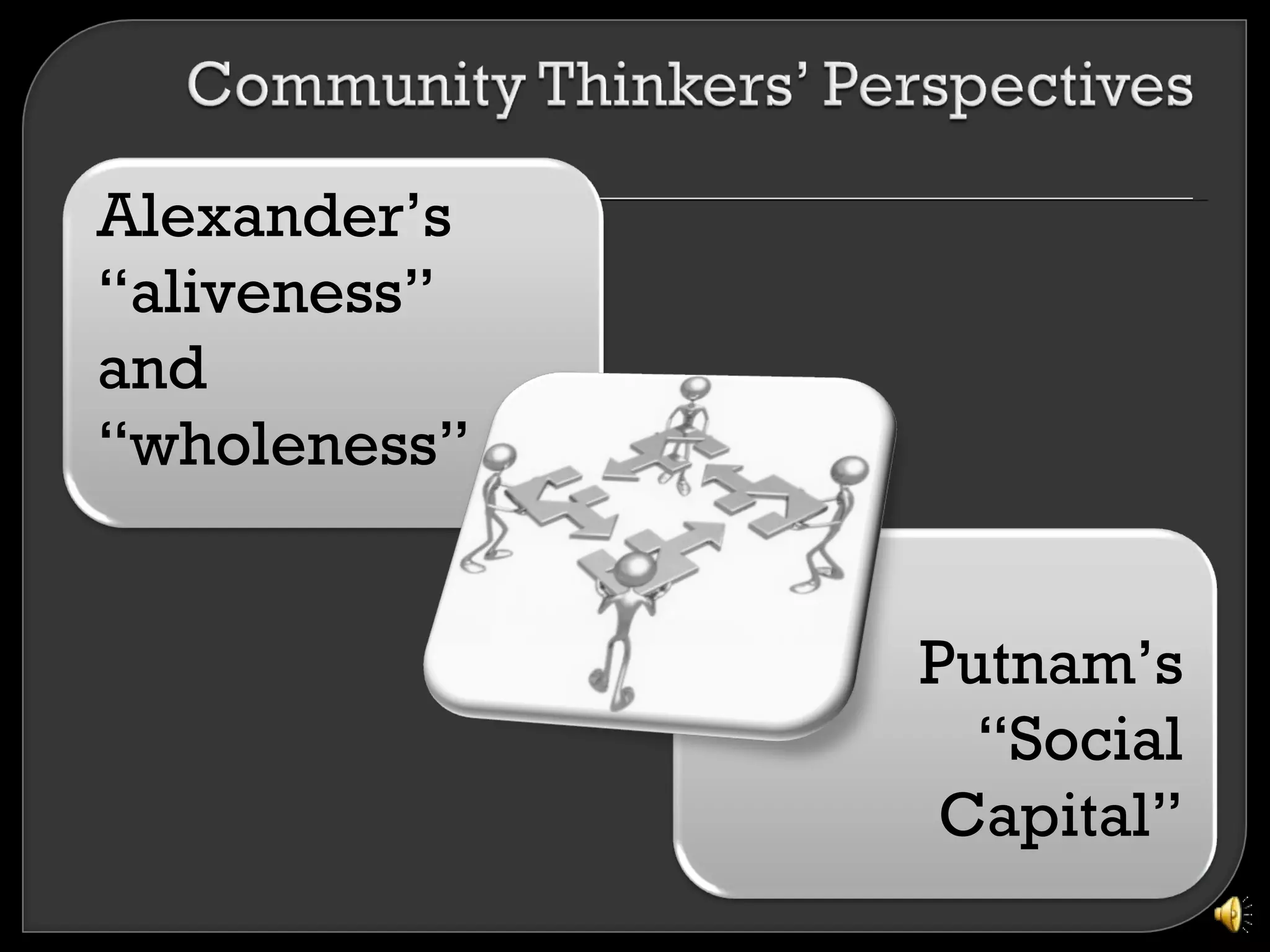
Alexander’s
“aliveness”
and
“wholeness”


              Putnam’s
                “Social
               Capital”
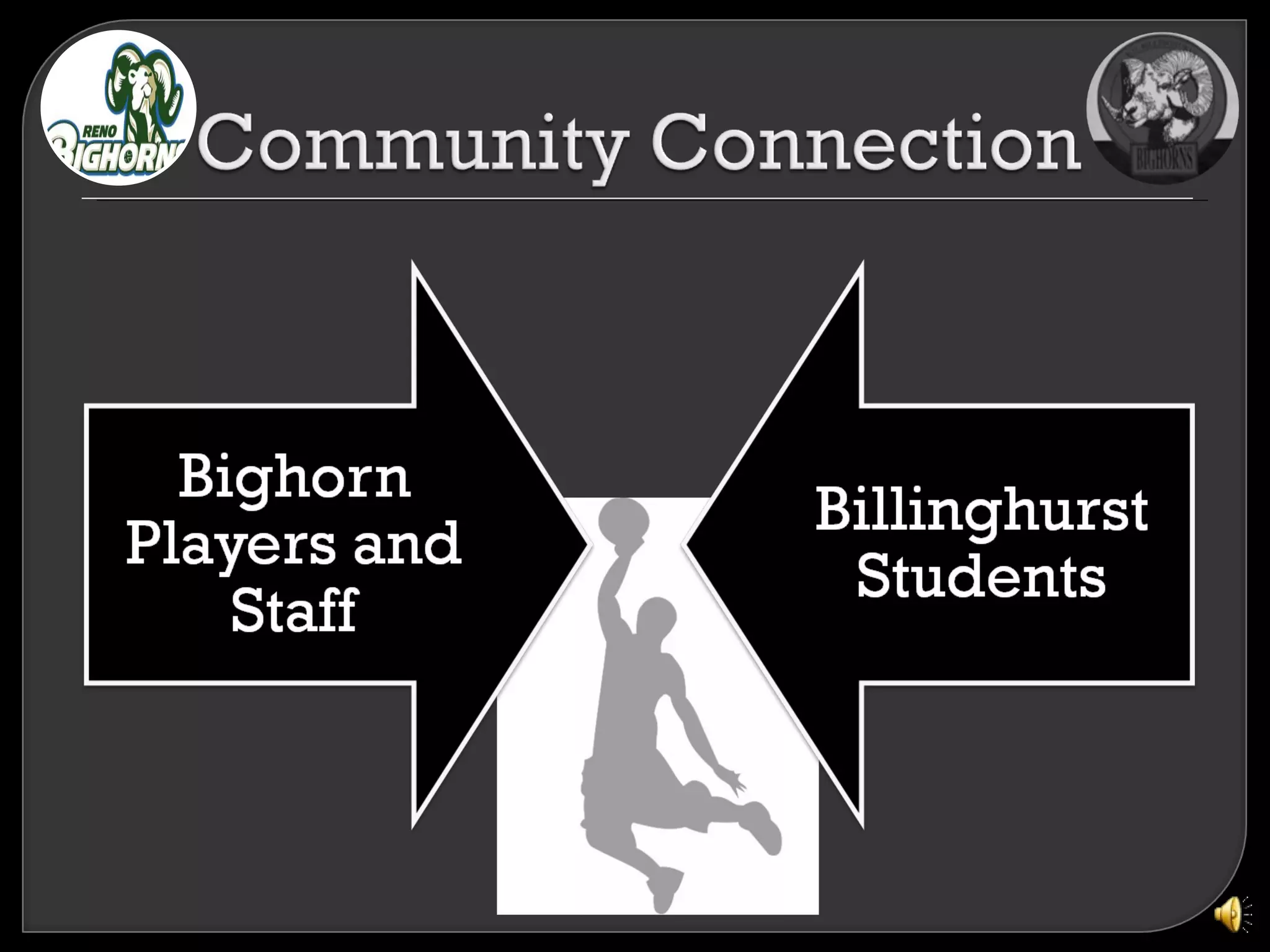
The NBA D-League is
“deeply committed to
addressing important
social issues with a
special emphasis on
programs that support
education”.
  -Bighorn Media Guide
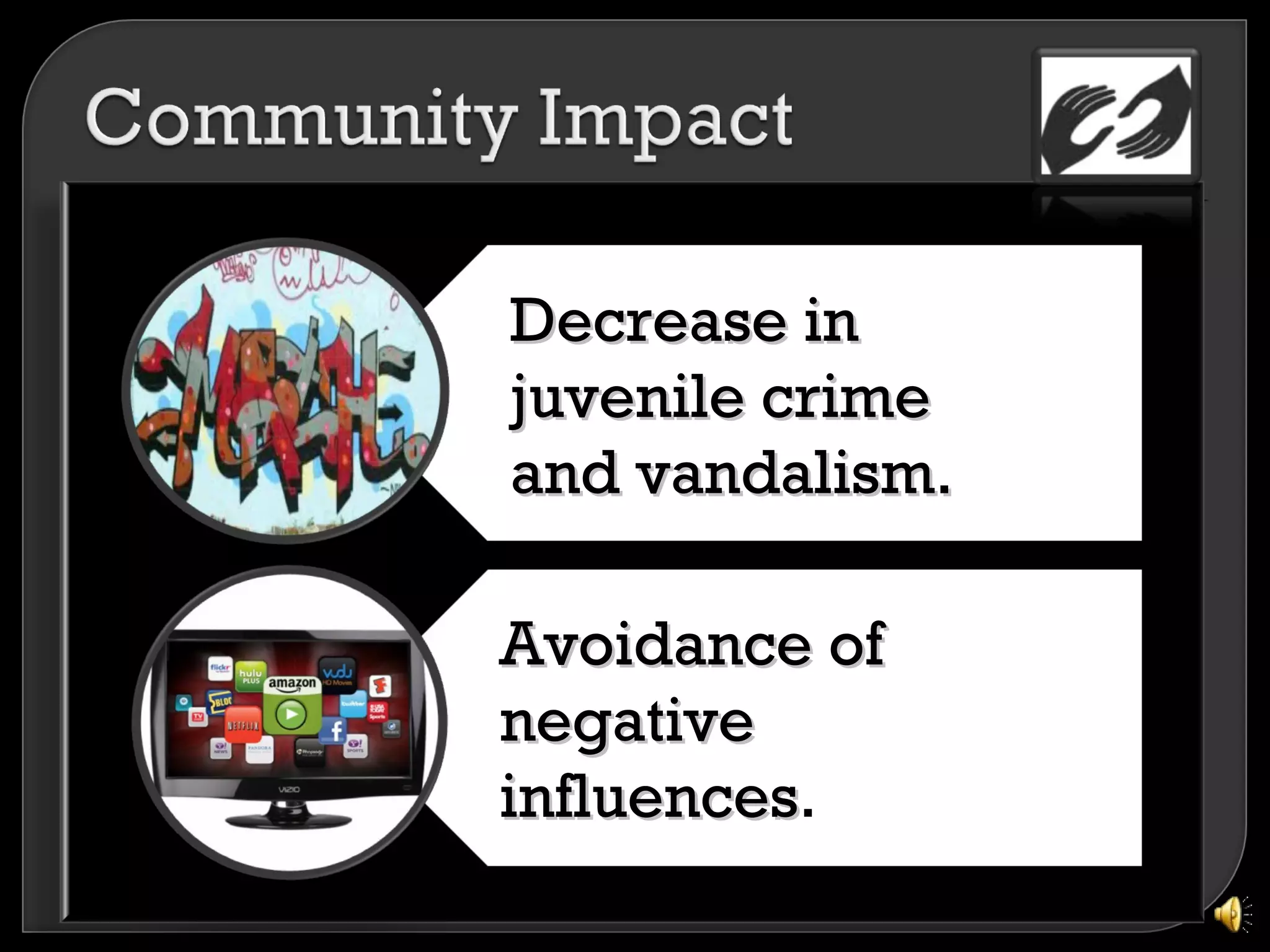
Decrease in
juvenile crime
and vandalism.

Avoidance of
negative
influences.
influences
Kouzes and Posner (2007) write that leaders
model the way by “setting examples through the
daily actions that demonstrate they are deeply
committed to their beliefs” (p. 16).


Communicate     Share            Involve
individual      personal         students in
values to       information to   development
students and    build            of shared
live by them.   connections.     values.
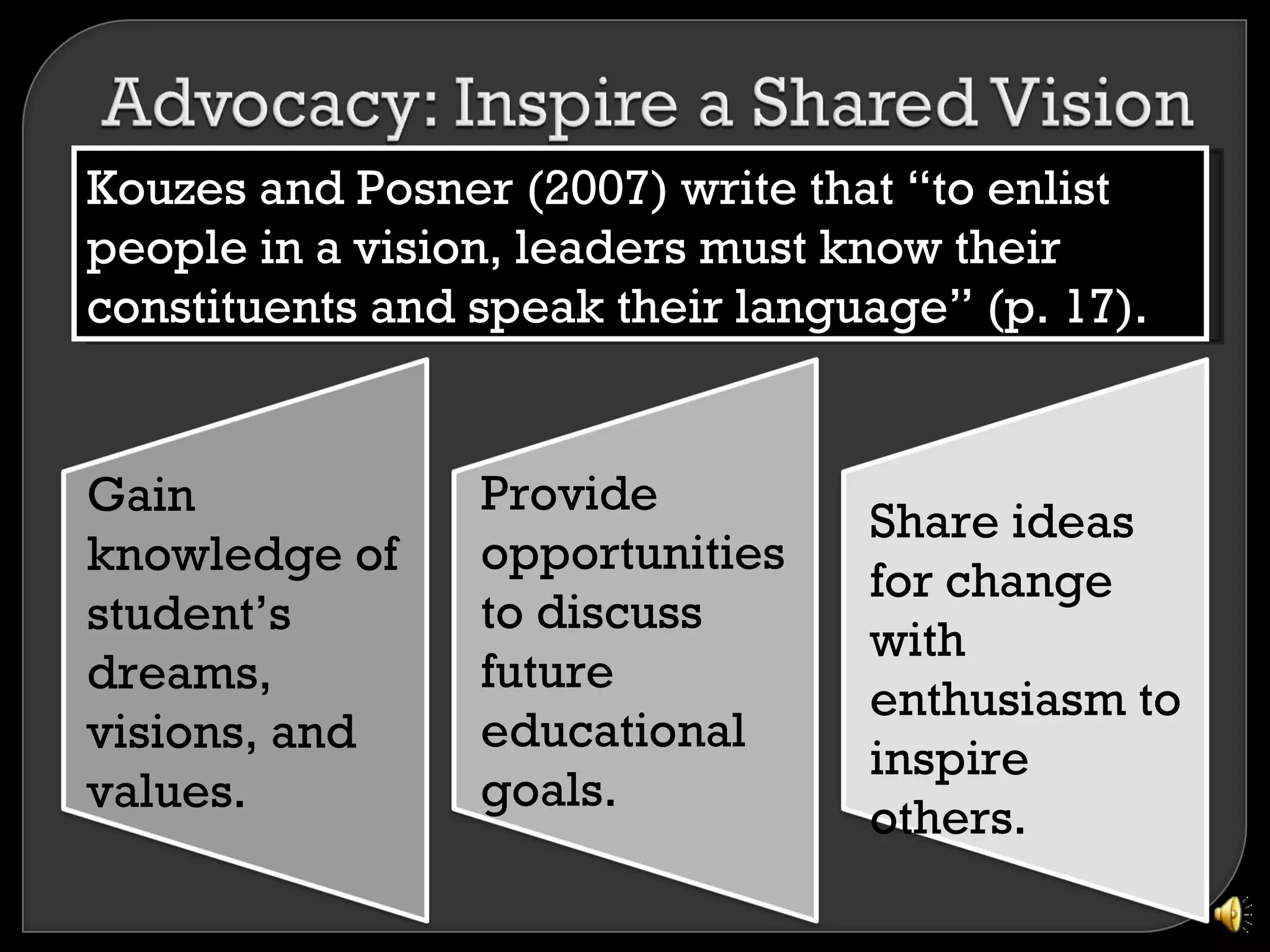
Kouzes and Posner (2007) write that “to enlist
people in a vision, leaders must know their
constituents and speak their language” (p. 17).


Gain             Provide
                                  Share ideas
knowledge of     opportunities
                                  for change
student’s        to discuss
                                  with
dreams,          future
                                  enthusiasm to
visions, and     educational
                                  inspire
values.          goals.
                                  others.
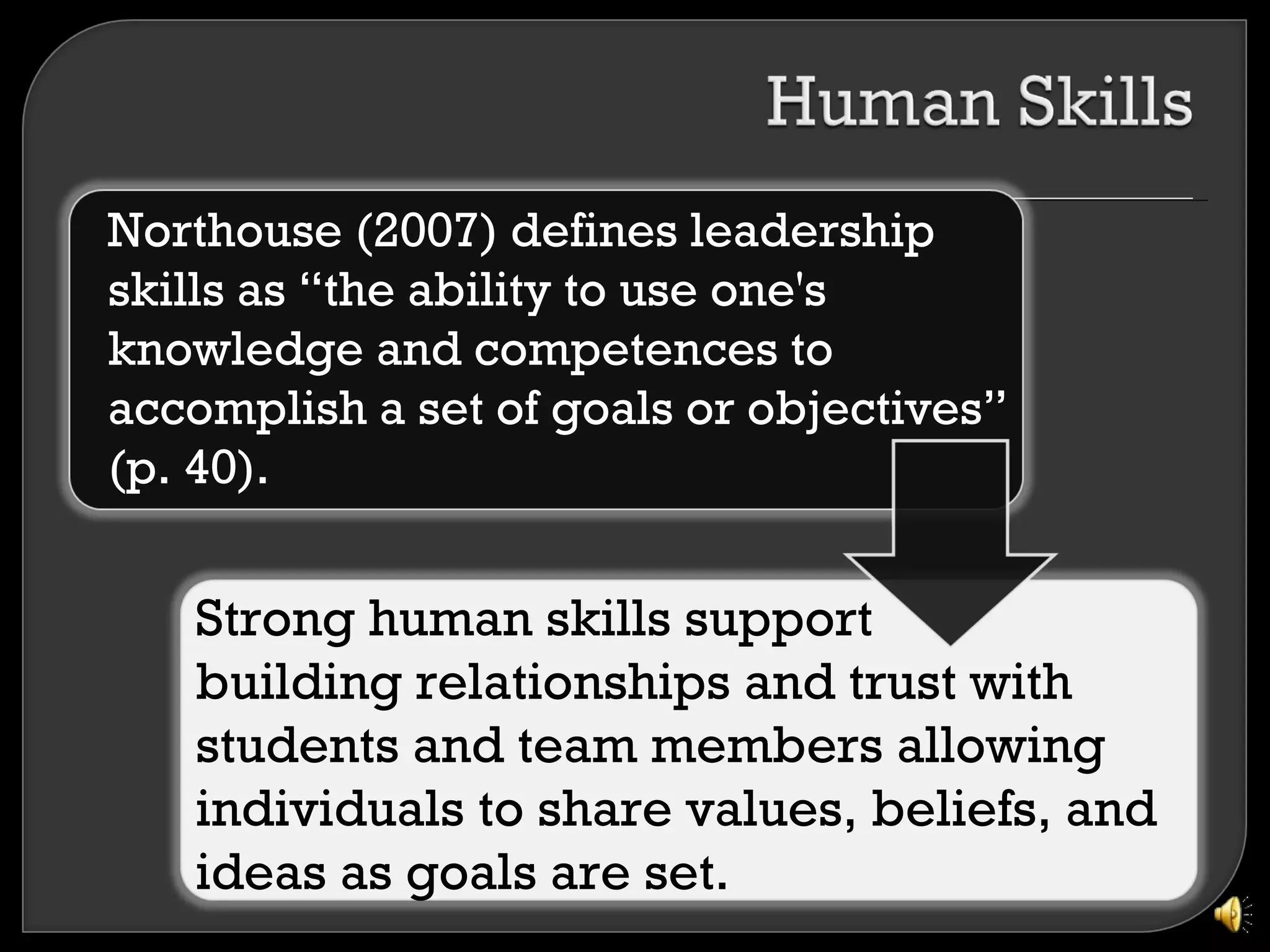
Northouse (2007) defines leadership
skills as “the ability to use one's
knowledge and competences to
accomplish a set of goals or objectives”
(p. 40).


   Strong human skills support
   building relationships and trust with
   students and team members allowing
   individuals to share values, beliefs, and
   ideas as goals are set.
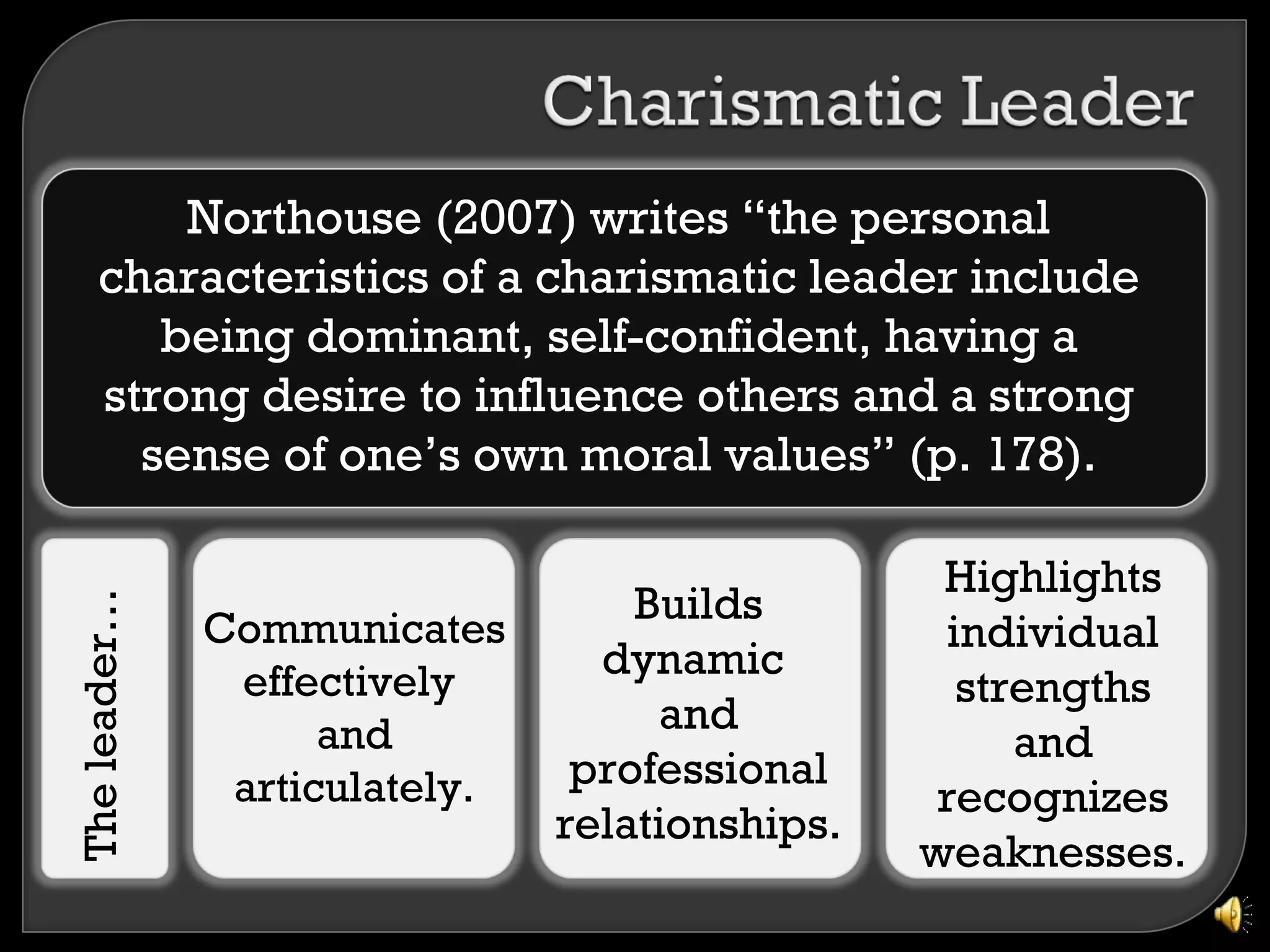
Northouse (2007) writes “the personal
     characteristics of a charismatic leader include
        being dominant, self-confident, having a
     strong desire to influence others and a strong
       sense of one’s own moral values” (p. 178).

                                                 Highlights
                                   Builds
The leader…


              Communicates                        individual
               effectively       dynamic
                                                   strengths
                    and             and
                                                      and
               articulately.    professional
                                                 recognizes
                               relationships.
                                                weaknesses.
Back to
Basics Boot
Camp
Block. P. (2008). Community. San Francisco, CA:
  Berrett-Koehler Publishers, Inc.
Collins, J. (2001). Good to great. New York: Harper
 Collins.
Family of Vince Lombardi. (2010). Famous quotes of
  Vince Lombardi. Retrieved from:
  http://www.vincelombardi.com/quotes.html
Fight Crime: Invest in Kids. (2000). After-School All-
  Stars Factoids. Retrieved from
  http://www.afterschoolallstars.org/site/pp.asp?
  c=enJJKMNpFmG&b=854685
Gottfredson, D., Gerstenblith, S., Soule, D., Womer, S.
       & Lu,
 S. (2004, December). Do after school programs
 reduce
 delinquency? Prevention Science, 5(4), 253-266.
Kouzes, J. & Posner, B. (2007). The leadership challenge.
  San Francisco, CA: Jossey-Bass.

Loveless, T. (February 6, 2003). Trends in Math
  Achievement: The Importance of Basic Skills.
  Presentation at the Mathematics Summit, Washington
  DC.

National Basketball Association Development League.
 (2010). NBA D-League in the community [Data file].
 Retrieved from
 http://www.nba.com/dleague/community_index.html
National Basketball Association Development League.
 (2010). Reno Bighorn media guide [Data file]. Retrieved
 from
 http://www.nba.com/dleague/reno/photos/7_Media_FIN
 AL.pdf
Northouse, P.G. (2007) Leadership: Theory and practice.
 Thousand Oaks, CA: Sage Publications.
Putnam, R. (2001). Bowling alone: the collapse and revival of
  American community. New York: Simon and Schuster,
  Inc.
Roulier, L. (January 1, 1999). Effects of goal setting
  procedures on students' mathematical achievement and
  self-efficacy. Dissertations Collection for University of
  Connecticut. Paper AAI9959401. Retrieved from
  http://digitalcommons.uconn.edu/dissertations/AAI99594
  01
Scholastic Research and Results. (2005). Research
  Foundation Paper: Research Foundation & Evidence of
  Effectiveness for FASST Math TM, 3 [PDF Document)].
  Retrieved from
  http://www.scholastic.com/administrator/math/pdf/FM
  _White_Paper.pdf
Shernoff, D. (2010, March). Engagement in after-school
  programs as a predictor of social competence and
  academic performance. American Journal of Community
  Psychology, 45, 325-337. doi:10.1007/s10464-010-9314-0
U.S. Department of Education. (2000). Working for
  children and families: safe and smart after-school
  programs. Retrieved from http://www2.ed.gov/offices/
  OESE/archives/pubs/parents/SafeSmart/index.html

lindsay_kendrick_task 4A_narrative

  • 1.
  • 3.
    Back to BasicsBoot Camp is designed to: Prepare students to succeed in future academics. Build confidence in individual mathematics ability. Facilitate team building and camaraderie among students and teachers. Encourage community connection through work with community partner.
  • 4.
    • Math Instruction • Self-Esteem and Confidence Building • Goal Development
  • 5.
     12, 13, and 14 year olds at Billinghurst Middle School not meeting standards in mathematics on the Nevada Criterion Referenced Test (CRT).
  • 6.
    Northouse (2007) defines leadership as “a process whereby an individual influences a group of individuals to achieve a common goal” (p. 2).
  • 7.
    Collins (2001) writesthat leading, “from good to great means having the humility to grasp the fact that you do not yet understand enough to have the answers and then to ask the questions that will lead to the best possible insights” (p. 75).
  • 8.
    Scholastic (2005) writesthat “the ability to recall basic math facts is necessary for students to attain higher order math skills” (p. 3) Loveless (2003) states that “proficiency with fractions is critical in preparation for Algebra” (p. 2) Roulier (1999) notes that goals “help students develop standards against which they can gauge their individual performance” (p. 2)
  • 9.
    To determine themath To determine what math skills that teachers think skills students feel are are most essential for most difficult. middle school success. To determine how To determine the level of teachers feel about the support students feel is importance of basic math needed for various math skills. skills.
  • 10.
    Billinghurst Middle Schoolteachers agree on: The importance of basic math skills. The benefits of additional instruction focusing on basic skills. The significance of integers and proportional reasoning. The survey was given to twelve math teachers and used Likert-scale and ordinal questions. (See Appendix A)
  • 11.
    Billinghurst Middle Schoolstudents surveyed: Struggle with integers and proportional reasoning. Request help. The survey was given to 31 seventh and eighth grade math support students and used Likert-scale and ordinal questions. (See Appendix A)
  • 12.
    This program isa unique after-school program as it: • develops data-driven curriculum. • implements flexible grouping. • administers regular formative assessments to guide future lessons. • assists students in setting group and personal goals to gauge success.
  • 13.
    Pre- and post-tests Quarterly Assessments Formative assessments CRT scores Student Survey
  • 14.
  • 16.
    ITEM PRICE QUANTITY TOTAL Granola Bars $11.90/box 6 boxes x $642.60/yr Popcorn $8.42/case 9 $303.12/yr Teacher Pay $20/hr/teachers; 4 cases x 9 $4200/ $40/week for 3 teachers two days a week x 35 weeks year Copy Paper $37.99/case 2 $75.98 Dry Erase $9.99/dozen 8 $79.82 markers Whiteboards $15/20 boards 5 $75.00 Flashcards $29.96/4 pack 6 $179.76 TOTAL $5556.28
  • 17.
    ACTIVITY TIMEFRAME DESCRIPTION Teacher June 2012 Teachers, school counselors Team and Special Education Meeting teachers identify candidates. Weekly September Teachers and students discuss Goals 2012-May progress toward personal Analysis 2013 goals. Quarter October 2012, Administer quarter exam, Tests and January, complete item analysis, Data March and individual student plans Review May 2013 evaluated. Team Teach November Teacher collaboration Meetings 2012, regarding what is working, February and what is not working. Adjust April 2013 curriculum as needed.
  • 18.
  • 19.
    The NBA D-Leagueis “deeply committed to addressing important social issues with a special emphasis on programs that support education”. -Bighorn Media Guide
  • 21.
    Decrease in juvenile crime andvandalism. Avoidance of negative influences. influences
  • 22.
    Kouzes and Posner(2007) write that leaders model the way by “setting examples through the daily actions that demonstrate they are deeply committed to their beliefs” (p. 16). Communicate Share Involve individual personal students in values to information to development students and build of shared live by them. connections. values.
  • 23.
    Kouzes and Posner(2007) write that “to enlist people in a vision, leaders must know their constituents and speak their language” (p. 17). Gain Provide Share ideas knowledge of opportunities for change student’s to discuss with dreams, future enthusiasm to visions, and educational inspire values. goals. others.
  • 24.
    Northouse (2007) definesleadership skills as “the ability to use one's knowledge and competences to accomplish a set of goals or objectives” (p. 40). Strong human skills support building relationships and trust with students and team members allowing individuals to share values, beliefs, and ideas as goals are set.
  • 25.
    Northouse (2007) writes“the personal characteristics of a charismatic leader include being dominant, self-confident, having a strong desire to influence others and a strong sense of one’s own moral values” (p. 178). Highlights Builds The leader… Communicates individual effectively dynamic strengths and and and articulately. professional recognizes relationships. weaknesses.
  • 26.
  • 29.
    Block. P. (2008).Community. San Francisco, CA: Berrett-Koehler Publishers, Inc. Collins, J. (2001). Good to great. New York: Harper Collins. Family of Vince Lombardi. (2010). Famous quotes of Vince Lombardi. Retrieved from: http://www.vincelombardi.com/quotes.html Fight Crime: Invest in Kids. (2000). After-School All- Stars Factoids. Retrieved from http://www.afterschoolallstars.org/site/pp.asp? c=enJJKMNpFmG&b=854685 Gottfredson, D., Gerstenblith, S., Soule, D., Womer, S. & Lu, S. (2004, December). Do after school programs reduce delinquency? Prevention Science, 5(4), 253-266.
  • 30.
    Kouzes, J. &Posner, B. (2007). The leadership challenge. San Francisco, CA: Jossey-Bass. Loveless, T. (February 6, 2003). Trends in Math Achievement: The Importance of Basic Skills. Presentation at the Mathematics Summit, Washington DC. National Basketball Association Development League. (2010). NBA D-League in the community [Data file]. Retrieved from http://www.nba.com/dleague/community_index.html
  • 31.
    National Basketball AssociationDevelopment League. (2010). Reno Bighorn media guide [Data file]. Retrieved from http://www.nba.com/dleague/reno/photos/7_Media_FIN AL.pdf Northouse, P.G. (2007) Leadership: Theory and practice. Thousand Oaks, CA: Sage Publications. Putnam, R. (2001). Bowling alone: the collapse and revival of American community. New York: Simon and Schuster, Inc. Roulier, L. (January 1, 1999). Effects of goal setting procedures on students' mathematical achievement and self-efficacy. Dissertations Collection for University of Connecticut. Paper AAI9959401. Retrieved from http://digitalcommons.uconn.edu/dissertations/AAI99594 01
  • 32.
    Scholastic Research andResults. (2005). Research Foundation Paper: Research Foundation & Evidence of Effectiveness for FASST Math TM, 3 [PDF Document)]. Retrieved from http://www.scholastic.com/administrator/math/pdf/FM _White_Paper.pdf Shernoff, D. (2010, March). Engagement in after-school programs as a predictor of social competence and academic performance. American Journal of Community Psychology, 45, 325-337. doi:10.1007/s10464-010-9314-0 U.S. Department of Education. (2000). Working for children and families: safe and smart after-school programs. Retrieved from http://www2.ed.gov/offices/ OESE/archives/pubs/parents/SafeSmart/index.html

Editor's Notes

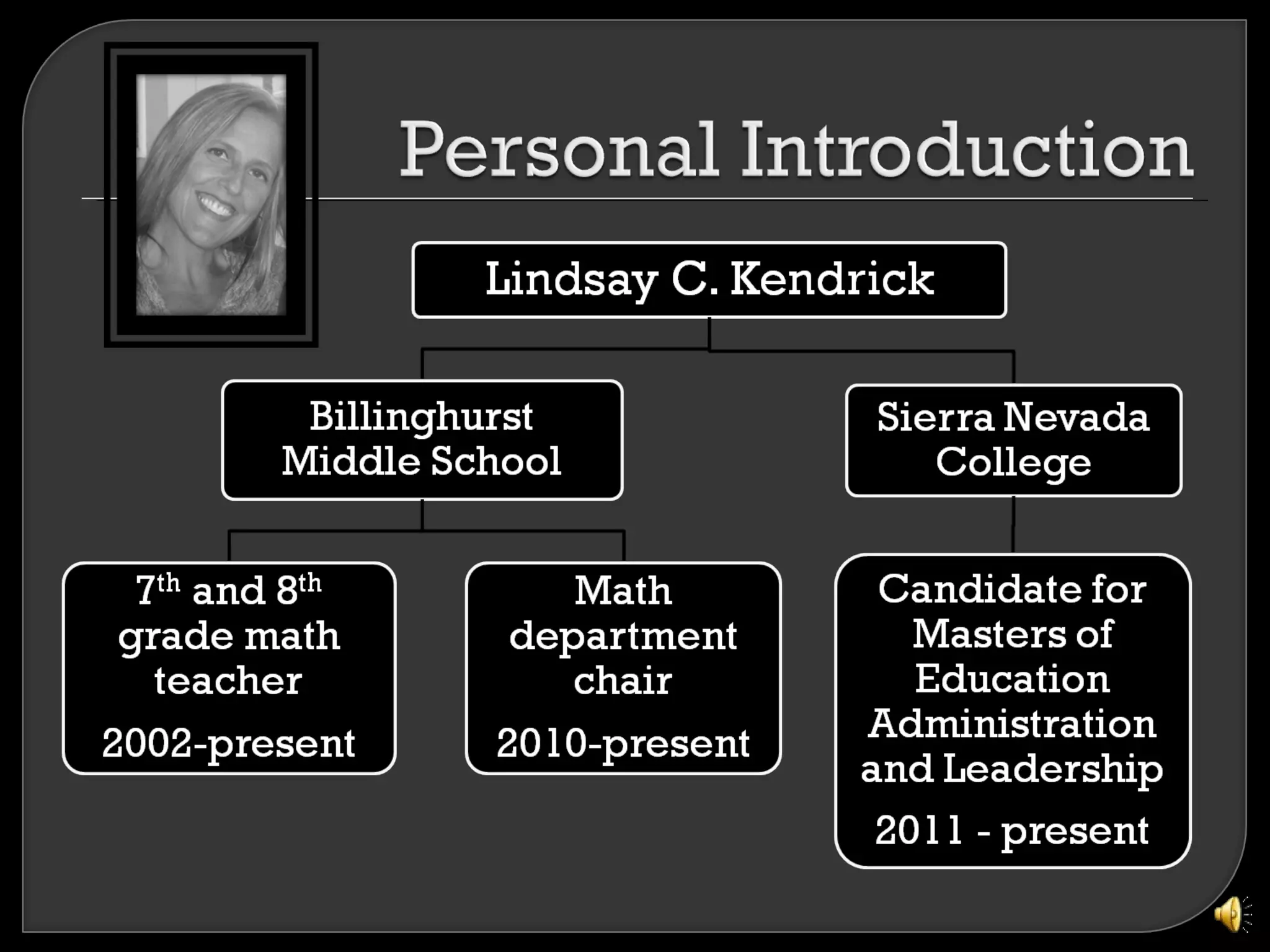
  • #3 My name is Lindsay Kendrick. I teach 7 th and 8 th grade mathematics at Billinghurst Middle School and am currently working on my masters of education administration and leadership at Sierra Nevada College
  • #4 Sierra Nevada College mission focuses on emphasizing entrepreneurial thinking and educational sustainability. Back to Basics Boot Camp is designed to assist students who struggle in mathematics while developing individual thinkers that will be ready to continue their education into high school and beyond.
  • #5 The purpose of Back to Basics Boot Camp is to provide math instruction that focuses on improving computational skills and strengthening knowledge of previously presented mathematics material. The program aims to promote student self-esteem and confidence in regard to individual math abilities. Group and personal goals are developed by students, charted in the classroom, and evaluated by teachers and students on a regular basis.
  • #6 Boot Camp teachers will invite 6 th , 7 th and 8 th grade students did not perform to standard on the Nevada CRT.
  • #7 With teacher guidance, students work together to set group goals that are posted in classroom. Students work as a team, providing peer support and encouragement as students work toward reaching set goals.
  • #8 Communication will be essential to the success of the program. Teacher and student survey results will assist in designing the most effective program. Monthly teacher meetings are designed to evaluate assessment data, share successes and failures, and alter curriculum as necessary .
  • #9 Without basic skills it is difficult for students to grasp new material. As student progress through middle school and on into high school topics will build from previous learned material. Back to basics Boot Camp will work with students on basic facts such as fractions to prepare them for higher-level material.
  • #10 Surveys were given to determine what teachers and students believe to be important math topics to master, the most difficult topics to master as well as what support students feel they need to be successful.
  • #11 Billinghurst Middle School teachers : Agree that students need to have basic math skills to learn grade level material. Agree that students not meeting standards on the state CRT would benefit from additional instruction focusing on basic skills. Believe that operations involving integers and proportional reasoning are the most important topics for students to know in middle school.
  • #12 Billinghurst Middle School students : Consider operations with integers and proportional reasoning the most difficult topics to understand. Request help with all topics presented; however, the level of help is varied depending on the subject matter.
  • #13 This program is not an after-school homework club. It is a program implemented by quality teachers focused on building students mathematics skills while building strong relationships with and among students. By creating a curriculum with students, teachers can guide instruction to meet the needs of individual students and prepare each for future mathematics instruction. Students will assist teachers and classmates in developing personal and group goals to be analyzed and revised regularly. There will be no excuse to not succeed, instead collaboration and instruction will ensure success.
  • #14 Pre- and post- tests will be administered at the beginning and end of the school year to measure growth. Quarterly Assessment results will be analyzed by teachers to determine if changes to the curriculum are necessary. Formative assessments will be used to check for understanding on a regular basis. At the conclusion of the school year teachers will analyze and compare last year’s CRT scores to the current year’s scores. Student Surveys will be given at the end of the program to determine student attitudes regarding effectiveness of program.
  • #15 Staff: Three highly qualified math teachers Facility: Three classrooms equipped with laptops and LCD projectors or ActiveBoards Materials: Paper Individual whiteboards and markers Flashcards
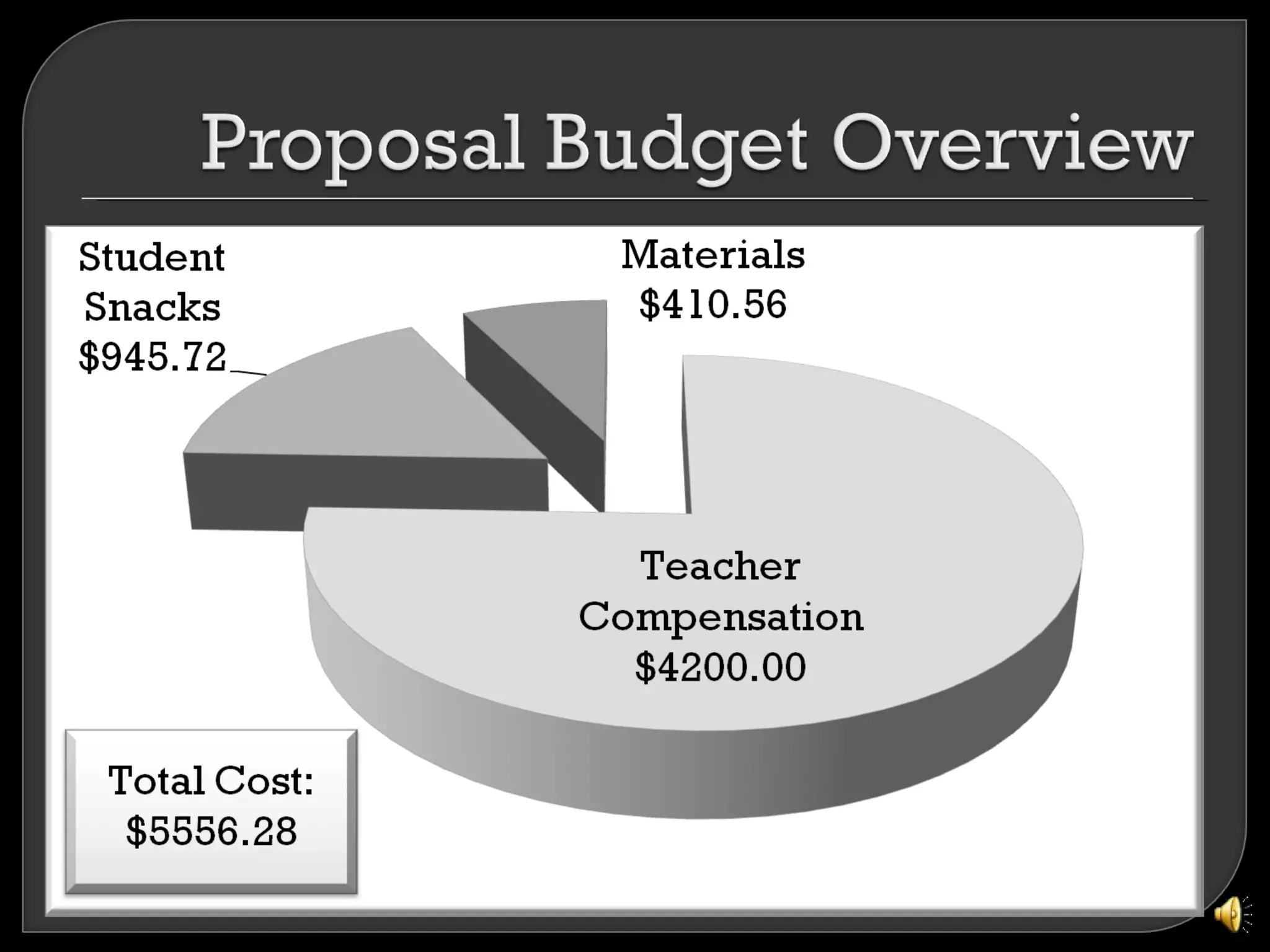
  • #16 The largest portion of the budget will be spent on teacher compensation with the remainder spent on materials and student snacks.
  • #17 This is a breakdown of the budget.
  • #18 The program preparation work will begin in June to determine students that will be invited and continue through the school year concluding with data analysis of CRT results and compiling student survey information.
  • #19 Community thinkers Alexander and Putnam emphasize wholeness and building relationships: Back to Basics Boot Camp will work to: Set group and personal goals that are used to set curriculum. Implement team-building exercises. Create sense of belonging in the classroom, the school, and the community. Build trust in relationships. Classroom designed as a place of respect and equality.
  • #20 Back to Basics Boot Camp staff will work to build a relationship with the Reno Bighorns Basketball Team. By aligning itself with the Back to Basics Boot Camp program the Bighorn organization will continue its already extensive work with the community. The organization will benefit from the positive publicity generated from motivating middle school students to succeed. In an effort to build a relationship with the Reno Bighorn organization, players, and staff will be approached to come and speak to the students enrolled in Back to Basics Boot Camp.
  • #21 In an effort to build a relationship with the Reno Bighorn organization, players, and staff will be approached to come and speak to the students enrolled in Back to Basics Boot Camp. Speakers can share their school experiences; speak of the importance of staying in school, developing a strong work ethic, and the benefits of working as a team. By seeing local celebrities take time to come and speak to them, students will be exposed to the importance of community, giving back, and living as a positive role model. The organization will also be approached about donating team memorabilia that can be used as incentives for student success in reaching goals.
  • #22 The After-School All-Stars organization (2000) concludes that every dollar spent on an after-school program produces three dollars in benefits to the public. The U.S. Department of Education (2000) reports that positive outcomes associated with after-school programs include Decreases in juvenile crime, violent victimization and vandalism. Avoidance of negative influences that lead to risky behaviors, such as drug, alcohol, and tobacco use. In addition, after-school programs offer positive alternatives to excessive television watching.
  • #23 As the doors of the program open teachers will being the process of building relationships with students. Sharing personal experiences, values, beliefs, successes and failures with students will help those relationships develop. Open communication will assist in providing an environment where students feel safe sharing their own personal information.
  • #24 Math instruction will not begin until teachers and students have had an opportunity to get to know one another, build relationships, and create an open, safe environment where each individual feels that he or she can share feelings, ideas, and concerns without fear of being judged. Students need to be asked what their needs are, where they struggle in mathematics, and how they best learn mathematics material. Students know best the answers to these questions; therefore students should be involved in how the curriculum and daily activities are developed. By understanding what students want and need teachers will be better prepared to help them succeed.
  • #25 Teachers involved with Back to Basics Boot Camp motivate and inspire students through a shared vision and desire to help students succeed in mathematics. Teachers and students work together setting and achieving personal and group goals while creating a sense of belonging in the classroom, the school, and the community.
  • #26 Teachers will provide open lines of communication for students and parents by contacting the families by phone and setting up home visits when possible. Communication will exist with participants in the program as well as community members involved. Teacher’s enthusiasm in the value of the program will be evident from the first day of classes, creating an atmosphere of excitement and anticipation.
  • #27 Back to Basics Boot Camp is designed to help low-performing students succeed in mathematics while promoting self-esteem and confidence in regard to individual math abilities. To provide the highest quality instruction and a superior team of teachers, resources are essential. In addition to classroom materials, qualified teachers, and a data-driven curriculum, this program requires determination and support of teachers, students, and community partners. Back to Basics Boot Camp is a program these students need and a program Billinghurst Middle School staff is determined to provide.