Pointing is the action of filling the gap
between masonry units (joints) with a
mortar to protect the masonry from
water ingress and associated
decay.Before any work begins it is
important to observe how the wall was
originally built and take note of this. If
you observe traditional solid masonry
construction, you will very often note
the inclusion of small stones between
larger stones.
These pinning stones (also referred to as
gallets or snecks) may be there to offer
support or “chock” or act as large pieces
of aggregate, reducing the amount of
mortar used within the joint. This
reduction in mortar mass aids curing and
to some degree the cost. In order to
maintain the visual integrity, it is
important that these pinning stones are
placed back within the wall as close as
possible to that of the original.
In most repointing cases the least popular
aspect of the process, although vital that it’s
done as thoroughly as possible is the removal
of the existing mortar joints which, in the case
of original lime mortars, is relatively straight
forward
However, more frequently this involves the
removal of hard cement mortars and in order
to mitigate further damage to the original
masonry this should be removed as carefully
as practical leaving as square a profile as can
be practically achieved to the back of the
joint. Exactly how it’s achieved will be very
subjective, as will the tools used to achieve it.
There may well be occasions where
mechanical cutting out is deemed appropriate
and when and where this method is suitable
we would advise due diligence to mitigate
unnecessary damage to the masonry units
When removing existing pointing it’s important to keep any damage
to the masonry to an absolute minimum, and themost obvious
element to manage that is “common sense”. Remove by cutting out
in a controlled manner where the existing is mortar is cut out to the
open face of the joint, don’t direct energy from the chisel directly
into the mortar. This reduces the energy and stress to the masonry
unit. Tools should be appropriate to the joint size and chisels
should be as sharp a chisel as possible, while it may be counter
intuitive you don’t necessarily require big heavy hammers, and
rarely would we advocate the use of mechanical type “breakers” or
similar.
The joints need to be raked out to a
suitable depth, with the general rule being
that it should be at least one and a half
times the width of the joint, in the case of
wide joints common sense should
prevail. Insufficient depth will result in
nothing more than a token gesture with an
increased risk of the mortar becoming
loose or simply falling out within a
relatively short time. Conversely too
much mortar, can lead to masonry
becoming looser while benefiting the
vendor.
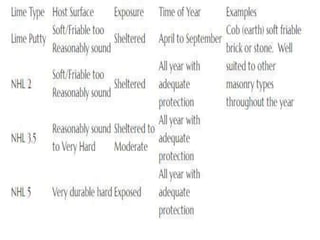
Lime mortars for pointing

Lime mortars for pointing

  • 2.
    Pointing is theaction of filling the gap between masonry units (joints) with a mortar to protect the masonry from water ingress and associated decay.Before any work begins it is important to observe how the wall was originally built and take note of this. If you observe traditional solid masonry construction, you will very often note the inclusion of small stones between larger stones.
  • 5.
    These pinning stones(also referred to as gallets or snecks) may be there to offer support or “chock” or act as large pieces of aggregate, reducing the amount of mortar used within the joint. This reduction in mortar mass aids curing and to some degree the cost. In order to maintain the visual integrity, it is important that these pinning stones are placed back within the wall as close as possible to that of the original.
  • 6.
    In most repointingcases the least popular aspect of the process, although vital that it’s done as thoroughly as possible is the removal of the existing mortar joints which, in the case of original lime mortars, is relatively straight forward
  • 9.
    However, more frequentlythis involves the removal of hard cement mortars and in order to mitigate further damage to the original masonry this should be removed as carefully as practical leaving as square a profile as can be practically achieved to the back of the joint. Exactly how it’s achieved will be very subjective, as will the tools used to achieve it. There may well be occasions where mechanical cutting out is deemed appropriate and when and where this method is suitable we would advise due diligence to mitigate unnecessary damage to the masonry units
  • 11.
    When removing existingpointing it’s important to keep any damage to the masonry to an absolute minimum, and themost obvious element to manage that is “common sense”. Remove by cutting out in a controlled manner where the existing is mortar is cut out to the open face of the joint, don’t direct energy from the chisel directly into the mortar. This reduces the energy and stress to the masonry unit. Tools should be appropriate to the joint size and chisels should be as sharp a chisel as possible, while it may be counter intuitive you don’t necessarily require big heavy hammers, and rarely would we advocate the use of mechanical type “breakers” or similar.
  • 14.
    The joints needto be raked out to a suitable depth, with the general rule being that it should be at least one and a half times the width of the joint, in the case of wide joints common sense should prevail. Insufficient depth will result in nothing more than a token gesture with an increased risk of the mortar becoming loose or simply falling out within a relatively short time. Conversely too much mortar, can lead to masonry becoming looser while benefiting the vendor.