Mark
     Proctor
    Project Lead


●
  The SkyNet funding bill is passed.
●
  The system goes online on August 4th, 1997.
●
  Human decisions are removed from strategic defense.
●
  SkyNet begins to learn at a geometric rate.
●
  It becomes self-aware at 2:14am Eastern time, August
29th
●
  In a panic, they try to pull the plug.
●
  And, Skynet fights back
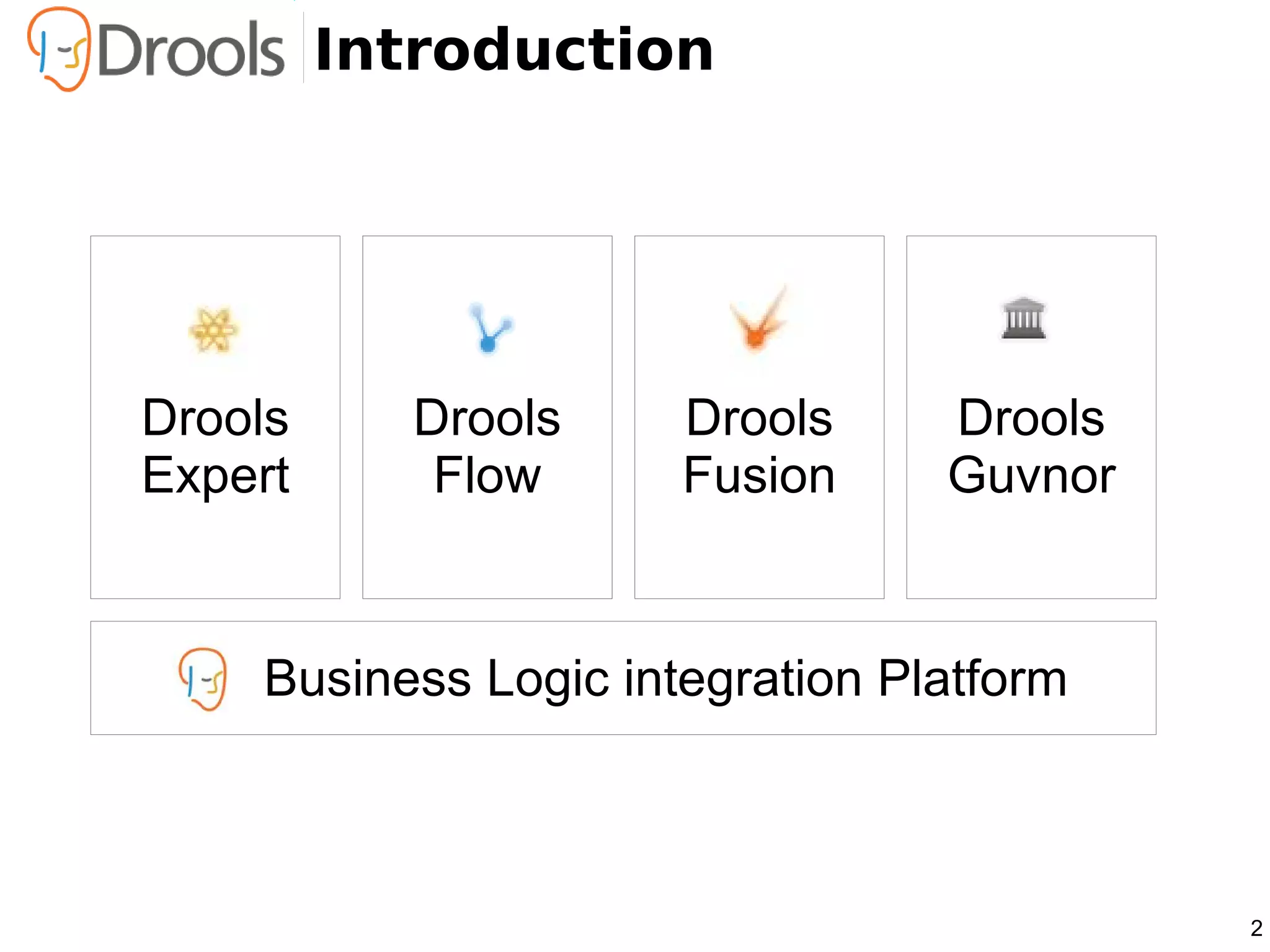
Introduction


Drools     Drools     Drools     Drools
Expert      Flow      Fusion     Guvnor


    Business Logic integration Platform


                                          2
Drools Expert
Learn by Example
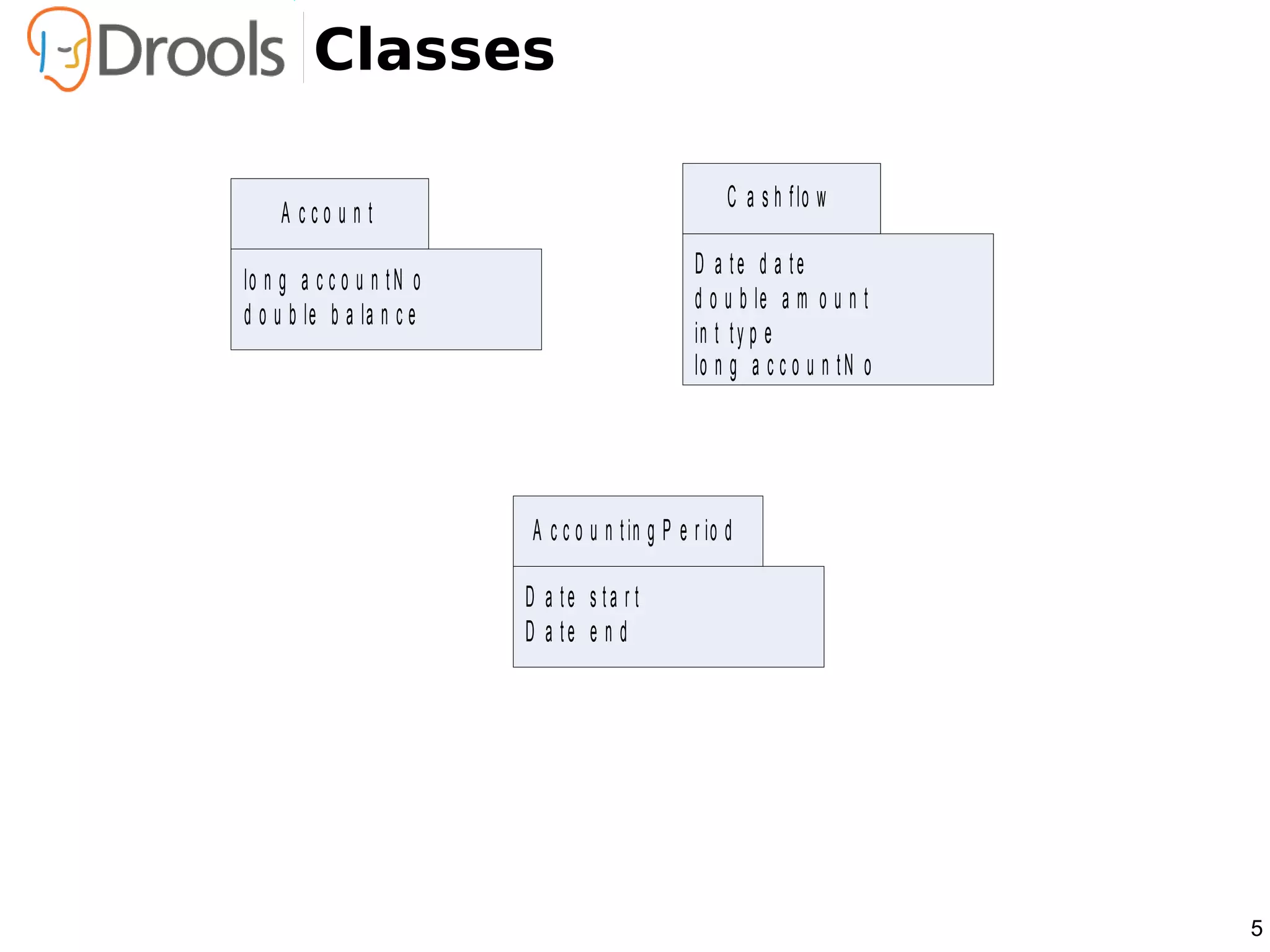
Classes

                                                       C a s h f lo w
     A cco u n t
                                                  D a te d a te
lo n g a c c o u n t N o
                                                  d o u b le a m o u n t
d o u b le b a la n c e
                                                  in t t y p e
                                                  lo n g a c c o u n t N o


                           A c c o u n t in g P e r io d

                           D a te s ta r t
                           D a te e n d


                                                                             5
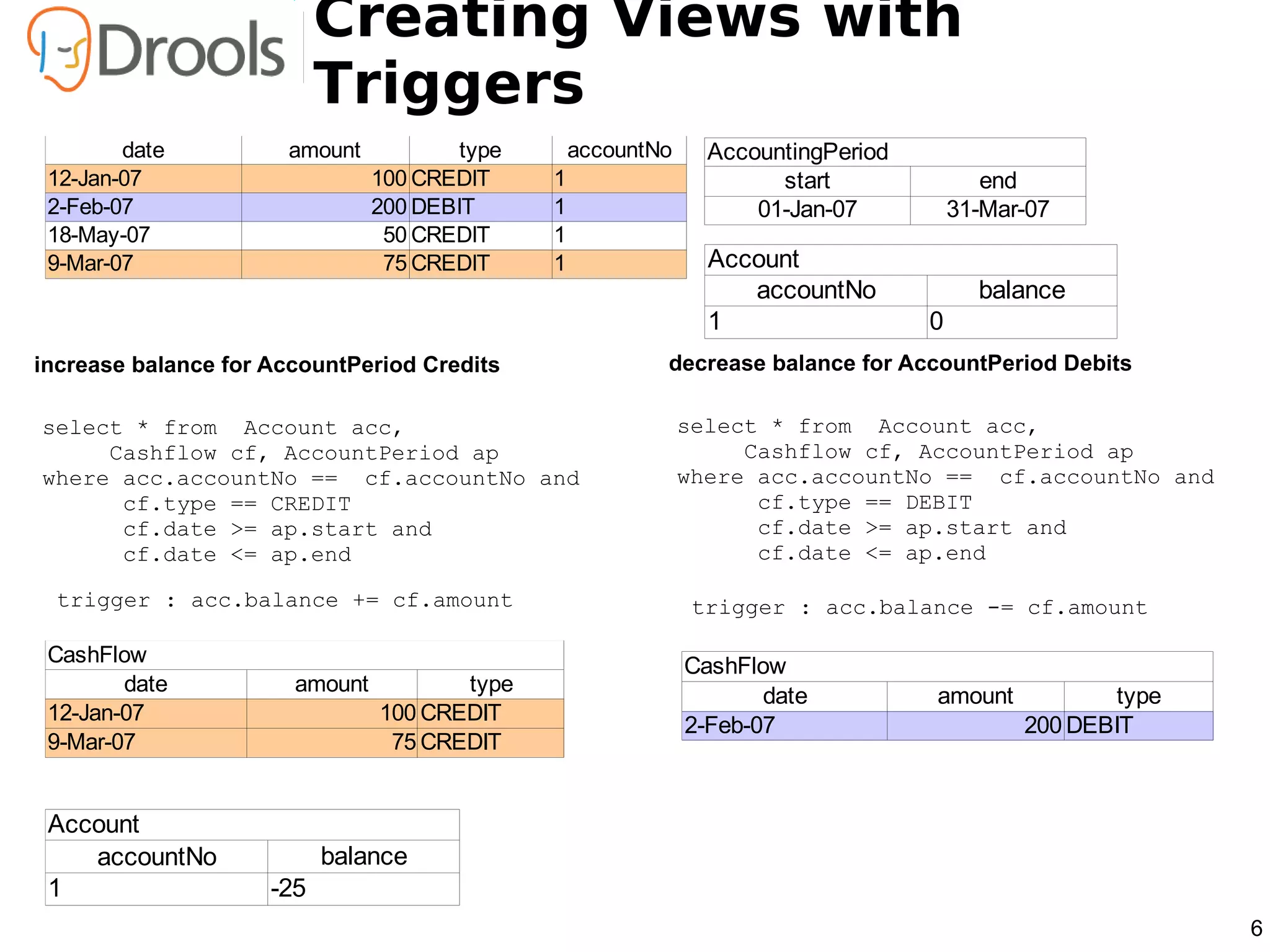
Creating Views with
                           Triggers
        date          amount            type       accountNo     AccountingPeriod
 12-Jan-07                      100 CREDIT     1                       start               end
 2-Feb-07                       200 DEBIT      1                     01-Jan-07          31-Mar-07
 18-May-07                       50 CREDIT     1
 9-Mar-07                        75 CREDIT     1                 Account
                                                                    accountNo             balance
                                                                 1                  0
increase balance for AccountPeriod Credits                 decrease balance for AccountPeriod Debits

select * from Account acc,                                     select * from Account acc,
     Cashflow cf, AccountPeriod ap                                  Cashflow cf, AccountPeriod ap
where acc.accountNo == cf.accountNo and                        where acc.accountNo == cf.accountNo and
      cf.type == CREDIT                                              cf.type == DEBIT
      cf.date >= ap.start and                                        cf.date >= ap.start and
      cf.date <= ap.end                                              cf.date <= ap.end

  trigger : acc.balance += cf.amount                            trigger : acc.balance -= cf.amount

 CashFlow                                                      CashFlow
        date           amount          type
                                                                      date          amount            type
 12-Jan-07                      100 CREDIT
                                                               2-Feb-07                       200 DEBIT
 9-Mar-07                        75 CREDIT


 Account
    accountNo              balance
 1                   -25
                                                                                                             6
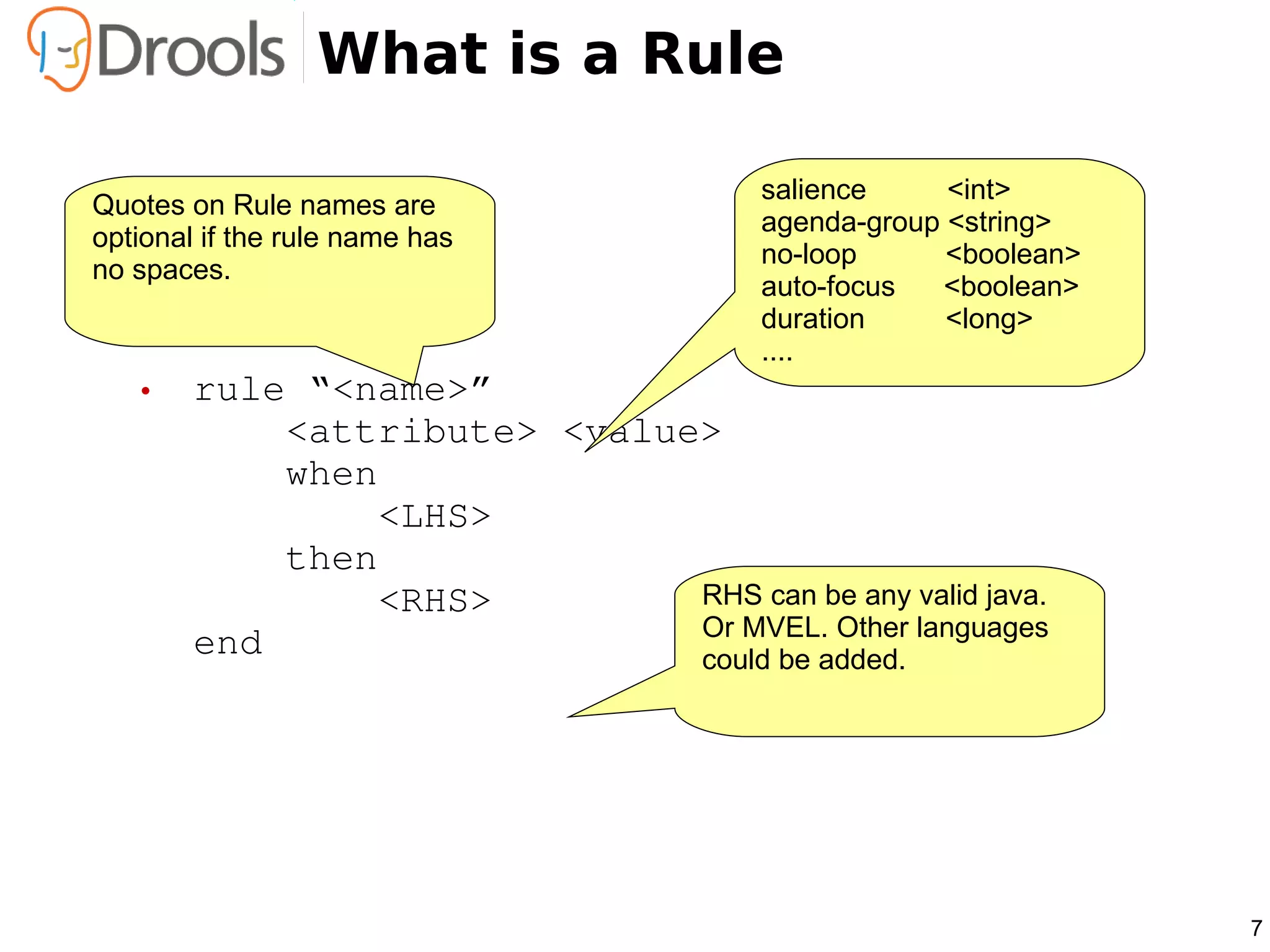
What is a Rule

                                     salience     <int>
Quotes on Rule names are
                                     agenda-group <string>
optional if the rule name has
                                     no-loop      <boolean>
no spaces.
                                     auto-focus  <boolean>
                                     duration     <long>
                                     ....
   • rule “<name>”
         <attribute> <value>
         when
             <LHS>
         then
             <RHS>         RHS can be any valid java.
                           Or MVEL. Other languages
     end                   could be added.


                                                              7
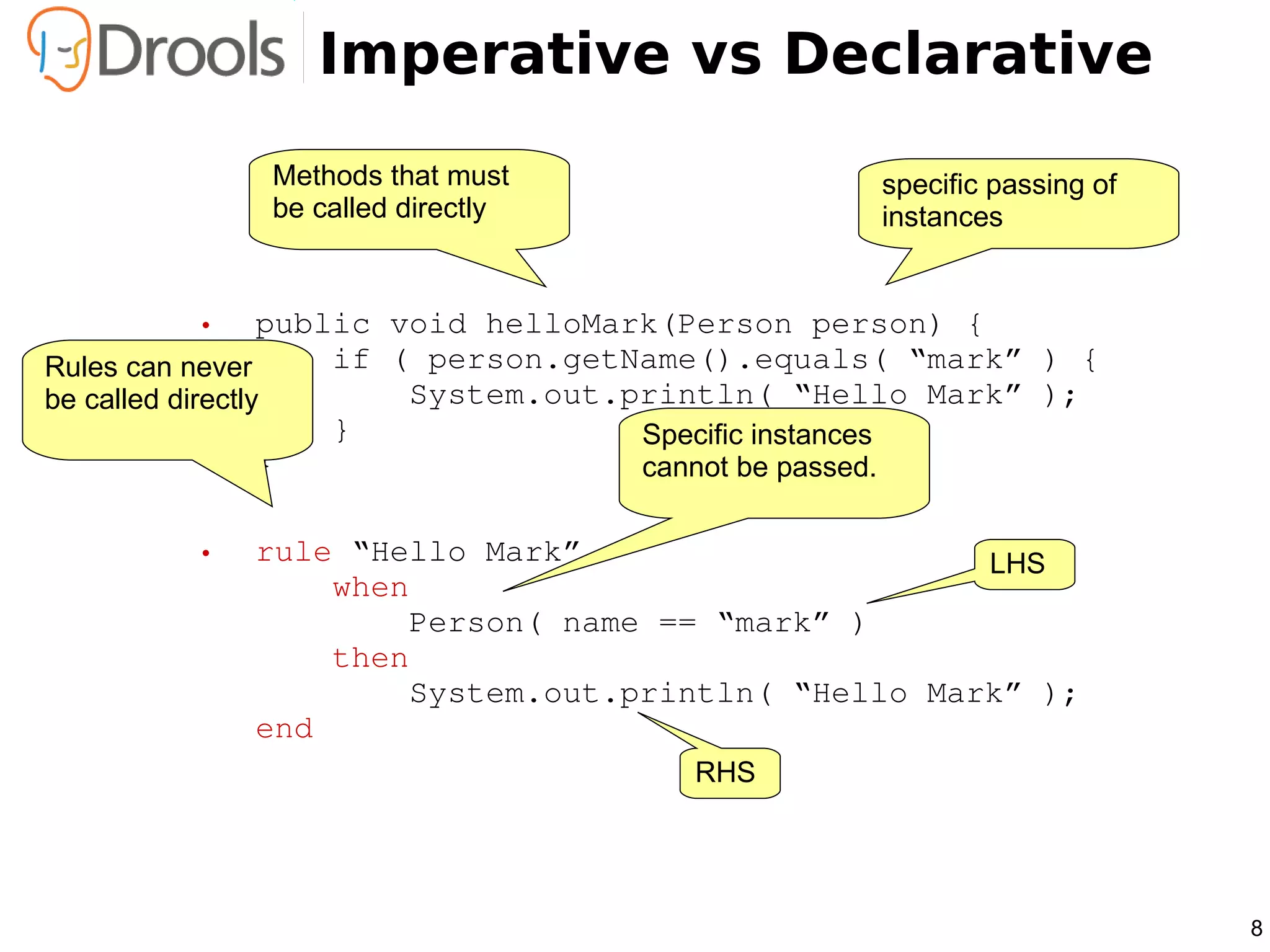
Imperative vs Declarative
             Methods that must                  specific passing of
             be called directly                 instances


        •         public void helloMark(Person person) {
Rules can never     if ( person.getName().equals( “mark” ) {
be called directly        System.out.println( “Hello Mark” );
                      }               Specific instances
                  }                   cannot be passed.

        •   rule “Hello Mark”                     LHS
                when
                    Person( name == “mark” )
                then
                    System.out.println( “Hello Mark” );
            end
                                     RHS


                                                                      8
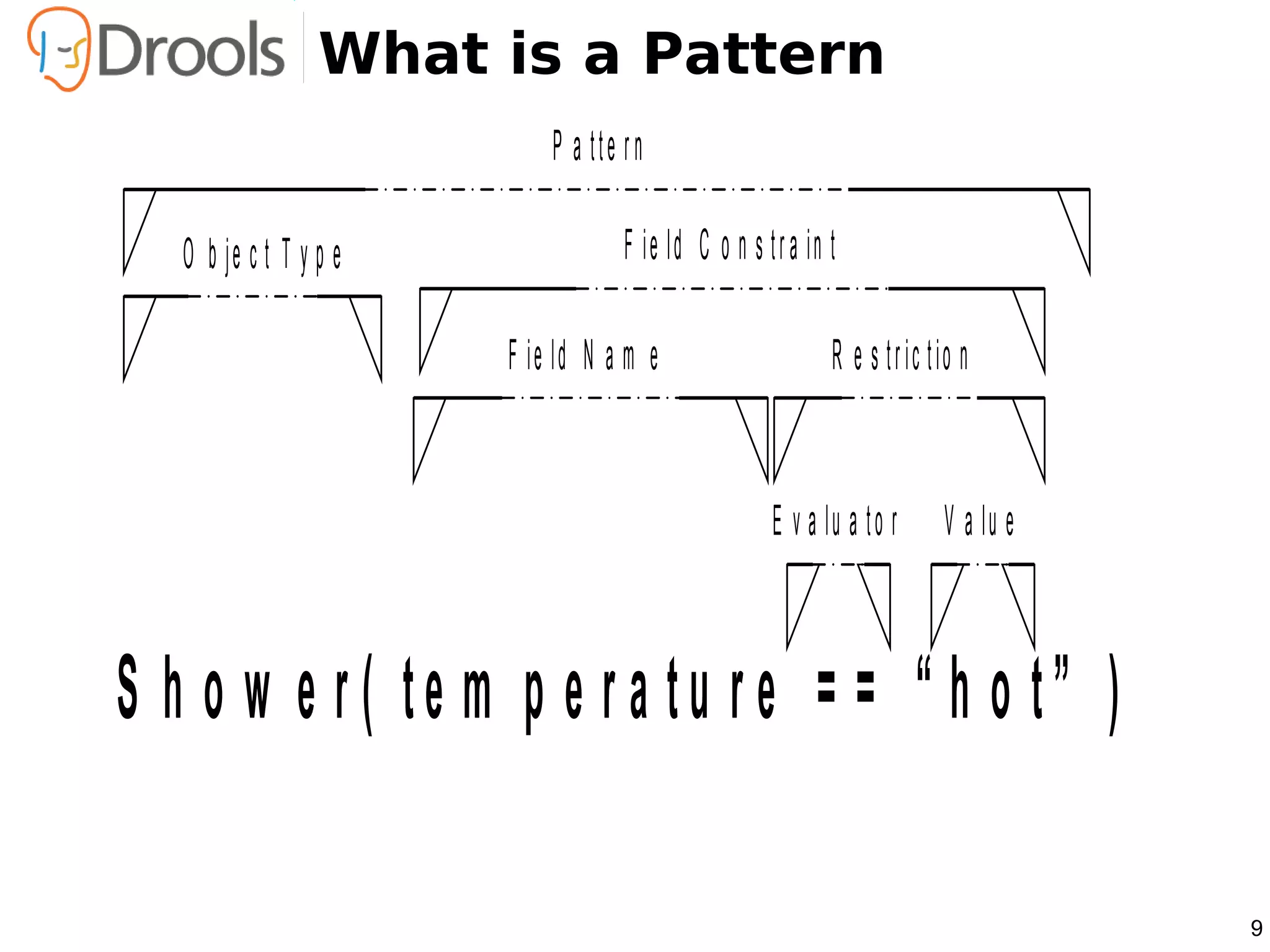
What is a Pattern
                            P a tte rn

   O b je c t T y p e               F ie ld C o n s t r a in t

                        F ie ld N a m e                      R e s t r ic t io n


                                                      E v a lu a t o r      V a lu e


S h o w e r( te m p e r a tu re = = “ h o t” )

                                                                                       9
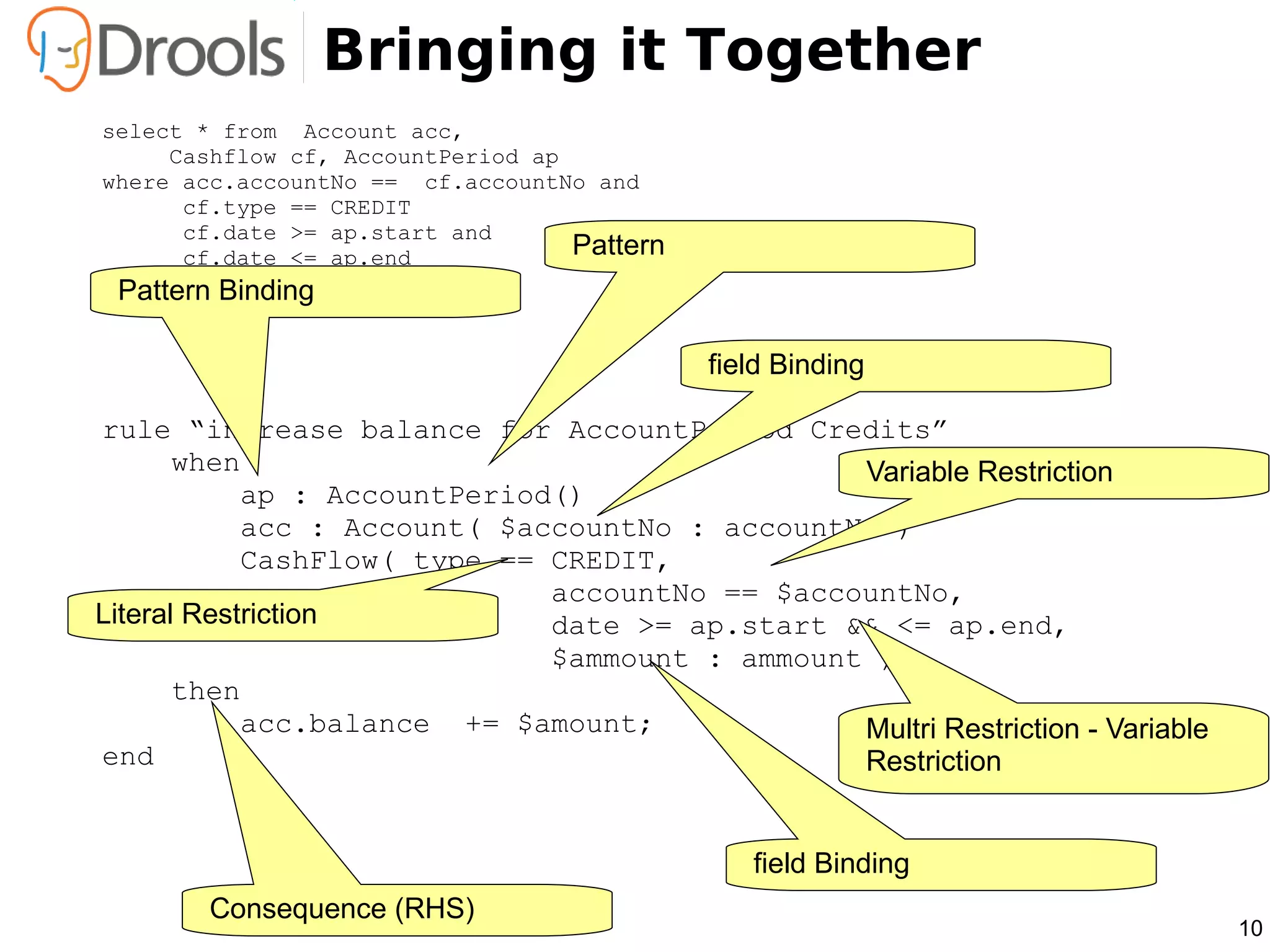
Bringing it Together
select * from Account acc,
       Cashflow cf, AccountPeriod ap
where acc.accountNo == cf.accountNo and
        cf.type == CREDIT
        cf.date >= ap.start and
        cf.date <= ap.end            Pattern
  trigger : acc.balance += cf.amount
 Pattern Binding

                                               field Binding

rule “increase balance for AccountPeriod Credits”
       when                                     Variable Restriction
            ap : AccountPeriod()
            acc : Account( $accountNo : accountNo )
            CashFlow( type == CREDIT,
                              accountNo == $accountNo,
Literal Restriction           date >= ap.start && <= ap.end,
                              $ammount : ammount )
       then
            acc.balance += $amount;             Multri Restriction - Variable
end                                             Restriction


                                                  field Binding
        Consequence (RHS)
                                                                                10
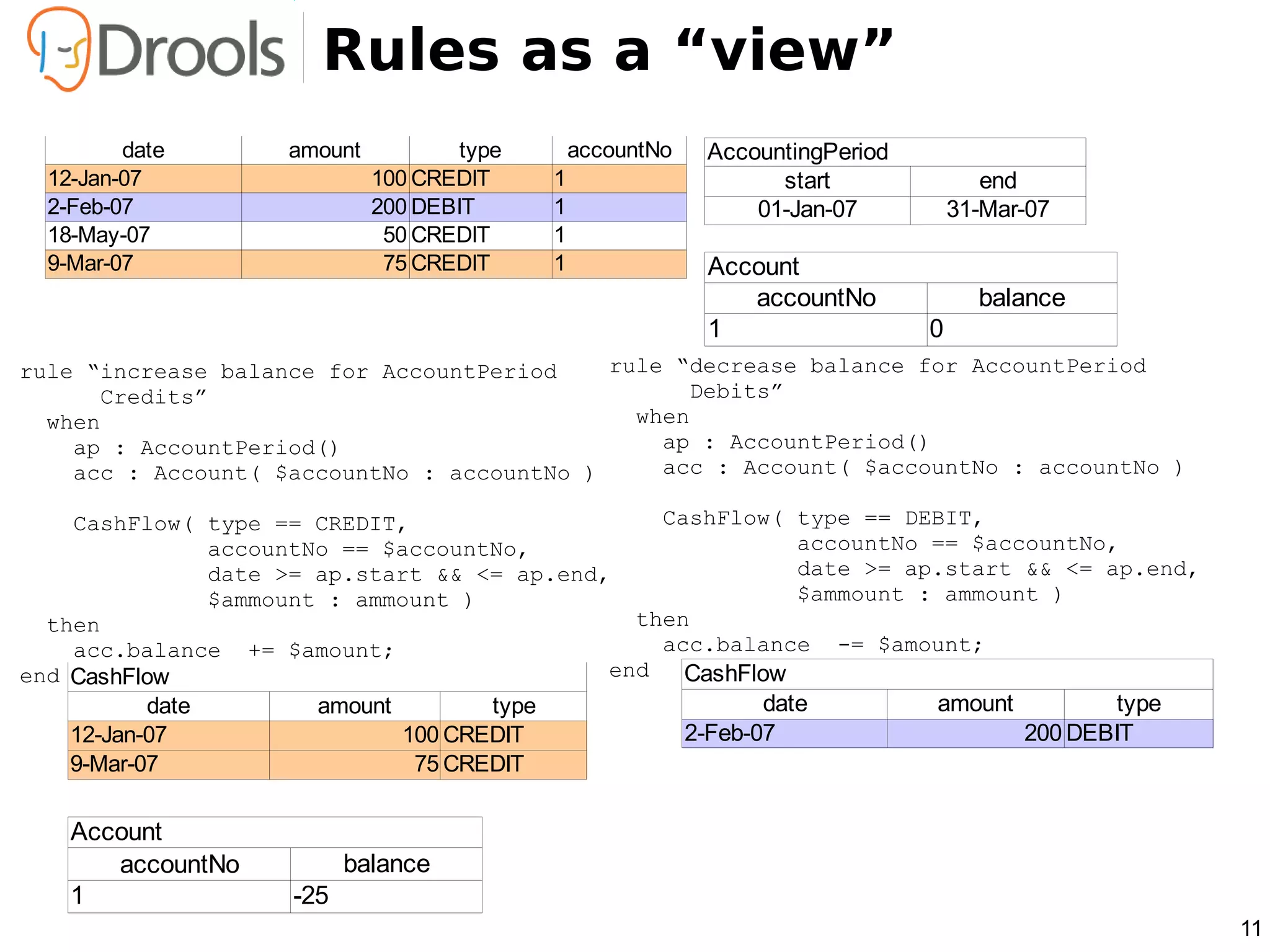
Rules as a “view”
         date       amount           type       accountNo   AccountingPeriod
  12-Jan-07                  100 CREDIT     1                     start               end
  2-Feb-07                   200 DEBIT      1                   01-Jan-07          31-Mar-07
  18-May-07                   50 CREDIT     1
  9-Mar-07                    75 CREDIT     1               Account
                                                               accountNo             balance
                                                            1                  0
rule “increase balance for AccountPeriod    rule “decrease balance for AccountPeriod
       Credits”                                    Debits”
  when                                        when
    ap : AccountPeriod()                        ap : AccountPeriod()
    acc : Account( $accountNo : accountNo )     acc : Account( $accountNo : accountNo )

    CashFlow( type == CREDIT,                     CashFlow( type == DEBIT,
                accountNo == $accountNo,                      accountNo == $accountNo,
                date >= ap.start && <= ap.end,                date >= ap.start && <= ap.end,
                $ammount : ammount )                          $ammount : ammount )
  then                                          then
    acc.balance += $amount;                       acc.balance -= $amount;
end CashFlow                                  end   CashFlow
           date         amount        type                 date         amount         type
    12-Jan-07                  100 CREDIT           2-Feb-07                   200 DEBIT
    9-Mar-07                    75 CREDIT

    Account
       accountNo           balance
    1                -25
                                                                                               11
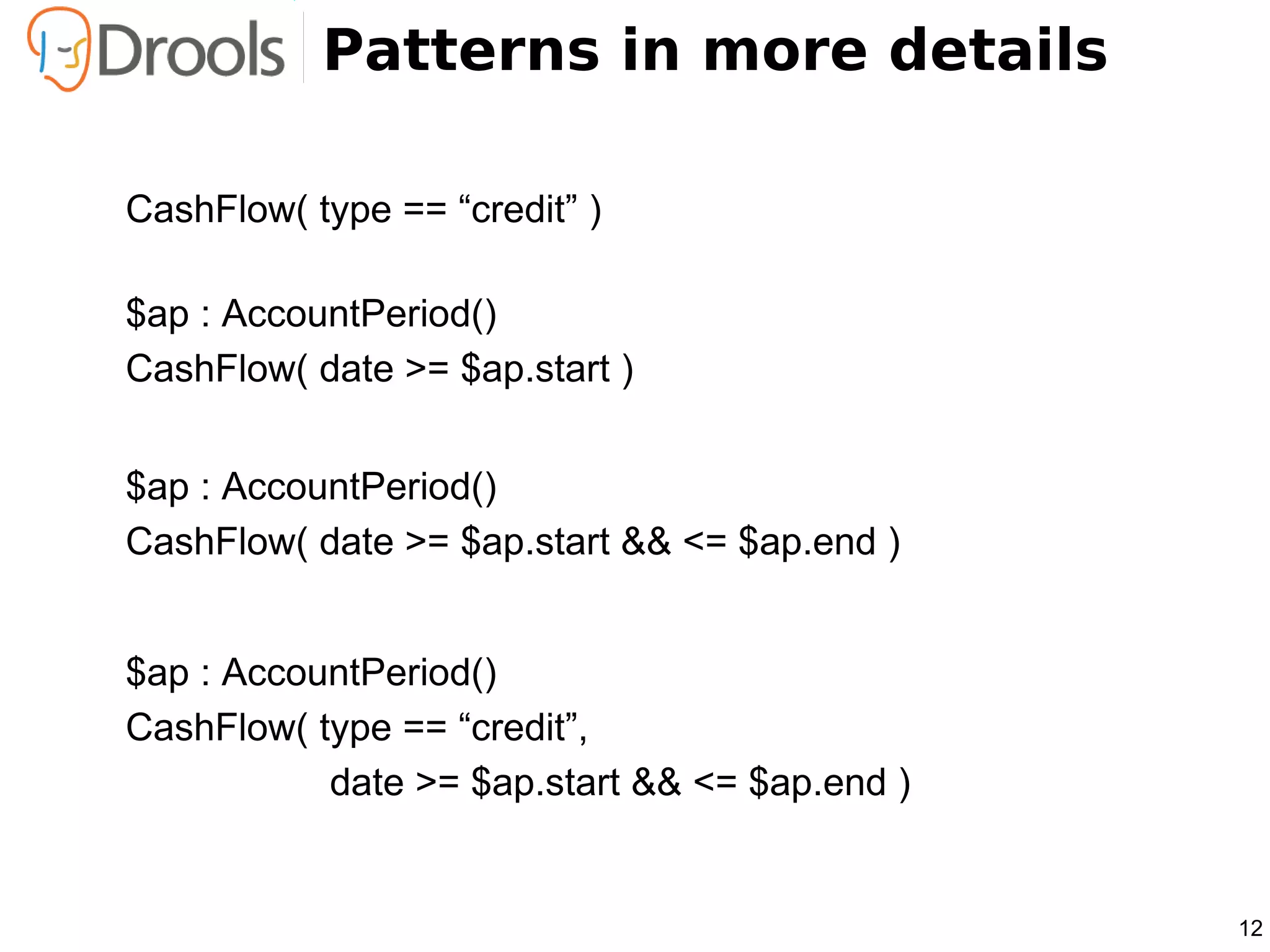
Patterns in more details

CashFlow( type == “credit” )

$ap : AccountPeriod()
CashFlow( date >= $ap.start )


$ap : AccountPeriod()
CashFlow( date >= $ap.start && <= $ap.end )


$ap : AccountPeriod()
CashFlow( type == “credit”,
           date >= $ap.start && <= $ap.end )


                                               12
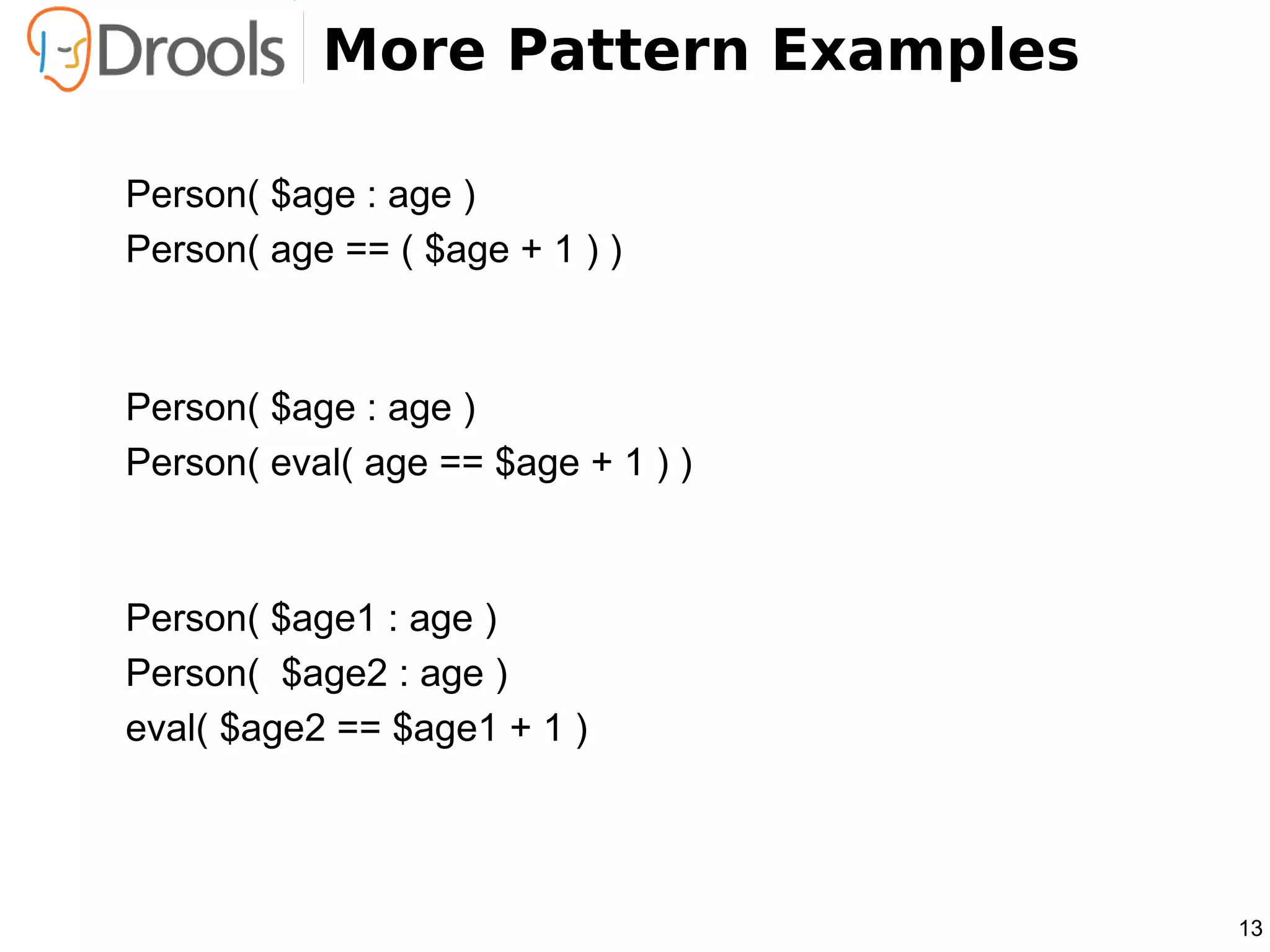
More Pattern Examples

Person( $age : age )
Person( age == ( $age + 1 ) )


Person( $age : age )
Person( eval( age == $age + 1 ) )


Person( $age1 : age )
Person( $age2 : age )
eval( $age2 == $age1 + 1 )


                                    13
More Pattern
           Examples
Person(age > 30 && < 40 || hair == “black”)

Person(age > 30 && < 40 || hair in (“black”, “brown”) )


Person( (age > 30 && < 40 && hair == “black”)
         ||
        (age > 50 && hair == “grey”) )


Person(pets contain $rover )


Person(pets[’rover’].type == “dog”)


Person(pets[0].type == “dog”)
                                                          14
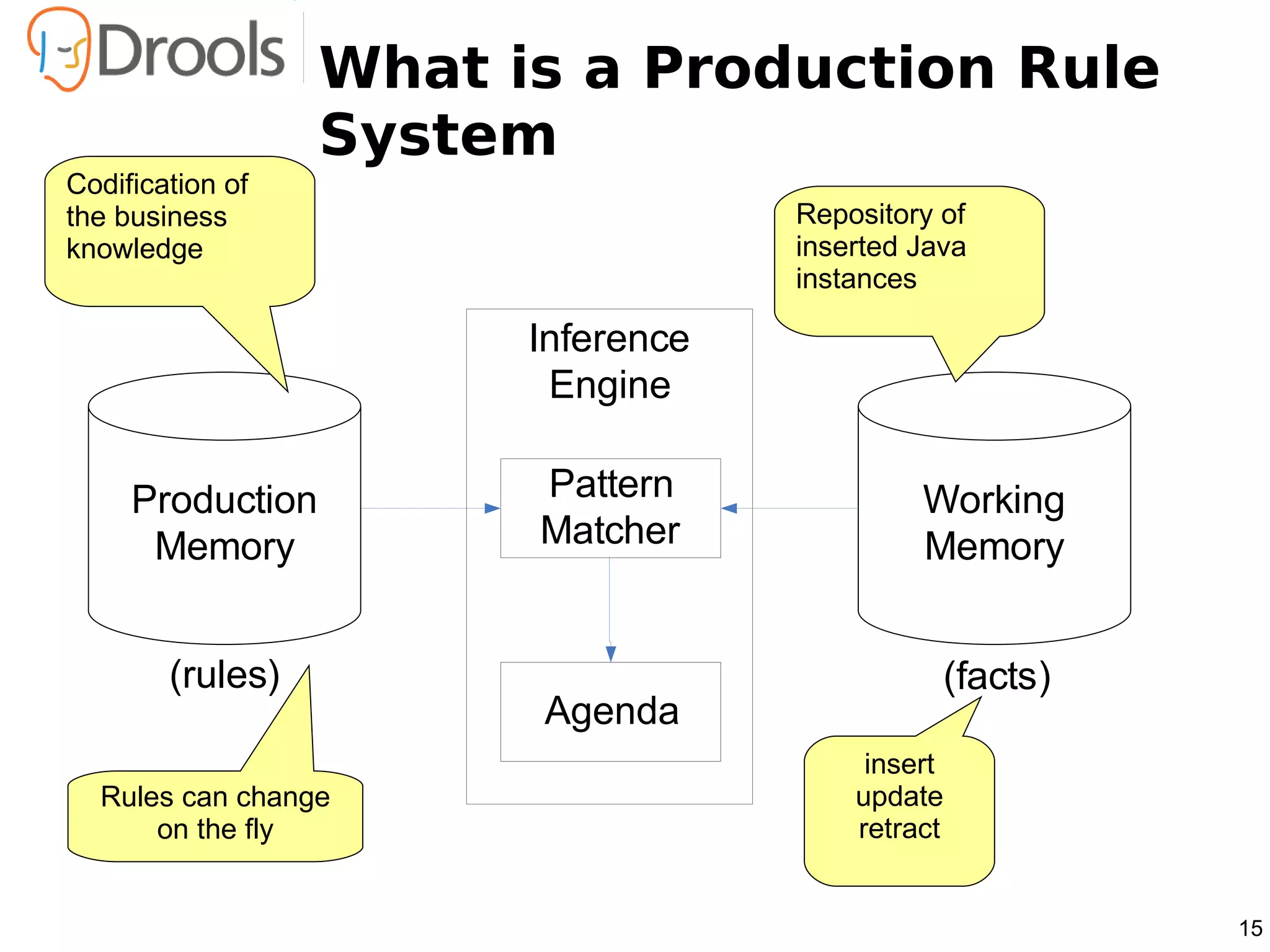
What is a Production Rule
                  System
Codification of
the business                        Repository of
knowledge                           inserted Java
                                    instances

                        Inference
                         Engine

     Production         Pattern              Working
      Memory            Matcher              Memory


        (rules)                                (facts)
                        Agenda
                                         insert
  Rules can change                      update
      on the fly                        retract


                                                         15
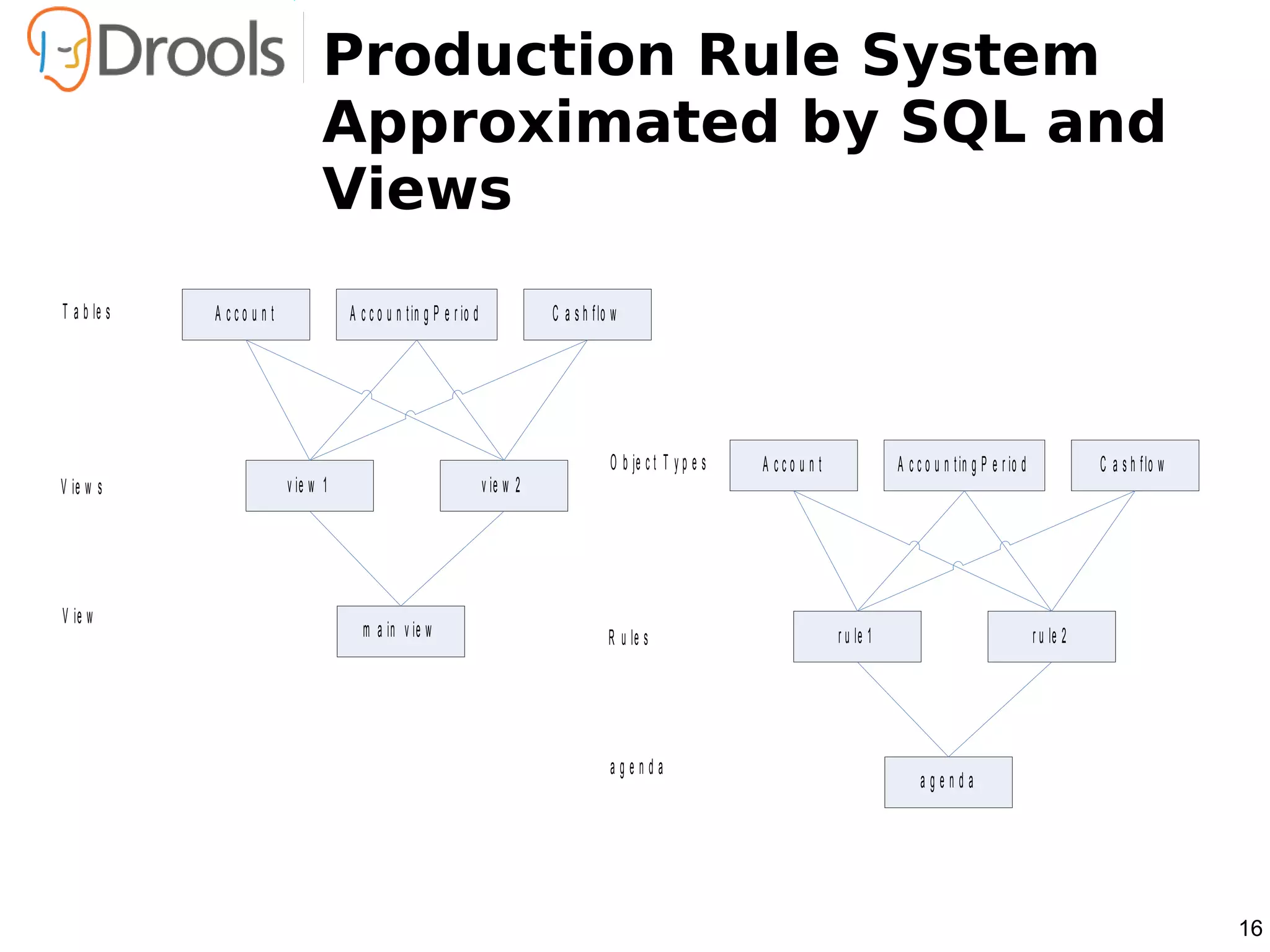
Production Rule System
                               Approximated by SQL and
                               Views
T a b le s   A cco unt              A c c o u n t in g P e r io d              C a s h f lo w


                                                                                           O b je c t T y p e s   A cco unt              A c c o u n t in g P e r io d              C a s h f lo w
V ie w s                 v ie w 1                                   v ie w 2


V ie w
                                      m a in v ie w                                        R u le s                           r u le 1                                   r u le 2


                                                                                           agenda
                                                                                                                                              agenda


                                                                                                                                                                                                     16
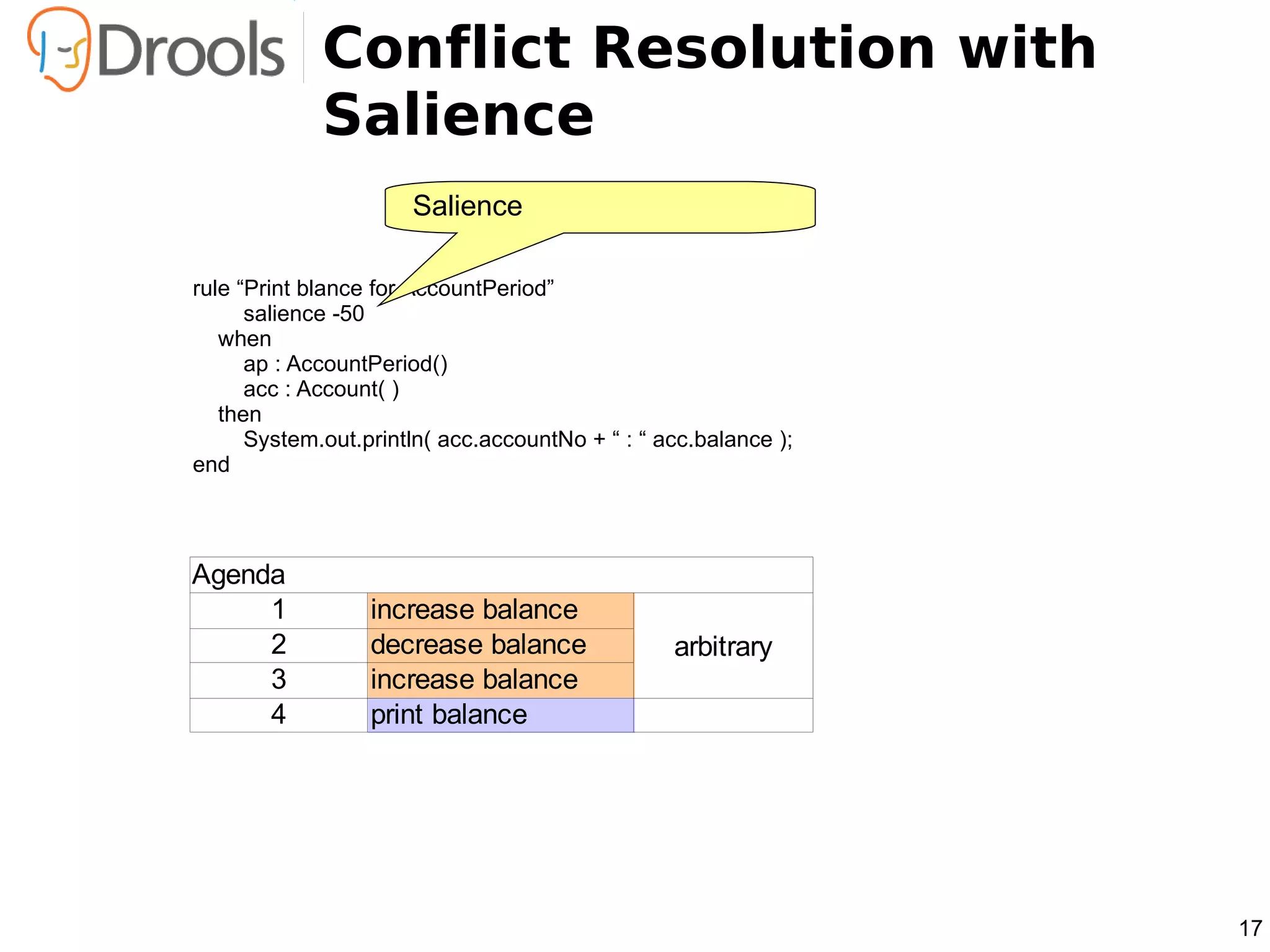
Conflict Resolution with
             Salience
                      Salience

rule “Print blance for AccountPeriod”
      salience -50
   when
      ap : AccountPeriod()
      acc : Account( )
   then
      System.out.println( acc.accountNo + “ : “ acc.balance );
end


Agenda
     1            increase balance
     2            decrease balance               arbitrary
     3            increase balance
     4            print balance


                                                                 17
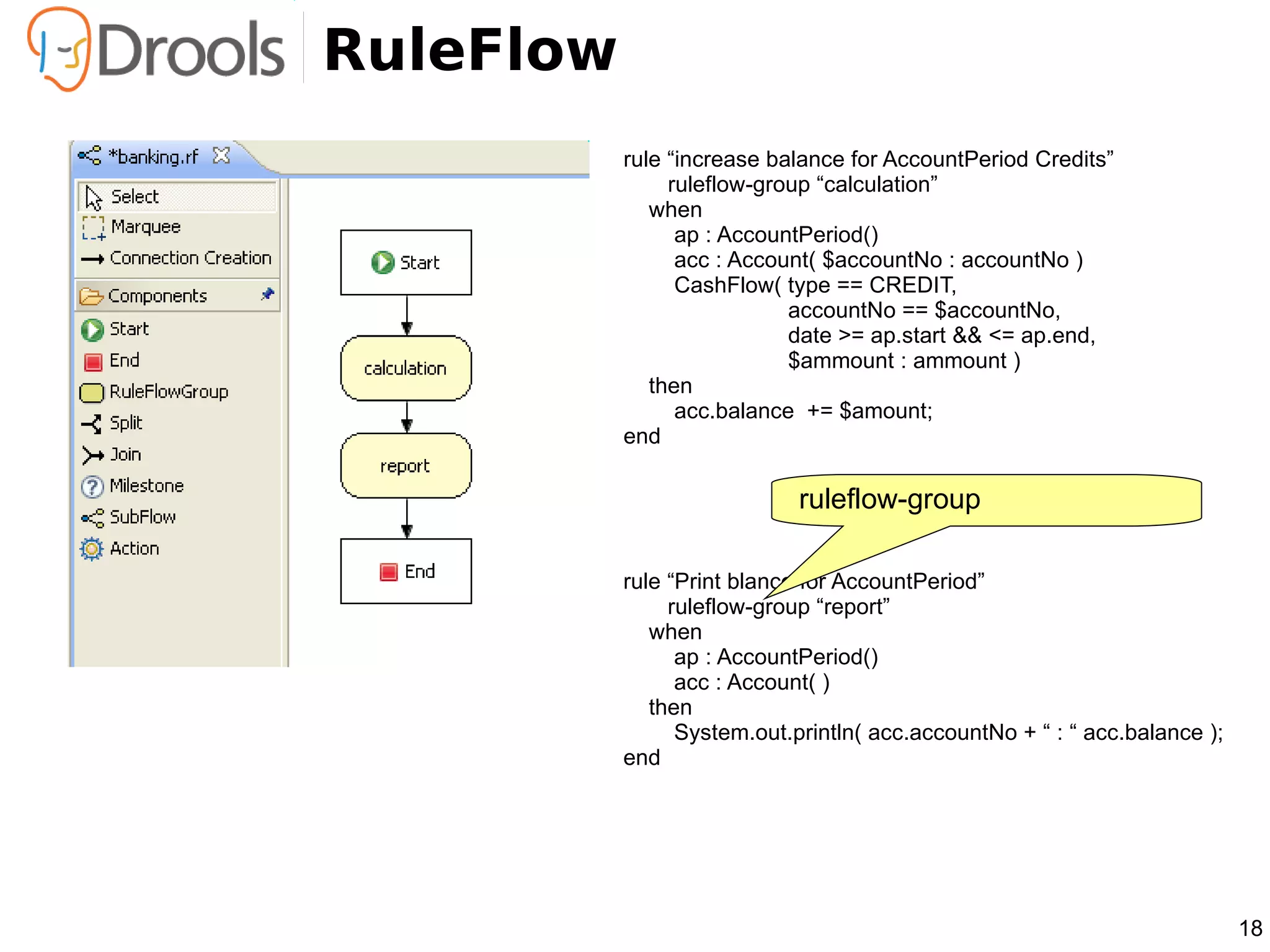
RuleFlow
           rule “increase balance for AccountPeriod Credits”
                ruleflow-group “calculation”
              when
                 ap : AccountPeriod()
                 acc : Account( $accountNo : accountNo )
                 CashFlow( type == CREDIT,
                            accountNo == $accountNo,
                            date >= ap.start && <= ap.end,
                            $ammount : ammount )
              then
                 acc.balance += $amount;
           end

                             ruleflow-group

           rule “Print blance for AccountPeriod”
                ruleflow-group “report”
              when
                 ap : AccountPeriod()
                 acc : Account( )
              then
                 System.out.println( acc.accountNo + “ : “ acc.balance );
           end


                                                                            18
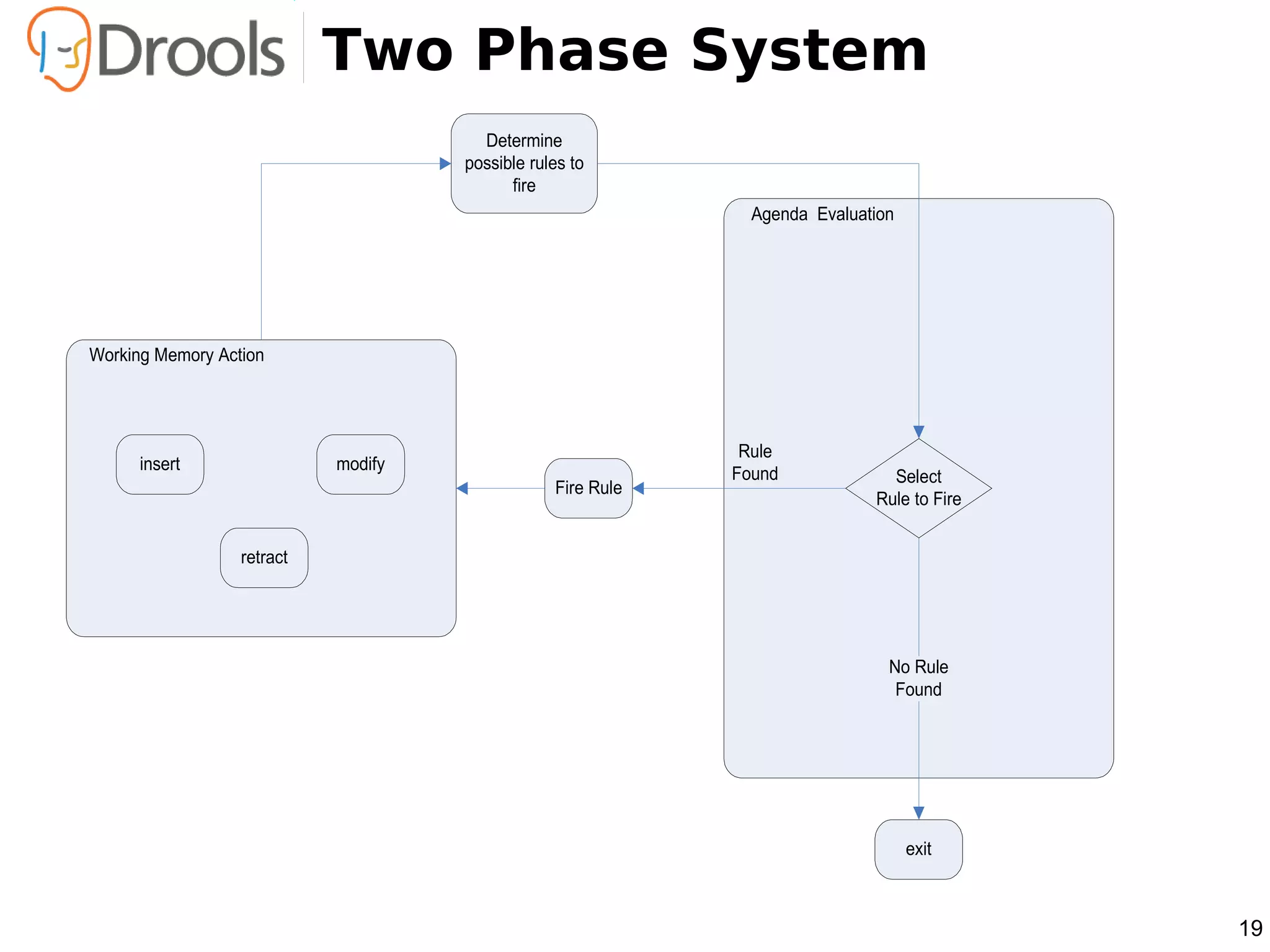
Two Phase System
                                       Determine
                                     possible rules to
                                           fire
                                                               Agenda Evaluation


Working Memory Action


                                                              Rule
      insert                modify
                                                             Found             Select
                                                 Fire Rule
                                                                             Rule to Fire


                  retract


                                                                               No Rule
                                                                                Found


                                                                                   exit


                                                                                            19
Conditional
 Elements
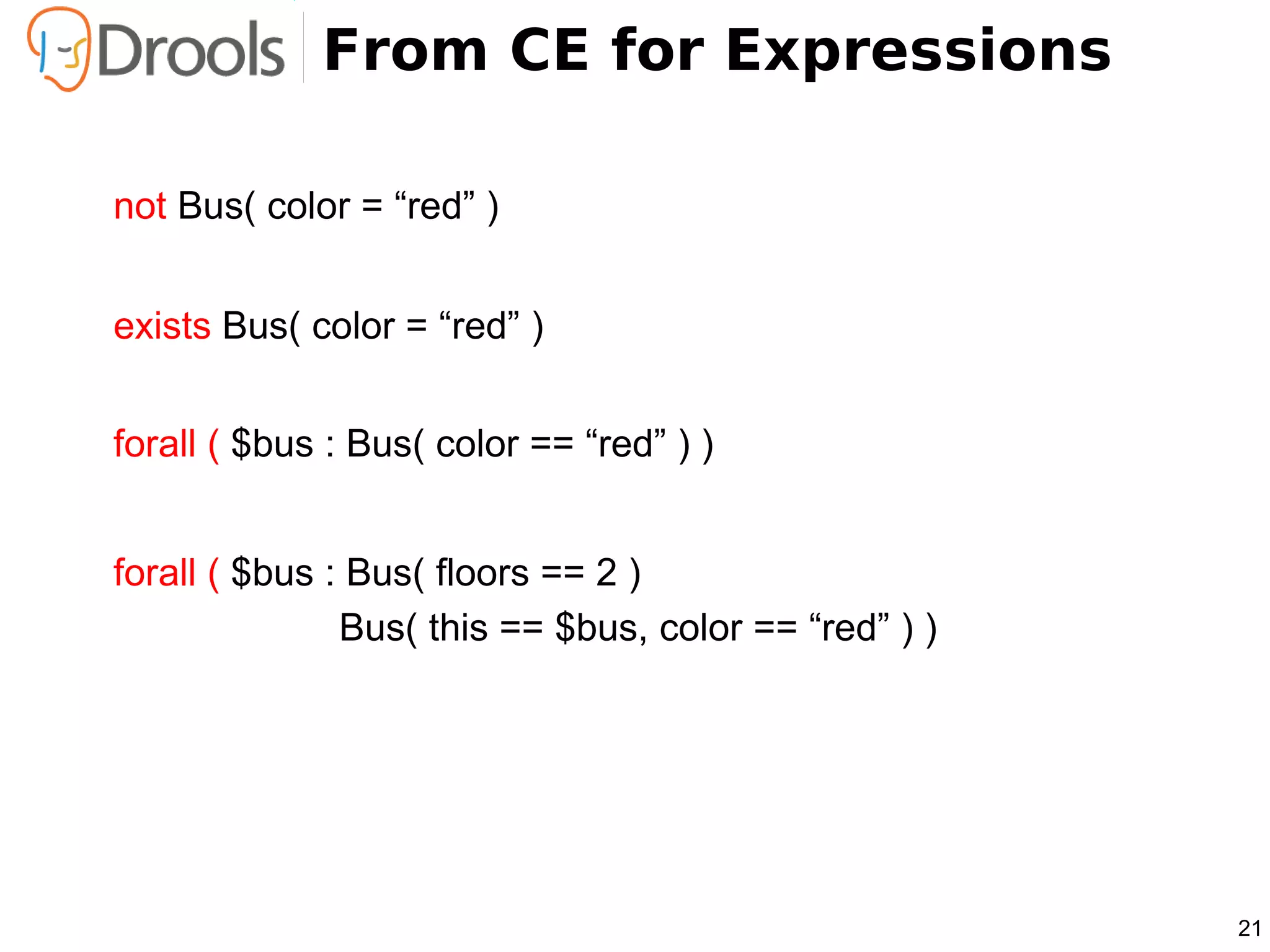
From CE for Expressions

not Bus( color = “red” )


exists Bus( color = “red” )


forall ( $bus : Bus( color == “red” ) )


forall ( $bus : Bus( floors == 2 )
               Bus( this == $bus, color == “red” ) )


                                                       21
From CE
for Expressions
From CE for Expressions

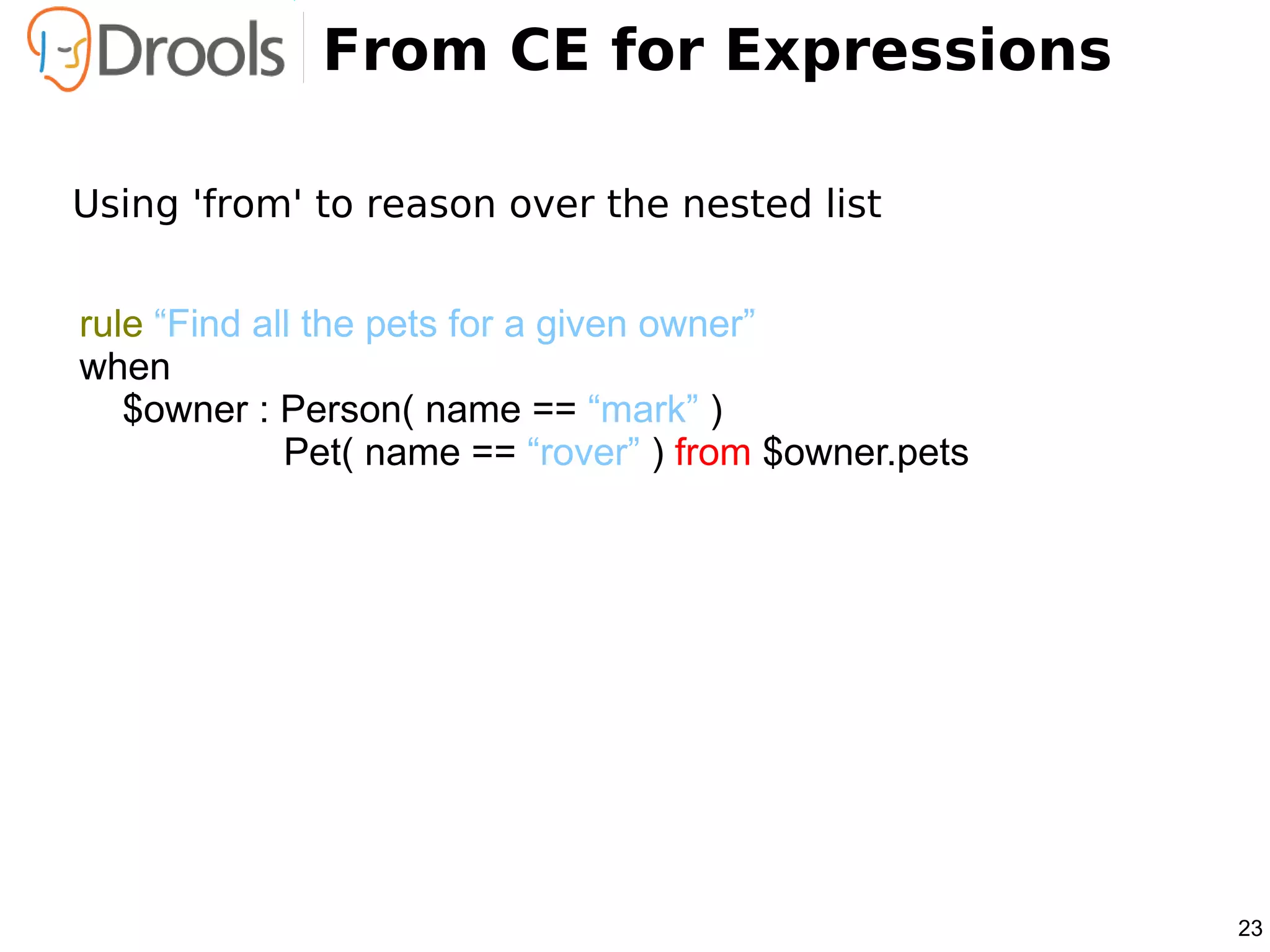
Using 'from' to reason over the nested list


rule “Find all the pets for a given owner”
when
   $owner : Person( name == “mark” )
             Pet( name == “rover” ) from $owner.pets


                                                       23
From CE for Expressions

'from' can work on any expression, not just a nested
field on a bound variable.


rule “Find People for given zip code”
when
   $zipCode : ZipCode()
   Person( ) from $hbn.getNamedQuery(“Find People”)
                        .setParameters( [ “zipCode” : $zipCode ] )
                        .list()

      Hibernate session


                                                                     24
Collect CE
Collect CE
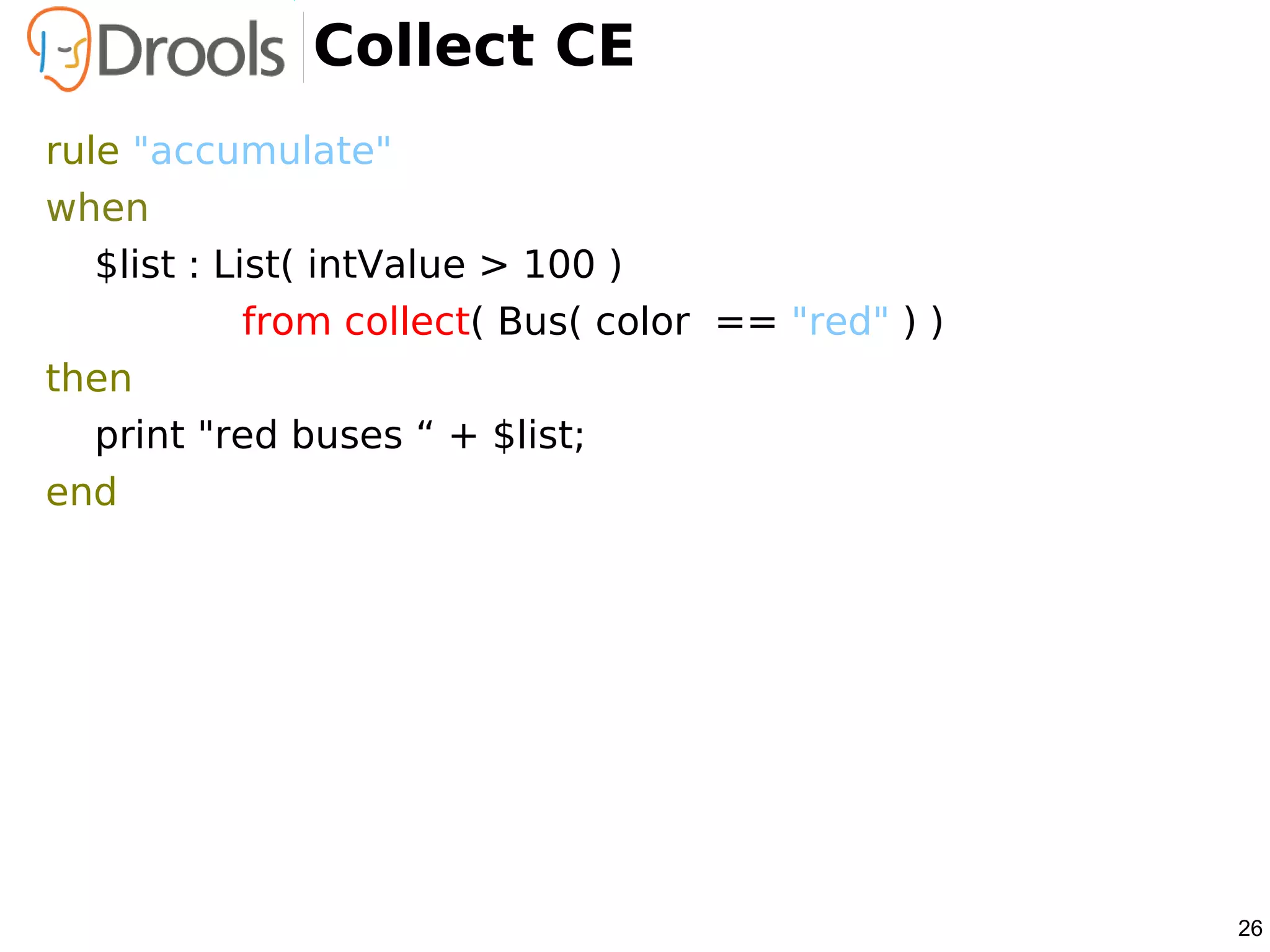
rule "accumulate"
when
   $list : List( intValue > 100 )
             from collect( Bus( color == "red" ) )
then
   print "red buses “ + $list;
end


                                                     26
Accumulate CE
Accumulate CE
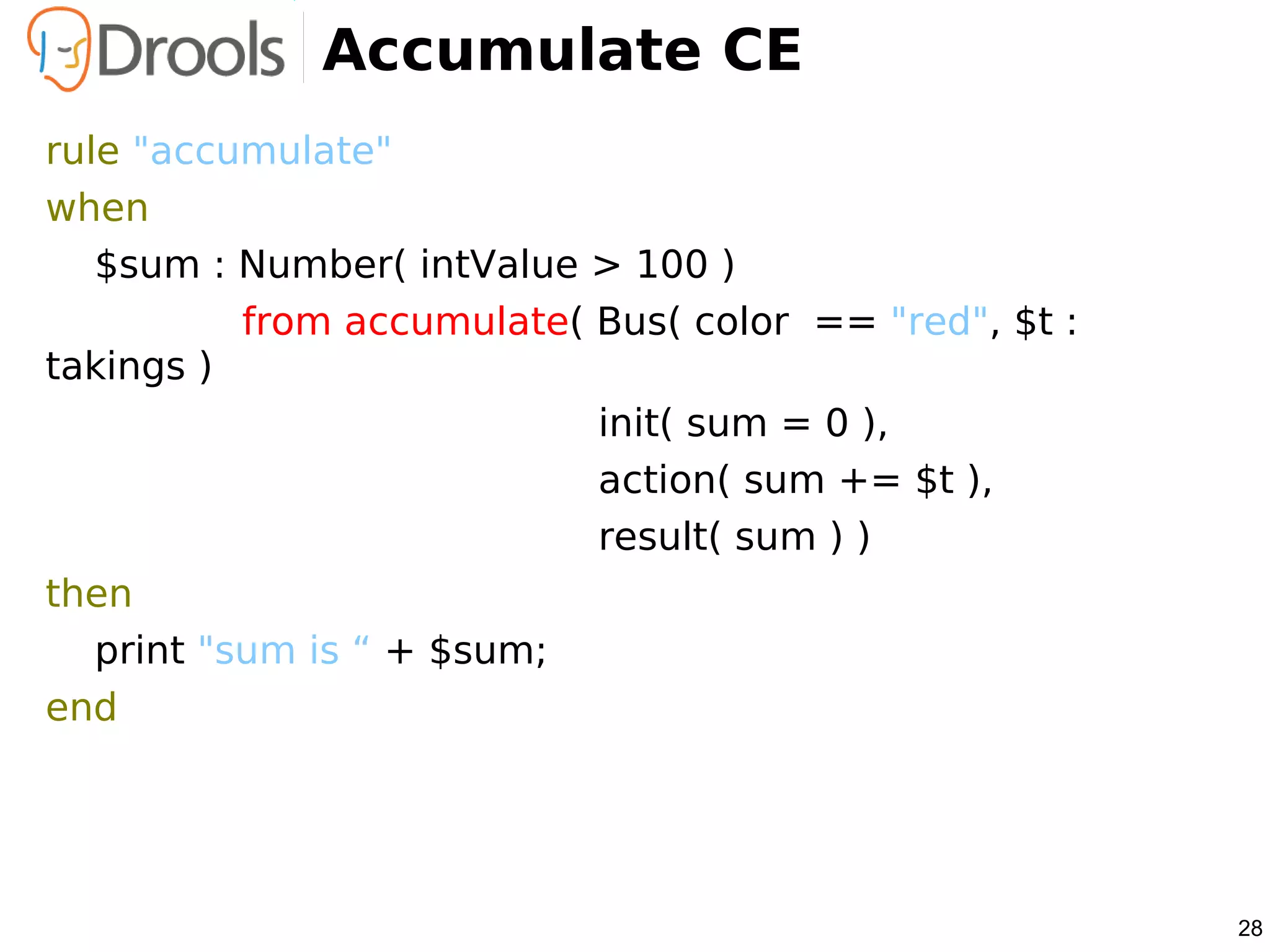
rule "accumulate"
when
   $sum : Number( intValue > 100 )
           from accumulate( Bus( color == "red", $t :
takings )
                            init( sum = 0 ),
                            action( sum += $t ),
                            result( sum ) )
then
   print "sum is “ + $sum;
end


                                                        28
Accumulate CE
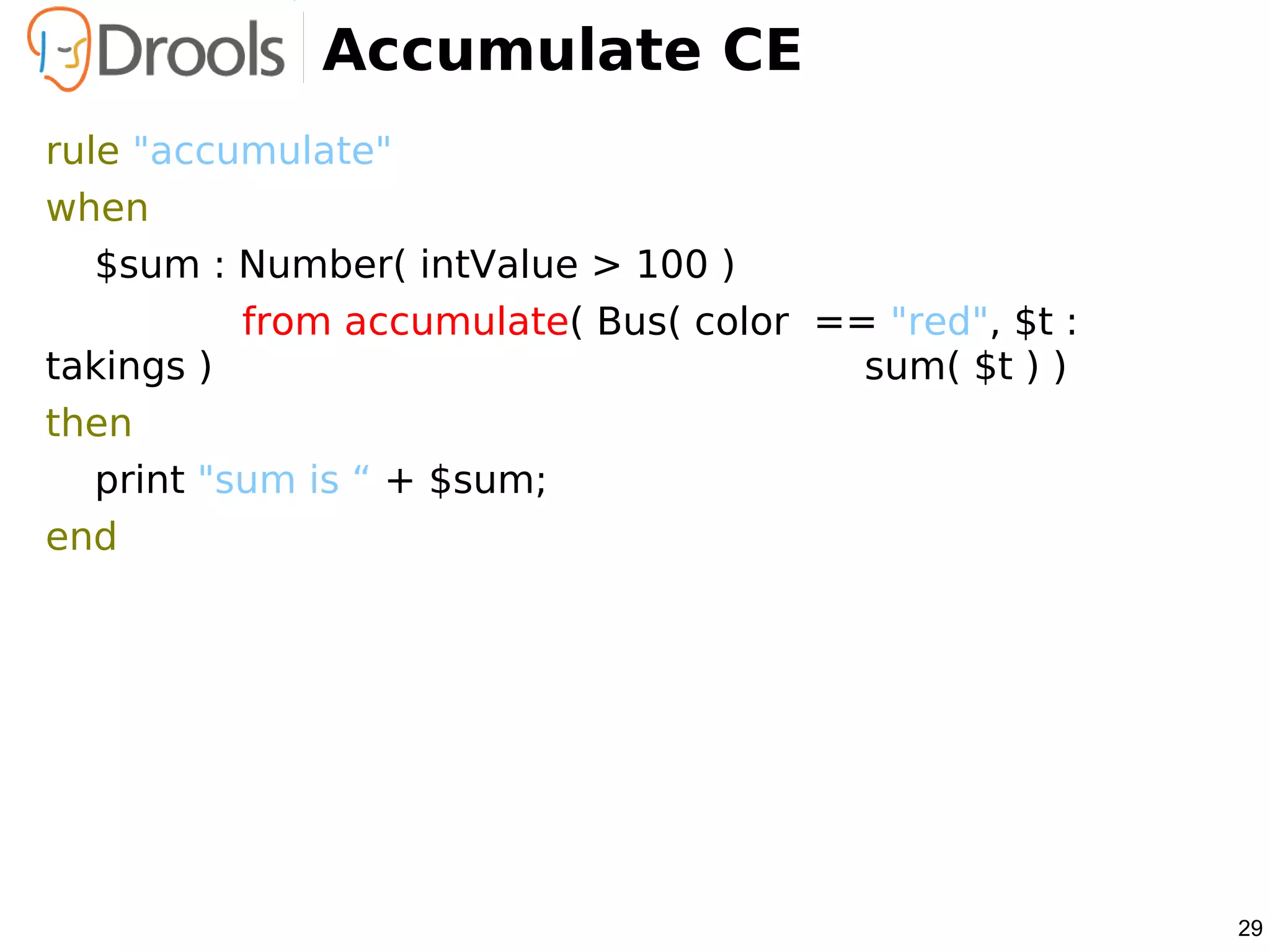
rule "accumulate"
when
   $sum : Number( intValue > 100 )
           from accumulate( Bus( color == "red", $t :
takings )                                sum( $t ) )
then
   print "sum is “ + $sum;
end


                                                        29
Accumulate CE
Patterns and CE's can be chained with 'from'

rule "collect"
when
   $zipCode : ZipCode()
   $sum : Number( intValue > 100 )
          from accumulate( Bus( color == "red", $t : takings )
                             from $hbn.getNamedQuery(“Find
Buses”)

.setParameters( [ “zipCode” :
                          $zipCode ] )
                                         .list(),
                           sum( $t ) )
then                                                         30
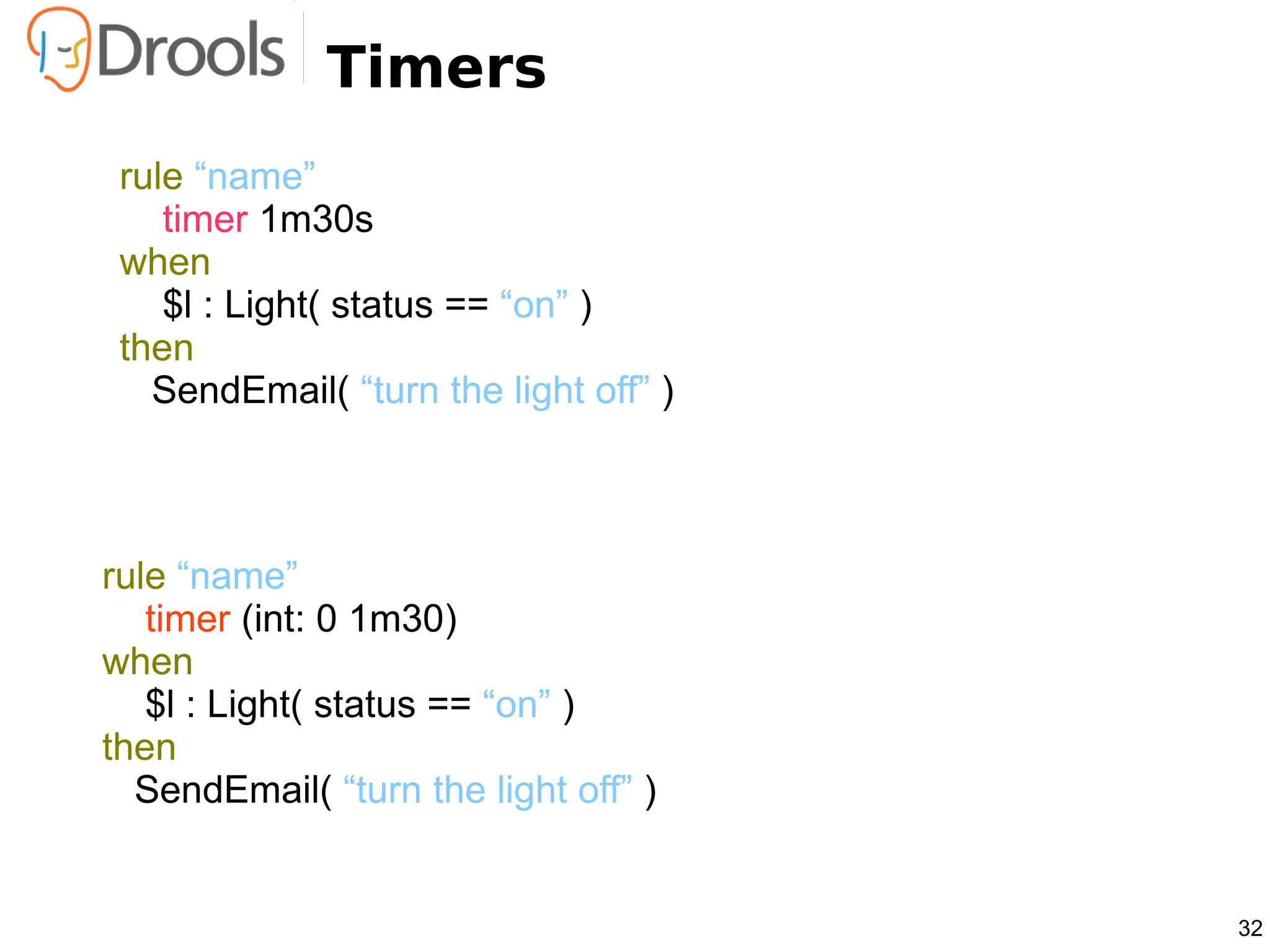
Timers
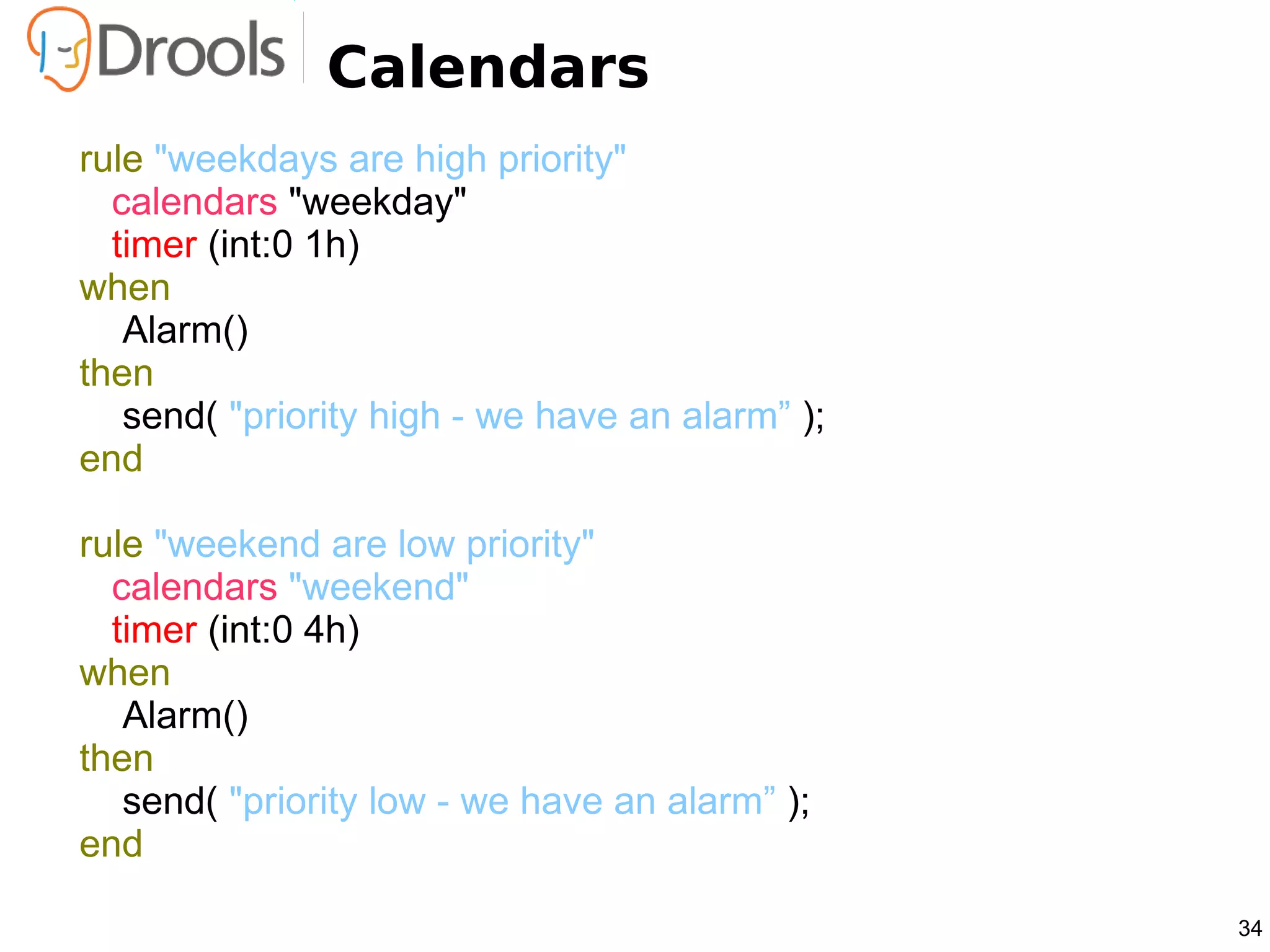
Calendars
Timers
 rule “name”
    timer 1m30s
 when
    $l : Light( status == “on” )
 then
   SendEmail( “turn the light off” )


rule “name”
   timer (int: 0 1m30)
when
   $l : Light( status == “on” )
then
  SendEmail( “turn the light off” )


                                       32
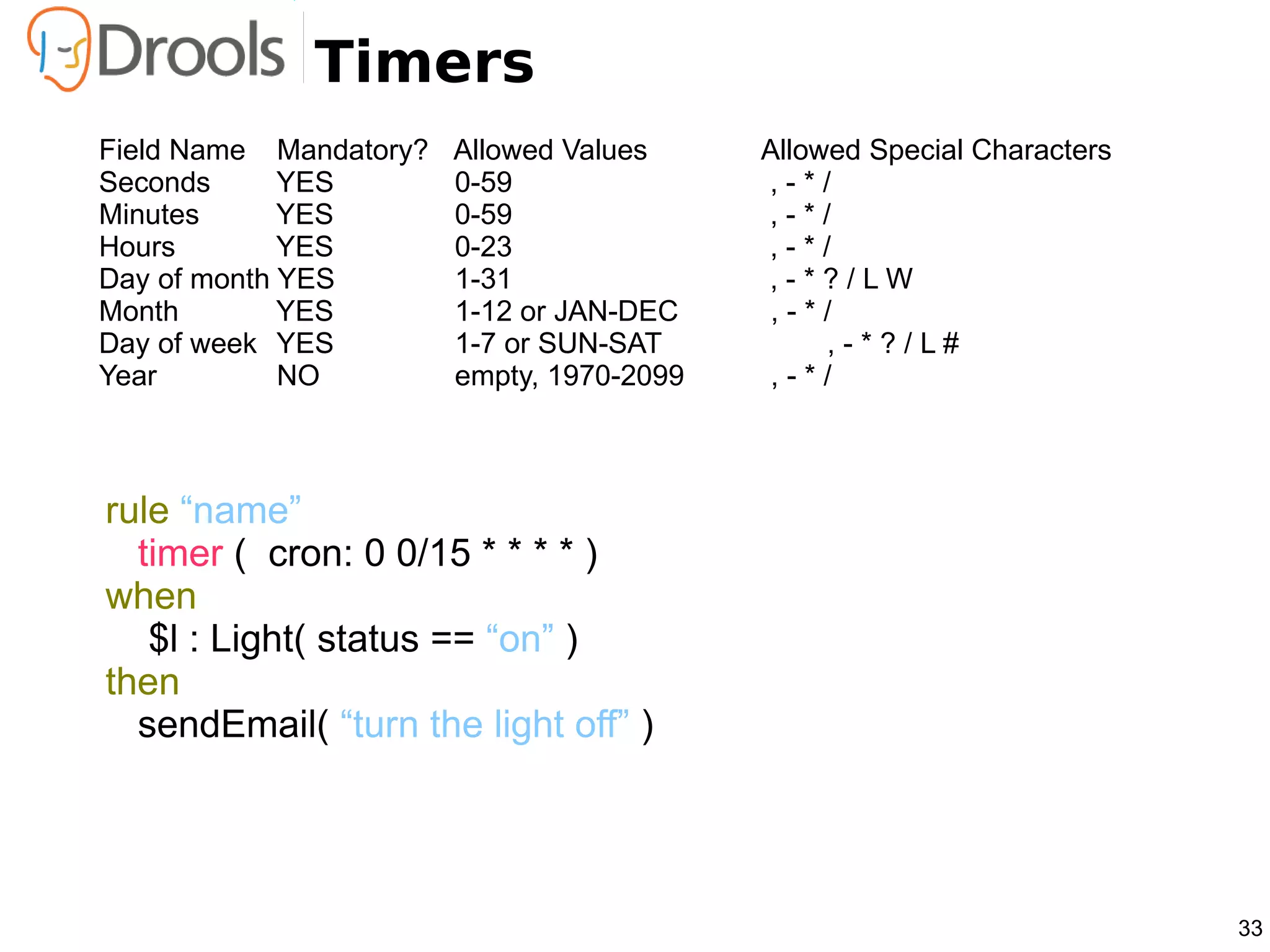
Timers
Field Name Mandatory?   Allowed Values     Allowed Special Characters
Seconds      YES        0-59               ,-*/
Minutes      YES        0-59               ,-*/
Hours        YES        0-23               ,-*/
Day of month YES        1-31               ,-*?/LW
Month        YES        1-12 or JAN-DEC     ,-*/
Day of week YES         1-7 or SUN-SAT          ,-*?/L#
Year         NO         empty, 1970-2099    ,-*/


rule “name”
  timer ( cron: 0 0/15 * * * * )
when
   $l : Light( status == “on” )
then
  sendEmail( “turn the light off” )


                                                                        33
Calendars
rule "weekdays are high priority"
  calendars "weekday"
  timer (int:0 1h)
when
   Alarm()
then
   send( "priority high - we have an alarm” );
end

rule "weekend are low priority"
  calendars "weekend"
  timer (int:0 4h)
when
   Alarm()
then
   send( "priority low - we have an alarm” );
end

                                                 34
Truth Maintenance
Inference
TMS and Inference
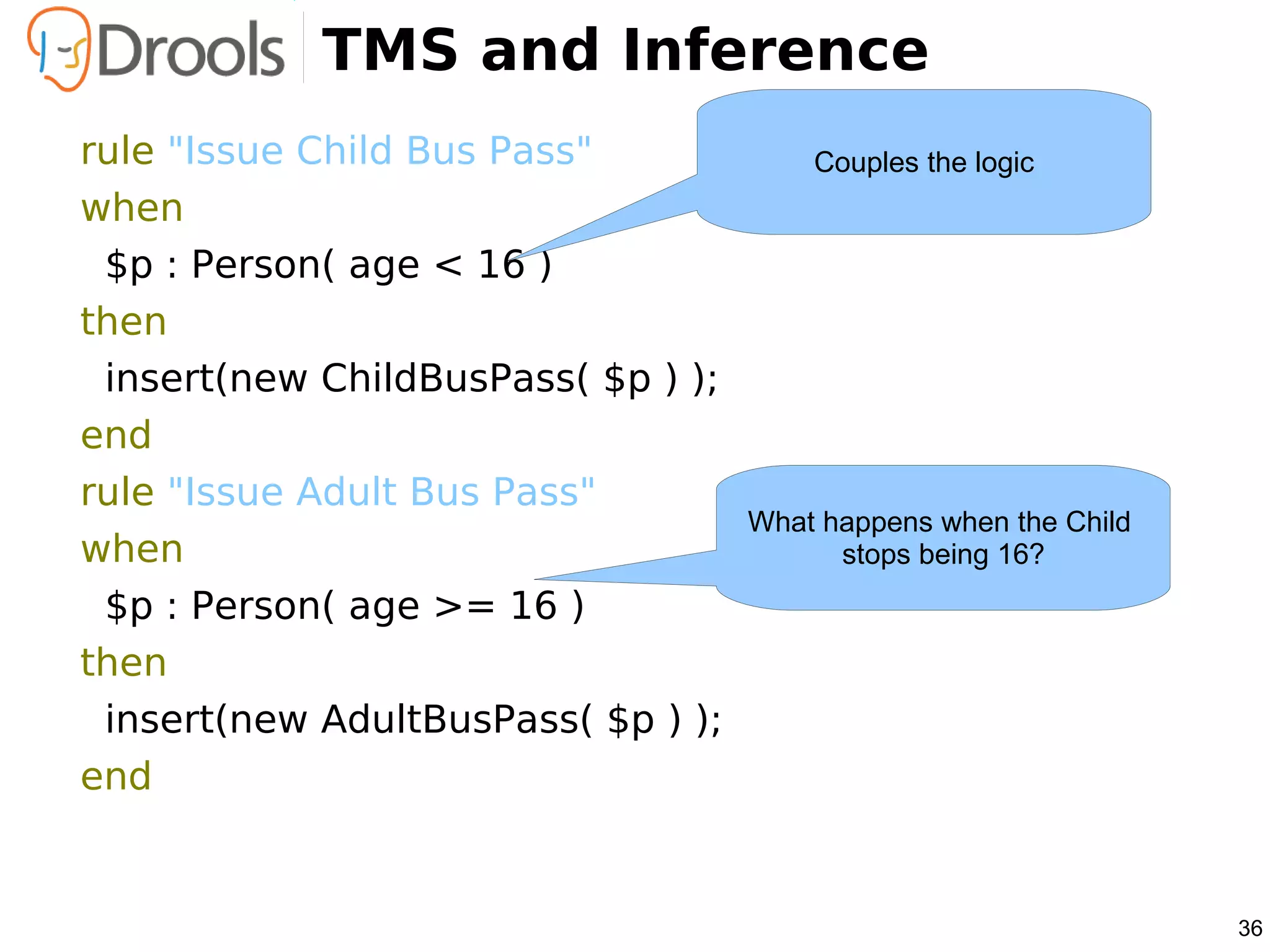
rule "Issue Child Bus Pass"             Couples the logic
when
 $p : Person( age < 16 )
then
 insert(new ChildBusPass( $p ) );
end
rule "Issue Adult Bus Pass"
                                    What happens when the Child
when                                      stops being 16?
 $p : Person( age >= 16 )
then
 insert(new AdultBusPass( $p ) );
end


                                                                  36
TMS and Inference
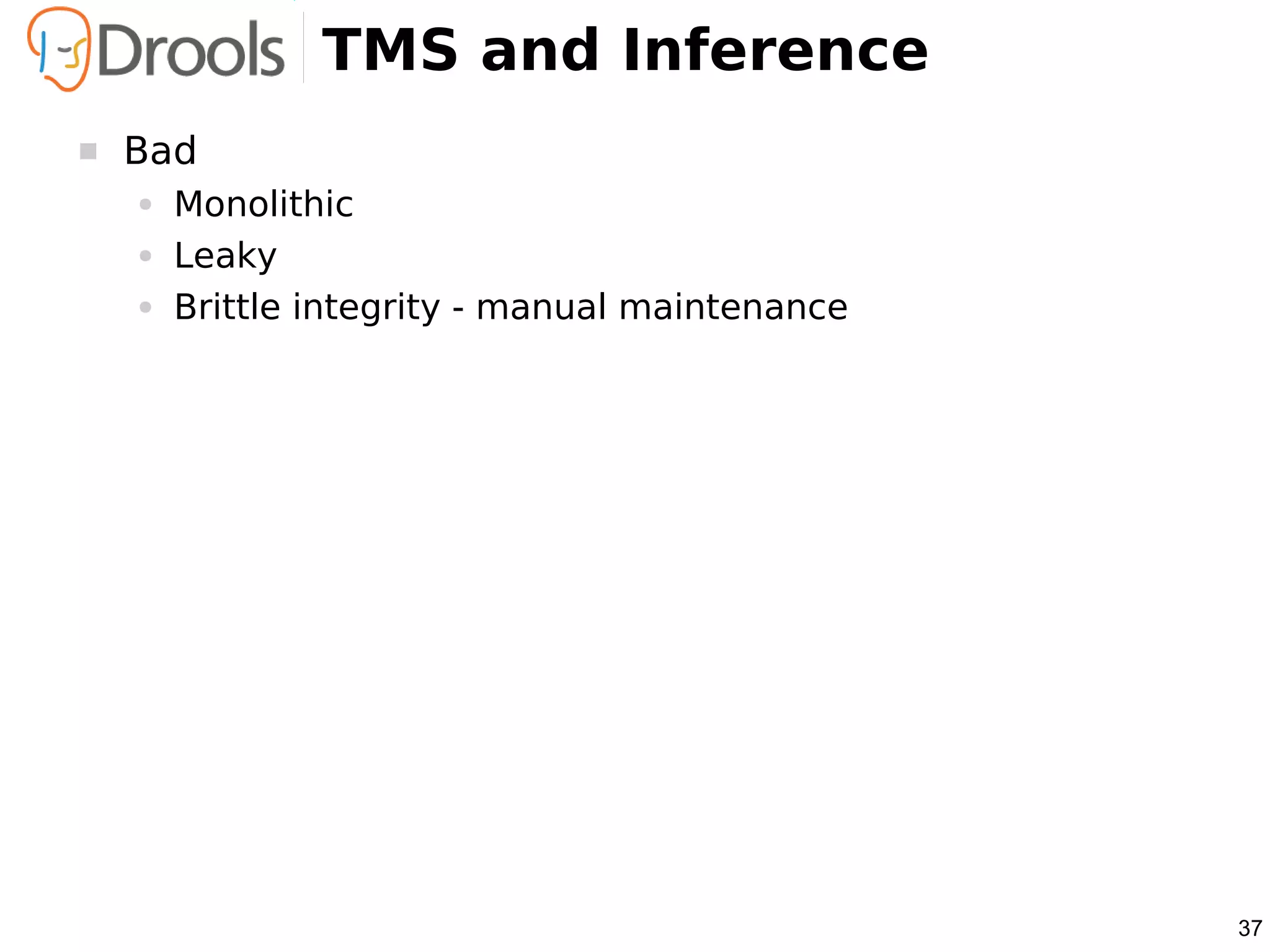
   Bad
    ●   Monolithic
    ●   Leaky
    ●   Brittle integrity - manual maintenance


                                                 37
TMS and Inference
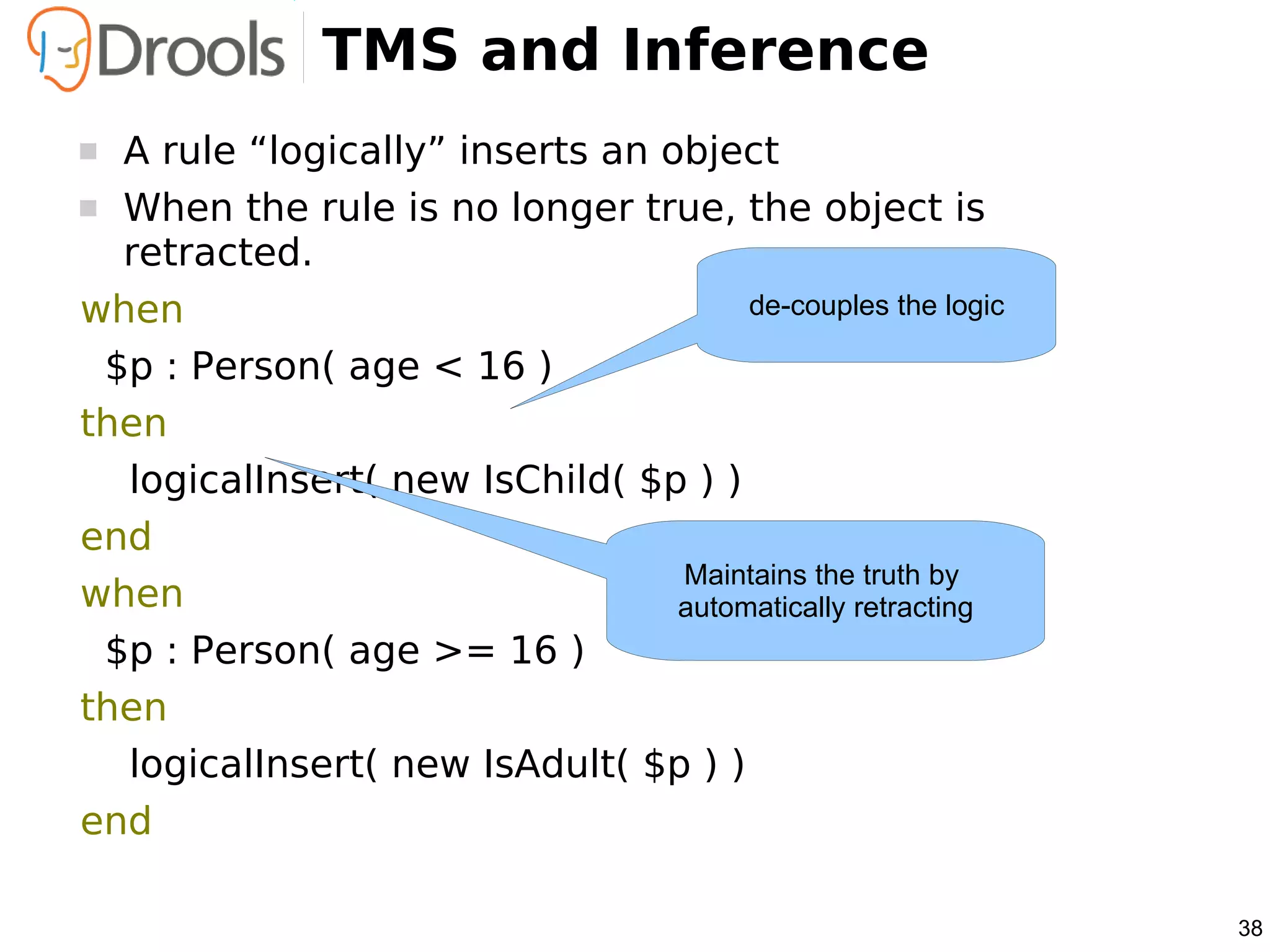
 A rule “logically” inserts an object
 When the rule is no longer true, the object is
  retracted.
when                                  de-couples the logic

 $p : Person( age < 16 )
then
  logicalInsert( new IsChild( $p ) )
end
                                 Maintains the truth by
when                             automatically retracting
 $p : Person( age >= 16 )
then
  logicalInsert( new IsAdult( $p ) )
end

                                                             38
TMS and Inference
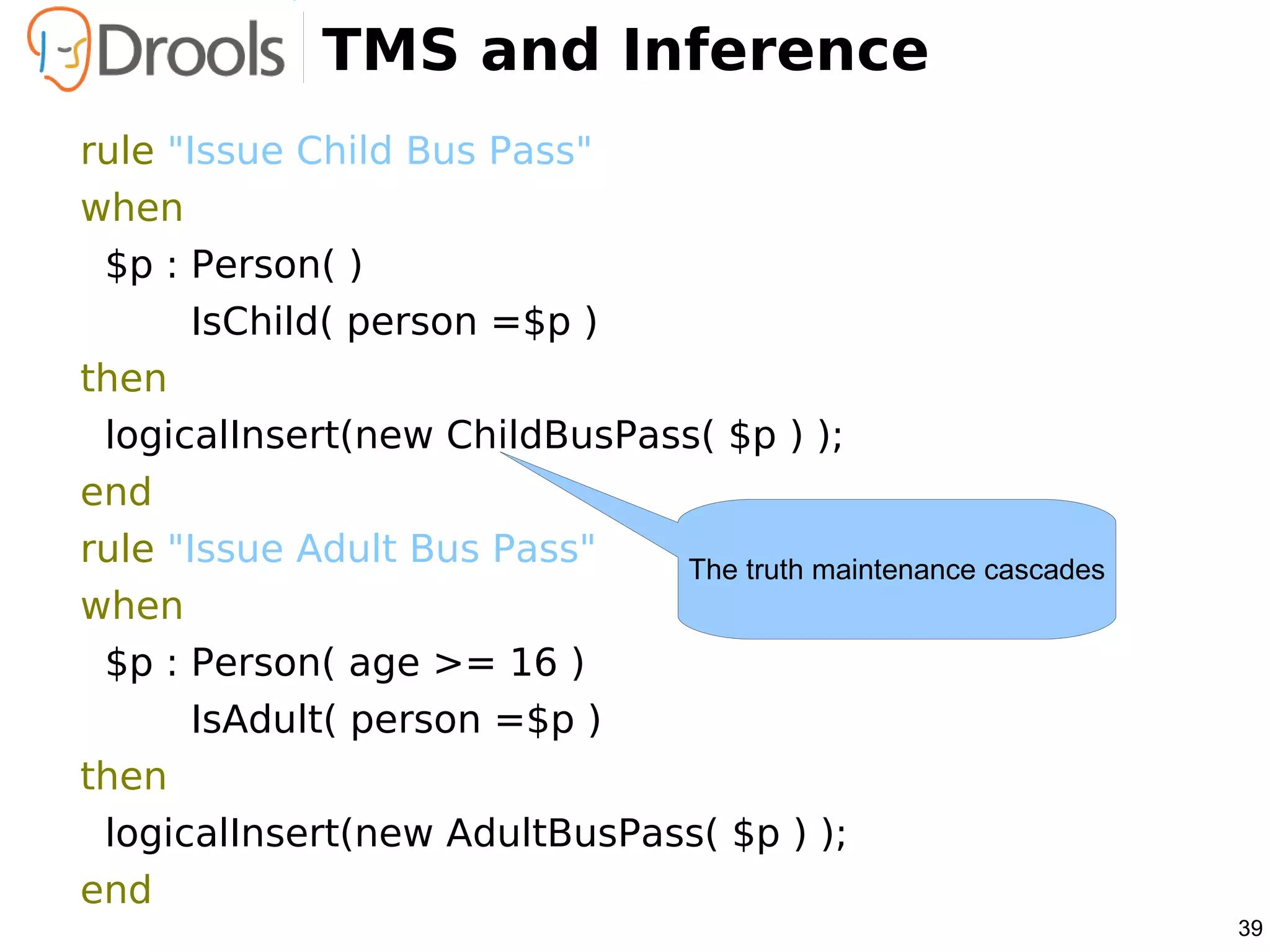
rule "Issue Child Bus Pass"
when
 $p : Person( )
       IsChild( person =$p )
then
 logicalInsert(new ChildBusPass( $p ) );
end
rule "Issue Adult Bus Pass"   The truth maintenance cascades
when
 $p : Person( age >= 16 )
       IsAdult( person =$p )
then
 logicalInsert(new AdultBusPass( $p ) );
end
                                                               39
TMS and Inference
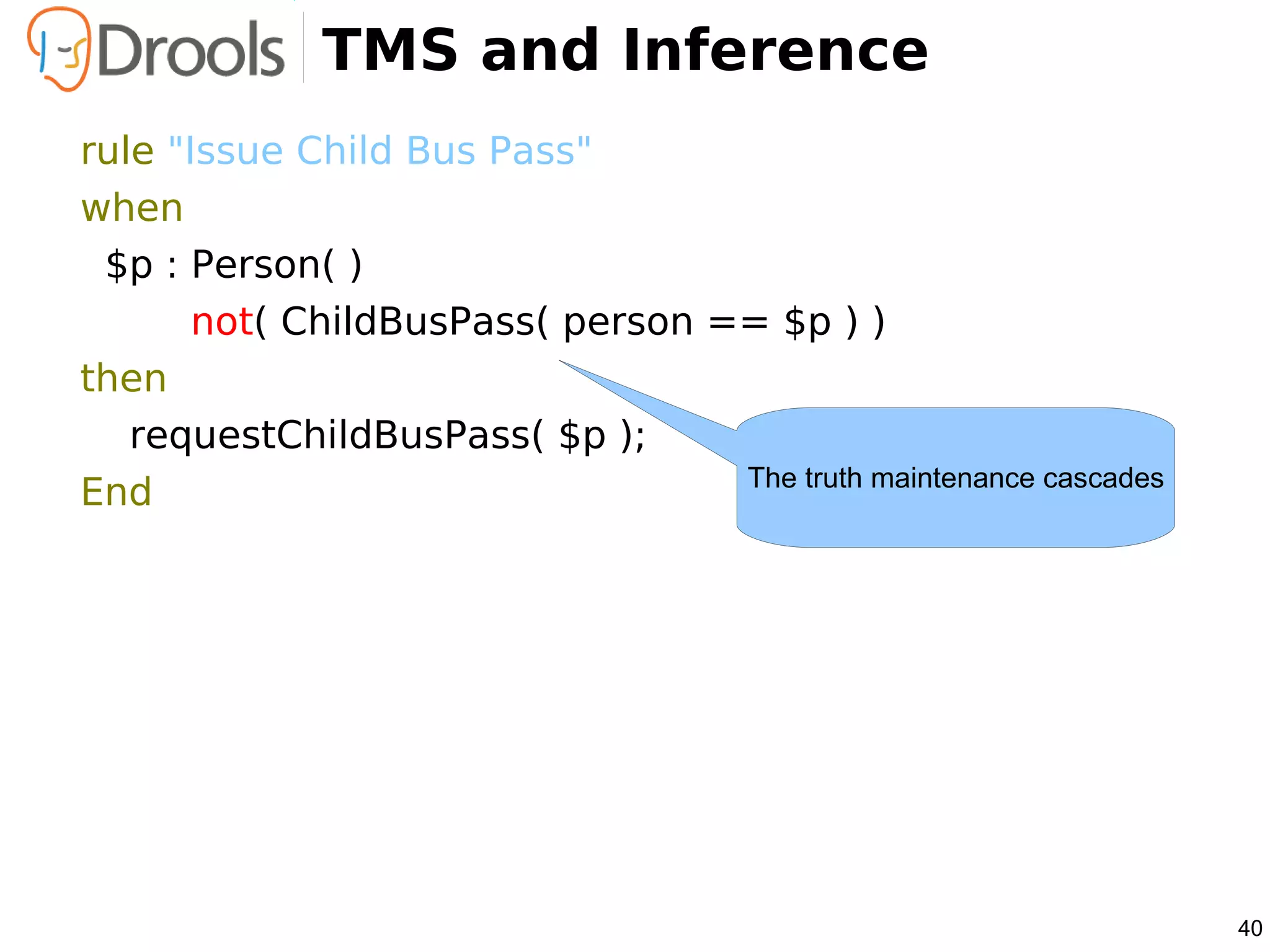
rule "Issue Child Bus Pass"
when
 $p : Person( )
       not( ChildBusPass( person == $p ) )
then
   requestChildBusPass( $p );
                                  The truth maintenance cascades
End


                                                                   40
TMS and Inference
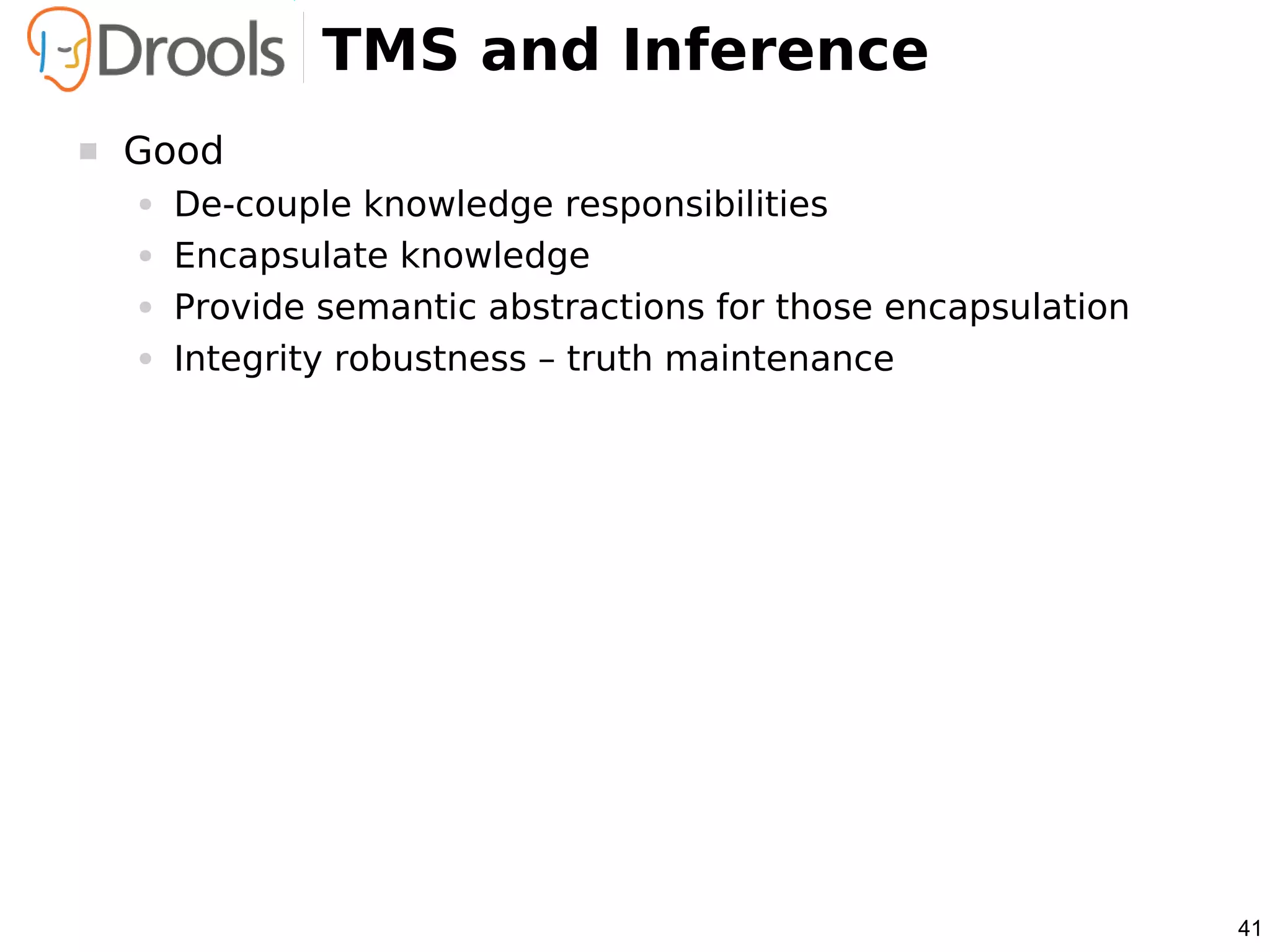
   Good
    ●   De-couple knowledge responsibilities
    ●   Encapsulate knowledge
    ●   Provide semantic abstractions for those encapsulation
    ●   Integrity robustness – truth maintenance


                                                                41
Tooling
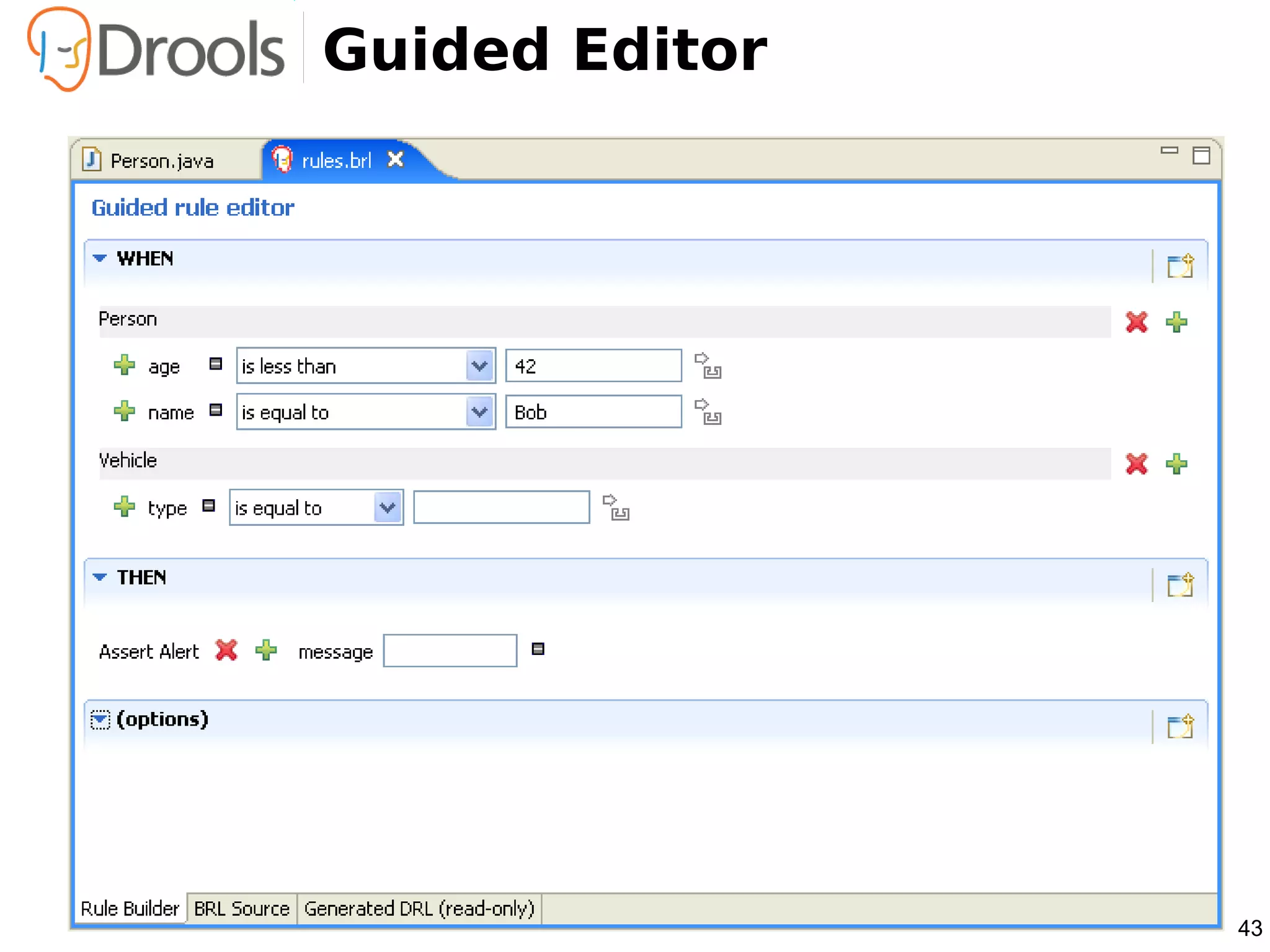
Guided Editor


                43
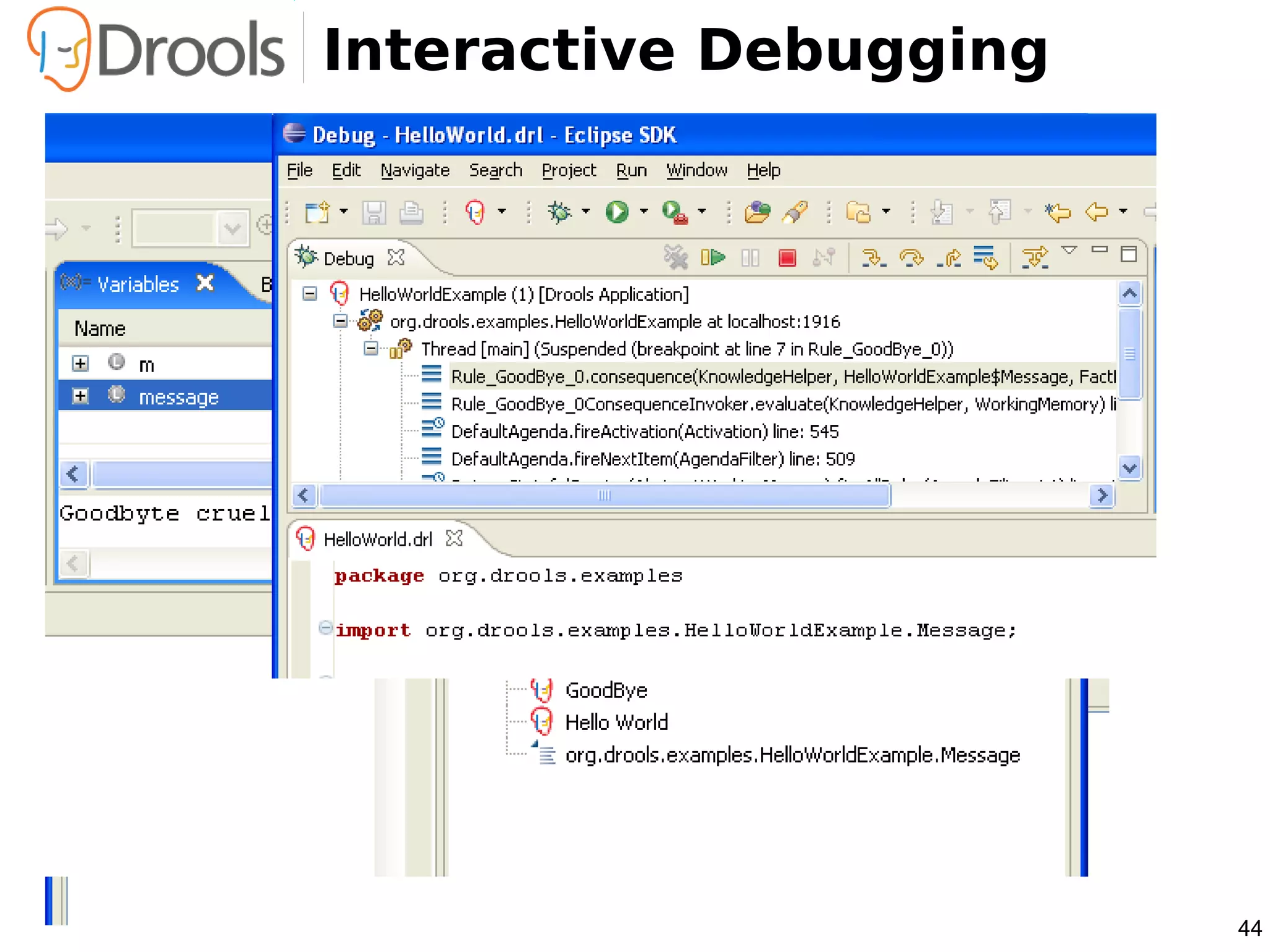
Interactive Debugging


                        44
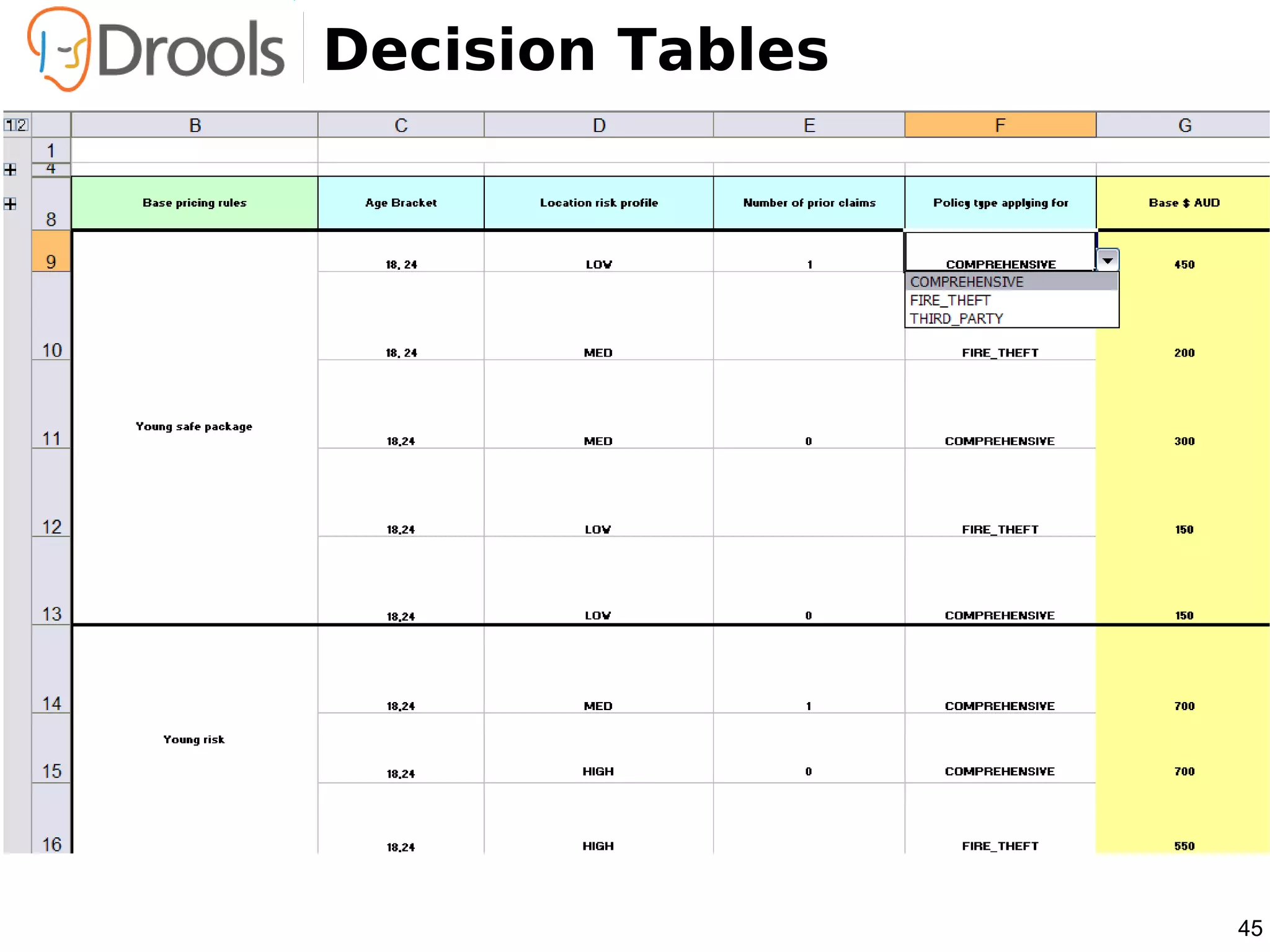
Decision Tables


                  45
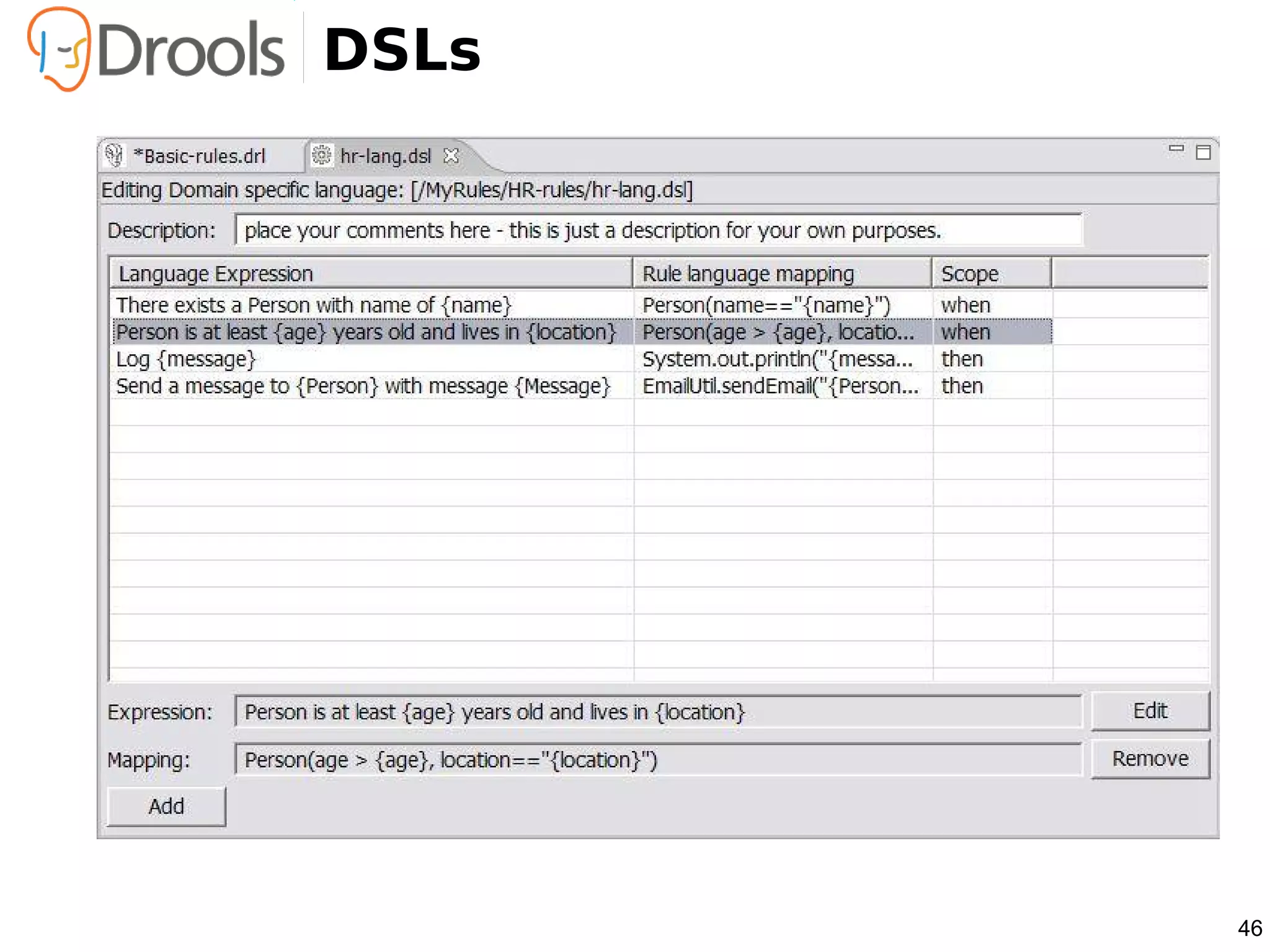
DSLs


       46
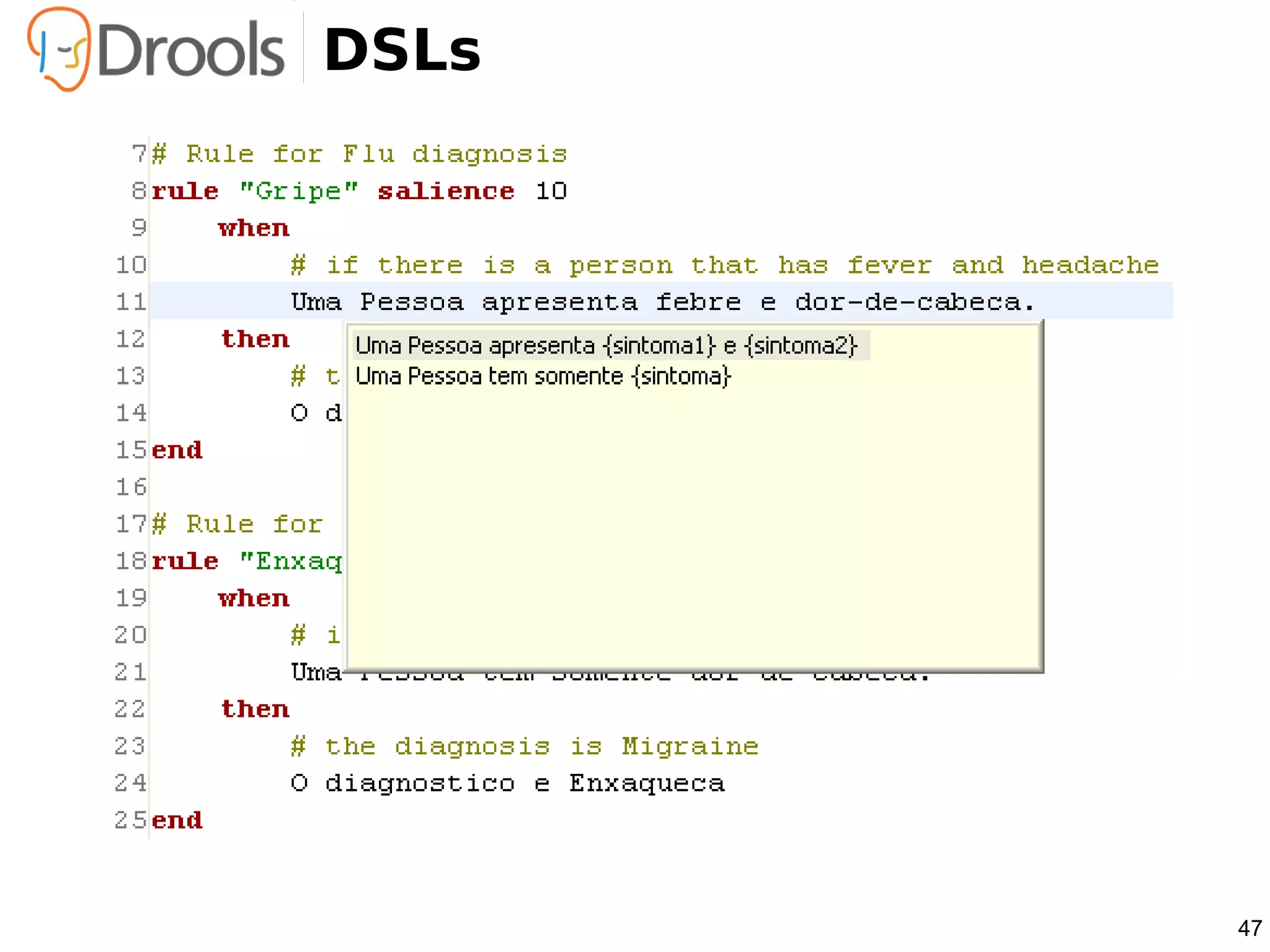
DSLs


       47
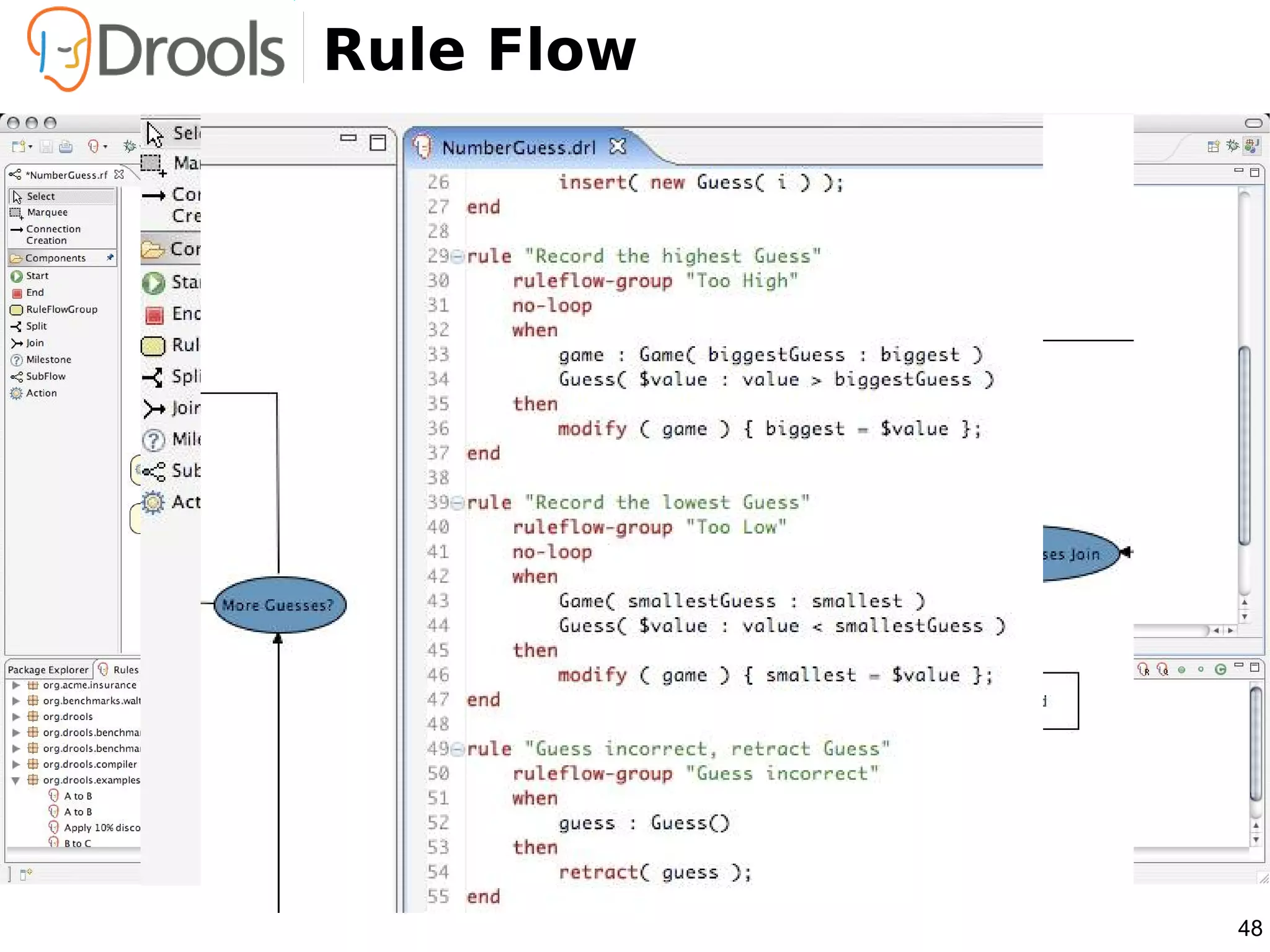
Rule Flow


            48
Drools Fusion
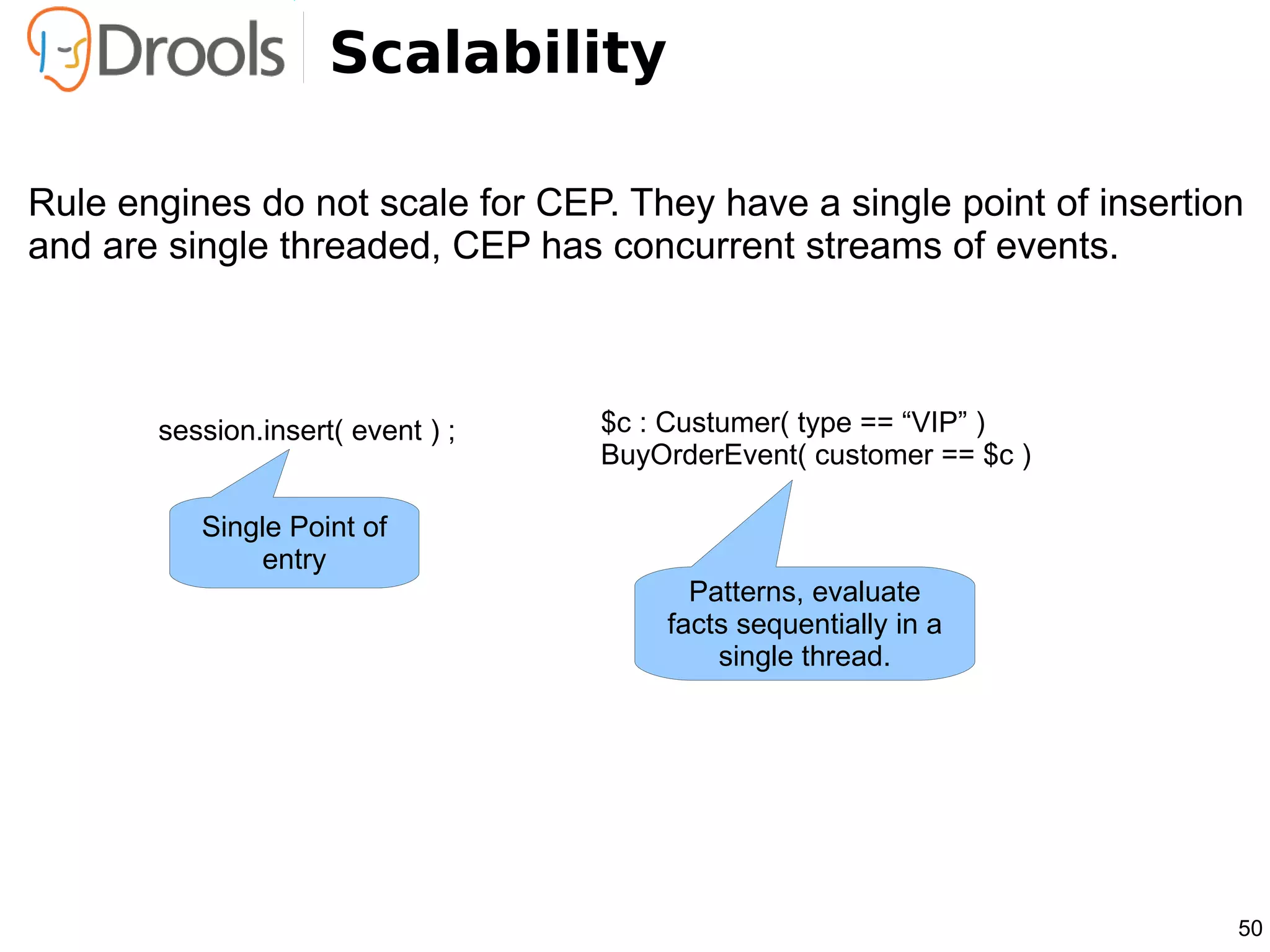
Scalability

Rule engines do not scale for CEP. They have a single point of insertion
and are single threaded, CEP has concurrent streams of events.


       session.insert( event ) ;   $c : Custumer( type == “VIP” )
                                   BuyOrderEvent( customer == $c )

          Single Point of
              entry
                                         Patterns, evaluate
                                       facts sequentially in a
                                           single thread.


                                                                       50
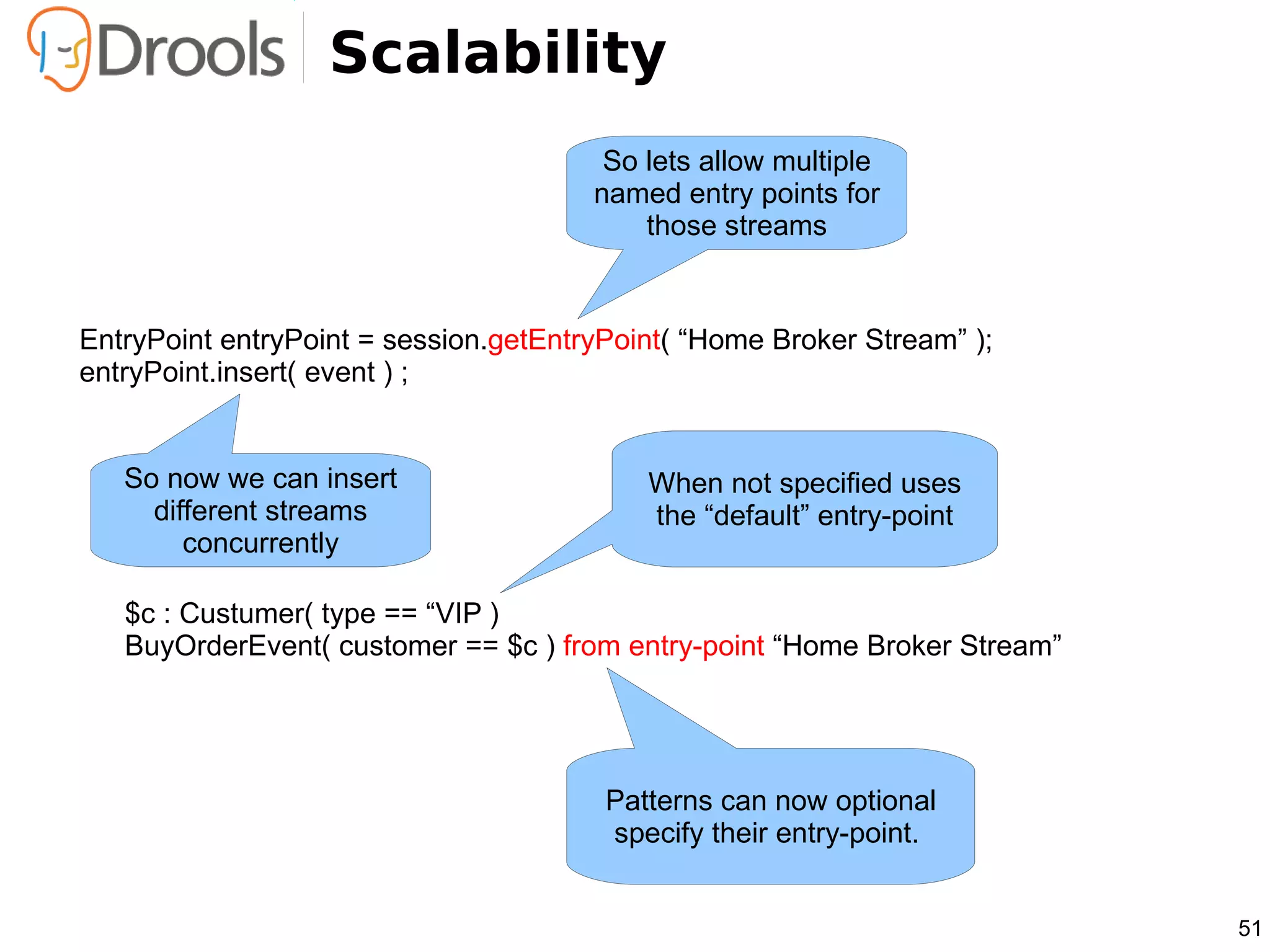
Scalability
                                        So lets allow multiple
                                       named entry points for
                                           those streams


EntryPoint entryPoint = session.getEntryPoint( “Home Broker Stream” );
entryPoint.insert( event ) ;


   So now we can insert                    When not specified uses
     different streams                     the “default” entry-point
        concurrently

   $c : Custumer( type == “VIP )
   BuyOrderEvent( customer == $c ) from entry-point “Home Broker Stream”


                                        Patterns can now optional
                                        specify their entry-point.


                                                                           51
Automatic Life-Cycle
                Management
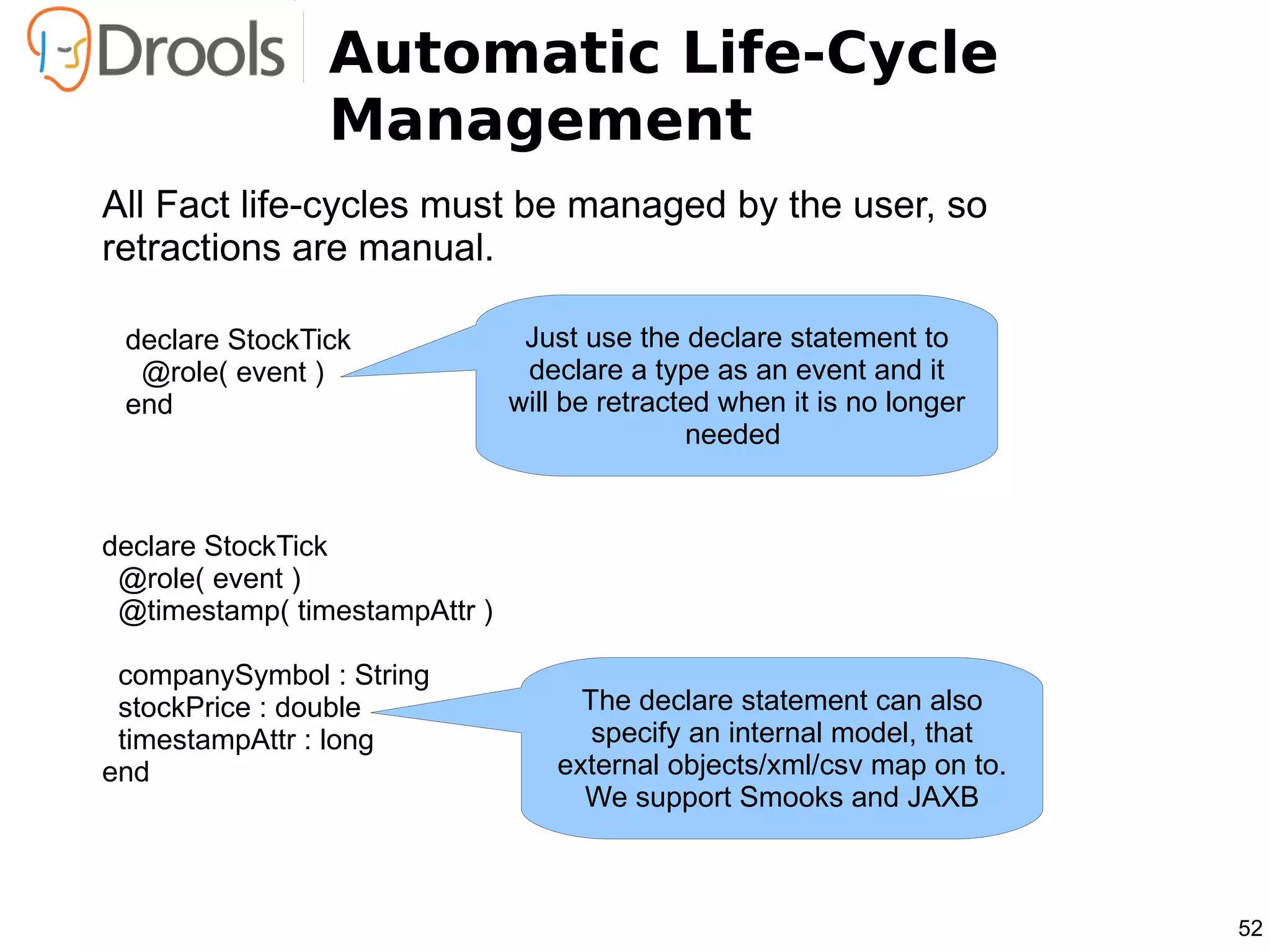
All Fact life-cycles must be managed by the user, so
retractions are manual.

 declare StockTick              Just use the declare statement to
  @role( event )                declare a type as an event and it
 end                           will be retracted when it is no longer
                                              needed


declare StockTick
 @role( event )
 @timestamp( timestampAttr )

 companySymbol : String
 stockPrice : double                 The declare statement can also
 timestampAttr : long                 specify an internal model, that
end                                external objects/xml/csv map on to.
                                     We support Smooks and JAXB


                                                                         52
Operators
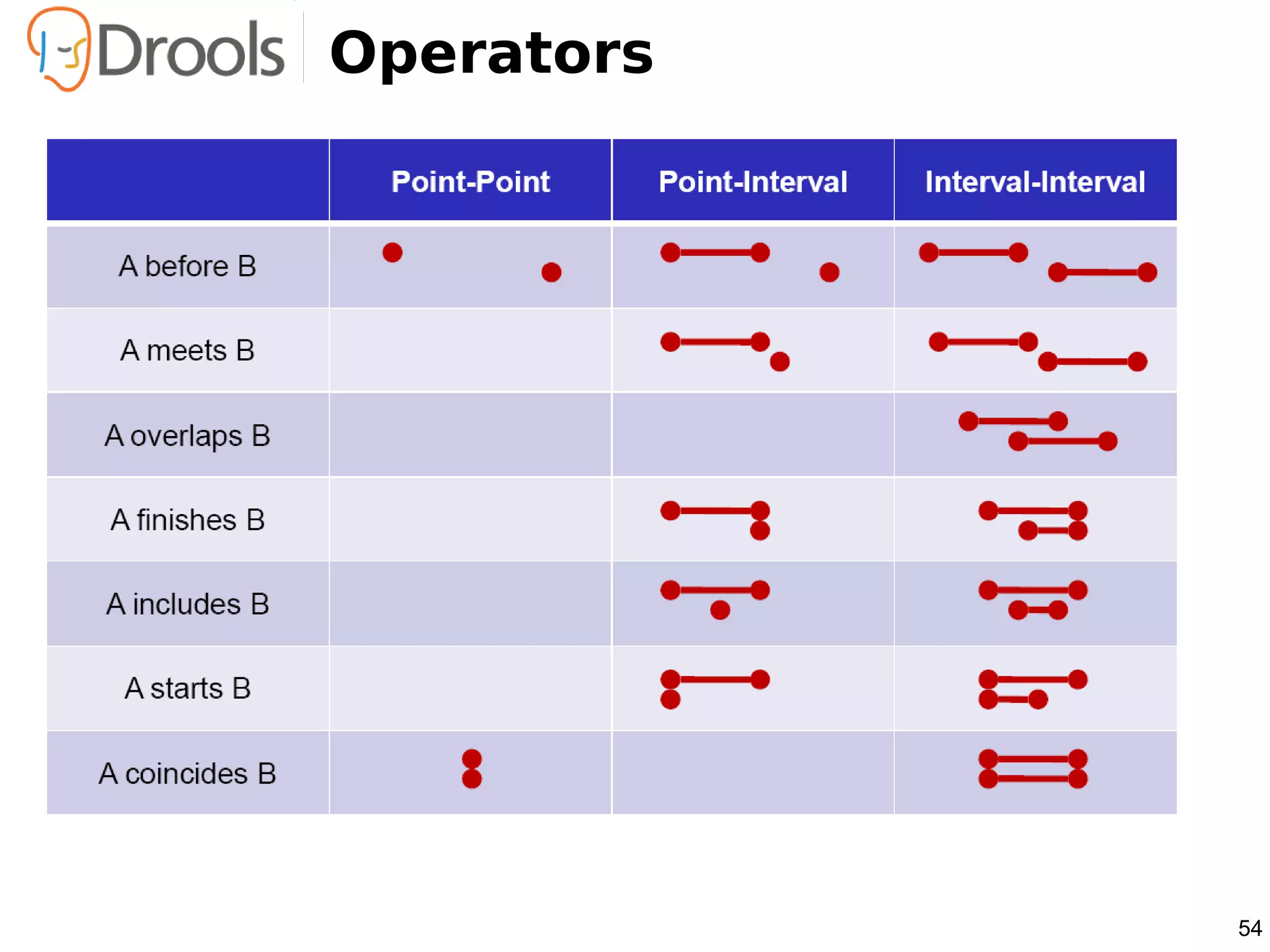
Rule engines do not have rich enough set of temporal comparison
operators                                     BackAckEvent must occur
                                                                between 1s and 10s 'after'
  $c : Custumer( type == “VIP )                                      BuyOrderEvent
  $oe : BuyOrderEvent( customer == $c )
             from entry-point “Home Broker Stream”
        BuyAckEvent( relatedEvent == $oe.id, this after[1s, 10s] $oe )
             from entry-point “Stock Trader Stream”


 The Full set of Operators are supported
          ●   coincides         ●   overlaps             ●   starts
          ●   before            ●   overlappedby         ●   startedby
          ●   after             ●   during               ●   finishes
          ●   meets             ●   includes             ●   finishedby
          ●   metby


                                                                                             53
Operators


            54
Operators

$c : Custumer( type == “VIP )
$oe : BuyOrderEvent( customer == $c )
            from entry-point “Home Broker Stream”
      not BuyAckEvent( relatedEvent == $oe.id, this after[1s, 10s] $oe )
            from entry-point “Stock Trader Stream”


             Existing Drools 'not'
          Conditional Elements can
           be used to detect non-
            occurrence of events


                                                                           55
Sliding time windows
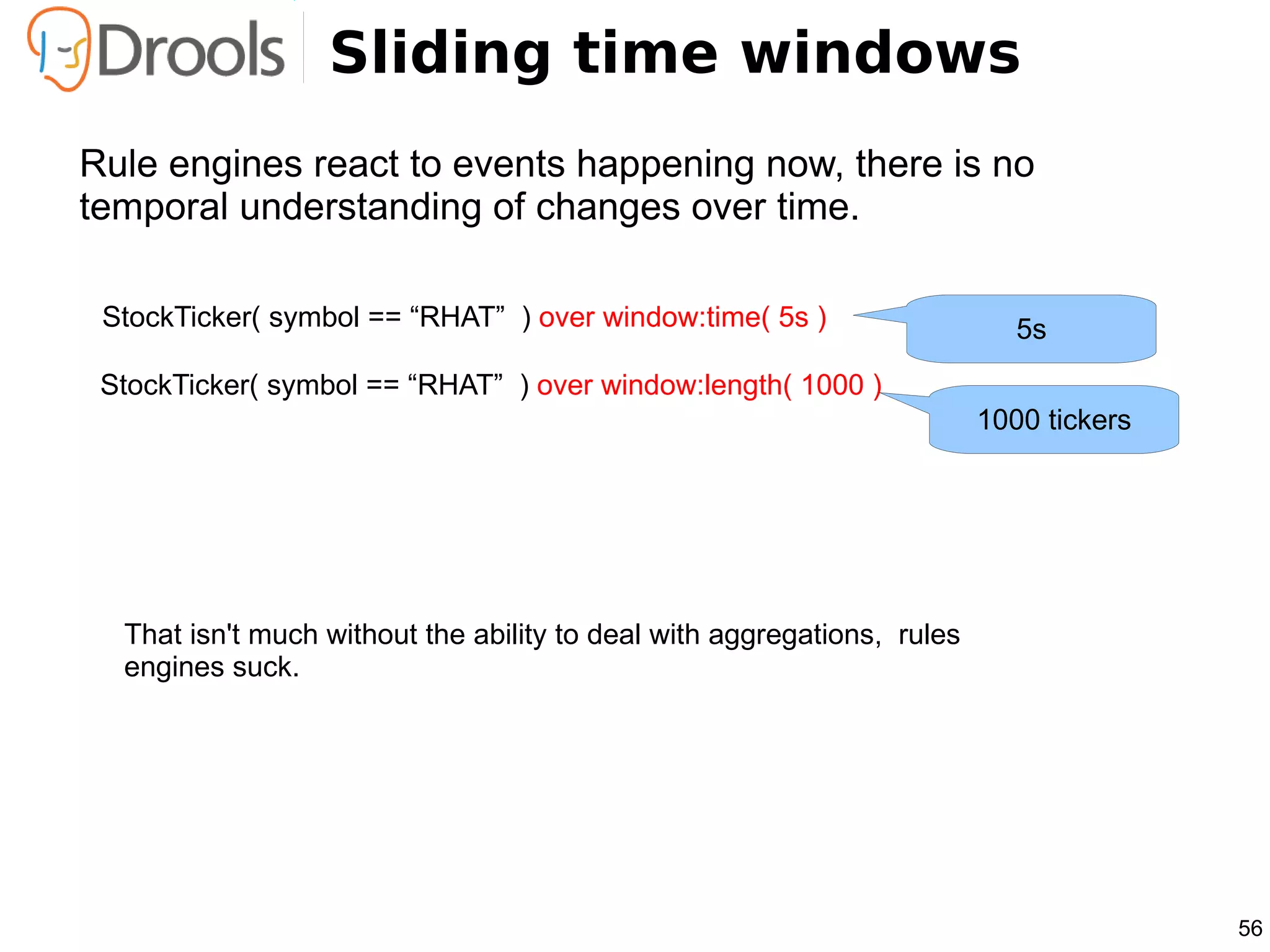
Rule engines react to events happening now, there is no
temporal understanding of changes over time.

 StockTicker( symbol == “RHAT” ) over window:time( 5s )                     5s
 StockTicker( symbol == “RHAT” ) over window:length( 1000 )
                                                                         1000 tickers


  That isn't much without the ability to deal with aggregations, rules
  engines suck.


                                                                                        56
Aggregations
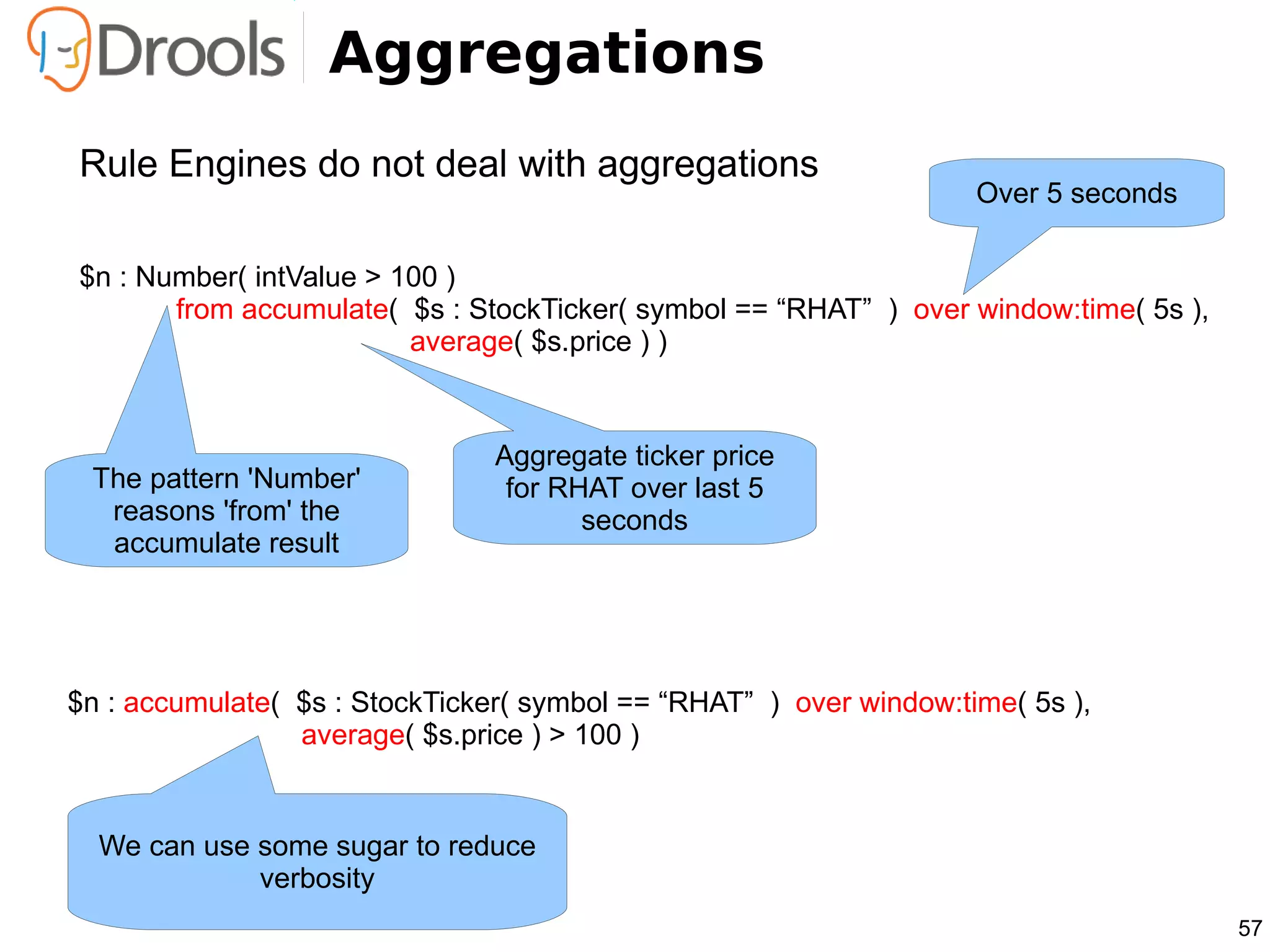
Rule Engines do not deal with aggregations
                                                                    Over 5 seconds

$n : Number( intValue > 100 )
       from accumulate( $s : StockTicker( symbol == “RHAT” ) over window:time( 5s ),
                         average( $s.price ) )


                                Aggregate ticker price
 The pattern 'Number'            for RHAT over last 5
  reasons 'from' the                   seconds
  accumulate result


$n : accumulate( $s : StockTicker( symbol == “RHAT” ) over window:time( 5s ),
                 average( $s.price ) > 100 )


  We can use some sugar to reduce
             verbosity
                                                                                       57
Drools Flow
Drools Flow

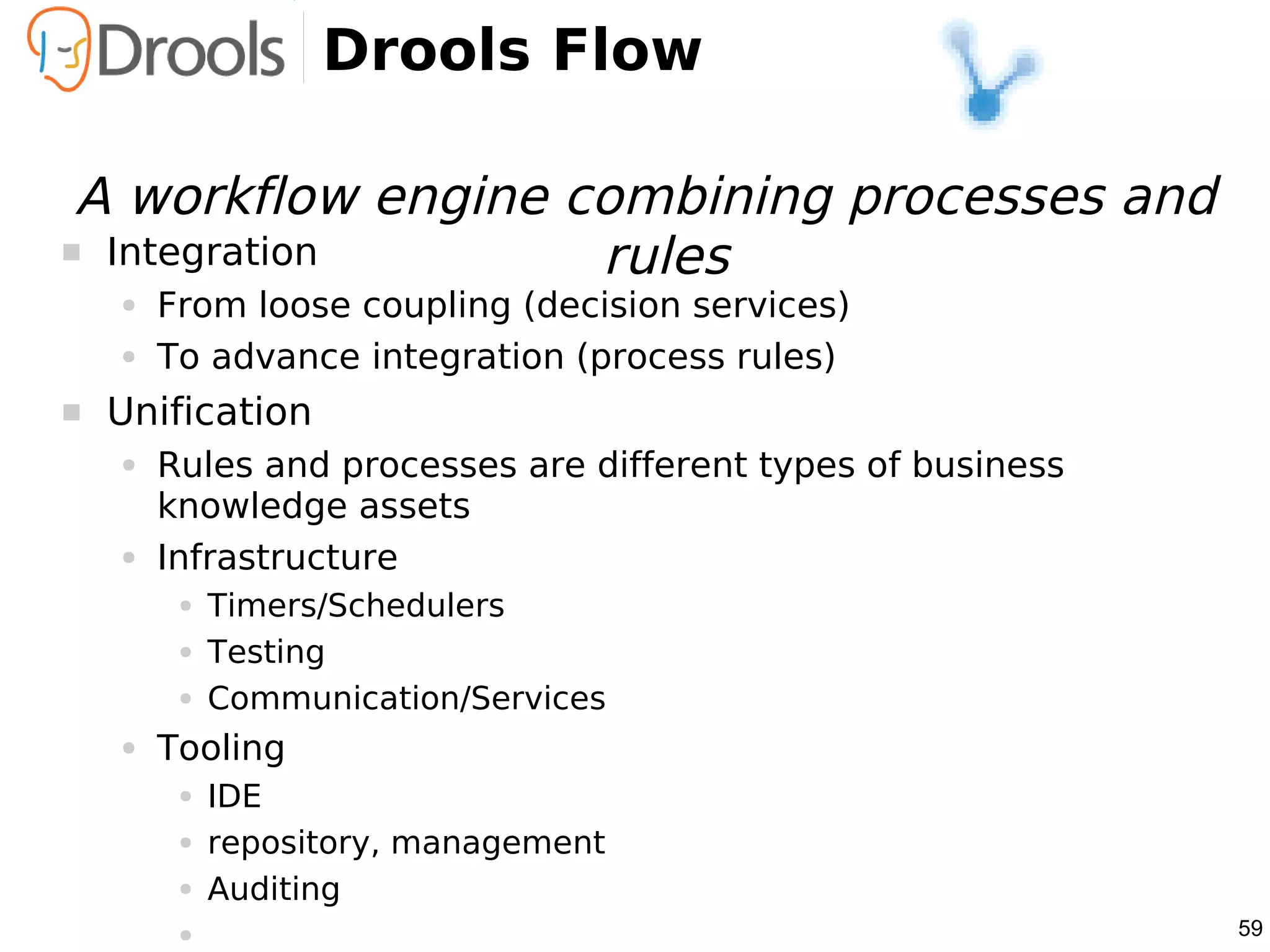
 A workflow engine combining processes and
 Integration       rules
    ●   From loose coupling (decision services)
    ●   To advance integration (process rules)
   Unification
    ●   Rules and processes are different types of business
        knowledge assets
    ●   Infrastructure
         ●   Timers/Schedulers
         ●   Testing
         ●   Communication/Services
    ●   Tooling
         ●   IDE
         ●   repository, management
         ●   Auditing
         ●                                                    59
Truth Maintenance
Inference
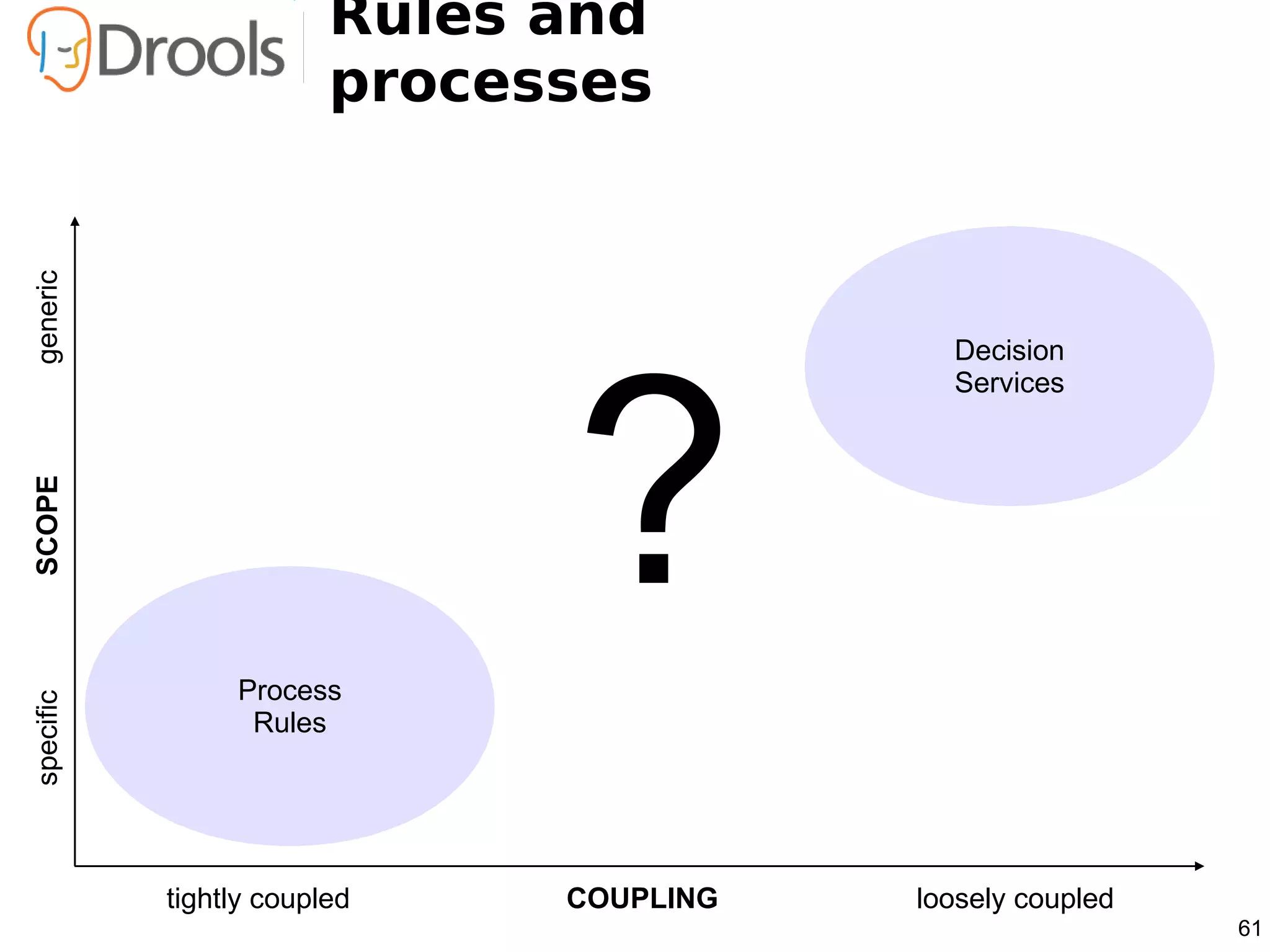
Rules and
                        processes
generic


                              ?
                                           Decision
                                           Services
SCOPE


                Process
specific


                 Rules


           tightly coupled    COUPLING   loosely coupled
                                                           61
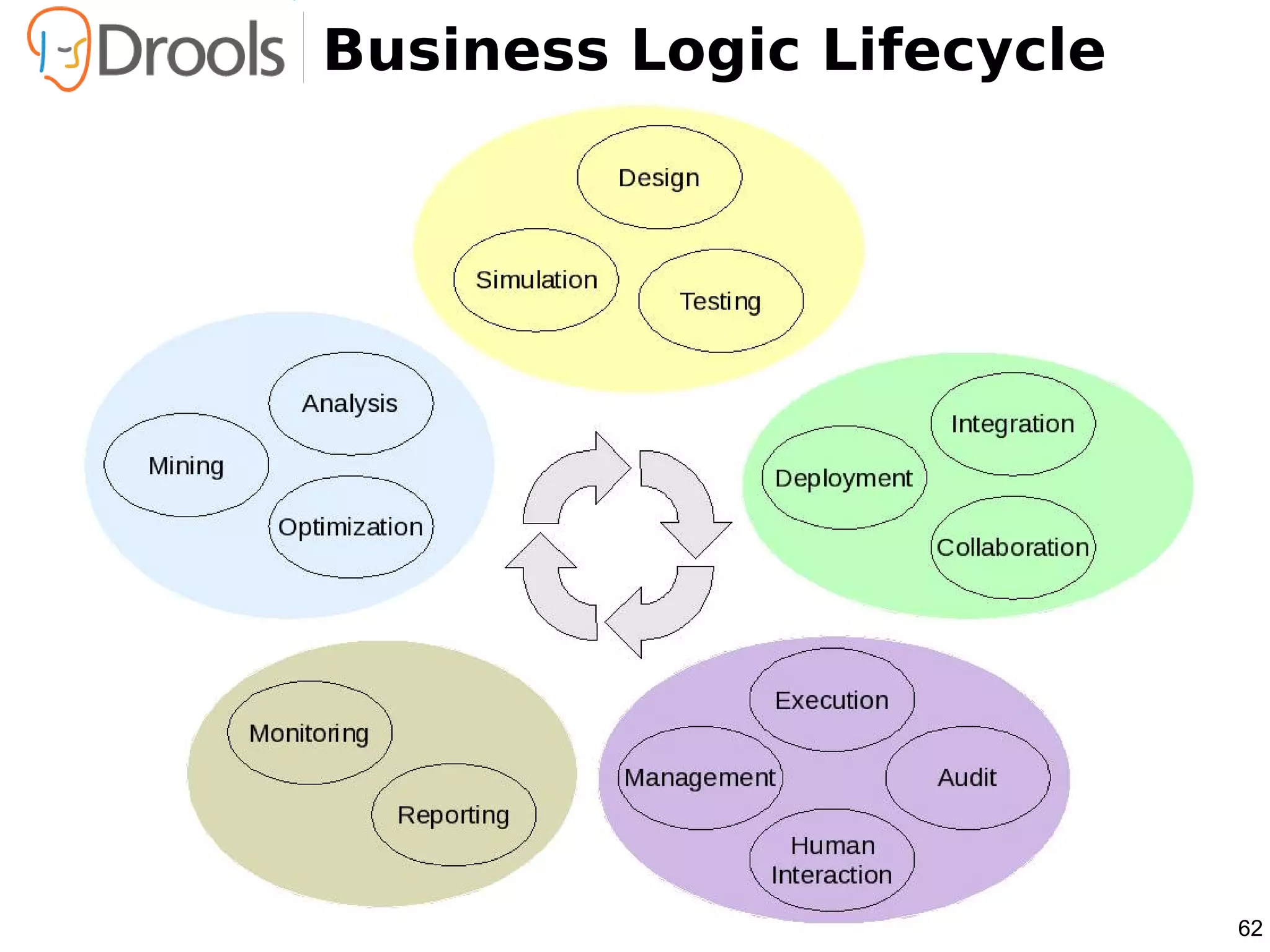
Business Logic Lifecycle


                           62
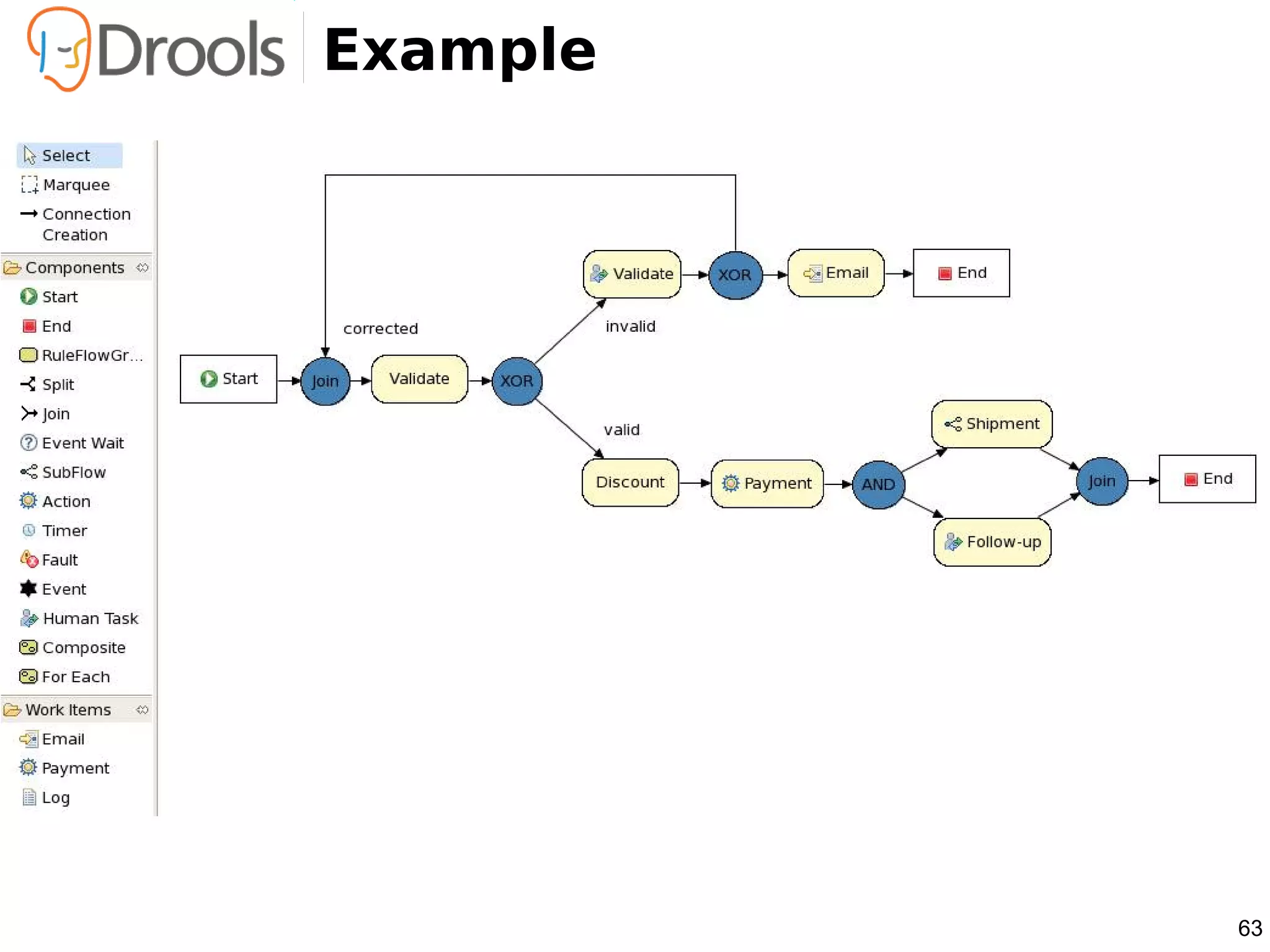
Example


          63
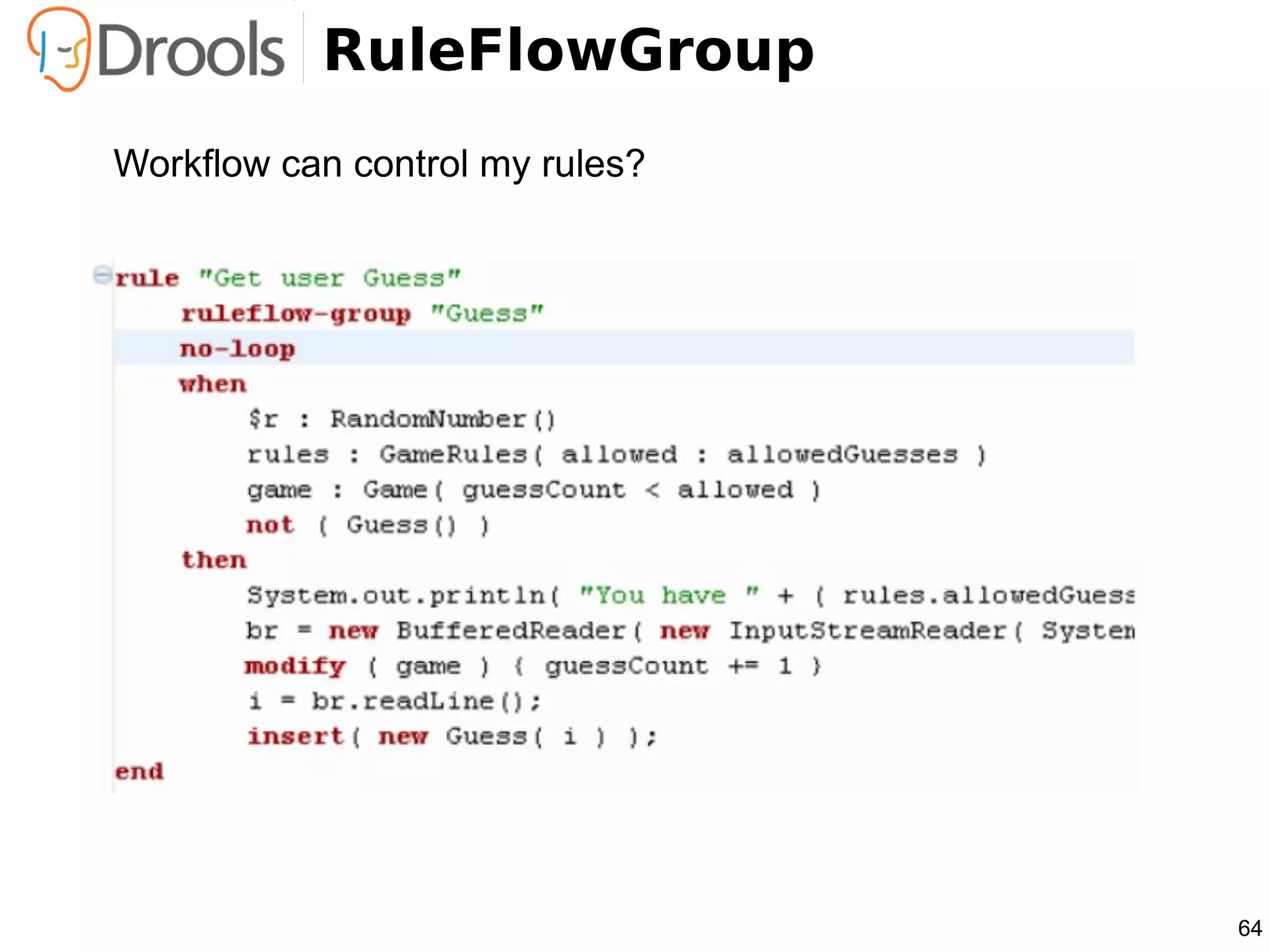
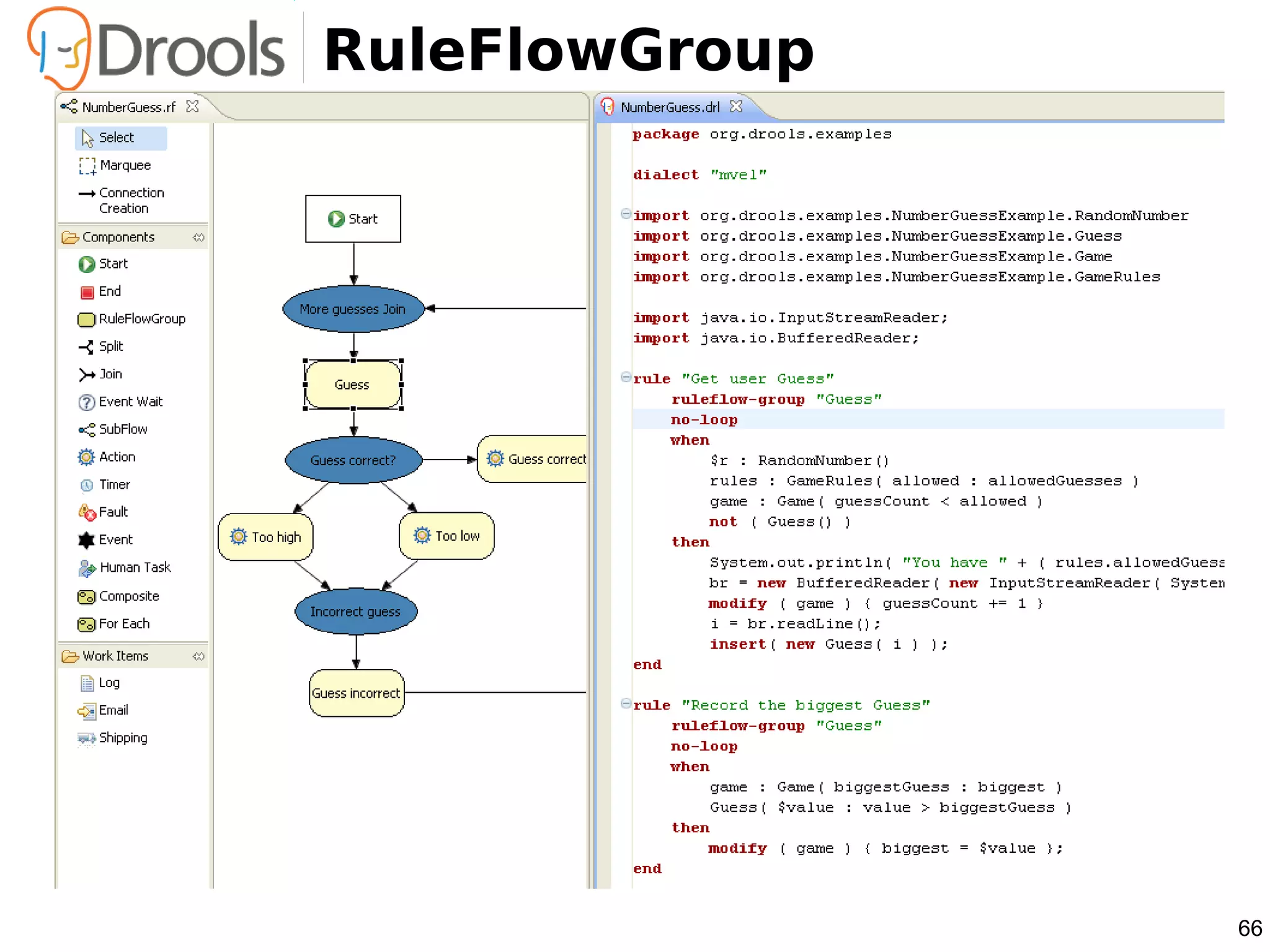
RuleFlowGroup
Workflow can control my rules?


                                 64
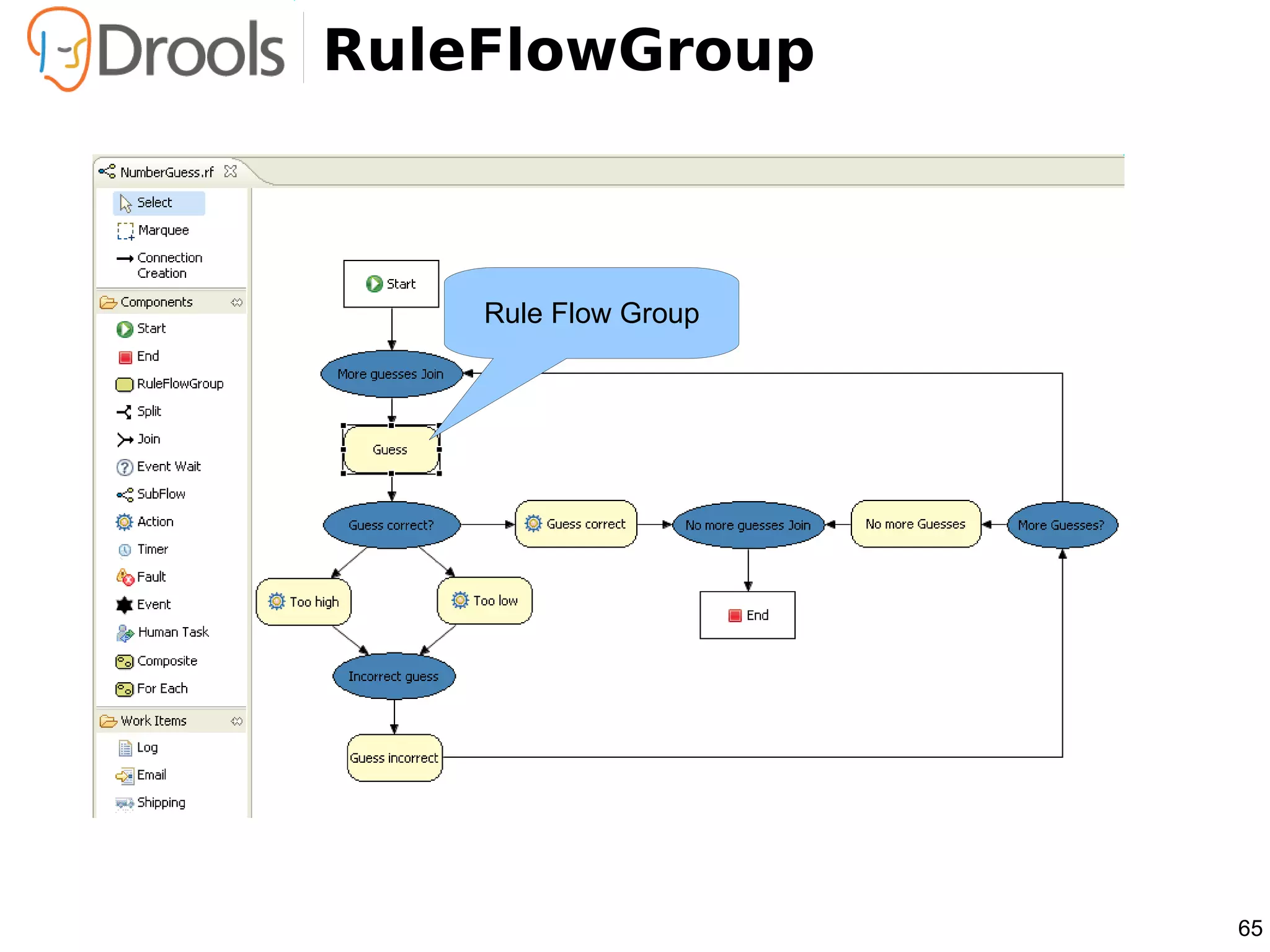
RuleFlowGroup


    Rule Flow Group


                      65
RuleFlowGroup


                66
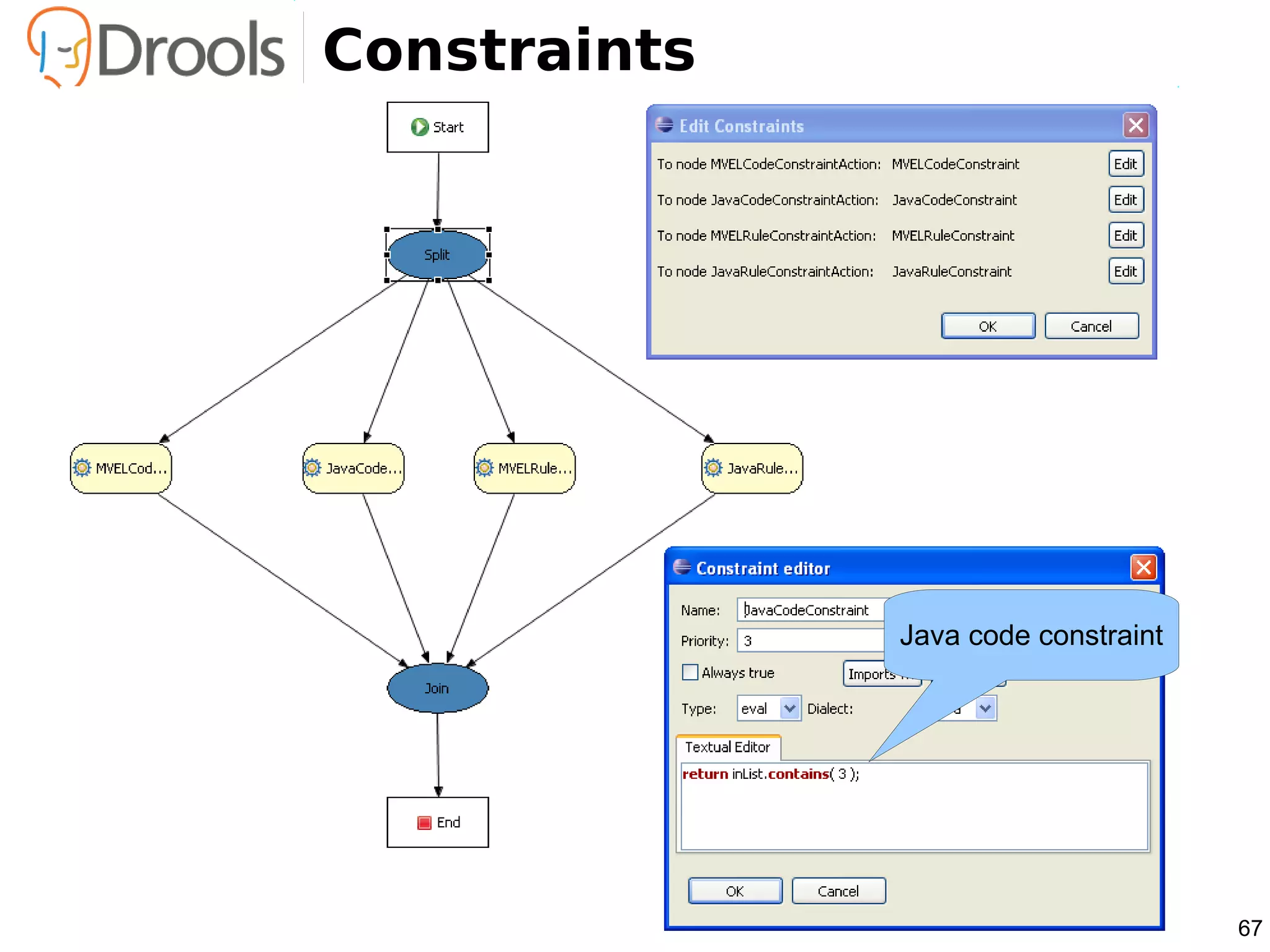
Constraints


              Java code constraint


                                     67
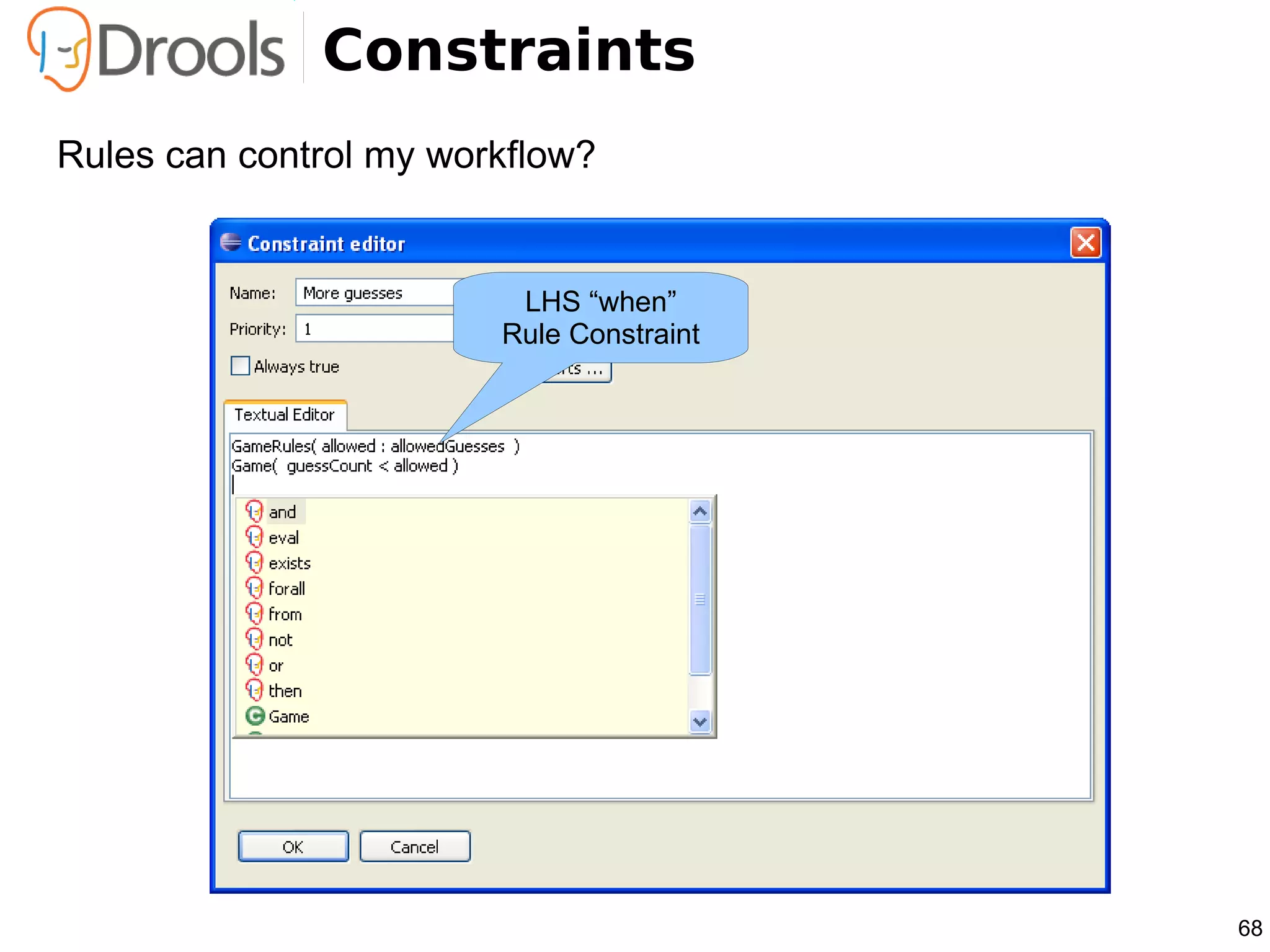
Constraints
Rules can control my workflow?


                         LHS “when”
                        Rule Constraint


                                          68
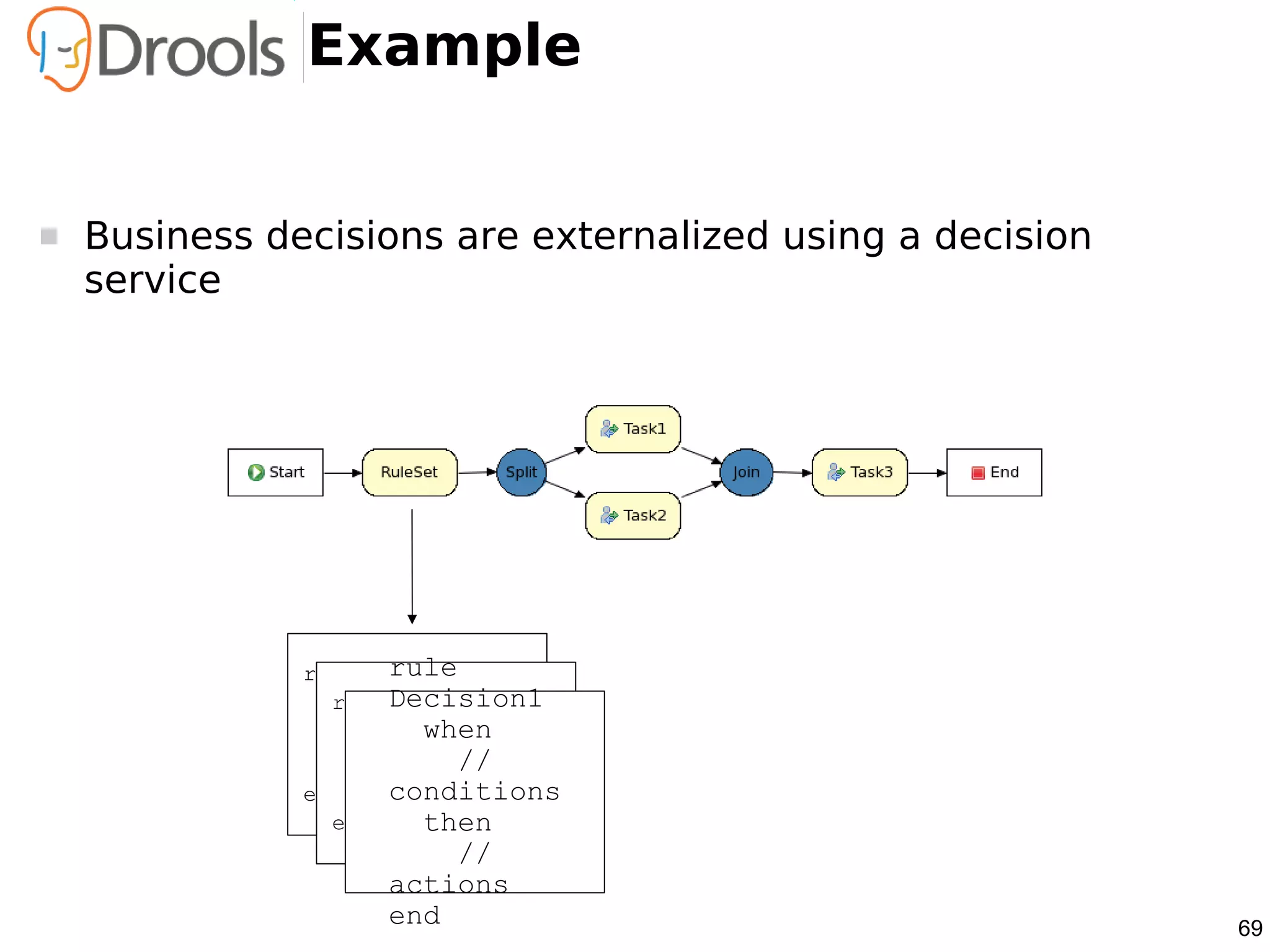
Example


   Business decisions are externalized using a decision
    service


                      rule
               rule Decision1
                 when Decision1
                 rule Decision1
                   // conditions
                   when when
                 then // conditions
                           //
                   // actions
                   then
               end    conditions
                      // actions
                 end     then
                         //
                     actions
                     end                                   69
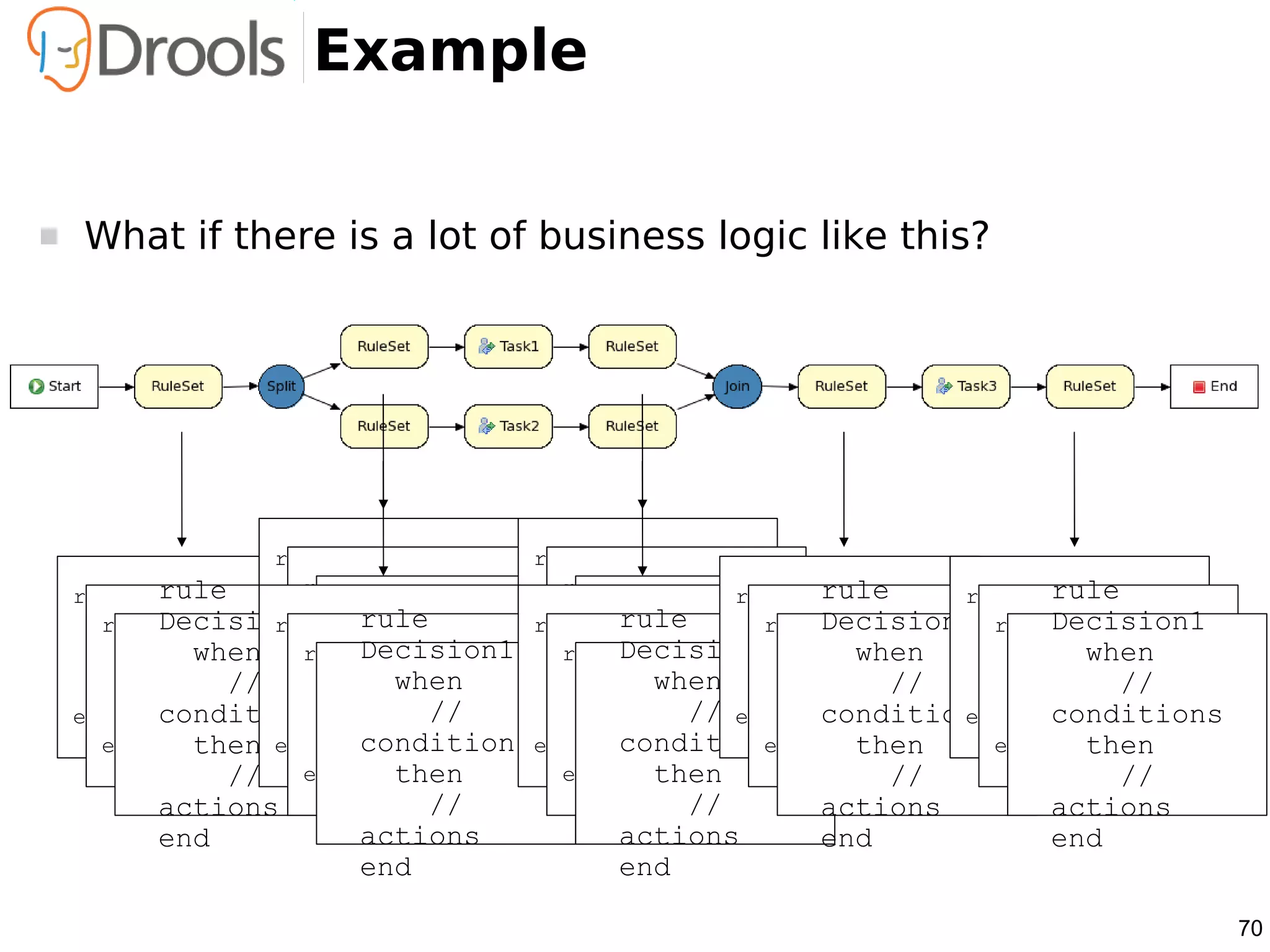
Example


   What if there is a lot of business logic like this?


                    rule Decision1       rule Decision1
           rule       when Decision1
                      rule                 when Decision1
                                           rule                  rule             rule
    rule Decision1      // conditions        // conditionsrule Decision1    rule Decision1
                        when Decision1
      when Decision1 rule  rule              when Decision1
                                                rule
      rule Decision1 then // conditions rule rule conditions Decision1 when Decision1
                    rule Decision1            Decision1
                                           then //          when Decision1
                                                            rule              rule Decision1
        // conditionswhen when
                      rule Decision1
                                                when          // conditions     // conditions
        when when       then // conditionswhen Decision1 when when
                            Decision1
                        // actions         rule actions
                                             // Decision1
                                             then // conditions                 when when
      then // conditions// conditions end // conditionsthen // conditionsthen // conditions
                // end when when
        // actions
        then
                           // actions
                           then              when when
                                                // actions
                                                then
                      then // conditions then // conditions// actions
                                                              then
                                                                      //                //
                                                                                // actions
                                                                                then
    end               end
           conditions// actions  //
                              // actions   end        //
                                                   // actions    conditions       conditions
           // actions   then                 // actions end
                                             then                // actions end   // actions
      end     then end end actions end end actions end
                           conditions
                           //                   conditions
                                                //                  then      end    then
                // end         then        end      then              //                //
          actions             //                  //         actions           actions
          end             actions             actions        end               end
                          end                 end

                                                                                                70
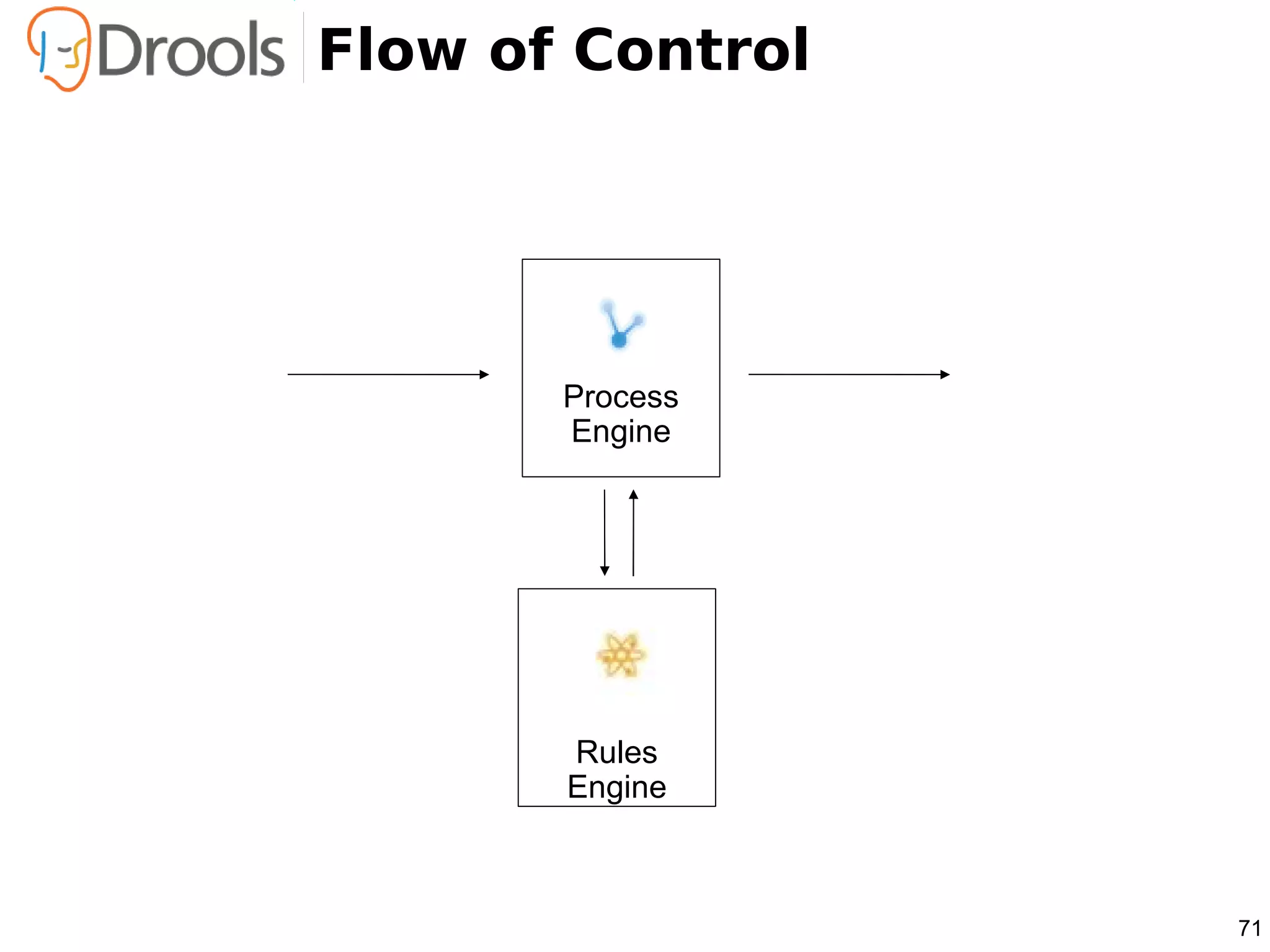
Flow of Control


       Process
       Engine


       Rules
       Engine


                  71
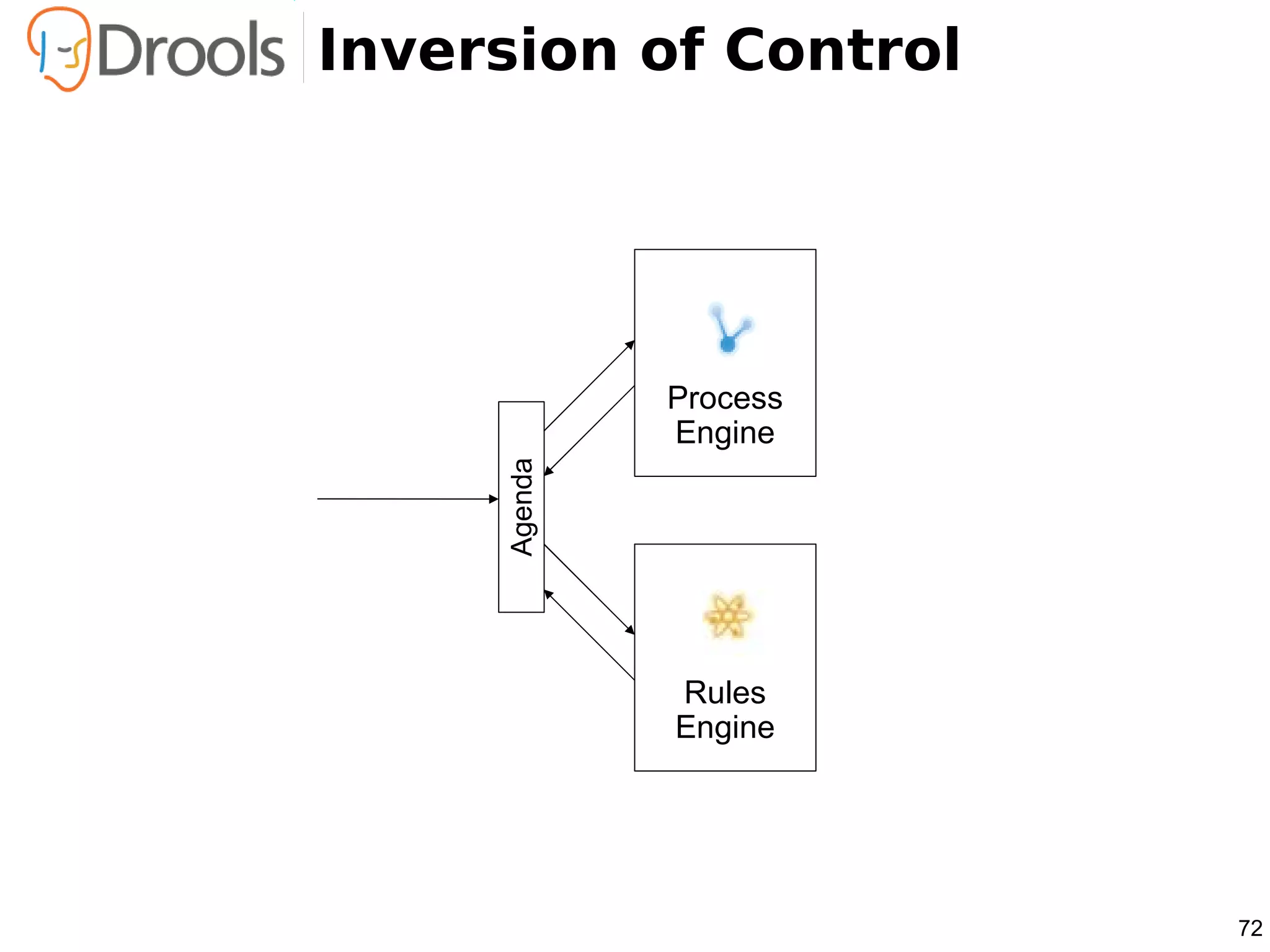
Inversion of Control


              Process
              Engine

     Agenda


              Rules
              Engine


                        72
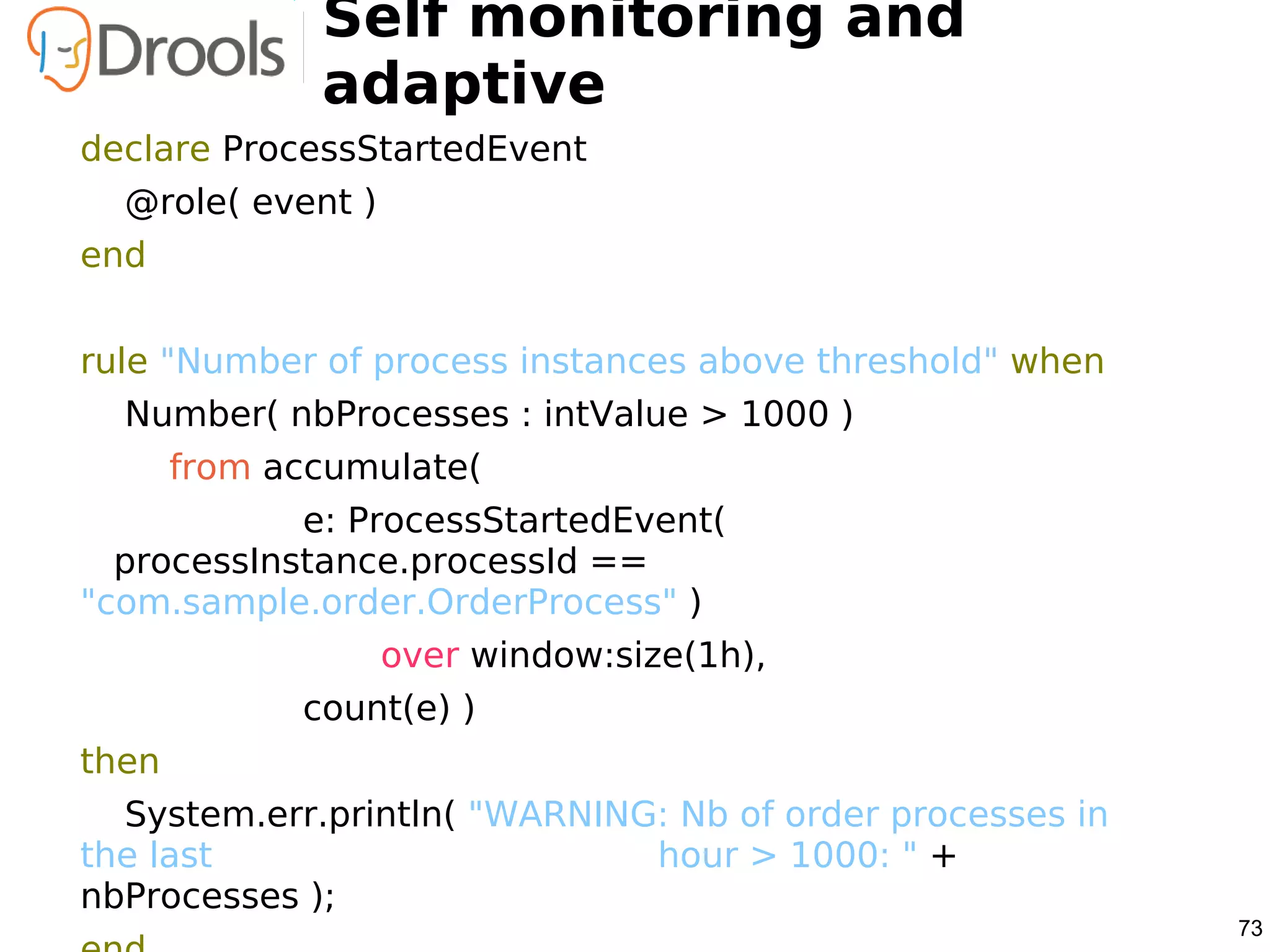
Self monitoring and
              adaptive
declare ProcessStartedEvent
  @role( event )
end


rule "Number of process instances above threshold" when
  Number( nbProcesses : intValue > 1000 )
       from accumulate(
            e: ProcessStartedEvent(
  processInstance.processId ==
"com.sample.order.OrderProcess" )
                   over window:size(1h),
             count(e) )
then
  System.err.println( "WARNING: Nb of order processes in
the last                      hour > 1000: " +
nbProcesses );
                                                           73
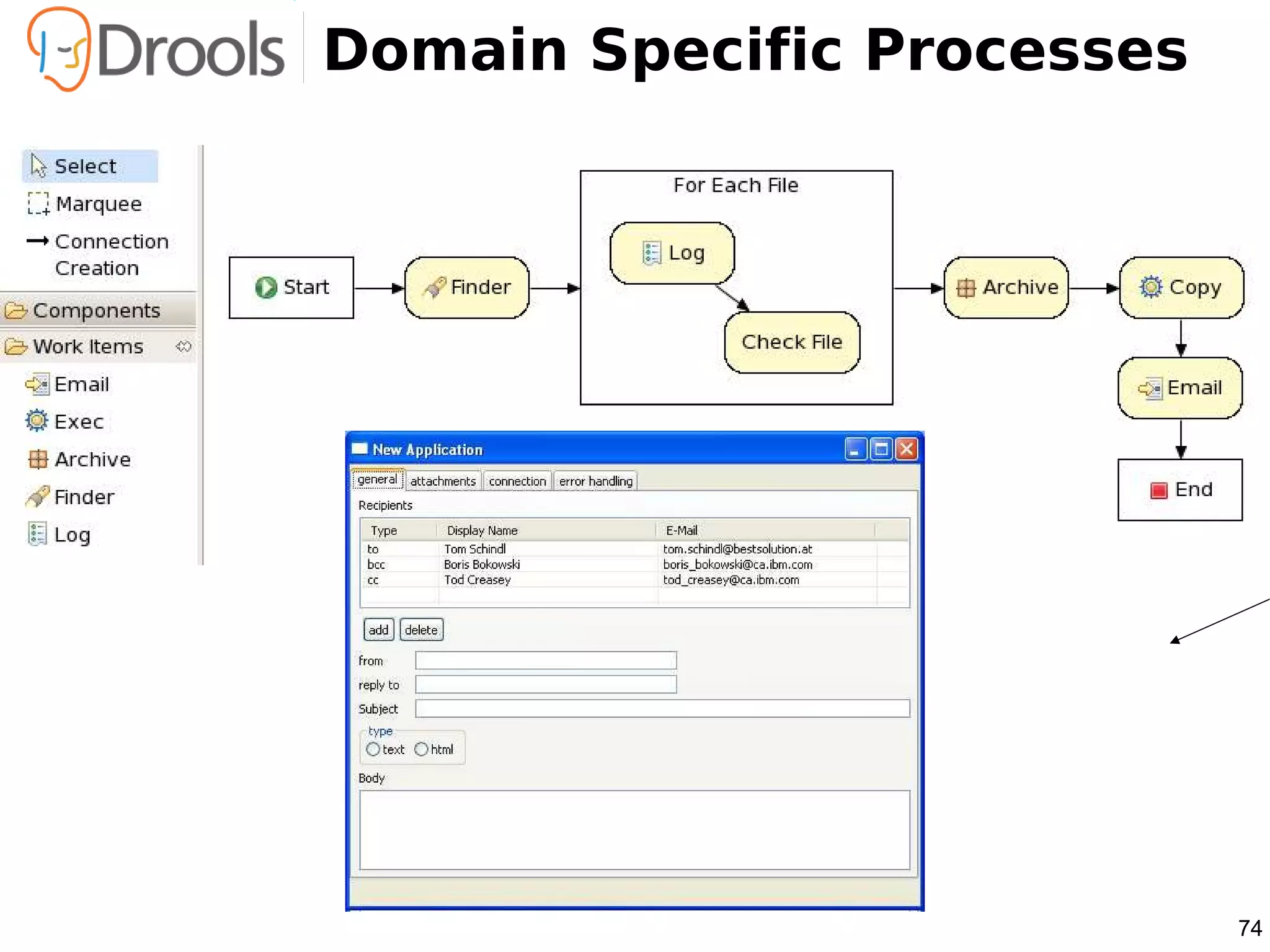
Domain Specific Processes


                            74
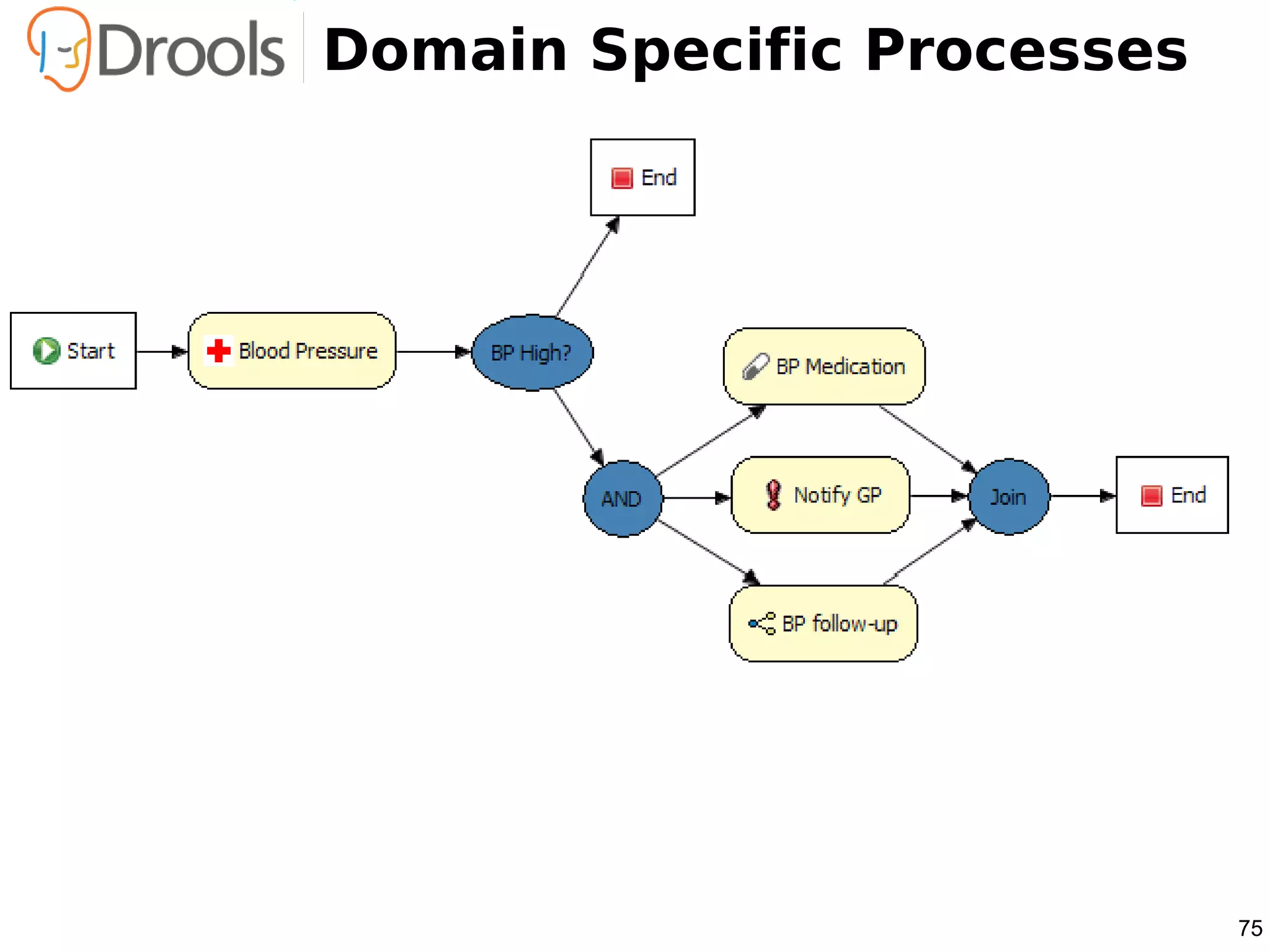
Domain Specific Processes


                            75
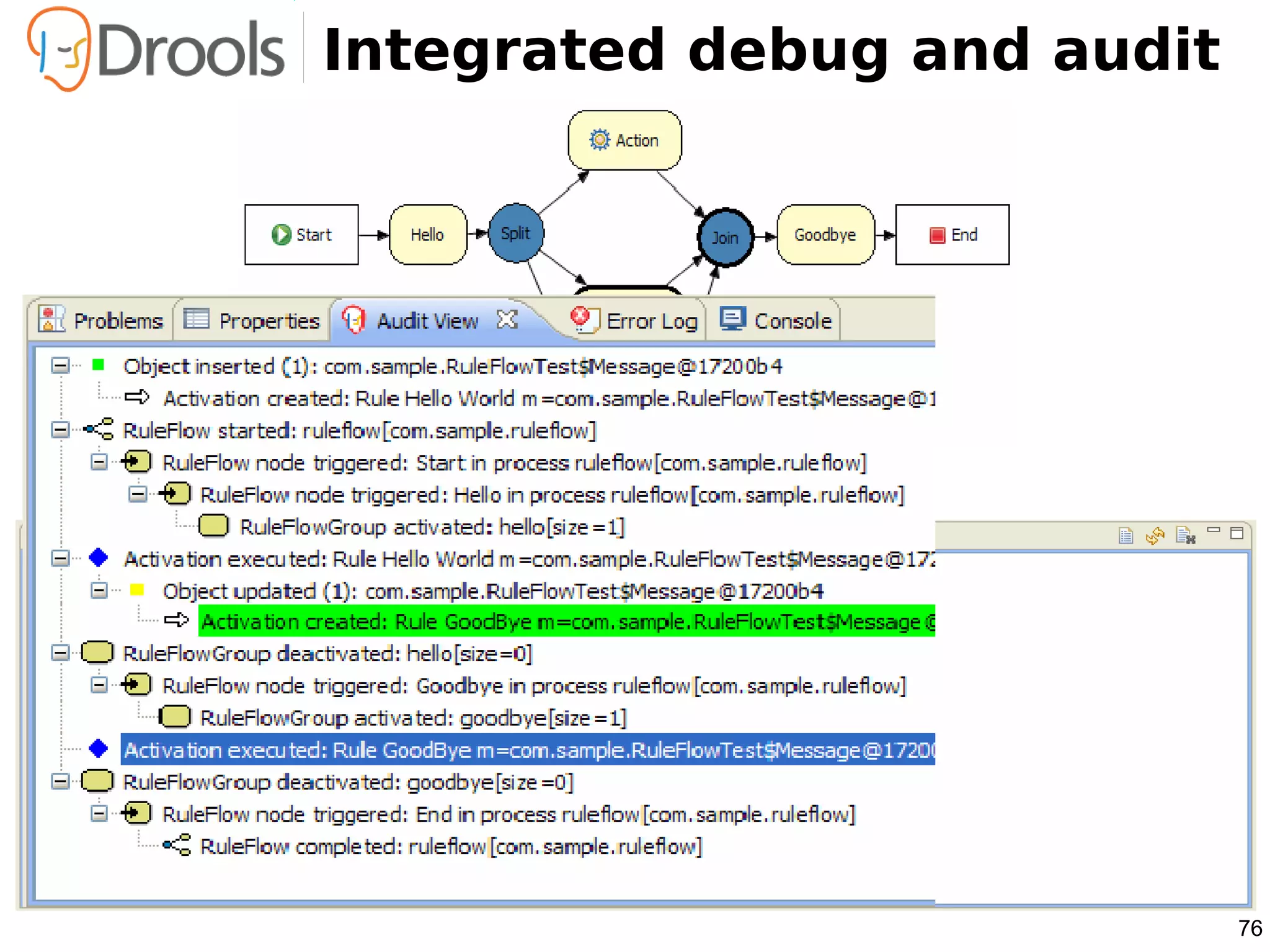
Integrated debug and audit


                             76
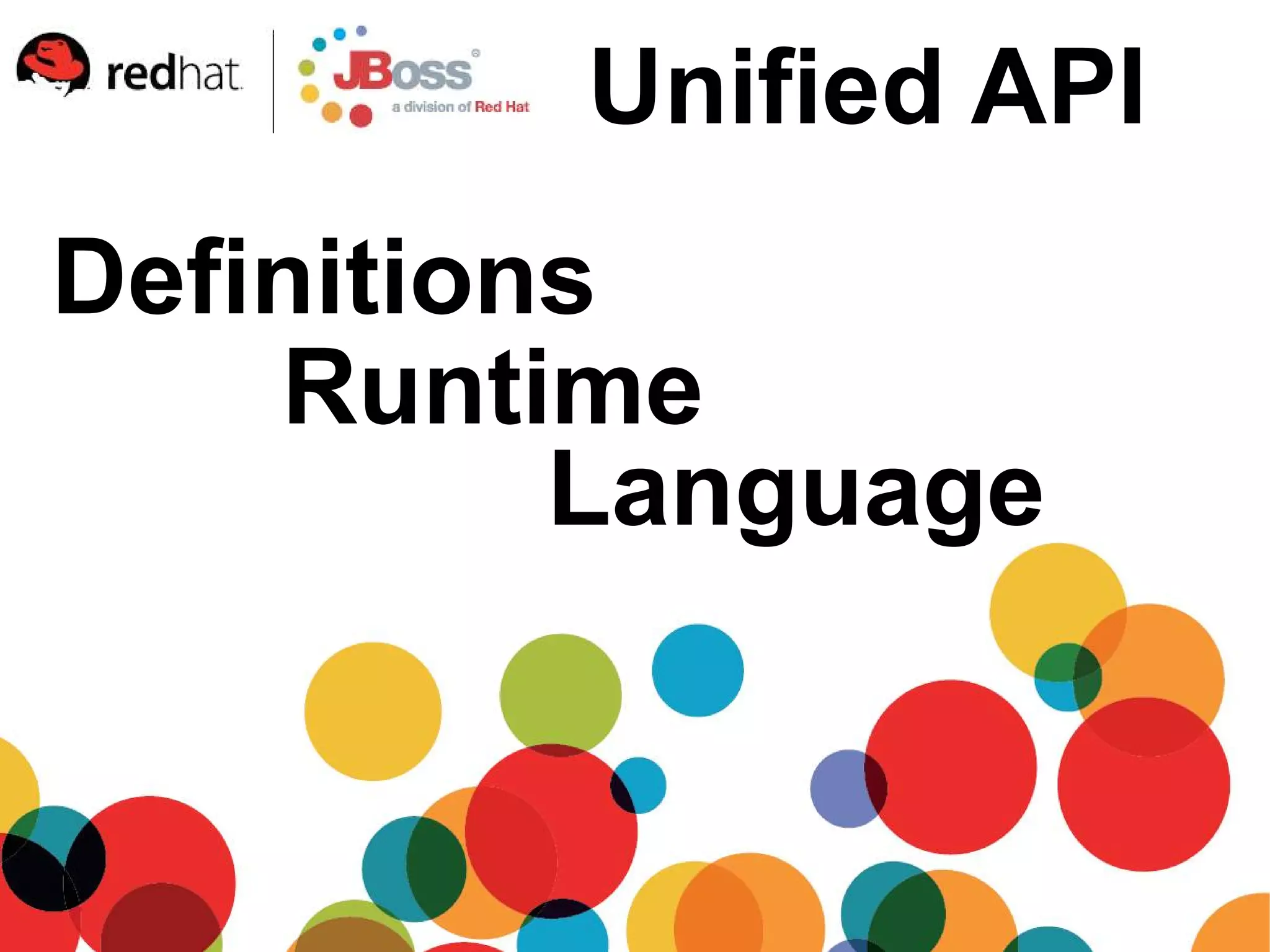
Unified API
Definitions
    Runtime
          Language
Definitions
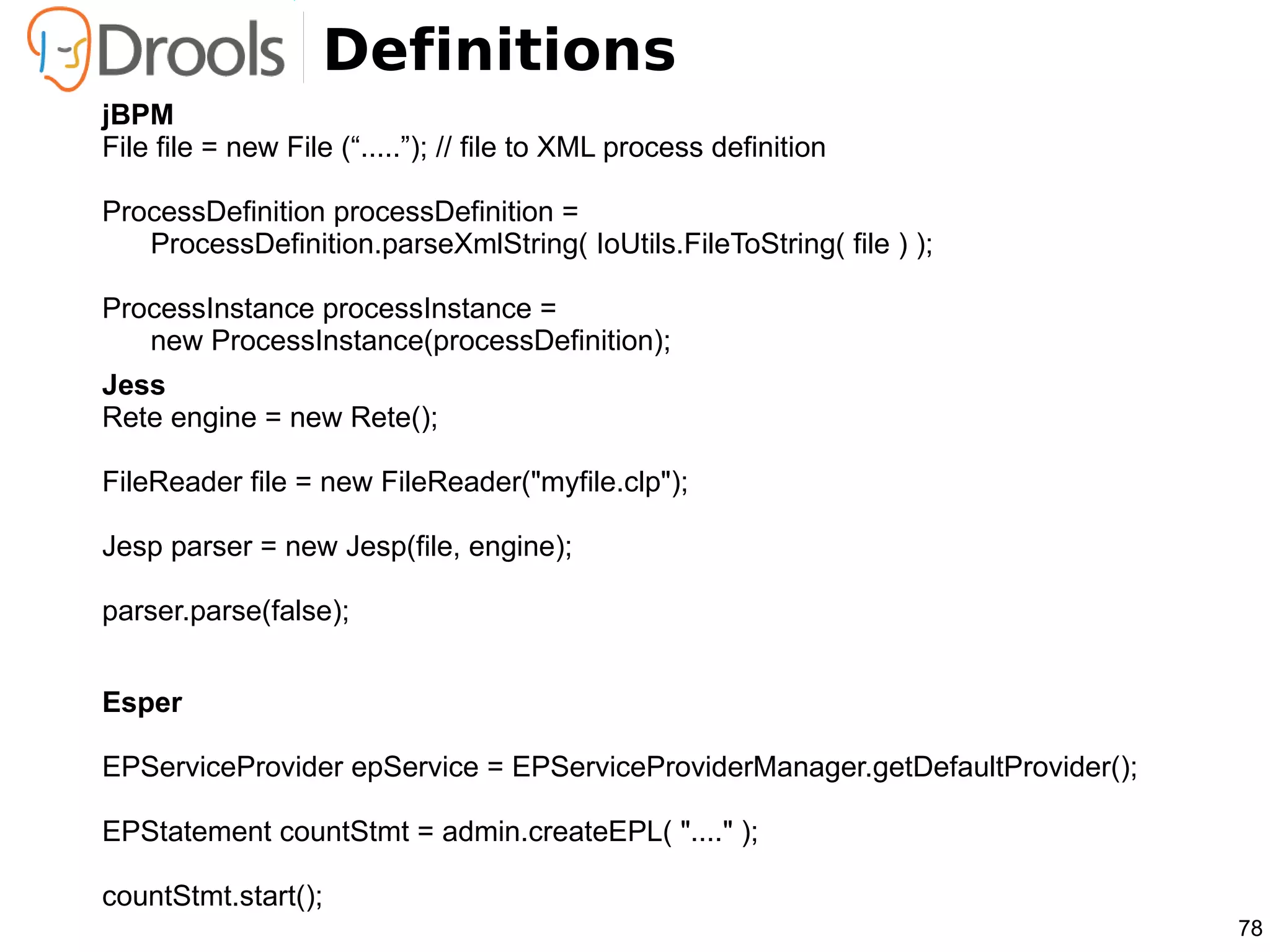
jBPM
File file = new File (“.....”); // file to XML process definition

ProcessDefinition processDefinition =
   ProcessDefinition.parseXmlString( IoUtils.FileToString( file ) );

ProcessInstance processInstance =
   new ProcessInstance(processDefinition);
Jess
Rete engine = new Rete();

FileReader file = new FileReader("myfile.clp");

Jesp parser = new Jesp(file, engine);

parser.parse(false);


Esper

EPServiceProvider epService = EPServiceProviderManager.getDefaultProvider();

EPStatement countStmt = admin.createEPL( "...." );

countStmt.start();
                                                                               78
Definitions
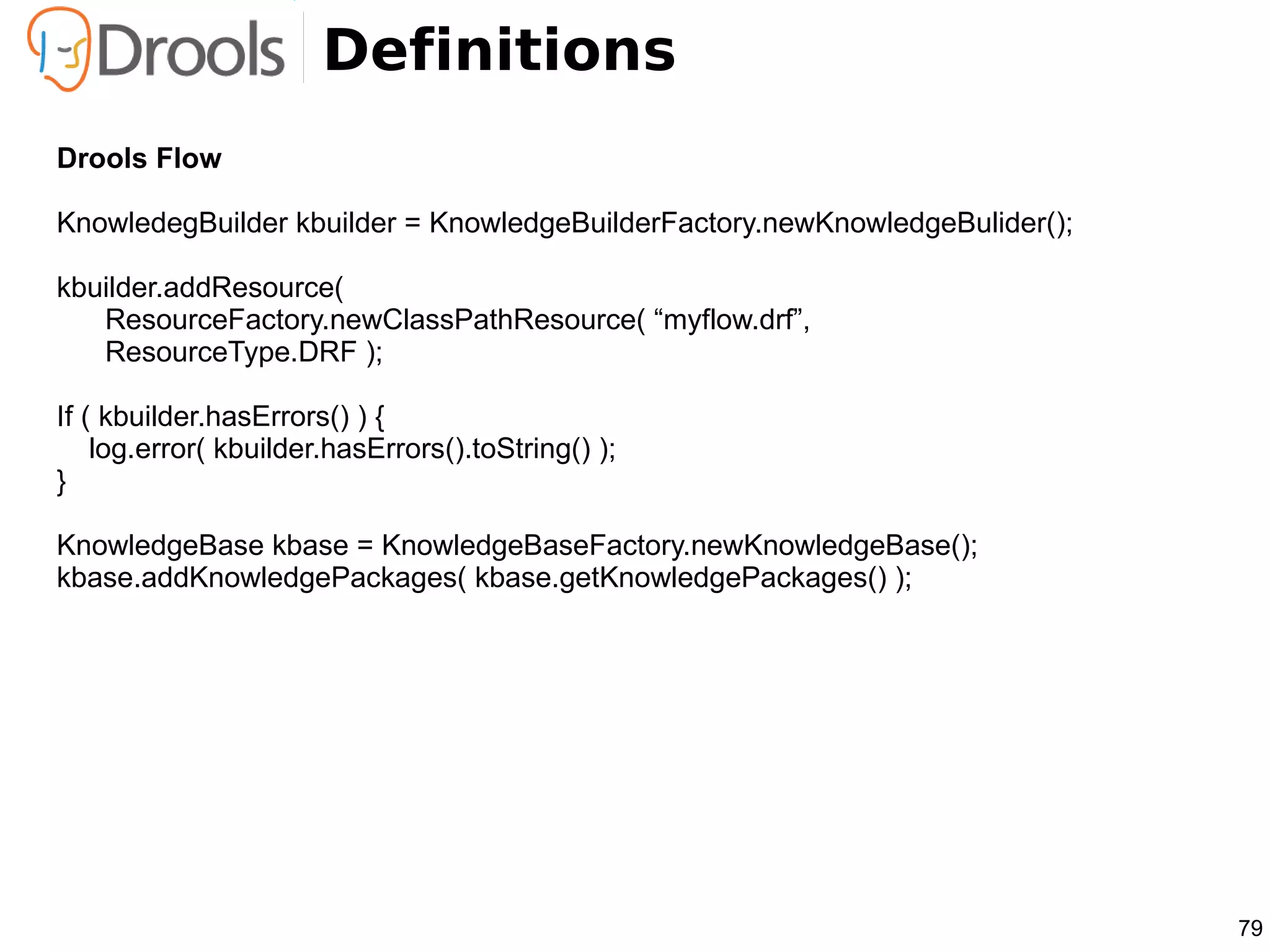
Drools Flow

KnowledegBuilder kbuilder = KnowledgeBuilderFactory.newKnowledgeBulider();

kbuilder.addResource(
   ResourceFactory.newClassPathResource( “myflow.drf”,
   ResourceType.DRF );

If ( kbuilder.hasErrors() ) {
    log.error( kbuilder.hasErrors().toString() );
}

KnowledgeBase kbase = KnowledgeBaseFactory.newKnowledgeBase();
kbase.addKnowledgePackages( kbase.getKnowledgePackages() );


                                                                             79
Definitions

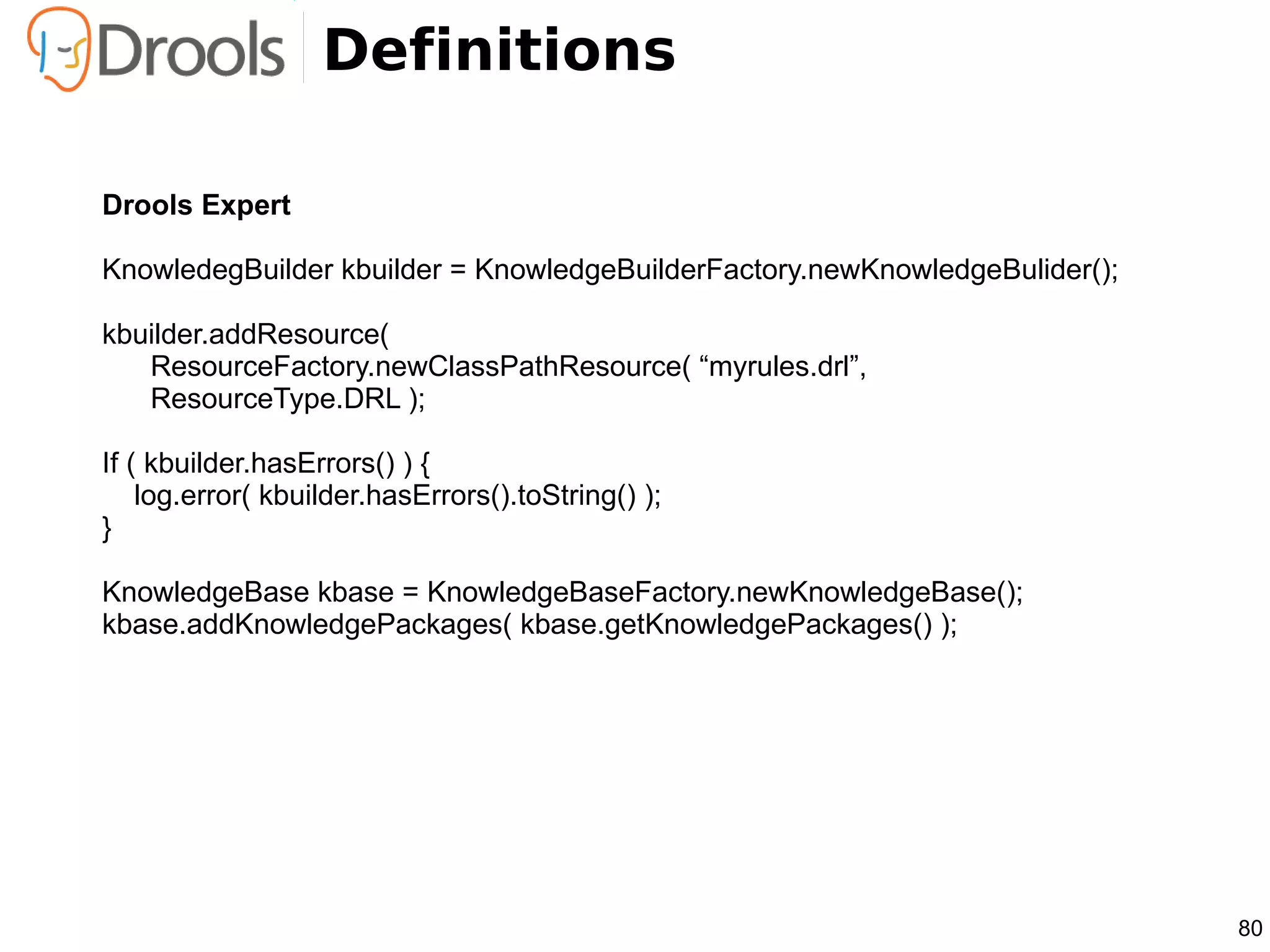
Drools Expert

KnowledegBuilder kbuilder = KnowledgeBuilderFactory.newKnowledgeBulider();

kbuilder.addResource(
   ResourceFactory.newClassPathResource( “myrules.drl”,
   ResourceType.DRL );

If ( kbuilder.hasErrors() ) {
    log.error( kbuilder.hasErrors().toString() );
}

KnowledgeBase kbase = KnowledgeBaseFactory.newKnowledgeBase();
kbase.addKnowledgePackages( kbase.getKnowledgePackages() );


                                                                             80
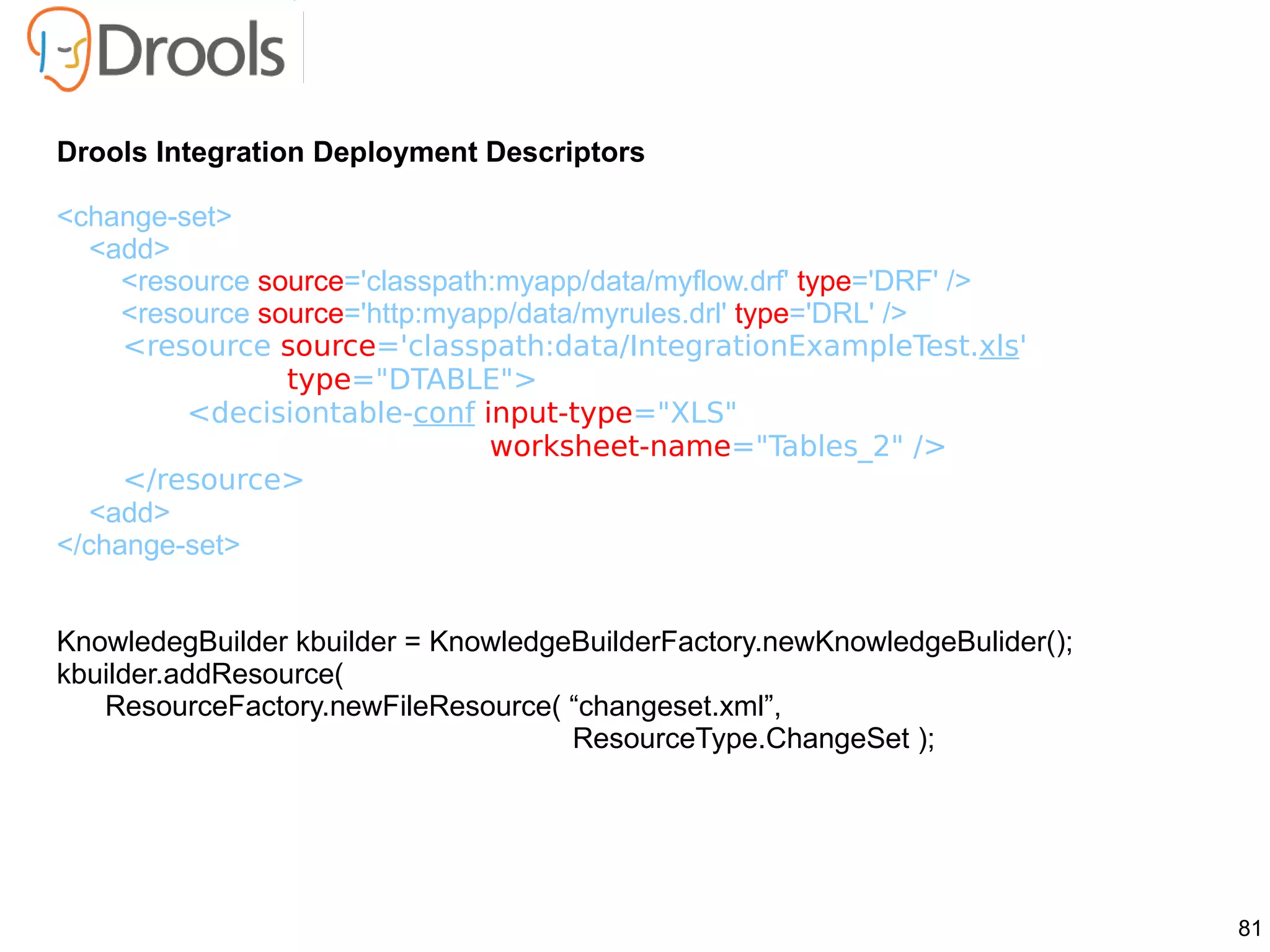
Drools Integration Deployment Descriptors

<change-set>
   <add>
     <resource source='classpath:myapp/data/myflow.drf' type='DRF' />
     <resource source='http:myapp/data/myrules.drl' type='DRL' />
     <resource source='classpath:data/IntegrationExampleTest.xls'
                 type="DTABLE">
          <decisiontable-conf input-type="XLS"
                                worksheet-name="Tables_2" />
     </resource>
   <add>
</change-set>


KnowledegBuilder kbuilder = KnowledgeBuilderFactory.newKnowledgeBulider();
kbuilder.addResource(
   ResourceFactory.newFileResource( “changeset.xml”,
                                     ResourceType.ChangeSet );


                                                                             81
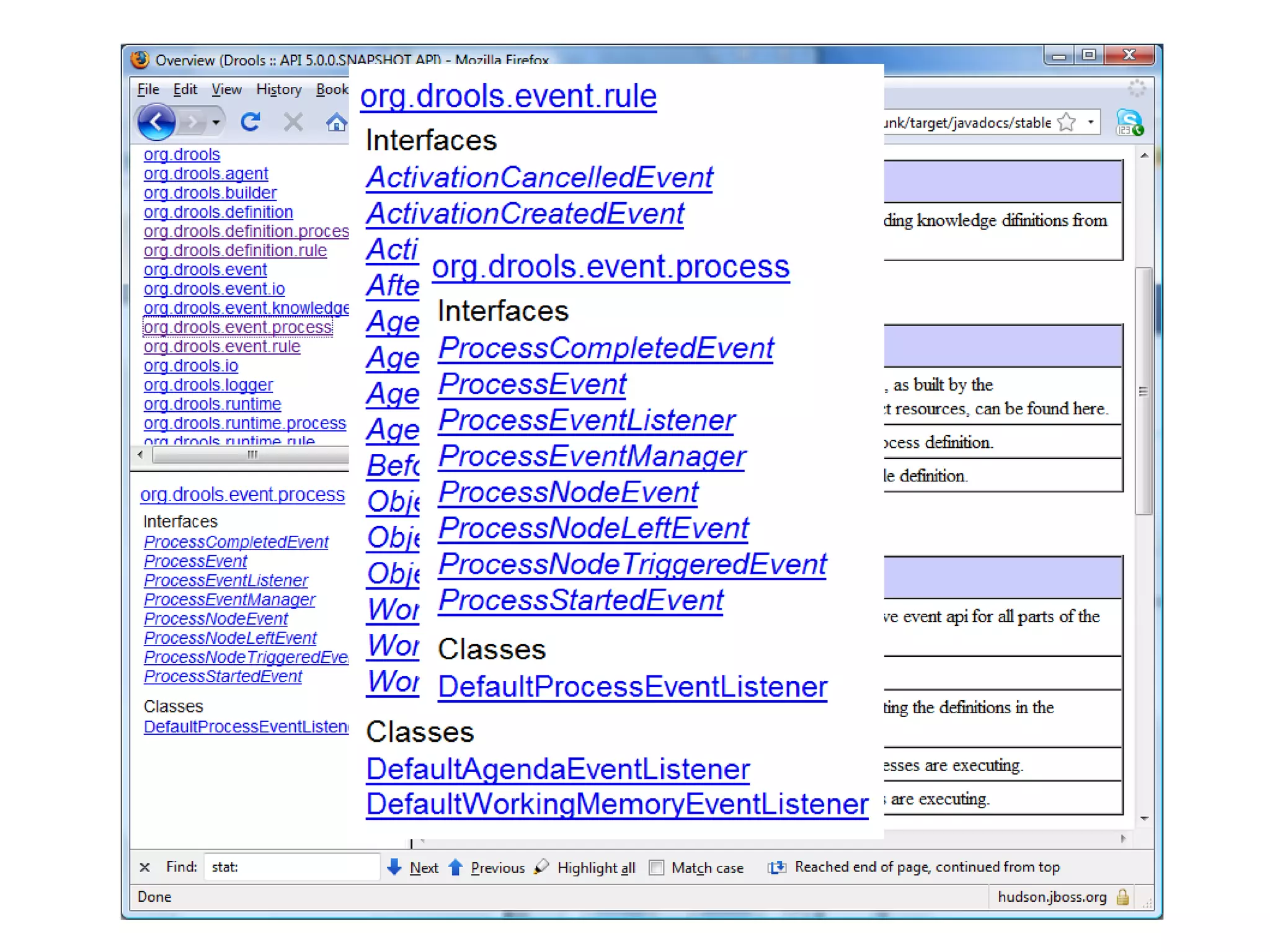
Unified Event Model
Mixins
Interface Markers
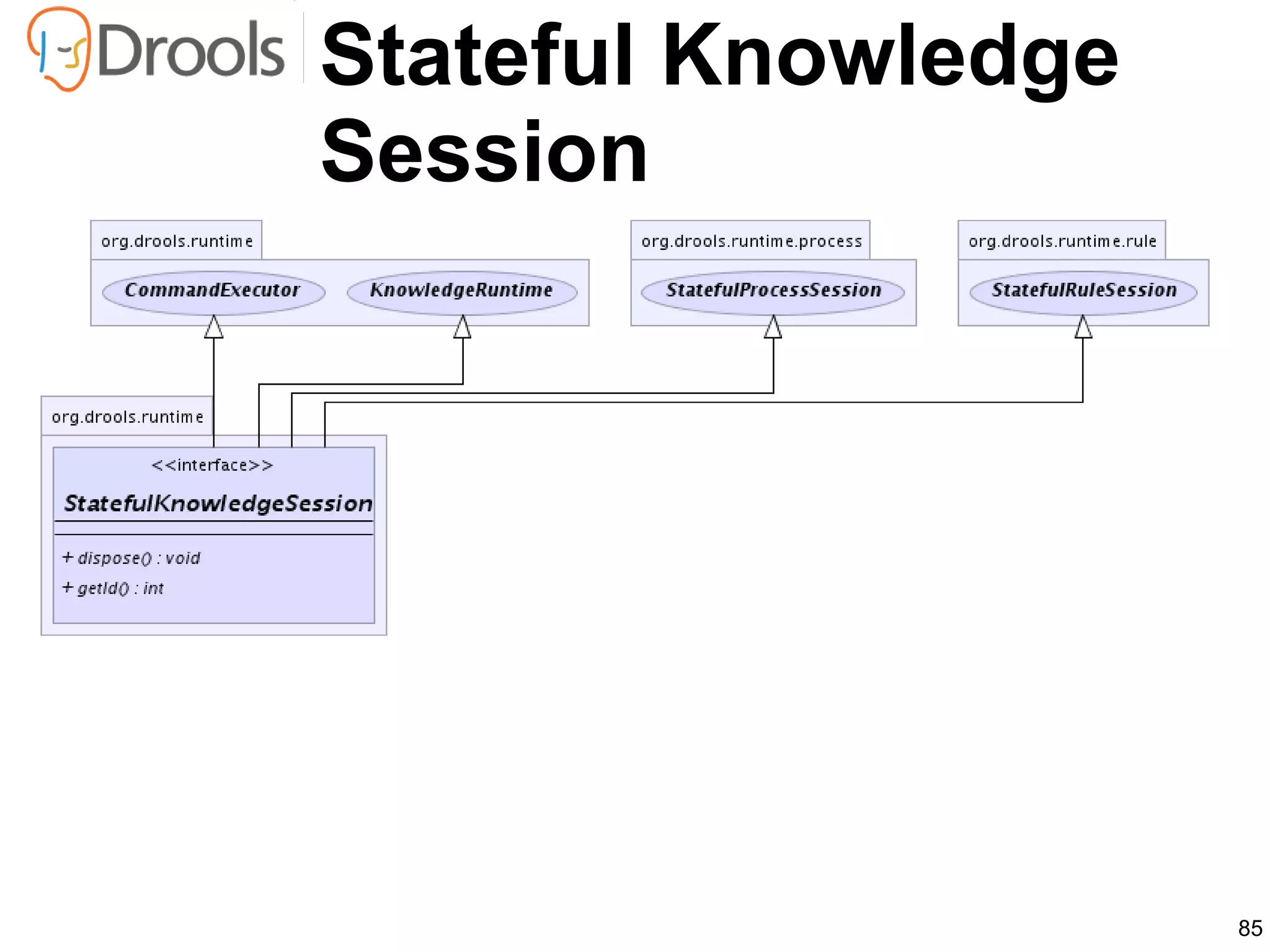
Stateful Knowledge
Session


                     85
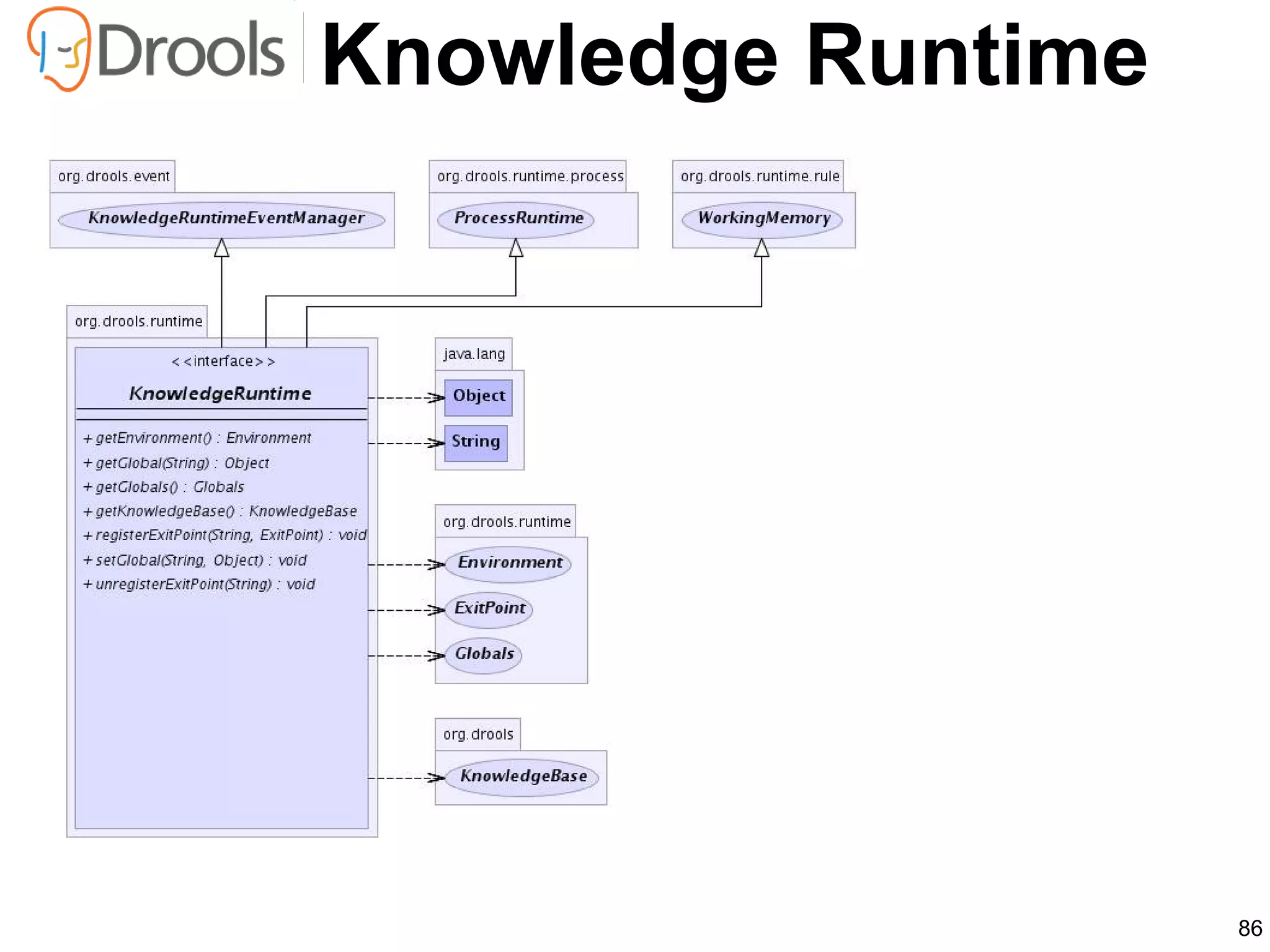
Knowledge Runtime


                    86
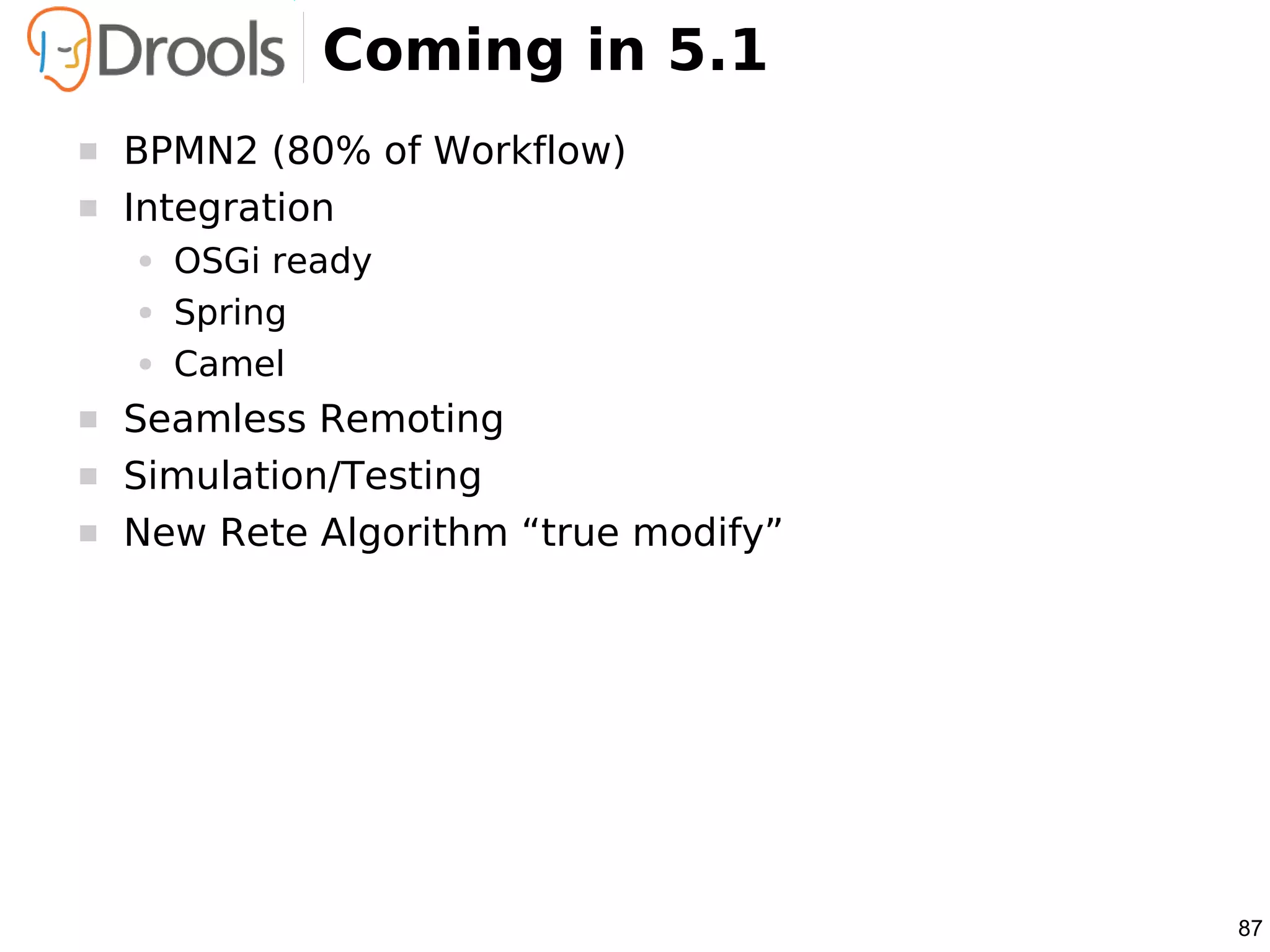
Coming in 5.1
   BPMN2 (80% of Workflow)
   Integration
    ●   OSGi ready
    ●   Spring
    ●   Camel
   Seamless Remoting
   Simulation/Testing
   New Rete Algorithm “true modify”


                                       87
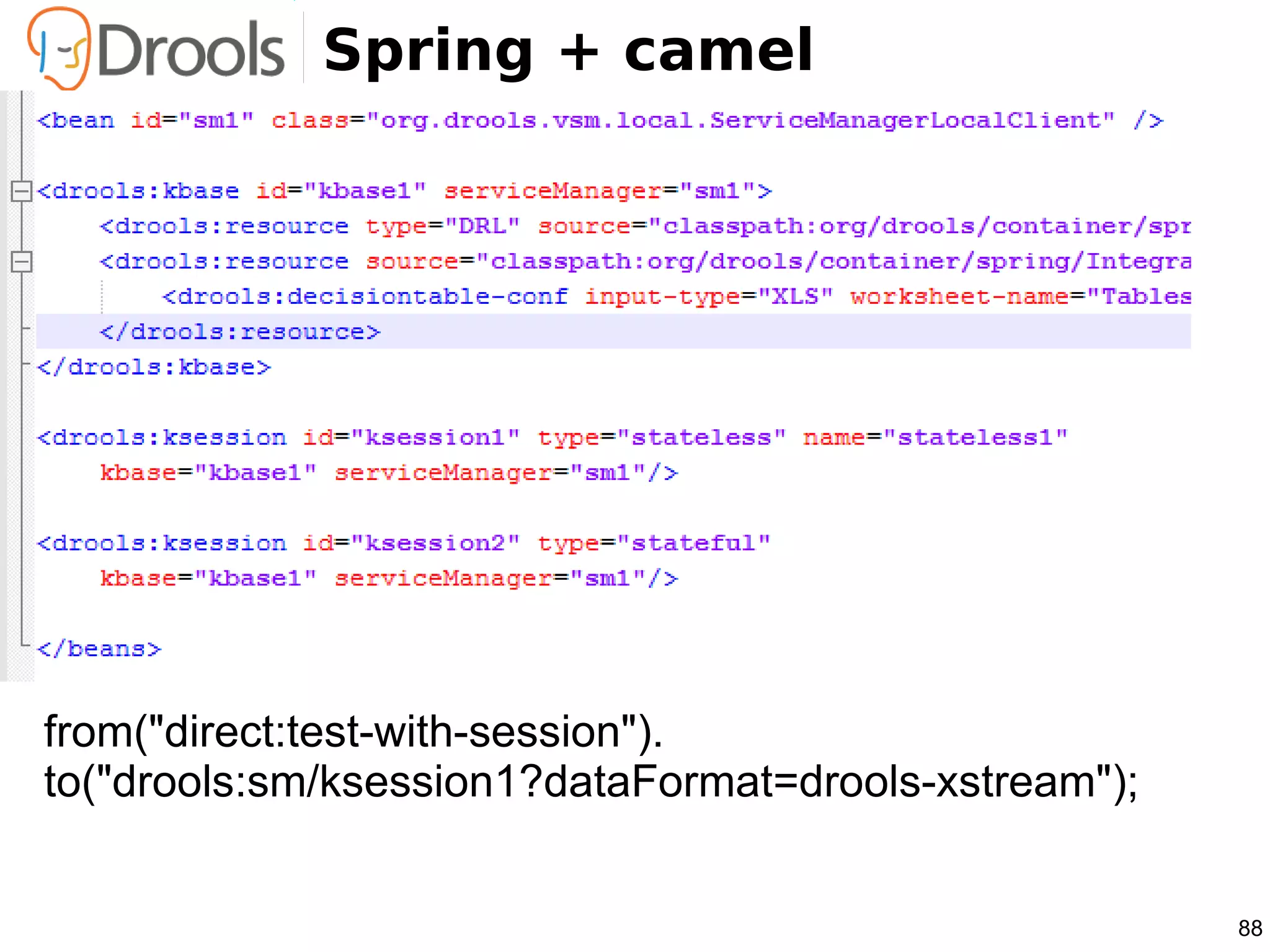
Spring + camel


from("direct:test-with-session").
to("drools:sm/ksession1?dataFormat=drools-xstream");


                                                       88
Questions?
                        • Dave Bowman: All right, HAL; I'll
                          go in through the emergency
                          airlock.
                        • HAL: Without your space helmet,
                          Dave, you're going to find that
                          rather difficult.
                        • Dave Bowman: HAL, I won't argue
                          with you anymore! Open the
                          doors!
                        • HAL: Dave, this conversation can
                          serve no purpose anymore.
                          Goodbye.
Joshua: Greetings, Professor Falken.
Stephen Falken: Hello, Joshua.
Joshua: A strange game. The only
winning move is not to play. How
about a nice game of chess?


                                                              89

Lille2010markp

  • 1.
    Mark Proctor Project Lead ● The SkyNet funding bill is passed. ● The system goes online on August 4th, 1997. ● Human decisions are removed from strategic defense. ● SkyNet begins to learn at a geometric rate. ● It becomes self-aware at 2:14am Eastern time, August 29th ● In a panic, they try to pull the plug. ● And, Skynet fights back
  • 2.
    Introduction Drools Drools Drools Drools Expert Flow Fusion Guvnor Business Logic integration Platform 2
  • 3.
  • 4.
  • 5.
    Classes C a s h f lo w A cco u n t D a te d a te lo n g a c c o u n t N o d o u b le a m o u n t d o u b le b a la n c e in t t y p e lo n g a c c o u n t N o A c c o u n t in g P e r io d D a te s ta r t D a te e n d 5
  • 6.
    Creating Views with Triggers date amount type accountNo AccountingPeriod 12-Jan-07 100 CREDIT 1 start end 2-Feb-07 200 DEBIT 1 01-Jan-07 31-Mar-07 18-May-07 50 CREDIT 1 9-Mar-07 75 CREDIT 1 Account accountNo balance 1 0 increase balance for AccountPeriod Credits decrease balance for AccountPeriod Debits select * from Account acc, select * from Account acc, Cashflow cf, AccountPeriod ap Cashflow cf, AccountPeriod ap where acc.accountNo == cf.accountNo and where acc.accountNo == cf.accountNo and cf.type == CREDIT cf.type == DEBIT cf.date >= ap.start and cf.date >= ap.start and cf.date <= ap.end cf.date <= ap.end trigger : acc.balance += cf.amount trigger : acc.balance -= cf.amount CashFlow CashFlow date amount type date amount type 12-Jan-07 100 CREDIT 2-Feb-07 200 DEBIT 9-Mar-07 75 CREDIT Account accountNo balance 1 -25 6
  • 7.
    What is aRule salience <int> Quotes on Rule names are agenda-group <string> optional if the rule name has no-loop <boolean> no spaces. auto-focus <boolean> duration <long> .... • rule “<name>”     <attribute> <value>     when         <LHS>     then         <RHS> RHS can be any valid java. Or MVEL. Other languages end could be added. 7
  • 8.
    Imperative vs Declarative Methods that must specific passing of be called directly instances • public void helloMark(Person person) { Rules can never     if ( person.getName().equals( “mark” ) { be called directly        System.out.println( “Hello Mark” );     } Specific instances } cannot be passed. • rule “Hello Mark” LHS     when         Person( name == “mark” )     then         System.out.println( “Hello Mark” ); end RHS 8
  • 9.
    What is aPattern P a tte rn O b je c t T y p e F ie ld C o n s t r a in t F ie ld N a m e R e s t r ic t io n E v a lu a t o r V a lu e S h o w e r( te m p e r a tu re = = “ h o t” ) 9
  • 10.
    Bringing it Together select* from Account acc, Cashflow cf, AccountPeriod ap where acc.accountNo == cf.accountNo and cf.type == CREDIT cf.date >= ap.start and cf.date <= ap.end Pattern trigger : acc.balance += cf.amount Pattern Binding field Binding rule “increase balance for AccountPeriod Credits” when Variable Restriction ap : AccountPeriod() acc : Account( $accountNo : accountNo ) CashFlow( type == CREDIT, accountNo == $accountNo, Literal Restriction date >= ap.start && <= ap.end, $ammount : ammount ) then acc.balance += $amount; Multri Restriction - Variable end Restriction field Binding Consequence (RHS) 10
  • 11.
    Rules as a“view” date amount type accountNo AccountingPeriod 12-Jan-07 100 CREDIT 1 start end 2-Feb-07 200 DEBIT 1 01-Jan-07 31-Mar-07 18-May-07 50 CREDIT 1 9-Mar-07 75 CREDIT 1 Account accountNo balance 1 0 rule “increase balance for AccountPeriod rule “decrease balance for AccountPeriod Credits” Debits” when when ap : AccountPeriod() ap : AccountPeriod() acc : Account( $accountNo : accountNo ) acc : Account( $accountNo : accountNo ) CashFlow( type == CREDIT, CashFlow( type == DEBIT, accountNo == $accountNo, accountNo == $accountNo, date >= ap.start && <= ap.end, date >= ap.start && <= ap.end, $ammount : ammount ) $ammount : ammount ) then then acc.balance += $amount; acc.balance -= $amount; end CashFlow end CashFlow date amount type date amount type 12-Jan-07 100 CREDIT 2-Feb-07 200 DEBIT 9-Mar-07 75 CREDIT Account accountNo balance 1 -25 11
  • 12.
    Patterns in moredetails CashFlow( type == “credit” ) $ap : AccountPeriod() CashFlow( date >= $ap.start ) $ap : AccountPeriod() CashFlow( date >= $ap.start && <= $ap.end ) $ap : AccountPeriod() CashFlow( type == “credit”, date >= $ap.start && <= $ap.end ) 12
  • 13.
    More Pattern Examples Person($age : age ) Person( age == ( $age + 1 ) ) Person( $age : age ) Person( eval( age == $age + 1 ) ) Person( $age1 : age ) Person( $age2 : age ) eval( $age2 == $age1 + 1 ) 13
  • 14.
    More Pattern Examples Person(age > 30 && < 40 || hair == “black”) Person(age > 30 && < 40 || hair in (“black”, “brown”) ) Person( (age > 30 && < 40 && hair == “black”) || (age > 50 && hair == “grey”) ) Person(pets contain $rover ) Person(pets[’rover’].type == “dog”) Person(pets[0].type == “dog”) 14
  • 15.
    What is aProduction Rule System Codification of the business Repository of knowledge inserted Java instances Inference Engine Production Pattern Working Memory Matcher Memory (rules) (facts) Agenda insert Rules can change update on the fly retract 15
  • 16.
    Production Rule System Approximated by SQL and Views T a b le s A cco unt A c c o u n t in g P e r io d C a s h f lo w O b je c t T y p e s A cco unt A c c o u n t in g P e r io d C a s h f lo w V ie w s v ie w 1 v ie w 2 V ie w m a in v ie w R u le s r u le 1 r u le 2 agenda agenda 16
  • 17.
    Conflict Resolution with Salience Salience rule “Print blance for AccountPeriod” salience -50 when ap : AccountPeriod() acc : Account( ) then System.out.println( acc.accountNo + “ : “ acc.balance ); end Agenda 1 increase balance 2 decrease balance arbitrary 3 increase balance 4 print balance 17
  • 18.
    RuleFlow rule “increase balance for AccountPeriod Credits” ruleflow-group “calculation” when ap : AccountPeriod() acc : Account( $accountNo : accountNo ) CashFlow( type == CREDIT, accountNo == $accountNo, date >= ap.start && <= ap.end, $ammount : ammount ) then acc.balance += $amount; end ruleflow-group rule “Print blance for AccountPeriod” ruleflow-group “report” when ap : AccountPeriod() acc : Account( ) then System.out.println( acc.accountNo + “ : “ acc.balance ); end 18
  • 19.
    Two Phase System Determine possible rules to fire Agenda Evaluation Working Memory Action Rule insert modify Found Select Fire Rule Rule to Fire retract No Rule Found exit 19
  • 20.
  • 21.
    From CE forExpressions not Bus( color = “red” ) exists Bus( color = “red” ) forall ( $bus : Bus( color == “red” ) ) forall ( $bus : Bus( floors == 2 ) Bus( this == $bus, color == “red” ) ) 21
  • 22.
  • 23.
    From CE forExpressions Using 'from' to reason over the nested list rule “Find all the pets for a given owner” when $owner : Person( name == “mark” ) Pet( name == “rover” ) from $owner.pets 23
  • 24.
    From CE forExpressions 'from' can work on any expression, not just a nested field on a bound variable. rule “Find People for given zip code” when $zipCode : ZipCode() Person( ) from $hbn.getNamedQuery(“Find People”) .setParameters( [ “zipCode” : $zipCode ] ) .list() Hibernate session 24
  • 25.
  • 26.
    Collect CE rule "accumulate" when $list : List( intValue > 100 ) from collect( Bus( color == "red" ) ) then print "red buses “ + $list; end 26
  • 27.
  • 28.
    Accumulate CE rule "accumulate" when $sum : Number( intValue > 100 ) from accumulate( Bus( color == "red", $t : takings ) init( sum = 0 ), action( sum += $t ), result( sum ) ) then print "sum is “ + $sum; end 28
  • 29.
    Accumulate CE rule "accumulate" when $sum : Number( intValue > 100 ) from accumulate( Bus( color == "red", $t : takings ) sum( $t ) ) then print "sum is “ + $sum; end 29
  • 30.
    Accumulate CE Patterns andCE's can be chained with 'from' rule "collect" when $zipCode : ZipCode() $sum : Number( intValue > 100 ) from accumulate( Bus( color == "red", $t : takings ) from $hbn.getNamedQuery(“Find Buses”) .setParameters( [ “zipCode” : $zipCode ] ) .list(), sum( $t ) ) then 30
  • 31.
  • 32.
    Timers rule “name” timer 1m30s when $l : Light( status == “on” ) then SendEmail( “turn the light off” ) rule “name” timer (int: 0 1m30) when $l : Light( status == “on” ) then SendEmail( “turn the light off” ) 32
  • 33.
    Timers Field Name Mandatory? Allowed Values Allowed Special Characters Seconds YES 0-59 ,-*/ Minutes YES 0-59 ,-*/ Hours YES 0-23 ,-*/ Day of month YES 1-31 ,-*?/LW Month YES 1-12 or JAN-DEC ,-*/ Day of week YES 1-7 or SUN-SAT ,-*?/L# Year NO empty, 1970-2099 ,-*/ rule “name” timer ( cron: 0 0/15 * * * * ) when $l : Light( status == “on” ) then sendEmail( “turn the light off” ) 33
  • 34.
    Calendars rule "weekdays arehigh priority" calendars "weekday" timer (int:0 1h) when Alarm() then send( "priority high - we have an alarm” ); end rule "weekend are low priority" calendars "weekend" timer (int:0 4h) when Alarm() then send( "priority low - we have an alarm” ); end 34
  • 35.
  • 36.
    TMS and Inference rule"Issue Child Bus Pass" Couples the logic when $p : Person( age < 16 ) then insert(new ChildBusPass( $p ) ); end rule "Issue Adult Bus Pass" What happens when the Child when stops being 16? $p : Person( age >= 16 ) then insert(new AdultBusPass( $p ) ); end 36
  • 37.
    TMS and Inference  Bad ● Monolithic ● Leaky ● Brittle integrity - manual maintenance 37
  • 38.
    TMS and Inference A rule “logically” inserts an object  When the rule is no longer true, the object is retracted. when de-couples the logic $p : Person( age < 16 ) then logicalInsert( new IsChild( $p ) ) end Maintains the truth by when automatically retracting $p : Person( age >= 16 ) then logicalInsert( new IsAdult( $p ) ) end 38
  • 39.
    TMS and Inference rule"Issue Child Bus Pass" when $p : Person( ) IsChild( person =$p ) then logicalInsert(new ChildBusPass( $p ) ); end rule "Issue Adult Bus Pass" The truth maintenance cascades when $p : Person( age >= 16 ) IsAdult( person =$p ) then logicalInsert(new AdultBusPass( $p ) ); end 39
  • 40.
    TMS and Inference rule"Issue Child Bus Pass" when $p : Person( ) not( ChildBusPass( person == $p ) ) then requestChildBusPass( $p ); The truth maintenance cascades End 40
  • 41.
    TMS and Inference  Good ● De-couple knowledge responsibilities ● Encapsulate knowledge ● Provide semantic abstractions for those encapsulation ● Integrity robustness – truth maintenance 41
  • 42.
  • 43.
  • 44.
  • 45.
  • 46.
  • 47.
  • 48.
  • 49.
  • 50.
    Scalability Rule engines donot scale for CEP. They have a single point of insertion and are single threaded, CEP has concurrent streams of events. session.insert( event ) ; $c : Custumer( type == “VIP” ) BuyOrderEvent( customer == $c ) Single Point of entry Patterns, evaluate facts sequentially in a single thread. 50
  • 51.
    Scalability So lets allow multiple named entry points for those streams EntryPoint entryPoint = session.getEntryPoint( “Home Broker Stream” ); entryPoint.insert( event ) ; So now we can insert When not specified uses different streams the “default” entry-point concurrently $c : Custumer( type == “VIP ) BuyOrderEvent( customer == $c ) from entry-point “Home Broker Stream” Patterns can now optional specify their entry-point. 51
  • 52.
    Automatic Life-Cycle Management All Fact life-cycles must be managed by the user, so retractions are manual. declare StockTick Just use the declare statement to @role( event ) declare a type as an event and it end will be retracted when it is no longer needed declare StockTick @role( event ) @timestamp( timestampAttr ) companySymbol : String stockPrice : double The declare statement can also timestampAttr : long specify an internal model, that end external objects/xml/csv map on to. We support Smooks and JAXB 52
  • 53.
    Operators Rule engines donot have rich enough set of temporal comparison operators BackAckEvent must occur between 1s and 10s 'after' $c : Custumer( type == “VIP ) BuyOrderEvent $oe : BuyOrderEvent( customer == $c ) from entry-point “Home Broker Stream” BuyAckEvent( relatedEvent == $oe.id, this after[1s, 10s] $oe ) from entry-point “Stock Trader Stream” The Full set of Operators are supported ● coincides ● overlaps ● starts ● before ● overlappedby ● startedby ● after ● during ● finishes ● meets ● includes ● finishedby ● metby 53
  • 54.
  • 55.
    Operators $c : Custumer(type == “VIP ) $oe : BuyOrderEvent( customer == $c ) from entry-point “Home Broker Stream” not BuyAckEvent( relatedEvent == $oe.id, this after[1s, 10s] $oe ) from entry-point “Stock Trader Stream” Existing Drools 'not' Conditional Elements can be used to detect non- occurrence of events 55
  • 56.
    Sliding time windows Ruleengines react to events happening now, there is no temporal understanding of changes over time. StockTicker( symbol == “RHAT” ) over window:time( 5s ) 5s StockTicker( symbol == “RHAT” ) over window:length( 1000 ) 1000 tickers That isn't much without the ability to deal with aggregations, rules engines suck. 56
  • 57.
    Aggregations Rule Engines donot deal with aggregations Over 5 seconds $n : Number( intValue > 100 ) from accumulate( $s : StockTicker( symbol == “RHAT” ) over window:time( 5s ), average( $s.price ) ) Aggregate ticker price The pattern 'Number' for RHAT over last 5 reasons 'from' the seconds accumulate result $n : accumulate( $s : StockTicker( symbol == “RHAT” ) over window:time( 5s ), average( $s.price ) > 100 ) We can use some sugar to reduce verbosity 57
  • 58.
  • 59.
    Drools Flow Aworkflow engine combining processes and  Integration rules ● From loose coupling (decision services) ● To advance integration (process rules)  Unification ● Rules and processes are different types of business knowledge assets ● Infrastructure ● Timers/Schedulers ● Testing ● Communication/Services ● Tooling ● IDE ● repository, management ● Auditing ● 59
  • 60.
  • 61.
    Rules and processes generic ? Decision Services SCOPE Process specific Rules tightly coupled COUPLING loosely coupled 61
  • 62.
  • 63.
  • 64.
  • 65.
    RuleFlowGroup Rule Flow Group 65
  • 66.
  • 67.
    Constraints Java code constraint 67
  • 68.
    Constraints Rules can controlmy workflow? LHS “when” Rule Constraint 68
  • 69.
    Example  Business decisions are externalized using a decision service rule rule Decision1 when Decision1 rule Decision1 // conditions when when then // conditions // // actions then end conditions // actions end then // actions end 69
  • 70.
    Example  What if there is a lot of business logic like this? rule Decision1 rule Decision1 rule when Decision1 rule when Decision1 rule rule rule rule Decision1 // conditions // conditionsrule Decision1 rule Decision1 when Decision1 when Decision1 rule rule when Decision1 rule rule Decision1 then // conditions rule rule conditions Decision1 when Decision1 rule Decision1 Decision1 then // when Decision1 rule rule Decision1 // conditionswhen when rule Decision1 when // conditions // conditions when when then // conditionswhen Decision1 when when Decision1 // actions rule actions // Decision1 then // conditions when when then // conditions// conditions end // conditionsthen // conditionsthen // conditions // end when when // actions then // actions then when when // actions then then // conditions then // conditions// actions then // // // actions then end end conditions// actions // // actions end // // actions conditions conditions // actions then // actions end then // actions end // actions end then end end actions end end actions end conditions // conditions // then end then // end then end then // // actions // // actions actions end actions actions end end end end 70
  • 71.
    Flow of Control Process Engine Rules Engine 71
  • 72.
    Inversion of Control Process Engine Agenda Rules Engine 72
  • 73.
    Self monitoring and adaptive declare ProcessStartedEvent @role( event ) end rule "Number of process instances above threshold" when Number( nbProcesses : intValue > 1000 ) from accumulate( e: ProcessStartedEvent( processInstance.processId == "com.sample.order.OrderProcess" ) over window:size(1h), count(e) ) then System.err.println( "WARNING: Nb of order processes in the last hour > 1000: " + nbProcesses ); 73
  • 74.
  • 75.
  • 76.
  • 77.
    Unified API Definitions Runtime Language
  • 78.
    Definitions jBPM File file =new File (“.....”); // file to XML process definition ProcessDefinition processDefinition = ProcessDefinition.parseXmlString( IoUtils.FileToString( file ) ); ProcessInstance processInstance = new ProcessInstance(processDefinition); Jess Rete engine = new Rete(); FileReader file = new FileReader("myfile.clp"); Jesp parser = new Jesp(file, engine); parser.parse(false); Esper EPServiceProvider epService = EPServiceProviderManager.getDefaultProvider(); EPStatement countStmt = admin.createEPL( "...." ); countStmt.start(); 78
  • 79.
    Definitions Drools Flow KnowledegBuilder kbuilder= KnowledgeBuilderFactory.newKnowledgeBulider(); kbuilder.addResource( ResourceFactory.newClassPathResource( “myflow.drf”, ResourceType.DRF ); If ( kbuilder.hasErrors() ) { log.error( kbuilder.hasErrors().toString() ); } KnowledgeBase kbase = KnowledgeBaseFactory.newKnowledgeBase(); kbase.addKnowledgePackages( kbase.getKnowledgePackages() ); 79
  • 80.
    Definitions Drools Expert KnowledegBuilder kbuilder= KnowledgeBuilderFactory.newKnowledgeBulider(); kbuilder.addResource( ResourceFactory.newClassPathResource( “myrules.drl”, ResourceType.DRL ); If ( kbuilder.hasErrors() ) { log.error( kbuilder.hasErrors().toString() ); } KnowledgeBase kbase = KnowledgeBaseFactory.newKnowledgeBase(); kbase.addKnowledgePackages( kbase.getKnowledgePackages() ); 80
  • 81.
    Drools Integration DeploymentDescriptors <change-set> <add> <resource source='classpath:myapp/data/myflow.drf' type='DRF' /> <resource source='http:myapp/data/myrules.drl' type='DRL' /> <resource source='classpath:data/IntegrationExampleTest.xls' type="DTABLE"> <decisiontable-conf input-type="XLS" worksheet-name="Tables_2" /> </resource> <add> </change-set> KnowledegBuilder kbuilder = KnowledgeBuilderFactory.newKnowledgeBulider(); kbuilder.addResource( ResourceFactory.newFileResource( “changeset.xml”, ResourceType.ChangeSet ); 81
  • 82.
  • 84.
  • 85.
  • 86.
  • 87.
    Coming in 5.1  BPMN2 (80% of Workflow)  Integration ● OSGi ready ● Spring ● Camel  Seamless Remoting  Simulation/Testing  New Rete Algorithm “true modify” 87
  • 88.
  • 89.
    Questions? • Dave Bowman: All right, HAL; I'll go in through the emergency airlock. • HAL: Without your space helmet, Dave, you're going to find that rather difficult. • Dave Bowman: HAL, I won't argue with you anymore! Open the doors! • HAL: Dave, this conversation can serve no purpose anymore. Goodbye. Joshua: Greetings, Professor Falken. Stephen Falken: Hello, Joshua. Joshua: A strange game. The only winning move is not to play. How about a nice game of chess? 89