Recommended
PPTX
procedure regarding a bill to become act.pptx
PPTX
Business Law - Process of making a Law.pptx
PPTX
PDF
AN OUTLINE OF THE LEGISLATIVE PROCESS OF SRI LANKA
PPTX
Stages of Law Making Process in Bangladesh
PDF
MODULE 1 LAW MAKING IN INDIA.pdf
PPTX
Kashif aziz slides telling about law and taxation of pakistan.
PPTX
Journey of the Greens, Whites and Bills
PPTX
Indian police notes 2 very helpful m laxminarayan
PPTX
Types_of_Bills_in_Parliament_______.pptx
PPTX
PPTX
PPT
PPTX
PPT
Lesson 4 How a Bill Becomes a Law.ppt
PPTX
PPT
Ch. 5 - How a Bill Becomes a Law
PPT
PDF
Introduction to Parliament.. Grade 8 and Above
PDF
PPTX
PPTX
How a bill really becomes law
PDF
Money bill vs finance bill
PPTX
Strategies for Effective Engagement at the Nebraska Legislature 8.28.14
PPT
PPTX
PPTX
I am sharing _Legislature Part II_ with you.pptx
PDF
PDF
GIÁO ÁN KẾ HOẠCH BÀI DẠY NĂNG LỰC SỐ MÔN TIẾNG ANH LỚP 12 CẢ NĂM - GLOBAL SUC...
PPTX
bundle of care.pptx Priti Bala @ BRD med
More Related Content
PPTX
procedure regarding a bill to become act.pptx
PPTX
Business Law - Process of making a Law.pptx
PPTX
PDF
AN OUTLINE OF THE LEGISLATIVE PROCESS OF SRI LANKA
PPTX
Stages of Law Making Process in Bangladesh
PDF
MODULE 1 LAW MAKING IN INDIA.pdf
PPTX
Kashif aziz slides telling about law and taxation of pakistan.
PPTX
Journey of the Greens, Whites and Bills
Similar to Lifecycle_of_a_Bill_in_India_with_Visuals.pptx
PPTX
Indian police notes 2 very helpful m laxminarayan
PPTX
Types_of_Bills_in_Parliament_______.pptx
PPTX
PPTX
PPT
PPTX
PPT
Lesson 4 How a Bill Becomes a Law.ppt
PPTX
PPT
Ch. 5 - How a Bill Becomes a Law
PPT
PDF
Introduction to Parliament.. Grade 8 and Above
PDF
PPTX
PPTX
How a bill really becomes law
PDF
Money bill vs finance bill
PPTX
Strategies for Effective Engagement at the Nebraska Legislature 8.28.14
PPT
PPTX
PPTX
I am sharing _Legislature Part II_ with you.pptx
PDF
Recently uploaded
PDF
GIÁO ÁN KẾ HOẠCH BÀI DẠY NĂNG LỰC SỐ MÔN TIẾNG ANH LỚP 12 CẢ NĂM - GLOBAL SUC...
PPTX
bundle of care.pptx Priti Bala @ BRD med
PPTX
Statistical Data Analysis using R Programming.pptx
DOCX
COMMUNITY HEALTH NURSING OSCE CHECKLIST.docx
PDF
Agents in Artificial Intelligence: Types, Architecture and Real-World Examples
PDF
Humanized antibody therapy & Immunotherapeutic in Clinical Practice .pdf
PDF
To synthesis and submit Benzamide synthesis.pdf
PPTX
special senses-eye, ear, nose, tongue.pptx
PPTX
Nanomaterials and its types - Dr.M.Jothimuniyandi
PDF
The Unique Wildlife of Ethiopia: From the Simien to the Bale Mountains
PPTX
Accounting Theory Group Presentation - Why Study Accounting Theory
PPTX
STERILITY INDICATOR Pharmaceutical microbiology
PPTX
ANTISEPTICS AND DISINFECTANTS CHAPTER NO.05.pptx
PDF
Freshman Geography Chapter 7-Population of Ethiiopia
PPTX
Palta Utsav Open to All Quiz Final Set.pptx
PPTX
Exploring car engine oil and lubricants purpose and functions
PPTX
How to Manage Scheduling Activities in Odoo 18 CRM
PDF
Geography unit 7-Population-Distribution`.pdf
PPTX
Activity on Job position in Odoo 19 Recruitment
PPTX
Introduction Pharmacotherapeutics _ PT1 2026.pptx
Lifecycle_of_a_Bill_in_India_with_Visuals.pptx 1. Lifecycle of a Bill in India
• From Drafting to Enactment
• Presented by: [Your Name / Designation]
• Date: [Insert Date]
⚖️
2. Introduction
• • Legislation forms the backbone of
governance.
• • Indian Constitution: Articles 107 to 111.
• • Bills ensure structured governance through
democratic procedures.
3. Sources of a Bill
• • Government policy decisions
• • Court directives
• • Law Commission reports
• • Public demand and political will
• • International obligations
4. Drafting the Bill
• • Legislative Department prepares draft
• • Ministry-specific content vetted for legality
• • Conforms to CrPC/IPCs drafting standards
• • Cabinet approval precedes introduction
5. Pre-legislative Process
• • Inter-ministerial consultations
• • Stakeholder consultations (if significant
impact)
• • Legal vetting
• • Draft Cabinet Note & Approval
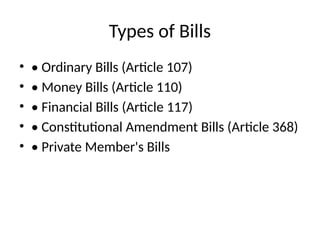
6. Types of Bills
• • Ordinary Bills (Article 107)
• • Money Bills (Article 110)
• • Financial Bills (Article 117)
• • Constitutional Amendment Bills (Article 368)
• • Private Member's Bills
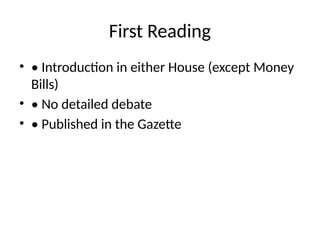
7. First Reading
• • Introduction in either House (except Money
Bills)
• • No detailed debate
• • Published in the Gazette
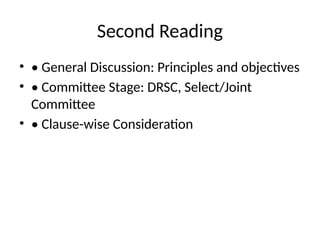
8. Second Reading
• • General Discussion: Principles and objectives
• • Committee Stage: DRSC, Select/Joint
Committee
• • Clause-wise Consideration
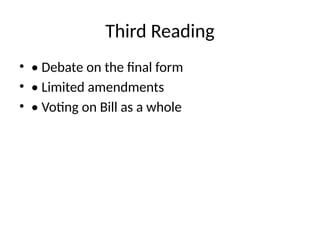
9. Third Reading
• • Debate on the final form
• • Limited amendments
• • Voting on Bill as a whole
10. Consideration in Second House
• • Same stages as first House
• • Amendments possible
• • Disagreement may lead to Joint Sitting
(Article 108)
11. Presidential Assent
• • President may:
• - Assent
• - Withhold
• - Return (except Money Bills)
• • Money Bills: No return provision
12. Act and Commencement
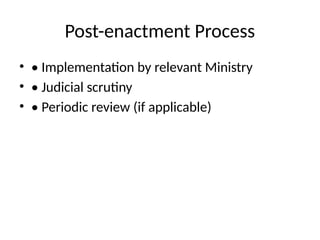
• • Post-assent, becomes an Act
• • Published in Gazette of India
• • Comes into force:
• - Immediately
• - On notified date
13. 14. 15. Special Cases
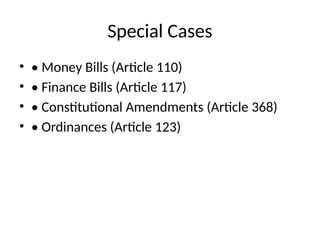
• • Money Bills (Article 110)
• • Finance Bills (Article 117)
• • Constitutional Amendments (Article 368)
• • Ordinances (Article 123)
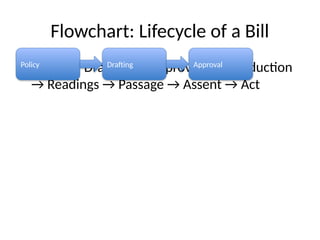
16. Flowchart: Lifecycle of a Bill
• Policy → Drafting → Approval → Introduction
→ Readings → Passage → Assent → Act
Policy Drafting Approval
17. Challenges
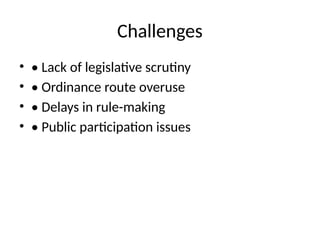
• • Lack of legislative scrutiny
• • Ordinance route overuse
• • Delays in rule-making
• • Public participation issues
18. Reforms and Best Practices
• • Regulatory Impact Assessments
• • Mandatory pre-legislative consultation
• • Strengthening Committees
• • Transparent digital tracking of Bills
19. Conclusion
• • Law-making is structured yet evolving
• • Vital for democratic and accountable
governance
• • Constant improvement ensures legal
robustness
20. Q&A / Thank You
• • Thank the audience
• • Invite questions and discussion
![Lifecycle of a Bill in India
• From Drafting to Enactment
• Presented by: [Your Name / Designation]
• Date: [Insert Date]
⚖️](https://image.slidesharecdn.com/lifecycleofabillinindiawithvisuals-250606055332-9a65e570/85/Lifecycle_of_a_Bill_in_India_with_Visuals-pptx-1-320.jpg)