SESSION 2
Setting Limits and
Understanding
Consequences of
Values
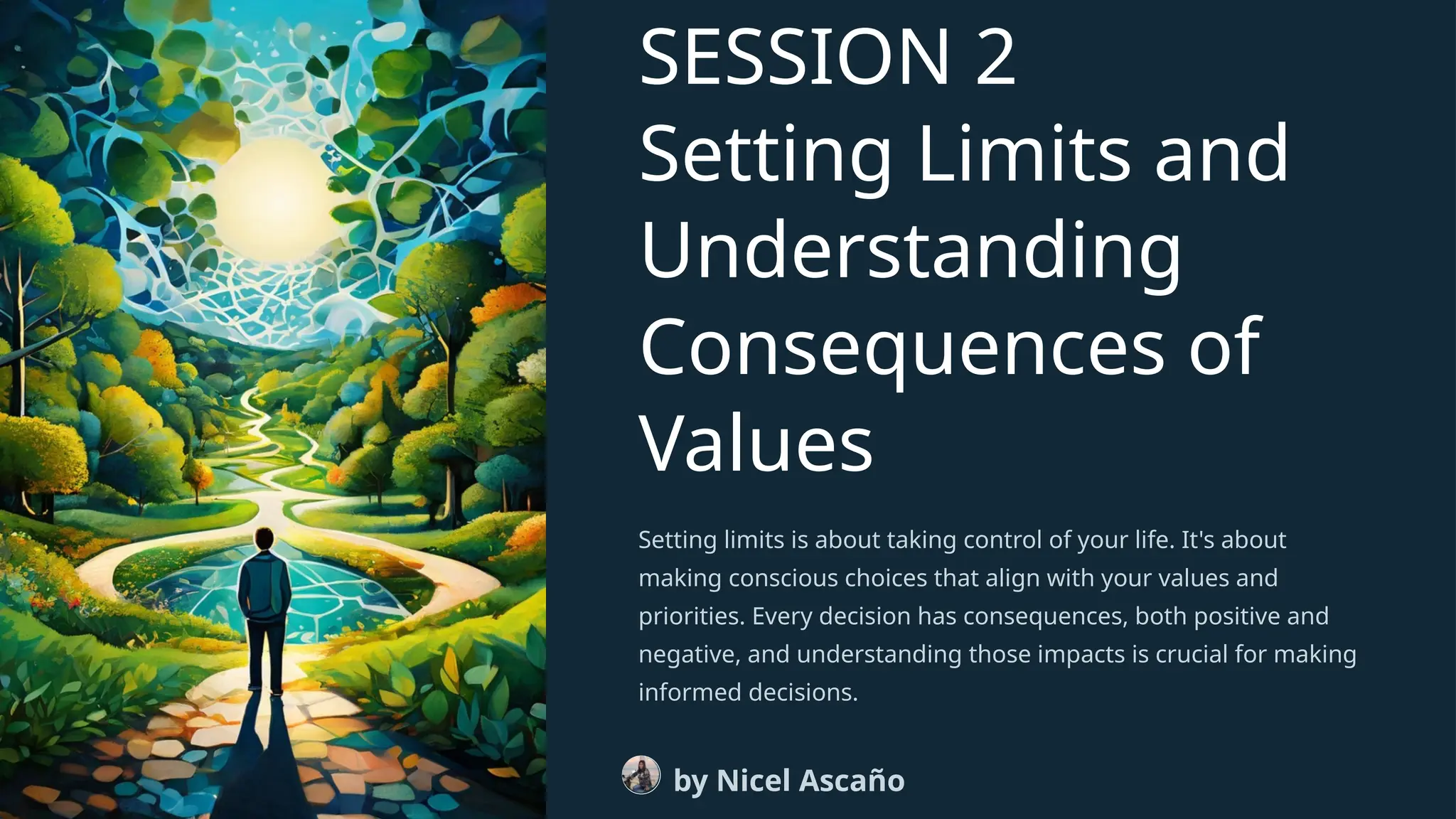
Setting limits is about taking control of your life. It's about
making conscious choices that align with your values and
priorities. Every decision has consequences, both positive and
negative, and understanding those impacts is crucial for making
informed decisions.
by Nicel Ascaño
SESSION 2
Setting Limits and
Understanding
Consequences of
Values
Setting limits is about taking control of your life. It's about
making conscious choices that align with your values and
priorities. Every decision has consequences, both positive and
negative, and understanding those impacts is crucial for making
informed decisions.
by Nicel Ascaño
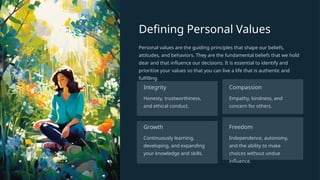
Defining Personal Values
Personal values are the guiding principles that shape our beliefs,
attitudes, and behaviors. They are the fundamental beliefs that we hold
dear and that influence our decisions. It is essential to identify and
prioritize your values so that you can live a life that is authentic and
fulfilling.
Integrity
Honesty, trustworthiness,
and ethical conduct.
Compassion
Empathy, kindness, and
concern for others.
Growth
Continuously learning,
developing, and expanding
your knowledge and skills.
Freedom
Independence, autonomy,
and the ability to make
choices without undue
influence.
Personal Values
G
I
F
C
Growth
Integrity
Freedom
Compassion
Identifying Priorities
Priorities are those aspects of our lives that we deem most important and worthy of our time and energy. It's
important to identify and prioritize your goals so that you can focus on what matters most to you.
Personal
Relationships, health, personal
growth, hobbies.
Professional
Career goals, work-life balance,
professional development.
Financial
Saving, investing, managing
debt, financial security.
Establishing Boundaries
Boundaries are limits that we set to protect our physical, emotional, and mental well-
being. They define what is acceptable and unacceptable behavior and help us maintain
healthy relationships. They are essential for our well-being and help us to avoid
burnout, resentment, and conflict.
Identify Your Needs
What are your needs in this situation?
Communicate Your Limits
Clearly state your boundaries.
Enforce Your Boundaries
Stick to your limits, even if it means saying no.
Communicating Limits
Effectively
Clear communication is crucial when setting limits. Be direct, assertive,
and respectful. Avoid being apologetic or hesitant. Clearly express
what you are willing and unwilling to do.
1 Use "I" Statements
Focus on your needs and
feelings.

2 Be Specific
Clearly define what you
are willing or unwilling to
do.
3 Set Consequences
State what will happen if
your boundaries are
crossed.
4 Be Consistent
Enforce your boundaries
consistently.
Addressing Pushback and
Resistance
People may resist your limits, but it's important to remain firm
and consistent. Acknowledge their feelings but reiterate your
boundaries. Don't engage in arguments or debates. Stick to your
limits.
Pushback Response
Anger Remain calm and assertive.
Guilt Trips Don't be manipulated;
focus on your needs.
Threats Set consequences and
follow through.
Recognizing the Ripple Effect of Choices
Every choice we make has a ripple effect. Our actions impact not only ourselves but also the people around us and the
environment. Understanding this ripple effect is important for making responsible and ethical decisions.
Relationships
How your choices affect
those you care about.
Career
The impact of your choices
on your professional path.
Planet
The environmental
consequences of your
choices.
Society
The influence of your
choices on your community.
Evaluating Short-Term and Long-
Term Impacts
It's crucial to consider the short-term and long-term consequences of our choices.
Sometimes, short-term rewards can lead to long-term problems. Understanding
the full implications of our decisions helps us make choices that are aligned with
our values and goals.
1 Immediate Gratification
Short-term pleasure or reward.
2 Long-Term Impact
Consequences that may unfold over time.
3 Decision Making
Weighing short-term vs. long-term.
Developing Accountability Measures
Accountability plays a vital role in setting limits. Developing accountability measures, such as tracking progress, seeking
feedback, and reflecting on your choices, can help you stay on track and make consistent progress towards your goals.
Vision Boards
Visual reminders of your goals.
Journaling
Documenting your journey and insights.
Embracing the Power of Saying
No
Saying no is not a sign of weakness; it's a sign of strength. It allows you to
protect your time, energy, and resources. By saying no to things that don't
align with your values and priorities, you create space for the things that truly
matter.
1 Avoid Feeling
Overwhelmed
Saying no helps you manage
your commitments.
2 Maintain a Healthy
Balance
It allows you to prioritize what
is important.
3 Protect Your Time and
Energy
It prevents you from being
drained by commitments you
don't want.
4 Focus on What Matters
It helps you allocate your
resources wisely.
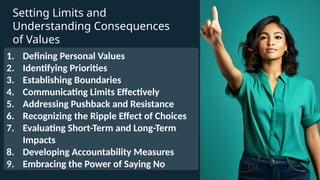
Setting Limits and
Understanding Consequences
of Values
1. Defining Personal Values
2. Identifying Priorities
3. Establishing Boundaries
4. Communicating Limits Effectively
5. Addressing Pushback and Resistance
6. Recognizing the Ripple Effect of Choices
7. Evaluating Short-Term and Long-Term
Impacts
8. Developing Accountability Measures
9. Embracing the Power of Saying No
Traits of Successful
People
Success is a multifaceted concept, but certain qualities
consistently stand out among those who achieve remarkable
things. Let's explore these traits and understand how they

contribute to a fulfilling and impactful life.
by Nicel Ascaño
1. Unyielding
Commitment to
Constant Learning
Embrace a mindset of lifelong learning, continuously seeking
new knowledge and skills. A relentless pursuit of personal and
professional development.
by Nicel Ascaño
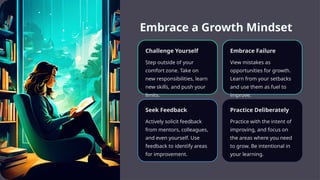
Embrace a Growth Mindset
Challenge Yourself
Step outside of your
comfort zone. Take on
new responsibilities, learn
new skills, and push your
limits.
Embrace Failure
View mistakes as
opportunities for growth.
Learn from your setbacks
and use them as fuel to
improve.
Seek Feedback
Actively solicit feedback
from mentors, colleagues,
and even yourself. Use
feedback to identify areas
for improvement.
Practice Deliberately
Practice with the intent of
improving, and focus on
the areas where you need
to grow. Be intentional in
your learning.
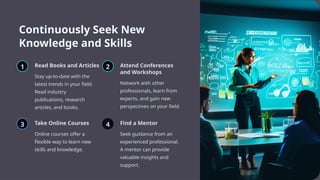
Continuously Seek New
Knowledge and Skills
1 Read Books and Articles
Stay up-to-date with the
latest trends in your field.
Read industry
publications, research
articles, and books.
2 Attend Conferences
and Workshops
Network with other
professionals, learn from
experts, and gain new
perspectives on your field.
3 Take Online Courses
Online courses offer a
flexible way to learn new
skills and knowledge.
4 Find a Mentor
Seek guidance from an
experienced professional.
A mentor can provide
valuable insights and
support.
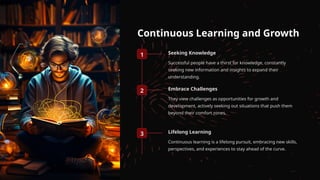
Continuous Learning and Growth
1 Seeking Knowledge
Successful people have a thirst for knowledge, constantly
seeking new information and insights to expand their
understanding.
2 Embrace Challenges
They view challenges as opportunities for growth and
development, actively seeking out situations that push them
beyond their comfort zones.
3 Lifelong Learning
Continuous learning is a lifelong pursuit, embracing new skills,
perspectives, and experiences to stay ahead of the curve.
2. Passion and Purpose
1 Fueled by Passion
Success often stems from
a deep-seated passion for
something, a driving force
that propels individuals to
achieve their goals.
2 Clear Purpose
Having a clear purpose in
life provides direction and
motivation, guiding
individuals towards their
aspirations.
3 Meaningful Contributions
Passion and purpose allow
individuals to make
meaningful contributions
to the world, leaving a
lasting impact on others.
4 Overcoming Challenges
Passion and purpose
provide resilience to
navigate challenges and
setbacks, fueling the
determination to
persevere.
3. Resilience and Adaptability
Bouncing Back
Resilience allows individuals to
bounce back from setbacks,
learn from mistakes, and adapt
to changing circumstances.
Flexibility
Adaptability enables individuals
to adjust their strategies and
approaches as needed,
remaining flexible in the face of
uncertainty.
Embrace Change
Successful people embrace
change as an opportunity for
growth and development,
adapting to new situations with
a positive mindset.
4. Time Management and Productivity/Sense of Urgency
Prioritization
Successful people
prioritize tasks
effectively, focusing on
the most important
activities that align with
their goals.
Time Blocking
Time blocking involves
scheduling specific time
slots for different tasks,
maximizing productivity
and minimizing
distractions.
Delegation
Effective delegation
allows individuals to
focus on high-impact
tasks by entrusting
certain responsibilities
to others.
Efficient Processes
Successful people
develop efficient
processes and workflows
to streamline their work
and eliminate
unnecessary steps.
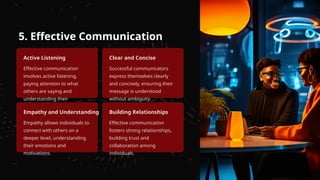
5. Effective Communication
Active Listening
Effective communication
involves active listening,
paying attention to what
others are saying and
understanding their
perspectives.
Clear and Concise
Successful communicators
express themselves clearly
and concisely, ensuring their
message is understood
without ambiguity.
Empathy and Understanding
Empathy allows individuals to
connect with others on a
deeper level, understanding
their emotions and
motivations.
Building Relationships
Effective communication
fosters strong relationships,
building trust and
collaboration among
individuals.
6. Risk-Taking and Calculated
Decisions
Risk Assessment Evaluate potential outcomes,
both positive and negative.
Calculated Approach Weigh the risks and rewards
carefully, making informed
decisions.
Embrace Uncertainty Be comfortable with
uncertainty and accept that not
all outcomes are predictable.
Learn from Mistakes View failures as learning
opportunities, adapting
strategies for future endeavors.
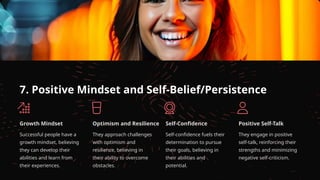
7. Positive Mindset and Self-Belief/Persistence
Growth Mindset
Successful people have a
growth mindset, believing
they can develop their
abilities and learn from
their experiences.
Optimism and Resilience
They approach challenges
with optimism and
resilience, believing in
their ability to overcome
obstacles.
Self-Confidence
Self-confidence fuels their
determination to pursue
their goals, believing in
their abilities and
potential.
Positive Self-Talk
They engage in positive
self-talk, reinforcing their
strengths and minimizing
negative self-criticism.
8. Networking and Relationship Building
Building Connections
Successful people actively build relationships with
others, fostering a network of connections that
provide support and opportunities.
Mentorship and Collaboration
They seek mentorship and collaborate with others,
learning from their experiences and sharing their
knowledge.
9. Discipline and Consistency
1 Self-Discipline
Discipline involves setting goals, creating a plan, and
following through consistently, even when faced
with challenges.
2 Habit Formation
Successful people develop positive habits that
support their goals, creating routines that promote
consistency and productivity.
3 Long-Term Vision
They understand that success is a journey that
requires consistent effort and dedication over time.
4 Perseverance
Perseverance fuels their commitment to their goals,
overcoming obstacles and setbacks with unwavering
determination.
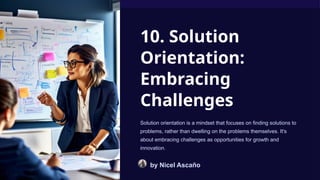
10. Solution
Orientation:
Embracing
Challenges
Solution orientation is a mindset that focuses on finding solutions to
problems, rather than dwelling on the problems themselves. It's
about embracing challenges as opportunities for growth and
innovation.
by Nicel Ascaño
Identifying Problems and
Opportunities
1 Problem Definition
Clearly define the problem
to be solved. What are the
symptoms? What are the
root causes?
2 Opportunity
Exploration
Identify potential
opportunities related to the
problem. Could this
problem be a chance to
improve processes or
develop new solutions?
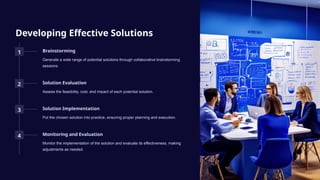
Developing Effective Solutions
1 Brainstorming
Generate a wide range of potential solutions through collaborative brainstorming
sessions.
2 Solution Evaluation
Assess the feasibility, cost, and impact of each potential solution.
3 Solution Implementation
Put the chosen solution into practice, ensuring proper planning and execution.
4 Monitoring and Evaluation
Monitor the implementation of the solution and evaluate its effectiveness, making
adjustments as needed.
Promoting Traits of
Successful People
at Home
This presentation explores strategies to cultivate essential traits of
successful individuals within the family setting. By instilling these
values in children, parents can empower them to thrive in all aspects
of life.
by Nicel Ascaño
Importance of Developing
Positive Habits
Positive habits are the building blocks of success. They create a
foundation for achieving goals and overcoming challenges.
1 Consistency
Establish routines that
promote positive
behaviors, such as reading,
exercise, or mindfulness.
2 Accountability
Encourage self-reflection
and tracking progress,
fostering a sense of
responsibility for personal
growth.
3 Purposeful Actions
Instill a focus on
meaningful activities that
align with values and
aspirations.
4 Continuous
Improvement
Embrace a mindset of
lifelong learning and
striving for excellence in all
areas.
Fostering a Growth Mindset
A growth mindset emphasizes the belief that intelligence and abilities can be developed through effort and learning.
Embrace Challenges
Encourage children to see
challenges as opportunities for
growth and learning.
Learn from Mistakes
Help them view mistakes as
valuable lessons and opportunities
to improve.
Persistence and Effort
Emphasize the importance of
perseverance and dedication in
achieving goals.
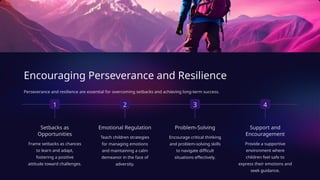
Encouraging Perseverance and Resilience
Perseverance and resilience are essential for overcoming setbacks and achieving long-term success.
1
Setbacks as
Opportunities
Frame setbacks as chances
to learn and adapt,
fostering a positive
attitude toward challenges.
2
Emotional Regulation
Teach children strategies
for managing emotions
and maintaining a calm
demeanor in the face of
adversity.
3
Problem-Solving
Encourage critical thinking
and problem-solving skills
to navigate difficult
situations effectively.
4
Support and
Encouragement
Provide a supportive
environment where
children feel safe to
express their emotions and
seek guidance.
Cultivating Effective Time Management
Effective time management is crucial for prioritizing tasks and maximizing productivity.
Goal Setting
Help children identify their goals and break them down into smaller, manageable steps.
Planning and Prioritization
Teach them how to plan their time, prioritize tasks, and create schedules.
Time Tracking
Encourage children to track their time to identify areas for improvement and optimize
their productivity.
Mindfulness and Focus
Promote mindfulness practices and strategies for avoiding distractions to maintain
focus and concentration.
Promoting Financial
Responsibility
Financial literacy and responsibility are vital for making informed decisions
and achieving financial security.
Age-Appropriate Discussions Engage in age-appropriate
conversations about money,
saving, spending, and budgeting.
Allowance and Chores Provide allowances or assign
chores linked to earning and
managing money.
Saving Goals Encourage children to set saving
goals and track their progress.
Financial Education Introduce basic concepts of
investing, banking, and debt
management.
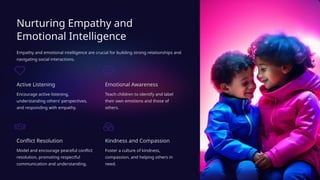
Nurturing Empathy and
Emotional Intelligence
Empathy and emotional intelligence are crucial for building strong relationships and
navigating social interactions.
Active Listening
Encourage active listening,
understanding others' perspectives,
and responding with empathy.
Emotional Awareness
Teach children to identify and label
their own emotions and those of
others.
Conflict Resolution
Model and encourage peaceful conflict
resolution, promoting respectful
communication and understanding.
Kindness and Compassion
Foster a culture of kindness,
compassion, and helping others in
need.
Instilling a Sense of Purpose
and Meaning
A sense of purpose and meaning drives motivation and creates a sense of
fulfillment in life.
Values and Beliefs
Discuss family values and beliefs,
fostering a sense of identity and
purpose.
Passion and Interests
Encourage children to explore
their passions and interests,
nurturing their talents and
abilities.
Community Involvement
Promote volunteerism and
community involvement,
fostering a sense of responsibility
and connection.
Positive Contributions
Encourage children to find ways
to make a positive impact on the
world, big or small.
Encouraging Continuous Learning and Skill
Development
Lifelong learning is essential for adapting to changing environments and achieving personal growth.
Reading
Encourage a love of reading by
providing access to a variety of
books and creating a positive
reading environment.
Hands-on Learning
Provide opportunities for hands-on
learning through experiments,
projects, and activities.
Collaborative Learning
Foster a collaborative learning
environment where children can
learn from each other and share
knowledge.
Modeling Effective Communication and Collaboration
Effective communication and collaboration skills are essential for building strong relationships and achieving shared goals.
1 Respectful Communication
Model respectful communication and active listening,
encouraging open dialogue and understanding.
2 Conflict Resolution
Teach children how to resolve conflicts peacefully and
respectfully, fostering compromise and empathy.
3 Teamwork and Collaboration
Create opportunities for family members to work together
on projects or tasks, promoting teamwork and
collaboration.
4 Open Dialogue
Encourage open dialogue and communication, creating a
safe space for sharing thoughts and feelings.
DEEPENING
1. Which of these traits do you think is
the most important? Choose your top
3 and explain why?
2. Do you think you encourage and
model these traits at home? Provide
specific practical examples on how
you are modelling them.
by Nicel Ascaño

setting limits and understanding va.pptx

  • 1.
    SESSION 2 Setting Limitsand Understanding Consequences of Values Setting limits is about taking control of your life. It's about making conscious choices that align with your values and priorities. Every decision has consequences, both positive and negative, and understanding those impacts is crucial for making informed decisions. by Nicel Ascaño

  • 2.
    SESSION 2 Setting Limitsand Understanding Consequences of Values Setting limits is about taking control of your life. It's about making conscious choices that align with your values and priorities. Every decision has consequences, both positive and negative, and understanding those impacts is crucial for making informed decisions. by Nicel Ascaño
  • 3.
    Defining Personal Values Personalvalues are the guiding principles that shape our beliefs, attitudes, and behaviors. They are the fundamental beliefs that we hold dear and that influence our decisions. It is essential to identify and prioritize your values so that you can live a life that is authentic and fulfilling. Integrity Honesty, trustworthiness, and ethical conduct. Compassion Empathy, kindness, and concern for others. Growth Continuously learning, developing, and expanding your knowledge and skills. Freedom Independence, autonomy, and the ability to make choices without undue influence.
  • 4.
  • 5.
    Identifying Priorities Priorities arethose aspects of our lives that we deem most important and worthy of our time and energy. It's important to identify and prioritize your goals so that you can focus on what matters most to you. Personal Relationships, health, personal growth, hobbies. Professional Career goals, work-life balance, professional development. Financial Saving, investing, managing debt, financial security.
  • 6.
    Establishing Boundaries Boundaries arelimits that we set to protect our physical, emotional, and mental well- being. They define what is acceptable and unacceptable behavior and help us maintain healthy relationships. They are essential for our well-being and help us to avoid burnout, resentment, and conflict. Identify Your Needs What are your needs in this situation? Communicate Your Limits Clearly state your boundaries. Enforce Your Boundaries Stick to your limits, even if it means saying no.
  • 7.
    Communicating Limits Effectively Clear communicationis crucial when setting limits. Be direct, assertive, and respectful. Avoid being apologetic or hesitant. Clearly express what you are willing and unwilling to do. 1 Use "I" Statements Focus on your needs and feelings. 2 Be Specific Clearly define what you are willing or unwilling to do. 3 Set Consequences State what will happen if your boundaries are crossed. 4 Be Consistent Enforce your boundaries consistently.
  • 8.
    Addressing Pushback and Resistance Peoplemay resist your limits, but it's important to remain firm and consistent. Acknowledge their feelings but reiterate your boundaries. Don't engage in arguments or debates. Stick to your limits. Pushback Response Anger Remain calm and assertive. Guilt Trips Don't be manipulated; focus on your needs. Threats Set consequences and follow through.
  • 9.
    Recognizing the RippleEffect of Choices Every choice we make has a ripple effect. Our actions impact not only ourselves but also the people around us and the environment. Understanding this ripple effect is important for making responsible and ethical decisions. Relationships How your choices affect those you care about. Career The impact of your choices on your professional path. Planet The environmental consequences of your choices. Society The influence of your choices on your community.
  • 10.
    Evaluating Short-Term andLong- Term Impacts It's crucial to consider the short-term and long-term consequences of our choices. Sometimes, short-term rewards can lead to long-term problems. Understanding the full implications of our decisions helps us make choices that are aligned with our values and goals. 1 Immediate Gratification Short-term pleasure or reward. 2 Long-Term Impact Consequences that may unfold over time. 3 Decision Making Weighing short-term vs. long-term.
  • 11.
    Developing Accountability Measures Accountabilityplays a vital role in setting limits. Developing accountability measures, such as tracking progress, seeking feedback, and reflecting on your choices, can help you stay on track and make consistent progress towards your goals. Vision Boards Visual reminders of your goals. Journaling Documenting your journey and insights.
  • 12.
    Embracing the Powerof Saying No Saying no is not a sign of weakness; it's a sign of strength. It allows you to protect your time, energy, and resources. By saying no to things that don't align with your values and priorities, you create space for the things that truly matter. 1 Avoid Feeling Overwhelmed Saying no helps you manage your commitments. 2 Maintain a Healthy Balance It allows you to prioritize what is important. 3 Protect Your Time and Energy It prevents you from being drained by commitments you don't want. 4 Focus on What Matters It helps you allocate your resources wisely.
  • 13.
    Setting Limits and UnderstandingConsequences of Values 1. Defining Personal Values 2. Identifying Priorities 3. Establishing Boundaries 4. Communicating Limits Effectively 5. Addressing Pushback and Resistance 6. Recognizing the Ripple Effect of Choices 7. Evaluating Short-Term and Long-Term Impacts 8. Developing Accountability Measures 9. Embracing the Power of Saying No
  • 14.
    Traits of Successful People Successis a multifaceted concept, but certain qualities consistently stand out among those who achieve remarkable things. Let's explore these traits and understand how they contribute to a fulfilling and impactful life. by Nicel Ascaño
  • 15.
    1. Unyielding Commitment to ConstantLearning Embrace a mindset of lifelong learning, continuously seeking new knowledge and skills. A relentless pursuit of personal and professional development. by Nicel Ascaño
  • 16.
    Embrace a GrowthMindset Challenge Yourself Step outside of your comfort zone. Take on new responsibilities, learn new skills, and push your limits. Embrace Failure View mistakes as opportunities for growth. Learn from your setbacks and use them as fuel to improve. Seek Feedback Actively solicit feedback from mentors, colleagues, and even yourself. Use feedback to identify areas for improvement. Practice Deliberately Practice with the intent of improving, and focus on the areas where you need to grow. Be intentional in your learning.
  • 17.
    Continuously Seek New Knowledgeand Skills 1 Read Books and Articles Stay up-to-date with the latest trends in your field. Read industry publications, research articles, and books. 2 Attend Conferences and Workshops Network with other professionals, learn from experts, and gain new perspectives on your field. 3 Take Online Courses Online courses offer a flexible way to learn new skills and knowledge. 4 Find a Mentor Seek guidance from an experienced professional. A mentor can provide valuable insights and support.
  • 18.
    Continuous Learning andGrowth 1 Seeking Knowledge Successful people have a thirst for knowledge, constantly seeking new information and insights to expand their understanding. 2 Embrace Challenges They view challenges as opportunities for growth and development, actively seeking out situations that push them beyond their comfort zones. 3 Lifelong Learning Continuous learning is a lifelong pursuit, embracing new skills, perspectives, and experiences to stay ahead of the curve.
  • 19.
    2. Passion andPurpose 1 Fueled by Passion Success often stems from a deep-seated passion for something, a driving force that propels individuals to achieve their goals. 2 Clear Purpose Having a clear purpose in life provides direction and motivation, guiding individuals towards their aspirations. 3 Meaningful Contributions Passion and purpose allow individuals to make meaningful contributions to the world, leaving a lasting impact on others. 4 Overcoming Challenges Passion and purpose provide resilience to navigate challenges and setbacks, fueling the determination to persevere.
  • 20.
    3. Resilience andAdaptability Bouncing Back Resilience allows individuals to bounce back from setbacks, learn from mistakes, and adapt to changing circumstances. Flexibility Adaptability enables individuals to adjust their strategies and approaches as needed, remaining flexible in the face of uncertainty. Embrace Change Successful people embrace change as an opportunity for growth and development, adapting to new situations with a positive mindset.
  • 21.
    4. Time Managementand Productivity/Sense of Urgency Prioritization Successful people prioritize tasks effectively, focusing on the most important activities that align with their goals. Time Blocking Time blocking involves scheduling specific time slots for different tasks, maximizing productivity and minimizing distractions. Delegation Effective delegation allows individuals to focus on high-impact tasks by entrusting certain responsibilities to others. Efficient Processes Successful people develop efficient processes and workflows to streamline their work and eliminate unnecessary steps.
  • 22.
    5. Effective Communication ActiveListening Effective communication involves active listening, paying attention to what others are saying and understanding their perspectives. Clear and Concise Successful communicators express themselves clearly and concisely, ensuring their message is understood without ambiguity. Empathy and Understanding Empathy allows individuals to connect with others on a deeper level, understanding their emotions and motivations. Building Relationships Effective communication fosters strong relationships, building trust and collaboration among individuals.
  • 23.
    6. Risk-Taking andCalculated Decisions Risk Assessment Evaluate potential outcomes, both positive and negative. Calculated Approach Weigh the risks and rewards carefully, making informed decisions. Embrace Uncertainty Be comfortable with uncertainty and accept that not all outcomes are predictable. Learn from Mistakes View failures as learning opportunities, adapting strategies for future endeavors.
  • 24.
    7. Positive Mindsetand Self-Belief/Persistence Growth Mindset Successful people have a growth mindset, believing they can develop their abilities and learn from their experiences. Optimism and Resilience They approach challenges with optimism and resilience, believing in their ability to overcome obstacles. Self-Confidence Self-confidence fuels their determination to pursue their goals, believing in their abilities and potential. Positive Self-Talk They engage in positive self-talk, reinforcing their strengths and minimizing negative self-criticism.
  • 25.
    8. Networking andRelationship Building Building Connections Successful people actively build relationships with others, fostering a network of connections that provide support and opportunities. Mentorship and Collaboration They seek mentorship and collaborate with others, learning from their experiences and sharing their knowledge.
  • 26.
    9. Discipline andConsistency 1 Self-Discipline Discipline involves setting goals, creating a plan, and following through consistently, even when faced with challenges. 2 Habit Formation Successful people develop positive habits that support their goals, creating routines that promote consistency and productivity. 3 Long-Term Vision They understand that success is a journey that requires consistent effort and dedication over time. 4 Perseverance Perseverance fuels their commitment to their goals, overcoming obstacles and setbacks with unwavering determination.
  • 27.
    10. Solution Orientation: Embracing Challenges Solution orientationis a mindset that focuses on finding solutions to problems, rather than dwelling on the problems themselves. It's about embracing challenges as opportunities for growth and innovation. by Nicel Ascaño
  • 28.
    Identifying Problems and Opportunities 1Problem Definition Clearly define the problem to be solved. What are the symptoms? What are the root causes? 2 Opportunity Exploration Identify potential opportunities related to the problem. Could this problem be a chance to improve processes or develop new solutions?
  • 29.
    Developing Effective Solutions 1Brainstorming Generate a wide range of potential solutions through collaborative brainstorming sessions. 2 Solution Evaluation Assess the feasibility, cost, and impact of each potential solution. 3 Solution Implementation Put the chosen solution into practice, ensuring proper planning and execution. 4 Monitoring and Evaluation Monitor the implementation of the solution and evaluate its effectiveness, making adjustments as needed.
  • 30.
    Promoting Traits of SuccessfulPeople at Home This presentation explores strategies to cultivate essential traits of successful individuals within the family setting. By instilling these values in children, parents can empower them to thrive in all aspects of life. by Nicel Ascaño
  • 31.
    Importance of Developing PositiveHabits Positive habits are the building blocks of success. They create a foundation for achieving goals and overcoming challenges. 1 Consistency Establish routines that promote positive behaviors, such as reading, exercise, or mindfulness. 2 Accountability Encourage self-reflection and tracking progress, fostering a sense of responsibility for personal growth. 3 Purposeful Actions Instill a focus on meaningful activities that align with values and aspirations. 4 Continuous Improvement Embrace a mindset of lifelong learning and striving for excellence in all areas.
  • 32.
    Fostering a GrowthMindset A growth mindset emphasizes the belief that intelligence and abilities can be developed through effort and learning. Embrace Challenges Encourage children to see challenges as opportunities for growth and learning. Learn from Mistakes Help them view mistakes as valuable lessons and opportunities to improve. Persistence and Effort Emphasize the importance of perseverance and dedication in achieving goals.
  • 33.
    Encouraging Perseverance andResilience Perseverance and resilience are essential for overcoming setbacks and achieving long-term success. 1 Setbacks as Opportunities Frame setbacks as chances to learn and adapt, fostering a positive attitude toward challenges. 2 Emotional Regulation Teach children strategies for managing emotions and maintaining a calm demeanor in the face of adversity. 3 Problem-Solving Encourage critical thinking and problem-solving skills to navigate difficult situations effectively. 4 Support and Encouragement Provide a supportive environment where children feel safe to express their emotions and seek guidance.
  • 34.
    Cultivating Effective TimeManagement Effective time management is crucial for prioritizing tasks and maximizing productivity. Goal Setting Help children identify their goals and break them down into smaller, manageable steps. Planning and Prioritization Teach them how to plan their time, prioritize tasks, and create schedules. Time Tracking Encourage children to track their time to identify areas for improvement and optimize their productivity. Mindfulness and Focus Promote mindfulness practices and strategies for avoiding distractions to maintain focus and concentration.
  • 35.
    Promoting Financial Responsibility Financial literacyand responsibility are vital for making informed decisions and achieving financial security. Age-Appropriate Discussions Engage in age-appropriate conversations about money, saving, spending, and budgeting. Allowance and Chores Provide allowances or assign chores linked to earning and managing money. Saving Goals Encourage children to set saving goals and track their progress. Financial Education Introduce basic concepts of investing, banking, and debt management.
  • 36.
    Nurturing Empathy and EmotionalIntelligence Empathy and emotional intelligence are crucial for building strong relationships and navigating social interactions. Active Listening Encourage active listening, understanding others' perspectives, and responding with empathy. Emotional Awareness Teach children to identify and label their own emotions and those of others. Conflict Resolution Model and encourage peaceful conflict resolution, promoting respectful communication and understanding. Kindness and Compassion Foster a culture of kindness, compassion, and helping others in need.
  • 37.
    Instilling a Senseof Purpose and Meaning A sense of purpose and meaning drives motivation and creates a sense of fulfillment in life. Values and Beliefs Discuss family values and beliefs, fostering a sense of identity and purpose. Passion and Interests Encourage children to explore their passions and interests, nurturing their talents and abilities. Community Involvement Promote volunteerism and community involvement, fostering a sense of responsibility and connection. Positive Contributions Encourage children to find ways to make a positive impact on the world, big or small.
  • 38.
    Encouraging Continuous Learningand Skill Development Lifelong learning is essential for adapting to changing environments and achieving personal growth. Reading Encourage a love of reading by providing access to a variety of books and creating a positive reading environment. Hands-on Learning Provide opportunities for hands-on learning through experiments, projects, and activities. Collaborative Learning Foster a collaborative learning environment where children can learn from each other and share knowledge.
  • 39.
    Modeling Effective Communicationand Collaboration Effective communication and collaboration skills are essential for building strong relationships and achieving shared goals. 1 Respectful Communication Model respectful communication and active listening, encouraging open dialogue and understanding. 2 Conflict Resolution Teach children how to resolve conflicts peacefully and respectfully, fostering compromise and empathy. 3 Teamwork and Collaboration Create opportunities for family members to work together on projects or tasks, promoting teamwork and collaboration. 4 Open Dialogue Encourage open dialogue and communication, creating a safe space for sharing thoughts and feelings.
  • 40.
    DEEPENING 1. Which ofthese traits do you think is the most important? Choose your top 3 and explain why? 2. Do you think you encourage and model these traits at home? Provide specific practical examples on how you are modelling them. by Nicel Ascaño