
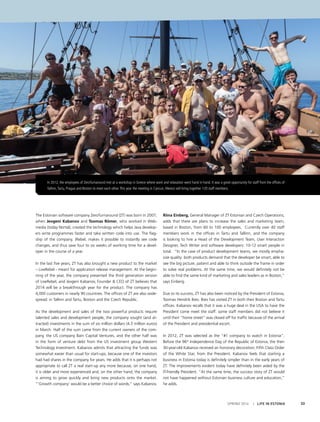

SPRING I 2014
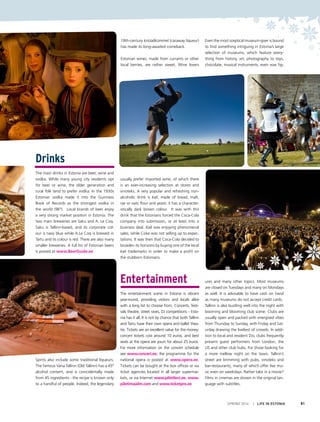
SPECIAL!
Government
Leading
Innovation
land & people I state & society I economy & business I technology & innovation I culture & entertainment I tourism
The e-Tiger Continues To Growl
Taavi Kotka:
Estonia Moves Into
The Cloud
Hot
#EstonianMafia
Start-Ups
Arvo Pärt's
Music
Emanates
Love
Cleantech
Innovation Estonia Aims
For Real Time
Economy
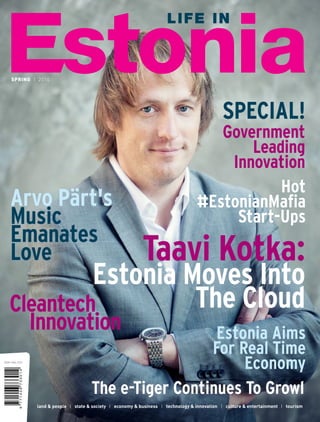
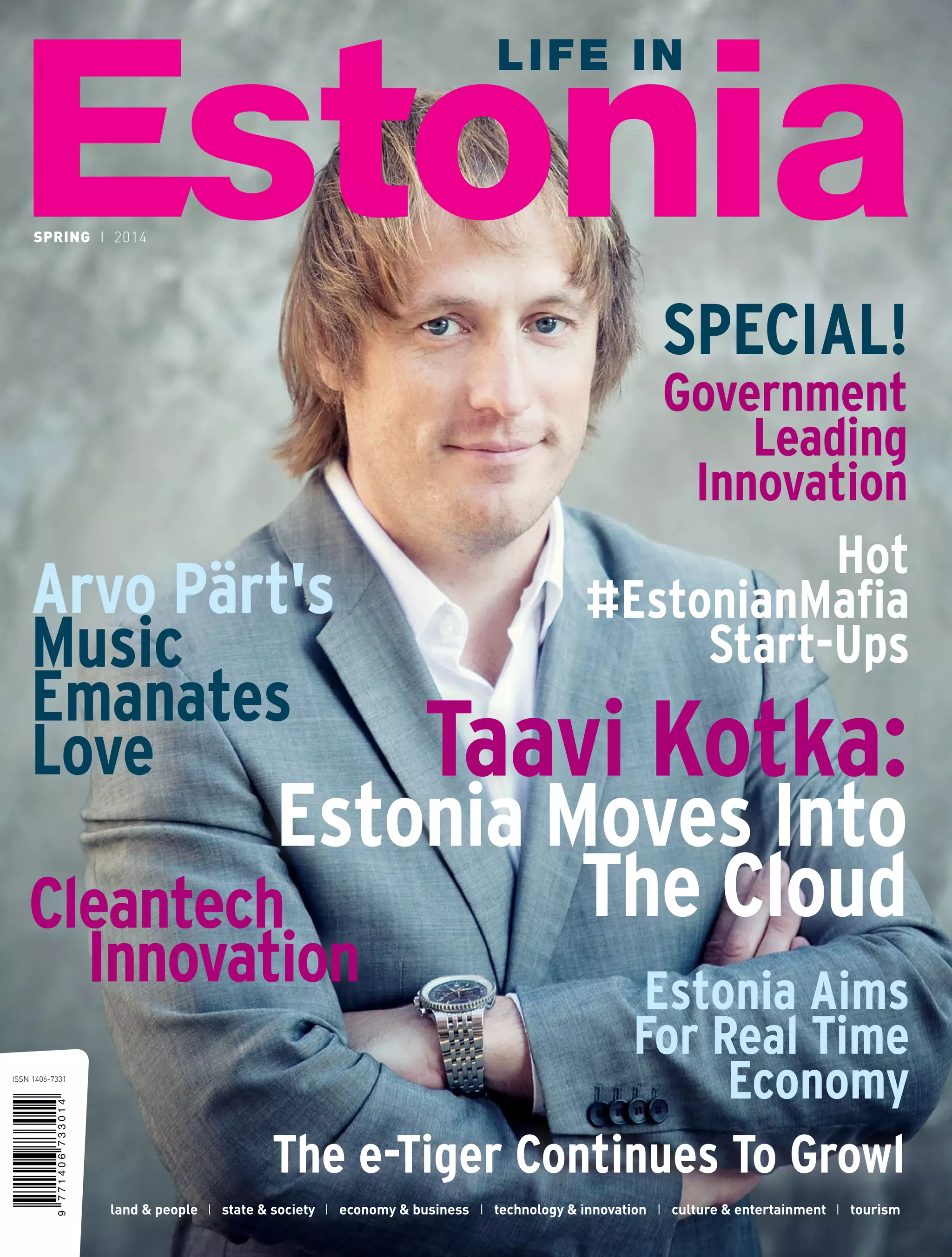
COVER
Taavi Kotka
Photo by:
Tiina-Liina Uudam
Executive publisher
Positive Projects
Pärnu mnt 69, 10134 Tallinn, Estonia
think@positive.ee
Editor
Reet Grosberg
reet.grosberg@ambassador.ee
Translation
Ingrid Hübscher
Ambassador Translation Agency
Language editor
Richard Adang
Design & Layout
Positive Design
Partner
SPRING 2014 I LIFE IN ESTONIA 3
In Estonia we can see a version of the in-
terconnected and computerized future
that is inextricably a part of the funda-
mental operations of society: 25% of the
electorate votes online, nearly 100% of
prescriptions and tax returns are done on-
line, as is almost all banking. Estonians have
given 140 million digital signatures, and last
December, Estonian and Finnish PMs signed
the first international treaty digitally. Add-
ing to this near 100% broadband coverage
and countrywide Wi-Fi, Estonia is one of the
most wired countries in the world.
As a country so dependent on digital solu-
tions, the whole of ICT infrastructure must
be regarded as an “ecosystem” in which
everything is interconnected. It functions as
a whole, thus it needs to be defended as a
whole. The more digitized we are, the more
vulnerable we are. It is therefore crucial to un-
derstand that cyber security is not just a matter
of blocking the bad things a cyber attack can
do; it is one of protecting all the good things
that cyber insecurity can prevent us from do-
ing – in other words, cyber security should not
be seen as an additional cost but as an enabler,
guarding our entire digital way of life.
However, even though we cannot take security
issues lightly, they cannot be used as an excuse
to limit freedom of expression. Freedom and
security need not contradict each other: on the
contrary, secure online interactions, enabled by
a secure online identity, is a precondition for full
internet freedom.
The freedoms we value are equally valid online as
well as offline. Those of us, for whom democratic
values are important, want to find a balance be-
tween security, privacy and free flow of informa-
tion. An encouraging example is Estonia, where
all residents are provided with a secure e-services
system while Estonia has also been ranked as the
first or one of the first in Internet freedom for sev-
eral years in a row.
Cooperation has been the guiding principle of our
IT success. As we prepare for the new opportunities
and challenges that will arise in the coming years,
we recognize that cooperation with and among
the Baltic Sea states and in transatlantic and inter-
national forums will be crucial to our success. We
are stronger and our reach is wider when we work
together and combine our efforts in pursuit of our
common goals.
I am glad that the Estonian ICT Week 2014 will
seek to demonstrate the interconnection between
innovation and the culture of start-up companies,
the awareness of net neutrality issues and the ca-
pability to implement IT solutions within states and
over state borders.
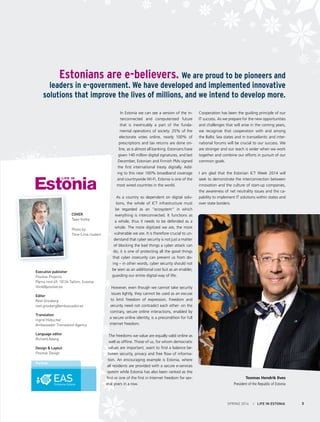
Toomas Hendrik Ilves
President of the Republic of Estonia
Estonians are e-believers. We are proud to be pioneers and
leaders in e-government. We have developed and implemented innovative
solutions that improve the lives of millions, and we intend to develop more.
6 		 Where To Go This Season?
		 Life In Estonia Recommends
8		 News
10 	 Events
The two most important international events to be hosted in Tallinn
are the international information and communications technology week
“Estonian ICT Week 2014”, from 23-30 April and the FinanceEstonia
International Forum 2014, from 17-18 June.
16 	 Estonia As A Country Moves
Into The Cloud And Expands
All Over The World!
Taavi Kotka, the Estonian government CIO, talks about taking the al-
ready successful e-state onto a totally new level: Estonia has an ambi-
tious plan of moving the state into a data cloud spread all over the
world. In addition, with the help of ICT, there can well be ten million
Estonians by 2020 instead of the current one million.
20	 Estonia: The Little Country
With A Start-Up Mindset
Sten Tamkivi, now an EIR at Andreessen Horowitz, who became known
as the Chief Evangelist of Skype, tells the story of Estonia’s IT success.
23 	 Estonian Tax Board 2.0
Presents: Real Time
Economy
The famous Estonian e-Tax Board has been admired and set as an ex-
ample all around the world. Where else can you submit your tax return
in just a few clicks and all declarations online without spending days on
end filling out paper forms? Marek Helm, Head of the Estonian Tax and
Customs Board, claims that although our e-Tax Board is admired all over
the world, the time is ripe for some qualitative changes.
26 	 What To Do With Legacy?
Implement No-legacy Policy
Estonia wants to introduce a no-legacy principle, which would require
us to renew all the state IT systems and technologies after a certain
amount of time, to keep in line with the ever-changing environment
and development of technology. Aet Rahe, Head of State Information
Systems Department, Ministry of Economic Affairs and Communica-
tions, introduces the policy.
28 	 The Estonian Government
Is About To Boost Seed
Investments In Estonia In
2014
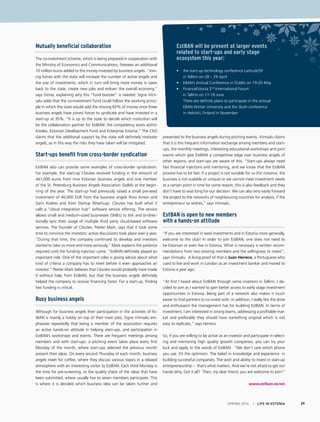
EstBAN is an umbrella organisation for business angels and business
angel groups seeking investment opportunities in Estonia and its neigh-
bouring regions with an aim to grow the quantity and quality of local
seed stage investments. Signe Viimsalu, CEO of EstBAN, gives an over-
view of the main goals in 2014.
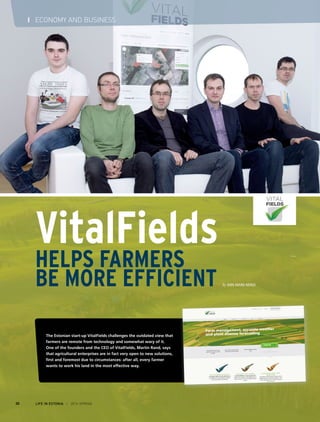
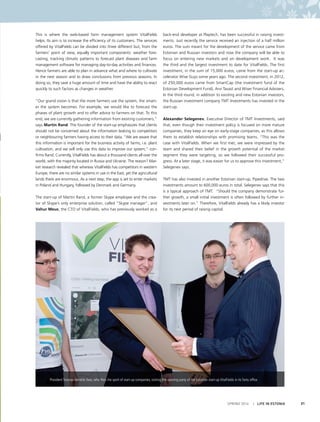
30 	 VitalFields Helps Farmers Be
More Efficient
The Estonian start-up VitalFields, which offers web-based services for
farm management, accurate weather and plant disease forecasting,
challenges the outdated view that farmers are remote from technology
and somewhat wary of it. The CEO of VitalFields, Martin Rand, says that
agricultural enterprises are in fact very open to new solutions.
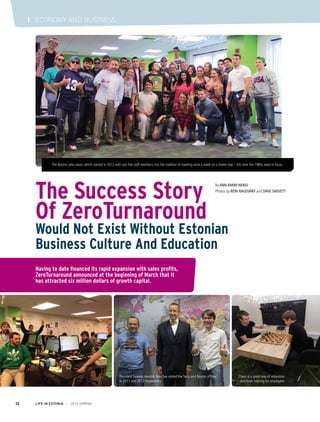
32 	 The Success Story Of
ZeroTurnaround
Having to date financed its rapid expansion with sales profits, Zero-
Turnaround announced at the beginning of March that it has attracted
six million dollars of growth capital.
34 	 Pipedrive – Estonian
Company in Shaq O’Neal’s
Investment Portfolio
The Estonian company Pipedrive has developed valued customer man-
agement software which provides wise and practical help to any sales-
man. Recently, the Silicon Valley technology guru Vivek Ranadive and the
former star basketball player Shaquille O’Neal invested in the company.
36 	 Estonia Can Change
		 The World, Will It?
Carl Pucci of Datel Ovela, the subsidiary of Datel AS, acknowledges
Estonian ICT technologies, many of which would be an excellent fit for
the global market.
I CONTENT
SPRING_2014
LIFE IN ESTONIA I 2014 SPRING4
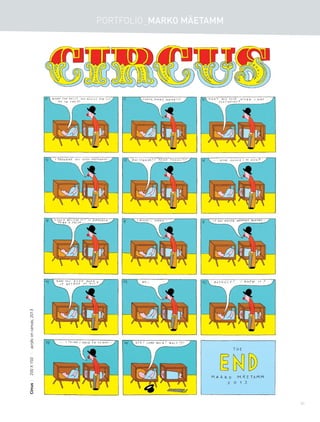
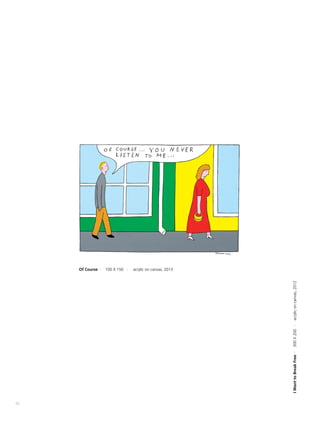
51 	 Portfolio –
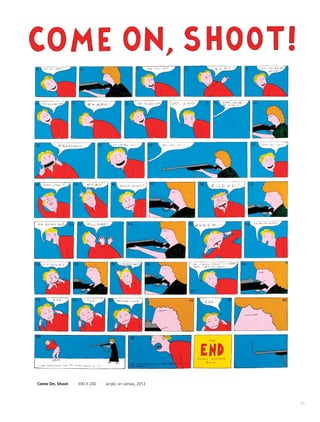
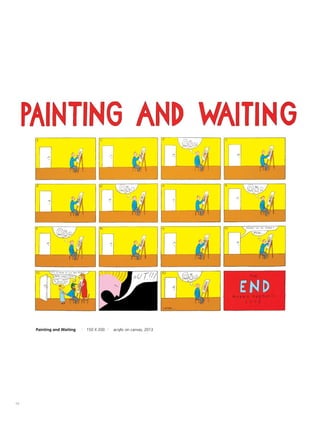
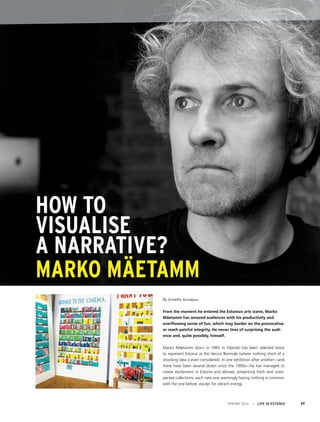
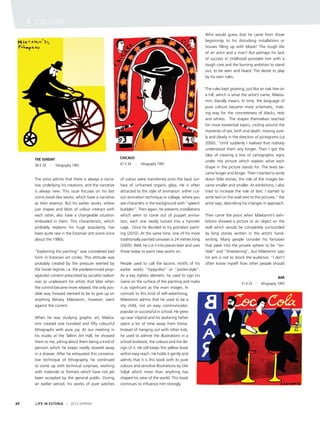
Marko Mäetamm
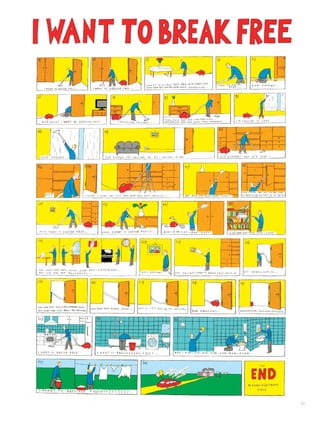
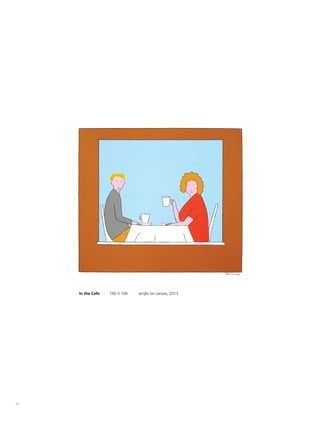
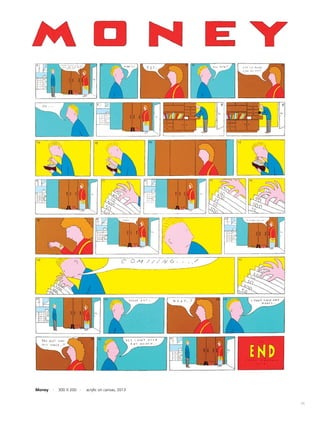
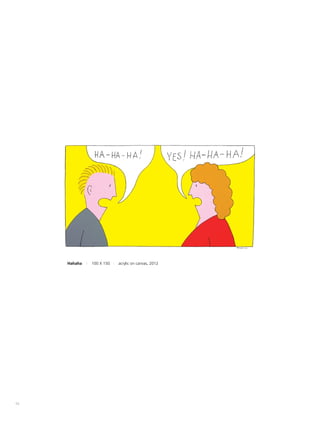
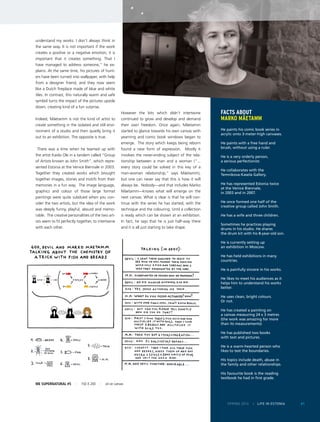
From the moment he entered the Estonian arts scene, Marko Mäetamm
has amazed audiences with his productivity and overflowing sense of
fun, which may border on the provocative or reach painful integrity. He
never tires of surprising the audience and, quite possibly, himself.
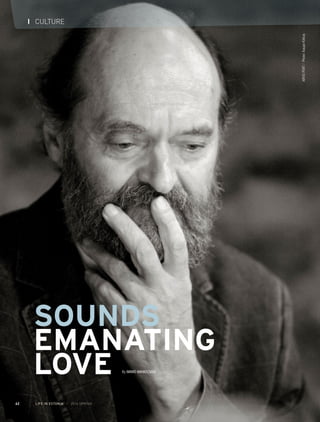
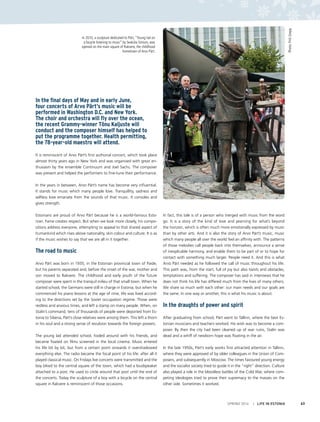
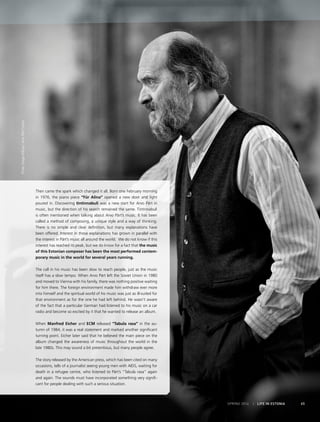
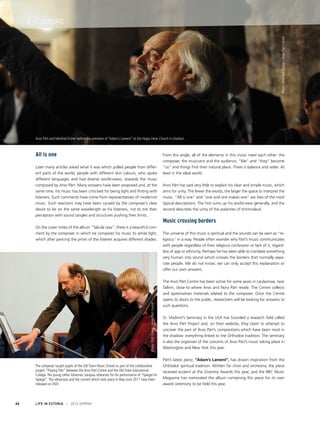
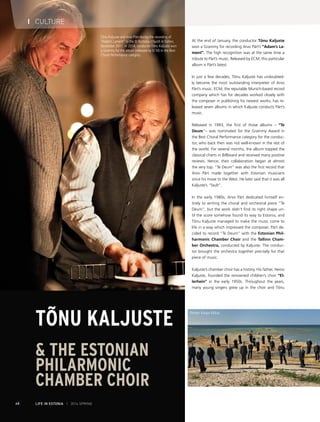
62 	 Sounds Emanating Love
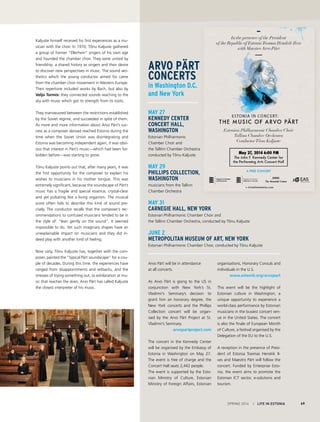
At the turn of May and June, four concerts of Arvo Pärt’s music will be
performed in Washington D.C. and New York. The Estonian Philhar-
monic Chamber Choir and orchestra will fly over the ocean, the recent
Grammy-winner Tõnu Kaljuste will conduct and the composer himself
has helped to put the programme together. What is the secret behind
the music of the most well-known Estonian? Life in Estonia tries to find
the answer.
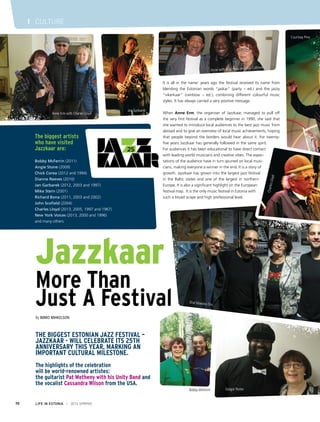
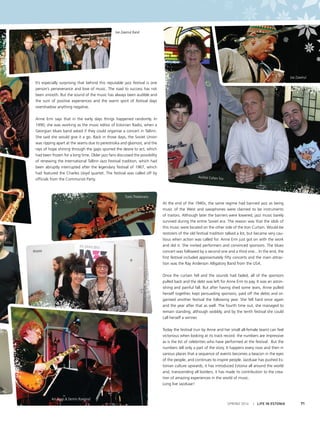
68 	 Jazzkaar – More Than
		 Just A Festival
The biggest Estonian jazz festival – Jazzkaar - will celebrate its 25th an-
niversary this year, marking an important cultural milestone. Let’s cast a
look at the history of the festival.
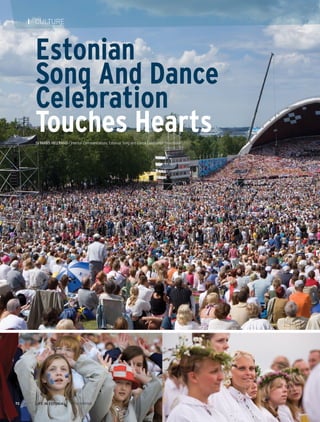
70 	 Estonian
Song And Dance Celebration
Touches Hearts
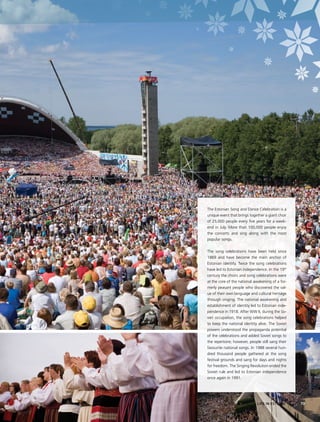
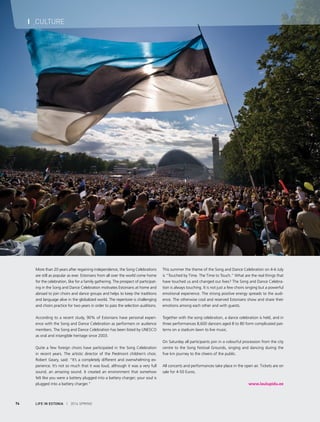
The Estonian Song and Dance Celebration is a unique event that brings
together a giant choir of 25,000 people every five years for a weekend
in July. More than 100,000 people enjoy the concerts and sing along
with the most popular songs. This summer the theme of the Song and
Dance Celebration on 4-6 July is “Touched by Time. The Time to Touch.”
73 	 Lottemaa Welcomes Visitors
Beginning In July
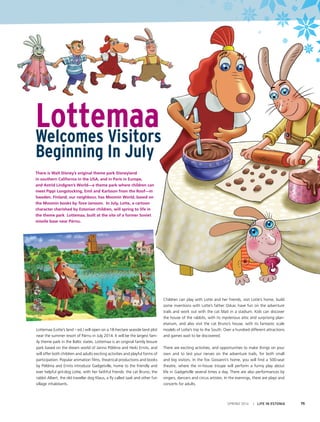
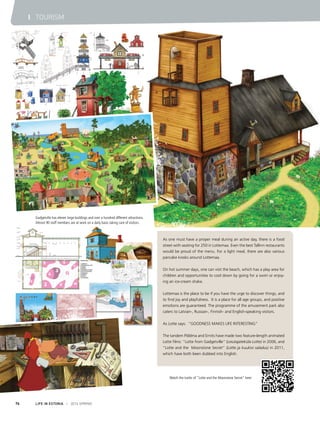
There is Walt Disney’s original theme park Disneyland in southern Cali-
fornia in the USA, and in Paris in Europe, and Astrid Lindgren’s World
in Sweden. Finland, our neighbour, has Moomin World. In July, Lotte,
a cartoon character cherished by Estonian children, will spring to life
in the theme park Lottemaa, built at the site of a former Soviet missile
base near Pärnu. 
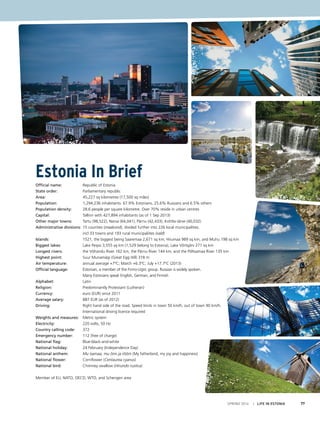
77 	 Estonia In Brief
78 	 Practical Information
	 For Visitors
38 	 Next Silicon Valleys:
		 Small Estonia Has Big Ideas
Nigel Cassidy from BBC visited Estonia for innovative start-ups and, among
other things, found the Stigo scooter. He saw it, drove it, and liked it.
41 	 Nordic Cleantech Open
The third edition of the Nordic Cleantech Open competition saw a re-
cord-breaking 107 cleantech companies applying. An international jury
of more than 50 influential representatives of multinational companies
and venture capital firms selected the top 25. Out of the 11 impressive
Estonian cleantech start-up companies which entered the competition,
Cityntel and Stigo both made it to the top 25.
43 	 Startup Wise Guys
		 On The Hunt For B2B Start-ups
The Estonia-based start-up accelerator Startup Wise Guys is about to
commence its new programme, Business Tech. For the first time, they
are looking specifically for B2B start-ups only. Life in Estonia met with
Mike Reiner, the co-founder and managing director of Startup Wise
Guys to find out more about the guys.
46 	 GameFounders: We Believe
In The Gaming Industry
GameFounders is the first European business accelerator exclusively
working with game studios. The accelerator was started in 2012 and,
in the past two years, it has become a considerable player in the game
industry.
47 	 How Do We Fix Maths
Education?
“I hated maths”– this is something we often hear from former school
leavers. The problem is not unique to Estonia. The British educational vi-
sionary Conrad Wolfram has developed a programme called Computer-
Based Math, and Estonia is the first country in the world to implement
this programme in schools.
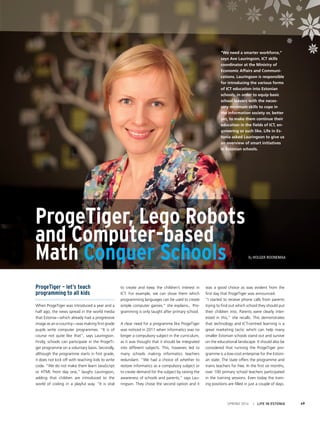
49 	 ProgeTiger, Lego Robots
And Computer-based Math
Conquer Schools
“We need a smarter workforce,” says Ave Lauringson, ICT skills coordina-
tor at the Ministry of Economic Affairs and Communications. Life in Esto-
nia asked her to give an overview of smart initiatives in Estonian schools.
SPRING 2014 I LIFE IN ESTONIA 5
LIFE IN ESTONIA I 2014 SPRING6
I WHERE TO GO THIS SEASON
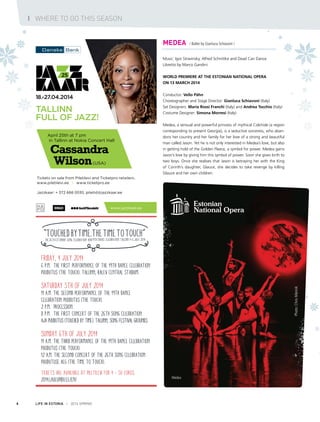
Friday, 4 July 2014
6 p.m. The first performance of the 19th dance celebration
Puudutus (The Touch). Tallinn, Kalev Central Stadium.
Saturday 5th of July 2014
11 a.m. The second performance of the 19th dance
celebration Puudutus (The Touch).
2 p.m. Procession.
8 p.m. The first concert of the 26th song celebration
Aja puudutus (Touched by Time). Tallinn, Song Festival Grounds.
Sunday 6th of July 2014
11 a.m. The third performance of the 19th dance celebration
Puudutus (The Touch).
12 a.m. The second concert of the 26th song celebration
Puudutuse aeg (The Time to Touch).
Tickets are available at Piletilevi for 4 – 50 Euros.
2014.laulupidu.ee/en/
MEDEA / Ballet by Gianluca Schiavoni /
Music: Igor Stravinsky, Alfred Schnittke and Dead Can Dance
Libretto by Marco Gandini
World premiere at the Estonian National Opera
on 13 March 2014
Conductor: Vello Pähn
Choreographer and Stage Director: Gianluca Schiavoni (Italy)
Set Designers: Maria Rossi Franchi (Italy) and Andrea Tocchio (Italy)
Costume Designer: Simona Morresi (Italy)
Medea, a sensual and powerful princess of mythical Colchide (a region
corresponding to present Georgia), is a seductive sorceress, who aban-
dons her country and her family for her love of a strong and beautiful
man called Jason. Yet he is not only interested in Medea’s love, but also
in getting hold of the Golden Fleece, a symbol for power. Medea gains
Jason’s love by giving him this symbol of power. Soon she gives birth to
two boys. Once she realises that Jason is betraying her with the King
of Corinth’s daughter, Glauce, she decides to take revenge by killing
Glauce and her own children.
Medea
Photo:ChrisMännik
SPRING 2014 I LIFE IN ESTONIA 7
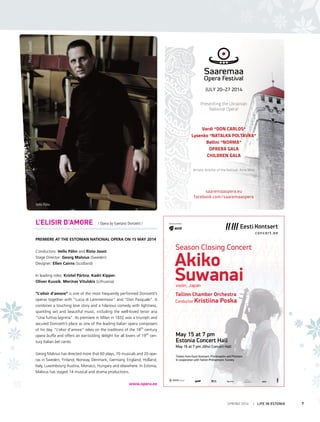
L’ELISIR D’AMORE / Opera by Gaetano Donizetti /
Premiere at the Estonian National Opera on 15 May 2014
Conductors: Vello Pähn and Risto Joost
Stage Director: Georg Malvius (Sweden)
Designer: Ellen Cairns (Scotland)
In leading roles: Kristel Pärtna, Kadri Kipper,
Oliver Kuusik, Merūnas Vitulskis (Lithuania)
“L’elisir d’amore” is one of the most frequently performed Donizetti’s
operas together with “Lucia di Lammermoor” and “Don Pasquale”. It
combines a touching love story and a hilarious comedy with lightness,
sparkling wit and beautiful music, including the well-loved tenor aria
“Una furtiva lagrima”. Its premiere in Milan in 1832 was a triumph and
secured Donizetti’s place as one of the leading Italian opera composers
of his day. “L’elisir d’amore” relies on the traditions of the 18th
century
opera buffa and offers an ear-tickling delight for all lovers of 19th
cen-
tury Italian bel canto.
Georg Malvius has directed more that 60 plays, 70 musicals and 20 ope-
ras in Sweden, Finland, Norway, Denmark, Germany, England, Holland,
Italy, Luxembourg Austria, Monaco, Hungary and elsewhere. In Estonia,
Malvius has staged 14 musical and drama productions.
www.opera.ee
May 15 at 7 pm
Estonia Concert Hall
May 16 at 7 pm Jõhvi Concert Hall
Tickets from Eesti Kontsert, Piletimaailm and Piletilevi
In cooperation with Tallinn Philharmonic Society
Akiko
Suwanaiviolin, Japan
Tallinn Chamber Orchestra
Conductor Kristiina Poska
Season Closing Concert
concert.ee
Eesti Kontserdi
suurtoetaja
Ametlik autopartner
hooaja peatoetaja
JULY 20–27 2014
Presenting the Ukrainian
National Opera!
Verdi “DON CARLOS“
Lysenko “NATALKA POLTAVKA“
Bellini “NORMA“
OPRERA GALA
CHILDREN GALA
Artistic director of the festival: Arne Mikk
saaremaaopera.eu
facebook.com/saaremaaopera
Vello Pähn
Photo:SuiradO
aUldrich
LIFE IN ESTONIA I 2014 SPRING8
The Estonian start-up Cognuse has beaten tough competition
to be included in the reputable US business accelerator DreamIt
Health. Cognuse develops and distributes innovative evaluation
and therapy solutions meant for cognitive rehabilitation patients.
A total of 120 companies applied to be accepted into the DreamIt
Health accelerator and only the nine strongest were selected. “With
the help of DreamIt Health, Cognuse is taking significant steps closer to
health insurance and medical care suppliers in its sector. It also enables
us to get access to research and development institutions and larger
investments which are necessary for growth,” explained Andres Mellik,
one of the founders of Cognuse. Currently the main focus of the com-
pany is product development and implementing business models. “We
are focusing on the US, Scandinavian, Japanese and Estonian markets,
and the training programme developed by us is already being used by
20 hospitals and more than 100 private patients,” added Mellik.
Cognuse was founded in 2010, and in 2013 it participated in Acceler-
ace Life, an accelerator of the Tallinn Tehnopol Science Park targeting
health technology companies. The main activity of Cognuse is the de-
velopment of training programmes for cognitive rehabilitation and the
adjustment of those programmes for various devices, such as iPads and
smart phones. In addition, the company has developed different appli-
ances for the use of rehabilitation programmes. Cognuse products are
meant for medical institutions and private patients. 
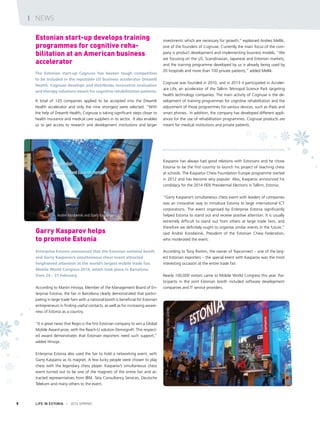
Enterprise Estonia announced that the Estonian national booth
and Garry Kasparov’s simultaneous chess event attracted
heightened attention at the world’s largest mobile trade fair,
Mobile World Congress 2014, which took place in Barcelona
from 24 – 27 February.
According to Martin Hirvoja, Member of the Management Board of En-
terprise Estonia, the fair in Barcelona clearly demonstrated that partici-
pating in large trade fairs with a national booth is beneficial for Estonian
entrepreneurs in finding useful contacts, as well as for increasing aware-
ness of Estonia as a country.
“It is great news that Regio is the first Estonian company to win a Global
Mobile Award prize, with the Reach-U solution Demograft. This respect-
ed award demonstrates that Estonian exporters need such support,”
added Hirvoja.
Enterprise Estonia also used the fair to hold a networking event, with
Garry Kasparov as its magnet. A few lucky people were chosen to play
chess with the legendary chess player. Kasparov’s simultaneous chess
event turned out to be one of the magnets of the entire fair and at-
tracted representatives from IBM, Tata Consultancy Services, Deutsche
Telekom and many others to the event.
Kasparov has always had good relations with Estonians and he chose
Estonia to be the first country to launch his project of teaching chess
at schools. The Kasparov Chess Foundation Europe programme started
in 2012 and has become very popular. Also, Kasparov announced his
candidacy for the 2014 FIDE Presidential Elections in Tallinn, Estonia.
“Garry Kasparov’s simultaneous chess event with leaders of companies
was an innovative way to introduce Estonia to large international ICT
corporations. The event organised by Enterprise Estonia significantly
helped Estonia to stand out and receive positive attention. It is usually
extremely difficult to stand out from others at large trade fairs, and
therefore we definitely ought to organise similar events in the future,”
said Andrei Korobeinik, President of the Estonian Chess Federation,
who moderated the event.
According to Tony Rivshin, the owner of Topconnect – one of the larg-
est Estonian exporters – the special event with Kasparov was the most
interesting occasion at the entire trade fair.
Nearly 100,000 visitors came to Mobile World Congress this year. Par-
ticipants in the joint Estonian booth included software development
companies and IT service providers.
Garry Kasparov helps
to promote Estonia
Estonian start-up develops training
programmes for cognitive reha-
bilitation at an American business
accelerator
I NEWS
Andrei Korobeinik and Garry Kasparov
Photos:LindaUldrich
SPRING 2014 I LIFE IN ESTONIA 9
Crossing the Estonian border from Russia, an external EU border, was
once a time-consuming, uncertain wrangle lasting days and resulting
in bribery, illegal sales of spots in queues, pollution, traffic safety issues
and losses for freight carriers.
The GoSwift Queue Management Service for motor vehicles allows driv-
ers to book a time to cross the border, thereby creating a more efficient
system, as drivers do not have to wait in long queues. Using the GoSwift
system, trucks and cars can now drive to the border just before the
registered border crossing time. Drivers can wait at designated waiting
areas where toilets, showers, dining areas and free WIFI are available,
proceeding as scheduled to cross the border easily and on time. By al-
locating a specific time and date for the applicant to cross the border
online, GoSwift has created minimum waiting times, cleaner surround-
ings near border crossing points and considerably more movement of
cars and trucks due to online efficiency.
The service has been implemented on the borders of Estonia, Lithuania
and Russia. The system saves Estonian road transportation companies
four million euros a year. According to Hannes Plinte, CEO of GoSwift,
drivers have already got used to the convenience of the online reserva-
tion system for border crossing, which has been in operation for two
and a half years. Nobody has to queue for long hours any more, and the
average border crossing time now is one hour.
In 2013, GoSwift won the World Summit Award (WSA) in the category
of e-Government & Open Data. According to Ken-Marti Vaher, the Es-
tonian Minister of the Interior, it took a bold and demanding client, as
well as a result-oriented developer to create such a good e-solution. “It
is a great honour to see the high standard of e-solutions being created
by Estonia and for one of our projects to receive recognition from inter-
national experts within the UN and the World Summit Award,” he said.
The GoSwift Queue Management Service has been used to queue vehi-
cles at the Estonian-Russian road border since 2011. In 2012 the service
was launched in Russia and in the summer of 2013 was also opened in
Lithuania. Besides border crossings, GoSwift can also be used at tourism
sites and to manage ferry queues: basically wher-
ever there are queues. Since June 2013, GoSwift
service has also been used at the Tallinn TV Tower
pilet.teletorn.ee, where customers can book a
time to enter the tower online instead of having to
queue outside.
Weekdone, an Estonian start-up which
aims to become the #1 app for managers
to monitor and manage their teams, won
the Slush Pitching Competition and raised
$200k in new fundin from a group of in-
vestors led by KIMA Ventures.
Weekdone, launched in 2013, is an easy yet
powerful tool for managers to track what’s
happening in their teams and an opportunity
to give immediate feedback to their employ-
ees. In essence, it is a hassle-free weekly em-
ployee status report, dashboard and feedback
system. In November 2013, the company won
the Slush Pitching Competition in Finland
among 1,300 start-ups, 400 of whom had ap-
plied to pitch. According to the winning pitch,
the best part of this tool is that it is suitable
and easy-to-use for both managers and em-
ployees, making life easier for managers and
teams more productive.
At the end of 2013, Weekdone also closed
their next investment round of $200k. It was
led by Jérémie Berrebi’s and Xavier Niel’s KIMA
Ventures, one of the world’s most active an-
gel investors. The round also included exist-
ing investors: Skype/Kazaa founding engineer
and chief architect Ahti Heinla, the Rubylight
venture fund, and Taavi Lepmets, a former
backer of Odnoklassniki, Russia’s largest social
network. The round brings the total raised by
Weekdone to $290k.
“I have managed and I am still managing many
companies,” said Jérémie Berrebi of KIMA Ven-
tures’ investment in the Estonian company. “I
really think weekly reporting is the most impor-
tant thing a manager needs to request from his
team. It’s not always easy, but with a tool like
Weekdone, it’s becoming fun for everyone.”
Recently, Weekdone grew its team from three
to six people and set up an office in New York
City. These moves follow a recent ramp-up in
sales: almost a third of Weekdone’s paying cus-
tomers started their subscriptions in October.
Weekdone has seen a lot of new uptake on
mobile platforms, with iPhone and iPad be-
ing available for some months. “We believe
that the future of many communication tools
is mobile, moving with you wherever you go.
Both leaders and team members are giving up
PCs and switching to mobiles for many tasks.
We already get many more registrations from
mobile devices than from web browsers and
PCs,” said Kaljundi.
This year Weekdone launched their real-time
Buzz timeline activity feed, which is now used
for internal daily communications among many
users. “Weekdone is not just about manage-
rial reporting, but also about employee-to-em-
ployee communications and making sure your
co-workers know what you are doing and are
able to help you,” said Kaljundi. “Checking
Buzz helps you to keep up to date on the pulse
of your company.”
weekdone.com
GoSwift – online reservation system
for border crossing
Estonian Start-up Weekdone Announces $200K Investment
Photo: Sami Heiskanen
Estonian
ICT Week
2014
LIFE IN ESTONIA I 2014 SPRING
I EVENTS
10
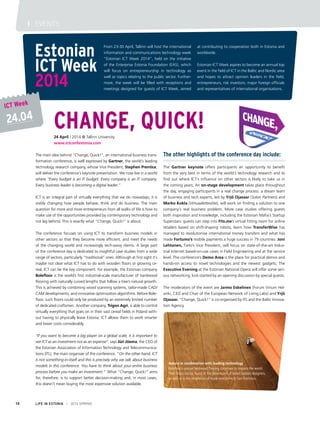
The main idea behind “Change, Quick!”, an international business trans-
formation conference, is well expressed by Gartner, the world´s leading
technology research company, whose Vice President, Stephen Prentice,
will deliver the conference´s keynote presentation. We now live in a world
where “Every budget is an IT budget. Every company is an IT company.
Every business leader is becoming a digital leader.”
ICT is an integral part of virtually everything that we do nowadays; it is
visibly changing how people behave, think and do business. The main
question for more and more entrepreneurs from all walks of life is how to
make use of the opportunities provided by contemporary technology and
not lag behind. This is exactly what “Change, Quick!” is about.
The conference focuses on using ICT to transform business models in
other sectors so that they become more efficient, and meet the needs
of the changing world and increasingly tech-savvy clients. A large part
of the conference day is dedicated to insightful case studies from a wide
range of sectors, particularly “traditional” ones. Although at first sight it´s
maybe not clear what ICT has to do with wooden floors or growing ce-
real, ICT can be the key component. For example, the Estonian company
Bolefloor is the world’s first industrial-scale manufacturer of hardwood
flooring with naturally curved lengths that follow a tree’s natural growth.
This is achieved by combining wood scanning systems, tailor-made CAD/
CAM developments, and innovative optimization algorithms. Before Bole-
floor, such floors could only be produced by an extremely limited number
of dedicated craftsmen. Another company, Trigon Agri, is able to control
virtually everything that goes on in their vast cereal fields in Poland with-
out having to physically leave Estonia: ICT allows them to work smarter
and lower costs considerably.
“If you want to become a big player on a global scale, it is important to
see ICT as an investment not as an expense”, says Jüri Jõema, the CEO of
the Estonian Association of Information Technology and Telecommunica-
tions (ITL), the main organiser of the conference. “On the other hand, ICT
is not something-in-itself and this is precisely why we talk about business
models in this conference. You have to think about your entire business
process before you make an investment.” What “Change, Quick!” aims
for, therefore, is to support better decision-making and, in most cases,
this doesn’t mean buying the most expensive solution available.
The other highlights of the conference day include:
The Gartner keynote offers participants an opportunity to benefit
from the very best in terms of the world´s technology research and to
find out where ICT´s influence on other sectors is likely to take us in
the coming years; An on-stage development takes place throughout
the day, engaging participants in a real change process: a dream team
of business and tech experts, led by Yrjö Ojasaar (Solon Partners) and
Marko Kokla (Virtuaalettevõte), will work on finding a solution to one
company´s real business problem; More case studies offering guests
both inspiration and knowledge, including the Estonian Mafia´s Startup
Superstars: guests can step into Fits.me’s virtual fitting room for online
retailers based on shift-shaping robots, learn how TransferWise has
managed to revolutionise international money transfers and what has
made Fortumo’s mobile payments a huge success in 79 countries. Joni
Lehtonen, Tieto’s Vice President, will focus on state-of-the-art Indus-
trial Internet based-on-use cases in Field Engineering and at the service
level. The conference’s Demo Area is the place for practical demos and
hands-on access to novel technologies and the newest gadgets; The
Executive Evening at the Estonian National Opera will offer some seri-
ous networking, kick-started by an opening discussion by special guests.
The moderators of the event are Jarmo Eskelinen (Forum Virium Hel-
sinki, CEO and Chair of the European Network of Living Labs) and Yrjö
Ojasaar. “Change, Quick!” is co-organised by ITL and the Baltic Innova-
tion Agency. 
Nature in combination with leading technology
Bolefloor´s unique hardwood flooring continues to impress the world.
Their floors can be found in the showrooms of noted fashion designers,
as well as in the residences of Apple executives in San Francisco.
CHANGE, QUICK!24 April / 2014 @ Tallinn University
www.ictconfestonia.com
From 23-30 April, Tallinn will host the international
information and communications technology week
“Estonian ICT Week 2014”, held on the initiative
of the Enterprise Estonia Foundation (EAS), which
will focus on entrepreneurship in technology as
well as topics relating to the public sector. Further-
more, the week will be filled with receptions and
meetings designed for guests of ICT Week, aimed
at contributing to cooperation both in Estonia and
worldwide.
Estonian ICT Week aspires to become an annual top
event in the field of ICT in the Baltic and Nordic area
and hopes to attract opinion leaders in the field,
entrepreneurs, risk investors, major foreign officials
and representatives of international organisations.
24.04
ICT Week
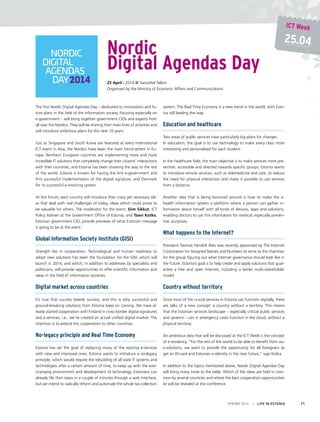
The first Nordic Digital Agendas Day – dedicated to innovations and fu-
ture plans in the field of the information society, focusing especially on
e-government – will bring together government CIOs and experts from
all over the Nordics. They will be sharing their main lines of activities and
will introduce ambitious plans for the next 10 years.
Just as Singapore and South Korea are featured at every international
ICT event in Asia, the Nordics have been the main trend-setters in Eu-
rope. Northern European countries are implementing more and more
incredible IT solutions that completely change their citizens’ interactions
with their countries, and Estonia has been showing the way to the rest
of the world. Estonia is known for having the first e-government and
first successful implementation of the digital signature, and Denmark
for its successful e-invoicing system.
At this forum, each country will introduce their crazy yet necessary ide-
as that deal with real challenges of today, ideas which could prove to
be valuable for others. The moderator for the event, Siim Sikkut, ICT
Policy Adviser at the Government Office of Estonia, and Taavi Kotka,
Estonian government CIO, provide previews of what Estonia’s message
is going to be at the event:
Global Information Society Institute (GISI)
Strength lies in cooperation. Technological and human readiness to
adopt new solutions has been the foundation for the GISI, which will
launch in 2014, and which, in addition to addresses by specialists and
politicians, will provide opportunities to offer scientific information and
ideas in the field of information societies.
Digital market across countries
It’s true that success breeds success, and this is why successful and
ground-breaking solutions from Estonia keep on coming. We have al-
ready started cooperation with Finland in cross-border digital signatures
and e-services, i.e., we’ve created an actual unified digital market. The
intention is to extend this cooperation to other countries.
No-legacy principle and Real Time Economy
Estonia has set the goal of replacing many of the existing e-services
with new and improved ones. Estonia wants to introduce a no-legacy
principle, which would require the rebuilding of all state IT systems and
technologies after a certain amount of time, to keep up with the ever-
changing environment and development of technology. Estonians can
already file their taxes in a couple of minutes through a web interface,
but we intend to radically reform and automate the whole tax collection
system. The Real Time Economy is a new trend in the world, with Esto-
nia still leading the way.
Education and healthcare
Two areas of public services have particularly big plans for changes.
In education, the goal is to use technology to make every class more
interesting and personalised for each student.
In the healthcare field, the main objective is to make services more pre-
ventive, accessible and directed towards specific groups. Estonia wants
to introduce remote services, such as telemedicine and care, to reduce
the need for physical interaction and make it possible to use services
from a distance.
Another idea that is being bounced around is how to make the e-
health information system a platform where a person can gather in-
formation about herself with all kinds of devices, apps and solutions,
enabling doctors to use this information for medical, especially preven-
tive, purposes.
What happens to the Internet?
President Toomas Hendrik Ilves was recently appointed by The Internet
Corporation for Assigned Names and Numbers to serve as the chairman
for the group figuring out what Internet governance should look like in
the future. Estonia’s goal is to help create and apply solutions that guar-
antee a free and open Internet, including a better multi-stakeholder
model.
Country without territory
Since most of the crucial services in Estonia can function digitally, there
are talks of a new concept: a country without a territory. This means
that the Estonian services landscape – especially critical public services
and systems – can in emergency cases function in the cloud, without a
physical territory.
An ambitious idea that will be discussed at the ICT Week is the concept
of e-residency. “For the rest of the world to be able to benefit from our
e-solutions, we want to provide the opportunity for all foreigners to
get an ID-card and Estonian e-identity in the near future,” says Kotka.
In addition to the topics mentioned above, Nordic Digital Agendas Day
will bring many more to the table. Which of the ideas are held in com-
mon by several countries and where the best cooperation opportunities
lie will be revealed at the conference.
Nordic
Digital Agendas Day
25 April / 2014 @ Swissôtel Tallinn
Organised by the Ministry of Economic Affairs and Communications
SPRING 2014 I LIFE IN ESTONIA 11
25.04
ICT Week
LIFE IN ESTONIA I 2014 SPRING12
I EVENTS
eHealth & Wellness
hackathon
25-27 April / 2014 @ Tehnopol Mustamäe
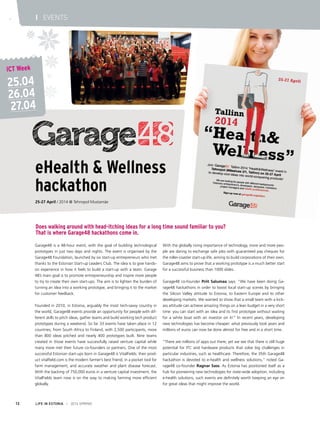
Garage48 is a 48-hour event, with the goal of building technological
prototypes in just two days and nights. The event is organised by the
Garage48 Foundation, launched by six start-up entrepreneurs who met
thanks to the Estonian Start-up Leaders Club. The idea is to give hands-
on experience in how it feels to build a start-up with a team. Garage
48’s main goal is to promote entrepreneurship and inspire more people
to try to create their own start-ups. The aim is to lighten the burden of
turning an idea into a working prototype, and bringing it to the market
for customer feedback.
Founded in 2010, in Estonia, arguably the most tech-savvy country in
the world, Garage48 events provide an opportunity for people with dif-
ferent skills to pitch ideas, gather teams and build working tech product
prototypes during a weekend. So far 33 events have taken place in 12
countries, from South Africa to Finland, with 2,500 participants, more
than 800 ideas pitched and nearly 400 prototypes built. Nine teams
created in those events have successfully raised venture capital while
many more met their future co-founders or partners. One of the most
successful Estonian start-ups born in Garage48 is VitalFields: their prod-
uct vitalfield.com is the modern farmer’s best friend, in a pocket tool for
farm management, and accurate weather and plant disease forecast.
With the backing of 750,000 euros in a venture capital investment, the
VitalFields team now is on the way to making farming more efficient
globally.
With the globally rising importance of technology, more and more peo-
ple are daring to exchange safe jobs with guaranteed pay cheques for
the roller-coaster start-up life, aiming to build corporations of their own.
Garage48 aims to prove that a working prototype is a much better start
for a successful business than 1000 slides.
Garage48 co-founder Priit Salumaa says: “We have been doing Ga-
rage48 hackathons in order to boost local start-up scenes by bringing
the Silicon Valley attitude to Estonia, to Eastern Europe and to other
developing markets. We wanted to show that a small team with a kick-
ass attitude can achieve amazing things on a lean budget in a very short
time: you can start with an idea and its first prototype without waiting
for a white boat with an investor on it!” In recent years, developing
new technologies has become cheaper: what previously took years and
millions of euros can now be done almost for free and in a short time.
“There are millions of apps out there, yet we see that there is still huge
potential for ITC and hardware products that solve big challenges in
particular industries, such as healthcare. Therefore, the 35th Garage48
hackathon is devoted to e-health and wellness solutions,” noted Ga-
rage48 co-founder Ragnar Sass. As Estonia has positioned itself as a
hub for pioneering new technologies for state-wide adoption, including
e-health solutions, such events are definitely worth keeping an eye on
for great ideas that might improve the world.
Does walking around with head-itching ideas for a long time sound familiar to you?
That is where Garage48 hackathons come in.
ICT Week
25.04
26.04
27.04
SPRING 2014 I LIFE IN ESTONIA 13
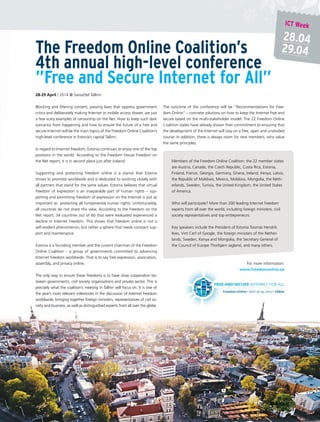
Blocking and filtering content, passing laws that oppress government
critics and deliberately making Internet or mobile access slower, are just
a few scary examples of censorship on the Net. How to keep such dark
scenarios from happening and how to ensure the future of a free and
secure Internet will be the main topics of the Freedom Online Coalition’s
high-level conference in Estonia’s capital Tallinn.
In regard to Internet freedom, Estonia continues to enjoy one of the top
positions in the world. According to the Freedom House Freedom on
the Net report, it is in second place just after Iceland.
Supporting and protecting freedom online is a stance that Estonia
strives to promote worldwide and is dedicated to working closely with
all partners that stand for the same values. Estonia believes that virtual
freedom of expression is an inseparable part of human rights – sup-
porting and promoting freedom of expression on the Internet is just as
important as protecting all fundamental human rights. Unfortunately,
all countries do not share this view. According to the Freedom on the
Net report, 34 countries out of 60 that were evaluated experienced a
decline in Internet freedom. This shows that freedom online is not a
self-evident phenomenon, but rather a sphere that needs constant sup-
port and maintenance.
Estonia is a founding member and the current chairman of the Freedom
Online Coalition – a group of governments committed to advancing
Internet freedom worldwide. That is to say free expression, association,
assembly, and privacy online.
The only way to ensure these freedoms is to have close cooperation be-
tween governments, civil society organisations and private sector. This is
precisely what the coalition’s meeting in Tallinn will focus on. It is one of
the year’s most relevant milestones in the discussion of Internet freedom
worldwide, bringing together foreign ministers, representatives of civil so-
ciety and business, as well as distinguished experts from all over the globe.
The outcome of the conference will be ”Recommendations for Free-
dom Online” – concrete solutions on how to keep the Internet free and
secure based on the multi-stakeholder model. The 22 Freedom Online
Coalition states have already shown their commitment to ensuring that
the development of the Internet will stay on a free, open and undivided
course. In addition, there is always room for new members, who value
the same principles.
For more information:
www.freedomonline.ee
The Freedom Online Coalition’s
4th annual high-level conference
”Free and Secure Internet for All”
28-29 April / 2014 @ Swissôtel Tallinn
28.04
29.04
ICT Week
Members of the Freedom Online Coalition: the 22 member states
are Austria, Canada, the Czech Republic, Costa Rica, Estonia,
Finland, France, Georgia, Germany, Ghana, Ireland, Kenya, Latvia,
the Republic of Maldives, Mexico, Moldova, Mongolia, the Neth-
erlands, Sweden, Tunisia, the United Kingdom, the United States
of America.
Who will participate? More than 200 leading Internet freedom
experts from all over the world, including foreign ministers, civil
society representatives and top entrepreneurs.
Key speakers include the President of Estonia Toomas Hendrik
Ilves, Vint Cerf of Google, the foreign ministers of the Nether-
lands, Sweden, Kenya and Mongolia, the Secretary General of
the Council of Europe Thorbjørn Jagland, and many others.
* This conference is a continuation of the annual conference organised by
EE and the International Technology Law Association, held for the first time in 2008.
LIFE IN ESTONIA I 2014 SPRING14
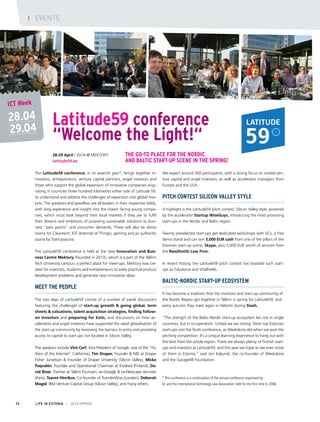
Latitude59 conference
“Welcome the Light!“
28-29 April / 2014 @ MEKTORY
latitude59.ee
I EVENTS
The Latitude59 conference, in its seventh year*, brings together in-
novators, entrepreneurs, venture capital partners, angel investors and
those who support the global expansion of innovative companies origi-
nating in countries three hundred kilometres either side of Latitude 59,
to understand and address the challenges of expansion into global mar-
kets. The speakers and panellists are all leaders in their respective fields,
with long experience and insight into the chasm facing young compa-
nies, which must look beyond their local markets if they are to fulfil
their dreams and ambitions of providing sustainable solutions to busi-
ness “pain points” and consumer demands. There will also be demo
rooms for Cleantech, IOT (Internet of Things), gaming and an authentic
sauna by Startupsauna.
The Latitude59 conference is held at the new Innovation and Busi-
ness Centre Mektory (founded in 2013), which is a part of the Tallinn
Tech University campus: a perfect place for meet-ups. Mektory was cre-
ated for scientists, students and entrepreneurs to solve practical product
development problems and generate new innovative ideas.
Meet the people
The two days of Latitude59 consist of a number of panel discussions
featuring the challenges of start-up growth & going global, term
sheets & valuations, talent acquisition strategies, finding follow-
on investors and preparing for Exits, and discussions on how ac-
celerators and angel investors have supported the rapid globalisation of
the start-up community by removing the barriers to entry and providing
access to capital to start-ups not located in Silicon Valley.
The speakers include Vint Cerf, Vice President of Google, one of the “Fa-
thers of the Internet” California), Tim Draper, Founder & MD at Draper
Fisher Jurvetson & Founder of Draper University (Silicon Valley), Micke
Paqvalén, Founder and Operational Chairman at Kiosked (Finland), Da-
vid Bizer, Partner at Talent Fountain, ex-Google & ex-Netscape recruiter
(Paris), Taavet Hinrikus, Co-founder of TransferWise (London), Deborah
Magid, IBM Venture Capital Group (Silicon Valley), and many others.
We expect around 300 participants, with a strong focus on invited ven-
ture capital and angel investors, as well as accelerator managers from
Europe and the USA.
Pitch Contest Silicon Valley style
A highlight is the Latitude59 pitch contest, Silicon Valley style, powered
by the accelerator Startup WiseGuys, introducing the most promising
start-ups in the Nordic and Baltic region.
Twenty preselected start-ups get dedicated workshops with VCs, a free
demo stand and can win 5,000 EUR cash from one of the pillars of the
Estonian start-up scene, Skype, plus 5,000 EUR worth of services from
the ReedSmith Law Firm.
In recent history, the Latitude59 pitch contest has boosted such start-
ups as Fabulonia and VitalFields.
Baltic-Nordic start-up ecosystem
It has become a tradition that the investors and start-up community of
the Nordic Region get together in Tallinn in spring for Latitude59, and
every autumn they meet again in Helsinki during Slush.
“The strength of the Baltic-Nordic start-up ecosystem lies not in single
countries, but in co-operation. United we are strong. Most top Estonian
start-ups visit the Slush conference, as Weekdone did when we won the
pitching competition. It’s a unique learning experience to hang out with
the best from the whole region. There are always plenty of Finnish start-
ups and investors at Latitude59, and this year we hope to see even more
of them in Estonia,” said Jüri Kaljundi, the co-founder of Weekdone
and the Garage48 Foundation.
The go-to place for the Nordic
and Baltic start-up scene in the spring!
28.04
29.04
ICT Week
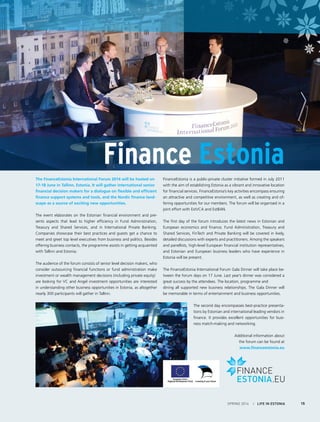
The FinanceEstonia International Forum 2014 will be hosted on
17-18 June in Tallinn, Estonia. It will gather international senior
financial decision makers for a dialogue on flexible and efficient
finance support systems and tools, and the Nordic finance land-
scape as a source of exciting new opportunities.
The event elaborates on the Estonian financial environment and pre-
sents aspects that lead to higher efficiency in Fund Administration,
Treasury and Shared Services, and in International Private Banking.
Companies showcase their best practices and guests get a chance to
meet and greet top level executives from business and politics. Besides
offering business contacts, the programme assists in getting acquainted
with Tallinn and Estonia.
The audience of the forum consists of senior level decision makers, who
consider outsourcing financial functions or fund administration make
investment or wealth management decisions (including private equity)
are looking for VC and Angel investment opportunities are interested
in understanding other business opportunities in Estonia, as altogether
nearly 300 participants will gather in Tallinn.
FinanceEstonia is a public-private cluster initiative formed in July 2011
with the aim of establishing Estonia as a vibrant and innovative location
for financial services. FinanceEstonia’s key activities encompass ensuring
an attractive and competitive environment, as well as creating and of-
fering opportunities for our members. The forum will be organised in a
joint effort with EstVCA and EstBAN.
The first day of the forum introduces the latest news in Estonian and
European economics and finance. Fund Administration, Treasury and
Shared Services, FinTech and Private Banking will be covered in lively,
detailed discussions with experts and practitioners. Among the speakers
and panellists, high-level European financial institution representatives,
and Estonian and European business leaders who have experience in
Estonia will be present.
The FinanceEstonia International Forum Gala Dinner will take place be-
tween the forum days on 17 June. Last year’s dinner was considered a
great success by the attendees. The location, programme and
dining all supported new business relationships. The Gala Dinner will
be memorable in terms of entertainment and business opportunities.
The second day encompasses best-practice presenta-
tions by Estonian and international leading vendors in
finance. It provides excellent opportunities for busi-
ness match-making and networking.
Additional information about
the forum can be found at
www.financeestonia.eu
Finance Estonia
SPRING 2014 I LIFE IN ESTONIA 15
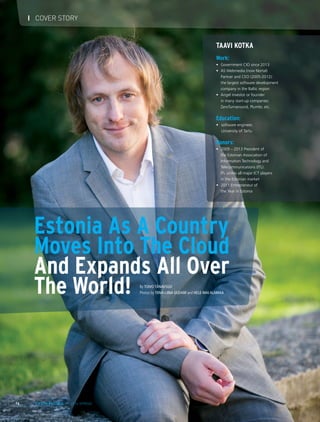
Estonia As A Country
Moves Into The Cloud
And Expands All Over
The World!
Taavi Kotka
Work:
•	 Government CIO since 2013
•	 AS Webmedia (now Nortal)
	 Partner and CEO (2005-2012):
	 the largest software development
company in the Baltic region
•	 Angel investor or founder
	 in many start-up companies:
	 ZeroTurnaround, Plumbr, etc.
 
Education:
•	 software engineer,
	 University of Tartu
 
Honors:
•	 2009 – 2013 President of
	 the Estonian Association of
	 Information Technology and
	 Telecommunications (ITL):
	 ITL unites all major ICT players
	 in the Estonian market
•	 2011 Entrepreneur of
	 the Year in Estonia
By Toivo Tänavsuu
Photos by TIINA-LIINA UUDAM and HELE-MAI ALAMAA
16 LIFE IN ESTONIA I 2014 SPRING
I COVER STORY
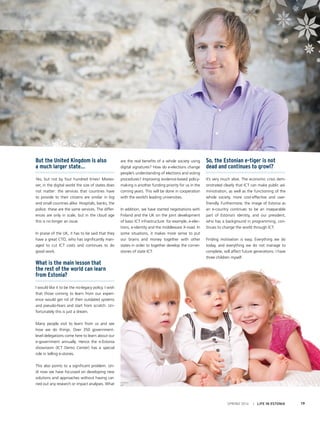
Taavi Kotka, the Estonian government
CIO, talks about taking the already suc-
cessful e-state onto a totally new level.
Namely, Estonia has an ambitious plan
of moving the state into a data cloud
spread all over the world, which will,
in a sense, make occupying the country
pointless. In addition, with the help of
ICT, there can well be ten million Es-
tonians by 2020 instead of the current
one million.
What is the essence
of the cloud initiative?
The development of the e-government in
Estonia has reached a point where sever-
al vital registries of the state only exist in
digital form without any paper copies. For
example, the Land Register has become a
database of critical importance and the Es-
tonian state cannot afford to lose it or have
its data tampered.
	
In order to mitigate risks and ensure the pres-
ervation and integrity of data, relying on data
centres located in Estonia is not sufficient. That
is why we have maintained copies of Estonian
registries at our embassies abroad for years.
However, embassies are not really meant for
preserving large volumes of data and running
applications. In addition, Estonian legislation,
similar to that in other countries, establishes
that data vital for the functioning of the state
is to be maintained exclusively in the Estonian
territory.
With this in mind, we developed the concept
of the “Data Embassy”, whose principal idea is
that, in addition to its network of physical em-
bassies, Estonia needs to develop a network of
data embassies. In simple terms, data embas-
sies would be server rooms in the territories of
friendly partner states.
So, in addition to the physical
embassy, would Estonia open
a Data Embassy in Germany,
for example?
Germany could be joined by other countries:
Canada, Australia, Sweden, Holland etc. We
would, in fact, sign a bilateral agreement with
a friendly state that would allocate to Estonia
a special physical or virtual room in the gov-
ernment cloud of that country, in some data
centre. In this room, the same rules would ap-
ply as in real embassies, meaning that the spe-
cific space would be the territory of Estonia,
with Estonian legislation in force. The part-
nering state would provide us with electricity,
cooling and an Internet connection, but other-
wise it would respect the diplomatic immunity
of the embassy.
What would be stored
in such data embassies?
As the network of data embassies involves
a cyber security aspect, we plan to move
all data and information systems critical for
the functioning of the state to such private
clouds. As a result, there would be an addi-
tional global dimension to the government
cloud currently physically located in Estonia,
dispersing data and information systems all
over the world.
In principle, such a cloud should contain every-
thing necessary to run a state: from the Popu-
lation Register, Land Register and Business
Register to e-government, e-health, judicial
systems and so on.
What would be the impact
of such a system?
Above all, there would be improved cyber se-
curity. Should Estonia become a target of a
massive cyber attack, it would be much more
difficult to “switch us off” as a state than, for
example, Georgia in August 2008. The state
would be able to provide e-services from Ger-
many, Sweden or Holland.
But let’s aim higher! Estonia could become
the first country in the world completely in a
cloud! In other words, the state together with
its citizens and services do not have to be tied
to a specific territory.
Estonians could live in Finland or London, be
deported to Siberia or whatever: we could
still elect our parliament, collect taxes etc.
Businesses would continue to operate, docu-
ments would be exchanged, addresses could
continually be changed in registers and new
citizens would be born. We could even send
our athletes to the Olympics, even if they did
their trial competitions in some other country.
This may sound like abstract bragging, but we
would actually be able to ensure the function-
ing of the state from the cloud!
What does that mean
in the light of events in
the Crimea?
The capacity to support the existence of our
state from the cloud would lead to a situa-
tion where—considering the recent events in
Crimea—it would be much more complicated
(i.e. expensive) to occupy Estonia. There would
be no point in conquering the country with
tanks, as the state would continue to function
from the cloud. In addition, considering that
Estonians have been voting over the Internet
for nearly ten years, it would be impossible to
organise a fake referendum. People would be
able to legitimately express their free will, us-
ing tested solutions. This means that in order
to occupy the state, all of our data embas-
sies all over the world would also have to be
occupied.
Can we say that investments
in the army, cannons and tanks
would become pointless?
No, Estonia should definitely maintain its ca-
pacity for physical and virtual defence and keep
fulfilling its tasks as a NATO member state. Be-
ing able to function from the cloud would just
offer us an additional security guarantee.
How was the idea of
Cloud Estonia born?
The need for a data embassy was born about a
year ago. The follow-up idea of a country with-
out a territory, i.e. a state functioning from the
cloud, was born in the process of drafting the
Estonian Digital Society Strategy 2020.
President Toomas Hendrik Ilves read the draft
of the strategy and said it lacked ambition. I
then added this revolutionary idea to the doc-
ument’s foreword and asked: “Is it ambitious
enough now, Mr. President?”
What kind of reaction has
the cloud idea provoked?
At first it usually creates the wow effect. In the
context of cyber security, the topic of virtual
embassies is a hot one. Our approach is often
considered too futuristic, because even Inter-
net elections, so ordinary for Estonians, are
regarded as too revolutionary in many other
countries. Silicon Valley has also dreamt of a
similar cloud state.
SPRING 2014 I LIFE IN ESTONIA 17
There is another wild idea in
relation to the state in the cloud:
start issuing Estonian e-identity
to foreigners.
This idea came about when we were looking
at how to allow foreigners working in Estonia
on a temporary basis – for example university
professors and entrepreneurs – to benefit from
our digital society. In order to use Estonian e-
services, such as digital prescription, e-bank-
ing, digital signature etc., one needs digital
identity. Thus, we need to issue non-resident
ID cards and mobile-IDs to those working or
studying here temporarily.
At a certain point, we realised that the need
for such a card is much wider. For example,
the card could be used by businessmen who
do not reside in Estonia but who want to be in-
volved in daily business development as board
members. E-identities together with digital sig-
natures would make this possible.
So you can be from New Zealand,
but do business in Europe
without ever leaving home?
Precisely. You just need to get a non-resident
ID-card. In only 18 minutes over the Internet,
you can start a company in Estonia, open a
bank account and sign all necessary docu-
ments with a digital signature. In less than a
day, you have the capability of doing business
not just in Estonia, but in the whole European
Union. And you can do all that without leaving
your home.
“An operational company with a bank account
in the European Union in less than a day” is a
much-needed service for many EU citizens, as
well as people from other countries.
The non-resident ID-card is not the key issue.
There are more and more private businesses
all over the world offering e-identity services.
Estonia’s goal is, after all, to make its e-services
accessible to other countries. People having Es-
tonian e-identity would become “satellite citi-
zens”, who would develop some connection
with Estonia through those processes. In addi-
tion, having 10 million satellite citizens on top
of our 1.3 million permanent residents would
also serve as an additional security guarantee.
In reality we will not reach such numbers, but
dreaming is important. Virtual residence also
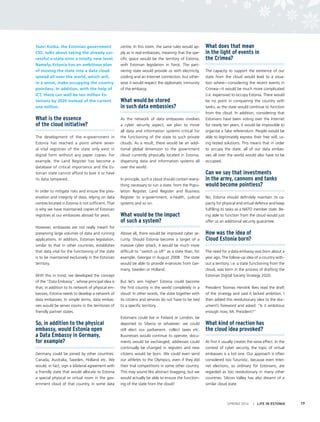
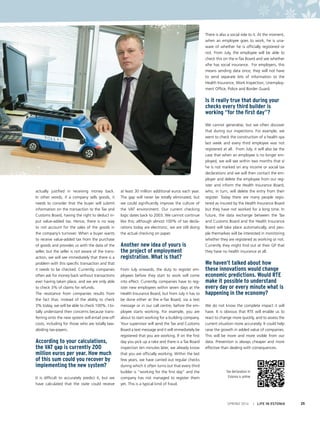
confirms the viability of our “state without ter-
ritory” concept.
What other innovations await
the Estonian e-state?
I am personally most interested in the Real
Time Economy. Estonia is the most effective tax
collector in the whole world. This means that
per euro collected we spend much less in tax
collection in comparison to other states. We
have developed a fully automated system of
tax declarations and refunds. But there is still
room for improvement. The handling of taxes,
e.g. declaring and refunding taxes, has delays
and those delays, in fact, “hold up money”.
In the worst cases, businesses receive their
overpaid VAT back in two months, and citizens
receive their income tax returns once a year.
These periods could be shortened significantly.
The goal is to reach a situation in which the
economy, including taxes, and recalculations
thereof, function in real time. We are very
close to this in Estonia, and if we succeed in
strengthening the tax control systems, we will
be able to take another step closer to our aim.
The tax system is not the only
field where such improvements
in systems and services are
happening, right?
Indeed. For the next seven years, substantial
resources have been allocated for ICT invest-
ments. The aim is not only to create new solu-
tions, but to improve the functioning of the
existing system. Many systems, including es-
pecially the ones that are more than a decade
old, need to be re-engineered, since work pro-
cesses, legislation and especially technology
change significantly. Voice recognition, touch-
screen technology, cyber-security, big data etc.
– a decade ago we lived in another world and
there is no point in remaining stuck there. ICT
systems need to be modernised on a regular
basis. Thus, we have established a rule that no
vital information system in the Estonian public
sector can be more than 13 years old. We call
this the no-legacy policy.
Isn’t the no-legacy policy
too expensive?
This is a very good question. It turns out that
the opposite is true. Our research and com-
parison with Scandinavian countries prove
that the continuous renewal and updating of
systems will be cheaper in the end than main-
taining legacy.
In addition, there has been a revolution in the
production and management of software and
the start-up culture has proven to the world
that huge ICT enterprises have been nourished
for no reason for decades. ICT is not as compli-
cated and costly as some believe.
The UK government’s ICT budget is 16 billion
pounds. The Estonian Government ICT budget
is about 40 million pounds: 400 times smaller.
LIFE IN ESTONIA I 2014 SPRING18
ESTONIAN DATA EMBASSIES
I COVER STORY
But the United Kingdom is also
a much larger state…
Yes, but not by four hundred times! Moreo-
ver, in the digital world the size of states does
not matter: the services that countries have
to provide to their citizens are similar in big
and small countries alike. Hospitals, banks, the
police: these are the same services. The differ-
ences are only in scale, but in the cloud age
this is no longer an issue.
In praise of the UK, it has to be said that they
have a great CTO, who has significantly man-
aged to cut ICT costs and continues to do
good work.
What is the main lesson that
the rest of the world can learn
from Estonia?
I would like it to be the no-legacy policy. I wish
that those coming to learn from our experi-
ence would get rid of their outdated systems
and pseudo-fears and start from scratch. Un-
fortunately this is just a dream.
Many people visit to learn from us and see
how we do things. Over 350 government-
level delegations come here to learn about our
e-government annually. Hence the e-Estonia
showroom (ICT Demo Center) has a special
role in telling e-stories.
This also points to a significant problem. Un-
til now we have focussed on developing new
solutions and approaches without having car-
ried out any research or impact analyses. What
are the real benefits of a whole society using
digital signatures? How do e-elections change
people’s understanding of elections and voting
procedures? Improving evidence-based policy-
making is another funding priority for us in the
coming years. This will be done in cooperation
with the world’s leading universities.
In addition, we have started negotiations with
Finland and the UK on the joint development
of basic ICT infrastructure: for example, e-elec-
tions, e-identity and the middleware X-road. In
some situations, it makes more sense to put
our brains and money together with other
states in order to together develop the corner-
stones of state ICT.
So, the Estonian e-tiger is not
dead and continues to growl?
It’s very much alive. The economic crisis dem-
onstrated clearly that ICT can make public ad-
ministration, as well as the functioning of the
whole society, more cost-effective and user-
friendly. Furthermore, the image of Estonia as
an e-country continues to be an inseparable
part of Estonia’s identity, and our president,
who has a background in programming, con-
tinues to change the world through ICT.
Finding motivation is easy. Everything we do
today, and everything we do not manage to
complete, will affect future generations. I have
three children myself.
SPRING 2014 I LIFE IN ESTONIA 19
Estonia:
The Little Country
With A Start-Up
Mindset
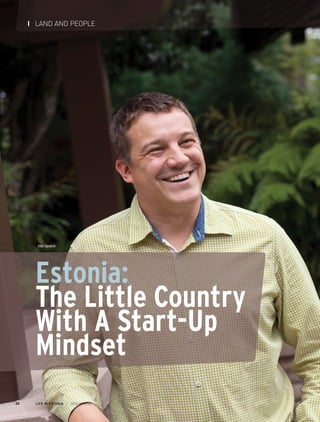
Sten Tamkivi
LIFE IN ESTONIA I 2014 SPRING20
I LAND AND PEOPLE
Ben Horowitz, co-founder and a partner of the venture
capital firm Andreessen Horowitz: Being someone reasonably
well-known in technology, I have been getting a lot of questions lately
about healthcare.gov. People want to know why it cost between two
and four times as much money to create a broken website as to build
the original iPhone. This is an excellent question. However, in my
experience, understanding why a project went wrong tends to be far
less valuable than understanding why a project went right. So, rather
than explaining why paying anywhere between $300M and $600M to
build the first iteration of healthcare.gov was a bad idea, I would like
to focus attention on a model for software-enabled government that
works. In doing so, perhaps this will be a step toward a better under-
standing of how technology might make the US government better
and not worse.
Early in my career as a venture capitalist, we invested in a company
called Skype and I went on the board. One of the many interesting as-
pects of Skype was that it was based in Estonia, a small country with a
difficult history. Over the centuries, Estonia had been invaded and taken
over many times by many countries, including Denmark, Sweden, Ger-
many, and most recently the Soviet Union. Now independent, but well
aware of their history, the Estonian people were humble, pragmatic,
proud of their freedom, but dubious of overly optimistic forecasts. In
some ways, they had the ideal culture for technology adoption: hope-
ful, yet appropriately sceptical.
Supported by this culture, Estonia built the technology platform to serve
its citizens that everyone wishes we had here. Estonia developed an in-
frastructure that enabled its government to serve its people so well that
Estonians would like to see more, not fewer, government technology
projects. To explain how they did it, I’ve asked one of our Entrepreneurs
in Residence, the Estonian Sten Tamkivi, to tell the story.
Sten Tamkivi, EIR at Andreessen Horowitz: Estonia might not
show up on the US radar very often. It is a tiny country in north-eastern
Europe, just next to Finland. It has the territory of the Netherlands, but
only a tenth of the population: 1.3 million inhabitants, comparable to
Hawaii. Estonia belongs to the European Union, Eurozone and NATO.
A friend from India recently quipped: “what is there to govern?”
What makes this tiny country interesting as a governance benchmark is
not just that the people can elect their parliament online or get their tax
returns in two days. It is also that this level of service for citizens did not
start with their government building a few web sites. Instead, Estonians
started by redesigning their entire information infrastructure from the
ground up, with openness, privacy, security and future-proofing in mind.
As the first building block of e-government, you need to be able to
tell your citizens apart. Sounds obvious, but sometimes referring to a
person by a social security number, then by a taxpayer number and at
other times by something else doesn’t cut it. Estonia uses a very simple,
unique ID methodology across all systems, from paper passport to bank
records to access to any government office or hospital. A citizen with
personal ID code 37501011234 is a male born in the 20th century (3),
on January 1st of year 1975, as baby #123 of that day. The number ends
with a computational checksum to easily detect typos.
For these identified citizens to transact with each other, Estonia passed
the Digital Signatures Act back in 2000. The state standardized
through a national Public-key Infrastructure (PKI), which binds citizen
identities to their cryptographic keys, and now it doesn’t matter if some
Tiit and Toivo (to use common Estonian names) sign a contract between
them in electronic form with certificates, or with plain ink on paper.
A signature is a signature in the eyes of the law.
As a quirky side-effect, that foundational law also forced all decen-
tralized government systems to become digital “by market demand”.
Namely, no part of the Estonian government can turn down a citizen’s
digitally signed request and ask for a paper copy. As citizens opt for con-
venience, bureaucrats see a higher inflow of digital forms and are self-
motivated to invest in systems that will help them manage the process.
Yet a social worker in a small village can still provide the same service
with no big investment by handling the small number of digitally signed
email attachments the office receives.
For future-proofing, the law did not lock in the technical nuances of
digital signatures. In fact, the implementation has changed over time.
Initially, Estonia equipped all traditional ID cards issued to all citizens
for identification and domestic travel inside the EU with microchips.
The chip carries two certificates: one for full legal signatures and one
for authenticating on any trusting web site or service (used widely,
from government services to Internet banks). As every person over 15
is required to have one, there are now over 1.2M cards active, close to
100% penetration of the population.
As mobile use in Estonia rapidly approached the current 144% (#3 in
Europe), the digital signatures adapted too. Instead of using smartcard
readers with their computers, users can now get Mobile ID enabled
SIM cards from their telecom operators. Without installing any addition-
al hardware or software, they can access systems and give signatures by
just typing PIN codes into their mobile phones.
As of this writing, between ID cards and mobile phones, 1.3M Estonians
have authenticated 230M times and given 140M legally binding signa-
tures. Besides the now daily usage for commercial contracts and bank
transactions, the most high profile use case has been for elections: since be-
coming the first country in the world to allow e-voting for local elections
in 2005, the system has been used for both Estonian and European Parlia-
ment Elections, and in 2011 accounted for 24% of all votes. (Interestingly,
the citizens voted from 105 countries in total, where they just happened
to be physically at the time - like my own vote submitted from California).
Follow the leader is a title, theme, task
Now you know, you don’t have to ask
- Rakim, “Follow the Leader”
SPRING 2014 I LIFE IN ESTONIA 21
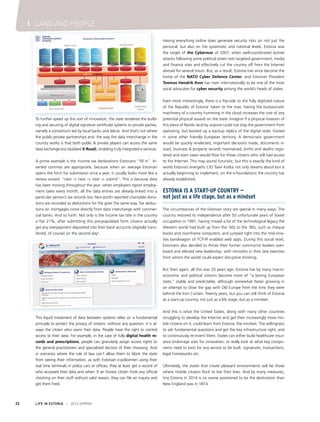
To further speed up this sort of innovation, the state tendered the build-
ing and securing of digital signature certificate systems to private parties,
namely a consortium led by local banks and telcos. And that’s not where
the public-private partnerships end: the way the data interchange in the
country works is that both public & private players can access the same
data exchange bus (dubbed X-Road), enabling truly integrated e-services.
A prime example is the income tax declarations Estonians “fill in”. In-
verted commas are appropriate, because when an average Estonian
opens the form for submission once a year, it usually looks more like a
review wizard: “next -> next -> next -> submit”. This is because data
has been moving throughout the year: when employers report employ-
ment taxes every month, all the data entries are already linked into a
particular person’s tax records too. Non-profit reported charitable dona-
tions are recorded as deductions for the giver the same way. Tax deduc-
tions on mortgages come directly from data interchange with commer-
cial banks. And so forth. Not only is the income tax rate in the country
a flat 21%, after submitting this pre-populated form citizens actually
get any overpayment deposited into their bank accounts (digitally trans-
ferred, of course) on the second day!
This liquid movement of data between systems relies on a fundamental
principle to protect the privacy of citizens: without any question, it is al-
ways the citizen who owns their data. People have the right to control
access to their data. For example, in the case of fully digital health re-
cords and prescriptions, people can granularly assign access rights to
the general practitioners and specialized doctors of their choosing. And
in scenarios where the rule of law can’t allow them to block the state
from seeing their information, as with Estonian e-policemen using their
real time terminals in police cars or offices, they at least get a record of
who accessed their data and when. If an honest citizen finds any official
checking on their stuff without valid reason, they can file an inquiry and
get them fired.
Having everything online does generate security risks on not just the
personal, but also on the systematic and national levels. Estonia was
the target of the Cyberwar of 2007, when well-coordinated botnet
attacks following some political street riots targeted government, media
and finance sites and effectively cut the country off from the Internet
abroad for several hours. But, as a result, Estonia has since become the
home of the NATO Cyber Defence Center, and Estonian President
Toomas Hendrik Ilves has risen internationally to be one of the most
vocal advocates for cyber security among the world’s heads of states.
Even more interestingly, there is a flip-side to the fully digitized nature
of the Republic of Estonia: taken to the max, having the bureaucratic
machinery of a country humming in the cloud increases the cost of any
potential physical assault on the state. Imagine if a physical invasion of
this piece of Nordic land by anyone could not stop the government from
operating, but booted up a backup replica of the digital state, hosted
in some other friendly European territory. A democratic government
would be quickly re-elected, important decisions made, documents is-
sued, business & property records maintained, births and deaths regis-
tered and even taxes would flow for those citizens who still had access
to the Internet. This may sound futuristic, but this is exactly the kind of
world Estonia’s energetic CIO Taavi Kotka not only dreams about but is
actually beginning to implement, on the e-foundations the country has
already established.
Estonia is a start-up country —
not just as a life stage, but as a mindset
The circumstances of the Estonian story are special in many ways. The
country restored its independence after 50 unfortunate years of Soviet
occupation in 1991, having missed a lot of the technological legacy the
Western world had built up from the ‘60s to the ‘80s, such as cheque
books and mainframe computers, and jumped right into the mid-nine-
ties bandwagon of TCP-IP enabled web apps. During this social reset,
Estonians also decided to throw their former communist leaders over-
board and elected new leadership, with ministers in their late twenties
from whom the world could expect disruptive thinking.
But then again, all this was 20 years ago. Estonia has by many macro-
economic and political notions become more of “a boring European
state,” stable and predictable, although somewhat faster growing in
an attempt to close the gap with Old Europe from the time they were
behind the Iron Curtain. Twenty years, but you can still think of Estonia
as a start-up country, not just as a life stage, but as a mindset.
And this is what the United States, along with many other countries
struggling to develop the Internet and get their increasingly more mo-
bile citizens on it, could learn from Estonia: the mindset. The willingness
to ask fundamental questions and get the key infrastructure right, and
to continuously re-invent them. States can either build healthcare insur-
ance brokerage sites for innovation, or really look at what key compo-
nents need to exist for any service to be built: signatures, transactions,
legal frameworks etc.
Ultimately, the states that create pleasant environments will be those
where mobile citizens flock to live their lives. And by many measures,
tiny Estonia in 2014 is no worse positioned to be the destination than
New England was in 1814.
LIFE IN ESTONIA I 2014 SPRING22
I LAND AND PEOPLE
Marek Helm, Head of the Estonian Tax and Customs Board
SPRING 2014 I LIFE IN ESTONIA 23
Estonian Tax Board 2.0 Presents:
Real Time
EconomyThe famous Estonian e-Tax Board has been admired and set as an
example all around the world. Where else can you submit your
tax return in just a few clicks? Where else can entrepreneurs sub-
mit all declarations online without spending days on end filling
out paper forms? Marek Helm, Head of the Estonian Tax and
Customs Board, claims that although our e-Tax Board is admired
all over the world, the time is ripe for some qualitative changes.
By Holger Roonemaa / Photos by Albert Truuväärt
LIFE IN ESTONIA I 2014 SPRING24
I ECONOMY AND BUSINESS
What is a Real Time Economy and
what does it mean in the Estonian
context?
We and our counterparts have not defined it
completely. Hence, the specific definition of
the term is still floating, in a good sense. The
way my colleagues and I see it, and how we re-
fer to it in our conversations with enthusiasts,
it denotes real-time information exchange in
a significantly higher quantity than we expe-
rience today. Despite the fact that currently
95-100% of tax declarations are filled in elec-
tronically, it is still not a Real Time Economy
(RTE). RTE means not only more comfortable
and faster services, but totally new services
from the point of view of the state and en-
trepreneurs, which would increase economic
competitiveness. New services help to man-
age cash-flow faster, and help companies and
private individuals make quicker and better
decisions.
Specifically, in terms of our field of activity, col-
lecting taxes, RTE means implementing elec-
tronic controls. I do not mean moving PDF files
and tables, but data acquisition, and cross and
automatic controls. For example, if we look
at value-added tax returns, the current logic
is linked with the submission dates of decla-
rations and the submission dates of returns.
Those dates are fixed. We could get rid of this
principle and say that if a company meets cer-
tain preconditions the state and the company
could make decisions immediately. Conditions
allowing for faster information exchange could
create motivation for law-abiding activity. This
could enliven the economy, and increase cash-
flow, data quality and economic safety. Inter-
actions with suspicious companies would de-
crease or be noticed much more quickly.
This would also mean that ab-
solutely all entrepreneurs could
work on equal conditions. It would
be more complicated to cheat,
wouldn’t it?
The way I see it, people would have more mo-
tivation to be honest. At the moment, the RTE
concept does not work and we offer the same
service for very many entrepreneurs: the same
deadlines for submitting declarations and for
returns. But if we implement the RTE concept,
companies will have a real motivation to be
honest, as honesty will be observable in real-
time and automatically detected. In this way,
we can offer certain advantages.
Like what?
It is our “problem” in Estonia that most dec-
larations are already electronic and we don’t
have the opportunity to develop them further.
Some people say that the appendix contain-
ing data of transactions in the value-added tax
return would be quickly supported by busi-
nesses if the Tax Board paid back the value-
added tax faster. But we already do that: 95%
of all returns go on the prepayment accounts
of companies within three days and from there
to banks. If today we paid this back within a
month, as prescribed by law, and said that with
the automated control of the value-added tax
we would start to do it within three days, this
automatic control system would exist already!
We have had the E-Tax Board for a
while and people submit declara-
tions digitally. Is the implementa-
tion of RTE the next logical step?
Definitely. According to statistics, we are the
most effective tax collector among all OECD
states. We took a giant step in 2005-2008,
when most declarations became electronic.
There was no similar leap between 2008-
2014. We are still in first place but, in terms
of efficiency or costs, there hasn’t been much
change. RTE would certainly decrease the
share of the shadow economy. If we bring
some of the money in the shadow economy
into the “real” economy, it would significantly
improve the revenue and expenditure relation-
ship. The assumption underlying our new ap-
proach is that our organisation will not grow.
Some say that we should just employ more
inspectors, but this would not be right! In that
way, we would just have more people doing
things the same old way, but what we really
need is to do things differently and, in the
longer term, probably with fewer people.
Let’s talk more specifically about
the RTE projects of the Tax and
Customs Board. One of the bigger
ones involves declaring VAT and
providing data for the Tax Board
on transactions exceeding 1,000
euros. This is not liked by busi-
nesses. What is the status of this
project?
We are ready to start. When the parliament
approves the draft act and the president pro-
claims the act, we can start on development.
We foresee six months for development work.
We have submitted a very strong concept and
it does actually have support among many en-
trepreneurs. Just a few weeks ago, the differ-
ent parliamentary fractions discussed this issue
and one prominent representative of entrepre-
neurs said that it is a much-needed act which
should be implemented.
What would it involve
for entrepreneurs?
Businesses have to consider that, if there are
invoices on their books which exceed 1,000
euros as single invoices or the sum of invoices
for a transaction partner, they need to submit
the registry code of the partner, the sum of
the transaction and the share of VAT of that
transaction as a separate appendix to the Tax
and Customs Board. The duty itself looks like
this: when the VAT declaration is submitted
on the 20th
day of the month, there is an elec-
tronic appendix which is filled in on the basis
of data in the accounting system. In other
words, we receive data on the transaction
partner, the sum of the transaction and the
share of VAT in this sum. We receive no infor-
mation about the contents of the goods, unit
price or amount. Companies add this data to
their declarations and the new information
system of the Tax and Customs Board will
receive and compare this information. Our
systems compare the transactions declared by
buyers with the declarations made by sellers.
The system will cross-check the data and de-
tect any discrepancies.
Unlike the current situation, where we receive
the VAT declaration without transaction data
(just three figures in fact), we will be able to
contact companies straight away and ask why
the data does not add up. Currently, we start
by asking for information, then we receive
the data in some weeks and only then can
we check it thoroughly. The new situation will
allow us to receive data automatically and we
can decide immediately which companies to
check.
Yet there has been resistance
to this idea by Estonian
entrepreneurs.
I can understand that. After all, the Tax and
Customs Board will be controlling more. We
receive 35,000-40,000 VAT claims monthly,
and we pay 95-100 million euros in VAT
back each month to companies on the ba-
sis of minimal controls. Under the new sys-
tem, we would have an overview of who is
Tax declaration in
Estonia is online
SPRING 2014 I LIFE IN ESTONIA 25
actually justified in receiving money back.
In other words, if a company sells goods, it
needs to consider that the buyer will submit
information on the transaction to the Tax and
Customs Board, having the right to deduct in-
put value-added tax. Hence, there is no way
to not account for the sales of the goods in
the company’s turnover. When a buyer wants
to receive value-added tax from the purchase
of goods and provides us with the data of the
seller, but the seller is not aware of the trans-
action, we will see immediately that there is a
problem with this specific transaction and that
it needs to be checked. Currently, companies
often ask for money back without transactions
ever having taken place, and we are only able
to check 3% of claims for refunds.
The resistance from companies results from
the fact that, instead of the ability to check
3% today, we will be able to check 100%. I to-
tally understand their concerns because trans-
ferring onto the new system will entail one-off
costs, including for those who are totally law-
abiding tax-payers.
According to your calculations,
the VAT gap is currently 200
million euros per year. How much
of this sum could you recover by
implementing the new system?
It is difficult to accurately predict it, but we
have calculated that the state could receive
at least 30 million additional euros each year.
The gap will never be totally eliminated, but
we could significantly improve the culture of
the VAT environment. Our current checking
logic dates back to 2003. We cannot continue
like this; although almost 100% of tax decla-
rations today are electronic, we are still doing
the actual checking on paper.
Another new idea of yours is
the project of employment
registration. What is that?
From July onwards, the duty to register em-
ployees before they start to work will come
into effect. Currently, companies have to reg-
ister new employees within seven days at the
Health Insurance Board, but from July it has to
be done either at the e-Tax Board, via a text
message or in our call centre, before the em-
ployee starts working. For example, you are
about to start working for a building company.
Your supervisor will send the Tax and Customs
Board a text message and it will immediately be
registered that you are working. If on the first
day you pick up a rake and there is a Tax Board
inspection ten minutes later, we already know
that you are officially working. Within the last
few years, we have carried out regular checks
during which it often turns out that every third
builder is “working for the first day” and the
company has not managed to register them
yet. This is a typical kind of fraud.
There is also a social side to it. At the moment,
when an employee goes to work, he is una-
ware of whether he is officially registered or
not. From July, the employee will be able to
check this on the e-Tax Board and see whether
s/he has social insurance. For employers, this
means sending data once; they will not have
to send separate bits of information to the
Health Insurance, Work Inspection, Unemploy-
ment Office, Police and Border Guard.
Is it really true that during your
checks every third builder is
working “for the first day”?
We cannot generalise, but we often discover
that during our inspections. For example, we
went to check the construction of a health spa
last week and every third employee was not
registered at all. From July, it will also be the
case that when an employee is no longer em-
ployed, we will see within two months that s/
he is not marked on any income or social tax
declarations and we will then contact the em-
ployer and delete the employee from our reg-
ister and inform the Health Insurance Board,
who, in turn, will delete the entry from their
register. Today there are many people regis-
tered as insured by the Health Insurance Board
but they have not worked for a long time. In
future, the data exchange between the Tax
and Customs Board and the Health Insurance
Board will take place automatically, and peo-
ple themselves will be interested in monitoring
whether they are registered as working or not.
Currently they might find out at their GP that
they have no health insurance at all.
We haven’t talked about how
these innovations would change
economic predictions. Would RTE
make it possible to understand
every day or every minute what is
happening in the economy?
We do not know the complete impact it will
have. It is obvious that RTE will enable us to
react to change more quickly, and to assess the
current situation more accurately. It could help
raise the growth in added value of companies.
This will be more and more visible from our
data. Prevention is always cheaper and more
effective than dealing with consequences.
LIFE IN ESTONIA I 2014 SPRING26
I ECONOMY AND BUSINESS
The term “legacy system” came into use in
the 1990s when it started to denote comput-
ers (technology) and software which were out
of date. Later on, the definition was narrowed
down and stood for all systems which were
not dependent on the Internet. Today this
more explicit meaning has been rejected and
the “pet-name” legacy continues to refer to
all IT solutions which are out-of-date in terms
of content and/or technology, but which con-
tinue to be used on a daily basis.
On the Estonian IT landscape, legacy is a rel-
atively new concept. The country began to
invest in IT only after Estonia had regained
independence and, therefore, we were able
to start from scratch. There were no earlier
information systems from 1960-1980, the
“legacy” period. Starting from scratch al-
lowed us to use the newest technologies, to
learn from best practices in the world and
to develop information systems specifically
targeted to individual needs. It was clearly
much cheaper (more efficient) to learn from
the mistakes made by others than to make
our own.
Today the Estonian IT landscape is at a cross-
roads. According to an e-health report by the
OECD, Estonia has the best e-health solutions
in the world: all our hospitals use information
systems which interact and exchange data with
each other and across hospitals; a common
digital image bank has been created; health
insurance systems have been developed; ef-
fective communication with the National
Health Insurance Fund has been ensured, etc.
The IT systems of all doctors, pharmacies and
the Estonian Health Insurance Fund function
as a whole and, in order to receive a prescrip-
tion, one just has to call one’s GP, take along
one’s ID card and go buy the medication at any
pharmacy. It took half a year for the society to
give up paper prescriptions and take up digital
ones. Today, 98% of prescriptions are issued
digitally and nobody would change the system
back: it just makes sense, considering how
easy and user friendly the service is.
Despite this, the recent National Audit Office’s
report pointed out a number of shortcomings in
the Estonian e-health solution. One could sum-
marise the audit with the following idea: “Con-
sidering the technologies available today, it is
possible (and imperative) to offer citizens even
better services.” So, on one hand, based on the
OECD report, everything seems fine and most
countries can only dream of reaching the same
level of healthcare solutions that Estonia has.
But on the other hand, there is internal pressure
to still considerably improve these services.
This is where the dilemma comes in. It is not a
question of resting on our laurels or improving
existing services: surely we have to improve the
quality of services. But the real question has to
do with legacy. Is it enough to make small im-
provements in existing systems or should we
just bulldoze the solutions which have been
called the best in the world and start over?
The latter (using heavy machinery) seems radi-
cal but, once we analyse the pros and cons, it
does not seem such a bad idea after all.
What To Do
With Legacy?
Implement
No-legacy PolicyBy Aet Rahe / Head of State Information Systems
Department, Ministry of Economic Affairs and
Communications.
SPRING 2014 I LIFE IN ESTONIA 27
Most of our world-leading e-health solu-
tions were created 10-13 years ago. The ar-
guments for radically changing the solutions
are the following:
Development of new technologies.
Doctors could be more effective in their work,
if they could use not only the keyboards, but
also benefit from touch-screens, speech rec-
ognition, teleworking, telemedicine etc.
New user habits. Along with the intro-
duction of new technologies, the user
habits and skills have changed. The tools
used by doctors in their work should
evolve in a similar fashion as the tools
used in everyday life and they should pro-
vide a similar user experience.
New work processes. All organisations
develop and grow in ten years. To maintain
progress, fundamental changes are often
needed instead of minor improvements.
Changed environment, including legis-
lation, both on the national and EU levels.
For example, cross-border medical services
have been possible in Europe since last year,
but most Estonian health information sys-
tems continue to be in Estonian and have
therefore no export potential.
Cyber security. Guaranteeing cyber secu-
rity is much more of a challenge today than
it was ten years ago.
Development of Open Data, Big Data, e-
identity, digital signatures etc. technolo-
gies, has an impact on how information sys-
tems are built, how data is stored and tagged
etc., which influences what parts of systems
should be custom built and which parts
should not. For example, with new technolo-
gies, new standardized and reusable compo-
nents and solutions are being developed, so
we don’t need to re-invent the wheel in every
information system.
Maintenance of legacy systems is costly,
as demonstrated clearly by the Swedish and
Finnish experiences. For instance, in Finland
there are still around 5,000 Cobol program-
mers. This is one of the oldest programming
languages in the world and, throughout the
years, continuous development of systems
has resulted in an expensive spaghetti archi-
tecture that is very difficult to maintain.
OECD 2012 eHealth Availability & Use indicator by country
The world is in constant flux and, in order to
offer the best services to customers, it is neces-
sary to keep up with the changes. The points
listed above speak volumes and Estonia’s pri-
vate sector practice to date demonstrates that
every now and then one needs to wipe off and
rebuild. In the long run, this will be cheaper and
more efficient than trying to maintain legacy.
As a result, a new umbrella term has been tak-
en into use by Estonian ICT policy makers: the
no-legacy policy. According to this idea, the
Estonian public sector should not have
any important information systems in use
which are over 13 years old. This means that
at least in every thirteen years the most im-
portant information systems should be rebuilt
from scratch or significantly re-engineered.
Why thirteen years? Estonia’s experience has
proven that the quality lifespan of a large na-
tional information system is approximately 10
years. Considering that the planning, develop-
ment and implementation of a new solution
is about a three-year process, we reached the
number 13.
Because the public sector has a monopoly on
the provision of public services to citizens, it
risks falling into the comfort zone. If customers
do not like the food in a restaurant, or experi-
ence bad service in a hotel, they can always
choose not to return and can find alternative
service providers. However, in the case of pub-
lic services there is rarely an alternative. Thus,
from time to time, impetus is needed to make
civil servants generate new ideas and ap-
proaches. The no-legacy policy with its obliga-
tion to renew, will provide a great opportunity
in this regard. Rebuilding the system makes it
possible to learn from previous mistakes and,
as a result, to create better solutions.
This public sector approach is also important
for the private sector, as companies providing
hardware and software services need to keep
up with the latest technologies and develop-
ments in order to stay competitive in internal
and export markets.
In conclusion, if you want to continuously de-
velop e-government solutions and keep it ef-
ficient: Do not deal with legacy, kill it!
Estonia (7)
Finland (25)
Sweden (24)
Denmark (10)
Luxembourg (3)
Iceland (7)
Netherlands (20)
Spain (112)
Croatia (7)
Hungary (42)
Norway (4)
Austria (35)
Belgium (43)
Portugal (34)
Czech Rep. (34)
Slovakia (32)
France (269)
Italy (182)
Germany (168)
UK (51)
Malta (1)
Romania (78)
Greece (59)
Latvia (15)
Slovenia (6)
Ireland (19)
Bulgaria (59)
Cyprus (9)
Poland (146)
Lithuania (32)
Benchmarking Information and Communication Technologies in Health System
Joint EC-OECD WORKSHOP Brussels, Aprill 18-19, 2013
	 Input	 Decision	 Exchange	 Tele
	 0	 0.1	 0.2	 0.3	 0.4	 0.5	 0.6	 0.7
LIFE IN ESTONIA I 2014 SPRING28
I ECONOMY AND BUSINESS
“It doesn’t happen every day that twenty-five businessmen join forces
and establish an NGO in order to develop an early stage ecosystem
for Estonian start-ups and seed investors,” Signe Viimsalu, CEO of
EstBAN (Estonian Business Angels Network), explains how the associa-
tion was born. “In other countries, the initiator or founder has usu-
ally been the state, a public entity or some arm of such an entity. In
Estonia, it was the serial entrepreneur Ivar Siimar who said ‘let’s do
it ourselves.’ Super!”
EstBAN is an umbrella organisation for business angels and business
angel groups seeking investment opportunities in Estonia and its neigh-
bouring regions with an aim to grow the quantity and quality of
local seed stage investments. The year 2013, the first year of activity,
was incredibly successful for EstBAN. Firstly, the goals set at the outset
were surpassed. The number of members of EstBAN has grown from 25
to 59. Secondly, the business angels have invested over 4.6 million euros
in 66 companies. The initial goals foresaw support to 10 start-ups and
one million euros in total. Thirdly, two-thirds of EstBAN members found
suitable investment opportunities in start-ups in the first year of activ-
ity. Another significant number is 56,112 euros, which is the average
investment of EstBAN per deal in 2013. A retrospective of the first year
can be found at www.estban.ee/about/2013-review.
It is quality not quantity that matters
Signe Viimsalu explains that it was a conscious decision not to publicise
the statistics on the average investment per member. The reason is that
this figure is very high in comparison with the members of similar as-
sociations in other countries. “It is understandable that the best practice
of angel investments is still developing in Estonia. There are not that
many business angels in Estonia, the investment need is enormous and
invested sums per deal are high for seed investors in order to have a real
impact on start-ups,” explains Viimsalu. The Chairman of the Manage-
ment Board of EstBAN, Ivar Siimar, states that the sums invested show a
real interest by members in angel investing.
The main goals of EstBAN in 2014 are to increase collaboration with
business angels in neighbouring countries in order to have more cross-
border syndication and to initiate a co-investment scheme with the Es-
tonian government. Another aim is to increase the number of business
angels to 80 and to have about 30 investments in the amount of four
million euros by the end of the year, without leverage from the Estonian
government. With a co-investment scheme the numbers will be differ-
ent. Both Siimar and Viimsalu confirm that EstBAN’s priority is to finalise
negotiations with the Estonian government to launch a co- investment
scheme as soon as possible, but what really matters is the quality of
investment projects in the pipeline, not the quantity.
The Estonian Government
Is About To Boost Seed
Investments In Estonia
In 2014 By Ann-Marii Nergi
SPRING 2014 I LIFE IN ESTONIA 29
Mutually beneficial collaboration
The co-investment scheme, which is being prepared in cooperation with
the Ministry of Economics and Communications, foresees an additional
10 million euros added to the money invested by business angels. “Join-
ing forces with the state will increase the number of active angels and
the size of investments, which in turn will bring more money in taxes
back to the state, create new jobs and enliven the overall economy,”
says Siimar, explaining why this “fund booster” is needed. Signe Viim-
salu adds that the co-investment fund could follow the working princi-
ple in which the state would add the missing 65% of money once three
business angels have joined forces to syndicate and have invested in a
start-up at 35%. “It is up to the state to decide which institution will
be the collaboration partner for EstBAN: the competency exists within
Kredex, Estonian Development Fund and Enterprise Estonia.” The CEO
claims that the additional support by the state will definitely motivate
angels, as in this way the risks they have taken will be mitigated.
Start-ups benefit from cross-border syndication
EstBAN also can provide some examples of cross-border syndication.
For example, the start-up Cloutex received funding in the amount of
441,000 euros from nine Estonian business angels and one member
of the St. Petersburg Business Angels Association (SoBA) at the begin-
ning of the year. The start-up had previously raised a small pre-seed
investment of 40,000 EUR from the business angels Riivo Anton and
Gerri Kodres and from Startup WiseGuys. Cloutex has built what it
calls a “cloud integration hub” software service offering. The service
allows small and medium-sized businesses (SMEs) to link and bi-direc-
tionally sync their usage of multiple third party cloud-based software
services. The founder of Cloutex, Peeter Mark, says that it took some
time to convince the investors: active discussions took place over a year.
“During that time, the company continued to develop and investors
started to take us more and more seriously,” Mark explains the patience
required until the funding injection came. “EstBAN definitely played an
important role. One of the important roles is giving advice about what
kind of criteria a company has to meet before it even approaches an
investor.” Peeter Mark believes that Cloutex would probably have made
it without help from EstBAN, but that the business angels definitely
helped the company to receive financing faster. For a start-up, finding
fast funding is critical.
Busy business angels
Although for business angels their participation in the activities of Es-
tBAN is mainly a hobby on top of their main jobs, Signe Viimsalu em-
phasises repeatedly that being a member of the association requires
an active hands-on attitude in helping start-ups, and participation in
EstBAN’s workshops and events. There are frequent meetings among
members and with start-ups: a pitching event takes place every first
Monday of the month, where start-ups selected the previous month
present their ideas. On every second Thursday of each month, business
angels meet for coffee, where they discuss various topics in a relaxed
atmosphere with an interesting visitor to EstBAN. Each third Monday is
the time for pre-screening, or the quality check of the ideas that have
been submitted, where usually five to seven members participate. This
is where it is decided which business idea can be taken further and
EstBAN will be present at larger events
related to start-ups and early stage
ecosystem this year:
• 	 the start-up technology conference Latitude59
	 in Tallinn on 28 – 29 April
• 	 EBAN’s Annual Conference in Dublin on 19-20 May
• 	 FinanceEstonia 2nd
International Forum
	 in Tallinn on 17-18 June
	 There are definite plans to participate in the annual
	 EBAN Winter University and the Slush conference
	 in Helsinki, Finland in November
presented to the business angels during pitching events. Viimsalu claims
that it is this frequent information exchange among members and start-
ups, the monthly meetings, interesting educational workshops and joint
events which give EstBAN a competitive edge over business angels of
other regions, and start-ups are aware of this. “Start-ups always need
fast financial injections and mentoring, and we know that the EstBAN
process has to be fast. If a project is not suitable for us (for instance, the
business is not scalable or unique) or we cannot meet investment needs
at a certain point in time for some reason, this is also feedback and they
don’t have to wait long for our decision. We can also very easily forward
the project to the networks of neighbouring countries for analysis, if the
entrepreneur so wishes,” says Viimsalu.
EstBAN is open to new members
with a hands-on attitude
“If you are interested in seed investments and in Estonia more generally,
welcome to the club! In order to join EstBAN, one does not need to
be Estonian or even live in Estonia. What is necessary is written recom-
mendations from two existing members and the willingness to invest”,
says Viimsalu. A living proof of that is Juan Herrera, a Portuguese who
used to live and work in London as an investment banker and moved to
Estonia a year ago.
“At first I heard about EstBAN through some investors in Tallinn. I de-
cided to join as I wanted to gain better access to early stage investment
opportunities in Estonia. Being part of a network also makes it much
easier to find partners to co-invest with. In addition, I really like the drive
and enthusiasm the management has for building EstBAN. In terms of
investment, I am interested in strong teams, addressing a profitable mar-
ket and preferably they should have something original which is not
easy to replicate,” says Herrera.
So, if you are willing to be active as an investor and participate in select-
ing and mentoring high quality growth companies, you can try your
luck and apply. In the words of EstBAN: “We don’t care which phone
you use. It’s the optimism. The belief in knowledge and experience 
in
building successful companies. The wish and ability to invest in start-up
entrepreneurship –
 that’s what matters. And we’re not afraid to get our
hands dirty. Got it all?  Then, my dear friend, you are welcome to join!”
www.estban.ee/en
LIFE IN ESTONIA I 2014 SPRING30
I ECONOMY AND BUSINESS
VitalFields
Helps Farmers
Be More Efficient By Ann-Marii Nergi
The Estonian start-up VitalFields challenges the outdated view that
farmers are remote from technology and somewhat wary of it.
One of the founders and the CEO of VitalFields, Martin Rand, says
that agricultural enterprises are in fact very open to new solutions,
first and foremost due to circumstances: after all, every farmer
wants to work his land in the most effective way.
SPRING 2014 I LIFE IN ESTONIA 31
This is where the web-based farm management system VitalFields
helps. Its aim is to increase the efficiency of its customers. The services
offered by VitalFields can be divided into three different but, from the
farmers’ point of view, equally important components: weather fore-
casting, tracking climatic patterns to forecast plant diseases and farm
management software for managing day-to-day activities and finances.
Hence farmers are able to plan in advance what and where to cultivate
in the next season and to draw conclusions from previous seasons. In
doing so, they save a huge amount of time and have the ability to react
quickly to such factors as changes in weather.
 
“Our grand vision is that the more farmers use the system, the smart-
er the system becomes. For example, we would like to forecast the
phases of plant growth and to offer advice to farmers on that. To this
end, we are currently gathering information from existing customers,”
says Martin Rand. The founder of the start-up emphasizes that clients
should not be concerned about the information leaking to competitors
or neighbouring farmers having access to their data. “We are aware that
this information is important for the business activity of farms, i.e. plant
cultivation, and we will only use this data to improve our system,” con-
firms Rand. Currently, VitalFields has about a thousand clients all over the
world, with the majority located in Russia and Ukraine. The reason? Mar-
ket research revealed that whereas VitalFields has competitors in western
Europe, there are no similar systems in use in the East, yet the agricultural
lands there are enormous. As a next step, the app is set to enter markets
in Poland and Hungary, followed by Denmark and Germany.
 
The start-up of Martin Rand, a former Skype employee and the crea-
tor of Skype’s only enterprise solution, called “Skype manager”, and
Vahur Meus, the CTO of VitalFields, who has previously worked as a
back-end developer at Playtech, has been successful in raising invest-
ments. Just recently the service received an injection of a half million
euros. The sum meant for the development of the service came from
Estonian and Russian investors and now the company will be able to
focus on entering new markets and on development work. It was
the third and the largest investment to date for VitalFields. The first
investment, in the sum of 15,000 euros, came from the start-up ac-
celerator Wise Guys some years ago. The second investment, in 2012,
of 250,000 euros came from SmartCap (the investment fund of the
Estonian Development Fund), Arvi Tavast and Wiser Financial Advisers.
In the third round, in addition to existing and new Estonian investors,
the Russian investment company TMT Investments has invested in the
start-up.
Alexander Selegenev, Executive Director of TMT Investments, said
that, even though their investment policy is focused on more mature
companies, they keep an eye on early-stage companies, as this allows
them to establish relationships with promising teams. “This was the
case with VitalFields. When we first met, we were impressed by the
team and shared their belief in the growth potential of the market
segment they were targeting, so we followed their successful pro-
gress. At a later stage, it was easier for us to approve this investment,”
Selegenev says.
TMT has also invested in another Estonian start-up, Pipedrive. The two
investments amount to 600,000 euros in total. Selegenev says that this
is a typical approach of TMT. “Should the company demonstrate fur-
ther growth, a small initial investment is often followed by further in-
vestments later on.” Therefore, VitalFields already has a likely investor
for its next period of raising capital.
President Toomas Hendrik Ilves, who likes the spirit of start-up companies, visiting the opening party of the Estonian start-up VitalFields in its Tartu office.
LIFE IN ESTONIA I 2014 SPRING32
I ECONOMY AND BUSINESS
The Success Story
Of ZeroTurnaround
Would Not Exist Without Estonian
Business Culture And Education
By Ann-Marii Nergi
Photos by Rein Raudjärv and Dave Shevett
Having to date financed its rapid expansion with sales profits,
ZeroTurnaround announced at the beginning of March that it
has attracted six million dollars of growth capital.
President Toomas Hendrik Ilves has visited the Tartu and Boston offices,
in 2011 and 2012 respectively.
Chess is a great way of relaxation
and brain training for employees
The Boston sales team, which started in 2012 with just five staff members, has the tradition of meeting once a week on a theme day – this time the 1980s were in focus.
SPRING 2014 I LIFE IN ESTONIA 33
The Estonian software company ZeroTurnaround (ZT) was born in 2007,
when Jevgeni Kabanov and Toomas Römer, who worked in Web-
media (today Nortal), created the technology which helps Java develop-
ers write programmes faster and take written code into use. The flag-
ship of the company, JRebel, makes it possible to instantly see code
changes, and thus save four to six weeks of working time for a devel-
oper in the course of a year.
In the last five years, ZT has also brought a new product to the market
– LiveRebel - meant for application release management. At the begin-
ning of the year, the company presented the third generation version
of LiveRebel, and Jevgeni Kabanov, Founder & CEO of ZT believes that
2014 will be a breakthrough year for the product. The company has
4,000 customers in nearly 90 countries. The offices of ZT are also wide-
spread: in Tallinn and Tartu, Boston and the Czech Republic.
As the development and sales of the two powerful products require
talented sales and development people, the company sought (and at-
tracted) investments in the sum of six million dollars (4.3 million euros)
in March. Half of the sum came from the current owners of the com-
pany, the US company Bain Capital Ventures, and the other half was
in the form of venture debt from the US investment group Western
Technology Investment. Kabanov admits that attracting the funds was
somewhat easier than usual for start-ups, because one of the investors
had had shares in the company for years. He adds that it is perhaps not
appropriate to call ZT a real start-up any more because, on one hand,
it is older and more experienced and, on the other hand, the company
is aiming to grow quickly and bring new products onto the market.
“‘Growth company’ would be a better choice of words,” says Kabanov.
Riina Einberg, General Manager of ZT Estonian and Czech Operations,
adds that there are plans to increase the sales and marketing team,
based in Boston, from 60 to 100 employees. Currently over 40 staff
members work in the offices in Tartu and Tallinn, and the company
is looking to hire a Head of the Development Team, User Interaction
Designer, Tech Writer and software developers: 10-12 smart people in
total. “In the case of product development teams, we mostly empha-
size quality: both products demand that the developer be smart, able to
see the big picture, patient and able to think outside the frame in order
to solve real problems. At the same time, we would definitely not be
able to find the same kind of marketing and sales leaders as in Boston,”
says Einberg.
Due to its success, ZT has also been noticed by the President of Estonia,
Toomas Hendrik Ilves. Ilves has visited ZT in both their Boston and Tartu
offices. Kabanov recalls that it was a huge deal in the USA to have the
President come meet the staff: some staff members did not believe it
until their “home street” was closed off for traffic because of the arrival
of the President and presidential escort.
In 2012, ZT was selected as the “#1 company to watch in Estonia”.
Before the 96th
Independence Day of the Republic of Estonia, the then
30-year-old Kabanov received an honorary decoration, Fifth Class Order
of the White Star, from the President. Kabanov feels that starting a
business in Estonia today is definitely simpler than in the early years of
ZT. The improvements evident today have definitely been aided by the
IT-friendly President. “At the same time, the success story of ZT would
not have happened without Estonian business culture and education,”
he adds.
In 2012, the employees of ZeroTurnaround met at a workshop in Greece where work and relaxation went hand in hand. It was a great opportunity for staff from the offices of
Tallinn,Tartu, Prague and Boston to meet each other.This year the meeting in Cancun, Mexico will bring together 120 staff members.
LIFE IN ESTONIA I 2014 SPRING34
I ECONOMY AND BUSINESS
Pipedrive is one more example of a successful
Estonian start-up which has the potential to
conquer the world. Founded in 2010 without
much fuss (or advertising), Pipedrive has man-
aged to stand out in the vast ocean of Cus-
tomer Relations Management (CRM) tools,
where each “drop” claims to be the best in
the world!
The facts speak for themselves: the company
has almost 10,000 paying customers (and
50,000 users) in over a hundred countries. It
makes millions of euros in sales revenue, whilst
claiming that everything—even the product it-
self—is still in the early phase of development.
One of the founders of Pipedrive, Urmas
Purde, says that, typically for many remark-
able inventions, the idea for the product grew
out of the frustration of the founders them-
selves. Purde and Timo Rein worked as train-
ers and salesmen with one of the most famous
Estonian training gurus, Peep Vain.
“We had to manage the sales of our own
training sessions. We had invested a lot of
money in three different CRMs in a row but
none of them were suitable for sales people.
We asked ourselves how we could fail with
customer management software three times
in a row. And we were still keeping an over-
view of our sales activity as post-its on the
wall!” says Purde.
Five years ago, whilst giving a training ses-
sion to a start-up company, Purde was
sketching some principles of sales pipeline
management on a whiteboard when some-
one from the audience asked: isn’t there
software for that? The idea was born and
the group of founders - Timo Rein, Urmas
Purde, Ragnar Sass, Martin Henk and
Martin Tajur - came together to develop
Pipedrive. The first seed money came from
Peep Vain.
Why is Pipedrive such a high-flyer? Whereas
most customer management software is
meant for supervisors and focuses on provid-
ing them with an objective overview of sales
activity and the working sales people only
tick boxes in each stage, Pipedrive has kind of
turned it upside down: it starts from the needs
of the sales person who is working on devel-
oping customer relations. It aims to provide
feedback on the effectiveness of sales activity
in the “sales-pipe”. This new logic quickly won
over the first users, who started to use the
product’s beta-version in autumn 2010. The
following spring the company was established
enough to start charging its customers.
Pipedrive helps sales people to maintain focus.
Purde explains that sales involves many exter-
nal impulses and demands: e-mail, meetings,
calls, and requests from supervisors and col-
leagues. It is therefore difficult to keep up the
pace of work.
Pipedrive
Estonian Company
In Shaq O’Neal’s
Investment Portfolio By Toivo Tänavsuu
The Estonian company Pipedrive has
developed valued customer management
software which provides wise and practical
help to any salesman. Recently, the Silicon
Valley technology guru Vivek Ranadivé and
the former star basketball player Shaquille
O’Neal invested in the company.
Sacramento Kings
Unveil New App
(at 10:10)
SPRING 2014 I LIFE IN ESTONIA 35
Purde asks: “Doesn’t this sound familiar: you
work like crazy for a week, making loads of calls,
sending tons of e-mails but you do not achieve
what you set out to do? Pipedrive is here to
help! It gives you a clear answer on what you
have to do in order to get the best results. What
is holding your money up? You maintain the
pace and do the right things at the right time.”
Pipedrive has generally received positive media
reviews and feedback from clients. Customers
include those who have never used customer
management software before and have used
Excel, notepaper etc., and those who have ex-
perience with Salesforce, for example.
Pipedrive can be used to sell anything, from
advertising and trucks to journalism. The com-
pany targets both small and large customers,
and most have found products without any
advertising. They just heard about it from
other users. The product sells itself. It may be
ironic that Pipedrive, a company selling sales
software, has no sales team of its own! Purde
says that a third of their customers come from
Europe, a third from the USA and a third from
the rest of the world.
In order to use Pipedrive, it does not matter
whether a sales company has five or five thou-
sand staff, says Purde. At first the company
thought of focussing on bigger customers
who made tempting offers to help the com-
pany fine-tune the product to their needs. But
the founders of Pipedrive stayed true to them-
selves, believing that this was not the way to
reach the masses.
Starting a start-up often provides many les-
sons. Purde says that they have not just
learned a lesson about celebrating success.
Estonians are modest in this regard.
When the first customers came on board, they
thought this was not a cause to celebrate.
Customers began to pay for the service and
they still did not think it was worth shout-
ing about. The number of customers grew to
ten, then a hundred and then a thousand. It
was only with the thousandth client that the
founders celebrated in a restaurant. The sec-
ond big celebration was the opening of the
new office in Tallinn.
Pipedrive has now attracted nearly 3.5 million
USD in investments, including support from
two business angels of the Estonian start-
up community, former Skype employees Ott
Kaukver and Taavet Hinrikus. The company is a
graduate of the AngelPad incubator.
Last autumn, without much attention, the
former NBA superstar Shaquille O’Neal and
his multimillionaire business partner Vivek Ra-
nadivé invested in Pipedrive. “They were the
ones who called us, looking for a partner to
serve a couple of customers,” Purde says. “We
met and seemed to understand each other.
The proposal to invest came from Vivek. We
understood that we had a lot to learn from
him, especially with regard to building a com-
pany like an organization. If we want everyone
to use Pipedrive in the future, we have to in-
tegrate with many systems. And this is exactly
Vivek’s speciality.”
Whereas the charismatic basketballer Shaq
may be a more familiar name, Ranadivé is no
less colourful a character. Growing up in a
small village in India, he built up the success-
ful stock-exchange listed IT-services company
TIBCO. Ranadivé also “wired up” Wall Street
in the 1980s. Since last year, Ranadivé and
O’Neal have been the owners of the Sacra-
mento Kings basketball team.
Pipedrive continues to grow and is about to
reach puberty. Now it needs to be clever in order
to allow the inner life of the company, customer
relations and the office side to grow in parallel.
Currently, nearly 40 people work in the two of-
fices of Pipedrive in Tallinn and Silicon Valley.
Purde says: “We are going to reach a 10-mil-
lion annual revenue run-rate by the end of this
year or the beginning of the next. Some smart
guys say that things get a bit easier as a man-
agement team grows with the company. Until
then, as is normal for start-ups, we have to deal
with all questions fast and at the same time.
We have to maintain focus and not get tired.”
The founders of Pipedrive in 2011: from left,Timo Rein, Martin Henk, Martin Tajur, Ragnar Sass and Urmas Purde. 
By Carl Pucci, Datel Ovela
Photo by Siim Solman
LIFE IN ESTONIA I 2014 SPRING36
I ECONOMY AND BUSINESS
Out of the ashes of occupation, Estonia has risen to become one of the
IT capitals of the world. Boasting a recent history that includes being
one of the birth places of Skype, there have been many down-right
astonishing creations in the tiny but brilliant nation of about one and a
half million people.
Not the least of those was the early decision to invest and push heav-
ily into bringing government services to the forefront of technological
innovation.
At a time when we see most of the world still struggling with legacy
information systems, arcane things like paper cheques, and closed dis-
parate government systems, Estonia breezes ahead with mobile pay-
ments and online voting to become the envy of many more sizeable and
storied nations.
It’s this story that grabs you: how is a nation with a smaller gross do-
mestic product than the annual revenue of 7-Eleven able to provide
such systems?
Let’s take a brief glance at what your average Estonian citizen can do in
the span of a few moments with a few swipes of a smart phone: vote
electronically and change their minds during the voting period, file taxes
in less than five minutes and without transaction costs, pick up prescrip-
tions, sign legal agreements, access, submit and track public permits
electronically, pay for parking, transfer money with a phone call regard-
less of bank affiliation etc.
This fusion of private sector and e-government inspired tools has several
simple but profound effects. Government saves money through process-
time reduction. There is growth in enterprise as the private sector finds it
easier to do business. Increased transparency eliminates the appearance of
corruption and leads to faith in government. There is increased public rev-
enue as compliance rises with the ease of access to information and tools;
in fact, Estonia has one of the highest tax compliance rates in the world.
All of this is, in no small part, thanks to the simplicity and security built into
the framework of interaction between the people and their government.
The beauty in this is that Estonia has not only created these concepts, it
has brought them into successful practice. The never-ending persever-
ance and sheer stubbornness to make their way to spite the world is as
much of a natural resource in Estonia as are the swaying birch trees and
rye flowers.
Estonia
Can Change
The World,
Will It?
SPRING 2014 I LIFE IN ESTONIA 37
It is a gift that Estonians can now share these systems with the rest of
the world, learning more and more along the way. That is precisely what
we at Datel Ovela have set about doing, ever since the idea of exporting
these tools to the United States occurred late one night in the middle of
a desert (that’s a wholly fascinating story meant for a warm glögg wine
in a cosy Tallinn café).
Datel and its peers have grown up with the new Republic of Estonia;
side by side with the development of the company has been the growth
of these cutting edge national ICT technologies, many of which are an
excellent fit for the global market. For instance, we have brought this
clever idea to the United States: linking the various spatial databases
in local government and connecting them to a web portal map tool
that can be accessed from any device without a download, in much
the same way as is done within the Estonian X-Road framework (www.
eesti.ee/eng).
With the overwhelming support Estonia and its firms, including our
own, have received from various levels of the international community,
there is clear validation for the concepts Estonia has developed. As im-
portant to our own development has been the support of the university
community, in such places as the United States, for engagement and
cooperation. After all, the brilliance of our tools lies not only in the
technology but also in the commitment and synergy created between
funded government mandates, private sector innovation, and engage-
ment with research institutions.
Bringing what Estonia has developed to the global market has involved
so much more than simply the Estonian economy. It means building
crucial ties to governments, making Estonia increasingly relevant, and
showing the world exactly why they should listen to this surprising and
brilliant little country in north-eastern Europe.
Datel AS was one of the first IT firms in Estonia and has
significantly contributed to the development of the Estonian
e-governance systems. The firm has developed core Estonian
government software platforms for State Land Information
that have grown into global products. Specialising in nextgen
GIS systems, Datel links all location-connected data with a
simple, intuitive user experience in HTML5, tailored for all
platforms. Its subsidiary Ovela LLC / www.ovela.us / con-
ducts business operations solely in the United States, with
development groups within Datel AS. / www.datel.eu /
After all, these concepts we have worked so very hard to build are not
merely computers and technology; they are changing the way people
interact with government. In 1984 many Western governments had fil-
ing rooms full of paper, disconnected databases on huge rotating silicon
disks, paper cheques, and people running from one florescent-lit office
to the next. What we have found in Estonia is a way to keep 2014 from
looking much the same. Together, we can change the very process, not
simply give the same concepts a new coat of paint and brighter light.
No matter how you look at it, what Estonia has is remarkable, and in
the story of Datel Ovela we find just one of many bridges that Estonia
can use to change the world. The question is simply: just how far can
we go together?
Right on the edge of Europe, halfway between Stockholm and St Pe-
tersburg, the tech-savvy country that launched Skype a decade ago
continues to be a hotbed of entrepreneurs and innovation. The start-up
community in the small nation, dubbed the #EstonianMafia on Twitter,
has been gaining visibility globally.
Examples of tech companies to come out of Estonia include Fitsme,
a virtual fitting room for online clothing retailers, now in 16 countries,
and Creative Mobile - a company creating free-to-play games for mo-
bile platforms. Playtech, one of the world’s biggest providers of online
gambling software, was founded in Estonia 15 years ago and is now
listed on the London Stock Exchange with a value of around £2bn.
Speedy commuting
Now a bunch of entrepreneurs and engineers working overtime in mod-
est workshops in the capital, Tallinn, are months away from launching
products to revolutionise transport - and guitar-playing.
Stigobike - a nifty unfolding scooter, designed for city commuting - is
hailed the fastest folding electric scooter in the world. It weighs just
17kg, has a range of 40km for each charge of its onboard lithium bat-
tery - and a top speed of 25km/h.
Next Silicon
Valleys:
Small Estonia
Has Big IdeasBy Nigel Cassidy / Business correspondent, BBC News
Estonia may be tiny but in tech terms it’s a giant.
It has a population of just 1.3 million, yet produces
more start-ups per head than any other country
in Europe.
Testing out the Stigobike
With frozen, packed snow on the ground and temperatures way below
zero in the Estonian capital Tallinn, there was no chance that even your
fearless BBC reporter was going to risk trying out the Stigo in a car park.
The next best thing was getting permission to ride it round an indoor
shopping centre.
It was easy to unfold and easy to ride. The tyres made a pretty good job
of keeping a grip on the highly polished stone floors. What fun we had
dodging pedestrians outside shops and executing tight turns between the
escalators.
A new design substitutes aluminium for carbon fibre. It has a simple two-
step opening and closing mechanism that allows the pint-sized scooter to
fold up and stand securely, yet with a footprint no larger than a shoebox.
“It’s true we don’t have traffic jams or commuting problems here in Tallinn,
but our team travel a lot, and the idea was born when we saw the difficul-
ties commuters face in international capitals. And only now has the battery
technology became available,” says Stigobike chief executive Rando Pikner.
The inventors envisage the bike, which will cost about 2,370 euros, being
ridden right up to airport check-in desks, railway ticket gates, or around
large buildings.
With safety concerns as they are, the main hurdle could be getting EU
authorities to approve the design as street-legal - let alone pavement-legal.
It seems unlikely that all the company’s dreams will be realised - in Europe
at least.
LIFE IN ESTONIA I 2014 SPRING38
I ECONOMY AND BUSINESS
SPECIFICATIONS:
• 	 Speeds up to 25 km/h
• 	 Weighs 17 kg
• 	 Folds up in 2 seconds with a footprint of a mere 45×40 cm
• 	 250W hub motor
• 	 36V LiFePO4 battery
• 	 Drives up to 40 km with a single charge
• 	 L1e-B street-legal electric scooter
• 	 Doesn’t need parking space
• 	 Can be charged from a regular outlet
stigobike.com
The new, innovative foldable Stigo electric scooter was presented to
the public for the first time on 20 September 2013, in Paris, France,
as part of the “1000 Pionniers” event, which brought together excep-
tional innovators from across the globe.
The Stigo solution is really simple: due to its ultra compact design and
light weight, it allows drivers to go virtually anywhere and it can be
brought along anywhere – to a restaurant or apartment, on public
transportation or on a small lift.
“It is quite fun to observe the reactions of people in the streets who
see us driving the Stigo: smiling faces, recognition and interest from
strangers have given us the courage to expect to see a lot of Stigo-bikes
on the streets in future,” said Rando Pikner, CEO of Stigobike Ltd.
Stigo is also very cost effective: driving 12–13 km per day, which is the
average commute of an urban person, costs a mere 1.5 euro cents a
day for the user. The cost of the Stigo electric scooter is 2,370 euros
and it comes with a two-year warranty. The company is planning to
produce 8,000 electric scooters in 2015.
Stigobike Ltd, which is seeking manufacturing partners for its novel
electric vehicle, has listed three main target groups: urban users, motor-
home and yacht users, and organisations, such as hospitals or airports,
which are in need of indoor or closed territory transportation.
Stigo –
a unique foldable
electric scooter
SPRING 2014 I LIFE IN ESTONIA 39
Guitar revolution
Another Estonian invention - the electronic Spicetone control box - is
aimed at competent guitar players. The control box, or effect pedal, is
plugged between guitar and amplifier.
Until now, devices of its kind have been mono, picking up signals from
all the strings together and processing the sound on one channel. But
the Spicetone box is polyphonic - it can process the sound of each string
individually. This allows an electric guitar to be played using the tech-
niques familiar to acoustic players.
The output of all six channels is processed separately, with the facility
to control distortion, modulation and overdrive, and to add many other
customised effects.
Guitar player Janek Kesselmann demonstrates the new device, filling
the room with loud yet subtle and undistorted sound - high harmonics
and all.
“I like it because I can play in the same style as I would on an acoustic
guitar, yet fill an entire concert hall with sound,” he says. “Otherwise,
to play electric, I would have to change my technique and the sound
would be very different.”
Spicetone’s prime mover, Rein Sabolotny, is proudly an analog man who
began building his deep knowledge of integrated circuits in the Soviet era.
He doesn’t play guitar himself but knows a lot about processing sound.
“A guitar in its nature is a polyphonic instrument. Yet for several rea-
sons, including cost, you lose all the polyphony,” he says. “After a life-
time in electronics, I felt you could do a lot more things to the sound,
and now we are finishing the design I hope it will also turn out to be a
good business decision.”
But will Spicetone find any customers?
London guitarist Greg Michalik runs Guitar Aid, an independent busi-
ness specialising in guitar repair and modification. He says there are
already some polyphonic (or hexaphonic) pickups on the market, but
they all have a different combination of coils and components.
“Basic designs have changed little since the 1950s and 1960s, so there
is always room for fresh ideas,” he says.
“It would be good to see something new, but one problem is that seri-
ous guitar players are conservative and tend to be sceptical about ex-
perimenting with niche ideas if they are too expensive.”
Estonia, with its tiny population, has to think beyond its borders and
look abroad to sell ideas like these. But it is also coming to terms with
the realisation that many of its best new ideas will end up overseas as
successful start-up entrepreneurs move to be nearer their markets.
LIFE IN ESTONIA I 2014 SPRING40
I ECONOMY AND BUSINESS
Electronics engineer Rein Sabolotny testing the prototype.
SPRING 2014 I LIFE IN ESTONIA 41
25 most promising Nordic
cleantech start-ups selected
by an international jury
The third edition of the Nordic Cleantech
Open competition saw a record-breaking 107
cleantech companies applying. An interna-
tional jury of more than 50 influential repre-
sentatives from multinational companies and
venture capital firms were involved in selecting
this year’s top 25. Among the jury members
were representatives from International Fi-
nance Corporation – IFC (Int), IdInvest Partners
(France), Evonik Corporate Venturing (Ger-
many), General Electric, Veolia (France), Tsing
Capital (China), Dow Chemicals (Switzerland),
Fortum (Finland), Grundfos (Denmark) and The
Swedish Energy Agency, as well as Enterprise
Estonia and the Estonian Development Fund.
“The Nordic Cleantech Open has always been a
great opportunity to discover new and innova-
tive companies from Scandinavia. This year’s co-
hort was diverse and promising, and we are very
much looking forward to meeting with the en-
trepreneurs,” said Julien Mialaret, Investment
Manager at Idinvest Partners, France. This year
Estonia participated in the competition for the
first time. “Estonia’s participation in the compe-
tition was a joint effort of Cleantech Scandina-
via and three Estonian organisations: Enterprise
Estonia, the Estonian Development Fund and
Tehnopol,” said Jaan Heinsoo, FDI Manager
and Cleantech Coordinator at the Estonian In-
vestment Agency / Enterprise Estonia. “Partici-
pating in the competition has helped Estonian
start-ups find their way to international investors,
work on their pitching skills and receive profes-
sional feedback.” Heinsoo also pointed out that
another goal of entering the competition was to
promote the level and achievements of the Es-
tonian cleantech sector to the Nordic cleantech
scene and international investment firms.
With 11 impressive Estonian cleantech start-up
companies entering, two of them – Cityntel
(IoT Technologies) and Stigo Electric Scooter -
made it to the top 25. Among other Estonian
participants were Bikeep, Prismattery, Roschier-
Technik, Ashtree Eesti, NordBiochem, BioOil,
Enetic, Nanoformula and NFUEL. The applicants
represented all of the Nordic countries and
cleantech segments. Similarly to previous years,
the largest proportion of entrants came from
Sweden and the largest represented segments
were renewable energy and energy efficiency.
Norway had the best results in terms of the
share of entrants that made it to the top 25.
What’s next?
”We see an ever increasing flow of brilliant, in-
novative companies coming out of the Nordic
and Estonian innovation systems. This is what’s
next! It is a great display of what the future
holds. The trends that we see are that they
are increasingly innovative, solve real industry
problems and are driven by younger and hun-
grier teams. This bodes well for the future,”
says Magnus Agerström, Managing Director
of Cleantech Scandinavia, the organiser of the
Nordic Cleantech Open.
The selection of the top 25 was just the be-
ginning for these companies. An intensive
program lay ahead. The top 25 companies
took part in Nordic Camp in early March, a
weekend meeting of the international jury
and the companies, held in the 450-year-old
Trolleholm Castle in the south of Sweden. The
Trolleholm Castle, one of the best-preserved
castles in Sweden, with spectacular interiors
and surroundings, provided the Nordic Camp
with a unique venue. After the Nordic Camp,
a group of companies will go to Paris to meet
with European investors and industrials at the
Nordic Cleantech Showcase in April. The win-
ners will be announced at the finals in Stock-
holm on 19 May. The top 25 start-ups and
investors from the Nordic Cleantech Open will
also be invited to participate in Latitude59,
the go-to conference for the Nordic and Baltic
start-up scene, held in Tallinn on 28-29 April.
Nordic Cleantech Open is a business compe-
tition aiming to identify, upgrade and display
the top 25 early stage cleantech companies
in the Nordic region each year. Partners and
sponsors of the competition are Cleantech
Scandinavia, Swedish Energy Agency, Tekes,
Tillväxtverket, Autodesk, LADEC, Enterprise
Estonia, Estonian Development Fund, Innovit,
Klak, Level39 and Pivotal Innovations.
For more information about the competition
and the companies visit
www.nordiccleantechopen.com
Nordic Cleantech OpenEstonian delegation with Cleantech Scandinavia project managers in Trolleholm.
The modern world presents our societies with many challenges, some of
which are extremely difficult to address due to fundamental limitations:
limited supply of resources, increased urbanisation and high expecta-
tions for standards of living are some of the variables in these equations.
Street lighting is the greatest energy consumer for local municipalities,
amounting to forty per cent of yearly budgets. By combining LED street
lights with smart control, potentially eighty per cent savings can be
achieved compared to conventional sodium street lights. The Estonian
Cityntel
Allows For
Flexible Smart
Street Light
Control
smart street light control solution Cityntel provides all the advantages
of smart street light control, while also offering additional beneficial
features.
The development of Smart Street Light Solution Cityntel began in June
2012, and the first pilot project was launched in September 2012 in the
Tallinn Technology Park Tehnopol.
A Cityntel control device is installed in every street light, and the street
lights are controlled based on high-level rules defined by the owners of
the lights. The Cityntel controllers form a mesh network, which makes
it possible to both communicate control rules to the lights as well as
provide feedback from the lights (including actual power consumption
and alerts in case of malfunction) to a central server. The street lights are
dimmed and can be brightened dynamically in specific regions based
on movement.
The reduced complexity and therefore also lower system price of Cityn-
tel permits greater adoption of these systems and thereby savings for
society. The Plug & Play installation distinguishes the Cityntel solution
from competing smart street light control solutions: any trained electri-
cian is able to install street lights equipped with Cityntel controls. Once
the lights have been powered, they form a network automatically and
start operation: there is no need for network configuration of individual
devices. “The Cityntel solution has been successfully integrated with
products of eight luminaire manufacturers and several commercial pilot
projects have been launched in Estonia, Finland and Germany,“ says
Jürgo Preden, CTO and Founder of Defendec & IoT Streetlight.
The underlying Internet of Things (IoT) networking technology, which
makes it possible to create smart mesh networks of street lights ena-
bling the Cityntel features, was originally developed by the Estonian
company Defendec for wireless security applications. Over a period of
six years, about €1M have been invested in the development of this
technology. As a spin-off from Defendec, IoT Streetlight, the company
commercialising Cityntel, is at a great advantage, having direct access
to this technology. The IoT network created by the Cityntel solution in
cities can also be used for other Smart City applications, such as traffic
management and waste management. These applications offer more
opportunities for municipalities to reduce CO2 emissions while also sav-
ing money.
www.cityntel.ee
LIFE IN ESTONIA I 2014 SPRING42
I ECONOMY AND BUSINESS
Kristiina Randoja,
CEO of IoT Streetlight OÜ
with the Cityntel smart
street light control device.
SPRING 2014 I LIFE IN ESTONIA 43
Startup Wise Guys
On The Hunt
For B2B Start-ups
The Estonia-based start-up accelerator Startup Wise Guys is about to start its new programme,
Business Tech. For the first time, they are looking specifically for business to business start-ups only.
Life in Estonia met with Mike Reiner, the co-founder and managing director of Startup Wise Guys to
find out more about the guys (and girls).
By Holger Roonemaa
What is Startup Wise Guys’
new programme all about?
We are providing a dedicated program for B2B
(business to business) companies focusing on
three key competence areas: Payments, Secu-
rity and Cloud. With our program we will focus
heavily on reducing sales cycles and improving
online channels. We are working closely with
corporate partners to leverage their networks,
knowledge and resources.
The reason for this new focus is based on our
strengths, portfolio companies and our sup-
port network. Most of our companies were
already B2B and most of our mentors have
a B2B background as well. When we look at
the Estonian market, it also makes more sense
because there are a lot of successful B2B com-
panies coming out of Estonia. Another impor-
tant thing to consider is that European inves-
tors prefer to invest in B2B start-ups rather
than B2Cs (business to consumers).
Is it because the business model
of B2B start-ups is a lot clearer
and more simple than those of
B2C companies?
It’s easier for investors to understand in many
cases, yes. B2Cs often have a higher risk
profile. A lot of B2C start-ups need to focus
more on growth first and revenue might po-
tentially come later. With B2B, you have rev-
enue early on. So the risk profile for investors
is lower.
How would you describe the type
of start-ups you are looking for?
Can you give me some examples?
If you’re thinking B2B, it’s any company
that has business customers. Good Estonian
start-ups include Fortumo, ZeroTurnaround,
Erply and Pipedrive. Earlier stage examples
are Cloutex and Plumbr. Payments, Security
and Cloud are areas we are especially inter-
ested in. Its great to see what Transferwise,
Fortumo and Erply, for instance, are doing.
In the context of security, we have the NATO
Cyber Defence Center here in Tallinn, which
means that there’s a great link with security.
Currently, we are working with different cor-
porations to support the start-ups during our
programme.
Mike Reiner
LIFE IN ESTONIA I 2014 SPRING44
I ECONOMY AND BUSINESS
I gather that you are not trying
to find a smaller niche by select-
ing only B2B companies, but
rather the other way round: there
is more potential in that segment.
The problem we face as Accelerators is that you
want to focus as much as possible and, at the
same time, you have to be careful not to limit
your pipeline too much. At the end of the day,
you want to have the opportunity to choose
the best deals. If you do too narrow of a niche,
then the applications that you get will be too
few and hence you might not have enough
quality. If you make it too broad, you might not
offer enough value in terms of mentor pool and
so on. It’s not easy to find the right equilibrium
given the competitive landscape.
Is there a trend that the start-up
scene is moving more towards the
concept of B2B rather than B2C?
I think the trend is always changing. Especially
in the US, there was a significant B2C trend:
Facebook, Twitter and Instagram. Based on
their success, there were a lot of start-ups that
focused on social products. It was a real hype.
But in Europe, start-ups had a harder time
raising money for B2C products. Investors in
Europe have seen that B2C is really tough. A
lot of investors have got burned and now they
prefer B2B. So yes there is a trend in terms
of B2Bs right now, but the trend is changing
based on what’s happening on the market.
With the acquisition of WhatsApp, some start-
ups might get inspired…
When will the programme start
and what will it be about?
We’re going to start this summer. We’ve cho-
sen 1 August as the starting date. The idea
is that we are going to do a four-month pro-
gramme. During the first month, we’ll focus
heavily on mentorship. The teams will meet
a lot of mentors. We’ll do mentor-matching
based on the industry background of the start-
up and based on the speciality that they need.
The teams are going to have one lead men-
tor who’s going to focus very heavily on the
start-up. The second month will focus more
on the business model validation and adjust-
ing the product based on the feedback of the
mentors. At the end of the third month we’re
going to have a showcase of the products and
we’re going to have a lot of investor meetings
for the start-ups and a demo day. Our lessons-
learned indicate that it’s much more important
to involve the investors early on, have informal
get-to-know and get-together meetings. In
the fourth month, we are going to focus on
the follow-up. We want the start-ups to move
to their target markets. We are going to look
especially towards the UK and US markets, but
only if that makes sense for the team. We’ll
help them with co-working spaces, finding
new mentors, investor talks and smoothing
the transition. We want them to focus on
what is most important at the right location.
Is it enough for you if someone
just has a great idea for a start-
up, or are you looking for some-
one that already has a product to
show?
The typical stage of the start-ups we are look-
ing for is when there is a team in place and
they have an initial product in place. So far the
teams we’ve taken in range from ones that
have been building a product for many years
and have already raised seed investments, to
teams that are really early-stage. They basically
just had an idea and a very, very early version
of a product, but they still got in. The range
is wide. If you only have an idea and a great
team, there is a chance that you’ll get in, but
typically we would like to see a product and
some initial traction as well.
If I get to join the programme,
what will you get out of it?
We invest 15 000 euros of seed money in a
start-up and typically we take 8% of equity for
that.
Surely you are not just looking
for start-ups from Estonia but
from anywhere?
Exactly. So far we’ve had 24 companies from
15 different countries. We’ve had companies
from Costa Rica, India, Chile and Russia. Our
marketing focuses heavily on Eastern Europe,
but the reality is that applications come in from
everywhere. Start-ups talk, you get published
in the media and attention grows. We’ve even
had applications from places like Lesotho. I’m
always amazed how they find us.
Can you tell me some success s
tories about your graduates?
Sure. There is VitalFields from Estonia. They’ve
raised 750 000 euros in total so far. They’re
focusing on increasing the output of farmers.
Then there is Monolith, which is Croatian but
is now based in the Netherlands. They have
raised a similar amount and focus on analysing
shopper behaviour in retail stores. Very liter-
ally, they can see what shoppers are doing and
what shelves they’re looking at. Customers
include Timberland and Nike. A B2C example
we invested in at the beginning is WappZapp,
which raised around 650 000 euros and aims
to compete with Netflix.
SPRING 2014 I LIFE IN ESTONIA 45
How many new start-ups
are you looking for?
So far we’ve taken in eight start-ups per pro-
gramme but now we’re looking for ten. The
quality needs to be good though.
Let’s take a different perspective
now: investors. If someone reads
this piece and thinks that maybe
he would like to invest in a start-
up, what should he do?
They can definitely contact me. We are always
happy to match our portfolio companies with
investors. If investors are just interested in see-
ing our portfolio companies, they can send an
email to me or anyone from our team. We’ll
make sure we add them to our event lists and
we’ll invite them to our demo days and inves-
tor events. They can come and meet the start-
ups, and see the pitch. It’s all about building
relationships and getting to know the teams.
I think it’s a perfect opportunity to become in-
volved, during the programme, and see how
much progress the start-ups are making, and
how they work as a team.
Who are the mentors that you
have?
Typically we have three different types of men-
tors. First, we have mentors with start-up
experience who’ve made exits. Then we have
mentors who are themselves currently involved
in their own start-ups and have very recently
had experiences similar to what our teams are
doing. The mentors that I’ve often found to be
the best hands-on mentors are actually around
30-year-old guys that had start-ups in the same
time space and are still working on them. Those
young mentors work really well. Finally we have
more experienced corporate mentors with back-
grounds from IBM, Paypal, Amazon etc. They
can help connect and they bring their networks.
Finally can you give me two or
three tips for both young
start-ups and investors
looking for great new ideas?
For start-ups the most important thing is valida-
tion. I see a lot of start-ups building stuff with-
out actually validating if there is a need for it.
Maybe the most important advice I can give to
early-stage start-ups is to go out there and talk
to customers all the time. Ask the customers
the right questions. You can even go to them
without a product. If you are tackling a certain
area of a problem, you just ask them about it:
how are they currently solving the problem,
and how much money are they spending on
it? Only then will you get a sense of whether
there’s actually a problem and how much mon-
ey it’s possible to make. You will see very fast if
there really is a need for your product or not.
Many start-ups are focused very heavily on
money and investments. What they really
need to do is focus on traction and the cus-
tomer. This is where the money will come
from. It takes a lot of effort to build rela-
tionships with investors. We see some start-
ups just basically shouting “come on, we
need the money”. They expect investors to
throw money at them. You have to under-
stand that it’s a lot of work to build a rela-
tionship with an investor. It’s a full-time job.
And for investors?
I see that many investors don’t actually take
the time to talk with start-ups. Many of them
just take a quick look at the idea and say
“okay, this is not for me.” In many cases, you
can see that the ideas change very fast and
it is much more about the team. Good inves-
tors take their time and follow the progress of
the teams. Accelerators are the perfect place
for that. Another thing is that I would love to
see a lot more cross-border investments. That
offers a lot more opportunity. Let’s say an Esto-
nian investor and a UK investor invest together
in an Estonian company. The company from
that point on has access to a UK network as
well. Getting those investors early on helps a
lot. Angels typically only like to invest locally,
because that’s what they know and what they
are more comfortable with. If angels trust each
other, there’s much more potential.
LIFE IN ESTONIA I 2014 SPRING46
I ECONOMY AND BUSINESS
GameFounders is the first European business
accelerator exclusively working with game
studios. The accelerator was started in 2012
and it has become a considerable player in the
game industry in the past two years.
GameFounders selects 10 game start-ups at a
time from a global pool to go through their
programme, and so far applications have been
submitted by 67 countries. Teams are expect-
ed to have a Beta version, prototype or demo
rail of their project and be ready to set up a
business. The applicants go through a month
of evaluation and the best ones receive small
investments and the chance to go through
the programme. “Feedback from mentors
has been increasingly positive. That obviously
raises our expectations of future teams,” says
Kadri Ugand, one of the co-founders of
GameFounders.
The teams relocate to Tallinn, Estonia for three
months, during which they participate in a
programme of seminars and mentoring ses-
sions, have access to gaming partnership deals
and get introduced to all the relevant people
for their game. GameFounders has over 110
mentors from various countries all over the
world, so the teams have top-notch gaming
executives giving them advice and sharing
their knowledge in different fields. These men-
tors fly in and help the teams get the business-
es behind their games set up.
Estonia as an exotic place
Estonia looked like a truly exotic place to the
teams: the city of Tallinn offered free transport,
the office in Tallinn University was modern and
most areas had Wifi. To top it off, there was
still snow on the ground as the teams arrived,
which many of them were seeing for the first
time.
During the three months, various specialists in
the gaming industry, from developers to inves-
tors, come to assist the companies. In the first
weeks of the programme, the teams met al-
most twenty mentors and the programme is set
to continue at this pace until the end of May.
In the first week of GameFounders, we have
received more than we expected from the en-
tire programme,” says Jonas, the co-founder of
Tiny Lab Productions, from Lithuania. The cycle
ends with demo days in large gaming events
in Europe – Tallinn, Malmö and Helsinki - and
in San Francisco, USA, where the companies
will pitch their products to potential investors
and publishers. The purpose is to find the fi-
nancing/publishing deals necessary for further
development.
This spring, the Estonia-based first game ac-
celerator in Europe will bring some new power
on board: Andrew Walker is joining the accel-
erator as a partner. Andrew has been working
in the gaming industry for eighteen years and
has dedicated recent years to working with
young game studios developing their busi-
nesses and creating strategic partnerships. His
previous work experience was with two of the
giants in the industry: Microsoft and THQ.
Currently GameFounders has twenty-eight
game studios from sixteen countries in its
portfolio, covering almost all continents. The
teams come from Italy, India, Lithuania, Ar-
gentina, Hungary, Estonia, Mexico, the US,
Ukraine, Macedonia, Brazil, Georgia, China,
Germany, the Netherlands and Finland.
Name:	 GameFounders
Activity: 	 business accelerator for game studios
Game studios:	 28 (in Portfolio)
Established: 	 2012
Website: 	 gamefounders.com
GameFounders:
We Believe In
The Gaming Industry
SPRING 2014 I LIFE IN ESTONIA 47
“I hated maths”– this is something we often hear from
former school leavers. The problem is not unique to Esto-
nia. The British educational visionary Conrad Wolfram has
developed a programme called Computer-Based Math, and
Estonia is the first country in the world to implement this
programme in schools.
How Do We
Fix Maths
Education?
Conrad Wolfram Knows The Answer
In Estonia we have reached the point where maths education boils
down to the national maths exam. Exam results, however, point to a
problem: we are testing things like calculus, which is something com-
puters have been able to do for years. There is a clear gap between the
maths taught in schools and the actual opportunities offered by math-
ematics. This begs the question: what should be done?
Over the last few decades, the importance of mathematics to jobs, society
and thinking has become greater than ever before. Yet maths educa-
tion is in a worldwide crisis: diverging more and more from the needs
of countries, industry, further education and students. Basically, no one’s
very happy. People trying to learn maths consider it boring and irrelevant:
students spend 80 per cent of their time doing calculus and only 20 per
cent of their time learning to think mathematically. Employers claim that
people don’t know enough. Governments realise it is a critical issue for
economic development, but don’t know how to go about fixing it. Many
teachers are frustrated, too. And yet, without question, mathematics is
more important to the world than it ever has been in human history. So
the falling interest in maths education truly contrasts with a world which
is ever more quantitative and ever more mathematical.
So what’s gone wrong and how do we bridge this chasm? The British
visionary of maths education Conrad Wolfram believes that comput-
ers are the key: only when they do the calculating is mathematics ap-
plicable to hard questions across many contexts. Real-life mathematics
has been transformed by computer-based calculation; now mainstream
maths education needs this fundamental change too.
“We have an opportunity to reform maths education so it’s both more
practical and more conceptual”, says Wolfram. “We can simultaneously
improve the vocational and the intellectual. And because mathematics
itself as a subject has so fundamentally changed in the outside world
with new computing technology, we have this opportunity in education.
Computer-Based Math: a critical reform
Wolfram initiated the project called Computer-Based Math, which aims
to reset the subject matter of maths beyond hand-calculating to wider
problem-solving, using modern computing. Statistics and probability
theory, or Data Science, is a key area that totally transforms the sub-
ject, providing a crucial general education for young people, offering
the skills needed to understand, analyse and utilise big data. Education
can no longer ignore the fact that information is mostly analysed on
computers. Rather than such topics as solving quadratic equations or
factoring polynomials, Computer-Based Math™ focuses on using the
power of mathematics to solve real-world problems, such as “should I
insure my mobile?”, “how long will I live?”, or “what makes a beauti-
ful shape?”
The core mission of the project is to create new curricula and study
materials which reflect fundamental changes in the application of
mathematics outside education, changes brought about by comput-
ers doing most of the calculations, not humans. “Computers have the
power to liberate mathematics from calculating, raising its use to new
levels—exactly what’s happened outside education,” says Wolfram.
“Mimic this real world of mathematics, and your education will be-
come more conceptual, more practical and more motivational.”
“I believe Computer-Based Math is a critical reform, and it’s not op-
tional,” says Wolfram. “However difficult, it is vital. It’s a critical part
of moving economies forward. I think it can take us from a knowledge
economy to what I call a computational knowledge economy, where
high-level mathematical thinking is widespread—for many, not just the
few—and those abilities, rather than just basic knowledge, which one
would term knowledge economies, are driving the economy forward.
The country to do this first will leapfrog others.”
Kristjan Korjus, Jaak Aaviksoo and Conrad Wolfram at a meeting in Tallinn
I EDUCATION & SCIENCE
48 LIFE IN ESTONIA I 2014 SPRING
Project partners
Conrad Wolfram, British
technology entrepreneur and
maths education visionary,
studied mathematics and natu-
ral sciences at the University of
Cambridge. He is the European
founder of the consortium of
software companies Wolfram
Research. He has developed
various technological applica-
tions, including Mathematica,
Wolfram Alpha and the com-
putable document format CDF,
and founded the company
computerbasedmath.org.Ltd.
 
Ülle Kikas is the project
coordinator at the Ministry
of Education and Research
(MoER). She holds a degree in
physics from the University of
Tartu. She currently works as
an adviser of STEM education
at the MoER. She worked for
a long time as a researcher at
the University of Tartu, where
she taught methods of statisti-
cal data analysis, among other
subjects. She has been the na-
tional coordinator of the global
school environmental educa-
tion programme GLOBE.
 
Kristjan Korjus is the Project
Manager at the University of
Tartu, and holds an MSc in
Mathematics from the Uni-
versity of Manchester in the
UK. He is currently doing his
doctorate in Informatics at the
University of Tartu. He works
on the methods of brain sci-
ence and machine learning
and teaches pure maths to
first-year Informatics students.
His multifaceted working
background includes teaching
maths to basic school children
with learning difficulties and
organising a popular science
lecture series at the University
of Manchester. Kristjan Korjus
is also a co-author of “Evening
Course in Maths”, one the
best-selling books in Estonia at
the moment.
First Computer-Based Math
Education Country is Estonia
In February 2013, it was announced that Esto-
nia would be the first country to make use of its
revolutionary re-thinking of maths education in a
project to build a new school statistics course. The
announcement was made at a meeting in one of
the oldest secondary schools in the country: the
Gustav Adolf Gymnasium, founded in 1631 in Tal-
linn by the Swedish King Gustav II Adolf.
“Since the start of computerbasedmath.org, I’ve
been asking which country will be first?’” said
Wolfram. He searched for a country that was small
enough, with strong education in mathematics
and ICT, and interested in testing new forms of ed-
ucation. “Now we have the answer: it’s Estonia.”
Jaak Aaviksoo, a physicist and the Estonian Min-
ister of Education at the time, stressed that com-
puter-based learning would only succeed when
it interested and challenged students, when they
saw that they could learn something very useful
with the help of the new technology.
Aaviksoo, who initiated the Tiger Leap programme
in 1996, said that in the last century Estonia was
a leading country in terms of Internet connections
available in classrooms. Now Estonia wants to lead
in innovating educational technology. “We believe
in the enthusiasm and potential of the Internet
generation: they are ready for computer-based
mathematics. It will also give them a competitive
advantage in the labour market,” he said.
31 volunteer schools testing
computer-based statistics
Estonia has been blazing a trail of world-leading
technical educational reform, notably its integra-
tion of programming as a central part of the pri-
mary curriculum from age seven on. With leader-
ship from the University of Tartu, many schools are
keen to volunteer for the pilot projects.
Computer-based mathematics will be taught in
Estonia in a distinct branch of maths: statistics.
“Statistics is by its nature closest to computers,
as a statistician almost always works on a com-
puter. Statistical calculations cannot be done in
your head,” said Kristjan Korjus, the Estonian
manager for Computer-Based Math. He states
that similar innovations have been implemented
before: “About sixty years ago, calculations in
maths lessons were done with the help of the slide
rule. Then calculators were invented and gradually
taken into use in maths lessons,” said Korjus.
A contemporary approach to teaching statistics
and probability theory was developed as the first
test project in the framework of computer-based
math. In this first phase of the project, “curric-
ulum mapping”, the task of Estonian and Brit-
ish experts was to try to forget everything they
knew about how maths was being taught. The
idea was to come up with 20 story-lines that
described real-life situations where you needed
to apply maths concepts. Each story-line posed
a main question that students would attempt to
solve. Computers, which are an organic part of
the process, allow for quick searches of numeri-
cal information, visualising data, and fast per-
formance of statistical procedures. The aim is to
broaden and deepen problem-solving without si-
multaneously increasing the time spent studying.
In addition, interactive lesson materials are
developed methodically, with the aim of help-
ing students and teachers tackle complex real
life problems with the help of computers. The
new lesson materials will also simplify the life of
teachers since they require less time for prepara-
tion. After the teaching resources – handbooks
for teachers, textbooks for students, problems
to solve in classes, tests and exams – are com-
pleted, the new curriculum will be tested in the
real world. “Teachers are the key people for suc-
cessful educational implementation of this inno-
vative approach. Altogether 45 volunteer maths
teachers are involved in the project,“ says Ülle
Kikas, the project coordinator at the Ministry of
Education and Research. “In 2013, they were
trained to embrace the new concept of comput-
er-based statistics and to cope with teaching in
a technology-rich environment, “ she adds. In
order to carry out the lessons, teachers do not
need in-depth knowledge of programming or
computing.
The new teaching concept and lesson materials
will be tested in 31 basic and secondary schools all
over Estonia in spring 2014. All aspects of the pilot
project will be thoroughly analysed and published
by scientists of the University of Tartu. Teachers will
reflect on their teaching processes and act as an
analytical group for up-scaling the project.
This project is the start of what is predicted to be
a complete shift in the world’s maths education
over the coming decades to a computer-based ap-
proach. The change promises to empower students
with abilities to do high-level problem-solving, ap-
ply mathematics, and gain experience far beyond
what traditional STEM education has delivered:
crucial both to twenty-first century economies and
the enrichment of each and every student’s life.
SPRING 2014 I LIFE IN ESTONIA 49
ProgeTiger – let’s teach
programming to all kids
When ProgeTiger was introduced a year and a
half ago, the news spread in the world media
that Estonia—which already had a progressive
image as an e-country—was making first grade
pupils write computer programmes. “It is of
course not quite like that”, says Lauringson.
Firstly, schools can participate in the ProgeTi-
ger programme on a voluntary basis. Secondly,
although the programme starts in first grade,
it does not kick off with teaching kids to write
code. “We do not make them learn JavaScript
or HTML from day one,” laughs Lauringson,
adding that children are introduced to the
world of coding in a playful way. “It is vital
to create and keep the children’s interest in
ICT. For example, we can show them which
programming languages can be used to create
simple computer games,” she explains. Pro-
gramming is only taught after primary school.
A clear need for a programme like ProgeTiger
was noticed in 2011 when informatics was no
longer a compulsory subject in the curriculum,
as it was thought that it should be integrated
into different subjects. This, however, led to
many schools making informatics teachers
redundant. “We had a choice of whether to
restore informatics as a compulsory subject or
to create demand for the subject by raising the
awareness of schools and parents,” says Lau-
ringson. They chose the second option and it
was a good choice as was evident from the
first day that ProgeTiger was announced.
“I started to receive phone calls from parents
trying to find out which school they should put
their children into. Parents were clearly inter-
ested in this,” she recalls. This demonstrates
that technology and ICT-centred learning is a
great marketing tactic which can help many
smaller Estonian schools stand out and survive
on the educational landscape. It should also be
considered that running the ProgeTiger pro-
gramme is a low-cost enterprise for the Estoni-
an state. The state offers the programme and
trains teachers for free. In the first six months,
over 100 primary school teachers participated
in the training sessions. Even today the train-
ing positions are filled in just a couple of days.
ProgeTiger, Lego Robots
and Computer-based
Math Conquer Schools
“We need a smarter workforce,”
says Ave Lauringson, ICT skills
coordinator at the Ministry of
Economic Affairs and Communi-
cations. Lauringson is responsible
for introducing the various forms
of ICT education into Estonian
schools, in order to equip basic
school leavers with the neces-
sary minimum skills to cope in
the information society or, better
yet, to make them continue their
education in the fields of ICT, en-
gineering or such like. Life in Es-
tonia asked Lauringson to give us
an overview of smart initiatives
in Estonian schools.
By Holger Roonemaa
LIFE IN ESTONIA I 2014 SPRING50
I EDUCATION & SCIENCE
Mozart learned to code at the age of four,
we do too!
The next phase is to create some competitive
moments and applications for the programme.
In other words ProgeTiger will be even more
attractive for schools and students. “For exam-
ple, companies could offer their services or ask
children to come up with ideas to solve prob-
lems. This helps to maintain teachers’ sense
of mission and the children will be even more
motivated to participate,” claims Lauringson.
Wolfram Alpha’s computer-based math pro-
gramme is also linked to the ProgeTiger pro-
gramme and the first 31 Estonian schools are
testing it. This is also something which makes
Estonia unique in the world: nowhere else has
Wolfram Alpha been incorporated into school
lessons.
Robotics in every fourth school
The opportunity to build something on one’s
own and to develop various new smart so-
lutions is what brings children into robotics
clubs. Children are very smart: one fifth-grader
was approached by a teacher with the pro-
posal to be the assistant teacher in a starting
robotics club. Today there is a robotics club in
140 Estonian schools, which means that every
fourth school has one.
The robotics club has a simple concept, says
Lauringson. As Estonia will participate in the
international First Lego League (FLL) compe-
tition, children start working on a new FLL
task from autumn. A robot will be built, us-
ing Lego Mindstorms, which should be best
able to solve tasks. The programme will lead
to participation in the international final
competition in spring. For example, this year
the topic of FLL was nature fury. Hundreds
of supporters gathered in March for the na-
tional final between two teams in the Tallinn
Sea Plane Harbour. Last year pupils had to
come up with ideas on how to help elderly
people. “For example, there was the idea of
a smart board next to the front door which
tells you if you’ve left the iron plugged in be-
fore you leave the house, and another one
reminding elderly people when to take their
medication and giving the accurate dosage,”
says Lauringson. One of the main advantages
of robotics clubs is the fact that, whereas
other subjects tend to focus on individual
tasks, robotics requires great teamwork and
communication.
What is the use of it all?
Learning programming from an early age and
playing around with robots may be great fun
for children, but why is it necessary? Laur-
ingson replies: “We need more higher value-
added people in our economy,” she says.
“We do not need hundreds of new lawyers or
public administrators, as there are more than
enough in our labour market,” she says and
gives the example of her employer – the Min-
istry of Economic Affairs and Communica-
tions – where there are 27 applicants per post.
In contrast, there is room for thousands more
ICT specialists and engineers in Estonia. In
addition, these are exactly the fields which
top all charts when it comes to salaries, staff
satisfaction etc. “If we think about creating
more added value, then it is precisely the pu-
pils in primary school and basic school who
will be able to do this in the future,” claims
Lauringson.
SPRING 2014 I LIFE IN ESTONIA 5151
PORTFOLIO_MARKO MÄETAMM
CircusI200X150Iacryliconcanvas,2013
52
IWanttoBreakFreeI300X200Iacryliconcanvas,2012
Of Course I 100 X 150 I acrylic on canvas, 2013
53
54
In the Cafe I 100 X 100 I acrylic on canvas, 2013
55
Money I 300 X 200 I acrylic on canvas, 2013
56
Hahaha I 100 X 150 I acrylic on canvas, 2012
57
Come On, Shoot I 300 X 200 I acrylic on canvas, 2012
Painting and Waiting I 150 X 200 I acrylic on canvas, 2013
58
SPRING 2014 I LIFE IN ESTONIA 59
How To
Visualise
A Narrative?
Marko Mäetamm
By Anneliis Aunapuu
From the moment he entered the Estonian arts scene, Marko
Mäetamm has amazed audiences with his productivity and
overflowing sense of fun, which may border on the provocative
or reach painful integrity. He never tires of surprising the audi-
ence and, quite possibly, himself.
Marko Mäetamm (born in 1965 in Viljandi) has been selected twice
to represent Estonia at the Venice Biennale (where nothing short of a
shocking idea is even considered). In one exhibition after another—and
there have been several dozen since the 1990s—he has managed to
create excitement in Estonia and abroad, presenting fresh and unex-
pected collections, each new one seemingly having nothing in common
with the one before, except for vibrant energy.
LIFE IN ESTONIA I 2014 SPRING60
I CULTURE
The artist admits that there is always a narra-
tive underlying his creations, and the narrative
is always new. This issue focuses on his last
comic-book-like works, which have a narrative
as their essence. But his earlier works, where
just shapes and blots of colour interact with
each other, also have a changeable situation
embodied in them. This characteristic, which
probably explains his huge popularity, has
been quite rare in the Estonian arts scene since
about the 1980s.
“Explaining the painting” was considered bad
form in Estonian art circles. This attitude was
probably created by the pressure exerted by
the Soviet regime, i.e. the predetermined prop-
agandist content prescribed by socialist realism
was so unpleasant for artists that later when
the control became more relaxed, the only pos-
sible way forward seemed to be to give up on
anything literary. Mäetamm, however, went
against the current.
When he was studying graphic art, Mäeta-
mm created one hundred and fifty colourful
lithographs with pure joy. At our meeting in
his studio at the Tallinn Art Hall, he showed
them to me, joking about them being a kind of
pension which he keeps neatly stowed away
in a drawer. After he exhausted this conserva-
tive technique of lithography, he continued
to come up with technical surprises, working
with materials or formats which have not yet
been accepted by the general public. During
an earlier period, his works of pure patches
of colour were transferred onto the back sur-
face of unframed organic glass. He is often
attracted to the style of animation: either cut-
out animation technique or collage, where you
see characters in the background with “speech
bubbles”. Then again, he presents installations
which seem to come out of puppet anima-
tion, each one neatly tucked into a hamster
cage. Once he decided to try porcelain paint-
ing (2010). At the same time, one of his more
traditionally painted canvases is 24 metres long
(2005). Well, he cut it into pieces later and uses
those today to paint new works on.
People used to call the laconic motifs of his
earlier works “hippy-like” or “poster-style”.
As a key stylistic element, he used to sign his
name on the surface of the painting and make
it as significant as the main images. In
contrast to this kind of self-advertising,
Mäetamm admits that he used to be a
shy child, not an easy communicator,
popular or successful in school. He grew
up near Viljandi and his seafaring father
spent a lot of time away from home.
Instead of hanging out with other kids,
he used to admire the illustrations in a
school textbook, the colours and the de-
sign of it. He still keeps this yellow book
within easy reach. He holds it gently and
admits that it is this book with its pure
colours and sensitive illustrations by Silvi
Väljal which more than anything has
shaped his view of the world. This book
continues to influence him strongly.
CHICAGO
47 X 34 I lithography 1992
THE SUNDAY
38 X 29 I lithography 1992
Who would guess that he came from those
beginnings to his disturbing installations or
houses filling up with blood? The tough life
of an artist and a man? But perhaps his lack
of success in childhood provided him with a
tough core and the burning ambition to stand
out, to be seen and heard. The desire to play
by his own rules.
The rules kept growing, just like an oak tree on
a hill, which is what the artist’s name, Mäeta-
mm, literally means. In time, the language of
pure colours became more schematic, mak-
ing way for the concreteness of blacks, reds
and whites. The shapes themselves reached
for more existential topics, circling around the
mysteries of sex, birth and death, moving sure-
ly and clearly in the direction of pictograms (ca
2000). “Until suddenly I realised that nobody
understood them any longer. Then I got the
idea of creating a line of cartographic signs
under the picture which explain what each
shape in the picture stands for. The texts be-
came longer and longer. Then I started to write
down little stories; the role of the images be-
came smaller and smaller. At exhibitions, I also
tried to increase the role of text: I started to
write text on the wall next to the pictures,” the
artist says, describing his changes in approach.
Then came the point when Mäetamm’s exhi-
bitions showed a picture or an object on the
wall which would be completely surrounded
by long stories written in the artist’s hand-
writing. Many people consider his fantasies
that peek into the private sphere to be “ter-
rible” and “threatening”, but Mäetamm says
his aim is not to shock the audience. “I don’t
often know myself how other people should
BAR
31 X 35 I lithography 1993
SPRING 2014 I LIFE IN ESTONIA 61
understand my works. I don’t always think in
the same way. It is not important if the work
creates a positive or a negative emotion; it is
important that it creates something. That I
have managed to address someone,” he ex-
plains. At the same time, his pictures of hunt-
ers have been turned into wallpaper, with help
from a designer friend, and they now seem
like a Dutch fireplace made of blue and white
tiles. In contrast, this naturally warm and safe
symbol turns the impact of the pictures upside
down, creating kind of a fun surprise.
Indeed, Mäetamm is not the kind of artist to
create something in the isolated and still envi-
ronment of a studio and then quietly bring it
out to an exhibition. The opposite is true.
There was a time when he teamed up with
the artist Kaido Ole in a tandem called “Group
of Artists known as John Smith”, which repre-
sented Estonia at the Venice Biennale in 2003.
Together they created works which brought
together images, stories and motifs from their
memories in a fun way. The image language,
graphics and colour of those large format
paintings were quite subdued when you con-
sider the two artists, but the idea of the work
was deeply funny, playful, absurd and memo-
rable. The creative personalities of the two art-
ists seem to fit perfectly together, to intertwine
with each other.
However the bits which didn’t intertwine
continued to grow and develop and demand
their own freedom. Once again, Mäetamm
started to glance towards his own canvas with
yearning and comic book windows began to
emerge. The story which keeps being reborn
found a new form of expression. Mostly it
involves the never-ending subject of the rela-
tionship between a man and a woman (“...
every story could be solved in this key of a
man-woman relationship,” says Mäetamm),
but one can never say that this is how it will
always be. Nobody—and that includes Marko
Mäetamm—knows what will emerge on the
next canvas. What is clear is that he will con-
tinue with the series he has started, with the
technique and the colouring. Until a collection
is ready which can be shown at an exhibition.
In fact, he says that he is just half-way there
and it is all just starting to take shape.
ME SUPERNATURAL #5 I 150 X 200 I oil on canvas
Facts about
Marko Mäetamm
He paints his comic book series in
acrylic onto 3-meter-high canvases.
He paints with a free hand and
brush, without using a ruler.
He is a very orderly person,
a serious perfectionist.
He collaborates with the
Temnikova-Kasela Gallery.
He has represented Estonia twice
at the Venice Biennale,
in 2003 and in 2007.
He once formed one half of the
creative group called John Smith.
He has a wife and three children.
Sometimes he practices playing
drums in his studio. He shares
the drum kit with his 8-year-old son.
He is currently setting up
an exhibition in Moscow.
He has held exhibitions in many
countries.
He is painfully sincere in his works.
He likes to meet his audiences as it
helps him to understand his works
better.
He uses clean, bright colours.
Or not.
He has created a painting on
a canvas measuring 24 x 3 metres
(the work was amazing for more
than its measurements)
He has published two books
with text and pictures.
He is a warm-hearted person who
likes to test the boundaries.
His topics include death, abuse in
the family and other relationships.
His favourite book is the reading
textbook he had in first grade.
ARVOPÄRT/Photo:KaupoKikkas
I CULTURE
Sounds
Emanating
Love By Immo Mihkelson
LIFE IN ESTONIA I 2014 SPRING62
In 2010, a sculpture dedicated to Pärt, “Young lad on
a bicycle listening to music” by Seaküla Simson, was
opened on the main square of Rakvere, the childhood
hometown of Arvo Pärt.
Photo:PriitGrepp
SPRING 2014 I LIFE IN ESTONIA 63
In the final days of May and in early June,
four concerts of Arvo Pärt’s music will be
performed in Washington D.C. and New York.
The choir and orchestra will fly over the ocean,
the recent Grammy-winner Tõnu Kaljuste will
conduct and the composer himself has helped to
put the programme together. Health permitting,
the 78-year-old maestro will attend.
It is reminiscent of Arvo Pärt’s first authorial concert, which took place
almost thirty years ago in New York and was organised with great en-
thusiasm by the ensemble Continuum and Joel Sachs. The composer
was present and helped the performers to fine-tune their performance.
In the years in between, Arvo Pärt’s name has become very influential.
It stands for music which many people love. Tranquillity, sadness and
selfless love emanate from the sounds of that music. It consoles and
gives strength.
Estonians are proud of Arvo Pärt because he is a world-famous Esto-
nian. Fame creates respect. But when we look more closely, his compo-
sitions address everyone, attempting to appeal to that shared aspect of
humankind which rises above nationality, skin colour and culture. It is as
if the music wishes to say that we are all in it together.
The road to music
Arvo Pärt was born in 1935, in the Estonian provincial town of Paide,
but his parents separated and, before the onset of the war, mother and
son moved to Rakvere. The childhood and early youth of the future
composer were spent in the tranquil milieu of that small town. When he
started school, the Germans were still in charge in Estonia, but when he
commenced his piano lessons at the age of nine, life was lived accord-
ing to the directions set by the Soviet occupation regime. Those were
restless and anxious times, and left a stamp on many people. When, on
Stalin’s command, tens of thousands of people were deported from Es-
tonia to Siberia, Pärt’s close relatives were among them. This left a thorn
in his soul and a strong sense of revulsion towards the foreign powers.
The young lad attended school, fooled around with his friends, and
became fixated on films screened in the local cinema. Music entered
his life bit by bit, but from a certain point onwards it overshadowed
everything else. The radio became the focal point of his life: after all it
played classical music. On Fridays live concerts were transmitted and the
boy biked to the central square of the town, which had a loudspeaker
attached to a post. He used to circle around that post until the end of
the concerts. Today the sculpture of a boy with a bicycle on the central
square in Rakvere is reminiscent of those occasions.
In fact, this tale is of a person who merged with music from the word
go. It is a story of the kind of love and yearning for what’s beyond
the horizon, which is often much more emotionally expressed by music
than by other arts. And it is also the story of Arvo Pärt’s music, music
which many people all over the world feel an affinity with. The patterns
of those melodies call people back into themselves, announce a sense
of inexplicable harmony, and enable them to be part of or to hope for
contact with something much larger. People need it. And this is what
Arvo Pärt needed as he followed the call of music throughout his life.
This path was, from the start, full of joy but also twists and obstacles,
temptations and suffering. The composer has said in interviews that he
does not think his life has differed much from the lives of many others.
We share so much with each other: our main needs and our goals are
the same. In one way or another, this is what his music is about.
In the draughts of power and spirit
After graduating from school, Pärt went to Tallinn, where the best Es-
tonian musicians and teachers worked. His wish was to become a com-
poser. By then the city had been cleaned up of war ruins, Stalin was
dead and a whiff of newborn hope was floating in the air.
In the late 1950s, Pärt’s early works first attracted attention in Tallinn,
where they were approved of by older colleagues in the Union of Com-
posers, and subsequently in Moscow. The times favoured young energy
and the socialist society tried to guide it in the “right” direction. Culture
also played a role in the bloodless battles of the Cold War, where com-
peting ideologies tried to prove their supremacy to the masses on the
other side. Sometimes it worked.
The premiere of “Adam’s Lament” at the Hagia Irene Church in Istanbul on 7 June 2010. The piece was written under the joint contract
for the cultural capitals Istanbul 2010 and Tallinn 2011. On stage: Estonian Philharmonic Chamber Choir, ensemble Vox Clamantis,
Borusan Philharmonic Orchestra and conductor Tõnu Kaljuste.
Manuscript of “Adam's Lament” by Pärt
Photo:MahmutCeylan/ArvoPärtCentre
LIFE IN ESTONIA I 2014 SPRING64
I CULTURE
Ever since his student-time orchestral work “Nekrolog” (1960), strong
pro and contra draughts had been blowing across his path as a Soviet
composer. He was praised, only to be criticised later, persecuted and
favoured. Audiences were keen on his music, but the officials had their
doubts.
Working as the recording director at Estonian Radio in the 1960s taught
him to listen to the fine nuances of sounds. This job probably also gave
him a crash course in the psychology of musicians, which later helped
him significantly in making his own special world of sound audible. Years
later Arvo Pärt said that his crooked road of searching for beauty, purity
and truth—of seeking God—began in the 1960s. It was the course he
chose. Even as a young man, he had high ideals and the intuitive sense
that making compromises could lead to losing everything.
A new breath of life
Around 1968, when there was anxiety throughout the world, Pärt lost
faith in the contrasts and oppositions of his music. He began to look for
a new shape and expression for sounds. This was a situation in which
Pärt had a general sense of what he wanted to say, but he had not yet
found the right words, the shapes of sentences and rhythms of speech
to express it. Pärt turned to music from earlier centuries and tried to
find a way to translate the tranquillity and clarity of that old music into
his own language.
This was the great turn which changed his life, both internally and ex-
ternally. He married for the second time and moved, living a modest
life in a dismal housing estate on the outskirts of Tallinn. The searching
years were difficult and those solitary attempts often brought only dis-
appointments. His wife, Nora Pärt, has recalled witnessing Arvo almost
losing faith and seemingly considering the idea of giving up trying to
be a composer.
In this confrontation, every talent was seen as a future warrior and Pärt
was favoured. But in Estonia, on the border of the huge red empire, the
Iron Curtain was weaker and thus the echoes of modern Western com-
position techniques could be heard. Pärt became fascinated by them,
the more so as they provided the opportunity to express his defiance
of the regime. Problems soon developed, as the environment in which
Pärt lived considered Western influences to be enemies. Defiance was
unacceptable.
Photo:KaupoKikkas/ArvoPärtCentre
SPRING 2014 I LIFE IN ESTONIA 65
Then came the spark which changed it all. Born one February morning
in 1976, the piano piece “Für Alina” opened a new door and light
poured in. Discovering tintinnabuli was a new start for Arvo Pärt in
music, but the direction of his search remained the same. Tintinnabuli
is often mentioned when talking about Arvo Pärt’s music. It has been
called a method of composing, a unique style and a way of thinking.
There is no simple and clear definition, but many explanations have
been offered. Interest in those explanations has grown in parallel with
the interest in Pärt’s music all around the world. We do not know if this
interest has reached its peak, but we do know for a fact that the music
of this Estonian composer has been the most performed contem-
porary music in the world for several years running.
The call in his music has been slow to reach people, just as the music
itself has a slow tempo. When Arvo Pärt left the Soviet Union in 1980
and moved to Vienna with his family, there was nothing positive waiting
for him there. The foreign environment made him withdraw ever more
into himself and the spiritual world of his music was just as ill-suited for
that environment as for the one he had left behind. He wasn’t aware
of the fact that a particular German had listened to his music on a car
radio and become so excited by it that he wanted to release an album.
When Manfred Eicher and ECM released “Tabula rasa” in the au-
tumn of 1984, it was a real statement and marked another significant
turning point. Eicher later said that he believed the main piece on the
album changed the awareness of music throughout the world in the
late 1980s. This may sound a bit pretentious, but many people agree.
The story released by the American press, which has been cited on many
occasions, tells of a journalist seeing young men with AIDS, waiting for
death in a refugee centre, who listened to Pärt’s “Tabula rasa” again
and again. The sounds must have incorporated something very signifi-
cant for people dealing with such a serious situation.
Arvo Pärt and Manfred Eicher before the premiere of “Adam’s Lament” at the Hagia Irene Church in Istanbul.
Photo:MahmutCeylan/ArvoPärtCentre
The composer taught pupils of the Old Town Music School as part of the collaborative
project “Playing Pärt” between the Arvo Pärt Centre and the Old Town Educational
College.The young cellist Johannes Sarapuu rehearses for his performance of “Spiegel im
Spiegel”.The rehearsals and the concert which took place in May-June 2011 have been
released on DVD.
Photo:PriitGrepp/ArvoPärtCentre
LIFE IN ESTONIA I 2014 SPRING66
I CULTURE
All is one
Later many articles asked what it was which pulled people from differ-
ent parts of the world, people with different skin colours, who spoke
different languages and had diverse world-views, towards the music
composed by Arvo Pärt. Many answers have been proposed and, at the
same time, his music has been criticised for being light and flirting with
listeners. Such comments have come from representatives of modernist
music. Such reactions may have been caused by the composer’s clear
desire to be on the same wavelength as his listeners, not to tire their
perception with sound tangles and structures pushing their limits.
On the cover notes of the album “Tabula rasa”, there is a beautiful com-
ment by the composer in which he compares his music to white light,
which after piercing the prism of the listener acquires different shades.
From this angle, all of the elements in this music meet each other: the
composer, the musicians and the audience. “Me” and “they” become
“us” and things find their natural place. There is balance and order. At
least in the ideal world.
Arvo Pärt has said very little to explain his clear and simple music, which
aims for unity. The fewer the words, the larger the space to interpret the
music. “All is one” and “one and one makes one” are two of the most
typical descriptions. The first sums up his world-view generally, and the
second describes the unity of the polarities of tintinnabuli.
Music crossing borders
The universe of this music is spiritual and the sounds can be seen as “re-
ligious” in a way. People often wonder why Pärt’s music communicates
with people regardless of their religious confession or lack of it, regard-
less of age or ethnicity. Perhaps he has been able to translate something
very human into sound which crosses the borders that normally sepa-
rate people. We do not know; we can only accept this explanation or
offer our own answers.
The Arvo Pärt Centre has been active for some years in Laulasmaa, near
Tallinn, close to where Arvo and Nora Pärt reside. The Centre collects
and systematises materials related to the composer. Once the Centre
opens its doors to the public, researchers will be looking for answers to
such questions.
St. Vladimir’s Seminary in the USA has founded a research field called
the Arvo Pärt Project and, on their website, they claim to attempt to
uncover the part of Arvo Pärt’s compositions which have been most in
the shadow: everything linked to the Orthodox tradition. The seminary
is also the organiser of the concerts of Arvo Pärt’s music taking place in
Washington and New York this year.
Pärt’s latest piece, “Adam’s Lament”, has drawn inspiration from the
Orthodox spiritual tradition. Written for choir and orchestra, the piece
received acclaim at the Grammy Awards this year, and the BBC Music
Magazine has nominated the album containing this piece for its own
award ceremony to be held this year.
Arvo Pärt and President Ilves on 5 April 2011 at the Arvo Pärt Centre.
SPRING 2014 I LIFE IN ESTONIA 67
Having been kicked out of Paradise, because of sin, the story of
Adam is the story of humankind, according to the composer. Pärt
uses his music to tell a story which was once written down by Saint
Silouan the Athonite. Actually it was made public by one of his
disciples, Archimandrite Sophrony, who Arvo Pärt met in the 1980s
in Essex, UK, and who became an important guide for Pärt, perhaps
even the most important source of support at that time in his life.
The words of encouragement and teachings of Fr. Sophrony helped
the composer who had relocated to the West to keep up his spirits
in the foreign environment and this resulted in a lot of wonder-
ful music. Pärt started to write the music for “Adam’s Lament” in
the early 1990s and Fr. Sophrony managed to share his thoughts
with the composer before his passing. But then the rough drafts
remained in a drawer until a few years ago, when Pärt finalised
the work and made it public. He had matured and become wiser
by twenty years; he was more experienced as a composer and his
sense for life was much deeper.
Whoever listens to the music and tries to touch the sounds and
words with his heart, may find a hopeful message in “Adam’s La-
ment”. This message says that, although many things have turned
out badly, each person and humankind as a whole may find their
way with the help of love.
This is not the end of the road but just a signpost.
A signpost to Arvo Pärt’s music.
The Arvo Pärt Centre (APC), in co-
operation with the Estonian Union
of Architects, recently organised
an international idea competition
in order to find the best architec-
tural solution for its building in
Laulasmaa, near Tallinn.
Seventy-one applications from all
over the world were submitted to
the first round of the competition.
Twenty participants were selected
to continue in the second round.
Among them is the bureau of the
world famous architect Zaha Had-
id, who has designed various arts
venues and opera houses.
In four years, when the Republic
of Estonia celebrates its hundredth
birthday, the new APC will open its
doors to the public in Laulasmaa,
surrounded by the magnificent
pine trees of the Lohusalu pen-
insula. The centre will be located
near the former summer house of
Arvo Pärt’s beloved teacher Heino
Eller. The plot of land in the forest
has been given the name Kellasalu
(grove of bells – ed.).
Anu Kivilo, Executive Manager of
the APC, said: “Laulasmaa has al-
ways been a very special place for
Arvo Pärt and his music. It was his
wish that the centre be located
away from the hustle and bustle
of the city centre. People would
then come to visit the centre on
purpose and not just drop by on
the spur of the moment. Thus the
journey will take some time and
visitors will be in the right frame
of mind.”
The APC architectural competition
was the first of its kind in Estonia.
In the first round of the competi-
tion, the quality of the architects
was assessed. Applicants had to
submit portfolios with four photos
of their previous works. According
to Peeter Pere, Head of the Esto-
nian Union of Architects, the level
of participants at a competition
organised in Estonia has never
been as high. “Just as Arvo Pärt’s
music is special, it is our wish that
the centre be designed to be a top
architectural piece by world stand-
ards. The international level is dem-
onstrated by us having a Fritzger
winner—the Nobel Prize of archi-
tecture—among us,” said Pere.
All of the twenty participants to
make it past the first round are
very well-known and will contin-
ue to compete anonymously and
from the same starting position.
“It is a paradox that special Esto-
nian music and a special composer
are about to bring special architec-
ture into being. This is happening
away from main centres and, as a
result, the pine forest we have se-
lected for the site of the building
will become especially attractive,”
added Pere.
Michael Pärt, Head of the Selec-
tion Committee, said that their
goal was to select those architects
whose previous work best fit the
concept and needs of the APC. “I
am really looking forward to the
next stop on this journey, when
we see the building designs of the
future Kellasalu venue,” said Mi-
chael Pärt. It is planned to select
the winning design by 20 June.
The future building will guarantee
appropriate storage for archive
materials. The new building will
enable the APC to enlarge its ac-
tivities, for example to cooperate
with researchers, and organise
educational programmes, confer-
ences, exhibitions, and music and
film evenings. This will enable the
centre to be more appealing to
visitors.
Visit the competition
homepage at
www.arhliit.ee/apc
The APC homepage:
www.arvopart.ee
Architectural competition for
the Arvo Pärt Centre’s new building
Photo:EvelinIlves
Tõnu Kaljuste and Arvo Pärt during the recording of
“Adam’s Lament” in the St Nicholas Church in Tallinn,
November 2011. In 2014, conductor Tõnu Kaljuste won
a Grammy for the album (released by ECM) in the Best
Choral Performance category.
I CULTURE
68 LIFE IN ESTONIA I 2014 SPRING
At the end of January, the conductor Tõnu Kaljuste
won a Grammy for recording Arvo Pärt’s “Adam’s La-
ment”. The high recognition was at the same time a
tribute to Pärt’s music. Released by ECM, this particular
album is Pärt’s latest.
In just a few decades, Tõnu Kaljuste has undoubted-
ly become the most outstanding interpreter of Arvo
Pärt’s music. ECM, the reputable Munich-based record
company which has for decades worked closely with
the composer in publishing his newest works, has re-
leased seven albums in which Kaljuste conducts Pärt’s
music.
Released in 1993, the first of those albums – “Te
Deum”– was nominated for the Grammy Award in
the Best Choral Performance category for the conduc-
tor, who back then was not well-known in the rest of
the world. For several months, the album topped the
classical charts in Billboard and received many positive
reviews. Hence, their collaboration began at almost
the very top. “Te Deum” was also the first record that
Arvo Pärt made together with Estonian musicians
since his move to the West. He later said that it was all
Kaljuste’s “fault”.
In the early 1980s, Arvo Pärt dedicated himself en-
tirely to writing the choral and orchestral piece “Te
Deum”, but the work didn’t find its right shape un-
til the score somehow found its way to Estonia, and
Tõnu Kaljuste managed to make the music come to
life in a way which impressed the composer. Pärt de-
cided to record “Te Deum” with the Estonian Phil-
harmonic Chamber Choir and the Tallinn Cham-
ber Orchestra, conducted by Kaljuste. The conduc-
tor brought the orchestra together precisely for that
piece of music.
Kaljuste’s chamber choir has a history. His father, Heino
Kaljuste, founded the renowned children’s choir “El-
lerhein” in the early 1950s. Throughout the years,
many young singers grew up in the choir and Tõnu
Tõnu Kaljuste
& THE ESTONIAN
PHILARMONIC
CHAMBER CHOIR
Photos: Kaupo Kikkas
SPRING 2014 I LIFE IN ESTONIA 69
Arvo Pärt will be in attendance
at all concerts.
As Arvo Pärt is going to the US in
conjunction with New York’s St.
Vladimir’s Seminary’s decision to
grant him an honorary degree, the
New York concerts and the Phillips
Collection concert will be organ-
ised by the Arvo Pärt Project at St.
Vladimir’s Seminary.
arvopartproject.com
The concert in the Kennedy Center
will be organised by the Embassy of
Estonia in Washington on May 27.
The event is free of charge and the
Concert Hall seats 2,442 people.
The event is supported by the Esto-
nian Ministry of Culture, Estonian
Ministry of Foreign Affairs, Estonian
organisations, Honorary Consuls and
individuals in the U.S.
www.estemb.org/arvopart
This event will be the highlight of
Estonian culture in Washington, a
unique opportunity to experience a
world-class performance by Estonian
musicians in the busiest concert ven-
ue in the United States. The concert
is also the finale of European Month
of Culture, a festival organised by the
Delegation of the EU to the U.S.
A reception in the presence of Presi-
dent of Estonia Toomas Hendrik Il-
ves and Maestro Pärt will follow the
concert. Funded by Enterprise Esto-
nia, the event aims to promote the
Estonian ICT sector, e-solutions and
tourism.
May 27
Kennedy Center
Concert Hall,
Washington
Estonian Philharmonic
Chamber Choir and
the Tallinn Chamber Orchestra
conducted by Tõnu Kaljuste
May 29
Phillips Collection,
Washington
musicians from the Tallinn
Chamber Orchestra
May 31
Carnegie Hall, New York
Estonian Philharmonic Chamber Choir and
the Tallinn Chamber Orchestra, conducted by Tõnu Kaljuste
June 2
Metropolitan Museum of Art, New York
Estonian Philharmonic Chamber Choir, conducted by Tõnu Kaljuste
Kaljuste himself received his first experiences as a mu-
sician with the choir. In 1970, Tõnu Kaljuste gathered
a group of former “Ellerhein” singers of his own age
and founded the chamber choir. They were united by
friendship, a shared history as singers and their desire
to discover new perspectives in music. The sound aes-
thetics which the young conductor aimed for came
from the chamber choir movement in Western Europe.
Their repertoire included works by Bach, but also by
Veljo Tormis: they connected sounds reaching to the
sky with music which got its strength from its roots.
They manoeuvred between the restrictions established
by the Soviet regime, and succeeded in spite of them.
As more and more information about Arvo Pärt’s suc-
cess as a composer abroad reached Estonia during the
time when the Soviet Union was disintegrating and
Estonia was becoming independent again, it was obvi-
ous that interest in Pärt’s music—which had been for-
bidden before—was starting to grow.
Tõnu Kaljuste points out that, after many years, it was
the first opportunity for the composer to explain his
wishes to musicians in his mother tongue. This was
extremely significant, because the soundscape of Pärt’s
music has a fragile and special essence, crystal-clear
and yet pulsating like a living organism. The musical
score often fails to describe this kind of sound pre-
cisely. The conductor recalls that the composer’s rec-
ommendations to confused musicians tended to be in
the style of: “lean gently on the sound”. It seemed
impossible to do. Yet such imaginary shapes have an
unexplainable impact on musicians and they did in-
deed play with another kind of feeling.
Now sixty, Tõnu Kaljuste has, together with the com-
poser, painted the “typical Pärt soundscape” for a cou-
ple of decades. During this time, the experiences have
ranged from disappointments and setbacks, and the
stresses of trying something out, to exhilaration at mu-
sic that reaches the skies. Arvo Pärt has called Kaljuste
the closest interpreter of his music.
Arvo Pärt
concerts
in Washington D.C.
and New York
I CULTURE & ENTERTAINMENT
Outloudz
It is all in the name: years ago the festival received its name from
blending the Estonian words “jaskar” (party – ed.) and the jazzy
“vikerkaar” (rainbow – ed.), combining different colourful music
styles. It has always carried a very positive message.
When Anne Erm, the organiser of Jazzkaar, managed to pull off
the very first festival as a complete beginner in 1990, she said that
she wanted to introduce local audiences to the best jazz music from
abroad and to give an overview of local music achievements, hoping
that people beyond the borders would hear about it. For twenty-
five years Jazzkaar has generally followed in the same spirit.
For audiences it has been educational to have direct contact
with leading world musicians and creative vibes. The expec-
tations of the audience have in turn spurred on local musi-
cians, making everyone a winner in the end. It is a story of
growth. Jazzkaar has grown into the largest jazz festival
in the Baltic states and one of the largest in northern
Europe. It is also a significant highlight on the European
festival map. It is the only music festival in Estonia with
such a broad scope and high professional level.
Shai Maestro Trio
Gregor Porter
CharlesLloyd
Courtney Pine
Anne with Al Jarreau and Will Calhoun
Bobby McFerrin
Jan Garbarek
Anne Erm with Charles Lloyd
LIFE IN ESTONIA I 2014 SPRING70
I CULTURE
Jazzkaar
More Than
Just A Festival
By Immo Mihkelson
The biggest Estonian jazz festival –
Jazzkaar - will celebrate its 25th
anniversary this year, marking an
important cultural milestone.
The highlights of the celebration
will be world-renowned artistes:
the guitarist Pat Metheny with his Unity Band and
the vocalist Cassandra Wilson from the USA.
The biggest artists
who have visited
Jazzkaar are:
Bobby McFerrin (2011)
Angie Stone (2009)
Chick Corea (2012 and 1994)
Dianne Reeves (2010)
Jan Garbarek (2012, 2003 and 1997)
Mike Stern (2001)
Richard Bona (2011, 2003 and 2002)
John Scofield (2004)
Charles Lloyd (2013, 2005, 1997 and 1967)
New York Voices (2013, 2000 and 1996)
and many others
It’s especially surprising that behind this reputable jazz festival is one
person’s perseverance and love of music. The road to success has not
been smooth. But the sound of the music has always been audible and
the sum of positive experiences and the warm spirit of festival days
overshadow anything negative.
Anne Erm says that in the early days things happened randomly. In
1990, she was working as the music editor of Estonian Radio, when a
Georgian blues band asked if they could organise a concert in Tallinn.
She said she would give it a go. Back in those days, the Soviet Union
was ripping apart at the seams due to perestroika and glasnost, and the
rays of hope shining through the gaps spurred the desire to act, which
had been frozen for a long time. Older jazz fans discussed the possibility
of renewing the International Tallinn Jazz Festival tradition, which had
been abruptly interrupted after the legendary festival of 1967, which
had featured the Charles Lloyd quartet. The festival was called off by
officials from the Communist Party.
Toots Thielemans
Avishai Cohen Trio
Ain Agan & Dennis Rowland
Joe Zawinul Band
Joe Zawinul
Hiromi
SPRING 2014 I LIFE IN ESTONIA 71
At the end of the 1940s, the same regime had banned jazz as being
music of the West and saxophones were claimed to be instruments
of traitors. Although later the barriers were lowered, jazz music barely
survived during the entire Soviet era. The reason was that the idols of
this music were located on the other side of the Iron Curtain. Would-be
restorers of the old festival tradition talked a lot, but became very cau-
tious when action was called for. Anne Erm just got on with the work
and did it. She invited performers and convinced sponsors. The blues
concert was followed by a second one and a third one... In the end, the
first festival included approximately fifty concerts and the main attrac-
tion was the Ray Anderson Alligatory Band from the USA.
Once the curtain fell and the sounds had faded, all of the sponsors
pulled back and the debt was left for Anne Erm to pay. It was an aston-
ishing and painful fall. But after having shed some tears, Anne pulled
herself together, kept persuading sponsors, paid off the debts and or-
ganised another festival the following year. She fell hard once again
and the year after that as well. The fourth time out, she managed to
remain standing, although wobbly, and by the tenth festival she could
call herself a winner.
Today the festival (run by Anne and her small all-female team) can feel
victorious when looking at its track record: the numbers are impressive
as is the list of celebrities who have performed at the festival. But the
numbers tell only a part of the story. It happens every now and then in
various places that a sequence of events becomes a beacon in the eyes
of the people, and continues to inspire people. Jazzkaar has pushed Es-
tonian culture upwards, it has introduced Estonia all around the world
and, transcending all borders, it has made its contribution to the crea-
tion of amazing experiences in the world of music.
Long live Jazzkaar!
LIFE IN ESTONIA I 2014 SPRING72
I CULTURE
Estonian
Song And Dance
Celebration
Touches HeartsBy Maris Hellrand / Internal Communications, Estonian Song and Dance Celebration Foundation
SPRING 2014 I LIFE IN ESTONIA 73
The Estonian Song and Dance Celebration is a
unique event that brings together a giant choir
of 25,000 people every five years for a week-
end in July. More than 100,000 people enjoy
the concerts and sing along with the most
popular songs.
The song celebrations have been held since
1869 and have become the main anchor of
Estonian identity. Twice the song celebrations
have led to Estonian independence. In the 19th
century the choirs and song celebrations were
at the core of the national awakening of a for-
merly peasant people who discovered the val-
ue of their own language and cultural heritage
through singing. The national awakening and
establishment of identity led to Estonian inde-
pendence in 1918. After WW II, during the So-
viet occupation, the song celebrations helped
to keep the national identity alive. The Soviet
powers understood the propaganda potential
of the celebrations and added Soviet songs to
the repertoire; however, people still sang their
favourite national songs. In 1988 several hun-
dred thousand people gathered at the song
festival grounds and sang for days and nights
for freedom. The Singing Revolution ended the
Soviet rule and led to Estonian independence
once again in 1991.
LIFE IN ESTONIA I 2014 SPRING74
I CULTURE
More than 20 years after regaining independence, the Song Celebrations
are still as popular as ever. Estonians from all over the world come home
for the celebration, like for a family gathering. The prospect of participat-
ing in the Song and Dance Celebration motivates Estonians at home and
abroad to join choirs and dance groups and helps to keep the traditions
and language alive in the globalized world. The repertoire is challenging
and choirs practice for two years in order to pass the selection auditions.
According to a recent study, 90% of Estonians have personal experi-
ence with the Song and Dance Celebration as performers or audience
members. The Song and Dance Celebration has been listed by UNESCO
as oral and intangible heritage since 2003.
Quite a few foreign choirs have participated in the Song Celebration
in recent years. The artistic director of the Piedmont children’s choir,
Robert Geary, said: “It’s a completely different and overwhelming ex-
perience. It’s not so much that it was loud, although it was a very full
sound, an amazing sound. It created an environment that somehow
felt like you were a battery plugged into a battery charger; your soul is
plugged into a battery charger.”
This summer the theme of the Song and Dance Celebration on 4-6 July
is “Touched by Time. The Time to Touch.” What are the real things that
have touched us and changed our lives? The Song and Dance Celebra-
tion is always touching. It is not just a few choirs singing but a powerful
emotional experience. The strong positive energy spreads to the audi-
ence. The otherwise cool and reserved Estonians show and share their
emotions among each other and with guests.
Together with the song celebration, a dance celebration is held, and in
three performances 8,600 dancers aged 8 to 80 form complicated pat-
terns on a stadium lawn to live music.
On Saturday all participants join in a colourful procession from the city
centre to the Song Festival Grounds, singing and dancing during the
five km journey to the cheers of the public.
All concerts and performances take place in the open air. Tickets are on
sale for 4-50 Euros.
www.laulupidu.ee
SPRING 2014 I LIFE IN ESTONIA 75
Lottemaa (Lotte’s land – ed.) will open on a 18-hectare seaside land plot
near the summer resort of Pärnu in July 2014. It will be the largest fam-
ily theme park in the Baltic states. Lottemaa is an original family leisure
park based on the dream world of Janno Põldma and Heiki Ernits, and
will offer both children and adults exciting activities and playful forms of
participation. Popular animation films, theatrical productions and books
by Põldma and Ernits introduce Gadgetville, home to the friendly and
ever helpful girl-dog Lotte, with her faithful friends: the cat Bruno, the
rabbit Albert, the old traveller dog Klaus, a fly called Jaak and other fun
village inhabitants.
Children can play with Lotte and her friends, visit Lotte’s home, build
some inventions with Lotte’s father Oskar, have fun on the adventure
trails and work out with the cat Mati in a stadium. Kids can discover
the house of the rabbits, with its mysterious attic and surprising plan-
etarium, and also visit the cat Bruno’s house, with its fantastic scale
models of Lotte’s trip to the South. Over a hundred different attractions
and games wait to be discovered.
There are exciting activities, and opportunities to make things on your
own and to test your nerves on the adventure trails, for both small
and big visitors. In the fox Giovanni’s home, you will find a 500-seat
theatre, where the in-house troupe will perform a funny play about
life in Gadgetville several times a day. There are also performances by
singers, dancers and circus artistes. In the evenings, there are plays and
concerts for adults.
LottemaaWelcomes Visitors
Beginning In July
There is Walt Disney’s original theme park Disneyland
in southern California in the USA, and in Paris in Europe,
and Astrid Lindgren’s World—a theme park where children can
meet Pippi Longstocking, Emil and Karlsson from the Roof—in
Sweden. Finland, our neighbour, has Moomin World, based on
the Moomin books by Tove Jansson. In July, Lotte, a cartoon
character cherished by Estonian children, will spring to life in
the theme park Lottemaa, built at the site of a former Soviet
missile base near Pärnu. 
Gadgetville has eleven large buildings and over a hundred different attractions.
Almost 90 staff members are at work on a daily basis taking care of visitors.
Watch the trailer of "Lotte and the Moonstone Secret" here:
LIFE IN ESTONIA I 2014 SPRING76
I TOURISM
As one must have a proper meal during an active day, there is a food
street with seating for 250 in Lottemaa. Even the best Tallinn restaurants
would be proud of the menu. For a light meal, there are also various
pancake kiosks around Lottemaa.
On hot summer days, one can visit the beach, which has a play area for
children and opportunities to cool down by going for a swim or enjoy-
ing an ice-cream shake.
 
Lottemaa is the place to be if you have the urge to discover things, and
to find joy and playfulness. It is a place for all age groups, and positive
emotions are guaranteed. The programme of the amusement park also
caters to Latvian-, Russian-, Finnish- and English-speaking visitors.
As Lotte says: “GOODNESS MAKES LIFE INTERESTING”
The tandem Põldma and Ernits have made two feature-length animated
Lotte films: “Lotte from Gadgetville” (Leiutajateküla Lotte) in 2006, and
“Lotte and the Moonstone Secret” (Lotte ja kuukivi saladus) in 2011,
which have both been dubbed into English.
Estonia In Brief
Official name: 	 Republic of Estonia
State order: 	 Parliamentary republic
Area: 	 45,227 sq kilometres (17,500 sq miles)
Population: 	 1,294,236 inhabitants: 67.9% Estonians, 25.6% Russians and 6.5% others
Population density: 	 28.6 people per square kilometre. Over 70% reside in urban centres
Capital: 	 Tallinn with 427,894 inhabitants (as of 1 Sep 2013)
Other major towns: 	 Tartu (98,522), Narva (64,041), Pärnu (42,433), Kohtla-Järve (40,032)
Administrative divisions:	15 counties (maakond), divided further into 226 local municipalities,
		 incl 33 towns and 193 rural municipaliites (vald)
Islands: 	 1521, the biggest being Saaremaa 2,671 sq km, Hiiumaa 989 sq km, and Muhu 198 sq km
Biggest lakes: 	 Lake Peipsi 3,555 sq km (1,529 belong to Estonia), Lake Võrtsjärv 271 sq km
Longest rivers: 	 the Võhandu River 162 km, the Pärnu River 144 km, and the Põltsamaa River 135 km
Highest point: 	 Suur Munamägi (Great Egg Hill) 318 m
Air temperature: 	 annual average +7ºC; March +6.3ºC; July +17.7ºC (2013)
Official language: 	 Estonian, a member of the Finno-Ugric group. Russian is widely spoken.
		 Many Estonians speak English, German, and Finnish
Alphabet: 	Latin
Religion: 	 Predominantly Protestant (Lutheran)
Currency: 	 euro (EUR) since 2011
Average salary: 	 887 EUR (as of 2012)
Driving: 	 Right hand side of the road. Speed limits in town 50 km/h, out of town 90 km/h.
		 International driving licence required
Weights and measures: 	 Metric system
Electricity: 	 220 volts, 50 Hz
Country calling code: 	372
Emergency number: 	 112 (free of charge)
National flag: 	Blue-black-and-white
National holiday: 	 24 February (Independence Day)
National anthem: 	 Mu isamaa, mu õnn ja rõõm (My fatherland, my joy and happiness)
National flower: 	 Cornflower (Centaurea cyanus)
National bird: 	 Chimney swallow (Hirundo rustica)
Member of EU, NATO, OECD, WTO, and Schengen area
SPRING 2014 I LIFE IN ESTONIA 77
For more travel details, please consult the
sources below: www.visitestonia.com
(Estonian Tourist Board), www.riik.ee/en.
Tourist information centres are located in all
larger towns.
The Tallinn Tourist Information Centre in the
Old Town is located at 4 Kullassepa Street - no
more than 10 steps from the Town Hall Square
(ph.: + 372 645 7777, e-mail: turismiinfo@
tallinnlv.ee). The Tallinn Tourist Information
Centre in Viru Keskus (ph: + 372 610 1557,
610 1558), open every day 9 am - 9 pm, is lo-
cated in the centre of the city. A wide selection
of maps, brochures and publications in several
languages (largest selection in English) can be
found at local bookstores and tourist informa-
tion centres.
Visa
As of 21 December 2007, Estonia is a part of
the Schengen visa area.
Nationals of EU and EEA member states are
free to enter Estonia. The required travel docu-
ment for entry is a national ID card or passport.
Nationals of the following countries do not
need visa to enter Estonia, and can stay for up
to 90 days in any 6-month period: Andorra,
Argentina, Australia, Brazil, Brunei, Canada,
Chile, Costa Rica, Croatia, El Salvador, Guate-
mala, Holy See, Honduras, Hong Kong, Israel,
Japan, Macao, Malaysia, Mexico, Monaco,
New Zealand, Nicaragua, Panama, Paraguay,
San Marino, Singapore, South Korea,
USA, Uruguay, Venezuela. The re-
quired travel document for entry is a
valid passport.
Citizens of countries not mentioned
above require a visa to enter Estonia.
Visitors arriving in Estonia with visa
must have national passports valid
at least 3 months after their planned
departure from Estonia.
Children aged 7 to 15 years must have their
own passport when travelling to Estonia or, if
they are registered in their parent’s passport,
must have their photo next to the name. Chil-
dren under 7 years need not have a photo if
they are registered in their parents’ passports.
Persons above 15 years must have a separate
travel document with photo.
For detailed information on visa requirements
and entry rules, please consult the Ministry of
Foreign Affairs website at www.vm.ee/eng.
Arrival
By plane: Recently renovated, the Tallinn Len-
nart Meri Airport, just 3 km from the city cen-
tre, is welcoming, modern and user-friendly.
Among other amenities, travellers have access
to a free WiFi area in the transit zone. The air-
port’s 24-hour customer service telephone is
+372 6058 888.
Tartu Airport is situated at Ülenurme, near
Tartu. Flights from Tartu to Helsinki depart six
times a week.
Regional airports are located in Kuressaare
(Saaremaa), Kärdla (Hiiumaa), and Pärnu; these
provide no regular international connections.
By ship: With over 6 million passengers an-
nually, the Port of Tallinn is undoubtedly Es-
tonia’s main gateway. Large passenger ferries
arrive from and depart for Helsinki and Stock-
holm regularly. The 85-km Tallinn-Helsinki line
is served by ferries that make the journey in
2 hours; hydrofoils and catamarans make
the trip on 1.5 hours and operate between
April to November-December, depending on
weather conditions. Travellers should note
that different ferry lines depart from different
terminals and harbours. The City Port with its
four terminals is a 10-15 minute walk from Tal-
linn Old Town; the Paldiski-Kapellskär line uses
the Port of Paldiski, about 50 km from Tallinn.
By car: Border checkpoints greet travellers
entering or departing the country by way of
the Estonian-Latvian border points at Ikla (the
Tallinn-Riga highway) and Valga, as well as
on the Estonian-Russian border at Narva (the
Tallinn-St. Petersburg highway), Luhamaa,
Koidula and Murati. On the Estonian-Russian
border, all traffic is subject to border formali-
ties both when entering and leaving Estonia.
By bus: Not only is travel by bus the fastest
and most convenient mode of international
public transportation in the Baltic states, it also
offers excellent value for your money. Regular
connections service all major cities in the Bal-
tic countries and St. Petersburg. Eurolines Lux
Express and Hansabuss offer comfortable Riga
Airport transfers from Tallinn, Pärnu, Klaipeda,
Vilnius, Panevezys, and Šiauliai. Prices start
from €20.00. A useful tip: Regular passenger
buses have priority at the border checkpoints,
so travel is smooth.
By train: There is only one international over-
night train to Moscow.
Practical
Information
For Visitors
LIFE IN ESTONIA I 2014 SPRING78
I TOURISM
Customs
We suggest travellers consult with the Esto-
nian Customs Board help desk (ph.: +372 880
0814 or www.customs.ee) for details. The
limit on import of alcoholic beverages from
outside the EU is one litre for beverages over
22% alcohol content, and two litres for bev-
erages up to 22%, and four litres for wine.
Import of tobacco and tobacco products from
non-EU countries is limited to 40 cigarettes or
100 cigarillos or 50 cigars or 50 g of tobacco
products. Counterfeit goods, including pirated
CDs, video and audio tapes, are prohibited
by law. A special export permit is required for
specimens of plants and animals of endan-
gered species, protected species and hunting
trophies (please contact the Nature Conserva-
tion Department, Ministry of the Environment
for details). Articles of cultural value produced
in Estonia more than 50 years ago also require
special permits (please contact the National
Heritage Board).
Getting Around
Estonia
Inter-city public
transportation
Public buses are the easiest, cheapest and most
convenient solution for visiting Tartu, Pärnu or
any other of the larger towns. Buses from Tal-
linn to Tartu depart every 15-30 minutes, to
Pärnu every hour. On weekdays, seats to these
destinations are almost always available even
immediately before departure (watch out for
special events). For weekend travel or trips to
more remote locations with fewer connec-
tions, it is advisable to buy tickets in advance.
The Tallinn Bus Terminal is located at Lastekodu
46. The timetable is also available online at
www.bussireisid.ee and ticket information is
available at telephone +372 6800 900.
Travelling by car
Travellers hoping to see more of the country
and the rural areas it would be best advised
to travel by car. The roads are quite good and
traffic is light. Crossing Estonia from north to
south or west to east by car takes approxi-
mately three to four hours. All major car rental
agencies have offices in Tallinn. It is also pos-
sible to rent the car in Estonia and drop it off
at a rental agency in Latvia or Lithuania, or vice
versa. The speed limit in rural areas is 90 km/h
and in cities 50 km/h. In some areas the high-
way speed limit is increased during the sum-
mer months. Headlights and seatbelts (front
and back) must be on at all times. Driving un-
der the influence of alcohol or other intoxicat-
ing substances is punishable by law.
Local Transport
Taxis: Taxis must clearly display their fares,
driver’s taxi service licenses, and a meter. The
initial charge for entering a cab ranges from
2 to 3.5 euros. Different taxi companies have
different rates, but the average charge per
kilometre is 0.5 euros. There is no additional
charge for ordering the taxi by phone, and it
usually takes the cab just five to ten minutes to
arrive. All taxi drivers must give you a receipt
(in Estonian, ask for “Kviitung, palun”). Locals
usually give the exact fare and no tip. As in
most major cities, some dishonest drivers at-
tempt to overcharge unsuspecting passengers.
If in doubt, note the taxi company and license
plate number.
Public transportation: Tallinn has a public
transport network of buses, trams and trol-
ley-buses. Other Estonian towns have buses.
Check the time schedule for Tallinn bus lines
for any bus stop at www.tallinn.ee/eng.
 
Free public transport: As of 2013, all resi-
dents of Tallinn, students and passengers 65
years and over are entitled to free travel on
Tallinn public transport.
Tickets for visitors: The Public Transport Card
Ühiskaart may be purchased for the price of
€2. This smart card, onto which you can load
money, or e-tickets can be purchased from
post offices and online at www.pilet.ee. Per-
sonalise the card for  €1 at the point of sale or
for free at www.pilet.ee/yhiskaart.
If you are using pay-as-you-go credit, your
smart card automatically calculates the cheap-
est fare within the next 24 hrs (never more
than one-day travel card). Validate your jour-
ney with Ühiskaart immediately after entering
the public transport vehicle. You can also buy
tickets from kiosks and from the driver (single
ticket €1.60 and student ticket €0.80). Try to
have precise change (cash only) for the driver.
The ticket is valid for one journey only in that
specific vehicle. Discounts only for ISIC Scholar
and Student Card holders. Holders of a vali-
dated TallinnCard are entitled to a free ride.
Accommodations
All major hotels in Tallinn have been newly
built or completely renovation in recent years.
Despite annual additions to the number of ho-
tels and rooms, it can nonetheless be difficult
to find a hotel room on short notice (particu-
larly over the week-end). For the best selec-
tion, we urge visitors to Tallinn and the rest of
Estonia to book hotel rooms in advance. For
more details, see the Estonian Tourist Board
website at www.visitestonia.ee.
SPRING 2014 I LIFE IN ESTONIA 79
Money
On 1 Jan 2011, Estonia adopted euro as its
currency thus replacing the Estonian kroon
which had been the only valid currency in
Estonia since 1992.
Most larger hotels, stores and restaurants ac-
cept Visa, MasterCard, Eurocard, Diner’s Club
and American Express. However, it is advisable
to carry some cash with you.
Traveller’s checks can be exchanged in most
banks but are less likely to be accepted in
shops. Eurocheque is the most widely ac-
cepted traveller’s check, but American Express
and Thomas Cook are also accepted. Banks
are plentiful and easy to find in Tallinn. Most
are open from 9:00 to 18:00 on weekdays,
while some offices are also open on Saturday
mornings. All banks offer currency exchange
services. Exchange offices can also be found
in larger hotels, the airport, harbour, railroad
station and major shopping centres. ATMs are
conveniently located around town; instruc-
tions are in English, Russian and Estonian.
Telephones and
Internet
The country code of Estonia is 372. Dial 00 for
outbound international calls.
The GSM mobile phone system is available;
please check compatibility with your operator.
Public Internet access points have been set
up all over Estonia. They are located in local
libraries and post offices. There are over 100
wireless free Internet zones around the coun-
try, many of them in rather unexpected places
- beaches, Old Town squares, stadiums, and
concert halls.
Emergencies
112 is the emergency number for ambulance,
police and fire department. The police can
also be reached directly at 110. Emergency
numbers can be dialled free of charge. Select
pharmacies are open 24-hours-a-day in many
major towns. The one in Tallinn is located at
10 Pärnu Road (opposite the Estonian Drama
Theatre); the one in Tartu is located in the
Town Hall building (Town Hall Square).
NationalHolidays
Estonians celebrate January 1 as New Year’s
Day, a rather slow and quiet day as people re-
cover from the festivities. Shops open late and
banks are closed. February 24, Independence
Day, is celebrated with a parade of the Esto-
nian Defence Forces at Vabaduse väljak (Free-
dom Square). May 1 is a bank holiday, similar
to Good Friday and May Day. June 23 is the
biggest holiday of the year as Estonians cel-
ebrate Midsummer Eve and the Victory Day in
commemoration of the 1919 Battle of Võnnu,
and June 24 is St. John’s Day (Midsummer).
August 20 is the Day of Restoration of Inde-
pendence (1991). December 24 (Christmas
Eve), December 25 (Christmas Day) and De-
cember 26 (Boxing Day) are usually spent at
home with families.
Food
Traditional Estonian cuisine consists of simple
peasant food, such as cottage cheese, pota-
toes and bread, all of which are still important
components of the local diet. The Estonian
dark bread is the main staple missed by Esto-
nians abroad. Typical Estonian dishes do not
feature prominently on restaurant menus, and
traditional home cooking is more likely to ap-
pear at small eateries in remote areas. Still,
a few establishments have made Estonian
specialities their niche; to sample Estonian cui-
sine, try the Vanaema juures, Kaerajaan and
Kolu Tavern (Open Air Museum) in Tallinn,
and the highly recommended Muhu Kalakoh-
vik and Lümanda söögimaja on the Island of
Saaremaa.
The list of the top 50 Estonian restaurants can
be found at www.flavoursofestonia.com
LIFE IN ESTONIA I 2014 SPRING80
I TOURISM
Drinks
The main drinks in Estonia are beer, wine and
vodka. While many young city residents opt
for beer or wine, the older generation and
rural folk tend to prefer vodka. In the 1930s
Estonian vodka made it into the Guinness
Book of Records as the strongest vodka in
the world (96º). Local brands of beer enjoy
a very strong market position in Estonia. The
two main breweries are Saku and A. Le Coq.
Saku is Tallinn-based, and its corporate col-
our is navy blue while A.Le Coq is brewed in
Tartu and its colour is red. There are also many
smaller breweries. A full list of Estonian beers
is posted at www.BeerGuide.ee
Spirits also include some traditional liqueurs.
The famous Vana Tallinn (Old Tallinn) has a 45º
alcohol content, and is coincidentally made
from 45 ingredients - the recipe is known only
to a handful of people. Indeed, the legendary
19th-century kristallkümmel (caraway liqueur)
has made its long-awaited comeback.
Estonian wines, made from currants or other
local berries, are rather sweet. Wine lovers
usually prefer imported wine, of which there
is an ever-increasing selection at stores and
vinoteks. A very popular and refreshing non-
alcoholic drink is kali, made of bread, malt,
rye or oats flour and yeast; it has a character-
istically dark brown colour. It was with this
drink that the Estonians forced the Coca-Cola
company into submission, or at least into a
business deal. Kali was enjoying phenomenal
sales, while Coke was not selling up to expec-
tations. It was then that Coca-Cola decided to
broaden its horizons by buying one of the local
kali trademarks in order to make a profit on
the stubborn Estonians.
Entertainment
The entertainment scene in Estonia is vibrant
year-round, providing visitors and locals alike
with a long list to choose from. Concerts, festi-
vals theatre, street raves, DJ competitions – Esto-
nia has it all. It is not by chance that both Tallinn
and Tartu have their own opera and ballet thea-
tre. Tickets are an excellent value for the money;
concert tickets cost around 10 euros, and best
seats at the opera are yours for about 25 euros.
For more information on the concert schedule
see www.concert.ee; the programme for the
national opera is posted at www.opera.ee.
Tickets can be bought at the box offices or via
ticket agencies located in all larger supermar-
kets, or via Internet www.piletilevi.ee, www.
piletimaailm.com and www.ticketpro.ee
Even the most sceptical museum-goer is bound
to find something intriguing in Estonia’s large
selection of museums, which feature every-
thing from history, art, photography to toys,
chocolate, musical instruments, even wax fig-
ures and many other topics. Most museums
are closed on Tuesdays and many on Mondays
as well. It is advisable to have cash on hand
as many museums do not accept credit cards.
Tallinn is also bustling well into the night with
booming and blooming club scene. Clubs are
usually open and packed with energised vibes
from Thursday to Sunday, with Friday and Sat-
urday drawing the liveliest of crowds. In addi-
tion to local and resident DJs, clubs frequently
present guest performers from London, the
US and other club hubs. For those looking for
a more mellow night on the town, Tallinn’s
street are brimming with pubs, vinoteks and
bar-restaurants, many of which offer live mu-
sic even on weekdays. Rather take in a movie?
Films in cinemas are shown in the original lan-
guage with subtitles.
SPRING 2014 I LIFE IN ESTONIA 81
Shops
Souvenir shops in Tallinn and most other tour-
ist locations are open seven days a week,
10:00-18:00 or 19:00. Big supermarkets and
hypermarkets are open seven days a week
from 9:00-21:00 or 10:00-22:00. Department
stores close a few hours earlier on Sundays or,
in smaller towns, may be closed on Sundays.
Smaller food shops may have shorter open-
ing hours. Some 24-hour shops can be found
as well. Other shops usually open at 9:00 or
10:00 and close at 18:00 or 19:00; they of-
ten close early on Saturdays and are closed on
Sundays. The majority of shops accept credit
cards, with the exception of smaller stores and
stores in rural areas.
Souvenirs
Souvenir and shopping preferences vary
hugely but there are certain souvenir gifts that
have gladdened many a heart. Estonian handi-
craft comes in many forms. There are woollen
sweaters and mittens with local ethnic pat-
terns, linen sheets and tablecloths, crocheted
shawls and veils, colourful woven rugs, hand-
made jewellery and glassware, baskets, and
an array of wooden spoons and butterknives
made from juniper. Fine and applied art for
show and purchase is on display at art gal-
leries around the country, featuring graph-
ics, glass, ceramics, hand-painted silk scarves
and leatherwork. Various herbal teas from
wild plants are available at pharmacies. Local
honey – pure or flavoured, e.g. ginger, is an-
other delicious treat. In rural areas, you may
find hand-milled flour. And those who keep
coming back swear by the Estonian black rye
bread. To bring home local spirits, popular
choices include Vana Tallinn or kristallkümmel
liqueur or local beer. And there is no place bet-
ter than Estonia to buy Estonian music.
Crime
Although common sense is advisable in all
destinations, Estonia gives no particular reason
to be excessively worried. Do not walk the un-
lit and abandoned areas alone at night. Do not
leave bags or items of value in the car, as not
to tempt car thieves or robbers. Pickpockets
may operate at crowded tourist destinations
in Tallinn, so make sure your wallet and docu-
ments are stored safely.
Language
Estonian is not widely spoken in the world, so
Estonians do not expect short-term visitors to
master the local language. Still, local people
are thrilled and pleased to hear a foreigner say
“Tere!” (Hi!) or “Aitäh (Thank you) in Estonian.
Knowledge of foreign languages is naturally a
must for hotel staff and numerous other pro-
fessions in the service sector. Many people are
fluent in English, particularly the younger ur-
ban generation, and a great number of people
also speak Finnish, due to Finnish TV, Finland’s
close proximity to Estonia and the great num-
ber of Finnish tourists. German is less widely
spoken in Estonia, although previous genera-
tions have often studied German, not English,
at school. Russian-language use has dropped
to a point where older people no longer speak
the language well and the younger generation
have already chosen other languages to learn
at school. Studying French has become more
popular over the last few years but the number
of people who speak French is still quite small.
An English-Estonian dictionary is available on-
line at www.ibs.ee/dict.
Estonians
Estonians are typical Nordic people – they are
reserved, not too talkative and speak rather
monotonously, with very little intonation. All
this may give one the impression of coldness
bordering on rudeness. But rest assured, this
is not the case, and the speaker may actu-
ally be extremely well-meaning, even excited.
There are several well-known Estonian sayings,
such as “Think first, then speak”, “Weigh eve-
rything carefully nine times before making a
move”, and “Talking is silver, silence is gold”.
It is, therefore, no wonder that the people are
not very good at small talk, do not waste too
much time on grand introductions, and usually
come straight to the point. This is why Estoni-
ans’ English may sometimes sound shockingly
direct. There is, however, often a subtle irony
involved in Estonians’ utterances - delivered
with a serious face and just the slightest twin-
kle of the eye.
Estonians are relatively individualistic. There
is a saying that five Estonians mean six par-
ties. Even though people agree on the final
objective, they insist on reaching it in their
own ways. Estonians also value their privacy.
In the old days, it was said that the neigh-
bour’s house was close enough if you could
see the smoke from the chimney. Modern,
tight-packed urbanites flock to remote coun-
tryside on the weekends to enjoy more space
and privacy.
Even though guests at birthday parties and
concerts are rather quiet and subdued in the
onset, they warm up eventually and turn into
a direct opposite of their day-character, as you
are likely to see in Tallinn’s clubs.
LIFE IN ESTONIA I 2014 SPRING82
I TOURISM
investinestonia.com
ESTONIA - AIMING HIGH
Meet the Land of Inventive People and
an Innovative Government

Life in Estonia (Spring 2014 issue)

  • 1.
    SPRING I 2014 SPECIAL! Government Leading Innovation land& people I state & society I economy & business I technology & innovation I culture & entertainment I tourism The e-Tiger Continues To Growl Taavi Kotka: Estonia Moves Into The Cloud Hot #EstonianMafia Start-Ups Arvo Pärt's Music Emanates Love Cleantech Innovation Estonia Aims For Real Time Economy
  • 3.
    COVER Taavi Kotka Photo by: Tiina-LiinaUudam Executive publisher Positive Projects Pärnu mnt 69, 10134 Tallinn, Estonia think@positive.ee Editor Reet Grosberg reet.grosberg@ambassador.ee Translation Ingrid Hübscher Ambassador Translation Agency Language editor Richard Adang Design & Layout Positive Design Partner SPRING 2014 I LIFE IN ESTONIA 3 In Estonia we can see a version of the in- terconnected and computerized future that is inextricably a part of the funda- mental operations of society: 25% of the electorate votes online, nearly 100% of prescriptions and tax returns are done on- line, as is almost all banking. Estonians have given 140 million digital signatures, and last December, Estonian and Finnish PMs signed the first international treaty digitally. Add- ing to this near 100% broadband coverage and countrywide Wi-Fi, Estonia is one of the most wired countries in the world. As a country so dependent on digital solu- tions, the whole of ICT infrastructure must be regarded as an “ecosystem” in which everything is interconnected. It functions as a whole, thus it needs to be defended as a whole. The more digitized we are, the more vulnerable we are. It is therefore crucial to un- derstand that cyber security is not just a matter of blocking the bad things a cyber attack can do; it is one of protecting all the good things that cyber insecurity can prevent us from do- ing – in other words, cyber security should not be seen as an additional cost but as an enabler, guarding our entire digital way of life. However, even though we cannot take security issues lightly, they cannot be used as an excuse to limit freedom of expression. Freedom and security need not contradict each other: on the contrary, secure online interactions, enabled by a secure online identity, is a precondition for full internet freedom. The freedoms we value are equally valid online as well as offline. Those of us, for whom democratic values are important, want to find a balance be- tween security, privacy and free flow of informa- tion. An encouraging example is Estonia, where all residents are provided with a secure e-services system while Estonia has also been ranked as the first or one of the first in Internet freedom for sev- eral years in a row. Cooperation has been the guiding principle of our IT success. As we prepare for the new opportunities and challenges that will arise in the coming years, we recognize that cooperation with and among the Baltic Sea states and in transatlantic and inter- national forums will be crucial to our success. We are stronger and our reach is wider when we work together and combine our efforts in pursuit of our common goals. I am glad that the Estonian ICT Week 2014 will seek to demonstrate the interconnection between innovation and the culture of start-up companies, the awareness of net neutrality issues and the ca- pability to implement IT solutions within states and over state borders. Toomas Hendrik Ilves President of the Republic of Estonia Estonians are e-believers. We are proud to be pioneers and leaders in e-government. We have developed and implemented innovative solutions that improve the lives of millions, and we intend to develop more.
  • 4.
    6 WhereTo Go This Season? Life In Estonia Recommends 8 News 10 Events The two most important international events to be hosted in Tallinn are the international information and communications technology week “Estonian ICT Week 2014”, from 23-30 April and the FinanceEstonia International Forum 2014, from 17-18 June. 16 Estonia As A Country Moves Into The Cloud And Expands All Over The World! Taavi Kotka, the Estonian government CIO, talks about taking the al- ready successful e-state onto a totally new level: Estonia has an ambi- tious plan of moving the state into a data cloud spread all over the world. In addition, with the help of ICT, there can well be ten million Estonians by 2020 instead of the current one million. 20 Estonia: The Little Country With A Start-Up Mindset Sten Tamkivi, now an EIR at Andreessen Horowitz, who became known as the Chief Evangelist of Skype, tells the story of Estonia’s IT success. 23 Estonian Tax Board 2.0 Presents: Real Time Economy The famous Estonian e-Tax Board has been admired and set as an ex- ample all around the world. Where else can you submit your tax return in just a few clicks and all declarations online without spending days on end filling out paper forms? Marek Helm, Head of the Estonian Tax and Customs Board, claims that although our e-Tax Board is admired all over the world, the time is ripe for some qualitative changes. 26 What To Do With Legacy? Implement No-legacy Policy Estonia wants to introduce a no-legacy principle, which would require us to renew all the state IT systems and technologies after a certain amount of time, to keep in line with the ever-changing environment and development of technology. Aet Rahe, Head of State Information Systems Department, Ministry of Economic Affairs and Communica- tions, introduces the policy. 28 The Estonian Government Is About To Boost Seed Investments In Estonia In 2014 EstBAN is an umbrella organisation for business angels and business angel groups seeking investment opportunities in Estonia and its neigh- bouring regions with an aim to grow the quantity and quality of local seed stage investments. Signe Viimsalu, CEO of EstBAN, gives an over- view of the main goals in 2014. 30 VitalFields Helps Farmers Be More Efficient The Estonian start-up VitalFields, which offers web-based services for farm management, accurate weather and plant disease forecasting, challenges the outdated view that farmers are remote from technology and somewhat wary of it. The CEO of VitalFields, Martin Rand, says that agricultural enterprises are in fact very open to new solutions. 32 The Success Story Of ZeroTurnaround Having to date financed its rapid expansion with sales profits, Zero- Turnaround announced at the beginning of March that it has attracted six million dollars of growth capital. 34 Pipedrive – Estonian Company in Shaq O’Neal’s Investment Portfolio The Estonian company Pipedrive has developed valued customer man- agement software which provides wise and practical help to any sales- man. Recently, the Silicon Valley technology guru Vivek Ranadive and the former star basketball player Shaquille O’Neal invested in the company. 36 Estonia Can Change The World, Will It? Carl Pucci of Datel Ovela, the subsidiary of Datel AS, acknowledges Estonian ICT technologies, many of which would be an excellent fit for the global market. I CONTENT SPRING_2014 LIFE IN ESTONIA I 2014 SPRING4
  • 5.
    51 Portfolio– Marko Mäetamm From the moment he entered the Estonian arts scene, Marko Mäetamm has amazed audiences with his productivity and overflowing sense of fun, which may border on the provocative or reach painful integrity. He never tires of surprising the audience and, quite possibly, himself. 62 Sounds Emanating Love At the turn of May and June, four concerts of Arvo Pärt’s music will be performed in Washington D.C. and New York. The Estonian Philhar- monic Chamber Choir and orchestra will fly over the ocean, the recent Grammy-winner Tõnu Kaljuste will conduct and the composer himself has helped to put the programme together. What is the secret behind the music of the most well-known Estonian? Life in Estonia tries to find the answer. 68 Jazzkaar – More Than Just A Festival The biggest Estonian jazz festival – Jazzkaar - will celebrate its 25th an- niversary this year, marking an important cultural milestone. Let’s cast a look at the history of the festival. 70 Estonian Song And Dance Celebration Touches Hearts The Estonian Song and Dance Celebration is a unique event that brings together a giant choir of 25,000 people every five years for a weekend in July. More than 100,000 people enjoy the concerts and sing along with the most popular songs. This summer the theme of the Song and Dance Celebration on 4-6 July is “Touched by Time. The Time to Touch.” 73 Lottemaa Welcomes Visitors Beginning In July There is Walt Disney’s original theme park Disneyland in southern Cali- fornia in the USA, and in Paris in Europe, and Astrid Lindgren’s World in Sweden. Finland, our neighbour, has Moomin World. In July, Lotte, a cartoon character cherished by Estonian children, will spring to life in the theme park Lottemaa, built at the site of a former Soviet missile base near Pärnu.  77 Estonia In Brief 78 Practical Information For Visitors 38 Next Silicon Valleys: Small Estonia Has Big Ideas Nigel Cassidy from BBC visited Estonia for innovative start-ups and, among other things, found the Stigo scooter. He saw it, drove it, and liked it. 41 Nordic Cleantech Open The third edition of the Nordic Cleantech Open competition saw a re- cord-breaking 107 cleantech companies applying. An international jury of more than 50 influential representatives of multinational companies and venture capital firms selected the top 25. Out of the 11 impressive Estonian cleantech start-up companies which entered the competition, Cityntel and Stigo both made it to the top 25. 43 Startup Wise Guys On The Hunt For B2B Start-ups The Estonia-based start-up accelerator Startup Wise Guys is about to commence its new programme, Business Tech. For the first time, they are looking specifically for B2B start-ups only. Life in Estonia met with Mike Reiner, the co-founder and managing director of Startup Wise Guys to find out more about the guys. 46 GameFounders: We Believe In The Gaming Industry GameFounders is the first European business accelerator exclusively working with game studios. The accelerator was started in 2012 and, in the past two years, it has become a considerable player in the game industry. 47 How Do We Fix Maths Education? “I hated maths”– this is something we often hear from former school leavers. The problem is not unique to Estonia. The British educational vi- sionary Conrad Wolfram has developed a programme called Computer- Based Math, and Estonia is the first country in the world to implement this programme in schools. 49 ProgeTiger, Lego Robots And Computer-based Math Conquer Schools “We need a smarter workforce,” says Ave Lauringson, ICT skills coordina- tor at the Ministry of Economic Affairs and Communications. Life in Esto- nia asked her to give an overview of smart initiatives in Estonian schools. SPRING 2014 I LIFE IN ESTONIA 5
  • 6.
    LIFE IN ESTONIAI 2014 SPRING6 I WHERE TO GO THIS SEASON Friday, 4 July 2014 6 p.m. The first performance of the 19th dance celebration Puudutus (The Touch). Tallinn, Kalev Central Stadium. Saturday 5th of July 2014 11 a.m. The second performance of the 19th dance celebration Puudutus (The Touch). 2 p.m. Procession. 8 p.m. The first concert of the 26th song celebration Aja puudutus (Touched by Time). Tallinn, Song Festival Grounds. Sunday 6th of July 2014 11 a.m. The third performance of the 19th dance celebration Puudutus (The Touch). 12 a.m. The second concert of the 26th song celebration Puudutuse aeg (The Time to Touch). Tickets are available at Piletilevi for 4 – 50 Euros. 2014.laulupidu.ee/en/ MEDEA / Ballet by Gianluca Schiavoni / Music: Igor Stravinsky, Alfred Schnittke and Dead Can Dance Libretto by Marco Gandini World premiere at the Estonian National Opera on 13 March 2014 Conductor: Vello Pähn Choreographer and Stage Director: Gianluca Schiavoni (Italy) Set Designers: Maria Rossi Franchi (Italy) and Andrea Tocchio (Italy) Costume Designer: Simona Morresi (Italy) Medea, a sensual and powerful princess of mythical Colchide (a region corresponding to present Georgia), is a seductive sorceress, who aban- dons her country and her family for her love of a strong and beautiful man called Jason. Yet he is not only interested in Medea’s love, but also in getting hold of the Golden Fleece, a symbol for power. Medea gains Jason’s love by giving him this symbol of power. Soon she gives birth to two boys. Once she realises that Jason is betraying her with the King of Corinth’s daughter, Glauce, she decides to take revenge by killing Glauce and her own children. Medea Photo:ChrisMännik
  • 7.
    SPRING 2014 ILIFE IN ESTONIA 7 L’ELISIR D’AMORE / Opera by Gaetano Donizetti / Premiere at the Estonian National Opera on 15 May 2014 Conductors: Vello Pähn and Risto Joost Stage Director: Georg Malvius (Sweden) Designer: Ellen Cairns (Scotland) In leading roles: Kristel Pärtna, Kadri Kipper, Oliver Kuusik, Merūnas Vitulskis (Lithuania) “L’elisir d’amore” is one of the most frequently performed Donizetti’s operas together with “Lucia di Lammermoor” and “Don Pasquale”. It combines a touching love story and a hilarious comedy with lightness, sparkling wit and beautiful music, including the well-loved tenor aria “Una furtiva lagrima”. Its premiere in Milan in 1832 was a triumph and secured Donizetti’s place as one of the leading Italian opera composers of his day. “L’elisir d’amore” relies on the traditions of the 18th century opera buffa and offers an ear-tickling delight for all lovers of 19th cen- tury Italian bel canto. Georg Malvius has directed more that 60 plays, 70 musicals and 20 ope- ras in Sweden, Finland, Norway, Denmark, Germany, England, Holland, Italy, Luxembourg Austria, Monaco, Hungary and elsewhere. In Estonia, Malvius has staged 14 musical and drama productions. www.opera.ee May 15 at 7 pm Estonia Concert Hall May 16 at 7 pm Jõhvi Concert Hall Tickets from Eesti Kontsert, Piletimaailm and Piletilevi In cooperation with Tallinn Philharmonic Society Akiko Suwanaiviolin, Japan Tallinn Chamber Orchestra Conductor Kristiina Poska Season Closing Concert concert.ee Eesti Kontserdi suurtoetaja Ametlik autopartner hooaja peatoetaja JULY 20–27 2014 Presenting the Ukrainian National Opera! Verdi “DON CARLOS“ Lysenko “NATALKA POLTAVKA“ Bellini “NORMA“ OPRERA GALA CHILDREN GALA Artistic director of the festival: Arne Mikk saaremaaopera.eu facebook.com/saaremaaopera Vello Pähn Photo:SuiradO
  • 8.
    aUldrich LIFE IN ESTONIAI 2014 SPRING8 The Estonian start-up Cognuse has beaten tough competition to be included in the reputable US business accelerator DreamIt Health. Cognuse develops and distributes innovative evaluation and therapy solutions meant for cognitive rehabilitation patients. A total of 120 companies applied to be accepted into the DreamIt Health accelerator and only the nine strongest were selected. “With the help of DreamIt Health, Cognuse is taking significant steps closer to health insurance and medical care suppliers in its sector. It also enables us to get access to research and development institutions and larger investments which are necessary for growth,” explained Andres Mellik, one of the founders of Cognuse. Currently the main focus of the com- pany is product development and implementing business models. “We are focusing on the US, Scandinavian, Japanese and Estonian markets, and the training programme developed by us is already being used by 20 hospitals and more than 100 private patients,” added Mellik. Cognuse was founded in 2010, and in 2013 it participated in Acceler- ace Life, an accelerator of the Tallinn Tehnopol Science Park targeting health technology companies. The main activity of Cognuse is the de- velopment of training programmes for cognitive rehabilitation and the adjustment of those programmes for various devices, such as iPads and smart phones. In addition, the company has developed different appli- ances for the use of rehabilitation programmes. Cognuse products are meant for medical institutions and private patients.  Enterprise Estonia announced that the Estonian national booth and Garry Kasparov’s simultaneous chess event attracted heightened attention at the world’s largest mobile trade fair, Mobile World Congress 2014, which took place in Barcelona from 24 – 27 February. According to Martin Hirvoja, Member of the Management Board of En- terprise Estonia, the fair in Barcelona clearly demonstrated that partici- pating in large trade fairs with a national booth is beneficial for Estonian entrepreneurs in finding useful contacts, as well as for increasing aware- ness of Estonia as a country. “It is great news that Regio is the first Estonian company to win a Global Mobile Award prize, with the Reach-U solution Demograft. This respect- ed award demonstrates that Estonian exporters need such support,” added Hirvoja. Enterprise Estonia also used the fair to hold a networking event, with Garry Kasparov as its magnet. A few lucky people were chosen to play chess with the legendary chess player. Kasparov’s simultaneous chess event turned out to be one of the magnets of the entire fair and at- tracted representatives from IBM, Tata Consultancy Services, Deutsche Telekom and many others to the event. Kasparov has always had good relations with Estonians and he chose Estonia to be the first country to launch his project of teaching chess at schools. The Kasparov Chess Foundation Europe programme started in 2012 and has become very popular. Also, Kasparov announced his candidacy for the 2014 FIDE Presidential Elections in Tallinn, Estonia. “Garry Kasparov’s simultaneous chess event with leaders of companies was an innovative way to introduce Estonia to large international ICT corporations. The event organised by Enterprise Estonia significantly helped Estonia to stand out and receive positive attention. It is usually extremely difficult to stand out from others at large trade fairs, and therefore we definitely ought to organise similar events in the future,” said Andrei Korobeinik, President of the Estonian Chess Federation, who moderated the event. According to Tony Rivshin, the owner of Topconnect – one of the larg- est Estonian exporters – the special event with Kasparov was the most interesting occasion at the entire trade fair. Nearly 100,000 visitors came to Mobile World Congress this year. Par- ticipants in the joint Estonian booth included software development companies and IT service providers. Garry Kasparov helps to promote Estonia Estonian start-up develops training programmes for cognitive reha- bilitation at an American business accelerator I NEWS Andrei Korobeinik and Garry Kasparov Photos:LindaUldrich
  • 9.
    SPRING 2014 ILIFE IN ESTONIA 9 Crossing the Estonian border from Russia, an external EU border, was once a time-consuming, uncertain wrangle lasting days and resulting in bribery, illegal sales of spots in queues, pollution, traffic safety issues and losses for freight carriers. The GoSwift Queue Management Service for motor vehicles allows driv- ers to book a time to cross the border, thereby creating a more efficient system, as drivers do not have to wait in long queues. Using the GoSwift system, trucks and cars can now drive to the border just before the registered border crossing time. Drivers can wait at designated waiting areas where toilets, showers, dining areas and free WIFI are available, proceeding as scheduled to cross the border easily and on time. By al- locating a specific time and date for the applicant to cross the border online, GoSwift has created minimum waiting times, cleaner surround- ings near border crossing points and considerably more movement of cars and trucks due to online efficiency. The service has been implemented on the borders of Estonia, Lithuania and Russia. The system saves Estonian road transportation companies four million euros a year. According to Hannes Plinte, CEO of GoSwift, drivers have already got used to the convenience of the online reserva- tion system for border crossing, which has been in operation for two and a half years. Nobody has to queue for long hours any more, and the average border crossing time now is one hour. In 2013, GoSwift won the World Summit Award (WSA) in the category of e-Government & Open Data. According to Ken-Marti Vaher, the Es- tonian Minister of the Interior, it took a bold and demanding client, as well as a result-oriented developer to create such a good e-solution. “It is a great honour to see the high standard of e-solutions being created by Estonia and for one of our projects to receive recognition from inter- national experts within the UN and the World Summit Award,” he said. The GoSwift Queue Management Service has been used to queue vehi- cles at the Estonian-Russian road border since 2011. In 2012 the service was launched in Russia and in the summer of 2013 was also opened in Lithuania. Besides border crossings, GoSwift can also be used at tourism sites and to manage ferry queues: basically wher- ever there are queues. Since June 2013, GoSwift service has also been used at the Tallinn TV Tower pilet.teletorn.ee, where customers can book a time to enter the tower online instead of having to queue outside. Weekdone, an Estonian start-up which aims to become the #1 app for managers to monitor and manage their teams, won the Slush Pitching Competition and raised $200k in new fundin from a group of in- vestors led by KIMA Ventures. Weekdone, launched in 2013, is an easy yet powerful tool for managers to track what’s happening in their teams and an opportunity to give immediate feedback to their employ- ees. In essence, it is a hassle-free weekly em- ployee status report, dashboard and feedback system. In November 2013, the company won the Slush Pitching Competition in Finland among 1,300 start-ups, 400 of whom had ap- plied to pitch. According to the winning pitch, the best part of this tool is that it is suitable and easy-to-use for both managers and em- ployees, making life easier for managers and teams more productive. At the end of 2013, Weekdone also closed their next investment round of $200k. It was led by Jérémie Berrebi’s and Xavier Niel’s KIMA Ventures, one of the world’s most active an- gel investors. The round also included exist- ing investors: Skype/Kazaa founding engineer and chief architect Ahti Heinla, the Rubylight venture fund, and Taavi Lepmets, a former backer of Odnoklassniki, Russia’s largest social network. The round brings the total raised by Weekdone to $290k. “I have managed and I am still managing many companies,” said Jérémie Berrebi of KIMA Ven- tures’ investment in the Estonian company. “I really think weekly reporting is the most impor- tant thing a manager needs to request from his team. It’s not always easy, but with a tool like Weekdone, it’s becoming fun for everyone.” Recently, Weekdone grew its team from three to six people and set up an office in New York City. These moves follow a recent ramp-up in sales: almost a third of Weekdone’s paying cus- tomers started their subscriptions in October. Weekdone has seen a lot of new uptake on mobile platforms, with iPhone and iPad be- ing available for some months. “We believe that the future of many communication tools is mobile, moving with you wherever you go. Both leaders and team members are giving up PCs and switching to mobiles for many tasks. We already get many more registrations from mobile devices than from web browsers and PCs,” said Kaljundi. This year Weekdone launched their real-time Buzz timeline activity feed, which is now used for internal daily communications among many users. “Weekdone is not just about manage- rial reporting, but also about employee-to-em- ployee communications and making sure your co-workers know what you are doing and are able to help you,” said Kaljundi. “Checking Buzz helps you to keep up to date on the pulse of your company.” weekdone.com GoSwift – online reservation system for border crossing Estonian Start-up Weekdone Announces $200K Investment Photo: Sami Heiskanen
  • 10.
    Estonian ICT Week 2014 LIFE INESTONIA I 2014 SPRING I EVENTS 10 The main idea behind “Change, Quick!”, an international business trans- formation conference, is well expressed by Gartner, the world´s leading technology research company, whose Vice President, Stephen Prentice, will deliver the conference´s keynote presentation. We now live in a world where “Every budget is an IT budget. Every company is an IT company. Every business leader is becoming a digital leader.” ICT is an integral part of virtually everything that we do nowadays; it is visibly changing how people behave, think and do business. The main question for more and more entrepreneurs from all walks of life is how to make use of the opportunities provided by contemporary technology and not lag behind. This is exactly what “Change, Quick!” is about. The conference focuses on using ICT to transform business models in other sectors so that they become more efficient, and meet the needs of the changing world and increasingly tech-savvy clients. A large part of the conference day is dedicated to insightful case studies from a wide range of sectors, particularly “traditional” ones. Although at first sight it´s maybe not clear what ICT has to do with wooden floors or growing ce- real, ICT can be the key component. For example, the Estonian company Bolefloor is the world’s first industrial-scale manufacturer of hardwood flooring with naturally curved lengths that follow a tree’s natural growth. This is achieved by combining wood scanning systems, tailor-made CAD/ CAM developments, and innovative optimization algorithms. Before Bole- floor, such floors could only be produced by an extremely limited number of dedicated craftsmen. Another company, Trigon Agri, is able to control virtually everything that goes on in their vast cereal fields in Poland with- out having to physically leave Estonia: ICT allows them to work smarter and lower costs considerably. “If you want to become a big player on a global scale, it is important to see ICT as an investment not as an expense”, says Jüri Jõema, the CEO of the Estonian Association of Information Technology and Telecommunica- tions (ITL), the main organiser of the conference. “On the other hand, ICT is not something-in-itself and this is precisely why we talk about business models in this conference. You have to think about your entire business process before you make an investment.” What “Change, Quick!” aims for, therefore, is to support better decision-making and, in most cases, this doesn’t mean buying the most expensive solution available. The other highlights of the conference day include: The Gartner keynote offers participants an opportunity to benefit from the very best in terms of the world´s technology research and to find out where ICT´s influence on other sectors is likely to take us in the coming years; An on-stage development takes place throughout the day, engaging participants in a real change process: a dream team of business and tech experts, led by Yrjö Ojasaar (Solon Partners) and Marko Kokla (Virtuaalettevõte), will work on finding a solution to one company´s real business problem; More case studies offering guests both inspiration and knowledge, including the Estonian Mafia´s Startup Superstars: guests can step into Fits.me’s virtual fitting room for online retailers based on shift-shaping robots, learn how TransferWise has managed to revolutionise international money transfers and what has made Fortumo’s mobile payments a huge success in 79 countries. Joni Lehtonen, Tieto’s Vice President, will focus on state-of-the-art Indus- trial Internet based-on-use cases in Field Engineering and at the service level. The conference’s Demo Area is the place for practical demos and hands-on access to novel technologies and the newest gadgets; The Executive Evening at the Estonian National Opera will offer some seri- ous networking, kick-started by an opening discussion by special guests. The moderators of the event are Jarmo Eskelinen (Forum Virium Hel- sinki, CEO and Chair of the European Network of Living Labs) and Yrjö Ojasaar. “Change, Quick!” is co-organised by ITL and the Baltic Innova- tion Agency.  Nature in combination with leading technology Bolefloor´s unique hardwood flooring continues to impress the world. Their floors can be found in the showrooms of noted fashion designers, as well as in the residences of Apple executives in San Francisco. CHANGE, QUICK!24 April / 2014 @ Tallinn University www.ictconfestonia.com From 23-30 April, Tallinn will host the international information and communications technology week “Estonian ICT Week 2014”, held on the initiative of the Enterprise Estonia Foundation (EAS), which will focus on entrepreneurship in technology as well as topics relating to the public sector. Further- more, the week will be filled with receptions and meetings designed for guests of ICT Week, aimed at contributing to cooperation both in Estonia and worldwide. Estonian ICT Week aspires to become an annual top event in the field of ICT in the Baltic and Nordic area and hopes to attract opinion leaders in the field, entrepreneurs, risk investors, major foreign officials and representatives of international organisations. 24.04 ICT Week
  • 11.
    The first NordicDigital Agendas Day – dedicated to innovations and fu- ture plans in the field of the information society, focusing especially on e-government – will bring together government CIOs and experts from all over the Nordics. They will be sharing their main lines of activities and will introduce ambitious plans for the next 10 years. Just as Singapore and South Korea are featured at every international ICT event in Asia, the Nordics have been the main trend-setters in Eu- rope. Northern European countries are implementing more and more incredible IT solutions that completely change their citizens’ interactions with their countries, and Estonia has been showing the way to the rest of the world. Estonia is known for having the first e-government and first successful implementation of the digital signature, and Denmark for its successful e-invoicing system. At this forum, each country will introduce their crazy yet necessary ide- as that deal with real challenges of today, ideas which could prove to be valuable for others. The moderator for the event, Siim Sikkut, ICT Policy Adviser at the Government Office of Estonia, and Taavi Kotka, Estonian government CIO, provide previews of what Estonia’s message is going to be at the event: Global Information Society Institute (GISI) Strength lies in cooperation. Technological and human readiness to adopt new solutions has been the foundation for the GISI, which will launch in 2014, and which, in addition to addresses by specialists and politicians, will provide opportunities to offer scientific information and ideas in the field of information societies. Digital market across countries It’s true that success breeds success, and this is why successful and ground-breaking solutions from Estonia keep on coming. We have al- ready started cooperation with Finland in cross-border digital signatures and e-services, i.e., we’ve created an actual unified digital market. The intention is to extend this cooperation to other countries. No-legacy principle and Real Time Economy Estonia has set the goal of replacing many of the existing e-services with new and improved ones. Estonia wants to introduce a no-legacy principle, which would require the rebuilding of all state IT systems and technologies after a certain amount of time, to keep up with the ever- changing environment and development of technology. Estonians can already file their taxes in a couple of minutes through a web interface, but we intend to radically reform and automate the whole tax collection system. The Real Time Economy is a new trend in the world, with Esto- nia still leading the way. Education and healthcare Two areas of public services have particularly big plans for changes. In education, the goal is to use technology to make every class more interesting and personalised for each student. In the healthcare field, the main objective is to make services more pre- ventive, accessible and directed towards specific groups. Estonia wants to introduce remote services, such as telemedicine and care, to reduce the need for physical interaction and make it possible to use services from a distance. Another idea that is being bounced around is how to make the e- health information system a platform where a person can gather in- formation about herself with all kinds of devices, apps and solutions, enabling doctors to use this information for medical, especially preven- tive, purposes. What happens to the Internet? President Toomas Hendrik Ilves was recently appointed by The Internet Corporation for Assigned Names and Numbers to serve as the chairman for the group figuring out what Internet governance should look like in the future. Estonia’s goal is to help create and apply solutions that guar- antee a free and open Internet, including a better multi-stakeholder model. Country without territory Since most of the crucial services in Estonia can function digitally, there are talks of a new concept: a country without a territory. This means that the Estonian services landscape – especially critical public services and systems – can in emergency cases function in the cloud, without a physical territory. An ambitious idea that will be discussed at the ICT Week is the concept of e-residency. “For the rest of the world to be able to benefit from our e-solutions, we want to provide the opportunity for all foreigners to get an ID-card and Estonian e-identity in the near future,” says Kotka. In addition to the topics mentioned above, Nordic Digital Agendas Day will bring many more to the table. Which of the ideas are held in com- mon by several countries and where the best cooperation opportunities lie will be revealed at the conference. Nordic Digital Agendas Day 25 April / 2014 @ Swissôtel Tallinn Organised by the Ministry of Economic Affairs and Communications SPRING 2014 I LIFE IN ESTONIA 11 25.04 ICT Week
  • 12.
    LIFE IN ESTONIAI 2014 SPRING12 I EVENTS eHealth & Wellness hackathon 25-27 April / 2014 @ Tehnopol Mustamäe Garage48 is a 48-hour event, with the goal of building technological prototypes in just two days and nights. The event is organised by the Garage48 Foundation, launched by six start-up entrepreneurs who met thanks to the Estonian Start-up Leaders Club. The idea is to give hands- on experience in how it feels to build a start-up with a team. Garage 48’s main goal is to promote entrepreneurship and inspire more people to try to create their own start-ups. The aim is to lighten the burden of turning an idea into a working prototype, and bringing it to the market for customer feedback. Founded in 2010, in Estonia, arguably the most tech-savvy country in the world, Garage48 events provide an opportunity for people with dif- ferent skills to pitch ideas, gather teams and build working tech product prototypes during a weekend. So far 33 events have taken place in 12 countries, from South Africa to Finland, with 2,500 participants, more than 800 ideas pitched and nearly 400 prototypes built. Nine teams created in those events have successfully raised venture capital while many more met their future co-founders or partners. One of the most successful Estonian start-ups born in Garage48 is VitalFields: their prod- uct vitalfield.com is the modern farmer’s best friend, in a pocket tool for farm management, and accurate weather and plant disease forecast. With the backing of 750,000 euros in a venture capital investment, the VitalFields team now is on the way to making farming more efficient globally. With the globally rising importance of technology, more and more peo- ple are daring to exchange safe jobs with guaranteed pay cheques for the roller-coaster start-up life, aiming to build corporations of their own. Garage48 aims to prove that a working prototype is a much better start for a successful business than 1000 slides. Garage48 co-founder Priit Salumaa says: “We have been doing Ga- rage48 hackathons in order to boost local start-up scenes by bringing the Silicon Valley attitude to Estonia, to Eastern Europe and to other developing markets. We wanted to show that a small team with a kick- ass attitude can achieve amazing things on a lean budget in a very short time: you can start with an idea and its first prototype without waiting for a white boat with an investor on it!” In recent years, developing new technologies has become cheaper: what previously took years and millions of euros can now be done almost for free and in a short time. “There are millions of apps out there, yet we see that there is still huge potential for ITC and hardware products that solve big challenges in particular industries, such as healthcare. Therefore, the 35th Garage48 hackathon is devoted to e-health and wellness solutions,” noted Ga- rage48 co-founder Ragnar Sass. As Estonia has positioned itself as a hub for pioneering new technologies for state-wide adoption, including e-health solutions, such events are definitely worth keeping an eye on for great ideas that might improve the world. Does walking around with head-itching ideas for a long time sound familiar to you? That is where Garage48 hackathons come in. ICT Week 25.04 26.04 27.04
  • 13.
    SPRING 2014 ILIFE IN ESTONIA 13 Blocking and filtering content, passing laws that oppress government critics and deliberately making Internet or mobile access slower, are just a few scary examples of censorship on the Net. How to keep such dark scenarios from happening and how to ensure the future of a free and secure Internet will be the main topics of the Freedom Online Coalition’s high-level conference in Estonia’s capital Tallinn. In regard to Internet freedom, Estonia continues to enjoy one of the top positions in the world. According to the Freedom House Freedom on the Net report, it is in second place just after Iceland. Supporting and protecting freedom online is a stance that Estonia strives to promote worldwide and is dedicated to working closely with all partners that stand for the same values. Estonia believes that virtual freedom of expression is an inseparable part of human rights – sup- porting and promoting freedom of expression on the Internet is just as important as protecting all fundamental human rights. Unfortunately, all countries do not share this view. According to the Freedom on the Net report, 34 countries out of 60 that were evaluated experienced a decline in Internet freedom. This shows that freedom online is not a self-evident phenomenon, but rather a sphere that needs constant sup- port and maintenance. Estonia is a founding member and the current chairman of the Freedom Online Coalition – a group of governments committed to advancing Internet freedom worldwide. That is to say free expression, association, assembly, and privacy online. The only way to ensure these freedoms is to have close cooperation be- tween governments, civil society organisations and private sector. This is precisely what the coalition’s meeting in Tallinn will focus on. It is one of the year’s most relevant milestones in the discussion of Internet freedom worldwide, bringing together foreign ministers, representatives of civil so- ciety and business, as well as distinguished experts from all over the globe. The outcome of the conference will be ”Recommendations for Free- dom Online” – concrete solutions on how to keep the Internet free and secure based on the multi-stakeholder model. The 22 Freedom Online Coalition states have already shown their commitment to ensuring that the development of the Internet will stay on a free, open and undivided course. In addition, there is always room for new members, who value the same principles. For more information: www.freedomonline.ee The Freedom Online Coalition’s 4th annual high-level conference ”Free and Secure Internet for All” 28-29 April / 2014 @ Swissôtel Tallinn 28.04 29.04 ICT Week Members of the Freedom Online Coalition: the 22 member states are Austria, Canada, the Czech Republic, Costa Rica, Estonia, Finland, France, Georgia, Germany, Ghana, Ireland, Kenya, Latvia, the Republic of Maldives, Mexico, Moldova, Mongolia, the Neth- erlands, Sweden, Tunisia, the United Kingdom, the United States of America. Who will participate? More than 200 leading Internet freedom experts from all over the world, including foreign ministers, civil society representatives and top entrepreneurs. Key speakers include the President of Estonia Toomas Hendrik Ilves, Vint Cerf of Google, the foreign ministers of the Nether- lands, Sweden, Kenya and Mongolia, the Secretary General of the Council of Europe Thorbjørn Jagland, and many others.
  • 14.
    * This conferenceis a continuation of the annual conference organised by EE and the International Technology Law Association, held for the first time in 2008. LIFE IN ESTONIA I 2014 SPRING14 Latitude59 conference “Welcome the Light!“ 28-29 April / 2014 @ MEKTORY latitude59.ee I EVENTS The Latitude59 conference, in its seventh year*, brings together in- novators, entrepreneurs, venture capital partners, angel investors and those who support the global expansion of innovative companies origi- nating in countries three hundred kilometres either side of Latitude 59, to understand and address the challenges of expansion into global mar- kets. The speakers and panellists are all leaders in their respective fields, with long experience and insight into the chasm facing young compa- nies, which must look beyond their local markets if they are to fulfil their dreams and ambitions of providing sustainable solutions to busi- ness “pain points” and consumer demands. There will also be demo rooms for Cleantech, IOT (Internet of Things), gaming and an authentic sauna by Startupsauna. The Latitude59 conference is held at the new Innovation and Busi- ness Centre Mektory (founded in 2013), which is a part of the Tallinn Tech University campus: a perfect place for meet-ups. Mektory was cre- ated for scientists, students and entrepreneurs to solve practical product development problems and generate new innovative ideas. Meet the people The two days of Latitude59 consist of a number of panel discussions featuring the challenges of start-up growth & going global, term sheets & valuations, talent acquisition strategies, finding follow- on investors and preparing for Exits, and discussions on how ac- celerators and angel investors have supported the rapid globalisation of the start-up community by removing the barriers to entry and providing access to capital to start-ups not located in Silicon Valley. The speakers include Vint Cerf, Vice President of Google, one of the “Fa- thers of the Internet” California), Tim Draper, Founder & MD at Draper Fisher Jurvetson & Founder of Draper University (Silicon Valley), Micke Paqvalén, Founder and Operational Chairman at Kiosked (Finland), Da- vid Bizer, Partner at Talent Fountain, ex-Google & ex-Netscape recruiter (Paris), Taavet Hinrikus, Co-founder of TransferWise (London), Deborah Magid, IBM Venture Capital Group (Silicon Valley), and many others. We expect around 300 participants, with a strong focus on invited ven- ture capital and angel investors, as well as accelerator managers from Europe and the USA. Pitch Contest Silicon Valley style A highlight is the Latitude59 pitch contest, Silicon Valley style, powered by the accelerator Startup WiseGuys, introducing the most promising start-ups in the Nordic and Baltic region. Twenty preselected start-ups get dedicated workshops with VCs, a free demo stand and can win 5,000 EUR cash from one of the pillars of the Estonian start-up scene, Skype, plus 5,000 EUR worth of services from the ReedSmith Law Firm. In recent history, the Latitude59 pitch contest has boosted such start- ups as Fabulonia and VitalFields. Baltic-Nordic start-up ecosystem It has become a tradition that the investors and start-up community of the Nordic Region get together in Tallinn in spring for Latitude59, and every autumn they meet again in Helsinki during Slush. “The strength of the Baltic-Nordic start-up ecosystem lies not in single countries, but in co-operation. United we are strong. Most top Estonian start-ups visit the Slush conference, as Weekdone did when we won the pitching competition. It’s a unique learning experience to hang out with the best from the whole region. There are always plenty of Finnish start- ups and investors at Latitude59, and this year we hope to see even more of them in Estonia,” said Jüri Kaljundi, the co-founder of Weekdone and the Garage48 Foundation. The go-to place for the Nordic and Baltic start-up scene in the spring! 28.04 29.04 ICT Week
  • 15.
    The FinanceEstonia InternationalForum 2014 will be hosted on 17-18 June in Tallinn, Estonia. It will gather international senior financial decision makers for a dialogue on flexible and efficient finance support systems and tools, and the Nordic finance land- scape as a source of exciting new opportunities. The event elaborates on the Estonian financial environment and pre- sents aspects that lead to higher efficiency in Fund Administration, Treasury and Shared Services, and in International Private Banking. Companies showcase their best practices and guests get a chance to meet and greet top level executives from business and politics. Besides offering business contacts, the programme assists in getting acquainted with Tallinn and Estonia. The audience of the forum consists of senior level decision makers, who consider outsourcing financial functions or fund administration make investment or wealth management decisions (including private equity) are looking for VC and Angel investment opportunities are interested in understanding other business opportunities in Estonia, as altogether nearly 300 participants will gather in Tallinn. FinanceEstonia is a public-private cluster initiative formed in July 2011 with the aim of establishing Estonia as a vibrant and innovative location for financial services. FinanceEstonia’s key activities encompass ensuring an attractive and competitive environment, as well as creating and of- fering opportunities for our members. The forum will be organised in a joint effort with EstVCA and EstBAN. The first day of the forum introduces the latest news in Estonian and European economics and finance. Fund Administration, Treasury and Shared Services, FinTech and Private Banking will be covered in lively, detailed discussions with experts and practitioners. Among the speakers and panellists, high-level European financial institution representatives, and Estonian and European business leaders who have experience in Estonia will be present. The FinanceEstonia International Forum Gala Dinner will take place be- tween the forum days on 17 June. Last year’s dinner was considered a great success by the attendees. The location, programme and dining all supported new business relationships. The Gala Dinner will be memorable in terms of entertainment and business opportunities. The second day encompasses best-practice presenta- tions by Estonian and international leading vendors in finance. It provides excellent opportunities for busi- ness match-making and networking. Additional information about the forum can be found at www.financeestonia.eu Finance Estonia SPRING 2014 I LIFE IN ESTONIA 15
  • 16.
    Estonia As ACountry Moves Into The Cloud And Expands All Over The World! Taavi Kotka Work: • Government CIO since 2013 • AS Webmedia (now Nortal) Partner and CEO (2005-2012): the largest software development company in the Baltic region • Angel investor or founder in many start-up companies: ZeroTurnaround, Plumbr, etc.   Education: • software engineer, University of Tartu   Honors: • 2009 – 2013 President of the Estonian Association of Information Technology and Telecommunications (ITL): ITL unites all major ICT players in the Estonian market • 2011 Entrepreneur of the Year in Estonia By Toivo Tänavsuu Photos by TIINA-LIINA UUDAM and HELE-MAI ALAMAA 16 LIFE IN ESTONIA I 2014 SPRING I COVER STORY
  • 17.
    Taavi Kotka, theEstonian government CIO, talks about taking the already suc- cessful e-state onto a totally new level. Namely, Estonia has an ambitious plan of moving the state into a data cloud spread all over the world, which will, in a sense, make occupying the country pointless. In addition, with the help of ICT, there can well be ten million Es- tonians by 2020 instead of the current one million. What is the essence of the cloud initiative? The development of the e-government in Estonia has reached a point where sever- al vital registries of the state only exist in digital form without any paper copies. For example, the Land Register has become a database of critical importance and the Es- tonian state cannot afford to lose it or have its data tampered. In order to mitigate risks and ensure the pres- ervation and integrity of data, relying on data centres located in Estonia is not sufficient. That is why we have maintained copies of Estonian registries at our embassies abroad for years. However, embassies are not really meant for preserving large volumes of data and running applications. In addition, Estonian legislation, similar to that in other countries, establishes that data vital for the functioning of the state is to be maintained exclusively in the Estonian territory. With this in mind, we developed the concept of the “Data Embassy”, whose principal idea is that, in addition to its network of physical em- bassies, Estonia needs to develop a network of data embassies. In simple terms, data embas- sies would be server rooms in the territories of friendly partner states. So, in addition to the physical embassy, would Estonia open a Data Embassy in Germany, for example? Germany could be joined by other countries: Canada, Australia, Sweden, Holland etc. We would, in fact, sign a bilateral agreement with a friendly state that would allocate to Estonia a special physical or virtual room in the gov- ernment cloud of that country, in some data centre. In this room, the same rules would ap- ply as in real embassies, meaning that the spe- cific space would be the territory of Estonia, with Estonian legislation in force. The part- nering state would provide us with electricity, cooling and an Internet connection, but other- wise it would respect the diplomatic immunity of the embassy. What would be stored in such data embassies? As the network of data embassies involves a cyber security aspect, we plan to move all data and information systems critical for the functioning of the state to such private clouds. As a result, there would be an addi- tional global dimension to the government cloud currently physically located in Estonia, dispersing data and information systems all over the world. In principle, such a cloud should contain every- thing necessary to run a state: from the Popu- lation Register, Land Register and Business Register to e-government, e-health, judicial systems and so on. What would be the impact of such a system? Above all, there would be improved cyber se- curity. Should Estonia become a target of a massive cyber attack, it would be much more difficult to “switch us off” as a state than, for example, Georgia in August 2008. The state would be able to provide e-services from Ger- many, Sweden or Holland. But let’s aim higher! Estonia could become the first country in the world completely in a cloud! In other words, the state together with its citizens and services do not have to be tied to a specific territory. Estonians could live in Finland or London, be deported to Siberia or whatever: we could still elect our parliament, collect taxes etc. Businesses would continue to operate, docu- ments would be exchanged, addresses could continually be changed in registers and new citizens would be born. We could even send our athletes to the Olympics, even if they did their trial competitions in some other country. This may sound like abstract bragging, but we would actually be able to ensure the function- ing of the state from the cloud! What does that mean in the light of events in the Crimea? The capacity to support the existence of our state from the cloud would lead to a situa- tion where—considering the recent events in Crimea—it would be much more complicated (i.e. expensive) to occupy Estonia. There would be no point in conquering the country with tanks, as the state would continue to function from the cloud. In addition, considering that Estonians have been voting over the Internet for nearly ten years, it would be impossible to organise a fake referendum. People would be able to legitimately express their free will, us- ing tested solutions. This means that in order to occupy the state, all of our data embas- sies all over the world would also have to be occupied. Can we say that investments in the army, cannons and tanks would become pointless? No, Estonia should definitely maintain its ca- pacity for physical and virtual defence and keep fulfilling its tasks as a NATO member state. Be- ing able to function from the cloud would just offer us an additional security guarantee. How was the idea of Cloud Estonia born? The need for a data embassy was born about a year ago. The follow-up idea of a country with- out a territory, i.e. a state functioning from the cloud, was born in the process of drafting the Estonian Digital Society Strategy 2020. President Toomas Hendrik Ilves read the draft of the strategy and said it lacked ambition. I then added this revolutionary idea to the doc- ument’s foreword and asked: “Is it ambitious enough now, Mr. President?” What kind of reaction has the cloud idea provoked? At first it usually creates the wow effect. In the context of cyber security, the topic of virtual embassies is a hot one. Our approach is often considered too futuristic, because even Inter- net elections, so ordinary for Estonians, are regarded as too revolutionary in many other countries. Silicon Valley has also dreamt of a similar cloud state. SPRING 2014 I LIFE IN ESTONIA 17
  • 18.
    There is anotherwild idea in relation to the state in the cloud: start issuing Estonian e-identity to foreigners. This idea came about when we were looking at how to allow foreigners working in Estonia on a temporary basis – for example university professors and entrepreneurs – to benefit from our digital society. In order to use Estonian e- services, such as digital prescription, e-bank- ing, digital signature etc., one needs digital identity. Thus, we need to issue non-resident ID cards and mobile-IDs to those working or studying here temporarily. At a certain point, we realised that the need for such a card is much wider. For example, the card could be used by businessmen who do not reside in Estonia but who want to be in- volved in daily business development as board members. E-identities together with digital sig- natures would make this possible. So you can be from New Zealand, but do business in Europe without ever leaving home? Precisely. You just need to get a non-resident ID-card. In only 18 minutes over the Internet, you can start a company in Estonia, open a bank account and sign all necessary docu- ments with a digital signature. In less than a day, you have the capability of doing business not just in Estonia, but in the whole European Union. And you can do all that without leaving your home. “An operational company with a bank account in the European Union in less than a day” is a much-needed service for many EU citizens, as well as people from other countries. The non-resident ID-card is not the key issue. There are more and more private businesses all over the world offering e-identity services. Estonia’s goal is, after all, to make its e-services accessible to other countries. People having Es- tonian e-identity would become “satellite citi- zens”, who would develop some connection with Estonia through those processes. In addi- tion, having 10 million satellite citizens on top of our 1.3 million permanent residents would also serve as an additional security guarantee. In reality we will not reach such numbers, but dreaming is important. Virtual residence also confirms the viability of our “state without ter- ritory” concept. What other innovations await the Estonian e-state? I am personally most interested in the Real Time Economy. Estonia is the most effective tax collector in the whole world. This means that per euro collected we spend much less in tax collection in comparison to other states. We have developed a fully automated system of tax declarations and refunds. But there is still room for improvement. The handling of taxes, e.g. declaring and refunding taxes, has delays and those delays, in fact, “hold up money”. In the worst cases, businesses receive their overpaid VAT back in two months, and citizens receive their income tax returns once a year. These periods could be shortened significantly. The goal is to reach a situation in which the economy, including taxes, and recalculations thereof, function in real time. We are very close to this in Estonia, and if we succeed in strengthening the tax control systems, we will be able to take another step closer to our aim. The tax system is not the only field where such improvements in systems and services are happening, right? Indeed. For the next seven years, substantial resources have been allocated for ICT invest- ments. The aim is not only to create new solu- tions, but to improve the functioning of the existing system. Many systems, including es- pecially the ones that are more than a decade old, need to be re-engineered, since work pro- cesses, legislation and especially technology change significantly. Voice recognition, touch- screen technology, cyber-security, big data etc. – a decade ago we lived in another world and there is no point in remaining stuck there. ICT systems need to be modernised on a regular basis. Thus, we have established a rule that no vital information system in the Estonian public sector can be more than 13 years old. We call this the no-legacy policy. Isn’t the no-legacy policy too expensive? This is a very good question. It turns out that the opposite is true. Our research and com- parison with Scandinavian countries prove that the continuous renewal and updating of systems will be cheaper in the end than main- taining legacy. In addition, there has been a revolution in the production and management of software and the start-up culture has proven to the world that huge ICT enterprises have been nourished for no reason for decades. ICT is not as compli- cated and costly as some believe. The UK government’s ICT budget is 16 billion pounds. The Estonian Government ICT budget is about 40 million pounds: 400 times smaller. LIFE IN ESTONIA I 2014 SPRING18 ESTONIAN DATA EMBASSIES I COVER STORY
  • 19.
    But the UnitedKingdom is also a much larger state… Yes, but not by four hundred times! Moreo- ver, in the digital world the size of states does not matter: the services that countries have to provide to their citizens are similar in big and small countries alike. Hospitals, banks, the police: these are the same services. The differ- ences are only in scale, but in the cloud age this is no longer an issue. In praise of the UK, it has to be said that they have a great CTO, who has significantly man- aged to cut ICT costs and continues to do good work. What is the main lesson that the rest of the world can learn from Estonia? I would like it to be the no-legacy policy. I wish that those coming to learn from our experi- ence would get rid of their outdated systems and pseudo-fears and start from scratch. Un- fortunately this is just a dream. Many people visit to learn from us and see how we do things. Over 350 government- level delegations come here to learn about our e-government annually. Hence the e-Estonia showroom (ICT Demo Center) has a special role in telling e-stories. This also points to a significant problem. Un- til now we have focussed on developing new solutions and approaches without having car- ried out any research or impact analyses. What are the real benefits of a whole society using digital signatures? How do e-elections change people’s understanding of elections and voting procedures? Improving evidence-based policy- making is another funding priority for us in the coming years. This will be done in cooperation with the world’s leading universities. In addition, we have started negotiations with Finland and the UK on the joint development of basic ICT infrastructure: for example, e-elec- tions, e-identity and the middleware X-road. In some situations, it makes more sense to put our brains and money together with other states in order to together develop the corner- stones of state ICT. So, the Estonian e-tiger is not dead and continues to growl? It’s very much alive. The economic crisis dem- onstrated clearly that ICT can make public ad- ministration, as well as the functioning of the whole society, more cost-effective and user- friendly. Furthermore, the image of Estonia as an e-country continues to be an inseparable part of Estonia’s identity, and our president, who has a background in programming, con- tinues to change the world through ICT. Finding motivation is easy. Everything we do today, and everything we do not manage to complete, will affect future generations. I have three children myself. SPRING 2014 I LIFE IN ESTONIA 19
  • 20.
    Estonia: The Little Country WithA Start-Up Mindset Sten Tamkivi LIFE IN ESTONIA I 2014 SPRING20 I LAND AND PEOPLE
  • 21.
    Ben Horowitz, co-founderand a partner of the venture capital firm Andreessen Horowitz: Being someone reasonably well-known in technology, I have been getting a lot of questions lately about healthcare.gov. People want to know why it cost between two and four times as much money to create a broken website as to build the original iPhone. This is an excellent question. However, in my experience, understanding why a project went wrong tends to be far less valuable than understanding why a project went right. So, rather than explaining why paying anywhere between $300M and $600M to build the first iteration of healthcare.gov was a bad idea, I would like to focus attention on a model for software-enabled government that works. In doing so, perhaps this will be a step toward a better under- standing of how technology might make the US government better and not worse. Early in my career as a venture capitalist, we invested in a company called Skype and I went on the board. One of the many interesting as- pects of Skype was that it was based in Estonia, a small country with a difficult history. Over the centuries, Estonia had been invaded and taken over many times by many countries, including Denmark, Sweden, Ger- many, and most recently the Soviet Union. Now independent, but well aware of their history, the Estonian people were humble, pragmatic, proud of their freedom, but dubious of overly optimistic forecasts. In some ways, they had the ideal culture for technology adoption: hope- ful, yet appropriately sceptical. Supported by this culture, Estonia built the technology platform to serve its citizens that everyone wishes we had here. Estonia developed an in- frastructure that enabled its government to serve its people so well that Estonians would like to see more, not fewer, government technology projects. To explain how they did it, I’ve asked one of our Entrepreneurs in Residence, the Estonian Sten Tamkivi, to tell the story. Sten Tamkivi, EIR at Andreessen Horowitz: Estonia might not show up on the US radar very often. It is a tiny country in north-eastern Europe, just next to Finland. It has the territory of the Netherlands, but only a tenth of the population: 1.3 million inhabitants, comparable to Hawaii. Estonia belongs to the European Union, Eurozone and NATO. A friend from India recently quipped: “what is there to govern?” What makes this tiny country interesting as a governance benchmark is not just that the people can elect their parliament online or get their tax returns in two days. It is also that this level of service for citizens did not start with their government building a few web sites. Instead, Estonians started by redesigning their entire information infrastructure from the ground up, with openness, privacy, security and future-proofing in mind. As the first building block of e-government, you need to be able to tell your citizens apart. Sounds obvious, but sometimes referring to a person by a social security number, then by a taxpayer number and at other times by something else doesn’t cut it. Estonia uses a very simple, unique ID methodology across all systems, from paper passport to bank records to access to any government office or hospital. A citizen with personal ID code 37501011234 is a male born in the 20th century (3), on January 1st of year 1975, as baby #123 of that day. The number ends with a computational checksum to easily detect typos. For these identified citizens to transact with each other, Estonia passed the Digital Signatures Act back in 2000. The state standardized through a national Public-key Infrastructure (PKI), which binds citizen identities to their cryptographic keys, and now it doesn’t matter if some Tiit and Toivo (to use common Estonian names) sign a contract between them in electronic form with certificates, or with plain ink on paper. A signature is a signature in the eyes of the law. As a quirky side-effect, that foundational law also forced all decen- tralized government systems to become digital “by market demand”. Namely, no part of the Estonian government can turn down a citizen’s digitally signed request and ask for a paper copy. As citizens opt for con- venience, bureaucrats see a higher inflow of digital forms and are self- motivated to invest in systems that will help them manage the process. Yet a social worker in a small village can still provide the same service with no big investment by handling the small number of digitally signed email attachments the office receives. For future-proofing, the law did not lock in the technical nuances of digital signatures. In fact, the implementation has changed over time. Initially, Estonia equipped all traditional ID cards issued to all citizens for identification and domestic travel inside the EU with microchips. The chip carries two certificates: one for full legal signatures and one for authenticating on any trusting web site or service (used widely, from government services to Internet banks). As every person over 15 is required to have one, there are now over 1.2M cards active, close to 100% penetration of the population. As mobile use in Estonia rapidly approached the current 144% (#3 in Europe), the digital signatures adapted too. Instead of using smartcard readers with their computers, users can now get Mobile ID enabled SIM cards from their telecom operators. Without installing any addition- al hardware or software, they can access systems and give signatures by just typing PIN codes into their mobile phones. As of this writing, between ID cards and mobile phones, 1.3M Estonians have authenticated 230M times and given 140M legally binding signa- tures. Besides the now daily usage for commercial contracts and bank transactions, the most high profile use case has been for elections: since be- coming the first country in the world to allow e-voting for local elections in 2005, the system has been used for both Estonian and European Parlia- ment Elections, and in 2011 accounted for 24% of all votes. (Interestingly, the citizens voted from 105 countries in total, where they just happened to be physically at the time - like my own vote submitted from California). Follow the leader is a title, theme, task Now you know, you don’t have to ask - Rakim, “Follow the Leader” SPRING 2014 I LIFE IN ESTONIA 21
  • 22.
    To further speedup this sort of innovation, the state tendered the build- ing and securing of digital signature certificate systems to private parties, namely a consortium led by local banks and telcos. And that’s not where the public-private partnerships end: the way the data interchange in the country works is that both public & private players can access the same data exchange bus (dubbed X-Road), enabling truly integrated e-services. A prime example is the income tax declarations Estonians “fill in”. In- verted commas are appropriate, because when an average Estonian opens the form for submission once a year, it usually looks more like a review wizard: “next -> next -> next -> submit”. This is because data has been moving throughout the year: when employers report employ- ment taxes every month, all the data entries are already linked into a particular person’s tax records too. Non-profit reported charitable dona- tions are recorded as deductions for the giver the same way. Tax deduc- tions on mortgages come directly from data interchange with commer- cial banks. And so forth. Not only is the income tax rate in the country a flat 21%, after submitting this pre-populated form citizens actually get any overpayment deposited into their bank accounts (digitally trans- ferred, of course) on the second day! This liquid movement of data between systems relies on a fundamental principle to protect the privacy of citizens: without any question, it is al- ways the citizen who owns their data. People have the right to control access to their data. For example, in the case of fully digital health re- cords and prescriptions, people can granularly assign access rights to the general practitioners and specialized doctors of their choosing. And in scenarios where the rule of law can’t allow them to block the state from seeing their information, as with Estonian e-policemen using their real time terminals in police cars or offices, they at least get a record of who accessed their data and when. If an honest citizen finds any official checking on their stuff without valid reason, they can file an inquiry and get them fired. Having everything online does generate security risks on not just the personal, but also on the systematic and national levels. Estonia was the target of the Cyberwar of 2007, when well-coordinated botnet attacks following some political street riots targeted government, media and finance sites and effectively cut the country off from the Internet abroad for several hours. But, as a result, Estonia has since become the home of the NATO Cyber Defence Center, and Estonian President Toomas Hendrik Ilves has risen internationally to be one of the most vocal advocates for cyber security among the world’s heads of states. Even more interestingly, there is a flip-side to the fully digitized nature of the Republic of Estonia: taken to the max, having the bureaucratic machinery of a country humming in the cloud increases the cost of any potential physical assault on the state. Imagine if a physical invasion of this piece of Nordic land by anyone could not stop the government from operating, but booted up a backup replica of the digital state, hosted in some other friendly European territory. A democratic government would be quickly re-elected, important decisions made, documents is- sued, business & property records maintained, births and deaths regis- tered and even taxes would flow for those citizens who still had access to the Internet. This may sound futuristic, but this is exactly the kind of world Estonia’s energetic CIO Taavi Kotka not only dreams about but is actually beginning to implement, on the e-foundations the country has already established. Estonia is a start-up country — not just as a life stage, but as a mindset The circumstances of the Estonian story are special in many ways. The country restored its independence after 50 unfortunate years of Soviet occupation in 1991, having missed a lot of the technological legacy the Western world had built up from the ‘60s to the ‘80s, such as cheque books and mainframe computers, and jumped right into the mid-nine- ties bandwagon of TCP-IP enabled web apps. During this social reset, Estonians also decided to throw their former communist leaders over- board and elected new leadership, with ministers in their late twenties from whom the world could expect disruptive thinking. But then again, all this was 20 years ago. Estonia has by many macro- economic and political notions become more of “a boring European state,” stable and predictable, although somewhat faster growing in an attempt to close the gap with Old Europe from the time they were behind the Iron Curtain. Twenty years, but you can still think of Estonia as a start-up country, not just as a life stage, but as a mindset. And this is what the United States, along with many other countries struggling to develop the Internet and get their increasingly more mo- bile citizens on it, could learn from Estonia: the mindset. The willingness to ask fundamental questions and get the key infrastructure right, and to continuously re-invent them. States can either build healthcare insur- ance brokerage sites for innovation, or really look at what key compo- nents need to exist for any service to be built: signatures, transactions, legal frameworks etc. Ultimately, the states that create pleasant environments will be those where mobile citizens flock to live their lives. And by many measures, tiny Estonia in 2014 is no worse positioned to be the destination than New England was in 1814. LIFE IN ESTONIA I 2014 SPRING22 I LAND AND PEOPLE
  • 23.
    Marek Helm, Headof the Estonian Tax and Customs Board SPRING 2014 I LIFE IN ESTONIA 23 Estonian Tax Board 2.0 Presents: Real Time EconomyThe famous Estonian e-Tax Board has been admired and set as an example all around the world. Where else can you submit your tax return in just a few clicks? Where else can entrepreneurs sub- mit all declarations online without spending days on end filling out paper forms? Marek Helm, Head of the Estonian Tax and Customs Board, claims that although our e-Tax Board is admired all over the world, the time is ripe for some qualitative changes. By Holger Roonemaa / Photos by Albert Truuväärt
  • 24.
    LIFE IN ESTONIAI 2014 SPRING24 I ECONOMY AND BUSINESS What is a Real Time Economy and what does it mean in the Estonian context? We and our counterparts have not defined it completely. Hence, the specific definition of the term is still floating, in a good sense. The way my colleagues and I see it, and how we re- fer to it in our conversations with enthusiasts, it denotes real-time information exchange in a significantly higher quantity than we expe- rience today. Despite the fact that currently 95-100% of tax declarations are filled in elec- tronically, it is still not a Real Time Economy (RTE). RTE means not only more comfortable and faster services, but totally new services from the point of view of the state and en- trepreneurs, which would increase economic competitiveness. New services help to man- age cash-flow faster, and help companies and private individuals make quicker and better decisions. Specifically, in terms of our field of activity, col- lecting taxes, RTE means implementing elec- tronic controls. I do not mean moving PDF files and tables, but data acquisition, and cross and automatic controls. For example, if we look at value-added tax returns, the current logic is linked with the submission dates of decla- rations and the submission dates of returns. Those dates are fixed. We could get rid of this principle and say that if a company meets cer- tain preconditions the state and the company could make decisions immediately. Conditions allowing for faster information exchange could create motivation for law-abiding activity. This could enliven the economy, and increase cash- flow, data quality and economic safety. Inter- actions with suspicious companies would de- crease or be noticed much more quickly. This would also mean that ab- solutely all entrepreneurs could work on equal conditions. It would be more complicated to cheat, wouldn’t it? The way I see it, people would have more mo- tivation to be honest. At the moment, the RTE concept does not work and we offer the same service for very many entrepreneurs: the same deadlines for submitting declarations and for returns. But if we implement the RTE concept, companies will have a real motivation to be honest, as honesty will be observable in real- time and automatically detected. In this way, we can offer certain advantages. Like what? It is our “problem” in Estonia that most dec- larations are already electronic and we don’t have the opportunity to develop them further. Some people say that the appendix contain- ing data of transactions in the value-added tax return would be quickly supported by busi- nesses if the Tax Board paid back the value- added tax faster. But we already do that: 95% of all returns go on the prepayment accounts of companies within three days and from there to banks. If today we paid this back within a month, as prescribed by law, and said that with the automated control of the value-added tax we would start to do it within three days, this automatic control system would exist already! We have had the E-Tax Board for a while and people submit declara- tions digitally. Is the implementa- tion of RTE the next logical step? Definitely. According to statistics, we are the most effective tax collector among all OECD states. We took a giant step in 2005-2008, when most declarations became electronic. There was no similar leap between 2008- 2014. We are still in first place but, in terms of efficiency or costs, there hasn’t been much change. RTE would certainly decrease the share of the shadow economy. If we bring some of the money in the shadow economy into the “real” economy, it would significantly improve the revenue and expenditure relation- ship. The assumption underlying our new ap- proach is that our organisation will not grow. Some say that we should just employ more inspectors, but this would not be right! In that way, we would just have more people doing things the same old way, but what we really need is to do things differently and, in the longer term, probably with fewer people. Let’s talk more specifically about the RTE projects of the Tax and Customs Board. One of the bigger ones involves declaring VAT and providing data for the Tax Board on transactions exceeding 1,000 euros. This is not liked by busi- nesses. What is the status of this project? We are ready to start. When the parliament approves the draft act and the president pro- claims the act, we can start on development. We foresee six months for development work. We have submitted a very strong concept and it does actually have support among many en- trepreneurs. Just a few weeks ago, the differ- ent parliamentary fractions discussed this issue and one prominent representative of entrepre- neurs said that it is a much-needed act which should be implemented. What would it involve for entrepreneurs? Businesses have to consider that, if there are invoices on their books which exceed 1,000 euros as single invoices or the sum of invoices for a transaction partner, they need to submit the registry code of the partner, the sum of the transaction and the share of VAT of that transaction as a separate appendix to the Tax and Customs Board. The duty itself looks like this: when the VAT declaration is submitted on the 20th day of the month, there is an elec- tronic appendix which is filled in on the basis of data in the accounting system. In other words, we receive data on the transaction partner, the sum of the transaction and the share of VAT in this sum. We receive no infor- mation about the contents of the goods, unit price or amount. Companies add this data to their declarations and the new information system of the Tax and Customs Board will receive and compare this information. Our systems compare the transactions declared by buyers with the declarations made by sellers. The system will cross-check the data and de- tect any discrepancies. Unlike the current situation, where we receive the VAT declaration without transaction data (just three figures in fact), we will be able to contact companies straight away and ask why the data does not add up. Currently, we start by asking for information, then we receive the data in some weeks and only then can we check it thoroughly. The new situation will allow us to receive data automatically and we can decide immediately which companies to check. Yet there has been resistance to this idea by Estonian entrepreneurs. I can understand that. After all, the Tax and Customs Board will be controlling more. We receive 35,000-40,000 VAT claims monthly, and we pay 95-100 million euros in VAT back each month to companies on the ba- sis of minimal controls. Under the new sys- tem, we would have an overview of who is
  • 25.
    Tax declaration in Estoniais online SPRING 2014 I LIFE IN ESTONIA 25 actually justified in receiving money back. In other words, if a company sells goods, it needs to consider that the buyer will submit information on the transaction to the Tax and Customs Board, having the right to deduct in- put value-added tax. Hence, there is no way to not account for the sales of the goods in the company’s turnover. When a buyer wants to receive value-added tax from the purchase of goods and provides us with the data of the seller, but the seller is not aware of the trans- action, we will see immediately that there is a problem with this specific transaction and that it needs to be checked. Currently, companies often ask for money back without transactions ever having taken place, and we are only able to check 3% of claims for refunds. The resistance from companies results from the fact that, instead of the ability to check 3% today, we will be able to check 100%. I to- tally understand their concerns because trans- ferring onto the new system will entail one-off costs, including for those who are totally law- abiding tax-payers. According to your calculations, the VAT gap is currently 200 million euros per year. How much of this sum could you recover by implementing the new system? It is difficult to accurately predict it, but we have calculated that the state could receive at least 30 million additional euros each year. The gap will never be totally eliminated, but we could significantly improve the culture of the VAT environment. Our current checking logic dates back to 2003. We cannot continue like this; although almost 100% of tax decla- rations today are electronic, we are still doing the actual checking on paper. Another new idea of yours is the project of employment registration. What is that? From July onwards, the duty to register em- ployees before they start to work will come into effect. Currently, companies have to reg- ister new employees within seven days at the Health Insurance Board, but from July it has to be done either at the e-Tax Board, via a text message or in our call centre, before the em- ployee starts working. For example, you are about to start working for a building company. Your supervisor will send the Tax and Customs Board a text message and it will immediately be registered that you are working. If on the first day you pick up a rake and there is a Tax Board inspection ten minutes later, we already know that you are officially working. Within the last few years, we have carried out regular checks during which it often turns out that every third builder is “working for the first day” and the company has not managed to register them yet. This is a typical kind of fraud. There is also a social side to it. At the moment, when an employee goes to work, he is una- ware of whether he is officially registered or not. From July, the employee will be able to check this on the e-Tax Board and see whether s/he has social insurance. For employers, this means sending data once; they will not have to send separate bits of information to the Health Insurance, Work Inspection, Unemploy- ment Office, Police and Border Guard. Is it really true that during your checks every third builder is working “for the first day”? We cannot generalise, but we often discover that during our inspections. For example, we went to check the construction of a health spa last week and every third employee was not registered at all. From July, it will also be the case that when an employee is no longer em- ployed, we will see within two months that s/ he is not marked on any income or social tax declarations and we will then contact the em- ployer and delete the employee from our reg- ister and inform the Health Insurance Board, who, in turn, will delete the entry from their register. Today there are many people regis- tered as insured by the Health Insurance Board but they have not worked for a long time. In future, the data exchange between the Tax and Customs Board and the Health Insurance Board will take place automatically, and peo- ple themselves will be interested in monitoring whether they are registered as working or not. Currently they might find out at their GP that they have no health insurance at all. We haven’t talked about how these innovations would change economic predictions. Would RTE make it possible to understand every day or every minute what is happening in the economy? We do not know the complete impact it will have. It is obvious that RTE will enable us to react to change more quickly, and to assess the current situation more accurately. It could help raise the growth in added value of companies. This will be more and more visible from our data. Prevention is always cheaper and more effective than dealing with consequences.
  • 26.
    LIFE IN ESTONIAI 2014 SPRING26 I ECONOMY AND BUSINESS The term “legacy system” came into use in the 1990s when it started to denote comput- ers (technology) and software which were out of date. Later on, the definition was narrowed down and stood for all systems which were not dependent on the Internet. Today this more explicit meaning has been rejected and the “pet-name” legacy continues to refer to all IT solutions which are out-of-date in terms of content and/or technology, but which con- tinue to be used on a daily basis. On the Estonian IT landscape, legacy is a rel- atively new concept. The country began to invest in IT only after Estonia had regained independence and, therefore, we were able to start from scratch. There were no earlier information systems from 1960-1980, the “legacy” period. Starting from scratch al- lowed us to use the newest technologies, to learn from best practices in the world and to develop information systems specifically targeted to individual needs. It was clearly much cheaper (more efficient) to learn from the mistakes made by others than to make our own. Today the Estonian IT landscape is at a cross- roads. According to an e-health report by the OECD, Estonia has the best e-health solutions in the world: all our hospitals use information systems which interact and exchange data with each other and across hospitals; a common digital image bank has been created; health insurance systems have been developed; ef- fective communication with the National Health Insurance Fund has been ensured, etc. The IT systems of all doctors, pharmacies and the Estonian Health Insurance Fund function as a whole and, in order to receive a prescrip- tion, one just has to call one’s GP, take along one’s ID card and go buy the medication at any pharmacy. It took half a year for the society to give up paper prescriptions and take up digital ones. Today, 98% of prescriptions are issued digitally and nobody would change the system back: it just makes sense, considering how easy and user friendly the service is. Despite this, the recent National Audit Office’s report pointed out a number of shortcomings in the Estonian e-health solution. One could sum- marise the audit with the following idea: “Con- sidering the technologies available today, it is possible (and imperative) to offer citizens even better services.” So, on one hand, based on the OECD report, everything seems fine and most countries can only dream of reaching the same level of healthcare solutions that Estonia has. But on the other hand, there is internal pressure to still considerably improve these services. This is where the dilemma comes in. It is not a question of resting on our laurels or improving existing services: surely we have to improve the quality of services. But the real question has to do with legacy. Is it enough to make small im- provements in existing systems or should we just bulldoze the solutions which have been called the best in the world and start over? The latter (using heavy machinery) seems radi- cal but, once we analyse the pros and cons, it does not seem such a bad idea after all. What To Do With Legacy? Implement No-legacy PolicyBy Aet Rahe / Head of State Information Systems Department, Ministry of Economic Affairs and Communications.
  • 27.
    SPRING 2014 ILIFE IN ESTONIA 27 Most of our world-leading e-health solu- tions were created 10-13 years ago. The ar- guments for radically changing the solutions are the following: Development of new technologies. Doctors could be more effective in their work, if they could use not only the keyboards, but also benefit from touch-screens, speech rec- ognition, teleworking, telemedicine etc. New user habits. Along with the intro- duction of new technologies, the user habits and skills have changed. The tools used by doctors in their work should evolve in a similar fashion as the tools used in everyday life and they should pro- vide a similar user experience. New work processes. All organisations develop and grow in ten years. To maintain progress, fundamental changes are often needed instead of minor improvements. Changed environment, including legis- lation, both on the national and EU levels. For example, cross-border medical services have been possible in Europe since last year, but most Estonian health information sys- tems continue to be in Estonian and have therefore no export potential. Cyber security. Guaranteeing cyber secu- rity is much more of a challenge today than it was ten years ago. Development of Open Data, Big Data, e- identity, digital signatures etc. technolo- gies, has an impact on how information sys- tems are built, how data is stored and tagged etc., which influences what parts of systems should be custom built and which parts should not. For example, with new technolo- gies, new standardized and reusable compo- nents and solutions are being developed, so we don’t need to re-invent the wheel in every information system. Maintenance of legacy systems is costly, as demonstrated clearly by the Swedish and Finnish experiences. For instance, in Finland there are still around 5,000 Cobol program- mers. This is one of the oldest programming languages in the world and, throughout the years, continuous development of systems has resulted in an expensive spaghetti archi- tecture that is very difficult to maintain. OECD 2012 eHealth Availability & Use indicator by country The world is in constant flux and, in order to offer the best services to customers, it is neces- sary to keep up with the changes. The points listed above speak volumes and Estonia’s pri- vate sector practice to date demonstrates that every now and then one needs to wipe off and rebuild. In the long run, this will be cheaper and more efficient than trying to maintain legacy. As a result, a new umbrella term has been tak- en into use by Estonian ICT policy makers: the no-legacy policy. According to this idea, the Estonian public sector should not have any important information systems in use which are over 13 years old. This means that at least in every thirteen years the most im- portant information systems should be rebuilt from scratch or significantly re-engineered. Why thirteen years? Estonia’s experience has proven that the quality lifespan of a large na- tional information system is approximately 10 years. Considering that the planning, develop- ment and implementation of a new solution is about a three-year process, we reached the number 13. Because the public sector has a monopoly on the provision of public services to citizens, it risks falling into the comfort zone. If customers do not like the food in a restaurant, or experi- ence bad service in a hotel, they can always choose not to return and can find alternative service providers. However, in the case of pub- lic services there is rarely an alternative. Thus, from time to time, impetus is needed to make civil servants generate new ideas and ap- proaches. The no-legacy policy with its obliga- tion to renew, will provide a great opportunity in this regard. Rebuilding the system makes it possible to learn from previous mistakes and, as a result, to create better solutions. This public sector approach is also important for the private sector, as companies providing hardware and software services need to keep up with the latest technologies and develop- ments in order to stay competitive in internal and export markets. In conclusion, if you want to continuously de- velop e-government solutions and keep it ef- ficient: Do not deal with legacy, kill it! Estonia (7) Finland (25) Sweden (24) Denmark (10) Luxembourg (3) Iceland (7) Netherlands (20) Spain (112) Croatia (7) Hungary (42) Norway (4) Austria (35) Belgium (43) Portugal (34) Czech Rep. (34) Slovakia (32) France (269) Italy (182) Germany (168) UK (51) Malta (1) Romania (78) Greece (59) Latvia (15) Slovenia (6) Ireland (19) Bulgaria (59) Cyprus (9) Poland (146) Lithuania (32) Benchmarking Information and Communication Technologies in Health System Joint EC-OECD WORKSHOP Brussels, Aprill 18-19, 2013 Input Decision Exchange Tele 0 0.1 0.2 0.3 0.4 0.5 0.6 0.7
  • 28.
    LIFE IN ESTONIAI 2014 SPRING28 I ECONOMY AND BUSINESS “It doesn’t happen every day that twenty-five businessmen join forces and establish an NGO in order to develop an early stage ecosystem for Estonian start-ups and seed investors,” Signe Viimsalu, CEO of EstBAN (Estonian Business Angels Network), explains how the associa- tion was born. “In other countries, the initiator or founder has usu- ally been the state, a public entity or some arm of such an entity. In Estonia, it was the serial entrepreneur Ivar Siimar who said ‘let’s do it ourselves.’ Super!” EstBAN is an umbrella organisation for business angels and business angel groups seeking investment opportunities in Estonia and its neigh- bouring regions with an aim to grow the quantity and quality of local seed stage investments. The year 2013, the first year of activity, was incredibly successful for EstBAN. Firstly, the goals set at the outset were surpassed. The number of members of EstBAN has grown from 25 to 59. Secondly, the business angels have invested over 4.6 million euros in 66 companies. The initial goals foresaw support to 10 start-ups and one million euros in total. Thirdly, two-thirds of EstBAN members found suitable investment opportunities in start-ups in the first year of activ- ity. Another significant number is 56,112 euros, which is the average investment of EstBAN per deal in 2013. A retrospective of the first year can be found at www.estban.ee/about/2013-review. It is quality not quantity that matters Signe Viimsalu explains that it was a conscious decision not to publicise the statistics on the average investment per member. The reason is that this figure is very high in comparison with the members of similar as- sociations in other countries. “It is understandable that the best practice of angel investments is still developing in Estonia. There are not that many business angels in Estonia, the investment need is enormous and invested sums per deal are high for seed investors in order to have a real impact on start-ups,” explains Viimsalu. The Chairman of the Manage- ment Board of EstBAN, Ivar Siimar, states that the sums invested show a real interest by members in angel investing. The main goals of EstBAN in 2014 are to increase collaboration with business angels in neighbouring countries in order to have more cross- border syndication and to initiate a co-investment scheme with the Es- tonian government. Another aim is to increase the number of business angels to 80 and to have about 30 investments in the amount of four million euros by the end of the year, without leverage from the Estonian government. With a co-investment scheme the numbers will be differ- ent. Both Siimar and Viimsalu confirm that EstBAN’s priority is to finalise negotiations with the Estonian government to launch a co- investment scheme as soon as possible, but what really matters is the quality of investment projects in the pipeline, not the quantity. The Estonian Government Is About To Boost Seed Investments In Estonia In 2014 By Ann-Marii Nergi
  • 29.
    SPRING 2014 ILIFE IN ESTONIA 29 Mutually beneficial collaboration The co-investment scheme, which is being prepared in cooperation with the Ministry of Economics and Communications, foresees an additional 10 million euros added to the money invested by business angels. “Join- ing forces with the state will increase the number of active angels and the size of investments, which in turn will bring more money in taxes back to the state, create new jobs and enliven the overall economy,” says Siimar, explaining why this “fund booster” is needed. Signe Viim- salu adds that the co-investment fund could follow the working princi- ple in which the state would add the missing 65% of money once three business angels have joined forces to syndicate and have invested in a start-up at 35%. “It is up to the state to decide which institution will be the collaboration partner for EstBAN: the competency exists within Kredex, Estonian Development Fund and Enterprise Estonia.” The CEO claims that the additional support by the state will definitely motivate angels, as in this way the risks they have taken will be mitigated. Start-ups benefit from cross-border syndication EstBAN also can provide some examples of cross-border syndication. For example, the start-up Cloutex received funding in the amount of 441,000 euros from nine Estonian business angels and one member of the St. Petersburg Business Angels Association (SoBA) at the begin- ning of the year. The start-up had previously raised a small pre-seed investment of 40,000 EUR from the business angels Riivo Anton and Gerri Kodres and from Startup WiseGuys. Cloutex has built what it calls a “cloud integration hub” software service offering. The service allows small and medium-sized businesses (SMEs) to link and bi-direc- tionally sync their usage of multiple third party cloud-based software services. The founder of Cloutex, Peeter Mark, says that it took some time to convince the investors: active discussions took place over a year. “During that time, the company continued to develop and investors started to take us more and more seriously,” Mark explains the patience required until the funding injection came. “EstBAN definitely played an important role. One of the important roles is giving advice about what kind of criteria a company has to meet before it even approaches an investor.” Peeter Mark believes that Cloutex would probably have made it without help from EstBAN, but that the business angels definitely helped the company to receive financing faster. For a start-up, finding fast funding is critical. Busy business angels Although for business angels their participation in the activities of Es- tBAN is mainly a hobby on top of their main jobs, Signe Viimsalu em- phasises repeatedly that being a member of the association requires an active hands-on attitude in helping start-ups, and participation in EstBAN’s workshops and events. There are frequent meetings among members and with start-ups: a pitching event takes place every first Monday of the month, where start-ups selected the previous month present their ideas. On every second Thursday of each month, business angels meet for coffee, where they discuss various topics in a relaxed atmosphere with an interesting visitor to EstBAN. Each third Monday is the time for pre-screening, or the quality check of the ideas that have been submitted, where usually five to seven members participate. This is where it is decided which business idea can be taken further and EstBAN will be present at larger events related to start-ups and early stage ecosystem this year: • the start-up technology conference Latitude59 in Tallinn on 28 – 29 April • EBAN’s Annual Conference in Dublin on 19-20 May • FinanceEstonia 2nd International Forum in Tallinn on 17-18 June There are definite plans to participate in the annual EBAN Winter University and the Slush conference in Helsinki, Finland in November presented to the business angels during pitching events. Viimsalu claims that it is this frequent information exchange among members and start- ups, the monthly meetings, interesting educational workshops and joint events which give EstBAN a competitive edge over business angels of other regions, and start-ups are aware of this. “Start-ups always need fast financial injections and mentoring, and we know that the EstBAN process has to be fast. If a project is not suitable for us (for instance, the business is not scalable or unique) or we cannot meet investment needs at a certain point in time for some reason, this is also feedback and they don’t have to wait long for our decision. We can also very easily forward the project to the networks of neighbouring countries for analysis, if the entrepreneur so wishes,” says Viimsalu. EstBAN is open to new members with a hands-on attitude “If you are interested in seed investments and in Estonia more generally, welcome to the club! In order to join EstBAN, one does not need to be Estonian or even live in Estonia. What is necessary is written recom- mendations from two existing members and the willingness to invest”, says Viimsalu. A living proof of that is Juan Herrera, a Portuguese who used to live and work in London as an investment banker and moved to Estonia a year ago. “At first I heard about EstBAN through some investors in Tallinn. I de- cided to join as I wanted to gain better access to early stage investment opportunities in Estonia. Being part of a network also makes it much easier to find partners to co-invest with. In addition, I really like the drive and enthusiasm the management has for building EstBAN. In terms of investment, I am interested in strong teams, addressing a profitable mar- ket and preferably they should have something original which is not easy to replicate,” says Herrera. So, if you are willing to be active as an investor and participate in select- ing and mentoring high quality growth companies, you can try your luck and apply. In the words of EstBAN: “We don’t care which phone you use. It’s the optimism. The belief in knowledge and experience 
in building successful companies. The wish and ability to invest in start-up entrepreneurship –
 that’s what matters. And we’re not afraid to get our hands dirty. Got it all?  Then, my dear friend, you are welcome to join!” www.estban.ee/en
  • 30.
    LIFE IN ESTONIAI 2014 SPRING30 I ECONOMY AND BUSINESS VitalFields Helps Farmers Be More Efficient By Ann-Marii Nergi The Estonian start-up VitalFields challenges the outdated view that farmers are remote from technology and somewhat wary of it. One of the founders and the CEO of VitalFields, Martin Rand, says that agricultural enterprises are in fact very open to new solutions, first and foremost due to circumstances: after all, every farmer wants to work his land in the most effective way.
  • 31.
    SPRING 2014 ILIFE IN ESTONIA 31 This is where the web-based farm management system VitalFields helps. Its aim is to increase the efficiency of its customers. The services offered by VitalFields can be divided into three different but, from the farmers’ point of view, equally important components: weather fore- casting, tracking climatic patterns to forecast plant diseases and farm management software for managing day-to-day activities and finances. Hence farmers are able to plan in advance what and where to cultivate in the next season and to draw conclusions from previous seasons. In doing so, they save a huge amount of time and have the ability to react quickly to such factors as changes in weather.   “Our grand vision is that the more farmers use the system, the smart- er the system becomes. For example, we would like to forecast the phases of plant growth and to offer advice to farmers on that. To this end, we are currently gathering information from existing customers,” says Martin Rand. The founder of the start-up emphasizes that clients should not be concerned about the information leaking to competitors or neighbouring farmers having access to their data. “We are aware that this information is important for the business activity of farms, i.e. plant cultivation, and we will only use this data to improve our system,” con- firms Rand. Currently, VitalFields has about a thousand clients all over the world, with the majority located in Russia and Ukraine. The reason? Mar- ket research revealed that whereas VitalFields has competitors in western Europe, there are no similar systems in use in the East, yet the agricultural lands there are enormous. As a next step, the app is set to enter markets in Poland and Hungary, followed by Denmark and Germany.   The start-up of Martin Rand, a former Skype employee and the crea- tor of Skype’s only enterprise solution, called “Skype manager”, and Vahur Meus, the CTO of VitalFields, who has previously worked as a back-end developer at Playtech, has been successful in raising invest- ments. Just recently the service received an injection of a half million euros. The sum meant for the development of the service came from Estonian and Russian investors and now the company will be able to focus on entering new markets and on development work. It was the third and the largest investment to date for VitalFields. The first investment, in the sum of 15,000 euros, came from the start-up ac- celerator Wise Guys some years ago. The second investment, in 2012, of 250,000 euros came from SmartCap (the investment fund of the Estonian Development Fund), Arvi Tavast and Wiser Financial Advisers. In the third round, in addition to existing and new Estonian investors, the Russian investment company TMT Investments has invested in the start-up. Alexander Selegenev, Executive Director of TMT Investments, said that, even though their investment policy is focused on more mature companies, they keep an eye on early-stage companies, as this allows them to establish relationships with promising teams. “This was the case with VitalFields. When we first met, we were impressed by the team and shared their belief in the growth potential of the market segment they were targeting, so we followed their successful pro- gress. At a later stage, it was easier for us to approve this investment,” Selegenev says. TMT has also invested in another Estonian start-up, Pipedrive. The two investments amount to 600,000 euros in total. Selegenev says that this is a typical approach of TMT. “Should the company demonstrate fur- ther growth, a small initial investment is often followed by further in- vestments later on.” Therefore, VitalFields already has a likely investor for its next period of raising capital. President Toomas Hendrik Ilves, who likes the spirit of start-up companies, visiting the opening party of the Estonian start-up VitalFields in its Tartu office.
  • 32.
    LIFE IN ESTONIAI 2014 SPRING32 I ECONOMY AND BUSINESS The Success Story Of ZeroTurnaround Would Not Exist Without Estonian Business Culture And Education By Ann-Marii Nergi Photos by Rein Raudjärv and Dave Shevett Having to date financed its rapid expansion with sales profits, ZeroTurnaround announced at the beginning of March that it has attracted six million dollars of growth capital. President Toomas Hendrik Ilves has visited the Tartu and Boston offices, in 2011 and 2012 respectively. Chess is a great way of relaxation and brain training for employees The Boston sales team, which started in 2012 with just five staff members, has the tradition of meeting once a week on a theme day – this time the 1980s were in focus.
  • 33.
    SPRING 2014 ILIFE IN ESTONIA 33 The Estonian software company ZeroTurnaround (ZT) was born in 2007, when Jevgeni Kabanov and Toomas Römer, who worked in Web- media (today Nortal), created the technology which helps Java develop- ers write programmes faster and take written code into use. The flag- ship of the company, JRebel, makes it possible to instantly see code changes, and thus save four to six weeks of working time for a devel- oper in the course of a year. In the last five years, ZT has also brought a new product to the market – LiveRebel - meant for application release management. At the begin- ning of the year, the company presented the third generation version of LiveRebel, and Jevgeni Kabanov, Founder & CEO of ZT believes that 2014 will be a breakthrough year for the product. The company has 4,000 customers in nearly 90 countries. The offices of ZT are also wide- spread: in Tallinn and Tartu, Boston and the Czech Republic. As the development and sales of the two powerful products require talented sales and development people, the company sought (and at- tracted) investments in the sum of six million dollars (4.3 million euros) in March. Half of the sum came from the current owners of the com- pany, the US company Bain Capital Ventures, and the other half was in the form of venture debt from the US investment group Western Technology Investment. Kabanov admits that attracting the funds was somewhat easier than usual for start-ups, because one of the investors had had shares in the company for years. He adds that it is perhaps not appropriate to call ZT a real start-up any more because, on one hand, it is older and more experienced and, on the other hand, the company is aiming to grow quickly and bring new products onto the market. “‘Growth company’ would be a better choice of words,” says Kabanov. Riina Einberg, General Manager of ZT Estonian and Czech Operations, adds that there are plans to increase the sales and marketing team, based in Boston, from 60 to 100 employees. Currently over 40 staff members work in the offices in Tartu and Tallinn, and the company is looking to hire a Head of the Development Team, User Interaction Designer, Tech Writer and software developers: 10-12 smart people in total. “In the case of product development teams, we mostly empha- size quality: both products demand that the developer be smart, able to see the big picture, patient and able to think outside the frame in order to solve real problems. At the same time, we would definitely not be able to find the same kind of marketing and sales leaders as in Boston,” says Einberg. Due to its success, ZT has also been noticed by the President of Estonia, Toomas Hendrik Ilves. Ilves has visited ZT in both their Boston and Tartu offices. Kabanov recalls that it was a huge deal in the USA to have the President come meet the staff: some staff members did not believe it until their “home street” was closed off for traffic because of the arrival of the President and presidential escort. In 2012, ZT was selected as the “#1 company to watch in Estonia”. Before the 96th Independence Day of the Republic of Estonia, the then 30-year-old Kabanov received an honorary decoration, Fifth Class Order of the White Star, from the President. Kabanov feels that starting a business in Estonia today is definitely simpler than in the early years of ZT. The improvements evident today have definitely been aided by the IT-friendly President. “At the same time, the success story of ZT would not have happened without Estonian business culture and education,” he adds. In 2012, the employees of ZeroTurnaround met at a workshop in Greece where work and relaxation went hand in hand. It was a great opportunity for staff from the offices of Tallinn,Tartu, Prague and Boston to meet each other.This year the meeting in Cancun, Mexico will bring together 120 staff members.
  • 34.
    LIFE IN ESTONIAI 2014 SPRING34 I ECONOMY AND BUSINESS Pipedrive is one more example of a successful Estonian start-up which has the potential to conquer the world. Founded in 2010 without much fuss (or advertising), Pipedrive has man- aged to stand out in the vast ocean of Cus- tomer Relations Management (CRM) tools, where each “drop” claims to be the best in the world! The facts speak for themselves: the company has almost 10,000 paying customers (and 50,000 users) in over a hundred countries. It makes millions of euros in sales revenue, whilst claiming that everything—even the product it- self—is still in the early phase of development. One of the founders of Pipedrive, Urmas Purde, says that, typically for many remark- able inventions, the idea for the product grew out of the frustration of the founders them- selves. Purde and Timo Rein worked as train- ers and salesmen with one of the most famous Estonian training gurus, Peep Vain. “We had to manage the sales of our own training sessions. We had invested a lot of money in three different CRMs in a row but none of them were suitable for sales people. We asked ourselves how we could fail with customer management software three times in a row. And we were still keeping an over- view of our sales activity as post-its on the wall!” says Purde. Five years ago, whilst giving a training ses- sion to a start-up company, Purde was sketching some principles of sales pipeline management on a whiteboard when some- one from the audience asked: isn’t there software for that? The idea was born and the group of founders - Timo Rein, Urmas Purde, Ragnar Sass, Martin Henk and Martin Tajur - came together to develop Pipedrive. The first seed money came from Peep Vain. Why is Pipedrive such a high-flyer? Whereas most customer management software is meant for supervisors and focuses on provid- ing them with an objective overview of sales activity and the working sales people only tick boxes in each stage, Pipedrive has kind of turned it upside down: it starts from the needs of the sales person who is working on devel- oping customer relations. It aims to provide feedback on the effectiveness of sales activity in the “sales-pipe”. This new logic quickly won over the first users, who started to use the product’s beta-version in autumn 2010. The following spring the company was established enough to start charging its customers. Pipedrive helps sales people to maintain focus. Purde explains that sales involves many exter- nal impulses and demands: e-mail, meetings, calls, and requests from supervisors and col- leagues. It is therefore difficult to keep up the pace of work. Pipedrive Estonian Company In Shaq O’Neal’s Investment Portfolio By Toivo Tänavsuu The Estonian company Pipedrive has developed valued customer management software which provides wise and practical help to any salesman. Recently, the Silicon Valley technology guru Vivek Ranadivé and the former star basketball player Shaquille O’Neal invested in the company. Sacramento Kings Unveil New App (at 10:10)
  • 35.
    SPRING 2014 ILIFE IN ESTONIA 35 Purde asks: “Doesn’t this sound familiar: you work like crazy for a week, making loads of calls, sending tons of e-mails but you do not achieve what you set out to do? Pipedrive is here to help! It gives you a clear answer on what you have to do in order to get the best results. What is holding your money up? You maintain the pace and do the right things at the right time.” Pipedrive has generally received positive media reviews and feedback from clients. Customers include those who have never used customer management software before and have used Excel, notepaper etc., and those who have ex- perience with Salesforce, for example. Pipedrive can be used to sell anything, from advertising and trucks to journalism. The com- pany targets both small and large customers, and most have found products without any advertising. They just heard about it from other users. The product sells itself. It may be ironic that Pipedrive, a company selling sales software, has no sales team of its own! Purde says that a third of their customers come from Europe, a third from the USA and a third from the rest of the world. In order to use Pipedrive, it does not matter whether a sales company has five or five thou- sand staff, says Purde. At first the company thought of focussing on bigger customers who made tempting offers to help the com- pany fine-tune the product to their needs. But the founders of Pipedrive stayed true to them- selves, believing that this was not the way to reach the masses. Starting a start-up often provides many les- sons. Purde says that they have not just learned a lesson about celebrating success. Estonians are modest in this regard. When the first customers came on board, they thought this was not a cause to celebrate. Customers began to pay for the service and they still did not think it was worth shout- ing about. The number of customers grew to ten, then a hundred and then a thousand. It was only with the thousandth client that the founders celebrated in a restaurant. The sec- ond big celebration was the opening of the new office in Tallinn. Pipedrive has now attracted nearly 3.5 million USD in investments, including support from two business angels of the Estonian start- up community, former Skype employees Ott Kaukver and Taavet Hinrikus. The company is a graduate of the AngelPad incubator. Last autumn, without much attention, the former NBA superstar Shaquille O’Neal and his multimillionaire business partner Vivek Ra- nadivé invested in Pipedrive. “They were the ones who called us, looking for a partner to serve a couple of customers,” Purde says. “We met and seemed to understand each other. The proposal to invest came from Vivek. We understood that we had a lot to learn from him, especially with regard to building a com- pany like an organization. If we want everyone to use Pipedrive in the future, we have to in- tegrate with many systems. And this is exactly Vivek’s speciality.” Whereas the charismatic basketballer Shaq may be a more familiar name, Ranadivé is no less colourful a character. Growing up in a small village in India, he built up the success- ful stock-exchange listed IT-services company TIBCO. Ranadivé also “wired up” Wall Street in the 1980s. Since last year, Ranadivé and O’Neal have been the owners of the Sacra- mento Kings basketball team. Pipedrive continues to grow and is about to reach puberty. Now it needs to be clever in order to allow the inner life of the company, customer relations and the office side to grow in parallel. Currently, nearly 40 people work in the two of- fices of Pipedrive in Tallinn and Silicon Valley. Purde says: “We are going to reach a 10-mil- lion annual revenue run-rate by the end of this year or the beginning of the next. Some smart guys say that things get a bit easier as a man- agement team grows with the company. Until then, as is normal for start-ups, we have to deal with all questions fast and at the same time. We have to maintain focus and not get tired.” The founders of Pipedrive in 2011: from left,Timo Rein, Martin Henk, Martin Tajur, Ragnar Sass and Urmas Purde. 
  • 36.
    By Carl Pucci,Datel Ovela Photo by Siim Solman LIFE IN ESTONIA I 2014 SPRING36 I ECONOMY AND BUSINESS Out of the ashes of occupation, Estonia has risen to become one of the IT capitals of the world. Boasting a recent history that includes being one of the birth places of Skype, there have been many down-right astonishing creations in the tiny but brilliant nation of about one and a half million people. Not the least of those was the early decision to invest and push heav- ily into bringing government services to the forefront of technological innovation. At a time when we see most of the world still struggling with legacy information systems, arcane things like paper cheques, and closed dis- parate government systems, Estonia breezes ahead with mobile pay- ments and online voting to become the envy of many more sizeable and storied nations. It’s this story that grabs you: how is a nation with a smaller gross do- mestic product than the annual revenue of 7-Eleven able to provide such systems? Let’s take a brief glance at what your average Estonian citizen can do in the span of a few moments with a few swipes of a smart phone: vote electronically and change their minds during the voting period, file taxes in less than five minutes and without transaction costs, pick up prescrip- tions, sign legal agreements, access, submit and track public permits electronically, pay for parking, transfer money with a phone call regard- less of bank affiliation etc. This fusion of private sector and e-government inspired tools has several simple but profound effects. Government saves money through process- time reduction. There is growth in enterprise as the private sector finds it easier to do business. Increased transparency eliminates the appearance of corruption and leads to faith in government. There is increased public rev- enue as compliance rises with the ease of access to information and tools; in fact, Estonia has one of the highest tax compliance rates in the world. All of this is, in no small part, thanks to the simplicity and security built into the framework of interaction between the people and their government. The beauty in this is that Estonia has not only created these concepts, it has brought them into successful practice. The never-ending persever- ance and sheer stubbornness to make their way to spite the world is as much of a natural resource in Estonia as are the swaying birch trees and rye flowers. Estonia Can Change The World, Will It?
  • 37.
    SPRING 2014 ILIFE IN ESTONIA 37 It is a gift that Estonians can now share these systems with the rest of the world, learning more and more along the way. That is precisely what we at Datel Ovela have set about doing, ever since the idea of exporting these tools to the United States occurred late one night in the middle of a desert (that’s a wholly fascinating story meant for a warm glögg wine in a cosy Tallinn café). Datel and its peers have grown up with the new Republic of Estonia; side by side with the development of the company has been the growth of these cutting edge national ICT technologies, many of which are an excellent fit for the global market. For instance, we have brought this clever idea to the United States: linking the various spatial databases in local government and connecting them to a web portal map tool that can be accessed from any device without a download, in much the same way as is done within the Estonian X-Road framework (www. eesti.ee/eng). With the overwhelming support Estonia and its firms, including our own, have received from various levels of the international community, there is clear validation for the concepts Estonia has developed. As im- portant to our own development has been the support of the university community, in such places as the United States, for engagement and cooperation. After all, the brilliance of our tools lies not only in the technology but also in the commitment and synergy created between funded government mandates, private sector innovation, and engage- ment with research institutions. Bringing what Estonia has developed to the global market has involved so much more than simply the Estonian economy. It means building crucial ties to governments, making Estonia increasingly relevant, and showing the world exactly why they should listen to this surprising and brilliant little country in north-eastern Europe. Datel AS was one of the first IT firms in Estonia and has significantly contributed to the development of the Estonian e-governance systems. The firm has developed core Estonian government software platforms for State Land Information that have grown into global products. Specialising in nextgen GIS systems, Datel links all location-connected data with a simple, intuitive user experience in HTML5, tailored for all platforms. Its subsidiary Ovela LLC / www.ovela.us / con- ducts business operations solely in the United States, with development groups within Datel AS. / www.datel.eu / After all, these concepts we have worked so very hard to build are not merely computers and technology; they are changing the way people interact with government. In 1984 many Western governments had fil- ing rooms full of paper, disconnected databases on huge rotating silicon disks, paper cheques, and people running from one florescent-lit office to the next. What we have found in Estonia is a way to keep 2014 from looking much the same. Together, we can change the very process, not simply give the same concepts a new coat of paint and brighter light. No matter how you look at it, what Estonia has is remarkable, and in the story of Datel Ovela we find just one of many bridges that Estonia can use to change the world. The question is simply: just how far can we go together?
  • 38.
    Right on theedge of Europe, halfway between Stockholm and St Pe- tersburg, the tech-savvy country that launched Skype a decade ago continues to be a hotbed of entrepreneurs and innovation. The start-up community in the small nation, dubbed the #EstonianMafia on Twitter, has been gaining visibility globally. Examples of tech companies to come out of Estonia include Fitsme, a virtual fitting room for online clothing retailers, now in 16 countries, and Creative Mobile - a company creating free-to-play games for mo- bile platforms. Playtech, one of the world’s biggest providers of online gambling software, was founded in Estonia 15 years ago and is now listed on the London Stock Exchange with a value of around £2bn. Speedy commuting Now a bunch of entrepreneurs and engineers working overtime in mod- est workshops in the capital, Tallinn, are months away from launching products to revolutionise transport - and guitar-playing. Stigobike - a nifty unfolding scooter, designed for city commuting - is hailed the fastest folding electric scooter in the world. It weighs just 17kg, has a range of 40km for each charge of its onboard lithium bat- tery - and a top speed of 25km/h. Next Silicon Valleys: Small Estonia Has Big IdeasBy Nigel Cassidy / Business correspondent, BBC News Estonia may be tiny but in tech terms it’s a giant. It has a population of just 1.3 million, yet produces more start-ups per head than any other country in Europe. Testing out the Stigobike With frozen, packed snow on the ground and temperatures way below zero in the Estonian capital Tallinn, there was no chance that even your fearless BBC reporter was going to risk trying out the Stigo in a car park. The next best thing was getting permission to ride it round an indoor shopping centre. It was easy to unfold and easy to ride. The tyres made a pretty good job of keeping a grip on the highly polished stone floors. What fun we had dodging pedestrians outside shops and executing tight turns between the escalators. A new design substitutes aluminium for carbon fibre. It has a simple two- step opening and closing mechanism that allows the pint-sized scooter to fold up and stand securely, yet with a footprint no larger than a shoebox. “It’s true we don’t have traffic jams or commuting problems here in Tallinn, but our team travel a lot, and the idea was born when we saw the difficul- ties commuters face in international capitals. And only now has the battery technology became available,” says Stigobike chief executive Rando Pikner. The inventors envisage the bike, which will cost about 2,370 euros, being ridden right up to airport check-in desks, railway ticket gates, or around large buildings. With safety concerns as they are, the main hurdle could be getting EU authorities to approve the design as street-legal - let alone pavement-legal. It seems unlikely that all the company’s dreams will be realised - in Europe at least. LIFE IN ESTONIA I 2014 SPRING38 I ECONOMY AND BUSINESS
  • 39.
    SPECIFICATIONS: • Speedsup to 25 km/h • Weighs 17 kg • Folds up in 2 seconds with a footprint of a mere 45×40 cm • 250W hub motor • 36V LiFePO4 battery • Drives up to 40 km with a single charge • L1e-B street-legal electric scooter • Doesn’t need parking space • Can be charged from a regular outlet stigobike.com The new, innovative foldable Stigo electric scooter was presented to the public for the first time on 20 September 2013, in Paris, France, as part of the “1000 Pionniers” event, which brought together excep- tional innovators from across the globe. The Stigo solution is really simple: due to its ultra compact design and light weight, it allows drivers to go virtually anywhere and it can be brought along anywhere – to a restaurant or apartment, on public transportation or on a small lift. “It is quite fun to observe the reactions of people in the streets who see us driving the Stigo: smiling faces, recognition and interest from strangers have given us the courage to expect to see a lot of Stigo-bikes on the streets in future,” said Rando Pikner, CEO of Stigobike Ltd. Stigo is also very cost effective: driving 12–13 km per day, which is the average commute of an urban person, costs a mere 1.5 euro cents a day for the user. The cost of the Stigo electric scooter is 2,370 euros and it comes with a two-year warranty. The company is planning to produce 8,000 electric scooters in 2015. Stigobike Ltd, which is seeking manufacturing partners for its novel electric vehicle, has listed three main target groups: urban users, motor- home and yacht users, and organisations, such as hospitals or airports, which are in need of indoor or closed territory transportation. Stigo – a unique foldable electric scooter SPRING 2014 I LIFE IN ESTONIA 39
  • 40.
    Guitar revolution Another Estonianinvention - the electronic Spicetone control box - is aimed at competent guitar players. The control box, or effect pedal, is plugged between guitar and amplifier. Until now, devices of its kind have been mono, picking up signals from all the strings together and processing the sound on one channel. But the Spicetone box is polyphonic - it can process the sound of each string individually. This allows an electric guitar to be played using the tech- niques familiar to acoustic players. The output of all six channels is processed separately, with the facility to control distortion, modulation and overdrive, and to add many other customised effects. Guitar player Janek Kesselmann demonstrates the new device, filling the room with loud yet subtle and undistorted sound - high harmonics and all. “I like it because I can play in the same style as I would on an acoustic guitar, yet fill an entire concert hall with sound,” he says. “Otherwise, to play electric, I would have to change my technique and the sound would be very different.” Spicetone’s prime mover, Rein Sabolotny, is proudly an analog man who began building his deep knowledge of integrated circuits in the Soviet era. He doesn’t play guitar himself but knows a lot about processing sound. “A guitar in its nature is a polyphonic instrument. Yet for several rea- sons, including cost, you lose all the polyphony,” he says. “After a life- time in electronics, I felt you could do a lot more things to the sound, and now we are finishing the design I hope it will also turn out to be a good business decision.” But will Spicetone find any customers? London guitarist Greg Michalik runs Guitar Aid, an independent busi- ness specialising in guitar repair and modification. He says there are already some polyphonic (or hexaphonic) pickups on the market, but they all have a different combination of coils and components. “Basic designs have changed little since the 1950s and 1960s, so there is always room for fresh ideas,” he says. “It would be good to see something new, but one problem is that seri- ous guitar players are conservative and tend to be sceptical about ex- perimenting with niche ideas if they are too expensive.” Estonia, with its tiny population, has to think beyond its borders and look abroad to sell ideas like these. But it is also coming to terms with the realisation that many of its best new ideas will end up overseas as successful start-up entrepreneurs move to be nearer their markets. LIFE IN ESTONIA I 2014 SPRING40 I ECONOMY AND BUSINESS Electronics engineer Rein Sabolotny testing the prototype.
  • 41.
    SPRING 2014 ILIFE IN ESTONIA 41 25 most promising Nordic cleantech start-ups selected by an international jury The third edition of the Nordic Cleantech Open competition saw a record-breaking 107 cleantech companies applying. An interna- tional jury of more than 50 influential repre- sentatives from multinational companies and venture capital firms were involved in selecting this year’s top 25. Among the jury members were representatives from International Fi- nance Corporation – IFC (Int), IdInvest Partners (France), Evonik Corporate Venturing (Ger- many), General Electric, Veolia (France), Tsing Capital (China), Dow Chemicals (Switzerland), Fortum (Finland), Grundfos (Denmark) and The Swedish Energy Agency, as well as Enterprise Estonia and the Estonian Development Fund. “The Nordic Cleantech Open has always been a great opportunity to discover new and innova- tive companies from Scandinavia. This year’s co- hort was diverse and promising, and we are very much looking forward to meeting with the en- trepreneurs,” said Julien Mialaret, Investment Manager at Idinvest Partners, France. This year Estonia participated in the competition for the first time. “Estonia’s participation in the compe- tition was a joint effort of Cleantech Scandina- via and three Estonian organisations: Enterprise Estonia, the Estonian Development Fund and Tehnopol,” said Jaan Heinsoo, FDI Manager and Cleantech Coordinator at the Estonian In- vestment Agency / Enterprise Estonia. “Partici- pating in the competition has helped Estonian start-ups find their way to international investors, work on their pitching skills and receive profes- sional feedback.” Heinsoo also pointed out that another goal of entering the competition was to promote the level and achievements of the Es- tonian cleantech sector to the Nordic cleantech scene and international investment firms. With 11 impressive Estonian cleantech start-up companies entering, two of them – Cityntel (IoT Technologies) and Stigo Electric Scooter - made it to the top 25. Among other Estonian participants were Bikeep, Prismattery, Roschier- Technik, Ashtree Eesti, NordBiochem, BioOil, Enetic, Nanoformula and NFUEL. The applicants represented all of the Nordic countries and cleantech segments. Similarly to previous years, the largest proportion of entrants came from Sweden and the largest represented segments were renewable energy and energy efficiency. Norway had the best results in terms of the share of entrants that made it to the top 25. What’s next? ”We see an ever increasing flow of brilliant, in- novative companies coming out of the Nordic and Estonian innovation systems. This is what’s next! It is a great display of what the future holds. The trends that we see are that they are increasingly innovative, solve real industry problems and are driven by younger and hun- grier teams. This bodes well for the future,” says Magnus Agerström, Managing Director of Cleantech Scandinavia, the organiser of the Nordic Cleantech Open. The selection of the top 25 was just the be- ginning for these companies. An intensive program lay ahead. The top 25 companies took part in Nordic Camp in early March, a weekend meeting of the international jury and the companies, held in the 450-year-old Trolleholm Castle in the south of Sweden. The Trolleholm Castle, one of the best-preserved castles in Sweden, with spectacular interiors and surroundings, provided the Nordic Camp with a unique venue. After the Nordic Camp, a group of companies will go to Paris to meet with European investors and industrials at the Nordic Cleantech Showcase in April. The win- ners will be announced at the finals in Stock- holm on 19 May. The top 25 start-ups and investors from the Nordic Cleantech Open will also be invited to participate in Latitude59, the go-to conference for the Nordic and Baltic start-up scene, held in Tallinn on 28-29 April. Nordic Cleantech Open is a business compe- tition aiming to identify, upgrade and display the top 25 early stage cleantech companies in the Nordic region each year. Partners and sponsors of the competition are Cleantech Scandinavia, Swedish Energy Agency, Tekes, Tillväxtverket, Autodesk, LADEC, Enterprise Estonia, Estonian Development Fund, Innovit, Klak, Level39 and Pivotal Innovations. For more information about the competition and the companies visit www.nordiccleantechopen.com Nordic Cleantech OpenEstonian delegation with Cleantech Scandinavia project managers in Trolleholm.
  • 42.
    The modern worldpresents our societies with many challenges, some of which are extremely difficult to address due to fundamental limitations: limited supply of resources, increased urbanisation and high expecta- tions for standards of living are some of the variables in these equations. Street lighting is the greatest energy consumer for local municipalities, amounting to forty per cent of yearly budgets. By combining LED street lights with smart control, potentially eighty per cent savings can be achieved compared to conventional sodium street lights. The Estonian Cityntel Allows For Flexible Smart Street Light Control smart street light control solution Cityntel provides all the advantages of smart street light control, while also offering additional beneficial features. The development of Smart Street Light Solution Cityntel began in June 2012, and the first pilot project was launched in September 2012 in the Tallinn Technology Park Tehnopol. A Cityntel control device is installed in every street light, and the street lights are controlled based on high-level rules defined by the owners of the lights. The Cityntel controllers form a mesh network, which makes it possible to both communicate control rules to the lights as well as provide feedback from the lights (including actual power consumption and alerts in case of malfunction) to a central server. The street lights are dimmed and can be brightened dynamically in specific regions based on movement. The reduced complexity and therefore also lower system price of Cityn- tel permits greater adoption of these systems and thereby savings for society. The Plug & Play installation distinguishes the Cityntel solution from competing smart street light control solutions: any trained electri- cian is able to install street lights equipped with Cityntel controls. Once the lights have been powered, they form a network automatically and start operation: there is no need for network configuration of individual devices. “The Cityntel solution has been successfully integrated with products of eight luminaire manufacturers and several commercial pilot projects have been launched in Estonia, Finland and Germany,“ says Jürgo Preden, CTO and Founder of Defendec & IoT Streetlight. The underlying Internet of Things (IoT) networking technology, which makes it possible to create smart mesh networks of street lights ena- bling the Cityntel features, was originally developed by the Estonian company Defendec for wireless security applications. Over a period of six years, about €1M have been invested in the development of this technology. As a spin-off from Defendec, IoT Streetlight, the company commercialising Cityntel, is at a great advantage, having direct access to this technology. The IoT network created by the Cityntel solution in cities can also be used for other Smart City applications, such as traffic management and waste management. These applications offer more opportunities for municipalities to reduce CO2 emissions while also sav- ing money. www.cityntel.ee LIFE IN ESTONIA I 2014 SPRING42 I ECONOMY AND BUSINESS Kristiina Randoja, CEO of IoT Streetlight OÜ with the Cityntel smart street light control device.
  • 43.
    SPRING 2014 ILIFE IN ESTONIA 43 Startup Wise Guys On The Hunt For B2B Start-ups The Estonia-based start-up accelerator Startup Wise Guys is about to start its new programme, Business Tech. For the first time, they are looking specifically for business to business start-ups only. Life in Estonia met with Mike Reiner, the co-founder and managing director of Startup Wise Guys to find out more about the guys (and girls). By Holger Roonemaa What is Startup Wise Guys’ new programme all about? We are providing a dedicated program for B2B (business to business) companies focusing on three key competence areas: Payments, Secu- rity and Cloud. With our program we will focus heavily on reducing sales cycles and improving online channels. We are working closely with corporate partners to leverage their networks, knowledge and resources. The reason for this new focus is based on our strengths, portfolio companies and our sup- port network. Most of our companies were already B2B and most of our mentors have a B2B background as well. When we look at the Estonian market, it also makes more sense because there are a lot of successful B2B com- panies coming out of Estonia. Another impor- tant thing to consider is that European inves- tors prefer to invest in B2B start-ups rather than B2Cs (business to consumers). Is it because the business model of B2B start-ups is a lot clearer and more simple than those of B2C companies? It’s easier for investors to understand in many cases, yes. B2Cs often have a higher risk profile. A lot of B2C start-ups need to focus more on growth first and revenue might po- tentially come later. With B2B, you have rev- enue early on. So the risk profile for investors is lower. How would you describe the type of start-ups you are looking for? Can you give me some examples? If you’re thinking B2B, it’s any company that has business customers. Good Estonian start-ups include Fortumo, ZeroTurnaround, Erply and Pipedrive. Earlier stage examples are Cloutex and Plumbr. Payments, Security and Cloud are areas we are especially inter- ested in. Its great to see what Transferwise, Fortumo and Erply, for instance, are doing. In the context of security, we have the NATO Cyber Defence Center here in Tallinn, which means that there’s a great link with security. Currently, we are working with different cor- porations to support the start-ups during our programme. Mike Reiner
  • 44.
    LIFE IN ESTONIAI 2014 SPRING44 I ECONOMY AND BUSINESS I gather that you are not trying to find a smaller niche by select- ing only B2B companies, but rather the other way round: there is more potential in that segment. The problem we face as Accelerators is that you want to focus as much as possible and, at the same time, you have to be careful not to limit your pipeline too much. At the end of the day, you want to have the opportunity to choose the best deals. If you do too narrow of a niche, then the applications that you get will be too few and hence you might not have enough quality. If you make it too broad, you might not offer enough value in terms of mentor pool and so on. It’s not easy to find the right equilibrium given the competitive landscape. Is there a trend that the start-up scene is moving more towards the concept of B2B rather than B2C? I think the trend is always changing. Especially in the US, there was a significant B2C trend: Facebook, Twitter and Instagram. Based on their success, there were a lot of start-ups that focused on social products. It was a real hype. But in Europe, start-ups had a harder time raising money for B2C products. Investors in Europe have seen that B2C is really tough. A lot of investors have got burned and now they prefer B2B. So yes there is a trend in terms of B2Bs right now, but the trend is changing based on what’s happening on the market. With the acquisition of WhatsApp, some start- ups might get inspired… When will the programme start and what will it be about? We’re going to start this summer. We’ve cho- sen 1 August as the starting date. The idea is that we are going to do a four-month pro- gramme. During the first month, we’ll focus heavily on mentorship. The teams will meet a lot of mentors. We’ll do mentor-matching based on the industry background of the start- up and based on the speciality that they need. The teams are going to have one lead men- tor who’s going to focus very heavily on the start-up. The second month will focus more on the business model validation and adjust- ing the product based on the feedback of the mentors. At the end of the third month we’re going to have a showcase of the products and we’re going to have a lot of investor meetings for the start-ups and a demo day. Our lessons- learned indicate that it’s much more important to involve the investors early on, have informal get-to-know and get-together meetings. In the fourth month, we are going to focus on the follow-up. We want the start-ups to move to their target markets. We are going to look especially towards the UK and US markets, but only if that makes sense for the team. We’ll help them with co-working spaces, finding new mentors, investor talks and smoothing the transition. We want them to focus on what is most important at the right location. Is it enough for you if someone just has a great idea for a start- up, or are you looking for some- one that already has a product to show? The typical stage of the start-ups we are look- ing for is when there is a team in place and they have an initial product in place. So far the teams we’ve taken in range from ones that have been building a product for many years and have already raised seed investments, to teams that are really early-stage. They basically just had an idea and a very, very early version of a product, but they still got in. The range is wide. If you only have an idea and a great team, there is a chance that you’ll get in, but typically we would like to see a product and some initial traction as well. If I get to join the programme, what will you get out of it? We invest 15 000 euros of seed money in a start-up and typically we take 8% of equity for that. Surely you are not just looking for start-ups from Estonia but from anywhere? Exactly. So far we’ve had 24 companies from 15 different countries. We’ve had companies from Costa Rica, India, Chile and Russia. Our marketing focuses heavily on Eastern Europe, but the reality is that applications come in from everywhere. Start-ups talk, you get published in the media and attention grows. We’ve even had applications from places like Lesotho. I’m always amazed how they find us. Can you tell me some success s tories about your graduates? Sure. There is VitalFields from Estonia. They’ve raised 750 000 euros in total so far. They’re focusing on increasing the output of farmers. Then there is Monolith, which is Croatian but is now based in the Netherlands. They have raised a similar amount and focus on analysing shopper behaviour in retail stores. Very liter- ally, they can see what shoppers are doing and what shelves they’re looking at. Customers include Timberland and Nike. A B2C example we invested in at the beginning is WappZapp, which raised around 650 000 euros and aims to compete with Netflix.
  • 45.
    SPRING 2014 ILIFE IN ESTONIA 45 How many new start-ups are you looking for? So far we’ve taken in eight start-ups per pro- gramme but now we’re looking for ten. The quality needs to be good though. Let’s take a different perspective now: investors. If someone reads this piece and thinks that maybe he would like to invest in a start- up, what should he do? They can definitely contact me. We are always happy to match our portfolio companies with investors. If investors are just interested in see- ing our portfolio companies, they can send an email to me or anyone from our team. We’ll make sure we add them to our event lists and we’ll invite them to our demo days and inves- tor events. They can come and meet the start- ups, and see the pitch. It’s all about building relationships and getting to know the teams. I think it’s a perfect opportunity to become in- volved, during the programme, and see how much progress the start-ups are making, and how they work as a team. Who are the mentors that you have? Typically we have three different types of men- tors. First, we have mentors with start-up experience who’ve made exits. Then we have mentors who are themselves currently involved in their own start-ups and have very recently had experiences similar to what our teams are doing. The mentors that I’ve often found to be the best hands-on mentors are actually around 30-year-old guys that had start-ups in the same time space and are still working on them. Those young mentors work really well. Finally we have more experienced corporate mentors with back- grounds from IBM, Paypal, Amazon etc. They can help connect and they bring their networks. Finally can you give me two or three tips for both young start-ups and investors looking for great new ideas? For start-ups the most important thing is valida- tion. I see a lot of start-ups building stuff with- out actually validating if there is a need for it. Maybe the most important advice I can give to early-stage start-ups is to go out there and talk to customers all the time. Ask the customers the right questions. You can even go to them without a product. If you are tackling a certain area of a problem, you just ask them about it: how are they currently solving the problem, and how much money are they spending on it? Only then will you get a sense of whether there’s actually a problem and how much mon- ey it’s possible to make. You will see very fast if there really is a need for your product or not. Many start-ups are focused very heavily on money and investments. What they really need to do is focus on traction and the cus- tomer. This is where the money will come from. It takes a lot of effort to build rela- tionships with investors. We see some start- ups just basically shouting “come on, we need the money”. They expect investors to throw money at them. You have to under- stand that it’s a lot of work to build a rela- tionship with an investor. It’s a full-time job. And for investors? I see that many investors don’t actually take the time to talk with start-ups. Many of them just take a quick look at the idea and say “okay, this is not for me.” In many cases, you can see that the ideas change very fast and it is much more about the team. Good inves- tors take their time and follow the progress of the teams. Accelerators are the perfect place for that. Another thing is that I would love to see a lot more cross-border investments. That offers a lot more opportunity. Let’s say an Esto- nian investor and a UK investor invest together in an Estonian company. The company from that point on has access to a UK network as well. Getting those investors early on helps a lot. Angels typically only like to invest locally, because that’s what they know and what they are more comfortable with. If angels trust each other, there’s much more potential.
  • 46.
    LIFE IN ESTONIAI 2014 SPRING46 I ECONOMY AND BUSINESS GameFounders is the first European business accelerator exclusively working with game studios. The accelerator was started in 2012 and it has become a considerable player in the game industry in the past two years. GameFounders selects 10 game start-ups at a time from a global pool to go through their programme, and so far applications have been submitted by 67 countries. Teams are expect- ed to have a Beta version, prototype or demo rail of their project and be ready to set up a business. The applicants go through a month of evaluation and the best ones receive small investments and the chance to go through the programme. “Feedback from mentors has been increasingly positive. That obviously raises our expectations of future teams,” says Kadri Ugand, one of the co-founders of GameFounders. The teams relocate to Tallinn, Estonia for three months, during which they participate in a programme of seminars and mentoring ses- sions, have access to gaming partnership deals and get introduced to all the relevant people for their game. GameFounders has over 110 mentors from various countries all over the world, so the teams have top-notch gaming executives giving them advice and sharing their knowledge in different fields. These men- tors fly in and help the teams get the business- es behind their games set up. Estonia as an exotic place Estonia looked like a truly exotic place to the teams: the city of Tallinn offered free transport, the office in Tallinn University was modern and most areas had Wifi. To top it off, there was still snow on the ground as the teams arrived, which many of them were seeing for the first time. During the three months, various specialists in the gaming industry, from developers to inves- tors, come to assist the companies. In the first weeks of the programme, the teams met al- most twenty mentors and the programme is set to continue at this pace until the end of May. In the first week of GameFounders, we have received more than we expected from the en- tire programme,” says Jonas, the co-founder of Tiny Lab Productions, from Lithuania. The cycle ends with demo days in large gaming events in Europe – Tallinn, Malmö and Helsinki - and in San Francisco, USA, where the companies will pitch their products to potential investors and publishers. The purpose is to find the fi- nancing/publishing deals necessary for further development. This spring, the Estonia-based first game ac- celerator in Europe will bring some new power on board: Andrew Walker is joining the accel- erator as a partner. Andrew has been working in the gaming industry for eighteen years and has dedicated recent years to working with young game studios developing their busi- nesses and creating strategic partnerships. His previous work experience was with two of the giants in the industry: Microsoft and THQ. Currently GameFounders has twenty-eight game studios from sixteen countries in its portfolio, covering almost all continents. The teams come from Italy, India, Lithuania, Ar- gentina, Hungary, Estonia, Mexico, the US, Ukraine, Macedonia, Brazil, Georgia, China, Germany, the Netherlands and Finland. Name: GameFounders Activity: business accelerator for game studios Game studios: 28 (in Portfolio) Established: 2012 Website: gamefounders.com GameFounders: We Believe In The Gaming Industry
  • 47.
    SPRING 2014 ILIFE IN ESTONIA 47 “I hated maths”– this is something we often hear from former school leavers. The problem is not unique to Esto- nia. The British educational visionary Conrad Wolfram has developed a programme called Computer-Based Math, and Estonia is the first country in the world to implement this programme in schools. How Do We Fix Maths Education? Conrad Wolfram Knows The Answer In Estonia we have reached the point where maths education boils down to the national maths exam. Exam results, however, point to a problem: we are testing things like calculus, which is something com- puters have been able to do for years. There is a clear gap between the maths taught in schools and the actual opportunities offered by math- ematics. This begs the question: what should be done? Over the last few decades, the importance of mathematics to jobs, society and thinking has become greater than ever before. Yet maths educa- tion is in a worldwide crisis: diverging more and more from the needs of countries, industry, further education and students. Basically, no one’s very happy. People trying to learn maths consider it boring and irrelevant: students spend 80 per cent of their time doing calculus and only 20 per cent of their time learning to think mathematically. Employers claim that people don’t know enough. Governments realise it is a critical issue for economic development, but don’t know how to go about fixing it. Many teachers are frustrated, too. And yet, without question, mathematics is more important to the world than it ever has been in human history. So the falling interest in maths education truly contrasts with a world which is ever more quantitative and ever more mathematical. So what’s gone wrong and how do we bridge this chasm? The British visionary of maths education Conrad Wolfram believes that comput- ers are the key: only when they do the calculating is mathematics ap- plicable to hard questions across many contexts. Real-life mathematics has been transformed by computer-based calculation; now mainstream maths education needs this fundamental change too. “We have an opportunity to reform maths education so it’s both more practical and more conceptual”, says Wolfram. “We can simultaneously improve the vocational and the intellectual. And because mathematics itself as a subject has so fundamentally changed in the outside world with new computing technology, we have this opportunity in education. Computer-Based Math: a critical reform Wolfram initiated the project called Computer-Based Math, which aims to reset the subject matter of maths beyond hand-calculating to wider problem-solving, using modern computing. Statistics and probability theory, or Data Science, is a key area that totally transforms the sub- ject, providing a crucial general education for young people, offering the skills needed to understand, analyse and utilise big data. Education can no longer ignore the fact that information is mostly analysed on computers. Rather than such topics as solving quadratic equations or factoring polynomials, Computer-Based Math™ focuses on using the power of mathematics to solve real-world problems, such as “should I insure my mobile?”, “how long will I live?”, or “what makes a beauti- ful shape?” The core mission of the project is to create new curricula and study materials which reflect fundamental changes in the application of mathematics outside education, changes brought about by comput- ers doing most of the calculations, not humans. “Computers have the power to liberate mathematics from calculating, raising its use to new levels—exactly what’s happened outside education,” says Wolfram. “Mimic this real world of mathematics, and your education will be- come more conceptual, more practical and more motivational.” “I believe Computer-Based Math is a critical reform, and it’s not op- tional,” says Wolfram. “However difficult, it is vital. It’s a critical part of moving economies forward. I think it can take us from a knowledge economy to what I call a computational knowledge economy, where high-level mathematical thinking is widespread—for many, not just the few—and those abilities, rather than just basic knowledge, which one would term knowledge economies, are driving the economy forward. The country to do this first will leapfrog others.” Kristjan Korjus, Jaak Aaviksoo and Conrad Wolfram at a meeting in Tallinn
  • 48.
    I EDUCATION &SCIENCE 48 LIFE IN ESTONIA I 2014 SPRING Project partners Conrad Wolfram, British technology entrepreneur and maths education visionary, studied mathematics and natu- ral sciences at the University of Cambridge. He is the European founder of the consortium of software companies Wolfram Research. He has developed various technological applica- tions, including Mathematica, Wolfram Alpha and the com- putable document format CDF, and founded the company computerbasedmath.org.Ltd.   Ülle Kikas is the project coordinator at the Ministry of Education and Research (MoER). She holds a degree in physics from the University of Tartu. She currently works as an adviser of STEM education at the MoER. She worked for a long time as a researcher at the University of Tartu, where she taught methods of statisti- cal data analysis, among other subjects. She has been the na- tional coordinator of the global school environmental educa- tion programme GLOBE.   Kristjan Korjus is the Project Manager at the University of Tartu, and holds an MSc in Mathematics from the Uni- versity of Manchester in the UK. He is currently doing his doctorate in Informatics at the University of Tartu. He works on the methods of brain sci- ence and machine learning and teaches pure maths to first-year Informatics students. His multifaceted working background includes teaching maths to basic school children with learning difficulties and organising a popular science lecture series at the University of Manchester. Kristjan Korjus is also a co-author of “Evening Course in Maths”, one the best-selling books in Estonia at the moment. First Computer-Based Math Education Country is Estonia In February 2013, it was announced that Esto- nia would be the first country to make use of its revolutionary re-thinking of maths education in a project to build a new school statistics course. The announcement was made at a meeting in one of the oldest secondary schools in the country: the Gustav Adolf Gymnasium, founded in 1631 in Tal- linn by the Swedish King Gustav II Adolf. “Since the start of computerbasedmath.org, I’ve been asking which country will be first?’” said Wolfram. He searched for a country that was small enough, with strong education in mathematics and ICT, and interested in testing new forms of ed- ucation. “Now we have the answer: it’s Estonia.” Jaak Aaviksoo, a physicist and the Estonian Min- ister of Education at the time, stressed that com- puter-based learning would only succeed when it interested and challenged students, when they saw that they could learn something very useful with the help of the new technology. Aaviksoo, who initiated the Tiger Leap programme in 1996, said that in the last century Estonia was a leading country in terms of Internet connections available in classrooms. Now Estonia wants to lead in innovating educational technology. “We believe in the enthusiasm and potential of the Internet generation: they are ready for computer-based mathematics. It will also give them a competitive advantage in the labour market,” he said. 31 volunteer schools testing computer-based statistics Estonia has been blazing a trail of world-leading technical educational reform, notably its integra- tion of programming as a central part of the pri- mary curriculum from age seven on. With leader- ship from the University of Tartu, many schools are keen to volunteer for the pilot projects. Computer-based mathematics will be taught in Estonia in a distinct branch of maths: statistics. “Statistics is by its nature closest to computers, as a statistician almost always works on a com- puter. Statistical calculations cannot be done in your head,” said Kristjan Korjus, the Estonian manager for Computer-Based Math. He states that similar innovations have been implemented before: “About sixty years ago, calculations in maths lessons were done with the help of the slide rule. Then calculators were invented and gradually taken into use in maths lessons,” said Korjus. A contemporary approach to teaching statistics and probability theory was developed as the first test project in the framework of computer-based math. In this first phase of the project, “curric- ulum mapping”, the task of Estonian and Brit- ish experts was to try to forget everything they knew about how maths was being taught. The idea was to come up with 20 story-lines that described real-life situations where you needed to apply maths concepts. Each story-line posed a main question that students would attempt to solve. Computers, which are an organic part of the process, allow for quick searches of numeri- cal information, visualising data, and fast per- formance of statistical procedures. The aim is to broaden and deepen problem-solving without si- multaneously increasing the time spent studying. In addition, interactive lesson materials are developed methodically, with the aim of help- ing students and teachers tackle complex real life problems with the help of computers. The new lesson materials will also simplify the life of teachers since they require less time for prepara- tion. After the teaching resources – handbooks for teachers, textbooks for students, problems to solve in classes, tests and exams – are com- pleted, the new curriculum will be tested in the real world. “Teachers are the key people for suc- cessful educational implementation of this inno- vative approach. Altogether 45 volunteer maths teachers are involved in the project,“ says Ülle Kikas, the project coordinator at the Ministry of Education and Research. “In 2013, they were trained to embrace the new concept of comput- er-based statistics and to cope with teaching in a technology-rich environment, “ she adds. In order to carry out the lessons, teachers do not need in-depth knowledge of programming or computing. The new teaching concept and lesson materials will be tested in 31 basic and secondary schools all over Estonia in spring 2014. All aspects of the pilot project will be thoroughly analysed and published by scientists of the University of Tartu. Teachers will reflect on their teaching processes and act as an analytical group for up-scaling the project. This project is the start of what is predicted to be a complete shift in the world’s maths education over the coming decades to a computer-based ap- proach. The change promises to empower students with abilities to do high-level problem-solving, ap- ply mathematics, and gain experience far beyond what traditional STEM education has delivered: crucial both to twenty-first century economies and the enrichment of each and every student’s life.
  • 49.
    SPRING 2014 ILIFE IN ESTONIA 49 ProgeTiger – let’s teach programming to all kids When ProgeTiger was introduced a year and a half ago, the news spread in the world media that Estonia—which already had a progressive image as an e-country—was making first grade pupils write computer programmes. “It is of course not quite like that”, says Lauringson. Firstly, schools can participate in the ProgeTi- ger programme on a voluntary basis. Secondly, although the programme starts in first grade, it does not kick off with teaching kids to write code. “We do not make them learn JavaScript or HTML from day one,” laughs Lauringson, adding that children are introduced to the world of coding in a playful way. “It is vital to create and keep the children’s interest in ICT. For example, we can show them which programming languages can be used to create simple computer games,” she explains. Pro- gramming is only taught after primary school. A clear need for a programme like ProgeTiger was noticed in 2011 when informatics was no longer a compulsory subject in the curriculum, as it was thought that it should be integrated into different subjects. This, however, led to many schools making informatics teachers redundant. “We had a choice of whether to restore informatics as a compulsory subject or to create demand for the subject by raising the awareness of schools and parents,” says Lau- ringson. They chose the second option and it was a good choice as was evident from the first day that ProgeTiger was announced. “I started to receive phone calls from parents trying to find out which school they should put their children into. Parents were clearly inter- ested in this,” she recalls. This demonstrates that technology and ICT-centred learning is a great marketing tactic which can help many smaller Estonian schools stand out and survive on the educational landscape. It should also be considered that running the ProgeTiger pro- gramme is a low-cost enterprise for the Estoni- an state. The state offers the programme and trains teachers for free. In the first six months, over 100 primary school teachers participated in the training sessions. Even today the train- ing positions are filled in just a couple of days. ProgeTiger, Lego Robots and Computer-based Math Conquer Schools “We need a smarter workforce,” says Ave Lauringson, ICT skills coordinator at the Ministry of Economic Affairs and Communi- cations. Lauringson is responsible for introducing the various forms of ICT education into Estonian schools, in order to equip basic school leavers with the neces- sary minimum skills to cope in the information society or, better yet, to make them continue their education in the fields of ICT, en- gineering or such like. Life in Es- tonia asked Lauringson to give us an overview of smart initiatives in Estonian schools. By Holger Roonemaa
  • 50.
    LIFE IN ESTONIAI 2014 SPRING50 I EDUCATION & SCIENCE Mozart learned to code at the age of four, we do too! The next phase is to create some competitive moments and applications for the programme. In other words ProgeTiger will be even more attractive for schools and students. “For exam- ple, companies could offer their services or ask children to come up with ideas to solve prob- lems. This helps to maintain teachers’ sense of mission and the children will be even more motivated to participate,” claims Lauringson. Wolfram Alpha’s computer-based math pro- gramme is also linked to the ProgeTiger pro- gramme and the first 31 Estonian schools are testing it. This is also something which makes Estonia unique in the world: nowhere else has Wolfram Alpha been incorporated into school lessons. Robotics in every fourth school The opportunity to build something on one’s own and to develop various new smart so- lutions is what brings children into robotics clubs. Children are very smart: one fifth-grader was approached by a teacher with the pro- posal to be the assistant teacher in a starting robotics club. Today there is a robotics club in 140 Estonian schools, which means that every fourth school has one. The robotics club has a simple concept, says Lauringson. As Estonia will participate in the international First Lego League (FLL) compe- tition, children start working on a new FLL task from autumn. A robot will be built, us- ing Lego Mindstorms, which should be best able to solve tasks. The programme will lead to participation in the international final competition in spring. For example, this year the topic of FLL was nature fury. Hundreds of supporters gathered in March for the na- tional final between two teams in the Tallinn Sea Plane Harbour. Last year pupils had to come up with ideas on how to help elderly people. “For example, there was the idea of a smart board next to the front door which tells you if you’ve left the iron plugged in be- fore you leave the house, and another one reminding elderly people when to take their medication and giving the accurate dosage,” says Lauringson. One of the main advantages of robotics clubs is the fact that, whereas other subjects tend to focus on individual tasks, robotics requires great teamwork and communication. What is the use of it all? Learning programming from an early age and playing around with robots may be great fun for children, but why is it necessary? Laur- ingson replies: “We need more higher value- added people in our economy,” she says. “We do not need hundreds of new lawyers or public administrators, as there are more than enough in our labour market,” she says and gives the example of her employer – the Min- istry of Economic Affairs and Communica- tions – where there are 27 applicants per post. In contrast, there is room for thousands more ICT specialists and engineers in Estonia. In addition, these are exactly the fields which top all charts when it comes to salaries, staff satisfaction etc. “If we think about creating more added value, then it is precisely the pu- pils in primary school and basic school who will be able to do this in the future,” claims Lauringson.
  • 51.
    SPRING 2014 ILIFE IN ESTONIA 5151 PORTFOLIO_MARKO MÄETAMM CircusI200X150Iacryliconcanvas,2013
  • 52.
  • 53.
  • 54.
    54 In the CafeI 100 X 100 I acrylic on canvas, 2013
  • 55.
    55 Money I 300X 200 I acrylic on canvas, 2013
  • 56.
    56 Hahaha I 100X 150 I acrylic on canvas, 2012
  • 57.
    57 Come On, ShootI 300 X 200 I acrylic on canvas, 2012
  • 58.
    Painting and WaitingI 150 X 200 I acrylic on canvas, 2013 58
  • 59.
    SPRING 2014 ILIFE IN ESTONIA 59 How To Visualise A Narrative? Marko Mäetamm By Anneliis Aunapuu From the moment he entered the Estonian arts scene, Marko Mäetamm has amazed audiences with his productivity and overflowing sense of fun, which may border on the provocative or reach painful integrity. He never tires of surprising the audi- ence and, quite possibly, himself. Marko Mäetamm (born in 1965 in Viljandi) has been selected twice to represent Estonia at the Venice Biennale (where nothing short of a shocking idea is even considered). In one exhibition after another—and there have been several dozen since the 1990s—he has managed to create excitement in Estonia and abroad, presenting fresh and unex- pected collections, each new one seemingly having nothing in common with the one before, except for vibrant energy.
  • 60.
    LIFE IN ESTONIAI 2014 SPRING60 I CULTURE The artist admits that there is always a narra- tive underlying his creations, and the narrative is always new. This issue focuses on his last comic-book-like works, which have a narrative as their essence. But his earlier works, where just shapes and blots of colour interact with each other, also have a changeable situation embodied in them. This characteristic, which probably explains his huge popularity, has been quite rare in the Estonian arts scene since about the 1980s. “Explaining the painting” was considered bad form in Estonian art circles. This attitude was probably created by the pressure exerted by the Soviet regime, i.e. the predetermined prop- agandist content prescribed by socialist realism was so unpleasant for artists that later when the control became more relaxed, the only pos- sible way forward seemed to be to give up on anything literary. Mäetamm, however, went against the current. When he was studying graphic art, Mäeta- mm created one hundred and fifty colourful lithographs with pure joy. At our meeting in his studio at the Tallinn Art Hall, he showed them to me, joking about them being a kind of pension which he keeps neatly stowed away in a drawer. After he exhausted this conserva- tive technique of lithography, he continued to come up with technical surprises, working with materials or formats which have not yet been accepted by the general public. During an earlier period, his works of pure patches of colour were transferred onto the back sur- face of unframed organic glass. He is often attracted to the style of animation: either cut- out animation technique or collage, where you see characters in the background with “speech bubbles”. Then again, he presents installations which seem to come out of puppet anima- tion, each one neatly tucked into a hamster cage. Once he decided to try porcelain paint- ing (2010). At the same time, one of his more traditionally painted canvases is 24 metres long (2005). Well, he cut it into pieces later and uses those today to paint new works on. People used to call the laconic motifs of his earlier works “hippy-like” or “poster-style”. As a key stylistic element, he used to sign his name on the surface of the painting and make it as significant as the main images. In contrast to this kind of self-advertising, Mäetamm admits that he used to be a shy child, not an easy communicator, popular or successful in school. He grew up near Viljandi and his seafaring father spent a lot of time away from home. Instead of hanging out with other kids, he used to admire the illustrations in a school textbook, the colours and the de- sign of it. He still keeps this yellow book within easy reach. He holds it gently and admits that it is this book with its pure colours and sensitive illustrations by Silvi Väljal which more than anything has shaped his view of the world. This book continues to influence him strongly. CHICAGO 47 X 34 I lithography 1992 THE SUNDAY 38 X 29 I lithography 1992 Who would guess that he came from those beginnings to his disturbing installations or houses filling up with blood? The tough life of an artist and a man? But perhaps his lack of success in childhood provided him with a tough core and the burning ambition to stand out, to be seen and heard. The desire to play by his own rules. The rules kept growing, just like an oak tree on a hill, which is what the artist’s name, Mäeta- mm, literally means. In time, the language of pure colours became more schematic, mak- ing way for the concreteness of blacks, reds and whites. The shapes themselves reached for more existential topics, circling around the mysteries of sex, birth and death, moving sure- ly and clearly in the direction of pictograms (ca 2000). “Until suddenly I realised that nobody understood them any longer. Then I got the idea of creating a line of cartographic signs under the picture which explain what each shape in the picture stands for. The texts be- came longer and longer. Then I started to write down little stories; the role of the images be- came smaller and smaller. At exhibitions, I also tried to increase the role of text: I started to write text on the wall next to the pictures,” the artist says, describing his changes in approach. Then came the point when Mäetamm’s exhi- bitions showed a picture or an object on the wall which would be completely surrounded by long stories written in the artist’s hand- writing. Many people consider his fantasies that peek into the private sphere to be “ter- rible” and “threatening”, but Mäetamm says his aim is not to shock the audience. “I don’t often know myself how other people should BAR 31 X 35 I lithography 1993
  • 61.
    SPRING 2014 ILIFE IN ESTONIA 61 understand my works. I don’t always think in the same way. It is not important if the work creates a positive or a negative emotion; it is important that it creates something. That I have managed to address someone,” he ex- plains. At the same time, his pictures of hunt- ers have been turned into wallpaper, with help from a designer friend, and they now seem like a Dutch fireplace made of blue and white tiles. In contrast, this naturally warm and safe symbol turns the impact of the pictures upside down, creating kind of a fun surprise. Indeed, Mäetamm is not the kind of artist to create something in the isolated and still envi- ronment of a studio and then quietly bring it out to an exhibition. The opposite is true. There was a time when he teamed up with the artist Kaido Ole in a tandem called “Group of Artists known as John Smith”, which repre- sented Estonia at the Venice Biennale in 2003. Together they created works which brought together images, stories and motifs from their memories in a fun way. The image language, graphics and colour of those large format paintings were quite subdued when you con- sider the two artists, but the idea of the work was deeply funny, playful, absurd and memo- rable. The creative personalities of the two art- ists seem to fit perfectly together, to intertwine with each other. However the bits which didn’t intertwine continued to grow and develop and demand their own freedom. Once again, Mäetamm started to glance towards his own canvas with yearning and comic book windows began to emerge. The story which keeps being reborn found a new form of expression. Mostly it involves the never-ending subject of the rela- tionship between a man and a woman (“... every story could be solved in this key of a man-woman relationship,” says Mäetamm), but one can never say that this is how it will always be. Nobody—and that includes Marko Mäetamm—knows what will emerge on the next canvas. What is clear is that he will con- tinue with the series he has started, with the technique and the colouring. Until a collection is ready which can be shown at an exhibition. In fact, he says that he is just half-way there and it is all just starting to take shape. ME SUPERNATURAL #5 I 150 X 200 I oil on canvas Facts about Marko Mäetamm He paints his comic book series in acrylic onto 3-meter-high canvases. He paints with a free hand and brush, without using a ruler. He is a very orderly person, a serious perfectionist. He collaborates with the Temnikova-Kasela Gallery. He has represented Estonia twice at the Venice Biennale, in 2003 and in 2007. He once formed one half of the creative group called John Smith. He has a wife and three children. Sometimes he practices playing drums in his studio. He shares the drum kit with his 8-year-old son. He is currently setting up an exhibition in Moscow. He has held exhibitions in many countries. He is painfully sincere in his works. He likes to meet his audiences as it helps him to understand his works better. He uses clean, bright colours. Or not. He has created a painting on a canvas measuring 24 x 3 metres (the work was amazing for more than its measurements) He has published two books with text and pictures. He is a warm-hearted person who likes to test the boundaries. His topics include death, abuse in the family and other relationships. His favourite book is the reading textbook he had in first grade.
  • 62.
    ARVOPÄRT/Photo:KaupoKikkas I CULTURE Sounds Emanating Love ByImmo Mihkelson LIFE IN ESTONIA I 2014 SPRING62
  • 63.
    In 2010, asculpture dedicated to Pärt, “Young lad on a bicycle listening to music” by Seaküla Simson, was opened on the main square of Rakvere, the childhood hometown of Arvo Pärt. Photo:PriitGrepp SPRING 2014 I LIFE IN ESTONIA 63 In the final days of May and in early June, four concerts of Arvo Pärt’s music will be performed in Washington D.C. and New York. The choir and orchestra will fly over the ocean, the recent Grammy-winner Tõnu Kaljuste will conduct and the composer himself has helped to put the programme together. Health permitting, the 78-year-old maestro will attend. It is reminiscent of Arvo Pärt’s first authorial concert, which took place almost thirty years ago in New York and was organised with great en- thusiasm by the ensemble Continuum and Joel Sachs. The composer was present and helped the performers to fine-tune their performance. In the years in between, Arvo Pärt’s name has become very influential. It stands for music which many people love. Tranquillity, sadness and selfless love emanate from the sounds of that music. It consoles and gives strength. Estonians are proud of Arvo Pärt because he is a world-famous Esto- nian. Fame creates respect. But when we look more closely, his compo- sitions address everyone, attempting to appeal to that shared aspect of humankind which rises above nationality, skin colour and culture. It is as if the music wishes to say that we are all in it together. The road to music Arvo Pärt was born in 1935, in the Estonian provincial town of Paide, but his parents separated and, before the onset of the war, mother and son moved to Rakvere. The childhood and early youth of the future composer were spent in the tranquil milieu of that small town. When he started school, the Germans were still in charge in Estonia, but when he commenced his piano lessons at the age of nine, life was lived accord- ing to the directions set by the Soviet occupation regime. Those were restless and anxious times, and left a stamp on many people. When, on Stalin’s command, tens of thousands of people were deported from Es- tonia to Siberia, Pärt’s close relatives were among them. This left a thorn in his soul and a strong sense of revulsion towards the foreign powers. The young lad attended school, fooled around with his friends, and became fixated on films screened in the local cinema. Music entered his life bit by bit, but from a certain point onwards it overshadowed everything else. The radio became the focal point of his life: after all it played classical music. On Fridays live concerts were transmitted and the boy biked to the central square of the town, which had a loudspeaker attached to a post. He used to circle around that post until the end of the concerts. Today the sculpture of a boy with a bicycle on the central square in Rakvere is reminiscent of those occasions. In fact, this tale is of a person who merged with music from the word go. It is a story of the kind of love and yearning for what’s beyond the horizon, which is often much more emotionally expressed by music than by other arts. And it is also the story of Arvo Pärt’s music, music which many people all over the world feel an affinity with. The patterns of those melodies call people back into themselves, announce a sense of inexplicable harmony, and enable them to be part of or to hope for contact with something much larger. People need it. And this is what Arvo Pärt needed as he followed the call of music throughout his life. This path was, from the start, full of joy but also twists and obstacles, temptations and suffering. The composer has said in interviews that he does not think his life has differed much from the lives of many others. We share so much with each other: our main needs and our goals are the same. In one way or another, this is what his music is about. In the draughts of power and spirit After graduating from school, Pärt went to Tallinn, where the best Es- tonian musicians and teachers worked. His wish was to become a com- poser. By then the city had been cleaned up of war ruins, Stalin was dead and a whiff of newborn hope was floating in the air. In the late 1950s, Pärt’s early works first attracted attention in Tallinn, where they were approved of by older colleagues in the Union of Com- posers, and subsequently in Moscow. The times favoured young energy and the socialist society tried to guide it in the “right” direction. Culture also played a role in the bloodless battles of the Cold War, where com- peting ideologies tried to prove their supremacy to the masses on the other side. Sometimes it worked.
  • 64.
    The premiere of“Adam’s Lament” at the Hagia Irene Church in Istanbul on 7 June 2010. The piece was written under the joint contract for the cultural capitals Istanbul 2010 and Tallinn 2011. On stage: Estonian Philharmonic Chamber Choir, ensemble Vox Clamantis, Borusan Philharmonic Orchestra and conductor Tõnu Kaljuste. Manuscript of “Adam's Lament” by Pärt Photo:MahmutCeylan/ArvoPärtCentre LIFE IN ESTONIA I 2014 SPRING64 I CULTURE Ever since his student-time orchestral work “Nekrolog” (1960), strong pro and contra draughts had been blowing across his path as a Soviet composer. He was praised, only to be criticised later, persecuted and favoured. Audiences were keen on his music, but the officials had their doubts. Working as the recording director at Estonian Radio in the 1960s taught him to listen to the fine nuances of sounds. This job probably also gave him a crash course in the psychology of musicians, which later helped him significantly in making his own special world of sound audible. Years later Arvo Pärt said that his crooked road of searching for beauty, purity and truth—of seeking God—began in the 1960s. It was the course he chose. Even as a young man, he had high ideals and the intuitive sense that making compromises could lead to losing everything. A new breath of life Around 1968, when there was anxiety throughout the world, Pärt lost faith in the contrasts and oppositions of his music. He began to look for a new shape and expression for sounds. This was a situation in which Pärt had a general sense of what he wanted to say, but he had not yet found the right words, the shapes of sentences and rhythms of speech to express it. Pärt turned to music from earlier centuries and tried to find a way to translate the tranquillity and clarity of that old music into his own language. This was the great turn which changed his life, both internally and ex- ternally. He married for the second time and moved, living a modest life in a dismal housing estate on the outskirts of Tallinn. The searching years were difficult and those solitary attempts often brought only dis- appointments. His wife, Nora Pärt, has recalled witnessing Arvo almost losing faith and seemingly considering the idea of giving up trying to be a composer. In this confrontation, every talent was seen as a future warrior and Pärt was favoured. But in Estonia, on the border of the huge red empire, the Iron Curtain was weaker and thus the echoes of modern Western com- position techniques could be heard. Pärt became fascinated by them, the more so as they provided the opportunity to express his defiance of the regime. Problems soon developed, as the environment in which Pärt lived considered Western influences to be enemies. Defiance was unacceptable.
  • 65.
    Photo:KaupoKikkas/ArvoPärtCentre SPRING 2014 ILIFE IN ESTONIA 65 Then came the spark which changed it all. Born one February morning in 1976, the piano piece “Für Alina” opened a new door and light poured in. Discovering tintinnabuli was a new start for Arvo Pärt in music, but the direction of his search remained the same. Tintinnabuli is often mentioned when talking about Arvo Pärt’s music. It has been called a method of composing, a unique style and a way of thinking. There is no simple and clear definition, but many explanations have been offered. Interest in those explanations has grown in parallel with the interest in Pärt’s music all around the world. We do not know if this interest has reached its peak, but we do know for a fact that the music of this Estonian composer has been the most performed contem- porary music in the world for several years running. The call in his music has been slow to reach people, just as the music itself has a slow tempo. When Arvo Pärt left the Soviet Union in 1980 and moved to Vienna with his family, there was nothing positive waiting for him there. The foreign environment made him withdraw ever more into himself and the spiritual world of his music was just as ill-suited for that environment as for the one he had left behind. He wasn’t aware of the fact that a particular German had listened to his music on a car radio and become so excited by it that he wanted to release an album. When Manfred Eicher and ECM released “Tabula rasa” in the au- tumn of 1984, it was a real statement and marked another significant turning point. Eicher later said that he believed the main piece on the album changed the awareness of music throughout the world in the late 1980s. This may sound a bit pretentious, but many people agree. The story released by the American press, which has been cited on many occasions, tells of a journalist seeing young men with AIDS, waiting for death in a refugee centre, who listened to Pärt’s “Tabula rasa” again and again. The sounds must have incorporated something very signifi- cant for people dealing with such a serious situation.
  • 66.
    Arvo Pärt andManfred Eicher before the premiere of “Adam’s Lament” at the Hagia Irene Church in Istanbul. Photo:MahmutCeylan/ArvoPärtCentre The composer taught pupils of the Old Town Music School as part of the collaborative project “Playing Pärt” between the Arvo Pärt Centre and the Old Town Educational College.The young cellist Johannes Sarapuu rehearses for his performance of “Spiegel im Spiegel”.The rehearsals and the concert which took place in May-June 2011 have been released on DVD. Photo:PriitGrepp/ArvoPärtCentre LIFE IN ESTONIA I 2014 SPRING66 I CULTURE All is one Later many articles asked what it was which pulled people from differ- ent parts of the world, people with different skin colours, who spoke different languages and had diverse world-views, towards the music composed by Arvo Pärt. Many answers have been proposed and, at the same time, his music has been criticised for being light and flirting with listeners. Such comments have come from representatives of modernist music. Such reactions may have been caused by the composer’s clear desire to be on the same wavelength as his listeners, not to tire their perception with sound tangles and structures pushing their limits. On the cover notes of the album “Tabula rasa”, there is a beautiful com- ment by the composer in which he compares his music to white light, which after piercing the prism of the listener acquires different shades. From this angle, all of the elements in this music meet each other: the composer, the musicians and the audience. “Me” and “they” become “us” and things find their natural place. There is balance and order. At least in the ideal world. Arvo Pärt has said very little to explain his clear and simple music, which aims for unity. The fewer the words, the larger the space to interpret the music. “All is one” and “one and one makes one” are two of the most typical descriptions. The first sums up his world-view generally, and the second describes the unity of the polarities of tintinnabuli. Music crossing borders The universe of this music is spiritual and the sounds can be seen as “re- ligious” in a way. People often wonder why Pärt’s music communicates with people regardless of their religious confession or lack of it, regard- less of age or ethnicity. Perhaps he has been able to translate something very human into sound which crosses the borders that normally sepa- rate people. We do not know; we can only accept this explanation or offer our own answers. The Arvo Pärt Centre has been active for some years in Laulasmaa, near Tallinn, close to where Arvo and Nora Pärt reside. The Centre collects and systematises materials related to the composer. Once the Centre opens its doors to the public, researchers will be looking for answers to such questions. St. Vladimir’s Seminary in the USA has founded a research field called the Arvo Pärt Project and, on their website, they claim to attempt to uncover the part of Arvo Pärt’s compositions which have been most in the shadow: everything linked to the Orthodox tradition. The seminary is also the organiser of the concerts of Arvo Pärt’s music taking place in Washington and New York this year. Pärt’s latest piece, “Adam’s Lament”, has drawn inspiration from the Orthodox spiritual tradition. Written for choir and orchestra, the piece received acclaim at the Grammy Awards this year, and the BBC Music Magazine has nominated the album containing this piece for its own award ceremony to be held this year.
  • 67.
    Arvo Pärt andPresident Ilves on 5 April 2011 at the Arvo Pärt Centre. SPRING 2014 I LIFE IN ESTONIA 67 Having been kicked out of Paradise, because of sin, the story of Adam is the story of humankind, according to the composer. Pärt uses his music to tell a story which was once written down by Saint Silouan the Athonite. Actually it was made public by one of his disciples, Archimandrite Sophrony, who Arvo Pärt met in the 1980s in Essex, UK, and who became an important guide for Pärt, perhaps even the most important source of support at that time in his life. The words of encouragement and teachings of Fr. Sophrony helped the composer who had relocated to the West to keep up his spirits in the foreign environment and this resulted in a lot of wonder- ful music. Pärt started to write the music for “Adam’s Lament” in the early 1990s and Fr. Sophrony managed to share his thoughts with the composer before his passing. But then the rough drafts remained in a drawer until a few years ago, when Pärt finalised the work and made it public. He had matured and become wiser by twenty years; he was more experienced as a composer and his sense for life was much deeper. Whoever listens to the music and tries to touch the sounds and words with his heart, may find a hopeful message in “Adam’s La- ment”. This message says that, although many things have turned out badly, each person and humankind as a whole may find their way with the help of love. This is not the end of the road but just a signpost. A signpost to Arvo Pärt’s music. The Arvo Pärt Centre (APC), in co- operation with the Estonian Union of Architects, recently organised an international idea competition in order to find the best architec- tural solution for its building in Laulasmaa, near Tallinn. Seventy-one applications from all over the world were submitted to the first round of the competition. Twenty participants were selected to continue in the second round. Among them is the bureau of the world famous architect Zaha Had- id, who has designed various arts venues and opera houses. In four years, when the Republic of Estonia celebrates its hundredth birthday, the new APC will open its doors to the public in Laulasmaa, surrounded by the magnificent pine trees of the Lohusalu pen- insula. The centre will be located near the former summer house of Arvo Pärt’s beloved teacher Heino Eller. The plot of land in the forest has been given the name Kellasalu (grove of bells – ed.). Anu Kivilo, Executive Manager of the APC, said: “Laulasmaa has al- ways been a very special place for Arvo Pärt and his music. It was his wish that the centre be located away from the hustle and bustle of the city centre. People would then come to visit the centre on purpose and not just drop by on the spur of the moment. Thus the journey will take some time and visitors will be in the right frame of mind.” The APC architectural competition was the first of its kind in Estonia. In the first round of the competi- tion, the quality of the architects was assessed. Applicants had to submit portfolios with four photos of their previous works. According to Peeter Pere, Head of the Esto- nian Union of Architects, the level of participants at a competition organised in Estonia has never been as high. “Just as Arvo Pärt’s music is special, it is our wish that the centre be designed to be a top architectural piece by world stand- ards. The international level is dem- onstrated by us having a Fritzger winner—the Nobel Prize of archi- tecture—among us,” said Pere. All of the twenty participants to make it past the first round are very well-known and will contin- ue to compete anonymously and from the same starting position. “It is a paradox that special Esto- nian music and a special composer are about to bring special architec- ture into being. This is happening away from main centres and, as a result, the pine forest we have se- lected for the site of the building will become especially attractive,” added Pere. Michael Pärt, Head of the Selec- tion Committee, said that their goal was to select those architects whose previous work best fit the concept and needs of the APC. “I am really looking forward to the next stop on this journey, when we see the building designs of the future Kellasalu venue,” said Mi- chael Pärt. It is planned to select the winning design by 20 June. The future building will guarantee appropriate storage for archive materials. The new building will enable the APC to enlarge its ac- tivities, for example to cooperate with researchers, and organise educational programmes, confer- ences, exhibitions, and music and film evenings. This will enable the centre to be more appealing to visitors. Visit the competition homepage at www.arhliit.ee/apc The APC homepage: www.arvopart.ee Architectural competition for the Arvo Pärt Centre’s new building Photo:EvelinIlves
  • 68.
    Tõnu Kaljuste andArvo Pärt during the recording of “Adam’s Lament” in the St Nicholas Church in Tallinn, November 2011. In 2014, conductor Tõnu Kaljuste won a Grammy for the album (released by ECM) in the Best Choral Performance category. I CULTURE 68 LIFE IN ESTONIA I 2014 SPRING At the end of January, the conductor Tõnu Kaljuste won a Grammy for recording Arvo Pärt’s “Adam’s La- ment”. The high recognition was at the same time a tribute to Pärt’s music. Released by ECM, this particular album is Pärt’s latest. In just a few decades, Tõnu Kaljuste has undoubted- ly become the most outstanding interpreter of Arvo Pärt’s music. ECM, the reputable Munich-based record company which has for decades worked closely with the composer in publishing his newest works, has re- leased seven albums in which Kaljuste conducts Pärt’s music. Released in 1993, the first of those albums – “Te Deum”– was nominated for the Grammy Award in the Best Choral Performance category for the conduc- tor, who back then was not well-known in the rest of the world. For several months, the album topped the classical charts in Billboard and received many positive reviews. Hence, their collaboration began at almost the very top. “Te Deum” was also the first record that Arvo Pärt made together with Estonian musicians since his move to the West. He later said that it was all Kaljuste’s “fault”. In the early 1980s, Arvo Pärt dedicated himself en- tirely to writing the choral and orchestral piece “Te Deum”, but the work didn’t find its right shape un- til the score somehow found its way to Estonia, and Tõnu Kaljuste managed to make the music come to life in a way which impressed the composer. Pärt de- cided to record “Te Deum” with the Estonian Phil- harmonic Chamber Choir and the Tallinn Cham- ber Orchestra, conducted by Kaljuste. The conduc- tor brought the orchestra together precisely for that piece of music. Kaljuste’s chamber choir has a history. His father, Heino Kaljuste, founded the renowned children’s choir “El- lerhein” in the early 1950s. Throughout the years, many young singers grew up in the choir and Tõnu Tõnu Kaljuste & THE ESTONIAN PHILARMONIC CHAMBER CHOIR Photos: Kaupo Kikkas
  • 69.
    SPRING 2014 ILIFE IN ESTONIA 69 Arvo Pärt will be in attendance at all concerts. As Arvo Pärt is going to the US in conjunction with New York’s St. Vladimir’s Seminary’s decision to grant him an honorary degree, the New York concerts and the Phillips Collection concert will be organ- ised by the Arvo Pärt Project at St. Vladimir’s Seminary. arvopartproject.com The concert in the Kennedy Center will be organised by the Embassy of Estonia in Washington on May 27. The event is free of charge and the Concert Hall seats 2,442 people. The event is supported by the Esto- nian Ministry of Culture, Estonian Ministry of Foreign Affairs, Estonian organisations, Honorary Consuls and individuals in the U.S. www.estemb.org/arvopart This event will be the highlight of Estonian culture in Washington, a unique opportunity to experience a world-class performance by Estonian musicians in the busiest concert ven- ue in the United States. The concert is also the finale of European Month of Culture, a festival organised by the Delegation of the EU to the U.S. A reception in the presence of Presi- dent of Estonia Toomas Hendrik Il- ves and Maestro Pärt will follow the concert. Funded by Enterprise Esto- nia, the event aims to promote the Estonian ICT sector, e-solutions and tourism. May 27 Kennedy Center Concert Hall, Washington Estonian Philharmonic Chamber Choir and the Tallinn Chamber Orchestra conducted by Tõnu Kaljuste May 29 Phillips Collection, Washington musicians from the Tallinn Chamber Orchestra May 31 Carnegie Hall, New York Estonian Philharmonic Chamber Choir and the Tallinn Chamber Orchestra, conducted by Tõnu Kaljuste June 2 Metropolitan Museum of Art, New York Estonian Philharmonic Chamber Choir, conducted by Tõnu Kaljuste Kaljuste himself received his first experiences as a mu- sician with the choir. In 1970, Tõnu Kaljuste gathered a group of former “Ellerhein” singers of his own age and founded the chamber choir. They were united by friendship, a shared history as singers and their desire to discover new perspectives in music. The sound aes- thetics which the young conductor aimed for came from the chamber choir movement in Western Europe. Their repertoire included works by Bach, but also by Veljo Tormis: they connected sounds reaching to the sky with music which got its strength from its roots. They manoeuvred between the restrictions established by the Soviet regime, and succeeded in spite of them. As more and more information about Arvo Pärt’s suc- cess as a composer abroad reached Estonia during the time when the Soviet Union was disintegrating and Estonia was becoming independent again, it was obvi- ous that interest in Pärt’s music—which had been for- bidden before—was starting to grow. Tõnu Kaljuste points out that, after many years, it was the first opportunity for the composer to explain his wishes to musicians in his mother tongue. This was extremely significant, because the soundscape of Pärt’s music has a fragile and special essence, crystal-clear and yet pulsating like a living organism. The musical score often fails to describe this kind of sound pre- cisely. The conductor recalls that the composer’s rec- ommendations to confused musicians tended to be in the style of: “lean gently on the sound”. It seemed impossible to do. Yet such imaginary shapes have an unexplainable impact on musicians and they did in- deed play with another kind of feeling. Now sixty, Tõnu Kaljuste has, together with the com- poser, painted the “typical Pärt soundscape” for a cou- ple of decades. During this time, the experiences have ranged from disappointments and setbacks, and the stresses of trying something out, to exhilaration at mu- sic that reaches the skies. Arvo Pärt has called Kaljuste the closest interpreter of his music. Arvo Pärt concerts in Washington D.C. and New York
  • 70.
    I CULTURE &ENTERTAINMENT Outloudz It is all in the name: years ago the festival received its name from blending the Estonian words “jaskar” (party – ed.) and the jazzy “vikerkaar” (rainbow – ed.), combining different colourful music styles. It has always carried a very positive message. When Anne Erm, the organiser of Jazzkaar, managed to pull off the very first festival as a complete beginner in 1990, she said that she wanted to introduce local audiences to the best jazz music from abroad and to give an overview of local music achievements, hoping that people beyond the borders would hear about it. For twenty- five years Jazzkaar has generally followed in the same spirit. For audiences it has been educational to have direct contact with leading world musicians and creative vibes. The expec- tations of the audience have in turn spurred on local musi- cians, making everyone a winner in the end. It is a story of growth. Jazzkaar has grown into the largest jazz festival in the Baltic states and one of the largest in northern Europe. It is also a significant highlight on the European festival map. It is the only music festival in Estonia with such a broad scope and high professional level. Shai Maestro Trio Gregor Porter CharlesLloyd Courtney Pine Anne with Al Jarreau and Will Calhoun Bobby McFerrin Jan Garbarek Anne Erm with Charles Lloyd LIFE IN ESTONIA I 2014 SPRING70 I CULTURE Jazzkaar More Than Just A Festival By Immo Mihkelson The biggest Estonian jazz festival – Jazzkaar - will celebrate its 25th anniversary this year, marking an important cultural milestone. The highlights of the celebration will be world-renowned artistes: the guitarist Pat Metheny with his Unity Band and the vocalist Cassandra Wilson from the USA. The biggest artists who have visited Jazzkaar are: Bobby McFerrin (2011) Angie Stone (2009) Chick Corea (2012 and 1994) Dianne Reeves (2010) Jan Garbarek (2012, 2003 and 1997) Mike Stern (2001) Richard Bona (2011, 2003 and 2002) John Scofield (2004) Charles Lloyd (2013, 2005, 1997 and 1967) New York Voices (2013, 2000 and 1996) and many others
  • 71.
    It’s especially surprisingthat behind this reputable jazz festival is one person’s perseverance and love of music. The road to success has not been smooth. But the sound of the music has always been audible and the sum of positive experiences and the warm spirit of festival days overshadow anything negative. Anne Erm says that in the early days things happened randomly. In 1990, she was working as the music editor of Estonian Radio, when a Georgian blues band asked if they could organise a concert in Tallinn. She said she would give it a go. Back in those days, the Soviet Union was ripping apart at the seams due to perestroika and glasnost, and the rays of hope shining through the gaps spurred the desire to act, which had been frozen for a long time. Older jazz fans discussed the possibility of renewing the International Tallinn Jazz Festival tradition, which had been abruptly interrupted after the legendary festival of 1967, which had featured the Charles Lloyd quartet. The festival was called off by officials from the Communist Party. Toots Thielemans Avishai Cohen Trio Ain Agan & Dennis Rowland Joe Zawinul Band Joe Zawinul Hiromi SPRING 2014 I LIFE IN ESTONIA 71 At the end of the 1940s, the same regime had banned jazz as being music of the West and saxophones were claimed to be instruments of traitors. Although later the barriers were lowered, jazz music barely survived during the entire Soviet era. The reason was that the idols of this music were located on the other side of the Iron Curtain. Would-be restorers of the old festival tradition talked a lot, but became very cau- tious when action was called for. Anne Erm just got on with the work and did it. She invited performers and convinced sponsors. The blues concert was followed by a second one and a third one... In the end, the first festival included approximately fifty concerts and the main attrac- tion was the Ray Anderson Alligatory Band from the USA. Once the curtain fell and the sounds had faded, all of the sponsors pulled back and the debt was left for Anne Erm to pay. It was an aston- ishing and painful fall. But after having shed some tears, Anne pulled herself together, kept persuading sponsors, paid off the debts and or- ganised another festival the following year. She fell hard once again and the year after that as well. The fourth time out, she managed to remain standing, although wobbly, and by the tenth festival she could call herself a winner. Today the festival (run by Anne and her small all-female team) can feel victorious when looking at its track record: the numbers are impressive as is the list of celebrities who have performed at the festival. But the numbers tell only a part of the story. It happens every now and then in various places that a sequence of events becomes a beacon in the eyes of the people, and continues to inspire people. Jazzkaar has pushed Es- tonian culture upwards, it has introduced Estonia all around the world and, transcending all borders, it has made its contribution to the crea- tion of amazing experiences in the world of music. Long live Jazzkaar!
  • 72.
    LIFE IN ESTONIAI 2014 SPRING72 I CULTURE Estonian Song And Dance Celebration Touches HeartsBy Maris Hellrand / Internal Communications, Estonian Song and Dance Celebration Foundation
  • 73.
    SPRING 2014 ILIFE IN ESTONIA 73 The Estonian Song and Dance Celebration is a unique event that brings together a giant choir of 25,000 people every five years for a week- end in July. More than 100,000 people enjoy the concerts and sing along with the most popular songs. The song celebrations have been held since 1869 and have become the main anchor of Estonian identity. Twice the song celebrations have led to Estonian independence. In the 19th century the choirs and song celebrations were at the core of the national awakening of a for- merly peasant people who discovered the val- ue of their own language and cultural heritage through singing. The national awakening and establishment of identity led to Estonian inde- pendence in 1918. After WW II, during the So- viet occupation, the song celebrations helped to keep the national identity alive. The Soviet powers understood the propaganda potential of the celebrations and added Soviet songs to the repertoire; however, people still sang their favourite national songs. In 1988 several hun- dred thousand people gathered at the song festival grounds and sang for days and nights for freedom. The Singing Revolution ended the Soviet rule and led to Estonian independence once again in 1991.
  • 74.
    LIFE IN ESTONIAI 2014 SPRING74 I CULTURE More than 20 years after regaining independence, the Song Celebrations are still as popular as ever. Estonians from all over the world come home for the celebration, like for a family gathering. The prospect of participat- ing in the Song and Dance Celebration motivates Estonians at home and abroad to join choirs and dance groups and helps to keep the traditions and language alive in the globalized world. The repertoire is challenging and choirs practice for two years in order to pass the selection auditions. According to a recent study, 90% of Estonians have personal experi- ence with the Song and Dance Celebration as performers or audience members. The Song and Dance Celebration has been listed by UNESCO as oral and intangible heritage since 2003. Quite a few foreign choirs have participated in the Song Celebration in recent years. The artistic director of the Piedmont children’s choir, Robert Geary, said: “It’s a completely different and overwhelming ex- perience. It’s not so much that it was loud, although it was a very full sound, an amazing sound. It created an environment that somehow felt like you were a battery plugged into a battery charger; your soul is plugged into a battery charger.” This summer the theme of the Song and Dance Celebration on 4-6 July is “Touched by Time. The Time to Touch.” What are the real things that have touched us and changed our lives? The Song and Dance Celebra- tion is always touching. It is not just a few choirs singing but a powerful emotional experience. The strong positive energy spreads to the audi- ence. The otherwise cool and reserved Estonians show and share their emotions among each other and with guests. Together with the song celebration, a dance celebration is held, and in three performances 8,600 dancers aged 8 to 80 form complicated pat- terns on a stadium lawn to live music. On Saturday all participants join in a colourful procession from the city centre to the Song Festival Grounds, singing and dancing during the five km journey to the cheers of the public. All concerts and performances take place in the open air. Tickets are on sale for 4-50 Euros. www.laulupidu.ee
  • 75.
    SPRING 2014 ILIFE IN ESTONIA 75 Lottemaa (Lotte’s land – ed.) will open on a 18-hectare seaside land plot near the summer resort of Pärnu in July 2014. It will be the largest fam- ily theme park in the Baltic states. Lottemaa is an original family leisure park based on the dream world of Janno Põldma and Heiki Ernits, and will offer both children and adults exciting activities and playful forms of participation. Popular animation films, theatrical productions and books by Põldma and Ernits introduce Gadgetville, home to the friendly and ever helpful girl-dog Lotte, with her faithful friends: the cat Bruno, the rabbit Albert, the old traveller dog Klaus, a fly called Jaak and other fun village inhabitants. Children can play with Lotte and her friends, visit Lotte’s home, build some inventions with Lotte’s father Oskar, have fun on the adventure trails and work out with the cat Mati in a stadium. Kids can discover the house of the rabbits, with its mysterious attic and surprising plan- etarium, and also visit the cat Bruno’s house, with its fantastic scale models of Lotte’s trip to the South. Over a hundred different attractions and games wait to be discovered. There are exciting activities, and opportunities to make things on your own and to test your nerves on the adventure trails, for both small and big visitors. In the fox Giovanni’s home, you will find a 500-seat theatre, where the in-house troupe will perform a funny play about life in Gadgetville several times a day. There are also performances by singers, dancers and circus artistes. In the evenings, there are plays and concerts for adults. LottemaaWelcomes Visitors Beginning In July There is Walt Disney’s original theme park Disneyland in southern California in the USA, and in Paris in Europe, and Astrid Lindgren’s World—a theme park where children can meet Pippi Longstocking, Emil and Karlsson from the Roof—in Sweden. Finland, our neighbour, has Moomin World, based on the Moomin books by Tove Jansson. In July, Lotte, a cartoon character cherished by Estonian children, will spring to life in the theme park Lottemaa, built at the site of a former Soviet missile base near Pärnu. 
  • 76.
    Gadgetville has elevenlarge buildings and over a hundred different attractions. Almost 90 staff members are at work on a daily basis taking care of visitors. Watch the trailer of "Lotte and the Moonstone Secret" here: LIFE IN ESTONIA I 2014 SPRING76 I TOURISM As one must have a proper meal during an active day, there is a food street with seating for 250 in Lottemaa. Even the best Tallinn restaurants would be proud of the menu. For a light meal, there are also various pancake kiosks around Lottemaa. On hot summer days, one can visit the beach, which has a play area for children and opportunities to cool down by going for a swim or enjoy- ing an ice-cream shake.   Lottemaa is the place to be if you have the urge to discover things, and to find joy and playfulness. It is a place for all age groups, and positive emotions are guaranteed. The programme of the amusement park also caters to Latvian-, Russian-, Finnish- and English-speaking visitors. As Lotte says: “GOODNESS MAKES LIFE INTERESTING” The tandem Põldma and Ernits have made two feature-length animated Lotte films: “Lotte from Gadgetville” (Leiutajateküla Lotte) in 2006, and “Lotte and the Moonstone Secret” (Lotte ja kuukivi saladus) in 2011, which have both been dubbed into English.
  • 77.
    Estonia In Brief Officialname: Republic of Estonia State order: Parliamentary republic Area: 45,227 sq kilometres (17,500 sq miles) Population: 1,294,236 inhabitants: 67.9% Estonians, 25.6% Russians and 6.5% others Population density: 28.6 people per square kilometre. Over 70% reside in urban centres Capital: Tallinn with 427,894 inhabitants (as of 1 Sep 2013) Other major towns: Tartu (98,522), Narva (64,041), Pärnu (42,433), Kohtla-Järve (40,032) Administrative divisions: 15 counties (maakond), divided further into 226 local municipalities, incl 33 towns and 193 rural municipaliites (vald) Islands: 1521, the biggest being Saaremaa 2,671 sq km, Hiiumaa 989 sq km, and Muhu 198 sq km Biggest lakes: Lake Peipsi 3,555 sq km (1,529 belong to Estonia), Lake Võrtsjärv 271 sq km Longest rivers: the Võhandu River 162 km, the Pärnu River 144 km, and the Põltsamaa River 135 km Highest point: Suur Munamägi (Great Egg Hill) 318 m Air temperature: annual average +7ºC; March +6.3ºC; July +17.7ºC (2013) Official language: Estonian, a member of the Finno-Ugric group. Russian is widely spoken. Many Estonians speak English, German, and Finnish Alphabet: Latin Religion: Predominantly Protestant (Lutheran) Currency: euro (EUR) since 2011 Average salary: 887 EUR (as of 2012) Driving: Right hand side of the road. Speed limits in town 50 km/h, out of town 90 km/h. International driving licence required Weights and measures: Metric system Electricity: 220 volts, 50 Hz Country calling code: 372 Emergency number: 112 (free of charge) National flag: Blue-black-and-white National holiday: 24 February (Independence Day) National anthem: Mu isamaa, mu õnn ja rõõm (My fatherland, my joy and happiness) National flower: Cornflower (Centaurea cyanus) National bird: Chimney swallow (Hirundo rustica) Member of EU, NATO, OECD, WTO, and Schengen area SPRING 2014 I LIFE IN ESTONIA 77
  • 78.
    For more traveldetails, please consult the sources below: www.visitestonia.com (Estonian Tourist Board), www.riik.ee/en. Tourist information centres are located in all larger towns. The Tallinn Tourist Information Centre in the Old Town is located at 4 Kullassepa Street - no more than 10 steps from the Town Hall Square (ph.: + 372 645 7777, e-mail: turismiinfo@ tallinnlv.ee). The Tallinn Tourist Information Centre in Viru Keskus (ph: + 372 610 1557, 610 1558), open every day 9 am - 9 pm, is lo- cated in the centre of the city. A wide selection of maps, brochures and publications in several languages (largest selection in English) can be found at local bookstores and tourist informa- tion centres. Visa As of 21 December 2007, Estonia is a part of the Schengen visa area. Nationals of EU and EEA member states are free to enter Estonia. The required travel docu- ment for entry is a national ID card or passport. Nationals of the following countries do not need visa to enter Estonia, and can stay for up to 90 days in any 6-month period: Andorra, Argentina, Australia, Brazil, Brunei, Canada, Chile, Costa Rica, Croatia, El Salvador, Guate- mala, Holy See, Honduras, Hong Kong, Israel, Japan, Macao, Malaysia, Mexico, Monaco, New Zealand, Nicaragua, Panama, Paraguay, San Marino, Singapore, South Korea, USA, Uruguay, Venezuela. The re- quired travel document for entry is a valid passport. Citizens of countries not mentioned above require a visa to enter Estonia. Visitors arriving in Estonia with visa must have national passports valid at least 3 months after their planned departure from Estonia. Children aged 7 to 15 years must have their own passport when travelling to Estonia or, if they are registered in their parent’s passport, must have their photo next to the name. Chil- dren under 7 years need not have a photo if they are registered in their parents’ passports. Persons above 15 years must have a separate travel document with photo. For detailed information on visa requirements and entry rules, please consult the Ministry of Foreign Affairs website at www.vm.ee/eng. Arrival By plane: Recently renovated, the Tallinn Len- nart Meri Airport, just 3 km from the city cen- tre, is welcoming, modern and user-friendly. Among other amenities, travellers have access to a free WiFi area in the transit zone. The air- port’s 24-hour customer service telephone is +372 6058 888. Tartu Airport is situated at Ülenurme, near Tartu. Flights from Tartu to Helsinki depart six times a week. Regional airports are located in Kuressaare (Saaremaa), Kärdla (Hiiumaa), and Pärnu; these provide no regular international connections. By ship: With over 6 million passengers an- nually, the Port of Tallinn is undoubtedly Es- tonia’s main gateway. Large passenger ferries arrive from and depart for Helsinki and Stock- holm regularly. The 85-km Tallinn-Helsinki line is served by ferries that make the journey in 2 hours; hydrofoils and catamarans make the trip on 1.5 hours and operate between April to November-December, depending on weather conditions. Travellers should note that different ferry lines depart from different terminals and harbours. The City Port with its four terminals is a 10-15 minute walk from Tal- linn Old Town; the Paldiski-Kapellskär line uses the Port of Paldiski, about 50 km from Tallinn. By car: Border checkpoints greet travellers entering or departing the country by way of the Estonian-Latvian border points at Ikla (the Tallinn-Riga highway) and Valga, as well as on the Estonian-Russian border at Narva (the Tallinn-St. Petersburg highway), Luhamaa, Koidula and Murati. On the Estonian-Russian border, all traffic is subject to border formali- ties both when entering and leaving Estonia. By bus: Not only is travel by bus the fastest and most convenient mode of international public transportation in the Baltic states, it also offers excellent value for your money. Regular connections service all major cities in the Bal- tic countries and St. Petersburg. Eurolines Lux Express and Hansabuss offer comfortable Riga Airport transfers from Tallinn, Pärnu, Klaipeda, Vilnius, Panevezys, and Šiauliai. Prices start from €20.00. A useful tip: Regular passenger buses have priority at the border checkpoints, so travel is smooth. By train: There is only one international over- night train to Moscow. Practical Information For Visitors LIFE IN ESTONIA I 2014 SPRING78 I TOURISM
  • 79.
    Customs We suggest travellersconsult with the Esto- nian Customs Board help desk (ph.: +372 880 0814 or www.customs.ee) for details. The limit on import of alcoholic beverages from outside the EU is one litre for beverages over 22% alcohol content, and two litres for bev- erages up to 22%, and four litres for wine. Import of tobacco and tobacco products from non-EU countries is limited to 40 cigarettes or 100 cigarillos or 50 cigars or 50 g of tobacco products. Counterfeit goods, including pirated CDs, video and audio tapes, are prohibited by law. A special export permit is required for specimens of plants and animals of endan- gered species, protected species and hunting trophies (please contact the Nature Conserva- tion Department, Ministry of the Environment for details). Articles of cultural value produced in Estonia more than 50 years ago also require special permits (please contact the National Heritage Board). Getting Around Estonia Inter-city public transportation Public buses are the easiest, cheapest and most convenient solution for visiting Tartu, Pärnu or any other of the larger towns. Buses from Tal- linn to Tartu depart every 15-30 minutes, to Pärnu every hour. On weekdays, seats to these destinations are almost always available even immediately before departure (watch out for special events). For weekend travel or trips to more remote locations with fewer connec- tions, it is advisable to buy tickets in advance. The Tallinn Bus Terminal is located at Lastekodu 46. The timetable is also available online at www.bussireisid.ee and ticket information is available at telephone +372 6800 900. Travelling by car Travellers hoping to see more of the country and the rural areas it would be best advised to travel by car. The roads are quite good and traffic is light. Crossing Estonia from north to south or west to east by car takes approxi- mately three to four hours. All major car rental agencies have offices in Tallinn. It is also pos- sible to rent the car in Estonia and drop it off at a rental agency in Latvia or Lithuania, or vice versa. The speed limit in rural areas is 90 km/h and in cities 50 km/h. In some areas the high- way speed limit is increased during the sum- mer months. Headlights and seatbelts (front and back) must be on at all times. Driving un- der the influence of alcohol or other intoxicat- ing substances is punishable by law. Local Transport Taxis: Taxis must clearly display their fares, driver’s taxi service licenses, and a meter. The initial charge for entering a cab ranges from 2 to 3.5 euros. Different taxi companies have different rates, but the average charge per kilometre is 0.5 euros. There is no additional charge for ordering the taxi by phone, and it usually takes the cab just five to ten minutes to arrive. All taxi drivers must give you a receipt (in Estonian, ask for “Kviitung, palun”). Locals usually give the exact fare and no tip. As in most major cities, some dishonest drivers at- tempt to overcharge unsuspecting passengers. If in doubt, note the taxi company and license plate number. Public transportation: Tallinn has a public transport network of buses, trams and trol- ley-buses. Other Estonian towns have buses. Check the time schedule for Tallinn bus lines for any bus stop at www.tallinn.ee/eng.   Free public transport: As of 2013, all resi- dents of Tallinn, students and passengers 65 years and over are entitled to free travel on Tallinn public transport. Tickets for visitors: The Public Transport Card Ühiskaart may be purchased for the price of €2. This smart card, onto which you can load money, or e-tickets can be purchased from post offices and online at www.pilet.ee. Per- sonalise the card for  €1 at the point of sale or for free at www.pilet.ee/yhiskaart. If you are using pay-as-you-go credit, your smart card automatically calculates the cheap- est fare within the next 24 hrs (never more than one-day travel card). Validate your jour- ney with Ühiskaart immediately after entering the public transport vehicle. You can also buy tickets from kiosks and from the driver (single ticket €1.60 and student ticket €0.80). Try to have precise change (cash only) for the driver. The ticket is valid for one journey only in that specific vehicle. Discounts only for ISIC Scholar and Student Card holders. Holders of a vali- dated TallinnCard are entitled to a free ride. Accommodations All major hotels in Tallinn have been newly built or completely renovation in recent years. Despite annual additions to the number of ho- tels and rooms, it can nonetheless be difficult to find a hotel room on short notice (particu- larly over the week-end). For the best selec- tion, we urge visitors to Tallinn and the rest of Estonia to book hotel rooms in advance. For more details, see the Estonian Tourist Board website at www.visitestonia.ee. SPRING 2014 I LIFE IN ESTONIA 79
  • 80.
    Money On 1 Jan2011, Estonia adopted euro as its currency thus replacing the Estonian kroon which had been the only valid currency in Estonia since 1992. Most larger hotels, stores and restaurants ac- cept Visa, MasterCard, Eurocard, Diner’s Club and American Express. However, it is advisable to carry some cash with you. Traveller’s checks can be exchanged in most banks but are less likely to be accepted in shops. Eurocheque is the most widely ac- cepted traveller’s check, but American Express and Thomas Cook are also accepted. Banks are plentiful and easy to find in Tallinn. Most are open from 9:00 to 18:00 on weekdays, while some offices are also open on Saturday mornings. All banks offer currency exchange services. Exchange offices can also be found in larger hotels, the airport, harbour, railroad station and major shopping centres. ATMs are conveniently located around town; instruc- tions are in English, Russian and Estonian. Telephones and Internet The country code of Estonia is 372. Dial 00 for outbound international calls. The GSM mobile phone system is available; please check compatibility with your operator. Public Internet access points have been set up all over Estonia. They are located in local libraries and post offices. There are over 100 wireless free Internet zones around the coun- try, many of them in rather unexpected places - beaches, Old Town squares, stadiums, and concert halls. Emergencies 112 is the emergency number for ambulance, police and fire department. The police can also be reached directly at 110. Emergency numbers can be dialled free of charge. Select pharmacies are open 24-hours-a-day in many major towns. The one in Tallinn is located at 10 Pärnu Road (opposite the Estonian Drama Theatre); the one in Tartu is located in the Town Hall building (Town Hall Square). NationalHolidays Estonians celebrate January 1 as New Year’s Day, a rather slow and quiet day as people re- cover from the festivities. Shops open late and banks are closed. February 24, Independence Day, is celebrated with a parade of the Esto- nian Defence Forces at Vabaduse väljak (Free- dom Square). May 1 is a bank holiday, similar to Good Friday and May Day. June 23 is the biggest holiday of the year as Estonians cel- ebrate Midsummer Eve and the Victory Day in commemoration of the 1919 Battle of Võnnu, and June 24 is St. John’s Day (Midsummer). August 20 is the Day of Restoration of Inde- pendence (1991). December 24 (Christmas Eve), December 25 (Christmas Day) and De- cember 26 (Boxing Day) are usually spent at home with families. Food Traditional Estonian cuisine consists of simple peasant food, such as cottage cheese, pota- toes and bread, all of which are still important components of the local diet. The Estonian dark bread is the main staple missed by Esto- nians abroad. Typical Estonian dishes do not feature prominently on restaurant menus, and traditional home cooking is more likely to ap- pear at small eateries in remote areas. Still, a few establishments have made Estonian specialities their niche; to sample Estonian cui- sine, try the Vanaema juures, Kaerajaan and Kolu Tavern (Open Air Museum) in Tallinn, and the highly recommended Muhu Kalakoh- vik and Lümanda söögimaja on the Island of Saaremaa. The list of the top 50 Estonian restaurants can be found at www.flavoursofestonia.com LIFE IN ESTONIA I 2014 SPRING80 I TOURISM
  • 81.
    Drinks The main drinksin Estonia are beer, wine and vodka. While many young city residents opt for beer or wine, the older generation and rural folk tend to prefer vodka. In the 1930s Estonian vodka made it into the Guinness Book of Records as the strongest vodka in the world (96º). Local brands of beer enjoy a very strong market position in Estonia. The two main breweries are Saku and A. Le Coq. Saku is Tallinn-based, and its corporate col- our is navy blue while A.Le Coq is brewed in Tartu and its colour is red. There are also many smaller breweries. A full list of Estonian beers is posted at www.BeerGuide.ee Spirits also include some traditional liqueurs. The famous Vana Tallinn (Old Tallinn) has a 45º alcohol content, and is coincidentally made from 45 ingredients - the recipe is known only to a handful of people. Indeed, the legendary 19th-century kristallkümmel (caraway liqueur) has made its long-awaited comeback. Estonian wines, made from currants or other local berries, are rather sweet. Wine lovers usually prefer imported wine, of which there is an ever-increasing selection at stores and vinoteks. A very popular and refreshing non- alcoholic drink is kali, made of bread, malt, rye or oats flour and yeast; it has a character- istically dark brown colour. It was with this drink that the Estonians forced the Coca-Cola company into submission, or at least into a business deal. Kali was enjoying phenomenal sales, while Coke was not selling up to expec- tations. It was then that Coca-Cola decided to broaden its horizons by buying one of the local kali trademarks in order to make a profit on the stubborn Estonians. Entertainment The entertainment scene in Estonia is vibrant year-round, providing visitors and locals alike with a long list to choose from. Concerts, festi- vals theatre, street raves, DJ competitions – Esto- nia has it all. It is not by chance that both Tallinn and Tartu have their own opera and ballet thea- tre. Tickets are an excellent value for the money; concert tickets cost around 10 euros, and best seats at the opera are yours for about 25 euros. For more information on the concert schedule see www.concert.ee; the programme for the national opera is posted at www.opera.ee. Tickets can be bought at the box offices or via ticket agencies located in all larger supermar- kets, or via Internet www.piletilevi.ee, www. piletimaailm.com and www.ticketpro.ee Even the most sceptical museum-goer is bound to find something intriguing in Estonia’s large selection of museums, which feature every- thing from history, art, photography to toys, chocolate, musical instruments, even wax fig- ures and many other topics. Most museums are closed on Tuesdays and many on Mondays as well. It is advisable to have cash on hand as many museums do not accept credit cards. Tallinn is also bustling well into the night with booming and blooming club scene. Clubs are usually open and packed with energised vibes from Thursday to Sunday, with Friday and Sat- urday drawing the liveliest of crowds. In addi- tion to local and resident DJs, clubs frequently present guest performers from London, the US and other club hubs. For those looking for a more mellow night on the town, Tallinn’s street are brimming with pubs, vinoteks and bar-restaurants, many of which offer live mu- sic even on weekdays. Rather take in a movie? Films in cinemas are shown in the original lan- guage with subtitles. SPRING 2014 I LIFE IN ESTONIA 81
  • 82.
    Shops Souvenir shops inTallinn and most other tour- ist locations are open seven days a week, 10:00-18:00 or 19:00. Big supermarkets and hypermarkets are open seven days a week from 9:00-21:00 or 10:00-22:00. Department stores close a few hours earlier on Sundays or, in smaller towns, may be closed on Sundays. Smaller food shops may have shorter open- ing hours. Some 24-hour shops can be found as well. Other shops usually open at 9:00 or 10:00 and close at 18:00 or 19:00; they of- ten close early on Saturdays and are closed on Sundays. The majority of shops accept credit cards, with the exception of smaller stores and stores in rural areas. Souvenirs Souvenir and shopping preferences vary hugely but there are certain souvenir gifts that have gladdened many a heart. Estonian handi- craft comes in many forms. There are woollen sweaters and mittens with local ethnic pat- terns, linen sheets and tablecloths, crocheted shawls and veils, colourful woven rugs, hand- made jewellery and glassware, baskets, and an array of wooden spoons and butterknives made from juniper. Fine and applied art for show and purchase is on display at art gal- leries around the country, featuring graph- ics, glass, ceramics, hand-painted silk scarves and leatherwork. Various herbal teas from wild plants are available at pharmacies. Local honey – pure or flavoured, e.g. ginger, is an- other delicious treat. In rural areas, you may find hand-milled flour. And those who keep coming back swear by the Estonian black rye bread. To bring home local spirits, popular choices include Vana Tallinn or kristallkümmel liqueur or local beer. And there is no place bet- ter than Estonia to buy Estonian music. Crime Although common sense is advisable in all destinations, Estonia gives no particular reason to be excessively worried. Do not walk the un- lit and abandoned areas alone at night. Do not leave bags or items of value in the car, as not to tempt car thieves or robbers. Pickpockets may operate at crowded tourist destinations in Tallinn, so make sure your wallet and docu- ments are stored safely. Language Estonian is not widely spoken in the world, so Estonians do not expect short-term visitors to master the local language. Still, local people are thrilled and pleased to hear a foreigner say “Tere!” (Hi!) or “Aitäh (Thank you) in Estonian. Knowledge of foreign languages is naturally a must for hotel staff and numerous other pro- fessions in the service sector. Many people are fluent in English, particularly the younger ur- ban generation, and a great number of people also speak Finnish, due to Finnish TV, Finland’s close proximity to Estonia and the great num- ber of Finnish tourists. German is less widely spoken in Estonia, although previous genera- tions have often studied German, not English, at school. Russian-language use has dropped to a point where older people no longer speak the language well and the younger generation have already chosen other languages to learn at school. Studying French has become more popular over the last few years but the number of people who speak French is still quite small. An English-Estonian dictionary is available on- line at www.ibs.ee/dict. Estonians Estonians are typical Nordic people – they are reserved, not too talkative and speak rather monotonously, with very little intonation. All this may give one the impression of coldness bordering on rudeness. But rest assured, this is not the case, and the speaker may actu- ally be extremely well-meaning, even excited. There are several well-known Estonian sayings, such as “Think first, then speak”, “Weigh eve- rything carefully nine times before making a move”, and “Talking is silver, silence is gold”. It is, therefore, no wonder that the people are not very good at small talk, do not waste too much time on grand introductions, and usually come straight to the point. This is why Estoni- ans’ English may sometimes sound shockingly direct. There is, however, often a subtle irony involved in Estonians’ utterances - delivered with a serious face and just the slightest twin- kle of the eye. Estonians are relatively individualistic. There is a saying that five Estonians mean six par- ties. Even though people agree on the final objective, they insist on reaching it in their own ways. Estonians also value their privacy. In the old days, it was said that the neigh- bour’s house was close enough if you could see the smoke from the chimney. Modern, tight-packed urbanites flock to remote coun- tryside on the weekends to enjoy more space and privacy. Even though guests at birthday parties and concerts are rather quiet and subdued in the onset, they warm up eventually and turn into a direct opposite of their day-character, as you are likely to see in Tallinn’s clubs. LIFE IN ESTONIA I 2014 SPRING82 I TOURISM
  • 84.
    investinestonia.com ESTONIA - AIMINGHIGH Meet the Land of Inventive People and an Innovative Government