 To appreciate the diversity of malaria as a disease
 To comprehend the life cycle of the parasite and the
vector
 To understand the factors that determine
transmission patterns, both vectorial and human
 The four human Plasmodium species
 P. falciparum
 P. vivax
 P. ovale
 P.knowlesi-Recently discovered to infect human though
previously infecting animals only
Morphological Characteristics of Malaria Parasites
 Introduction
 Morphology of malaria parasites
 Vector life cycle
 Parasite life cycle
 Factors that determine transmission
• 207 million cases reported in 2012 (80% from
Africa)
• 627,000 deaths (90% from Africa)
• <5yrs make up 77% of the deaths
• Causative agent = Plasmodium species
• 4 spp that infect humans
• Transmitted by anopheline mosquitoes
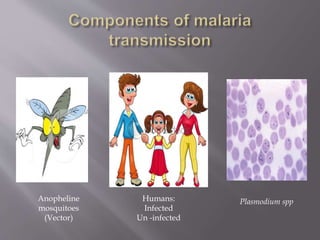
Anopheline
mosquitoes
(Vector)
Humans:
Infected
Un -infected
Plasmodium spp
• Main malaria vectors in Africa: An. gambiae s.s,
An. arabiensis, An. funestus
• They differ in biologically important
characteristics
– Host preference
– Where and when they bite
– Where they rest
– Breeding site
• These influence transmission of malaria and
methods for control
• An. gambiae s.s
• Anthropophilic (feeds exclusively on humans)
• Endophilic (rests indoors)
• Humid climate
• Fresh water breeder
• An. arabiensis
• Exophagic and exophilic
• Opportunistic feeder (anthropophilic & zoophilic)
• survival in hot and arid conditions
• Fresh water breeder
• An. funestus
 breeds in natural/artificial permanent and semi-
permanent water bodies with floating or emerging
vegetation
 has late-night biting patterns
 Anthropophilic and endophilic
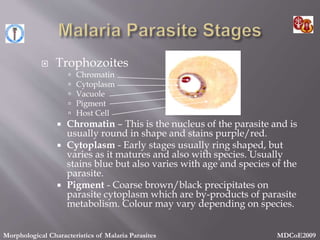
 Trophozoites
 Chromatin
 Cytoplasm
 Vacuole
 Pigment
 Host Cell
 Chromatin – This is the nucleus of the parasite and is
usually round in shape and stains purple/red.
 Cytoplasm - Early stages usually ring shaped, but
varies as it matures and also with species. Usually
stains blue but also varies with age and species of the
parasite.
 Pigment - Coarse brown/black precipitates on
parasite cytoplasm which are by-products of parasite
metabolism. Colour may vary depending on species.
Morphological Characteristics of Malaria Parasites MDCoE2009
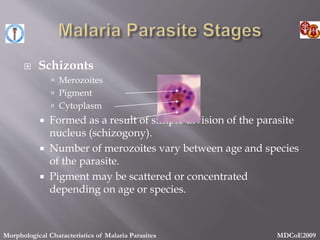
 Schizonts
 Merozoites
 Pigment
 Cytoplasm
 Formed as a result of simple division of the parasite
nucleus (schizogony).
 Number of merozoites vary between age and species
of the parasite.
 Pigment may be scattered or concentrated
depending on age or species.
Morphological Characteristics of Malaria Parasites MDCoE2009
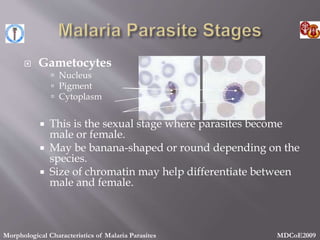
 Gametocytes
 Nucleus
 Pigment
 Cytoplasm
 This is the sexual stage where parasites become
male or female.
 May be banana-shaped or round depending on the
species.
 Size of chromatin may help differentiate between
male and female.
Morphological Characteristics of Malaria Parasites MDCoE2009
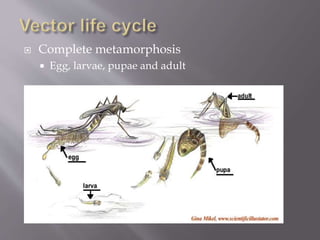
 Complete metamorphosis
 Egg, larvae, pupae and adult
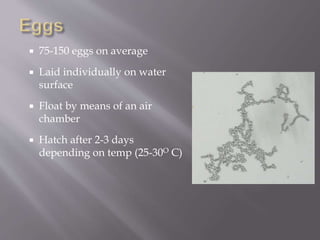
 75-150 eggs on average
 Laid individually on water
surface
 Float by means of an air
chamber
 Hatch after 2-3 days
depending on temp (25-30O C)
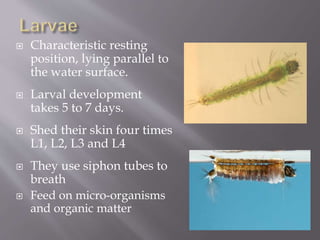
 Characteristic resting
position, lying parallel to
the water surface.
 Larval development
takes 5 to 7 days.
 Shed their skin four times
L1, L2, L3 and L4
 They use siphon tubes to
breath
 Feed on micro-organisms
and organic matter
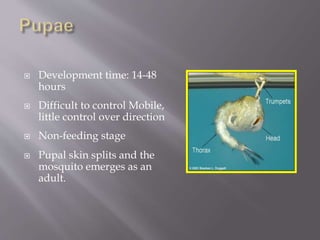
 Development time: 14-48
hours
 Difficult to control Mobile,
little control over direction
 Non-feeding stage
 Pupal skin splits and the
mosquito emerges as an
adult.
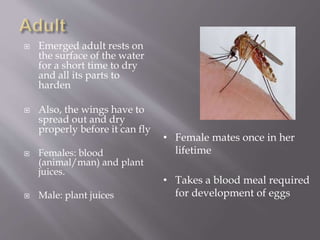
 Emerged adult rests on
the surface of the water
for a short time to dry
and all its parts to
harden
 Also, the wings have to
spread out and dry
properly before it can fly
 Females: blood
(animal/man) and plant
juices.
 Male: plant juices
• Female mates once in her
lifetime
• Takes a blood meal required
for development of eggs
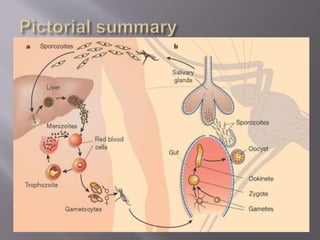
 Plasmodium transmitted form infected humans
to non-infected humans
 Vector – definitve host
 Human – intermediate host
 Has both extracellular and intracellular stages
in both vector and human
 Stages in the human:
 Exo-erythocytic schizogony (Liver stage)
 Erythrocytic stage (Red blood cell stage)
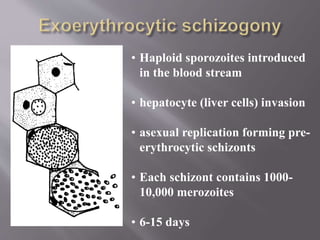
• Haploid sporozoites introduced
in the blood stream
• hepatocyte (liver cells) invasion
• asexual replication forming pre-
erythrocytic schizonts
• Each schizont contains 1000-
10,000 merozoites
• 6-15 days
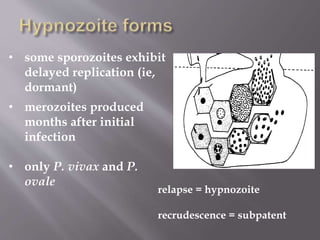
• some sporozoites exhibit
delayed replication (ie,
dormant)
• merozoites produced
months after initial
infection
• only P. vivax and P.
ovale
relapse = hypnozoite
recrudescence = subpatent
 Pre-erythrocytic schizont ruptures , merozoites
are released into the blood stream, where they
invade erythrocytes
 Merozoite develops into a ring form
 Ring form undergoes mitotic replication and
becomes a mature schizont
 Schizont contains 16-32 merozoites, ruptures
and realeases the merozoites
 Re-invasion of other RBC
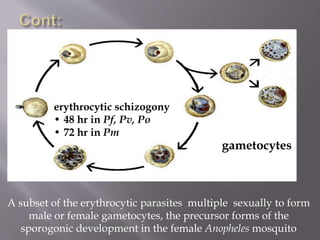
erythrocytic schizogony
• 48 hr in Pf, Pv, Po
• 72 hr in Pm
gametocytes
A subset of the erythrocytic parasites multiple sexually to form
male or female gametocytes, the precursor forms of the
sporogonic development in the female Anopheles mosquito
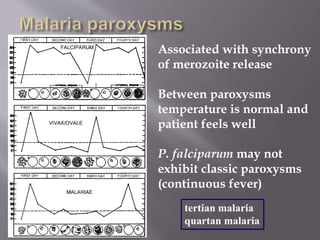
Associated with synchrony
of merozoite release
Between paroxysms
temperature is normal and
patient feels well
P. falciparum may not
exhibit classic paroxysms
(continuous fever)
tertian malaria
quartan malaria
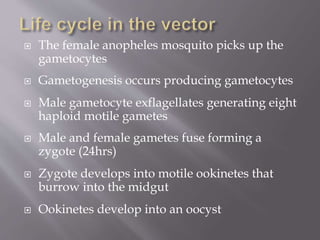
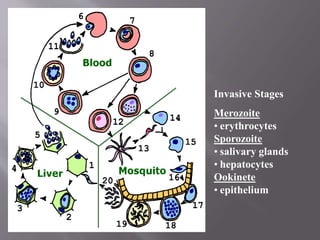
 The female anopheles mosquito picks up the
gametocytes
 Gametogenesis occurs producing gametocytes
 Male gametocyte exflagellates generating eight
haploid motile gametes
 Male and female gametes fuse forming a
zygote (24hrs)
 Zygote develops into motile ookinetes that
burrow into the midgut
 Ookinetes develop into an oocyst
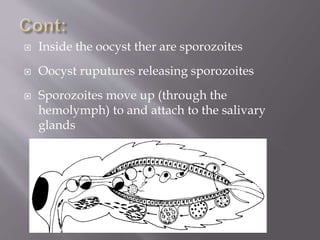
 Inside the oocyst ther are sporozoites
 Oocyst ruputures releasing sporozoites
 Sporozoites move up (through the
hemolymph) to and attach to the salivary
glands
Invasive Stages
Merozoite
• erythrocytes
Sporozoite
• salivary glands
• hepatocytes
Ookinete
• epithelium
Climatic factors –
 affects breeding sites, larval development, parasite
development e.t.c.
Non-climatic factors
 Human activities
 Human host immune factors
 Socio-economic factors
 Vector factors
 survival and longevity
 Genetic factors
The three components must exist together in time and
space for successful transmission
Thank you for listening

Life cycle presentation.pptx

  • 2.
     To appreciatethe diversity of malaria as a disease  To comprehend the life cycle of the parasite and the vector  To understand the factors that determine transmission patterns, both vectorial and human
  • 3.
     The fourhuman Plasmodium species  P. falciparum  P. vivax  P. ovale  P.knowlesi-Recently discovered to infect human though previously infecting animals only Morphological Characteristics of Malaria Parasites
  • 4.
     Introduction  Morphologyof malaria parasites  Vector life cycle  Parasite life cycle  Factors that determine transmission
  • 5.
    • 207 millioncases reported in 2012 (80% from Africa) • 627,000 deaths (90% from Africa) • <5yrs make up 77% of the deaths • Causative agent = Plasmodium species • 4 spp that infect humans • Transmitted by anopheline mosquitoes
  • 6.
  • 7.
    • Main malariavectors in Africa: An. gambiae s.s, An. arabiensis, An. funestus • They differ in biologically important characteristics – Host preference – Where and when they bite – Where they rest – Breeding site • These influence transmission of malaria and methods for control
  • 8.
    • An. gambiaes.s • Anthropophilic (feeds exclusively on humans) • Endophilic (rests indoors) • Humid climate • Fresh water breeder • An. arabiensis • Exophagic and exophilic • Opportunistic feeder (anthropophilic & zoophilic) • survival in hot and arid conditions • Fresh water breeder
  • 9.
    • An. funestus breeds in natural/artificial permanent and semi- permanent water bodies with floating or emerging vegetation  has late-night biting patterns  Anthropophilic and endophilic
  • 11.
     Trophozoites  Chromatin Cytoplasm  Vacuole  Pigment  Host Cell  Chromatin – This is the nucleus of the parasite and is usually round in shape and stains purple/red.  Cytoplasm - Early stages usually ring shaped, but varies as it matures and also with species. Usually stains blue but also varies with age and species of the parasite.  Pigment - Coarse brown/black precipitates on parasite cytoplasm which are by-products of parasite metabolism. Colour may vary depending on species. Morphological Characteristics of Malaria Parasites MDCoE2009
  • 12.
     Schizonts  Merozoites Pigment  Cytoplasm  Formed as a result of simple division of the parasite nucleus (schizogony).  Number of merozoites vary between age and species of the parasite.  Pigment may be scattered or concentrated depending on age or species. Morphological Characteristics of Malaria Parasites MDCoE2009
  • 13.
     Gametocytes  Nucleus Pigment  Cytoplasm  This is the sexual stage where parasites become male or female.  May be banana-shaped or round depending on the species.  Size of chromatin may help differentiate between male and female. Morphological Characteristics of Malaria Parasites MDCoE2009
  • 15.
     Complete metamorphosis Egg, larvae, pupae and adult
  • 16.
     75-150 eggson average  Laid individually on water surface  Float by means of an air chamber  Hatch after 2-3 days depending on temp (25-30O C)
  • 17.
     Characteristic resting position,lying parallel to the water surface.  Larval development takes 5 to 7 days.  Shed their skin four times L1, L2, L3 and L4  They use siphon tubes to breath  Feed on micro-organisms and organic matter
  • 18.
     Development time:14-48 hours  Difficult to control Mobile, little control over direction  Non-feeding stage  Pupal skin splits and the mosquito emerges as an adult.
  • 19.
     Emerged adultrests on the surface of the water for a short time to dry and all its parts to harden  Also, the wings have to spread out and dry properly before it can fly  Females: blood (animal/man) and plant juices.  Male: plant juices • Female mates once in her lifetime • Takes a blood meal required for development of eggs
  • 20.
     Plasmodium transmittedform infected humans to non-infected humans  Vector – definitve host  Human – intermediate host  Has both extracellular and intracellular stages in both vector and human  Stages in the human:  Exo-erythocytic schizogony (Liver stage)  Erythrocytic stage (Red blood cell stage)
  • 21.
    • Haploid sporozoitesintroduced in the blood stream • hepatocyte (liver cells) invasion • asexual replication forming pre- erythrocytic schizonts • Each schizont contains 1000- 10,000 merozoites • 6-15 days
  • 22.
    • some sporozoitesexhibit delayed replication (ie, dormant) • merozoites produced months after initial infection • only P. vivax and P. ovale relapse = hypnozoite recrudescence = subpatent
  • 23.
     Pre-erythrocytic schizontruptures , merozoites are released into the blood stream, where they invade erythrocytes  Merozoite develops into a ring form  Ring form undergoes mitotic replication and becomes a mature schizont  Schizont contains 16-32 merozoites, ruptures and realeases the merozoites  Re-invasion of other RBC
  • 24.
    erythrocytic schizogony • 48hr in Pf, Pv, Po • 72 hr in Pm gametocytes A subset of the erythrocytic parasites multiple sexually to form male or female gametocytes, the precursor forms of the sporogonic development in the female Anopheles mosquito
  • 25.
    Associated with synchrony ofmerozoite release Between paroxysms temperature is normal and patient feels well P. falciparum may not exhibit classic paroxysms (continuous fever) tertian malaria quartan malaria
  • 26.
     The femaleanopheles mosquito picks up the gametocytes  Gametogenesis occurs producing gametocytes  Male gametocyte exflagellates generating eight haploid motile gametes  Male and female gametes fuse forming a zygote (24hrs)  Zygote develops into motile ookinetes that burrow into the midgut  Ookinetes develop into an oocyst
  • 27.
     Inside theoocyst ther are sporozoites  Oocyst ruputures releasing sporozoites  Sporozoites move up (through the hemolymph) to and attach to the salivary glands
  • 29.
    Invasive Stages Merozoite • erythrocytes Sporozoite •salivary glands • hepatocytes Ookinete • epithelium
  • 30.
    Climatic factors – affects breeding sites, larval development, parasite development e.t.c. Non-climatic factors  Human activities  Human host immune factors  Socio-economic factors
  • 31.
     Vector factors survival and longevity  Genetic factors The three components must exist together in time and space for successful transmission
  • 32.
    Thank you forlistening