By,
U.Naga Pradeep
RRS college
of engg and tech
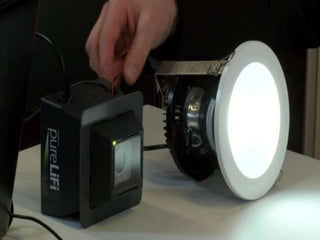
Li Fi is transmission of data through
illumination by taking the fiber out of fiber
optics by sending data through a LED light
bulb that varies in intensity faster than the
human eye can follow. Li-Fi is the term
some have used to label the fast and
cheap wireless-communication system,
which is the optical version of Wi-Fi.
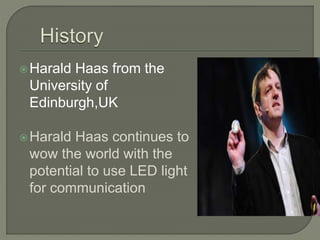
Harald Haas from the
University of
Edinburgh,UK
Harald Haas continues to
wow the world with the
potential to use LED light
for communication
The technology truly began during the
1990's in countries like Germany, Korea,
and Japan where they discovered LED's
could be retrofitted to send information.
 TED Global talk on VLC. Harald Haas explained,
Very simple, if the LED is on, you transmit a digital
, if it’s off you transmit a 0. The LEDs can be
switched on and off very quickly, which gives nice
opportunities for transmitting
 Radio waves are replaced by light waves in a new
method of data transmission which is being called
Li-Fi. Light-emitting diodes can be switched on and
off faster than the human eye can detect, causing
the light source to appear to be on continuously. g
data.
 Light-emitting diodes (commonly referred to
as LEDs and found in traffic and street lights,
car brake lights, remote control units and
countless other applications) can be switched
on and off faster than the human eye can
detect, causing the light source to appear to
be on continuously, even though it is in fact
'flickering'. This invisible on-off activity
enables a kind of data transmission
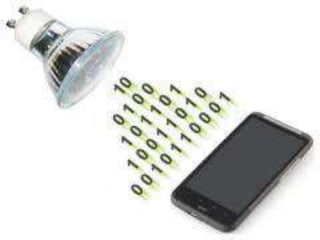
using binary codes: switching on an LED is a
logical '1', switching it off is a logical '0'.
 Li Fi (Light Fidelity) is a fast and cheap optical
version of Wi-Fi, the technology of which is
based on Visible Light Communication (VLC).
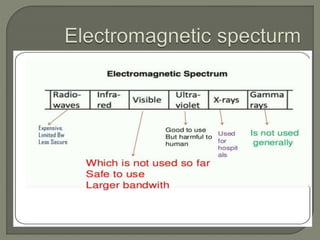
 VLC is a data communication medium, which
uses visible light between 400 THz (780 nm)
and 800 THz (375 nm) as optical carrier for
data transmission and illumination. It uses
fast pulses of light to transmit information
wirelessly.
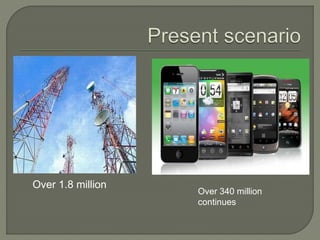
Over 1.8 million
Over 340 million
continues
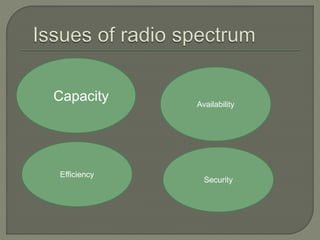
Capacity Availability
Efficiency
Security
The main components of this
communication system are:
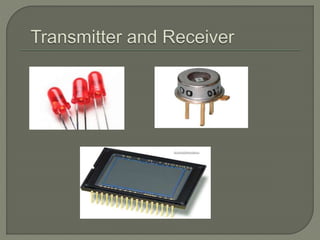
1) a high brightness LED,
2) a silicon photodiode which shows
good response to visible wavelength
region serving as the receiving element
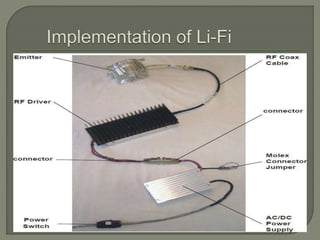
The LI FI product consists of 4 primary sub-
assemblies:
• Bulb
• RF power amplifier circuit (PA)
• Printed circuit board (PCB)
• Enclosure
receiver dongle
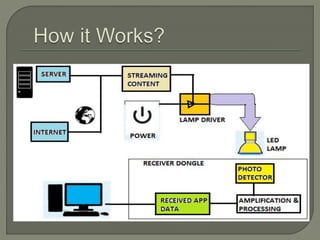
 On one end all the data on the internet will be
streamed to a lamp driver when the led is
turned on the microchip converts the digital
data in form of light
 A light sensitive device (photo detector)
receives the signal and converts it back into
original data. This method of using rapid
pulses of light to transmit information
wirelessly is technically referred as Visible
Light Communication
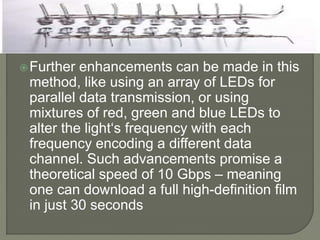
Further enhancements can be made in this
method, like using an array of LEDs for
parallel data transmission, or using
mixtures of red, green and blue LEDs to
alter the light‘s frequency with each
frequency encoding a different data
channel. Such advancements promise a
theoretical speed of 10 Gbps – meaning
one can download a full high-definition film
in just 30 seconds
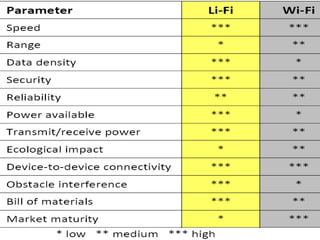
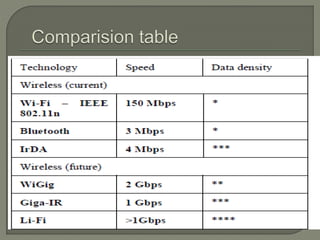
LI-FI is a term of one used to describe
visible light communication technology
applied to high speed wireless
communication.
Wi-Fi is a wireless networking technology
that allows computers and other devices to
communicate over a wireless signal.
Some of the applications of Li-Fi are given
below:
 Airways
 Green information technology
 Free from frequency bandwidth problem
 Increase communication safety
 Multi user communication
 Lightings points used as hotspot
 Smarter power plants
 Under sea Awesomeness
Li-Fi could offers safe, abundant
connectivity for all various of sensitive
locations.
Can be used underwater without radio
interference because salt conducts
electricity
It is impossible to achieve more than
10Gbps, theoretically allowing a high-
definition film to be downloaded in 30
sec.
Mostly powered by LEDs so it is cost
efficient
Transmission of data is fast and easy.
Presence of light is essential
There should be line of sight
Works better with fluorescent light and
LEDs but very low efficiency with bulbs
Li-Fi is certainly not useless, but it has
certain inherent limits for the technology.
Li-Fi may not be able to replace
conventional radios altogether, but it could
turbo charge the development of wireless
television and make it easier to throw a
wireless signal across an entire house. At
present, finding the ideal position for a
wireless router is something of a divine art.
Li fi(light fidelity),npe

Li fi(light fidelity),npe

  • 1.
  • 2.
    Li Fi istransmission of data through illumination by taking the fiber out of fiber optics by sending data through a LED light bulb that varies in intensity faster than the human eye can follow. Li-Fi is the term some have used to label the fast and cheap wireless-communication system, which is the optical version of Wi-Fi.
  • 3.
    Harald Haas fromthe University of Edinburgh,UK Harald Haas continues to wow the world with the potential to use LED light for communication
  • 4.
    The technology trulybegan during the 1990's in countries like Germany, Korea, and Japan where they discovered LED's could be retrofitted to send information.
  • 5.
     TED Globaltalk on VLC. Harald Haas explained, Very simple, if the LED is on, you transmit a digital , if it’s off you transmit a 0. The LEDs can be switched on and off very quickly, which gives nice opportunities for transmitting  Radio waves are replaced by light waves in a new method of data transmission which is being called Li-Fi. Light-emitting diodes can be switched on and off faster than the human eye can detect, causing the light source to appear to be on continuously. g data.
  • 6.
     Light-emitting diodes(commonly referred to as LEDs and found in traffic and street lights, car brake lights, remote control units and countless other applications) can be switched on and off faster than the human eye can detect, causing the light source to appear to be on continuously, even though it is in fact 'flickering'. This invisible on-off activity enables a kind of data transmission using binary codes: switching on an LED is a logical '1', switching it off is a logical '0'.
  • 8.
     Li Fi(Light Fidelity) is a fast and cheap optical version of Wi-Fi, the technology of which is based on Visible Light Communication (VLC).  VLC is a data communication medium, which uses visible light between 400 THz (780 nm) and 800 THz (375 nm) as optical carrier for data transmission and illumination. It uses fast pulses of light to transmit information wirelessly.
  • 9.
    Over 1.8 million Over340 million continues
  • 11.
  • 13.
    The main componentsof this communication system are: 1) a high brightness LED, 2) a silicon photodiode which shows good response to visible wavelength region serving as the receiving element
  • 14.
    The LI FIproduct consists of 4 primary sub- assemblies: • Bulb • RF power amplifier circuit (PA) • Printed circuit board (PCB) • Enclosure receiver dongle
  • 17.
     On oneend all the data on the internet will be streamed to a lamp driver when the led is turned on the microchip converts the digital data in form of light  A light sensitive device (photo detector) receives the signal and converts it back into original data. This method of using rapid pulses of light to transmit information wirelessly is technically referred as Visible Light Communication
  • 18.
    Further enhancements canbe made in this method, like using an array of LEDs for parallel data transmission, or using mixtures of red, green and blue LEDs to alter the light‘s frequency with each frequency encoding a different data channel. Such advancements promise a theoretical speed of 10 Gbps – meaning one can download a full high-definition film in just 30 seconds
  • 22.
    LI-FI is aterm of one used to describe visible light communication technology applied to high speed wireless communication. Wi-Fi is a wireless networking technology that allows computers and other devices to communicate over a wireless signal.
  • 25.
    Some of theapplications of Li-Fi are given below:  Airways  Green information technology  Free from frequency bandwidth problem  Increase communication safety  Multi user communication  Lightings points used as hotspot  Smarter power plants  Under sea Awesomeness
  • 26.
    Li-Fi could offerssafe, abundant connectivity for all various of sensitive locations. Can be used underwater without radio interference because salt conducts electricity
  • 27.
    It is impossibleto achieve more than 10Gbps, theoretically allowing a high- definition film to be downloaded in 30 sec. Mostly powered by LEDs so it is cost efficient Transmission of data is fast and easy.
  • 28.
    Presence of lightis essential There should be line of sight Works better with fluorescent light and LEDs but very low efficiency with bulbs
  • 29.
    Li-Fi is certainlynot useless, but it has certain inherent limits for the technology. Li-Fi may not be able to replace conventional radios altogether, but it could turbo charge the development of wireless television and make it easier to throw a wireless signal across an entire house. At present, finding the ideal position for a wireless router is something of a divine art.