Lymphatic Filariasis Morbidity
Management and Disability
Prevention (LF MMDP)
1
Module 2- Clinical components
Part 6- Psychosocial management of
lymphatic filariasis
2
Introduction: Purpose of the module
This module is intended to provide an overview of the
psychosocial impact of lymphatic filariasis disease and possible
interventions to address these issues.
3
Introduction: Learning objectives
After completing the module, participant will:
• Describe the psychosocial impacts among persons living
with lymphatic filariasis disease.
• Familarise with programme activities available to provide
psychosocial and other support for individuals living with
lymphatic filariasis disease.
4
The definition of health
5
• WHO defines health as “a state of complete physical,
mental, and social well-being, and not merely the absence
of disease or infirmity”
• Lymphatic filariasis affects people in mental, physical
and social aspects
• Mental health services should be integrated into the
essential package of care to ensure the early detection
and management of psychosocial issues (e.g. health care
worker training in detection, education on counselling, etc.)
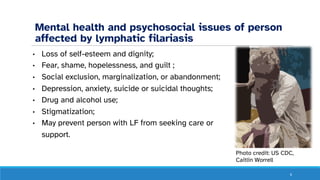
Mental health and psychosocial issues of person
affected by lymphatic filariasis
• Loss of self-esteem and dignity;
• Fear, shame, hopelessness, and guilt ;
• Social exclusion, marginalization, or abandonment;
• Depression, anxiety, suicide or suicidal thoughts;
• Drug and alcohol use;
• Stigmatization;
• May prevent person with LF from seeking care or
support.
6
Photo credit: US CDC,
Caitlin Worrell
7
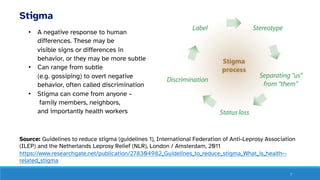
Stigma
• A negative response to human
differences. These may be
visible signs or differences in
behavior, or they may be more subtle
• Can range from subtle
(e.g. gossiping) to overt negative
behavior, often called discrimination
• Stigma can come from anyone –
family members, neighbors,
and importantly health workers
Source: Guidelines to reduce stigma (guidelines 1), International Federation of Anti-Leprosy Association
(ILEP) and the Netherlands Leprosy Relief (NLR), London / Amsterdam, 2011
https://www.researchgate.net/publication/278304982_Guidelines_to_reduce_stigma_What_is_health--
related_stigma
Causes of stigma
• Fear – of catching the disease is a common cause
• Unattractiveness – some conditions can cause visible impairments that
are perceived to be unattractive
• Values and beliefs – related to the perceived cause of the condition
(e.g. infidelity, witchcraft)
• Policies or beliefs – such as separate locations for treatment or
discriminatory laws
• Lack of confidentiality – unwanted disclosure of one’s condition
8
9
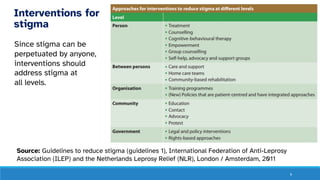
Interventions for
stigma
Since stigma can be
perpetuated by anyone,
interventions should
address stigma at
all levels.
Source: Guidelines to reduce stigma (guidelines 1), International Federation of Anti-Leprosy
Association (ILEP) and the Netherlands Leprosy Relief (NLR), London / Amsterdam, 2011
Mental health and psychosocial support
• Psychosocial support can simultaneously have a preventive and curative
impact.
• Psychosocial support is preventive in that it prevents the development
of mental health conditions.
• Psychosocial support is curative in that it helps individuals and
communities to overcome and treat psychosocial problems caused by
the chronic and acute aspects of the disease.
10
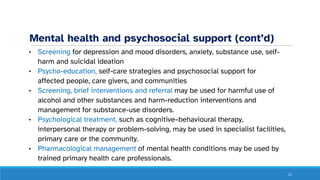
Mental health and psychosocial support (cont’d)
• Screening for depression and mood disorders, anxiety, substance use, self-
harm and suicidal ideation
• Psycho-education, self-care strategies and psychosocial support for
affected people, care givers, and communities
• Screening, brief interventions and referral may be used for harmful use of
alcohol and other substances and harm-reduction interventions and
management for substance-use disorders.
• Psychological treatment, such as cognitive–behavioural therapy,
interpersonal therapy or problem-solving, may be used in specialist facilities,
primary care or the community.
• Pharmacological management of mental health conditions may be used by
trained primary health care professionals.
11
12
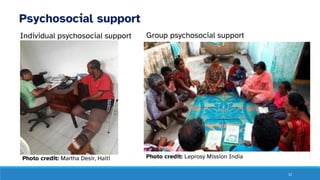
Psychosocial support
Individual psychosocial support Group psychosocial support
Photo credit: Leprosy Mission India
Photo credit: Martha Desir, Haiti
Individual psychosocial support
• Can occur in various settings (e.g. health facility, community
activities, home).
• One-on-one counselling with a lay/peer counsellor or with
a mental health specialist.
• Opportunity for person with LF to express challenges
living with LF, gain coping strategies to deal with challenges,
and improve mental wellbeing.
13
14
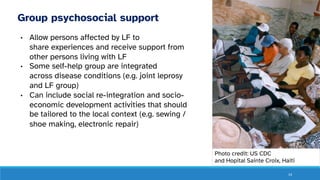
Group psychosocial support
• Allow persons affected by LF to
share experiences and receive support from
other persons living with LF
• Some self-help group are integrated
across disease conditions (e.g. joint leprosy
and LF group)
• Can include social re-integration and socio-
economic development activities that should
be tailored to the local context (e.g. sewing /
shoe making, electronic repair)
Photo credit: US CDC
and Hopital Sainte Croix, Haiti
Location of psychosocial services
• Hospital setting:
• Clinic;
• Health center;
• Dispensary;
• Other health facility.
• Field setting:
• Home visit;
• Community meeting;
• Hope club.
15
• Social reintegration center
Individuals responsible for psychosocial support
• Persons affected by LF;
• Family members;
• Peer counsellors (usually another person affected by LF);
• Field coordinator;
• Health professionals with experience in lymphatic filariasis
and mental health services (doctors, nurses,
physiotherapists, others).
16
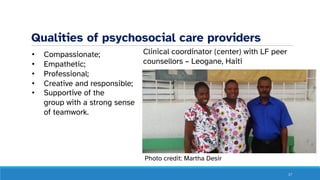
Qualities of psychosocial care providers
• Compassionate;
• Empathetic;
• Professional;
• Creative and responsible;
• Supportive of the
group with a strong sense
of teamwork.
17
Clinical coordinator (center) with LF peer
counsellors – Leogane, Haiti
Photo credit: Martha Desir
Challenges integrating psychosocial care into
MMDP programmes
18
• Many MMDP activities take place in a clinic setting
unfortunately, not all patients are able to participate in
programmes taking place at the health facility level.
• Peer-support groups may not be sufficient to address severe
mental health issues.
• Countries where LF is endemic may not have clinicians
trained in mental health care.
• Mental health issues remain stigmatized in many settings.
Experiences with a psychosocial support programme in
Haiti
19
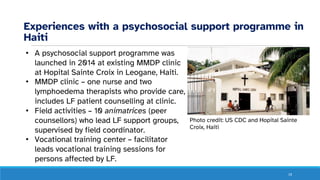
• A psychosocial support programme was
launched in 2014 at existing MMDP clinic
at Hopital Sainte Croix in Leogane, Haiti.
• MMDP clinic – one nurse and two
lymphoedema therapists who provide care,
includes LF patient counselling at clinic.
• Field activities – 10 animatrices (peer
counsellors) who lead LF support groups,
supervised by field coordinator.
• Vocational training center – facilitator
leads vocational training sessions for
persons affected by LF.
Photo credit: US CDC and Hopital Sainte
Croix, Haiti
20
Experiences with a psychosocial support programme in
Haiti (cont’d)
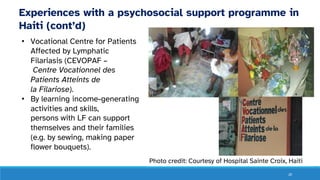
• Vocational Centre for Patients
Affected by Lymphatic
Filariasis (CEVOPAF –
Centre Vocationnel des
Patients Atteints de
la Filariose).
• By learning income-generating
activities and skills,
persons with LF can support
themselves and their families
(e.g. by sewing, making paper
flower bouquets).
Photo credit: Courtesy of Hospital Sainte Croix, Haiti
21
Experiences with a psychosocial
support programme in Haiti (cont’d)
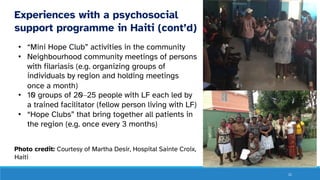
• “Mini Hope Club” activities in the community
• Neighbourhood community meetings of persons
with filariasis (e.g. organizing groups of
individuals by region and holding meetings
once a month)
• 10 groups of 20‒25 people with LF each led by
a trained facilitator (fellow person living with LF)
• “Hope Clubs” that bring together all patients in
the region (e.g. once every 3 months)
Photo credit: Courtesy of Martha Desir, Hospital Sainte Croix,
Haiti
22
Experiences with a psychosocial support programme in
Haiti (cont’d)
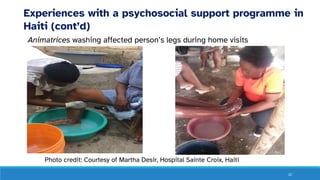
Animatrices washing affected person’s legs during home visits
Photo credit: Courtesy of Martha Desir, Hospital Sainte Croix, Haiti
Key takeaways
Lymphatic filariasis affects individuals not only physically but also
mentally, making it critical to include psychosocial care as part of
the minimum package of care in order to achieve integrated and
holistic care of affected individuals.
23
24
Resources
Stigma and mental wellbeing
• infoNTD – Resources on Stigma and mental well being- https://www.infontd.org/toolkits/stigma-
guides/stigmaguides
• ILEP – Guidelines to Reduce Stigma
https://www.researchgate.net/publication/278304982_Guidelines_to_reduce_stigma_What_is_heal
th--related_stigma
• Global Partnership for Zero Leprosy – Reducing stigma, discrimination, and exclusion
https://zeroleprosy.org/wp-content/uploads/2020/04/4.3-Support-Groups-final.pdf
• WHO – WHO Mental Health Gap Action Programme
https://www.who.int/mental_health/mhgap/en/
• WHO - Screening and brief interventions based on motivational interviewing for alcohol and other
substance use
(https://apps.who.int/iris/bitstream/handle/10665/67210/WHO_MSD_MSB_01.6b.pdf;jsessionid=5
5761BBE558793FBC26ADEE13D046FC2?sequence=1)

LFMMDP_course_module2__part600000000000_EN.pdf

  • 1.
    Lymphatic Filariasis Morbidity Managementand Disability Prevention (LF MMDP) 1
  • 2.
    Module 2- Clinicalcomponents Part 6- Psychosocial management of lymphatic filariasis 2
  • 3.
    Introduction: Purpose ofthe module This module is intended to provide an overview of the psychosocial impact of lymphatic filariasis disease and possible interventions to address these issues. 3
  • 4.
    Introduction: Learning objectives Aftercompleting the module, participant will: • Describe the psychosocial impacts among persons living with lymphatic filariasis disease. • Familarise with programme activities available to provide psychosocial and other support for individuals living with lymphatic filariasis disease. 4
  • 5.
    The definition ofhealth 5 • WHO defines health as “a state of complete physical, mental, and social well-being, and not merely the absence of disease or infirmity” • Lymphatic filariasis affects people in mental, physical and social aspects • Mental health services should be integrated into the essential package of care to ensure the early detection and management of psychosocial issues (e.g. health care worker training in detection, education on counselling, etc.)
  • 6.
    Mental health andpsychosocial issues of person affected by lymphatic filariasis • Loss of self-esteem and dignity; • Fear, shame, hopelessness, and guilt ; • Social exclusion, marginalization, or abandonment; • Depression, anxiety, suicide or suicidal thoughts; • Drug and alcohol use; • Stigmatization; • May prevent person with LF from seeking care or support. 6 Photo credit: US CDC, Caitlin Worrell
  • 7.
    7 Stigma • A negativeresponse to human differences. These may be visible signs or differences in behavior, or they may be more subtle • Can range from subtle (e.g. gossiping) to overt negative behavior, often called discrimination • Stigma can come from anyone – family members, neighbors, and importantly health workers Source: Guidelines to reduce stigma (guidelines 1), International Federation of Anti-Leprosy Association (ILEP) and the Netherlands Leprosy Relief (NLR), London / Amsterdam, 2011 https://www.researchgate.net/publication/278304982_Guidelines_to_reduce_stigma_What_is_health-- related_stigma
  • 8.
    Causes of stigma •Fear – of catching the disease is a common cause • Unattractiveness – some conditions can cause visible impairments that are perceived to be unattractive • Values and beliefs – related to the perceived cause of the condition (e.g. infidelity, witchcraft) • Policies or beliefs – such as separate locations for treatment or discriminatory laws • Lack of confidentiality – unwanted disclosure of one’s condition 8
  • 9.
    9 Interventions for stigma Since stigmacan be perpetuated by anyone, interventions should address stigma at all levels. Source: Guidelines to reduce stigma (guidelines 1), International Federation of Anti-Leprosy Association (ILEP) and the Netherlands Leprosy Relief (NLR), London / Amsterdam, 2011
  • 10.
    Mental health andpsychosocial support • Psychosocial support can simultaneously have a preventive and curative impact. • Psychosocial support is preventive in that it prevents the development of mental health conditions. • Psychosocial support is curative in that it helps individuals and communities to overcome and treat psychosocial problems caused by the chronic and acute aspects of the disease. 10
  • 11.
    Mental health andpsychosocial support (cont’d) • Screening for depression and mood disorders, anxiety, substance use, self- harm and suicidal ideation • Psycho-education, self-care strategies and psychosocial support for affected people, care givers, and communities • Screening, brief interventions and referral may be used for harmful use of alcohol and other substances and harm-reduction interventions and management for substance-use disorders. • Psychological treatment, such as cognitive–behavioural therapy, interpersonal therapy or problem-solving, may be used in specialist facilities, primary care or the community. • Pharmacological management of mental health conditions may be used by trained primary health care professionals. 11
  • 12.
    12 Psychosocial support Individual psychosocialsupport Group psychosocial support Photo credit: Leprosy Mission India Photo credit: Martha Desir, Haiti
  • 13.
    Individual psychosocial support •Can occur in various settings (e.g. health facility, community activities, home). • One-on-one counselling with a lay/peer counsellor or with a mental health specialist. • Opportunity for person with LF to express challenges living with LF, gain coping strategies to deal with challenges, and improve mental wellbeing. 13
  • 14.
    14 Group psychosocial support •Allow persons affected by LF to share experiences and receive support from other persons living with LF • Some self-help group are integrated across disease conditions (e.g. joint leprosy and LF group) • Can include social re-integration and socio- economic development activities that should be tailored to the local context (e.g. sewing / shoe making, electronic repair) Photo credit: US CDC and Hopital Sainte Croix, Haiti
  • 15.
    Location of psychosocialservices • Hospital setting: • Clinic; • Health center; • Dispensary; • Other health facility. • Field setting: • Home visit; • Community meeting; • Hope club. 15 • Social reintegration center
  • 16.
    Individuals responsible forpsychosocial support • Persons affected by LF; • Family members; • Peer counsellors (usually another person affected by LF); • Field coordinator; • Health professionals with experience in lymphatic filariasis and mental health services (doctors, nurses, physiotherapists, others). 16
  • 17.
    Qualities of psychosocialcare providers • Compassionate; • Empathetic; • Professional; • Creative and responsible; • Supportive of the group with a strong sense of teamwork. 17 Clinical coordinator (center) with LF peer counsellors – Leogane, Haiti Photo credit: Martha Desir
  • 18.
    Challenges integrating psychosocialcare into MMDP programmes 18 • Many MMDP activities take place in a clinic setting unfortunately, not all patients are able to participate in programmes taking place at the health facility level. • Peer-support groups may not be sufficient to address severe mental health issues. • Countries where LF is endemic may not have clinicians trained in mental health care. • Mental health issues remain stigmatized in many settings.
  • 19.
    Experiences with apsychosocial support programme in Haiti 19 • A psychosocial support programme was launched in 2014 at existing MMDP clinic at Hopital Sainte Croix in Leogane, Haiti. • MMDP clinic – one nurse and two lymphoedema therapists who provide care, includes LF patient counselling at clinic. • Field activities – 10 animatrices (peer counsellors) who lead LF support groups, supervised by field coordinator. • Vocational training center – facilitator leads vocational training sessions for persons affected by LF. Photo credit: US CDC and Hopital Sainte Croix, Haiti
  • 20.
    20 Experiences with apsychosocial support programme in Haiti (cont’d) • Vocational Centre for Patients Affected by Lymphatic Filariasis (CEVOPAF – Centre Vocationnel des Patients Atteints de la Filariose). • By learning income-generating activities and skills, persons with LF can support themselves and their families (e.g. by sewing, making paper flower bouquets). Photo credit: Courtesy of Hospital Sainte Croix, Haiti
  • 21.
    21 Experiences with apsychosocial support programme in Haiti (cont’d) • “Mini Hope Club” activities in the community • Neighbourhood community meetings of persons with filariasis (e.g. organizing groups of individuals by region and holding meetings once a month) • 10 groups of 20‒25 people with LF each led by a trained facilitator (fellow person living with LF) • “Hope Clubs” that bring together all patients in the region (e.g. once every 3 months) Photo credit: Courtesy of Martha Desir, Hospital Sainte Croix, Haiti
  • 22.
    22 Experiences with apsychosocial support programme in Haiti (cont’d) Animatrices washing affected person’s legs during home visits Photo credit: Courtesy of Martha Desir, Hospital Sainte Croix, Haiti
  • 23.
    Key takeaways Lymphatic filariasisaffects individuals not only physically but also mentally, making it critical to include psychosocial care as part of the minimum package of care in order to achieve integrated and holistic care of affected individuals. 23
  • 24.
    24 Resources Stigma and mentalwellbeing • infoNTD – Resources on Stigma and mental well being- https://www.infontd.org/toolkits/stigma- guides/stigmaguides • ILEP – Guidelines to Reduce Stigma https://www.researchgate.net/publication/278304982_Guidelines_to_reduce_stigma_What_is_heal th--related_stigma • Global Partnership for Zero Leprosy – Reducing stigma, discrimination, and exclusion https://zeroleprosy.org/wp-content/uploads/2020/04/4.3-Support-Groups-final.pdf • WHO – WHO Mental Health Gap Action Programme https://www.who.int/mental_health/mhgap/en/ • WHO - Screening and brief interventions based on motivational interviewing for alcohol and other substance use (https://apps.who.int/iris/bitstream/handle/10665/67210/WHO_MSD_MSB_01.6b.pdf;jsessionid=5 5761BBE558793FBC26ADEE13D046FC2?sequence=1)