Lymphatic Filariasis Morbidity
Management and Disability
Prevention (LF MMDP)
1
Module 3- Programmatic components
Part 2- Situation analysis
2
Introduction: Purpose of the module
This module is intended to give an overview of the components
of an MMDP situation analysis and how this tool can be used in
MMDP programme planning.
3
Introduction: Module learning objectives
After completing the module, participants will:
• Describe the components of a situation analysis for MMDP.
• Explain the role of situation analyses in MMDP programme
planning.
• Demonstrate knowledge on the tools available to assist
countries in completing a situation analysis.
4
5
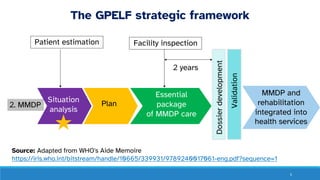
The GPELF strategic framework
2. MMDP Plan
Essential
package
of MMDP care
Situation
analysis
MMDP and
rehabilitation
integrated into
health services
Patient estimation Facility inspection
2 years
Dossier
development
Validation
Source: Adapted from WHO's Aide Memoire
https://iris.who.int/bitstream/handle/10665/339931/9789240017061-eng.pdf?sequence=1
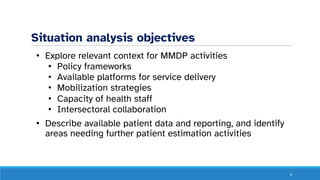
Situation analysis objectives
• Explore relevant context for MMDP activities
• Policy frameworks
• Available platforms for service delivery
• Mobilization strategies
• Capacity of health staff
• Intersectoral collaboration
• Describe available patient data and reporting, and identify
areas needing further patient estimation activities
6
7
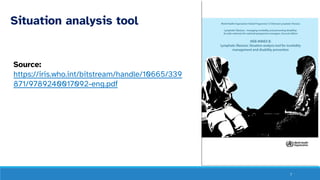
Situation analysis tool
Source:
https://iris.who.int/bitstream/handle/10665/339
871/9789240017092-eng.pdf
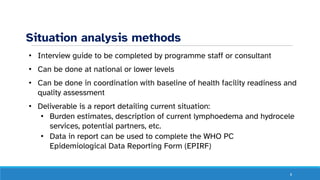
Situation analysis methods
• Interview guide to be completed by programme staff or consultant
• Can be done at national or lower levels
• Can be done in coordination with baseline of health facility readiness and
quality assessment
• Deliverable is a report detailing current situation:
• Burden estimates, description of current lymphoedema and hydrocele
services, potential partners, etc.
• Data in report can be used to complete the WHO PC
Epidemiological Data Reporting Form (EPIRF)
8
Situation analysis components (1)
• Patient distribution
• How many lymphoedema or hydrocele patients are there?
• Where are the patients located?
• Case finding and access to services
• What strategies are used to identify and report patients
with lymphoedema and hydrocele?
• What factors might influence patient access?
◦ Do patients have to pay for surgery? If so, how much?
• What community networks exist that could be used for
mobilizing patients?
9
Situation analysis components (2)
• Technical and operational facilities
• What level and type of facilities provide lymphoedema or
hydrocele services?
• How many implementation units have available facilities
for lymphoedema or hydrocele services?
• How recently were surgeons trained in hydrocele surgery?
• How ready are facilities to perform hydrocele surgery?
• What are the current skills and training needs of health workers
in management of lymphoedema and adenolymphangitis?
• How many lymphoedema patients have been trained in self-
management?
10
Situation analysis components (3)
• Strategic framework
• What policies exist that affect lymphoedema management or hydrocele
surgery?
• Are there other health programmes with whom collaboration
is possible?
• Are there common activities that could be used to help care for or
monitor lymphoedema or hydrocele patients?
• Are there similar indicators among programmes?
• How feasible is joint training of staff, caregivers and/or patients?
• What nongovernmental organizations are engaged in MMDP activities?
Where are they working?
11
Defining goals and activities (1)
• Use results of situation analysis to develop a multi-year plan for
implementing MMDP activities.
• Determine areas in which additional patient estimation activities are
needed.
• Set ultimate and annual goals for:
o “Number of hydrocele surgeries”
o “Number of staff and patients trained in lymphoedema
management”
• Calculate staff, supplies and budget needed to implement programme.
12
Defining goals and activities (2)
13
• Determine best service delivery platforms to reach patients.
• Determine major barriers that need to be addressed to
deliver the essential package of care.
• Determine other partners that could contribute
to programme goals.
Subnational activities
• District health facilities can:
• Serve as technical referral facilities
• Provide access to treatment for complicated cases
• Train community volunteers
• Monitor and evaluate activities
• Communities can:
• Help with case-finding
• Engage in activities to reduce discrimination and stigmatization
• Become volunteers to help with caregiving and following up patients
14
Coordination and integration
• MMDP focal points at national and subnational levels can
be useful to coordinate activities.
• A local MMDP committee can include all local stakeholders and can
be important in activities to reduce stigmatization.
• Specific activities could be combined with other subnational health
programme activities, such as:
• Case-finding;
• Training;
• Patient follow-up.
15
Case study – Burkina Faso/Cameroon/Ethiopia (1)
• Implemented before providing NGO support.
• Some national information collected, but with focus on specific regions
in country.
• Implemented in coordination with baseline quality assessment at
selected hospitals or health centers.
• Implemented by MoH with support of consultants.
• ~ 20‒25 days, including travel to regions to visit hospitals and
health centres, and report writing.
• US$ 5000‒10 000.
16
Case study – Burkina Faso/Cameroon/Ethiopia (2)
• Questionnaire implementation itself raised awareness of regional health
staff of MMDP activity needs
• Results were used to:
• Gather estimates of number of patients per implementation unit
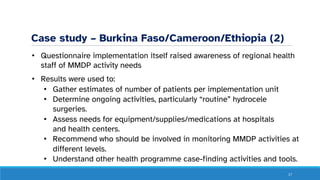
• Determine ongoing activities, particularly “routine” hydrocele
surgeries.
• Assess needs for equipment/supplies/medications at hospitals
and health centers.
• Recommend who should be involved in monitoring MMDP activities at
different levels.
• Understand other health programme case-finding activities and tools.
17
18
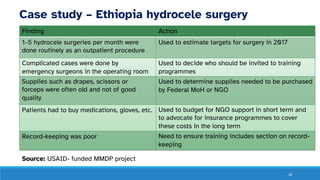
Case study – Ethiopia hydrocele surgery
Finding Action
1‒5 hydrocele surgeries per month were
done routinely as an outpatient procedure
Used to estimate targets for surgery in 2017
Complicated cases were done by
emergency surgeons in the operating room
Used to decide who should be invited to training
programmes
Supplies such as drapes, scissors or
forceps were often old and not of good
quality
Used to determine supplies needed to be purchased
by Federal MoH or NGO
Patients had to buy medications, gloves, etc. Used to budget for NGO support in short term and
to advocate for insurance programmes to cover
these costs in the long term
Record-keeping was poor Need to ensure training includes section on record-
keeping
Source: USAID- funded MMDP project

LFMMDP_course_module3__part200000000_EN.pdf

  • 1.
    Lymphatic Filariasis Morbidity Managementand Disability Prevention (LF MMDP) 1
  • 2.
    Module 3- Programmaticcomponents Part 2- Situation analysis 2
  • 3.
    Introduction: Purpose ofthe module This module is intended to give an overview of the components of an MMDP situation analysis and how this tool can be used in MMDP programme planning. 3
  • 4.
    Introduction: Module learningobjectives After completing the module, participants will: • Describe the components of a situation analysis for MMDP. • Explain the role of situation analyses in MMDP programme planning. • Demonstrate knowledge on the tools available to assist countries in completing a situation analysis. 4
  • 5.
    5 The GPELF strategicframework 2. MMDP Plan Essential package of MMDP care Situation analysis MMDP and rehabilitation integrated into health services Patient estimation Facility inspection 2 years Dossier development Validation Source: Adapted from WHO's Aide Memoire https://iris.who.int/bitstream/handle/10665/339931/9789240017061-eng.pdf?sequence=1
  • 6.
    Situation analysis objectives •Explore relevant context for MMDP activities • Policy frameworks • Available platforms for service delivery • Mobilization strategies • Capacity of health staff • Intersectoral collaboration • Describe available patient data and reporting, and identify areas needing further patient estimation activities 6
  • 7.
  • 8.
    Situation analysis methods •Interview guide to be completed by programme staff or consultant • Can be done at national or lower levels • Can be done in coordination with baseline of health facility readiness and quality assessment • Deliverable is a report detailing current situation: • Burden estimates, description of current lymphoedema and hydrocele services, potential partners, etc. • Data in report can be used to complete the WHO PC Epidemiological Data Reporting Form (EPIRF) 8
  • 9.
    Situation analysis components(1) • Patient distribution • How many lymphoedema or hydrocele patients are there? • Where are the patients located? • Case finding and access to services • What strategies are used to identify and report patients with lymphoedema and hydrocele? • What factors might influence patient access? ◦ Do patients have to pay for surgery? If so, how much? • What community networks exist that could be used for mobilizing patients? 9
  • 10.
    Situation analysis components(2) • Technical and operational facilities • What level and type of facilities provide lymphoedema or hydrocele services? • How many implementation units have available facilities for lymphoedema or hydrocele services? • How recently were surgeons trained in hydrocele surgery? • How ready are facilities to perform hydrocele surgery? • What are the current skills and training needs of health workers in management of lymphoedema and adenolymphangitis? • How many lymphoedema patients have been trained in self- management? 10
  • 11.
    Situation analysis components(3) • Strategic framework • What policies exist that affect lymphoedema management or hydrocele surgery? • Are there other health programmes with whom collaboration is possible? • Are there common activities that could be used to help care for or monitor lymphoedema or hydrocele patients? • Are there similar indicators among programmes? • How feasible is joint training of staff, caregivers and/or patients? • What nongovernmental organizations are engaged in MMDP activities? Where are they working? 11
  • 12.
    Defining goals andactivities (1) • Use results of situation analysis to develop a multi-year plan for implementing MMDP activities. • Determine areas in which additional patient estimation activities are needed. • Set ultimate and annual goals for: o “Number of hydrocele surgeries” o “Number of staff and patients trained in lymphoedema management” • Calculate staff, supplies and budget needed to implement programme. 12
  • 13.
    Defining goals andactivities (2) 13 • Determine best service delivery platforms to reach patients. • Determine major barriers that need to be addressed to deliver the essential package of care. • Determine other partners that could contribute to programme goals.
  • 14.
    Subnational activities • Districthealth facilities can: • Serve as technical referral facilities • Provide access to treatment for complicated cases • Train community volunteers • Monitor and evaluate activities • Communities can: • Help with case-finding • Engage in activities to reduce discrimination and stigmatization • Become volunteers to help with caregiving and following up patients 14
  • 15.
    Coordination and integration •MMDP focal points at national and subnational levels can be useful to coordinate activities. • A local MMDP committee can include all local stakeholders and can be important in activities to reduce stigmatization. • Specific activities could be combined with other subnational health programme activities, such as: • Case-finding; • Training; • Patient follow-up. 15
  • 16.
    Case study –Burkina Faso/Cameroon/Ethiopia (1) • Implemented before providing NGO support. • Some national information collected, but with focus on specific regions in country. • Implemented in coordination with baseline quality assessment at selected hospitals or health centers. • Implemented by MoH with support of consultants. • ~ 20‒25 days, including travel to regions to visit hospitals and health centres, and report writing. • US$ 5000‒10 000. 16
  • 17.
    Case study –Burkina Faso/Cameroon/Ethiopia (2) • Questionnaire implementation itself raised awareness of regional health staff of MMDP activity needs • Results were used to: • Gather estimates of number of patients per implementation unit • Determine ongoing activities, particularly “routine” hydrocele surgeries. • Assess needs for equipment/supplies/medications at hospitals and health centers. • Recommend who should be involved in monitoring MMDP activities at different levels. • Understand other health programme case-finding activities and tools. 17
  • 18.
    18 Case study –Ethiopia hydrocele surgery Finding Action 1‒5 hydrocele surgeries per month were done routinely as an outpatient procedure Used to estimate targets for surgery in 2017 Complicated cases were done by emergency surgeons in the operating room Used to decide who should be invited to training programmes Supplies such as drapes, scissors or forceps were often old and not of good quality Used to determine supplies needed to be purchased by Federal MoH or NGO Patients had to buy medications, gloves, etc. Used to budget for NGO support in short term and to advocate for insurance programmes to cover these costs in the long term Record-keeping was poor Need to ensure training includes section on record- keeping Source: USAID- funded MMDP project