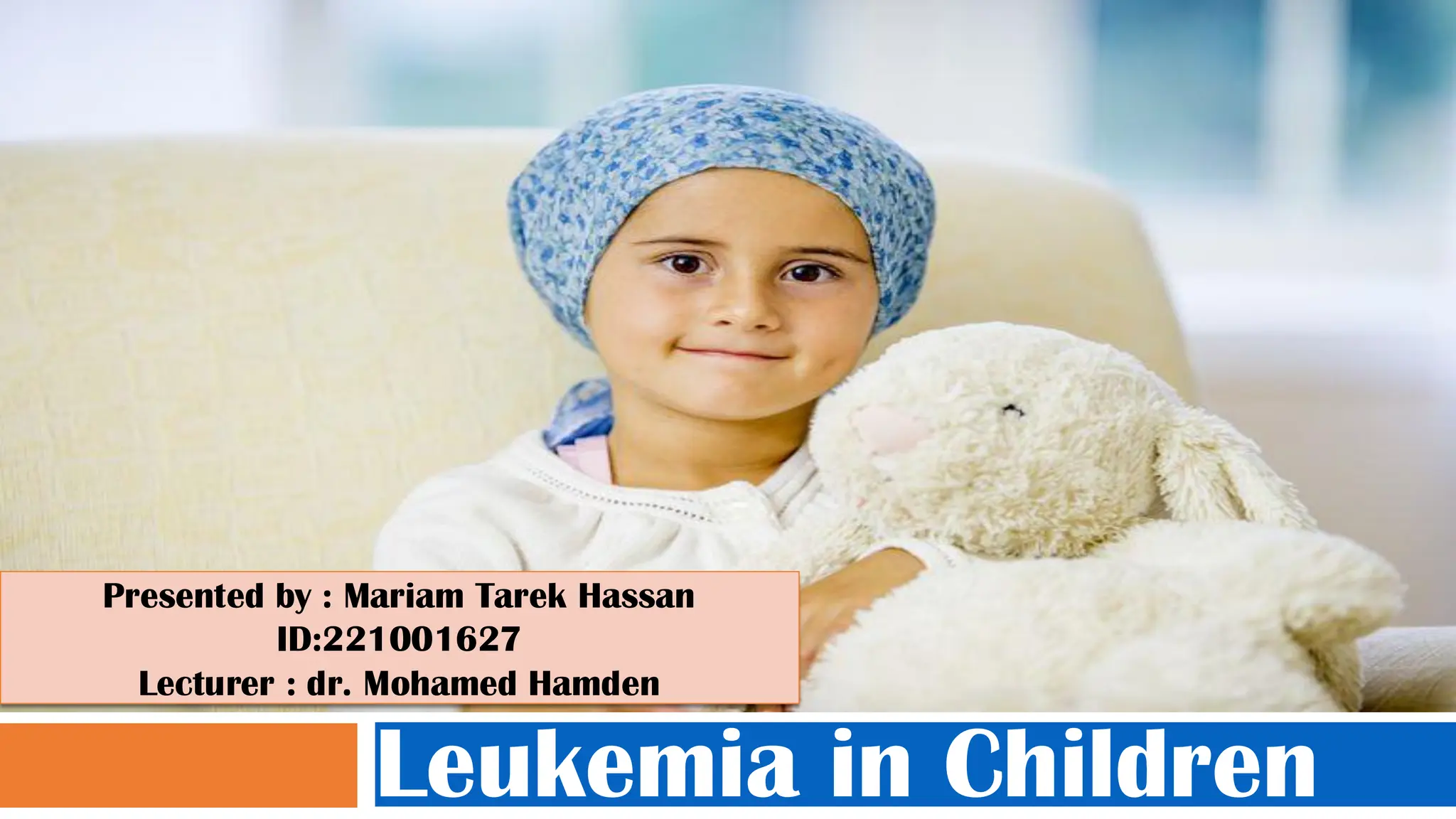
Leukemia in Children
Presented by : Mariam Tarek Hassan
ID:221001627
Lecturer : dr. Mohamed Hamden
Types
Chemotherapy Handling
Risk factors
Diagnosis
Symptoms
Definition
Treatment
2
3
Childhood Leukemia
Most common form of cancer in childhood
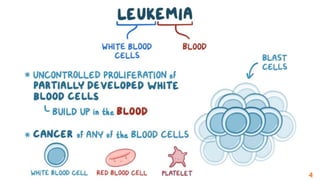
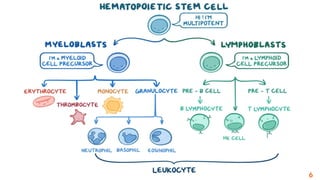
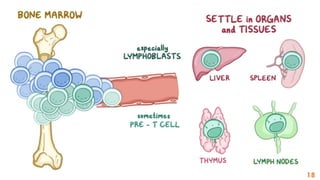
➢ Leukemias are cancers of progenitor cells in bone marrow
➢ Most often starts in early forms of white blood cells, but
some may start in other blood cell types
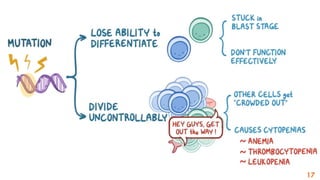
➢ The bone marrow makes abnormal blood cells “Blast
cells” that are immature and don’t work as healthy cells
“compete for nutrients with other healthy cells”
4
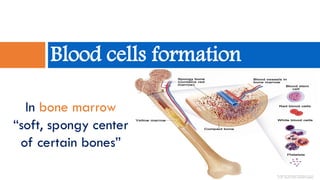
In bone marrow
“soft, spongy center
of certain bones”
Blood cells formation
6
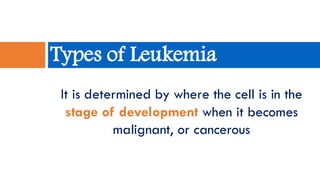
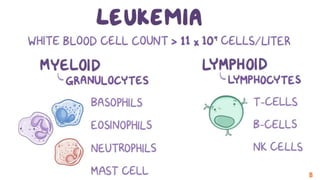
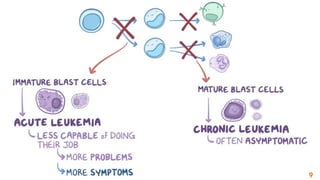
It is determined by where the cell is in the
stage of development when it becomes
malignant, or cancerous
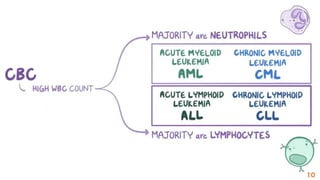
Types of Leukemia
8
9
10
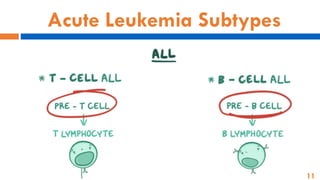
11
Acute Leukemia Subtypes
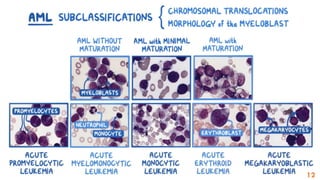
12
13
Types of Childhood Leukemia
➢ Acute lymphoblastic leukemia (ALL) ~ 80% “ages of 2 - 4 years”
➢ Acute myelogenous leukemia (AML) ~ 15% “very young children
& teenagers” - more common in elderly
➢ Hybrid or mixed lineage leukemia ~ rare with features of both
ALL & AML
➢ Chronic leukemias ~ rarely seen in children
➢ Juvenile myelomonocytic leukemia (JMML) ~ rare type neither
chronic nor acute “children < age 4”
14
Congenital Leukemia
➢ Quite rare (<1% of all childhood leukemias)
➢ Occurs within 4 - 6 weeks of birth
➢ Unfortunately, the 6-month survival rate is only 1/3,
despite aggressive chemotherapy
➢ However spontaneous remissions have been reported,
but science has not offered definitive answers as to
how this might occur
• Having a risk factor does not
mean that you will get cancer;
• Not having risk factors doesn’t
mean that you will not get
cancer
Risk factors
16
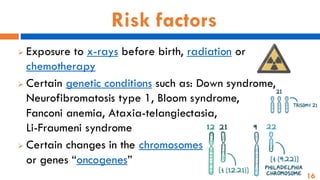
Risk factors
➢ Exposure to x-rays before birth, radiation or
chemotherapy
➢ Certain genetic conditions such as: Down syndrome,
Neurofibromatosis type 1, Bloom syndrome,
Fanconi anemia, Ataxia-telangiectasia,
Li-Fraumeni syndrome
➢ Certain changes in the chromosomes
or genes “oncogenes”
17
18
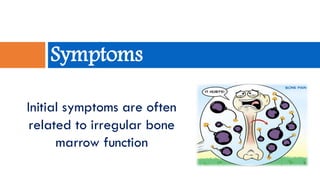
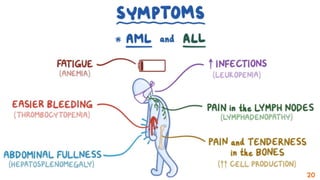
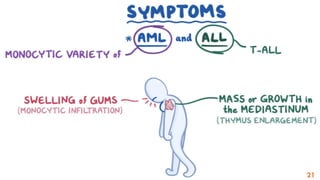
Initial symptoms are often
related to irregular bone
marrow function
Symptoms
20
21
In addition to a complete medical
history and physical examination,
Diagnostic procedures for leukemia
may include:
Diagnosis
23
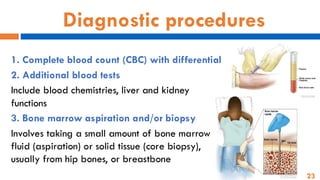
Diagnostic procedures
1. Complete blood count (CBC) with differential
2. Additional blood tests
Include blood chemistries, liver and kidney
functions
3. Bone marrow aspiration and/or biopsy
Involves taking a small amount of bone marrow
fluid (aspiration) or solid tissue (core biopsy),
usually from hip bones, or breastbone
24
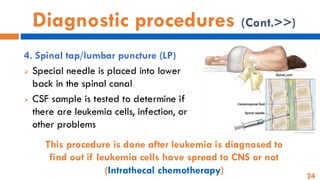
Diagnostic procedures (Cont.>>)
4. Spinal tap/lumbar puncture (LP)
➢ Special needle is placed into lower
back in the spinal canal
➢ CSF sample is tested to determine if
there are leukemia cells, infection, or
other problems
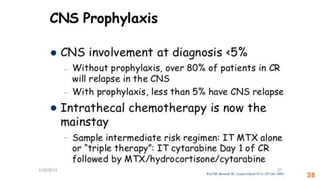
This procedure is done after leukemia is diagnosed to
find out if leukemia cells have spread to CNS or not
(Intrathecal chemotherapy)
25
Diagnostic procedures (Cont.>>)
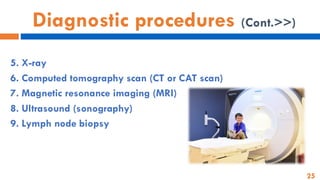
5. X-ray
6. Computed tomography scan (CT or CAT scan)
7. Magnetic resonance imaging (MRI)
8. Ultrasound (sonography)
9. Lymph node biopsy
Determined based on:
➢ Child's age, overall health, and medical history
➢ Type of leukemia & certain chromosomal changes
➢ Extent of the disease
➢ Child's tolerance for certain medications
➢ Physician’s opinion or preference
[Patient’s Risk Classification]
Treatment
27
Treatment
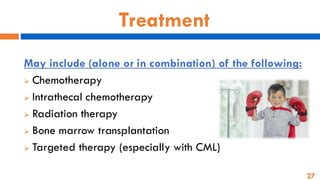
May include (alone or in combination) of the following:
➢ Chemotherapy
➢ Intrathecal chemotherapy
➢ Radiation therapy
➢ Bone marrow transplantation
➢ Targeted therapy (especially with CML)
28
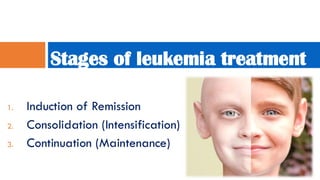
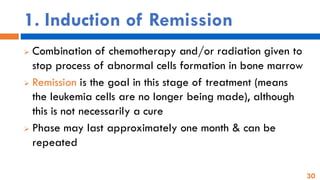
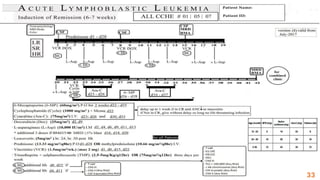
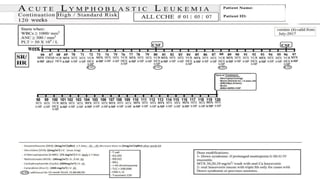
1. Induction of Remission
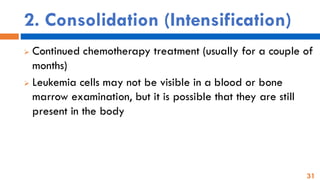
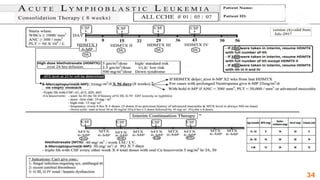
2. Consolidation (Intensification)
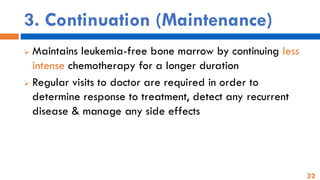
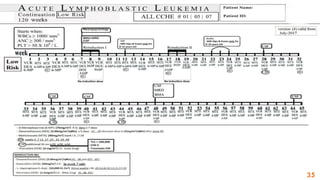
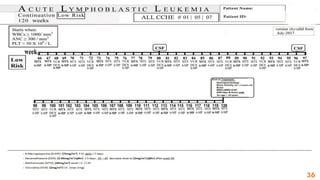
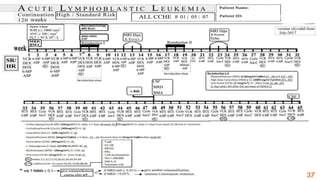
3. Continuation (Maintenance)
Stages of leukemia treatment
30
1. Induction of Remission
➢ Combination of chemotherapy and/or radiation given to
stop process of abnormal cells formation in bone marrow
➢ Remission is the goal in this stage of treatment (means
the leukemia cells are no longer being made), although
this is not necessarily a cure
➢ Phase may last approximately one month & can be
repeated
31
2. Consolidation (Intensification)
➢ Continued chemotherapy treatment (usually for a couple of
months)
➢ Leukemia cells may not be visible in a blood or bone
marrow examination, but it is possible that they are still
present in the body
32
3. Continuation (Maintenance)
➢ Maintains leukemia-free bone marrow by continuing less
intense chemotherapy for a longer duration
➢ Regular visits to doctor are required in order to
determine response to treatment, detect any recurrent
disease & manage any side effects
33
34
35
36
37
38
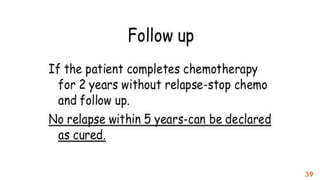
39
40
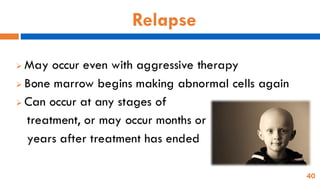
Relapse
➢ May occur even with aggressive therapy
➢ Bone marrow begins making abnormal cells again
➢ Can occur at any stages of
treatment, or may occur months or
years after treatment has ended
41
42
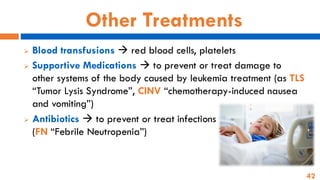
Other Treatments
➢ Blood transfusions → red blood cells, platelets
➢ Supportive Medications → to prevent or treat damage to
other systems of the body caused by leukemia treatment (as TLS
“Tumor Lysis Syndrome”, CINV “chemotherapy-induced nausea
and vomiting”)
➢ Antibiotics → to prevent or treat infections
(FN “Febrile Neutropenia”)
43
References
44
Chemotherapy Handling
45
Chemotherapy drugs are
bio hazardous agents
46
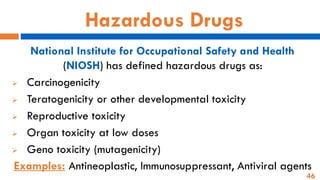
Hazardous Drugs
National Institute for Occupational Safety and Health
(NIOSH) has defined hazardous drugs as:
➢ Carcinogenicity
➢ Teratogenicity or other developmental toxicity
➢ Reproductive toxicity
➢ Organ toxicity at low doses
➢ Geno toxicity (mutagenicity)
Examples: Antineoplastic, Immunosuppressant, Antiviral agents
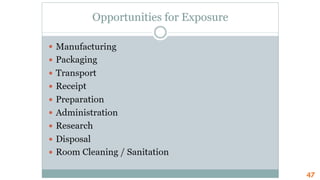
47
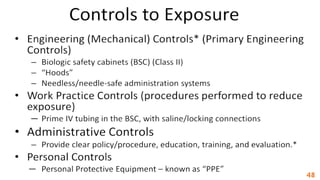
48
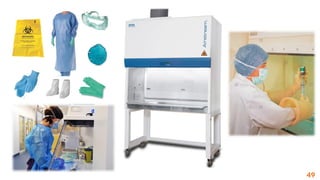
49
References
50
51

Leukemia in children-3 me .pdffffffffffff

  • 1.
    Leukemia in Children Presentedby : Mariam Tarek Hassan ID:221001627 Lecturer : dr. Mohamed Hamden
  • 2.
  • 3.
    3 Childhood Leukemia Most commonform of cancer in childhood ➢ Leukemias are cancers of progenitor cells in bone marrow ➢ Most often starts in early forms of white blood cells, but some may start in other blood cell types ➢ The bone marrow makes abnormal blood cells “Blast cells” that are immature and don’t work as healthy cells “compete for nutrients with other healthy cells”
  • 4.
  • 5.
    In bone marrow “soft,spongy center of certain bones” Blood cells formation
  • 6.
  • 7.
    It is determinedby where the cell is in the stage of development when it becomes malignant, or cancerous Types of Leukemia
  • 8.
  • 9.
  • 10.
  • 11.
  • 12.
  • 13.
    13 Types of ChildhoodLeukemia ➢ Acute lymphoblastic leukemia (ALL) ~ 80% “ages of 2 - 4 years” ➢ Acute myelogenous leukemia (AML) ~ 15% “very young children & teenagers” - more common in elderly ➢ Hybrid or mixed lineage leukemia ~ rare with features of both ALL & AML ➢ Chronic leukemias ~ rarely seen in children ➢ Juvenile myelomonocytic leukemia (JMML) ~ rare type neither chronic nor acute “children < age 4”
  • 14.
    14 Congenital Leukemia ➢ Quiterare (<1% of all childhood leukemias) ➢ Occurs within 4 - 6 weeks of birth ➢ Unfortunately, the 6-month survival rate is only 1/3, despite aggressive chemotherapy ➢ However spontaneous remissions have been reported, but science has not offered definitive answers as to how this might occur
  • 15.
    • Having arisk factor does not mean that you will get cancer; • Not having risk factors doesn’t mean that you will not get cancer Risk factors
  • 16.
    16 Risk factors ➢ Exposureto x-rays before birth, radiation or chemotherapy ➢ Certain genetic conditions such as: Down syndrome, Neurofibromatosis type 1, Bloom syndrome, Fanconi anemia, Ataxia-telangiectasia, Li-Fraumeni syndrome ➢ Certain changes in the chromosomes or genes “oncogenes”
  • 17.
  • 18.
  • 19.
    Initial symptoms areoften related to irregular bone marrow function Symptoms
  • 20.
  • 21.
  • 22.
    In addition toa complete medical history and physical examination, Diagnostic procedures for leukemia may include: Diagnosis
  • 23.
    23 Diagnostic procedures 1. Completeblood count (CBC) with differential 2. Additional blood tests Include blood chemistries, liver and kidney functions 3. Bone marrow aspiration and/or biopsy Involves taking a small amount of bone marrow fluid (aspiration) or solid tissue (core biopsy), usually from hip bones, or breastbone
  • 24.
    24 Diagnostic procedures (Cont.>>) 4.Spinal tap/lumbar puncture (LP) ➢ Special needle is placed into lower back in the spinal canal ➢ CSF sample is tested to determine if there are leukemia cells, infection, or other problems This procedure is done after leukemia is diagnosed to find out if leukemia cells have spread to CNS or not (Intrathecal chemotherapy)
  • 25.
    25 Diagnostic procedures (Cont.>>) 5.X-ray 6. Computed tomography scan (CT or CAT scan) 7. Magnetic resonance imaging (MRI) 8. Ultrasound (sonography) 9. Lymph node biopsy
  • 26.
    Determined based on: ➢Child's age, overall health, and medical history ➢ Type of leukemia & certain chromosomal changes ➢ Extent of the disease ➢ Child's tolerance for certain medications ➢ Physician’s opinion or preference [Patient’s Risk Classification] Treatment
  • 27.
    27 Treatment May include (aloneor in combination) of the following: ➢ Chemotherapy ➢ Intrathecal chemotherapy ➢ Radiation therapy ➢ Bone marrow transplantation ➢ Targeted therapy (especially with CML)
  • 28.
  • 29.
    1. Induction ofRemission 2. Consolidation (Intensification) 3. Continuation (Maintenance) Stages of leukemia treatment
  • 30.
    30 1. Induction ofRemission ➢ Combination of chemotherapy and/or radiation given to stop process of abnormal cells formation in bone marrow ➢ Remission is the goal in this stage of treatment (means the leukemia cells are no longer being made), although this is not necessarily a cure ➢ Phase may last approximately one month & can be repeated
  • 31.
    31 2. Consolidation (Intensification) ➢Continued chemotherapy treatment (usually for a couple of months) ➢ Leukemia cells may not be visible in a blood or bone marrow examination, but it is possible that they are still present in the body
  • 32.
    32 3. Continuation (Maintenance) ➢Maintains leukemia-free bone marrow by continuing less intense chemotherapy for a longer duration ➢ Regular visits to doctor are required in order to determine response to treatment, detect any recurrent disease & manage any side effects
  • 33.
  • 34.
  • 35.
  • 36.
  • 37.
  • 38.
  • 39.
  • 40.
    40 Relapse ➢ May occureven with aggressive therapy ➢ Bone marrow begins making abnormal cells again ➢ Can occur at any stages of treatment, or may occur months or years after treatment has ended
  • 41.
  • 42.
    42 Other Treatments ➢ Bloodtransfusions → red blood cells, platelets ➢ Supportive Medications → to prevent or treat damage to other systems of the body caused by leukemia treatment (as TLS “Tumor Lysis Syndrome”, CINV “chemotherapy-induced nausea and vomiting”) ➢ Antibiotics → to prevent or treat infections (FN “Febrile Neutropenia”)
  • 43.
  • 44.
  • 45.
  • 46.
    46 Hazardous Drugs National Institutefor Occupational Safety and Health (NIOSH) has defined hazardous drugs as: ➢ Carcinogenicity ➢ Teratogenicity or other developmental toxicity ➢ Reproductive toxicity ➢ Organ toxicity at low doses ➢ Geno toxicity (mutagenicity) Examples: Antineoplastic, Immunosuppressant, Antiviral agents
  • 47.
  • 48.
  • 49.
  • 50.
  • 51.