Let’s write open
IoText data protocol
for time-series data in Rust
Marcin Bielak
github.com/bieli
RUSTMEET
PL, Gliwice, 15 March 2025
/ agenda
/ … / motivations
- data streams traceability for Internet of Things devices
- multi architecture targets (ARMs, ESP32s, x86, …)
- Rust learning in practice
/ … / showtime
- First challenges, when IoText specification was born
- Python + Rust PyO3 bridge, next switching to Rust
- Performance measures (compare to JSON, Protobuf, AVRO)
- Tip: How to adopt RUST and IoText for IoT/embedded systems?
/ … / about_me -> @bieli
/ about_me -> @bieli
/ … / 24+ years in IT
- from electronics, automation, SCADA design, microcontrollers
- to Big Data domain -> data solutions architect and teams leader
- Linux kernel active user 20+ years & self-studies every day!
- connected with 3rd biggest automotive company on the globe
- 50+ PetaBytes scale data streams challenges every day
/ … / hobbies
- IoT embedded systems
- IoT protocols researching 1001000101001001101001110101010010010
- IoT sharing knowledge on “IoT, Hardware and Robotics” meetup
- traveling 50+ [km] on electric scooter (at summer time)
/ … / motivations
/ motivations / IoT / data / time-series
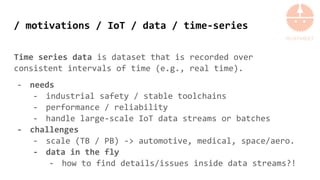
Time series data is dataset that is recorded over
consistent intervals of time (e.g., real time).
- needs
- industrial safety / stable toolchains
- performance / reliability
- handle large-scale IoT data streams or batches
- challenges
- scale (TB / PB) -> automotive, medical, space/aero.
- data in the fly
- how to find details/issues inside data streams?!
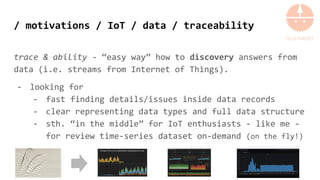
/ motivations / IoT / data / traceability
trace & ability - “easy way” how to discovery answers from
data (i.e. streams from Internet of Things).
- looking for
- fast finding details/issues inside data records
- clear representing data types and full data structure
- sth. “in the middle” for IoT enthusiasts - like me -
for review time-series dataset on-demand (on the fly!)
-
-
/ motivations / multi architecture / targets
- Cross-Platform Compatibility: Rust supports multiple
architectures, including ARM, x64, RISC-V, LX6/ESP32, and
RBPi making it versatile for various IoT devices.
- Efficient Embedded Systems: Rust's zero-cost abstractions and
efficient memory usage make it suitable for
resource-constrained embedded systems.
- Interoperability: Rust's FFI (Foreign Function Interface)
allows seamless integration with existing C/C++ codebases,
enabling interoperability across different systems.
/ motivations / learning / Rust
As always, nice to check, write some code, failed, return
to right path and again, and again -> dev./eng. story!
- measures
- how fast I can write library inside Rust ecosystem?
- how flexible is Rust ecosystem?
- how stable is non-critical safety code in Rust?
- how cross-platform development in Rust works?
- is it good for IoT enthusiasts and data engineers?
- what exactly performance we have in data exchanges?
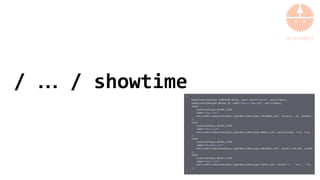
/ … / showtime
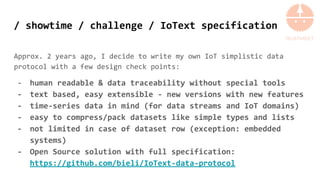
/ showtime / challenge / IoText specification
Approx. 2 years ago, I decide to write my own IoT simplistic data
protocol with a few design check points:
- human readable & data traceability without special tools
- text based, easy extensible - new versions with new features
- time-series data in mind (for data streams and IoT domains)
- easy to compress/pack datasets like simple types and lists
- not limited in case of dataset row (exception: embedded
systems)
- Open Source solution with full specification:
https://github.com/bieli/IoText-data-protocol
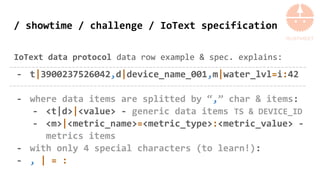
/ showtime / challenge / IoText specification
IoText data protocol data row example & spec. explains:
- t|3900237526042,d|device_name_001,m|water_lvl=i:42
- where data items are splitted by “,” char & items:
- <t|d>|<value> - generic data items TS & DEVICE_ID
- <m>|<metric_name>=<metric_type>:<metric_value> -
metrics items
- with only 4 special characters (to learn!):
- , | = :
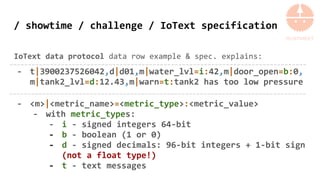
/ showtime / challenge / IoText specification
IoText data protocol data row example & spec. explains:
- t|3900237526042,d|d01,m|water_lvl=i:42,m|door_open=b:0,
m|tank2_lvl=d:12.43,m|warn=t:tank2 has too low pressure
- <m>|<metric_name>=<metric_type>:<metric_value>
- with metric_types:
- i - signed integers 64-bit
- b - boolean (1 or 0)
- d - signed decimals: 96-bit integers + 1-bit sign
(not a float type!)
- t - text messages
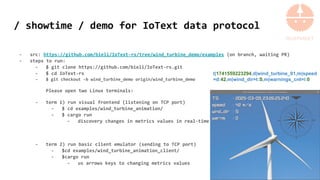
/ showtime / demo for IoText data protocol
- src: https://github.com/bieli/IoText-rs/tree/wind_turbine_demo/examples (on branch, waiting PR)
- steps to run:
- $ git clone https://github.com/bieli/IoText-rs.git
- $ cd IoText-rs
- $ git checkout -b wind_turbine_demo origin/wind_turbine_demo
Please open two Linux terminals:
- term 1) run visual frontend (listening on TCP port)
- $ cd examples/wind_turbine_animation/
- $ cargo run
- discovery changes in metrics values in real-time
- term 2) run basic client emulator (sending to TCP port)
- $cd examples/wind_turbine_animation_client/
- $cargo run
- us arrows keys to changing metrics values
t|1741559223294,d|wind_turbine_01,m|speed
=d:42,m|wind_dir=t:S,m|warnings_cnt=i:0
/ showtime / challenge / Python + Rust PyO3
We can build modules/code in RUST and add as modules into
Python.
- OpenAI/tiktoken inspiration for Python + Rust!
- PyO3: Library bindings & compilation from Python -> RUST
- PR is here:
https://github.com/bieli/IoText-data-protocol/pull/13
- I dropped below PR -> reasons no exp. with RUST ~2 years
ago … still waiting in todo!(“for experiments”).
/ showtime / challenge / switching to Rust
I switched to pure Rust and decided to build implementation
from scratch for educational reasons.
- Learning RUST in practice - recommended path!
- Discovery RUST ecosystem
- Experiments with data types, crates and patterns
- My first Crate iotext_rs deployment for Open Source
community!
- Link to repository:
https://github.com/bieli/IoText-rs
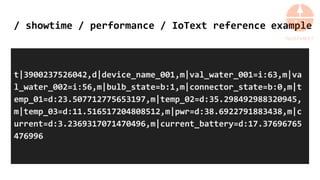
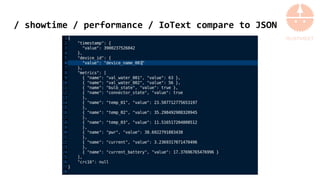
/ showtime / performance / IoText reference example
t|3900237526042,d|device_name_001,m|val_water_001=i:63,m|va
l_water_002=i:56,m|bulb_state=b:1,m|connector_state=b:0,m|t
emp_01=d:23.507712775653197,m|temp_02=d:35.298492988320945,
m|temp_03=d:11.516517204808512,m|pwr=d:38.6922791883438,m|c
urrent=d:3.2369317071470496,m|current_battery=d:17.37696765
476996
/ showtime / performance / IoText compare to JSON
JSON is text based semi-structured data format, very
popular in web development, data engineering and REST APIs.
- Default without schema - schema inference possible from
data types (optional JSONSchema)
- Human readable - but in case of thousands of lines it’s
need special tools like jq to filtering records
- Very popular in IT today, so all modern programming
languages have their native (de)serializers.
- Resources consumed format - CPU intensive and RAM usage.
/ showtime / performance / IoText compare to JSON
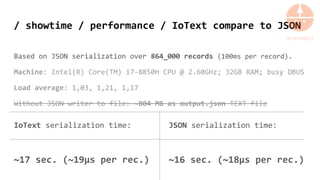
Based on JSON serialization over 864_000 records (100ms per record).
Machine: Intel(R) Core(TM) i7-8850H CPU @ 2.60GHz; 32GB RAM; busy DBUS
Load average: 1,03, 1,21, 1,17
Without JSON writer to file: ~804 MB as output.json TEXT file
IoText serialization time:
~17 sec. (~19µs per rec.)
JSON serialization time:
~16 sec. (~18µs per rec.)
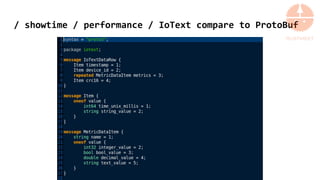
/ showtime / performance / IoText compare to ProtoBuf
Protobuf was originally developed by Google for use in
their internal systems, including Google Search, Google
Maps, and Gmail. Connected with gRPC for microservices
communication.
- Financial institutions for high-frequency trading and fraud detection.
- Used by game developers to optimize network performance and reduce
bandwidth usage.
- IoT applications send data between devices, such as sensors, gateways,
and cloud servers.
- Automotive applications to exchange data between cars and infrastructure,
such as traffic lights and parking meters.
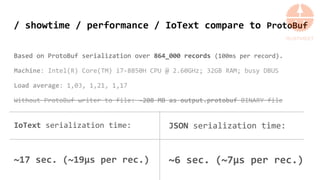
/ showtime / performance / IoText compare to ProtoBuf
Based on ProtoBuf serialization over 864_000 records (100ms per record).
Machine: Intel(R) Core(TM) i7-8850H CPU @ 2.60GHz; 32GB RAM; busy DBUS
Load average: 1,03, 1,21, 1,17
Without ProtoBuf writer to file: ~208 MB as output.protobuf BINARY file
IoText serialization time:
~17 sec. (~19µs per rec.)
JSON serialization time:
~6 sec. (~7µs per rec.)
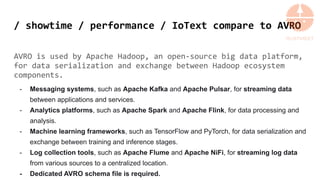
/ showtime / performance / IoText compare to AVRO
AVRO is used by Apache Hadoop, an open-source big data platform,
for data serialization and exchange between Hadoop ecosystem
components.
- Messaging systems, such as Apache Kafka and Apache Pulsar, for streaming data
between applications and services.
- Analytics platforms, such as Apache Spark and Apache Flink, for data processing and
analysis.
- Machine learning frameworks, such as TensorFlow and PyTorch, for data serialization and
exchange between training and inference stages.
- Log collection tools, such as Apache Flume and Apache NiFi, for streaming log data
from various sources to a centralized location.
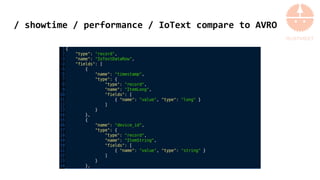
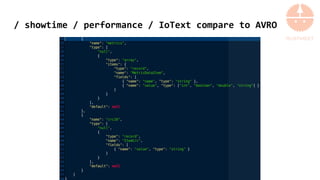
- Dedicated AVRO schema file is required.
/ showtime / performance / IoText compare to AVRO
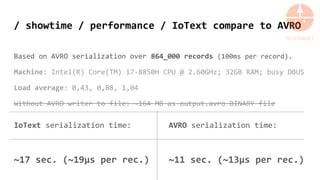
Based on AVRO serialization over 864_000 records (100ms per record).
Machine: Intel(R) Core(TM) i7-8850H CPU @ 2.60GHz; 32GB RAM; busy DBUS
Load average: 0,43, 0,88, 1,04
Without AVRO writer to file: ~164 MB as output.avro BINARY file
IoText serialization time:
~17 sec. (~19µs per rec.)
AVRO serialization time:
~11 sec. (~13µs per rec.)
/ showtime / performance / protocols compare table
Based on serialization over 864_000 records (100ms per record). Without writing to
file. Machine: Intel(R) Core(TM) i7-8850H CPU @ 2.60GHz; 32GB RAM; busy DBUS
Summary for serialization time in seconds for tested data protocols:
IoText
~17
~19
~224
AVRO
~11
~13
~164
JSON
~16
~18
~804
protocol name
duration [s]
per rec.[µs]
payload [MB]
ProtoBuf
~6
~7
~208
/ showtime / performance / IoText compare to MessagePack
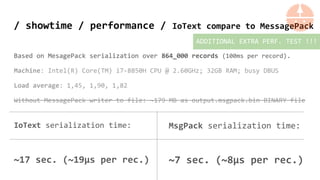
Based on MesagePack serialization over 864_000 records (100ms per record).
Machine: Intel(R) Core(TM) i7-8850H CPU @ 2.60GHz; 32GB RAM; busy DBUS
Load average: 1,45, 1,90, 1,82
Without MessagePack writer to file: ~179 MB as output.msgpack.bin BINARY file
IoText serialization time:
~17 sec. (~19µs per rec.)
MsgPack serialization time:
~7 sec. (~8µs per rec.)
ADDITIONAL EXTRA PERF. TEST !!!
/ showtime / embedded systems / IoText + RUST
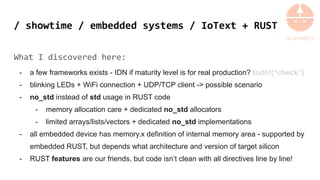
What I discovered here:
- a few frameworks exists - IDN if maturity level is for real production? todo!(“check”)
- blinking LEDs + WiFi connection + UDP/TCP client -> possible scenario
- no_std instead of std usage in RUST code
- memory allocation care + dedicated no_std allocators
- limited arrays/lists/vectors + dedicated no_std implementations
- all embedded device has memory.x definition of internal memory area - supported by
embedded RUST, but depends what architecture and version of target silicon
- RUST features are our friends, but code isn’t clean with all directives line by line!
/ lessons learned
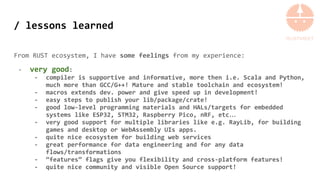
From RUST ecosystem, I have some feelings from my experience:
- very good:
- compiler is supportive and informative, more then i.e. Scala and Python,
much more than GCC/G++! Mature and stable toolchain and ecosystem!
- macros extends dev. power and give speed up in development!
- easy steps to publish your lib/package/crate!
- good low-level programming materials and HALs/targets for embedded
systems like ESP32, STM32, Raspberry Pico, nRF, etc…
- very good support for multiple libraries like e.g. RayLib, for building
games and desktop or WebAssembly UIs apps.
- quite nice ecosystem for building web services
- great performance for data engineering and for any data
flows/transformations
- “features” flags give you flexibility and cross-platform features!
- quite nice community and visible Open Source support!
/ lessons learned
From RUST ecosystem, I have some feelings from my
experience:
- mixed:
- RUST is an easy language, when you are “an expert” in a
few programming languages ;)
- reflections are not on mature level - not intuitive API
and hard for newbies to operate e.g. on structs fields!
- for std & no_std we need different mindsets required to
write universal libraries/crates for servers and
embedded systems (in one code base)
/ new challenges
Maybe in this year ;-)
- plugin for Grafana for easy plot IoText data from IoText
data streams (needs dedicated Grafana backend/plugin)
- extends IoText protocol (schema versioning, …)
- return to PyO3 + Rust bridge with new experience
- publish multiple hardware/targets specific tests
- find next commercial usage for IoText data protocol
- collects more feedbacks from Open Source community
- … and who knows ;) maybe with Elon we will be on Mars!
/ rust / new_beginning
Thanks for watching!
“Live long and prosper, friends!”
IoText lib. repository: https://github.com/bieli/IoText-rs
IoT presentations: https://www.slideshare.net/bieli
contact: https://www.linkedin.com/in/marcin-bielak/
🖖

Let’s write open IoText protocol for time-series data in Rust

  • 1.
    Let’s write open IoTextdata protocol for time-series data in Rust Marcin Bielak github.com/bieli RUSTMEET PL, Gliwice, 15 March 2025
  • 2.
    / agenda / …/ motivations - data streams traceability for Internet of Things devices - multi architecture targets (ARMs, ESP32s, x86, …) - Rust learning in practice / … / showtime - First challenges, when IoText specification was born - Python + Rust PyO3 bridge, next switching to Rust - Performance measures (compare to JSON, Protobuf, AVRO) - Tip: How to adopt RUST and IoText for IoT/embedded systems? / … / about_me -> @bieli
  • 3.
    / about_me ->@bieli / … / 24+ years in IT - from electronics, automation, SCADA design, microcontrollers - to Big Data domain -> data solutions architect and teams leader - Linux kernel active user 20+ years & self-studies every day! - connected with 3rd biggest automotive company on the globe - 50+ PetaBytes scale data streams challenges every day / … / hobbies - IoT embedded systems - IoT protocols researching 1001000101001001101001110101010010010 - IoT sharing knowledge on “IoT, Hardware and Robotics” meetup - traveling 50+ [km] on electric scooter (at summer time)
  • 4.
    / … /motivations
  • 5.
    / motivations /IoT / data / time-series Time series data is dataset that is recorded over consistent intervals of time (e.g., real time). - needs - industrial safety / stable toolchains - performance / reliability - handle large-scale IoT data streams or batches - challenges - scale (TB / PB) -> automotive, medical, space/aero. - data in the fly - how to find details/issues inside data streams?!
  • 6.
    / motivations /IoT / data / traceability trace & ability - “easy way” how to discovery answers from data (i.e. streams from Internet of Things). - looking for - fast finding details/issues inside data records - clear representing data types and full data structure - sth. “in the middle” for IoT enthusiasts - like me - for review time-series dataset on-demand (on the fly!) - -
  • 7.
    / motivations /multi architecture / targets - Cross-Platform Compatibility: Rust supports multiple architectures, including ARM, x64, RISC-V, LX6/ESP32, and RBPi making it versatile for various IoT devices. - Efficient Embedded Systems: Rust's zero-cost abstractions and efficient memory usage make it suitable for resource-constrained embedded systems. - Interoperability: Rust's FFI (Foreign Function Interface) allows seamless integration with existing C/C++ codebases, enabling interoperability across different systems.
  • 8.
    / motivations /learning / Rust As always, nice to check, write some code, failed, return to right path and again, and again -> dev./eng. story! - measures - how fast I can write library inside Rust ecosystem? - how flexible is Rust ecosystem? - how stable is non-critical safety code in Rust? - how cross-platform development in Rust works? - is it good for IoT enthusiasts and data engineers? - what exactly performance we have in data exchanges?
  • 9.
    / … /showtime
  • 10.
    / showtime /challenge / IoText specification Approx. 2 years ago, I decide to write my own IoT simplistic data protocol with a few design check points: - human readable & data traceability without special tools - text based, easy extensible - new versions with new features - time-series data in mind (for data streams and IoT domains) - easy to compress/pack datasets like simple types and lists - not limited in case of dataset row (exception: embedded systems) - Open Source solution with full specification: https://github.com/bieli/IoText-data-protocol
  • 11.
    / showtime /challenge / IoText specification IoText data protocol data row example & spec. explains: - t|3900237526042,d|device_name_001,m|water_lvl=i:42 - where data items are splitted by “,” char & items: - <t|d>|<value> - generic data items TS & DEVICE_ID - <m>|<metric_name>=<metric_type>:<metric_value> - metrics items - with only 4 special characters (to learn!): - , | = :
  • 12.
    / showtime /challenge / IoText specification IoText data protocol data row example & spec. explains: - t|3900237526042,d|d01,m|water_lvl=i:42,m|door_open=b:0, m|tank2_lvl=d:12.43,m|warn=t:tank2 has too low pressure - <m>|<metric_name>=<metric_type>:<metric_value> - with metric_types: - i - signed integers 64-bit - b - boolean (1 or 0) - d - signed decimals: 96-bit integers + 1-bit sign (not a float type!) - t - text messages
  • 13.
    / showtime /demo for IoText data protocol - src: https://github.com/bieli/IoText-rs/tree/wind_turbine_demo/examples (on branch, waiting PR) - steps to run: - $ git clone https://github.com/bieli/IoText-rs.git - $ cd IoText-rs - $ git checkout -b wind_turbine_demo origin/wind_turbine_demo Please open two Linux terminals: - term 1) run visual frontend (listening on TCP port) - $ cd examples/wind_turbine_animation/ - $ cargo run - discovery changes in metrics values in real-time - term 2) run basic client emulator (sending to TCP port) - $cd examples/wind_turbine_animation_client/ - $cargo run - us arrows keys to changing metrics values t|1741559223294,d|wind_turbine_01,m|speed =d:42,m|wind_dir=t:S,m|warnings_cnt=i:0
  • 14.
    / showtime /challenge / Python + Rust PyO3 We can build modules/code in RUST and add as modules into Python. - OpenAI/tiktoken inspiration for Python + Rust! - PyO3: Library bindings & compilation from Python -> RUST - PR is here: https://github.com/bieli/IoText-data-protocol/pull/13 - I dropped below PR -> reasons no exp. with RUST ~2 years ago … still waiting in todo!(“for experiments”).
  • 15.
    / showtime /challenge / switching to Rust I switched to pure Rust and decided to build implementation from scratch for educational reasons. - Learning RUST in practice - recommended path! - Discovery RUST ecosystem - Experiments with data types, crates and patterns - My first Crate iotext_rs deployment for Open Source community! - Link to repository: https://github.com/bieli/IoText-rs
  • 16.
    / showtime /performance / IoText reference example t|3900237526042,d|device_name_001,m|val_water_001=i:63,m|va l_water_002=i:56,m|bulb_state=b:1,m|connector_state=b:0,m|t emp_01=d:23.507712775653197,m|temp_02=d:35.298492988320945, m|temp_03=d:11.516517204808512,m|pwr=d:38.6922791883438,m|c urrent=d:3.2369317071470496,m|current_battery=d:17.37696765 476996
  • 17.
    / showtime /performance / IoText compare to JSON JSON is text based semi-structured data format, very popular in web development, data engineering and REST APIs. - Default without schema - schema inference possible from data types (optional JSONSchema) - Human readable - but in case of thousands of lines it’s need special tools like jq to filtering records - Very popular in IT today, so all modern programming languages have their native (de)serializers. - Resources consumed format - CPU intensive and RAM usage.
  • 18.
    / showtime /performance / IoText compare to JSON
  • 19.
    / showtime /performance / IoText compare to JSON Based on JSON serialization over 864_000 records (100ms per record). Machine: Intel(R) Core(TM) i7-8850H CPU @ 2.60GHz; 32GB RAM; busy DBUS Load average: 1,03, 1,21, 1,17 Without JSON writer to file: ~804 MB as output.json TEXT file IoText serialization time: ~17 sec. (~19µs per rec.) JSON serialization time: ~16 sec. (~18µs per rec.)
  • 20.
    / showtime /performance / IoText compare to ProtoBuf Protobuf was originally developed by Google for use in their internal systems, including Google Search, Google Maps, and Gmail. Connected with gRPC for microservices communication. - Financial institutions for high-frequency trading and fraud detection. - Used by game developers to optimize network performance and reduce bandwidth usage. - IoT applications send data between devices, such as sensors, gateways, and cloud servers. - Automotive applications to exchange data between cars and infrastructure, such as traffic lights and parking meters.
  • 21.
    / showtime /performance / IoText compare to ProtoBuf
  • 22.
    / showtime /performance / IoText compare to ProtoBuf Based on ProtoBuf serialization over 864_000 records (100ms per record). Machine: Intel(R) Core(TM) i7-8850H CPU @ 2.60GHz; 32GB RAM; busy DBUS Load average: 1,03, 1,21, 1,17 Without ProtoBuf writer to file: ~208 MB as output.protobuf BINARY file IoText serialization time: ~17 sec. (~19µs per rec.) JSON serialization time: ~6 sec. (~7µs per rec.)
  • 23.
    / showtime /performance / IoText compare to AVRO AVRO is used by Apache Hadoop, an open-source big data platform, for data serialization and exchange between Hadoop ecosystem components. - Messaging systems, such as Apache Kafka and Apache Pulsar, for streaming data between applications and services. - Analytics platforms, such as Apache Spark and Apache Flink, for data processing and analysis. - Machine learning frameworks, such as TensorFlow and PyTorch, for data serialization and exchange between training and inference stages. - Log collection tools, such as Apache Flume and Apache NiFi, for streaming log data from various sources to a centralized location. - Dedicated AVRO schema file is required.
  • 24.
    / showtime /performance / IoText compare to AVRO
  • 25.
    / showtime /performance / IoText compare to AVRO
  • 26.
    / showtime /performance / IoText compare to AVRO Based on AVRO serialization over 864_000 records (100ms per record). Machine: Intel(R) Core(TM) i7-8850H CPU @ 2.60GHz; 32GB RAM; busy DBUS Load average: 0,43, 0,88, 1,04 Without AVRO writer to file: ~164 MB as output.avro BINARY file IoText serialization time: ~17 sec. (~19µs per rec.) AVRO serialization time: ~11 sec. (~13µs per rec.)
  • 27.
    / showtime /performance / protocols compare table Based on serialization over 864_000 records (100ms per record). Without writing to file. Machine: Intel(R) Core(TM) i7-8850H CPU @ 2.60GHz; 32GB RAM; busy DBUS Summary for serialization time in seconds for tested data protocols: IoText ~17 ~19 ~224 AVRO ~11 ~13 ~164 JSON ~16 ~18 ~804 protocol name duration [s] per rec.[µs] payload [MB] ProtoBuf ~6 ~7 ~208
  • 28.
    / showtime /performance / IoText compare to MessagePack Based on MesagePack serialization over 864_000 records (100ms per record). Machine: Intel(R) Core(TM) i7-8850H CPU @ 2.60GHz; 32GB RAM; busy DBUS Load average: 1,45, 1,90, 1,82 Without MessagePack writer to file: ~179 MB as output.msgpack.bin BINARY file IoText serialization time: ~17 sec. (~19µs per rec.) MsgPack serialization time: ~7 sec. (~8µs per rec.) ADDITIONAL EXTRA PERF. TEST !!!
  • 29.
    / showtime /embedded systems / IoText + RUST What I discovered here: - a few frameworks exists - IDN if maturity level is for real production? todo!(“check”) - blinking LEDs + WiFi connection + UDP/TCP client -> possible scenario - no_std instead of std usage in RUST code - memory allocation care + dedicated no_std allocators - limited arrays/lists/vectors + dedicated no_std implementations - all embedded device has memory.x definition of internal memory area - supported by embedded RUST, but depends what architecture and version of target silicon - RUST features are our friends, but code isn’t clean with all directives line by line!
  • 30.
    / lessons learned FromRUST ecosystem, I have some feelings from my experience: - very good: - compiler is supportive and informative, more then i.e. Scala and Python, much more than GCC/G++! Mature and stable toolchain and ecosystem! - macros extends dev. power and give speed up in development! - easy steps to publish your lib/package/crate! - good low-level programming materials and HALs/targets for embedded systems like ESP32, STM32, Raspberry Pico, nRF, etc… - very good support for multiple libraries like e.g. RayLib, for building games and desktop or WebAssembly UIs apps. - quite nice ecosystem for building web services - great performance for data engineering and for any data flows/transformations - “features” flags give you flexibility and cross-platform features! - quite nice community and visible Open Source support!
  • 31.
    / lessons learned FromRUST ecosystem, I have some feelings from my experience: - mixed: - RUST is an easy language, when you are “an expert” in a few programming languages ;) - reflections are not on mature level - not intuitive API and hard for newbies to operate e.g. on structs fields! - for std & no_std we need different mindsets required to write universal libraries/crates for servers and embedded systems (in one code base)
  • 32.
    / new challenges Maybein this year ;-) - plugin for Grafana for easy plot IoText data from IoText data streams (needs dedicated Grafana backend/plugin) - extends IoText protocol (schema versioning, …) - return to PyO3 + Rust bridge with new experience - publish multiple hardware/targets specific tests - find next commercial usage for IoText data protocol - collects more feedbacks from Open Source community - … and who knows ;) maybe with Elon we will be on Mars!
  • 33.
    / rust /new_beginning Thanks for watching! “Live long and prosper, friends!” IoText lib. repository: https://github.com/bieli/IoText-rs IoT presentations: https://www.slideshare.net/bieli contact: https://www.linkedin.com/in/marcin-bielak/ 🖖