I.S.F.D LENGUAS VIVAS BARILOCHE
PRÁCTICA DOCENTE III
ENTREGA DE PLANIFICACIÓN
ALUMNO PRACTICANTE: Dumrauf Johanna
Institución educativa: Nuestra Señora de Pompeya
Año y sección: 4 año Naturales
Nivel lingüístico del curso: Elementary
Cantidad de alumnos: 25 alumnos
Tipo de Planificación: Clase
Unidad Temática: Make a difference
Clase Nº: 9
Duración de la clase: 1 hora
Fecha de la clase: 12 de julio
Fecha de entrega de la planificación: 5 de julio
Learning Aims
During this lesson, learners will be able to…
 Acquire new grammar about going to future;
 Develop speaking skills by expressing ideas and opinions;
 Develop writing skills by completing activities related to be going to;
 To foster students’ individual and collaborative work when expressing their ideas
about the pictures and through a game;
 To use ‘be going to’ in affirmative and negative forms to talk about the future.
Language Focus
LEXIS FUNCTIONS STRUCTURE
R
E
V
 Verbs: to be
 Expressing their
opinion;
 Present simple
N
E
W
 Verbs: to be – play –
see -have - take  Expressing their
opinion;
 Recognize be
going to forms and
their uses
 Present simple:
Verb to be
 Be going to future
Materials
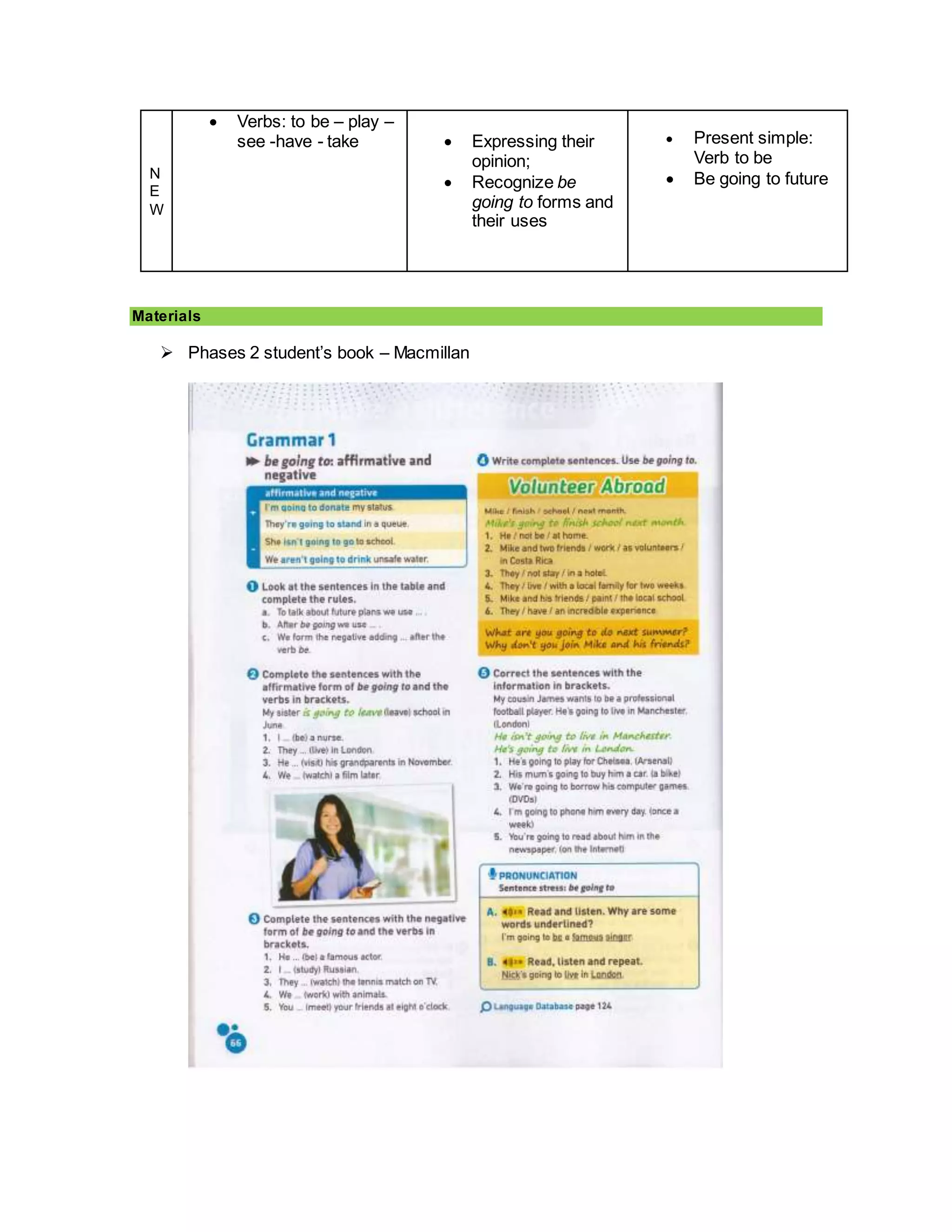
 Phases 2 student’s book – Macmillan
 Blackboard
 Laptop
Procedures
(2 minutes):
I’ll say “good morning, everyone” to the students and ask them how they are.”
Scaffolding strategies: asking
Transition comment: Are you ready? Great! Let’s start!
(20 minutes):
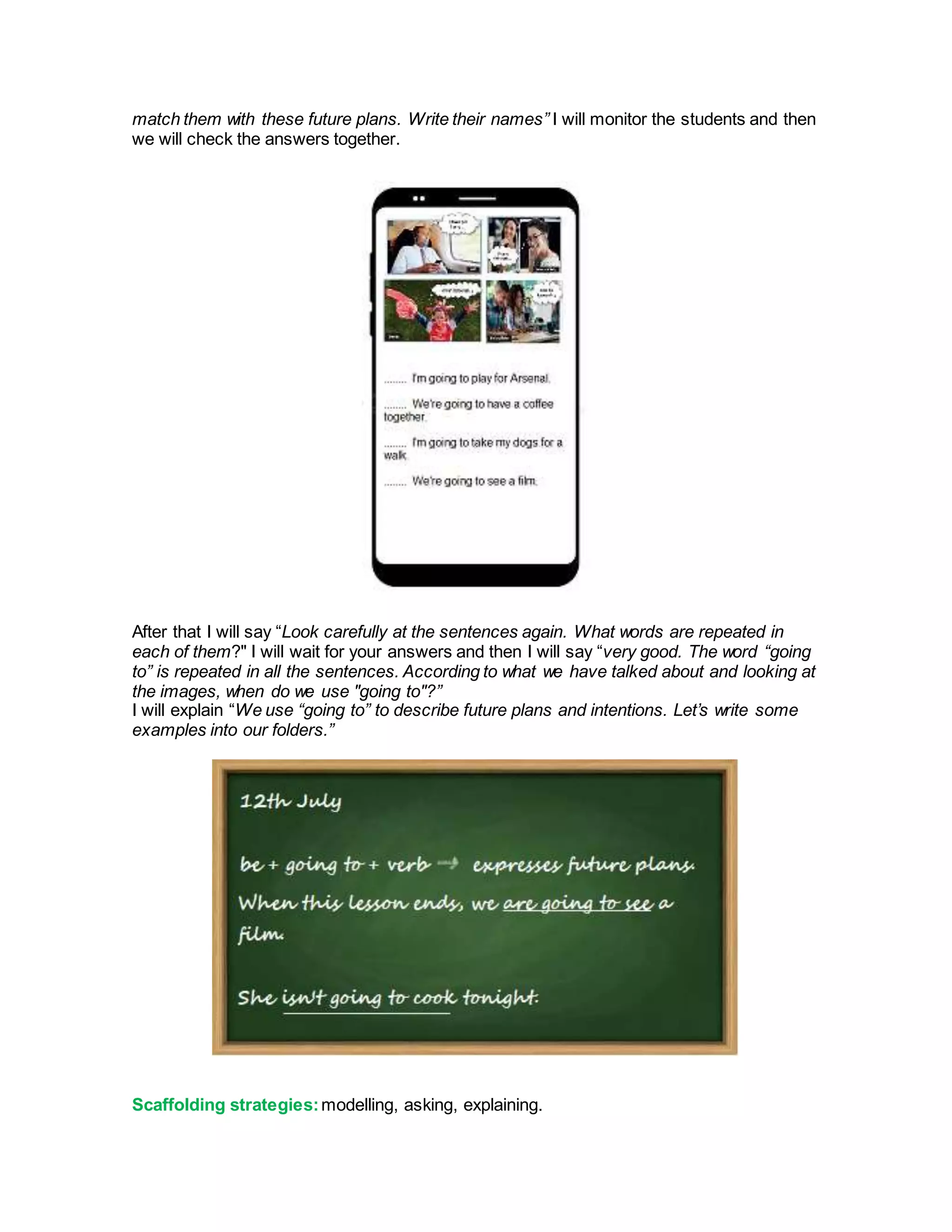
I will start by showing some photos on my laptop screen and I will say “Look at the
photos.” I will go through the names and I will ask “How old do you think the people are?”
Then I will say “focus on the bubbles. Each person is thinking about their future. This can
be something happening soon, foe example, this evening or further in the future. What is
Jeff doing? What is thinking about?” I will elicit their answers with the different photos.
Then I will ask “Please, open Classroom on your cell phones. Let’s go to the document
called “going to””. I will say “we have some sentences. Look the photos again and try to
match them with these future plans. Write their names” I will monitor the students and then
we will check the answers together.
After that I will say “Look carefully at the sentences again. What words are repeated in
each of them?" I will wait for your answers and then I will say “very good. The word “going
to” is repeated in all the sentences. According to what we have talked about and looking at
the images, when do we use "going to"?”
I will explain “We use “going to” to describe future plans and intentions. Let’s write some
examples into our folders.”
Scaffolding strategies:modelling, asking, explaining.
Transition comment: “Now, we are going to do some exercises.”
(10 minutes)
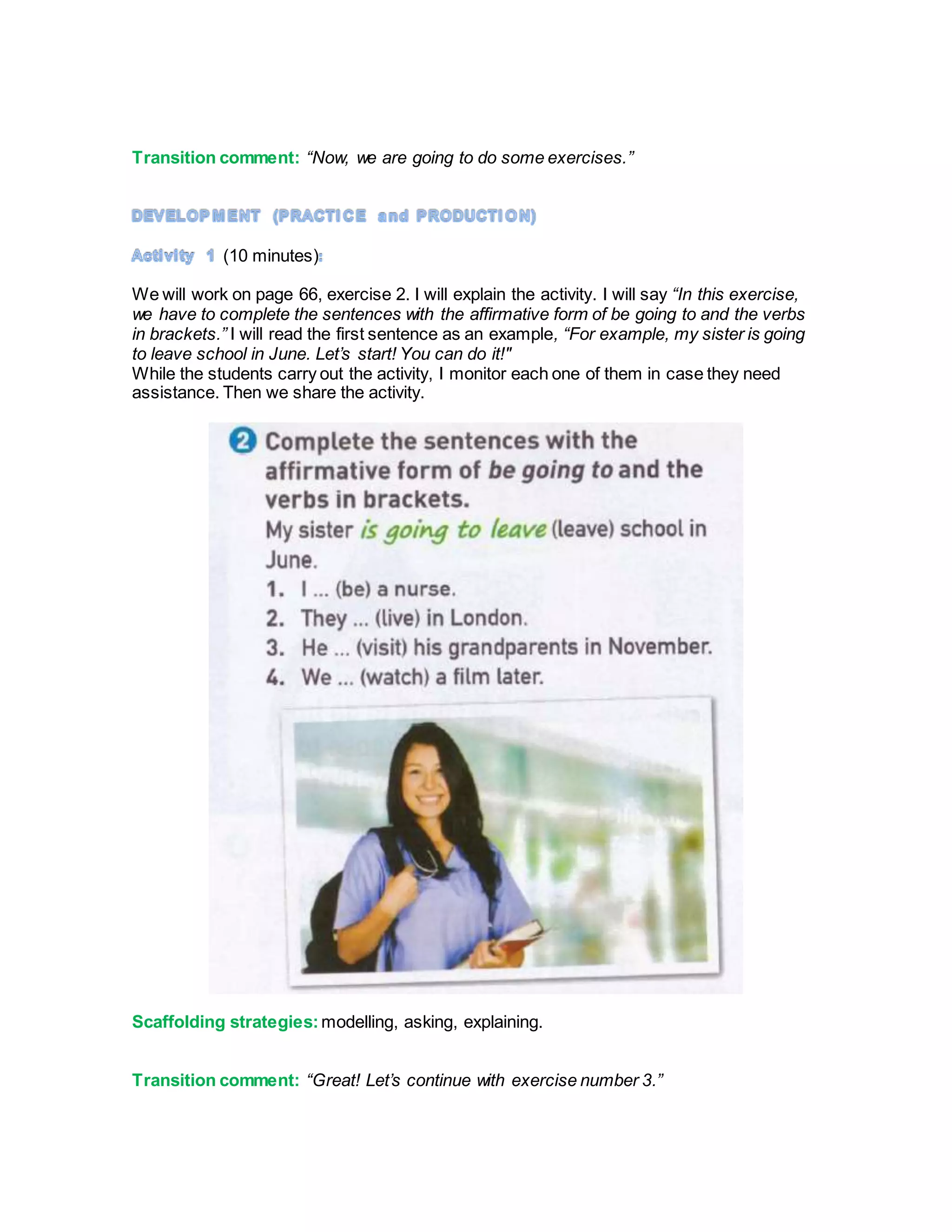
We will work on page 66, exercise 2. I will explain the activity. I will say “In this exercise,
we have to complete the sentences with the affirmative form of be going to and the verbs
in brackets.” I will read the first sentence as an example, “For example, my sister is going
to leave school in June. Let’s start! You can do it!"
While the students carry out the activity, I monitor each one of them in case they need
assistance. Then we share the activity.
Scaffolding strategies: modelling, asking, explaining.
Transition comment: “Great! Let’s continue with exercise number 3.”
(10 minutes)
We will work on page 66, exercise 3. I will explain the activity. I will say ““In this exercise,
we have to complete the sentences with the negative form of be going to and the verbs in
brackets.”Any question?"
While the students carry out the activity, I monitor each one of them in case they need
assistance. Then, we will check the activity together.
Scaffolding strategies: modelling, asking, explaining.
Transition comment: “Let’s play a game!”
(15 minutes):
In order to reinforce the new grammar learned today, we are going to play a game. I will
invite the students to come closer to the desk so that they can take a closer look at my
computer screen. I will say " well, now we are going to review the grammar learned today
through a game. Please, come closer to the desk so you can see more closely the options
that are going to appear on my computer screen. We are going to play a quiz game, where
you will have to choose the answer from three options. In addition, we will have a time limit
between each question and round of points. Are you ready?”
Game link:
https://wordwall.net/es/resource/34115354
Scaffolding strategies: modelling, asking, explaining.
Transition comment: “Good job everyone! That’s all for today.”
(3 minutes) :
Students prepare to put away their supplies. I tell them "Very good job everyone. Before
we leave class, please help tidy up the classroom”; “Thank you very much”; “See you on
Thursday. Bye"
To be completed by your tutor:
Lesson plan
component
Excellent
5
Very Good
4
Good
3
Acceptable
2
Needs
improvement
1
Visual
organization
Coherence
and
sequencing
Variety of
resources
Stages and
activities
Scaffolding
strategies
Language
accuracy
Observations

Lesson Template 9 - Dumrauf Johanna.docx

  • 1.
    I.S.F.D LENGUAS VIVASBARILOCHE PRÁCTICA DOCENTE III ENTREGA DE PLANIFICACIÓN ALUMNO PRACTICANTE: Dumrauf Johanna Institución educativa: Nuestra Señora de Pompeya Año y sección: 4 año Naturales Nivel lingüístico del curso: Elementary Cantidad de alumnos: 25 alumnos Tipo de Planificación: Clase Unidad Temática: Make a difference Clase Nº: 9 Duración de la clase: 1 hora Fecha de la clase: 12 de julio Fecha de entrega de la planificación: 5 de julio Learning Aims During this lesson, learners will be able to…  Acquire new grammar about going to future;  Develop speaking skills by expressing ideas and opinions;  Develop writing skills by completing activities related to be going to;  To foster students’ individual and collaborative work when expressing their ideas about the pictures and through a game;  To use ‘be going to’ in affirmative and negative forms to talk about the future. Language Focus LEXIS FUNCTIONS STRUCTURE R E V  Verbs: to be  Expressing their opinion;  Present simple
  • 2.
    N E W  Verbs: tobe – play – see -have - take  Expressing their opinion;  Recognize be going to forms and their uses  Present simple: Verb to be  Be going to future Materials  Phases 2 student’s book – Macmillan
  • 3.
     Blackboard  Laptop Procedures (2minutes): I’ll say “good morning, everyone” to the students and ask them how they are.” Scaffolding strategies: asking Transition comment: Are you ready? Great! Let’s start! (20 minutes): I will start by showing some photos on my laptop screen and I will say “Look at the photos.” I will go through the names and I will ask “How old do you think the people are?” Then I will say “focus on the bubbles. Each person is thinking about their future. This can be something happening soon, foe example, this evening or further in the future. What is Jeff doing? What is thinking about?” I will elicit their answers with the different photos.
  • 4.
    Then I willask “Please, open Classroom on your cell phones. Let’s go to the document called “going to””. I will say “we have some sentences. Look the photos again and try to
  • 5.
    match them withthese future plans. Write their names” I will monitor the students and then we will check the answers together. After that I will say “Look carefully at the sentences again. What words are repeated in each of them?" I will wait for your answers and then I will say “very good. The word “going to” is repeated in all the sentences. According to what we have talked about and looking at the images, when do we use "going to"?” I will explain “We use “going to” to describe future plans and intentions. Let’s write some examples into our folders.” Scaffolding strategies:modelling, asking, explaining.
  • 6.
    Transition comment: “Now,we are going to do some exercises.” (10 minutes) We will work on page 66, exercise 2. I will explain the activity. I will say “In this exercise, we have to complete the sentences with the affirmative form of be going to and the verbs in brackets.” I will read the first sentence as an example, “For example, my sister is going to leave school in June. Let’s start! You can do it!" While the students carry out the activity, I monitor each one of them in case they need assistance. Then we share the activity. Scaffolding strategies: modelling, asking, explaining. Transition comment: “Great! Let’s continue with exercise number 3.”
  • 7.
    (10 minutes) We willwork on page 66, exercise 3. I will explain the activity. I will say ““In this exercise, we have to complete the sentences with the negative form of be going to and the verbs in brackets.”Any question?" While the students carry out the activity, I monitor each one of them in case they need assistance. Then, we will check the activity together. Scaffolding strategies: modelling, asking, explaining. Transition comment: “Let’s play a game!” (15 minutes): In order to reinforce the new grammar learned today, we are going to play a game. I will invite the students to come closer to the desk so that they can take a closer look at my computer screen. I will say " well, now we are going to review the grammar learned today through a game. Please, come closer to the desk so you can see more closely the options that are going to appear on my computer screen. We are going to play a quiz game, where you will have to choose the answer from three options. In addition, we will have a time limit between each question and round of points. Are you ready?” Game link: https://wordwall.net/es/resource/34115354
  • 8.
    Scaffolding strategies: modelling,asking, explaining. Transition comment: “Good job everyone! That’s all for today.” (3 minutes) : Students prepare to put away their supplies. I tell them "Very good job everyone. Before we leave class, please help tidy up the classroom”; “Thank you very much”; “See you on Thursday. Bye" To be completed by your tutor: Lesson plan component Excellent 5 Very Good 4 Good 3 Acceptable 2 Needs improvement 1 Visual organization Coherence and sequencing
  • 9.