Properties of Water
School/program name
Date
Background Information
(for facilitator)
• Cohesion: Water is attracted to water.
• Adhesion: Water is attracted to other substances.
• Adhesion and cohesion are water properties that affect every water molecule on earth and also the
interaction of water molecules with molecules of other substances. Essentially, cohesion and
adhesion are the "stickiness" that water molecules have for each other and for other
substances. Water drops are composed of water molecules that like to stick together, which
explains why water falls from the sky as raindrops rather than individual molecules. Rain therefore
is an example of the property of cohesion. When one corner of a piece of paper towel is dipped
into a glass of water the water will climb the fibers of the paper. The water molecules are attracted
to the molecules of the fabric with greater force than gravity and therefore are able to climb up the
paper. Therefore adhesion is when water molecules are attracted to another surface.
• Surface tension is caused by the attraction of the particles at the surface layer by the quantity of
the liquid. For water, surface tension happens when a water molecule is surrounded on all sides by
other water molecules, which creates a sphere or ball. In the case of surface tension, cohesion is
affected by the volume of water at the surface layer resulting elastic like force. The helps to explain
why some small insects, like a water strider, can walk on water. In the case of a water strider the
weight of the insect is less than the force necessary to penetrate the surface of the water.
• Buoyancy is an upward force exerted that opposes the weight of a fully or partially immersed
object. If the upward force exerted is equal to or greater than the density of the immersed object
the object is deemed buoyant. This is the principle that allows large cruise ships and fishing vessels
to remain afloat even though individual pieces of the vessel would sink if not part of the whole.
Agenda
Opening (30 minutes)
Setting the Stage (20 minutes)
Activity: Camp Song, “Little Water Molecule” (10 minutes)
Cyber Investigation: Just Dunk It (15 minutes)
Setting the Stage (15 minutes)
Activity: Cohesion and Surface Tension of Water (60 minutes)
Break (15 minutes)
Cyber Investigation: Sea Trials (15 minutes)
Lunch (30 minutes)
Recess: Water Sponge Relay (30 minutes)
STEM-tastic Careers (30 minutes)
Mind Snacks (15 minutes)
Engineering Challenge: Boat Building Challenge (75 minutes)
STEM Camp Notebook Reflection (20 minutes)
Wrap Up (10 minutes)
Dive Into Digital Project (60 minutes)
Learning Objectives
To explain the basic chemistry of water
To investigate properties of water
including cohesion and adhesion
Today’s Vocabulary
Surface Tension
Molecule
Volume
Setting the Stage
Water
Properties
Quiz
Activity:
Camp Song
“Little Water Molecule”
Cyber
Investigation:
Just Dunk It
Exploration: Just Dunk It
Setting
the
Stage
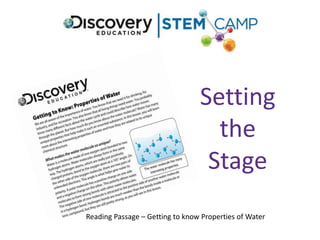
Reading Passage – Getting to know Properties of Water
Activity:
Cohesion and Surface
Tension of Water
Hands-On Lab: Cohesion and Surface Tension of Water
Cyber
Investigation:
Sea Trials
STEMtastic Careers
aquacultural manager
aquarist,
Hydrologist,
water and liquid waste treatment
plant operator
chemical technician
chemist
ship and boat captain
computer software engineer
Economist,
remote sensing scientist
biochemical engineer
hydroelectric plant technician
materials scientist
Mind Snacks
Engineering Challenge:
Boat Building
Engineering Project: Boat Building Challenge
Notebook Reflection
What have you learned about the properties of water?
How do the properties of water impact living organisms?
What is your favorite water activity? How does it relate
to the properties of water?
Which careers you examined today most intrigue you
and why are you interested in them?
Wrap Up
Water
Properties
Quiz
Exploration: Waters of the Earth

Lesson Presentation Day 2.pptx

  • 1.
  • 2.
    Background Information (for facilitator) •Cohesion: Water is attracted to water. • Adhesion: Water is attracted to other substances. • Adhesion and cohesion are water properties that affect every water molecule on earth and also the interaction of water molecules with molecules of other substances. Essentially, cohesion and adhesion are the "stickiness" that water molecules have for each other and for other substances. Water drops are composed of water molecules that like to stick together, which explains why water falls from the sky as raindrops rather than individual molecules. Rain therefore is an example of the property of cohesion. When one corner of a piece of paper towel is dipped into a glass of water the water will climb the fibers of the paper. The water molecules are attracted to the molecules of the fabric with greater force than gravity and therefore are able to climb up the paper. Therefore adhesion is when water molecules are attracted to another surface. • Surface tension is caused by the attraction of the particles at the surface layer by the quantity of the liquid. For water, surface tension happens when a water molecule is surrounded on all sides by other water molecules, which creates a sphere or ball. In the case of surface tension, cohesion is affected by the volume of water at the surface layer resulting elastic like force. The helps to explain why some small insects, like a water strider, can walk on water. In the case of a water strider the weight of the insect is less than the force necessary to penetrate the surface of the water. • Buoyancy is an upward force exerted that opposes the weight of a fully or partially immersed object. If the upward force exerted is equal to or greater than the density of the immersed object the object is deemed buoyant. This is the principle that allows large cruise ships and fishing vessels to remain afloat even though individual pieces of the vessel would sink if not part of the whole.
  • 3.
    Agenda Opening (30 minutes) Settingthe Stage (20 minutes) Activity: Camp Song, “Little Water Molecule” (10 minutes) Cyber Investigation: Just Dunk It (15 minutes) Setting the Stage (15 minutes) Activity: Cohesion and Surface Tension of Water (60 minutes) Break (15 minutes) Cyber Investigation: Sea Trials (15 minutes) Lunch (30 minutes) Recess: Water Sponge Relay (30 minutes) STEM-tastic Careers (30 minutes) Mind Snacks (15 minutes) Engineering Challenge: Boat Building Challenge (75 minutes) STEM Camp Notebook Reflection (20 minutes) Wrap Up (10 minutes) Dive Into Digital Project (60 minutes)
  • 4.
    Learning Objectives To explainthe basic chemistry of water To investigate properties of water including cohesion and adhesion
  • 5.
  • 6.
  • 7.
  • 8.
  • 9.
  • 10.
    Setting the Stage Reading Passage –Getting to know Properties of Water
  • 11.
    Activity: Cohesion and Surface Tensionof Water Hands-On Lab: Cohesion and Surface Tension of Water
  • 12.
  • 13.
    STEMtastic Careers aquacultural manager aquarist, Hydrologist, waterand liquid waste treatment plant operator chemical technician chemist ship and boat captain computer software engineer Economist, remote sensing scientist biochemical engineer hydroelectric plant technician materials scientist
  • 14.
  • 15.
    Engineering Challenge: Boat Building EngineeringProject: Boat Building Challenge
  • 16.
    Notebook Reflection What haveyou learned about the properties of water? How do the properties of water impact living organisms? What is your favorite water activity? How does it relate to the properties of water? Which careers you examined today most intrigue you and why are you interested in them?
  • 17.
  • 18.
  • 19.

Editor's Notes

  • #8 Navigate to the site http://ga.water.usgs.gov/edu/sc3.html to take this online Water Properites Quiz, serving as a pre-test for the days activities.  Poll the students for each true/false question and enter the most popular answer.  Upon completion select the results, display the results from the responses.  Let students know you will revisit this quiz at the end of the day.    
  • #9 Have students sing the camp song to begin to learn the properties of water. Provide students with lyrics. Ask them to highlight important vocabulary terms from the song. After the highlighting is done, have them write the words and their meaning in their STEM notebook.
  • #10 During this investigation, students will calculate the volume of three objects by using the displacement method. Detailed instructions are provided in the Teacher’s Guide for Just Dunk It Teacher's Guide. Direct students as a whole group through the Exploration Just Dunk It (English)/Just Dunk It (Spanish). Have students record the data explored on the Student’s Guide or in their STEM Camp Notebook.
  • #11 Using a reading strategy of your choice, have students read Reading Passage - Getting to know Properties of Water noting important facts in their STEM Camp Notebooks.  
  • #12 During the Hands-On Lab: Cohesion and Surface Tension of Water, students investigate the properties of water including cohesion and surface tension of water. Detailed instructions are provided in the Teacher’s Guide for Hands-On Lab: Cohesion and Surface Tension of Water.
  • #13 This lesson allows students to design a ship that will be seaworthy. The students will explore this concept using an interactive tool that allows them to choose the shape of the hull, the lower and upper decks, and test the construction.   Have students working in small groups navigate to Navy STEM for the Classroom. Have them select “Interactives” then choose “Sea Trials” to begin the interactive. To conclude the activity have each group of students discuss the results of their trials.
  • #14 Direct students to the Science Buddies site. Instruct students to explore the careers on this site and compare and contrast in terms of salary, education, outlook and tasks performed on the job 5 of the following careers: aquacultural manager, aquarist, hydrologist, water and liquid waste treatment plant operator, chemical technician, chemist, ship and boat captain, computer software engineer, economist, remote sensing scientist, biochemical engineer, hydroelectric plant technician, materials scientist. Have students record the information in their STEM Camp Notebooks.
  • #15 During your snack time, here are a few fun activities for your campers to explore. These can be done as a large group, or allow students to explore in small groups if multiple computers are available. Choose any of the interactives at the bottom of this Together Counts page to explore energy balance.
  • #16 In the Boat Building Challenge, students will work in teams to create a boat that will float across a kiddie pool carrying a weight. Detailed instructions for the engineering challenge can be found in the Teacher’s Guide for Boat Building Challenge.
  • #17 In their journals, students should answer the following questions: What have you learned about the properties of water? How do the properties of water impact living organisms? What is your favorite water activity? How does it relate to the properties of water? Which careers you examined today most intrigue you and why are you interested in them?
  • #19 Take this online Water Properties Quiz. Poll the students for each True/False question and enter the most popular answer. Upon completion select the results, display the results from the responses.
  • #20 As a teaser that leads into the next day, direct students whole group through the exploration Waters of the Earth.