Letters From The Lamb:
                         Thyatira (Revelation 2:18-29)

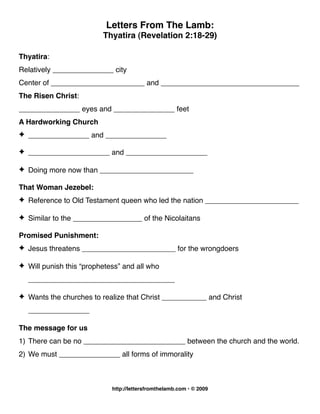
Thyatira:
Relatively _______________ city
Center of _______________________ and __________________________________
The Risen Christ:
_______________ eyes and _______________ feet
A Hardworking Church
✦ _______________ and _______________

✦ ____________________ and ____________________

✦ Doing more now than _______________________

That Woman Jezebel:
✦ Reference to Old Testament queen who led the nation _______________________

✦ Similar to the _________________ of the Nicolaitans

Promised Punishment:
✦ Jesus threatens _______________________ for the wrongdoers

✦ Will punish this “prophetess” and all who
  ____________________________________

✦ Wants the churches to realize that Christ ___________ and Christ
  _______________

The message for us
1)
There can be no _________________________ between the church and the world.
2)
We must _______________ all forms of immorality


                            http://lettersfromthelamb.com • © 2009
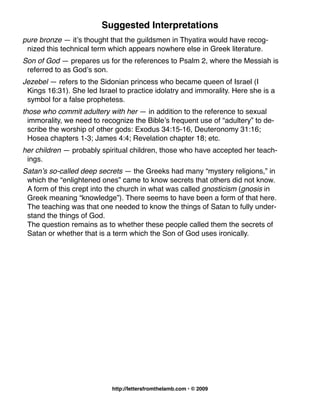
Suggested Interpretations
pure bronze — itʼs thought that the guildsmen in Thyatira would have recog-
 nized this technical term which appears nowhere else in Greek literature.
Son of God — prepares us for the references to Psalm 2, where the Messiah is
 referred to as Godʼs son.
Jezebel — refers to the Sidonian princess who became queen of Israel (I
 Kings 16:31). She led Israel to practice idolatry and immorality. Here she is a
 symbol for a false prophetess.
those who commit adultery with her — in addition to the reference to sexual
  immorality, we need to recognize the Bibleʼs frequent use of “adultery” to de-
  scribe the worship of other gods: Exodus 34:15-16, Deuteronomy 31:16;
  Hosea chapters 1-3; James 4:4; Revelation chapter 18; etc.
her children — probably spiritual children, those who have accepted her teach-
 ings.
Satanʼs so-called deep secrets — the Greeks had many “mystery religions,” in
  which the “enlightened ones” came to know secrets that others did not know.
  A form of this crept into the church in what was called gnosticism (gnosis in
  Greek meaning “knowledge”). There seems to have been a form of that here.
  The teaching was that one needed to know the things of Satan to fully under-
  stand the things of God.

 The question remains as to whether these people called them the secrets of
  Satan or whether that is a term which the Son of God uses ironically.


                            http://lettersfromthelamb.com • © 2009

Lesson 6 — Thyatira

  • 1.
    Letters From TheLamb: Thyatira (Revelation 2:18-29) Thyatira: Relatively _______________ city Center of _______________________ and __________________________________ The Risen Christ: _______________ eyes and _______________ feet A Hardworking Church ✦ _______________ and _______________ ✦ ____________________ and ____________________ ✦ Doing more now than _______________________ That Woman Jezebel: ✦ Reference to Old Testament queen who led the nation _______________________ ✦ Similar to the _________________ of the Nicolaitans Promised Punishment: ✦ Jesus threatens _______________________ for the wrongdoers ✦ Will punish this “prophetess” and all who ____________________________________ ✦ Wants the churches to realize that Christ ___________ and Christ _______________ The message for us 1) There can be no _________________________ between the church and the world. 2) We must _______________ all forms of immorality http://lettersfromthelamb.com • © 2009
  • 2.
    Suggested Interpretations pure bronze— itʼs thought that the guildsmen in Thyatira would have recog- nized this technical term which appears nowhere else in Greek literature. Son of God — prepares us for the references to Psalm 2, where the Messiah is referred to as Godʼs son. Jezebel — refers to the Sidonian princess who became queen of Israel (I Kings 16:31). She led Israel to practice idolatry and immorality. Here she is a symbol for a false prophetess. those who commit adultery with her — in addition to the reference to sexual immorality, we need to recognize the Bibleʼs frequent use of “adultery” to de- scribe the worship of other gods: Exodus 34:15-16, Deuteronomy 31:16; Hosea chapters 1-3; James 4:4; Revelation chapter 18; etc. her children — probably spiritual children, those who have accepted her teach- ings. Satanʼs so-called deep secrets — the Greeks had many “mystery religions,” in which the “enlightened ones” came to know secrets that others did not know. A form of this crept into the church in what was called gnosticism (gnosis in Greek meaning “knowledge”). There seems to have been a form of that here. The teaching was that one needed to know the things of Satan to fully under- stand the things of God. The question remains as to whether these people called them the secrets of Satan or whether that is a term which the Son of God uses ironically. http://lettersfromthelamb.com • © 2009