Strategy and
Strategic
Management: An
overview
Global Business Consultants &
Partners Training Courses
Copyright 2020 Global Business Consultants
Chapter 2. Levels of Strategy
Lesson 2: Strategic Management and Operational
Management
Good Strategy + Good
Strategy Execution =
Business Survival & Growth
Sam Lee Mohan | GBC
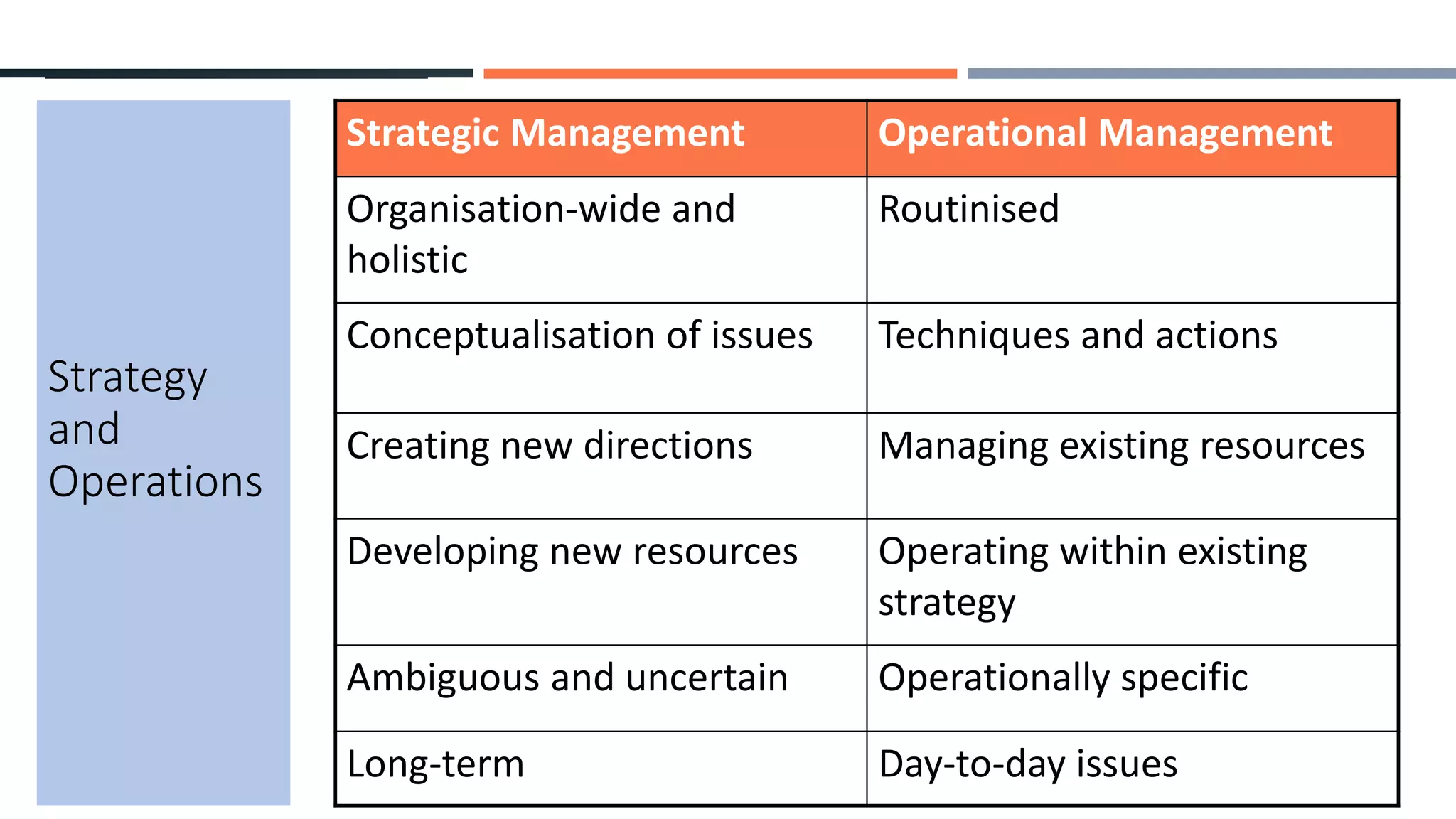
Strategy
and
Operations
Strategic Management Operational Management
Organisation-wide and
holistic
Routinised
Conceptualisation of issues Techniques and actions
Creating new directions Managing existing resources
Developing new resources Operating within existing
strategy
Ambiguous and uncertain Operationally specific
Long-term Day-to-day issues
Strategic management focuses on activities necessary to ensure
competitive positioning of a business.
Strategic management involves the formulation and
implementation of the major goals and initiatives organization-
wide.
Goals, otherwise referred to as Company Objectives, include:
Financial e.g. 10% increase in revenue.
Customer e.g. 100% Customer satisfaction.
Business Processes e.g. Alignment to International Standards.
Talent & Teamwork e.g. 90% talent retention
Strategic management is concerned with the whole company
taking a holistic view. It does not exclude any function in the
business.
The formation of the business’ company-wide strategy is predicated by its
Vision, Mission, Values and its Goals or Company Objectives.
Strategic
Management
Strategic management focuses on activities necessary to ensure
competitive positioning of a business continued...
Strategic management is about creating new directions for the
company.
This is especially when the company’s current strategy is not supporting
the its Goals or Company Objectives.
Reasons that a company’s current strategy may not be working include:
Internal factors such as lack of key resources for critical functions.
External factors such as government policy or rising cost of energy.
In light of new information or actual data, a company can choose to pivot
or persevere its strategy.
Minor pivots can include changing its Goals or Company Objectives.
Major pivots can include Mergers & Acquisitions, divestment of certain
functions or the business as a whole.
Strategic
Management
Strategic management focuses on activities necessary to ensure
competitive positioning of a business continued...
Strategic management is concerned about anticipating
uncertainty and can therefore be ambiguous.
 A good strategy in highly uncertain business environments are those that
seek to shape the future with high-stakes bets.
For example. Eastman Kodak Company, is spending $500 million per year
to develop an array of digital photography products that it hopes will
fundamentally change the way people create, store, and view pictures.
Planning for uncertainty, such as COVID-19, also entails making smaller
bets especially in small businesses that do not have large amounts of
liquidity.
For example. A company in the digital photography industry can investing
time and effort each year to pursue a rival vision centered around home-
based photo printers.
Strategic
Management
Strategic management focuses on activities necessary to ensure competitive
positioning of a business continued...
Strategic management is concerned with the company’s long-term
planning that involves establishing Goals or Company Objectives that
are expected to be achieved in three, five or more years.
Long-term planning processes, enable alignment of project work and daily
tasks with company’s strategic goals or company objectives.
 When a company’s projects or tasks do not align with its Goals or Company
Objectives, then one of two actions must be taken.
 Action one. Align projects or tasks to Goals or Company Objectives, or
 Action tow. Stop the project and/or tasks.
Long-term planning also involves monitoring and evaluating activities.
 For example. In long-term planning you plan the amount of materials required to
conduct operations. Then, your purchasing department can use the data about
future demands to estimate orders. This helps them negotiate contracts with
suppliers and schedule deliveries.
Strategic
Management
Operational management is the administration of business practices to
create the highest level of efficiency within a company.
Operational management is concerned with Routines so that a
company can become especially good at carrying out its common
operations in a particular way to achieve competitive advantage.
Routine operations is also known as general operations.
Routinized operations are the daily repetitive tasks that keep the business
going such as general accounting, customer service and technical support.
For example. The accounting department must keep track of all incoming
payments from customers and all outgoing payments for expenses.
Continuous production of products and output of services are also part of
operations.
Operational
Management
Operational management is the administration of business
practices to create the highest level of efficiency within a
company.
Operational management involves the Techniques and
Actions which a company employs to create its goods or
services including:
Materials, machines, people and technology.
As part of a company’s operational management, it
establishes its knowledge about how the fundamental
concepts of its products or services can be operationalized
into effective actions.
For example. A manufacturing company will have knowledge of
techniques of die design, die modelling, die testing and finishing.
Operational
Management
Operational management is the administration of business
practices to create the highest level of efficiency within a
company.
Operational management involves the allocation and
management of resources to new and existing products and
services.
A company uses its resources effectively to ensure that
materials or information flow smoothly through processes,
operations and supply networks to avoid unnecessary delays,
but also use its operational resources effectively.
Managing the ongoing allocation of resources and activities
ensures that a company’s operations are both efficient and
reflect customer demand for its products and services.
Operational
Management
Operational management is the administration of business practices to
create the highest level of efficiency within a company.
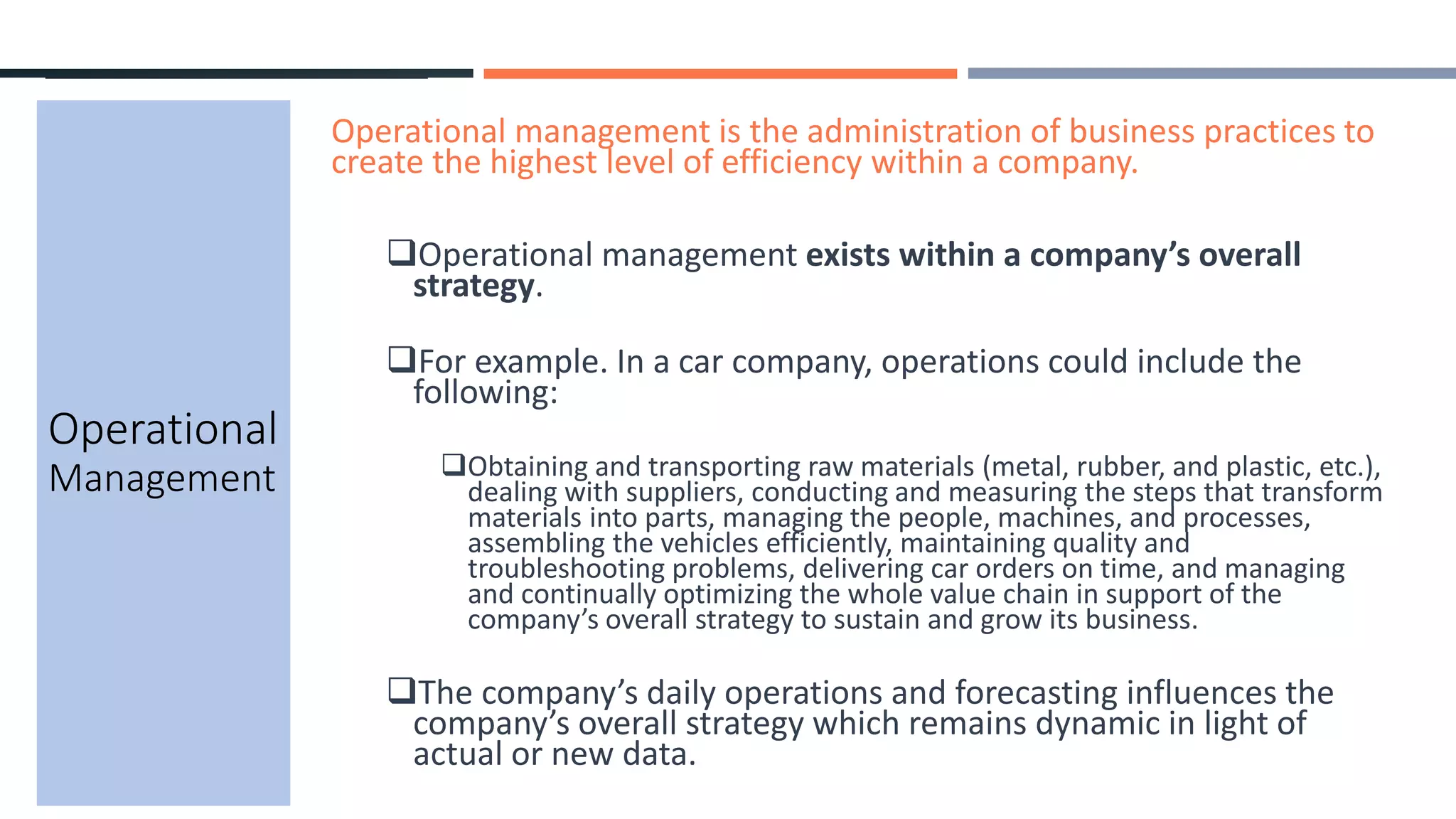
Operational management exists within a company’s overall
strategy.
For example. In a car company, operations could include the
following:
Obtaining and transporting raw materials (metal, rubber, and plastic, etc.),
dealing with suppliers, conducting and measuring the steps that transform
materials into parts, managing the people, machines, and processes,
assembling the vehicles efficiently, maintaining quality and
troubleshooting problems, delivering car orders on time, and managing
and continually optimizing the whole value chain in support of the
company’s overall strategy to sustain and grow its business.
The company’s daily operations and forecasting influences the
company’s overall strategy which remains dynamic in light of
actual or new data.
Operational
Management
Operational management is the administration of business
practices to create the highest level of efficiency within a
company.
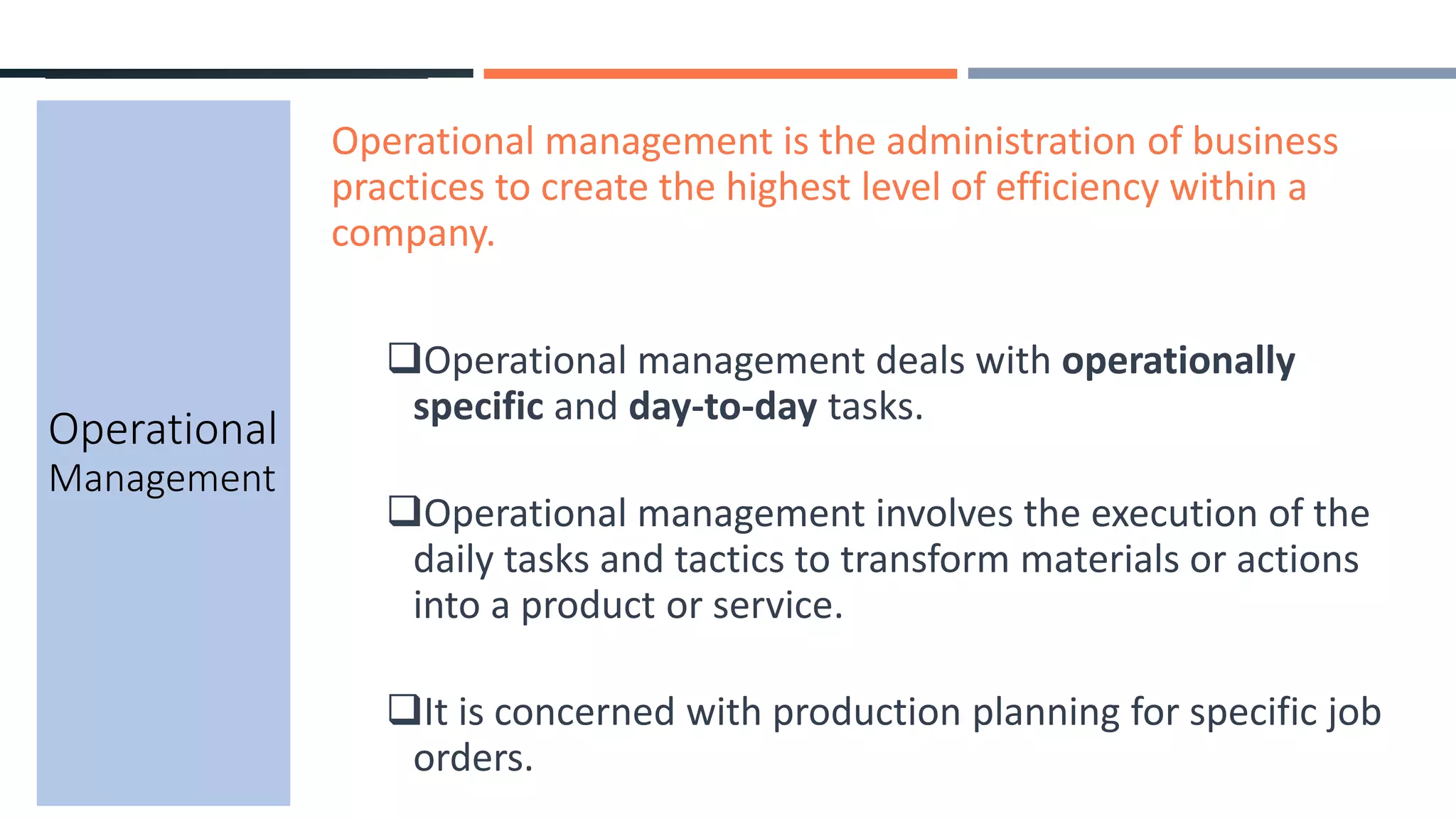
Operational management deals with operationally
specific and day-to-day tasks.
Operational management involves the execution of the
daily tasks and tactics to transform materials or actions
into a product or service.
It is concerned with production planning for specific job
orders.
Operational
Management
“Operational management is concerned with
the day-to-day activities required to produce
goods and services, while strategic
management focuses on activities necessary
to ensure competitive positioning.”
Global Business Consultants
Copyright 2020 Global Business Consultants
Congratulations! You’ve completed lesson 2.
Recap: In this lesson you learned that Operational Management
exist within a company’s overall strategy. You also learned that
Strategic Management is concerned with the long-term planning
in a company and operational management is concerned with
day-to-day tasks and activities.
Awesome work!
Now click Complete and then Next for Lesson 3.

Lesson 2 strategic management and operational management

  • 1.
    Strategy and Strategic Management: An overview GlobalBusiness Consultants & Partners Training Courses Copyright 2020 Global Business Consultants
  • 2.
    Chapter 2. Levelsof Strategy Lesson 2: Strategic Management and Operational Management
  • 3.
    Good Strategy +Good Strategy Execution = Business Survival & Growth Sam Lee Mohan | GBC
  • 4.
    Strategy and Operations Strategic Management OperationalManagement Organisation-wide and holistic Routinised Conceptualisation of issues Techniques and actions Creating new directions Managing existing resources Developing new resources Operating within existing strategy Ambiguous and uncertain Operationally specific Long-term Day-to-day issues
  • 5.
    Strategic management focuseson activities necessary to ensure competitive positioning of a business. Strategic management involves the formulation and implementation of the major goals and initiatives organization- wide. Goals, otherwise referred to as Company Objectives, include: Financial e.g. 10% increase in revenue. Customer e.g. 100% Customer satisfaction. Business Processes e.g. Alignment to International Standards. Talent & Teamwork e.g. 90% talent retention Strategic management is concerned with the whole company taking a holistic view. It does not exclude any function in the business. The formation of the business’ company-wide strategy is predicated by its Vision, Mission, Values and its Goals or Company Objectives. Strategic Management
  • 6.
    Strategic management focuseson activities necessary to ensure competitive positioning of a business continued... Strategic management is about creating new directions for the company. This is especially when the company’s current strategy is not supporting the its Goals or Company Objectives. Reasons that a company’s current strategy may not be working include: Internal factors such as lack of key resources for critical functions. External factors such as government policy or rising cost of energy. In light of new information or actual data, a company can choose to pivot or persevere its strategy. Minor pivots can include changing its Goals or Company Objectives. Major pivots can include Mergers & Acquisitions, divestment of certain functions or the business as a whole. Strategic Management
  • 7.
    Strategic management focuseson activities necessary to ensure competitive positioning of a business continued... Strategic management is concerned about anticipating uncertainty and can therefore be ambiguous.  A good strategy in highly uncertain business environments are those that seek to shape the future with high-stakes bets. For example. Eastman Kodak Company, is spending $500 million per year to develop an array of digital photography products that it hopes will fundamentally change the way people create, store, and view pictures. Planning for uncertainty, such as COVID-19, also entails making smaller bets especially in small businesses that do not have large amounts of liquidity. For example. A company in the digital photography industry can investing time and effort each year to pursue a rival vision centered around home- based photo printers. Strategic Management
  • 8.
    Strategic management focuseson activities necessary to ensure competitive positioning of a business continued... Strategic management is concerned with the company’s long-term planning that involves establishing Goals or Company Objectives that are expected to be achieved in three, five or more years. Long-term planning processes, enable alignment of project work and daily tasks with company’s strategic goals or company objectives.  When a company’s projects or tasks do not align with its Goals or Company Objectives, then one of two actions must be taken.  Action one. Align projects or tasks to Goals or Company Objectives, or  Action tow. Stop the project and/or tasks. Long-term planning also involves monitoring and evaluating activities.  For example. In long-term planning you plan the amount of materials required to conduct operations. Then, your purchasing department can use the data about future demands to estimate orders. This helps them negotiate contracts with suppliers and schedule deliveries. Strategic Management
  • 9.
    Operational management isthe administration of business practices to create the highest level of efficiency within a company. Operational management is concerned with Routines so that a company can become especially good at carrying out its common operations in a particular way to achieve competitive advantage. Routine operations is also known as general operations. Routinized operations are the daily repetitive tasks that keep the business going such as general accounting, customer service and technical support. For example. The accounting department must keep track of all incoming payments from customers and all outgoing payments for expenses. Continuous production of products and output of services are also part of operations. Operational Management
  • 10.
    Operational management isthe administration of business practices to create the highest level of efficiency within a company. Operational management involves the Techniques and Actions which a company employs to create its goods or services including: Materials, machines, people and technology. As part of a company’s operational management, it establishes its knowledge about how the fundamental concepts of its products or services can be operationalized into effective actions. For example. A manufacturing company will have knowledge of techniques of die design, die modelling, die testing and finishing. Operational Management
  • 11.
    Operational management isthe administration of business practices to create the highest level of efficiency within a company. Operational management involves the allocation and management of resources to new and existing products and services. A company uses its resources effectively to ensure that materials or information flow smoothly through processes, operations and supply networks to avoid unnecessary delays, but also use its operational resources effectively. Managing the ongoing allocation of resources and activities ensures that a company’s operations are both efficient and reflect customer demand for its products and services. Operational Management
  • 12.
    Operational management isthe administration of business practices to create the highest level of efficiency within a company. Operational management exists within a company’s overall strategy. For example. In a car company, operations could include the following: Obtaining and transporting raw materials (metal, rubber, and plastic, etc.), dealing with suppliers, conducting and measuring the steps that transform materials into parts, managing the people, machines, and processes, assembling the vehicles efficiently, maintaining quality and troubleshooting problems, delivering car orders on time, and managing and continually optimizing the whole value chain in support of the company’s overall strategy to sustain and grow its business. The company’s daily operations and forecasting influences the company’s overall strategy which remains dynamic in light of actual or new data. Operational Management
  • 13.
    Operational management isthe administration of business practices to create the highest level of efficiency within a company. Operational management deals with operationally specific and day-to-day tasks. Operational management involves the execution of the daily tasks and tactics to transform materials or actions into a product or service. It is concerned with production planning for specific job orders. Operational Management
  • 14.
    “Operational management isconcerned with the day-to-day activities required to produce goods and services, while strategic management focuses on activities necessary to ensure competitive positioning.” Global Business Consultants Copyright 2020 Global Business Consultants
  • 15.
    Congratulations! You’ve completedlesson 2. Recap: In this lesson you learned that Operational Management exist within a company’s overall strategy. You also learned that Strategic Management is concerned with the long-term planning in a company and operational management is concerned with day-to-day tasks and activities. Awesome work! Now click Complete and then Next for Lesson 3.