Types of Computers
Typesof Computers
based on data
based on data
handling capabilities
handling capabilities
4.
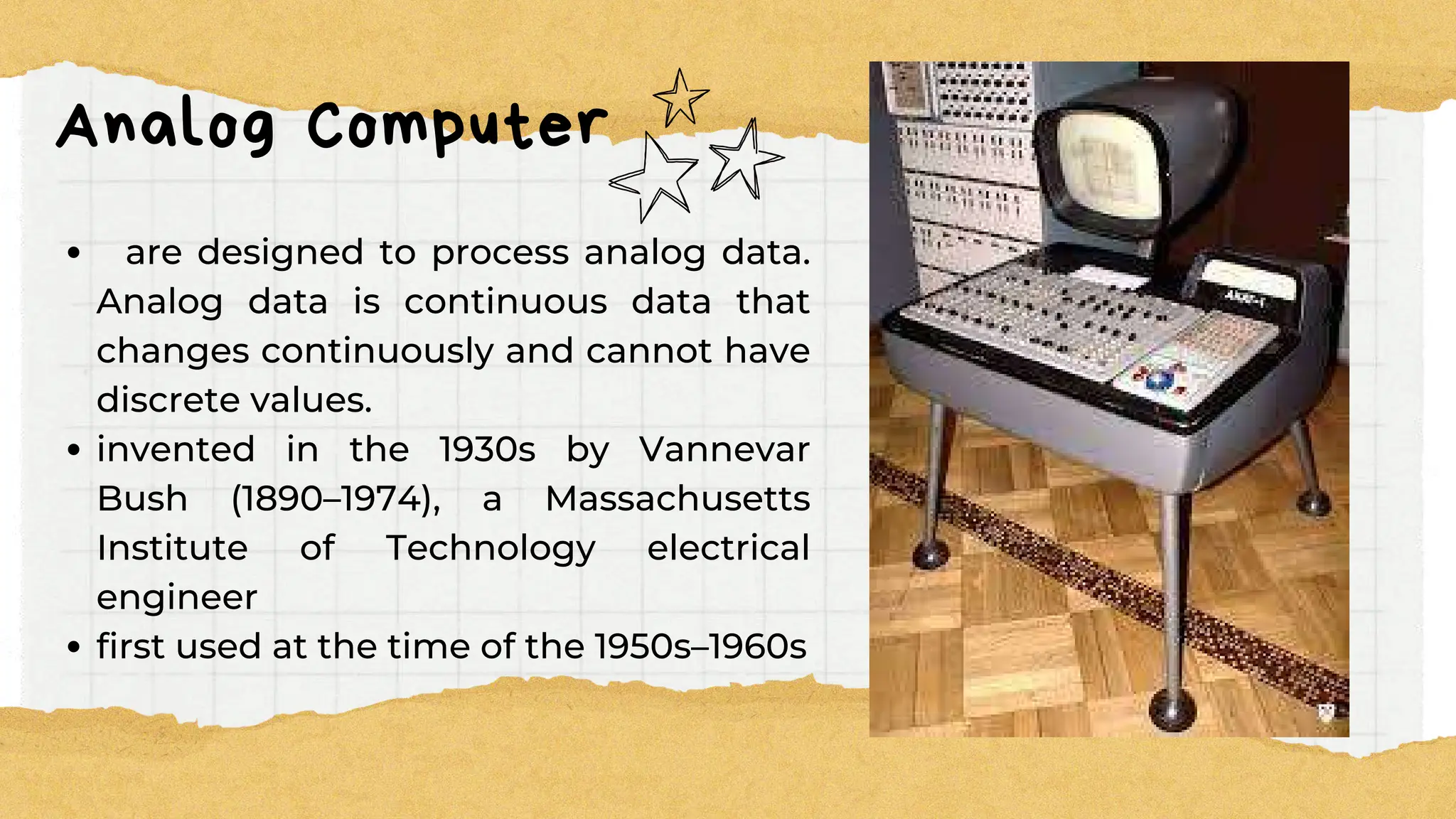
Analog Computer
are designedto process analog data.
Analog data is continuous data that
changes continuously and cannot have
discrete values.
invented in the 1930s by Vannevar
Bush (1890–1974), a Massachusetts
Institute of Technology electrical
engineer
first used at the time of the 1950s–1960s
5.
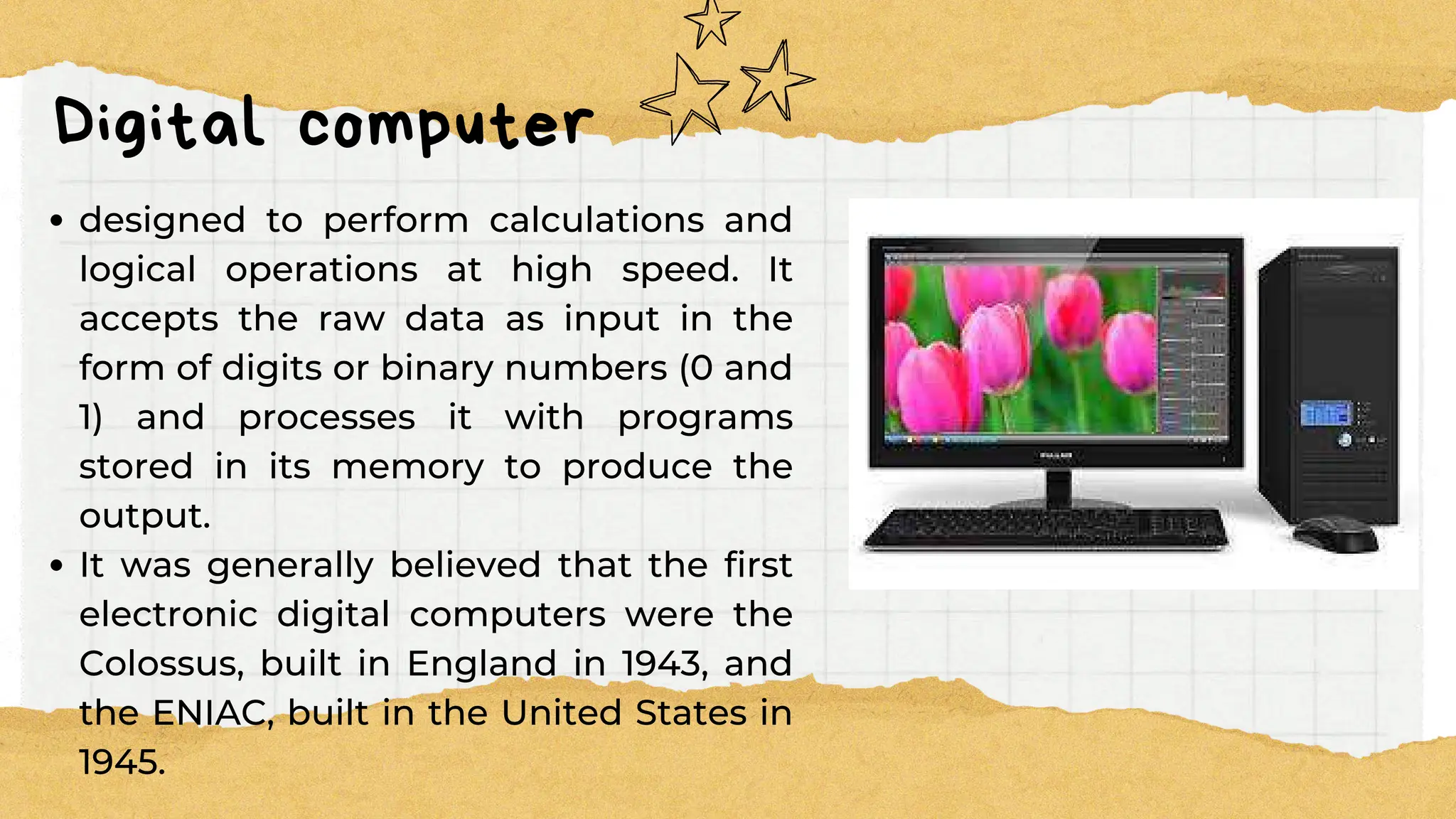
Digital computer
designed toperform calculations and
logical operations at high speed. It
accepts the raw data as input in the
form of digits or binary numbers (0 and
1) and processes it with programs
stored in its memory to produce the
output.
It was generally believed that the first
electronic digital computers were the
Colossus, built in England in 1943, and
the ENIAC, built in the United States in
1945.
6.
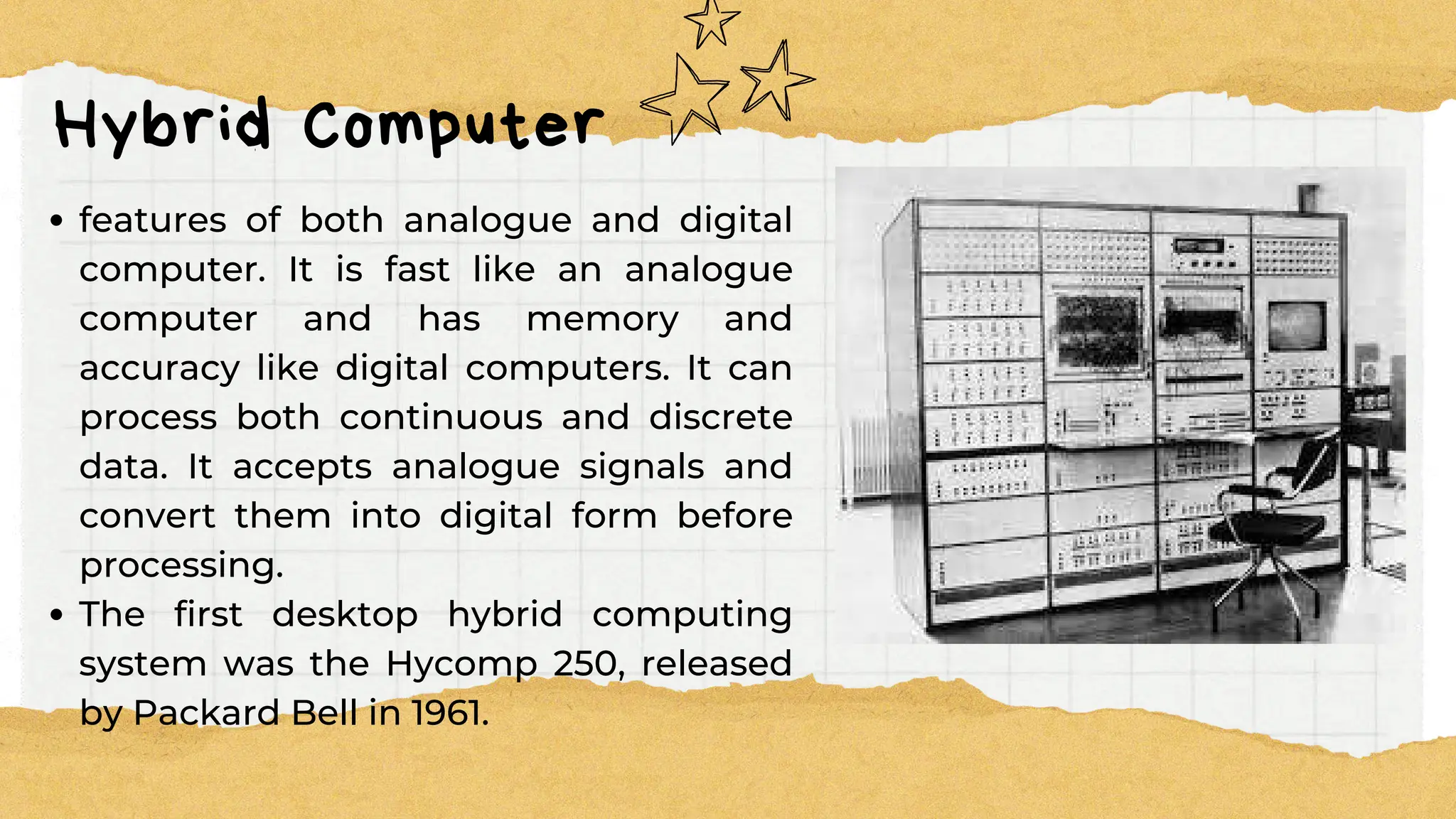
Hybrid Computer
features ofboth analogue and digital
computer. It is fast like an analogue
computer and has memory and
accuracy like digital computers. It can
process both continuous and discrete
data. It accepts analogue signals and
convert them into digital form before
processing.
The first desktop hybrid computing
system was the Hycomp 250, released
by Packard Bell in 1961.
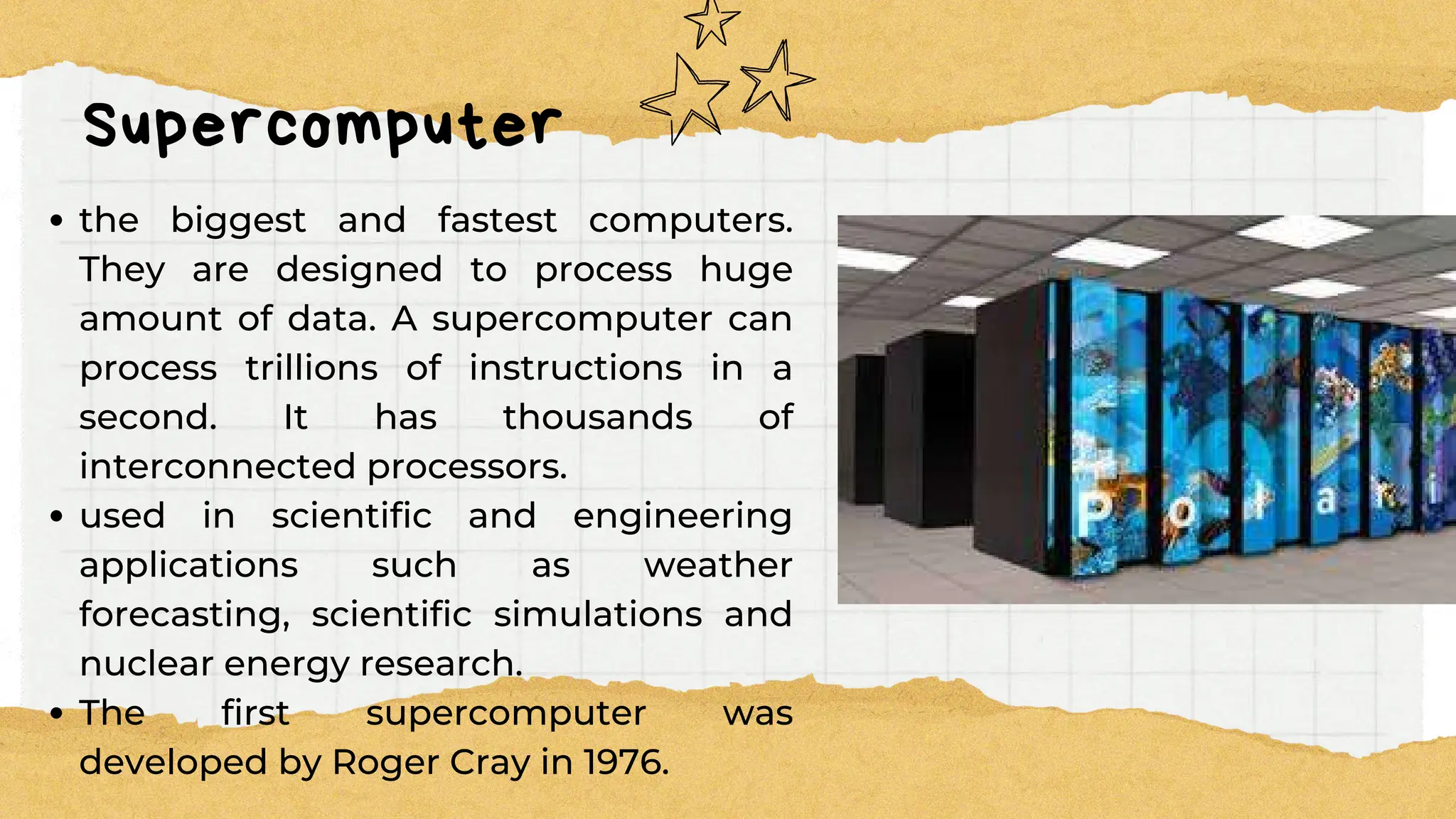
Supercomputer
the biggest andfastest computers.
They are designed to process huge
amount of data. A supercomputer can
process trillions of instructions in a
second. It has thousands of
interconnected processors.
used in scientific and engineering
applications such as weather
forecasting, scientific simulations and
nuclear energy research.
The first supercomputer was
developed by Roger Cray in 1976.
9.
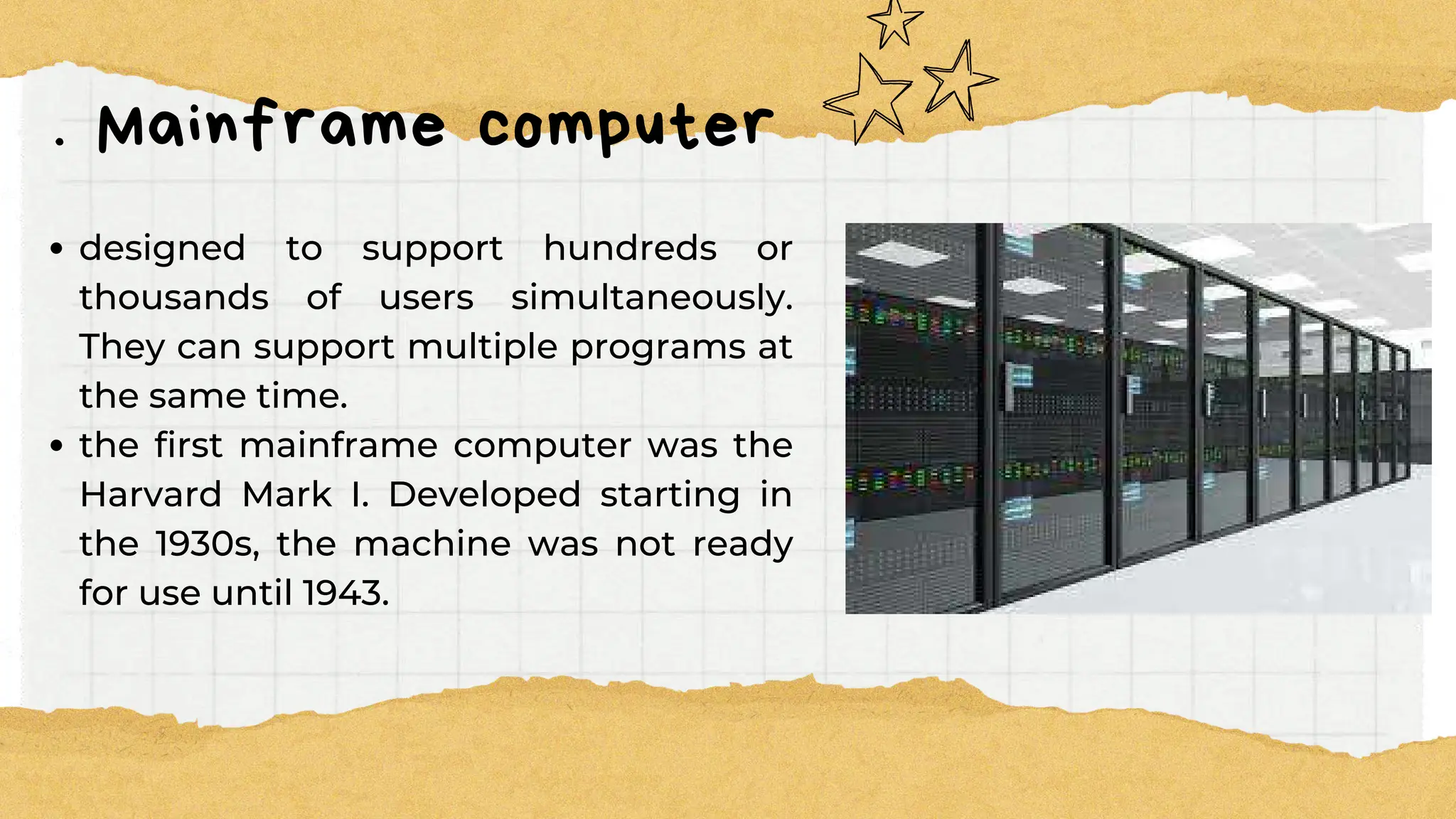
. Mainframe computer
designedto support hundreds or
thousands of users simultaneously.
They can support multiple programs at
the same time.
the first mainframe computer was the
Harvard Mark I. Developed starting in
the 1930s, the machine was not ready
for use until 1943.
10.
Miniframe or Minicomputer
a midsize multiprocessing computer. It
consists of two or more processors and
can support 4 to 200 users at one time.
used in institutes and departments for
tasks such as billing, accounting and
inventory management.
first developed in the 1960s and early
1970s by the Digital Equipment
Corporation
11.
Microcomputer
also known asa personal computer. It
is a general-purpose computer that is
designed for individual use. It has a
microprocessor as a central processing
unit, memory, storage area, input unit
and output unit.
first microcomputer was the Micral,
released in 1973 by Réalisation d'Études
Électroniques (R2E).
12.
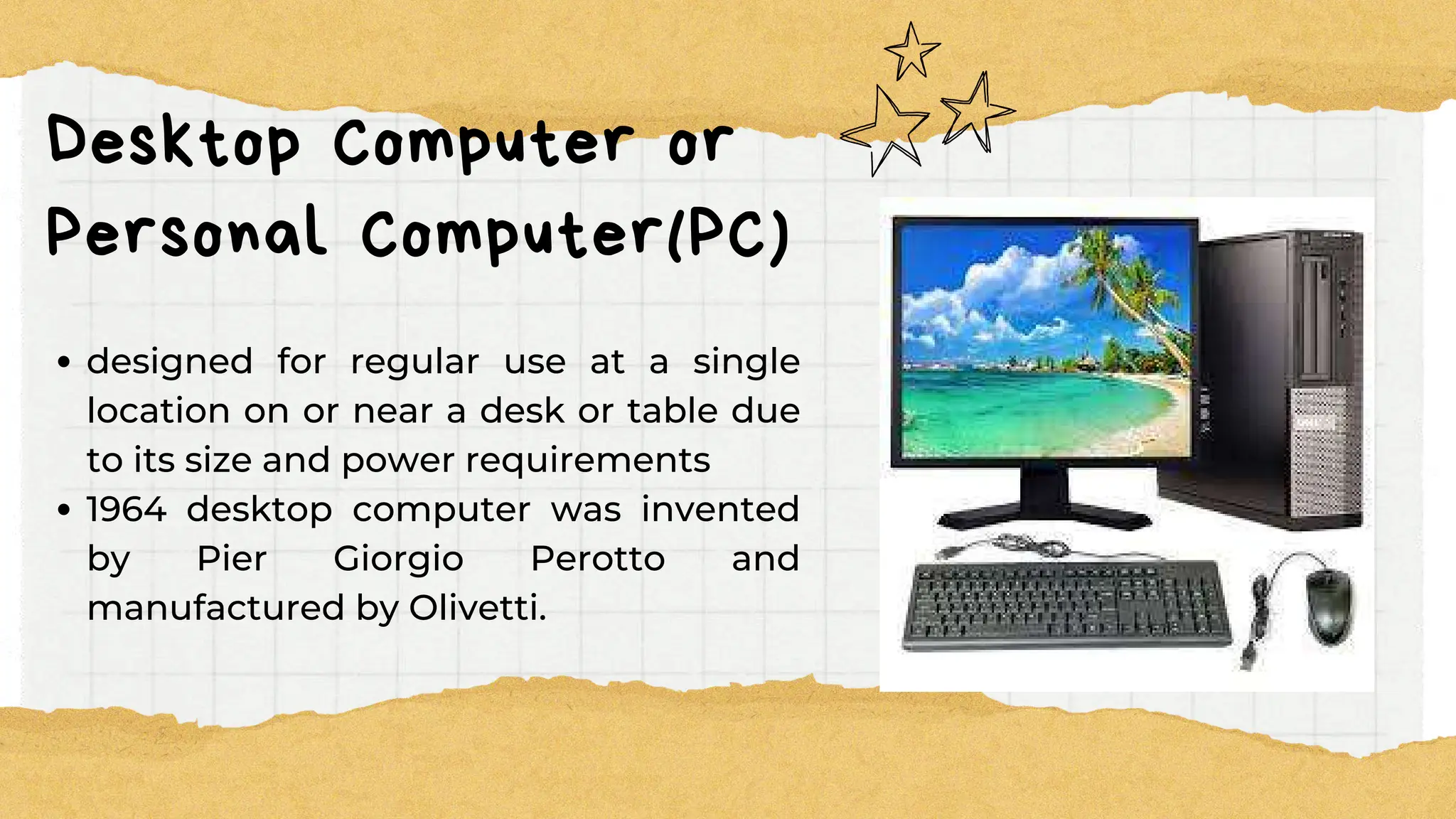
Desktop Computer or
PersonalComputer(PC)
designed for regular use at a single
location on or near a desk or table due
to its size and power requirements
1964 desktop computer was invented
by Pier Giorgio Perotto and
manufactured by Olivetti.
13.
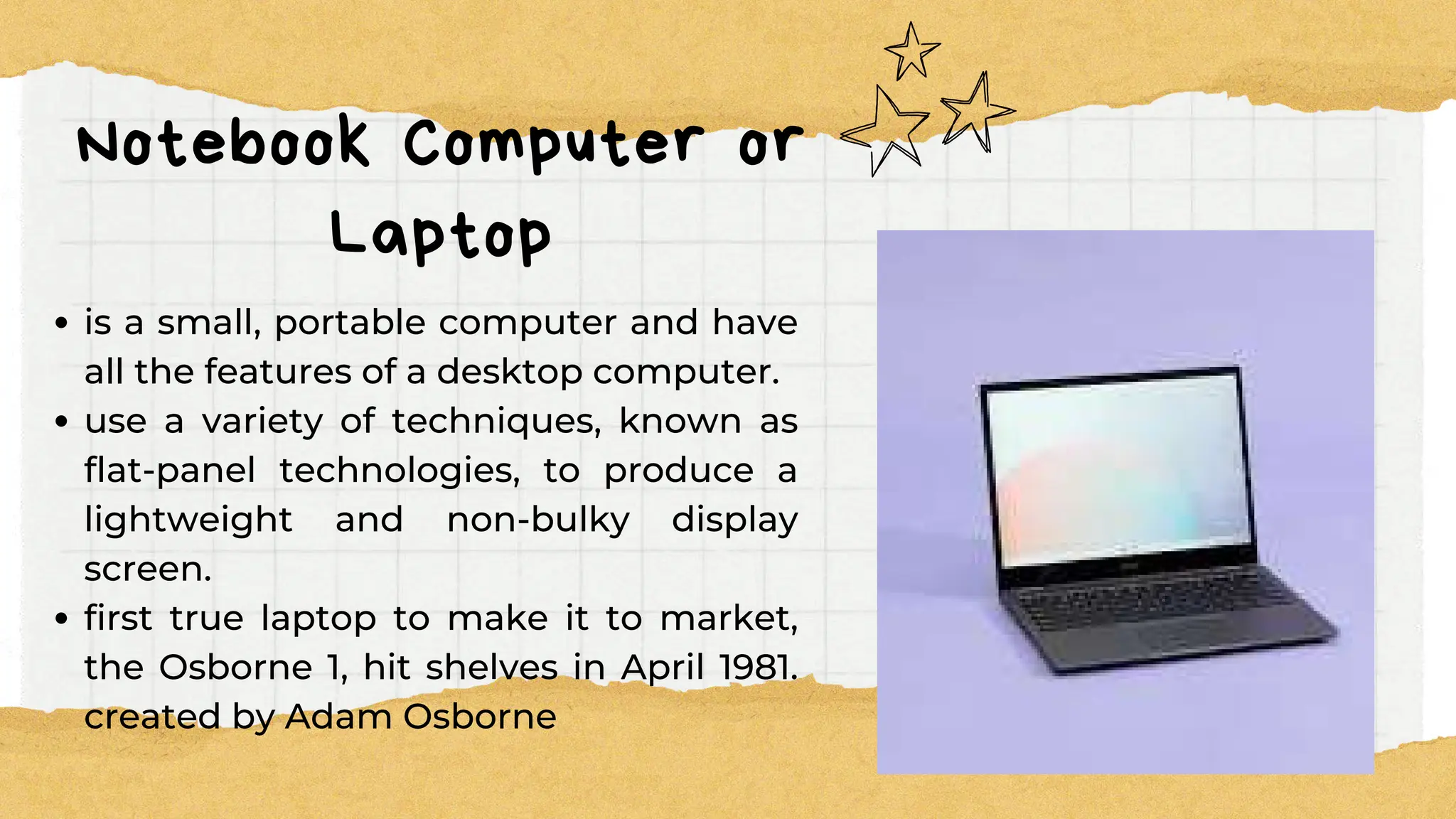
Notebook Computer or
Laptop
isa small, portable computer and have
all the features of a desktop computer.
use a variety of techniques, known as
flat-panel technologies, to produce a
lightweight and non-bulky display
screen.
first true laptop to make it to market,
the Osborne 1, hit shelves in April 1981.
created by Adam Osborne
14.
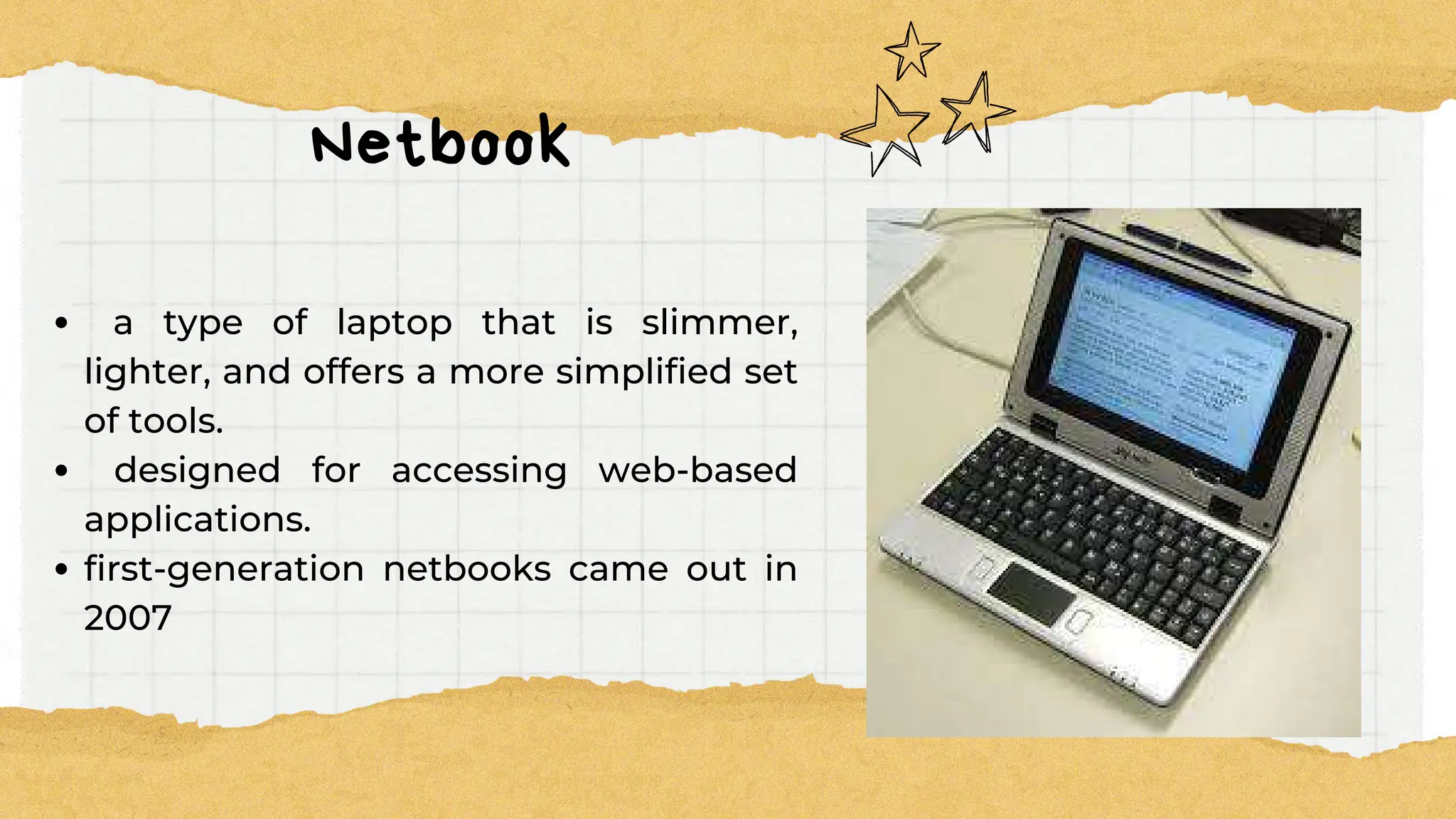
Netbook
a type oflaptop that is slimmer,
lighter, and offers a more simplified set
of tools.
designed for accessing web-based
applications.
first-generation netbooks came out in
2007