Academic
Texts
• 1. Understanding the importance of genre
• When you read English in your academic studies, you will do
more than just understand the words in the text. You will
consider meaning, but you will also think about other
aspects of the text. These include structure, audience and
purpose.
• First, however, you need to understand what genre a text
belongs to – in other words, what kind of text it is. When you
begin to understand different genres, you will be able to use
this knowledge as a tool to approach new or unfamiliar
academic texts.
Academic text
• a type of text or writing that is written by professionals in a
given field and is also intended for a scholarly audience.
• The primary goal of academic writing is to inform the
audience while providing non-biased information and
providing solid evidence to back up the writer's claims.
• academic writing heavily incorporates vocabulary/ies that
are specific to or intended for a specific field.
• To avoid plagiarism, sources of evidence and research must
be cited both in-text and in the reference list when writing
academic text.
Characteristics
• Specialized
• Uses objective and formal Language
• Names and credentials of the author must be present
• Written for the purpose of information
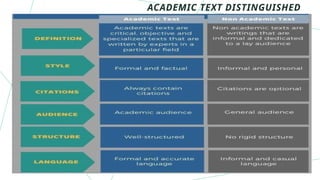
ACADEMIC TEXT DISTINGUISHED
Textbooks
• Textbooks are specifically designed to help the learner. For
example, they might have summaries or review quizzes.
Textbooks vary in style, tone and level depending on their
audience. They are a good place to start when learning about a
new topic.
Short Essays
• Student essays vary in length and formality, but they usually
contain three sections: Introduction, Main body, Conclusion.
They usually need to include citation of sources. Essays help
teachers to see what students have learnt and how deeply. Try
to read examples of student essays in your discipline to become
more familiar with what is expected of you.
Dissertations and Theses
• You will probably have to write longer texts at postgraduate level.
Longer texts include dissertations (typically 10,000 to 20,000 words)
at Master's level, and theses (typically 60,000 to 80,000 words) at
Doctor's level (PhD). These texts are the result of a long period of
reading, research and reflection – perhaps several months or years.
The structure and style varies across disciplines but is likely to
include the following:
• Introduction
• Background
• Literature Review
• Research Design/Methodology
• Results/Findings
• Discussion/Interpretation
• Recommendations
• Conclusion
Research Articles
• Research articles are written mainly for a specialist audience
– researchers, academics and postgraduate students. They
usually contain the following:
• Introduction to the research
• Literature review
• Background to the research and method
• Results or main findings
• Discussion, including authors' interpretation of the results
• Recommendations: ideas for future research
• Conclusion
• Bibliography
• Appendix (optional) to give information such as tables of
raw data from the research
Case Studies
• Case studies may be found in any discipline, though
they are most common in disciplines such as
business, sociology and law. They are primarily
descriptive. A typical structure is as follows:
• Context (what is the focus, where, when?)
• Description of the setting (person, company or
place)
• An account of how this changed over the period
of time under investigation
• Headings help the audience work through the
text
Reports
• The purpose of reports is to describe what happened
(e.g. in a piece of research) and discuss and evaluate
its importance. Reports are found in different
disciplines, such as science, law and medicine. They
typically include some or all of the following:
• Context/Overview (Title, Contents etc.)
• Introduction
• Methodology/Description of the event (e.g. piece of
research)
• Findings/Main points
• Discussion/Evaluation
• Conclusion
Analysing text: Genre, audience and
purpose
The term 'genre' refers to the typical
structure and organisational patterns of a
text, its intended audience and its purpose.
All texts are written to communicate with a
specific audience – this audience could be
experts, or it could be newcomers to the
topic. The audience becomes part of a
community when interacting with the genre,
based partly on what they expect from it and
their understanding of its purpose.
The purpose of a
particular genre might be
to:
* Present and explain
information
* Persuade the audience
to accept a new argument
* Describe a process.
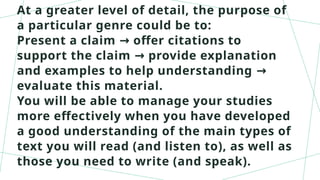
At a greater level of detail, the purpose of
a particular genre could be to:
Present a claim offer citations to
→
support the claim provide explanation
→
and examples to help understanding →
evaluate this material.
You will be able to manage your studies
more effectively when you have developed
a good understanding of the main types of
text you will read (and listen to), as well as
those you need to write (and speak).


Lesson-1-_-Academic-Texts-Autosaved.pptx

  • 1.
  • 2.
    • 1. Understandingthe importance of genre • When you read English in your academic studies, you will do more than just understand the words in the text. You will consider meaning, but you will also think about other aspects of the text. These include structure, audience and purpose. • First, however, you need to understand what genre a text belongs to – in other words, what kind of text it is. When you begin to understand different genres, you will be able to use this knowledge as a tool to approach new or unfamiliar academic texts.
  • 3.
    Academic text • atype of text or writing that is written by professionals in a given field and is also intended for a scholarly audience. • The primary goal of academic writing is to inform the audience while providing non-biased information and providing solid evidence to back up the writer's claims. • academic writing heavily incorporates vocabulary/ies that are specific to or intended for a specific field. • To avoid plagiarism, sources of evidence and research must be cited both in-text and in the reference list when writing academic text.
  • 4.
    Characteristics • Specialized • Usesobjective and formal Language • Names and credentials of the author must be present • Written for the purpose of information
  • 5.
  • 6.
    Textbooks • Textbooks arespecifically designed to help the learner. For example, they might have summaries or review quizzes. Textbooks vary in style, tone and level depending on their audience. They are a good place to start when learning about a new topic.
  • 7.
    Short Essays • Studentessays vary in length and formality, but they usually contain three sections: Introduction, Main body, Conclusion. They usually need to include citation of sources. Essays help teachers to see what students have learnt and how deeply. Try to read examples of student essays in your discipline to become more familiar with what is expected of you.
  • 8.
    Dissertations and Theses •You will probably have to write longer texts at postgraduate level. Longer texts include dissertations (typically 10,000 to 20,000 words) at Master's level, and theses (typically 60,000 to 80,000 words) at Doctor's level (PhD). These texts are the result of a long period of reading, research and reflection – perhaps several months or years. The structure and style varies across disciplines but is likely to include the following: • Introduction • Background • Literature Review • Research Design/Methodology • Results/Findings • Discussion/Interpretation • Recommendations • Conclusion
  • 9.
    Research Articles • Researcharticles are written mainly for a specialist audience – researchers, academics and postgraduate students. They usually contain the following: • Introduction to the research • Literature review • Background to the research and method • Results or main findings • Discussion, including authors' interpretation of the results • Recommendations: ideas for future research • Conclusion • Bibliography • Appendix (optional) to give information such as tables of raw data from the research
  • 10.
    Case Studies • Casestudies may be found in any discipline, though they are most common in disciplines such as business, sociology and law. They are primarily descriptive. A typical structure is as follows: • Context (what is the focus, where, when?) • Description of the setting (person, company or place) • An account of how this changed over the period of time under investigation • Headings help the audience work through the text
  • 11.
    Reports • The purposeof reports is to describe what happened (e.g. in a piece of research) and discuss and evaluate its importance. Reports are found in different disciplines, such as science, law and medicine. They typically include some or all of the following: • Context/Overview (Title, Contents etc.) • Introduction • Methodology/Description of the event (e.g. piece of research) • Findings/Main points • Discussion/Evaluation • Conclusion
  • 12.
    Analysing text: Genre,audience and purpose The term 'genre' refers to the typical structure and organisational patterns of a text, its intended audience and its purpose. All texts are written to communicate with a specific audience – this audience could be experts, or it could be newcomers to the topic. The audience becomes part of a community when interacting with the genre, based partly on what they expect from it and their understanding of its purpose.
  • 13.
    The purpose ofa particular genre might be to: * Present and explain information * Persuade the audience to accept a new argument * Describe a process.
  • 14.
    At a greaterlevel of detail, the purpose of a particular genre could be to: Present a claim offer citations to → support the claim provide explanation → and examples to help understanding → evaluate this material. You will be able to manage your studies more effectively when you have developed a good understanding of the main types of text you will read (and listen to), as well as those you need to write (and speak).