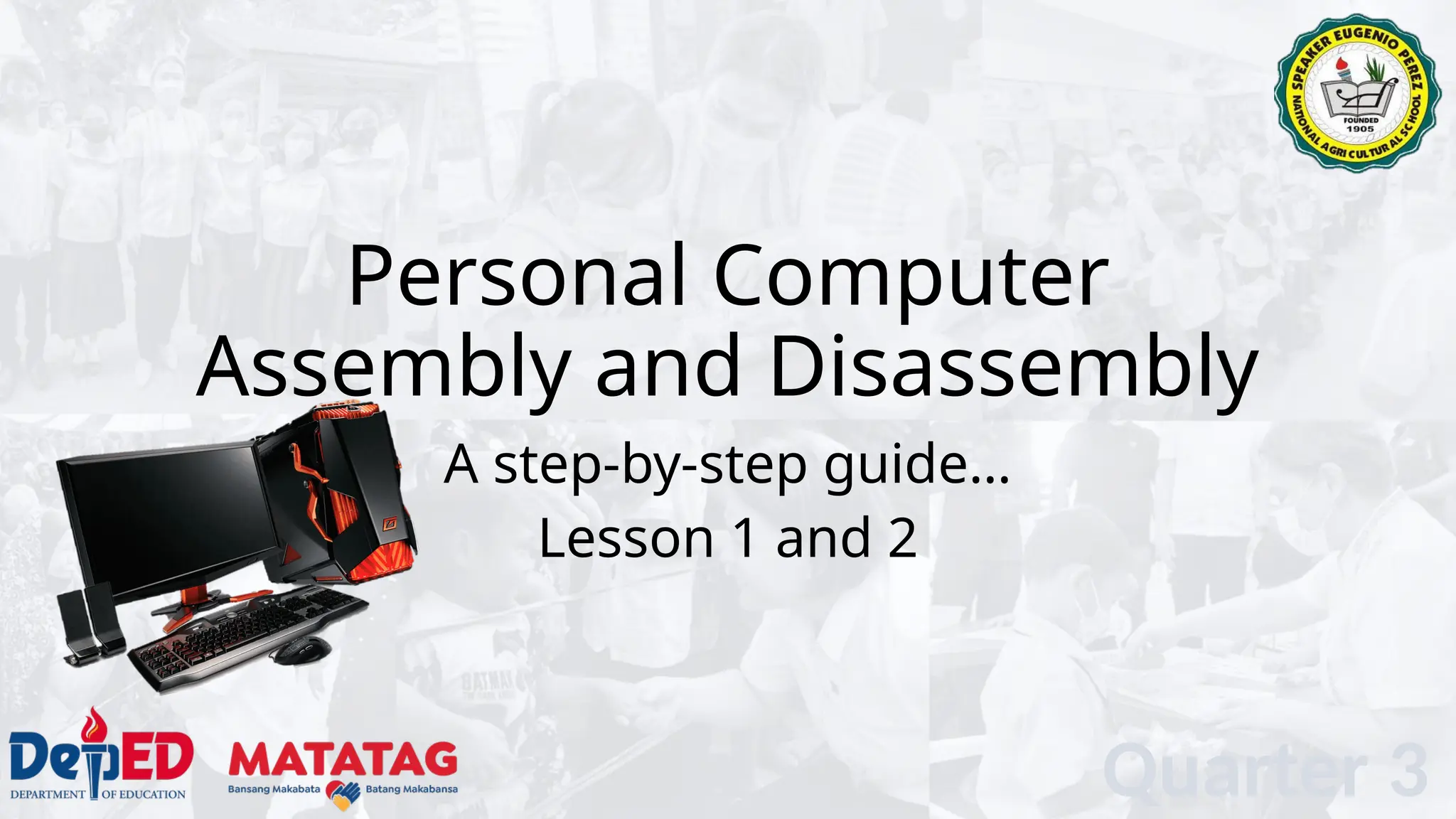
Personal Computer
Assembly and Disassembly
A step-by-step guide…
Lesson 1 and 2
Quarter 3
Why Learn PC Assembly and
Disassembly?
•Cost savings
•Customization
•Learning opportunity
•Troubleshooting skills
Quarter 3
Required Tools and Equipment
•Basic Tools:
Screwdrivers (Philips, flat-head)
Anti-static wrist strap
Tweezers
Thermal paste (optional)
Quarter 3
Required Tools and Equipment
•Optional Tools:
Cable ties
Compressed air
Quarter 3
Safety Precautions
•Electrostatic Discharge (ESD)
Safety:
Use an anti-static wrist strap.
Work on a non-conductive surface.
•General Precautions:
Power off the PC.
Unplug all cables. Quarter 3
Overview of PC Components
•INTERNAL COMPONENTS:
•Motherboard
•CPU
•RAM
•Power Supply Unit (PSU)
•Storage (HDD/SSD)
•Graphics Card
•Cooling System
Quarter 3
Overview of PC Components
•EXTERNAL COMPONENTS:
•Monitor
•Keyboard
•Mouse
Quarter 3
Steps to Assemble a PC
1. Prepare Workspace
•Clean and organized area.
2. Install Components:
•Step 1. Opening the Outer Shell/Case
•Step2. Installing the System Fan
•Step3. Installing the CPU Fan
•Step4. Installing the Power Supply
•Step5. CD/ DVD Drive(s) (optional)
Quarter 3
Steps to Assemble a PC
•Step6. Hard Drive
•Step7. Memory (RAM)
•Step8. Motherboard
•Step9. Close the outer shell/case
•Step10. Plugging
Quarter 3
Steps to Disassemble a PC
•Step1. Unplugging
•Step2.Opening the Outer Shell/Case
•Step3. Removing the System Fan
•Step4. Removing the CPU Fan
•Step5. Removing the Power Supply
Quarter 3
Common Mistakes to Avoid
•Forgetting to use anti-static
measures.
•Applying too much/little thermal
paste.
•Incorrect cable connections.
•Over-tightening screws.
Quarter 3
Troubleshooting Tips
•No Power:
Check PSU switch and connections.
•No Display:
Ensure GPU and monitor connections are
secure.
•Overheating:
Verify cooling systems and thermal paste.
Quarter 3

Lesson 1 & 2. Personal Computer Assembly and Disassembly.pptx

  • 1.
    Personal Computer Assembly andDisassembly A step-by-step guide… Lesson 1 and 2 Quarter 3
  • 2.
    Why Learn PCAssembly and Disassembly? •Cost savings •Customization •Learning opportunity •Troubleshooting skills Quarter 3
  • 3.
    Required Tools andEquipment •Basic Tools: Screwdrivers (Philips, flat-head) Anti-static wrist strap Tweezers Thermal paste (optional) Quarter 3
  • 4.
    Required Tools andEquipment •Optional Tools: Cable ties Compressed air Quarter 3
  • 5.
    Safety Precautions •Electrostatic Discharge(ESD) Safety: Use an anti-static wrist strap. Work on a non-conductive surface. •General Precautions: Power off the PC. Unplug all cables. Quarter 3
  • 6.
    Overview of PCComponents •INTERNAL COMPONENTS: •Motherboard •CPU •RAM •Power Supply Unit (PSU) •Storage (HDD/SSD) •Graphics Card •Cooling System Quarter 3
  • 7.
    Overview of PCComponents •EXTERNAL COMPONENTS: •Monitor •Keyboard •Mouse Quarter 3
  • 8.
    Steps to Assemblea PC 1. Prepare Workspace •Clean and organized area. 2. Install Components: •Step 1. Opening the Outer Shell/Case •Step2. Installing the System Fan •Step3. Installing the CPU Fan •Step4. Installing the Power Supply •Step5. CD/ DVD Drive(s) (optional) Quarter 3
  • 9.
    Steps to Assemblea PC •Step6. Hard Drive •Step7. Memory (RAM) •Step8. Motherboard •Step9. Close the outer shell/case •Step10. Plugging Quarter 3
  • 10.
    Steps to Disassemblea PC •Step1. Unplugging •Step2.Opening the Outer Shell/Case •Step3. Removing the System Fan •Step4. Removing the CPU Fan •Step5. Removing the Power Supply Quarter 3
  • 11.
    Common Mistakes toAvoid •Forgetting to use anti-static measures. •Applying too much/little thermal paste. •Incorrect cable connections. •Over-tightening screws. Quarter 3
  • 12.
    Troubleshooting Tips •No Power: CheckPSU switch and connections. •No Display: Ensure GPU and monitor connections are secure. •Overheating: Verify cooling systems and thermal paste. Quarter 3