TECHNOPRENEURSHIP
LESSON 03:INNOVATION AND IDEA
GENERATION
UNDERSTANDING INNOVATION AND IDEA
GENERATION IN TECHNOPRENEURSHIP
Innovation is a cornerstone of technopreneurship, representing the
fusion of technology and entrepreneurship to create value and
address market needs. This dynamic interplay not only involves the
development of new products or services but also encompasses the
strategic application of technology to solve existing problems and
enhance business operations.
FOUR PRIMARY TYPES OF INNOVATION
1. Disruptive Innovation
Disruptive innovation refers to new products or services that
fundamentally change the competitive landscape by targeting
underserved or overlooked market segments.
This type of innovation often begins as a lower-quality or less
expensive alternative but improves over time, eventually displacing
established competitors. A notable example is Netflix, which started
as a DVD rental service and evolved into a dominant streaming
platform, disrupting traditional media consumption models
FOUR PRIMARY TYPES OF INNOVATION
2. Incremental Innovation
Incremental innovation involves making small, continuous
improvements to existing products, services, or processes. This type
of innovation focuses on enhancing performance, quality, or user
experience without drastically altering the original offering.
For instance, the introduction of new features in smartphones from
one model to the next exemplifies incremental innovation. It is
essential for maintaining competitiveness in mature markets and
often relies on customer feedback and iterative development
FOUR PRIMARY TYPES OF INNOVATION
3. Radical Innovation
Radical innovation represents breakthrough advancements that
create entirely new markets or fundamentally alter existing ones
through novel technologies or concepts.
This type of innovation can redefine industry paradigms and often
involves significant risk and investment. Examples include the advent
of smartphones and cloud computing, which transformed
communication and data storage respectively. Radical innovations are
characterized by their potential to solve problems in unprecedented
ways.
FOUR PRIMARY TYPES OF INNOVATION
4. Architectural Innovation
Architectural innovation involves reconfiguring existing technologies
or systems to create new applications or value propositions.
This type focuses on redesigning product structures or processes to
enhance functionality or efficiency, often leading to new market
opportunities. An example might include modular design in
technology products that allows for greater customization and
flexibility. Architectural innovations leverage existing technologies in
innovative ways to meet evolving market demands.
PRINCIPLES OF INNOVATION
Innovation is a multifaceted concept that plays a crucial role in the
growth and sustainability of organizations. It encompasses various
principles that guide the process of generating new ideas, products,
or services
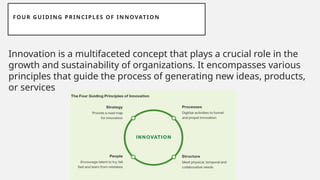
FOUR GUIDING PRINCIPLES OF INNOVATION
Innovation is a multifaceted concept that plays a crucial role in the
growth and sustainability of organizations. It encompasses various
principles that guide the process of generating new ideas, products,
or services
I D E A P R E S E N TAT I O N O F I N N O V AT I O N
To effectively present an innovation idea, it's crucial to combine clarity, creativity,
and strategic communication. Here are key strategies and methods for a
successful presentation:
Stages of the Innovation Process
• Idea Generation: Brainstorm various ideas through market research and
competitor analysis.
• Conceptualization: Develop prototypes and feasibility studies to align ideas
with company strategy.
• Development: Focus on the technical aspects, including product development
and testing.
• Product Launch: Introduce the innovation to the market effectively.
P R E S E N TAT I O N T E C H N I Q U E S
Utilize diverse methods to engage your audience and convey your message:
Visual Aids: Incorporate diagrams, infographics, or slides that visually represent
your ideas. Tools like PowerPoint templates can enhance clarity and impact.
Mini Business Case: Present a concise business case that outlines the strategic,
commercial, and financial aspects of your idea. This approach strengthens
persuasiveness by addressing potential concerns from stakeholders.
Creative Formats: Consider unconventional methods such as mood boards,
storyboards, or even a short video to illustrate your concept dynamically
C O N N E C T I N G W I T H Y O U R A U D I E N C E
Effective communication is key to gaining support for your
innovation:
• Understand Audience Perspectives: Address the customer needs,
business viability, and technological feasibility of your idea to ensure
it resonates with stakeholders.
• Engage Emotionally: Use storytelling techniques to make your
presentation relatable and memorable. This can foster a connection
with your audience and enhance their interest in your proposal
A V O I D C O M M O N P I T F A L L S
Be mindful of common mistakes in presentations:
• Overloading Information: Keep slides concise and focused; avoid
cluttering them with excessive text or data.
• Neglecting Audience Engagement: Ensure you actively engage
with your audience throughout the presentation, inviting questions
and feedback
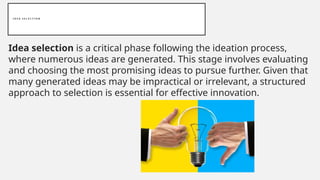
I D E A S E L E C T I O N
Idea selection is a critical phase following the ideation process,
where numerous ideas are generated. This stage involves evaluating
and choosing the most promising ideas to pursue further. Given that
many generated ideas may be impractical or irrelevant, a structured
approach to selection is essential for effective innovation.
P R O C E S S O N S E L E C T I N G I D E A S
• Problem Identification
Clearly define the challenge or opportunity at hand. This sets a focused
direction for generating relevant ideas, ensuring that all participants
understand the core issue to address.
• Idea Generation
Engage in brainstorming sessions to create a wide range of potential
solutions. Techniques such as divergent thinking and mind mapping
encourage free thinking without immediate judgment, prioritizing
quantity over quality at this stage
P R O C E S S O N S E L E C T I N G I D E A S
• Idea Evaluation
After generating ideas, shift focus to evaluating and filtering them based
on specific criteria such as feasibility, potential impact, cost, and
alignment with strategic objectives. Common evaluation techniques
include SWOT analysis and scoring models to rank ideas effectively.
• Shortlisting Ideas
Create a shortlist of the top ideas for further review. This helps streamline
discussions with decision-makers by presenting a manageable number of
high-potential options instead of an overwhelming list
P R O C E S S O N S E L E C T I N G I D E A S
• Validation
Before implementation, validate shortlisted ideas through testing
methods like customer feedback, focus groups, or A/B testing. This
phase may involve iterations to refine ideas based on insights
gathered from real-world applications.
• Implementation Planning
Develop a detailed plan for how to implement the selected ideas,
considering resource availability and potential challenges in
execution
I D E N T I F Y I N G C U S T O M E R ’ S N E E D S
Customer Journey Mapping: This involves visualizing the customer’s
experience with your product or service from start to finish.
Surveys and Feedback: Conducting surveys allows businesses to
gather direct input from customers about their preferences and
experiences.
Focus Groups: Organizing focus groups provides a platform for in-
depth discussions with customers.
I D E N T I F Y I N G C U S T O M E R ’ S N E E D S
Data Analysis: Analyzing customer data from various sources such as usage patterns,
purchase history, and feedback can reveal trends and latent needs that customers may not
explicitly express.
Social Listening: Monitoring social media platforms for mentions of your brand or products
can provide real-time insights into customer sentiments and emerging needs.
Observation: Observing how customers interact with products in real-life scenarios can
reveal unarticulated needs.
Segmentation: Segmenting customers based on demographics, behavior, or preferences
allows for a more tailored approach to understanding needs.
M A R K E T R E S E A R C H A N D V A L I D A T I O N
• Market research is the systematic gathering, recording, and analysis of data about
customers, competitors, and the overall market environment. It provides insights into:
• Market Size: Understanding how large the potential market is.
• Customer Demographics: Identifying who the customers are based on age, gender,
income, etc.
• Competitor Analysis: Analyzing competitors’ strengths and weaknesses to identify
opportunities and threats.
T H E D E C I S I O N M A K I N G P R O C E S S
The decision-making process is a systematic approach used to
identify and select the best course of action among various
alternatives. This process is essential in both personal and
professional contexts, allowing individuals and organizations
to make informed choices that align with their goals.
T H E D E C I S I O N M A K I N G P R O C E S S
Steps in the Decision-Making Process:
• Identify the Decision
• Gather Relevant Information
• Identify Alternatives
• Weigh the Evidence
• Choose Among Alternatives
• Take Action
• Review Your Decision & Its Consequences

Lesson 03_Innovation and Idea Generation.pptx

  • 1.
  • 2.
    UNDERSTANDING INNOVATION ANDIDEA GENERATION IN TECHNOPRENEURSHIP Innovation is a cornerstone of technopreneurship, representing the fusion of technology and entrepreneurship to create value and address market needs. This dynamic interplay not only involves the development of new products or services but also encompasses the strategic application of technology to solve existing problems and enhance business operations.
  • 3.
    FOUR PRIMARY TYPESOF INNOVATION 1. Disruptive Innovation Disruptive innovation refers to new products or services that fundamentally change the competitive landscape by targeting underserved or overlooked market segments. This type of innovation often begins as a lower-quality or less expensive alternative but improves over time, eventually displacing established competitors. A notable example is Netflix, which started as a DVD rental service and evolved into a dominant streaming platform, disrupting traditional media consumption models
  • 4.
    FOUR PRIMARY TYPESOF INNOVATION 2. Incremental Innovation Incremental innovation involves making small, continuous improvements to existing products, services, or processes. This type of innovation focuses on enhancing performance, quality, or user experience without drastically altering the original offering. For instance, the introduction of new features in smartphones from one model to the next exemplifies incremental innovation. It is essential for maintaining competitiveness in mature markets and often relies on customer feedback and iterative development
  • 5.
    FOUR PRIMARY TYPESOF INNOVATION 3. Radical Innovation Radical innovation represents breakthrough advancements that create entirely new markets or fundamentally alter existing ones through novel technologies or concepts. This type of innovation can redefine industry paradigms and often involves significant risk and investment. Examples include the advent of smartphones and cloud computing, which transformed communication and data storage respectively. Radical innovations are characterized by their potential to solve problems in unprecedented ways.
  • 6.
    FOUR PRIMARY TYPESOF INNOVATION 4. Architectural Innovation Architectural innovation involves reconfiguring existing technologies or systems to create new applications or value propositions. This type focuses on redesigning product structures or processes to enhance functionality or efficiency, often leading to new market opportunities. An example might include modular design in technology products that allows for greater customization and flexibility. Architectural innovations leverage existing technologies in innovative ways to meet evolving market demands.
  • 7.
    PRINCIPLES OF INNOVATION Innovationis a multifaceted concept that plays a crucial role in the growth and sustainability of organizations. It encompasses various principles that guide the process of generating new ideas, products, or services
  • 8.
    FOUR GUIDING PRINCIPLESOF INNOVATION Innovation is a multifaceted concept that plays a crucial role in the growth and sustainability of organizations. It encompasses various principles that guide the process of generating new ideas, products, or services
  • 9.
    I D EA P R E S E N TAT I O N O F I N N O V AT I O N To effectively present an innovation idea, it's crucial to combine clarity, creativity, and strategic communication. Here are key strategies and methods for a successful presentation: Stages of the Innovation Process • Idea Generation: Brainstorm various ideas through market research and competitor analysis. • Conceptualization: Develop prototypes and feasibility studies to align ideas with company strategy. • Development: Focus on the technical aspects, including product development and testing. • Product Launch: Introduce the innovation to the market effectively.
  • 10.
    P R ES E N TAT I O N T E C H N I Q U E S Utilize diverse methods to engage your audience and convey your message: Visual Aids: Incorporate diagrams, infographics, or slides that visually represent your ideas. Tools like PowerPoint templates can enhance clarity and impact. Mini Business Case: Present a concise business case that outlines the strategic, commercial, and financial aspects of your idea. This approach strengthens persuasiveness by addressing potential concerns from stakeholders. Creative Formats: Consider unconventional methods such as mood boards, storyboards, or even a short video to illustrate your concept dynamically
  • 11.
    C O NN E C T I N G W I T H Y O U R A U D I E N C E Effective communication is key to gaining support for your innovation: • Understand Audience Perspectives: Address the customer needs, business viability, and technological feasibility of your idea to ensure it resonates with stakeholders. • Engage Emotionally: Use storytelling techniques to make your presentation relatable and memorable. This can foster a connection with your audience and enhance their interest in your proposal
  • 12.
    A V OI D C O M M O N P I T F A L L S Be mindful of common mistakes in presentations: • Overloading Information: Keep slides concise and focused; avoid cluttering them with excessive text or data. • Neglecting Audience Engagement: Ensure you actively engage with your audience throughout the presentation, inviting questions and feedback
  • 13.
    I D EA S E L E C T I O N Idea selection is a critical phase following the ideation process, where numerous ideas are generated. This stage involves evaluating and choosing the most promising ideas to pursue further. Given that many generated ideas may be impractical or irrelevant, a structured approach to selection is essential for effective innovation.
  • 14.
    P R OC E S S O N S E L E C T I N G I D E A S • Problem Identification Clearly define the challenge or opportunity at hand. This sets a focused direction for generating relevant ideas, ensuring that all participants understand the core issue to address. • Idea Generation Engage in brainstorming sessions to create a wide range of potential solutions. Techniques such as divergent thinking and mind mapping encourage free thinking without immediate judgment, prioritizing quantity over quality at this stage
  • 15.
    P R OC E S S O N S E L E C T I N G I D E A S • Idea Evaluation After generating ideas, shift focus to evaluating and filtering them based on specific criteria such as feasibility, potential impact, cost, and alignment with strategic objectives. Common evaluation techniques include SWOT analysis and scoring models to rank ideas effectively. • Shortlisting Ideas Create a shortlist of the top ideas for further review. This helps streamline discussions with decision-makers by presenting a manageable number of high-potential options instead of an overwhelming list
  • 16.
    P R OC E S S O N S E L E C T I N G I D E A S • Validation Before implementation, validate shortlisted ideas through testing methods like customer feedback, focus groups, or A/B testing. This phase may involve iterations to refine ideas based on insights gathered from real-world applications. • Implementation Planning Develop a detailed plan for how to implement the selected ideas, considering resource availability and potential challenges in execution
  • 17.
    I D EN T I F Y I N G C U S T O M E R ’ S N E E D S Customer Journey Mapping: This involves visualizing the customer’s experience with your product or service from start to finish. Surveys and Feedback: Conducting surveys allows businesses to gather direct input from customers about their preferences and experiences. Focus Groups: Organizing focus groups provides a platform for in- depth discussions with customers.
  • 18.
    I D EN T I F Y I N G C U S T O M E R ’ S N E E D S Data Analysis: Analyzing customer data from various sources such as usage patterns, purchase history, and feedback can reveal trends and latent needs that customers may not explicitly express. Social Listening: Monitoring social media platforms for mentions of your brand or products can provide real-time insights into customer sentiments and emerging needs. Observation: Observing how customers interact with products in real-life scenarios can reveal unarticulated needs. Segmentation: Segmenting customers based on demographics, behavior, or preferences allows for a more tailored approach to understanding needs.
  • 19.
    M A RK E T R E S E A R C H A N D V A L I D A T I O N • Market research is the systematic gathering, recording, and analysis of data about customers, competitors, and the overall market environment. It provides insights into: • Market Size: Understanding how large the potential market is. • Customer Demographics: Identifying who the customers are based on age, gender, income, etc. • Competitor Analysis: Analyzing competitors’ strengths and weaknesses to identify opportunities and threats.
  • 20.
    T H ED E C I S I O N M A K I N G P R O C E S S The decision-making process is a systematic approach used to identify and select the best course of action among various alternatives. This process is essential in both personal and professional contexts, allowing individuals and organizations to make informed choices that align with their goals.
  • 21.
    T H ED E C I S I O N M A K I N G P R O C E S S Steps in the Decision-Making Process: • Identify the Decision • Gather Relevant Information • Identify Alternatives • Weigh the Evidence • Choose Among Alternatives • Take Action • Review Your Decision & Its Consequences