 Introduction
 Mode of Transmission
 Classification
 Signs & Symptoms
 Diagnosis
 Treatment
 Conclusion
 Reference
 Leprosy is also known as Hansen’s disease, after the
scientist who discovered M. leprae In 1873.
 Leprosy is an infectious disease that causes severe,
disfiguring skin sores and nerve damage in the arms and
legs.
 Today, about 180,000 people worldwide are infected with
leprosy, according to the World Health Organization, most
of them in Africa and Asia. About 200 people are
diagnosed with leprosy in the U.S. every year.
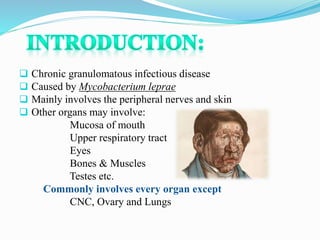
 Chronic granulomatous infectious disease
 Caused by Mycobacterium leprae
 Mainly involves the peripheral nerves and skin
 Other organs may involve:
Mucosa of mouth
Upper respiratory tract
Eyes
Bones & Muscles
Testes etc.
Commonly involves every organ except
CNC, Ovary and Lungs

Droplet infection (most Common)

Skin to skin contact with infectious cases

Insect Vectors e.g.. Mosquito, Bedbugs
Tattooing needles
 Identify the patients likely to develop the deformities and
determine the prognosis
 Frame the line of treatment
 Helpful in planning and evaluation of leprosy control
activities
Identify the infectious cases-Epidemiological importance-
Principle targets for treatment
Three types of classification
1. Indian Classification
2. Ridly and jopling classification
 Indeterminate type
 Tuberculoid type
 Borderline type
 Lepromatus type
 Pure neuritic type
 Divides Leprosy cases into five groups according to their
position on an immunohistological scale.
 Tuberculoid
 Borderline Tuberculoid
 Borderline Borderline
 Borderline Lepromatous
 Lepromatous
 Large bumps on the skin that do not feel
pain.
 Large bumps on the skin that do not heal for
weeks or months.
 Muscle weakness .
 Disappearance of eyebrows or eyelashes .
 Mycobacterium leprae multiplies very
slowly.
 Symptoms can take as long as 20 years to
appear.
I.
Well defined skin lesions that are numb.
II.
Chronically stuffy nose and many skin lesions and
nodules on both sides of the body.
 Hypopigmented or reddish skin
lesions with definite loss of sensation
 Damage to the peripheral nerves, as
demonstrated by loss of sensation
 Weakness of the muscles of hands, feet or face
 Positive skin smear
Common drugs
I. Dapsone
II. Rifampicin
III. Clofazimine
The combination of these three drugs Is
known as multi drug therapy (MDT)
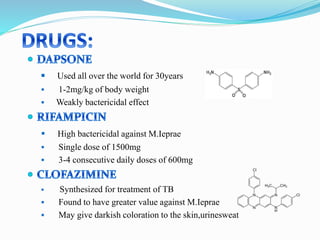
Used all over the world for 30years
 1-2mg/kg of body weight
 Weakly bactericidal effect
 High bactericidal against M.Ieprae
 Single dose of 1500mg
 3-4 consecutive daily doses of 600mg
 Synthesized for treatment of TB
 Found to have greater value against M.Ieprae
 May give darkish coloration to the skin,urinesweat
 Fortunately, modern medicine has cured most of the
world of Leprosy
 People with Leprosy are being more accepted by
communities around the world
 Leprosy still Remains a problem in
undeveloped countries
The World Health Organization is putting a stop to this
If they reach their goal, Leprosy should be eliminated from the
world within 20 years
 Truman RW, Singh P, Sharma R, Rougemont J, Scollard
DM, Cole ST, “The New England Journal of Medicine”,
2011,Vol.364, 1626-1633.
 Taylor, J, Vitek V, Enriquez V and J, Smedley, “International
Journal of Leprosy”, 1999, Vol.60, 449–452.
 Silva CL, Foss NT, “Journal of Infected Disease”, 1989,
Vol.159, 787–790.
 Shepard CC, “International Journal of Leprosy”, 1962, Vol.30,
10-18.
 Izumi S, Budiawan T, Saeki K, Matsuoka M, Kawatsu
K, “Indian Journal of Leprosy”, 1999, Vol.71, 37–43.
Leprosy presentation

Leprosy presentation

  • 2.
     Introduction  Modeof Transmission  Classification  Signs & Symptoms  Diagnosis  Treatment  Conclusion  Reference
  • 3.
     Leprosy isalso known as Hansen’s disease, after the scientist who discovered M. leprae In 1873.  Leprosy is an infectious disease that causes severe, disfiguring skin sores and nerve damage in the arms and legs.  Today, about 180,000 people worldwide are infected with leprosy, according to the World Health Organization, most of them in Africa and Asia. About 200 people are diagnosed with leprosy in the U.S. every year.
  • 4.
     Chronic granulomatousinfectious disease  Caused by Mycobacterium leprae  Mainly involves the peripheral nerves and skin  Other organs may involve: Mucosa of mouth Upper respiratory tract Eyes Bones & Muscles Testes etc. Commonly involves every organ except CNC, Ovary and Lungs
  • 5.
     Droplet infection (mostCommon)  Skin to skin contact with infectious cases  Insect Vectors e.g.. Mosquito, Bedbugs Tattooing needles
  • 6.
     Identify thepatients likely to develop the deformities and determine the prognosis  Frame the line of treatment  Helpful in planning and evaluation of leprosy control activities Identify the infectious cases-Epidemiological importance- Principle targets for treatment
  • 7.
    Three types ofclassification 1. Indian Classification 2. Ridly and jopling classification  Indeterminate type  Tuberculoid type  Borderline type  Lepromatus type  Pure neuritic type
  • 8.
     Divides Leprosycases into five groups according to their position on an immunohistological scale.  Tuberculoid  Borderline Tuberculoid  Borderline Borderline  Borderline Lepromatous  Lepromatous
  • 9.
     Large bumpson the skin that do not feel pain.  Large bumps on the skin that do not heal for weeks or months.  Muscle weakness .  Disappearance of eyebrows or eyelashes .
  • 10.
     Mycobacterium lepraemultiplies very slowly.  Symptoms can take as long as 20 years to appear. I. Well defined skin lesions that are numb. II. Chronically stuffy nose and many skin lesions and nodules on both sides of the body.
  • 11.
     Hypopigmented orreddish skin lesions with definite loss of sensation  Damage to the peripheral nerves, as demonstrated by loss of sensation  Weakness of the muscles of hands, feet or face  Positive skin smear
  • 12.
    Common drugs I. Dapsone II.Rifampicin III. Clofazimine The combination of these three drugs Is known as multi drug therapy (MDT)
  • 13.
    Used all overthe world for 30years  1-2mg/kg of body weight  Weakly bactericidal effect  High bactericidal against M.Ieprae  Single dose of 1500mg  3-4 consecutive daily doses of 600mg  Synthesized for treatment of TB  Found to have greater value against M.Ieprae  May give darkish coloration to the skin,urinesweat
  • 14.
     Fortunately, modernmedicine has cured most of the world of Leprosy  People with Leprosy are being more accepted by communities around the world  Leprosy still Remains a problem in undeveloped countries The World Health Organization is putting a stop to this If they reach their goal, Leprosy should be eliminated from the world within 20 years
  • 15.
     Truman RW,Singh P, Sharma R, Rougemont J, Scollard DM, Cole ST, “The New England Journal of Medicine”, 2011,Vol.364, 1626-1633.  Taylor, J, Vitek V, Enriquez V and J, Smedley, “International Journal of Leprosy”, 1999, Vol.60, 449–452.  Silva CL, Foss NT, “Journal of Infected Disease”, 1989, Vol.159, 787–790.  Shepard CC, “International Journal of Leprosy”, 1962, Vol.30, 10-18.  Izumi S, Budiawan T, Saeki K, Matsuoka M, Kawatsu K, “Indian Journal of Leprosy”, 1999, Vol.71, 37–43.