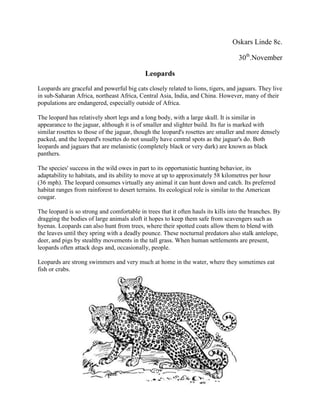
Oskars Linde 8c. 30th.NovemberLeopardsLeopards are graceful and powerful big cats closely related to lions, tigers, and jaguars. They live in sub-Saharan Africa, northeast Africa, Central Asia, India, and China. However, many of their populations are endangered, especially outside of Africa.The leopard has relatively short legs and a long body, with a large skull. It is similar in appearance to the jaguar, although it is of smaller and slighter build. Its fur is marked with similar rosettes to those of the jaguar, though the leopard's rosettes are smaller and more densely packed, and the leopard's rosettes do not usually have central spots as the jaguar's do. Both leopards and jaguars that are melanistic (completely black or very dark) are known as black panthers.The species' success in the wild owes in part to its opportunistic hunting behavior, its adaptability to habitats, and its ability to move at up to approximately 58 kilometres per hour (36 mph). The leopard consumes virtually any animal it can hunt down and catch. Its preferred habitat ranges from rainforest to desert terrains. Its ecological role is similar to the American cougar.The leopard is so strong and comfortable in trees that it often hauls its kills into the branches. By dragging the bodies of large animals aloft it hopes to keep them safe from scavengers such as hyenas. Leopards can also hunt from trees, where their spotted coats allow them to blend with the leaves until they spring with a deadly pounce. These nocturnal predators also stalk antelope, deer, and pigs by stealthy movements in the tall grass. When human settlements are present, leopards often attack dogs and, occasionally, people.Leopards are strong swimmers and very much at home in the water, where they sometimes eat fish or crabs. 8487831405890

Leopards

  • 1.
    Oskars Linde 8c.30th.NovemberLeopardsLeopards are graceful and powerful big cats closely related to lions, tigers, and jaguars. They live in sub-Saharan Africa, northeast Africa, Central Asia, India, and China. However, many of their populations are endangered, especially outside of Africa.The leopard has relatively short legs and a long body, with a large skull. It is similar in appearance to the jaguar, although it is of smaller and slighter build. Its fur is marked with similar rosettes to those of the jaguar, though the leopard's rosettes are smaller and more densely packed, and the leopard's rosettes do not usually have central spots as the jaguar's do. Both leopards and jaguars that are melanistic (completely black or very dark) are known as black panthers.The species' success in the wild owes in part to its opportunistic hunting behavior, its adaptability to habitats, and its ability to move at up to approximately 58 kilometres per hour (36 mph). The leopard consumes virtually any animal it can hunt down and catch. Its preferred habitat ranges from rainforest to desert terrains. Its ecological role is similar to the American cougar.The leopard is so strong and comfortable in trees that it often hauls its kills into the branches. By dragging the bodies of large animals aloft it hopes to keep them safe from scavengers such as hyenas. Leopards can also hunt from trees, where their spotted coats allow them to blend with the leaves until they spring with a deadly pounce. These nocturnal predators also stalk antelope, deer, and pigs by stealthy movements in the tall grass. When human settlements are present, leopards often attack dogs and, occasionally, people.Leopards are strong swimmers and very much at home in the water, where they sometimes eat fish or crabs. 8487831405890