PRESENTED BY- ANUSHKA SINGH
BBA- LLB (7TH Semester)
2018006764
INTRODUCTION
“Doctrine of Legitimate Expectation (LE) belongs to the
domain of public law and is intended to give relief to the
people when they are not able to justify their claims on the
basis of law in the strict sense of the term through they had
suffered a civil consequences because their legitimate
expectation had been violated.” As in public law the doctrine
of locus standi has been relaxed and LE belongs to public
domain so anyone can approach the court.
ORIGIN
The concept gained standing after it was introduced
by Lord Denning in Schimdt v Secretary of Home
Affairs [1968] EWCA Civ 1, Court of Appeal (England
and Wales), wherein he recognized, as obiter, the
‘right, interest, or legitimate expectation’ of an
individual against an administrative action with
regards to the right to be heard.
MEANING
The principle of the Legitimate Expectation means that
expectations raised by administrative conduct have to be
respected and fulfilled at least for the public interest and
betterment demands otherwise. And non-fulfillment can
have some serious legal consequences. The main role
played by the Courts in the entire transaction of this
doctrine is to safeguard the individual’s expectations in
the face of change of the policy.
PROCEDURAL AND SUBSTANTIVE MEANING
In very famous English case Council of Civil Service Union v. Minister for
Civil Service [1985] A.C. 374, H.L. (UK).] , Lord Diplock, has explained the
doctrine of legitimate expectation, both in procedural and substantive
contexts.
“Procedural: The procedural part of it relates to a representation that a
hearing or other appropriate procedure will be afforded before any decision
is made.
Substantive: The substantive part of the theory is that if a representation
has been expressly made that a benefit of a substantive nature will be
granted or if any person is already in receipt of any benefit, it will be
continued and will not be substantially varied to the disadvantage of the
recipient.”
This was further reiterated in an Indian case of National Buildings
Construction vs S. Raghunathan & Ors., S. P. Singh (28/08/1998)
MEANING OF EXPECTATION
In Union of India (UOI) and Ors. vs. Hindustan Development Corpn.
and Ors. (MANU/SC/0219/1994), Para 29
The expectation should be legitimate, that is, reasonable, logical
and valid. Any expectation which is based on sporadic or casual or
random acts, or which is unreasonable, illogical or invalid cannot be
a legitimate expectation. Not being a right, it is not enforceable as
such. Therefore, legitimacy of an expectation can only be inferred if
it is based on the sanction of law or custom or an established
procedure followed in regular and natural system.
“In India the doctrine has been under Article 14 of the
Constitution. Under this article this state’s constitutional
provisions imposes the duty to act fairly on all public
authorities and therefore, people can have legitimate
expectation that they will be treated fairly by the states. Thus
‘non-arbitrariness and unreasonableness’ have been made the
necessary qualifiers for assessing as to whether there was a
denial of legitimate expectation or not.
ARTICLE 14 AND DOCTRINE OF LE
It has been developed both in the context of
reasonableness and natural justice. It has both positive
and negative aspects. If applied negatively, an
Administrative authority can be prohibited on violating
the LE. If it is applied positively an Administrative
authority can be compelled to fulfill the LE of people.
POSITIVE AND NEGATIVE INTERPRETATION
Circumstances which may lead to the formation of legitimate
expectations were postulated in Madras City Wine Merchants v. State of
Tamil Nadu ((1994) 5 SCC 509) like:-
 If there was some explicit promise or representation made by the
administrative body
 That such a promise was clear and unambiguous
 The existence of a consistent practice in the past which the person
can reasonably expect to operate in the same way
WHEN MAY LEGITIMATE EXPECTATION ARISE
The Doctrine of Legitimate Expectation was firstly discussed in the Indian arena
in the case of State of Kerala v. K.G. Madhavan Pillai ((1988) 4 SCC 669). Herein
a sanction was issued for the respondents to open a new aided school and to
upgrade the existing schools, however, an Order was issued 15 days later to keep
the previous sanction in abeyance. This Order was challenged by the respondents
in lieu of violation of principles of natural justice. The Supreme Court ruled that
the sanction had entitled the respondents with legitimate expectation and the
second order violated principles of natural justice. LE means reasonable
expectation and not legal exception.
Forign S Pundit v/s Secretary of State of Home affairs
Wherein the government had cut short the period already allowed to a foreigner
to enter and stay in England. The court held that the person had LE expected to
stay in England which cannot be violated without fair and reasonable procedure.
EXAMPLE
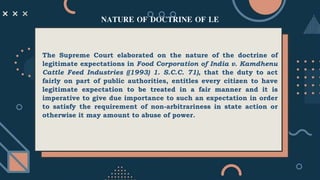
The Supreme Court elaborated on the nature of the doctrine of
legitimate expectations in Food Corporation of India v. Kamdhenu
Cattle Feed Industries ((1993) 1. S.C.C. 71), that the duty to act
fairly on part of public authorities, entitles every citizen to have
legitimate expectation to be treated in a fair manner and it is
imperative to give due importance to such an expectation in order
to satisfy the requirement of non-arbitrariness in state action or
otherwise it may amount to abuse of power.
NATURE OF DOCTRINE OF LE
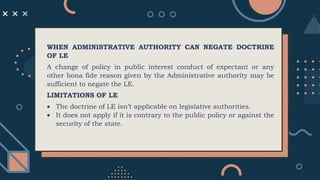
WHEN ADMINISTRATIVE AUTHORITY CAN NEGATE DOCTRINE
OF LE
A change of policy in public interest conduct of expectant or any
other bona fide reason given by the Administrative authority may be
sufficient to negate the LE.
LIMITATIONS OF LE
 The doctrine of LE isn’t applicable on legislative authorities.
 It does not apply if it is contrary to the public policy or against the
security of the state.
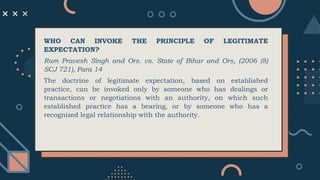
WHO CAN INVOKE THE PRINCIPLE OF LEGITIMATE
EXPECTATION?
Ram Pravesh Singh and Ors. vs. State of Bihar and Ors, (2006 (8)
SCJ 721), Para 14
The doctrine of legitimate expectation, based on established
practice, can be invoked only by someone who has dealings or
transactions or negotiations with an authority, on which such
established practice has a bearing, or by someone who has a
recognized legal relationship with the authority.
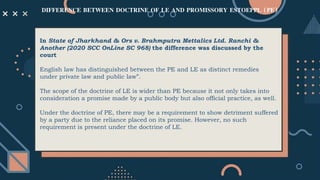
DIFFERENCE BETWEEN DOCTRINE OF LE AND PROMISSORY ESTOEPPL (PE)
In State of Jharkhand & Ors v. Brahmputra Mettalics Ltd. Ranchi &
Another (2020 SCC OnLine SC 968) the difference was discussed by the
court
English law has distinguished between the PE and LE as distinct remedies
under private law and public law”.
The scope of the doctrine of LE is wider than PE because it not only takes into
consideration a promise made by a public body but also official practice, as well.
Under the doctrine of PE, there may be a requirement to show detriment suffered
by a party due to the reliance placed on its promise. However, no such
requirement is present under the doctrine of LE.
The doctrine has undoubtedly gained significance in the Indian
Courts, giving locus standi to a person who may or may not have a
direct legal right. The doctrine of legitimate expectations very well
leads to a procedural right i.e. right to judicial review in India but
the substantive aspect of the doctrine can be said to be in a
budding stage. There has been hesitance amongst academicians as
to whether the doctrine should apply to substantive rights at all. It
has been argued that application of the doctrine to substantive
rights might result in failure of separation of powers and would
qualify as overstepping of Judiciary’s powers.
CONCLUSION
THANKYOU

Legitimate Expectation

  • 1.
    PRESENTED BY- ANUSHKASINGH BBA- LLB (7TH Semester) 2018006764
  • 2.
    INTRODUCTION “Doctrine of LegitimateExpectation (LE) belongs to the domain of public law and is intended to give relief to the people when they are not able to justify their claims on the basis of law in the strict sense of the term through they had suffered a civil consequences because their legitimate expectation had been violated.” As in public law the doctrine of locus standi has been relaxed and LE belongs to public domain so anyone can approach the court.
  • 3.
    ORIGIN The concept gainedstanding after it was introduced by Lord Denning in Schimdt v Secretary of Home Affairs [1968] EWCA Civ 1, Court of Appeal (England and Wales), wherein he recognized, as obiter, the ‘right, interest, or legitimate expectation’ of an individual against an administrative action with regards to the right to be heard.
  • 4.
    MEANING The principle ofthe Legitimate Expectation means that expectations raised by administrative conduct have to be respected and fulfilled at least for the public interest and betterment demands otherwise. And non-fulfillment can have some serious legal consequences. The main role played by the Courts in the entire transaction of this doctrine is to safeguard the individual’s expectations in the face of change of the policy.
  • 5.
    PROCEDURAL AND SUBSTANTIVEMEANING In very famous English case Council of Civil Service Union v. Minister for Civil Service [1985] A.C. 374, H.L. (UK).] , Lord Diplock, has explained the doctrine of legitimate expectation, both in procedural and substantive contexts. “Procedural: The procedural part of it relates to a representation that a hearing or other appropriate procedure will be afforded before any decision is made. Substantive: The substantive part of the theory is that if a representation has been expressly made that a benefit of a substantive nature will be granted or if any person is already in receipt of any benefit, it will be continued and will not be substantially varied to the disadvantage of the recipient.” This was further reiterated in an Indian case of National Buildings Construction vs S. Raghunathan & Ors., S. P. Singh (28/08/1998)
  • 6.
    MEANING OF EXPECTATION InUnion of India (UOI) and Ors. vs. Hindustan Development Corpn. and Ors. (MANU/SC/0219/1994), Para 29 The expectation should be legitimate, that is, reasonable, logical and valid. Any expectation which is based on sporadic or casual or random acts, or which is unreasonable, illogical or invalid cannot be a legitimate expectation. Not being a right, it is not enforceable as such. Therefore, legitimacy of an expectation can only be inferred if it is based on the sanction of law or custom or an established procedure followed in regular and natural system.
  • 7.
    “In India thedoctrine has been under Article 14 of the Constitution. Under this article this state’s constitutional provisions imposes the duty to act fairly on all public authorities and therefore, people can have legitimate expectation that they will be treated fairly by the states. Thus ‘non-arbitrariness and unreasonableness’ have been made the necessary qualifiers for assessing as to whether there was a denial of legitimate expectation or not. ARTICLE 14 AND DOCTRINE OF LE
  • 8.
    It has beendeveloped both in the context of reasonableness and natural justice. It has both positive and negative aspects. If applied negatively, an Administrative authority can be prohibited on violating the LE. If it is applied positively an Administrative authority can be compelled to fulfill the LE of people. POSITIVE AND NEGATIVE INTERPRETATION
  • 9.
    Circumstances which maylead to the formation of legitimate expectations were postulated in Madras City Wine Merchants v. State of Tamil Nadu ((1994) 5 SCC 509) like:-  If there was some explicit promise or representation made by the administrative body  That such a promise was clear and unambiguous  The existence of a consistent practice in the past which the person can reasonably expect to operate in the same way WHEN MAY LEGITIMATE EXPECTATION ARISE
  • 10.
    The Doctrine ofLegitimate Expectation was firstly discussed in the Indian arena in the case of State of Kerala v. K.G. Madhavan Pillai ((1988) 4 SCC 669). Herein a sanction was issued for the respondents to open a new aided school and to upgrade the existing schools, however, an Order was issued 15 days later to keep the previous sanction in abeyance. This Order was challenged by the respondents in lieu of violation of principles of natural justice. The Supreme Court ruled that the sanction had entitled the respondents with legitimate expectation and the second order violated principles of natural justice. LE means reasonable expectation and not legal exception. Forign S Pundit v/s Secretary of State of Home affairs Wherein the government had cut short the period already allowed to a foreigner to enter and stay in England. The court held that the person had LE expected to stay in England which cannot be violated without fair and reasonable procedure. EXAMPLE
  • 11.
    The Supreme Courtelaborated on the nature of the doctrine of legitimate expectations in Food Corporation of India v. Kamdhenu Cattle Feed Industries ((1993) 1. S.C.C. 71), that the duty to act fairly on part of public authorities, entitles every citizen to have legitimate expectation to be treated in a fair manner and it is imperative to give due importance to such an expectation in order to satisfy the requirement of non-arbitrariness in state action or otherwise it may amount to abuse of power. NATURE OF DOCTRINE OF LE
  • 12.
    WHEN ADMINISTRATIVE AUTHORITYCAN NEGATE DOCTRINE OF LE A change of policy in public interest conduct of expectant or any other bona fide reason given by the Administrative authority may be sufficient to negate the LE. LIMITATIONS OF LE  The doctrine of LE isn’t applicable on legislative authorities.  It does not apply if it is contrary to the public policy or against the security of the state.
  • 13.
    WHO CAN INVOKETHE PRINCIPLE OF LEGITIMATE EXPECTATION? Ram Pravesh Singh and Ors. vs. State of Bihar and Ors, (2006 (8) SCJ 721), Para 14 The doctrine of legitimate expectation, based on established practice, can be invoked only by someone who has dealings or transactions or negotiations with an authority, on which such established practice has a bearing, or by someone who has a recognized legal relationship with the authority.
  • 14.
    DIFFERENCE BETWEEN DOCTRINEOF LE AND PROMISSORY ESTOEPPL (PE) In State of Jharkhand & Ors v. Brahmputra Mettalics Ltd. Ranchi & Another (2020 SCC OnLine SC 968) the difference was discussed by the court English law has distinguished between the PE and LE as distinct remedies under private law and public law”. The scope of the doctrine of LE is wider than PE because it not only takes into consideration a promise made by a public body but also official practice, as well. Under the doctrine of PE, there may be a requirement to show detriment suffered by a party due to the reliance placed on its promise. However, no such requirement is present under the doctrine of LE.
  • 15.
    The doctrine hasundoubtedly gained significance in the Indian Courts, giving locus standi to a person who may or may not have a direct legal right. The doctrine of legitimate expectations very well leads to a procedural right i.e. right to judicial review in India but the substantive aspect of the doctrine can be said to be in a budding stage. There has been hesitance amongst academicians as to whether the doctrine should apply to substantive rights at all. It has been argued that application of the doctrine to substantive rights might result in failure of separation of powers and would qualify as overstepping of Judiciary’s powers. CONCLUSION
  • 16.