1784: William Jonesset up the Royal Asiatic society, in Calcutta for:
- academic enquiry into history
-Study cultivate and preserve the antiquities, arts, science and literature of
asia.
1810: Bengal code (act XIX): Government was vested with powers and save
monuments from misuse
Under this legislation managing boards were formed for maintenance and
conservation of selected monuments .Cost of maintenance to be met out of
land holdings
2.
LEGISLATION IN CONSERVATION.
INTERNATIONAL:IDENTIFIED CONCEPTS OF
CONSERVATION, LISTING, FUNDING, DEMONSTRATION
PROJECTS WITH MATCHING FUNDING
NATIONAL:
CENTRAL :CONSTITUTION OF INDIA, HERITAGE BYE LAWS
TO BE ADOPTED, A.S.I
STATE:DIRECTORATE OF ARCHAEOLOGY
LOCAL : MUNICIPAL, NGO,(DEMONSTRATION PROJECTS)
3.
A.S.I: ARCHAEOLOGICAL SURVEYOF INDIA:
The Archaeological Survey of India (ASI) is the
• premier organization for the archaeological research, scientific analysis,
excavation of archaeological sites, conservation
•preservation of protected monuments and areas of national importance,
•maintenance of site museums and overall regulation of legislations related to
antiquities and art treasures.
• it functions as an attached office under the department of culture. under the
ancient monuments and archaeological sites and remains act of 1958,
Set up in 1861- in order to prevent smuggling and fraudulent dealings in
antiquities
4.
ACTIVITIES
•Conducting archaeological explorationsand excavations;
•Architectural survey of monuments;
•Maintenance, conservation and preservation of protected monuments
and archaeological sites and remains of national importance;
•Chemical preservation of monuments and antiquarian remains;
•Archaeological expeditions outside India ;
•Horticulture operation in and around ancient monuments and sites.
•Epigraphical and numismatic studies;
•Setting up and re-organization of Site Museums;
•Training in Archaeology;
•Bringing out archaeological publications;
•Implementation and regulation of - The Ancient Monuments and
Archaeological Sites and Remains Act, 1958;
•The Antiquities and Art Treasures Act, 1972, etc.
5.
First DG: AlexanderCunningham- Systematic Survey
1902:DG- John Marshall-conservation manual
Indian legislation comparable to British- Historic monuments Protection Act
1882-passed by British parliament
•THE ARCHAEOLOGICAL SURVEY OF INDIA HAS DECLARED 3606
MONUMENTS UP TO DEC 2000 TO BE OF NATIONAL IMPORTANCE IN
THE COUNTRY
EDUCATION:/INTAKE
ADMISTRATIVE SET UP: CENTER
-Director General A.S.I
-the entire country is divided into 24 Circles.
-Each Circle is headed by a Superintending Archaeologist (S.A.), who is
further assisted by Deputy Superintending Archaeologist (Dy.S.A.),
STATE: Dept of culture- Directorate of archaeology
6.
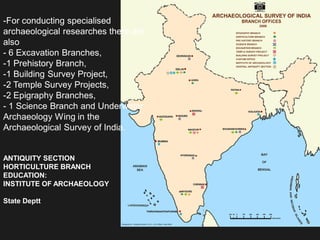
ANTIQUITY SECTION
HORTICULTURE BRANCH
EDUCATION:
INSTITUTEOF ARCHAEOLOGY
State Deptt
-For conducting specialised
archaeological researches there are
also
- 6 Excavation Branches,
-1 Prehistory Branch,
-1 Building Survey Project,
-2 Temple Survey Projects,
-2 Epigraphy Branches,
- 1 Science Branch and Underwater
Archaeology Wing in the
Archaeological Survey of India.
7.
The Circles carryout archaeological fieldwork, research activities and
implement the various provisions of the AMASR Act, 1958 and
Antiquities and Art Treasures Act 1972. This may include the following:
•Carrying out village-to-village survey of antiquarian remains; exploration
of archaeological sites, documentation of loose sculptures;
•Excavation of archaeological sites;
•Conservation and day-to-day maintenance of protected monuments;
•Providing basic amenities at the monuments for tourists;
•Issuing of NOC for any sort of construction, additions and alterations to
existing structures or new constructions coming under 100 m to 300 m
(regulated area) from the protected monuments;
•Issuing permission for filming, photography and cultural programmes at
the protected monuments;
•Organising public awareness programmes on various occasions like
Word Heritage Day (April 18), World Heritage Week (November 17-25),
Museum Day (May 18) and other important occasions;
•Registration of antiquities and issuing non-antiquity certificates;
•Interaction with various universities and research institutions.
8.
JOHN MARSHALL(1901 TO1947 )
His principles on archaeological conservation are still valid and
followed even by modern conservation experts. The main observations
of Marshall were:
-Hypothetical restorations were unwarranted, unless they were
essential to the stability of a building;
-Every original member of a building should be preserved in tact, and
demolition and reconstruction should be undertaken only if the
structure could not be otherwise maintained;
-Restoration of carved stone, carved wood or plaster-moulding should
be undertaken only if artisans were able to attain the excellence of the
old; and
-In no case should mythological or other scenes be re-carved
- Religious buildings will not be listed as far as possible.
9.
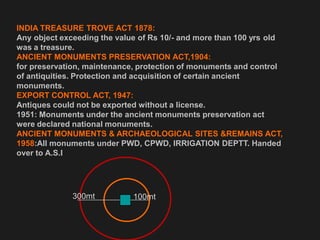
INDIA TREASURE TROVEACT 1878:
Any object exceeding the value of Rs 10/- and more than 100 yrs old
was a treasure.
ANCIENT MONUMENTS PRESERVATION ACT,1904:
for preservation, maintenance, protection of monuments and control
of antiquities. Protection and acquisition of certain ancient
monuments.
EXPORT CONTROL ACT, 1947:
Antiques could not be exported without a license.
1951: Monuments under the ancient monuments preservation act
were declared national monuments.
ANCIENT MONUMENTS & ARCHAEOLOGICAL SITES &REMAINS ACT,
1958:All monuments under PWD, CPWD, IRRIGATION DEPTT. Handed
over to A.S.I
100mt
300mt
10.
CONSTITUTION OF INDIA:…
UNDERTHE MUNICIPAL ACT: HERITAGE REGULATIONS CAN BE FRAMED:
DESIGNATED AS SPECIAL AREA. CENTRAL GOVT. HAS FRAMED MODEL
HERITAGE REGULATIONS WHICH ARE TO BE ADOPTED BY DIFFERENT
STATES.
BOMBAY THE FIRST CITY TO FRAME THEM:
REGULATION: These regulations may be called as `Regulation
towards conservation of heritage in urban areas,……
APPLICABILITY: This regulation shall apply to all ….
This regulation shall apply to those buildings artifacts, structures
and/or precincts, of historical and/or architectural and/or cultural
land/or environmental significance (and natural areas of scenic
beauty but not limited to sacred groves, hills, hillocks, waterbodies,
open areas (natural features) and significant urban elements of the
historic fabric which.
For the purpose of this regulations ‘precinct’ will hereafter refer ..listed
heritage buildings, artifacts, structures of historic and / or Aesthetic
and / or architectural and / or cultural and / or environmental
significance being bound on all sides by paths and / or roads and or
water bodies and / or railway lines and / or buildings for which
special regulations may hence forth be devised.
COMMENCEMENT :
11.
PUBLICATION OF THEDRAFT CONSERVATION PLAN
The Heritage Conservation Committee shall, …publish it in the
official Gazette …inviting suggestions or objections from any
person with respect to the conservation plan within a period of
two months from the date of its publication.
MODIFICATION MADE AFTER PUBLICATION OF DRAFT
CONSERVATION PLAN
With the approval of Government ….power to alter. Modify, or
relax the provision of other regulations,
The said list of buildings, artifacts, structures, and precincts
may be supplemented /altered/added/ or modified from
time to time …
HEARING OF PERSONS LIKELY TO BE AFFECTED
Provided that in case any alterations, modifications or …/
precincts,… the Commissioner shall give an opportunity of
hearing to the said owner/lessee and the public.
the affected person must within one month from the date of
publication of the draft conservation plan communicate his
objections to the Heritage Conservation Committee.
12.
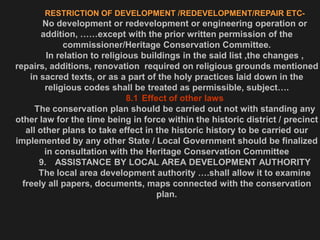
RESTRICTION OF DEVELOPMENT/REDEVELOPMENT/REPAIR ETC-
No development or redevelopment or engineering operation or
addition, ……except with the prior written permission of the
commissioner/Heritage Conservation Committee.
In relation to religious buildings in the said list ,the changes ,
repairs, additions, renovation required on religious grounds mentioned
in sacred texts, or as a part of the holy practices laid down in the
religious codes shall be treated as permissible, subject….
8.1 Effect of other laws
The conservation plan should be carried out not with standing any
other law for the time being in force within the historic district / precinct
all other plans to take effect in the historic history to be carried our
implemented by any other State / Local Government should be finalized
in consultation with the Heritage Conservation Committee
9. ASSISTANCE BY LOCAL AREA DEVELOPMENT AUTHORITY
The local area development authority ….shall allow it to examine
freely all papers, documents, maps connected with the conservation
plan.
13.
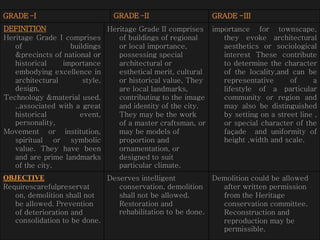
GRADE –I GRADE–II GRADE -III
DEFINITION
Heritage Grade I comprises
of buildings
&precincts of national or
historical importance
embodying excellence in
architectural style,
design,
Technology &material used.
..associated with a great
historical event,
personality,
Movement or institution,
spiritual or symbolic
value. They have been
and are prime landmarks
of the city.
Heritage Grade II comprises
of buildings of regional
or local importance,
possessing special
architectural or
esthetical merit, cultural
or historical value, They
are local landmarks,
contributing to the image
and identity of the city.
They may be the work
of a master craftsman, or
may be models of
proportion and
ornamentation, or
designed to suit
particular climate.
importance for townscape,
they evoke architectural
aesthetics or sociological
interest These contribute
to determine the character
of the locality,and can be
representative of a
lifestyle of a particular
community or region and
may also be distinguished
by setting on a street line ,
or special character of the
façade and uniformity of
height ,width and scale.
OBJECTIVE
Requirescarefulpreservat
on, demolition shall not
be allowed. Prevention
of deterioration and
consolidation to be done.
Deserves intelligent
conservation, demolition
shall not be allowed.
Restoration and
rehabilitation to be done.
Demolition could be allowed
after written permission
from the Heritage
conservation committee.
Reconstruction and
reproduction may be
permissible.
14.
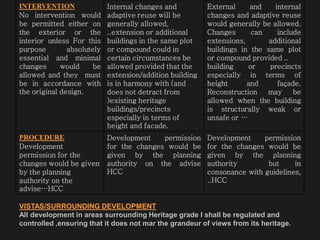
INTERVENTION
No intervention would
bepermitted either on
the exterior or the
interior unless For this
purpose absolutely
essential and minimal
changes would be
allowed and they must
be in accordance with
the original design.
Internal changes and
adaptive reuse will be
generally allowed,
..extension or additional
buildings in the same plot
or compound could in
certain circumstances be
allowed provided that the
extension/addition building
is in harmony with (and
does not detract from
)existing heritage
buildings/precincts
especially in terms of
height and facade.
External and internal
changes and adaptive reuse
would generally be allowed.
Changes can include
extensions, additional
buildings in the same plot
or compound provided ..
building or precincts
especially in terms of
height and façade.
Reconstruction may be
allowed when the building
is structurally weak or
unsafe or …
PROCEDURE
Development
permission for the
changes would be given
by the planning
authority on the
advise…HCC
Development permission
for the changes would be
given by the planning
authority on the advise
HCC
Development permission
for the changes would be
given by the planning
authority but in
consonance with guidelines,
..HCC
VISTAS/SURROUNDING DEVELOPMENT
All development in areas surrounding Heritage grade I shall be regulated and
controlled ,ensuring that it does not mar the grandeur of views from its heritage.
15.
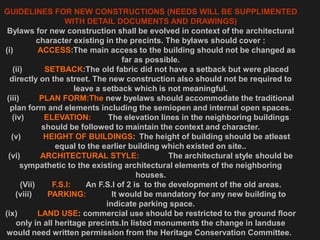
GUIDELINES FOR NEWCONSTRUCTIONS (NEEDS WILL BE SUPPLIMENTED
WITH DETAIL DOCUMENTS AND DRAWINGS)
Bylaws for new construction shall be evolved in context of the architectural
character existing in the precints. The bylaws should cover :
(i) ACCESS:The main access to the building should not be changed as
far as possible.
(ii) SETBACK:The old fabric did not have a setback but were placed
directly on the street. The new construction also should not be required to
leave a setback which is not meaningful.
(iii) PLAN FORM:The new byelaws should accommodate the traditional
plan form and elements including the semiopen and internal open spaces.
(iv) ELEVATION: The elevation lines in the neighboring buildings
should be followed to maintain the context and character.
(v) HEIGHT OF BUILDINGS: The height of building should be atleast
equal to the earlier building which existed on site..
(vi) ARCHITECTURAL STYLE: The architectural style should be
sympathetic to the existing architectural elements of the neighboring
houses.
(Vii) F.S.I: An F.S.I of 2 is to the development of the old areas.
(viii) PARKING: It would be mandatory for any new building to
indicate parking space.
(ix) LAND USE: commercial use should be restricted to the ground floor
only in all heritage precints.In listed monuments the change in landuse
would need written permission from the Heritage Conservation Committee.
16.
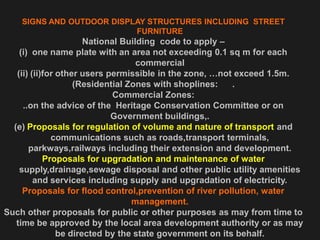
SIGNS AND OUTDOORDISPLAY STRUCTURES INCLUDING STREET
FURNITURE
National Building code to apply –
(i) one name plate with an area not exceeding 0.1 sq m for each
commercial
(ii) (ii)for other users permissible in the zone, …not exceed 1.5m.
(Residential Zones with shoplines: .
Commercial Zones:
..on the advice of the Heritage Conservation Committee or on
Government buildings,.
(e) Proposals for regulation of volume and nature of transport and
communications such as roads,transport terminals,
parkways,railways including their extension and development.
Proposals for upgradation and maintenance of water
supply,drainage,sewage disposal and other public utility amenities
and services including supply and upgradation of electricity.
Proposals for flood control,prevention of river pollution, water
management.
Such other proposals for public or other purposes as may from time to
time be approved by the local area development authority or as may
be directed by the state government on its behalf.
17.
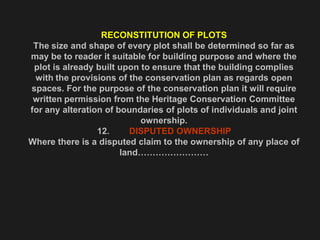
RECONSTITUTION OF PLOTS
Thesize and shape of every plot shall be determined so far as
may be to reader it suitable for building purpose and where the
plot is already built upon to ensure that the building complies
with the provisions of the conservation plan as regards open
spaces. For the purpose of the conservation plan it will require
written permission from the Heritage Conservation Committee
for any alteration of boundaries of plots of individuals and joint
ownership.
12. DISPUTED OWNERSHIP
Where there is a disputed claim to the ownership of any place of
land……………………
18.
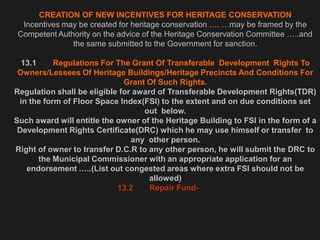
CREATION OF NEWINCENTIVES FOR HERITAGE CONSERVATION
Incentives may be created for heritage conservation …. …may be framed by the
Competent Authority on the advice of the Heritage Conservation Committee …..and
the same submitted to the Government for sanction.
13.1 Regulations For The Grant Of Transferable Development Rights To
Owners/Lessees Of Heritage Buildings/Heritage Precincts And Conditions For
Grant Of Such Rights.
Regulation shall be eligible for award of Transferable Development Rights(TDR)
in the form of Floor Space Index(FSI) to the extent and on due conditions set
out below.
Such award will entitle the owner of the Heritage Building to FSI in the form of a
Development Rights Certificate(DRC) which he may use himself or transfer to
any other person.
Right of owner to transfer D.C.R to any other person, he will submit the DRC to
the Municipal Commissioner with an appropriate application for an
endorsement …..(List out congested areas where extra FSI should not be
allowed)
13.2 Repair Fund-
19.
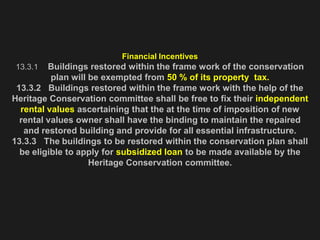
Financial Incentives
13.3.1 Buildingsrestored within the frame work of the conservation
plan will be exempted from 50 % of its property tax.
13.3.2 Buildings restored within the frame work with the help of the
Heritage Conservation committee shall be free to fix their independent
rental values ascertaining that the at the time of imposition of new
rental values owner shall have the binding to maintain the repaired
and restored building and provide for all essential infrastructure.
13.3.3 The buildings to be restored within the conservation plan shall
be eligible to apply for subsidized loan to be made available by the
Heritage Conservation committee.
20.
• IN INDIA:
•MOST PROMINENT OF THEM OTHER
THAN THE ASI ARE, INTACH, INDIAN
HERITAGE /SOCIETY, BOMBAY
ENVIRONMENTAL ACTION GROUP,
CRUTA FOUNDATION ETC.
21.
INDIAN NATIONAL TRUSTFOR ART AND CULTURAL
HERITAGE
• INTACH, AN NGO,SET UP IN 1984 HAS 144 CHAPTERS
ACROSS THE COUNTRY
• HAS BEEN PROMOTING CONSERVATION AND TODAY HAVE 30
HERITAGE CONSERVATION PLANS PREPARED ALL OVER THE
COUNTRY,
• PREPARED AN INVENTORY OF 30,000 BUILDINGS
• IT DOCUMENTS THE HERITAGE BUILDING AND ZONES AND WORKS IN
ACCORDANCE TO THE STATE GOVERNMENTS.
• EXAMPLES HAVE BEEN THE RELIGIOUS CITY OF BHUBNESHWAR, IN
MEHRAULI (DELHI), CENTRAL AREA OF LUCKNOW, THE TOTAL
SETTLEMENT OF LEH IN LADDAK, THE COCHIN FORT AREA, WARDS IN
MUMBAI FORT AREA, THE CHAR MINAR AREA OF HYDERABAD, AND
THE PLANNED TOWN OF PONDICERRY.
• PLANS ARE ALSO BEING PREPARED FOR THE CONSERVATION OF
MAHABALIPURAM, AMBER(RAJ), JODHPUR, JAISALMER, VARNASI,
VRINDAWAN AND MATHURA.
22.
LOCAL NGO,S
THE FOUNDATIONFOR CONSEVATION AND RESEARCH OF
URBANTRADITIONAL ARCHITECTURE (CRUTA FOUNDATION)
STARTED IN CALCUTTA, ORGANIZED LOCAL
WALKS, TOURS AND SLIDE SHOWS IN NORTH
CALCUTTA.
CRUTA REALIZED THAT THE LOCAL RESIDENTS
NEEDED TO BE EXHORTED TO TAKE PRIDE IN THEIR
NEIGHBORHOOD AND REVIVE THE PARA CULTURE,
THE COLLABORATION OF AHMEDABAD MUNICIPAL
CORPORATION AND THE CRUTA EMERGED AS A
MILESTONE IN THE HISTORY OF URBAN
CONSERVATION EFFORTS IN THE CONTEXT OF
INDIAN CITIES. THE AMC BECAME THE FIRST
MUNICIPAL CORPORATION TO HAVE A HERITAGE
CELL
.
23.
WORLD-WIDE ORGANISATIONS
UNESCO -THE UNITED NATIONS EDUCATIONAL, SCIENTIFIC AND
CULTURAL ORGANIZATION - WAS ESTABLISHED IN 1945 ,BASED IN
PARIS.
IT IS MOST OBVIOUSLY ASSOCIATED WITH THE 1972 CONVENTION
FOR THE PROTECTION OF THE WORLD CULTURAL AND NATURAL
HERITAGE, UNDER WHICH 'WORLD HERITAGE SITES' OF 'UNIVERSAL
CULTURAL VALUE' ARE DESIGNATED.
UNESCO IS ALSO RESPONSIBLE FOR THE (HAGUE) CONVENTION
FOR THE PROTECTION OF CULTURAL PROPERTY IN THE EVENT OF
ARMED CONFLICT (1954), AND FOR CONVENTIONS CONCERNING THE
ILLEGAL MOVEMENT OF CULTURAL PROPERTY
IT IS CURRENTLY ATTEMPTING TO DEVELOP A CONVENTION ON THE
PROTECTION OF UNDERWATER HERITAGE.
24.
ICCROM - THEINTERNATIONAL CENTRE FOR THE
STUDY OF THE PRESERVATION AND RESTORATION OF
CULTURAL PROPERTY - IS AN INTERGOVERNMENTAL
BODY SET UP IN 1956 AND LOCATED IN ROME.
IT PROVIDES EXPERT TECHNICAL ADVICE ON HOW
TO CONSERVE SITES ON THE WORLD HERITAGE LIST.
LEAD INTERNATIONAL ORGANISATION CONCERNED
WITH TRAINING OF RESTORATION AND
CONSERVATION SPECIALISTS
IT HAS ALSO SET UP AN INTERNATIONAL DATABASE
OF CONSERVATION TRAINING COURSES, ACCESSIBLE
VIA ITS WEBSITE .
25.
-THE INTERNATIONAL COUNCILON MONUMENTS AND SITES - IS A
NON-GOVERNMENTAL ORGANIZATION BASED IN PARIS.
- FOUNDED IN 1965 TO PROMOTE THE DOCTRINE AND THE
TECHNIQUES OF CONSERVATION, FOLLOWING THE ADOPTION OF
THE CHARTER FOR THE CONSERVATION AND RESTORATION OF
MONUMENTS AND SITES - THE 'VENICE CHARTER'.
TODAY IT HAS NATIONAL COMMITTEES IN OVER 90 COUNTRIES,
THE ORGANIZATION IS UNESCO'S PRINCIPAL ADVISOR ON
HERITAGE CONSERVATION, INCLUDING THE EVALUATION OF
CULTURAL PROPERTIES PROPOSED FOR INSCRIPTION ON THE
WORLD HERITAGE LIST.
ICOMOS SEEKS TO ESTABLISH INTERNATIONAL STANDARDS FOR
THE PRESERVATION, RESTORATION, AND MANAGEMENT OF THE
CULTURAL ENVIRONMENT.
ICOMOS
26.
EUROPEAN ORGANISATIONS
THE COUNCILOF EUROPE, BASED IN STRASBOURG, IS AN INTER-
GOVERNMENTAL ORGANIZATION, FOUNDED IN 1949 ITS MAIN ROLES
ARE TO STRENGTHEN DEMOCRACY, HUMAN RIGHTS AND THE RULE OF
LAW THROUGHOUT ITS MEMBER STATES, AND ENHANCE EUROPE'S
COMMON CULTURAL HERITAGE IN ALL ITS DIVERSITY.
THE EUROPEAN UNION (EU), BASED IN BRUSSELS, MEMBERSHIP NOW
STANDS AT 15 COUNTRIES. FORMAL EU 'COMPETENCE' IN CULTURAL
MATTERS CAME ONLY WITH THE MAASTRICHT TREATY OF 1993 WHICH
INTRODUCED AS A NEW OBJECTIVE OF EU ACTION '[TO MAKE] A
CONTRIBUTION TO…THE FLOWERING OF THE CULTURES OF THE
MEMBER STATES'.
IT MAY OFFER 'AID TO PROMOTE CULTURE AND HERITAGE
CONSERVATION', AND SHOULD SEEK TO '[BRING] THE COMMON
CULTURAL HERITAGE TO THE FORE'. DESPITE AN APPARENT EMPHASIS
IN INITIAL INFORMATION ON CONTEMPORARY CREATIVE ARTS, THE
PROGRAMMED CERTAINLY INCLUDES THE CULTURAL HERITAGE
.
.
EUROPA NOSTRA, BASED IN THE HAGUE, WAS FOUNDED IN 1963. IT IS AN
UMBRELLA ORGANIZATION CONSISTING OF MORE THAN 200 NGOS INVOLVED
IN THE HERITAGE FIELD,
27.
ORGANISATIONS
AGA KHAN CULTURALTRUST:
ESTABLISHED IN 1988
FOCUS: IMPROVEMENT OF BUILT ENVIORNMENTS IN
COUNTRIES WITH PREDOMINANT MUSLIM
POPULATIONPROJECTS: AWARDS FOR ARCHITECTURE,
EDUCATION PROGRAM,
WORLD MONUMENT FUND
GETTY FOUNDATION
FORD FOUNDATION

![EUROPEAN ORGANISATIONS
THE COUNCIL OF EUROPE, BASED IN STRASBOURG, IS AN INTER-
GOVERNMENTAL ORGANIZATION, FOUNDED IN 1949 ITS MAIN ROLES
ARE TO STRENGTHEN DEMOCRACY, HUMAN RIGHTS AND THE RULE OF
LAW THROUGHOUT ITS MEMBER STATES, AND ENHANCE EUROPE'S
COMMON CULTURAL HERITAGE IN ALL ITS DIVERSITY.
THE EUROPEAN UNION (EU), BASED IN BRUSSELS, MEMBERSHIP NOW
STANDS AT 15 COUNTRIES. FORMAL EU 'COMPETENCE' IN CULTURAL
MATTERS CAME ONLY WITH THE MAASTRICHT TREATY OF 1993 WHICH
INTRODUCED AS A NEW OBJECTIVE OF EU ACTION '[TO MAKE] A
CONTRIBUTION TO…THE FLOWERING OF THE CULTURES OF THE
MEMBER STATES'.
IT MAY OFFER 'AID TO PROMOTE CULTURE AND HERITAGE
CONSERVATION', AND SHOULD SEEK TO '[BRING] THE COMMON
CULTURAL HERITAGE TO THE FORE'. DESPITE AN APPARENT EMPHASIS
IN INITIAL INFORMATION ON CONTEMPORARY CREATIVE ARTS, THE
PROGRAMMED CERTAINLY INCLUDES THE CULTURAL HERITAGE
.
.
EUROPA NOSTRA, BASED IN THE HAGUE, WAS FOUNDED IN 1963. IT IS AN
UMBRELLA ORGANIZATION CONSISTING OF MORE THAN 200 NGOS INVOLVED
IN THE HERITAGE FIELD,](https://image.slidesharecdn.com/legislation-260204051258-c2a99bdd/85/legislation-pdfvvcccccccccccccvvvvvvvvvvvvvv-26-320.jpg)