Visit https://ebookultra.com to download the full version and
explore more ebooks
Financing Development Aid and Beyond Oecd
_____ Click the link below to download _____
https://ebookultra.com/download/financing-development-
aid-and-beyond-oecd/
Explore and download more ebooks at ebookultra.com
Here are some suggested products you might be interested in.
Click the link to download
Development Aid at a Glance 2008 Statistics by Region Oecd
Organisation For Economic Co-Operation And Development
https://ebookultra.com/download/development-aid-at-a-
glance-2008-statistics-by-region-oecd-organisation-for-economic-co-
operation-and-development/
Aid for Trade and Development 1st Edition Dominique
Njinkeu
https://ebookultra.com/download/aid-for-trade-and-development-1st-
edition-dominique-njinkeu/
Geographical Distribution of Financial Flows to Aid
Recipients 1998 2002 2004 Edition Oecd
https://ebookultra.com/download/geographical-distribution-of-
financial-flows-to-aid-recipients-1998-2002-2004-edition-oecd/
World Bank Financing of Education Lending Learning and
Development 2nd edition Jones
https://ebookultra.com/download/world-bank-financing-of-education-
lending-learning-and-development-2nd-edition-jones/
OECD Economic Surveys Italy 2007 Edition 2007 Oecd
Organisation For Economic Co-Operation And Development
https://ebookultra.com/download/oecd-economic-surveys-
italy-2007-edition-2007-oecd-organisation-for-economic-co-operation-
and-development/
OECD Tourism Trends and Policies 2016 Edition 2016 Volume
2016 Oecd Organisation For Economic Co-Operation And
Development
https://ebookultra.com/download/oecd-tourism-trends-and-
policies-2016-edition-2016-volume-2016-oecd-organisation-for-economic-
co-operation-and-development/
OECD Reviews of Innovation Policy Luxembourg 2016 Edition
2016 Oecd Organisation For Economic Co-Operation And
Development
https://ebookultra.com/download/oecd-reviews-of-innovation-policy-
luxembourg-2016-edition-2016-oecd-organisation-for-economic-co-
operation-and-development/
Oecd Economic Surveys Portugal 2017 Edition 2017 Volume
2017 Oecd Organisation For Economic Co-Operation And
Development
https://ebookultra.com/download/oecd-economic-surveys-
portugal-2017-edition-2017-volume-2017-oecd-organisation-for-economic-
co-operation-and-development/
OECD Environmental Performance Reviews Estonia 2017
Edition 2017 Volume 2017 Oecd Organisation For Economic
Co-Operation And Development
https://ebookultra.com/download/oecd-environmental-performance-
reviews-estonia-2017-edition-2017-volume-2017-oecd-organisation-for-
economic-co-operation-and-development/
Financing Development Aid and Beyond Oecd Digital
Instant Download
Author(s): OECD
ISBN(s): 9789264027589, 9264027580
Edition: illustrated edition
File Details: PDF, 10.38 MB
Year: 2007
Language: english
www.oecd.org/publishing
Development Centre Perspectives
Financing
Development
AID AND BEYOND
Development Centre Perspectives
Financing Development
AID AND BEYOND
Aid alone cannot finance development; new actors and fresh sources of finance are essential
complements to it. The emergence of a multiplicity of new financing options is good news for
developing countries, but it also raises challenges. The authors in this book assess aspects of the
changes in the “international development finance architecture”, from a global and a developing-
country perspective. The result is a vast range of policy implications for donor and recipient alike.
While policy makers in developing countries need to make the most of new funding opportunities,
donors need to reposition themselves in the system.
This highly stimulating book takes a deep look at this systemic evolution. It presents a fascinating –
and highly digestible – picture of what is at stake in financing development. It also provides
recommendations on the introduction of innovative policy mechanisms, on the use of both grants
and loans in development finance, and on the challenges of managing diverse financial flows at
country-level.
This volume is the first in the Development Centre Perspectives series.
To come in the series (provisional titles):
Business for Development
Policy Coherence and Human Security
The African Economic Outlook
The Latin American Economic Outlook
The Black Sea and Central Asian Economic Outlook
Financing
Development
AID
AND
BEYOND
ISBN 978-92-64-02758-9
41 2007 02 01 P -:HSTCQE=UWZ]^:
The full text of this book is available on line via these links:
www.sourceoecd.org/finance/9789264027589
www.sourceoecd.org/emergingeconomies/9789264027589
Those with access to all OECD books on line should use this link:
www.sourceoecd.org/9789264027589
SourceOECD is the OECD’s online library of books, periodicals and statistical databases.
For more information about this award-winning service and free trials ask your librarian, or write to us
at SourceOECD@oecd.org.
Development
Centre
Perspectives
DEVELOPMENT CENTRE OF THE ORGANISATION
FOR ECONOMIC CO-OPERATION AND DEVELOPMENT
Development Centre Perspectives
Financing Development
Aid and Beyond
ORGANISATION FOR ECONOMIC CO-OPERATION
AND DEVELOPMENT
The OECD is a unique forum where the governments of 30 democracies work together to
address the economic, social and environmental challenges of globalisation. The OECD is also at
the forefront of efforts to understand and to help governments respond to new developments and
concerns, such as corporate governance, the information economy and the challenges of an
ageing population. The Organisation provides a setting where governments can compare policy
experiences, seek answers to common problems, identify good practice and work to co-ordinate
domestic and international policies.
The OECD member countries are: Australia, Austria, Belgium, Canada, the Czech Republic,
Denmark, Finland, France, Germany, Greece, Hungary, Iceland, Ireland, Italy, Japan, Korea,
Luxembourg, Mexico, the Netherlands, New Zealand, Norway, Poland, Portugal, the Slovak Republic,
Spain, Sweden, Switzerland, Turkey, the United Kingdom and the United States. The Commission of
the European Communities takes part in the work of the OECD.
OECD Publishing disseminates widely the results of the Organisation’s statistics gathering and
research on economic, social and environmental issues, as well as the conventions, guidelines and
standards agreed by its members.
Also available in French under the title:
Financer le développement
© OECD 2007
No reproduction, copy, transmission or translation of this publication may be made without written permission. Applications should be sent to
OECD Publishing rights@oecd.org or by fax 33 1 45 24 99 30. Permission to photocopy a portion of this work should be addressed to the Centre français
d’exploitation du droit de copie (CFC), 20, rue des Grands-Augustins, 75006 Paris, France, fax 33 1 46 34 67 19, contact@cfcopies.com or (for US only) to
Copyright Clearance Center (CCC), 222 Rosewood Drive Danvers, MA 01923, USA, fax 1 978 646 8600, info@copyright.com.
The opinions expressed and arguments employed herein do not necessarily reflect
the official views of the Organisation or of the governments of its member countries.
3
Financing Development 2007
ISBN: 9789264027589 © OECD 2007
THE DEVELOPMENT CENTRE
The Development Centre of the Organisation for Economic Co-operation and
Development was established by decision of the OECD Council on 23 October 1962 and
comprises22membercountriesoftheOECD:Austria,Belgium,theCzechRepublic,Finland,
France,Germany,Greece,Iceland,Ireland,Italy,Korea,Luxembourg,Mexico,theNetherlands,
Norway, Portugal, Slovak Republic, Spain, Sweden, Switzerland, Turkey and the United
KingdomaswellasBrazilsinceMarch1994,ChilesinceNovember1998,IndiasinceFebruary
2001, Romania since October 2004, Thailand since March 2005 and South Africa since
May 2006. The Commission of the European Communities also takes part in the Centre’s
Governing Board.
The Development Centre, whose membership is open to both OECD and non-OECD
countries, occupies a unique place within the OECD and in the international community.
MembersfinancetheCentreandserveonitsGoverningBoard,whichsetsthebiennialwork
programme and oversees its implementation.
TheCentrelinksOECDmemberswithdevelopingandemergingeconomiesandfosters
debate and discussion to seek creative policy solutions to emerging global issues and
developmentchallenges.ParticipantsinCentreeventsareinvitedintheirpersonalcapacity.
A small core of staff works with experts and institutions from the OECD and partner
countriestofulfilthe Centre’sworkprogramme.Theresultsarediscussedininformalexpert
and policy dialogue meetings, and are published in a range of high-quality productsforthe
research and policy communities. The Centre’s Study Series presents in-depth analyses of
major development issues. Policy Briefs and Policy Insights summarise major conclusions
for policy makers; WorkingPapersdealwiththemoretechnicalaspectsoftheCentre’swork.
For an overview of the Centre’s activities, please see www.oecd.org/dev
THE OPINIONS EXPRESSED AND ARGUMENTSEMPLOYED INDEVELOPMENT CENTRE PUBLICATION ARE THE SOLE
RESPONSIBILITYOF THE AUTHORS ANDDO NOTNECESSARILYREFLECT THOSEOF THE OECD, ITSDEVELOPMENT
CENTRE OR OF THE GOVERNMENTS OF THEIR MEMBER COUNTRIES.
2
4
OECD Development Centre Perspectives
ISBN: 9789264027589 © OECD 2007
5
Financing Development 2007
ISBN: 9789264027589 © OECD 2007
Foreword
The Development Centre has organised its 2007/2008 work programme around
strategically selected output areas culminating in the production of regular annual or
biannualflagshippublicationsandregionalOutlooks. These serve as the hubs for associated
policy dialogue events organised by the Centre and as instruments for engaging key
stakeholders in the Centre’s activities. Each thematic output area and its corresponding
“flagship” is supported by an Informal Policy Network composed of interested principal
stakeholders in member-country capitals and delegations, and an Expert Network of
specialists fromtheOECDcommunity, other international organisations, the privatesector,
leadinginternationaluniversitiesandthinktanks.AnInformal AdvisoryGroupfor each output
area including the regional Outlooks has been formed from these networks.
This volume on FinancingDevelopmentis one of the Centre’s thematic flagships. Business
for Development is the topic of another title in the series, while Policy Coherence for
Development and Human Security is the focus of the third. The series is completed by the
African Economic Outlook, Latin American Economic Outlook and Black Sea and Central
Asian Economic Outlook.
6
OECD Development Centre Perspectives
ISBN: 9789264027589 © OECD 2007
Acknowledgements
This first volume of Financing Development has been authored by an OECD
Development Centre team comprising Daniel Cohen, Denis Drechsler, Johannes Jütting,
Helmut Reisen, Henri-Bernard Solignac Lecomte and Felix Zimmermann. It also includes
substantive inputs by Brian Ngo, from theWorld Bank and the OECD-based Support Unit of
the Africa Partnership Forum (APF), and Pierre Jacquet, from the Agence Française de
Développement, withwhichtheDevelopmentCentrehasafruitfulpartnershipagreement.
WeextendouracknowledgementstoRichardManning,ChairoftheOECDDevelopment
AssistanceCommittee(DAC),MichaelRoeskauandRichardCarey,respectivelyDirectorand
Deputy Director of the DAC Secretariat, as well as their colleagues, for having shared data
andprovidedstimulatingexchangesinthecontextofourjointendeavour,theOECDGlobal
ForumonDevelopment.OurgratitudealsogoestoDavidBatt,DirectoroftheAPFSupport
Unit, for his kind collaboration which is consolidated in Brian Ngo’s contribution
(Chapter2).TheWorldBankGlobalPartnershipsofficeprovidedkeysupportinthecountry
surveyonGhanawhichfeedsintoChapters5and6.TheOECDDirectorateforFinancialand
EnterpriseAffairscontributedBox2.3inChapter2.TheOECDGeneralSecretariatcontributed
Box 4.3 in Chapter 4. Finally, we wish to thank Prof. Louka T. Katseli, Director of the
DevelopmentCentre,andDeputyDirectorandChiefDevelopmentEconomistJavierSantiso
fortheirextremelyvaluablecomments.
ThevolumehasbeeneditedbyRobertCornell,formerDeputySecretaryGeneralofthe
OECD.TheOECDDevelopmentCentre’sPublicationsandMediaUnit,headedbyColmFoy,
turnedthemanuscriptintothepublication.
Other annual publications are being launched by the OECD Development Centre on
Business for Development and Policy Coherence for Development and Human Security.
7
Financing Development 2007
ISBN: 9789264027589 © OECD 2007
Table of Contents
Preface ............................................................................................................................................................. 9
Chapter 1 Introduction: New Actors, New Approaches............................................................................. 11
PART I
THE EVOLVING ARCHITECTURE OF DEVELOPMENT FINANCE:
A GLOBAL PERSPECTIVE
Chapter 2 Resources for Development in Africa ....................................................................................... 23
Chapter 3 After Gleneagles:WhatRole for Loans in ODA? ....................................................................... 53
Chapter 4 Innovative Approaches to Funding the Millennium Development Goals ............................ 69
PART II
IMPLICATIONS FOR POLICY MAKING IN RECIPIENT COUNTRIES
Chapter 5 NewActorsinHealthFinancing:ImplicationsforaDonorDarling ..................................... 95
Chapter 6 IntegratingGlobalProgrammeswithCountry-ledNationalProgrammes:
EvidencefromGhana ................................................................................................................. 111
Chapter 7 DifferentCountries,DifferentNeeds:TheRoleofPrivateHealthInsurance
inDevelopingCountries ......................................................................................................... 125
8
OECD Development Centre Perspectives
ISBN: 9789264027589 © OECD 2007
9
Financing Development 2007
ISBN: 9789264027589 © OECD 2007
Preface
Anaidprofessionalfrom20yearsagowouldhardlyrecognisethescenetoday. Adopted
attheturnofthecentury,theMillenniumDevelopmentGoals(MDGs)haveraisedresources
and renewed hope for development and poverty reduction. They have also provided an
impetus for a more effective and performance-oriented aid-management culture.
Simultaneously, new private actors with deep pockets and astonishing creativity have
emerged sharing the same humanitarian and development objectives as traditional official
donors. New official donors have also entered the scene with their own priorities and
approaches.Tocomplementtraditionalgrantsandloans,botholdandnewactorsareturning
increasingly to innovative mechanisms to raise and deliver their funds.
PolicymakersinOECDanddevelopingcountrieshaveunderstoodthattheinternational
developmentfinancesystemwillneedtoadapttonewchallenges.Aspartofthisrealisation,
the OECD has chosen development finance as the first theme of its Global Forum on
Development (www.oecd.org/development/globalforum). OECD and developing-country
governments,internationalorganisationsfoundations,NGOs,thinktanks,privatecompanies
and “emerging donors” are all participating in a series of Forum-linked events over three
years (2006-09). The OECD is inviting participants in the events to explore options and,
ultimately,togeneratemomentumforamoreeffectivedevelopmentfinancesystem.
This volume is the first in a series designed to underpin GlobalForumdiscussions. Its
policy-orientedpaperspresentviewsandrecommendationsontheintroductionofinnovative
financingmechanisms,ontheuseofbothgrantsandloansindevelopmentfinance,andon
thechallengesofmanagingdiversefinancialflowsatthecountrylevel.
Thenextbookintheseries,expectedinearly2008,willexaminequestionsofownership,
leadership and capacity in development finance, themes which coincide with the second
year’s discussions in the Global Forum. It will explorehow developing countries can play a
strongerroleinshapingdevelopmentfinance,atbothglobalanddevelopingcountrylevels,
andhowdevelopmentpolicymakerscanhelpbuildtheircapacitytodoso. A thirdvolume
willfocusontheeffectiveuseofinstruments.
Taken together, the publications in the Financing Development series will provide a
comprehensive set of recommendations for policy makers throughout the world to help them
tocopewiththechallengesandopportunitiespresentedbyachanginginternationallandscape.
This first volume describes the nature of that landscape and, thus, is already a major
contribution to the essential discussions within the international community that lie ahead.
Louka T. Katseli
Director
OECD Development Centre
March 2007
10
OECD Development Centre Perspectives
ISBN: 9789264027589 © OECD 2007
11
Financing Development 2007
ISBN: 9789264027589 © OECD 2007
Chapter 1
Introduction
New Actors, New Approaches
With concern about how to finance the Millennium Development Goals (MDGs)
widespread,recentdonorpledgestoraiseaidvolumesarewelcome.However,aidalonewill
notsuffice—bringinginnewactorsandsourcesofdevelopmentfinancewillbeessential.
Inmanydevelopingcountries,thisisalreadyhappening.Thisnewmultiplicityoffinancing
optionsisthusgoodnews,butithasalsobroughtaboutmajorchallenges,inparticularfor
efficientaiddeliveryonthegroundandforkeepingtransactioncostsincheck.Thisvolume
assessesvariousaspectsofthechanging“internationaldevelopmentfinancearchitecture”,
first from a global perspective and then from a developing country perspective, drawing
policyimplicationsfordonorsandrecipients.
The International Development Finance System is Becoming More Complex
With the Millennium Declaration in 2000, the Monterrey Summit on Development
FinanceandtheEarthSummitinJohannesburgin2002,worldleadersagreedtorevitalise
effortstohelpunlockandmoreeffectivelyusealldevelopmentresourcesincludingdomestic
savings,tradeandinvestmentreceiptsandofficialdevelopmentassistance.Bytreatingaid
asjustoneofseveralfinanceflowsandcallingfortheprivatesectortobecomemoreinvolved
indevelopment,theMonterreyConsensusandJohannesburgDeclarationsymbolisedashift
inconsciousnessaboutinternationaldevelopmentfinance.Indeed,importantnewactors,
includingprivatehouseholds,foundationsandnon-governmentalorganisations(NGOs)have
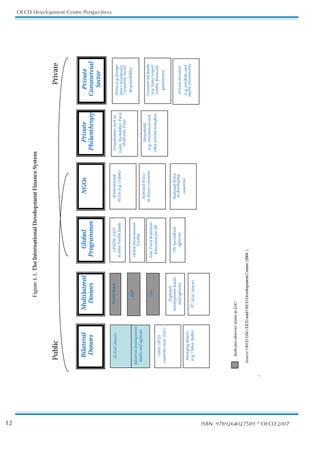
joinedbilateralandmultilateraldonorsinfinancingdevelopment.Figure1.1givesanidea
ofthecomplexityofthenewdevelopmentfinancesystem.
12
OECD Development Centre Perspectives
ISBN: 9789264027589 © OECD 2007
Figure
1.1.
The
International
Development
Finance
System
(MPCBM
1SPHSBNNFT

('5.
(7*

PUIFSIFBMUIGVOET

(MPCBMOWJSPONFOU

'BDJMJUZ

/(0T

*OUFSOBUJ
POBM

/(0T
FH0YGBN

6/4QFDJBMJTFE

HFODJFT

/BUJPOBM/(0T

JOEPOPSDPVOUSJFT

/BUJPOBM/(0T

JOEFWFMPQJOH

DPVOUSJFT

.VMUJMBUFSBM

%POPST

'BTU5SBDL*OJUJBUJWF
EVDBUJPOGPSMM

8PSME#BOL

6/


$

%$EPOPS

3FHJPOBM

EFWFMPQNFOUCBOLT
BOEBHFODJFT

*.'

P
ublic
Private
1SJWBUF
1IJMBOUISPQZ

1SJWBUF
$PNNFSDJBM
4FDUPS

%$EPOPST

0UIFS0$%

DPVOUSJFT
OPO

%$

NFSHJOHEPOPST

FH$IJOB
*OEJB

#JMBUFSBM

%POPST

#JMBUFSBMEFWFMPQNFOU
CBOLTBOEBHFODJFT


*OEJDBUFTPCTFSWFSTUBUVTJO%$


4PVSDF

0$%%$%$%BOE0$%%FWFMPQNFOU$FOUSF


.
'PVOEBUJPOTTVDIBT
(BUFT
3PDLFGFMMFS
'PSE

8FMMDPNF5SVTU

)PVTFIPME

FHSFNJUUBODFTBOE
PUIFSQSJWBUFUSBOTGFST

'JSNT
FHGPSFJHO
EJSFDUJOWFTUNFOU

$PSQPSBUF4PDJBM
3FTQPOTJCJMJUZ

$PNNFSDJBM#BOLT

FHMPBOT
FYQPSU
DSFEJUT
GJOBODJBM
HVBSBOUFFT

1SJWBUF*OWFTUPST

FHQPSUGPMJPBOE
FRVJUZJOWFTUNFOUT

1VCMJD

1SJWBUF
13
Financing Development 2007
ISBN: 9789264027589 © OECD 2007
Capital Inflows Have Changed, but Mostly in Emerging Economies
The past 25 years have seen remarkable changes in the composition of capital inflows
todevelopingcountries(Figure1.2).ODAhasalmostquadrupled(from$22.4 billionin1980
to $79.5 billion in 2004), but has fallen as a proportion of total developing country inflows,
whichincluderemittances,commercialloansandequityinvestment.WhileODAconstituted
around35percentoftotalcapitalinflowsin1990,forexample,itnowaccountsforlessthan
15 per cent.
Figure 1.2. Composition of Developing Countries’ Capital Inflows
(1980-2004, $ billion)


0% 3FNJUUBODFT 0UIFSQSJWBUFGMPXT DSFEJUPSTBOEFRVJUZJOWFTUNFOU
Source: Author's illustration based on data from World Bank, UNCTAD, IIF
, OECD DAC.
Alldevelopingcountrieshavenotexperiencedthesetrendsequally.Figure1.3highlights
thedistinctionbetweenemergingeconomies1
andotherdevelopingcountries(Lambertand
Cogneau, 2006). Specifically, emerging economies such as Brazil, Mexico, Malaysia and
Indonesia have enjoyed high levels of commercial bank loans, trade lending, and equity and
portfolio investments. In poorer countries, the emergence of new flows has been less
pronounced,buteventhereODA’sshareoftotalcapitalinflowsdecreasedfromaround65 per
cent in 1980 to just over 40 per cent in 2004.
14
OECD Development Centre Perspectives
ISBN: 9789264027589 © OECD 2007
Figure 1.3. Composition of Capital Inflows in Emerging Economies
and Other Developing Countries
(1980-2004, $ billion)
ODA Volumes Are Up, but Their “Real” Value Has Been Questioned
Aid remains central to international development policy, as documented by donor
pledges for more and better aid at various summits in 2005. After declining throughout the
1990s,ODAhasincreasedsincetheturnofthecentury,followingtheadoptionoftheMDGs.
TheOECD(2006)reportsanincreaseofaidto$106 billionin2005,representingarealincrease
of 8.7 per cent from the previous year. This follows annual increases of 5.9 per cent, 7 per
cent and 3.9 per cent from 2002 to 2004 (Pearson, 2004). In view of these developments, the
OECD believes that the increase of around $50 billion to $130 billion by 2010, promised by
the European Union and the G8, can be achieved.
A closer look at the breakdown of recent aid increases reveals that a large proportion
can be attributed to debt relief and special-purpose grants (Chervalier and Zimet, 2006).
Special-purposegrantsarecrucialforthereconstructionofdamagecausedbydisasterssuch
as the 2005 tsunami, but are not necessarily targeted to the achievement of the MDGs.
Similarly, debt relief — under the Heavily-Indebted Poor Countries (HIPC) initiative or
MultilateralDebtReliefInitiative(MDRI)—doesnotnecessarilyfreemoneyfordevelopment
and has, for the most part, benefited a small number of large countries, including Iraq (it
received nearly $14 billion in debt forgiveness grants in 2005) and Nigeria (a little over
$5 billion). As the OECD (2006) argues, aid figures are blurred by this “debt relief bubble”.
Moreover, that IraqhasbenefitedfromincreasedODAalsoevidencesthegrowinginfluence
of security issues on ODA allocations.
Source: Author's illustration based on data from World Bank, UNCTAD, IIF
, OECD DAC.
O
th
e
r
d
e
v
e
lo
p
in
g
c
o
u
n
t
ri
e
s
E
m
e
r
g
in
g
e
c
o
n
o
m
ie
s


0% 3FNJUUBODFT 5PUBMQSJWBUFGMPXT DSFEJUPSTBOEFRVJUZ
15
Financing Development 2007
ISBN: 9789264027589 © OECD 2007
Private Actors Are Entering the Scene
In addition to loans and investment, remittances from private households have emerged as
a major source of capital to developing countries. Despite significant discrepancies in the data,
several surveys have shown that in some countries remittances account for 15 per cent or more
of GDP (World Bank, 2006; United Nations, 2006). The evidence grows that they contribute to the
achievement of the MDGs: household surveys in several countries have shown that remittances
go partly to fund education, nutrition and health (Katseli et al., 2006; Cox and Ureta, 2003).
Private companies and foundations also play an increasing role, although their contribution
to international development programmes is difficult to quantify. Financial support from major
foundations,forexample,isspentmostlyintheircountriesoforigin.Theirinternationalsupportis
channelled to developing countries largely indirectly, for example via multilateralorganisations.
Thisrunstheriskofdouble-countingdevelopmentfinance.Acontributionfromafoundationmay
beattributedtotheprivatesectorandtothepublicsector,asflowsfrommultilateralsareconsidered
asODAbytheOECDDevelopmentAssistanceCommittee(DAC)CreditorReportingSystem(OECD,
2003). Nevertheless, as an example of the magnitude of private philanthropy, the International
FederationofPharmaceuticalManufacturersandAssociations(IFPMA)reportsthecontributionsof
thetenmajorcompaniesthathavedonatedproductstothePartnershipforQualityMedicalDonations
since1998at$2.7billion(IFPMA,2004and2005;seealsoHudsonInstitute,2004;PhRMA,2003).
Ofthemanyphilanthropicorganisationsactiveindevelopingcountries,theBillandMelinda
Gates Foundation is perhaps the most well known, having disbursed $1.4billion in grants by
December2005,withprogrammesinglobalhealth($843million)andeducation($284million),
as well as initiatives in global development, global libraries, financial services for the poor,
agriculturaldevelopment,water,sanitationandhygiene($228million).Intermsoffundsspent
abroad,theFordFoundationisthelargestUSfoundationinvolvedinfinancingdevelopment.
The Distinction Between Public and Private Financing is Blurry
NGOs exemplify organisations that bridge the divide between public and private finance.
Someprovideautonomousfinancingraised,forexample,fromprivatedonations.Othersdonot
actasfinancesourcesbutasimplementingagenciesorservicedeliverersinprojectsfinancedby
thepublicsector,includingODA.In2002,transferstoNGOsamountedto$1.2billioninODA,an
increaseof34percentfrom1992(EpsteinandGang,2006).
The public-private divide is also spanned by so-called global funds, public-private
partnerships that have been set up over recent years to spark action around specific global
challenges such as the health and education MDGs. Their budgets are now considerable. The
EducationforAllFastTrackInitiative(EFA-FTI),forexample,hasdisbursed$115milliontolow-
incomecountriesthroughitsCatalyticFund,linkingtheinitiative’sfundingtotheMDGofuniversal
primaryeducation.TheGlobalFundtoFightAids,TuberculosisandMalaria(“TheGlobalFund”)
and the Global Alliance for Vaccines and Immunization (“The GAVI Alliance”) have been very
activeinthehealthsector.ByDecember2005,theGAVIAlliancehaddisbursed$603millionsince
itslaunchin2000;theGlobalFundhasdisbursed$2.38billionsince2002.
Inspiteoftheselargevolumes,questionsremainaboutwhetherglobalfundshaveincreased
overallflowstodevelopingcountries(seeChapter4ofthisvolume).Arguably,publicfinancesthrough
globalfundscouldequallyhavebeendirectedthroughexistingchannelssuchasthe WorldBank.
Moreover,thehopethatthefundswouldcatalyseprivatefinancialcontributionshasalsofailedto
materialise.Althoughprivatecontributionstoglobalfundsshouldnotbedisregarded—forthe
16
OECD Development Centre Perspectives
ISBN: 9789264027589 © OECD 2007
GAVIAlliance,theyevensurpassedpublic-sectorcontributionsduringitsfirsttwoyears—theirfunding
isstillcomposedlargelyofconventionalbilateralandmultilateralODA.Privatecontributionstothe
GlobalFund,forexample,constitutedonly3percentoftotalpledgesin2004,comingfromfoundations
(e.g.Gates),multinationalcompanies(e.g.Winterthur)andprivateindividuals(e.g.KofiAnnan).
Policy Implications for Donors and Recipients
Thesechangesintheinternationaldevelopmentfinancesystemarenoteasilygrasped,
neither statistically or analytically.Yet they are having major implications for policy makers
in developing countries, who need to make the most of new funding opportunities, and for
aiddonors,whoneedtorepositionthemselvesinthesystem.Drawingfromitsownexpertise
aswellasthatofcolleagueswithinandoutsidetheOECD,theDevelopmentCentrehasbeen
assessing several significant aspects of this systemic evolution. This volume pulls together
someofthiskeymaterialandpresentsitsystematicallysothatinterestedreaderscanhaveit
in one place and in digestible form2
.
Part I examines the changes in the development finance system from a global
perspective.Therise of new actors and the change in approachesare captured in Chapter 2,
“ResourcesforDevelopmentinAfrica”,whichdescribestheevolving aid environmentofthe
continent and draws policy implications for both donor and recipient countries. Much of
therecentincreaseinaidflowsfromthetraditionaldonors,themembersoftheOECDDAC,
has taken the forms of debt relief, emergency assistance and other special-purpose grants,
but overall commitments are on the rise and debt relief is well past its peak. New actors are
increasingly visible on the continent, especially non-DAC donors such as China and India.
Theshareofnon-aidflowsfromaroundtheworldisincreasing.Sub-SaharanAfrica(SSA),in
particular, may still rely more on official flows than the rest of the developing world, yet it
also attracts almost as much FDI as a share of GDP as do other developing regions. As for
remittances, they exceeded 2 per cent of GDP in 2004 in 15 SSA countries.
TheissueoftheoptimalchoicebetweenfinancinginstrumentsisattheheartofChapter3,
“After Gleneagles: What Role for Loans in ODA?” Ever since the Meltzer Report in
March 2000 recommended that multilateral development banks should provide support in
the form of grants rather than loans, the debate on the optimal composition of ODA has
been reinvigorated, not to say heated. Often the debate is cast in terms of “grants versus
loans”
, although both are to a degree complementary. Both loans and grants have their role
in concessional finance, and this view also applies in the OECD Initiative on Investment for
Development (see Box 2.3 in Chapter 2). Loans provide sequential leverage for a given amount
of ODA to the extent that reflows finance new loans. Indeed, the pro-loan argument of
sequential leverage hinges on the importance of recipient-country contributions to the
reflows. Loans exert discipline on resource allocation. A grants-only policy risks denying
countries future financial-market access. Grants appeal to debt-trapped countries and apply
to the finance of most of the MDGs when their public-goods character is at odds with loan
finance. The 2006 Report of the French Conseild’AnalyseEconomique(CAE) on Development
Aid built heavily on the Development Centre work reviewed in this chapter.
Chapter 4, “Innovative Approaches to Funding the Millennium Development Goals”,
looks beyond traditional means of financing development. It starts from the realisation that
OECD governments can fulfil their pledges for increased aid in only three ways: through full
accounting as ODA of debt relief granted to poor countries (including Iraq, which received
almost $14 billion, and Nigeria, more than $5 billion in 2005); through increasing ODA
17
Financing Development 2007
ISBN: 9789264027589 © OECD 2007
appropriations in ordinary budgets; and through innovative forms of development finance,
which also need to be fully accounted for as ODA. As debt relief will not contribute much to
ODA in the near future and as budgetary pressures in donor countries are likely to grow, the
search for innovative funding mechanisms will have priority. Further, while the Monterrey
conference on financing development led to new commitments from donors to raise ODA,
thebillfortheMDGsremainslikelytobehigherthantheODAfunding.Thefast-approaching
MDG deadline in the year 2015 increases pressure to find ways now to pay that bill. The
chapter helps to classify the many proposals for new forms of development finance. The
policy relevance and prescience of this paper have been validated since its first appearance
as Development Centre Policy Brief 24. The criteria used for evaluating different proposals
include revenue potential, speed of availability and political feasibility
. T
wo favoured options,
namely the frontloading of funds through an International Finance Facility and raising money
through aviation taxes have made tangible progress. A third, strengthened use of public
guarantees and better ODA accounting for them, is likely to get more support as guarantees
can unlock considerable private capital.
The second part of this volume tells the developing country’s side of the story. In
Chapter 5, “New Actors in Health Financing: Implications for a Donor Darling”
, a case study
of health financing in Ghana shows both how the new multiplicity of financing options has
provided alternatives for developing countries in funding achievement of the MDGs and
how it has introduced major management challenges. Health finance in Ghana offers evidence
that even in a country and sector that benefit from large ODA volumes, new actors and flows
of development finance are manifest and highlight issues that apply well beyond this case
study. Developing countries need stronger information systems to forecast flows and design
more effective policies. They also need better co-ordination mechanisms in which
conventional donors and new actors can participate to ensure that aid is effective.
Chapter 6,“Integrating Global Programmes with Country-led National Programmes”
, focuses
on Ghana as well. Based on a country survey conducted by the OECD Development Centre on
behalf of concerned multilateral institutions, it explores the alignment of global/vertical aid
programmes (GPs) with planning and implementation systems in recipient countries. New
sources of finance may have increased the overall financial envelope, but they have also brought
monitoring and co-ordination challenges. For more effective finance, co-ordination mechanisms
must include the new funders. In order to take ownership of their own development process,
developing countries need to improve inter-ministerial co-operation and to address mismatches
between budgets and spending, as well as capacity gaps.
Finally, financing development involves more than an increased level and quality of
resources flowing into developing countries: that is the key point that emerges from Chapter
7, “Different Countries, Different Needs: The Role of Private Health Insurance in Developing
Countries”
. This chapter assesses the scope for funds to be raised through insurance
mechanisms based on pre-payment and risk pooling the health sector, the focus of MDGs 4-6.
It concludes that, generally, private health insurance (PHI) can effectively complement
existing health-care financing options, provided that it is well managed, with efficient
insurance regulation systems, and adapted to local market characteristics. In many countries,
small-scale insurance schemes managed in close co-operation with the beneficiaries of
services even offer an interesting alternative to systems in which health care is financed by
the state (through tax payments) or on a cash and carry basis. The chapter sorts developing
countries into regional groupings in terms of the current status, prospects and domestic
policy challenges of using PHI as a major financing vehicle for health care.
18
OECD Development Centre Perspectives
ISBN: 9789264027589 © OECD 2007
Notes
1. This study follows the definition of the Institute for International Finance (IIF), which classifies
29 countriesasemergingeconomies.“Otherdevelopingcountries”arethe124remaininglow-income
and middle-income countries.
2. Thepiecesassembledherehavevariousorigins,bothpublishedandhithertounpublished.Chapter2
began as a formal paper [AFP/Meeting(2006)15] presented at a meeting of the Africa Partnership
Forum in Moscow on 26-27 October 2006. Chapters 3, 4 and 5 first appeared as Development Centre
Policy Briefs (Nos. 31, 24 and 33 respectively). Chapters 6 and 7 are original in this volume.
19
Financing Development 2007
ISBN: 9789264027589 © OECD 2007
Bibliography
CHERVALIER, B. and J. ZIMET (2006), American Philanthropic Foundations: Emerging Actors of Globalization
and Pillars of the Transatlantic Dialogue, German Marshall Fund of the United States, GMF,
Washington,D.C.
Cox, A. and M. URETA (2003), “International Migration, Remittances and Schooling: Evidence from El
Salvador”
, NBERWorkingPaper No. 9766, National Bureau of Economic Research, Cambridge, MA.
EPSTEIN, G.S. and I.N. GANG (2006), “Decentralizing Aid with Interested Parties”
, UNU-WIDER, Research Paper
No. 2006/06.
HUDSON INSTITUTE (2004), “
A Review of Pharmaceutical Company Contributions – HIV/AIDS, Tuberculosis,
Malaria and Other Infectious Diseases”, Center for Science in Public Policy, Hudson Institute,
Washington, D.C.
IFPMA (2004) and (2005), Building Healthier Societies through Partnerships, International Federation of
Pharmaceutical Manufacturers Associations, IFPMA, Geneva.
KATSELI, L.T., R.E.B. LUCAS and T
. XENOGIANI (2006), “Policies for Migration and Development: A European
Perspective”
, Policy Brief No.30,OECDDevelopmentCentre,Paris.
LAMBERT, S. and D. COGNEAU (2006), « L
’aide au développement et les autres flux nord sud: Complémentarité
ou substitution? », OECD Development Centre, WorkingPaperNo.251,June.
OECD(2003),“PhilanthropicFoundationsandDevelopmentCo-operation”,off-printoftheDACJournal,
Vol.4,No.3.
OECD (2006), DACNews – News and Ideas from the OECD Development Assistance Committee (DAC)
Secretariat,April.
PEARSON, M. (2004), “Economic and Financial Aspects of the Global Health Partnerships”
, Global Health
Partnership Study Paper 2, DFID Health Resource Centre, DFID, London.
PhRMA (2003), Global Partnerships, Humanitarian Programs of the Pharmaceutical Industry in Developing
Nations, Pharmaceutical Research and Manufacturers of America, PhRMA, Washington, D.C.
UNITED NATIONS (2006), “International Migration and Development Fact Sheet”
, UN Department of Economic
and Social Affairs, Population Division.
WORLD BANK (2006), Global Economic Prospects 2006 – Economic Implications of Remittances and Migration,
World Bank, Washington, D.C.
20
OECD Development Centre Perspectives
ISBN: 9789264027589 © OECD 2007
21
Financing Development 2007
ISBN: 9789264027589 © OECD 2007
PART I
THE EVOLVING ARCHITECTURE OF DEVELOPMENT FINANCE:
A GLOBAL PERSPECTIVE
22
OECD Development Centre Perspectives
ISBN: 9789264027589 © OECD2007
23
Financing Development 2007
ISBN: 9789264027589 © OECD 2007
Chapter 2
Resources for Development in Africa
The relationship between Africa and its development partners is undergoing radical
change. Key landmark events since 2000 include the adoption of the MDGs in 2000; the
MonterreyConsensusin2002;theendorsementoftheParisDeclarationonaideffectiveness
and managing for development results in 2005; and the G8 commitments at Gleneagles in
2005 to increase official development assistance (ODA) to Africa by $25 billion a year by
2010, reiterated in St Petersburg in 2006. As a result, issues of scaling-up aid and aid
effectiveness have dominated the policy dialogue.
Total aid flows from OECD/DAC donors have risen sharply in recent years, with total
ODA reaching a record $106.5 billion in 2005, although debt relief (including the large debt
cancellations for Iraq and Nigeria), emergency assistance and other special-purpose grants
accounted for a large share of the increase. Recent survey data, based on a partial sample of
information provided by donors, suggest only a modest increase in aid allocations to Africa
overthenexttwoyears.Thisomitsaidbynon-DACcountriesanddiscussionsonaiddelivery
and effectiveness will need to take into account their growing role.
AsimportantasitisforAfrica,aidisnottheonlystory.Whilesub-SaharanAfricastands
out as relying significantly more on official flows than the rest of the developing world
(Figure 2.1), non-aid flows are becoming increasingly more important. Foreign direct
Abstract
Aid flows from OECD/DAC (Development Assistance Committee) donors have risen sharply
in recent years, but debt relief, emergency assistance and other special-purpose grants
accountedforalargeshareoftheincrease.Aidfromtraditionaldonorsdoesnotcompletethe
picture,however.Non-DACdonorshaveincreasingrelevanceandnon-aidflowsfromaround
theworldarerapidlygainingweight.Today,sub-SaharanAfrica(SSA)stillreliesmoreonofficial
flows than the rest of the developing world, but it also attracts almost as much FDI as a share
ofGDPasdootherdevelopingregions.For15SSAcountries,remittancesexceeded2percent
of GDP in 2004. All these diverse developments have policy implications for both donor and
recipientcountries.
24
OECD Development Centre Perspectives
ISBN: 9789264027589 © OECD2007
investment (FDI) has grown four-fold in the past decade, reaching an average of $13 billion
in the last three years. T
oday, sub-Saharan Africa attracts almost as much FDI as a share of
GDP as do other developing regions. Although — as private flows — remittances cannot be
considered development resources, they are a potential source of finance. Estimates put 2005
remittances at $8 billion and would be much higher if unrecorded flows through informal
channels could be included. North Africa as a sub-region and South Africa have relied almost
exclusively on private flows in recent years. For 15 sub-Saharan African (SSA) countries,
remittances exceeded 2 per cent of GDP in 2004.
Debt relief through the Highly Indebted Poor Countries (HIPC) Initiative and the more
recent Multilateral Debt Relief Initiative (MDRI) has significantly reduced the debt burden
of many African countries. On average, the HIPC Initiative has helped to reduce debt service
for the 28 countries that have reached decision point by an average of $2.5 billion a year. For
the 19 countries that have already reached the HIPC completion point, an additional
$1.0 billion to $1.5 billion of additional relief will be granted each year through the MDRI.
In addition to foreign financing, realising the ambition of poverty reduction strategies
will require continued effort in domestic revenue generation in recipient countries. African
countries have managed to raise government revenue by the equivalent of four percentage
'JHVSFHHSFHBUF/FU3FTPVSDF'MPXT
CJMMJPO 
AllDevelopingCountries
0
50
100
150
200
250
300
350
400
450
500
2000 2001 2002 2003 2004
Sub-SaharanAfrica
0
10
20
30
40
50
60
2000 2001 2002 2003 2004
Sub-SaharanAfrica(excludingSouthAfrica)
0
10
20
30
40
50
60
2000 2001 2002 2003 2004
NorthAfrica
0
1
2
3
4
5
2000 2001 2002 2003 2004
Private flows Public flows
4PVSDF8PSME#BOL (MPCBM%FWFMPQNFOU'JOBODF
25
Financing Development 2007
ISBN: 9789264027589 © OECD 2007
points of GDP since the early 2000s, yet half of them still mobilise less than 15 per cent of
their GDP in tax revenues. Without further effort to raise domestic revenue, these countries
willcontinuetofacethechallengeimposedbythevolatilityandunpredictabilityofaidflows.
A broader look at the totality of the financial resources available to Africa helps to
highlight several important development finance issues, including:
— the implications of FDI for patterns of trade and integration;
— the catalytic role of official aid in promoting other flows such as private capital flows;
— the critical role of improving governance, most notably with respect to the business
climate to attract FDI and to capitalise on sharply larger remittances flows; and
— theneedtoensuresustainabledevelopmentfinancewithdomesticresourcesatitscore.
This chapter reviews the trends of aid flows in the context of other financial resources
available for development including debt relief, private capital flows, remittances and
domestic revenue. It also provides perspectives on their relative importance in Africa and
compared with other regions of the world, and it highlights key policy issues that need to be
addressed by both African countries and the international community.
Delivery of Aid Commitments
Overallaidflowshavesharplyincreased,butalargepartoftheincreaseisduetodebt
relief and emergency assistance. From a low of $48 billion1
in 1997, total ODA provided by
OECD countries that are members of the Development Assistance Committee (DAC)
2
reached
an all-time high of $106.5 billion in 2005, an increase of $27 billion. A significant share of this
increase was accounted for by debt cancellation for Nigeria ($5 billion) and Iraq ($14 billion)
and exceptional financing for tsunami relief (around $2 billion). Netting out debt relief and
the other special-purpose grants
3
, estimated programmable aid flows increased by $5 billion
to reach $50.4 billion in 2005 (Figure 2.2). After a fall of 25 per cent in real terms from 1993 to
1999, ODA to Africa showed a strong upward trend from 2000 (T
able 2.1). The share of debt
relief to rising ODA flows is more marked in sub-Saharan Africa where debt cancellations
provided by the Paris Club and the HIPC Initiative have been very significant since the late
1990s. ODA flows to North Africa have been more stable, averaging between $2 billion and
$3 billion in the past several years.
Meeting the donors’ commitment to increase ODA in the next few years will be a major
challenge. Commitments made by G8 countries to double yearly aid to Africa by 2010 and by
the EU15 countries to provide at least 0.51 per cent of their GNI as ODA by 2010 suggest that
aid can reach as much as $130 billion by the end of the decade, with 80 per cent of the increase
coming from Europe. Yet very significant effort will be needed by most EU15 countries. For
example, Italy will have to triple its ODA between 2004 and 2010 to meet the 0.51 per cent
target; several other EU15 countries including Austria, Finland, Germany, Greece and Spain
will need to more than double their aid during the same time period. This large increase in
aid will need to occur when many of these countries face severe budget constraints.
26
OECD Development Centre Perspectives
ISBN: 9789264027589 © OECD2007
5BCMF0%UPGSJDB
CJMMJPO 

      
4VC4BIBSBOGSJDB    
B
  
C
/PSUIPG4BIBSB      OB
GSJDB5PUBM      OB

/PUFT
B  5IFPVUUVSOJOXBTIFBWJMZEFUFSNJOFECZUIFCJMMJPOPGEFCUSFMJFGUPUIF%FNPDSBUJD3FQVCMJDPG
$POHPVOEFSUIF)*1$JOJUJBUJWF
C  0GXIJDICJMMJPOGPS/JHFSJBTEFCUSFMJFG

4PVSDF0$%%$BOEUIF%53FQPSU  
Innovative financing mechanisms may help to scale up aid but progress so far has been
quite modest (for more perspective, see Chapter 5). The International Finance Facility (IFF)4
,
through the pilot initiative for immunisation for instance, would help to raise frontloaded,
reliable funding over a number of years to expand global immunisation efforts. The United
Kingdom, France, Italy, Spain and Sweden have made contribution pledges that provide the
guarantee to issue bonds in the very near future. Concomitantly France, together with Brazil,
Chile, Norway and the UK recently announced a new undertaking, mostly through taxes on
airline tickets, that hopes to raise at least $300 million next year in 2007 to help pay for the
purchase of medicines. France has already implemented the air ticket levy that would mobilise
about $250 million a year. A dozen more countries are actively considering contributing by
imposing airline ticket taxes of their own.
Realising the commitment to double aid to Africa by 2010 is increasingly uncertain. A
recent survey
5
of DAC member countries and key multilateral agencies highlighted the
apparent disconnect between political commitments to sharply increase aid and the results
'JHVSF0%CZDBUFHPSJFT 
CJMMJPO 
0
20
40
60
80
100
120
2001 200 2003 2004 2005
Programmable Resources Other special purpose grants Net debt relief grants
4PVSDF0$%%FWFMPQNFOUTTJTUBODF$PNNJUUFF %$
27
Financing Development 2007
ISBN: 9789264027589 © OECD 2007
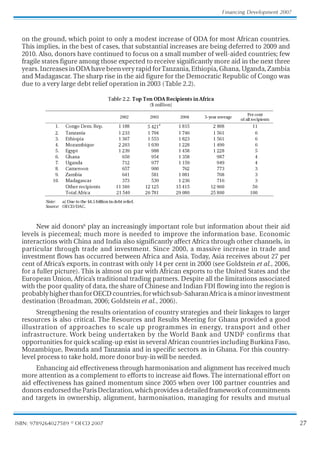
on the ground, which point to only a modest increase of ODA for most African countries.
This implies, in the best of cases, that substantial increases are being deferred to 2009 and
2010. Also, donors have continued to focus on a small number of well-aided countries; few
fragile states figure among those expected to receive significantly more aid in the next three
years.IncreasesinODAhavebeenveryrapidforTanzania,Ethiopia,Ghana,Uganda,Zambia
and Madagascar. The sharp rise in the aid figure for the Democratic Republic of Congo was
due to a very large debt relief operation in 2003 (Table 2.2).
5BCMF5PQ5FO0%3FDJQJFOUTJOGSJDB
NJMMJPO 


   ZFBSBWFSBHF
1FSDFOU
PGBMMSFDJQJFOUT
 $POHP%FN3FQ  
B
   
 5BO[BOJB     
 UIJPQJB     
 .P[BNCJRVF     
 HZQU     
 (IBOB     
 6HBOEB     
 $BNFSPPO     
 ;BNCJB     
 .BEBHBTDBS     
 0UIFSSFDJQJFOUT     
 5PUBMGSJDB     

/PUF B %VFUPUIFCJMMJPOJOEFCUSFMJFG
4PVSDF 0$%%$
New aid donors6
play an increasingly important role but information about their aid
levels is piecemeal; much more is needed to improve the information base. Economic
interactions with China and India also significantly affect Africa through other channels, in
particular through trade and investment. Since 2000, a massive increase in trade and
investment flows has occurred between Africa and Asia. Today, Asia receives about 27 per
cent of Africa’s exports, in contrast with only 14 per cent in 2000 (see Goldstein et al., 2006,
for a fuller picture). This is almost on par with African exports to the United States and the
European Union, Africa’
s traditional trading partners. Despite all the limitations associated
with the poor quality of data, the share of Chinese and Indian FDI flowing into the region is
probably higher than for OECD countries, for which sub-Saharan Africa is a minor investment
destination (Broadman, 2006; Goldstein et al., 2006).
Strengthening the results orientation of country strategies and their linkages to larger
resources is also critical. The Resources and Results Meeting for Ghana provided a good
illustration of approaches to scale up programmes in energy, transport and other
infrastructure. Work being undertaken by the World Bank and UNDP confirms that
opportunities for quick scaling-up exist in several African countries including Burkina Faso,
Mozambique, Rwanda and T
anzania and in specific sectors as in Ghana. For this country-
level process to take hold, more donor buy-in will be needed.
Enhancing aid effectiveness through harmonisation and alignment has received much
more attention as a complement to efforts to increase aid flows. The international effort on
aid effectiveness has gained momentum since 2005 when over 100 partner countries and
donors endorsed the Paris Declaration, which provides a detailed framework of commitments
and targets in ownership, alignment, harmonisation, managing for results and mutual
28
OECD Development Centre Perspectives
ISBN: 9789264027589 © OECD2007
accountability.SubstantialprogresshasbeenmadeinanumberofAfricancountriesincluding
Burkina Faso, Ethiopia, Ghana, Mozambique, Tanzania and Uganda, and good progress has
beenachievedinothers(seeAnnexTable2.A.5).Harmonisationactionssuchasjointanalytic
work, collaborative or joint programming and assistance strategies, programme-based
approaches, pooling of financing among donors, use of country systems where feasible and
joint or independent assessments of aid at the country level, among others, have begun to
reduce transaction costs to countries.
Serious impediments remain to broaderanddeeperimprovement in implementing the
Paris principles. They include data constraints, inappropriate staff incentives, institutional
rigidities and obstacles to change management. Efforts to establish a baseline (see
Annex Table 2.A.4 for details) and to monitor progress will help focus both countries and
donor agencies on harmonisation and management for results7
.
Many issues on the management of aid continue to require attention, ranging from
inadequate support to fragile states to insufficient response to shocks, the lack of
predictability,andtheuseofconditionality.Scalingupwillalsorequiremoreco-ordination
amongaiddeliverychannels—bilateralfunds,multilateralfunds,globalfundsandprivate
funds.Inparticular,globalfundsneedtosupportcountry-ledstrategiesandprioritiesand
avoidunderminingthecapacityofnationalauthoritiesforcoherentplanning,financingand
servicedelivery.
Policy Issues on Aid Delivery
From Africa’s perspective:
— strengthen national capacity to plan and implement country priorities and to monitor
and evaluate outcomes;
— sustain the process of alignment and aid harmonisation;
From the donors’ perspective:
— ensure that the recent momentum on aid increases is sustained;
— improve aid predictability by sharing forward information and adopting Paris
Declaration agenda compact (budget support, programmatic approach);
— enhance co-ordination between DAC and non-DAC donors.
Debt Relief
Debt relief has been important in driving recent aid increases and will remain a key
factorinthemediumterm.InadditiontodebtreliefbytheParisClubandundertheHIPC
initiative,16AfricancountriesthathavereachedHIPCcompletionhavealsobegantobenefit
fromlargerdebtcancellationby threemultilateral institutions — the IDA, the IMF and the
AfricanDevelopmentFund(AfDF)undertheMultilateralDebtReliefInitiative(MDRI).Debt
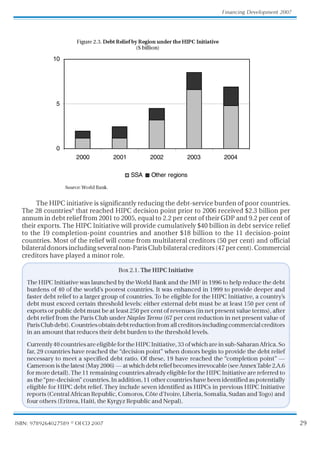
relief from all sources has increased significantly over the past few years. Figure 2.3 shows
that sub-Saharan Africa received a rising share of HIPC debt relief, capturing almost three
quartersofthatprovidedin2002-04.
29
Financing Development 2007
ISBN: 9789264027589 © OECD 2007
The HIPC initiative is significantly reducing the debt-service burden of poor countries.
The 28 countries8
that reached HIPC decision point prior to 2006 received $2.3 billion per
annum in debt relief from 2001 to 2005, equal to 2.2 per cent of their GDP and 9.2 per cent of
their exports. The HIPC Initiative will provide cumulatively $40 billion in debt service relief
to the 19 completion-point countries and another $18 billion to the 11 decision-point
countries. Most of the relief will come from multilateral creditors (50 per cent) and official
bilateral donors including several non-Paris Club bilateral creditors (47 per cent). Commercial
creditors have played a minor role.
'JHVSF%FCU3FMJFGCZ3FHJPOVOEFSUIF)*1$*OJUJBUJWF
CJMMJPO 
0
5
10
2000 2001 2002 2003 2004
SSA Other regions
 4PVSDF8PSME#BOL
Box 2.1. TheHIPCInitiative
The HIPC Initiative was launched by theWorld Bank and the IMF in 1996 to help reduce the debt
burdens of 40 of the world’s poorest countries. It was enhanced in 1999 to provide deeper and
faster debt relief to a larger group of countries. To be eligible for the HIPC Initiative, a country’s
debt must exceed certain threshold levels: either external debt must be at least 150 per cent of
exportsor public debt must be at least 250 per cent of revenues (in net present value terms), after
debt relief from the Paris Club under NaplesTerms (67 per cent reduction in net present value of
Paris Club debt). Countries obtain debt reduction from all creditors including commercial creditors
in an amount that reduces their debt burden to the threshold levels.
Currently 40 countries are eligible for the HIPC Initiative, 33 of which are in sub-Saharan Africa. So
far, 29 countries have reached the “decision point” when donors begin to provide the debt relief
necessary to meet a specified debt ratio. Of these, 19 have reached the “completion point” —
Cameroon is the latest (May 2006) — at which debt relief becomes irrevocable (see Annex Table 2.A.6
for more detail). The 11 remaining countries already eligible for the HIPC Initiative are referred to
as the “pre-decision” countries. In addition, 11 other countries have been identified as potentially
eligible for HIPC debt relief. They include seven identified as HIPCs in previous HIPC Initiative
reports (Central African Republic, Comoros, Côte d’Ivoire, Liberia, Somalia, Sudan and Togo) and
four others (Eritrea, Haiti, the Kyrgyz Republic and Nepal).
30
OECD Development Centre Perspectives
ISBN: 9789264027589 © OECD2007
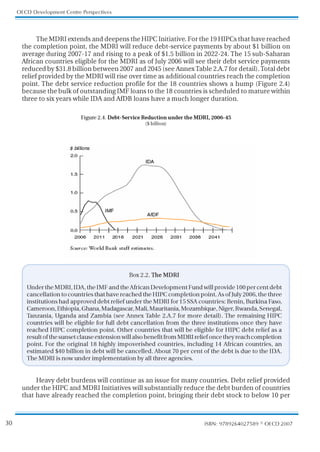
TheMDRIextendsanddeepenstheHIPCInitiative.Forthe19HIPCsthathavereached
the completion point, the MDRI will reduce debt-service payments by about $1 billion on
average during 2007-17 and rising to a peak of $1.5 billion in 2022-24. The 15 sub-Saharan
African countries eligible for the MDRI as of July 2006 will see their debt service payments
reducedby$31.8billionbetween2007and2045(seeAnnexTable2.A.7fordetail).Totaldebt
reliefprovidedby the MDRI will rise over time as additional countries reach the completion
point. The debt service reduction profile for the 18 countries shows a hump (Figure 2.4)
becausethebulkofoutstandingIMFloanstothe18countriesisscheduledtomaturewithin
three to six years while IDA and AfDB loans have a much longer duration.
Figure 2.4. Debt-Service Reduction under the MDRI, 2006-45
($ billion)
Heavydebtburdenswillcontinueasanissueformanycountries.Debtreliefprovided
undertheHIPCandMDRIInitiativeswillsubstantiallyreducethedebtburdenofcountries
that have already reached the completion point, bringing their debt stock to below 10 per
Box 2.2. TheMDRI
UndertheMDRI,IDA,theIMFandtheAfricanDevelopmentFundwillprovide100percentdebt
cancellationtocountriesthathavereachedtheHIPCcompletionpoint.AsofJuly2006,thethree
institutionshadapproveddebtreliefundertheMDRIfor15SSAcountries:Benin,BurkinaFaso,
Cameroon,Ethiopia,Ghana,Madagascar,Mali,Mauritania,Mozambique,Niger,Rwanda,Senegal,
Tanzania, Uganda and Zambia (see Annex Table 2.A.7 for more detail). The remaining HIPC
countries will be eligible for full debt cancellation from the three institutions once they have
reached HIPC completion point. Other countries that will be eligible for HIPC debt relief as a
resultofthesunsetclauseextensionwillalsobenefitfromMDRIreliefoncetheyreachcompletion
point. For the original 18 highly impoverished countries, including 14 African countries, an
estimated $40 billion in debt will be cancelled. About 70 per cent of the debt is due to the IDA.
TheMDRIisnowunderimplementation by all threeagencies.
31
Financing Development 2007
ISBN: 9789264027589 © OECD 2007
cent of GDP on average. For the remaining 11 HIPCs that have not reached the completion
point9
, debt as a share of GDP would be about four times as high. Countries that are HIPC
eligible but have not yet reach the decision point
10
face the same challenge and are therefore
under similar pressure to move expeditiously towards HIPC completion point.
For MDRI countries, lower debt burdens and the prospect of increased market access
point to the continued need to focus on debt sustainability and concerns about “free riders”
.
MDRI countries would still require substantial resources to help them meet the MDGs, with
a large share of grants in order to maintain a low or moderate risk of debt distress. Also,
sharply lower debt burdens and improved sovereign credit risk may entice non-concessional
borrowing such as suppliers’ and export credit and commercial loans, raising again the
potential for renewed risk of debt distress. How fast debt should accumulate in MDRI
countries is thus a key question.
Debt Relief and Debt Sustainability Policy Issues
From Africa’s perspective:
— carefully monitor new indebtedness to ensure debt sustainability;
— strengthen the debt management system and avoid the temptation to allow the
institutions associated with debt management to weaken as debt burdens are sharply
reduced.
From the donors’ perspective:
— ensure that the large projected debt relief will not affect the scaling up of ODA;
— help countries ensure long-term debt sustainability and avoid the “free rider” issue
through the strengthening of creditors’ co-ordination.
Private Capital Flows
Private capital flows to Africa have grown sharply in line with overall trends to developing
countries11
. The increase has been broad-based, with foreign direct investment (FDI),
commercial bank lending, and portfolio equity all recording substantial gains (Table 2.3).
After a long period in the 1970s and 1980s with no upward trend, FDI flows to Africa have
grown sharply since the late 1990s. Rising prices of primary commodities (including oil) and
improving investment climates partly explain this growth, although large variations across
countries remain. The last report on DoingBusiness(World Bank, 2006b) confirms that trend,
showing that sub-Saharan Africa ranked third in the world in 2005 after Eastern Europe and
the OECD countries in the scope and pace of reforms to the business enabling environment
(Eifert and Ramachandran, 2004). For portfolio equity flows, most of the increase reflected
equity offerings in South African mining companies. After several years of net reflows starting
in the late 1990s, Africa has confirmed its renewed access to commercial bank lending (see
also Box 2.3).
32
OECD Development Centre Perspectives
ISBN: 9789264027589 © OECD2007
5BCMF/FU1SJWBUF$BQJUBM'MPXTUPGSJDB
CJMMJPO 


QSFMJNJOBSZ 
/FU'%*GMPXT    
/PSUIGSJDB    
4VC4BIBSBOGSJDB    
/FUQPSUGPMJPFRVJUZGMPXT    
/PSUIGSJDB    
4VC4BIBSBOGSJDB    
/FUCBOLEFCUGMPXT    OB
/PSUIGSJDB    OB
4VC4BIBSBOGSJDB    
/FUCPOETGMPXT    OB
/PSUIGSJDB    OB
4VC4BIBSBOGSJDB    
5PUBM OFU QSJWBUFDBQJUBMGMPXT    OB
/PSUIGSJDB    OB
4VC4BIBSBOGSJDB    

4PVSDF8PSME#BOL (MPCBM%FWFMPQNFOU'JOBODF  
Private capital flows to Africa and more particularly FDI are vastly underestimated due
to very rudimentary monitoring systems12
. Based on results of projects conducted in
18 African countries, private flows could be two to three times the levels reported in
internationally published figures. Vital components of inflows, notably retained earnings
and intra-company debt transactions (for FDI) and off-shore borrowing (for debt flows) are
often not recorded by exchange control or foreign investment promotion Agencies. For the
18 countries cited above, intra-company loans accounted for 40 per cent of total equity flows
but are not reported in official FDI statistics.
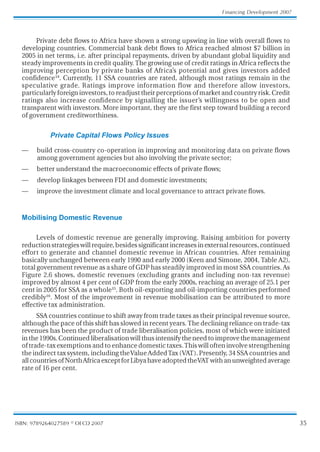
FDI inflows have concentrated largely in the extractive industries but have begun to
diversify
. South Africa and resource-rich countries, notably Angola, Equatorial Guinea, Nigeria
and Sudan, have continued to receive the lion’
s share of FDI, but the reach of FDI flows across
Africa is broadening (Figure 2.5). According to UNCTAD (2005), FDI inflows rose in 40 of
the 53 countries in Africa in 2004. There has also been greater diversification of investment
sectors with manufacturing, finance and tourism the key areas of concentration outside
the resources sector.
33
Financing Development 2007
ISBN: 9789264027589 © OECD 2007
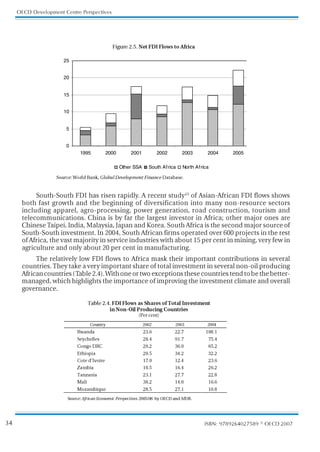
Box 2.3. UsingODAtoPromotePrivateInvestmentforDevelopment:PolicyGuidanceforDonors
Launched in 2003 to support the MonterreyConsensus, the Policy Framework for Investment offers
anon-prescriptivechecklistofissuesforinterestedgovernmentsengagedindomesticreform,regional
co-operation or international policy dialogue to create an environment attractive to domestic and
foreigninvestorsandenhancethebenefitsofinvestmenttosociety.TheFrameworkispartofabroader
OECDInitiativeonInvestmentforDevelopment,togetherwithtwootherprojectsondrawinglessons
on using ODA to mobilise investment and sharing the OECD’s experience with investment policy
peerreviewsascapacity-buildingmechanisms.Thereport,UsingODAtoPromotePrivateInvestment
for Development: Policy Guidance for Donors, issued in 2006, has spelled out quite specific
recommendations for donor agencies to review the way they do business:
1. Development agencies should ensure that their internal incentive and evaluation systems do not
work against staff pursuing longer-term, programmatic and possibly higher-risk interventions.
Institutional and policy reforms are not one-off events, and efforts may not come to fruition within
an agency’s typical three-year or four-year programme cycle or the period of one staff member’
s
posting to a developing country.
2. Staff working on private-sector development, agriculture, infrastructure, public governance,
capacity development, environment and gender are often located in different organisations only
loosely associated with the core ODA programme. To mobilise investment more effectively, these
staff need to work in close association and, ideally, under a common strategic framework.
3. The capacity of staff in development agencies may need to be strengthened, to help them better
determine, based on differences in countries’ investment climates and stages of development,
appropriate approaches and aid instruments to use and how best to sequence reforms.
4. Some development agencies may need to engage more with the private sector in developing
countries and encourage their public-sector partners to do so too. Development agencies can facilitate
public-private partnerships by strengthening public authorities’ capacities to negotiate contracts
and exploring how the mitigation of non-commercial risks can be improved, including through co-
ordinated responses by donors.
5. Development agencies can help develop the local private sector by procuring as many goods and
services as possible in developing countries, subject to value-for-money considerations. This may
require some capacity building in the local private sector to enable firms to participate in competitive
and transparent processes and so take advantage of these opportunities. Development agencies can
also encourage their suppliers and contractors to adopt responsible business practices.
6. Development agencies potentially have a wide selection of ODA instruments at their disposal,
including the direct supply of goods or services, free-standing technical co-operation grants,
concessional loans, partnership alliances, equity acquisitions and guarantees. Few DAC members
use all of these instruments, however, and the use of some, such as concessional loans or equity
acquisitions, may be limited to a development bank, a development finance institution or another
specialised agency. Given the variety of domains that need to be addressed to mobilise investment,
there is a risk that relying on a few aid instruments may inhibit the effectiveness of development
agencies’ efforts. DAC members should consider whether the selection of aid instruments at their
disposal, including through co-ordinated arrangements with other agencies, is right for reaching
their objectives, especially in addressing, albeit indirectly, the private sector.
7. To help ensure that the range of DAC members’ policies impacts positively on investment
mobilisation, development agencies may need to expand their capacity to analyse the impact of
non-ODA policies on developing countries and engage with representatives of other policy
communities to influence policy formulation processes.
Note: In the context of the loans versus grants debate, the fourth and sixth recommendations critically assume a variety of
ODA instruments, including concessional loans and guarantees.
34
OECD Development Centre Perspectives
ISBN: 9789264027589 © OECD2007
South-South FDI has risen rapidly. A recent study13
of Asian-African FDI flows shows
both fast growth and the beginning of diversification into many non-resource sectors
including apparel, agro-processing, power generation, road construction, tourism and
telecommunications. China is by far the largest investor in Africa; other major ones are
ChineseTaipei, India, Malaysia, Japan and Korea. South Africa is the second major sourceof
South-South investment. In 2004, South African firms operated over 600 projects in the rest
ofAfrica, the vast majority in service industries with about 15 per cent in mining, very few in
agriculture and only about 20 per cent in manufacturing.
The relatively low FDI flows to Africa mask their important contributions in several
countries.They take a very important share of total investment in several non-oil producing
Africancountries(Table2.4).Withoneortwoexceptionsthesecountriestendtobethebetter-
managed, which highlights the importance of improving the investment climate and overall
governance.
5BCMF'%*'MPXTBT4IBSFTPG5PUBM*OWFTUNFOU
JO/PO0JM1SPEVDJOH$PVOUSJFT
1FSDFOU 

$PVOUSZ   
3XBOEB   
4FZDIFMMFT   
$POHP%3$   
UIJPQJB   
$PUFE*WPJSF   
;BNCJB   
5BO[BOJB   
.BMJ   
.P[BNCJRVF   

4PVSDFGSJDBODPOPNJD1FSTQFDUJWFTCZ0$%BOEG%#
'JHVSF/FU'%*'MPXTUPGSJDB
0
5
10
15
20
25
1995 2000 2001 2002 2003 2004 2005
Other SSA South Africa North Africa
4PVSDF8PSME#BOL(MPCBM%FWFMPQNFOU'JOBODF%BUBCBTF
35
Financing Development 2007
ISBN: 9789264027589 © OECD 2007
Private debt flows to Africa have shown a strong upswing in line with overall flows to
developing countries. Commercial bank debt flows to Africa reached almost $7 billion in
2005 in net terms, i.e. after principal repayments, driven by abundant global liquidity and
steady improvements in credit quality. The growing use of credit ratings in Africa reflects the
improving perception by private banks of Africa’s potential and gives investors added
confidence14
. Currently, 11 SSA countries are rated, although most ratings remain in the
speculative grade. Ratings improve information flow and therefore allow investors,
particularly foreign investors, to readjust their perceptions of market and country risk. Credit
ratings also increase confidence by signalling the issuer’
s willingness to be open and
transparent with investors. More important, they are the first step toward building a record
of government creditworthiness.
Private Capital Flows Policy Issues
— buildcross-countryco-operationinimprovingandmonitoringdataonprivateflows
amonggovernmentagenciesbutalsoinvolvingtheprivatesector;
— betterunderstandthemacroeconomiceffectsofprivateflows;
— developlinkagesbetweenFDIanddomesticinvestments;
— improvetheinvestmentclimateandlocalgovernancetoattractprivateflows.
Mobilising Domestic Revenue
Levels of domestic revenue are generally improving. Raising ambition for poverty
reductionstrategieswillrequire,besidessignificantincreasesinexternalresources,continued
effort to generate and channel domestic revenue in African countries. After remaining
basically unchanged between early 1990 and early 2000 (Keen and Simone, 2004, Table A2),
totalgovernment revenue as a share of GDP has steadily improved in most SSA countries. As
Figure 2.6 shows, domestic revenues (excluding grants and including non-tax revenue)
improved by almost 4 per cent of GDP from the early 2000s, reaching an average of 25.1 per
cent in 2005 for SSA as a whole15
. Both oil-exporting and oil-importing countries performed
credibly16
. Most of the improvement in revenue mobilisation can be attributed to more
effective tax administration.
SSA countries continue to shift away from trade taxes as their principal revenuesource,
althoughthepaceofthisshifthasslowedinrecentyears.Thedecliningrelianceontrade-tax
revenues has been the product of trade liberalisation policies, most of which were initiated
inthe1990s.Continuedliberalisationwillthusintensifytheneedtoimprovethemanagement
oftrade-taxexemptionsandtoenhancedomestictaxes.Thiswillofteninvolvestrengthening
theindirecttaxsystem,includingtheValueAddedTax (VAT).Presently,34SSAcountriesand
allcountriesofNorthAfricaexceptforLibyahaveadoptedtheVATwithanunweightedaverage
rate of 16 per cent.
36
OECD Development Centre Perspectives
ISBN: 9789264027589 © OECD2007
'JHVSF(PWFSONFOU3FWFOVF FYDMHSBOUT 
4PVSDF*.'3FHJPOBMDPOPNJD0VUMPPLo44  
Oil-exporting
countries
Oil-importing
countries
15
18
21
24
27
30
1997-2001 2002 2003 2004 2005
Government
Revenue
as
%
of
GDP
Despiteimprovedrevenueperformance,halfoftheSSAcountriesstillmobiliselessthan
15 per cent of their GDP in tax revenues, which is generally considered a reasonabletarget
formostlow-incomecountries(Table2.5).Besidesoil-richAngola,GhanaandtheRepublic
ofCongo,countriesthatcollectmorethan20percentoftheirGDPintaxestendtoconcentrate
intheSoutherncone.NorthAfricaneconomiesmobiliseasignificantlylargershareofGDP
indomesticresources,averagingabove30percent.
5BCMF5BY3FWFOVFBTB4IBSFPG(%1
WFSBHF QFSDFOU 

-FTTUIBOQFSDFOU
PG(%1
UPQFSDFOU
PG(%1
UPQFSDFOU
PG(%1
.PSFUIBOQFSDFOU
PG(%1
DPVOUSJFT DPVOUSJFT DPVOUSJFT DPVOUSJFT
$IBE
$FOUSBMGSJDBO3FQVCMJD
$POHP %FN3FQ
-JCFSJB
.BEBHBTDBS
/JHFS
3XBOEB

#VSLJOB'BTP
$PNPSPT
$PUFE*WPJSF
SJUSFB
(BCPO
(BNCJB
(VJOFB
(VJOFB#JTTBV
.BMJ
.P[BNCJRVF
4JFSSB-FPOF
4VEBO
5BO[BOJB
5PHP
6HBOEB
#VSVOEJ
$BNFSPPO
$BQF7FSEF
#FOJO
UIJPQJB
,FOZB
.BMBXJ
.BVSJUBOJB
.BVSJUJVT
/JHFSJB
4FOFHBM
4BP5PNF1SJODJQF
;BNCJB
MHFSJB
OHPMB
#PUTXBOB
$POHP 3FQPG
HZQU
RVBU(VJOFB
(IBOB
-FTPUIP
.PSPDDP
/BNJCJB
4FZDIFMMFT
4PVUIGSJDB
4XB[JMBOE
5VOJTJB
;JNCBCXF
37
Financing Development 2007
ISBN: 9789264027589 © OECD 2007
Domestic Revenue Policy Issues
— sustaineffortstoraisedomesticrevenues.Thisisparticularlyrelevantforabouthalfof
SSAcountrieswheretaxrevenueasashareofGDPremainslowatlessthan15percent
(IMF, 2005, p. 47).Thechallengeimposedbythelargesizeoftheinformalandrural
sectorsinmanyAfricancountriesshouldalsobekeptinperspective;
— continueeffortstoimprovetaxadministration;
— reviewtaxdesigntoimprovedomestictaxsystemswithadecliningrelianceontrade-
tax revenues and to avoid excessive exemptions on both trade taxes and corporate
incometaxes.
Remittances
Because remittances are private funds, they should not be viewed as a substitute for
official development aid.Yet they have been shown to have a significant impact on poverty
reduction,whichwarrantstheirtreatmentaspart of the financial resourcesthatdeveloping
countriescanrelyontoachievetheMDGs.Althoughremittancesandinternationalmigration
aretightlyrelated,thischapterfocusessolelyontheimpactondevelopingcountriesofinward
remittances and will not discuss migration issues.
As a source of foreign exchange, remittances have outpaced private capital flows and
ODA.Worldwideremittanceshavetripledoverthepastdecadetoexceed$230billionoverall
and$165billiontodevelopingcountriesin2005(WorldBank,2006a) (Table 2.6). Most North
African countries are large recipients of recorded remittances. Nigeria and Sudan are the
largest recipients in sub-Saharan Africa.
5BCMF3FDPSEFE3FNJUUBODFT$PNQBSFEUP0UIFS'MPXT
MM%FWFMPQJOH$PVOUSJFT
CJMMJPO 

  
3FNJUUBODFT  
'PSFJHOEJSFDUJOWFTUNFOU  
1SJWBUFEFCUBOEQPSUGPMJPFRVJUZ  
0GGJDJBMEFWFMPQNFOUBTTJTUBODF  

4PVSDF8PSME#BOL (MPCBM%FWFMPQNFOU'JOBODF 
In recorded data, sub-Saharan Africa received only about 5 per cent of remittances to
developing countries, but these flows have leaped by 240 per cent over the past decade
(Table 2.7). Remittances flowing to 15 SSA countries exceeded 2 per cent of their GDP in
2004 (Table 2.8}. On average, SSA received the equivalent of 1.5 per cent of its GDP as formal
remittances.
38
OECD Development Centre Perspectives
ISBN: 9789264027589 © OECD2007
5BCMF3FDPSEFE3FNJUUBODFT$PNQBSFEUP0UIFS'MPXT
GSJDB
CJMMJPO 

  
3FNJUUBODFT
4VC4BIBSBOGSJDB
/PSUIGSJDB


'PSFJHOEJSFDUJOWFTUNFOU
4VC4BIBSBOGSJDB
/PSUIGSJDB


1SJWBUFEFCUBOEQPSUGPMJPFRVJUZ
4VC4BIBSBOGSJDB
/PSUIGSJDB


0GGJDJBMEFWFMPQNFOUBTTJTUBODF
4VC4BIBSBOGSJDB
/PSUIGSJDB


4PVSDF8PSME#BOL (MPCBM%FWFMPQNFOU'JOBODF 
5BCMF8PSLFST3FNJUUBODFTUP4FMFDUFE$PVOUSJFTJOGSJDB 
NJMMJPO 

$PVOUSZ      TU  4IBSFPG(%1 
  
.PSPDDP      
HZQU      
MHFSJB      
/JHFSJB      
5VOJTJB      
4VEBO      
4FOFHBM      
,FOZB      
-FTPUIP      
6HBOEB      
.BVSJUJVT      
.BMJ      
5PHP      
$BQF7FSEF      
#FOJO      
4XB[JMBOE      
      
44      

4PVSDF#BDLHSPVOEEBUBUP8PSME#BOL (MPCBMDPOPNJD1SPTQFDUT 
Informal remittances are likely to be much larger than formal flows. Evidence from
household surveys suggests widespread use of informal remittance channels. Given the
weakness of the formal financial system and the high cost of sending remittances to Africa,
one would expect that informal remittances could be very large indeed. For example,
estimated informal remittances to Uganda could be as much as four to five times formal
flows. The surge in remittances is likely to continue in the medium term.
39
Financing Development 2007
ISBN: 9789264027589 © OECD 2007
Themacroeconomiceffectsofremittancesaresignificant.Thefollowingeffectsareworth
noting:
— remittancesarestableandmaybecountercyclical,astheytendtorisewhentherecipient
economy suffers a downturn in activity or a natural disaster;
— by generating a steady stream of foreign-exchange earnings, remittances can improve
a country’s creditworthiness and enhance its access to international capital markets;
and
— evidence from household surveys shows that remittances have a significant impact on
poverty.Cross-country analysis also show significant poverty-reduction effects of
remittances:a10percentincreaseinpercapitaofficialremittancesmayleadtoa3.5per
cent decline in the share of poor people in the population (Adams and Page, 2005).
Policy Issues Related to Remittances
— Reduceremittancefees17
to increase the disposable income of poor migrants and to
motivate them to send more money home. Options include:
i) increasing access to banking and strengthening competition in the remittance industry;
ii) helpingtoestablishpartnershipsbetweenremittanceserviceprovidersandexisting
postal and other retail networks;
iii) requiring greater disclosure on remittance fees from remittance service providers; and
iv) providing financial education to migrants.
— Capitaliseontheimpactofremittancesthrougheffortstoimprovetheoverallinvestment
climate in remittance recipient countries.
Concluding Remarks
ThiscomprehensivereviewoftheflowsofresourcesfordevelopmentinAfricapointsto
the continued importance of official aid as the main development financing instrument,
particularly for the least-developed countries. For other countries, non-aid flows are
beginningtoplayamoreinfluentialrole,makingitessentialtomatchfinancinginstruments
to specific countries’ needs and capacities.
Much more effort will be needed to understand better the links between development
assistanceandotherflows.Forinstance,theOECD/DAC(OECD,2006)hasissuedguidelines
on how development assistance can help developing countries mobilise more investment
(both foreign and domestic) such as by lowering risks, developing economic infrastructure
andfinancialmarketsandstrengtheningthecapacitiesoflocalfirms.Developmentpartners
canalsohelptopromoteremittanceflowsthroughsupport to improvethebusinessclimate
andstrengthencompetitionintheremittancetransfermarkettohelplowertransferfees.All
the efforts mentioned here would also help donors to improve aid allocations among
countries in order to optimise synergies and complementarities among various flows.
40
OECD Development Centre Perspectives
ISBN: 9789264027589 © OECD2007
Notes
1. ODAfiguresareshownnetofrepayments(netODA).SeeAnnexTables2.A.1and2.A.2formoredetail.
2. This amount does not include aid provided by non-DAC donors (see note 6 for more detail).
3. Special purpose grants include debt relief, technical cooperation, emergency/distress relief and
administrative costs.
4. The IFF is based on two basic ideas: frontloading aid (spending money now for critical development
investments to reach the MDGs) and using off-budget commitments, thus helping donors manage
fiscal constraints while raising ODA receipts; spending by IFF will count as ODA received but not as
ODA provided until the bonds are redeemed.
5. The survey was done in the context of monitoring aid up-scaling in March-April 2006. While the
indicative future aid allocations cover only 27 per cent of total ODA, they do reflect the allocation
intentions of 16 of the 27 agencies surveyed.
6. One can conveniently regroup “new” donors in three main groups: i) OECD countries that are not
members of the DAC (Korea, T
urkey, Mexico and several European countries) and new EU members
that are not members of the OECD; ii) the Middle East and OPEC countries and funds; and iii) the
more disparate group of non-OECD, non-EU donors among which figure the two “heavyweights”
,
China and India.
7. The next high-level forum on aid effectiveness will take place in Ghana in mid-2008. Viet Nam will
host a meeting on managing for development results in February 2007.
8. The Republic of Congo reached the decision point in March 2006.
9. These 11 HIPC countries are expected to reach the completion point by the end of 2007.
10. The following SSA countries figure in this group: Central African Republic, Comoros, Côte d’Ivoire,
Liberia, Somalia, Sudan and T
ogo.
11. Net private flows to all developing countries increased sharply to reach $476 billion in 2005, reinforcing
a trend underway since 2002.
12. Development Finance International (2004). The project is funded by 18 African countries and by the
governments of Denmark, Sweden, Switzerland and the United Kingdom.
13. Based on firm-level data from a new large World Bank Quantitative survey and from filed work in four
countries in 2006 — Ghana, Senegal, South Africa and T
anzania — on the African operations of Chinese
and Indian businesses. See Broadman (2006).
14. Standard and Poor’
s reported the upgrade of South Africa’
s credit rating in early 2006 and no rating
actions in the downward direction for the rest of Africa. In the recent period, 20 SSA countries have
access to commercial bank lending. They are: Botswana, Burkina Faso, Cameroon, Congo Rep.,
Equatorial Guinea, Ethiopia, Gabon, Ghana, Guinea, Kenya, Liberia, Mali, Mauritius, Mozambique,
Nigeria, Senegal, Sudan, T
anzania and Zambia. South Africa and most North African countries have
access to both bond and commercial debt.
41
Financing Development 2007
ISBN: 9789264027589 © OECD 2007
15. Anyanalysisofdomesticrevenueandtaxationindevelopingcountriesfacesthefundamentalproblem
of the incompleteness and lack of reliability of the data.The IMF GovernmentFinanceStatisticsis the
most reliable source but suffers from incomplete information for most of Africa. The analysis is based
on information available from several sources including IMF (2006) and World Bank (2005).
16. The favourable revenue performance of SSA in the past few years is confirmed by the evaluation of
the IMF’
s role in Africa that shows that in the 24 countries assisted by the IMF through the Poverty
Reduction and Growth Facility (PRGF) during the 1995-2003 period, total revenue as a share of GDP
goes up by an average 1.2 percentage points two years after the start of the programme.
17. The fees charged by remittance service providers are often as high as 10-15 per cent for small transfers
typically made by poor migrants. These costs are much higher than the actual cost of carrying out the
transactions.
42
OECD Development Centre Perspectives
ISBN: 9789264027589 © OECD2007
Annex
Tables

5BCMF/FU0%EJTCVSTFNFOUT

CJMMJPO


QSFMJNJOBSZ

5PUBM0%


($PVOUSJFT


6OJUFE4UBUFT


+BQBO


6OJUFE,JOHEPN


'SBODF


(FSNBOZ


$BOBEB


*UBMZ


.FNP*UFN6$PVOUSJFT


4PVSDF0$%%FWFMPQNFOUTTJTUBODF$PNNJUUFF
%$

5BCMF
.BJO$PNQPOFOUTPG0%

CJMMJPO


QSFMJNJOBSZ

5PUBM0%


#JMBUFSBM0%


%FCUSFMJFG


5FDIOJDBMDPPQFSBUJPO


NFSHFODZEJTUSFTTSFMJFG


ENJOJTUSBUJWFDPTUT


4QFDJBMQVSQPTFHSBOUT
TFFOPUF


.VMUJMBUFSBM0%


5PUBM0%MFTTEFCUSFMJFG


5PUBM0%MFTTTQFDJBMQVSQPTF
HSBOUT


/PUF
4QFDJBMQVSQPTFHSBOUTJODMVEFEFCUSFMJFG
UFDIOJDBMDPPQFSBUJPO
FNFSHFODZEJTUSFTTSFMJFGBOEBENJOJTUSBUJWFDPTUT
4PVSDF

0$%%FWFMPQNFOUTTJTUBODF$PNNJUUFF
%$
43
Financing Development 2007
ISBN: 9789264027589 © OECD 2007
5BCMF
.BJO$PNQPOFOUTPG0%

DPOTUBOUQSJDFT
CJMMJPO


QSFMJNJOBSZ

5PUBM0%


#JMBUFSBM0%


%FCUSFMJFG


5FDIOJDBMDPPQFSBUJPO


NFSHFODZEJTUSFTTSFMJFG


ENJOJTUSBUJWFDPTUT


4QFDJBMQVSQPTFHSBOUT
TFF
OPUF


.VMUJMBUFSBM0%


5PUBM0%MFTTEFCUSFMJFG


5PUBM0%MFTTTQFDJBM
QVSQPTFHSBOUT


/PUF
4QFDJBMQVSQPTFHSBOUTJODMVEFEFCUSFMJFG
UFDIOJDBMDPPQFSBUJPO
FNFSHFODZEJTUSFTTSFMJFGBOEBENJOJTUSBUJWFDPTUT
4PVSDF

0$%%FWFMPQNFOUTTJTUBODF$PNNJUUFF
%$
44
OECD Development Centre Perspectives
ISBN: 9789264027589 © OECD2007
5BCMF
1BSJT%FDMBSBUJPO*OEJDBUPST
5PCFNFBTVSFEOBUJPOBMMZBOENPOJUPSFEJOUFSOBUJPOBMMZ


0
8
/

3
4
)
*
1

5

3
(

5

'
0
3


1BSUOFST
IBWF
PQFSBUJPOBM
EFWFMPQNFOU
TUSBUFHJFT‰OVNCFS
PG
DPVOUSJFT
XJUI
OBUJPOBM
EFWFMPQNFOUTUSBUFHJFT
JODMVEJOH134T

UIBU
IBWF
DMFBSTUSBUFHJDQSJPSJUJFT
MJOLFEUPBNFEJVNUFSNFYQFOEJUVSFGSBNFXPSLBOESFGMFDUFEJOBOOVBMCVEHFUT
UMFBTUQFSDFOUPGQBSUOFSDPVOUSJFTIBWF
PQFSBUJPOBMEFWFMPQNFOUTUSBUFHJFT

-
*
(
/
.

/
5

5

3
(

5
4

'
0
3


B

1VCMJD
GJOBODJBM
NBOBHFNFOU
‰
IBMG
PG
QBSUOFS
DPVOUSJFT
NPWF
VQ
BU
MFBTU
POF
NFBTVSF
JFQPJOUT
POUIF1'.$1*
$PVOUSZ1PMJDZBOE
*OTUJUVUJPOBMTTFTTNFOU
TDBMFPGQFSGPSNBODF

3FMJBCMFDPVOUSZTZTUFNT‰OVNCFSPGQBSUOFSDPVOUSJFTUIBUIBWFQSPDVSFNFOU
BOEQVCMJDGJOBODJBMNBOBHFNFOUTZTUFNTUIBUFJUIFS
B
BEIFSFUPCSPBEMZBDDFQUFE
HPPEQSBDUJDFTPS
C
IBWFBSFGPSNQSPHSBNNFJOQMBDFUPBDIJFWFUIFTF
C

1SPDVSFNFOU
‰
POFUIJSE
PG
QBSUOFS
DPVOUSJFT
NPWFVQBUMFBTUPOFNFBTVSF
JFGSPN%UP$
$UP#
PS
#
UP


PO
UIF
GPVSQPJOU
TDBMF
VTFE
UP
BTTFTT
QFSGPSNBODFGPSUIJTJOEJDBUPS

JEGMPXTBSFBMJHOFEPOOBUJPOBMQSJPSJUJFT‰QFSDFOUPGBJEGMPXUPUIFHPWFSONFOU
TFDUPSUIBUJTSFQPSUFEJOQBSUOFSTOBUJPOBMCVEHFUT
)BMWF
UIF
HBQ‰
IBMWF
UIF
QSPQPSUJPO
PG
BJE
GMPXT
UP
HPWFSONFOU
TFDUPS
OPU
SFQPSUFE
JO
HPWFSONFOUT
CVEHFU
T

XJUIBUMFBTUQFSDFOUSFQPSUFEPOCVEHFU


4USFOHUIFO
DBQBDJUZ
CZ
DPPSEJOBUFE
TVQQPSU‰QFS
DFOU
PG
EPOPS
DBQBDJUZ
EFWFMPQNFOU
TVQQPSU
QSPWJEFE
UISPVHI
DPPSEJOBUFE
QSPHSBNNFT
DPOTJTUFOU
XJUI
QBSUOFSTOBUJPOBMEFWFMPQNFOUTUSBUFHJFT
QFS
DFOU
PG
UFDIOJDBM
DPPQFSBUJPO
GMPXT
BSF
JNQMFNFOUFE
UISPVHI
DPPSEJOBUFE
QSPHSBNNFT
DPOTJTUFOUXJUIOBUJPOBMEFWFMPQNFOUTUSBUFHJFT
1
F
S

D
F
O
U

P
G

E
P
O
P
S
T

4DPSF

5BSHFU


MM
EPOPST
VTF
QBSUOFS
DPVOUSJFT
1'.
TZTUFNT
UP
QFS
DFOU
PG
EPOPST
VTF
QBSUOFS
DPVOUSJFT1'.TZTUFNT
1
F
S

D
F
O
U

P
G

B
J
E

G
M
P
X
T

4DPSF

5BSHFU


UXPUIJSET
SFEVDUJPO
JO
UIF
QFSDFOUBHF
PG
BJE
UP
UIF
QVCMJD
TFDUPS
OPU
VTJOH
QBSUOFSDPVOUSJFT1'.TZTUFNT
B
6TF
PG
DPVOUSZ
QVCMJD
GJOBODJBM
NBOBHFNFOU
TZTUFNT‰
QFS
DFOU
PG
EPOPST
BOE
PG
BJEGMPXTUIBUVTFQVCMJDGJOBODJBMNBOBHFNFOUTZTUFNTJOQBSUOFSDPVOUSJFT
XIJDI
FJUIFS
B
BEIFSFUPCSPBEMZBDDFQUFEHPPEQSBDUJDFTPS
C
IBWFBSFGPSNQSPHSBNNF
JOQMBDFUPBDIJFWFUIFTF
UP
POFUIJSESFEVDUJPOJOUIFQFSDFOUBHFPG
BJE
UP
UIF
QVCMJD
TFDUPS
OPU
VTJOH
QBSUOFS
DPVOUSJFT1'.TZTUFNT
Another Random Scribd Document
with Unrelated Content
The Project Gutenberg eBook of Fighting
Germany's Spies
This ebook is for the use of anyone anywhere in the United
States and most other parts of the world at no cost and with
almost no restrictions whatsoever. You may copy it, give it away
or re-use it under the terms of the Project Gutenberg License
included with this ebook or online at www.gutenberg.org. If you
are not located in the United States, you will have to check the
laws of the country where you are located before using this
eBook.
Title: Fighting Germany's Spies
Author: French Strother
Release date: June 11, 2018 [eBook #57307]
Language: English
Credits: Produced by deaurider, John Campbell and the Online
Distributed Proofreading Team at http://www.pgdp.net
(This
file was produced from images generously made
available
by The Internet Archive)
*** START OF THE PROJECT GUTENBERG EBOOK FIGHTING
GERMANY'S SPIES ***
TRANSCRIBER’S NOTE
Some minor changes to the text are noted at the end of the book.
© Harris  Ewing
ATTORNEY-GENERAL THOMAS W. GREGORY
Who directed the nation-wide work of arresting and prosecuting German plotters
and of interning dangerous enemy aliens
FIGHTING
GERMANY’S SPIES
By
FRENCH STROTHER
Illustrated
Garden City New York
DOUBLEDAY PAGE  COMPANY
1918
COPYRIGHT, 1918, BY
DOUBLEDAY, PAGE  COMPANY
ALL RIGHTS RESERVED, INCLUDING THAT OF
TRANSLATION INTO FOREIGN LANGUAGES,
INCLUDING THE SCANDINAVIAN
FOREWORD
“Fighting Germany’s Spies” is published to bring home to the
public in a detailed and convincing manner the character of the
German activities in the United States. By courtesy of the Bureau of
Investigation of the Department of Justice the facts and documents
of this narrative have been verified.
CONTENTS
PAGE
Foreword v
Introduction xi
CHAPTER
I. The inside story of the passport frauds and the
first glimpse of Werner Horn 3
II. The inside story of Werner Horn and the first
glimpse of the ship bombs 37
III. Robert Fay and the ship bombs 60
IV. The inside story of the Captain of the Eitel
Friedrich 83
V. James J. F. Archibald and his pro-German
activities 92
VI. A tale told in telegrams 109
VII. German codes and ciphers 134
VIII. The Tiger of Berlin meets the Wolf of Wall
Street 158
IX. The American Protective League 192
X. The German-Hindu conspiracy 223
XI. Dr. Scheele, chemical spy 258
LIST OF HALF-TONE ILLUSTRATIONS
Attorney-General Thomas W. Gregory Frontispiece
FACING PAGE
German agents who dealt in fraudulent
passports 16
The official German plotters at Washington 32
Captain Thierichens and scenes on the Eitel
Friedrich 88
“When the water gets to the boilers” 112
Mr. A. Bruce Bielaski 152
Rintelen and his confederates 184
Officers of the American Protective League 200
LINE CUTS IN THE TEXT
PAGE
A German attaché reminds Bernstorff of Wedell 6
The successful use of a fraudulent passport 18
Von Papen and Albert appear as unneutral
plotters 28, 29
The card “of the guileless stranger from Tokyo” 31
Von Papen becomes accessory to a crime 33
Two of Ruroede’s visitors’ credentials 34
Horn’s application for a furlough 39
Werner Horn’s plan of escape 41
Werner Horn’s commission in the German army 48, 49
Werner Horn’s confession 56, 57
The Lusitania warning 94, 95
Code message transmitting money to Sir Roger
Casement 137
A letter from John Devoy, an Irish-American,
exposing his hand in a plot with the Germans 140
Extracts from a German code expert’s blotter 147
Bolo’s handwriting 148
A tale told in cablegrams 150, 151
The Cohalan-Irish Revolution message 154, 155
INTRODUCTION
Espionage has always been to Americans one of the hateful relics
of an outworn political system of Europe from which America was
fortunately free. We lived in an atmosphere not tainted with dynastic
ambitions or internal oppression. We had no secret agents spying
and plotting in other countries and were slow to suspect other
countries of doing such things here.
The war, however, disillusioned us. We found our soil to be
infested with representatives of an unscrupulous Power which did
not hesitate to violate our hospitality and break its most sacred
pledges in using this country as a base for unneutral plots against
France and Great Britain. We soon learned that these plots were
directed against us as well. They were only another manifestation of
the spirit which led to the open hostility of Germany which forced us
into war.
For a time we were at a great disadvantage in meeting the
situation. We had no secret police; we had no laws adequate to deal
with these novel offenses.
The Department of Justice met the situation, so far as it could
under existing law, by a great enlargement of its Bureau of
Investigation, and by the creation of a legal division devoted entirely
to problems arising out of the war. Congress substantially supplied
the deficiency in the laws by the passage of appropriate statutes.
Under the powers obtained in these two directions the Department
proceeded vigorously to the suppression of sedition, the internment
of enemy aliens, and the prosecution of German agents. Its success
is, I feel, attested by the absence of disorder in this country under
war-time conditions. Open German activities have long since ceased
here and the more subtle operations have been driven so far under
cover as to be ineffective. In this work the Department of Justice has
had the efficient and loyal aid of private citizens, who have
responded generously to a patriotic impulse, through the agency of
the American Protective League and similar organizations.
Mr. Strother’s narrative covers some of the more outstanding cases
of the period when German plotting was at its height. The failure of
these plots and the retribution visited upon the evil-doers are
evidences, not merely of governmental efficiency, but of that of old,
age-old, substantive laws of morality, which Germany as a nation
has undertaken to flout—as we now know, in vain—both here and
elsewhere.
T. W. Gregory
Attorney-General.
Washington, D. C.
August 14, 1918.
FIGHTING GERMANY’S SPIES
FIGHTING
GERMANY’S SPIES
W
CHAPTER I
The Inside Story of the Passport Frauds
and
The First Glimpse of Werner Horn
hen Carl Ruroede, the “genius” of the German passport frauds,
came suddenly to earth in the hands of agents of the
Department of Justice and unbosomed himself to the United States
Assistant District Attorney in New York, he said sadly:
“I thought I was going to get an Iron Cross; but what they ought
to do is to pin a little tin stove on me.”
The cold, strong hand of American justice wrung that very human
cry from Ruroede, who was the central figure (though far from the
most sinister or the most powerful) in this earliest drama of
Germany’s bad faith with neutral America—a drama that dealt in
forgery, blackmail, and lies that revealed in action the motives of
greed and jealousy and ambition, and that ended with three
diplomats disgraced, one plotter in the penitentiary, and another
sent to a watery grave in the Atlantic by a torpedo from a U-boat of
the very country he had tried to serve. This is the story:
Twenty-five days after the Kaiser touched the button which
publicly notified the world that Germany at last had decided that
“The Day” had come—to be exact, on August 25, 1914—Ambassador
Bernstorff wrote a letter effusively addressed to “My very honoured
Mr. Von Wedell.” (Ruroede had not yet appeared on the scene.) The
letter itself was more restrained than the address, but in it Bernstorff
condescended to accept tentatively an offer of Wedell’s to make a
nameless voyage. The voyage was soon made, for on September
24th Wedell left Rotterdam, bearing a letter from the German
Consul-General there, asking all German authorities to speed him on
his way to Berlin, because he was bearing dispatches to the Foreign
Office. Arrived in Berlin, Wedell executed his commission and then
called upon his uncle, Count Botho von Wedell, a high functionary of
the Foreign Office. He was aflame with a great idea, which he
unfolded to his uncle. The idea was approved, and right after the
elections in November he was back in New York to put it into
execution, incidentally bearing with him some letters handed him by
order of Mr. Ballin, head of the Hamburg-American Steamship
Company, and another letter “for a young lady who goes to America
in the interest of Germany.” If unhappy Wedell had let this be his last
voyage—but that belongs later in the story.
Wedell’s scheme was this: He learned in Berlin that Germany had
at home all the common soldiers she expected to need, but that
more officers were wanted. He was told that Germany cared not at
all whether the 100,000 reservists in America got home or not, but
that she cared very much indeed to get the 800 or 1,000 officers in
North and South America back to the Fatherland. Nothing but the
ocean and the British fleet stood in their way. The ocean might be
overcome. But the British fleet——? Wedell proposed the answer: He
would buy passports from longshoremen in New York—careless
Swedes or Swiss or Spaniards to whom $20 was of infinitely more
concern than a mere lie—and send the officers to Europe, armed
with these documents, as neutrals travelling on business. Once in
Norway or Spain or Italy, to get on into Germany would be easy.
For a few weeks Wedell got along famously. He bought passports
and papers showing nativity from Norwegian, Swedish, Danish, and
Swiss longshoremen and sailors. Meantime, he got in touch with
German reserve officers and passed them on to Europe on these
passports.
A GERMAN ATTACHÉ REMINDS BERNSTORFF OF WEDELL
This telegram is from Haniel von Haimhausen, the counsellor of the German
Embassy in Washington, and was sent in response to an inquiry from Bernstorff
for the name of the man who had offered to act as a messenger to Germany for
him. The message reads:
Count Bernstorff, care Ritz Carlton. Hans Adam von Wedell attorney fifteen William Street, New York
he has been introduced by consul Hossenfelder, Haniel.
But he was not content with these foreign passports. In the case
of a few exceptionally valuable German officers he wished to have
credentials that would be above all suspicion. Consequently, he set
about to gather a few American passports. Here his troubles began,
and here he added the gravest burden to his already great load of
culpabilities. For Von Wedell was an American citizen, and proud of
it. But he was prouder still of his German origin and his high German
connections, and in his eagerness to serve them he threw overboard
his loyalty to the land of his adoption.
Von Wedell applied to a friend of his, a certain Tammany lawyer of
pro-German sympathies, who had supplied him with a room
belonging to a well-known fraternal organization as a safe base from
which to handle his work in passports. What he wanted was an
agent who was an American and who had political acquaintanceship
that would enable him to work with less suspicion and with wider
organization in gathering American passports. Through the lawyer
he came in contact with an American, who for the purposes of this
story may be called Mr. Carrots, because that is not his name but is
remotely like it. Carrots seemed willing to go into the enterprise and
at a meeting in Von Wedell’s room Von Wedell carefully unfolded the
scheme, taking papers from a steel cabinet in the corner to show a
further reason why the American passports he already had would
soon be useless. This reason was that the Government was about to
issue an order requiring that a photograph of the bearer should be
affixed to the passport and that on this photograph should appear
half of the embossing raised by the impression of the seal of the
Department of State. He agreed to pay Carrots $20 apiece for all
genuine passports he would supply to him. Carrots accepted his
proposal and departed.
Instead of going out to buy passports, he went at once to the
Surveyor of the Port of New York, Mr. Thomas E. Rush, and told him
what Wedell was doing. Mr. Rush promptly got in touch with his chief
in the Treasury Department at Washington, who referred the matter
to the State Department, and they, in turn, to the Department of
Justice. The result was that Carrots went back to Wedell about a
week later and told him he would not be able to go on with the work
but would supply someone to take his place. This was satisfactory to
Wedell.
In the meantime, Wedell had introduced Carrots to a fellow-
conspirator, Carl Ruroede, a clerk in the ship forwarding department
of Oelrichs  Company—a man of little position, but fired by the war
with the ambition to make a name in German circles that would put
him in a position to succeed Oelrichs  Company as the general
agent of the North German Lloyd in New York.
About this time Wedell lost his nerve. He was a lawyer and
realized some of the possible consequences of certain of his acts. He
had had occasion to forge names to two passports; and also he
found out that he had reasons to suspect that he was under
surveillance. These reasons were very good: he had arranged for the
transportation to Italy of a German named Doctor Stark, using the
passport of a friend of his in the newspaper business named Charles
Raoul Chatillon. Wedell got wind of the fact that Stark had been
taken off the steamer Duca de Aosta at Gibraltar, and was being
detained while the British looked up his credentials.
Wedell by this time was in a most unhappy plight. Bernstorff and
Von Papen had no use for him because he had been bragging about
the great impression he was going to make upon the Foreign Office
in Berlin by his work. If any impressions were to be made upon the
Foreign Office in Berlin by anybody in America, Bernstorff and Von
Papen wanted to make them. Wedell was so dangerously under
suspicion that Von Papen, Von Igel, and his Tammany lawyer friend
had all warned him he had better get out of the country. Wedell took
their advice and fled to Cuba.
The substitute whom Carrots had promised now entered the case,
in the person of a man who called himself Aucher, but who was in
reality a special agent of the Department of Justice. Aucher was not
introduced to Ruroede, the now active German, and so, when he
began his operations, he confronted the very difficult task of making
his own connections with a naturally suspicious person.
Carrots had been dealing with Ruroede after Wedell’s
disappearance; and, by the time he was ready to quit, Ruroede had
told him that “everything was off for the present,” but that if he
would drop around again to his office about January 7, 1915, he
might make use of him. Aucher, now on the case, did not wait for
that date, but on December 18th called on Ruroede at his office at
room 204 of the Maritime Building, at No. 8 Bridge Street, across the
way from the Customs House.
In this plainly furnished office Aucher appeared in the guise of a
Bowery tough. He succeeded admirably in this rôle—so well, indeed,
that Ruroede afterward declared that he “succeeded wonderfully in
impressing upon my mind that he was a gangman, and I had visions
of slung shots, pistol shots, and holdups” when he saw him. Aucher
opened the conversation by announcing:
“I’m a friend of Carrots.”
“That’s interesting,” was Ruroede’s only acknowledgment.
“He’s the guy that’s getting them passports for you,” went on
Aucher, “and all I wants to know is, did you give him any cush?”
“What do you mean?” asked Ruroede.
“Nix on that!” Aucher exclaimed. “You know what I mean. Did you
give that fellow any money?”
To which Ruroede replied: “I don’t see why I should tell you if I
did.”
“Well,” retorted Aucher, “I’ll tell you why. I’m the guy that delivers
the goods, and he swears he never got a penny from you. Now did
he?”
It was at this point that Ruroede had his visions of slung shots, so
he admitted he had paid Carrots $100 only a few days before.
“Well,” demanded Aucher, “ain’t there going to be any more?”
“Nope. Not now,” Ruroede replied. “Maybe next month.”
“Now see here,” said Aucher. “Let’s cut this guy out. He’s just
nothing but a booze fighter, and he’s been kidding you for money
without delivering the goods. What’s the matter with just fixing it up
between ourselves?”
Ruroede now tried to put Aucher off till Christmas, having recalled
meanwhile that the steamer Bergensfjord was to sail on January 2d,
and that he might need passports for officers travelling on that ship.
But Aucher protested that he was “broke,” and further impressed on
Ruroede that he had gotten no money from Carrots or Wedell for his
work for them. He also produced six letters written by the State
Department in answer to applicants for passports, and finally
convinced Ruroede of his good faith and that he ought to start him
to work right away. They haggled over the price, and finally agreed
on $20 apiece for passports for native-born Americans and $30
apiece for passports of naturalized citizens—the higher price for
getting the latter because they involved more red-tape and hence
more risk. Aucher was to come back on December 24th and bring
the passports and get some money on account.
On that day Aucher called at Ruroede’s office, and after further
quarrelling about Carrots and his honesty, Ruroede declared that he
was ready to do business. Aucher objected to the presence of a
young man in the room with them, and Ruroede replied:
“Oh, he’s all right. He’s my son, and you needn’t be afraid to talk
with him around.”
Aucher then produced an American passport, No. 45,573, made
out in the name of Howard Paul Wright, for use in Holland and
Germany. It was a perfectly good passport, too, as it had been
especially made out for the purpose by the Department of State at
the request of the Department of Justice. It bore Mr. Bryan’s genuine
signature, and a photograph of “Wright,” who was another agent of
the Bureau of Investigation. Aucher also declared he was on the way
toward getting the other five passports. Ruroede threw the Wright
passport on his desk and said:
“I’ll keep this. Go ahead and get the others.”
“What about money?” demanded Aucher.
“I’ll pay you $25 for it—no, I’ll do better than that. To show you I
mean business, take that,” and he threw a $100 bill on the table.
Ruroede also gave Aucher photographs of four German officers, and
begged him to get passports right away to fit their descriptions,
because he wanted to get these men off on the Norwegian Line
steamer Bergensfjord, sailing January 2d. He added that the officers
of the Norwegian Line had all been “smeared” (otherwise “fixed”)
Welcome to our website – the ideal destination for book lovers and
knowledge seekers. With a mission to inspire endlessly, we offer a
vast collection of books, ranging from classic literary works to
specialized publications, self-development books, and children's
literature. Each book is a new journey of discovery, expanding
knowledge and enriching the soul of the reade
Our website is not just a platform for buying books, but a bridge
connecting readers to the timeless values of culture and wisdom. With
an elegant, user-friendly interface and an intelligent search system,
we are committed to providing a quick and convenient shopping
experience. Additionally, our special promotions and home delivery
services ensure that you save time and fully enjoy the joy of reading.
Let us accompany you on the journey of exploring knowledge and
personal growth!
ebookultra.com

Financing Development Aid and Beyond Oecd

  • 1.
    Visit https://ebookultra.com todownload the full version and explore more ebooks Financing Development Aid and Beyond Oecd _____ Click the link below to download _____ https://ebookultra.com/download/financing-development- aid-and-beyond-oecd/ Explore and download more ebooks at ebookultra.com
  • 2.
    Here are somesuggested products you might be interested in. Click the link to download Development Aid at a Glance 2008 Statistics by Region Oecd Organisation For Economic Co-Operation And Development https://ebookultra.com/download/development-aid-at-a- glance-2008-statistics-by-region-oecd-organisation-for-economic-co- operation-and-development/ Aid for Trade and Development 1st Edition Dominique Njinkeu https://ebookultra.com/download/aid-for-trade-and-development-1st- edition-dominique-njinkeu/ Geographical Distribution of Financial Flows to Aid Recipients 1998 2002 2004 Edition Oecd https://ebookultra.com/download/geographical-distribution-of- financial-flows-to-aid-recipients-1998-2002-2004-edition-oecd/ World Bank Financing of Education Lending Learning and Development 2nd edition Jones https://ebookultra.com/download/world-bank-financing-of-education- lending-learning-and-development-2nd-edition-jones/
  • 3.
    OECD Economic SurveysItaly 2007 Edition 2007 Oecd Organisation For Economic Co-Operation And Development https://ebookultra.com/download/oecd-economic-surveys- italy-2007-edition-2007-oecd-organisation-for-economic-co-operation- and-development/ OECD Tourism Trends and Policies 2016 Edition 2016 Volume 2016 Oecd Organisation For Economic Co-Operation And Development https://ebookultra.com/download/oecd-tourism-trends-and- policies-2016-edition-2016-volume-2016-oecd-organisation-for-economic- co-operation-and-development/ OECD Reviews of Innovation Policy Luxembourg 2016 Edition 2016 Oecd Organisation For Economic Co-Operation And Development https://ebookultra.com/download/oecd-reviews-of-innovation-policy- luxembourg-2016-edition-2016-oecd-organisation-for-economic-co- operation-and-development/ Oecd Economic Surveys Portugal 2017 Edition 2017 Volume 2017 Oecd Organisation For Economic Co-Operation And Development https://ebookultra.com/download/oecd-economic-surveys- portugal-2017-edition-2017-volume-2017-oecd-organisation-for-economic- co-operation-and-development/ OECD Environmental Performance Reviews Estonia 2017 Edition 2017 Volume 2017 Oecd Organisation For Economic Co-Operation And Development https://ebookultra.com/download/oecd-environmental-performance- reviews-estonia-2017-edition-2017-volume-2017-oecd-organisation-for- economic-co-operation-and-development/
  • 5.
    Financing Development Aidand Beyond Oecd Digital Instant Download Author(s): OECD ISBN(s): 9789264027589, 9264027580 Edition: illustrated edition File Details: PDF, 10.38 MB Year: 2007 Language: english
  • 6.
    www.oecd.org/publishing Development Centre Perspectives Financing Development AIDAND BEYOND Development Centre Perspectives Financing Development AID AND BEYOND Aid alone cannot finance development; new actors and fresh sources of finance are essential complements to it. The emergence of a multiplicity of new financing options is good news for developing countries, but it also raises challenges. The authors in this book assess aspects of the changes in the “international development finance architecture”, from a global and a developing- country perspective. The result is a vast range of policy implications for donor and recipient alike. While policy makers in developing countries need to make the most of new funding opportunities, donors need to reposition themselves in the system. This highly stimulating book takes a deep look at this systemic evolution. It presents a fascinating – and highly digestible – picture of what is at stake in financing development. It also provides recommendations on the introduction of innovative policy mechanisms, on the use of both grants and loans in development finance, and on the challenges of managing diverse financial flows at country-level. This volume is the first in the Development Centre Perspectives series. To come in the series (provisional titles): Business for Development Policy Coherence and Human Security The African Economic Outlook The Latin American Economic Outlook The Black Sea and Central Asian Economic Outlook Financing Development AID AND BEYOND ISBN 978-92-64-02758-9 41 2007 02 01 P -:HSTCQE=UWZ]^: The full text of this book is available on line via these links: www.sourceoecd.org/finance/9789264027589 www.sourceoecd.org/emergingeconomies/9789264027589 Those with access to all OECD books on line should use this link: www.sourceoecd.org/9789264027589 SourceOECD is the OECD’s online library of books, periodicals and statistical databases. For more information about this award-winning service and free trials ask your librarian, or write to us at SourceOECD@oecd.org. Development Centre Perspectives
  • 7.
    DEVELOPMENT CENTRE OFTHE ORGANISATION FOR ECONOMIC CO-OPERATION AND DEVELOPMENT Development Centre Perspectives Financing Development Aid and Beyond
  • 8.
    ORGANISATION FOR ECONOMICCO-OPERATION AND DEVELOPMENT The OECD is a unique forum where the governments of 30 democracies work together to address the economic, social and environmental challenges of globalisation. The OECD is also at the forefront of efforts to understand and to help governments respond to new developments and concerns, such as corporate governance, the information economy and the challenges of an ageing population. The Organisation provides a setting where governments can compare policy experiences, seek answers to common problems, identify good practice and work to co-ordinate domestic and international policies. The OECD member countries are: Australia, Austria, Belgium, Canada, the Czech Republic, Denmark, Finland, France, Germany, Greece, Hungary, Iceland, Ireland, Italy, Japan, Korea, Luxembourg, Mexico, the Netherlands, New Zealand, Norway, Poland, Portugal, the Slovak Republic, Spain, Sweden, Switzerland, Turkey, the United Kingdom and the United States. The Commission of the European Communities takes part in the work of the OECD. OECD Publishing disseminates widely the results of the Organisation’s statistics gathering and research on economic, social and environmental issues, as well as the conventions, guidelines and standards agreed by its members. Also available in French under the title: Financer le développement © OECD 2007 No reproduction, copy, transmission or translation of this publication may be made without written permission. Applications should be sent to OECD Publishing rights@oecd.org or by fax 33 1 45 24 99 30. Permission to photocopy a portion of this work should be addressed to the Centre français d’exploitation du droit de copie (CFC), 20, rue des Grands-Augustins, 75006 Paris, France, fax 33 1 46 34 67 19, contact@cfcopies.com or (for US only) to Copyright Clearance Center (CCC), 222 Rosewood Drive Danvers, MA 01923, USA, fax 1 978 646 8600, info@copyright.com. The opinions expressed and arguments employed herein do not necessarily reflect the official views of the Organisation or of the governments of its member countries.
  • 9.
    3 Financing Development 2007 ISBN:9789264027589 © OECD 2007 THE DEVELOPMENT CENTRE The Development Centre of the Organisation for Economic Co-operation and Development was established by decision of the OECD Council on 23 October 1962 and comprises22membercountriesoftheOECD:Austria,Belgium,theCzechRepublic,Finland, France,Germany,Greece,Iceland,Ireland,Italy,Korea,Luxembourg,Mexico,theNetherlands, Norway, Portugal, Slovak Republic, Spain, Sweden, Switzerland, Turkey and the United KingdomaswellasBrazilsinceMarch1994,ChilesinceNovember1998,IndiasinceFebruary 2001, Romania since October 2004, Thailand since March 2005 and South Africa since May 2006. The Commission of the European Communities also takes part in the Centre’s Governing Board. The Development Centre, whose membership is open to both OECD and non-OECD countries, occupies a unique place within the OECD and in the international community. MembersfinancetheCentreandserveonitsGoverningBoard,whichsetsthebiennialwork programme and oversees its implementation. TheCentrelinksOECDmemberswithdevelopingandemergingeconomiesandfosters debate and discussion to seek creative policy solutions to emerging global issues and developmentchallenges.ParticipantsinCentreeventsareinvitedintheirpersonalcapacity. A small core of staff works with experts and institutions from the OECD and partner countriestofulfilthe Centre’sworkprogramme.Theresultsarediscussedininformalexpert and policy dialogue meetings, and are published in a range of high-quality productsforthe research and policy communities. The Centre’s Study Series presents in-depth analyses of major development issues. Policy Briefs and Policy Insights summarise major conclusions for policy makers; WorkingPapersdealwiththemoretechnicalaspectsoftheCentre’swork. For an overview of the Centre’s activities, please see www.oecd.org/dev THE OPINIONS EXPRESSED AND ARGUMENTSEMPLOYED INDEVELOPMENT CENTRE PUBLICATION ARE THE SOLE RESPONSIBILITYOF THE AUTHORS ANDDO NOTNECESSARILYREFLECT THOSEOF THE OECD, ITSDEVELOPMENT CENTRE OR OF THE GOVERNMENTS OF THEIR MEMBER COUNTRIES. 2
  • 10.
    4 OECD Development CentrePerspectives ISBN: 9789264027589 © OECD 2007
  • 11.
    5 Financing Development 2007 ISBN:9789264027589 © OECD 2007 Foreword The Development Centre has organised its 2007/2008 work programme around strategically selected output areas culminating in the production of regular annual or biannualflagshippublicationsandregionalOutlooks. These serve as the hubs for associated policy dialogue events organised by the Centre and as instruments for engaging key stakeholders in the Centre’s activities. Each thematic output area and its corresponding “flagship” is supported by an Informal Policy Network composed of interested principal stakeholders in member-country capitals and delegations, and an Expert Network of specialists fromtheOECDcommunity, other international organisations, the privatesector, leadinginternationaluniversitiesandthinktanks.AnInformal AdvisoryGroupfor each output area including the regional Outlooks has been formed from these networks. This volume on FinancingDevelopmentis one of the Centre’s thematic flagships. Business for Development is the topic of another title in the series, while Policy Coherence for Development and Human Security is the focus of the third. The series is completed by the African Economic Outlook, Latin American Economic Outlook and Black Sea and Central Asian Economic Outlook.
  • 12.
    6 OECD Development CentrePerspectives ISBN: 9789264027589 © OECD 2007 Acknowledgements This first volume of Financing Development has been authored by an OECD Development Centre team comprising Daniel Cohen, Denis Drechsler, Johannes Jütting, Helmut Reisen, Henri-Bernard Solignac Lecomte and Felix Zimmermann. It also includes substantive inputs by Brian Ngo, from theWorld Bank and the OECD-based Support Unit of the Africa Partnership Forum (APF), and Pierre Jacquet, from the Agence Française de Développement, withwhichtheDevelopmentCentrehasafruitfulpartnershipagreement. WeextendouracknowledgementstoRichardManning,ChairoftheOECDDevelopment AssistanceCommittee(DAC),MichaelRoeskauandRichardCarey,respectivelyDirectorand Deputy Director of the DAC Secretariat, as well as their colleagues, for having shared data andprovidedstimulatingexchangesinthecontextofourjointendeavour,theOECDGlobal ForumonDevelopment.OurgratitudealsogoestoDavidBatt,DirectoroftheAPFSupport Unit, for his kind collaboration which is consolidated in Brian Ngo’s contribution (Chapter2).TheWorldBankGlobalPartnershipsofficeprovidedkeysupportinthecountry surveyonGhanawhichfeedsintoChapters5and6.TheOECDDirectorateforFinancialand EnterpriseAffairscontributedBox2.3inChapter2.TheOECDGeneralSecretariatcontributed Box 4.3 in Chapter 4. Finally, we wish to thank Prof. Louka T. Katseli, Director of the DevelopmentCentre,andDeputyDirectorandChiefDevelopmentEconomistJavierSantiso fortheirextremelyvaluablecomments. ThevolumehasbeeneditedbyRobertCornell,formerDeputySecretaryGeneralofthe OECD.TheOECDDevelopmentCentre’sPublicationsandMediaUnit,headedbyColmFoy, turnedthemanuscriptintothepublication. Other annual publications are being launched by the OECD Development Centre on Business for Development and Policy Coherence for Development and Human Security.
  • 13.
    7 Financing Development 2007 ISBN:9789264027589 © OECD 2007 Table of Contents Preface ............................................................................................................................................................. 9 Chapter 1 Introduction: New Actors, New Approaches............................................................................. 11 PART I THE EVOLVING ARCHITECTURE OF DEVELOPMENT FINANCE: A GLOBAL PERSPECTIVE Chapter 2 Resources for Development in Africa ....................................................................................... 23 Chapter 3 After Gleneagles:WhatRole for Loans in ODA? ....................................................................... 53 Chapter 4 Innovative Approaches to Funding the Millennium Development Goals ............................ 69 PART II IMPLICATIONS FOR POLICY MAKING IN RECIPIENT COUNTRIES Chapter 5 NewActorsinHealthFinancing:ImplicationsforaDonorDarling ..................................... 95 Chapter 6 IntegratingGlobalProgrammeswithCountry-ledNationalProgrammes: EvidencefromGhana ................................................................................................................. 111 Chapter 7 DifferentCountries,DifferentNeeds:TheRoleofPrivateHealthInsurance inDevelopingCountries ......................................................................................................... 125
  • 14.
    8 OECD Development CentrePerspectives ISBN: 9789264027589 © OECD 2007
  • 15.
    9 Financing Development 2007 ISBN:9789264027589 © OECD 2007 Preface Anaidprofessionalfrom20yearsagowouldhardlyrecognisethescenetoday. Adopted attheturnofthecentury,theMillenniumDevelopmentGoals(MDGs)haveraisedresources and renewed hope for development and poverty reduction. They have also provided an impetus for a more effective and performance-oriented aid-management culture. Simultaneously, new private actors with deep pockets and astonishing creativity have emerged sharing the same humanitarian and development objectives as traditional official donors. New official donors have also entered the scene with their own priorities and approaches.Tocomplementtraditionalgrantsandloans,botholdandnewactorsareturning increasingly to innovative mechanisms to raise and deliver their funds. PolicymakersinOECDanddevelopingcountrieshaveunderstoodthattheinternational developmentfinancesystemwillneedtoadapttonewchallenges.Aspartofthisrealisation, the OECD has chosen development finance as the first theme of its Global Forum on Development (www.oecd.org/development/globalforum). OECD and developing-country governments,internationalorganisationsfoundations,NGOs,thinktanks,privatecompanies and “emerging donors” are all participating in a series of Forum-linked events over three years (2006-09). The OECD is inviting participants in the events to explore options and, ultimately,togeneratemomentumforamoreeffectivedevelopmentfinancesystem. This volume is the first in a series designed to underpin GlobalForumdiscussions. Its policy-orientedpaperspresentviewsandrecommendationsontheintroductionofinnovative financingmechanisms,ontheuseofbothgrantsandloansindevelopmentfinance,andon thechallengesofmanagingdiversefinancialflowsatthecountrylevel. Thenextbookintheseries,expectedinearly2008,willexaminequestionsofownership, leadership and capacity in development finance, themes which coincide with the second year’s discussions in the Global Forum. It will explorehow developing countries can play a strongerroleinshapingdevelopmentfinance,atbothglobalanddevelopingcountrylevels, andhowdevelopmentpolicymakerscanhelpbuildtheircapacitytodoso. A thirdvolume willfocusontheeffectiveuseofinstruments. Taken together, the publications in the Financing Development series will provide a comprehensive set of recommendations for policy makers throughout the world to help them tocopewiththechallengesandopportunitiespresentedbyachanginginternationallandscape. This first volume describes the nature of that landscape and, thus, is already a major contribution to the essential discussions within the international community that lie ahead. Louka T. Katseli Director OECD Development Centre March 2007
  • 16.
    10 OECD Development CentrePerspectives ISBN: 9789264027589 © OECD 2007
  • 17.
    11 Financing Development 2007 ISBN:9789264027589 © OECD 2007 Chapter 1 Introduction New Actors, New Approaches With concern about how to finance the Millennium Development Goals (MDGs) widespread,recentdonorpledgestoraiseaidvolumesarewelcome.However,aidalonewill notsuffice—bringinginnewactorsandsourcesofdevelopmentfinancewillbeessential. Inmanydevelopingcountries,thisisalreadyhappening.Thisnewmultiplicityoffinancing optionsisthusgoodnews,butithasalsobroughtaboutmajorchallenges,inparticularfor efficientaiddeliveryonthegroundandforkeepingtransactioncostsincheck.Thisvolume assessesvariousaspectsofthechanging“internationaldevelopmentfinancearchitecture”, first from a global perspective and then from a developing country perspective, drawing policyimplicationsfordonorsandrecipients. The International Development Finance System is Becoming More Complex With the Millennium Declaration in 2000, the Monterrey Summit on Development FinanceandtheEarthSummitinJohannesburgin2002,worldleadersagreedtorevitalise effortstohelpunlockandmoreeffectivelyusealldevelopmentresourcesincludingdomestic savings,tradeandinvestmentreceiptsandofficialdevelopmentassistance.Bytreatingaid asjustoneofseveralfinanceflowsandcallingfortheprivatesectortobecomemoreinvolved indevelopment,theMonterreyConsensusandJohannesburgDeclarationsymbolisedashift inconsciousnessaboutinternationaldevelopmentfinance.Indeed,importantnewactors, includingprivatehouseholds,foundationsandnon-governmentalorganisations(NGOs)have joinedbilateralandmultilateraldonorsinfinancingdevelopment.Figure1.1givesanidea ofthecomplexityofthenewdevelopmentfinancesystem.
  • 18.
    12 OECD Development CentrePerspectives ISBN: 9789264027589 © OECD 2007 Figure 1.1. The International Development Finance System (MPCBM 1SPHSBNNFT ('5. (7* PUIFSIFBMUIGVOET (MPCBMOWJSPONFOU 'BDJMJUZ /(0T *OUFSOBUJ POBM /(0T FH0YGBN 6/4QFDJBMJTFE HFODJFT /BUJPOBM/(0T JOEPOPSDPVOUSJFT /BUJPOBM/(0T JOEFWFMPQJOH DPVOUSJFT .VMUJMBUFSBM %POPST 'BTU5SBDL*OJUJBUJWF EVDBUJPOGPSMM 8PSME#BOL 6/ $ %$EPOPS 3FHJPOBM EFWFMPQNFOUCBOLT BOEBHFODJFT *.' P ublic Private 1SJWBUF 1IJMBOUISPQZ 1SJWBUF $PNNFSDJBM 4FDUPS %$EPOPST 0UIFS0$% DPVOUSJFT OPO %$ NFSHJOHEPOPST FH$IJOB *OEJB #JMBUFSBM %POPST #JMBUFSBMEFWFMPQNFOU CBOLTBOEBHFODJFT *OEJDBUFTPCTFSWFSTUBUVTJO%$ 4PVSDF 0$%%$%$%BOE0$%%FWFMPQNFOU$FOUSF . 'PVOEBUJPOTTVDIBT (BUFT 3PDLFGFMMFS 'PSE 8FMMDPNF5SVTU )PVTFIPME FHSFNJUUBODFTBOE PUIFSQSJWBUFUSBOTGFST 'JSNT FHGPSFJHO EJSFDUJOWFTUNFOU $PSQPSBUF4PDJBM 3FTQPOTJCJMJUZ $PNNFSDJBM#BOLT FHMPBOT FYQPSU DSFEJUT GJOBODJBM HVBSBOUFFT 1SJWBUF*OWFTUPST FHQPSUGPMJPBOE FRVJUZJOWFTUNFOUT 1VCMJD 1SJWBUF
  • 19.
    13 Financing Development 2007 ISBN:9789264027589 © OECD 2007 Capital Inflows Have Changed, but Mostly in Emerging Economies The past 25 years have seen remarkable changes in the composition of capital inflows todevelopingcountries(Figure1.2).ODAhasalmostquadrupled(from$22.4 billionin1980 to $79.5 billion in 2004), but has fallen as a proportion of total developing country inflows, whichincluderemittances,commercialloansandequityinvestment.WhileODAconstituted around35percentoftotalcapitalinflowsin1990,forexample,itnowaccountsforlessthan 15 per cent. Figure 1.2. Composition of Developing Countries’ Capital Inflows (1980-2004, $ billion) 0% 3FNJUUBODFT 0UIFSQSJWBUFGMPXT DSFEJUPSTBOEFRVJUZJOWFTUNFOU Source: Author's illustration based on data from World Bank, UNCTAD, IIF , OECD DAC. Alldevelopingcountrieshavenotexperiencedthesetrendsequally.Figure1.3highlights thedistinctionbetweenemergingeconomies1 andotherdevelopingcountries(Lambertand Cogneau, 2006). Specifically, emerging economies such as Brazil, Mexico, Malaysia and Indonesia have enjoyed high levels of commercial bank loans, trade lending, and equity and portfolio investments. In poorer countries, the emergence of new flows has been less pronounced,buteventhereODA’sshareoftotalcapitalinflowsdecreasedfromaround65 per cent in 1980 to just over 40 per cent in 2004.
  • 20.
    14 OECD Development CentrePerspectives ISBN: 9789264027589 © OECD 2007 Figure 1.3. Composition of Capital Inflows in Emerging Economies and Other Developing Countries (1980-2004, $ billion) ODA Volumes Are Up, but Their “Real” Value Has Been Questioned Aid remains central to international development policy, as documented by donor pledges for more and better aid at various summits in 2005. After declining throughout the 1990s,ODAhasincreasedsincetheturnofthecentury,followingtheadoptionoftheMDGs. TheOECD(2006)reportsanincreaseofaidto$106 billionin2005,representingarealincrease of 8.7 per cent from the previous year. This follows annual increases of 5.9 per cent, 7 per cent and 3.9 per cent from 2002 to 2004 (Pearson, 2004). In view of these developments, the OECD believes that the increase of around $50 billion to $130 billion by 2010, promised by the European Union and the G8, can be achieved. A closer look at the breakdown of recent aid increases reveals that a large proportion can be attributed to debt relief and special-purpose grants (Chervalier and Zimet, 2006). Special-purposegrantsarecrucialforthereconstructionofdamagecausedbydisasterssuch as the 2005 tsunami, but are not necessarily targeted to the achievement of the MDGs. Similarly, debt relief — under the Heavily-Indebted Poor Countries (HIPC) initiative or MultilateralDebtReliefInitiative(MDRI)—doesnotnecessarilyfreemoneyfordevelopment and has, for the most part, benefited a small number of large countries, including Iraq (it received nearly $14 billion in debt forgiveness grants in 2005) and Nigeria (a little over $5 billion). As the OECD (2006) argues, aid figures are blurred by this “debt relief bubble”. Moreover, that IraqhasbenefitedfromincreasedODAalsoevidencesthegrowinginfluence of security issues on ODA allocations. Source: Author's illustration based on data from World Bank, UNCTAD, IIF , OECD DAC. O th e r d e v e lo p in g c o u n t ri e s E m e r g in g e c o n o m ie s 0% 3FNJUUBODFT 5PUBMQSJWBUFGMPXT DSFEJUPSTBOEFRVJUZ
  • 21.
    15 Financing Development 2007 ISBN:9789264027589 © OECD 2007 Private Actors Are Entering the Scene In addition to loans and investment, remittances from private households have emerged as a major source of capital to developing countries. Despite significant discrepancies in the data, several surveys have shown that in some countries remittances account for 15 per cent or more of GDP (World Bank, 2006; United Nations, 2006). The evidence grows that they contribute to the achievement of the MDGs: household surveys in several countries have shown that remittances go partly to fund education, nutrition and health (Katseli et al., 2006; Cox and Ureta, 2003). Private companies and foundations also play an increasing role, although their contribution to international development programmes is difficult to quantify. Financial support from major foundations,forexample,isspentmostlyintheircountriesoforigin.Theirinternationalsupportis channelled to developing countries largely indirectly, for example via multilateralorganisations. Thisrunstheriskofdouble-countingdevelopmentfinance.Acontributionfromafoundationmay beattributedtotheprivatesectorandtothepublicsector,asflowsfrommultilateralsareconsidered asODAbytheOECDDevelopmentAssistanceCommittee(DAC)CreditorReportingSystem(OECD, 2003). Nevertheless, as an example of the magnitude of private philanthropy, the International FederationofPharmaceuticalManufacturersandAssociations(IFPMA)reportsthecontributionsof thetenmajorcompaniesthathavedonatedproductstothePartnershipforQualityMedicalDonations since1998at$2.7billion(IFPMA,2004and2005;seealsoHudsonInstitute,2004;PhRMA,2003). Ofthemanyphilanthropicorganisationsactiveindevelopingcountries,theBillandMelinda Gates Foundation is perhaps the most well known, having disbursed $1.4billion in grants by December2005,withprogrammesinglobalhealth($843million)andeducation($284million), as well as initiatives in global development, global libraries, financial services for the poor, agriculturaldevelopment,water,sanitationandhygiene($228million).Intermsoffundsspent abroad,theFordFoundationisthelargestUSfoundationinvolvedinfinancingdevelopment. The Distinction Between Public and Private Financing is Blurry NGOs exemplify organisations that bridge the divide between public and private finance. Someprovideautonomousfinancingraised,forexample,fromprivatedonations.Othersdonot actasfinancesourcesbutasimplementingagenciesorservicedeliverersinprojectsfinancedby thepublicsector,includingODA.In2002,transferstoNGOsamountedto$1.2billioninODA,an increaseof34percentfrom1992(EpsteinandGang,2006). The public-private divide is also spanned by so-called global funds, public-private partnerships that have been set up over recent years to spark action around specific global challenges such as the health and education MDGs. Their budgets are now considerable. The EducationforAllFastTrackInitiative(EFA-FTI),forexample,hasdisbursed$115milliontolow- incomecountriesthroughitsCatalyticFund,linkingtheinitiative’sfundingtotheMDGofuniversal primaryeducation.TheGlobalFundtoFightAids,TuberculosisandMalaria(“TheGlobalFund”) and the Global Alliance for Vaccines and Immunization (“The GAVI Alliance”) have been very activeinthehealthsector.ByDecember2005,theGAVIAlliancehaddisbursed$603millionsince itslaunchin2000;theGlobalFundhasdisbursed$2.38billionsince2002. Inspiteoftheselargevolumes,questionsremainaboutwhetherglobalfundshaveincreased overallflowstodevelopingcountries(seeChapter4ofthisvolume).Arguably,publicfinancesthrough globalfundscouldequallyhavebeendirectedthroughexistingchannelssuchasthe WorldBank. Moreover,thehopethatthefundswouldcatalyseprivatefinancialcontributionshasalsofailedto materialise.Althoughprivatecontributionstoglobalfundsshouldnotbedisregarded—forthe
  • 22.
    16 OECD Development CentrePerspectives ISBN: 9789264027589 © OECD 2007 GAVIAlliance,theyevensurpassedpublic-sectorcontributionsduringitsfirsttwoyears—theirfunding isstillcomposedlargelyofconventionalbilateralandmultilateralODA.Privatecontributionstothe GlobalFund,forexample,constitutedonly3percentoftotalpledgesin2004,comingfromfoundations (e.g.Gates),multinationalcompanies(e.g.Winterthur)andprivateindividuals(e.g.KofiAnnan). Policy Implications for Donors and Recipients Thesechangesintheinternationaldevelopmentfinancesystemarenoteasilygrasped, neither statistically or analytically.Yet they are having major implications for policy makers in developing countries, who need to make the most of new funding opportunities, and for aiddonors,whoneedtorepositionthemselvesinthesystem.Drawingfromitsownexpertise aswellasthatofcolleagueswithinandoutsidetheOECD,theDevelopmentCentrehasbeen assessing several significant aspects of this systemic evolution. This volume pulls together someofthiskeymaterialandpresentsitsystematicallysothatinterestedreaderscanhaveit in one place and in digestible form2 . Part I examines the changes in the development finance system from a global perspective.Therise of new actors and the change in approachesare captured in Chapter 2, “ResourcesforDevelopmentinAfrica”,whichdescribestheevolving aid environmentofthe continent and draws policy implications for both donor and recipient countries. Much of therecentincreaseinaidflowsfromthetraditionaldonors,themembersoftheOECDDAC, has taken the forms of debt relief, emergency assistance and other special-purpose grants, but overall commitments are on the rise and debt relief is well past its peak. New actors are increasingly visible on the continent, especially non-DAC donors such as China and India. Theshareofnon-aidflowsfromaroundtheworldisincreasing.Sub-SaharanAfrica(SSA),in particular, may still rely more on official flows than the rest of the developing world, yet it also attracts almost as much FDI as a share of GDP as do other developing regions. As for remittances, they exceeded 2 per cent of GDP in 2004 in 15 SSA countries. TheissueoftheoptimalchoicebetweenfinancinginstrumentsisattheheartofChapter3, “After Gleneagles: What Role for Loans in ODA?” Ever since the Meltzer Report in March 2000 recommended that multilateral development banks should provide support in the form of grants rather than loans, the debate on the optimal composition of ODA has been reinvigorated, not to say heated. Often the debate is cast in terms of “grants versus loans” , although both are to a degree complementary. Both loans and grants have their role in concessional finance, and this view also applies in the OECD Initiative on Investment for Development (see Box 2.3 in Chapter 2). Loans provide sequential leverage for a given amount of ODA to the extent that reflows finance new loans. Indeed, the pro-loan argument of sequential leverage hinges on the importance of recipient-country contributions to the reflows. Loans exert discipline on resource allocation. A grants-only policy risks denying countries future financial-market access. Grants appeal to debt-trapped countries and apply to the finance of most of the MDGs when their public-goods character is at odds with loan finance. The 2006 Report of the French Conseild’AnalyseEconomique(CAE) on Development Aid built heavily on the Development Centre work reviewed in this chapter. Chapter 4, “Innovative Approaches to Funding the Millennium Development Goals”, looks beyond traditional means of financing development. It starts from the realisation that OECD governments can fulfil their pledges for increased aid in only three ways: through full accounting as ODA of debt relief granted to poor countries (including Iraq, which received almost $14 billion, and Nigeria, more than $5 billion in 2005); through increasing ODA
  • 23.
    17 Financing Development 2007 ISBN:9789264027589 © OECD 2007 appropriations in ordinary budgets; and through innovative forms of development finance, which also need to be fully accounted for as ODA. As debt relief will not contribute much to ODA in the near future and as budgetary pressures in donor countries are likely to grow, the search for innovative funding mechanisms will have priority. Further, while the Monterrey conference on financing development led to new commitments from donors to raise ODA, thebillfortheMDGsremainslikelytobehigherthantheODAfunding.Thefast-approaching MDG deadline in the year 2015 increases pressure to find ways now to pay that bill. The chapter helps to classify the many proposals for new forms of development finance. The policy relevance and prescience of this paper have been validated since its first appearance as Development Centre Policy Brief 24. The criteria used for evaluating different proposals include revenue potential, speed of availability and political feasibility . T wo favoured options, namely the frontloading of funds through an International Finance Facility and raising money through aviation taxes have made tangible progress. A third, strengthened use of public guarantees and better ODA accounting for them, is likely to get more support as guarantees can unlock considerable private capital. The second part of this volume tells the developing country’s side of the story. In Chapter 5, “New Actors in Health Financing: Implications for a Donor Darling” , a case study of health financing in Ghana shows both how the new multiplicity of financing options has provided alternatives for developing countries in funding achievement of the MDGs and how it has introduced major management challenges. Health finance in Ghana offers evidence that even in a country and sector that benefit from large ODA volumes, new actors and flows of development finance are manifest and highlight issues that apply well beyond this case study. Developing countries need stronger information systems to forecast flows and design more effective policies. They also need better co-ordination mechanisms in which conventional donors and new actors can participate to ensure that aid is effective. Chapter 6,“Integrating Global Programmes with Country-led National Programmes” , focuses on Ghana as well. Based on a country survey conducted by the OECD Development Centre on behalf of concerned multilateral institutions, it explores the alignment of global/vertical aid programmes (GPs) with planning and implementation systems in recipient countries. New sources of finance may have increased the overall financial envelope, but they have also brought monitoring and co-ordination challenges. For more effective finance, co-ordination mechanisms must include the new funders. In order to take ownership of their own development process, developing countries need to improve inter-ministerial co-operation and to address mismatches between budgets and spending, as well as capacity gaps. Finally, financing development involves more than an increased level and quality of resources flowing into developing countries: that is the key point that emerges from Chapter 7, “Different Countries, Different Needs: The Role of Private Health Insurance in Developing Countries” . This chapter assesses the scope for funds to be raised through insurance mechanisms based on pre-payment and risk pooling the health sector, the focus of MDGs 4-6. It concludes that, generally, private health insurance (PHI) can effectively complement existing health-care financing options, provided that it is well managed, with efficient insurance regulation systems, and adapted to local market characteristics. In many countries, small-scale insurance schemes managed in close co-operation with the beneficiaries of services even offer an interesting alternative to systems in which health care is financed by the state (through tax payments) or on a cash and carry basis. The chapter sorts developing countries into regional groupings in terms of the current status, prospects and domestic policy challenges of using PHI as a major financing vehicle for health care.
  • 24.
    18 OECD Development CentrePerspectives ISBN: 9789264027589 © OECD 2007 Notes 1. This study follows the definition of the Institute for International Finance (IIF), which classifies 29 countriesasemergingeconomies.“Otherdevelopingcountries”arethe124remaininglow-income and middle-income countries. 2. Thepiecesassembledherehavevariousorigins,bothpublishedandhithertounpublished.Chapter2 began as a formal paper [AFP/Meeting(2006)15] presented at a meeting of the Africa Partnership Forum in Moscow on 26-27 October 2006. Chapters 3, 4 and 5 first appeared as Development Centre Policy Briefs (Nos. 31, 24 and 33 respectively). Chapters 6 and 7 are original in this volume.
  • 25.
    19 Financing Development 2007 ISBN:9789264027589 © OECD 2007 Bibliography CHERVALIER, B. and J. ZIMET (2006), American Philanthropic Foundations: Emerging Actors of Globalization and Pillars of the Transatlantic Dialogue, German Marshall Fund of the United States, GMF, Washington,D.C. Cox, A. and M. URETA (2003), “International Migration, Remittances and Schooling: Evidence from El Salvador” , NBERWorkingPaper No. 9766, National Bureau of Economic Research, Cambridge, MA. EPSTEIN, G.S. and I.N. GANG (2006), “Decentralizing Aid with Interested Parties” , UNU-WIDER, Research Paper No. 2006/06. HUDSON INSTITUTE (2004), “ A Review of Pharmaceutical Company Contributions – HIV/AIDS, Tuberculosis, Malaria and Other Infectious Diseases”, Center for Science in Public Policy, Hudson Institute, Washington, D.C. IFPMA (2004) and (2005), Building Healthier Societies through Partnerships, International Federation of Pharmaceutical Manufacturers Associations, IFPMA, Geneva. KATSELI, L.T., R.E.B. LUCAS and T . XENOGIANI (2006), “Policies for Migration and Development: A European Perspective” , Policy Brief No.30,OECDDevelopmentCentre,Paris. LAMBERT, S. and D. COGNEAU (2006), « L ’aide au développement et les autres flux nord sud: Complémentarité ou substitution? », OECD Development Centre, WorkingPaperNo.251,June. OECD(2003),“PhilanthropicFoundationsandDevelopmentCo-operation”,off-printoftheDACJournal, Vol.4,No.3. OECD (2006), DACNews – News and Ideas from the OECD Development Assistance Committee (DAC) Secretariat,April. PEARSON, M. (2004), “Economic and Financial Aspects of the Global Health Partnerships” , Global Health Partnership Study Paper 2, DFID Health Resource Centre, DFID, London. PhRMA (2003), Global Partnerships, Humanitarian Programs of the Pharmaceutical Industry in Developing Nations, Pharmaceutical Research and Manufacturers of America, PhRMA, Washington, D.C. UNITED NATIONS (2006), “International Migration and Development Fact Sheet” , UN Department of Economic and Social Affairs, Population Division. WORLD BANK (2006), Global Economic Prospects 2006 – Economic Implications of Remittances and Migration, World Bank, Washington, D.C.
  • 26.
    20 OECD Development CentrePerspectives ISBN: 9789264027589 © OECD 2007
  • 27.
    21 Financing Development 2007 ISBN:9789264027589 © OECD 2007 PART I THE EVOLVING ARCHITECTURE OF DEVELOPMENT FINANCE: A GLOBAL PERSPECTIVE
  • 28.
    22 OECD Development CentrePerspectives ISBN: 9789264027589 © OECD2007
  • 29.
    23 Financing Development 2007 ISBN:9789264027589 © OECD 2007 Chapter 2 Resources for Development in Africa The relationship between Africa and its development partners is undergoing radical change. Key landmark events since 2000 include the adoption of the MDGs in 2000; the MonterreyConsensusin2002;theendorsementoftheParisDeclarationonaideffectiveness and managing for development results in 2005; and the G8 commitments at Gleneagles in 2005 to increase official development assistance (ODA) to Africa by $25 billion a year by 2010, reiterated in St Petersburg in 2006. As a result, issues of scaling-up aid and aid effectiveness have dominated the policy dialogue. Total aid flows from OECD/DAC donors have risen sharply in recent years, with total ODA reaching a record $106.5 billion in 2005, although debt relief (including the large debt cancellations for Iraq and Nigeria), emergency assistance and other special-purpose grants accounted for a large share of the increase. Recent survey data, based on a partial sample of information provided by donors, suggest only a modest increase in aid allocations to Africa overthenexttwoyears.Thisomitsaidbynon-DACcountriesanddiscussionsonaiddelivery and effectiveness will need to take into account their growing role. AsimportantasitisforAfrica,aidisnottheonlystory.Whilesub-SaharanAfricastands out as relying significantly more on official flows than the rest of the developing world (Figure 2.1), non-aid flows are becoming increasingly more important. Foreign direct Abstract Aid flows from OECD/DAC (Development Assistance Committee) donors have risen sharply in recent years, but debt relief, emergency assistance and other special-purpose grants accountedforalargeshareoftheincrease.Aidfromtraditionaldonorsdoesnotcompletethe picture,however.Non-DACdonorshaveincreasingrelevanceandnon-aidflowsfromaround theworldarerapidlygainingweight.Today,sub-SaharanAfrica(SSA)stillreliesmoreonofficial flows than the rest of the developing world, but it also attracts almost as much FDI as a share ofGDPasdootherdevelopingregions.For15SSAcountries,remittancesexceeded2percent of GDP in 2004. All these diverse developments have policy implications for both donor and recipientcountries.
  • 30.
    24 OECD Development CentrePerspectives ISBN: 9789264027589 © OECD2007 investment (FDI) has grown four-fold in the past decade, reaching an average of $13 billion in the last three years. T oday, sub-Saharan Africa attracts almost as much FDI as a share of GDP as do other developing regions. Although — as private flows — remittances cannot be considered development resources, they are a potential source of finance. Estimates put 2005 remittances at $8 billion and would be much higher if unrecorded flows through informal channels could be included. North Africa as a sub-region and South Africa have relied almost exclusively on private flows in recent years. For 15 sub-Saharan African (SSA) countries, remittances exceeded 2 per cent of GDP in 2004. Debt relief through the Highly Indebted Poor Countries (HIPC) Initiative and the more recent Multilateral Debt Relief Initiative (MDRI) has significantly reduced the debt burden of many African countries. On average, the HIPC Initiative has helped to reduce debt service for the 28 countries that have reached decision point by an average of $2.5 billion a year. For the 19 countries that have already reached the HIPC completion point, an additional $1.0 billion to $1.5 billion of additional relief will be granted each year through the MDRI. In addition to foreign financing, realising the ambition of poverty reduction strategies will require continued effort in domestic revenue generation in recipient countries. African countries have managed to raise government revenue by the equivalent of four percentage 'JHVSFHHSFHBUF/FU3FTPVSDF'MPXT CJMMJPO AllDevelopingCountries 0 50 100 150 200 250 300 350 400 450 500 2000 2001 2002 2003 2004 Sub-SaharanAfrica 0 10 20 30 40 50 60 2000 2001 2002 2003 2004 Sub-SaharanAfrica(excludingSouthAfrica) 0 10 20 30 40 50 60 2000 2001 2002 2003 2004 NorthAfrica 0 1 2 3 4 5 2000 2001 2002 2003 2004 Private flows Public flows 4PVSDF8PSME#BOL (MPCBM%FWFMPQNFOU'JOBODF
  • 31.
    25 Financing Development 2007 ISBN:9789264027589 © OECD 2007 points of GDP since the early 2000s, yet half of them still mobilise less than 15 per cent of their GDP in tax revenues. Without further effort to raise domestic revenue, these countries willcontinuetofacethechallengeimposedbythevolatilityandunpredictabilityofaidflows. A broader look at the totality of the financial resources available to Africa helps to highlight several important development finance issues, including: — the implications of FDI for patterns of trade and integration; — the catalytic role of official aid in promoting other flows such as private capital flows; — the critical role of improving governance, most notably with respect to the business climate to attract FDI and to capitalise on sharply larger remittances flows; and — theneedtoensuresustainabledevelopmentfinancewithdomesticresourcesatitscore. This chapter reviews the trends of aid flows in the context of other financial resources available for development including debt relief, private capital flows, remittances and domestic revenue. It also provides perspectives on their relative importance in Africa and compared with other regions of the world, and it highlights key policy issues that need to be addressed by both African countries and the international community. Delivery of Aid Commitments Overallaidflowshavesharplyincreased,butalargepartoftheincreaseisduetodebt relief and emergency assistance. From a low of $48 billion1 in 1997, total ODA provided by OECD countries that are members of the Development Assistance Committee (DAC) 2 reached an all-time high of $106.5 billion in 2005, an increase of $27 billion. A significant share of this increase was accounted for by debt cancellation for Nigeria ($5 billion) and Iraq ($14 billion) and exceptional financing for tsunami relief (around $2 billion). Netting out debt relief and the other special-purpose grants 3 , estimated programmable aid flows increased by $5 billion to reach $50.4 billion in 2005 (Figure 2.2). After a fall of 25 per cent in real terms from 1993 to 1999, ODA to Africa showed a strong upward trend from 2000 (T able 2.1). The share of debt relief to rising ODA flows is more marked in sub-Saharan Africa where debt cancellations provided by the Paris Club and the HIPC Initiative have been very significant since the late 1990s. ODA flows to North Africa have been more stable, averaging between $2 billion and $3 billion in the past several years. Meeting the donors’ commitment to increase ODA in the next few years will be a major challenge. Commitments made by G8 countries to double yearly aid to Africa by 2010 and by the EU15 countries to provide at least 0.51 per cent of their GNI as ODA by 2010 suggest that aid can reach as much as $130 billion by the end of the decade, with 80 per cent of the increase coming from Europe. Yet very significant effort will be needed by most EU15 countries. For example, Italy will have to triple its ODA between 2004 and 2010 to meet the 0.51 per cent target; several other EU15 countries including Austria, Finland, Germany, Greece and Spain will need to more than double their aid during the same time period. This large increase in aid will need to occur when many of these countries face severe budget constraints.
  • 32.
    26 OECD Development CentrePerspectives ISBN: 9789264027589 © OECD2007 5BCMF0%UPGSJDB CJMMJPO 4VC4BIBSBOGSJDB B C /PSUIPG4BIBSB OB GSJDB5PUBM OB /PUFT B 5IFPVUUVSOJOXBTIFBWJMZEFUFSNJOFECZUIFCJMMJPOPGEFCUSFMJFGUPUIF%FNPDSBUJD3FQVCMJDPG $POHPVOEFSUIF)*1$JOJUJBUJWF C 0GXIJDICJMMJPOGPS/JHFSJBTEFCUSFMJFG 4PVSDF0$%%$BOEUIF%53FQPSU Innovative financing mechanisms may help to scale up aid but progress so far has been quite modest (for more perspective, see Chapter 5). The International Finance Facility (IFF)4 , through the pilot initiative for immunisation for instance, would help to raise frontloaded, reliable funding over a number of years to expand global immunisation efforts. The United Kingdom, France, Italy, Spain and Sweden have made contribution pledges that provide the guarantee to issue bonds in the very near future. Concomitantly France, together with Brazil, Chile, Norway and the UK recently announced a new undertaking, mostly through taxes on airline tickets, that hopes to raise at least $300 million next year in 2007 to help pay for the purchase of medicines. France has already implemented the air ticket levy that would mobilise about $250 million a year. A dozen more countries are actively considering contributing by imposing airline ticket taxes of their own. Realising the commitment to double aid to Africa by 2010 is increasingly uncertain. A recent survey 5 of DAC member countries and key multilateral agencies highlighted the apparent disconnect between political commitments to sharply increase aid and the results 'JHVSF0%CZDBUFHPSJFT CJMMJPO 0 20 40 60 80 100 120 2001 200 2003 2004 2005 Programmable Resources Other special purpose grants Net debt relief grants 4PVSDF0$%%FWFMPQNFOUTTJTUBODF$PNNJUUFF %$
  • 33.
    27 Financing Development 2007 ISBN:9789264027589 © OECD 2007 on the ground, which point to only a modest increase of ODA for most African countries. This implies, in the best of cases, that substantial increases are being deferred to 2009 and 2010. Also, donors have continued to focus on a small number of well-aided countries; few fragile states figure among those expected to receive significantly more aid in the next three years.IncreasesinODAhavebeenveryrapidforTanzania,Ethiopia,Ghana,Uganda,Zambia and Madagascar. The sharp rise in the aid figure for the Democratic Republic of Congo was due to a very large debt relief operation in 2003 (Table 2.2). 5BCMF5PQ5FO0%3FDJQJFOUTJOGSJDB NJMMJPO ZFBSBWFSBHF 1FSDFOU PGBMMSFDJQJFOUT $POHP%FN3FQ B 5BO[BOJB UIJPQJB .P[BNCJRVF HZQU (IBOB 6HBOEB $BNFSPPO ;BNCJB .BEBHBTDBS 0UIFSSFDJQJFOUT 5PUBMGSJDB /PUF B %VFUPUIFCJMMJPOJOEFCUSFMJFG 4PVSDF 0$%%$ New aid donors6 play an increasingly important role but information about their aid levels is piecemeal; much more is needed to improve the information base. Economic interactions with China and India also significantly affect Africa through other channels, in particular through trade and investment. Since 2000, a massive increase in trade and investment flows has occurred between Africa and Asia. Today, Asia receives about 27 per cent of Africa’s exports, in contrast with only 14 per cent in 2000 (see Goldstein et al., 2006, for a fuller picture). This is almost on par with African exports to the United States and the European Union, Africa’ s traditional trading partners. Despite all the limitations associated with the poor quality of data, the share of Chinese and Indian FDI flowing into the region is probably higher than for OECD countries, for which sub-Saharan Africa is a minor investment destination (Broadman, 2006; Goldstein et al., 2006). Strengthening the results orientation of country strategies and their linkages to larger resources is also critical. The Resources and Results Meeting for Ghana provided a good illustration of approaches to scale up programmes in energy, transport and other infrastructure. Work being undertaken by the World Bank and UNDP confirms that opportunities for quick scaling-up exist in several African countries including Burkina Faso, Mozambique, Rwanda and T anzania and in specific sectors as in Ghana. For this country- level process to take hold, more donor buy-in will be needed. Enhancing aid effectiveness through harmonisation and alignment has received much more attention as a complement to efforts to increase aid flows. The international effort on aid effectiveness has gained momentum since 2005 when over 100 partner countries and donors endorsed the Paris Declaration, which provides a detailed framework of commitments and targets in ownership, alignment, harmonisation, managing for results and mutual
  • 34.
    28 OECD Development CentrePerspectives ISBN: 9789264027589 © OECD2007 accountability.SubstantialprogresshasbeenmadeinanumberofAfricancountriesincluding Burkina Faso, Ethiopia, Ghana, Mozambique, Tanzania and Uganda, and good progress has beenachievedinothers(seeAnnexTable2.A.5).Harmonisationactionssuchasjointanalytic work, collaborative or joint programming and assistance strategies, programme-based approaches, pooling of financing among donors, use of country systems where feasible and joint or independent assessments of aid at the country level, among others, have begun to reduce transaction costs to countries. Serious impediments remain to broaderanddeeperimprovement in implementing the Paris principles. They include data constraints, inappropriate staff incentives, institutional rigidities and obstacles to change management. Efforts to establish a baseline (see Annex Table 2.A.4 for details) and to monitor progress will help focus both countries and donor agencies on harmonisation and management for results7 . Many issues on the management of aid continue to require attention, ranging from inadequate support to fragile states to insufficient response to shocks, the lack of predictability,andtheuseofconditionality.Scalingupwillalsorequiremoreco-ordination amongaiddeliverychannels—bilateralfunds,multilateralfunds,globalfundsandprivate funds.Inparticular,globalfundsneedtosupportcountry-ledstrategiesandprioritiesand avoidunderminingthecapacityofnationalauthoritiesforcoherentplanning,financingand servicedelivery. Policy Issues on Aid Delivery From Africa’s perspective: — strengthen national capacity to plan and implement country priorities and to monitor and evaluate outcomes; — sustain the process of alignment and aid harmonisation; From the donors’ perspective: — ensure that the recent momentum on aid increases is sustained; — improve aid predictability by sharing forward information and adopting Paris Declaration agenda compact (budget support, programmatic approach); — enhance co-ordination between DAC and non-DAC donors. Debt Relief Debt relief has been important in driving recent aid increases and will remain a key factorinthemediumterm.InadditiontodebtreliefbytheParisClubandundertheHIPC initiative,16AfricancountriesthathavereachedHIPCcompletionhavealsobegantobenefit fromlargerdebtcancellationby threemultilateral institutions — the IDA, the IMF and the AfricanDevelopmentFund(AfDF)undertheMultilateralDebtReliefInitiative(MDRI).Debt relief from all sources has increased significantly over the past few years. Figure 2.3 shows that sub-Saharan Africa received a rising share of HIPC debt relief, capturing almost three quartersofthatprovidedin2002-04.
  • 35.
    29 Financing Development 2007 ISBN:9789264027589 © OECD 2007 The HIPC initiative is significantly reducing the debt-service burden of poor countries. The 28 countries8 that reached HIPC decision point prior to 2006 received $2.3 billion per annum in debt relief from 2001 to 2005, equal to 2.2 per cent of their GDP and 9.2 per cent of their exports. The HIPC Initiative will provide cumulatively $40 billion in debt service relief to the 19 completion-point countries and another $18 billion to the 11 decision-point countries. Most of the relief will come from multilateral creditors (50 per cent) and official bilateral donors including several non-Paris Club bilateral creditors (47 per cent). Commercial creditors have played a minor role. 'JHVSF%FCU3FMJFGCZ3FHJPOVOEFSUIF)*1$*OJUJBUJWF CJMMJPO 0 5 10 2000 2001 2002 2003 2004 SSA Other regions 4PVSDF8PSME#BOL Box 2.1. TheHIPCInitiative The HIPC Initiative was launched by theWorld Bank and the IMF in 1996 to help reduce the debt burdens of 40 of the world’s poorest countries. It was enhanced in 1999 to provide deeper and faster debt relief to a larger group of countries. To be eligible for the HIPC Initiative, a country’s debt must exceed certain threshold levels: either external debt must be at least 150 per cent of exportsor public debt must be at least 250 per cent of revenues (in net present value terms), after debt relief from the Paris Club under NaplesTerms (67 per cent reduction in net present value of Paris Club debt). Countries obtain debt reduction from all creditors including commercial creditors in an amount that reduces their debt burden to the threshold levels. Currently 40 countries are eligible for the HIPC Initiative, 33 of which are in sub-Saharan Africa. So far, 29 countries have reached the “decision point” when donors begin to provide the debt relief necessary to meet a specified debt ratio. Of these, 19 have reached the “completion point” — Cameroon is the latest (May 2006) — at which debt relief becomes irrevocable (see Annex Table 2.A.6 for more detail). The 11 remaining countries already eligible for the HIPC Initiative are referred to as the “pre-decision” countries. In addition, 11 other countries have been identified as potentially eligible for HIPC debt relief. They include seven identified as HIPCs in previous HIPC Initiative reports (Central African Republic, Comoros, Côte d’Ivoire, Liberia, Somalia, Sudan and Togo) and four others (Eritrea, Haiti, the Kyrgyz Republic and Nepal).
  • 36.
    30 OECD Development CentrePerspectives ISBN: 9789264027589 © OECD2007 TheMDRIextendsanddeepenstheHIPCInitiative.Forthe19HIPCsthathavereached the completion point, the MDRI will reduce debt-service payments by about $1 billion on average during 2007-17 and rising to a peak of $1.5 billion in 2022-24. The 15 sub-Saharan African countries eligible for the MDRI as of July 2006 will see their debt service payments reducedby$31.8billionbetween2007and2045(seeAnnexTable2.A.7fordetail).Totaldebt reliefprovidedby the MDRI will rise over time as additional countries reach the completion point. The debt service reduction profile for the 18 countries shows a hump (Figure 2.4) becausethebulkofoutstandingIMFloanstothe18countriesisscheduledtomaturewithin three to six years while IDA and AfDB loans have a much longer duration. Figure 2.4. Debt-Service Reduction under the MDRI, 2006-45 ($ billion) Heavydebtburdenswillcontinueasanissueformanycountries.Debtreliefprovided undertheHIPCandMDRIInitiativeswillsubstantiallyreducethedebtburdenofcountries that have already reached the completion point, bringing their debt stock to below 10 per Box 2.2. TheMDRI UndertheMDRI,IDA,theIMFandtheAfricanDevelopmentFundwillprovide100percentdebt cancellationtocountriesthathavereachedtheHIPCcompletionpoint.AsofJuly2006,thethree institutionshadapproveddebtreliefundertheMDRIfor15SSAcountries:Benin,BurkinaFaso, Cameroon,Ethiopia,Ghana,Madagascar,Mali,Mauritania,Mozambique,Niger,Rwanda,Senegal, Tanzania, Uganda and Zambia (see Annex Table 2.A.7 for more detail). The remaining HIPC countries will be eligible for full debt cancellation from the three institutions once they have reached HIPC completion point. Other countries that will be eligible for HIPC debt relief as a resultofthesunsetclauseextensionwillalsobenefitfromMDRIreliefoncetheyreachcompletion point. For the original 18 highly impoverished countries, including 14 African countries, an estimated $40 billion in debt will be cancelled. About 70 per cent of the debt is due to the IDA. TheMDRIisnowunderimplementation by all threeagencies.
  • 37.
    31 Financing Development 2007 ISBN:9789264027589 © OECD 2007 cent of GDP on average. For the remaining 11 HIPCs that have not reached the completion point9 , debt as a share of GDP would be about four times as high. Countries that are HIPC eligible but have not yet reach the decision point 10 face the same challenge and are therefore under similar pressure to move expeditiously towards HIPC completion point. For MDRI countries, lower debt burdens and the prospect of increased market access point to the continued need to focus on debt sustainability and concerns about “free riders” . MDRI countries would still require substantial resources to help them meet the MDGs, with a large share of grants in order to maintain a low or moderate risk of debt distress. Also, sharply lower debt burdens and improved sovereign credit risk may entice non-concessional borrowing such as suppliers’ and export credit and commercial loans, raising again the potential for renewed risk of debt distress. How fast debt should accumulate in MDRI countries is thus a key question. Debt Relief and Debt Sustainability Policy Issues From Africa’s perspective: — carefully monitor new indebtedness to ensure debt sustainability; — strengthen the debt management system and avoid the temptation to allow the institutions associated with debt management to weaken as debt burdens are sharply reduced. From the donors’ perspective: — ensure that the large projected debt relief will not affect the scaling up of ODA; — help countries ensure long-term debt sustainability and avoid the “free rider” issue through the strengthening of creditors’ co-ordination. Private Capital Flows Private capital flows to Africa have grown sharply in line with overall trends to developing countries11 . The increase has been broad-based, with foreign direct investment (FDI), commercial bank lending, and portfolio equity all recording substantial gains (Table 2.3). After a long period in the 1970s and 1980s with no upward trend, FDI flows to Africa have grown sharply since the late 1990s. Rising prices of primary commodities (including oil) and improving investment climates partly explain this growth, although large variations across countries remain. The last report on DoingBusiness(World Bank, 2006b) confirms that trend, showing that sub-Saharan Africa ranked third in the world in 2005 after Eastern Europe and the OECD countries in the scope and pace of reforms to the business enabling environment (Eifert and Ramachandran, 2004). For portfolio equity flows, most of the increase reflected equity offerings in South African mining companies. After several years of net reflows starting in the late 1990s, Africa has confirmed its renewed access to commercial bank lending (see also Box 2.3).
  • 38.
    32 OECD Development CentrePerspectives ISBN: 9789264027589 © OECD2007 5BCMF/FU1SJWBUF$BQJUBM'MPXTUPGSJDB CJMMJPO QSFMJNJOBSZ /FU'%*GMPXT /PSUIGSJDB 4VC4BIBSBOGSJDB /FUQPSUGPMJPFRVJUZGMPXT /PSUIGSJDB 4VC4BIBSBOGSJDB /FUCBOLEFCUGMPXT OB /PSUIGSJDB OB 4VC4BIBSBOGSJDB /FUCPOETGMPXT OB /PSUIGSJDB OB 4VC4BIBSBOGSJDB 5PUBM OFU QSJWBUFDBQJUBMGMPXT OB /PSUIGSJDB OB 4VC4BIBSBOGSJDB 4PVSDF8PSME#BOL (MPCBM%FWFMPQNFOU'JOBODF Private capital flows to Africa and more particularly FDI are vastly underestimated due to very rudimentary monitoring systems12 . Based on results of projects conducted in 18 African countries, private flows could be two to three times the levels reported in internationally published figures. Vital components of inflows, notably retained earnings and intra-company debt transactions (for FDI) and off-shore borrowing (for debt flows) are often not recorded by exchange control or foreign investment promotion Agencies. For the 18 countries cited above, intra-company loans accounted for 40 per cent of total equity flows but are not reported in official FDI statistics. FDI inflows have concentrated largely in the extractive industries but have begun to diversify . South Africa and resource-rich countries, notably Angola, Equatorial Guinea, Nigeria and Sudan, have continued to receive the lion’ s share of FDI, but the reach of FDI flows across Africa is broadening (Figure 2.5). According to UNCTAD (2005), FDI inflows rose in 40 of the 53 countries in Africa in 2004. There has also been greater diversification of investment sectors with manufacturing, finance and tourism the key areas of concentration outside the resources sector.
  • 39.
    33 Financing Development 2007 ISBN:9789264027589 © OECD 2007 Box 2.3. UsingODAtoPromotePrivateInvestmentforDevelopment:PolicyGuidanceforDonors Launched in 2003 to support the MonterreyConsensus, the Policy Framework for Investment offers anon-prescriptivechecklistofissuesforinterestedgovernmentsengagedindomesticreform,regional co-operation or international policy dialogue to create an environment attractive to domestic and foreigninvestorsandenhancethebenefitsofinvestmenttosociety.TheFrameworkispartofabroader OECDInitiativeonInvestmentforDevelopment,togetherwithtwootherprojectsondrawinglessons on using ODA to mobilise investment and sharing the OECD’s experience with investment policy peerreviewsascapacity-buildingmechanisms.Thereport,UsingODAtoPromotePrivateInvestment for Development: Policy Guidance for Donors, issued in 2006, has spelled out quite specific recommendations for donor agencies to review the way they do business: 1. Development agencies should ensure that their internal incentive and evaluation systems do not work against staff pursuing longer-term, programmatic and possibly higher-risk interventions. Institutional and policy reforms are not one-off events, and efforts may not come to fruition within an agency’s typical three-year or four-year programme cycle or the period of one staff member’ s posting to a developing country. 2. Staff working on private-sector development, agriculture, infrastructure, public governance, capacity development, environment and gender are often located in different organisations only loosely associated with the core ODA programme. To mobilise investment more effectively, these staff need to work in close association and, ideally, under a common strategic framework. 3. The capacity of staff in development agencies may need to be strengthened, to help them better determine, based on differences in countries’ investment climates and stages of development, appropriate approaches and aid instruments to use and how best to sequence reforms. 4. Some development agencies may need to engage more with the private sector in developing countries and encourage their public-sector partners to do so too. Development agencies can facilitate public-private partnerships by strengthening public authorities’ capacities to negotiate contracts and exploring how the mitigation of non-commercial risks can be improved, including through co- ordinated responses by donors. 5. Development agencies can help develop the local private sector by procuring as many goods and services as possible in developing countries, subject to value-for-money considerations. This may require some capacity building in the local private sector to enable firms to participate in competitive and transparent processes and so take advantage of these opportunities. Development agencies can also encourage their suppliers and contractors to adopt responsible business practices. 6. Development agencies potentially have a wide selection of ODA instruments at their disposal, including the direct supply of goods or services, free-standing technical co-operation grants, concessional loans, partnership alliances, equity acquisitions and guarantees. Few DAC members use all of these instruments, however, and the use of some, such as concessional loans or equity acquisitions, may be limited to a development bank, a development finance institution or another specialised agency. Given the variety of domains that need to be addressed to mobilise investment, there is a risk that relying on a few aid instruments may inhibit the effectiveness of development agencies’ efforts. DAC members should consider whether the selection of aid instruments at their disposal, including through co-ordinated arrangements with other agencies, is right for reaching their objectives, especially in addressing, albeit indirectly, the private sector. 7. To help ensure that the range of DAC members’ policies impacts positively on investment mobilisation, development agencies may need to expand their capacity to analyse the impact of non-ODA policies on developing countries and engage with representatives of other policy communities to influence policy formulation processes. Note: In the context of the loans versus grants debate, the fourth and sixth recommendations critically assume a variety of ODA instruments, including concessional loans and guarantees.
  • 40.
    34 OECD Development CentrePerspectives ISBN: 9789264027589 © OECD2007 South-South FDI has risen rapidly. A recent study13 of Asian-African FDI flows shows both fast growth and the beginning of diversification into many non-resource sectors including apparel, agro-processing, power generation, road construction, tourism and telecommunications. China is by far the largest investor in Africa; other major ones are ChineseTaipei, India, Malaysia, Japan and Korea. South Africa is the second major sourceof South-South investment. In 2004, South African firms operated over 600 projects in the rest ofAfrica, the vast majority in service industries with about 15 per cent in mining, very few in agriculture and only about 20 per cent in manufacturing. The relatively low FDI flows to Africa mask their important contributions in several countries.They take a very important share of total investment in several non-oil producing Africancountries(Table2.4).Withoneortwoexceptionsthesecountriestendtobethebetter- managed, which highlights the importance of improving the investment climate and overall governance. 5BCMF'%*'MPXTBT4IBSFTPG5PUBM*OWFTUNFOU JO/PO0JM1SPEVDJOH$PVOUSJFT 1FSDFOU $PVOUSZ 3XBOEB 4FZDIFMMFT $POHP%3$ UIJPQJB $PUFE*WPJSF ;BNCJB 5BO[BOJB .BMJ .P[BNCJRVF 4PVSDFGSJDBODPOPNJD1FSTQFDUJWFTCZ0$%BOEG%# 'JHVSF/FU'%*'MPXTUPGSJDB 0 5 10 15 20 25 1995 2000 2001 2002 2003 2004 2005 Other SSA South Africa North Africa 4PVSDF8PSME#BOL(MPCBM%FWFMPQNFOU'JOBODF%BUBCBTF
  • 41.
    35 Financing Development 2007 ISBN:9789264027589 © OECD 2007 Private debt flows to Africa have shown a strong upswing in line with overall flows to developing countries. Commercial bank debt flows to Africa reached almost $7 billion in 2005 in net terms, i.e. after principal repayments, driven by abundant global liquidity and steady improvements in credit quality. The growing use of credit ratings in Africa reflects the improving perception by private banks of Africa’s potential and gives investors added confidence14 . Currently, 11 SSA countries are rated, although most ratings remain in the speculative grade. Ratings improve information flow and therefore allow investors, particularly foreign investors, to readjust their perceptions of market and country risk. Credit ratings also increase confidence by signalling the issuer’ s willingness to be open and transparent with investors. More important, they are the first step toward building a record of government creditworthiness. Private Capital Flows Policy Issues — buildcross-countryco-operationinimprovingandmonitoringdataonprivateflows amonggovernmentagenciesbutalsoinvolvingtheprivatesector; — betterunderstandthemacroeconomiceffectsofprivateflows; — developlinkagesbetweenFDIanddomesticinvestments; — improvetheinvestmentclimateandlocalgovernancetoattractprivateflows. Mobilising Domestic Revenue Levels of domestic revenue are generally improving. Raising ambition for poverty reductionstrategieswillrequire,besidessignificantincreasesinexternalresources,continued effort to generate and channel domestic revenue in African countries. After remaining basically unchanged between early 1990 and early 2000 (Keen and Simone, 2004, Table A2), totalgovernment revenue as a share of GDP has steadily improved in most SSA countries. As Figure 2.6 shows, domestic revenues (excluding grants and including non-tax revenue) improved by almost 4 per cent of GDP from the early 2000s, reaching an average of 25.1 per cent in 2005 for SSA as a whole15 . Both oil-exporting and oil-importing countries performed credibly16 . Most of the improvement in revenue mobilisation can be attributed to more effective tax administration. SSA countries continue to shift away from trade taxes as their principal revenuesource, althoughthepaceofthisshifthasslowedinrecentyears.Thedecliningrelianceontrade-tax revenues has been the product of trade liberalisation policies, most of which were initiated inthe1990s.Continuedliberalisationwillthusintensifytheneedtoimprovethemanagement oftrade-taxexemptionsandtoenhancedomestictaxes.Thiswillofteninvolvestrengthening theindirecttaxsystem,includingtheValueAddedTax (VAT).Presently,34SSAcountriesand allcountriesofNorthAfricaexceptforLibyahaveadoptedtheVATwithanunweightedaverage rate of 16 per cent.
  • 42.
    36 OECD Development CentrePerspectives ISBN: 9789264027589 © OECD2007 'JHVSF(PWFSONFOU3FWFOVF FYDMHSBOUT 4PVSDF*.'3FHJPOBMDPOPNJD0VUMPPLo44 Oil-exporting countries Oil-importing countries 15 18 21 24 27 30 1997-2001 2002 2003 2004 2005 Government Revenue as % of GDP Despiteimprovedrevenueperformance,halfoftheSSAcountriesstillmobiliselessthan 15 per cent of their GDP in tax revenues, which is generally considered a reasonabletarget formostlow-incomecountries(Table2.5).Besidesoil-richAngola,GhanaandtheRepublic ofCongo,countriesthatcollectmorethan20percentoftheirGDPintaxestendtoconcentrate intheSoutherncone.NorthAfricaneconomiesmobiliseasignificantlylargershareofGDP indomesticresources,averagingabove30percent. 5BCMF5BY3FWFOVFBTB4IBSFPG(%1 WFSBHF QFSDFOU -FTTUIBOQFSDFOU PG(%1 UPQFSDFOU PG(%1 UPQFSDFOU PG(%1 .PSFUIBOQFSDFOU PG(%1 DPVOUSJFT DPVOUSJFT DPVOUSJFT DPVOUSJFT $IBE $FOUSBMGSJDBO3FQVCMJD $POHP %FN3FQ -JCFSJB .BEBHBTDBS /JHFS 3XBOEB #VSLJOB'BTP $PNPSPT $PUFE*WPJSF SJUSFB (BCPO (BNCJB (VJOFB (VJOFB#JTTBV .BMJ .P[BNCJRVF 4JFSSB-FPOF 4VEBO 5BO[BOJB 5PHP 6HBOEB #VSVOEJ $BNFSPPO $BQF7FSEF #FOJO UIJPQJB ,FOZB .BMBXJ .BVSJUBOJB .BVSJUJVT /JHFSJB 4FOFHBM 4BP5PNF1SJODJQF ;BNCJB MHFSJB OHPMB #PUTXBOB $POHP 3FQPG HZQU RVBU(VJOFB (IBOB -FTPUIP .PSPDDP /BNJCJB 4FZDIFMMFT 4PVUIGSJDB 4XB[JMBOE 5VOJTJB ;JNCBCXF
  • 43.
    37 Financing Development 2007 ISBN:9789264027589 © OECD 2007 Domestic Revenue Policy Issues — sustaineffortstoraisedomesticrevenues.Thisisparticularlyrelevantforabouthalfof SSAcountrieswheretaxrevenueasashareofGDPremainslowatlessthan15percent (IMF, 2005, p. 47).Thechallengeimposedbythelargesizeoftheinformalandrural sectorsinmanyAfricancountriesshouldalsobekeptinperspective; — continueeffortstoimprovetaxadministration; — reviewtaxdesigntoimprovedomestictaxsystemswithadecliningrelianceontrade- tax revenues and to avoid excessive exemptions on both trade taxes and corporate incometaxes. Remittances Because remittances are private funds, they should not be viewed as a substitute for official development aid.Yet they have been shown to have a significant impact on poverty reduction,whichwarrantstheirtreatmentaspart of the financial resourcesthatdeveloping countriescanrelyontoachievetheMDGs.Althoughremittancesandinternationalmigration aretightlyrelated,thischapterfocusessolelyontheimpactondevelopingcountriesofinward remittances and will not discuss migration issues. As a source of foreign exchange, remittances have outpaced private capital flows and ODA.Worldwideremittanceshavetripledoverthepastdecadetoexceed$230billionoverall and$165billiontodevelopingcountriesin2005(WorldBank,2006a) (Table 2.6). Most North African countries are large recipients of recorded remittances. Nigeria and Sudan are the largest recipients in sub-Saharan Africa. 5BCMF3FDPSEFE3FNJUUBODFT$PNQBSFEUP0UIFS'MPXT MM%FWFMPQJOH$PVOUSJFT CJMMJPO 3FNJUUBODFT 'PSFJHOEJSFDUJOWFTUNFOU 1SJWBUFEFCUBOEQPSUGPMJPFRVJUZ 0GGJDJBMEFWFMPQNFOUBTTJTUBODF 4PVSDF8PSME#BOL (MPCBM%FWFMPQNFOU'JOBODF In recorded data, sub-Saharan Africa received only about 5 per cent of remittances to developing countries, but these flows have leaped by 240 per cent over the past decade (Table 2.7). Remittances flowing to 15 SSA countries exceeded 2 per cent of their GDP in 2004 (Table 2.8}. On average, SSA received the equivalent of 1.5 per cent of its GDP as formal remittances.
  • 44.
    38 OECD Development CentrePerspectives ISBN: 9789264027589 © OECD2007 5BCMF3FDPSEFE3FNJUUBODFT$PNQBSFEUP0UIFS'MPXT GSJDB CJMMJPO 3FNJUUBODFT 4VC4BIBSBOGSJDB /PSUIGSJDB 'PSFJHOEJSFDUJOWFTUNFOU 4VC4BIBSBOGSJDB /PSUIGSJDB 1SJWBUFEFCUBOEQPSUGPMJPFRVJUZ 4VC4BIBSBOGSJDB /PSUIGSJDB 0GGJDJBMEFWFMPQNFOUBTTJTUBODF 4VC4BIBSBOGSJDB /PSUIGSJDB 4PVSDF8PSME#BOL (MPCBM%FWFMPQNFOU'JOBODF 5BCMF8PSLFST3FNJUUBODFTUP4FMFDUFE$PVOUSJFTJOGSJDB NJMMJPO $PVOUSZ TU 4IBSFPG(%1 .PSPDDP HZQU MHFSJB /JHFSJB 5VOJTJB 4VEBO 4FOFHBM ,FOZB -FTPUIP 6HBOEB .BVSJUJVT .BMJ 5PHP $BQF7FSEF #FOJO 4XB[JMBOE 44 4PVSDF#BDLHSPVOEEBUBUP8PSME#BOL (MPCBMDPOPNJD1SPTQFDUT Informal remittances are likely to be much larger than formal flows. Evidence from household surveys suggests widespread use of informal remittance channels. Given the weakness of the formal financial system and the high cost of sending remittances to Africa, one would expect that informal remittances could be very large indeed. For example, estimated informal remittances to Uganda could be as much as four to five times formal flows. The surge in remittances is likely to continue in the medium term.
  • 45.
    39 Financing Development 2007 ISBN:9789264027589 © OECD 2007 Themacroeconomiceffectsofremittancesaresignificant.Thefollowingeffectsareworth noting: — remittancesarestableandmaybecountercyclical,astheytendtorisewhentherecipient economy suffers a downturn in activity or a natural disaster; — by generating a steady stream of foreign-exchange earnings, remittances can improve a country’s creditworthiness and enhance its access to international capital markets; and — evidence from household surveys shows that remittances have a significant impact on poverty.Cross-country analysis also show significant poverty-reduction effects of remittances:a10percentincreaseinpercapitaofficialremittancesmayleadtoa3.5per cent decline in the share of poor people in the population (Adams and Page, 2005). Policy Issues Related to Remittances — Reduceremittancefees17 to increase the disposable income of poor migrants and to motivate them to send more money home. Options include: i) increasing access to banking and strengthening competition in the remittance industry; ii) helpingtoestablishpartnershipsbetweenremittanceserviceprovidersandexisting postal and other retail networks; iii) requiring greater disclosure on remittance fees from remittance service providers; and iv) providing financial education to migrants. — Capitaliseontheimpactofremittancesthrougheffortstoimprovetheoverallinvestment climate in remittance recipient countries. Concluding Remarks ThiscomprehensivereviewoftheflowsofresourcesfordevelopmentinAfricapointsto the continued importance of official aid as the main development financing instrument, particularly for the least-developed countries. For other countries, non-aid flows are beginningtoplayamoreinfluentialrole,makingitessentialtomatchfinancinginstruments to specific countries’ needs and capacities. Much more effort will be needed to understand better the links between development assistanceandotherflows.Forinstance,theOECD/DAC(OECD,2006)hasissuedguidelines on how development assistance can help developing countries mobilise more investment (both foreign and domestic) such as by lowering risks, developing economic infrastructure andfinancialmarketsandstrengtheningthecapacitiesoflocalfirms.Developmentpartners canalsohelptopromoteremittanceflowsthroughsupport to improvethebusinessclimate andstrengthencompetitionintheremittancetransfermarkettohelplowertransferfees.All the efforts mentioned here would also help donors to improve aid allocations among countries in order to optimise synergies and complementarities among various flows.
  • 46.
    40 OECD Development CentrePerspectives ISBN: 9789264027589 © OECD2007 Notes 1. ODAfiguresareshownnetofrepayments(netODA).SeeAnnexTables2.A.1and2.A.2formoredetail. 2. This amount does not include aid provided by non-DAC donors (see note 6 for more detail). 3. Special purpose grants include debt relief, technical cooperation, emergency/distress relief and administrative costs. 4. The IFF is based on two basic ideas: frontloading aid (spending money now for critical development investments to reach the MDGs) and using off-budget commitments, thus helping donors manage fiscal constraints while raising ODA receipts; spending by IFF will count as ODA received but not as ODA provided until the bonds are redeemed. 5. The survey was done in the context of monitoring aid up-scaling in March-April 2006. While the indicative future aid allocations cover only 27 per cent of total ODA, they do reflect the allocation intentions of 16 of the 27 agencies surveyed. 6. One can conveniently regroup “new” donors in three main groups: i) OECD countries that are not members of the DAC (Korea, T urkey, Mexico and several European countries) and new EU members that are not members of the OECD; ii) the Middle East and OPEC countries and funds; and iii) the more disparate group of non-OECD, non-EU donors among which figure the two “heavyweights” , China and India. 7. The next high-level forum on aid effectiveness will take place in Ghana in mid-2008. Viet Nam will host a meeting on managing for development results in February 2007. 8. The Republic of Congo reached the decision point in March 2006. 9. These 11 HIPC countries are expected to reach the completion point by the end of 2007. 10. The following SSA countries figure in this group: Central African Republic, Comoros, Côte d’Ivoire, Liberia, Somalia, Sudan and T ogo. 11. Net private flows to all developing countries increased sharply to reach $476 billion in 2005, reinforcing a trend underway since 2002. 12. Development Finance International (2004). The project is funded by 18 African countries and by the governments of Denmark, Sweden, Switzerland and the United Kingdom. 13. Based on firm-level data from a new large World Bank Quantitative survey and from filed work in four countries in 2006 — Ghana, Senegal, South Africa and T anzania — on the African operations of Chinese and Indian businesses. See Broadman (2006). 14. Standard and Poor’ s reported the upgrade of South Africa’ s credit rating in early 2006 and no rating actions in the downward direction for the rest of Africa. In the recent period, 20 SSA countries have access to commercial bank lending. They are: Botswana, Burkina Faso, Cameroon, Congo Rep., Equatorial Guinea, Ethiopia, Gabon, Ghana, Guinea, Kenya, Liberia, Mali, Mauritius, Mozambique, Nigeria, Senegal, Sudan, T anzania and Zambia. South Africa and most North African countries have access to both bond and commercial debt.
  • 47.
    41 Financing Development 2007 ISBN:9789264027589 © OECD 2007 15. Anyanalysisofdomesticrevenueandtaxationindevelopingcountriesfacesthefundamentalproblem of the incompleteness and lack of reliability of the data.The IMF GovernmentFinanceStatisticsis the most reliable source but suffers from incomplete information for most of Africa. The analysis is based on information available from several sources including IMF (2006) and World Bank (2005). 16. The favourable revenue performance of SSA in the past few years is confirmed by the evaluation of the IMF’ s role in Africa that shows that in the 24 countries assisted by the IMF through the Poverty Reduction and Growth Facility (PRGF) during the 1995-2003 period, total revenue as a share of GDP goes up by an average 1.2 percentage points two years after the start of the programme. 17. The fees charged by remittance service providers are often as high as 10-15 per cent for small transfers typically made by poor migrants. These costs are much higher than the actual cost of carrying out the transactions.
  • 48.
    42 OECD Development CentrePerspectives ISBN: 9789264027589 © OECD2007 Annex Tables 5BCMF/FU0%EJTCVSTFNFOUT CJMMJPO QSFMJNJOBSZ 5PUBM0% ($PVOUSJFT 6OJUFE4UBUFT +BQBO 6OJUFE,JOHEPN 'SBODF (FSNBOZ $BOBEB *UBMZ .FNP*UFN6$PVOUSJFT 4PVSDF0$%%FWFMPQNFOUTTJTUBODF$PNNJUUFF %$ 5BCMF .BJO$PNQPOFOUTPG0% CJMMJPO QSFMJNJOBSZ 5PUBM0% #JMBUFSBM0% %FCUSFMJFG 5FDIOJDBMDPPQFSBUJPO NFSHFODZEJTUSFTTSFMJFG ENJOJTUSBUJWFDPTUT 4QFDJBMQVSQPTFHSBOUT TFFOPUF .VMUJMBUFSBM0% 5PUBM0%MFTTEFCUSFMJFG 5PUBM0%MFTTTQFDJBMQVSQPTF HSBOUT /PUF 4QFDJBMQVSQPTFHSBOUTJODMVEFEFCUSFMJFG UFDIOJDBMDPPQFSBUJPO FNFSHFODZEJTUSFTTSFMJFGBOEBENJOJTUSBUJWFDPTUT 4PVSDF 0$%%FWFMPQNFOUTTJTUBODF$PNNJUUFF %$
  • 49.
    43 Financing Development 2007 ISBN:9789264027589 © OECD 2007 5BCMF .BJO$PNQPOFOUTPG0% DPOTUBOUQSJDFT CJMMJPO QSFMJNJOBSZ 5PUBM0% #JMBUFSBM0% %FCUSFMJFG 5FDIOJDBMDPPQFSBUJPO NFSHFODZEJTUSFTTSFMJFG ENJOJTUSBUJWFDPTUT 4QFDJBMQVSQPTFHSBOUT TFF OPUF .VMUJMBUFSBM0% 5PUBM0%MFTTEFCUSFMJFG 5PUBM0%MFTTTQFDJBM QVSQPTFHSBOUT /PUF 4QFDJBMQVSQPTFHSBOUTJODMVEFEFCUSFMJFG UFDIOJDBMDPPQFSBUJPO FNFSHFODZEJTUSFTTSFMJFGBOEBENJOJTUSBUJWFDPTUT 4PVSDF 0$%%FWFMPQNFOUTTJTUBODF$PNNJUUFF %$
  • 50.
    44 OECD Development CentrePerspectives ISBN: 9789264027589 © OECD2007 5BCMF 1BSJT%FDMBSBUJPO*OEJDBUPST 5PCFNFBTVSFEOBUJPOBMMZBOENPOJUPSFEJOUFSOBUJPOBMMZ 0 8 / 3 4 ) * 1 5 3 ( 5 ' 0 3 1BSUOFST IBWF PQFSBUJPOBM EFWFMPQNFOU TUSBUFHJFT‰OVNCFS PG DPVOUSJFT XJUI OBUJPOBM EFWFMPQNFOUTUSBUFHJFT JODMVEJOH134T UIBU IBWF DMFBSTUSBUFHJDQSJPSJUJFT MJOLFEUPBNFEJVNUFSNFYQFOEJUVSFGSBNFXPSLBOESFGMFDUFEJOBOOVBMCVEHFUT UMFBTUQFSDFOUPGQBSUOFSDPVOUSJFTIBWF PQFSBUJPOBMEFWFMPQNFOUTUSBUFHJFT - * ( / . / 5 5 3 ( 5 4 ' 0 3 B 1VCMJD GJOBODJBM NBOBHFNFOU ‰ IBMG PG QBSUOFS DPVOUSJFT NPWF VQ BU MFBTU POF NFBTVSF JFQPJOUT POUIF1'.$1* $PVOUSZ1PMJDZBOE *OTUJUVUJPOBMTTFTTNFOU TDBMFPGQFSGPSNBODF 3FMJBCMFDPVOUSZTZTUFNT‰OVNCFSPGQBSUOFSDPVOUSJFTUIBUIBWFQSPDVSFNFOU BOEQVCMJDGJOBODJBMNBOBHFNFOUTZTUFNTUIBUFJUIFS B BEIFSFUPCSPBEMZBDDFQUFE HPPEQSBDUJDFTPS C IBWFBSFGPSNQSPHSBNNFJOQMBDFUPBDIJFWFUIFTF C 1SPDVSFNFOU ‰ POFUIJSE PG QBSUOFS DPVOUSJFT NPWFVQBUMFBTUPOFNFBTVSF JFGSPN%UP$ $UP# PS # UP PO UIF GPVSQPJOU TDBMF VTFE UP BTTFTT QFSGPSNBODFGPSUIJTJOEJDBUPS JEGMPXTBSFBMJHOFEPOOBUJPOBMQSJPSJUJFT‰QFSDFOUPGBJEGMPXUPUIFHPWFSONFOU TFDUPSUIBUJTSFQPSUFEJOQBSUOFSTOBUJPOBMCVEHFUT )BMWF UIF HBQ‰ IBMWF UIF QSPQPSUJPO PG BJE GMPXT UP HPWFSONFOU TFDUPS OPU SFQPSUFE JO HPWFSONFOUT CVEHFU T XJUIBUMFBTUQFSDFOUSFQPSUFEPOCVEHFU 4USFOHUIFO DBQBDJUZ CZ DPPSEJOBUFE TVQQPSU‰QFS DFOU PG EPOPS DBQBDJUZ EFWFMPQNFOU TVQQPSU QSPWJEFE UISPVHI DPPSEJOBUFE QSPHSBNNFT DPOTJTUFOU XJUI QBSUOFSTOBUJPOBMEFWFMPQNFOUTUSBUFHJFT QFS DFOU PG UFDIOJDBM DPPQFSBUJPO GMPXT BSF JNQMFNFOUFE UISPVHI DPPSEJOBUFE QSPHSBNNFT DPOTJTUFOUXJUIOBUJPOBMEFWFMPQNFOUTUSBUFHJFT 1 F S D F O U P G E P O P S T 4DPSF 5BSHFU MM EPOPST VTF QBSUOFS DPVOUSJFT 1'. TZTUFNT UP QFS DFOU PG EPOPST VTF QBSUOFS DPVOUSJFT1'.TZTUFNT 1 F S D F O U P G B J E G M P X T 4DPSF 5BSHFU UXPUIJSET SFEVDUJPO JO UIF QFSDFOUBHF PG BJE UP UIF QVCMJD TFDUPS OPU VTJOH QBSUOFSDPVOUSJFT1'.TZTUFNT B 6TF PG DPVOUSZ QVCMJD GJOBODJBM NBOBHFNFOU TZTUFNT‰ QFS DFOU PG EPOPST BOE PG BJEGMPXTUIBUVTFQVCMJDGJOBODJBMNBOBHFNFOUTZTUFNTJOQBSUOFSDPVOUSJFT XIJDI FJUIFS B BEIFSFUPCSPBEMZBDDFQUFEHPPEQSBDUJDFTPS C IBWFBSFGPSNQSPHSBNNF JOQMBDFUPBDIJFWFUIFTF UP POFUIJSESFEVDUJPOJOUIFQFSDFOUBHFPG BJE UP UIF QVCMJD TFDUPS OPU VTJOH QBSUOFS DPVOUSJFT1'.TZTUFNT
  • 51.
    Another Random ScribdDocument with Unrelated Content
  • 55.
    The Project GutenbergeBook of Fighting Germany's Spies
  • 56.
    This ebook isfor the use of anyone anywhere in the United States and most other parts of the world at no cost and with almost no restrictions whatsoever. You may copy it, give it away or re-use it under the terms of the Project Gutenberg License included with this ebook or online at www.gutenberg.org. If you are not located in the United States, you will have to check the laws of the country where you are located before using this eBook. Title: Fighting Germany's Spies Author: French Strother Release date: June 11, 2018 [eBook #57307] Language: English Credits: Produced by deaurider, John Campbell and the Online Distributed Proofreading Team at http://www.pgdp.net (This file was produced from images generously made available by The Internet Archive) *** START OF THE PROJECT GUTENBERG EBOOK FIGHTING GERMANY'S SPIES ***
  • 57.
    TRANSCRIBER’S NOTE Some minorchanges to the text are noted at the end of the book.
  • 58.
    © Harris Ewing ATTORNEY-GENERAL THOMAS W. GREGORY Who directed the nation-wide work of arresting and prosecuting German plotters and of interning dangerous enemy aliens
  • 59.
  • 60.
    COPYRIGHT, 1918, BY DOUBLEDAY,PAGE COMPANY ALL RIGHTS RESERVED, INCLUDING THAT OF TRANSLATION INTO FOREIGN LANGUAGES, INCLUDING THE SCANDINAVIAN
  • 61.
    FOREWORD “Fighting Germany’s Spies”is published to bring home to the public in a detailed and convincing manner the character of the German activities in the United States. By courtesy of the Bureau of Investigation of the Department of Justice the facts and documents of this narrative have been verified.
  • 62.
    CONTENTS PAGE Foreword v Introduction xi CHAPTER I.The inside story of the passport frauds and the first glimpse of Werner Horn 3 II. The inside story of Werner Horn and the first glimpse of the ship bombs 37 III. Robert Fay and the ship bombs 60 IV. The inside story of the Captain of the Eitel Friedrich 83 V. James J. F. Archibald and his pro-German activities 92 VI. A tale told in telegrams 109 VII. German codes and ciphers 134 VIII. The Tiger of Berlin meets the Wolf of Wall Street 158 IX. The American Protective League 192 X. The German-Hindu conspiracy 223 XI. Dr. Scheele, chemical spy 258
  • 63.
    LIST OF HALF-TONEILLUSTRATIONS Attorney-General Thomas W. Gregory Frontispiece FACING PAGE German agents who dealt in fraudulent passports 16 The official German plotters at Washington 32 Captain Thierichens and scenes on the Eitel Friedrich 88 “When the water gets to the boilers” 112 Mr. A. Bruce Bielaski 152 Rintelen and his confederates 184 Officers of the American Protective League 200 LINE CUTS IN THE TEXT PAGE A German attaché reminds Bernstorff of Wedell 6 The successful use of a fraudulent passport 18 Von Papen and Albert appear as unneutral plotters 28, 29 The card “of the guileless stranger from Tokyo” 31 Von Papen becomes accessory to a crime 33 Two of Ruroede’s visitors’ credentials 34 Horn’s application for a furlough 39 Werner Horn’s plan of escape 41
  • 64.
    Werner Horn’s commissionin the German army 48, 49 Werner Horn’s confession 56, 57 The Lusitania warning 94, 95 Code message transmitting money to Sir Roger Casement 137 A letter from John Devoy, an Irish-American, exposing his hand in a plot with the Germans 140 Extracts from a German code expert’s blotter 147 Bolo’s handwriting 148 A tale told in cablegrams 150, 151 The Cohalan-Irish Revolution message 154, 155
  • 65.
    INTRODUCTION Espionage has alwaysbeen to Americans one of the hateful relics of an outworn political system of Europe from which America was fortunately free. We lived in an atmosphere not tainted with dynastic ambitions or internal oppression. We had no secret agents spying and plotting in other countries and were slow to suspect other countries of doing such things here. The war, however, disillusioned us. We found our soil to be infested with representatives of an unscrupulous Power which did not hesitate to violate our hospitality and break its most sacred pledges in using this country as a base for unneutral plots against France and Great Britain. We soon learned that these plots were directed against us as well. They were only another manifestation of the spirit which led to the open hostility of Germany which forced us into war. For a time we were at a great disadvantage in meeting the situation. We had no secret police; we had no laws adequate to deal with these novel offenses. The Department of Justice met the situation, so far as it could under existing law, by a great enlargement of its Bureau of Investigation, and by the creation of a legal division devoted entirely to problems arising out of the war. Congress substantially supplied the deficiency in the laws by the passage of appropriate statutes. Under the powers obtained in these two directions the Department proceeded vigorously to the suppression of sedition, the internment of enemy aliens, and the prosecution of German agents. Its success is, I feel, attested by the absence of disorder in this country under
  • 66.
    war-time conditions. OpenGerman activities have long since ceased here and the more subtle operations have been driven so far under cover as to be ineffective. In this work the Department of Justice has had the efficient and loyal aid of private citizens, who have responded generously to a patriotic impulse, through the agency of the American Protective League and similar organizations. Mr. Strother’s narrative covers some of the more outstanding cases of the period when German plotting was at its height. The failure of these plots and the retribution visited upon the evil-doers are evidences, not merely of governmental efficiency, but of that of old, age-old, substantive laws of morality, which Germany as a nation has undertaken to flout—as we now know, in vain—both here and elsewhere. T. W. Gregory Attorney-General. Washington, D. C. August 14, 1918.
  • 67.
  • 68.
  • 69.
    W CHAPTER I The InsideStory of the Passport Frauds and The First Glimpse of Werner Horn hen Carl Ruroede, the “genius” of the German passport frauds, came suddenly to earth in the hands of agents of the Department of Justice and unbosomed himself to the United States Assistant District Attorney in New York, he said sadly: “I thought I was going to get an Iron Cross; but what they ought to do is to pin a little tin stove on me.” The cold, strong hand of American justice wrung that very human cry from Ruroede, who was the central figure (though far from the most sinister or the most powerful) in this earliest drama of Germany’s bad faith with neutral America—a drama that dealt in forgery, blackmail, and lies that revealed in action the motives of greed and jealousy and ambition, and that ended with three diplomats disgraced, one plotter in the penitentiary, and another sent to a watery grave in the Atlantic by a torpedo from a U-boat of the very country he had tried to serve. This is the story: Twenty-five days after the Kaiser touched the button which publicly notified the world that Germany at last had decided that “The Day” had come—to be exact, on August 25, 1914—Ambassador Bernstorff wrote a letter effusively addressed to “My very honoured Mr. Von Wedell.” (Ruroede had not yet appeared on the scene.) The letter itself was more restrained than the address, but in it Bernstorff condescended to accept tentatively an offer of Wedell’s to make a nameless voyage. The voyage was soon made, for on September 24th Wedell left Rotterdam, bearing a letter from the German Consul-General there, asking all German authorities to speed him on
  • 70.
    his way toBerlin, because he was bearing dispatches to the Foreign Office. Arrived in Berlin, Wedell executed his commission and then called upon his uncle, Count Botho von Wedell, a high functionary of the Foreign Office. He was aflame with a great idea, which he unfolded to his uncle. The idea was approved, and right after the elections in November he was back in New York to put it into execution, incidentally bearing with him some letters handed him by order of Mr. Ballin, head of the Hamburg-American Steamship Company, and another letter “for a young lady who goes to America in the interest of Germany.” If unhappy Wedell had let this be his last voyage—but that belongs later in the story. Wedell’s scheme was this: He learned in Berlin that Germany had at home all the common soldiers she expected to need, but that more officers were wanted. He was told that Germany cared not at all whether the 100,000 reservists in America got home or not, but that she cared very much indeed to get the 800 or 1,000 officers in North and South America back to the Fatherland. Nothing but the ocean and the British fleet stood in their way. The ocean might be overcome. But the British fleet——? Wedell proposed the answer: He would buy passports from longshoremen in New York—careless Swedes or Swiss or Spaniards to whom $20 was of infinitely more concern than a mere lie—and send the officers to Europe, armed with these documents, as neutrals travelling on business. Once in Norway or Spain or Italy, to get on into Germany would be easy. For a few weeks Wedell got along famously. He bought passports and papers showing nativity from Norwegian, Swedish, Danish, and Swiss longshoremen and sailors. Meantime, he got in touch with German reserve officers and passed them on to Europe on these passports.
  • 71.
    A GERMAN ATTACHÉREMINDS BERNSTORFF OF WEDELL This telegram is from Haniel von Haimhausen, the counsellor of the German Embassy in Washington, and was sent in response to an inquiry from Bernstorff for the name of the man who had offered to act as a messenger to Germany for him. The message reads: Count Bernstorff, care Ritz Carlton. Hans Adam von Wedell attorney fifteen William Street, New York he has been introduced by consul Hossenfelder, Haniel. But he was not content with these foreign passports. In the case of a few exceptionally valuable German officers he wished to have credentials that would be above all suspicion. Consequently, he set about to gather a few American passports. Here his troubles began, and here he added the gravest burden to his already great load of culpabilities. For Von Wedell was an American citizen, and proud of it. But he was prouder still of his German origin and his high German connections, and in his eagerness to serve them he threw overboard his loyalty to the land of his adoption.
  • 72.
    Von Wedell appliedto a friend of his, a certain Tammany lawyer of pro-German sympathies, who had supplied him with a room belonging to a well-known fraternal organization as a safe base from which to handle his work in passports. What he wanted was an agent who was an American and who had political acquaintanceship that would enable him to work with less suspicion and with wider organization in gathering American passports. Through the lawyer he came in contact with an American, who for the purposes of this story may be called Mr. Carrots, because that is not his name but is remotely like it. Carrots seemed willing to go into the enterprise and at a meeting in Von Wedell’s room Von Wedell carefully unfolded the scheme, taking papers from a steel cabinet in the corner to show a further reason why the American passports he already had would soon be useless. This reason was that the Government was about to issue an order requiring that a photograph of the bearer should be affixed to the passport and that on this photograph should appear half of the embossing raised by the impression of the seal of the Department of State. He agreed to pay Carrots $20 apiece for all genuine passports he would supply to him. Carrots accepted his proposal and departed. Instead of going out to buy passports, he went at once to the Surveyor of the Port of New York, Mr. Thomas E. Rush, and told him what Wedell was doing. Mr. Rush promptly got in touch with his chief in the Treasury Department at Washington, who referred the matter to the State Department, and they, in turn, to the Department of Justice. The result was that Carrots went back to Wedell about a week later and told him he would not be able to go on with the work but would supply someone to take his place. This was satisfactory to Wedell. In the meantime, Wedell had introduced Carrots to a fellow- conspirator, Carl Ruroede, a clerk in the ship forwarding department of Oelrichs Company—a man of little position, but fired by the war with the ambition to make a name in German circles that would put him in a position to succeed Oelrichs Company as the general agent of the North German Lloyd in New York.
  • 73.
    About this timeWedell lost his nerve. He was a lawyer and realized some of the possible consequences of certain of his acts. He had had occasion to forge names to two passports; and also he found out that he had reasons to suspect that he was under surveillance. These reasons were very good: he had arranged for the transportation to Italy of a German named Doctor Stark, using the passport of a friend of his in the newspaper business named Charles Raoul Chatillon. Wedell got wind of the fact that Stark had been taken off the steamer Duca de Aosta at Gibraltar, and was being detained while the British looked up his credentials. Wedell by this time was in a most unhappy plight. Bernstorff and Von Papen had no use for him because he had been bragging about the great impression he was going to make upon the Foreign Office in Berlin by his work. If any impressions were to be made upon the Foreign Office in Berlin by anybody in America, Bernstorff and Von Papen wanted to make them. Wedell was so dangerously under suspicion that Von Papen, Von Igel, and his Tammany lawyer friend had all warned him he had better get out of the country. Wedell took their advice and fled to Cuba. The substitute whom Carrots had promised now entered the case, in the person of a man who called himself Aucher, but who was in reality a special agent of the Department of Justice. Aucher was not introduced to Ruroede, the now active German, and so, when he began his operations, he confronted the very difficult task of making his own connections with a naturally suspicious person. Carrots had been dealing with Ruroede after Wedell’s disappearance; and, by the time he was ready to quit, Ruroede had told him that “everything was off for the present,” but that if he would drop around again to his office about January 7, 1915, he might make use of him. Aucher, now on the case, did not wait for that date, but on December 18th called on Ruroede at his office at room 204 of the Maritime Building, at No. 8 Bridge Street, across the way from the Customs House.
  • 74.
    In this plainlyfurnished office Aucher appeared in the guise of a Bowery tough. He succeeded admirably in this rôle—so well, indeed, that Ruroede afterward declared that he “succeeded wonderfully in impressing upon my mind that he was a gangman, and I had visions of slung shots, pistol shots, and holdups” when he saw him. Aucher opened the conversation by announcing: “I’m a friend of Carrots.” “That’s interesting,” was Ruroede’s only acknowledgment. “He’s the guy that’s getting them passports for you,” went on Aucher, “and all I wants to know is, did you give him any cush?” “What do you mean?” asked Ruroede. “Nix on that!” Aucher exclaimed. “You know what I mean. Did you give that fellow any money?” To which Ruroede replied: “I don’t see why I should tell you if I did.” “Well,” retorted Aucher, “I’ll tell you why. I’m the guy that delivers the goods, and he swears he never got a penny from you. Now did he?” It was at this point that Ruroede had his visions of slung shots, so he admitted he had paid Carrots $100 only a few days before. “Well,” demanded Aucher, “ain’t there going to be any more?” “Nope. Not now,” Ruroede replied. “Maybe next month.” “Now see here,” said Aucher. “Let’s cut this guy out. He’s just nothing but a booze fighter, and he’s been kidding you for money without delivering the goods. What’s the matter with just fixing it up between ourselves?” Ruroede now tried to put Aucher off till Christmas, having recalled meanwhile that the steamer Bergensfjord was to sail on January 2d, and that he might need passports for officers travelling on that ship. But Aucher protested that he was “broke,” and further impressed on Ruroede that he had gotten no money from Carrots or Wedell for his
  • 75.
    work for them.He also produced six letters written by the State Department in answer to applicants for passports, and finally convinced Ruroede of his good faith and that he ought to start him to work right away. They haggled over the price, and finally agreed on $20 apiece for passports for native-born Americans and $30 apiece for passports of naturalized citizens—the higher price for getting the latter because they involved more red-tape and hence more risk. Aucher was to come back on December 24th and bring the passports and get some money on account. On that day Aucher called at Ruroede’s office, and after further quarrelling about Carrots and his honesty, Ruroede declared that he was ready to do business. Aucher objected to the presence of a young man in the room with them, and Ruroede replied: “Oh, he’s all right. He’s my son, and you needn’t be afraid to talk with him around.” Aucher then produced an American passport, No. 45,573, made out in the name of Howard Paul Wright, for use in Holland and Germany. It was a perfectly good passport, too, as it had been especially made out for the purpose by the Department of State at the request of the Department of Justice. It bore Mr. Bryan’s genuine signature, and a photograph of “Wright,” who was another agent of the Bureau of Investigation. Aucher also declared he was on the way toward getting the other five passports. Ruroede threw the Wright passport on his desk and said: “I’ll keep this. Go ahead and get the others.” “What about money?” demanded Aucher. “I’ll pay you $25 for it—no, I’ll do better than that. To show you I mean business, take that,” and he threw a $100 bill on the table. Ruroede also gave Aucher photographs of four German officers, and begged him to get passports right away to fit their descriptions, because he wanted to get these men off on the Norwegian Line steamer Bergensfjord, sailing January 2d. He added that the officers of the Norwegian Line had all been “smeared” (otherwise “fixed”)
  • 76.
    Welcome to ourwebsite – the ideal destination for book lovers and knowledge seekers. With a mission to inspire endlessly, we offer a vast collection of books, ranging from classic literary works to specialized publications, self-development books, and children's literature. Each book is a new journey of discovery, expanding knowledge and enriching the soul of the reade Our website is not just a platform for buying books, but a bridge connecting readers to the timeless values of culture and wisdom. With an elegant, user-friendly interface and an intelligent search system, we are committed to providing a quick and convenient shopping experience. Additionally, our special promotions and home delivery services ensure that you save time and fully enjoy the joy of reading. Let us accompany you on the journey of exploring knowledge and personal growth! ebookultra.com