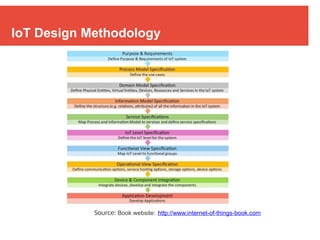
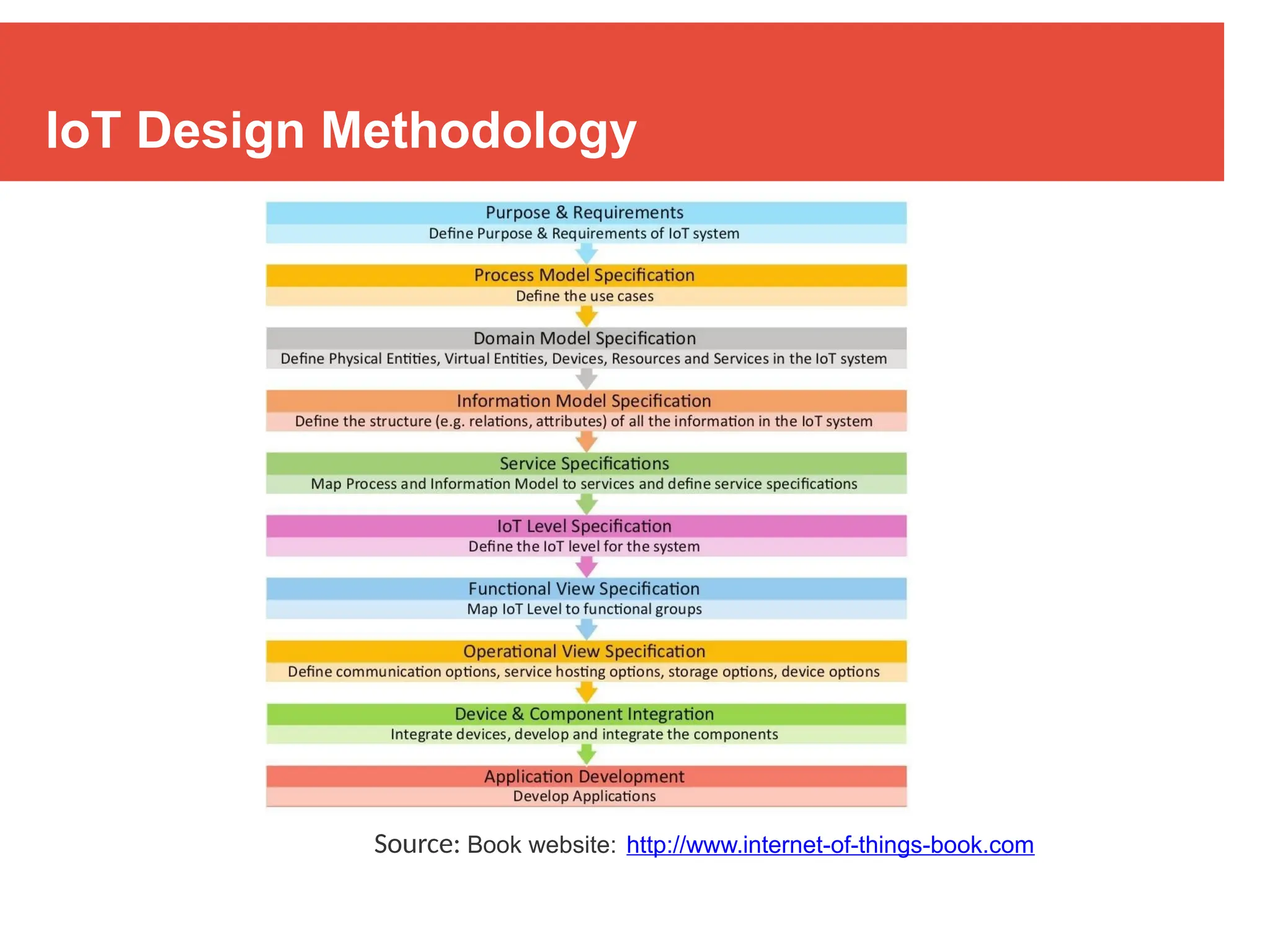
IoT Design Methodology
Source: Book website: http://www.internet-of-things-book.com
Internet of Things
Instructor : Dr. Bibhas Ghoshal
Spring 2022
IoT System Design : Home Automation
Source: Book website: http://www.internet-of-things-book.com
Internet of Things
Instructor : Dr. Bibhas Ghoshal
Spring 2022
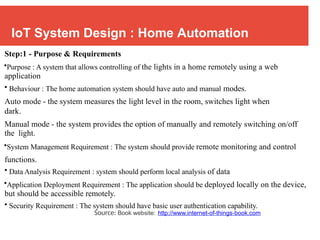
Step:1 - Purpose & Requirements
•Purpose : A system that allows controlling of the lights in a home remotely using a web
application
• Behaviour : The home automation system should have auto and manual modes.
Auto mode - the system measures the light level in the room, switches light when
dark.
Manual mode - the system provides the option of manually and remotely switching on/off
the light.
•System Management Requirement : The system should provide remote monitoring and control
functions.
• Data Analysis Requirement : system should perform local analysis of data
•Application Deployment Requirement : The application should be deployed locally on the device,
but should be accessible remotely.
• Security Requirement : The system should have basic user authentication capability.
IoT System Design : Home Automation
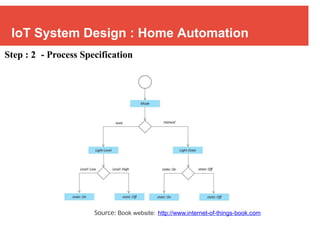
Step : 2 - Process Specification
Source: Book website: http://www.internet-of-things-book.com
Internet of Things
Instructor : Dr. Bibhas Ghoshal
Spring 2022
IoT System Design : Home Automation
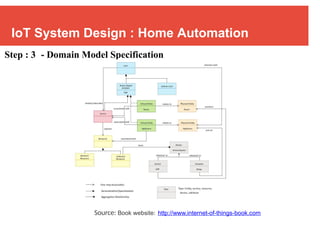
Step : 3 - Domain Model Specification
Source: Book website: http://www.internet-of-things-book.com
Internet of Things
Instructor : Dr. Bibhas Ghoshal
Spring 2022
IoT System Design : Home Automation
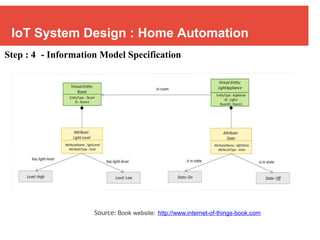
Step : 4 - Information Model Specification
Source: Book website: http://www.internet-of-things-book.com
Internet of Things
Instructor : Dr. Bibhas Ghoshal
Spring 2022
IoT System Design : Home Automation
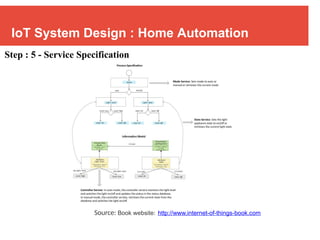
Step : 5 - Service Specification
Source: Book website: http://www.internet-of-things-book.com
Internet of Things
Instructor : Dr. Bibhas Ghoshal
Spring 2022
IoT System Design : Home Automation
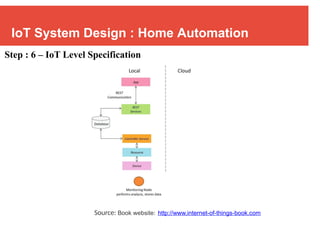
Step : 6 – IoT Level Specification
Source: Book website: http://www.internet-of-things-book.com
Internet of Things
Instructor : Dr. Bibhas Ghoshal
Spring 2022
IoT System Design : Home Automation
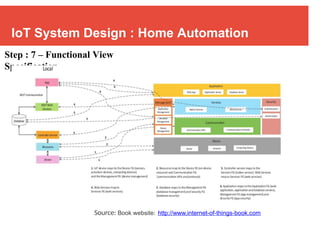
Step : 7 – Functional View
Specification
Source: Book website: http://www.internet-of-things-book.com
Internet of Things
Instructor : Dr. Bibhas Ghoshal
Spring 2022
IoT System Design : Home Automation
Step : 8 – Operational View Specification
Source: Book website: http://www.internet-of-things-book.com
Internet of Things
Instructor : Dr. Bibhas Ghoshal
Spring 2022
IoT System Design : Home Automation
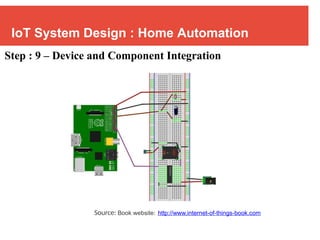
Step : 9 – Device and Component Integration
Source: Book website: http://www.internet-of-things-book.com
Internet of Things
Instructor : Dr. Bibhas Ghoshal
Spring 2022
IoT System Design : Home Automation
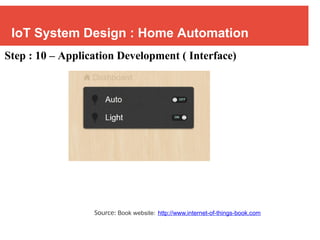
Step : 10 – Application Development ( Interface)
Source: Book website: http://www.internet-of-things-book.com
Internet of Things
Instructor : Dr. Bibhas Ghoshal
Spring 2022
IoT System Design : Home Automation
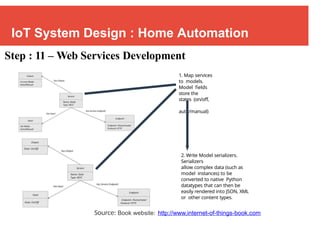
Step : 11 – Web Services Development
1. Map services
to models.
Model fields
store the
states (on/off,
auto/manual)
2. Write Model serializers.
Serializers
allow complex data (such as
model instances) to be
converted to native Python
datatypes that can then be
easily rendered into JSON, XML
or other content types.
Source: Book website: http://www.internet-of-things-book.com
Internet of Things
Instructor : Dr. Bibhas Ghoshal
Spring 2022
IoT System Design : Home Automation
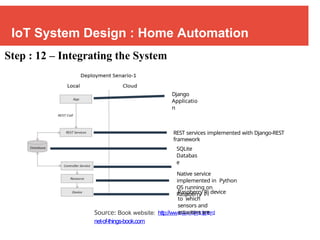
Step : 12 – Integrating the System
Django
Applicatio
n
Source: Book website: http://wwcown.ninecteterd
net-of-things-book.com
Internet of Things
Spring 2022
REST services implemented with Django-REST
framework
SQLite
Databas
e
Native service
implemented in Python
OS running on
Raspberry Pi
Raspberry Pi device
to which
sensors and
actuators are

Lecture3_IoT_System_Design_Methodology-Ch1.pptx

  • 1.
    IoT Design Methodology Source:Book website: http://www.internet-of-things-book.com Internet of Things Instructor : Dr. Bibhas Ghoshal Spring 2022
  • 2.
    IoT System Design: Home Automation Source: Book website: http://www.internet-of-things-book.com Internet of Things Instructor : Dr. Bibhas Ghoshal Spring 2022 Step:1 - Purpose & Requirements •Purpose : A system that allows controlling of the lights in a home remotely using a web application • Behaviour : The home automation system should have auto and manual modes. Auto mode - the system measures the light level in the room, switches light when dark. Manual mode - the system provides the option of manually and remotely switching on/off the light. •System Management Requirement : The system should provide remote monitoring and control functions. • Data Analysis Requirement : system should perform local analysis of data •Application Deployment Requirement : The application should be deployed locally on the device, but should be accessible remotely. • Security Requirement : The system should have basic user authentication capability.
  • 3.
    IoT System Design: Home Automation Step : 2 - Process Specification Source: Book website: http://www.internet-of-things-book.com Internet of Things Instructor : Dr. Bibhas Ghoshal Spring 2022
  • 4.
    IoT System Design: Home Automation Step : 3 - Domain Model Specification Source: Book website: http://www.internet-of-things-book.com Internet of Things Instructor : Dr. Bibhas Ghoshal Spring 2022
  • 5.
    IoT System Design: Home Automation Step : 4 - Information Model Specification Source: Book website: http://www.internet-of-things-book.com Internet of Things Instructor : Dr. Bibhas Ghoshal Spring 2022
  • 6.
    IoT System Design: Home Automation Step : 5 - Service Specification Source: Book website: http://www.internet-of-things-book.com Internet of Things Instructor : Dr. Bibhas Ghoshal Spring 2022
  • 7.
    IoT System Design: Home Automation Step : 6 – IoT Level Specification Source: Book website: http://www.internet-of-things-book.com Internet of Things Instructor : Dr. Bibhas Ghoshal Spring 2022
  • 8.
    IoT System Design: Home Automation Step : 7 – Functional View Specification Source: Book website: http://www.internet-of-things-book.com Internet of Things Instructor : Dr. Bibhas Ghoshal Spring 2022
  • 9.
    IoT System Design: Home Automation Step : 8 – Operational View Specification Source: Book website: http://www.internet-of-things-book.com Internet of Things Instructor : Dr. Bibhas Ghoshal Spring 2022
  • 10.
    IoT System Design: Home Automation Step : 9 – Device and Component Integration Source: Book website: http://www.internet-of-things-book.com Internet of Things Instructor : Dr. Bibhas Ghoshal Spring 2022
  • 11.
    IoT System Design: Home Automation Step : 10 – Application Development ( Interface) Source: Book website: http://www.internet-of-things-book.com Internet of Things Instructor : Dr. Bibhas Ghoshal Spring 2022
  • 12.
    IoT System Design: Home Automation Step : 11 – Web Services Development 1. Map services to models. Model fields store the states (on/off, auto/manual) 2. Write Model serializers. Serializers allow complex data (such as model instances) to be converted to native Python datatypes that can then be easily rendered into JSON, XML or other content types. Source: Book website: http://www.internet-of-things-book.com Internet of Things Instructor : Dr. Bibhas Ghoshal Spring 2022
  • 13.
    IoT System Design: Home Automation Step : 12 – Integrating the System Django Applicatio n Source: Book website: http://wwcown.ninecteterd net-of-things-book.com Internet of Things Spring 2022 REST services implemented with Django-REST framework SQLite Databas e Native service implemented in Python OS running on Raspberry Pi Raspberry Pi device to which sensors and actuators are