Biological Effects
IAEA Training Material on Radiation Protection in Radiotherapy
Radiation Protection in Radiotherapy Part 3, lecture 1: Radiation protection 2
Introduction
 What matters in the end is the biological
effect!
 Dose to the tumor determines probability of
cure (or likelihood of palliation)
 Dose to normal structures determines
probability of side effects and complications
 Dose to patient, staff and visitors determines
risk of radiation detriment to these groups
Radiation Protection in Radiotherapy Part 3, lecture 1: Radiation protection 3
Introduction
 What matters in the end is the biological
effect!
 Dose to the tumor determines probability of
cure (or likelihood of palliation)
 Dose to normal structures determines
probability of side effects and complications
 Dose to patient, staff and visitors determines
risk of radiation detriment to these groups
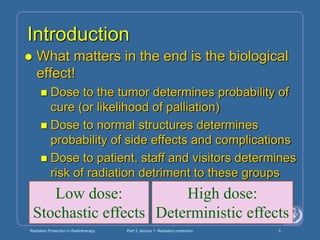
High dose:
Deterministic effects
Low dose:
Stochastic effects
Radiation Protection in Radiotherapy Part 3, lecture 1: Radiation protection 4
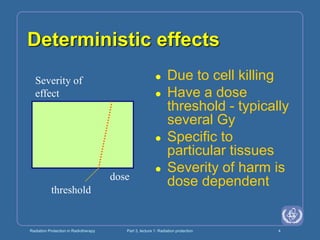
Deterministic effects
 Due to cell killing
 Have a dose
threshold - typically
several Gy
 Specific to
particular tissues
 Severity of harm is
dose dependent
dose
Severity of
effect
threshold
Radiation Protection in Radiotherapy Part 3, lecture 1: Radiation protection 5
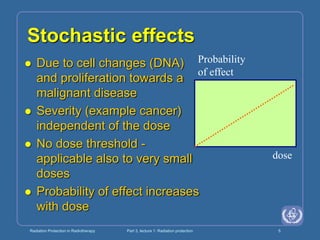
Stochastic effects
 Due to cell changes (DNA)
and proliferation towards a
malignant disease
 Severity (example cancer)
independent of the dose
 No dose threshold -
applicable also to very small
doses
 Probability of effect increases
with dose
dose
Probability
of effect
Radiation Protection in Radiotherapy Part 3, lecture 1: Radiation protection 6
Contents:
1. Biological radiation effects
2. From Gray to Sievert
3. Epidemiological evidence
4. Risks and dose constraints
Radiation Protection in Radiotherapy Part 3, lecture 1: Radiation protection 7
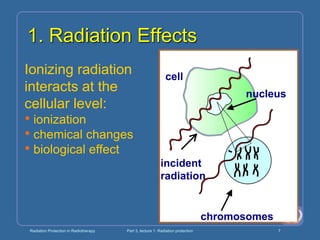
1. Radiation Effects
Ionizing radiation
interacts at the
cellular level:
• ionization
• chemical changes
• biological effect
cell
nucleus
chromosomes
incident
radiation
Radiation Protection in Radiotherapy Part 3, lecture 1: Radiation protection 8
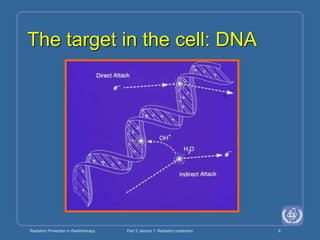
The target in the cell: DNA
Radiation Protection in Radiotherapy Part 3, lecture 1: Radiation protection 9
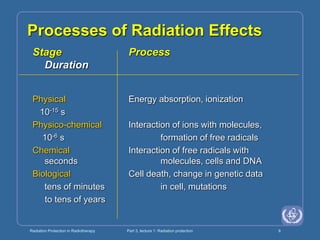
Processes of Radiation Effects
Stage Process
Duration
Physical Energy absorption, ionization
10-15 s
Physico-chemical Interaction of ions with molecules,
10-6 s formation of free radicals
Chemical Interaction of free radicals with
seconds molecules, cells and DNA
Biological Cell death, change in genetic data
tens of minutes in cell, mutations
to tens of years
Radiation Protection in Radiotherapy Part 3, lecture 1: Radiation protection 10
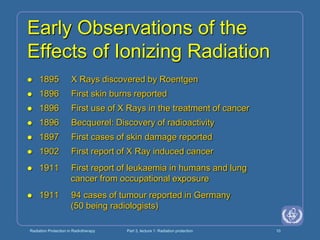
Early Observations of the
Effects of Ionizing Radiation
 1895 X Rays discovered by Roentgen
 1896 First skin burns reported
 1896 First use of X Rays in the treatment of cancer
 1896 Becquerel: Discovery of radioactivity
 1897 First cases of skin damage reported
 1902 First report of X Ray induced cancer
 1911 First report of leukaemia in humans and lung
cancer from occupational exposure
 1911 94 cases of tumour reported in Germany
(50 being radiologists)
Radiation Protection in Radiotherapy Part 3, lecture 1: Radiation protection 11
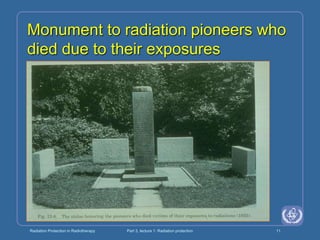
Monument to radiation pioneers who
died due to their exposures
Radiation Protection in Radiotherapy Part 3, lecture 1: Radiation protection 12
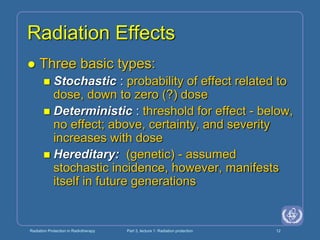
Radiation Effects
 Three basic types:
 Stochastic : probability of effect related to
dose, down to zero (?) dose
 Deterministic : threshold for effect - below,
no effect; above, certainty, and severity
increases with dose
 Hereditary: (genetic) - assumed
stochastic incidence, however, manifests
itself in future generations
Radiation Protection in Radiotherapy Part 3, lecture 1: Radiation protection 13
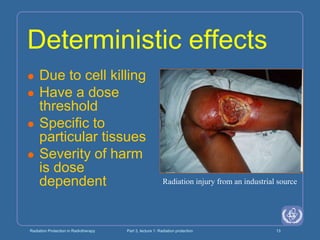
Deterministic effects
 Due to cell killing
 Have a dose
threshold
 Specific to
particular tissues
 Severity of harm
is dose
dependent Radiation injury from an industrial source
Radiation Protection in Radiotherapy Part 3, lecture 1: Radiation protection 14
Examples for deterministic
effects
 Skin breakdown
 Cataract of the lens of the eye
 Sterility
 Kidney failure
 Acute radiation syndrome (whole body)
Radiation Protection in Radiotherapy Part 3, lecture 1: Radiation protection 15
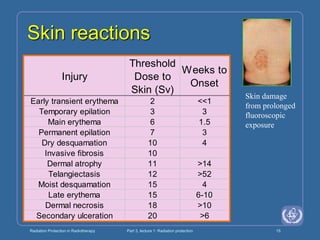
Skin reactions
Injury
Threshold
Dose to
Skin (Sv)
Weeks to
Onset
Early transient erythema 2 <<1
Temporary epilation 3 3
Main erythema 6 1.5
Permanent epilation 7 3
Dry desquamation 10 4
Invasive fibrosis 10
Dermal atrophy 11 >14
Telangiectasis 12 >52
Moist desquamation 15 4
Late erythema 15 6-10
Dermal necrosis 18 >10
Secondary ulceration 20 >6
Skin damage
from prolonged
fluoroscopic
exposure
Radiation Protection in Radiotherapy Part 3, lecture 1: Radiation protection 16
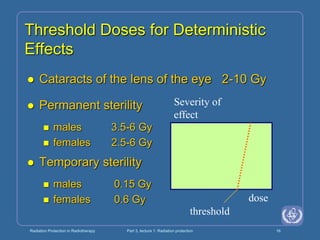
Threshold Doses for Deterministic
Effects
 Cataracts of the lens of the eye 2-10 Gy
 Permanent sterility
 males 3.5-6 Gy
 females 2.5-6 Gy
 Temporary sterility
 males 0.15 Gy
 females 0.6 Gy dose
Severity of
effect
threshold
Radiation Protection in Radiotherapy Part 3, lecture 1: Radiation protection 17
Note on threshold values
 Depend on dose delivery mode:
 single high dose most effective
 fractionation increases threshold dose in
most cases significantly
 decreasing the dose rate increases
threshold in most cases
 Threshold may differ in different
persons
Radiation Protection in Radiotherapy Part 3, lecture 1: Radiation protection 18
Stochastic effects
 Due to cell changes (DNA) and
proliferation towards a malignant
disease
 Severity (i.e. cancer) independent of the
dose
 No dose threshold (they are presumed
to occur at any dose however small)
 Probability of effect increases with dose
Radiation Protection in Radiotherapy Part 3, lecture 1: Radiation protection 19
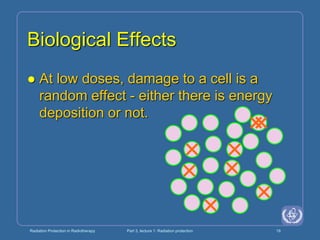
Biological Effects
 At low doses, damage to a cell is a
random effect - either there is energy
deposition or not.
Radiation Protection in Radiotherapy Part 3, lecture 1: Radiation protection 20
… order of magnitudes
 1cm3 of tissue = 109 cells
 1 mGy --> 1 in 1000 or 106 cells hit
 999 of 1000 lesions are repaired - leaving
103 cells damaged
 999 of 1000 damaged cells die (not a major
problem as millions of cells die every day in
every person)
 1 cell may live with damage (could be
mutated)
Radiation Protection in Radiotherapy Part 3, lecture 1: Radiation protection 21
Cancer induction
 The most important stochastic effect for
radiation safety considerations
 Is a multistage process - typically three
steps: each of them requires an event…
 Is a complicated process involving cells,
communication between cells and the
immune system...
Radiation Protection in Radiotherapy Part 3, lecture 1: Radiation protection 22
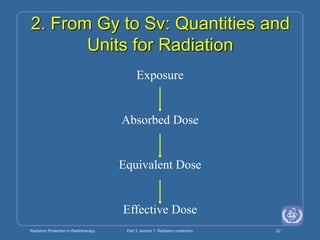
2. From Gy to Sv: Quantities and
Units for Radiation
Exposure
Absorbed Dose
Equivalent Dose
Effective Dose
Radiation Protection in Radiotherapy Part 3, lecture 1: Radiation protection 23
Radiation Quantities
Absorbed dose D
 the amount of energy deposited per unit
mass in any target material
 applies to any radiation
 measured in gray (Gy) = 1 joule/kg
 old unit the rad = 0.01 Gy
Radiation Protection in Radiotherapy Part 3, lecture 1: Radiation protection 24
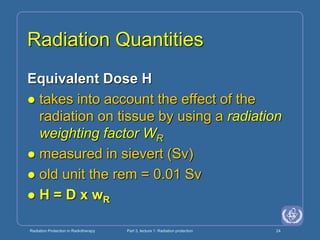
Radiation Quantities
Equivalent Dose H
 takes into account the effect of the
radiation on tissue by using a radiation
weighting factor WR
 measured in sievert (Sv)
 old unit the rem = 0.01 Sv
 H = D x wR
Radiation Protection in Radiotherapy Part 3, lecture 1: Radiation protection 25
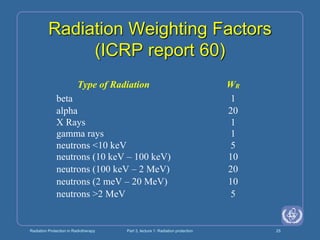
Radiation Weighting Factors
(ICRP report 60)
Type of Radiation WR
beta 1
alpha 20
X Rays 1
gamma rays 1
neutrons <10 keV 5
neutrons (10 keV – 100 keV) 10
neutrons (100 keV – 2 MeV) 20
neutrons (2 meV – 20 MeV) 10
neutrons >2 MeV 5
Radiation Protection in Radiotherapy Part 3, lecture 1: Radiation protection 26
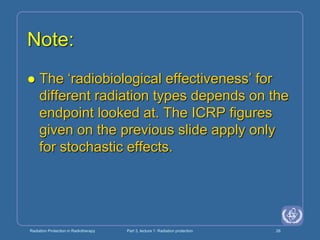
Note:
 The ‘radiobiological effectiveness’ for
different radiation types depends on the
endpoint looked at. The ICRP figures
given on the previous slide apply only
for stochastic effects.
Radiation Protection in Radiotherapy Part 3, lecture 1: Radiation protection 27
Radiation Quantities
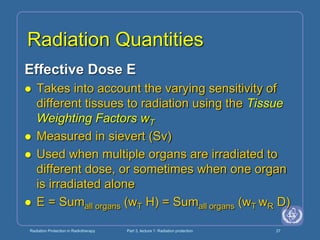
Effective Dose E
 Takes into account the varying sensitivity of
different tissues to radiation using the Tissue
Weighting Factors wT
 Measured in sievert (Sv)
 Used when multiple organs are irradiated to
different dose, or sometimes when one organ
is irradiated alone
 E = Sumall organs (wT H) = Sumall organs (wT wR D)
Radiation Protection in Radiotherapy Part 3, lecture 1: Radiation protection 28
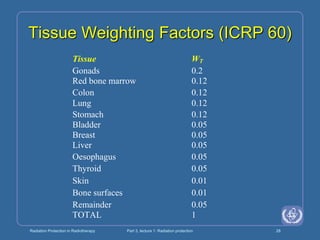
Tissue Weighting Factors (ICRP 60)
Tissue WT
Gonads 0.2
Red bone marrow 0.12
Colon 0.12
Lung 0.12
Stomach 0.12
Bladder 0.05
Breast 0.05
Liver 0.05
Oesophagus 0.05
Thyroid 0.05
Skin 0.01
Bone surfaces 0.01
Remainder 0.05
TOTAL 1
Radiation Protection in Radiotherapy Part 3, lecture 1: Radiation protection 29
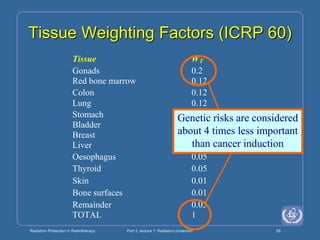
Tissue Weighting Factors (ICRP 60)
Tissue WT
Gonads 0.2
Red bone marrow 0.12
Colon 0.12
Lung 0.12
Stomach 0.12
Bladder 0.05
Breast 0.05
Liver 0.05
Oesophagus 0.05
Thyroid 0.05
Skin 0.01
Bone surfaces 0.01
Remainder 0.05
TOTAL 1
Genetic risks are considered
about 4 times less important
than cancer induction
Radiation Protection in Radiotherapy Part 3, lecture 1: Radiation protection 30
Radiation Quantities
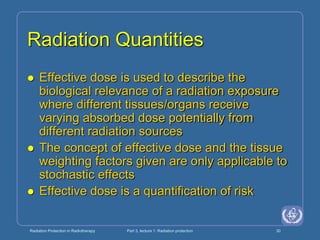
 Effective dose is used to describe the
biological relevance of a radiation exposure
where different tissues/organs receive
varying absorbed dose potentially from
different radiation sources
 The concept of effective dose and the tissue
weighting factors given are only applicable to
stochastic effects
 Effective dose is a quantification of risk
Radiation Protection in Radiotherapy Part 3, lecture 1: Radiation protection 31
Radiation Quantities
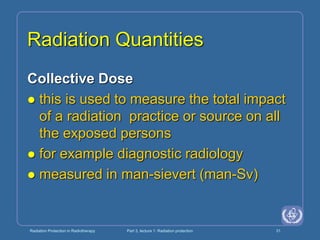
Collective Dose
 this is used to measure the total impact
of a radiation practice or source on all
the exposed persons
 for example diagnostic radiology
 measured in man-sievert (man-Sv)
Radiation Protection in Radiotherapy Part 3, lecture 1: Radiation protection 32
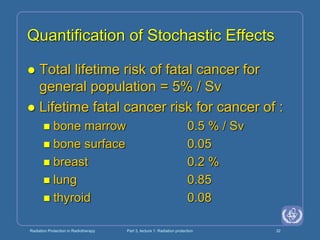
Quantification of Stochastic Effects
 Total lifetime risk of fatal cancer for
general population = 5% / Sv
 Lifetime fatal cancer risk for cancer of :
 bone marrow 0.5 % / Sv
 bone surface 0.05
 breast 0.2 %
 lung 0.85
 thyroid 0.08
Radiation Protection in Radiotherapy Part 3, lecture 1: Radiation protection 33
How do we know all this?
 Epidemiology (observations
of humans)
 Experimental radiobiology
(studies on animals)
 Cellular and molecular
radiation biology
Radiation Protection in Radiotherapy Part 3, lecture 1: Radiation protection 34
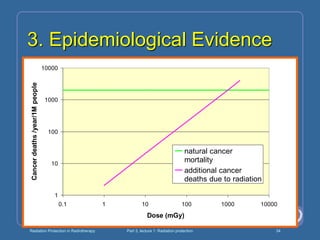
3. Epidemiological Evidence
1
10
100
1000
10000
0.1 1 10 100 1000 10000
Dose (mGy)
Cancer
deaths
/year/1M
people
natural cancer
mortality
additional cancer
deaths due to radiation
Radiation Protection in Radiotherapy Part 3, lecture 1: Radiation protection 35
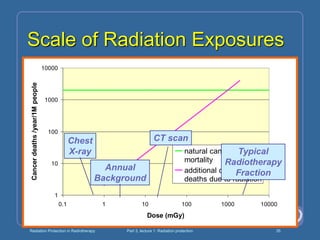
Scale of Radiation Exposures
1
10
100
1000
10000
0.1 1 10 100 1000 10000
Dose (mGy)
Cancer
deaths
/year/1M
people
natural cancer
mortality
additional cancer
deaths due to radiation
Annual
Background
CT scan
Chest
X-ray Typical
Radiotherapy
Fraction
Radiation Protection in Radiotherapy Part 3, lecture 1: Radiation protection 36
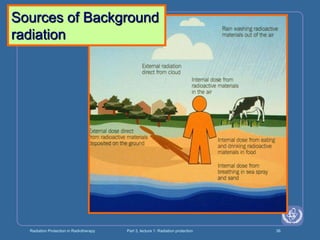
Sources of Background
radiation
Radiation Protection in Radiotherapy Part 3, lecture 1: Radiation protection 37
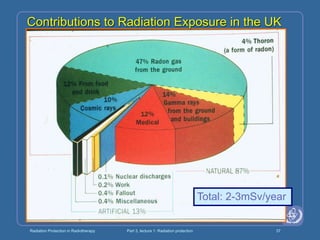
Contributions to Radiation Exposure in the UK
Total: 2-3mSv/year
Radiation Protection in Radiotherapy Part 3, lecture 1: Radiation protection 38
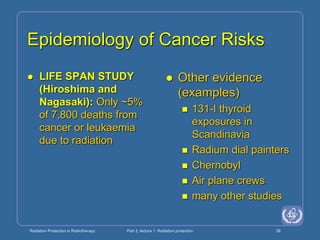
Epidemiology of Cancer Risks
 LIFE SPAN STUDY
(Hiroshima and
Nagasaki): Only ~5%
of 7,800 deaths from
cancer or leukaemia
due to radiation
 Other evidence
(examples)
 131-I thyroid
exposures in
Scandinavia
 Radium dial painters
 Chernobyl
 Air plane crews
 many other studies
Radiation Protection in Radiotherapy Part 3, lecture 1: Radiation protection 39
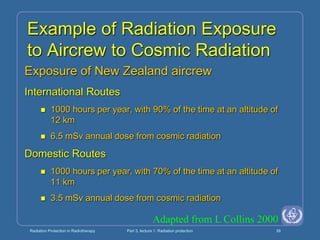
Example of Radiation Exposure
to Aircrew to Cosmic Radiation
Exposure of New Zealand aircrew
International Routes
 1000 hours per year, with 90% of the time at an altitude of
12 km
 6.5 mSv annual dose from cosmic radiation
Domestic Routes
 1000 hours per year, with 70% of the time at an altitude of
11 km
 3.5 mSv annual dose from cosmic radiation
Adapted from L Collins 2000
Radiation Protection in Radiotherapy Part 3, lecture 1: Radiation protection 40
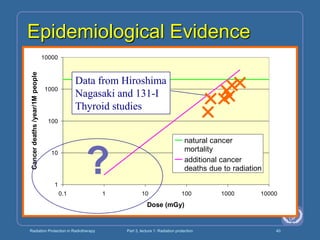
Epidemiological Evidence
1
10
100
1000
10000
0.1 1 10 100 1000 10000
Dose (mGy)
Cancer
deaths
/year/1M
people
natural cancer
mortality
additional cancer
deaths due to radiation
Data from Hiroshima
Nagasaki and 131-I
Thyroid studies
?
Radiation Protection in Radiotherapy Part 3, lecture 1: Radiation protection 41
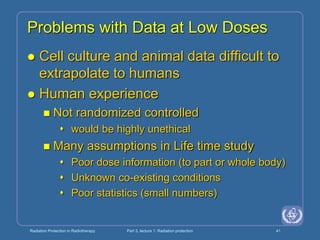
Problems with Data at Low Doses
 Cell culture and animal data difficult to
extrapolate to humans
 Human experience
 Not randomized controlled
 would be highly unethical
 Many assumptions in Life time study
 Poor dose information (to part or whole body)
 Unknown co-existing conditions
 Poor statistics (small numbers)
Radiation Protection in Radiotherapy Part 3, lecture 1: Radiation protection 42
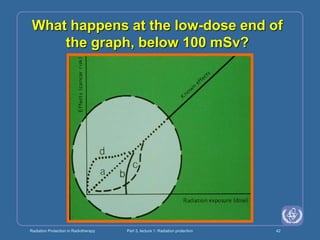
What happens at the low-dose end of
the graph, below 100 mSv?
Radiation Protection in Radiotherapy Part 3, lecture 1: Radiation protection 43
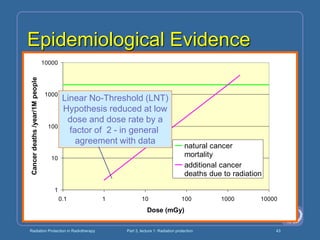
Epidemiological Evidence
1
10
100
1000
10000
0.1 1 10 100 1000 10000
Dose (mGy)
Cancer
deaths
/year/1M
people
natural cancer
mortality
additional cancer
deaths due to radiation
Linear No-Threshold (LNT)
Hypothesis reduced at low
dose and dose rate by a
factor of 2 - in general
agreement with data
Radiation Protection in Radiotherapy Part 3, lecture 1: Radiation protection 44
4. Risk Estimates
 Risk = probability of effect
 Different effects can be looked at - one needs
to carefully look at what effect is considered:
e.g. thyroid cancer mortality is NOT identical
to thyroid cancer incidence!!!!
 Risk estimates usually obtained from high
dose and extrapolated to low dose
Radiation Protection in Radiotherapy Part 3, lecture 1: Radiation protection 45
The Influence of Dose Rate on
Stochastic Effects
 Studies on mice comparing acute radiation with
continuous exposure demonstrates a dose-rate
reduction factor of between 2 and 5 for life-
shortening, and between 1 and 10 for tumour
induction.
 In humans, the atomic bomb survivor data suggests
a Dose Dose Rate Effectiveness Factor (DDREF) of
2.0 for leukaemia and 1.4 for all other cancers.
 A DDREF should be applied either if the total dose
is < 200 mGy or the dose rate is below 0.1
mGy/min.
Radiation Protection in Radiotherapy Part 3, lecture 1: Radiation protection 46
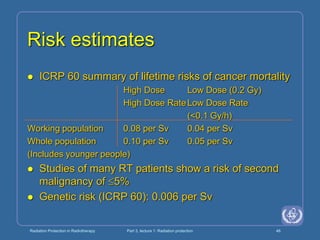
Risk estimates
 ICRP 60 summary of lifetime risks of cancer mortality
High Dose Low Dose (0.2 Gy)
High Dose RateLow Dose Rate
(<0.1 Gy/h)
Working population 0.08 per Sv 0.04 per Sv
Whole population 0.10 per Sv 0.05 per Sv
(Includes younger people)
 Studies of many RT patients show a risk of second
malignancy of 5%
 Genetic risk (ICRP 60): 0.006 per Sv
Radiation Protection in Radiotherapy Part 3, lecture 1: Radiation protection 47
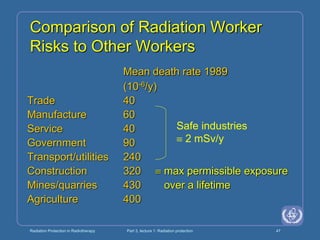
Comparison of Radiation Worker
Risks to Other Workers
Mean death rate 1989
(10-6/y)
Trade 40
Manufacture 60
Service 40
Government 90
Transport/utilities 240
Construction 320  max permissible exposure
Mines/quarries 430 over a lifetime
Agriculture 400
Safe industries
 2 mSv/y
Radiation Protection in Radiotherapy Part 3, lecture 1: Radiation protection 48
Basis for Exposure Limits
 Limits have changed with time
 Biological information
 Genetic risks are smaller, carcinogenic risks
are larger than thought in 1950s
 Social philosophy
 Ability to control exposures
Radiation Protection in Radiotherapy Part 3, lecture 1: Radiation protection 49
Comment on Fetus/Embryo
 Fetus/embryo is more sensitive to ionizing radiation
than the adult human
 Increased incidence of spontaneous abortion a few
days after conception
 Increased incidence
 Mental retardation
 Microcephaly (small head size) especially 8-15 weeks after
conception
 Malformations: skeletal, stunted growth, genital
 Higher risk of cancer (esp. leukemia)
 Both in childhood and later life
Radiation Protection in Radiotherapy Part 3, lecture 1: Radiation protection 50
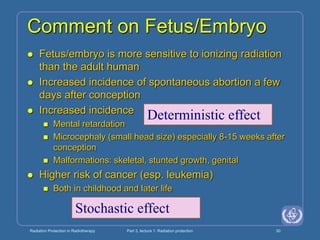
Comment on Fetus/Embryo
 Fetus/embryo is more sensitive to ionizing radiation
than the adult human
 Increased incidence of spontaneous abortion a few
days after conception
 Increased incidence
 Mental retardation
 Microcephaly (small head size) especially 8-15 weeks after
conception
 Malformations: skeletal, stunted growth, genital
 Higher risk of cancer (esp. leukemia)
 Both in childhood and later life
Deterministic effect
Stochastic effect
Radiation Protection in Radiotherapy Part 3, lecture 1: Radiation protection 51
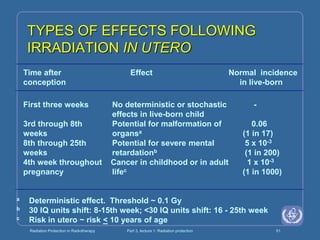
Time after Effect Normal incidence
conception in live-born
First three weeks No deterministic or stochastic -
effects in live-born child
3rd through 8th Potential for malformation of 0.06
weeks organsa (1 in 17)
8th through 25th Potential for severe mental 5 x 10⁻³
weeks retardationb (1 in 200)
4th week throughout Cancer in childhood or in adult 1 x 10⁻³
pregnancy lifec (1 in 1000)
a Deterministic effect. Threshold ~ 0.1 Gy
b 30 IQ units shift: 8-15th week; <30 IQ units shift: 16 - 25th week
c Risk in utero ~ risk < 10 years of age
TYPES OF EFFECTS FOLLOWING
IRRADIATION IN UTERO
Radiation Protection in Radiotherapy Part 3, lecture 1: Radiation protection 52
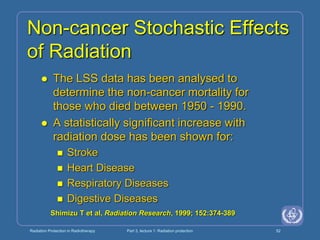
Non-cancer Stochastic Effects
of Radiation
 The LSS data has been analysed to
determine the non-cancer mortality for
those who died between 1950 - 1990.
 A statistically significant increase with
radiation dose has been shown for:
 Stroke
 Heart Disease
 Respiratory Diseases
 Digestive Diseases
Shimizu T et al, Radiation Research, 1999; 152:374-389
Radiation Protection in Radiotherapy Part 3, lecture 1: Radiation protection 53
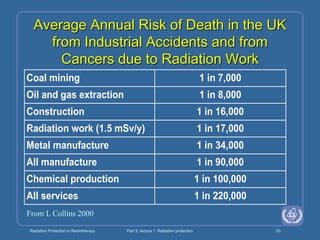
Average Annual Risk of Death in the UK
from Industrial Accidents and from
Cancers due to Radiation Work
Coal mining 1 in 7,000
Oil and gas extraction 1 in 8,000
Construction 1 in 16,000
Radiation work (1.5 mSv/y) 1 in 17,000
Metal manufacture 1 in 34,000
All manufacture 1 in 90,000
Chemical production 1 in 100,000
All services 1 in 220,000
From L Collins 2000
Radiation Protection in Radiotherapy Part 3, lecture 1: Radiation protection 54
Summary
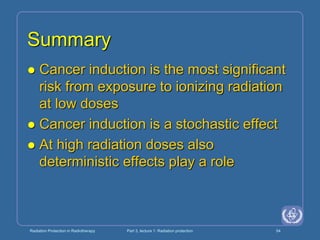
 Cancer induction is the most significant
risk from exposure to ionizing radiation
at low doses
 Cancer induction is a stochastic effect
 At high radiation doses also
deterministic effects play a role
Radiation Protection in Radiotherapy Part 3, lecture 1: Radiation protection 55
Summary: Dose Quantities
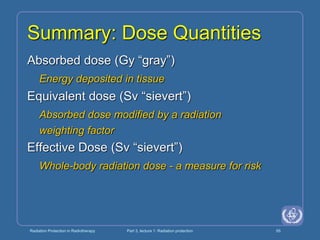
Absorbed dose (Gy “gray”)
Energy deposited in tissue
Equivalent dose (Sv “sievert”)
Absorbed dose modified by a radiation
weighting factor
Effective Dose (Sv “sievert”)
Whole-body radiation dose - a measure for risk
Radiation Protection in Radiotherapy Part 3, lecture 1: Radiation protection 56
Summary
 Risks can be calculated
 However:
 the numbers are typically small and may not be
meaningful for everyone
 The action taken to avoid or minimize risks
depends on interpretation and the perceived
benefits - this can vary significantly from one
person to the next and amongst societies
 Dose constraints can be chosen to
match risks in other professions
Any questions?
Question:
Why is our information of radiation
effects of low radiation doses
(e.g. < 20mSv) limited?
Radiation Protection in Radiotherapy Part 3, lecture 1: Radiation protection 59
The answer should include but
not be limited to:
 Close to background radiation - dosimetry
difficult
 Limited epidemiological evidence
 Research and experiments with humans are
ethically impossible
 The effects are very small (if any)
 It is likely that there is a dose and dose rate
effect - at lower doses and dose rate
radiation effects are likely to be smaller than
at high doses.

Lecture_2 Radiation effects.pptx

  • 1.
    Biological Effects IAEA TrainingMaterial on Radiation Protection in Radiotherapy
  • 2.
    Radiation Protection inRadiotherapy Part 3, lecture 1: Radiation protection 2 Introduction  What matters in the end is the biological effect!  Dose to the tumor determines probability of cure (or likelihood of palliation)  Dose to normal structures determines probability of side effects and complications  Dose to patient, staff and visitors determines risk of radiation detriment to these groups
  • 3.
    Radiation Protection inRadiotherapy Part 3, lecture 1: Radiation protection 3 Introduction  What matters in the end is the biological effect!  Dose to the tumor determines probability of cure (or likelihood of palliation)  Dose to normal structures determines probability of side effects and complications  Dose to patient, staff and visitors determines risk of radiation detriment to these groups High dose: Deterministic effects Low dose: Stochastic effects
  • 4.
    Radiation Protection inRadiotherapy Part 3, lecture 1: Radiation protection 4 Deterministic effects  Due to cell killing  Have a dose threshold - typically several Gy  Specific to particular tissues  Severity of harm is dose dependent dose Severity of effect threshold
  • 5.
    Radiation Protection inRadiotherapy Part 3, lecture 1: Radiation protection 5 Stochastic effects  Due to cell changes (DNA) and proliferation towards a malignant disease  Severity (example cancer) independent of the dose  No dose threshold - applicable also to very small doses  Probability of effect increases with dose dose Probability of effect
  • 6.
    Radiation Protection inRadiotherapy Part 3, lecture 1: Radiation protection 6 Contents: 1. Biological radiation effects 2. From Gray to Sievert 3. Epidemiological evidence 4. Risks and dose constraints
  • 7.
    Radiation Protection inRadiotherapy Part 3, lecture 1: Radiation protection 7 1. Radiation Effects Ionizing radiation interacts at the cellular level: • ionization • chemical changes • biological effect cell nucleus chromosomes incident radiation
  • 8.
    Radiation Protection inRadiotherapy Part 3, lecture 1: Radiation protection 8 The target in the cell: DNA
  • 9.
    Radiation Protection inRadiotherapy Part 3, lecture 1: Radiation protection 9 Processes of Radiation Effects Stage Process Duration Physical Energy absorption, ionization 10-15 s Physico-chemical Interaction of ions with molecules, 10-6 s formation of free radicals Chemical Interaction of free radicals with seconds molecules, cells and DNA Biological Cell death, change in genetic data tens of minutes in cell, mutations to tens of years
  • 10.
    Radiation Protection inRadiotherapy Part 3, lecture 1: Radiation protection 10 Early Observations of the Effects of Ionizing Radiation  1895 X Rays discovered by Roentgen  1896 First skin burns reported  1896 First use of X Rays in the treatment of cancer  1896 Becquerel: Discovery of radioactivity  1897 First cases of skin damage reported  1902 First report of X Ray induced cancer  1911 First report of leukaemia in humans and lung cancer from occupational exposure  1911 94 cases of tumour reported in Germany (50 being radiologists)
  • 11.
    Radiation Protection inRadiotherapy Part 3, lecture 1: Radiation protection 11 Monument to radiation pioneers who died due to their exposures
  • 12.
    Radiation Protection inRadiotherapy Part 3, lecture 1: Radiation protection 12 Radiation Effects  Three basic types:  Stochastic : probability of effect related to dose, down to zero (?) dose  Deterministic : threshold for effect - below, no effect; above, certainty, and severity increases with dose  Hereditary: (genetic) - assumed stochastic incidence, however, manifests itself in future generations
  • 13.
    Radiation Protection inRadiotherapy Part 3, lecture 1: Radiation protection 13 Deterministic effects  Due to cell killing  Have a dose threshold  Specific to particular tissues  Severity of harm is dose dependent Radiation injury from an industrial source
  • 14.
    Radiation Protection inRadiotherapy Part 3, lecture 1: Radiation protection 14 Examples for deterministic effects  Skin breakdown  Cataract of the lens of the eye  Sterility  Kidney failure  Acute radiation syndrome (whole body)
  • 15.
    Radiation Protection inRadiotherapy Part 3, lecture 1: Radiation protection 15 Skin reactions Injury Threshold Dose to Skin (Sv) Weeks to Onset Early transient erythema 2 <<1 Temporary epilation 3 3 Main erythema 6 1.5 Permanent epilation 7 3 Dry desquamation 10 4 Invasive fibrosis 10 Dermal atrophy 11 >14 Telangiectasis 12 >52 Moist desquamation 15 4 Late erythema 15 6-10 Dermal necrosis 18 >10 Secondary ulceration 20 >6 Skin damage from prolonged fluoroscopic exposure
  • 16.
    Radiation Protection inRadiotherapy Part 3, lecture 1: Radiation protection 16 Threshold Doses for Deterministic Effects  Cataracts of the lens of the eye 2-10 Gy  Permanent sterility  males 3.5-6 Gy  females 2.5-6 Gy  Temporary sterility  males 0.15 Gy  females 0.6 Gy dose Severity of effect threshold
  • 17.
    Radiation Protection inRadiotherapy Part 3, lecture 1: Radiation protection 17 Note on threshold values  Depend on dose delivery mode:  single high dose most effective  fractionation increases threshold dose in most cases significantly  decreasing the dose rate increases threshold in most cases  Threshold may differ in different persons
  • 18.
    Radiation Protection inRadiotherapy Part 3, lecture 1: Radiation protection 18 Stochastic effects  Due to cell changes (DNA) and proliferation towards a malignant disease  Severity (i.e. cancer) independent of the dose  No dose threshold (they are presumed to occur at any dose however small)  Probability of effect increases with dose
  • 19.
    Radiation Protection inRadiotherapy Part 3, lecture 1: Radiation protection 19 Biological Effects  At low doses, damage to a cell is a random effect - either there is energy deposition or not.
  • 20.
    Radiation Protection inRadiotherapy Part 3, lecture 1: Radiation protection 20 … order of magnitudes  1cm3 of tissue = 109 cells  1 mGy --> 1 in 1000 or 106 cells hit  999 of 1000 lesions are repaired - leaving 103 cells damaged  999 of 1000 damaged cells die (not a major problem as millions of cells die every day in every person)  1 cell may live with damage (could be mutated)
  • 21.
    Radiation Protection inRadiotherapy Part 3, lecture 1: Radiation protection 21 Cancer induction  The most important stochastic effect for radiation safety considerations  Is a multistage process - typically three steps: each of them requires an event…  Is a complicated process involving cells, communication between cells and the immune system...
  • 22.
    Radiation Protection inRadiotherapy Part 3, lecture 1: Radiation protection 22 2. From Gy to Sv: Quantities and Units for Radiation Exposure Absorbed Dose Equivalent Dose Effective Dose
  • 23.
    Radiation Protection inRadiotherapy Part 3, lecture 1: Radiation protection 23 Radiation Quantities Absorbed dose D  the amount of energy deposited per unit mass in any target material  applies to any radiation  measured in gray (Gy) = 1 joule/kg  old unit the rad = 0.01 Gy
  • 24.
    Radiation Protection inRadiotherapy Part 3, lecture 1: Radiation protection 24 Radiation Quantities Equivalent Dose H  takes into account the effect of the radiation on tissue by using a radiation weighting factor WR  measured in sievert (Sv)  old unit the rem = 0.01 Sv  H = D x wR
  • 25.
    Radiation Protection inRadiotherapy Part 3, lecture 1: Radiation protection 25 Radiation Weighting Factors (ICRP report 60) Type of Radiation WR beta 1 alpha 20 X Rays 1 gamma rays 1 neutrons <10 keV 5 neutrons (10 keV – 100 keV) 10 neutrons (100 keV – 2 MeV) 20 neutrons (2 meV – 20 MeV) 10 neutrons >2 MeV 5
  • 26.
    Radiation Protection inRadiotherapy Part 3, lecture 1: Radiation protection 26 Note:  The ‘radiobiological effectiveness’ for different radiation types depends on the endpoint looked at. The ICRP figures given on the previous slide apply only for stochastic effects.
  • 27.
    Radiation Protection inRadiotherapy Part 3, lecture 1: Radiation protection 27 Radiation Quantities Effective Dose E  Takes into account the varying sensitivity of different tissues to radiation using the Tissue Weighting Factors wT  Measured in sievert (Sv)  Used when multiple organs are irradiated to different dose, or sometimes when one organ is irradiated alone  E = Sumall organs (wT H) = Sumall organs (wT wR D)
  • 28.
    Radiation Protection inRadiotherapy Part 3, lecture 1: Radiation protection 28 Tissue Weighting Factors (ICRP 60) Tissue WT Gonads 0.2 Red bone marrow 0.12 Colon 0.12 Lung 0.12 Stomach 0.12 Bladder 0.05 Breast 0.05 Liver 0.05 Oesophagus 0.05 Thyroid 0.05 Skin 0.01 Bone surfaces 0.01 Remainder 0.05 TOTAL 1
  • 29.
    Radiation Protection inRadiotherapy Part 3, lecture 1: Radiation protection 29 Tissue Weighting Factors (ICRP 60) Tissue WT Gonads 0.2 Red bone marrow 0.12 Colon 0.12 Lung 0.12 Stomach 0.12 Bladder 0.05 Breast 0.05 Liver 0.05 Oesophagus 0.05 Thyroid 0.05 Skin 0.01 Bone surfaces 0.01 Remainder 0.05 TOTAL 1 Genetic risks are considered about 4 times less important than cancer induction
  • 30.
    Radiation Protection inRadiotherapy Part 3, lecture 1: Radiation protection 30 Radiation Quantities  Effective dose is used to describe the biological relevance of a radiation exposure where different tissues/organs receive varying absorbed dose potentially from different radiation sources  The concept of effective dose and the tissue weighting factors given are only applicable to stochastic effects  Effective dose is a quantification of risk
  • 31.
    Radiation Protection inRadiotherapy Part 3, lecture 1: Radiation protection 31 Radiation Quantities Collective Dose  this is used to measure the total impact of a radiation practice or source on all the exposed persons  for example diagnostic radiology  measured in man-sievert (man-Sv)
  • 32.
    Radiation Protection inRadiotherapy Part 3, lecture 1: Radiation protection 32 Quantification of Stochastic Effects  Total lifetime risk of fatal cancer for general population = 5% / Sv  Lifetime fatal cancer risk for cancer of :  bone marrow 0.5 % / Sv  bone surface 0.05  breast 0.2 %  lung 0.85  thyroid 0.08
  • 33.
    Radiation Protection inRadiotherapy Part 3, lecture 1: Radiation protection 33 How do we know all this?  Epidemiology (observations of humans)  Experimental radiobiology (studies on animals)  Cellular and molecular radiation biology
  • 34.
    Radiation Protection inRadiotherapy Part 3, lecture 1: Radiation protection 34 3. Epidemiological Evidence 1 10 100 1000 10000 0.1 1 10 100 1000 10000 Dose (mGy) Cancer deaths /year/1M people natural cancer mortality additional cancer deaths due to radiation
  • 35.
    Radiation Protection inRadiotherapy Part 3, lecture 1: Radiation protection 35 Scale of Radiation Exposures 1 10 100 1000 10000 0.1 1 10 100 1000 10000 Dose (mGy) Cancer deaths /year/1M people natural cancer mortality additional cancer deaths due to radiation Annual Background CT scan Chest X-ray Typical Radiotherapy Fraction
  • 36.
    Radiation Protection inRadiotherapy Part 3, lecture 1: Radiation protection 36 Sources of Background radiation
  • 37.
    Radiation Protection inRadiotherapy Part 3, lecture 1: Radiation protection 37 Contributions to Radiation Exposure in the UK Total: 2-3mSv/year
  • 38.
    Radiation Protection inRadiotherapy Part 3, lecture 1: Radiation protection 38 Epidemiology of Cancer Risks  LIFE SPAN STUDY (Hiroshima and Nagasaki): Only ~5% of 7,800 deaths from cancer or leukaemia due to radiation  Other evidence (examples)  131-I thyroid exposures in Scandinavia  Radium dial painters  Chernobyl  Air plane crews  many other studies
  • 39.
    Radiation Protection inRadiotherapy Part 3, lecture 1: Radiation protection 39 Example of Radiation Exposure to Aircrew to Cosmic Radiation Exposure of New Zealand aircrew International Routes  1000 hours per year, with 90% of the time at an altitude of 12 km  6.5 mSv annual dose from cosmic radiation Domestic Routes  1000 hours per year, with 70% of the time at an altitude of 11 km  3.5 mSv annual dose from cosmic radiation Adapted from L Collins 2000
  • 40.
    Radiation Protection inRadiotherapy Part 3, lecture 1: Radiation protection 40 Epidemiological Evidence 1 10 100 1000 10000 0.1 1 10 100 1000 10000 Dose (mGy) Cancer deaths /year/1M people natural cancer mortality additional cancer deaths due to radiation Data from Hiroshima Nagasaki and 131-I Thyroid studies ?
  • 41.
    Radiation Protection inRadiotherapy Part 3, lecture 1: Radiation protection 41 Problems with Data at Low Doses  Cell culture and animal data difficult to extrapolate to humans  Human experience  Not randomized controlled  would be highly unethical  Many assumptions in Life time study  Poor dose information (to part or whole body)  Unknown co-existing conditions  Poor statistics (small numbers)
  • 42.
    Radiation Protection inRadiotherapy Part 3, lecture 1: Radiation protection 42 What happens at the low-dose end of the graph, below 100 mSv?
  • 43.
    Radiation Protection inRadiotherapy Part 3, lecture 1: Radiation protection 43 Epidemiological Evidence 1 10 100 1000 10000 0.1 1 10 100 1000 10000 Dose (mGy) Cancer deaths /year/1M people natural cancer mortality additional cancer deaths due to radiation Linear No-Threshold (LNT) Hypothesis reduced at low dose and dose rate by a factor of 2 - in general agreement with data
  • 44.
    Radiation Protection inRadiotherapy Part 3, lecture 1: Radiation protection 44 4. Risk Estimates  Risk = probability of effect  Different effects can be looked at - one needs to carefully look at what effect is considered: e.g. thyroid cancer mortality is NOT identical to thyroid cancer incidence!!!!  Risk estimates usually obtained from high dose and extrapolated to low dose
  • 45.
    Radiation Protection inRadiotherapy Part 3, lecture 1: Radiation protection 45 The Influence of Dose Rate on Stochastic Effects  Studies on mice comparing acute radiation with continuous exposure demonstrates a dose-rate reduction factor of between 2 and 5 for life- shortening, and between 1 and 10 for tumour induction.  In humans, the atomic bomb survivor data suggests a Dose Dose Rate Effectiveness Factor (DDREF) of 2.0 for leukaemia and 1.4 for all other cancers.  A DDREF should be applied either if the total dose is < 200 mGy or the dose rate is below 0.1 mGy/min.
  • 46.
    Radiation Protection inRadiotherapy Part 3, lecture 1: Radiation protection 46 Risk estimates  ICRP 60 summary of lifetime risks of cancer mortality High Dose Low Dose (0.2 Gy) High Dose RateLow Dose Rate (<0.1 Gy/h) Working population 0.08 per Sv 0.04 per Sv Whole population 0.10 per Sv 0.05 per Sv (Includes younger people)  Studies of many RT patients show a risk of second malignancy of 5%  Genetic risk (ICRP 60): 0.006 per Sv
  • 47.
    Radiation Protection inRadiotherapy Part 3, lecture 1: Radiation protection 47 Comparison of Radiation Worker Risks to Other Workers Mean death rate 1989 (10-6/y) Trade 40 Manufacture 60 Service 40 Government 90 Transport/utilities 240 Construction 320  max permissible exposure Mines/quarries 430 over a lifetime Agriculture 400 Safe industries  2 mSv/y
  • 48.
    Radiation Protection inRadiotherapy Part 3, lecture 1: Radiation protection 48 Basis for Exposure Limits  Limits have changed with time  Biological information  Genetic risks are smaller, carcinogenic risks are larger than thought in 1950s  Social philosophy  Ability to control exposures
  • 49.
    Radiation Protection inRadiotherapy Part 3, lecture 1: Radiation protection 49 Comment on Fetus/Embryo  Fetus/embryo is more sensitive to ionizing radiation than the adult human  Increased incidence of spontaneous abortion a few days after conception  Increased incidence  Mental retardation  Microcephaly (small head size) especially 8-15 weeks after conception  Malformations: skeletal, stunted growth, genital  Higher risk of cancer (esp. leukemia)  Both in childhood and later life
  • 50.
    Radiation Protection inRadiotherapy Part 3, lecture 1: Radiation protection 50 Comment on Fetus/Embryo  Fetus/embryo is more sensitive to ionizing radiation than the adult human  Increased incidence of spontaneous abortion a few days after conception  Increased incidence  Mental retardation  Microcephaly (small head size) especially 8-15 weeks after conception  Malformations: skeletal, stunted growth, genital  Higher risk of cancer (esp. leukemia)  Both in childhood and later life Deterministic effect Stochastic effect
  • 51.
    Radiation Protection inRadiotherapy Part 3, lecture 1: Radiation protection 51 Time after Effect Normal incidence conception in live-born First three weeks No deterministic or stochastic - effects in live-born child 3rd through 8th Potential for malformation of 0.06 weeks organsa (1 in 17) 8th through 25th Potential for severe mental 5 x 10⁻³ weeks retardationb (1 in 200) 4th week throughout Cancer in childhood or in adult 1 x 10⁻³ pregnancy lifec (1 in 1000) a Deterministic effect. Threshold ~ 0.1 Gy b 30 IQ units shift: 8-15th week; <30 IQ units shift: 16 - 25th week c Risk in utero ~ risk < 10 years of age TYPES OF EFFECTS FOLLOWING IRRADIATION IN UTERO
  • 52.
    Radiation Protection inRadiotherapy Part 3, lecture 1: Radiation protection 52 Non-cancer Stochastic Effects of Radiation  The LSS data has been analysed to determine the non-cancer mortality for those who died between 1950 - 1990.  A statistically significant increase with radiation dose has been shown for:  Stroke  Heart Disease  Respiratory Diseases  Digestive Diseases Shimizu T et al, Radiation Research, 1999; 152:374-389
  • 53.
    Radiation Protection inRadiotherapy Part 3, lecture 1: Radiation protection 53 Average Annual Risk of Death in the UK from Industrial Accidents and from Cancers due to Radiation Work Coal mining 1 in 7,000 Oil and gas extraction 1 in 8,000 Construction 1 in 16,000 Radiation work (1.5 mSv/y) 1 in 17,000 Metal manufacture 1 in 34,000 All manufacture 1 in 90,000 Chemical production 1 in 100,000 All services 1 in 220,000 From L Collins 2000
  • 54.
    Radiation Protection inRadiotherapy Part 3, lecture 1: Radiation protection 54 Summary  Cancer induction is the most significant risk from exposure to ionizing radiation at low doses  Cancer induction is a stochastic effect  At high radiation doses also deterministic effects play a role
  • 55.
    Radiation Protection inRadiotherapy Part 3, lecture 1: Radiation protection 55 Summary: Dose Quantities Absorbed dose (Gy “gray”) Energy deposited in tissue Equivalent dose (Sv “sievert”) Absorbed dose modified by a radiation weighting factor Effective Dose (Sv “sievert”) Whole-body radiation dose - a measure for risk
  • 56.
    Radiation Protection inRadiotherapy Part 3, lecture 1: Radiation protection 56 Summary  Risks can be calculated  However:  the numbers are typically small and may not be meaningful for everyone  The action taken to avoid or minimize risks depends on interpretation and the perceived benefits - this can vary significantly from one person to the next and amongst societies  Dose constraints can be chosen to match risks in other professions
  • 57.
  • 58.
    Question: Why is ourinformation of radiation effects of low radiation doses (e.g. < 20mSv) limited?
  • 59.
    Radiation Protection inRadiotherapy Part 3, lecture 1: Radiation protection 59 The answer should include but not be limited to:  Close to background radiation - dosimetry difficult  Limited epidemiological evidence  Research and experiments with humans are ethically impossible  The effects are very small (if any)  It is likely that there is a dose and dose rate effect - at lower doses and dose rate radiation effects are likely to be smaller than at high doses.

Editor's Notes