International Conference on Islamic Microfinance CENTER OF ISLAMIC BANKING & ECNOMICS Organized By : Held At:
Mr. Mamode Raffick Nabee Mohomed Founder/Secretary Al Barakah MCSL ISLAMIC MICROFINANCE  THE CO-OPERATIVE MODEL Case Study Of : Al Barakah Multi-purpose Co-operative Society Limited An Islamic   Microfinance Co-operative in Mauritius
Conceptual Framework Mindset for Islamic Micro Finance “ … this day have I perfected your  religion  for you, completed My favour upon you, and have chosen for you  Islam  as your religion…” (Maida- 5:3)“ Purpose of Creation of man Wa maa khalatul jinna wal insaa illaa liya buduun(51:56)
PRAISE TO ALLAH Sabbaha lillaahi maa fissammaawaati wa maa fil-’arz:wa Huwal- ‘Aziizul- hakiim(59:1) Tout dans bannes le ciel et la terre faire  louanges  Allah. C’est Li le puissant, Le sage. Tabaarakallazii bi yadihil-Mulk; wa Huwa alaa kulli shay-in-Qadiir Allazii khalaqal –mawta wal Hayaata  li-yabluwakum ayyukum ahsanu amalaa: wa Huwal- ‘Aziizul- Gafuur(67:1 & 2) Louanges a Celui, qui  L’autorite  dans So la main.Li enan pouvoir lor tout quique chose. C’est Li qui fine creer la mort et la vie, pou tester ou et trouver qui cene la faire meilleur travail. Li puissant et pardonneur aussi.
OWNERSHIP Lillaahi maa fissamaawaati wa maa fil ard.(2:286) Tout ce qui lor banne le ciel et la terre pou Allah . ACCOUNTABILITY Wa tabarakallazii lahuu mulkus-samaawaati wal-’ardi wa maa baynahumaa: wa ‘indahuu ilmus-Sa a’ah: wa ilayhi turja’uun( 43 : 85) Louange a Celui qui possede banne le ciel et la terre, et tout ce qui exister entre les deux, et aussi la connaissance de l’Heure. C’est divant Li qui pou faire ou retourner . Wa innaaa ilaa Rabbinaa lamunqalibuun( 43: 14) Nou sur pou  retourner  vers nous Maitre. Fana+Retour +…….Hisab/Accountable ?
Worldviews ? What is worldview ?  It is not just your view of the globe/universe but fundamental convictions and  assumptions  about  - the meaning of life - The nature of good and evil, - Your view of humankind -  Your values  - Overall life perspective Several explanations of the universe ,nature and meaning of human life have been given. Differences in views leads to differences in conclusions
Role of   worldview! Every society/system is determined by its own Wv   Based on a set of  assumptions   - About the  origin  of the universe  - The  nature  of human life. The Wv performs the same function as the  foundation  does for a building. The society is a logical result of this Wv. ( Wv of Capitalist, communist,socialist societies )
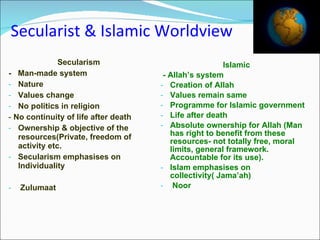
Secularist & Islamic Worldview Secularism -  Man-made system Nature Values change No politics in religion -  No continuity of life after death Ownership & objective of the resources(Private, freedom of activity etc. Secularism emphasises on Individuality Zulumaat Islamic  - Allah’s system Creation of Allah Values remain same Programme for Islamic government Life after death Absolute ownership for Allah (Man has right to benefit from these resources- not totally free, moral limits, general framework. Accountable for its use). Islam emphasises on collectivity( Jama’ah) Noor
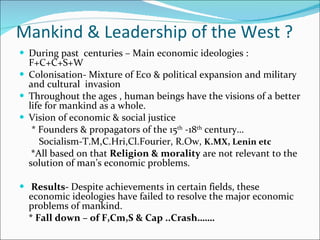
Mankind & Leadership of the West ? During past  centuries – Main economic ideologies : F+C+C+S+W Colonisation- Mixture of Eco & political expansion and military and cultural  invasion Throughout the ages , human beings have the visions of a better life for mankind as a whole. Vision of economic & social justice * Founders & propagators of the 15 th  -18 th  century… Socialism-T.M,C.Hri,Cl.Fourier, R.Ow,  K.MX, Lenin etc   * All based on that  Religion & morality  are not relevant to the solution of man’s economic problems. Results-  Despite achievements in certain fields, these economic ideologies have failed to resolve the major economic problems of mankind. * Fall down – of F,Cm,S & Cap ..Crash…….
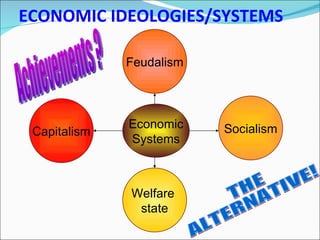
ECONOMIC IDEOLOGIES/SYSTEMS Capitalism Feudalism Socialism Welfare  state Economic Systems Achievements ? THE ALTERNATIVE!
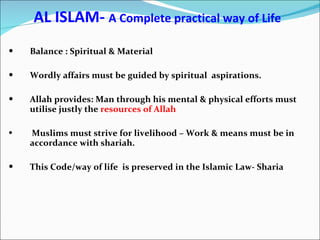
AL ISLAM-  A Complete practical way of Life Balance : Spiritual & Material Wordly affairs must be guided by spiritual  aspirations. Allah provides: Man through his mental & physical efforts must utilise justly the  resources of Allah Muslims must strive for livelihood – Work & means must be in accordance with shariah. This Code/way of life  is preserved in the Islamic Law- Sharia
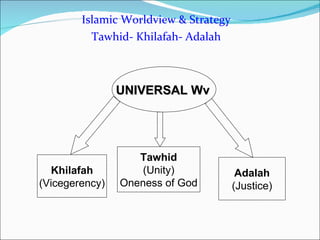
Islamic Worldview & Strategy Tawhid- Khilafah- Adalah UNIVERSAL Wv   Khilafah (Vicegerency) Adalah (Justice) Tawhid (Unity) Oneness of God
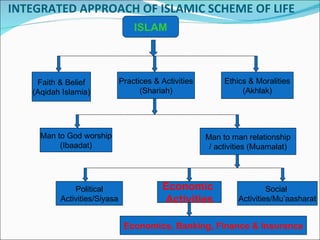
INTEGRATED APPROACH OF ISLAMIC SCHEME OF LIFE ISLAM Faith & Belief (Aqidah Islamia) Practices & Activities (Shariah) Ethics & Moralities (Akhlak) Man to man relationship / activities (Muamalat) Man to God worship (Ibaadat) Social  Activities/Mu’aasharat Economic  Activities Political Activities/Siyasa Economics, Banking, Finance & Insurance
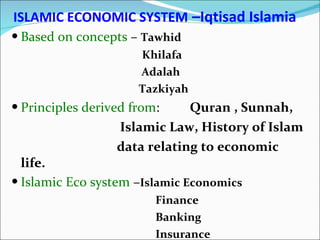
ISLAMIC ECONOMIC SYSTEM   –Iqtisad Islamia Based on concepts  –  Tawhid   Khilafa  Adalah Tazkiyah Principles derived from :  Quran , Sunnah,  Islamic Law, History of Islam data relating to economic life. Islamic Eco system  – Islamic Economics  Finance  Banking  Insurance
CONCERN FOR COMMUNITY-UMMAH Saying of the Prophet (SAW ): “ It is narrated by Huzaifah that the Apostle of God said: Whoever does not take an  interest  in the  affairs and problems  of  Muslims  is not of them…”  Tabrani 2 .  It is related by Anas that the Apostle of God said: ‘By the Holy Being in whose power is my life, none of you can be a true believer  unless  he desires for his  brother  what he desires for himself.’  B & M
.Concept of Ummah/Community Status  -  Wasat,khair Role  -  To counsel others to do good,  to forbid  evil(3:104,110) -  Do it on the basis of  brotherhood/ukhouwat  ( 3:103,49:13) .  All share  equally & equitably  the responsibilities enthrusted to the Ummah. . Context : Mission of establishing  Islamic Microfinance is the concern of  everyone . (Fard Kifaya)
Severity of Riba/Interest in Islam  Assaba al Moubiqat It is related by Abu Huraira (RA ) that the Apostle of God (SAW ) said: “ Keep (strictly) away from the  seven  mortal sins.” “ What are the seven sins?” the companions asked. To join anyone with God( in worship, in His attributes and in His functions)  -  Shirk 2.  To practice sorcery  -  Sorcery 3.  To kill a person unlawfully  -  Killing 4.  To lend money on usurious terms  -  Riba/interest? 5.  To eat of the property of the orphan  -  orphan 6.  To desert the Muslim army and run away from- jehad ( for fear of life )  7.  To accuse falsely pious and innocent bondswomen of the Lord of adultery ,the Prophet   replied.  –  slander  WAR ON RIBA from Allah & His Prophet (saw)…  ( 2:279)
Microfinance ? Microfinance means “ programme that extend small loans to very poor people for self employment projects that generate income in allowing them to take care of themselves and their families ” (Micro credit Summit, 1997). The World Bank  has recognized microfinance programme as an approach to address income inequalities and poverty. Microfinance programmes  and scheme has been proven to be successful in many countries in addressing the problems of poverty  The World Bank had also declared 2005 as the year of microfinance with the aim to expand their poverty eradication campaign.
Why MicroFinance? Conventional commercial banks have not considered poor people to be a viable market. MF  is an  alternative  for the poor and micro entrepreneurs  who are normally not eligible or bankable to receive loans from commercial banks. Small loan is given for the  purpose  of existing/new income generating project or business expansion. Terms  and conditions of the loan are normally easy to understand and flexible. It is provided for short term financing and repayments can be made on a weekly or longer basis.  Procedures  and processes of loan disbursements are normally fast and easy. In order to facilitate loan process for the poor, loan is given without collateral or guarantor, and normally is based on trust. MF is one of the most popular instruments employed for  poverty reduction strategy.
Why MicroFinance? Microfinance offers poor people access to basic financial services such as loans, savings, money transfer services and micro-insurance. (Poor like everyone else, need a diverse range of financial services…). Believed that  charity  will not be effective in eradicating poverty as it will lead to dependency and lack of initiative among the poor. The primary  mission  of microfinance is, therefore, to help poor people in assisting themselves to become economically independent Microfinance grew out of experiments in Latin America and South Asia, but the best known start was in Bangladesh in 1976, following the wide-spread famine in 1974.
Models of MicroFinance Grameen Bank model -The  mode l that has popularized  collateral-free micro finance  and has been replicated in many countries in a wide variety of settings. The model requires careful targeting of the poor through means  tests comprising mostly women groups .  Village Bank model - A second model  that has been widely replicated mainly in Latin America and Africa, but with substantially less total outreach than the many Grameen Bank replications is the  Village Bank model.  SHGs - The list of models would be incomplete without mentioning the Self-Help Groups (SHGs) model Originating in India.Under this model each SHG is formed with about ten-fifteen members who are relatively homogeneous in terms of income. An SHG essentially pools together its members’ savings and uses it for lending. The  Credit Union Model (CU).  It is in the nature of non-profit financial cooperative owned and controlled by its members. A couple of Islamic cooperative models are at work in many parts of the world.
The Cooperative Ideology/ Movement Concept of cooperative : - From the beginning of human society, cooperation has always been a vital factor in human development.  - As a  social creature , it is the natural urge of man to cooperate with each other.  - Cooperation conveys the idea of helping each other and making joint efforts to achieve a common goal. The Cooperative Movement emerged in the middle of the 19th century by the Rochdale Pioneers. On the 24th October 1844, in Rochdale, Lancashire England, a group of people faced with  economic exploitation  and deprivation set up a cooperative store, based on the principles of  self-help and mutual help . They defined a set of principles which became the basis for the cooperative ideology which has spread all over the world be it a capitalist, socialist or Muslim society.
What is a Co-operative ?  A cooperative is an autonomous association of persons united voluntarily to meet their common economic, social and cultural needs and aspirations through a jointly owned and democratically controlled enterprise. ( www.i ca.coop ) 7 principles  of cooperatives: 1 .  Voluntary and open membership (VoM)  2. Democratic member control (DmC) 3. Member economic control (MeC) 4. Autonomy and independence (A&I) 5. Education, training and information (EtI) 6. Co-operation among co-operatives (CaC) 7. Concern for community (CfC)
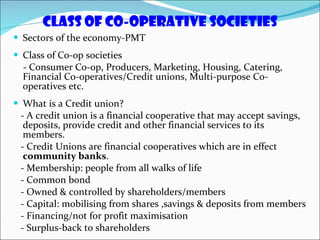
Class of co-operative societies Sectors of the economy-PMT Class of Co-op societies - Consumer Co-op, Producers, Marketing, Housing, Catering, Financial Co-operatives/Credit unions, Multi-purpose Co-operatives etc. What is a Credit union? - A credit union is a financial cooperative that may accept savings, deposits, provide credit and other financial services to its members.  - Credit Unions are financial cooperatives which are in effect  community banks . - Membership: people from all walks of life - Common bond - Owned & controlled by shareholders/members - Capital: mobilising from shares ,savings & deposits from members - Financing/not for profit maximisation - Surplus-back to shareholders
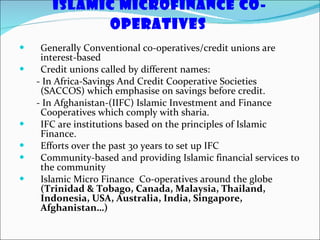
Islamic MicroFinance Co-operatives   Generally Conventional co-operatives/credit unions are interest-based  Credit unions called by different names: - In Africa-Savings And Credit Cooperative Societies (SACCOS) which emphasise on savings before credit.  - In Afghanistan-(IIFC) Islamic Investment and Finance Cooperatives which comply with sharia. IFC are institutions based on the principles of Islamic Finance.  Efforts over the past 30 years to set up IFC Community-based and providing Islamic financial services to the community Islamic Micro Finance  Co-operatives around the globe  (Trinidad & Tobago, Canada, Malaysia, Thailand, Indonesia, USA, Australia, India, Singapore, Afghanistan…)
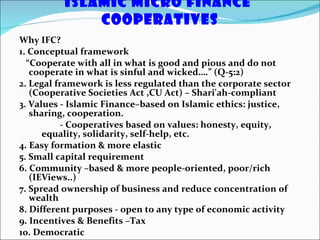
Islamic Micro Finance  Cooperatives Why IFC? 1. Conceptual framework  “ Cooperate with all in what is good and pious and do not cooperate in what is sinful and wicked….” (Q-5:2) 2. Legal framework is less regulated than the corporate sector (Cooperative Societies Act ,CU Act) – Shari'ah-compliant 3. Values - Islamic Finance–based on Islamic ethics: justice, sharing, cooperation. - Cooperatives based on values: honesty, equity, equality, solidarity, self-help, etc. 4. Easy formation & more elastic 5. Small capital requirement 6. Community –based & more people-oriented, poor/rich (IEViews..) 7. Spread ownership of business and reduce concentration of wealth 8. Different purposes - open to any type of economic activity 9. Incentives & Benefits –Tax 10. Democratic
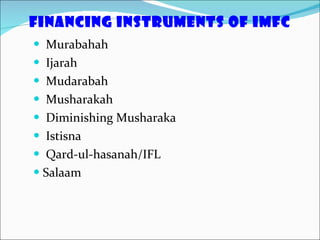
Financing instruments of IMFC Murabahah Ijarah Mudarabah Musharakah Diminishing Musharaka Istisna Qard-ul-hasanah/IFL Salaam
Al Barakah Multi-purpose Co-operative Society Limited An Islamic Microfinance Cooperative in  Mauritius
Geographical Background & Muslims in Mauritius Mauritius-gateway to Africa, South Asia & Asia Multi-religious society:  Population-1.2+ M Hindu  : 51%, Christians: 28%, Muslims : 18%, Chinese : 3% Muslims presence in all walks of life: Islamic schools, professionals, orphanage, Waqf, business, etc. Muslims have contributed enormously in the dvp. of the economy Efforts is  done to establish the financial system of Islam.
Islamic Banking & Financial Services in Mauritius  ? Budget Speech 2008/2009 - Minister of Finance Mauritius wants to connect to this sophisticated and growing global phenomenon that spans  banking, non-banking financial services,  micro-finance , insurance and capital markets. We will also set the regulatory framework for leasing companies to market  products which are Shari'ah compliant .   ( 60 ) And to level the playing field appropriate amendments will be made to the legislation to make  normal banking and  Islamic banking  tax neutral .( 62 )
WHY AL BARAKAH? Keen desire by Muslims to re-establish their identity. To become part of the Islamic banking & Finance phenomena. Establishing an Islamic bank in Mauritius in 1990’s was a manifestation of this desire. Concern for community-ummah Preliminary work carried out. Formation of an Islamic Credit Union in the Cooperative sector ( AL BARAKAH ) to r esponse to religious as well as economic reasons  Community-based project Provide an alternative to the interest-based financial institutions. Provide halal/licit investment opportunities and returns. Contribute in a halal/licit way to the overall development of the economy. (Registered on 10 th  June 1998)
Approach of Al Barakah ? Mission-based  - Not for profits modes & Market-based For profits modes Our  Islamic approach to poverty alleviation is a composite of a mission-based and market-based interventions. All members of AB do not belong to the extremely poor or the destitute category and are in a position to create wealth for themselves, for the Islamic Microfinance Institution (IMFI) and for the society.  For-profit financing provides financial sustainability to Islamic Microfinance Institutions (IsMFI). Target -The  Family, promotes the concept of family empowerment Islamic Micro Finance through Cooperatives
Operates: Within the Co-operative Societies Act 2005  Within the framework of its rules and  regulations In accordance with Islamic Financial Laws. LEGAL FRAMEWORK
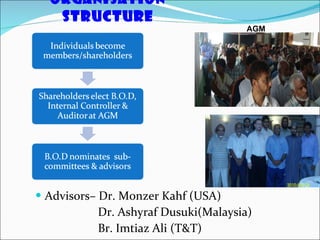
Organisation Structure Advisors– Dr. Monzer Kahf (USA) Dr. Ashyraf Dusuki(Malaysia) Br. Imtiaz Ali (T&T) AGM
PRODUCTS & SERVICES BASED ON ISLAMIC FINANCIAL TECHNIQUES Tailor-made schemes based on Murabahah: 1. Household General Financing 2. Computer Financing 3. Traders Financing 4.  Home Financing 5. Air Ticket Financing 6. Motor Vehicle/Cycle Financing 7. Land & Property Financing Istisnaa Financing (Manufacture-Sale) Partnership /JV with shareholders (M&M) Interest-Free Loan (Qard-al-Hasan) Hajj Savings Account
Reserves & Funds Statutory Reserve  Profit Equalisation Reserve  Dividend Equalisation Fund Micro Takaful Fund  Creating awareness about Islamic Finance. Organizing lectures, seminars, conferences and workshop. Organizing mini trade fair, socio-cultural programme. COMMUNITY-BASED ACTIVITIES
CHALLENGES Individual/organisational/government level Legal Framework Public acceptance Economic potential Human Resource Mass Education-Islamic EP Competition
Opportunities with Al Barakah  for  Islamic Finance Projects in Mauritius Legal & Regulatory Framework * The Banking Act 2004-Amendments 2007 * The FSDA 2001-(Non-banking activities)  * The Cooperative  Societies Act 2005  Membership for corporate bodies  Projects/Joint ventures etc.
CONCLUSION 13 years of operation An eye-opener Islamic Finance at different levels Well-being of all
Mamode Raffick Nabee Mohomed Founder/Secretary Al Barakah M.C.S.L E-mail:  [email_address] www.albarakahcoop.org Tel: (230) 6275766
CENTER OF ISLAMIC BANKING & ECNOMICS Head Office:   192- Ahmad Block, New Garden Town , Lahore, Pakistan  Ph: +92-42-35913096-8, 35858990, 38407850  Fax: +92 -42-35913056 E-mail :  [email_address] Web:  http://www.alhudacibe.com

Lecture presentation-20 june 2011 (brother rafiq)

  • 1.
    International Conference onIslamic Microfinance CENTER OF ISLAMIC BANKING & ECNOMICS Organized By : Held At:
  • 2.
    Mr. Mamode RaffickNabee Mohomed Founder/Secretary Al Barakah MCSL ISLAMIC MICROFINANCE THE CO-OPERATIVE MODEL Case Study Of : Al Barakah Multi-purpose Co-operative Society Limited An Islamic Microfinance Co-operative in Mauritius
  • 3.
    Conceptual Framework Mindsetfor Islamic Micro Finance “ … this day have I perfected your religion for you, completed My favour upon you, and have chosen for you Islam as your religion…” (Maida- 5:3)“ Purpose of Creation of man Wa maa khalatul jinna wal insaa illaa liya buduun(51:56)
  • 4.
    PRAISE TO ALLAHSabbaha lillaahi maa fissammaawaati wa maa fil-’arz:wa Huwal- ‘Aziizul- hakiim(59:1) Tout dans bannes le ciel et la terre faire louanges Allah. C’est Li le puissant, Le sage. Tabaarakallazii bi yadihil-Mulk; wa Huwa alaa kulli shay-in-Qadiir Allazii khalaqal –mawta wal Hayaata li-yabluwakum ayyukum ahsanu amalaa: wa Huwal- ‘Aziizul- Gafuur(67:1 & 2) Louanges a Celui, qui L’autorite dans So la main.Li enan pouvoir lor tout quique chose. C’est Li qui fine creer la mort et la vie, pou tester ou et trouver qui cene la faire meilleur travail. Li puissant et pardonneur aussi.
  • 5.
    OWNERSHIP Lillaahi maafissamaawaati wa maa fil ard.(2:286) Tout ce qui lor banne le ciel et la terre pou Allah . ACCOUNTABILITY Wa tabarakallazii lahuu mulkus-samaawaati wal-’ardi wa maa baynahumaa: wa ‘indahuu ilmus-Sa a’ah: wa ilayhi turja’uun( 43 : 85) Louange a Celui qui possede banne le ciel et la terre, et tout ce qui exister entre les deux, et aussi la connaissance de l’Heure. C’est divant Li qui pou faire ou retourner . Wa innaaa ilaa Rabbinaa lamunqalibuun( 43: 14) Nou sur pou retourner vers nous Maitre. Fana+Retour +…….Hisab/Accountable ?
  • 6.
    Worldviews ? Whatis worldview ? It is not just your view of the globe/universe but fundamental convictions and assumptions about - the meaning of life - The nature of good and evil, - Your view of humankind - Your values - Overall life perspective Several explanations of the universe ,nature and meaning of human life have been given. Differences in views leads to differences in conclusions
  • 7.
    Role of worldview! Every society/system is determined by its own Wv Based on a set of assumptions - About the origin of the universe - The nature of human life. The Wv performs the same function as the foundation does for a building. The society is a logical result of this Wv. ( Wv of Capitalist, communist,socialist societies )
  • 8.
    Secularist & IslamicWorldview Secularism - Man-made system Nature Values change No politics in religion - No continuity of life after death Ownership & objective of the resources(Private, freedom of activity etc. Secularism emphasises on Individuality Zulumaat Islamic - Allah’s system Creation of Allah Values remain same Programme for Islamic government Life after death Absolute ownership for Allah (Man has right to benefit from these resources- not totally free, moral limits, general framework. Accountable for its use). Islam emphasises on collectivity( Jama’ah) Noor
  • 9.
    Mankind & Leadershipof the West ? During past centuries – Main economic ideologies : F+C+C+S+W Colonisation- Mixture of Eco & political expansion and military and cultural invasion Throughout the ages , human beings have the visions of a better life for mankind as a whole. Vision of economic & social justice * Founders & propagators of the 15 th -18 th century… Socialism-T.M,C.Hri,Cl.Fourier, R.Ow, K.MX, Lenin etc * All based on that Religion & morality are not relevant to the solution of man’s economic problems. Results- Despite achievements in certain fields, these economic ideologies have failed to resolve the major economic problems of mankind. * Fall down – of F,Cm,S & Cap ..Crash…….
  • 10.
    ECONOMIC IDEOLOGIES/SYSTEMS CapitalismFeudalism Socialism Welfare state Economic Systems Achievements ? THE ALTERNATIVE!
  • 11.
    AL ISLAM- A Complete practical way of Life Balance : Spiritual & Material Wordly affairs must be guided by spiritual aspirations. Allah provides: Man through his mental & physical efforts must utilise justly the resources of Allah Muslims must strive for livelihood – Work & means must be in accordance with shariah. This Code/way of life is preserved in the Islamic Law- Sharia
  • 12.
    Islamic Worldview &Strategy Tawhid- Khilafah- Adalah UNIVERSAL Wv Khilafah (Vicegerency) Adalah (Justice) Tawhid (Unity) Oneness of God
  • 13.
    INTEGRATED APPROACH OFISLAMIC SCHEME OF LIFE ISLAM Faith & Belief (Aqidah Islamia) Practices & Activities (Shariah) Ethics & Moralities (Akhlak) Man to man relationship / activities (Muamalat) Man to God worship (Ibaadat) Social Activities/Mu’aasharat Economic Activities Political Activities/Siyasa Economics, Banking, Finance & Insurance
  • 14.
    ISLAMIC ECONOMIC SYSTEM –Iqtisad Islamia Based on concepts – Tawhid Khilafa Adalah Tazkiyah Principles derived from : Quran , Sunnah, Islamic Law, History of Islam data relating to economic life. Islamic Eco system – Islamic Economics Finance Banking Insurance
  • 15.
    CONCERN FOR COMMUNITY-UMMAHSaying of the Prophet (SAW ): “ It is narrated by Huzaifah that the Apostle of God said: Whoever does not take an interest in the affairs and problems of Muslims is not of them…” Tabrani 2 . It is related by Anas that the Apostle of God said: ‘By the Holy Being in whose power is my life, none of you can be a true believer unless he desires for his brother what he desires for himself.’ B & M
  • 16.
    .Concept of Ummah/CommunityStatus - Wasat,khair Role - To counsel others to do good, to forbid evil(3:104,110) - Do it on the basis of brotherhood/ukhouwat ( 3:103,49:13) . All share equally & equitably the responsibilities enthrusted to the Ummah. . Context : Mission of establishing Islamic Microfinance is the concern of everyone . (Fard Kifaya)
  • 17.
    Severity of Riba/Interestin Islam Assaba al Moubiqat It is related by Abu Huraira (RA ) that the Apostle of God (SAW ) said: “ Keep (strictly) away from the seven mortal sins.” “ What are the seven sins?” the companions asked. To join anyone with God( in worship, in His attributes and in His functions) - Shirk 2. To practice sorcery - Sorcery 3. To kill a person unlawfully - Killing 4. To lend money on usurious terms - Riba/interest? 5. To eat of the property of the orphan - orphan 6. To desert the Muslim army and run away from- jehad ( for fear of life ) 7. To accuse falsely pious and innocent bondswomen of the Lord of adultery ,the Prophet replied. – slander WAR ON RIBA from Allah & His Prophet (saw)… ( 2:279)
  • 18.
    Microfinance ? Microfinancemeans “ programme that extend small loans to very poor people for self employment projects that generate income in allowing them to take care of themselves and their families ” (Micro credit Summit, 1997). The World Bank has recognized microfinance programme as an approach to address income inequalities and poverty. Microfinance programmes and scheme has been proven to be successful in many countries in addressing the problems of poverty The World Bank had also declared 2005 as the year of microfinance with the aim to expand their poverty eradication campaign.
  • 19.
    Why MicroFinance? Conventionalcommercial banks have not considered poor people to be a viable market. MF is an alternative for the poor and micro entrepreneurs who are normally not eligible or bankable to receive loans from commercial banks. Small loan is given for the purpose of existing/new income generating project or business expansion. Terms and conditions of the loan are normally easy to understand and flexible. It is provided for short term financing and repayments can be made on a weekly or longer basis. Procedures and processes of loan disbursements are normally fast and easy. In order to facilitate loan process for the poor, loan is given without collateral or guarantor, and normally is based on trust. MF is one of the most popular instruments employed for poverty reduction strategy.
  • 20.
    Why MicroFinance? Microfinanceoffers poor people access to basic financial services such as loans, savings, money transfer services and micro-insurance. (Poor like everyone else, need a diverse range of financial services…). Believed that charity will not be effective in eradicating poverty as it will lead to dependency and lack of initiative among the poor. The primary mission of microfinance is, therefore, to help poor people in assisting themselves to become economically independent Microfinance grew out of experiments in Latin America and South Asia, but the best known start was in Bangladesh in 1976, following the wide-spread famine in 1974.
  • 21.
    Models of MicroFinanceGrameen Bank model -The mode l that has popularized collateral-free micro finance and has been replicated in many countries in a wide variety of settings. The model requires careful targeting of the poor through means tests comprising mostly women groups . Village Bank model - A second model that has been widely replicated mainly in Latin America and Africa, but with substantially less total outreach than the many Grameen Bank replications is the Village Bank model. SHGs - The list of models would be incomplete without mentioning the Self-Help Groups (SHGs) model Originating in India.Under this model each SHG is formed with about ten-fifteen members who are relatively homogeneous in terms of income. An SHG essentially pools together its members’ savings and uses it for lending. The Credit Union Model (CU). It is in the nature of non-profit financial cooperative owned and controlled by its members. A couple of Islamic cooperative models are at work in many parts of the world.
  • 22.
    The Cooperative Ideology/Movement Concept of cooperative : - From the beginning of human society, cooperation has always been a vital factor in human development. - As a social creature , it is the natural urge of man to cooperate with each other. - Cooperation conveys the idea of helping each other and making joint efforts to achieve a common goal. The Cooperative Movement emerged in the middle of the 19th century by the Rochdale Pioneers. On the 24th October 1844, in Rochdale, Lancashire England, a group of people faced with economic exploitation and deprivation set up a cooperative store, based on the principles of self-help and mutual help . They defined a set of principles which became the basis for the cooperative ideology which has spread all over the world be it a capitalist, socialist or Muslim society.
  • 23.
    What is aCo-operative ? A cooperative is an autonomous association of persons united voluntarily to meet their common economic, social and cultural needs and aspirations through a jointly owned and democratically controlled enterprise. ( www.i ca.coop ) 7 principles of cooperatives: 1 . Voluntary and open membership (VoM) 2. Democratic member control (DmC) 3. Member economic control (MeC) 4. Autonomy and independence (A&I) 5. Education, training and information (EtI) 6. Co-operation among co-operatives (CaC) 7. Concern for community (CfC)
  • 24.
    Class of co-operativesocieties Sectors of the economy-PMT Class of Co-op societies - Consumer Co-op, Producers, Marketing, Housing, Catering, Financial Co-operatives/Credit unions, Multi-purpose Co-operatives etc. What is a Credit union? - A credit union is a financial cooperative that may accept savings, deposits, provide credit and other financial services to its members. - Credit Unions are financial cooperatives which are in effect community banks . - Membership: people from all walks of life - Common bond - Owned & controlled by shareholders/members - Capital: mobilising from shares ,savings & deposits from members - Financing/not for profit maximisation - Surplus-back to shareholders
  • 25.
    Islamic MicroFinance Co-operatives Generally Conventional co-operatives/credit unions are interest-based Credit unions called by different names: - In Africa-Savings And Credit Cooperative Societies (SACCOS) which emphasise on savings before credit. - In Afghanistan-(IIFC) Islamic Investment and Finance Cooperatives which comply with sharia. IFC are institutions based on the principles of Islamic Finance. Efforts over the past 30 years to set up IFC Community-based and providing Islamic financial services to the community Islamic Micro Finance Co-operatives around the globe (Trinidad & Tobago, Canada, Malaysia, Thailand, Indonesia, USA, Australia, India, Singapore, Afghanistan…)
  • 26.
    Islamic Micro Finance Cooperatives Why IFC? 1. Conceptual framework “ Cooperate with all in what is good and pious and do not cooperate in what is sinful and wicked….” (Q-5:2) 2. Legal framework is less regulated than the corporate sector (Cooperative Societies Act ,CU Act) – Shari'ah-compliant 3. Values - Islamic Finance–based on Islamic ethics: justice, sharing, cooperation. - Cooperatives based on values: honesty, equity, equality, solidarity, self-help, etc. 4. Easy formation & more elastic 5. Small capital requirement 6. Community –based & more people-oriented, poor/rich (IEViews..) 7. Spread ownership of business and reduce concentration of wealth 8. Different purposes - open to any type of economic activity 9. Incentives & Benefits –Tax 10. Democratic
  • 27.
    Financing instruments ofIMFC Murabahah Ijarah Mudarabah Musharakah Diminishing Musharaka Istisna Qard-ul-hasanah/IFL Salaam
  • 28.
    Al Barakah Multi-purposeCo-operative Society Limited An Islamic Microfinance Cooperative in Mauritius
  • 29.
    Geographical Background &Muslims in Mauritius Mauritius-gateway to Africa, South Asia & Asia Multi-religious society: Population-1.2+ M Hindu : 51%, Christians: 28%, Muslims : 18%, Chinese : 3% Muslims presence in all walks of life: Islamic schools, professionals, orphanage, Waqf, business, etc. Muslims have contributed enormously in the dvp. of the economy Efforts is done to establish the financial system of Islam.
  • 30.
    Islamic Banking &Financial Services in Mauritius ? Budget Speech 2008/2009 - Minister of Finance Mauritius wants to connect to this sophisticated and growing global phenomenon that spans banking, non-banking financial services, micro-finance , insurance and capital markets. We will also set the regulatory framework for leasing companies to market products which are Shari'ah compliant . ( 60 ) And to level the playing field appropriate amendments will be made to the legislation to make normal banking and Islamic banking tax neutral .( 62 )
  • 31.
    WHY AL BARAKAH?Keen desire by Muslims to re-establish their identity. To become part of the Islamic banking & Finance phenomena. Establishing an Islamic bank in Mauritius in 1990’s was a manifestation of this desire. Concern for community-ummah Preliminary work carried out. Formation of an Islamic Credit Union in the Cooperative sector ( AL BARAKAH ) to r esponse to religious as well as economic reasons Community-based project Provide an alternative to the interest-based financial institutions. Provide halal/licit investment opportunities and returns. Contribute in a halal/licit way to the overall development of the economy. (Registered on 10 th June 1998)
  • 32.
    Approach of AlBarakah ? Mission-based - Not for profits modes & Market-based For profits modes Our Islamic approach to poverty alleviation is a composite of a mission-based and market-based interventions. All members of AB do not belong to the extremely poor or the destitute category and are in a position to create wealth for themselves, for the Islamic Microfinance Institution (IMFI) and for the society. For-profit financing provides financial sustainability to Islamic Microfinance Institutions (IsMFI). Target -The Family, promotes the concept of family empowerment Islamic Micro Finance through Cooperatives
  • 33.
    Operates: Within theCo-operative Societies Act 2005 Within the framework of its rules and regulations In accordance with Islamic Financial Laws. LEGAL FRAMEWORK
  • 34.
    Organisation Structure Advisors–Dr. Monzer Kahf (USA) Dr. Ashyraf Dusuki(Malaysia) Br. Imtiaz Ali (T&T) AGM
  • 35.
    PRODUCTS & SERVICESBASED ON ISLAMIC FINANCIAL TECHNIQUES Tailor-made schemes based on Murabahah: 1. Household General Financing 2. Computer Financing 3. Traders Financing 4. Home Financing 5. Air Ticket Financing 6. Motor Vehicle/Cycle Financing 7. Land & Property Financing Istisnaa Financing (Manufacture-Sale) Partnership /JV with shareholders (M&M) Interest-Free Loan (Qard-al-Hasan) Hajj Savings Account
  • 36.
    Reserves & FundsStatutory Reserve Profit Equalisation Reserve Dividend Equalisation Fund Micro Takaful Fund Creating awareness about Islamic Finance. Organizing lectures, seminars, conferences and workshop. Organizing mini trade fair, socio-cultural programme. COMMUNITY-BASED ACTIVITIES
  • 37.
    CHALLENGES Individual/organisational/government levelLegal Framework Public acceptance Economic potential Human Resource Mass Education-Islamic EP Competition
  • 38.
    Opportunities with AlBarakah for Islamic Finance Projects in Mauritius Legal & Regulatory Framework * The Banking Act 2004-Amendments 2007 * The FSDA 2001-(Non-banking activities) * The Cooperative Societies Act 2005 Membership for corporate bodies Projects/Joint ventures etc.
  • 39.
    CONCLUSION 13 yearsof operation An eye-opener Islamic Finance at different levels Well-being of all
  • 40.
    Mamode Raffick NabeeMohomed Founder/Secretary Al Barakah M.C.S.L E-mail: [email_address] www.albarakahcoop.org Tel: (230) 6275766
  • 41.
    CENTER OF ISLAMICBANKING & ECNOMICS Head Office:   192- Ahmad Block, New Garden Town , Lahore, Pakistan  Ph: +92-42-35913096-8, 35858990, 38407850  Fax: +92 -42-35913056 E-mail :  [email_address] Web: http://www.alhudacibe.com