Religiosity and threshold effect in social and financial performance of
microfinance institutions
Mohammad Ashraful Mobin
Muhammad Zubair Mughal
Chief Executive Officer
Alhuda centre of Islamic banking and economics
Islamic Microfinance
Product Development
& Country Experiences
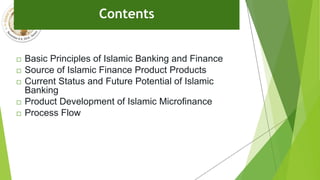
Contents
 Basic Principles of Islamic Banking and Finance
 Source of Islamic Finance Product Products
 Current Status and Future Potential of Islamic
Banking
 Product Development of Islamic Microfinance
 Process Flow
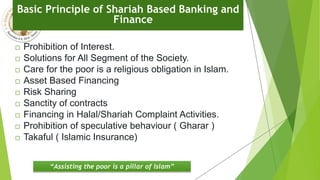
Basic Principle of Shariah Based Banking and
Finance
 Prohibition of Interest.
 Solutions for All Segment of the Society.
 Care for the poor is a religious obligation in Islam.
 Asset Based Financing
 Risk Sharing
 Sanctity of contracts
 Financing in Halal/Shariah Complaint Activities.
 Prohibition of speculative behaviour ( Gharar )
 Takaful ( Islamic Insurance)
“Assisting the poor is a pillar of Islam”
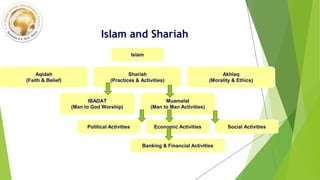
Islam
Aqidah
(Faith & Belief)
Shariah
(Practices & Activities)
Akhlaq
(Morality & Ethics)
IBADAT
(Man to God Worship)
Muamalat
(Man to Man Activities)
Political Activities Economic Activities Social Activities
Banking & Financial Activities
Islam and Shariah
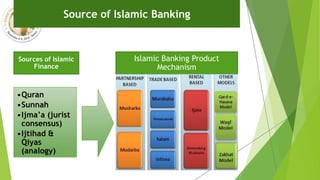
Sources of Islamic
Finance
Islamic Banking Product
Mechanism
•Quran
•Sunnah
•Ijma’a (jurist
consensus)
•Ijtihad &
Qiyas
(analogy)
Source of Islamic Banking
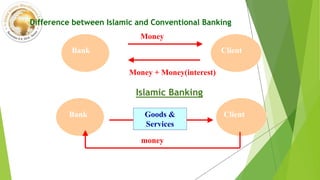
Difference between Islamic and Conventional Banking
Conventional
Bank Client
Money
Money + Money(interest)
Bank ClientGoods &
Services
money
Islamic Banking
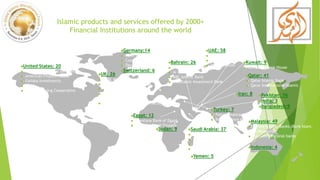
Islamic products and services offered by 2000+
Financial Institutions around the world
.
United States: 20
- Al Manzil Financial Services
- American Finance House
- Failaka Investments
- HSBC
- Ameen Housing Cooperative
Germany:14
- Bank Sepah
- Commerz Bank
- Deutsche Bank
Switzerland: 6
UK: 26
- HSBC Amanah Finance
- Al Baraka International Ltd
- Takafol UK Ltd
- The Halal Mutual Investment
Company
- J Aron & Co Ltd (Goldman Sachs)
Bahrain: 26
- Bahrain Islamic Bank
- Al Baraka
- ABC Islamic Bank
- CitiIslamic Investment Bank
Malaysia: 49
2 - Pure Islamic Banks (Bank Islam,
Bank Muamalat)
Rest - conventional banks
Saudi Arabia: 37
- Al Rajhi
- SAMBA
- Saudi Hollandi
- Riyadh Bank
UAE: 58
- Dubai Islamic Bank
- Abu Dhabi Islamic Bank
- HSBC Amanah
Qatar: 41
- Qatar Islamic Bank
- Qatar International Islamic
Kuwait: 9
- Kuwait Finance House
Iran: 8
Egypt: 12
- Alwatany Bank of Egypt
- Egyptian Saudi Finance
Indonesia: 4
Sudan: 9
Pakistan: 76
India: 3
Bangladesh:9
Turkey: 7
- Faisal Finance Institution
- Ihlas Finance House
Yemen: 5
Current Status of Islamic Finance Industry
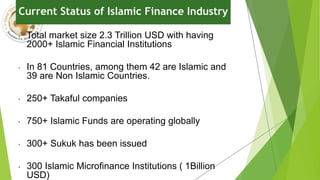
• Total market size 2.3 Trillion USD with having
2000+ Islamic Financial Institutions
• In 81 Countries, among them 42 are Islamic and
39 are Non Islamic Countries.
• 250+ Takaful companies
• 750+ Islamic Funds are operating globally
• 300+ Sukuk has been issued
• 300 Islamic Microfinance Institutions ( 1Billion
USD)
Current Status of Islamic Finance Industry
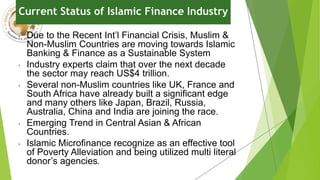
• Due to the Recent Int’l Financial Crisis, Muslim &
Non-Muslim Countries are moving towards Islamic
Banking & Finance as a Sustainable System
• Industry experts claim that over the next decade
the sector may reach US$4 trillion.
• Several non-Muslim countries like UK, France and
South Africa have already built a significant edge
and many others like Japan, Brazil, Russia,
Australia, China and India are joining the race.
• Emerging Trend in Central Asian & African
Countries.
• Islamic Microfinance recognize as an effective tool
of Poverty Alleviation and being utilized multi literal
donor’s agencies.
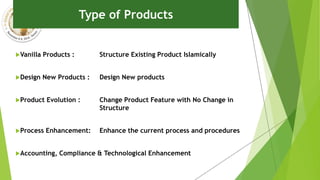
Vanilla Products : Structure Existing Product Islamically
Design New Products : Design New products
Product Evolution : Change Product Feature with No Change in
Structure
Process Enhancement: Enhance the current process and procedures
Accounting, Compliance & Technological Enhancement
Type of Products
BOD
CEO/MD
Shariah Board/Advisor
Product Development Department
Marketing Department
Accounting & Finance
I.T Department
HR & Capacity Building
Sales Team
Role & Internal Involvement for New
Product
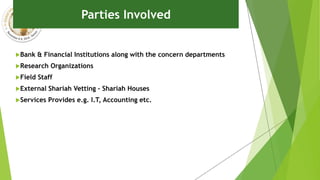
Bank & Financial Institutions along with the concern departments
Research Organizations
Field Staff
External Shariah Vetting – Shariah Houses
Services Provides e.g. I.T, Accounting etc.
Parties Involved
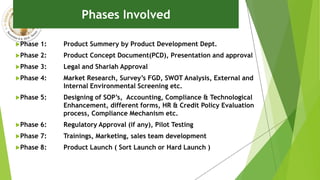
Phase 1: Product Summery by Product Development Dept.
Phase 2: Product Concept Document(PCD), Presentation and approval
Phase 3: Legal and Shariah Approval
Phase 4: Market Research, Survey’s FGD, SWOT Analysis, External and
Internal Environmental Screening etc.
Phase 5: Designing of SOP’s, Accounting, Compliance & Technological
Enhancement, different forms, HR & Credit Policy Evaluation
process, Compliance Mechanism etc.
Phase 6: Regulatory Approval (if any), Pilot Testing
Phase 7: Trainings, Marketing, sales team development
Phase 8: Product Launch ( Sort Launch or Hard Launch )
Phases Involved
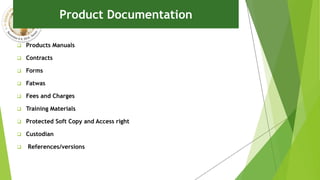
 Products Manuals
 Contracts
 Forms
 Fatwas
 Fees and Charges
 Training Materials
 Protected Soft Copy and Access right
 Custodian
 References/versions
Product Documentation
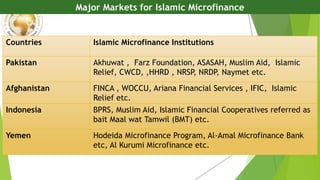
Major Markets for Islamic Microfinance
Countries Islamic Microfinance Institutions
Pakistan Akhuwat , Farz Foundation, ASASAH, Muslim Aid, Islamic
Relief, CWCD, ,HHRD , NRSP, NRDP, Naymet etc.
Afghanistan FINCA , WOCCU, Ariana Financial Services , IFIC, Islamic
Relief etc.
Indonesia BPRS, Muslim Aid, Islamic Financial Cooperatives referred as
bait Maal wat Tamwil (BMT) etc.
Yemen Hodeida Microfinance Program, Al-Amal Microfinance Bank
etc, Al Kurumi Microfinance etc.
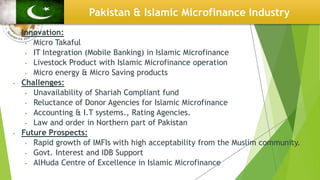
Pakistan & Islamic Microfinance Industry
• Innovation:
• Micro Takaful
• IT Integration (Mobile Banking) in Islamic Microfinance
• Livestock Product with Islamic Microfinance operation
• Micro energy & Micro Saving products
• Challenges:
• Unavailability of Shariah Compliant fund
• Reluctance of Donor Agencies for Islamic Microfinance
• Accounting & I.T systems., Rating Agencies.
• Law and order in Northern part of Pakistan
• Future Prospects:
• Rapid growth of IMFIs with high acceptability from the Muslim community.
• Govt. Interest and IDB Support
• AlHuda Centre of Excellence in Islamic Microfinance
Afghanistan & Islamic Microfinance Industry
• Innovation:
• Enterprise Incubation i.e. business modeling and micro financing.
• Integration of Rural Economy (Exact Target Market) with Islamic
Microfinance
• Challenges:
• Lack of Quality HR in Islamic Microfinance Sector Poor IT integration
• Weak microfinance regulatory regime.
• Unavailability of Micro Insurance
• Security, Law and order
• Future Prospects:
• Rising Donors’ interest for poverty alleviation (FINCA, HIH, MISFA & USAID
etc)
• High demand of Islamic Microfinance
Indonesia & Islamic Microfinance Industry
• Innovation:
• Bait-ul-mal Tamveel (BMT), BPRS
• Challenges:
• Poor IT integration
• High Poverty Index
• Lesser financial sustainability in the community/ natives
• Future Prospects:
• Rising Donors’ interest poverty alleviation especially through IMF
• Role of Ministry of Cooperative & Central Bank is positive.
• Rapid growth of IMFIs with high acceptability from the majority Muslim
community.
Yemen & Islamic Microfinance Industry
• Innovation:
• I.T Integration & Micro Takaful
• Role of Islamic Bank to Strengthened the Islamic Microfinance Institutions.
• Challenges:
• Reluctance in Research & Implementation of new Products, as only
(Murabahah) is serving almost 80% of Islamic Microfinance Industry.
• Significant division of Urban and Rural population
• Law and Order
• Future Prospects:
• High Demand of IMF
• Role of SFD & YMN
• New Range of Islamic Microfinance products
JazzakAllah
Thank you for listening with
patience
AlHuda CIBE FZ LLE - U.A.E
P: + 971 56 9286664, + 971 55 938 99 00
AlHuda Center of Islamic Banking & Economics - Pakistan
Ph: (92-42) 35913096 - 98, Fax: (92-42) 35913056
Email: info@alhudacibe.com Website: www.alhudacibe.com

Alhuda CIBE -Product development

  • 1.
    Religiosity and thresholdeffect in social and financial performance of microfinance institutions Mohammad Ashraful Mobin
  • 2.
    Muhammad Zubair Mughal ChiefExecutive Officer Alhuda centre of Islamic banking and economics Islamic Microfinance Product Development & Country Experiences
  • 3.
    Contents  Basic Principlesof Islamic Banking and Finance  Source of Islamic Finance Product Products  Current Status and Future Potential of Islamic Banking  Product Development of Islamic Microfinance  Process Flow
  • 4.
    Basic Principle ofShariah Based Banking and Finance  Prohibition of Interest.  Solutions for All Segment of the Society.  Care for the poor is a religious obligation in Islam.  Asset Based Financing  Risk Sharing  Sanctity of contracts  Financing in Halal/Shariah Complaint Activities.  Prohibition of speculative behaviour ( Gharar )  Takaful ( Islamic Insurance) “Assisting the poor is a pillar of Islam”
  • 5.
    Islam Aqidah (Faith & Belief) Shariah (Practices& Activities) Akhlaq (Morality & Ethics) IBADAT (Man to God Worship) Muamalat (Man to Man Activities) Political Activities Economic Activities Social Activities Banking & Financial Activities Islam and Shariah
  • 6.
    Sources of Islamic Finance IslamicBanking Product Mechanism •Quran •Sunnah •Ijma’a (jurist consensus) •Ijtihad & Qiyas (analogy) Source of Islamic Banking
  • 7.
    Difference between Islamicand Conventional Banking Conventional Bank Client Money Money + Money(interest) Bank ClientGoods & Services money Islamic Banking
  • 8.
    Islamic products andservices offered by 2000+ Financial Institutions around the world . United States: 20 - Al Manzil Financial Services - American Finance House - Failaka Investments - HSBC - Ameen Housing Cooperative Germany:14 - Bank Sepah - Commerz Bank - Deutsche Bank Switzerland: 6 UK: 26 - HSBC Amanah Finance - Al Baraka International Ltd - Takafol UK Ltd - The Halal Mutual Investment Company - J Aron & Co Ltd (Goldman Sachs) Bahrain: 26 - Bahrain Islamic Bank - Al Baraka - ABC Islamic Bank - CitiIslamic Investment Bank Malaysia: 49 2 - Pure Islamic Banks (Bank Islam, Bank Muamalat) Rest - conventional banks Saudi Arabia: 37 - Al Rajhi - SAMBA - Saudi Hollandi - Riyadh Bank UAE: 58 - Dubai Islamic Bank - Abu Dhabi Islamic Bank - HSBC Amanah Qatar: 41 - Qatar Islamic Bank - Qatar International Islamic Kuwait: 9 - Kuwait Finance House Iran: 8 Egypt: 12 - Alwatany Bank of Egypt - Egyptian Saudi Finance Indonesia: 4 Sudan: 9 Pakistan: 76 India: 3 Bangladesh:9 Turkey: 7 - Faisal Finance Institution - Ihlas Finance House Yemen: 5
  • 9.
    Current Status ofIslamic Finance Industry • Total market size 2.3 Trillion USD with having 2000+ Islamic Financial Institutions • In 81 Countries, among them 42 are Islamic and 39 are Non Islamic Countries. • 250+ Takaful companies • 750+ Islamic Funds are operating globally • 300+ Sukuk has been issued • 300 Islamic Microfinance Institutions ( 1Billion USD)
  • 10.
    Current Status ofIslamic Finance Industry • Due to the Recent Int’l Financial Crisis, Muslim & Non-Muslim Countries are moving towards Islamic Banking & Finance as a Sustainable System • Industry experts claim that over the next decade the sector may reach US$4 trillion. • Several non-Muslim countries like UK, France and South Africa have already built a significant edge and many others like Japan, Brazil, Russia, Australia, China and India are joining the race. • Emerging Trend in Central Asian & African Countries. • Islamic Microfinance recognize as an effective tool of Poverty Alleviation and being utilized multi literal donor’s agencies.
  • 11.
    Vanilla Products :Structure Existing Product Islamically Design New Products : Design New products Product Evolution : Change Product Feature with No Change in Structure Process Enhancement: Enhance the current process and procedures Accounting, Compliance & Technological Enhancement Type of Products
  • 12.
    BOD CEO/MD Shariah Board/Advisor Product DevelopmentDepartment Marketing Department Accounting & Finance I.T Department HR & Capacity Building Sales Team Role & Internal Involvement for New Product
  • 13.
    Bank & FinancialInstitutions along with the concern departments Research Organizations Field Staff External Shariah Vetting – Shariah Houses Services Provides e.g. I.T, Accounting etc. Parties Involved
  • 14.
    Phase 1: ProductSummery by Product Development Dept. Phase 2: Product Concept Document(PCD), Presentation and approval Phase 3: Legal and Shariah Approval Phase 4: Market Research, Survey’s FGD, SWOT Analysis, External and Internal Environmental Screening etc. Phase 5: Designing of SOP’s, Accounting, Compliance & Technological Enhancement, different forms, HR & Credit Policy Evaluation process, Compliance Mechanism etc. Phase 6: Regulatory Approval (if any), Pilot Testing Phase 7: Trainings, Marketing, sales team development Phase 8: Product Launch ( Sort Launch or Hard Launch ) Phases Involved
  • 15.
     Products Manuals Contracts  Forms  Fatwas  Fees and Charges  Training Materials  Protected Soft Copy and Access right  Custodian  References/versions Product Documentation
  • 16.
    Major Markets forIslamic Microfinance Countries Islamic Microfinance Institutions Pakistan Akhuwat , Farz Foundation, ASASAH, Muslim Aid, Islamic Relief, CWCD, ,HHRD , NRSP, NRDP, Naymet etc. Afghanistan FINCA , WOCCU, Ariana Financial Services , IFIC, Islamic Relief etc. Indonesia BPRS, Muslim Aid, Islamic Financial Cooperatives referred as bait Maal wat Tamwil (BMT) etc. Yemen Hodeida Microfinance Program, Al-Amal Microfinance Bank etc, Al Kurumi Microfinance etc.
  • 17.
    Pakistan & IslamicMicrofinance Industry • Innovation: • Micro Takaful • IT Integration (Mobile Banking) in Islamic Microfinance • Livestock Product with Islamic Microfinance operation • Micro energy & Micro Saving products • Challenges: • Unavailability of Shariah Compliant fund • Reluctance of Donor Agencies for Islamic Microfinance • Accounting & I.T systems., Rating Agencies. • Law and order in Northern part of Pakistan • Future Prospects: • Rapid growth of IMFIs with high acceptability from the Muslim community. • Govt. Interest and IDB Support • AlHuda Centre of Excellence in Islamic Microfinance
  • 18.
    Afghanistan & IslamicMicrofinance Industry • Innovation: • Enterprise Incubation i.e. business modeling and micro financing. • Integration of Rural Economy (Exact Target Market) with Islamic Microfinance • Challenges: • Lack of Quality HR in Islamic Microfinance Sector Poor IT integration • Weak microfinance regulatory regime. • Unavailability of Micro Insurance • Security, Law and order • Future Prospects: • Rising Donors’ interest for poverty alleviation (FINCA, HIH, MISFA & USAID etc) • High demand of Islamic Microfinance
  • 19.
    Indonesia & IslamicMicrofinance Industry • Innovation: • Bait-ul-mal Tamveel (BMT), BPRS • Challenges: • Poor IT integration • High Poverty Index • Lesser financial sustainability in the community/ natives • Future Prospects: • Rising Donors’ interest poverty alleviation especially through IMF • Role of Ministry of Cooperative & Central Bank is positive. • Rapid growth of IMFIs with high acceptability from the majority Muslim community.
  • 20.
    Yemen & IslamicMicrofinance Industry • Innovation: • I.T Integration & Micro Takaful • Role of Islamic Bank to Strengthened the Islamic Microfinance Institutions. • Challenges: • Reluctance in Research & Implementation of new Products, as only (Murabahah) is serving almost 80% of Islamic Microfinance Industry. • Significant division of Urban and Rural population • Law and Order • Future Prospects: • High Demand of IMF • Role of SFD & YMN • New Range of Islamic Microfinance products
  • 21.
    JazzakAllah Thank you forlistening with patience
  • 22.
    AlHuda CIBE FZLLE - U.A.E P: + 971 56 9286664, + 971 55 938 99 00 AlHuda Center of Islamic Banking & Economics - Pakistan Ph: (92-42) 35913096 - 98, Fax: (92-42) 35913056 Email: info@alhudacibe.com Website: www.alhudacibe.com