CONTENT OF PRESENTATION
 Basics of Technology Research
 Ideation and GAP Analysis
 Technology Research Design
 Evaluation of Technology
Research
A B
C D
CONTENT OF PRESENTATION
 Definition of Research
 Meaning of Technology Research
 Basic and Applied Research
 Method for Technology Research
 Expected Outputs
composed of two syllables, re and search.
• re is a prefix meaning again, a new or over
again
Definition of Research
• search is a verb meaning to
examine closely and
carefully, to test and try, or
to prove.
1. a noun describing a careful, systematic, patient
study and investigation in some field of knowledge,
undertaken to establish facts or principles.
Definition of Research
2. the application of the scientific
method
3. a scientific and systematic process of collecting
and logically analyzing information (data)
Definition of Research
4. a search for knowledge /a
movement from unknown to known
5. art of scientific investigation
The word technology stems from the Greek
word techne, meaning art, skill.
Meaning of Technology Research
Technology is defined as “the study,
mastery and utilization of
manufacturing methods and
industrial arts” (Hornby, 1974).
Technology is “the knowledge of artefacts emphasizing
their manufacturing”.
Objects manufactured by human
beings will be called artefacts.
Meaning of Technology Research
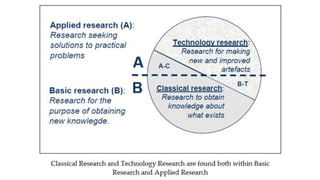
Technology research is “research for the purpose of
producing new and better artefacts”.
• The technology researcher tries to
create artefacts which are better
than those which already exist, e.g.
quicker, more useful, or more
dependable (Skolimowski, 1983).
Meaning of Technology Research
`
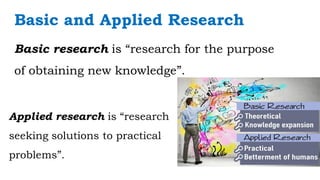
Basic research is “research for the purpose
of obtaining new knowledge”.
Applied research is “research
seeking solutions to practical
problems”.
Basic and Applied Research
`
`
1. Goal: New and Better Artefacts
• The technology researcher is concerned about how to make
new artefacts or improve existing artefacts
• The motivation is a need for a new artefact, or a need to
improve an existing artefact.
• The researcher starts out by collecting requirements to the
artefact.
Method for Technology Research
`
2. Hypothesis, Predictions and Evaluations
• When the requirements have been collected, the researcher
starts making an artefact which is supposed to satisfy the
requirements.
Method for Technology Research
• Despite the fact that nobody has done this before, the
researcher assumes that it is feasible.
`
2. Hypothesis, Predictions and Evaluations
• When the artefact is ready, the researcher has to show that it
actually fulfils the posed requirements and thereby satisfies
the (potential) need on which it is based.
Method for Technology Research
• The overall hypothesis of the technology researcher is: The
artefact satisfies the need.
`
2. Hypothesis, Predictions and Evaluations
• In order to evaluate the overall hypothesis, the researcher has
to formulate sub-hypotheses about the properties of the
artefact
Example
H1: Artefact A is user-friendly.
Method for Technology Research
`
2. Hypothesis, Predictions and Evaluations
• However, neither such hypotheses can be tested straight
away. Therefore, the researcher uses predictions, which are
statements about the artefact’s behavior under certain
circumstances.
Method for Technology Research
• Predictions may be derived from the need and from the posed
requirements.
`
2. Hypothesis, Predictions and Evaluations
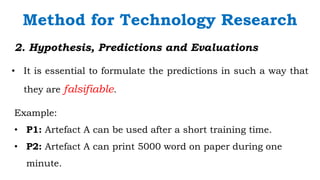
• It is essential to formulate the predictions in such a way that
they are falsifiable.
Method for Technology Research
Example:
• P1: Artefact A can be used after a short training time.
• P2: Artefact A can print 5000 word on paper during one
minute.
`
2. Hypothesis, Predictions and Evaluations
• It is essential to formulate the predictions in such a way that
they are falsifiable.
Method for Technology Research
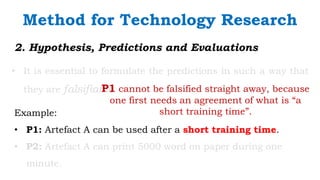
Example:
• P1: Artefact A can be used after a short training time.
• P2: Artefact A can print 5000 word on paper during one
minute.
P1 cannot be falsified straight away, because
one first needs an agreement of what is “a
short training time”.
`
2. Hypothesis, Predictions and Evaluations
• It is essential to formulate the predictions in such a way that
they are falsifiable.
Method for Technology Research
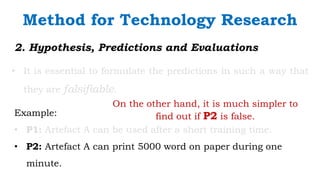
Example:
• P1: Artefact A can be used after a short training time.
• P2: Artefact A can print 5000 word on paper during one
minute.
On the other hand, it is much simpler to
find out if P2 is false.
`
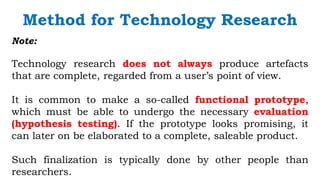
Note:
Technology research does not always produce artefacts
that are complete, regarded from a user’s point of view.
It is common to make a so-called functional prototype,
which must be able to undergo the necessary evaluation
(hypothesis testing). If the prototype looks promising, it
can later on be elaborated to a complete, saleable product.
Such finalization is typically done by other people than
researchers.
Method for Technology Research
`
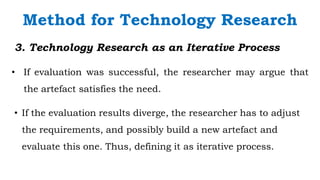
3. Technology Research as an Iterative Process
• If evaluation was successful, the researcher may argue that
the artefact satisfies the need.
Method for Technology Research
• If the evaluation results diverge, the researcher has to adjust
the requirements, and possibly build a new artefact and
evaluate this one. Thus, defining it as iterative process.
`
Method for Technology Research
`
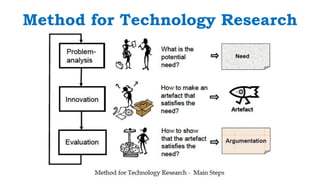
Method for Technology Research
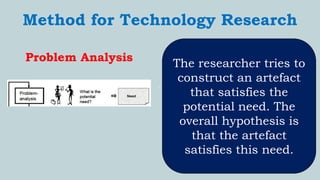
Problem Analysis The researcher tries to
construct an artefact
that satisfies the
potential need. The
overall hypothesis is
that the artefact
satisfies this need.
`
Method for Technology Research
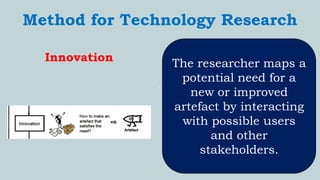
Innovation The researcher maps a
potential need for a
new or improved
artefact by interacting
with possible users
and other
stakeholders.
`
Method for Technology Research
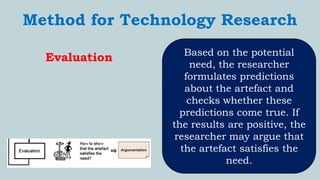
Evaluation Based on the potential
need, the researcher
formulates predictions
about the artefact and
checks whether these
predictions come true. If
the results are positive, the
researcher may argue that
the artefact satisfies the
need.
`
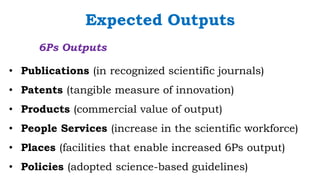
6Ps Outputs
• Publications (in recognized scientific journals)
• Patents (tangible measure of innovation)
• Products (commercial value of output)
• People Services (increase in the scientific workforce)
• Places (facilities that enable increased 6Ps output)
• Policies (adopted science-based guidelines)
Expected Outputs
CONTENT OF PRESENTATION
 The Research Problem and its Purpose
 Criteria for Selecting GOOD Research
Problem
 Ideation and Gap Analysis in
Technology Developemtn Research
A B C
A research problem is a statement about an area
of concern, a condition to be improved, a difficulty
to be eliminated, or a troubling question that
exists in scholarly literature, in theory, or in
practice that points to the need for meaningful
understanding and deliberate investigation.
The Research Problem
• Research problem in technology research is concerned about
how to make new artefacts or improve existing artefacts based
on requirements or needs.
The Research Problem
• Such requirements are stated by existing
users (in case the artefact needs
improvement) or by new or potential users
(in case this type of artefact not yet exists).
• Introduce the reader to the importance of the topic being
studied.
• Places the problem into a particular context that defines the
parameters of what is to be investigated.
Purpose of Research Problem
• Provides the framework for reporting the
results and indicates what is probably
necessary to conduct the study and explain
how the findings will present this
information.
Criteria for Selecting a GOOD
Technology Research Problem
Criteria for Selecting a GOOD
Technology Research Problem
• Social: The social developments include factors like consumer
behavior demographics, religion, lifestyles, values, and
advertising.
• Technological: The technology aspect of
STEEP analysis focuses highly on
technological advancements. It includes
factors like innovation, communication,
energy, transport, research and
development, patent regulations and life-
cycle of products
DOST STEEP Evaluation Criteria
• Economic: The economic condition is strongly associated with
the consumers’ buying position. In this step, factors such as
interest rates, international trade, taxes, savings, inflation,
subsidies, availability of jobs and entrepreneurship are
considered
• Environmental: Environmental
developments involve ecosystem factors
such as water, wind, food, soil, energy,
pollution and environmental regulations.
DOST STEEP Evaluation Criteria
• Political: The Political developments can highly influence
individuals and organizations. It is important to be aware of
likely upcoming shifts in power. Political developments can
affect environmental, antitrust, financial markets, trade, and
other kinds of laws.
Factors to be considered include political
stability, regulation of monopolies, tax
policies, price regulations consumer
protection, jurisdiction and trade unions.
DOST STEEP Evaluation Criteria
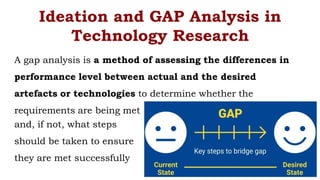
A gap analysis is a method of assessing the differences in
performance level between actual and the desired
artefacts or technologies to determine whether the
requirements are being met
Ideation and GAP Analysis in
Technology Research
and, if not, what steps
should be taken to ensure
they are met successfully
• A clear problem statement that can easily define all of your
objectives is helpful to you to develop effective research.
• It is also helpful for the evaluators to get an idea of either the
research questions of your projects has provided all the
possible answers to your questions or not.
Ideation and GAP Analysis in Technology Research
1. Specify the Research Objectives
In technology research, you can start first
analyzing the existing process flow of your topic
of interest and determine technical
problems/flaws existing on the said process
flow.
Ideation and GAP Analysis in Technology Research
1. Specify the Research Objectives
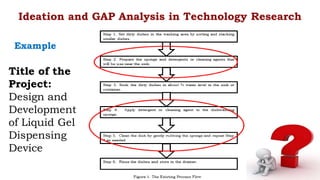
Title of the
Project:
Design and
Development
of Liquid Gel
Dispensing
Device
Ideation and GAP Analysis in Technology Research
Example
• There are some environmental variables or contextual
variables which are helpful to you to provide enough idea
about the findings of your research problem.
• You just need to find out all the environmental or contextual
variables which can affect your research project.
Ideation and GAP Analysis in Technology Research
2. Review the Context of the Research Problem
• The simplicity or the complexity of the research
problem depends upon the number of
variables/requirements and relationship between
these variables/requirements.
• As a researcher, you should try to select such
variables/requirements for your research project
which have a direct relation with the research
problems or the research questions.
Ideation and GAP Analysis in Technology Research
3. Explore the Nature of the Problem
In technology research, you can explore the nature of
problem in various ways.
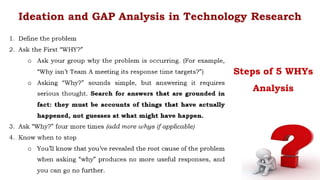
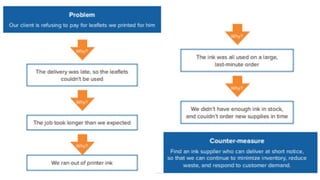
One of which is the 5 WHYs technique developed by
Sakichi Toyoda. The 5 Whys strategy is a simple,
effective tool for uncovering the root of a problem.
Ideation and GAP Analysis in Technology Research
3. Explore the Nature of the Problem
1.Start with a problem and ask why it is occurring.
2.Make sure that your answer is grounded in fact, and
then ask the question again.
3.Continue the process until you reach the root cause
of the problem, and you can identify a counter-
measure that will prevent it from recurring.
Ideation and GAP Analysis in Technology Research
Criteria of 5 WHYs Analysis
Ideation and GAP Analysis in Technology Research
Steps of 5 WHYs
Analysis
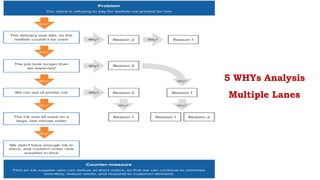
5 WHYs Analysis
Multiple Lanes
• We can’t ignore these variables while formulating the research
questions since this is considered as an essential stage for
problem formulation.
Ideation and GAP Analysis in Technology Research
4. Define the Variable Relationships
• You can use the fishbone technique in defining
your variables. Fishbone Diagrams (also known
as Ishikawa Diagrams) can be used to answer
the following questions that commonly arise in
problem solving.
Ideation and GAP Analysis in Technology Research
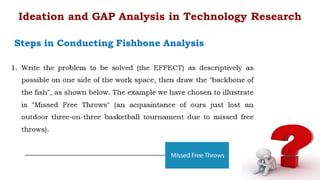
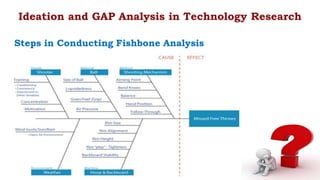
Steps in Conducting Fishbone Analysis
Ideation and GAP Analysis in Technology Research
Steps in Conducting Fishbone Analysis
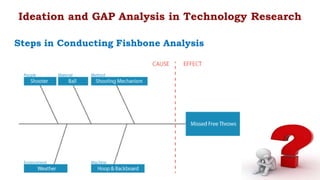
2. Decide how to Categorize the causes.
There are two basic methods: A) by function, or B) by process
sequence. The most frequent approach is to categorize by
function.
Note: In manufacturing settings the categories are often: Machine,
Method, Materials, Measurement, People, and Environment. In service
settings, Machine and Method are often replaced by Policies (high level
decision rules), and Procedures (specific tasks).
Ideation and GAP Analysis in Technology Research
Steps in Conducting Fishbone Analysis
Ideation and GAP Analysis in Technology Research
Steps in Conducting Fishbone Analysis
Ideation and GAP Analysis in Technology Research
Steps in Conducting Fishbone Analysis

Lecture-on-Technology-Research-by-Prof.-Cubian.pdf

  • 2.
    CONTENT OF PRESENTATION Basics of Technology Research  Ideation and GAP Analysis  Technology Research Design  Evaluation of Technology Research
  • 3.
  • 5.
    CONTENT OF PRESENTATION Definition of Research  Meaning of Technology Research  Basic and Applied Research  Method for Technology Research  Expected Outputs
  • 6.
    composed of twosyllables, re and search. • re is a prefix meaning again, a new or over again Definition of Research • search is a verb meaning to examine closely and carefully, to test and try, or to prove.
  • 7.
    1. a noundescribing a careful, systematic, patient study and investigation in some field of knowledge, undertaken to establish facts or principles. Definition of Research 2. the application of the scientific method
  • 8.
    3. a scientificand systematic process of collecting and logically analyzing information (data) Definition of Research 4. a search for knowledge /a movement from unknown to known 5. art of scientific investigation
  • 9.
    The word technologystems from the Greek word techne, meaning art, skill. Meaning of Technology Research Technology is defined as “the study, mastery and utilization of manufacturing methods and industrial arts” (Hornby, 1974).
  • 10.
    Technology is “theknowledge of artefacts emphasizing their manufacturing”. Objects manufactured by human beings will be called artefacts. Meaning of Technology Research
  • 11.
    Technology research is“research for the purpose of producing new and better artefacts”. • The technology researcher tries to create artefacts which are better than those which already exist, e.g. quicker, more useful, or more dependable (Skolimowski, 1983). Meaning of Technology Research
  • 12.
    ` Basic research is“research for the purpose of obtaining new knowledge”. Applied research is “research seeking solutions to practical problems”. Basic and Applied Research
  • 13.
  • 14.
    ` 1. Goal: Newand Better Artefacts • The technology researcher is concerned about how to make new artefacts or improve existing artefacts • The motivation is a need for a new artefact, or a need to improve an existing artefact. • The researcher starts out by collecting requirements to the artefact. Method for Technology Research
  • 15.
    ` 2. Hypothesis, Predictionsand Evaluations • When the requirements have been collected, the researcher starts making an artefact which is supposed to satisfy the requirements. Method for Technology Research • Despite the fact that nobody has done this before, the researcher assumes that it is feasible.
  • 16.
    ` 2. Hypothesis, Predictionsand Evaluations • When the artefact is ready, the researcher has to show that it actually fulfils the posed requirements and thereby satisfies the (potential) need on which it is based. Method for Technology Research • The overall hypothesis of the technology researcher is: The artefact satisfies the need.
  • 17.
    ` 2. Hypothesis, Predictionsand Evaluations • In order to evaluate the overall hypothesis, the researcher has to formulate sub-hypotheses about the properties of the artefact Example H1: Artefact A is user-friendly. Method for Technology Research
  • 18.
    ` 2. Hypothesis, Predictionsand Evaluations • However, neither such hypotheses can be tested straight away. Therefore, the researcher uses predictions, which are statements about the artefact’s behavior under certain circumstances. Method for Technology Research • Predictions may be derived from the need and from the posed requirements.
  • 19.
    ` 2. Hypothesis, Predictionsand Evaluations • It is essential to formulate the predictions in such a way that they are falsifiable. Method for Technology Research Example: • P1: Artefact A can be used after a short training time. • P2: Artefact A can print 5000 word on paper during one minute.
  • 20.
    ` 2. Hypothesis, Predictionsand Evaluations • It is essential to formulate the predictions in such a way that they are falsifiable. Method for Technology Research Example: • P1: Artefact A can be used after a short training time. • P2: Artefact A can print 5000 word on paper during one minute. P1 cannot be falsified straight away, because one first needs an agreement of what is “a short training time”.
  • 21.
    ` 2. Hypothesis, Predictionsand Evaluations • It is essential to formulate the predictions in such a way that they are falsifiable. Method for Technology Research Example: • P1: Artefact A can be used after a short training time. • P2: Artefact A can print 5000 word on paper during one minute. On the other hand, it is much simpler to find out if P2 is false.
  • 22.
    ` Note: Technology research doesnot always produce artefacts that are complete, regarded from a user’s point of view. It is common to make a so-called functional prototype, which must be able to undergo the necessary evaluation (hypothesis testing). If the prototype looks promising, it can later on be elaborated to a complete, saleable product. Such finalization is typically done by other people than researchers. Method for Technology Research
  • 23.
    ` 3. Technology Researchas an Iterative Process • If evaluation was successful, the researcher may argue that the artefact satisfies the need. Method for Technology Research • If the evaluation results diverge, the researcher has to adjust the requirements, and possibly build a new artefact and evaluate this one. Thus, defining it as iterative process.
  • 24.
  • 25.
    ` Method for TechnologyResearch Problem Analysis The researcher tries to construct an artefact that satisfies the potential need. The overall hypothesis is that the artefact satisfies this need.
  • 26.
    ` Method for TechnologyResearch Innovation The researcher maps a potential need for a new or improved artefact by interacting with possible users and other stakeholders.
  • 27.
    ` Method for TechnologyResearch Evaluation Based on the potential need, the researcher formulates predictions about the artefact and checks whether these predictions come true. If the results are positive, the researcher may argue that the artefact satisfies the need.
  • 28.
    ` 6Ps Outputs • Publications(in recognized scientific journals) • Patents (tangible measure of innovation) • Products (commercial value of output) • People Services (increase in the scientific workforce) • Places (facilities that enable increased 6Ps output) • Policies (adopted science-based guidelines) Expected Outputs
  • 30.
    CONTENT OF PRESENTATION The Research Problem and its Purpose  Criteria for Selecting GOOD Research Problem  Ideation and Gap Analysis in Technology Developemtn Research
  • 31.
  • 32.
    A research problemis a statement about an area of concern, a condition to be improved, a difficulty to be eliminated, or a troubling question that exists in scholarly literature, in theory, or in practice that points to the need for meaningful understanding and deliberate investigation. The Research Problem
  • 33.
    • Research problemin technology research is concerned about how to make new artefacts or improve existing artefacts based on requirements or needs. The Research Problem • Such requirements are stated by existing users (in case the artefact needs improvement) or by new or potential users (in case this type of artefact not yet exists).
  • 34.
    • Introduce thereader to the importance of the topic being studied. • Places the problem into a particular context that defines the parameters of what is to be investigated. Purpose of Research Problem • Provides the framework for reporting the results and indicates what is probably necessary to conduct the study and explain how the findings will present this information.
  • 35.
    Criteria for Selectinga GOOD Technology Research Problem
  • 36.
    Criteria for Selectinga GOOD Technology Research Problem
  • 37.
    • Social: Thesocial developments include factors like consumer behavior demographics, religion, lifestyles, values, and advertising. • Technological: The technology aspect of STEEP analysis focuses highly on technological advancements. It includes factors like innovation, communication, energy, transport, research and development, patent regulations and life- cycle of products DOST STEEP Evaluation Criteria
  • 38.
    • Economic: Theeconomic condition is strongly associated with the consumers’ buying position. In this step, factors such as interest rates, international trade, taxes, savings, inflation, subsidies, availability of jobs and entrepreneurship are considered • Environmental: Environmental developments involve ecosystem factors such as water, wind, food, soil, energy, pollution and environmental regulations. DOST STEEP Evaluation Criteria
  • 39.
    • Political: ThePolitical developments can highly influence individuals and organizations. It is important to be aware of likely upcoming shifts in power. Political developments can affect environmental, antitrust, financial markets, trade, and other kinds of laws. Factors to be considered include political stability, regulation of monopolies, tax policies, price regulations consumer protection, jurisdiction and trade unions. DOST STEEP Evaluation Criteria
  • 40.
    A gap analysisis a method of assessing the differences in performance level between actual and the desired artefacts or technologies to determine whether the requirements are being met Ideation and GAP Analysis in Technology Research and, if not, what steps should be taken to ensure they are met successfully
  • 41.
    • A clearproblem statement that can easily define all of your objectives is helpful to you to develop effective research. • It is also helpful for the evaluators to get an idea of either the research questions of your projects has provided all the possible answers to your questions or not. Ideation and GAP Analysis in Technology Research 1. Specify the Research Objectives
  • 42.
    In technology research,you can start first analyzing the existing process flow of your topic of interest and determine technical problems/flaws existing on the said process flow. Ideation and GAP Analysis in Technology Research 1. Specify the Research Objectives
  • 43.
    Title of the Project: Designand Development of Liquid Gel Dispensing Device Ideation and GAP Analysis in Technology Research Example
  • 44.
    • There aresome environmental variables or contextual variables which are helpful to you to provide enough idea about the findings of your research problem. • You just need to find out all the environmental or contextual variables which can affect your research project. Ideation and GAP Analysis in Technology Research 2. Review the Context of the Research Problem
  • 45.
    • The simplicityor the complexity of the research problem depends upon the number of variables/requirements and relationship between these variables/requirements. • As a researcher, you should try to select such variables/requirements for your research project which have a direct relation with the research problems or the research questions. Ideation and GAP Analysis in Technology Research 3. Explore the Nature of the Problem
  • 46.
    In technology research,you can explore the nature of problem in various ways. One of which is the 5 WHYs technique developed by Sakichi Toyoda. The 5 Whys strategy is a simple, effective tool for uncovering the root of a problem. Ideation and GAP Analysis in Technology Research 3. Explore the Nature of the Problem
  • 47.
    1.Start with aproblem and ask why it is occurring. 2.Make sure that your answer is grounded in fact, and then ask the question again. 3.Continue the process until you reach the root cause of the problem, and you can identify a counter- measure that will prevent it from recurring. Ideation and GAP Analysis in Technology Research Criteria of 5 WHYs Analysis
  • 48.
    Ideation and GAPAnalysis in Technology Research Steps of 5 WHYs Analysis
  • 50.
  • 51.
    • We can’tignore these variables while formulating the research questions since this is considered as an essential stage for problem formulation. Ideation and GAP Analysis in Technology Research 4. Define the Variable Relationships • You can use the fishbone technique in defining your variables. Fishbone Diagrams (also known as Ishikawa Diagrams) can be used to answer the following questions that commonly arise in problem solving.
  • 52.
    Ideation and GAPAnalysis in Technology Research Steps in Conducting Fishbone Analysis
  • 53.
    Ideation and GAPAnalysis in Technology Research Steps in Conducting Fishbone Analysis 2. Decide how to Categorize the causes. There are two basic methods: A) by function, or B) by process sequence. The most frequent approach is to categorize by function. Note: In manufacturing settings the categories are often: Machine, Method, Materials, Measurement, People, and Environment. In service settings, Machine and Method are often replaced by Policies (high level decision rules), and Procedures (specific tasks).
  • 54.
    Ideation and GAPAnalysis in Technology Research Steps in Conducting Fishbone Analysis
  • 55.
    Ideation and GAPAnalysis in Technology Research Steps in Conducting Fishbone Analysis
  • 56.
    Ideation and GAPAnalysis in Technology Research Steps in Conducting Fishbone Analysis