Abstraction in Java
Abstractionis a process of hiding the
implementation details and showing only
functionality to the user.
Example to understand Abstraction:
Television remote control is an excellent example of
abstraction. It simplifies the interaction with a TV by
hiding the complexity behind simple buttons and
symbols, making it easy without needing to understand
the technical details of how the TV functions.
4.
Abstract class inJava
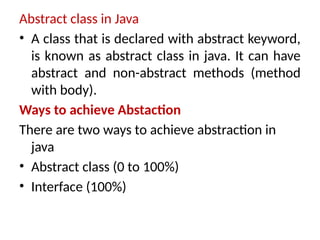
• A class that is declared with abstract keyword,
is known as abstract class in java. It can have
abstract and non-abstract methods (method
with body).
Ways to achieve Abstaction
There are two ways to achieve abstraction in
java
• Abstract class (0 to 100%)
• Interface (100%)
5.
Abstract class inJava
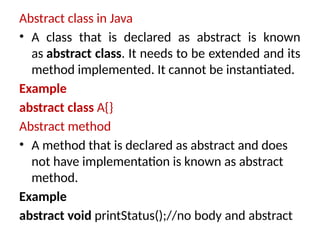
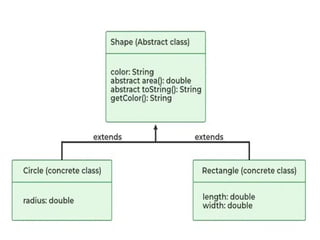
• A class that is declared as abstract is known
as abstract class. It needs to be extended and its
method implemented. It cannot be instantiated.
Example
abstract class A{}
Abstract method
• A method that is declared as abstract and does
not have implementation is known as abstract
method.
Example
abstract void printStatus();//no body and abstract
7.
Example of abstractclass that has abstract method
In this example, Bike the abstract class that contains only one
abstract method run. It implementation is provided by the
Honda class.
abstract class Bike{
abstract void run();
}
class Honda4 extends Bike{
void run(){System.out.println("running safely..");}
public static void main(String args[]){
Honda4 obj = new Honda4();
obj.run();
}
}
8.
abstract class Bank{
abstractdouble getRateOfInterest();
}
class SBI extends Bank{
double getRateOfInterest(){return 7.5;}
}
class PNB extends Bank{
double getRateOfInterest(){return 7;}
}
class TestBank{
public static void main(String args[]){
SBI b=new SBI();//if object is PNB, method of PNB will be invoked
int interest=b.getRateOfInterest();
System.out.println("Rate of Interest is: "+interest+" %");
}}
• Rate of Interest is: 7.5 %
9.
An abstract classcan have data member, abstract method, method body,
constructor and even main() method.
File: TestAbstraction2.java
//example of abstract class that have method body
abstract class Bike{
Bike(){System.out.println("bike is created");}
abstract void run();
void changeGear(){System.out.println("gear changed");}
}
class Honda extends Bike{
void run(){System.out.println("running safely..");}
}
class TestAbstraction2{
public static void main(String args[]){
Bike obj = new Honda();
obj.run();
obj.changeGear();
} }
10.
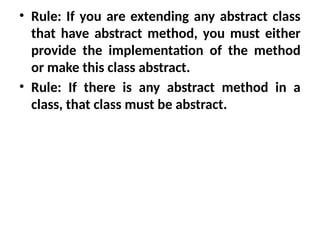
• Rule: Ifyou are extending any abstract class
that have abstract method, you must either
provide the implementation of the method
or make this class abstract.
• Rule: If there is any abstract method in a
class, that class must be abstract.
11.
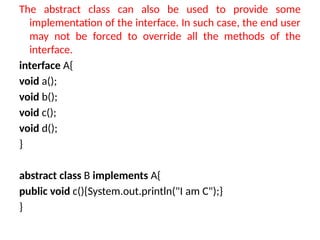
The abstract classcan also be used to provide some
implementation of the interface. In such case, the end user
may not be forced to override all the methods of the
interface.
interface A{
void a();
void b();
void c();
void d();
}
abstract class B implements A{
public void c(){System.out.println("I am C");}
}
12.
class M extendsB{
public void a(){System.out.println("I am a");}
public void b(){System.out.println("I am b");}
public void d(){System.out.println("I am d");}
}
class Test5{
public static void main(String args[]){
M a=new M();
a.a();
a.b();
a.c();
a.d();
}}
13.
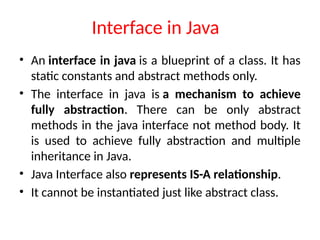
Interface in Java
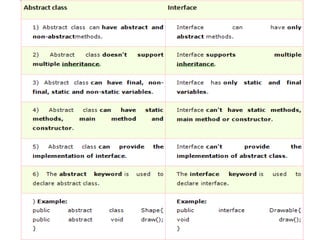
•An interface in java is a blueprint of a class. It has
static constants and abstract methods only.
• The interface in java is a mechanism to achieve
fully abstraction. There can be only abstract
methods in the java interface not method body. It
is used to achieve fully abstraction and multiple
inheritance in Java.
• Java Interface also represents IS-A relationship.
• It cannot be instantiated just like abstract class.
14.
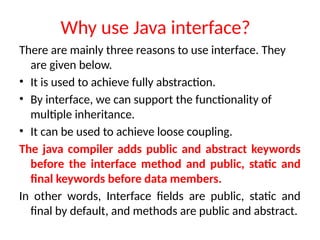
Why use Javainterface?
There are mainly three reasons to use interface. They
are given below.
• It is used to achieve fully abstraction.
• By interface, we can support the functionality of
multiple inheritance.
• It can be used to achieve loose coupling.
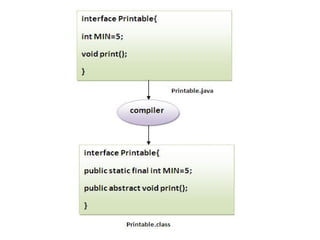
The java compiler adds public and abstract keywords
before the interface method and public, static and
final keywords before data members.
In other words, Interface fields are public, static and
final by default, and methods are public and abstract.
16.
interface printable{
void print();
}
classA6 implements printable{
public void print(){System.out.println("Hello");}
public static void main(String args[]){
A6 obj = new A6();
obj.print();
}
}
17.
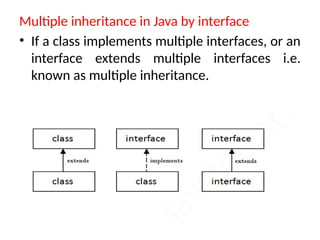
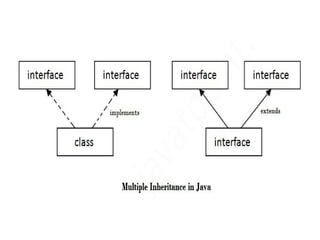
Multiple inheritance inJava by interface
• If a class implements multiple interfaces, or an
interface extends multiple interfaces i.e.
known as multiple inheritance.
19.
interface Printable{
void print();
}
interfaceShowable{
void show();
}
class A7 implements Printable,Showable{
public void print(){System.out.println("Hello");}
public void show(){System.out.println("Welcome");}
public static void main(String args[]){
A7 obj = new A7();
obj.print();
obj.show();
}
}
20.
Interface inheritance
A classimplements interface but one interface extends another interface .
interface Printable{
void print();
}
interface Showable extends Printable{
void show();
}
class Testinterface2 implements Showable{
public void print(){System.out.println("Hello");}
public void show(){System.out.println("Welcome");}
public static void main(String args[]){
Testinterface2 obj = new Testinterface2();
obj.print();
obj.show();
} }
![Example of abstract class that has abstract method
In this example, Bike the abstract class that contains only one
abstract method run. It implementation is provided by the
Honda class.
abstract class Bike{
abstract void run();
}
class Honda4 extends Bike{
void run(){System.out.println("running safely..");}
public static void main(String args[]){
Honda4 obj = new Honda4();
obj.run();
}
}](https://image.slidesharecdn.com/lecture10-250526083057-13414da8/85/Lecture-on-Object-Oriented-Programming-Language-Java-pptx-7-320.jpg)
![abstract class Bank{
abstract double getRateOfInterest();
}
class SBI extends Bank{
double getRateOfInterest(){return 7.5;}
}
class PNB extends Bank{
double getRateOfInterest(){return 7;}
}
class TestBank{
public static void main(String args[]){
SBI b=new SBI();//if object is PNB, method of PNB will be invoked
int interest=b.getRateOfInterest();
System.out.println("Rate of Interest is: "+interest+" %");
}}
• Rate of Interest is: 7.5 %](https://image.slidesharecdn.com/lecture10-250526083057-13414da8/85/Lecture-on-Object-Oriented-Programming-Language-Java-pptx-8-320.jpg)
![An abstract class can have data member, abstract method, method body,
constructor and even main() method.
File: TestAbstraction2.java
//example of abstract class that have method body
abstract class Bike{
Bike(){System.out.println("bike is created");}
abstract void run();
void changeGear(){System.out.println("gear changed");}
}
class Honda extends Bike{
void run(){System.out.println("running safely..");}
}
class TestAbstraction2{
public static void main(String args[]){
Bike obj = new Honda();
obj.run();
obj.changeGear();
} }](https://image.slidesharecdn.com/lecture10-250526083057-13414da8/85/Lecture-on-Object-Oriented-Programming-Language-Java-pptx-9-320.jpg)
![class M extends B{
public void a(){System.out.println("I am a");}
public void b(){System.out.println("I am b");}
public void d(){System.out.println("I am d");}
}
class Test5{
public static void main(String args[]){
M a=new M();
a.a();
a.b();
a.c();
a.d();
}}](https://image.slidesharecdn.com/lecture10-250526083057-13414da8/85/Lecture-on-Object-Oriented-Programming-Language-Java-pptx-12-320.jpg)
![interface printable{
void print();
}
class A6 implements printable{
public void print(){System.out.println("Hello");}
public static void main(String args[]){
A6 obj = new A6();
obj.print();
}
}](https://image.slidesharecdn.com/lecture10-250526083057-13414da8/85/Lecture-on-Object-Oriented-Programming-Language-Java-pptx-16-320.jpg)
![interface Printable{
void print();
}
interface Showable{
void show();
}
class A7 implements Printable,Showable{
public void print(){System.out.println("Hello");}
public void show(){System.out.println("Welcome");}
public static void main(String args[]){
A7 obj = new A7();
obj.print();
obj.show();
}
}](https://image.slidesharecdn.com/lecture10-250526083057-13414da8/85/Lecture-on-Object-Oriented-Programming-Language-Java-pptx-19-320.jpg)
![Interface inheritance
A class implements interface but one interface extends another interface .
interface Printable{
void print();
}
interface Showable extends Printable{
void show();
}
class Testinterface2 implements Showable{
public void print(){System.out.println("Hello");}
public void show(){System.out.println("Welcome");}
public static void main(String args[]){
Testinterface2 obj = new Testinterface2();
obj.print();
obj.show();
} }](https://image.slidesharecdn.com/lecture10-250526083057-13414da8/85/Lecture-on-Object-Oriented-Programming-Language-Java-pptx-20-320.jpg)