Engineering
Management
Delegation, Motivation
Lecture # 9
Delegation
Delegation
 Key activity performed by managers and
leaders
 Not easy but essential, if leader is to
operate efficiently
 Frees up managers time to do activities
of more importance for organization
 “If you want it to be done properly, do it
yourself.”
Definition of Delegation
Usually
 Manager
 retains the responsibility
 requires frequent interaction with
subordinate as the task progresses
 Subordinate
 has less freedom to act
 Needs to agree the method of
tackling the job with leader
Definition of Delegation
 In true delegation
 Subordinates should have high level
of autonomy to act as they think
best to achieve the results agreed
with the leader
 Monitoring the activity at agreed
upon points, unless help is
requested by the subordinate
Definition of Delegation
 When delegating a task, leaders are carrying
out the following;
 Giving to subordinates some of their own
responsibility, (usually of specific tasks and relevant
decisions)
 Giving subordinates sufficient authority to match
the responsibility
 Ensuring that subordinates accept accountability
for success or failure (leaders carry the ultimate
responsibility of all the tasks carried out by the team
under them)
 Be available to help with advice if required
Delegation Process
 Before leaders delegate tasks they
need to consider;
 What tasks to delegate?
 Level of delegation?
 Some of the examples of levels of
delegation are;
Delegation Process
 Leaders instruct subordinates to do the task, but
to check with them before taking any decision
(this is not really delegation, but task allocation)
 Leaders instruct subordinates to do the task and
keep them fully informed
 Leaders request subordinates to carry out task,
holding weekly reviews with them
 Leaders delegate the task and say ‘let me know
if I can help’
 Leaders abdicate the tasks by saying, ‘here you
are; do this and let me know when finished’
Delegation Process
 Steps need to be followed in delegation;
 Analyze all the jobs that need to be done
and decide which can be delegated (usually
if a task can be clearly defined then it is a candidate for
delegation)
 Out of the jobs that can be delegated
decide which job to keep and which to
delegate and to whom?
 Analyze the subordinates who will receive
these tasks (any special training or coaching?)
Delegation Process
 Agree the content and expected results of
delegated tasks with the subordinates (often
delegation can be in stages, with reducing intervention
from leader)
 Delegate the task and trust in the subordinate
to achieve the agreed objectives (discretely
monitor progress and offer help when asked)
 If the subordinate achieves the result then
provide reward (prize, promotion, bonus, bigger
assignment)
 If subordinate fails, take it as a learning
experience (leader should have monitored progress so
that failure should have not allowed to occur)
Motivation
Motivation
 Motive:
 A consideration or motion that excites to
action
 Motivation:
 A motivating force
Motivation is therefore a force which
excites and drives a person to action.
Motivation
 People are highly motivated
when they join any org.
 After some time their motivation
level drops
 Factors that cause this change in
morale & motivation are;
Motivation
1. Favoritism
2. Excessive emphasis within the
company on status (different canteen for staff
and managers)
3. Non-recognition of achievements
4. Petty regulations
5. Poor communication
Motivation
 Motivation varies with time
(e.g., age of person, mood at the time, etc.)
 There are two main types of
motivation drivers;
1. Primary motivation drivers;
1. instinctive (hunger, thirst, pain avoidance)
2. Secondary motivation drivers; learned
(doing a good project/assignment that will get praise from
the teacher)
Motivation and Performance
 Every action has positive and negative
factor associated with it which vary from
person to person
 Factors that affect job performance are;
1. Ability related to the task being done
2. Availability of support tools
3. Organizational environment
4. Clearly defined missions and goals
5. Motivation on the job
Motivational Theories
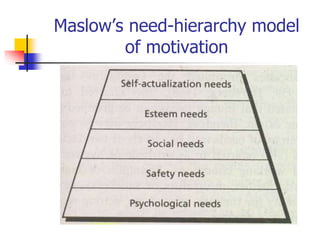
 Maslow, in his need-hierarchy model of
motivation postulated five levels of needs;
1. Psychological needs; (basic needs, such as hunger,
thirst, shelter)
2. Safety needs; (protection from threat and danger,
physical or emotional)
3. Social needs; (need to belong to a group)
4. Esteem needs; (ego needs – self esteem and esteem
for others)
5. Self-actualization needs; (need for continual self
development)
Maslow’s need-hierarchy model
of motivation
Motivational Theories
 Maslow further postulated that;
1. A higher level need only arises
when the ones below are satisfied
2. A satisfied need no longer
dominates an individual’s behavior
3. An unsatisfied need acts as a
motivator
Motivational Theories
 McGregor’s theory X and theory Y
 Theory X – hygiene seekers, carrot
and stick motivation technique
 Theory Y – motivation seekers
Motivational Theories
 McClelland postulated that each
person is motivated by one of three
needs;
1. Need for power; (power is desired for the sake
of power, not for achieving the goals)
2. Need for affiliation; (need for belonging to a
group)
3. Need for achievement; (motivation by
achieving the goals)
Motivation Techniques
 In order to motivate staff effectively
a manager or team lead must;
 understand the needs of
subordinates and
 ensure that these are matched to
the requirements of the
organization in which they work
Motivation Techniques
 Considerations which must be taken
into account when motivating staff;
1. Financial reward
 Hygiene needs
 Esteem needs
2. Financial techniques for motivation
(incentive payments, profit sharing, bonus)
3. Working conditions – dissatisfaction
preventer rather than as a motivator
Motivation Techniques
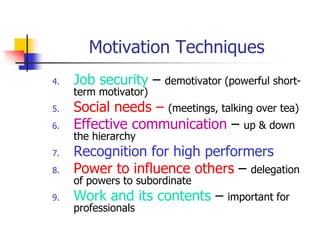
4. Job security – demotivator (powerful short-
term motivator)
5. Social needs – (meetings, talking over tea)
6. Effective communication – up & down
the hierarchy
7. Recognition for high performers
8. Power to influence others – delegation
of powers to subordinate
9. Work and its contents – important for
professionals

Lecture 9, Delegation and Motivation.ppt

  • 1.
  • 2.
  • 3.
    Delegation  Key activityperformed by managers and leaders  Not easy but essential, if leader is to operate efficiently  Frees up managers time to do activities of more importance for organization  “If you want it to be done properly, do it yourself.”
  • 4.
    Definition of Delegation Usually Manager  retains the responsibility  requires frequent interaction with subordinate as the task progresses  Subordinate  has less freedom to act  Needs to agree the method of tackling the job with leader
  • 5.
    Definition of Delegation In true delegation  Subordinates should have high level of autonomy to act as they think best to achieve the results agreed with the leader  Monitoring the activity at agreed upon points, unless help is requested by the subordinate
  • 6.
    Definition of Delegation When delegating a task, leaders are carrying out the following;  Giving to subordinates some of their own responsibility, (usually of specific tasks and relevant decisions)  Giving subordinates sufficient authority to match the responsibility  Ensuring that subordinates accept accountability for success or failure (leaders carry the ultimate responsibility of all the tasks carried out by the team under them)  Be available to help with advice if required
  • 7.
    Delegation Process  Beforeleaders delegate tasks they need to consider;  What tasks to delegate?  Level of delegation?  Some of the examples of levels of delegation are;
  • 8.
    Delegation Process  Leadersinstruct subordinates to do the task, but to check with them before taking any decision (this is not really delegation, but task allocation)  Leaders instruct subordinates to do the task and keep them fully informed  Leaders request subordinates to carry out task, holding weekly reviews with them  Leaders delegate the task and say ‘let me know if I can help’  Leaders abdicate the tasks by saying, ‘here you are; do this and let me know when finished’
  • 9.
    Delegation Process  Stepsneed to be followed in delegation;  Analyze all the jobs that need to be done and decide which can be delegated (usually if a task can be clearly defined then it is a candidate for delegation)  Out of the jobs that can be delegated decide which job to keep and which to delegate and to whom?  Analyze the subordinates who will receive these tasks (any special training or coaching?)
  • 10.
    Delegation Process  Agreethe content and expected results of delegated tasks with the subordinates (often delegation can be in stages, with reducing intervention from leader)  Delegate the task and trust in the subordinate to achieve the agreed objectives (discretely monitor progress and offer help when asked)  If the subordinate achieves the result then provide reward (prize, promotion, bonus, bigger assignment)  If subordinate fails, take it as a learning experience (leader should have monitored progress so that failure should have not allowed to occur)
  • 11.
  • 12.
    Motivation  Motive:  Aconsideration or motion that excites to action  Motivation:  A motivating force Motivation is therefore a force which excites and drives a person to action.
  • 13.
    Motivation  People arehighly motivated when they join any org.  After some time their motivation level drops  Factors that cause this change in morale & motivation are;
  • 14.
    Motivation 1. Favoritism 2. Excessiveemphasis within the company on status (different canteen for staff and managers) 3. Non-recognition of achievements 4. Petty regulations 5. Poor communication
  • 15.
    Motivation  Motivation varieswith time (e.g., age of person, mood at the time, etc.)  There are two main types of motivation drivers; 1. Primary motivation drivers; 1. instinctive (hunger, thirst, pain avoidance) 2. Secondary motivation drivers; learned (doing a good project/assignment that will get praise from the teacher)
  • 16.
    Motivation and Performance Every action has positive and negative factor associated with it which vary from person to person  Factors that affect job performance are; 1. Ability related to the task being done 2. Availability of support tools 3. Organizational environment 4. Clearly defined missions and goals 5. Motivation on the job
  • 17.
    Motivational Theories  Maslow,in his need-hierarchy model of motivation postulated five levels of needs; 1. Psychological needs; (basic needs, such as hunger, thirst, shelter) 2. Safety needs; (protection from threat and danger, physical or emotional) 3. Social needs; (need to belong to a group) 4. Esteem needs; (ego needs – self esteem and esteem for others) 5. Self-actualization needs; (need for continual self development)
  • 18.
  • 19.
    Motivational Theories  Maslowfurther postulated that; 1. A higher level need only arises when the ones below are satisfied 2. A satisfied need no longer dominates an individual’s behavior 3. An unsatisfied need acts as a motivator
  • 20.
    Motivational Theories  McGregor’stheory X and theory Y  Theory X – hygiene seekers, carrot and stick motivation technique  Theory Y – motivation seekers
  • 21.
    Motivational Theories  McClellandpostulated that each person is motivated by one of three needs; 1. Need for power; (power is desired for the sake of power, not for achieving the goals) 2. Need for affiliation; (need for belonging to a group) 3. Need for achievement; (motivation by achieving the goals)
  • 22.
    Motivation Techniques  Inorder to motivate staff effectively a manager or team lead must;  understand the needs of subordinates and  ensure that these are matched to the requirements of the organization in which they work
  • 23.
    Motivation Techniques  Considerationswhich must be taken into account when motivating staff; 1. Financial reward  Hygiene needs  Esteem needs 2. Financial techniques for motivation (incentive payments, profit sharing, bonus) 3. Working conditions – dissatisfaction preventer rather than as a motivator
  • 24.
    Motivation Techniques 4. Jobsecurity – demotivator (powerful short- term motivator) 5. Social needs – (meetings, talking over tea) 6. Effective communication – up & down the hierarchy 7. Recognition for high performers 8. Power to influence others – delegation of powers to subordinate 9. Work and its contents – important for professionals