CPU Scheduling(cont’d)
Course Code:CSC 2209
Dept. of Computer Science
Faculty of Science and Technology
Lecturer No: 07 Week No: 07 Semester:
Lecturer: Name & email
Course Title: Operating Systems
2.
Lecture Outline
1. ThreadScheduling
2. Multi-Processor Scheduling
3. Real-Time CPU Scheduling
4. Operating Systems Examples
5. Algorithm Evaluation
3.
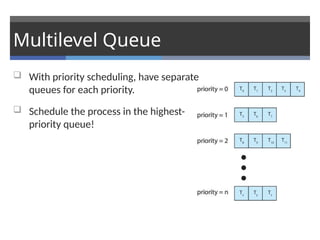
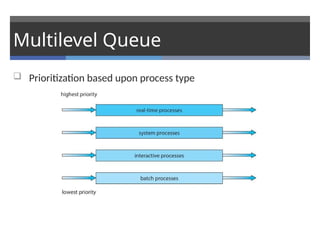
Multilevel Queue
Withpriority scheduling, have separate
queues for each priority.
Schedule the process in the highest-
priority queue!
Multilevel Feedback Queue
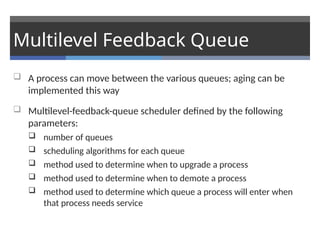
A process can move between the various queues; aging can be
implemented this way
Multilevel-feedback-queue scheduler defined by the following
parameters:
number of queues
scheduling algorithms for each queue
method used to determine when to upgrade a process
method used to determine when to demote a process
method used to determine which queue a process will enter when
that process needs service
6.
Example of MultilevelFeedback Queue
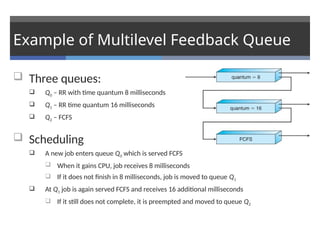
Three queues:
Q0 – RR with time quantum 8 milliseconds
Q1 – RR time quantum 16 milliseconds
Q2 – FCFS
Scheduling
A new job enters queue Q0 which is served FCFS
When it gains CPU, job receives 8 milliseconds
If it does not finish in 8 milliseconds, job is moved to queue Q1
At Q1 job is again served FCFS and receives 16 additional milliseconds
If it still does not complete, it is preempted and moved to queue Q2
7.
Thread Scheduling
Distinctionbetween user-level and kernel-level threads
When threads supported, threads scheduled, not processes
Many-to-one and many-to-many models, thread library schedules
user-level threads to run on LWP
Known as process-contention scope (PCS) since scheduling
competition is within the process
Typically done via priority set by programmer
Kernel thread scheduled onto available CPU is system-contention
scope (SCS) – competition among all threads in system
8.
Pthread Scheduling
APIallows specifying either PCS or SCS during thread creation
PTHREAD_SCOPE_PROCESS schedules threads using PCS
scheduling
PTHREAD_SCOPE_SYSTEM schedules threads using SCS
scheduling
Can be limited by OS – Linux and macOS only allow
PTHREAD_SCOPE_SYSTEM
9.
Multiple-Processor Scheduling
CPUscheduling more complex when multiple CPUs are available
Multiprocess may be any one of the following architectures:
Multicore CPUs
Multithreaded cores
NUMA systems
Heterogeneous multiprocessing
10.
Multiple-Processor Scheduling
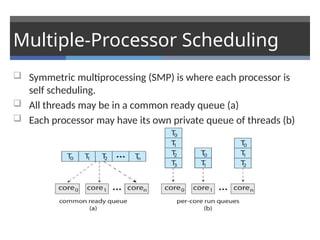
Symmetricmultiprocessing (SMP) is where each processor is
self scheduling.
All threads may be in a common ready queue (a)
Each processor may have its own private queue of threads (b)
11.
Multicore Processors
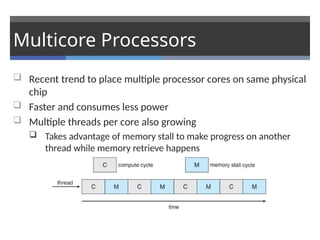
Recenttrend to place multiple processor cores on same physical
chip
Faster and consumes less power
Multiple threads per core also growing
Takes advantage of memory stall to make progress on another
thread while memory retrieve happens
Multithreaded Multicore System
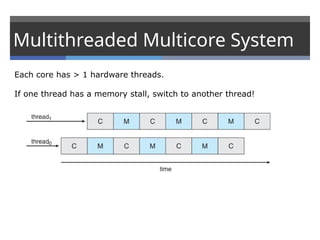
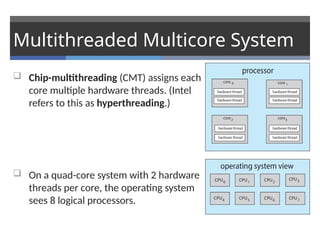
Chip-multithreading (CMT) assigns each
core multiple hardware threads. (Intel
refers to this as hyperthreading.)
On a quad-core system with 2 hardware
threads per core, the operating system
sees 8 logical processors.
14.
Multithreaded Multicore System
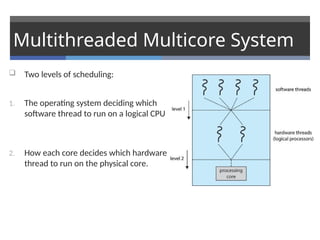
Two levels of scheduling:
1. The operating system deciding which
software thread to run on a logical CPU
2. How each core decides which hardware
thread to run on the physical core.
15.
Multiple-Processor Scheduling –Load
Balancing
If SMP, need to keep all CPUs loaded for efficiency
Load balancing attempts to keep workload evenly distributed
Push migration – periodic task checks load on each processor,
and if found pushes task from overloaded CPU to other CPUs
Pull migration – idle processors pulls waiting task from busy
processor
16.
Multiple-Processor Scheduling –Processor Affinity
When a thread has been running on one processor, the cache contents of that
processor stores the memory accesses by that thread.
We refer to this as a thread having affinity for a processor (i.e. “processor
affinity”)
Load balancing may affect processor affinity as a thread may be moved from
one processor to another to balance loads, yet that thread loses the contents
of what it had in the cache of the processor it was moved off of.
Soft affinity – the operating system attempts to keep a thread running on the
same processor, but no guarantees.
Hard affinity – allows a process to specify a set of processors it may run on.
17.
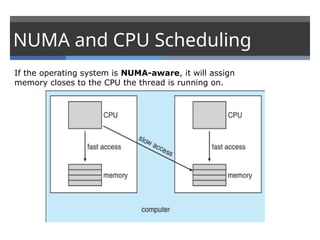
NUMA and CPUScheduling
If the operating system is NUMA-aware, it will assign
memory closes to the CPU the thread is running on.
18.
Real-Time CPU Scheduling
Can present obvious challenges
Soft real-time systems – Critical real-time tasks have the
highest priority, but no guarantee as to when tasks will be
scheduled
Hard real-time systems – task must be serviced by its deadline
19.
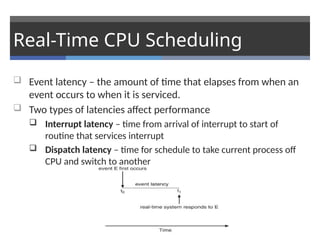
Real-Time CPU Scheduling
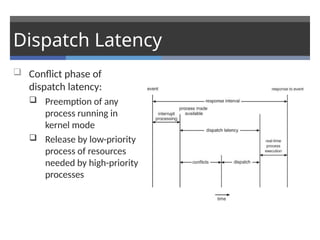
Event latency – the amount of time that elapses from when an
event occurs to when it is serviced.
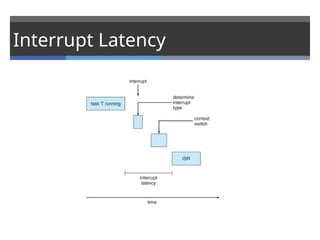
Two types of latencies affect performance
Interrupt latency – time from arrival of interrupt to start of
routine that services interrupt
Dispatch latency – time for schedule to take current process off
CPU and switch to another
Dispatch Latency
Conflictphase of
dispatch latency:
Preemption of any
process running in
kernel mode
Release by low-priority
process of resources
needed by high-priority
processes
22.
Priority-based Scheduling
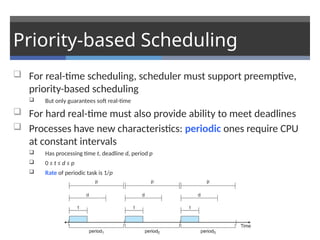
Forreal-time scheduling, scheduler must support preemptive,
priority-based scheduling
But only guarantees soft real-time
For hard real-time must also provide ability to meet deadlines
Processes have new characteristics: periodic ones require CPU
at constant intervals
Has processing time t, deadline d, period p
0 ≤ t ≤ d ≤ p
Rate of periodic task is 1/p
Algorithm Evaluation
Howto select CPU-scheduling algorithm for an OS?
Determine criteria, then evaluate algorithms
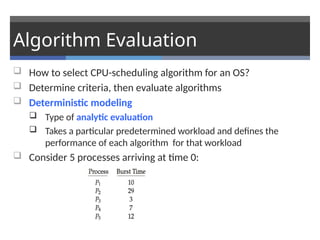
Deterministic modeling
Type of analytic evaluation
Takes a particular predetermined workload and defines the
performance of each algorithm for that workload
Consider 5 processes arriving at time 0:
25.
Deterministic Evaluation
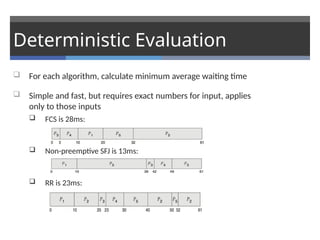
Foreach algorithm, calculate minimum average waiting time
Simple and fast, but requires exact numbers for input, applies
only to those inputs
FCS is 28ms:
Non-preemptive SFJ is 13ms:
RR is 23ms:
26.
Queueing Models
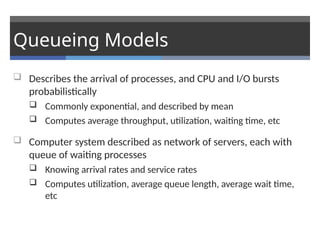
Describesthe arrival of processes, and CPU and I/O bursts
probabilistically
Commonly exponential, and described by mean
Computes average throughput, utilization, waiting time, etc
Computer system described as network of servers, each with
queue of waiting processes
Knowing arrival rates and service rates
Computes utilization, average queue length, average wait time,
etc
27.
Little’s Formula
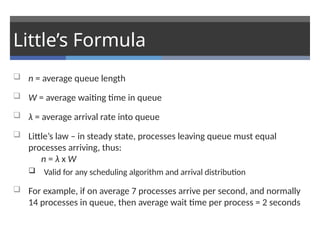
n= average queue length
W = average waiting time in queue
λ = average arrival rate into queue
Little’s law – in steady state, processes leaving queue must equal
processes arriving, thus:
n = λ x W
Valid for any scheduling algorithm and arrival distribution
For example, if on average 7 processes arrive per second, and normally
14 processes in queue, then average wait time per process = 2 seconds
28.
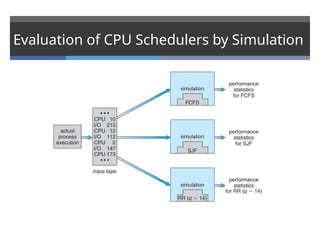
Simulations
Queueing modelslimited
Simulations more accurate
Programmed model of computer system
Clock is a variable
Gather statistics indicating algorithm performance
Data to drive simulation gathered via
Random number generator according to probabilities
Distributions defined mathematically or empirically
Trace tapes record sequences of real events in real systems
Implementation
Even simulationshave limited accuracy
Just implement new scheduler and test in real systems
High cost, high risk
Environments vary
Most flexible schedulers can be modified per-site or per-system
Or APIs to modify priorities
But again environments vary