Chapter 1-
Introduction to Digital
Marketing
Copyright © 2018
Objectives
 What is digital marketing?
 Role of digital marketing in marketing strategy
 Differences between traditional marketing and digital marketing
 Conceptual frameworks of digital marketing
 Internet behaviour of users
Copyright © 2018
Introduction
Characteristics of digital marketing are:
 Two-way Communication
 Targeting of One
 Level Playing Field
 Measurability
 Push and Pull
 Real-time
 Zero Moment of Truth
Copyright © 2018
Digital Marketing
Philip Kotler defines digital marketing as ‘a form of direct marketing which links
consumers with sellers electronically using interactive technologies like emails,
websites, online forums and newsgroups, interactive television, mobile
communications, etc.’
Copyright © 2018
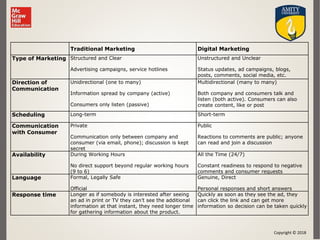
Traditional Marketing Digital Marketing
Type of Marketing Structured and Clear
Advertising campaigns, service hotlines
Unstructured and Unclear
Status updates, ad campaigns, blogs,
posts, comments, social media, etc.
Direction of
Communication
Unidirectional (one to many)
Information spread by company (active)
Consumers only listen (passive)
Multidirectional (many to many)
Both company and consumers talk and
listen (both active). Consumers can also
create content, like or post
Scheduling Long-term Short-term
Communication
with Consumer
Private
Communication only between company and
consumer (via email, phone); discussion is kept
secret
Public
Reactions to comments are public; anyone
can read and join a discussion
Availability During Working Hours
No direct support beyond regular working hours
(9 to 6)
All the Time (24/7)
Constant readiness to respond to negative
comments and consumer requests
Language Formal, Legally Safe
Official
Genuine, Direct
Personal responses and short answers
Response time Longer as if somebody is interested after seeing
an ad in print or TV they can’t see the additional
information at that instant, they need longer time
for gathering information about the product.
Quickly as soon as they see the ad, they
can click the link and can get more
information so decision can be taken quickly
Copyright © 2018
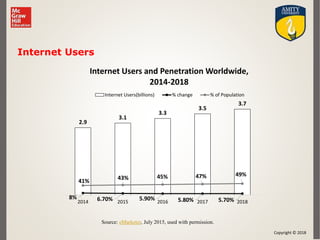
2.9
3.1
3.3
3.5
3.7
8% 6.70% 5.90% 5.80% 5.70%
41%
43% 45% 47% 49%
2014 2015 2016 2017 2018
Internet Users and Penetration Worldwide,
2014-2018
Internet Users(billions) % change % of Population
Source: eMarketer, July 2015, used with permission.
Internet Users
Copyright © 2018
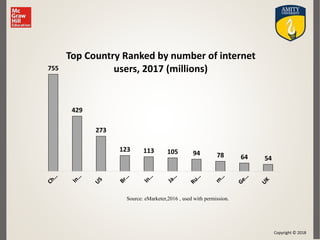
755
429
273
123 113 105 94 78 64 54
Top Country Ranked by number of internet
users, 2017 (millions)
Source: eMarketer,2016 , used with permission.
Copyright © 2018
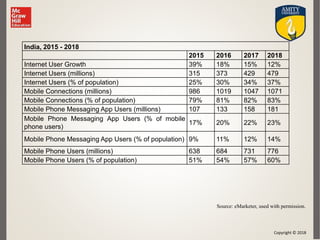
India, 2015 - 2018
2015 2016 2017 2018
Internet User Growth 39% 18% 15% 12%
Internet Users (millions) 315 373 429 479
Internet Users (% of population) 25% 30% 34% 37%
Mobile Connections (millions) 986 1019 1047 1071
Mobile Connections (% of population) 79% 81% 82% 83%
Mobile Phone Messaging App Users (millions) 107 133 158 181
Mobile Phone Messaging App Users (% of mobile
phone users)
17% 20% 22% 23%
Mobile Phone Messaging App Users (% of population) 9% 11% 12% 14%
Mobile Phone Users (millions) 638 684 731 776
Mobile Phone Users (% of population) 51% 54% 57% 60%
Source: eMarketer, used with permission.
Copyright © 2018
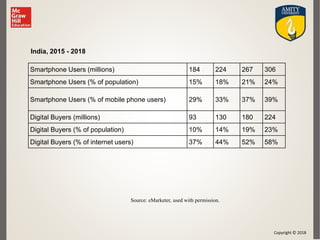
India, 2015 - 2018
Smartphone Users (millions) 184 224 267 306
Smartphone Users (% of population) 15% 18% 21% 24%
Smartphone Users (% of mobile phone users) 29% 33% 37% 39%
Digital Buyers (millions) 93 130 180 224
Digital Buyers (% of population) 10% 14% 19% 23%
Digital Buyers (% of internet users) 37% 44% 52% 58%
Source: eMarketer, used with permission.
Copyright © 2018
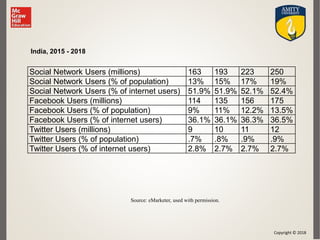
Social Network Users (millions) 163 193 223 250
Social Network Users (% of population) 13% 15% 17% 19%
Social Network Users (% of internet users) 51.9% 51.9% 52.1% 52.4%
Facebook Users (millions) 114 135 156 175
Facebook Users (% of population) 9% 11% 12.2% 13.5%
Facebook Users (% of internet users) 36.1% 36.1% 36.3% 36.5%
Twitter Users (millions) 9 10 11 12
Twitter Users (% of population) .7% .8% .9% .9%
Twitter Users (% of internet users) 2.8% 2.7% 2.7% 2.7%
India, 2015 - 2018
Source: eMarketer, used with permission.
Copyright © 2018
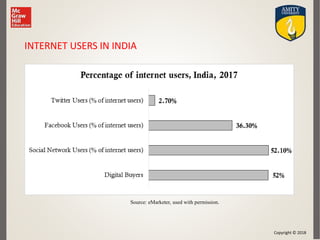
INTERNET USERS IN INDIA
Source: eMarketer, used with permission.
Copyright © 2018
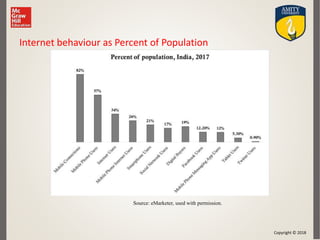
Internet behaviour as Percent of Population
Source: eMarketer, used with permission.
Copyright © 2018
Digital Marketing Strategy
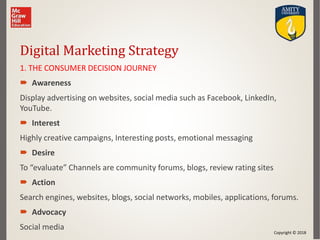
1. THE CONSUMER DECISION JOURNEY
 Awareness
Display advertising on websites, social media such as Facebook, LinkedIn,
YouTube.
 Interest
Highly creative campaigns, Interesting posts, emotional messaging
 Desire
To “evaluate” Channels are community forums, blogs, review rating sites
 Action
Search engines, websites, blogs, social networks, mobiles, applications, forums.
 Advocacy
Social media
Copyright © 2018
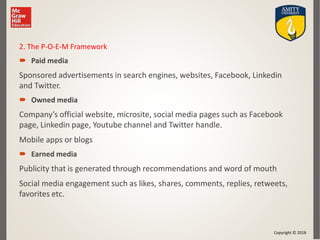
2. The P-O-E-M Framework
 Paid media
Sponsored advertisements in search engines, websites, Facebook, Linkedin
and Twitter.
 Owned media
Company’s official website, microsite, social media pages such as Facebook
page, Linkedin page, Youtube channel and Twitter handle.
Mobile apps or blogs
 Earned media
Publicity that is generated through recommendations and word of mouth
Social media engagement such as likes, shares, comments, replies, retweets,
favorites etc.
Copyright © 2018
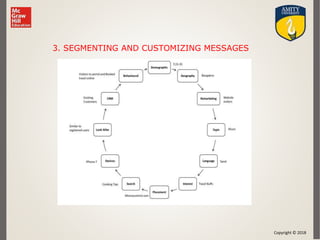
3. SEGMENTING AND CUSTOMIZING MESSAGES
Copyright © 2018
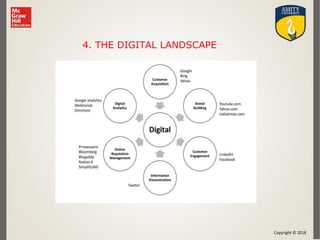
4. THE DIGITAL LANDSCAPE
Copyright © 2018
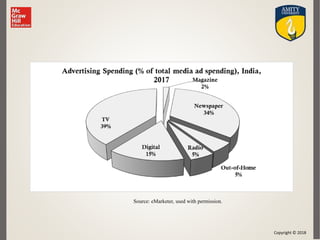
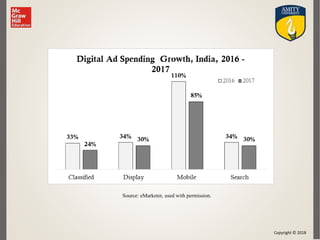
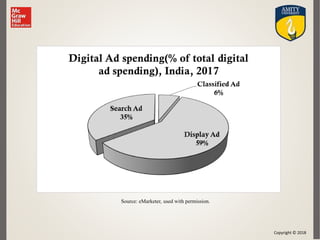
Source: eMarketer, used with permission.
Copyright © 2018
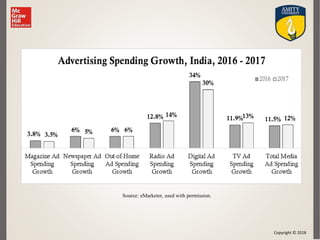
Source: eMarketer, used with permission.
Copyright © 2018
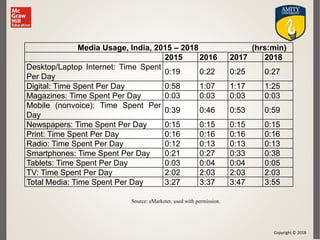
Media Usage, India, 2015 – 2018 (hrs:min)
2015 2016 2017 2018
Desktop/Laptop Internet: Time Spent
Per Day
0:19 0:22 0:25 0:27
Digital: Time Spent Per Day 0:58 1:07 1:17 1:25
Magazines: Time Spent Per Day 0:03 0:03 0:03 0:03
Mobile (nonvoice): Time Spent Per
Day
0:39 0:46 0:53 0:59
Newspapers: Time Spent Per Day 0:15 0:15 0:15 0:15
Print: Time Spent Per Day 0:16 0:16 0:16 0:16
Radio: Time Spent Per Day 0:12 0:13 0:13 0:13
Smartphones: Time Spent Per Day 0:21 0:27 0:33 0:38
Tablets: Time Spent Per Day 0:03 0:04 0:04 0:05
TV: Time Spent Per Day 2:02 2:03 2:03 2:03
Total Media: Time Spent Per Day 3:27 3:37 3:47 3:55
Source: eMarketer, used with permission.
Copyright © 2018
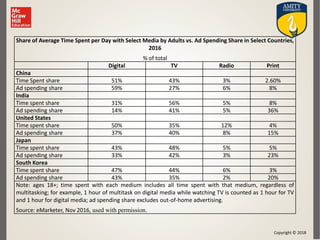
Share of Average Time Spent per Day with Select Media by Adults vs. Ad Spending Share in Select Countries,
2016
% of total
Digital TV Radio Print
China
Time Spent share 51% 43% 3% 2.60%
Ad spending share 59% 27% 6% 8%
India
Time spent share 31% 56% 5% 8%
Ad spending share 14% 41% 5% 36%
United States
Time spent share 50% 35% 12% 4%
Ad spending share 37% 40% 8% 15%
Japan
Time spent share 43% 48% 5% 5%
Ad spending share 33% 42% 3% 23%
South Korea
Time spent share 47% 44% 6% 3%
Ad spending share 43% 35% 2% 20%
Note: ages 18+; time spent with each medium includes all time spent with that medium, regardless of
multitasking; for example, 1 hour of multitask on digital media while watching TV is counted as 1 hour for TV
and 1 hour for digital media; ad spending share excludes out-of-home advertising.
Source: eMarketer, Nov 2016, used with permission.
Copyright © 2018
Source: eMarketer, used with permission.
Copyright © 2018
Source: eMarketer, used with permission.
Copyright © 2018
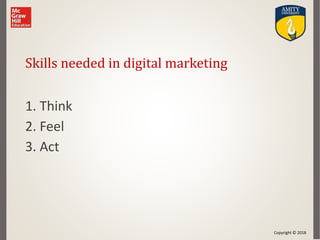
Skills needed in digital marketing
1. Think
2. Feel
3. Act
Copyright © 2018
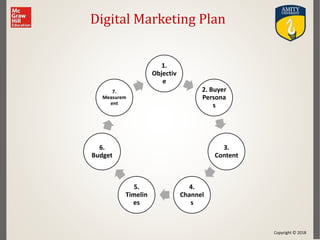
Digital Marketing Plan
1.
Objectiv
e
2. Buyer
Persona
s
3.
Content
4.
Channel
s
5.
Timelin
es
6.
Budget
7.
Measurem
ent

Lecture 2_Introduction to Digital Marketing.pptx

  • 1.
    Chapter 1- Introduction toDigital Marketing
  • 2.
    Copyright © 2018 Objectives What is digital marketing?  Role of digital marketing in marketing strategy  Differences between traditional marketing and digital marketing  Conceptual frameworks of digital marketing  Internet behaviour of users
  • 3.
    Copyright © 2018 Introduction Characteristicsof digital marketing are:  Two-way Communication  Targeting of One  Level Playing Field  Measurability  Push and Pull  Real-time  Zero Moment of Truth
  • 4.
    Copyright © 2018 DigitalMarketing Philip Kotler defines digital marketing as ‘a form of direct marketing which links consumers with sellers electronically using interactive technologies like emails, websites, online forums and newsgroups, interactive television, mobile communications, etc.’
  • 5.
    Copyright © 2018 TraditionalMarketing Digital Marketing Type of Marketing Structured and Clear Advertising campaigns, service hotlines Unstructured and Unclear Status updates, ad campaigns, blogs, posts, comments, social media, etc. Direction of Communication Unidirectional (one to many) Information spread by company (active) Consumers only listen (passive) Multidirectional (many to many) Both company and consumers talk and listen (both active). Consumers can also create content, like or post Scheduling Long-term Short-term Communication with Consumer Private Communication only between company and consumer (via email, phone); discussion is kept secret Public Reactions to comments are public; anyone can read and join a discussion Availability During Working Hours No direct support beyond regular working hours (9 to 6) All the Time (24/7) Constant readiness to respond to negative comments and consumer requests Language Formal, Legally Safe Official Genuine, Direct Personal responses and short answers Response time Longer as if somebody is interested after seeing an ad in print or TV they can’t see the additional information at that instant, they need longer time for gathering information about the product. Quickly as soon as they see the ad, they can click the link and can get more information so decision can be taken quickly
  • 6.
    Copyright © 2018 2.9 3.1 3.3 3.5 3.7 8%6.70% 5.90% 5.80% 5.70% 41% 43% 45% 47% 49% 2014 2015 2016 2017 2018 Internet Users and Penetration Worldwide, 2014-2018 Internet Users(billions) % change % of Population Source: eMarketer, July 2015, used with permission. Internet Users
  • 7.
    Copyright © 2018 755 429 273 123113 105 94 78 64 54 Top Country Ranked by number of internet users, 2017 (millions) Source: eMarketer,2016 , used with permission.
  • 8.
    Copyright © 2018 India,2015 - 2018 2015 2016 2017 2018 Internet User Growth 39% 18% 15% 12% Internet Users (millions) 315 373 429 479 Internet Users (% of population) 25% 30% 34% 37% Mobile Connections (millions) 986 1019 1047 1071 Mobile Connections (% of population) 79% 81% 82% 83% Mobile Phone Messaging App Users (millions) 107 133 158 181 Mobile Phone Messaging App Users (% of mobile phone users) 17% 20% 22% 23% Mobile Phone Messaging App Users (% of population) 9% 11% 12% 14% Mobile Phone Users (millions) 638 684 731 776 Mobile Phone Users (% of population) 51% 54% 57% 60% Source: eMarketer, used with permission.
  • 9.
    Copyright © 2018 India,2015 - 2018 Smartphone Users (millions) 184 224 267 306 Smartphone Users (% of population) 15% 18% 21% 24% Smartphone Users (% of mobile phone users) 29% 33% 37% 39% Digital Buyers (millions) 93 130 180 224 Digital Buyers (% of population) 10% 14% 19% 23% Digital Buyers (% of internet users) 37% 44% 52% 58% Source: eMarketer, used with permission.
  • 10.
    Copyright © 2018 SocialNetwork Users (millions) 163 193 223 250 Social Network Users (% of population) 13% 15% 17% 19% Social Network Users (% of internet users) 51.9% 51.9% 52.1% 52.4% Facebook Users (millions) 114 135 156 175 Facebook Users (% of population) 9% 11% 12.2% 13.5% Facebook Users (% of internet users) 36.1% 36.1% 36.3% 36.5% Twitter Users (millions) 9 10 11 12 Twitter Users (% of population) .7% .8% .9% .9% Twitter Users (% of internet users) 2.8% 2.7% 2.7% 2.7% India, 2015 - 2018 Source: eMarketer, used with permission.
  • 11.
    Copyright © 2018 INTERNETUSERS IN INDIA Source: eMarketer, used with permission.
  • 12.
    Copyright © 2018 Internetbehaviour as Percent of Population Source: eMarketer, used with permission.
  • 13.
    Copyright © 2018 DigitalMarketing Strategy 1. THE CONSUMER DECISION JOURNEY  Awareness Display advertising on websites, social media such as Facebook, LinkedIn, YouTube.  Interest Highly creative campaigns, Interesting posts, emotional messaging  Desire To “evaluate” Channels are community forums, blogs, review rating sites  Action Search engines, websites, blogs, social networks, mobiles, applications, forums.  Advocacy Social media
  • 14.
    Copyright © 2018 2.The P-O-E-M Framework  Paid media Sponsored advertisements in search engines, websites, Facebook, Linkedin and Twitter.  Owned media Company’s official website, microsite, social media pages such as Facebook page, Linkedin page, Youtube channel and Twitter handle. Mobile apps or blogs  Earned media Publicity that is generated through recommendations and word of mouth Social media engagement such as likes, shares, comments, replies, retweets, favorites etc.
  • 15.
    Copyright © 2018 3.SEGMENTING AND CUSTOMIZING MESSAGES
  • 16.
    Copyright © 2018 4.THE DIGITAL LANDSCAPE
  • 17.
    Copyright © 2018 Source:eMarketer, used with permission.
  • 18.
    Copyright © 2018 Source:eMarketer, used with permission.
  • 19.
    Copyright © 2018 MediaUsage, India, 2015 – 2018 (hrs:min) 2015 2016 2017 2018 Desktop/Laptop Internet: Time Spent Per Day 0:19 0:22 0:25 0:27 Digital: Time Spent Per Day 0:58 1:07 1:17 1:25 Magazines: Time Spent Per Day 0:03 0:03 0:03 0:03 Mobile (nonvoice): Time Spent Per Day 0:39 0:46 0:53 0:59 Newspapers: Time Spent Per Day 0:15 0:15 0:15 0:15 Print: Time Spent Per Day 0:16 0:16 0:16 0:16 Radio: Time Spent Per Day 0:12 0:13 0:13 0:13 Smartphones: Time Spent Per Day 0:21 0:27 0:33 0:38 Tablets: Time Spent Per Day 0:03 0:04 0:04 0:05 TV: Time Spent Per Day 2:02 2:03 2:03 2:03 Total Media: Time Spent Per Day 3:27 3:37 3:47 3:55 Source: eMarketer, used with permission.
  • 20.
    Copyright © 2018 Shareof Average Time Spent per Day with Select Media by Adults vs. Ad Spending Share in Select Countries, 2016 % of total Digital TV Radio Print China Time Spent share 51% 43% 3% 2.60% Ad spending share 59% 27% 6% 8% India Time spent share 31% 56% 5% 8% Ad spending share 14% 41% 5% 36% United States Time spent share 50% 35% 12% 4% Ad spending share 37% 40% 8% 15% Japan Time spent share 43% 48% 5% 5% Ad spending share 33% 42% 3% 23% South Korea Time spent share 47% 44% 6% 3% Ad spending share 43% 35% 2% 20% Note: ages 18+; time spent with each medium includes all time spent with that medium, regardless of multitasking; for example, 1 hour of multitask on digital media while watching TV is counted as 1 hour for TV and 1 hour for digital media; ad spending share excludes out-of-home advertising. Source: eMarketer, Nov 2016, used with permission.
  • 21.
    Copyright © 2018 Source:eMarketer, used with permission.
  • 22.
    Copyright © 2018 Source:eMarketer, used with permission.
  • 23.
    Copyright © 2018 Skillsneeded in digital marketing 1. Think 2. Feel 3. Act
  • 24.
    Copyright © 2018 DigitalMarketing Plan 1. Objectiv e 2. Buyer Persona s 3. Content 4. Channel s 5. Timelin es 6. Budget 7. Measurem ent