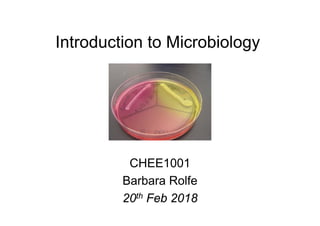
Introduction to Microbiology
CHEE1001
Barbara Rolfe
20th Feb 2018
Microbiology-the study of microorganisms
Microbe/microorganism- microscopic things that have
characteristics of life (including viruses)
Agent-thing that produces a certain effect such as a disease
Pathogen-microbial agent of disease
Culture (cultivate)-v. to grow microbes
Isolate-to separate different lineages of microbes from each
other in a growth medium
Basic Terms
History of Microbiology
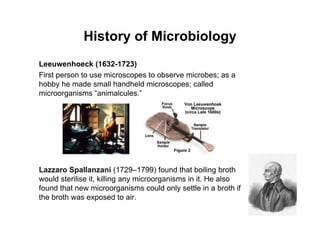
Leeuwenhoeck (1632-1723)
First person to use microscopes to observe microbes; as a
hobby he made small handheld microscopes; called
microorganisms “animalcules.”
Lazzaro Spallanzani (1729–1799) found that boiling broth
would sterilise it, killing any microorganisms in it. He also
found that new microorganisms could only settle in a broth if
the broth was exposed to air.
History of Microbiology
6th century BCE - Existence of unseen microbiological
creatures living in earth, water, air and fire postulated by
Jainism
1st century BCE - The Roman scholar, Marcus Terentius
Varro, in a book titled ‘On Agriculture’ warned against
locating a homestead near swamps “because there are bred
certain minute creatures which cannot be seen by the eyes,
which float in the air and enter the body through the mouth
and nose and there by cause serious diseases”
History of Microbiology
Medieval Islamic world
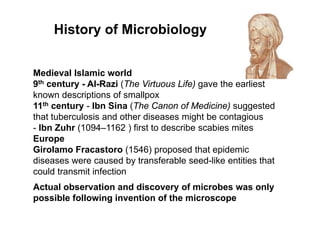
9th century - Al-Razi (The Virtuous Life) gave the earliest
known descriptions of smallpox
11th century - Ibn Sina (The Canon of Medicine) suggested
that tuberculosis and other diseases might be contagious
- Ibn Zuhr (1094–1162 ) first to describe scabies mites
Europe
Girolamo Fracastoro (1546) proposed that epidemic
diseases were caused by transferable seed-like entities that
could transmit infection
Actual observation and discovery of microbes was only
possible following invention of the microscope
Control of Infectious Diseases?
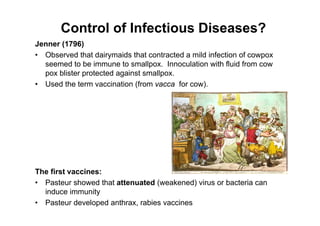
Jenner (1796)
• Observed that dairymaids that contracted a mild infection of cowpox
seemed to be immune to smallpox. Innoculation with fluid from cow
pox blister protected against smallpox.
• Used the term vaccination (from vacca for cow).
The first vaccines:
• Pasteur showed that attenuated (weakened) virus or bacteria can
induce immunity
• Pasteur developed anthrax, rabies vaccines
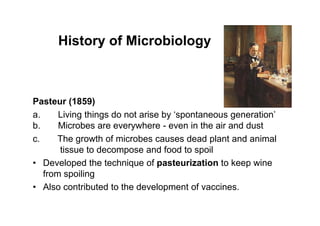
Pasteur (1859)
a. Living things do not arise by ‘spontaneous generation’
b. Microbes are everywhere - even in the air and dust
c. The growth of microbes causes dead plant and animal
tissue to decompose and food to spoil
• Developed the technique of pasteurization to keep wine
from spoiling
• Also contributed to the development of vaccines.
History of Microbiology
Pasteurisation
Heat-processing of food to kill pathogenic bacteria.
• High-Temperature-Short-Time Treatment (HTST)
milk is pasteurized at 72°C for 15 seconds.
• Low-Temperature-Long-Time Treatment (LTLT)
milk is pasteurized at 63°C for 30 minutes.
• Foods can also be pasteurized using gamma irradiation.
Times and temperatures depend on the type of food and the
final result (retention of nutrients, color, texture, flavour).
Germ Theory of Disease
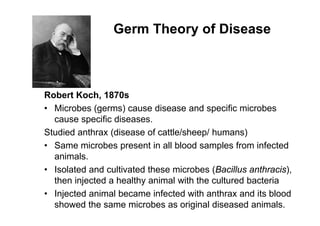
Robert Koch, 1870s
• Microbes (germs) cause disease and specific microbes
cause specific diseases.
Studied anthrax (disease of cattle/sheep/ humans)
• Same microbes present in all blood samples from infected
animals.
• Isolated and cultivated these microbes (Bacillus anthracis),
then injected a healthy animal with the cultured bacteria
• Injected animal became infected with anthrax and its blood
showed the same microbes as original diseased animals.
Germ Theory of Disease
Koch’s Postulates
1. The causative agent must be present in every
individual with the disease.
2. The causative agent must be isolated and grown in
pure culture
3. The pure culture must cause the disease when
inoculated into another animal.
4. The causative agent must be reisolated from the
experimental animal and reidentified in pure culture.
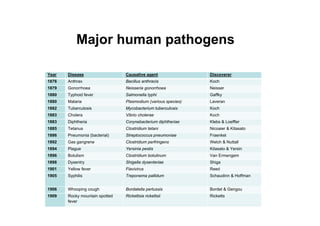
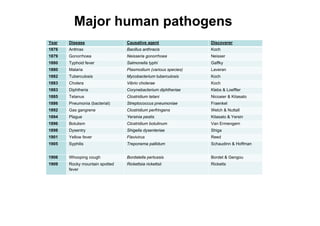
Major human pathogens
Year Disease Causative agent Discoverer
1876 Anthrax Bacillus anthracis Koch
1879 Gonorrhoea Neisseria gonorrhoea Neisser
1880 Typhoid fever Salmonella typhi Gaffky
1880 Malaria Plasmodium (various species) Laveran
1882 Tuberculosis Mycobacterium tuberculosis Koch
1883 Cholera Vibrio cholerae Koch
1883 Diphtheria Corynebacterium diphtheriae Klebs & Loeffler
1885 Tetanus Clostridium tetani Nicoaier & Kitasato
1886 Pneumonia (bacterial) Streptococcus pneumoniae Fraenkel
1892 Gas gangrene Clostridium perfringens Welch & Nuttall
1894 Plague Yersinia pestis Kitasato & Yersin
1896 Botulism Clostridium botulinum Van Ermengem
1898 Dysentry Shigella dysenteriae Shiga
1901 Yellow fever Flavivirus Reed
1905 Syphilis Treponema pallidum Schaudinn & Hoffman
1906 Whooping cough Bordatella pertussis Bordet & Gengou
1909 Rocky mountain spotted
fever
Rickettsia rickettsii Ricketts
Chemotherapy
Paul Ehrlich (1909)
• discovered a drug treatment for syphilis;
• developed the guiding principle of chemotherapy, of selective
toxicity (drug must be toxic to the infecting microbe, but relatively
harmless to host cells).
• the first major class of drugs to come into widespread clinical use
were sulphur drugs
Florey/Chain/Fleming (1928-1938)
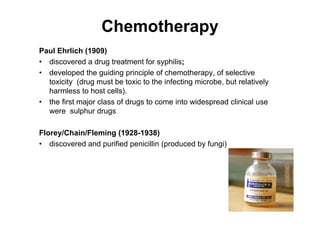
• discovered and purified penicillin (produced by fungi)
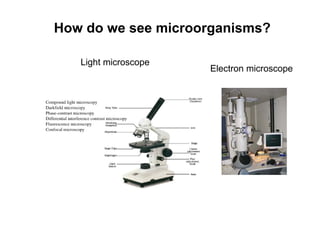
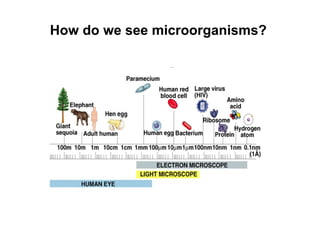
How do we see microorganisms?
Light microscope
Electron microscope
How do we see microorganisms?
• Measured in micrometres
(1µm = 1x10⁻⁶ meters/ 1x10⁻³ mm)
• Human hair - ~100 µm wide
• Red blood cells - 8 µm wide
• Animal cell ~ 10-100 µm
• Bacteria ~ 1 µm diameter
• Viruses 20-400 nanometres diameter
(1 nm = 10 -9 meters)
How do we see microorganisms?
Cellular (living)
Bacteria - single-celled organisms, with circular DNA and no
nucleus
Algae - unicellular or multicellular
Fungi - most are multi-celled; some are single celled (yeasts)
organisms with nucleus and mitochondria
Protozoa - single celled organisms with nucleus and other
membranous organelles
Non-cellular (? non-living)
Viruses - infectious particles made of DNA or RNA, protein,
sometimes lipid membrane
Prions - infectious proteins
Five major groups of microorganisms
Two Types of Cells
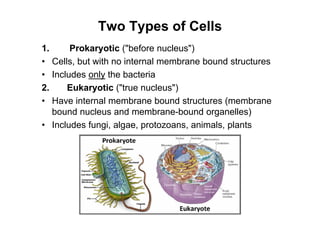
1. Prokaryotic ("before nucleus")
• Cells, but with no internal membrane bound structures
• Includes only the bacteria
2. Eukaryotic ("true nucleus")
• Have internal membrane bound structures (membrane
bound nucleus and membrane-bound organelles)
• Includes fungi, algae, protozoans, animals, plants
Bacteria
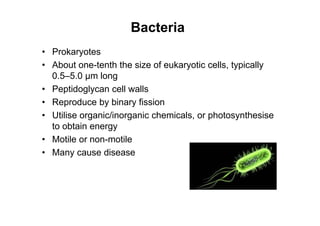
• Prokaryotes
• About one-tenth the size of eukaryotic cells, typically
0.5–5.0 µm long
• Peptidoglycan cell walls
• Reproduce by binary fission
• Utilise organic/inorganic chemicals, or photosynthesise
to obtain energy
• Motile or non-motile
• Many cause disease
Bacteria
• Estimated 40 million bacterial cells in 1 gram of soil, 1
million in 1 ml fresh water
• Approximately ten times as many bacterial cells in the
human microbiota as there are human cells in the body,
most in the gut flora, and many on the skin
• Most common fatal bacterial diseases are respiratory
infections, eg tuberculosis kills about 2 million people per
year, mostly in sub-Saharan Africa
• Less than 1% of microorganisms cause disease
Bacterial classification
Bacterial classification schemes originally utilized
• morphology
• staining properties
• O2 growth requirements of the species
• biochemical tests
Modern classification includes molecular genetic analysis
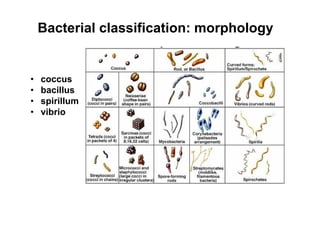
Bacterial classification: morphology
• coccus
• bacillus
• spirillum
• vibrio
Bacterial Classification: Gram Stain
• Bacteria have two different types of cell wall, a thick one
(gram-positive) and a thinner one (gram-negative)
• Terminology originates from the reaction of cells to the
Gram stain, developed in 1884 to classify bacterial species.
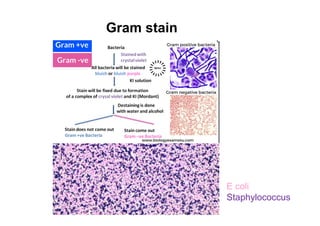
• Gram positive bacteria stain blue-purple due to their thick
cell wall, Gram negative bacteria stain red
• These differences in cell wall structure produce differences
in antibiotic susceptibility (eg Vancomycin kills only gram-
positive bacteria and is ineffective against gram-negative
pathogens such as Haemophilus influenzae or
Pseudomonas aeruginosa)
Gram stain
E coli
Staphylococcus
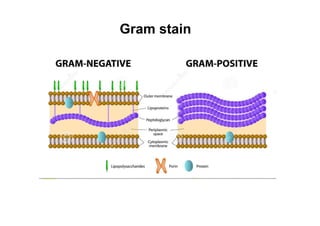
Gram stain
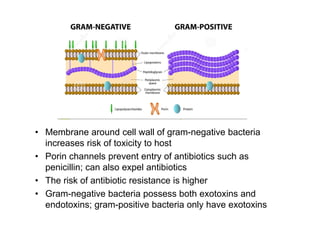
• Membrane around cell wall of gram-negative bacteria
increases risk of toxicity to host
• Porin channels prevent entry of antibiotics such as
penicillin; can also expel antibiotics
• The risk of antibiotic resistance is higher
• Gram-negative bacteria possess both exotoxins and
endotoxins; gram-positive bacteria only have exotoxins
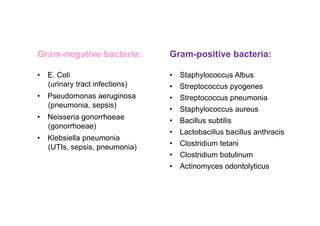
Gram-positive bacteria:
• Staphylococcus Albus
• Streptococcus pyogenes
• Streptococcus pneumonia
• Staphylococcus aureus
• Bacillus subtilis
• Lactobacillus bacillus anthracis
• Clostridium tetani
• Clostridium botulinum
• Actinomyces odontolyticus
Gram-negative bacteria:
• E. Coli
(urinary tract infections)
• Pseudomonas aeruginosa
(pneumonia, sepsis)
• Neisseria gonorrhoeae
(gonorrhoeae)
• Klebsiella pneumonia
(UTIs, sepsis, pneumonia)
Naming and classifying
• Linnaeus System
• Each organism has two names:
Genus (eg Staphylococcus)
Species (aureus)
Used for all organisms (except viruses)
Major human pathogens
Year Disease Causative agent Discoverer
1876 Anthrax Bacillus anthracis Koch
1879 Gonorrhoea Neisseria gonorrhoea Neisser
1880 Typhoid fever Salmonella typhi Gaffky
1880 Malaria Plasmodium (various species) Laveran
1882 Tuberculosis Mycobacterium tuberculosis Koch
1883 Cholera Vibrio cholerae Koch
1883 Diphtheria Corynebacterium diphtheriae Klebs & Loeffler
1885 Tetanus Clostridium tetani Nicoaier & Kitasato
1886 Pneumonia (bacterial) Streptococcus pneumoniae Fraenkel
1892 Gas gangrene Clostridium perfringens Welch & Nuttall
1894 Plague Yersinia pestis Kitasato & Yersin
1896 Botulism Clostridium botulinum Van Ermengem
1898 Dysentry Shigella dysenteriae Shiga
1901 Yellow fever Flavivirus Reed
1905 Syphilis Treponema pallidum Schaudinn & Hoffman
1906 Whooping cough Bordatella pertussis Bordet & Gengou
1909 Rocky mountain spotted
fever
Rickettsia rickettsii Ricketts
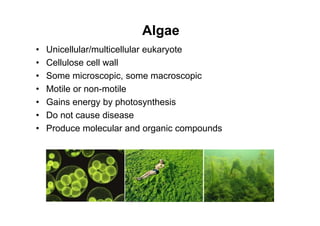
Algae
• Unicellular/multicellular eukaryote
• Cellulose cell wall
• Some microscopic, some macroscopic
• Motile or non-motile
• Gains energy by photosynthesis
• Do not cause disease
• Produce molecular and organic compounds
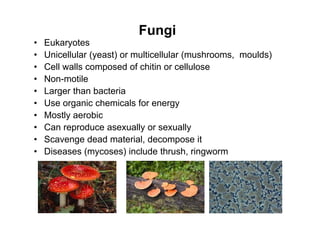
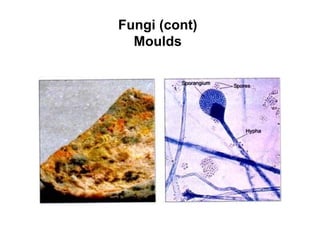
Fungi
• Eukaryotes
• Unicellular (yeast) or multicellular (mushrooms, moulds)
• Cell walls composed of chitin or cellulose
• Non-motile
• Larger than bacteria
• Use organic chemicals for energy
• Mostly aerobic
• Can reproduce asexually or sexually
• Scavenge dead material, decompose it
• Diseases (mycoses) include thrush, ringworm
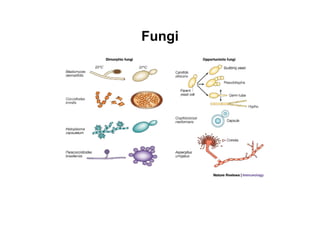
Fungi
Fungi (cont)
Yeasts
• Nonfilamentous, unicellular
• Reproduce asexually by budding or sexually by
producing various kinds of spores
• Aerobic or facultative anaerobes
• Used to prepare bread, wine, beer etc.
(eg. Saccharomyces cerevisiae)
• Some are pathogenic eg. Candida albicans (thrush)
Fungi (cont)
Moulds
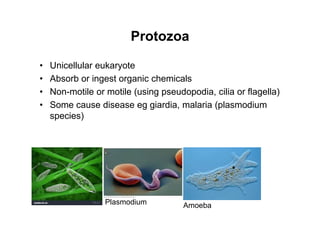
Protozoa
• Unicellular eukaryote
• Absorb or ingest organic chemicals
• Non-motile or motile (using pseudopodia, cilia or flagella)
• Some cause disease eg giardia, malaria (plasmodium
species)
Amoeba
Plasmodium
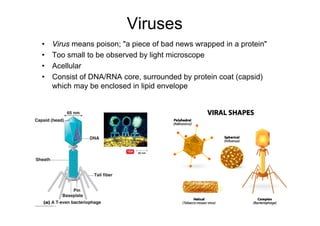
Viruses
• Virus means poison; "a piece of bad news wrapped in a protein"
• Too small to be observed by light microscope
• Acellular
• Consist of DNA/RNA core, surrounded by protein coat (capsid)
which may be enclosed in lipid envelope
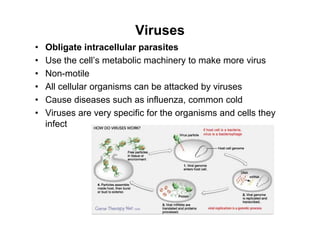
Viruses
• Obligate intracellular parasites
• Use the cell’s metabolic machinery to make more virus
• Non-motile
• All cellular organisms can be attacked by viruses
• Cause diseases such as influenza, common cold
• Viruses are very specific for the organisms and cells they
infect
Are Viruses Alive?
• Living things are defined by their ability to reproduce,
metabolise, organize as cells, contain all organic
molecules (lipids, enzymes, nucleic acids, carbs), evolve
and adapt to changing environments
• Viruses can evolve, they contain some macromolecules,
they direct their own reproduction
But
• Viruses are not cells
• They have either DNA or RNA (prokaryotic and
eukaryotic cells have both)
• They lack a metabolism of their own (they cannot
produce ATP, etc.)
• Raw materials and energy are supplied by the host cell
Why Study Microbiology?
1. Impact on Human Health
2. Balance of Nature - food source, play a role in
decomposition, help other animals digest grass (cattle,
sheep, termites).
3. Environmental – provide safe drinking water;
development of biodegradable products; use bacteria to
clean up oil spills, etc. – called bioremediation.
4. Industrial – foodstuffs (beer, wine, cheese, bread),
antibiotics, insulin, genetic engineering
5. Agricultural - research has led to healthier livestock and
disease-free crops.
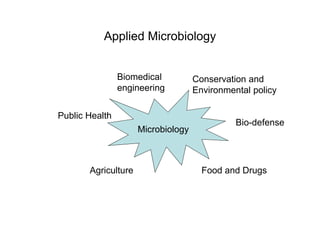
Applied Microbiology
Microbiology
Food and Drugs
Agriculture
Conservation and
Environmental policy
Public Health
Biomedical
engineering
Bio-defense
Balance of Nature
• Bacteria living in the gut of cattle, horses and other herbivores
secrete cellulase, an enzyme that helps in digestion of cellulose
from plant cell walls.
• Populations of microbes (such as bacteria and yeasts) inhabit the
skin and mucosal surfaces in various parts of the body as part of
normal, healthy human physiology. E. coli in the human large
intestine synthesizes vitamin B and releases it for human use.
• However if microbe numbers grow beyond their typical ranges (eg
due to a compromised immune system) or if they populate areas of
the body normally not colonized or sterile (eg blood, lower
respiratory tract, or abdominal cavity), disease can result (causing,
respectively, bacteremia/sepsis, pneumonia, and peritonitis).
The International Scientific Association for
Probiotics and Prebiotics consensus statement
on the appropriate use of the term probiotic
• Retain the FAO/WHO definition1 for probiotics: “live microorganisms
that, when administered in adequate amounts, confer a health benefit
on the host”
• Include in the framework for definition of probiotics microbial species
that have been shown in properly controlled studies to confer benefits
to health
• Any specific claim beyond “contains probiotics” must be further
substantiated
• Keep live cultures, traditionally associated with fermented foods and for
which there is no evidence of a health benefit, outside the probiotic
framework
• Keep undefined, faecal microbiota transplants outside the probiotic
framework
• New commensals and consortia comprising defined strains from
human samples, with adequate evidence of safety and efficacy, are
'probiotics'
Nature Reviews Gastroenterology & Hepatology 2014;11:506–514
Environmental Microbiology
• Microorganisms (mostly photosynthetic algae) produce
50-70% of the atmospheric oxygen on Earth
• Microorganisms are essential for decomposition of dead
organisms
• Many important elements (S, N, P) are cycled by
microorganisms
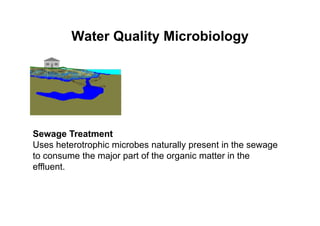
Water Quality Microbiology
Sewage Treatment
Uses heterotrophic microbes naturally present in the sewage
to consume the major part of the organic matter in the
effluent.
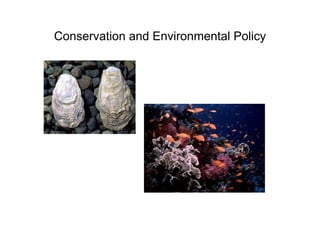
Conservation and Environmental Policy
Industrial Microbiology
Humans have used microorganisms for
thousands of years
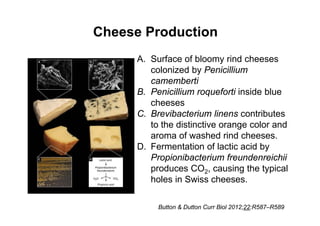
Cheese Production
A. Surface of bloomy rind cheeses
colonized by Penicillium
camemberti
B. Penicillium roqueforti inside blue
cheeses
C. Brevibacterium linens contributes
to the distinctive orange color and
aroma of washed rind cheeses.
D. Fermentation of lactic acid by
Propionibacterium freundenreichii
produces CO2, causing the typical
holes in Swiss cheeses.
Button & Dutton Curr Biol 2012;22:R587–R589
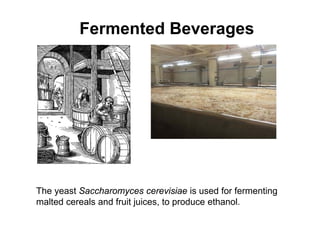
Fermented Beverages
The yeast Saccharomyces cerevisiae is used for fermenting
malted cereals and fruit juices, to produce ethanol.
Industrial Microbiology
Production of Biogas
• Biogas is a mixture of gases (containing predominantly
methane) produced by microbes (eg Methanobacterium)
during the sewage treatment process and which may be
used as fuel.
Microbes as Biocontrol Agents
Biocontrol refers to the use of biological methods for
controlling plant diseases and animal pests.
• Bacillus thuringiensis for the control butterfly caterpillars
• Trichoderma species (fungus) for the treatment of plant
diseases.
• Baculoviruses (genus Nucleopolyhedrovirus) for species-
specific, narrow spectrum insecticidal applications.
• Myxoma virus, calicivirus for control of rabbits in Australia
Microbes as Biofertilizers
Biofertilisers are organisms that enrich the nutrient quality
of the soil. The main sources of biofertilisers are bacteria,
fungi and cyanobacteria.
• Nitrogen-fixing bacteria that live in the soil (eg
Azospirillum, Azotobacter), enrich soil nitrogen content.
• Fungi are also known to form symbiotic associations with
plants (mycorrhiza), absorbing phosphorus from soil and
passing it to the plant.
• Cyanobacteria (e.g. Anabaena, Nostoc, Oscillatoriacan)
fix atmospheric nitrogen. Serve as biofertilizer in paddy
fields
• Blue green algae add organic matter to the soil and
increase its fertility.
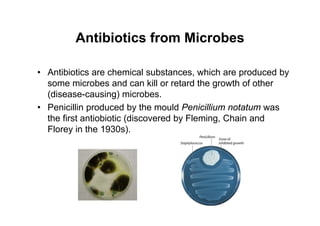
Antibiotics from Microbes
• Antibiotics are chemical substances, which are produced by
some microbes and can kill or retard the growth of other
(disease-causing) microbes.
• Penicillin produced by the mould Penicillium notatum was
the first antiobiotic (discovered by Fleming, Chain and
Florey in the 1930s).
Chemicals, Enzymes, other Bioactive
Molecules
• Aspergillus niger (a fungus) produces citric acid
• Acetobacter aceti (a bacterium) produces acetic acid
• Clostridium butylicum (a bacterium) produces butyric acid
• Lactobacillus (a bacterium) produces lactic acid
• Yeast (Saccharomyces cerevisiae) is used for commercial
production of ethanol.
• Streptokinase produced by Streptococcus and modified by
genetic engineering is used as a ‘clot buster’ after heart attack
• Cyclosporin A (immunosuppressive agent in organ-transplant
patients) is produced by the fungus Trichoderma polysporum.
• Statins (blood-cholesterol lowering agents) are produced by
the yeast Monascus purpureus
Recombinant Protein Production
• The biotechnological process of generating a specific
protein.
• Achieved by manipulation of gene expression in an
organism such that it expresses large amounts of a
recombinant protein.
• Common hosts are bacteria (eg E.coli, B. subtilis), yeast
(such as S.cerevisiae).
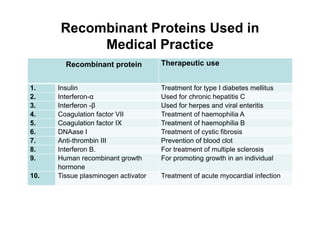
Recombinant Proteins Used in
Medical Practice
Recombinant protein Therapeutic use
1. Insulin Treatment for type I diabetes mellitus
2. Interferon-α Used for chronic hepatitis C
3. Interferon -β Used for herpes and viral enteritis
4. Coagulation factor VII Treatment of haemophilia A
5. Coagulation factor IX Treatment of haemophilia B
6. DNAase I Treatment of cystic fibrosis
7. Anti-thrombin III Prevention of blood clot
8. Interferon B. For treatment of multiple sclerosis
9. Human recombinant growth
hormone
For promoting growth in an individual
10. Tissue plasminogen activator Treatment of acute myocardial infection
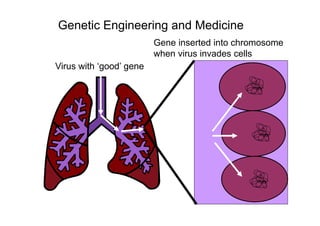
Genetic Engineering and Medicine
Virus with ‘good’ gene
Gene inserted into chromosome
when virus invades cells

Lecture 2_Intro to Microbiology.pdf

  • 1.
  • 2.
    Microbiology-the study ofmicroorganisms Microbe/microorganism- microscopic things that have characteristics of life (including viruses) Agent-thing that produces a certain effect such as a disease Pathogen-microbial agent of disease Culture (cultivate)-v. to grow microbes Isolate-to separate different lineages of microbes from each other in a growth medium Basic Terms
  • 3.
    History of Microbiology Leeuwenhoeck(1632-1723) First person to use microscopes to observe microbes; as a hobby he made small handheld microscopes; called microorganisms “animalcules.” Lazzaro Spallanzani (1729–1799) found that boiling broth would sterilise it, killing any microorganisms in it. He also found that new microorganisms could only settle in a broth if the broth was exposed to air.
  • 4.
    History of Microbiology 6thcentury BCE - Existence of unseen microbiological creatures living in earth, water, air and fire postulated by Jainism 1st century BCE - The Roman scholar, Marcus Terentius Varro, in a book titled ‘On Agriculture’ warned against locating a homestead near swamps “because there are bred certain minute creatures which cannot be seen by the eyes, which float in the air and enter the body through the mouth and nose and there by cause serious diseases”
  • 5.
    History of Microbiology MedievalIslamic world 9th century - Al-Razi (The Virtuous Life) gave the earliest known descriptions of smallpox 11th century - Ibn Sina (The Canon of Medicine) suggested that tuberculosis and other diseases might be contagious - Ibn Zuhr (1094–1162 ) first to describe scabies mites Europe Girolamo Fracastoro (1546) proposed that epidemic diseases were caused by transferable seed-like entities that could transmit infection Actual observation and discovery of microbes was only possible following invention of the microscope
  • 6.
    Control of InfectiousDiseases? Jenner (1796) • Observed that dairymaids that contracted a mild infection of cowpox seemed to be immune to smallpox. Innoculation with fluid from cow pox blister protected against smallpox. • Used the term vaccination (from vacca for cow). The first vaccines: • Pasteur showed that attenuated (weakened) virus or bacteria can induce immunity • Pasteur developed anthrax, rabies vaccines
  • 7.
    Pasteur (1859) a. Livingthings do not arise by ‘spontaneous generation’ b. Microbes are everywhere - even in the air and dust c. The growth of microbes causes dead plant and animal tissue to decompose and food to spoil • Developed the technique of pasteurization to keep wine from spoiling • Also contributed to the development of vaccines. History of Microbiology
  • 8.
    Pasteurisation Heat-processing of foodto kill pathogenic bacteria. • High-Temperature-Short-Time Treatment (HTST) milk is pasteurized at 72°C for 15 seconds. • Low-Temperature-Long-Time Treatment (LTLT) milk is pasteurized at 63°C for 30 minutes. • Foods can also be pasteurized using gamma irradiation. Times and temperatures depend on the type of food and the final result (retention of nutrients, color, texture, flavour).
  • 9.
    Germ Theory ofDisease Robert Koch, 1870s • Microbes (germs) cause disease and specific microbes cause specific diseases. Studied anthrax (disease of cattle/sheep/ humans) • Same microbes present in all blood samples from infected animals. • Isolated and cultivated these microbes (Bacillus anthracis), then injected a healthy animal with the cultured bacteria • Injected animal became infected with anthrax and its blood showed the same microbes as original diseased animals.
  • 10.
    Germ Theory ofDisease Koch’s Postulates 1. The causative agent must be present in every individual with the disease. 2. The causative agent must be isolated and grown in pure culture 3. The pure culture must cause the disease when inoculated into another animal. 4. The causative agent must be reisolated from the experimental animal and reidentified in pure culture.
  • 11.
    Major human pathogens YearDisease Causative agent Discoverer 1876 Anthrax Bacillus anthracis Koch 1879 Gonorrhoea Neisseria gonorrhoea Neisser 1880 Typhoid fever Salmonella typhi Gaffky 1880 Malaria Plasmodium (various species) Laveran 1882 Tuberculosis Mycobacterium tuberculosis Koch 1883 Cholera Vibrio cholerae Koch 1883 Diphtheria Corynebacterium diphtheriae Klebs & Loeffler 1885 Tetanus Clostridium tetani Nicoaier & Kitasato 1886 Pneumonia (bacterial) Streptococcus pneumoniae Fraenkel 1892 Gas gangrene Clostridium perfringens Welch & Nuttall 1894 Plague Yersinia pestis Kitasato & Yersin 1896 Botulism Clostridium botulinum Van Ermengem 1898 Dysentry Shigella dysenteriae Shiga 1901 Yellow fever Flavivirus Reed 1905 Syphilis Treponema pallidum Schaudinn & Hoffman 1906 Whooping cough Bordatella pertussis Bordet & Gengou 1909 Rocky mountain spotted fever Rickettsia rickettsii Ricketts
  • 12.
    Chemotherapy Paul Ehrlich (1909) •discovered a drug treatment for syphilis; • developed the guiding principle of chemotherapy, of selective toxicity (drug must be toxic to the infecting microbe, but relatively harmless to host cells). • the first major class of drugs to come into widespread clinical use were sulphur drugs Florey/Chain/Fleming (1928-1938) • discovered and purified penicillin (produced by fungi)
  • 13.
    How do wesee microorganisms? Light microscope Electron microscope
  • 14.
    How do wesee microorganisms?
  • 15.
    • Measured inmicrometres (1µm = 1x10⁻⁶ meters/ 1x10⁻³ mm) • Human hair - ~100 µm wide • Red blood cells - 8 µm wide • Animal cell ~ 10-100 µm • Bacteria ~ 1 µm diameter • Viruses 20-400 nanometres diameter (1 nm = 10 -9 meters) How do we see microorganisms?
  • 16.
    Cellular (living) Bacteria -single-celled organisms, with circular DNA and no nucleus Algae - unicellular or multicellular Fungi - most are multi-celled; some are single celled (yeasts) organisms with nucleus and mitochondria Protozoa - single celled organisms with nucleus and other membranous organelles Non-cellular (? non-living) Viruses - infectious particles made of DNA or RNA, protein, sometimes lipid membrane Prions - infectious proteins Five major groups of microorganisms
  • 17.
    Two Types ofCells 1. Prokaryotic ("before nucleus") • Cells, but with no internal membrane bound structures • Includes only the bacteria 2. Eukaryotic ("true nucleus") • Have internal membrane bound structures (membrane bound nucleus and membrane-bound organelles) • Includes fungi, algae, protozoans, animals, plants
  • 18.
    Bacteria • Prokaryotes • Aboutone-tenth the size of eukaryotic cells, typically 0.5–5.0 µm long • Peptidoglycan cell walls • Reproduce by binary fission • Utilise organic/inorganic chemicals, or photosynthesise to obtain energy • Motile or non-motile • Many cause disease
  • 19.
    Bacteria • Estimated 40million bacterial cells in 1 gram of soil, 1 million in 1 ml fresh water • Approximately ten times as many bacterial cells in the human microbiota as there are human cells in the body, most in the gut flora, and many on the skin • Most common fatal bacterial diseases are respiratory infections, eg tuberculosis kills about 2 million people per year, mostly in sub-Saharan Africa • Less than 1% of microorganisms cause disease
  • 20.
    Bacterial classification Bacterial classificationschemes originally utilized • morphology • staining properties • O2 growth requirements of the species • biochemical tests Modern classification includes molecular genetic analysis
  • 21.
    Bacterial classification: morphology •coccus • bacillus • spirillum • vibrio
  • 22.
    Bacterial Classification: GramStain • Bacteria have two different types of cell wall, a thick one (gram-positive) and a thinner one (gram-negative) • Terminology originates from the reaction of cells to the Gram stain, developed in 1884 to classify bacterial species. • Gram positive bacteria stain blue-purple due to their thick cell wall, Gram negative bacteria stain red • These differences in cell wall structure produce differences in antibiotic susceptibility (eg Vancomycin kills only gram- positive bacteria and is ineffective against gram-negative pathogens such as Haemophilus influenzae or Pseudomonas aeruginosa)
  • 23.
  • 24.
  • 25.
    • Membrane aroundcell wall of gram-negative bacteria increases risk of toxicity to host • Porin channels prevent entry of antibiotics such as penicillin; can also expel antibiotics • The risk of antibiotic resistance is higher • Gram-negative bacteria possess both exotoxins and endotoxins; gram-positive bacteria only have exotoxins
  • 26.
    Gram-positive bacteria: • StaphylococcusAlbus • Streptococcus pyogenes • Streptococcus pneumonia • Staphylococcus aureus • Bacillus subtilis • Lactobacillus bacillus anthracis • Clostridium tetani • Clostridium botulinum • Actinomyces odontolyticus Gram-negative bacteria: • E. Coli (urinary tract infections) • Pseudomonas aeruginosa (pneumonia, sepsis) • Neisseria gonorrhoeae (gonorrhoeae) • Klebsiella pneumonia (UTIs, sepsis, pneumonia)
  • 27.
    Naming and classifying •Linnaeus System • Each organism has two names: Genus (eg Staphylococcus) Species (aureus) Used for all organisms (except viruses)
  • 28.
    Major human pathogens YearDisease Causative agent Discoverer 1876 Anthrax Bacillus anthracis Koch 1879 Gonorrhoea Neisseria gonorrhoea Neisser 1880 Typhoid fever Salmonella typhi Gaffky 1880 Malaria Plasmodium (various species) Laveran 1882 Tuberculosis Mycobacterium tuberculosis Koch 1883 Cholera Vibrio cholerae Koch 1883 Diphtheria Corynebacterium diphtheriae Klebs & Loeffler 1885 Tetanus Clostridium tetani Nicoaier & Kitasato 1886 Pneumonia (bacterial) Streptococcus pneumoniae Fraenkel 1892 Gas gangrene Clostridium perfringens Welch & Nuttall 1894 Plague Yersinia pestis Kitasato & Yersin 1896 Botulism Clostridium botulinum Van Ermengem 1898 Dysentry Shigella dysenteriae Shiga 1901 Yellow fever Flavivirus Reed 1905 Syphilis Treponema pallidum Schaudinn & Hoffman 1906 Whooping cough Bordatella pertussis Bordet & Gengou 1909 Rocky mountain spotted fever Rickettsia rickettsii Ricketts
  • 29.
    Algae • Unicellular/multicellular eukaryote •Cellulose cell wall • Some microscopic, some macroscopic • Motile or non-motile • Gains energy by photosynthesis • Do not cause disease • Produce molecular and organic compounds
  • 30.
    Fungi • Eukaryotes • Unicellular(yeast) or multicellular (mushrooms, moulds) • Cell walls composed of chitin or cellulose • Non-motile • Larger than bacteria • Use organic chemicals for energy • Mostly aerobic • Can reproduce asexually or sexually • Scavenge dead material, decompose it • Diseases (mycoses) include thrush, ringworm
  • 31.
  • 32.
    Fungi (cont) Yeasts • Nonfilamentous,unicellular • Reproduce asexually by budding or sexually by producing various kinds of spores • Aerobic or facultative anaerobes • Used to prepare bread, wine, beer etc. (eg. Saccharomyces cerevisiae) • Some are pathogenic eg. Candida albicans (thrush)
  • 33.
  • 34.
    Protozoa • Unicellular eukaryote •Absorb or ingest organic chemicals • Non-motile or motile (using pseudopodia, cilia or flagella) • Some cause disease eg giardia, malaria (plasmodium species) Amoeba Plasmodium
  • 35.
    Viruses • Virus meanspoison; "a piece of bad news wrapped in a protein" • Too small to be observed by light microscope • Acellular • Consist of DNA/RNA core, surrounded by protein coat (capsid) which may be enclosed in lipid envelope
  • 36.
    Viruses • Obligate intracellularparasites • Use the cell’s metabolic machinery to make more virus • Non-motile • All cellular organisms can be attacked by viruses • Cause diseases such as influenza, common cold • Viruses are very specific for the organisms and cells they infect
  • 37.
    Are Viruses Alive? •Living things are defined by their ability to reproduce, metabolise, organize as cells, contain all organic molecules (lipids, enzymes, nucleic acids, carbs), evolve and adapt to changing environments • Viruses can evolve, they contain some macromolecules, they direct their own reproduction But • Viruses are not cells • They have either DNA or RNA (prokaryotic and eukaryotic cells have both) • They lack a metabolism of their own (they cannot produce ATP, etc.) • Raw materials and energy are supplied by the host cell
  • 38.
    Why Study Microbiology? 1.Impact on Human Health 2. Balance of Nature - food source, play a role in decomposition, help other animals digest grass (cattle, sheep, termites). 3. Environmental – provide safe drinking water; development of biodegradable products; use bacteria to clean up oil spills, etc. – called bioremediation. 4. Industrial – foodstuffs (beer, wine, cheese, bread), antibiotics, insulin, genetic engineering 5. Agricultural - research has led to healthier livestock and disease-free crops.
  • 39.
    Applied Microbiology Microbiology Food andDrugs Agriculture Conservation and Environmental policy Public Health Biomedical engineering Bio-defense
  • 40.
    Balance of Nature •Bacteria living in the gut of cattle, horses and other herbivores secrete cellulase, an enzyme that helps in digestion of cellulose from plant cell walls. • Populations of microbes (such as bacteria and yeasts) inhabit the skin and mucosal surfaces in various parts of the body as part of normal, healthy human physiology. E. coli in the human large intestine synthesizes vitamin B and releases it for human use. • However if microbe numbers grow beyond their typical ranges (eg due to a compromised immune system) or if they populate areas of the body normally not colonized or sterile (eg blood, lower respiratory tract, or abdominal cavity), disease can result (causing, respectively, bacteremia/sepsis, pneumonia, and peritonitis).
  • 41.
    The International ScientificAssociation for Probiotics and Prebiotics consensus statement on the appropriate use of the term probiotic • Retain the FAO/WHO definition1 for probiotics: “live microorganisms that, when administered in adequate amounts, confer a health benefit on the host” • Include in the framework for definition of probiotics microbial species that have been shown in properly controlled studies to confer benefits to health • Any specific claim beyond “contains probiotics” must be further substantiated • Keep live cultures, traditionally associated with fermented foods and for which there is no evidence of a health benefit, outside the probiotic framework • Keep undefined, faecal microbiota transplants outside the probiotic framework • New commensals and consortia comprising defined strains from human samples, with adequate evidence of safety and efficacy, are 'probiotics' Nature Reviews Gastroenterology & Hepatology 2014;11:506–514
  • 42.
    Environmental Microbiology • Microorganisms(mostly photosynthetic algae) produce 50-70% of the atmospheric oxygen on Earth • Microorganisms are essential for decomposition of dead organisms • Many important elements (S, N, P) are cycled by microorganisms
  • 43.
    Water Quality Microbiology SewageTreatment Uses heterotrophic microbes naturally present in the sewage to consume the major part of the organic matter in the effluent.
  • 44.
  • 45.
    Industrial Microbiology Humans haveused microorganisms for thousands of years
  • 46.
    Cheese Production A. Surfaceof bloomy rind cheeses colonized by Penicillium camemberti B. Penicillium roqueforti inside blue cheeses C. Brevibacterium linens contributes to the distinctive orange color and aroma of washed rind cheeses. D. Fermentation of lactic acid by Propionibacterium freundenreichii produces CO2, causing the typical holes in Swiss cheeses. Button & Dutton Curr Biol 2012;22:R587–R589
  • 47.
    Fermented Beverages The yeastSaccharomyces cerevisiae is used for fermenting malted cereals and fruit juices, to produce ethanol.
  • 48.
    Industrial Microbiology Production ofBiogas • Biogas is a mixture of gases (containing predominantly methane) produced by microbes (eg Methanobacterium) during the sewage treatment process and which may be used as fuel.
  • 49.
    Microbes as BiocontrolAgents Biocontrol refers to the use of biological methods for controlling plant diseases and animal pests. • Bacillus thuringiensis for the control butterfly caterpillars • Trichoderma species (fungus) for the treatment of plant diseases. • Baculoviruses (genus Nucleopolyhedrovirus) for species- specific, narrow spectrum insecticidal applications. • Myxoma virus, calicivirus for control of rabbits in Australia
  • 50.
    Microbes as Biofertilizers Biofertilisersare organisms that enrich the nutrient quality of the soil. The main sources of biofertilisers are bacteria, fungi and cyanobacteria. • Nitrogen-fixing bacteria that live in the soil (eg Azospirillum, Azotobacter), enrich soil nitrogen content. • Fungi are also known to form symbiotic associations with plants (mycorrhiza), absorbing phosphorus from soil and passing it to the plant. • Cyanobacteria (e.g. Anabaena, Nostoc, Oscillatoriacan) fix atmospheric nitrogen. Serve as biofertilizer in paddy fields • Blue green algae add organic matter to the soil and increase its fertility.
  • 51.
    Antibiotics from Microbes •Antibiotics are chemical substances, which are produced by some microbes and can kill or retard the growth of other (disease-causing) microbes. • Penicillin produced by the mould Penicillium notatum was the first antiobiotic (discovered by Fleming, Chain and Florey in the 1930s).
  • 52.
    Chemicals, Enzymes, otherBioactive Molecules • Aspergillus niger (a fungus) produces citric acid • Acetobacter aceti (a bacterium) produces acetic acid • Clostridium butylicum (a bacterium) produces butyric acid • Lactobacillus (a bacterium) produces lactic acid • Yeast (Saccharomyces cerevisiae) is used for commercial production of ethanol. • Streptokinase produced by Streptococcus and modified by genetic engineering is used as a ‘clot buster’ after heart attack • Cyclosporin A (immunosuppressive agent in organ-transplant patients) is produced by the fungus Trichoderma polysporum. • Statins (blood-cholesterol lowering agents) are produced by the yeast Monascus purpureus
  • 53.
    Recombinant Protein Production •The biotechnological process of generating a specific protein. • Achieved by manipulation of gene expression in an organism such that it expresses large amounts of a recombinant protein. • Common hosts are bacteria (eg E.coli, B. subtilis), yeast (such as S.cerevisiae).
  • 54.
    Recombinant Proteins Usedin Medical Practice Recombinant protein Therapeutic use 1. Insulin Treatment for type I diabetes mellitus 2. Interferon-α Used for chronic hepatitis C 3. Interferon -β Used for herpes and viral enteritis 4. Coagulation factor VII Treatment of haemophilia A 5. Coagulation factor IX Treatment of haemophilia B 6. DNAase I Treatment of cystic fibrosis 7. Anti-thrombin III Prevention of blood clot 8. Interferon B. For treatment of multiple sclerosis 9. Human recombinant growth hormone For promoting growth in an individual 10. Tissue plasminogen activator Treatment of acute myocardial infection
  • 55.
    Genetic Engineering andMedicine Virus with ‘good’ gene Gene inserted into chromosome when virus invades cells