1. Recognize the concept of health
2. Define health with narrow and broad perspectives
3. Identify components of health and give examples for each
4. Recognize characteristic features of mentally healthy adult
5. Identify the components of psychological health
6. Differentiate between disease, illness and sickness
7. List approaches to achieve health
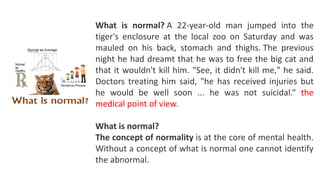
What is normal? A 22-year-old man jumped into the
tiger's enclosure at the local zoo on Saturday and was
mauled on his back, stomach and thighs. The previous
night he had dreamt that he was to free the big cat and
that it wouldn't kill him. "See, it didn't kill me," he said.
Doctors treating him said, "he has received injuries but
he would be well soon ... he was not suicidal.“ the
medical point of view.
What is normal?
The concept of normality is at the core of mental health.
Without a concept of what is normal one cannot identify
the abnormal.
•Your job as a Public Health Professional will be to
prevent health problems in your community.
•Diarrheal disease, measles, tuberculosis, pneumonia,
HIV/AIDS, substance abuse and harmful traditional
practices are among the health problems you will
become familiar with in your community setting.
•You have to understand what is meant by health?
•In the Oxford English Dictionary
health is defined as:
‘the state of being free from
sickness, injury, disease, bodily
conditions; something indicating
good bodily condition’.
Question
•Think about someone, you think is healthy
and someone else who you would consider
to be not healthy.
•Look at the definition of health again.
•Is it similar to the things you thought about
when you thought of a healthy and an
unhealthy person?
Answer
• This definition of health is a widely publicized one. But you
may have thought of someone who has a disability or
wondered about someone who looks physically OK, but
who you know does no exercise. Clearly health is not quite
as simple as the definition implies.
• The concept of health is wide and the way we define health
also depends on individual perception, religious beliefs,
cultural values, norms, and social class (determinants of
health).
• Generally, there are TWO different perspectives concerning
people’s own definitions of health a narrow perspective and
a broad perspective.
Narrow perspectives of health
• People with a narrow perspective consider
health as the absence of disease or disability
or biological dysfunction.
• According to this view (or model), to call
someone unhealthy or sick means there should
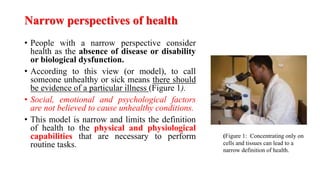
be evidence of a particular illness (Figure 1).
• Social, emotional and psychological factors
are not believed to cause unhealthy conditions.
• This model is narrow and limits the definition
of health to the physical and physiological
capabilities that are necessary to perform
routine tasks.
(Figure 1: Concentrating only on
cells and tissues can lead to a
narrow definition of health.
▪ According to this definition, the individual is healthy if all the
body parts, cells, tissues and organ systems are functioning well
and there is no apparent dysfunction of the body.
▪ Using this model, people view the human body in the same terms
as a computer, or mechanical device — when something is
wrong you take it to experts who maintain it (physician).
▪ Physicians, unlike behavioral experts, often focus on treatment
and clinical interventions with medication rather than
educational interventions to bring about behavior change.
Case Scenario
• About two months ago, Sarah lost her six-
month-old twins. She is grief affected. She
was always slim but now she looks very
thin. She cannot sleep, she cannot eat and
she doesn’t want to talk to anyone.
• Do you think the view of health 1 you
have just read about applies to Sarah?
Answer
▪ This view of health ignores many of the social and psychological causes of ill health.
▪ Sarah’s grief is not an illness but it is certainly affecting her health.
▪ The broader perspective of health which includes other factors in addition to physical ones should
be discussed.
▪ In your work as a Public Health Professional, you will be expected to identify the overall social,
mental and physical factors which affect the health of your community and you will have to
think about effective interventions accordingly.
Defining Health 2
“Health is a state of complete
physical, mental and social well being
and not merely the absence of disease
or infirmity”. WHO’s 191
member states have endorsed
this statement.
World Health Organization (1948)
▪ This classic definition is important, as it identifies the vital
components of health.
▪ To more fully understand the meaning of health, it is important to
understand each of its individual components.
▪ The broader concept of health can help you as a Public Health
Professional when you are planning and implementing your
health education activities at community level.
Normality as Health
• The WHO has defined health as a complete state of physical, mental
and social well-being and not merely the absence of disease or
infirmity. Later they added spiritual well-being to the definition.
• So health is a positive state, not just the absence of disease.
Suicide attempts in the previous example are an important marker
for mental health illness. However, the mere absence of this
particular marker does not rule out mental illness. But the young
man’s actions do indicate a lack of judgement - would jumping into
the enclosure free the tiger? and after freeing the tiger what next? A
display of impaired judgement is often the first visible sign of a
mental health problem.
•Think back to Sarah. Describe her state of health.
Answer
Sarah is mentally distressed.
She does not by any means
have ‘mental and social
well-being’.
Today, three types of definition of health seem to be
possible and are used.
1.The first is that health is the absence of any disease or
impairment.
2.The second is that health is a state that allows the individual
to adequately cope with all demands of daily life (implying
also the absence of disease and impairment).
3.The third definition states that health is a state of balance,
an equilibrium that an individual has established within
himself and between himself and his social and physical
environment.
Components of health
1. Physical health
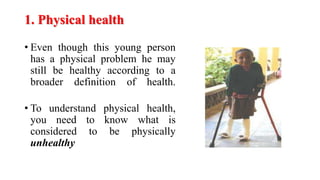
• Even though this young person
has a physical problem he may
still be healthy according to a
broader definition of health.
• To understand physical health,
you need to know what is
considered to be physically
unhealthy
Defining physical health
• Physical health is defined as the absence of diseases or disability of
the body parts.
• Physical health could be defined as the ability to perform routine
tasks without any physical restriction (activity).
The following examples can help you to understand someone who is
physically unhealthy:
• A person who has been harmed due to a car accident
• A farmer infected by malaria and unable to do their farming duties
• A person infected by tuberculosis and unable to perform his or her tasks.
Question
• Think about someone with physical damage, perhaps
due to a car accident.
• Also think about someone in your community who you
would consider to be physically disabled.
• According to the WHO definition do you see them
as healthy?
Answer
• While both of these people may be restricted in their
movement and ability to do routine tasks they may still
be in a state of physical and mental well-being.
• Health is NOT limited to the biological integrity and
the physiological functioning of the human body.
• Psychological health is also an important aspect of a
health definition.
2. Psychological (mental) Health
Question
•Think about people in the community who are
showing behavior that may indicate they are
going through a period of mental distress in their
lives (sadness, angry, depression, anxiety).
•Or think about Sarah again.
•Do you think that everyone in distress shows the
same sorts of symptoms?
Answer
• Sometimes it can be really hard from the outside to tell if the person is
struggling with mental health issues, but at other times they:
• Show symptoms that suggest a lack of self-esteem or personal
identity, or an inability of logical decision-making.
• They are without a proper purpose in their life.
• They may be taking drug, drinking alcohol
• have a non-logical response to any request.
• They may have an inability to maintain their personal autonomy
• are unable to maintain good relationships with people around
them.
So how do we recognize a mentally healthy adult?
There are three components of psychological
health.
1. Cognitive (intellectual) component
• The cognitive component of mental health is
really to do with thinking and being able to work
things out.
• It includes the ability of an individual to learn, to
have awareness (consciousness) and to perceive
reality.
• At a higher level it also involves having a
memory and being able to solve problems, as
well as being able to work creativity and have a
sense of imagination and critical thinking.
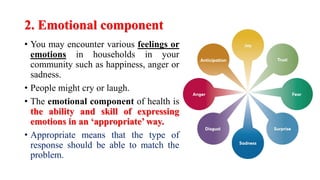
2. Emotional component
• You may encounter various feelings or
emotions in households in your
community such as happiness, anger or
sadness.
• People might cry or laugh.
• The emotional component of health is
the ability and skill of expressing
emotions in an ‘appropriate’ way.
• Appropriate means that the type of
response should be able to match the
problem.
Case Scenario
A secondary school student, while sitting for an exam,
started to cry uncontrollably? This could be due to their
inability to control themselves in the stressful situation. Or
could this suggest that they have a deeper emotional
health problem?
Answer
Showing emotions like this is not something that you can
immediately say, ‘oh this is exam nerves. Knowing more
about someone’s life is important. If you knew this student
usually sailed through exams and was a calm, unflappable
person, then you might begin to think this was something
needing investigation. Or perhaps family circumstances are
relevant here — maybe a beloved grandmother has just
died.
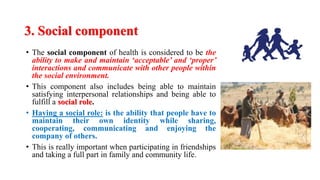
3. Social component
• The social component of health is considered to be the
ability to make and maintain ‘acceptable’ and ‘proper’
interactions and communicate with other people within
the social environment.
• This component also includes being able to maintain
satisfying interpersonal relationships and being able to
fulfill a social role.
• Having a social role: is the ability that people have to
maintain their own identity while sharing,
cooperating, communicating and enjoying the
company of others.
• This is really important when participating in friendships
and taking a full part in family and community life.
Question
Which of the following examples could be considered to contribute to social health?
Explain your answers.
• Sadness when a close family member dies
• Going to a football match or involvement in a community meeting
• Celebrating traditional festivals within your community
• Shopping in the market
• Creating and maintaining friendship.
Answer
In reality all these events could have a social component and help towards building people’s
social view of health.
They all involve interacting with others and gaining support, friendship in many instances
Spiritual Health
•It is relation of health with religion or
cultural values and beliefs and is a way of
achieving mental satisfaction in stressful or
in other ill-health conditions
Health is a fundamental human right.
The attainment of highest possible level
of health is the most important world
wide social goal.
Difference between disease, illness and sickness
Disease: The meaning of “Disease” is “without ease” (uneasiness).
Either a Physiological /Psychological dysfunction
Illness: Not only presence of disease but involvement of individual's
perceptions and behavior in response to disease are included.
Disease is very subjective.
Sickness: includes a state of social dysfunction too. i.e. The role, an
individual assumes when ill.
APPROACHES TO ACHIEVE HEALTH
• Legal or regulatory approach: focuses on the use of
the law, policies, regulations to protect the health of
the public
• Administrative or service approach: concerned with
making health facilities accessible to the people
• Educational approach: designed to improve health
literacy, knowledge, and life skills conducive to
individual and community health
Lecture 1.pdf

Lecture 1.pdf

  • 2.
    1. Recognize theconcept of health 2. Define health with narrow and broad perspectives 3. Identify components of health and give examples for each 4. Recognize characteristic features of mentally healthy adult 5. Identify the components of psychological health 6. Differentiate between disease, illness and sickness 7. List approaches to achieve health
  • 3.
    What is normal?A 22-year-old man jumped into the tiger's enclosure at the local zoo on Saturday and was mauled on his back, stomach and thighs. The previous night he had dreamt that he was to free the big cat and that it wouldn't kill him. "See, it didn't kill me," he said. Doctors treating him said, "he has received injuries but he would be well soon ... he was not suicidal.“ the medical point of view. What is normal? The concept of normality is at the core of mental health. Without a concept of what is normal one cannot identify the abnormal.
  • 4.
    •Your job asa Public Health Professional will be to prevent health problems in your community. •Diarrheal disease, measles, tuberculosis, pneumonia, HIV/AIDS, substance abuse and harmful traditional practices are among the health problems you will become familiar with in your community setting. •You have to understand what is meant by health?
  • 5.
    •In the OxfordEnglish Dictionary health is defined as: ‘the state of being free from sickness, injury, disease, bodily conditions; something indicating good bodily condition’.
  • 6.
    Question •Think about someone,you think is healthy and someone else who you would consider to be not healthy. •Look at the definition of health again. •Is it similar to the things you thought about when you thought of a healthy and an unhealthy person?
  • 7.
    Answer • This definitionof health is a widely publicized one. But you may have thought of someone who has a disability or wondered about someone who looks physically OK, but who you know does no exercise. Clearly health is not quite as simple as the definition implies. • The concept of health is wide and the way we define health also depends on individual perception, religious beliefs, cultural values, norms, and social class (determinants of health). • Generally, there are TWO different perspectives concerning people’s own definitions of health a narrow perspective and a broad perspective.
  • 8.
    Narrow perspectives ofhealth • People with a narrow perspective consider health as the absence of disease or disability or biological dysfunction. • According to this view (or model), to call someone unhealthy or sick means there should be evidence of a particular illness (Figure 1). • Social, emotional and psychological factors are not believed to cause unhealthy conditions. • This model is narrow and limits the definition of health to the physical and physiological capabilities that are necessary to perform routine tasks. (Figure 1: Concentrating only on cells and tissues can lead to a narrow definition of health.
  • 9.
    ▪ According tothis definition, the individual is healthy if all the body parts, cells, tissues and organ systems are functioning well and there is no apparent dysfunction of the body. ▪ Using this model, people view the human body in the same terms as a computer, or mechanical device — when something is wrong you take it to experts who maintain it (physician). ▪ Physicians, unlike behavioral experts, often focus on treatment and clinical interventions with medication rather than educational interventions to bring about behavior change.
  • 10.
    Case Scenario • Abouttwo months ago, Sarah lost her six- month-old twins. She is grief affected. She was always slim but now she looks very thin. She cannot sleep, she cannot eat and she doesn’t want to talk to anyone. • Do you think the view of health 1 you have just read about applies to Sarah? Answer ▪ This view of health ignores many of the social and psychological causes of ill health. ▪ Sarah’s grief is not an illness but it is certainly affecting her health. ▪ The broader perspective of health which includes other factors in addition to physical ones should be discussed. ▪ In your work as a Public Health Professional, you will be expected to identify the overall social, mental and physical factors which affect the health of your community and you will have to think about effective interventions accordingly.
  • 12.
    Defining Health 2 “Healthis a state of complete physical, mental and social well being and not merely the absence of disease or infirmity”. WHO’s 191 member states have endorsed this statement. World Health Organization (1948)
  • 13.
    ▪ This classicdefinition is important, as it identifies the vital components of health. ▪ To more fully understand the meaning of health, it is important to understand each of its individual components. ▪ The broader concept of health can help you as a Public Health Professional when you are planning and implementing your health education activities at community level.
  • 14.
    Normality as Health •The WHO has defined health as a complete state of physical, mental and social well-being and not merely the absence of disease or infirmity. Later they added spiritual well-being to the definition. • So health is a positive state, not just the absence of disease. Suicide attempts in the previous example are an important marker for mental health illness. However, the mere absence of this particular marker does not rule out mental illness. But the young man’s actions do indicate a lack of judgement - would jumping into the enclosure free the tiger? and after freeing the tiger what next? A display of impaired judgement is often the first visible sign of a mental health problem.
  • 15.
    •Think back toSarah. Describe her state of health. Answer Sarah is mentally distressed. She does not by any means have ‘mental and social well-being’.
  • 16.
    Today, three typesof definition of health seem to be possible and are used. 1.The first is that health is the absence of any disease or impairment. 2.The second is that health is a state that allows the individual to adequately cope with all demands of daily life (implying also the absence of disease and impairment). 3.The third definition states that health is a state of balance, an equilibrium that an individual has established within himself and between himself and his social and physical environment.
  • 17.
  • 18.
    1. Physical health •Even though this young person has a physical problem he may still be healthy according to a broader definition of health. • To understand physical health, you need to know what is considered to be physically unhealthy
  • 19.
    Defining physical health •Physical health is defined as the absence of diseases or disability of the body parts. • Physical health could be defined as the ability to perform routine tasks without any physical restriction (activity). The following examples can help you to understand someone who is physically unhealthy: • A person who has been harmed due to a car accident • A farmer infected by malaria and unable to do their farming duties • A person infected by tuberculosis and unable to perform his or her tasks.
  • 20.
    Question • Think aboutsomeone with physical damage, perhaps due to a car accident. • Also think about someone in your community who you would consider to be physically disabled. • According to the WHO definition do you see them as healthy? Answer • While both of these people may be restricted in their movement and ability to do routine tasks they may still be in a state of physical and mental well-being. • Health is NOT limited to the biological integrity and the physiological functioning of the human body. • Psychological health is also an important aspect of a health definition.
  • 21.
    2. Psychological (mental)Health Question •Think about people in the community who are showing behavior that may indicate they are going through a period of mental distress in their lives (sadness, angry, depression, anxiety). •Or think about Sarah again. •Do you think that everyone in distress shows the same sorts of symptoms?
  • 22.
    Answer • Sometimes itcan be really hard from the outside to tell if the person is struggling with mental health issues, but at other times they: • Show symptoms that suggest a lack of self-esteem or personal identity, or an inability of logical decision-making. • They are without a proper purpose in their life. • They may be taking drug, drinking alcohol • have a non-logical response to any request. • They may have an inability to maintain their personal autonomy • are unable to maintain good relationships with people around them.
  • 23.
    So how dowe recognize a mentally healthy adult?
  • 24.
    There are threecomponents of psychological health. 1. Cognitive (intellectual) component • The cognitive component of mental health is really to do with thinking and being able to work things out. • It includes the ability of an individual to learn, to have awareness (consciousness) and to perceive reality. • At a higher level it also involves having a memory and being able to solve problems, as well as being able to work creativity and have a sense of imagination and critical thinking.
  • 25.
    2. Emotional component •You may encounter various feelings or emotions in households in your community such as happiness, anger or sadness. • People might cry or laugh. • The emotional component of health is the ability and skill of expressing emotions in an ‘appropriate’ way. • Appropriate means that the type of response should be able to match the problem.
  • 26.
    Case Scenario A secondaryschool student, while sitting for an exam, started to cry uncontrollably? This could be due to their inability to control themselves in the stressful situation. Or could this suggest that they have a deeper emotional health problem? Answer Showing emotions like this is not something that you can immediately say, ‘oh this is exam nerves. Knowing more about someone’s life is important. If you knew this student usually sailed through exams and was a calm, unflappable person, then you might begin to think this was something needing investigation. Or perhaps family circumstances are relevant here — maybe a beloved grandmother has just died.
  • 27.
    3. Social component •The social component of health is considered to be the ability to make and maintain ‘acceptable’ and ‘proper’ interactions and communicate with other people within the social environment. • This component also includes being able to maintain satisfying interpersonal relationships and being able to fulfill a social role. • Having a social role: is the ability that people have to maintain their own identity while sharing, cooperating, communicating and enjoying the company of others. • This is really important when participating in friendships and taking a full part in family and community life.
  • 28.
    Question Which of thefollowing examples could be considered to contribute to social health? Explain your answers. • Sadness when a close family member dies • Going to a football match or involvement in a community meeting • Celebrating traditional festivals within your community • Shopping in the market • Creating and maintaining friendship. Answer In reality all these events could have a social component and help towards building people’s social view of health. They all involve interacting with others and gaining support, friendship in many instances
  • 29.
    Spiritual Health •It isrelation of health with religion or cultural values and beliefs and is a way of achieving mental satisfaction in stressful or in other ill-health conditions
  • 30.
    Health is afundamental human right. The attainment of highest possible level of health is the most important world wide social goal.
  • 31.
    Difference between disease,illness and sickness Disease: The meaning of “Disease” is “without ease” (uneasiness). Either a Physiological /Psychological dysfunction Illness: Not only presence of disease but involvement of individual's perceptions and behavior in response to disease are included. Disease is very subjective. Sickness: includes a state of social dysfunction too. i.e. The role, an individual assumes when ill.
  • 32.
    APPROACHES TO ACHIEVEHEALTH • Legal or regulatory approach: focuses on the use of the law, policies, regulations to protect the health of the public • Administrative or service approach: concerned with making health facilities accessible to the people • Educational approach: designed to improve health literacy, knowledge, and life skills conducive to individual and community health